EXERCISE TOLERANCE TEST
Dr. Sayeedur Rahman Khan Rumi
dr.rumibd@gmail.com
MD Cardiology Final Part Student
NHFH & RI
EXERCISE TOLERANCE TEST
• Exercise testing is a noninvasive tool to evaluate the cardiovascular
system’s response to exercise under carefully controlled conditions.
• Exercise is the body’s most common physiologic stress, and it places
major demands on the cardiopulmonary system. Thus, exercise can
be considered the most practical test of cardiac perfusion and
function.
• The exercise test complements the medical history and the physical
examination, and it remains the second most commonly performed
cardiologic procedure next to the routine ECG.
Purposes of Exercise Testing
Exercise testing has been used for the provocation and identification of
myocardial ischemia for >6 decades
• Detection of coronary artery disease (CAD) in patients with chest pain
(chest discomfort) syndromes or potential symptom equivalents
• Evaluation of the anatomic and functional severity of CAD
• Prediction of cardiovascular events and all-cause death
• Evaluation of physical capacity and effort tolerance
• Evaluation of exercise-related symptoms
• Assessment of chronotropic competence, arrhythmias, and response
to implanted device therapy
• Assessment of the response to medical interventions
Types of Exercise
• Three types of exercise can be used to stress the cardiovascular
system:
Isometric
Dynamic
combination of the two
• Isometric exercise, defined as constant muscular contraction without
movement (such as handgrip), imposes a disproportionate pressure
load on the left ventricle relative to the body’s ability to supply
oxygen.
• Dynamic exercise defined as rhythmic muscular activity resulting in
movement, initiates a more appropriate increase in cardiac output
and oxygen exchange.
EXERCISE PHYSIOLOGY
• Sympathetic activation
• Parasympathetic withdrawal
• Vasoconstriction, except in-
• Exercising muscles
• Cerebral circulation
• Coronary circulation
• ↑Norepinephrine and Renin
• ↑O2 extraction(upto 3 fold)
• ↑Ventricular contractility
• ↓Peripheral resistance
• ↑SBP,MBP,PP
• DBP –no significant change
• Pulmonary vascular bed can
accommodate 6 fold CO
• CO - ↑ 4-6 times
Graphs of the hemodynamic responses to dynamic exercise
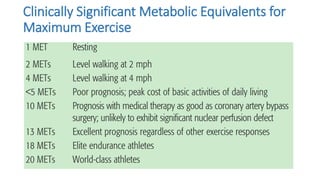
METABOLIC EQUIVALENTS
•MET (Metabolic Equivalent Term)
•1 MET = "Basal" aerobic oxygen consumption to stay alive =
3.5 ml O2 /Kg/min
Clinically Significant Metabolic Equivalents for
Maximum Exercise
AGE PREDICTED MAXIMUM HR
• Age Predicted Max HR= 220 - age in years
• Targeted HR= 85% of Max Predicted HR.
• Maximum HR ↓ with age
• A high degree of variability exists among subjects of identical age
(±12 beats per minute [bpm])
• Not used as an indicator of max exertion in ETT / Indication to
terminate the test
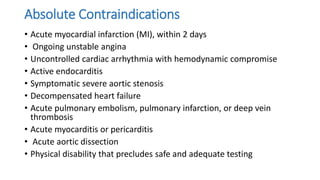
Absolute Contraindications
• Acute myocardial infarction (MI), within 2 days
• Ongoing unstable angina
• Uncontrolled cardiac arrhythmia with hemodynamic compromise
• Active endocarditis
• Symptomatic severe aortic stenosis
• Decompensated heart failure
• Acute pulmonary embolism, pulmonary infarction, or deep vein
thrombosis
• Acute myocarditis or pericarditis
• Acute aortic dissection
• Physical disability that precludes safe and adequate testing
Relative Contraindications
• Known obstructive left main coronary artery stenosis
• Moderate to severe aortic stenosis with uncertain relation to symptoms
• Tachyarrhythmias with uncontrolled ventricular rates
• Acquired advanced or complete heart block
• Hypertrophic obstructive cardiomyopathy with severe resting gradient
• Recent stroke or transient ischemic attack
• Mental impairment with limited ability to cooperate
• Resting hypertension with systolic or diastolic blood pressures >200/110
mm Hg
• Uncorrected medical conditions, such as significant anemia, important
electrolyte imbalance, and hyperthyroidism
METHODOLOGY OF EXERCISE
TESTING
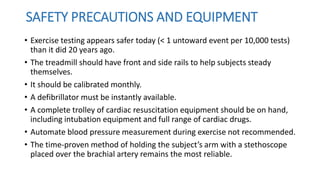
• Exercise testing appears safer today (< 1 untoward event per 10,000 tests)
than it did 20 years ago.
• The treadmill should have front and side rails to help subjects steady
themselves.
• It should be calibrated monthly.
• A defibrillator must be instantly available.
• A complete trolley of cardiac resuscitation equipment should be on hand,
including intubation equipment and full range of cardiac drugs.
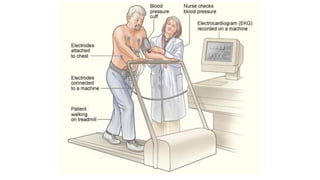
• Automate blood pressure measurement during exercise not recommended.
• The time-proven method of holding the subject’s arm with a stethoscope
placed over the brachial artery remains the most reliable.
SAFETY PRECAUTIONS AND EQUIPMENT
PRETEST PREPARATIONS
• The patient should be instructed not to eat, drink, or smoke at least 2
hours prior to the test and to come dressed for exercise, including
proper footwear.
• The physician should also review the patient’s medical history, making
note of any conditions that can increase the risk of testing (the
absolute and relative contraindications to exercise testing).
• A physical examination— including assessment of systolic murmurs—
should be performed before all exercise tests.
• An echocardiogram should be considered prior to testing.
• Pretest standard 12-lead ECGs are necessary
• Good skin preparation is necessary for good conductance to avoid
artifacts and is especially important for elderly patients who have a
higher skin resistance and tendency toward contact noise.
• The areas for electrode application are first shaved and then rubbed
with alcohol-saturated gauze.
• Disposable electrodes used in exercise testing are generally silver–
silver chloride combinations with adherent gel.
• The changes caused by exercise electrode placement can be kept to a
minimum by keeping the arm electrodes off the chest and placing
them on the shoulders, placing the ground (right leg) electrode on the
back out of the cardiac field, placing the left leg electrodes below the
umbilicus
PRETEST PREPARATIONS (Cont‘d)
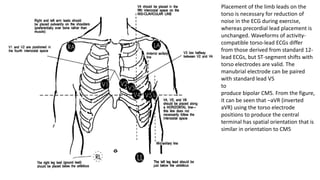
Placement of the limb leads on the
torso is necessary for reduction of
noise in the ECG during exercise,
whereas precordial lead placement is
unchanged. Waveforms of activity-
compatible torso-lead ECGs differ
from those derived from standard 12-
lead ECGs, but ST-segment shifts with
torso electrodes are valid. The
manubrial electrode can be paired
with standard lead V5
to
produce bipolar CM5. From the figure,
it can be seen that –aVR (inverted
aVR) using the torso electrode
positions to produce the central
terminal has spatial orientation that is
similar in orientation to CM5
DURING THE TEST
• Most complications can be avoided by measuring blood pressure,
monitoring the ECG, questioning the patient about symptoms and
levels of fatigue, and assessing appearance during the test.
• Subjects should be reminded not to grasp the front or side rails
because this decreases the work performed and creates noise in the
ECG.
• Target heart rates based on age should not be used to terminate the
test because the relationship between maximal heart rate and age is
poor.
• For test termination The absolute and relative indications are used.
Indications for Termination of Exercise Testing
Absolute Indications:
• ST-segment elevation (>1.0 mm) in leads without preexisting Q waves
because of prior MI (other than aVR, aVL, and V1)
• Drop in systolic blood pressure >10 mm Hg, despite an increase in
workload, when accompanied by any other evidence of ischemia
• Moderate-to-severe angina
• Central nervous system symptoms (eg, ataxia, dizziness, near syncope)
• Signs of poor perfusion (cyanosis or pallor)
• Sustained ventricular tachycardia (VT) or other arrhythmia, including
second- or third-degree atrioventricular (AV) block, that interferes with
normal maintenance of cardiac output during exercise
• Technical difficulties in monitoring the ECG or systolic blood pressure
• The subject’s request to stop
Indications for Termination of Exercise Testing
Relative Indications:
• Marked ST displacement (horizontal or downsloping of >2 mm, measured
60 to 80 ms after the J point [the end of the QRS complex]) in a patient
with suspected ischemia
• Drop in systolic blood pressure >10 mm Hg (persistently below baseline)
despite an increase in workload, in the absence of other evidence of
ischemia
• Increasing chest pain
• Fatigue, shortness of breath, wheezing, leg cramps, or claudication
• Arrhythmias other than sustained VT, including multifocal ectopy,
ventricular triplets, supraventricular tachycardia, and bradyarrhythmias
that have the potential to become more complex or to interfere with
hemodynamic stability
• Exaggerated hypertensive response (systolic blood pressure >250 mm Hg or
diastolic blood pressure >115 mm Hg)
• Development of bundle-branch block that cannot immediately be
distinguished from VT
• If none of these end points is
met, the test should be
symptom limited.
• The Borg scales are an
excellent means of
quantifying an individual’s
effort.
• In general, a Borg scale rating
>18 indicates the patient has
performed maximal exercise.
DURING THE TEST (Cont‘d)
Borg Scale for Rating Perceived Exertion
To ensure the safety of exercise testing, the following list of the most
dangerous circumstances in the exercise testing laboratory should be
recognized:
• When patients exhibit ST-segment elevation (without baseline diagnostic Q
waves), this can be associated with dangerous arrhythmias and infarction.
• When a patient with an ischemic cardiomyopathy exhibits severe chest
pain because of ischemia (angina pectoris), a cool-down walk is advisable.
• When a patient develops exertional hypotension accompanied by ischemia
(angina or ST-segment depression) or when it occurs in a patient with a
history of congestive heart failure, cardiomyopathy, or recent MI, safety is a
serious issue.
• When a patient with a history of sudden death or collapse during exercise
develops premature ventricular depolarizations that become frequent, a
cool-down walk is advisable.
DURING THE TEST (Cont’d)
RECOVERY AFTER EXERCISE
• Monitoring should continue for at least 5 minutes after exercise or
until changes stabilize.
• An abnormal response occurring only in the recovery period is neither
unusual nor necessarily suggestive of a false positive result.
• The recovery period, particularly the third minute is critical for ST
analysis.
• ST depression at that time has important implications regarding the
presence and severity of coronary artery disease (CAD).
• A cool-down walk can be helpful in performing tests on patients with
an established diagnosis undergoing testing for other than diagnostic
reasons, as in testing athletes or patients with congestive heart failure
(CHF), valvular heart disease, or a recent (MI).
EXERCISE PROTOCOLS
• Bruce
• Balke-Ware
• Ellestad
• McHenry
• Naughton
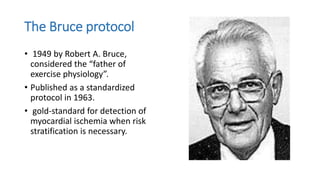
The Bruce protocol
• 1949 by Robert A. Bruce,
considered the “father of
exercise physiology”.
• Published as a standardized
protocol in 1963.
• gold-standard for detection of
myocardial ischemia when risk
stratification is necessary.
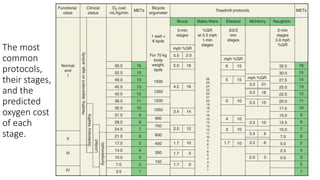
The most
common
protocols,
their stages,
and the
predicted
oxygen cost
of each
stage.
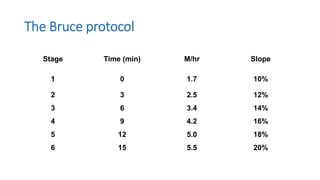
Stage Time (min) M/hr Slope
1 0 1.7 10%
2 3 2.5 12%
3 6 3.4 14%
4 9 4.2 16%
5 12 5.0 18%
6 15 5.5 20%
The Bruce protocol
What Represents a Positive
Test?
ST-Segment Deviation
• Changes in the level of the
ST segment comprise the
earliest abnormal finding in
the history of exercise
testing and have been the
focus of standard test
criteria for the diagnosis of
myocardial ischemia for
well over half a century.
ST-Segment Depression
• The standard criteria for test positivity include horizontal or
downsloping ST depression ≥1 mm (0.1 mV) at 60 to 80 ms after the J
point.
• When modest resting ST depression is present on the upright control
ECG before exercise, only additional ST depression during exercise is
measured for analysis.
• In the presence of resting ST-segment elevation at 60 to 80 ms after
the J point because of early repolarization, only ST-segment changes
below the P-Q baseline should be used for analysis.
• The lower the workload and rate–pressure product at which ST
depression occurs, the worse is the prognosis and the more likely the
presence of multivessel disease.
• the duration of ST depression in the recovery phase also can be
related to the severity of CAD.
ST-Segment Elevation in Postinfarction
Patients With Q Waves
• Exercise-induced elevation can occur in an infarct area where prior Q
waves are present. The development of >0.10 mV of J-point elevation
(>1.0 mm at standard gain) at 60 ms after the J point is considered an
abnormal response.
• In the presence of prior Q-wave MI, this could represent reversible
ischemia in the peri-infarct area or ventricular dyskinesis or akinetic
LV segmental wall motion
ST-Segment Elevation in Subjects Without
Prior Infarction
• In subjects without previous infarction (absence of Q waves on the
resting ECG), ST-segment elevation during exercise frequently
localizes the site of severe transient combined endocardial and
subepicardial ischemia resulting from significant subtotal proximal
occlusive CAD.
ST-Segment Normalization
• It is usual for young subjects with early repolarization to have
normalization of resting ST-segment elevation during exercise.
• Normalization of the ST segment during exercise might be related to
cancellation effects of oppositely directed forces from multiple areas
of ischemia (ischemic counterpoise) which could explain false
negative test findings in some patients with multivessel CAD.
Chest Pain
• Taken in association with ST depression, chest pain increases the
sensitivity of the exercise test to approximately 85% in a cohort of
symptomatic patients. The nature of the pain is important.
Increase in R-wave Voltage
• In the normal patient, R-wave voltage decreases during exercise.
Immediately after exercise R-wave voltage is at its smallest and then
gradually returns to normal during the recovery period.
• The reduction in R-wave voltage is thought to be a result of the
reduction of LVEDV with increasing exercise in the normal patient.
• In patients with coronary disease, R-wave voltage usually remains
unchanged or increases, especially in those with poor LV function.
• R-wave changes may be useful in patients with LBBB where ST
changes lack sensitivity or specificity.
Abnormal Systolic Blood Pressure Response
• Failure of the systolic blood pressure to rise during exercise is an
important indicator of an abnormal LV and is an indication to stop the
test.
• A decrease in systolic blood pressure during exercise is even more
specific for severe coronary artery disease – assuming that there are
no valve lesions and the patient is not on vasodilators.
Development of Ventricular Arrhythmias
• Ventricular ectopics (>10/min)
• Multifocal ectopic
• Ventricular tachycardia, etc., associated with ST-segment depression
and chest pain, are more specific.
Summary of variables developing during an Exercise Test
suggestive of multiple vessel coronary disease and a
poorer prognosis
• ST depression:
o at low heart rate (<130/min off β blockade)
o >2 mm in several leads
o Downsloping
o persisting >5 min into recovery period
• Blood pressure response: failure to rise or falling >10 mmHg
• Ventricular arrhythmias developing at low exercise load
• Poor exercise tolerance: inability to complete Bruce protocol stage II
or equivalent and a positive test with inappropriate tachycardia.
Patients with these results are generally referred for coronary angiography.
False-positive Results
• Hyperventilation
• Prolapsing mitral valve
• Hypertrophic cardiomyopathy
• Dilated cardiomyopathy
• Hypertension with LV
hypertrophy
• LBBB
• Aortic stenosis
• Young women with chest pain
• Wolff–Parkinson–White
syndrome
• Drugs, e.g. digoxin,
antidepressants
• Anaemia
• Coronary artery spasm
• Hypokalaemia
• Hypersensitivity to
catecholamines
• Observer variability.
The Exercise Electrocardiographic Test Report
• The exercise test report should describe information relevant to diagnosis
and prognosis.
• This would include the reason for terminating exercise, such as fatigue;
more specific symptoms like angina, leg pain or dyspnea; or a sign like a
drop in systolic blood pressure or arrhythmia.
• Resting, exercise, and recovery HRs and blood pressures should be
tabulated according to stages, and peak exercise values should be stated.
• There should be a specific statement with regard to the presence or
absence of chest pain at peak exercise and whether this was the reason for
termination of the test.
• Patient effort can be defined by percent maximum predicted HR achieved
or by use of a chronotropic index. Additionally, it is useful to describe effort
capacity as percent of maximum predicted MET workload equivalents,
adjusted for age and for sex.
• Peak end-exercise or recovery-phase ST-segment deviation should be
described, and the test should be defined as positive, negative, or
equivocal according to standard ST-segment criteria.
PROGNOSTIC UTILIZATION OF EXERCISE
TESTING
• The two principal reasons for estimating prognosis are to provide
accurate answers to patients’ questions regarding the probable
outcome of their illnesses and to identify those patients in whom
interventions might improve outcome.
• This assessment should always include calculation of a properly
designed score such as the Duke Treadmill Score or the VA Treadmill
Score.
Duke Treadmill Score
Duke Score = Exercise time (min) – 5 X (ST depression mm)- 4 X (Angina
index)
Angina index:
0 No angina
1 Non limiting angina
2 If angina stops test
High Risk = -11, mortality - >5% annually
Low Risk = +5, mortality - 0.5% annually
Age and
Double
Product (DP)
adjusted Duke
Treadmill
Score (DTS)
nomogram for
predictions of
Cardiovascular
mortality.
EXERCISE TESTING AFTER MYOCARDIAL
INFARCTION
Benefits of Exercise Testing Post-MI
Predischarge submaximal test:
• Optimizing discharge
• Altering medical therapy
• Triaging for intensity of follow-up
• First step in rehabilitation—assurance,
encouragement
• Reassuring spouse
• Recognizing exercise-induced ischemia
and dysrhythmias
Maximal test for return to normal
activities:
• Determining limitations Prognostication
• Reassuring employers
• Determining level of disability Triaging
for invasive studies
• Deciding on medications
• Exercise prescription
• Continued rehabilitation
Complications Secondary to Exercise Testing
• Cardiac:
Bradyarrhythmias
Tachyarrhythmias
Acute coronary syndromes
Heart failure
Hypotension, syncope, and shock
Death (rare; frequency estimated at 1 per 10 000 tests, perhaps less)
• Noncardiac:
Musculoskeletal trauma
Soft-tissue injury
• Miscellaneous:
Severe fatigue (malaise), sometimes persisting for days; dizziness; body aches;
delayed feelings of illness
Thank You

Exercise Tolerance Test

  • 1.
    EXERCISE TOLERANCE TEST Dr.Sayeedur Rahman Khan Rumi dr.rumibd@gmail.com MD Cardiology Final Part Student NHFH & RI
  • 2.
    EXERCISE TOLERANCE TEST •Exercise testing is a noninvasive tool to evaluate the cardiovascular system’s response to exercise under carefully controlled conditions. • Exercise is the body’s most common physiologic stress, and it places major demands on the cardiopulmonary system. Thus, exercise can be considered the most practical test of cardiac perfusion and function. • The exercise test complements the medical history and the physical examination, and it remains the second most commonly performed cardiologic procedure next to the routine ECG.
  • 3.
    Purposes of ExerciseTesting Exercise testing has been used for the provocation and identification of myocardial ischemia for >6 decades • Detection of coronary artery disease (CAD) in patients with chest pain (chest discomfort) syndromes or potential symptom equivalents • Evaluation of the anatomic and functional severity of CAD • Prediction of cardiovascular events and all-cause death • Evaluation of physical capacity and effort tolerance • Evaluation of exercise-related symptoms • Assessment of chronotropic competence, arrhythmias, and response to implanted device therapy • Assessment of the response to medical interventions
  • 4.
    Types of Exercise •Three types of exercise can be used to stress the cardiovascular system: Isometric Dynamic combination of the two • Isometric exercise, defined as constant muscular contraction without movement (such as handgrip), imposes a disproportionate pressure load on the left ventricle relative to the body’s ability to supply oxygen. • Dynamic exercise defined as rhythmic muscular activity resulting in movement, initiates a more appropriate increase in cardiac output and oxygen exchange.
  • 5.
    EXERCISE PHYSIOLOGY • Sympatheticactivation • Parasympathetic withdrawal • Vasoconstriction, except in- • Exercising muscles • Cerebral circulation • Coronary circulation • ↑Norepinephrine and Renin • ↑O2 extraction(upto 3 fold) • ↑Ventricular contractility • ↓Peripheral resistance • ↑SBP,MBP,PP • DBP –no significant change • Pulmonary vascular bed can accommodate 6 fold CO • CO - ↑ 4-6 times
  • 6.
    Graphs of thehemodynamic responses to dynamic exercise
  • 7.
    METABOLIC EQUIVALENTS •MET (MetabolicEquivalent Term) •1 MET = "Basal" aerobic oxygen consumption to stay alive = 3.5 ml O2 /Kg/min
  • 8.
    Clinically Significant MetabolicEquivalents for Maximum Exercise
  • 9.
    AGE PREDICTED MAXIMUMHR • Age Predicted Max HR= 220 - age in years • Targeted HR= 85% of Max Predicted HR. • Maximum HR ↓ with age • A high degree of variability exists among subjects of identical age (±12 beats per minute [bpm]) • Not used as an indicator of max exertion in ETT / Indication to terminate the test
  • 10.
    Absolute Contraindications • Acutemyocardial infarction (MI), within 2 days • Ongoing unstable angina • Uncontrolled cardiac arrhythmia with hemodynamic compromise • Active endocarditis • Symptomatic severe aortic stenosis • Decompensated heart failure • Acute pulmonary embolism, pulmonary infarction, or deep vein thrombosis • Acute myocarditis or pericarditis • Acute aortic dissection • Physical disability that precludes safe and adequate testing
  • 11.
    Relative Contraindications • Knownobstructive left main coronary artery stenosis • Moderate to severe aortic stenosis with uncertain relation to symptoms • Tachyarrhythmias with uncontrolled ventricular rates • Acquired advanced or complete heart block • Hypertrophic obstructive cardiomyopathy with severe resting gradient • Recent stroke or transient ischemic attack • Mental impairment with limited ability to cooperate • Resting hypertension with systolic or diastolic blood pressures >200/110 mm Hg • Uncorrected medical conditions, such as significant anemia, important electrolyte imbalance, and hyperthyroidism
  • 12.
  • 13.
    • Exercise testingappears safer today (< 1 untoward event per 10,000 tests) than it did 20 years ago. • The treadmill should have front and side rails to help subjects steady themselves. • It should be calibrated monthly. • A defibrillator must be instantly available. • A complete trolley of cardiac resuscitation equipment should be on hand, including intubation equipment and full range of cardiac drugs. • Automate blood pressure measurement during exercise not recommended. • The time-proven method of holding the subject’s arm with a stethoscope placed over the brachial artery remains the most reliable. SAFETY PRECAUTIONS AND EQUIPMENT
  • 15.
    PRETEST PREPARATIONS • Thepatient should be instructed not to eat, drink, or smoke at least 2 hours prior to the test and to come dressed for exercise, including proper footwear. • The physician should also review the patient’s medical history, making note of any conditions that can increase the risk of testing (the absolute and relative contraindications to exercise testing). • A physical examination— including assessment of systolic murmurs— should be performed before all exercise tests. • An echocardiogram should be considered prior to testing. • Pretest standard 12-lead ECGs are necessary
  • 16.
    • Good skinpreparation is necessary for good conductance to avoid artifacts and is especially important for elderly patients who have a higher skin resistance and tendency toward contact noise. • The areas for electrode application are first shaved and then rubbed with alcohol-saturated gauze. • Disposable electrodes used in exercise testing are generally silver– silver chloride combinations with adherent gel. • The changes caused by exercise electrode placement can be kept to a minimum by keeping the arm electrodes off the chest and placing them on the shoulders, placing the ground (right leg) electrode on the back out of the cardiac field, placing the left leg electrodes below the umbilicus PRETEST PREPARATIONS (Cont‘d)
  • 17.
    Placement of thelimb leads on the torso is necessary for reduction of noise in the ECG during exercise, whereas precordial lead placement is unchanged. Waveforms of activity- compatible torso-lead ECGs differ from those derived from standard 12- lead ECGs, but ST-segment shifts with torso electrodes are valid. The manubrial electrode can be paired with standard lead V5 to produce bipolar CM5. From the figure, it can be seen that –aVR (inverted aVR) using the torso electrode positions to produce the central terminal has spatial orientation that is similar in orientation to CM5
  • 18.
    DURING THE TEST •Most complications can be avoided by measuring blood pressure, monitoring the ECG, questioning the patient about symptoms and levels of fatigue, and assessing appearance during the test. • Subjects should be reminded not to grasp the front or side rails because this decreases the work performed and creates noise in the ECG. • Target heart rates based on age should not be used to terminate the test because the relationship between maximal heart rate and age is poor. • For test termination The absolute and relative indications are used.
  • 19.
    Indications for Terminationof Exercise Testing Absolute Indications: • ST-segment elevation (>1.0 mm) in leads without preexisting Q waves because of prior MI (other than aVR, aVL, and V1) • Drop in systolic blood pressure >10 mm Hg, despite an increase in workload, when accompanied by any other evidence of ischemia • Moderate-to-severe angina • Central nervous system symptoms (eg, ataxia, dizziness, near syncope) • Signs of poor perfusion (cyanosis or pallor) • Sustained ventricular tachycardia (VT) or other arrhythmia, including second- or third-degree atrioventricular (AV) block, that interferes with normal maintenance of cardiac output during exercise • Technical difficulties in monitoring the ECG or systolic blood pressure • The subject’s request to stop
  • 20.
    Indications for Terminationof Exercise Testing Relative Indications: • Marked ST displacement (horizontal or downsloping of >2 mm, measured 60 to 80 ms after the J point [the end of the QRS complex]) in a patient with suspected ischemia • Drop in systolic blood pressure >10 mm Hg (persistently below baseline) despite an increase in workload, in the absence of other evidence of ischemia • Increasing chest pain • Fatigue, shortness of breath, wheezing, leg cramps, or claudication • Arrhythmias other than sustained VT, including multifocal ectopy, ventricular triplets, supraventricular tachycardia, and bradyarrhythmias that have the potential to become more complex or to interfere with hemodynamic stability • Exaggerated hypertensive response (systolic blood pressure >250 mm Hg or diastolic blood pressure >115 mm Hg) • Development of bundle-branch block that cannot immediately be distinguished from VT
  • 21.
    • If noneof these end points is met, the test should be symptom limited. • The Borg scales are an excellent means of quantifying an individual’s effort. • In general, a Borg scale rating >18 indicates the patient has performed maximal exercise. DURING THE TEST (Cont‘d) Borg Scale for Rating Perceived Exertion
  • 22.
    To ensure thesafety of exercise testing, the following list of the most dangerous circumstances in the exercise testing laboratory should be recognized: • When patients exhibit ST-segment elevation (without baseline diagnostic Q waves), this can be associated with dangerous arrhythmias and infarction. • When a patient with an ischemic cardiomyopathy exhibits severe chest pain because of ischemia (angina pectoris), a cool-down walk is advisable. • When a patient develops exertional hypotension accompanied by ischemia (angina or ST-segment depression) or when it occurs in a patient with a history of congestive heart failure, cardiomyopathy, or recent MI, safety is a serious issue. • When a patient with a history of sudden death or collapse during exercise develops premature ventricular depolarizations that become frequent, a cool-down walk is advisable. DURING THE TEST (Cont’d)
  • 23.
    RECOVERY AFTER EXERCISE •Monitoring should continue for at least 5 minutes after exercise or until changes stabilize. • An abnormal response occurring only in the recovery period is neither unusual nor necessarily suggestive of a false positive result. • The recovery period, particularly the third minute is critical for ST analysis. • ST depression at that time has important implications regarding the presence and severity of coronary artery disease (CAD). • A cool-down walk can be helpful in performing tests on patients with an established diagnosis undergoing testing for other than diagnostic reasons, as in testing athletes or patients with congestive heart failure (CHF), valvular heart disease, or a recent (MI).
  • 24.
    EXERCISE PROTOCOLS • Bruce •Balke-Ware • Ellestad • McHenry • Naughton
  • 25.
    The Bruce protocol •1949 by Robert A. Bruce, considered the “father of exercise physiology”. • Published as a standardized protocol in 1963. • gold-standard for detection of myocardial ischemia when risk stratification is necessary.
  • 26.
    The most common protocols, their stages, andthe predicted oxygen cost of each stage.
  • 27.
    Stage Time (min)M/hr Slope 1 0 1.7 10% 2 3 2.5 12% 3 6 3.4 14% 4 9 4.2 16% 5 12 5.0 18% 6 15 5.5 20% The Bruce protocol
  • 28.
    What Represents aPositive Test?
  • 29.
    ST-Segment Deviation • Changesin the level of the ST segment comprise the earliest abnormal finding in the history of exercise testing and have been the focus of standard test criteria for the diagnosis of myocardial ischemia for well over half a century.
  • 30.
    ST-Segment Depression • Thestandard criteria for test positivity include horizontal or downsloping ST depression ≥1 mm (0.1 mV) at 60 to 80 ms after the J point. • When modest resting ST depression is present on the upright control ECG before exercise, only additional ST depression during exercise is measured for analysis. • In the presence of resting ST-segment elevation at 60 to 80 ms after the J point because of early repolarization, only ST-segment changes below the P-Q baseline should be used for analysis. • The lower the workload and rate–pressure product at which ST depression occurs, the worse is the prognosis and the more likely the presence of multivessel disease. • the duration of ST depression in the recovery phase also can be related to the severity of CAD.
  • 32.
    ST-Segment Elevation inPostinfarction Patients With Q Waves • Exercise-induced elevation can occur in an infarct area where prior Q waves are present. The development of >0.10 mV of J-point elevation (>1.0 mm at standard gain) at 60 ms after the J point is considered an abnormal response. • In the presence of prior Q-wave MI, this could represent reversible ischemia in the peri-infarct area or ventricular dyskinesis or akinetic LV segmental wall motion
  • 33.
    ST-Segment Elevation inSubjects Without Prior Infarction • In subjects without previous infarction (absence of Q waves on the resting ECG), ST-segment elevation during exercise frequently localizes the site of severe transient combined endocardial and subepicardial ischemia resulting from significant subtotal proximal occlusive CAD.
  • 34.
    ST-Segment Normalization • Itis usual for young subjects with early repolarization to have normalization of resting ST-segment elevation during exercise. • Normalization of the ST segment during exercise might be related to cancellation effects of oppositely directed forces from multiple areas of ischemia (ischemic counterpoise) which could explain false negative test findings in some patients with multivessel CAD.
  • 35.
    Chest Pain • Takenin association with ST depression, chest pain increases the sensitivity of the exercise test to approximately 85% in a cohort of symptomatic patients. The nature of the pain is important.
  • 36.
    Increase in R-waveVoltage • In the normal patient, R-wave voltage decreases during exercise. Immediately after exercise R-wave voltage is at its smallest and then gradually returns to normal during the recovery period. • The reduction in R-wave voltage is thought to be a result of the reduction of LVEDV with increasing exercise in the normal patient. • In patients with coronary disease, R-wave voltage usually remains unchanged or increases, especially in those with poor LV function. • R-wave changes may be useful in patients with LBBB where ST changes lack sensitivity or specificity.
  • 37.
    Abnormal Systolic BloodPressure Response • Failure of the systolic blood pressure to rise during exercise is an important indicator of an abnormal LV and is an indication to stop the test. • A decrease in systolic blood pressure during exercise is even more specific for severe coronary artery disease – assuming that there are no valve lesions and the patient is not on vasodilators.
  • 38.
    Development of VentricularArrhythmias • Ventricular ectopics (>10/min) • Multifocal ectopic • Ventricular tachycardia, etc., associated with ST-segment depression and chest pain, are more specific.
  • 39.
    Summary of variablesdeveloping during an Exercise Test suggestive of multiple vessel coronary disease and a poorer prognosis • ST depression: o at low heart rate (<130/min off β blockade) o >2 mm in several leads o Downsloping o persisting >5 min into recovery period • Blood pressure response: failure to rise or falling >10 mmHg • Ventricular arrhythmias developing at low exercise load • Poor exercise tolerance: inability to complete Bruce protocol stage II or equivalent and a positive test with inappropriate tachycardia. Patients with these results are generally referred for coronary angiography.
  • 40.
    False-positive Results • Hyperventilation •Prolapsing mitral valve • Hypertrophic cardiomyopathy • Dilated cardiomyopathy • Hypertension with LV hypertrophy • LBBB • Aortic stenosis • Young women with chest pain • Wolff–Parkinson–White syndrome • Drugs, e.g. digoxin, antidepressants • Anaemia • Coronary artery spasm • Hypokalaemia • Hypersensitivity to catecholamines • Observer variability.
  • 41.
    The Exercise ElectrocardiographicTest Report • The exercise test report should describe information relevant to diagnosis and prognosis. • This would include the reason for terminating exercise, such as fatigue; more specific symptoms like angina, leg pain or dyspnea; or a sign like a drop in systolic blood pressure or arrhythmia. • Resting, exercise, and recovery HRs and blood pressures should be tabulated according to stages, and peak exercise values should be stated. • There should be a specific statement with regard to the presence or absence of chest pain at peak exercise and whether this was the reason for termination of the test. • Patient effort can be defined by percent maximum predicted HR achieved or by use of a chronotropic index. Additionally, it is useful to describe effort capacity as percent of maximum predicted MET workload equivalents, adjusted for age and for sex. • Peak end-exercise or recovery-phase ST-segment deviation should be described, and the test should be defined as positive, negative, or equivocal according to standard ST-segment criteria.
  • 42.
    PROGNOSTIC UTILIZATION OFEXERCISE TESTING • The two principal reasons for estimating prognosis are to provide accurate answers to patients’ questions regarding the probable outcome of their illnesses and to identify those patients in whom interventions might improve outcome. • This assessment should always include calculation of a properly designed score such as the Duke Treadmill Score or the VA Treadmill Score.
  • 43.
    Duke Treadmill Score DukeScore = Exercise time (min) – 5 X (ST depression mm)- 4 X (Angina index) Angina index: 0 No angina 1 Non limiting angina 2 If angina stops test High Risk = -11, mortality - >5% annually Low Risk = +5, mortality - 0.5% annually
  • 44.
    Age and Double Product (DP) adjustedDuke Treadmill Score (DTS) nomogram for predictions of Cardiovascular mortality.
  • 46.
    EXERCISE TESTING AFTERMYOCARDIAL INFARCTION Benefits of Exercise Testing Post-MI Predischarge submaximal test: • Optimizing discharge • Altering medical therapy • Triaging for intensity of follow-up • First step in rehabilitation—assurance, encouragement • Reassuring spouse • Recognizing exercise-induced ischemia and dysrhythmias Maximal test for return to normal activities: • Determining limitations Prognostication • Reassuring employers • Determining level of disability Triaging for invasive studies • Deciding on medications • Exercise prescription • Continued rehabilitation
  • 47.
    Complications Secondary toExercise Testing • Cardiac: Bradyarrhythmias Tachyarrhythmias Acute coronary syndromes Heart failure Hypotension, syncope, and shock Death (rare; frequency estimated at 1 per 10 000 tests, perhaps less) • Noncardiac: Musculoskeletal trauma Soft-tissue injury • Miscellaneous: Severe fatigue (malaise), sometimes persisting for days; dizziness; body aches; delayed feelings of illness
  • 48.