STEMI
Definition and classification
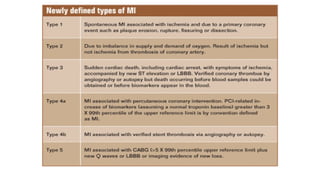
• Detection of rise or fall of cardiac biomarker with atleast one value
above 99th
percentile above URL along with any one of the following :
1- symptoms of ischemia
2-new or presumed ST-T / LBBB
3- pathological Q wave
4- identification of thrombus by angiography or autopsy
Criteria for prior Myocardial infarction
• Any one of the following criteria meets the diagnosis for prior MI :
1- Pathological Q wave with or without symptoms in the absence of
non ischemic causes.
2- Imaging evidence of a region of loss of viable myocardium that is
thinned and fails to contract , in the absence of a non ischemic cause .
3- Pathological finding of a prior MI .
PATHOPHYSIOLOGY
• STEMI usually occurs when coronary blood flow decreases abruptly
after a thrombotic occlusion of a coronary artery previously affected
by atherosclerosis.
• Slowly developing, high-grade coronary artery stenosis do not
typically precipitate STEMI because of the development of a rich
collateral network over time
• rare cases, STEMI may be due to coronary artery occlusion caused by
coronary emboli, congenital abnormalities, coronary spasm, and a
wide variety of systemic—particularly inflammatory—diseases.
• amount of myocardial damage caused by coronary occlusion depends on
1-the territory supplied by the affected vessel,
2-whether or not the vessel becomes totally occluded,
3-the duration of coronary occlusion,
4-the quantity of blood supplied by collateral vessels to the affected tissue,
5-the demand for oxygen of the myocardium whose blood supply has been
suddenly limited,
6-endogenous factors that can produce early spontaneous lysis of the
occlusive thrombus, and
7-the adequacy of myocardial perfusion in the infarct zone when flow is
restored in the occluded epicardial coronary artery.
• Patients at increased risk for developing STEMI include those with
multiple coronary risk factors and those with UA .
• Less common underlying medical conditions predisposing patients to
STEMI include
hypercoagulability,
collagen vascular disease,
cocaine abuse, and
Intra cardiac thrombi or masses that produce coronary emboli.
CLINICAL PRESENTATION
• precipitating factor appears to be present before STEMI, such as vigorous
physical exercise, emotional stress, or a medical or surgical illness.
• Pain (m/c) is deep and visceral; adjectives commonly used to describe it
are heavy, squeezing, and crushing; although, occasionally, it is described
as stabbing or burning
• similar in character to the discomfort of angina pectoris but commonly
occurs at rest, is usually more severe, and lasts longer.
• Typically, the pain involves the central portion of the chest and/or the
epigastrium, and, on occasion, it radiates to the arms. Less common sites
of radiation include the abdomen, back, lower jaw, and neck.
• weakness, sweating, nausea, vomiting, anxiety, and a sense of
impending doom.
• differential diagnosis: acute pericarditis, pulmonary embolism, acute
aortic dissection, costochondritis, and gastrointestinal disorders.
• painless STEMIs is greater in patients with diabetes mellitus, and it
increases with age.
• less commonly, with or without pain, include sudden loss of
consciousness, a confusional state, profound weakness, arrhythmia,
evidence of peripheral embolism, unexplained drop in arterial
pressure.
Physical findings
• Anxious, restless
• Pallor a/w perspiration and cool of extremities
• Substernal chest pain >30min and diaphoresis
• AWMI – increase sympathetic activities (tachycardia , HTN)
• IWMI- increase parasympathetic activity (bradycardia , hypotension)
• Precordium – usually quiet
• S3,S4, decrease intensity of first heart sound , paradoxical splitting of S2
• Mid systolic or late systolic murmur
• Decreased carotid pulsation
• transmural infarction, systolic pressure declines by ~10–15 mmHg from the
preinfarction state.
Laboratory findings
• STEMI progresses through the following temporal stages:
(1) acute (first few hours–7 days),
(2) healing (7–28 days), and
(3) healed (≥29 days).
• Laboratory tests of value in confirming the diagnosis may be divided into four groups:
(1) ECG,
(2) serum cardiac biomarkers,
(3) cardiac imaging, and
(4)nonspecific indices of tissue necrosis and inflammation.
• ECG:
ST Elevation
Q wave on ECG
No STEMI + positive biomarker = NSTEMI
Cardiac biomarkers
• criteria for AMI require a rise and/or fall in cardiac biomarker values with at least
one value above the 99th percentile of the upper reference limit for normal
individuals.
• Cardiac-specific troponin T (cTnT) and cardiac-specific troponin I (cTnI)
preferred marker
can be detected to <1ng/ml
elevation 12-24hours after symptoms onset
may remain elevated for 7-10 days after STEMI
CK-MB
(non specific )
Non specific reaction after MI(3-7 days) - increase TLC , increase ESR
Cardiac imaging
• 2D Echocardiography –
Abnormal wall motion
also identify the presence of right ventricular (RV) infarction,ventricular
aneurysm, pericardial effusion, and LV thrombus
Doppler Echo – detect and quantify VSD, MR
Radionuclide imaging techniques-
Transmural infarct- Cold Spot
Can not D/W acute vs chronic infarct
Management
• prognosis in STEMI depends on
(1) electrical complications (arrhythmias)
(2) mechanical complications (“pump failure”).
MCC of out of hospital death – Ventrical fibrillation
Goal of initial management –
-control of cardiac discomfort
- Rapid identification of candidates for early perfusion
• Aspirin – buccal absorption of chewed tablet 160-325mg tablet
followed by 75-162mg once daily.
• O2 inhalation via nasal prongs or face mask – 2-4 L/min for first 6-12
hours
• control of discomfort :
• Nitroglycerine : Up to three doses of 0.4 mg should be administered
at about 5-min intervals
• IV nitroglycerine NTG
• Avoid in SBP<90, RV infarction , phosphodiesterase 5 inhibitor
• Morphine – very effective analgesic
Venous pooling – reduce CO and MAP
Vagotomy effect- bradycardia and advanced degree heart block
• Morphine is routinely administered by repetitive (every 5 min)
intravenous injection of small doses (2–4 mg).
• IV Beta blocker
diminishing myocardial O2 demand and hence ischemia.
Reduce the risks of reinfarction and ventricular fibrillation
• metoprolol, 5 mg every 2–5 min for a total of three doses, provided the
patient has a heart rate >60 beats/min, systolic pressure >100 mmHg, a PR
interval <0.24 s, and rales that are no higher than 10 cm up from the
diaphragm.
• Fifteen minutes after the last intravenous dose, an oral regimen is initiated of
50 mg every 6 h for 48 h, followed by 100 mg every 12 h.
• Role of CCB in acute phase ? No role
• Glucocorticoids and nonsteroidal anti-inflammatory agents, with the
exception of aspirin, should be avoided in patients with STEMI.
• They can impair infarct healing and increase the risk of myocardial rupture,
and their use may result in a larger infarct scar.
Primary PCI
• PCI, usually angioplasty and/or stenting without preceding
fibrinolysis, referred to as primary PCI, is effective in restoring
perfusion in STEMI when carried out on an emergency basis in the
first few hours of MI.
• Can be done in patients having C/I to fibrinolysis
• more effective than fibrinolysis
• generally preferred when the diagnosis is in doubt, cardiogenic shock
is present, bleeding risk is increased, or symptoms have been present
for at least 2–3 h when the clot is more mature
Fibrinolysis
• If no contraindications are present (see below), fibrinolytic therapy
should ideally be initiated within 30 min of presentation (i.e., door-to
needle time ≤30 min).
• fibrinolytic agents
• Tissue plasminogen activator (tPA),
• streptokinase, tenecteplase (TNK), and
• reteplase (rPA)
• The current recommended regimen of tPA consists of a 15-mg bolus
followed by 50 mg intravenously over the first 30 min, followed by 35
mg over the next 60 min.
• Streptokinase is administered as 1.5 million units (MU) intravenously
over 1 h.
• rPA is administered in a double-bolus regimen consisting of a 10-MU
bolus given over 2–3 min, followed by a second 10-MU bolus 30 min
later.
• TNK is given as a single weight-based intravenous bolus of 0.53 mg/kg
over 10 s.
Contraindication of fibrinolytic agents
• Absolute –
-h/o hemorrhagic CVA at any time,
-non hemorrhagic stroke or other cerebrovascular event within the past
year ,
-marked hypertension (>180/110 mmHg),
-suspicion of aortic dissection, and
-active internal bleeding (excluding menses).
• Relative –
• On anticoagulant INR ≥2,
• recent (<2 weeks) invasive or surgical procedure or
• prolonged (>10 min) cardiopulmonary resuscitation,
• bleeding diathesis,
• pregnancy,
• hemorrhagic ophthalmic condition (e.g., hemorrhagic diabetic retinopathy),
• active peptic ulcer disease,
• history of severe hypertension (Under control).
• STK- used within 5 days to 2 years.
• Cardiac catheterization and coronary angiography should be carried
out after fibrinolytic therapy if there is evidence of either
• (1) failure of reperfusion (persistent chest pain and ST-segment
elevation >90 min), in which case a rescue PCI should be considered;
or
• (2) coronary artery reocclusion (re-elevation of ST segments and/or
recurrent chest pain) or the development of recurrent ischemia (such
as recurrent angina in the early hospital course or a positive exercise
stress test before discharge),
General management
• Coronary care units – rhythm and hemodynamic monitoring
• Activity – bed rest for 6-12 hours , ambulation after 2-3 days
• Diet – nil PO or clear fluids in initial 4-12 hrs
• Bowel management- fiber , stool softner
• Sedation – diazepam , oxazepam , or lorazepam
• Many drugs used in the coronary care unit, such as atropine, H2
blockers, and narcotics, can produce delirium, particularly in the
elderly.
Pharmacotherapy
• Antithrombotics
• antiplatelet and anticoagulant therapy during the initial phase of
STEMI
• Antiplatelets – Aspirin, P2Y12- Clopidogrel, prasugrel ,ticagrelor ,
cangrelor , GPIIB/IIIA Inhibitors – abciximab, tirofiban
• Anticoagulants – UFH, LMWH , Fondaparinaux , Bivalirudin
• The recommended dose of UFH is an initial bolus of 60 U/kg
(maximum 4000 U) followed by an initial infusion of 12 U/kg per h
(maximum 1000 U/h).
• BETA BLOCKERS
• ACE/ARB
COMPLICATION
• VENTRICULAR DYSFUNCTION
• HYPOVOLEMIA
• CHF
• CARDIGENIC SHOCK
• ARRHYTHEMIA
• Others – recurrent chest pain, pericarditis , thromboembolism , left
ventricular aneurysm

St elevation myocardial infraction medicine

  • 1.
  • 2.
    Definition and classification •Detection of rise or fall of cardiac biomarker with atleast one value above 99th percentile above URL along with any one of the following : 1- symptoms of ischemia 2-new or presumed ST-T / LBBB 3- pathological Q wave 4- identification of thrombus by angiography or autopsy
  • 4.
    Criteria for priorMyocardial infarction • Any one of the following criteria meets the diagnosis for prior MI : 1- Pathological Q wave with or without symptoms in the absence of non ischemic causes. 2- Imaging evidence of a region of loss of viable myocardium that is thinned and fails to contract , in the absence of a non ischemic cause . 3- Pathological finding of a prior MI .
  • 5.
    PATHOPHYSIOLOGY • STEMI usuallyoccurs when coronary blood flow decreases abruptly after a thrombotic occlusion of a coronary artery previously affected by atherosclerosis. • Slowly developing, high-grade coronary artery stenosis do not typically precipitate STEMI because of the development of a rich collateral network over time • rare cases, STEMI may be due to coronary artery occlusion caused by coronary emboli, congenital abnormalities, coronary spasm, and a wide variety of systemic—particularly inflammatory—diseases.
  • 6.
    • amount ofmyocardial damage caused by coronary occlusion depends on 1-the territory supplied by the affected vessel, 2-whether or not the vessel becomes totally occluded, 3-the duration of coronary occlusion, 4-the quantity of blood supplied by collateral vessels to the affected tissue, 5-the demand for oxygen of the myocardium whose blood supply has been suddenly limited, 6-endogenous factors that can produce early spontaneous lysis of the occlusive thrombus, and 7-the adequacy of myocardial perfusion in the infarct zone when flow is restored in the occluded epicardial coronary artery.
  • 7.
    • Patients atincreased risk for developing STEMI include those with multiple coronary risk factors and those with UA . • Less common underlying medical conditions predisposing patients to STEMI include hypercoagulability, collagen vascular disease, cocaine abuse, and Intra cardiac thrombi or masses that produce coronary emboli.
  • 8.
    CLINICAL PRESENTATION • precipitatingfactor appears to be present before STEMI, such as vigorous physical exercise, emotional stress, or a medical or surgical illness. • Pain (m/c) is deep and visceral; adjectives commonly used to describe it are heavy, squeezing, and crushing; although, occasionally, it is described as stabbing or burning • similar in character to the discomfort of angina pectoris but commonly occurs at rest, is usually more severe, and lasts longer. • Typically, the pain involves the central portion of the chest and/or the epigastrium, and, on occasion, it radiates to the arms. Less common sites of radiation include the abdomen, back, lower jaw, and neck.
  • 9.
    • weakness, sweating,nausea, vomiting, anxiety, and a sense of impending doom. • differential diagnosis: acute pericarditis, pulmonary embolism, acute aortic dissection, costochondritis, and gastrointestinal disorders. • painless STEMIs is greater in patients with diabetes mellitus, and it increases with age. • less commonly, with or without pain, include sudden loss of consciousness, a confusional state, profound weakness, arrhythmia, evidence of peripheral embolism, unexplained drop in arterial pressure.
  • 10.
    Physical findings • Anxious,restless • Pallor a/w perspiration and cool of extremities • Substernal chest pain >30min and diaphoresis • AWMI – increase sympathetic activities (tachycardia , HTN) • IWMI- increase parasympathetic activity (bradycardia , hypotension) • Precordium – usually quiet • S3,S4, decrease intensity of first heart sound , paradoxical splitting of S2 • Mid systolic or late systolic murmur • Decreased carotid pulsation • transmural infarction, systolic pressure declines by ~10–15 mmHg from the preinfarction state.
  • 11.
    Laboratory findings • STEMIprogresses through the following temporal stages: (1) acute (first few hours–7 days), (2) healing (7–28 days), and (3) healed (≥29 days). • Laboratory tests of value in confirming the diagnosis may be divided into four groups: (1) ECG, (2) serum cardiac biomarkers, (3) cardiac imaging, and (4)nonspecific indices of tissue necrosis and inflammation.
  • 12.
    • ECG: ST Elevation Qwave on ECG No STEMI + positive biomarker = NSTEMI
  • 13.
    Cardiac biomarkers • criteriafor AMI require a rise and/or fall in cardiac biomarker values with at least one value above the 99th percentile of the upper reference limit for normal individuals. • Cardiac-specific troponin T (cTnT) and cardiac-specific troponin I (cTnI) preferred marker can be detected to <1ng/ml elevation 12-24hours after symptoms onset may remain elevated for 7-10 days after STEMI CK-MB (non specific ) Non specific reaction after MI(3-7 days) - increase TLC , increase ESR
  • 14.
    Cardiac imaging • 2DEchocardiography – Abnormal wall motion also identify the presence of right ventricular (RV) infarction,ventricular aneurysm, pericardial effusion, and LV thrombus Doppler Echo – detect and quantify VSD, MR Radionuclide imaging techniques- Transmural infarct- Cold Spot Can not D/W acute vs chronic infarct
  • 15.
    Management • prognosis inSTEMI depends on (1) electrical complications (arrhythmias) (2) mechanical complications (“pump failure”). MCC of out of hospital death – Ventrical fibrillation Goal of initial management – -control of cardiac discomfort - Rapid identification of candidates for early perfusion
  • 16.
    • Aspirin –buccal absorption of chewed tablet 160-325mg tablet followed by 75-162mg once daily. • O2 inhalation via nasal prongs or face mask – 2-4 L/min for first 6-12 hours • control of discomfort : • Nitroglycerine : Up to three doses of 0.4 mg should be administered at about 5-min intervals • IV nitroglycerine NTG • Avoid in SBP<90, RV infarction , phosphodiesterase 5 inhibitor
  • 17.
    • Morphine –very effective analgesic Venous pooling – reduce CO and MAP Vagotomy effect- bradycardia and advanced degree heart block • Morphine is routinely administered by repetitive (every 5 min) intravenous injection of small doses (2–4 mg). • IV Beta blocker diminishing myocardial O2 demand and hence ischemia. Reduce the risks of reinfarction and ventricular fibrillation
  • 18.
    • metoprolol, 5mg every 2–5 min for a total of three doses, provided the patient has a heart rate >60 beats/min, systolic pressure >100 mmHg, a PR interval <0.24 s, and rales that are no higher than 10 cm up from the diaphragm. • Fifteen minutes after the last intravenous dose, an oral regimen is initiated of 50 mg every 6 h for 48 h, followed by 100 mg every 12 h. • Role of CCB in acute phase ? No role • Glucocorticoids and nonsteroidal anti-inflammatory agents, with the exception of aspirin, should be avoided in patients with STEMI. • They can impair infarct healing and increase the risk of myocardial rupture, and their use may result in a larger infarct scar.
  • 19.
    Primary PCI • PCI,usually angioplasty and/or stenting without preceding fibrinolysis, referred to as primary PCI, is effective in restoring perfusion in STEMI when carried out on an emergency basis in the first few hours of MI. • Can be done in patients having C/I to fibrinolysis • more effective than fibrinolysis • generally preferred when the diagnosis is in doubt, cardiogenic shock is present, bleeding risk is increased, or symptoms have been present for at least 2–3 h when the clot is more mature
  • 20.
    Fibrinolysis • If nocontraindications are present (see below), fibrinolytic therapy should ideally be initiated within 30 min of presentation (i.e., door-to needle time ≤30 min). • fibrinolytic agents • Tissue plasminogen activator (tPA), • streptokinase, tenecteplase (TNK), and • reteplase (rPA)
  • 21.
    • The currentrecommended regimen of tPA consists of a 15-mg bolus followed by 50 mg intravenously over the first 30 min, followed by 35 mg over the next 60 min. • Streptokinase is administered as 1.5 million units (MU) intravenously over 1 h. • rPA is administered in a double-bolus regimen consisting of a 10-MU bolus given over 2–3 min, followed by a second 10-MU bolus 30 min later. • TNK is given as a single weight-based intravenous bolus of 0.53 mg/kg over 10 s.
  • 22.
    Contraindication of fibrinolyticagents • Absolute – -h/o hemorrhagic CVA at any time, -non hemorrhagic stroke or other cerebrovascular event within the past year , -marked hypertension (>180/110 mmHg), -suspicion of aortic dissection, and -active internal bleeding (excluding menses).
  • 23.
    • Relative – •On anticoagulant INR ≥2, • recent (<2 weeks) invasive or surgical procedure or • prolonged (>10 min) cardiopulmonary resuscitation, • bleeding diathesis, • pregnancy, • hemorrhagic ophthalmic condition (e.g., hemorrhagic diabetic retinopathy), • active peptic ulcer disease, • history of severe hypertension (Under control). • STK- used within 5 days to 2 years.
  • 24.
    • Cardiac catheterizationand coronary angiography should be carried out after fibrinolytic therapy if there is evidence of either • (1) failure of reperfusion (persistent chest pain and ST-segment elevation >90 min), in which case a rescue PCI should be considered; or • (2) coronary artery reocclusion (re-elevation of ST segments and/or recurrent chest pain) or the development of recurrent ischemia (such as recurrent angina in the early hospital course or a positive exercise stress test before discharge),
  • 25.
    General management • Coronarycare units – rhythm and hemodynamic monitoring • Activity – bed rest for 6-12 hours , ambulation after 2-3 days • Diet – nil PO or clear fluids in initial 4-12 hrs • Bowel management- fiber , stool softner • Sedation – diazepam , oxazepam , or lorazepam • Many drugs used in the coronary care unit, such as atropine, H2 blockers, and narcotics, can produce delirium, particularly in the elderly.
  • 26.
    Pharmacotherapy • Antithrombotics • antiplateletand anticoagulant therapy during the initial phase of STEMI • Antiplatelets – Aspirin, P2Y12- Clopidogrel, prasugrel ,ticagrelor , cangrelor , GPIIB/IIIA Inhibitors – abciximab, tirofiban • Anticoagulants – UFH, LMWH , Fondaparinaux , Bivalirudin • The recommended dose of UFH is an initial bolus of 60 U/kg (maximum 4000 U) followed by an initial infusion of 12 U/kg per h (maximum 1000 U/h).

  • 27.
  • 28.
    COMPLICATION • VENTRICULAR DYSFUNCTION •HYPOVOLEMIA • CHF • CARDIGENIC SHOCK • ARRHYTHEMIA • Others – recurrent chest pain, pericarditis , thromboembolism , left ventricular aneurysm