Anticoagulation during
pregnancy
Dr. Sayeedur Rahman Khan Rumi
MD Cardiology Final Part Student
National Heart Foundation Hospital & Research Institute
Conditions requiring anticoagulation during
pregnancy include -
• Mechanical prosthetic heart valves
• Chronic atrial fibrillation
• Acute venous thromboembolism
• Eisenmenger syndrome
• Antiphospholipid antibody syndrome, and
• Inherited deficiencies predisposing to
thromboembolism
The three most common agents considered for use
during pregnancy are –
• Unfractionated heparin (UFH),
• Low-molecular-weight heparin (LMWH)
• Warfarin
Warfarin
• Warfarin freely crosses the placental barrier and can
adversely affect fetal development.
• It has been associated with a high incidence of
spontaneous abortion, prematurity, still birth, and fetal
bleeding.
• Warfarin can cause neonatal intracranial hemorrhage
or a retroplacental hematoma.
• Warfarin is considered safe during breast-feeding.
• Warfarin is the most effective anticoagulant for
preventing maternal thromboembolic events
during pregnancy.
• The risk of thromboembolic events using warfarin
throughout pregnancy is <4%, compared with 33%
with the use of UFH throughout pregnancy.
• Warfarin is an FDA class X during the first trimester
and is best considered a class B drug for the
remainder of pregnancy.
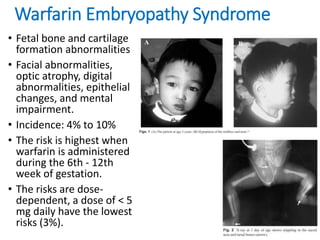
Warfarin Embryopathy Syndrome
• Fetal bone and cartilage
formation abnormalities
• Facial abnormalities,
optic atrophy, digital
abnormalities, epithelial
changes, and mental
impairment.
• Incidence: 4% to 10%
• The risk is highest when
warfarin is administered
during the 6th - 12th
week of gestation.
• The risks are dose-
dependent, a dose of < 5
mg daily have the lowest
risks (3%).
Unfractionated heparin
• UFH does not cross the placenta, and does not
have any teratogenic effects.
• Associated with -
Maternal osteoporosis
Hemorrhage
Thrombocytopenia, or thrombosis (HITT)
High incidence of thromboembolic events with
older generation mechanical valves
• Route: IV / SC
• Dose: based on an activated partial thromboplastin
time (aPTT) of 2 to 3 times the control level
Low-molecular-weight heparin
• Its advantages over UFH –
More predictable anticoagulant response
Lower incidences of HITT and osteoporosis.
• It does not cross the placenta
• SC twice-daily dosing
• It is essential to monitor anti-Xa levels. (The
4-hour-post dose target anti-Xa level varies
between 0.7 to 1.2)
2014 AHA/ACC Guideline for the
Management
of Patients With Valvular Heart Disease:
Prosthetic Valves in Pregnancy
CLASS I
• Therapeutic anticoagulation with frequent monitoring is
recommended for all pregnant patients with a
mechanical prosthesis. (Level of Evidence: B)
• Warfarin is recommended in pregnant patients with a
mechanical prosthesis to achieve a therapeutic INR in the
second and third trimesters. (Level of Evidence: B)
• Discontinuation of warfarin with initiation of intravenous
UFH (with an activated partial thromboplastin time [aPTT] >2 times
control) is recommended before planned vaginal delivery
in pregnant patients with a mechanical prosthesis. (Level
of Evidence: C)
• Low-dose aspirin (75mg to 100mg) once per day is
recommended for pregnant patients in the second and
third trimesters with either a mechanical prosthesis or
bioprosthesis. (Level of Evidence: C)
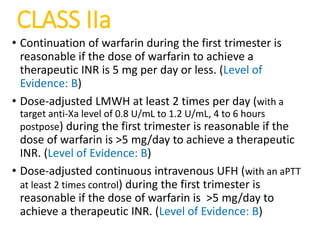
CLASS IIa
• Continuation of warfarin during the first trimester is
reasonable if the dose of warfarin to achieve a
therapeutic INR is 5 mg per day or less. (Level of
Evidence: B)
• Dose-adjusted LMWH at least 2 times per day (with a
target anti-Xa level of 0.8 U/mL to 1.2 U/mL, 4 to 6 hours
postpose) during the first trimester is reasonable if the
dose of warfarin is >5 mg/day to achieve a therapeutic
INR. (Level of Evidence: B)
• Dose-adjusted continuous intravenous UFH (with an aPTT
at least 2 times control) during the first trimester is
reasonable if the dose of warfarin is >5 mg/day to
achieve a therapeutic INR. (Level of Evidence: B)
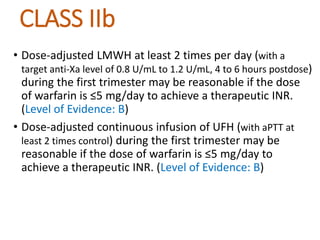
CLASS IIb
• Dose-adjusted LMWH at least 2 times per day (with a
target anti-Xa level of 0.8 U/mL to 1.2 U/mL, 4 to 6 hours postdose)
during the first trimester may be reasonable if the dose
of warfarin is ≤5 mg/day to achieve a therapeutic INR.
(Level of Evidence: B)
• Dose-adjusted continuous infusion of UFH (with aPTT at
least 2 times control) during the first trimester may be
reasonable if the dose of warfarin is ≤5 mg/day to
achieve a therapeutic INR. (Level of Evidence: B)
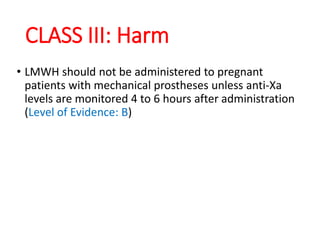
CLASS III: Harm
• LMWH should not be administered to pregnant
patients with mechanical prostheses unless anti-Xa
levels are monitored 4 to 6 hours after administration
(Level of Evidence: B)
Thank you

Antithrombotic in pregnancy

  • 1.
    Anticoagulation during pregnancy Dr. SayeedurRahman Khan Rumi MD Cardiology Final Part Student National Heart Foundation Hospital & Research Institute
  • 2.
    Conditions requiring anticoagulationduring pregnancy include - • Mechanical prosthetic heart valves • Chronic atrial fibrillation • Acute venous thromboembolism • Eisenmenger syndrome • Antiphospholipid antibody syndrome, and • Inherited deficiencies predisposing to thromboembolism
  • 3.
    The three mostcommon agents considered for use during pregnancy are – • Unfractionated heparin (UFH), • Low-molecular-weight heparin (LMWH) • Warfarin
  • 4.
    Warfarin • Warfarin freelycrosses the placental barrier and can adversely affect fetal development. • It has been associated with a high incidence of spontaneous abortion, prematurity, still birth, and fetal bleeding. • Warfarin can cause neonatal intracranial hemorrhage or a retroplacental hematoma. • Warfarin is considered safe during breast-feeding.
  • 5.
    • Warfarin isthe most effective anticoagulant for preventing maternal thromboembolic events during pregnancy. • The risk of thromboembolic events using warfarin throughout pregnancy is <4%, compared with 33% with the use of UFH throughout pregnancy. • Warfarin is an FDA class X during the first trimester and is best considered a class B drug for the remainder of pregnancy.
  • 6.
    Warfarin Embryopathy Syndrome •Fetal bone and cartilage formation abnormalities • Facial abnormalities, optic atrophy, digital abnormalities, epithelial changes, and mental impairment. • Incidence: 4% to 10% • The risk is highest when warfarin is administered during the 6th - 12th week of gestation. • The risks are dose- dependent, a dose of < 5 mg daily have the lowest risks (3%).
  • 7.
    Unfractionated heparin • UFHdoes not cross the placenta, and does not have any teratogenic effects. • Associated with - Maternal osteoporosis Hemorrhage Thrombocytopenia, or thrombosis (HITT) High incidence of thromboembolic events with older generation mechanical valves • Route: IV / SC • Dose: based on an activated partial thromboplastin time (aPTT) of 2 to 3 times the control level
  • 8.
    Low-molecular-weight heparin • Itsadvantages over UFH – More predictable anticoagulant response Lower incidences of HITT and osteoporosis. • It does not cross the placenta • SC twice-daily dosing • It is essential to monitor anti-Xa levels. (The 4-hour-post dose target anti-Xa level varies between 0.7 to 1.2)
  • 9.
    2014 AHA/ACC Guidelinefor the Management of Patients With Valvular Heart Disease: Prosthetic Valves in Pregnancy
  • 10.
    CLASS I • Therapeuticanticoagulation with frequent monitoring is recommended for all pregnant patients with a mechanical prosthesis. (Level of Evidence: B) • Warfarin is recommended in pregnant patients with a mechanical prosthesis to achieve a therapeutic INR in the second and third trimesters. (Level of Evidence: B) • Discontinuation of warfarin with initiation of intravenous UFH (with an activated partial thromboplastin time [aPTT] >2 times control) is recommended before planned vaginal delivery in pregnant patients with a mechanical prosthesis. (Level of Evidence: C) • Low-dose aspirin (75mg to 100mg) once per day is recommended for pregnant patients in the second and third trimesters with either a mechanical prosthesis or bioprosthesis. (Level of Evidence: C)
  • 11.
    CLASS IIa • Continuationof warfarin during the first trimester is reasonable if the dose of warfarin to achieve a therapeutic INR is 5 mg per day or less. (Level of Evidence: B) • Dose-adjusted LMWH at least 2 times per day (with a target anti-Xa level of 0.8 U/mL to 1.2 U/mL, 4 to 6 hours postpose) during the first trimester is reasonable if the dose of warfarin is >5 mg/day to achieve a therapeutic INR. (Level of Evidence: B) • Dose-adjusted continuous intravenous UFH (with an aPTT at least 2 times control) during the first trimester is reasonable if the dose of warfarin is >5 mg/day to achieve a therapeutic INR. (Level of Evidence: B)
  • 12.
    CLASS IIb • Dose-adjustedLMWH at least 2 times per day (with a target anti-Xa level of 0.8 U/mL to 1.2 U/mL, 4 to 6 hours postdose) during the first trimester may be reasonable if the dose of warfarin is ≤5 mg/day to achieve a therapeutic INR. (Level of Evidence: B) • Dose-adjusted continuous infusion of UFH (with aPTT at least 2 times control) during the first trimester may be reasonable if the dose of warfarin is ≤5 mg/day to achieve a therapeutic INR. (Level of Evidence: B)
  • 13.
    CLASS III: Harm •LMWH should not be administered to pregnant patients with mechanical prostheses unless anti-Xa levels are monitored 4 to 6 hours after administration (Level of Evidence: B)
  • 14.