
Dr. Danny Kainer
&
Anitha Iyer
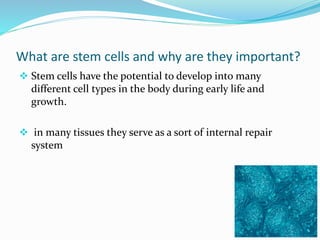
What are stem cells and why are they important?
 Stem cells have the potential to develop into many
different cell types in the body during early life and
growth.
 in many tissues they serve as a sort of internal repair
system
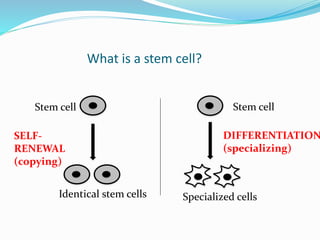
What is a stem cell?
Identical stem cells
Stem cell
SELF-
RENEWAL
(copying)
Stem cell
Specialized cells
DIFFERENTIATION
(specializing)
Properties of stem cells
they are capable of dividing and renewing themselves for
long periods
they are unspecialized
they can give rise to specialized cell types.
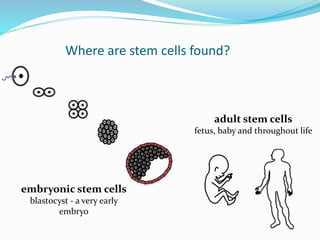
Where are stem cells found?
embryonic stem cells
blastocyst - a very early
embryo
adult stem cells
fetus, baby and throughout life
A few terms……
 Potency: A measure of how many types of specialized
cells a stem cell can make
 Totipotent: Each cell can develop into a new individual
Ex. Cells from early (1-3 days) embryos
 Pluripotent: Can make all types of specialized cells in the
body.
Ex. Embryonic stem cells are pluripotent
 Multipotent: Can make multiple types of specialized
cells, but not all types
Ex. Adult stem cells are multipotent
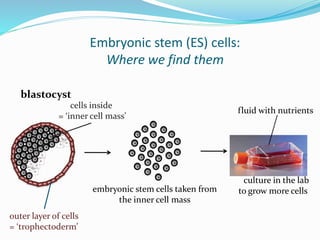
Embryonic stem (ES) cells:
Where we find them
blastocyst
outer layer of cells
= ‘trophectoderm’
cells inside
= ‘inner cell mass’
embryonic stem cells taken from
the inner cell mass
culture in the lab
to grow more cells
fluid with nutrients
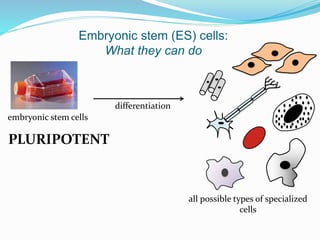
Embryonic stem (ES) cells:
What they can do
embryonic stem cells
PLURIPOTENT
all possible types of specialized
cells
differentiation
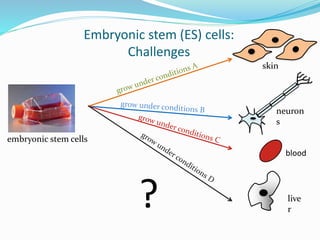
neuron
s
Embryonic stem (ES) cells:
Challenges
embryonic stem cells
skin
blood
live
r?
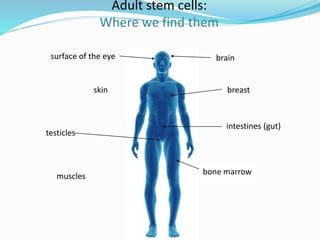
Adult stem cells:
Where we find them
muscles
skin
surface of the eye brain
breast
intestines (gut)
testicles
bone marrow
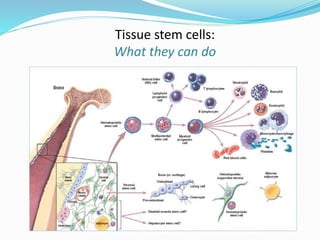
Tissue stem cells:
What they can do
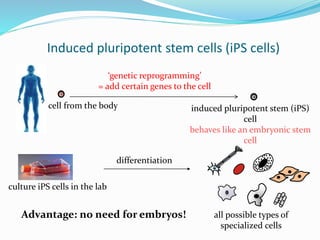
Induced pluripotent stem cells (iPS cells)
cell from the body
‘genetic reprogramming’
= add certain genes to the cell
induced pluripotent stem (iPS)
cell
behaves like an embryonic stem
cell
Advantage: no need for embryos! all possible types of
specialized cells
culture iPS cells in the lab
differentiation
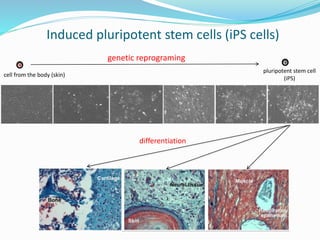
Induced pluripotent stem cells (iPS cells)
cell from the body (skin)
genetic reprograming
pluripotent stem cell
(iPS)
differentiation
Potential uses of human stem cells
http://video.pbs.org/video/1754537562/
Experimental model system
Heart muscle cells beating in a petri dish!
http://www.exploratorium.edu/tv/index.php?project=70&pr
ogram=746
1:37 – 2:43
Videos by the Exploratorium
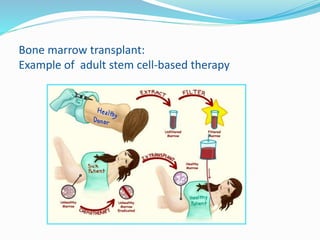
Bone marrow transplant:
Example of adult stem cell-based therapy
Human trials:
 The FDA approved the first clinical trial involving human
embryonic stem cells on January 23, 2009.
Geron Corporation - spinal cord injuries
 In 2010
Stargardt’s Macular Dystrophy and Dry Age-Related
Macular Degeneration
 In 2013
Severe myopia
Stem cells & Parkinson’s
http://www.youtube.com/watch?v=1yCgLythe00
Stem cells and ALS
 Astrocytes in the spinal cord. Year 3 toward human
trial
http://www.youtube.com/watch?v=tplx_ftKdYc
Stem cells and Arthritis
http://www.ted.com/talks/kevin_stone_the_bio_future_of_j
oint_replacement
Stem Cell Power
Stem Cell Power

Stem Cell Power

  • 1.
  • 3.
    What are stemcells and why are they important?  Stem cells have the potential to develop into many different cell types in the body during early life and growth.  in many tissues they serve as a sort of internal repair system
  • 4.
    What is astem cell? Identical stem cells Stem cell SELF- RENEWAL (copying) Stem cell Specialized cells DIFFERENTIATION (specializing)
  • 5.
    Properties of stemcells they are capable of dividing and renewing themselves for long periods they are unspecialized they can give rise to specialized cell types.
  • 6.
    Where are stemcells found? embryonic stem cells blastocyst - a very early embryo adult stem cells fetus, baby and throughout life
  • 7.
    A few terms…… Potency: A measure of how many types of specialized cells a stem cell can make  Totipotent: Each cell can develop into a new individual Ex. Cells from early (1-3 days) embryos  Pluripotent: Can make all types of specialized cells in the body. Ex. Embryonic stem cells are pluripotent  Multipotent: Can make multiple types of specialized cells, but not all types Ex. Adult stem cells are multipotent
  • 8.
    Embryonic stem (ES)cells: Where we find them blastocyst outer layer of cells = ‘trophectoderm’ cells inside = ‘inner cell mass’ embryonic stem cells taken from the inner cell mass culture in the lab to grow more cells fluid with nutrients
  • 9.
    Embryonic stem (ES)cells: What they can do embryonic stem cells PLURIPOTENT all possible types of specialized cells differentiation
  • 10.
    neuron s Embryonic stem (ES)cells: Challenges embryonic stem cells skin blood live r?
  • 11.
    Adult stem cells: Wherewe find them muscles skin surface of the eye brain breast intestines (gut) testicles bone marrow
  • 12.
  • 13.
    Induced pluripotent stemcells (iPS cells) cell from the body ‘genetic reprogramming’ = add certain genes to the cell induced pluripotent stem (iPS) cell behaves like an embryonic stem cell Advantage: no need for embryos! all possible types of specialized cells culture iPS cells in the lab differentiation
  • 14.
    Induced pluripotent stemcells (iPS cells) cell from the body (skin) genetic reprograming pluripotent stem cell (iPS) differentiation
  • 15.
    Potential uses ofhuman stem cells http://video.pbs.org/video/1754537562/
  • 16.
    Experimental model system Heartmuscle cells beating in a petri dish! http://www.exploratorium.edu/tv/index.php?project=70&pr ogram=746 1:37 – 2:43 Videos by the Exploratorium
  • 17.
    Bone marrow transplant: Exampleof adult stem cell-based therapy
  • 18.
    Human trials:  TheFDA approved the first clinical trial involving human embryonic stem cells on January 23, 2009. Geron Corporation - spinal cord injuries  In 2010 Stargardt’s Macular Dystrophy and Dry Age-Related Macular Degeneration  In 2013 Severe myopia
  • 19.
    Stem cells &Parkinson’s http://www.youtube.com/watch?v=1yCgLythe00 Stem cells and ALS  Astrocytes in the spinal cord. Year 3 toward human trial http://www.youtube.com/watch?v=tplx_ftKdYc Stem cells and Arthritis http://www.ted.com/talks/kevin_stone_the_bio_future_of_j oint_replacement