Statistics & Data Mining


 R. Akerkar
 TMRF, Kolhapur, India


                  Data Mining - R. Akerkar   1
Why Data Preprocessing?
   Data in the real world is dirty
                                  y
       incomplete: lacking attribute values, lacking certain
        attributes of interest, or containing only aggregate data
           e.g., occupation=
            e g occupation=“”
       noisy: containing errors or outliers
           e.g., Salary=“-10”
       inconsistent: containing discrepancies in codes or names
           e.g., Age=“42” Birthday=“03/07/1997”
           e.g., Was rating “1,2,3”, now rating “A, B, C
                              1,2,3 ,             A, C”
           e.g., discrepancy between duplicate records


       This is the
        Thi i th real world…
                    l    ld
                                 Data Mining - R. Akerkar           2
Why Is Data Dirty?
      y             y
   Incomplete data comes from
       n/a data value when collected
         /
       different consideration between the time when the data was
        collected and when it is analyzed.
       human/hardware/software problems
   Noisy data comes from the process of data
       Collection instrument’s f lt
        C ll ti i t         t’ fault
       Data entry
       transmission
   Inconsistent data comes from
       Different data sources
       Functional d
        F   ti   l dependency violation
                        d      i l ti

                                 Data Mining - R. Akerkar            3
Why Is Data Preprocessing
    Important?
   No quality data no quality mining results!
               data,
       Quality decisions must be based on quality data
           e.g., duplicate or missing data may cause incorrect or even
              g, p                   g        y
            misleading statistics.
       Data warehouse needs consistent integration of quality data
   Data extraction, cleaning, and transformation
    comprises the majority of the work of building a data
    warehouse. Bill
    warehouse —Bill Inmon


                                Data Mining - R. Akerkar                  4
Major Tasks in Data Preprocessing
   Data cleaning
       Fill in missing values, smooth noisy data, and resolve
        inconsistencies
   Data integration
       Integration of multiple databases, data cubes, or files
   Data transformation
       Normalization and aggregation ( a distance based mining algorithms
        provide better results if data is normalized and scaled to range.)
   Data reduction
       Obtains reduced representation in volume but p
                             p                             produces the same or
        similar analytical results (correlation analysis).
   Data discretization
       Part of data reduction but with particular importance, especially for
                                        p            p           p      y
        numerical data.

                                 Data Mining - R. Akerkar                         5
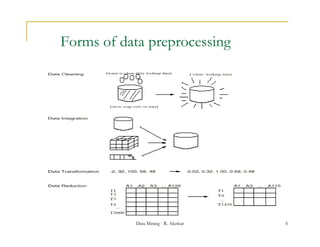
Forms of data preprocessing


           Data Mining - R. Akerkar   6
Data Cleaning
                    g
   Importance
       “Data l
        “D t cleaning i one of th th
                    i is        f the three bi
                                            biggest problems i
                                                  t    bl    in
        data warehousing”—Ralph Kimball
       “Data cleaning is the number one problem in data
        warehousing”—DCI survey
             h    i ” DCI
   Data cleaning tasks
       Fill in missing values (time consuming)
       Identify outliers and smooth out noisy data
       Correct inconsistent data
       Resolve redundancy caused by data integration
                         y         y          g

                             Data Mining - R. Akerkar             7
Missing Data
          g
   Data is not always available
       E.g.,
        E g many tuples have no recorded value for several attributes
                                                           attributes,
        such as customer income in sales data
   Missing data may be due to
       equipment malfunction
       inconsistent with other recorded data and thus deleted
       data not entered due to misunderstanding
       certain data may not be considered important at the time of
        entry
       not register history or changes of the data
   Missing data may need to be inferred.


                             Data Mining - R. Akerkar                 8
How to Handle Missing
    Data?
   Ignore the tuple: usually done when class label is missing (assuming the
    tasks in classification—not effective when the percentage of missing values
    per attribute varies considerably.
   Fill in the missing value manually: t di
         i th    i i      l        ll tedious + i f
                                                infeasible?
                                                      ibl ?
   Fill in it automatically with
       a global constant : e g “unknown”, a new class?!
                            e.g., unknown
       the attribute mean
       the attribute mean for all samples belonging to the same class: smarter
       the most probable value: inference-based such as Bayesian formula or
        decision tree or regression.


                                    Data Mining - R. Akerkar                      9
Noisy Data
   Noise: random error or variance in a measured variable.

   For example, for a numeric attribute “price” how can we smooth out
    the data to remove the noise.

   Incorrect attribute values may due to
     faulty data collection instruments

     data entry problems

     data transmission problems

     technology limitation
                gy
     inconsistency in naming convention


                               Data Mining - R. Akerkar                  10
How to Handle Noisy Data?
   Binning method:
       first sort data and partition into (equi-depth) bins
       then one can smooth by bin means, smooth by bin median,
        smooth by bin boundaries etc
                         boundaries, etc.


   Regression
      g
       smooth by fitting the data into regression functions


                              Data Mining - R. Akerkar         11
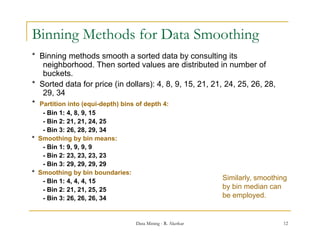
Binning Methods for Data Smoothing
* Binning methods smooth a sorted data by consulting its
   neighborhood. Then sorted values are distributed in number of
   buckets.
* Sorted data for price (in dollars): 4, 8, 9, 15, 21, 21, 24, 25, 26, 28,
   29, 34
* Partition into (equi-depth) bins of depth 4:
    - Bin 1: 4, 8, 9, 15
    - Bin 2: 21, 21, 24, 25
    - Bin 3: 26, 28, 29, 34
* Smoothing by bin means:
    - Bin 1: 9, 9, 9, 9
    - Bin 2: 23, 23, 23, 23
    - Bin 3: 29, 29, 29, 29
* S
  Smoothing by bin boundaries:
         thi b bi b         d i
    - Bin 1: 4, 4, 4, 15                                     Similarly, smoothing
    - Bin 2: 21, 21, 25, 25                                  by bin median can
    - Bin 3: 26, 26, 26, 34
                , , ,                                        be employed.


                                  Data Mining - R. Akerkar                     12
Simple Discretization Methods: Binning

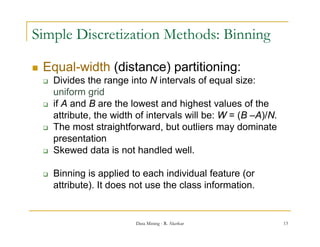
   Equal-width (distance) partitioning:
       Divides the
        Di id th range i t N i t
                            into intervals of equal size:
                                           l f       l i
        uniform grid
       if A and B are the lowest and highest values of the
                                          g
        attribute, the width of intervals will be: W = (B –A)/N.
       The most straightforward, but outliers may dominate
        presentation
       Skewed data is not handled well.

       Binning is
        Bi i i applied t each i di id l f t
                         li d to   h individual feature (
                                                        (or
        attribute). It does not use the class information.


                            Data Mining - R. Akerkar               13
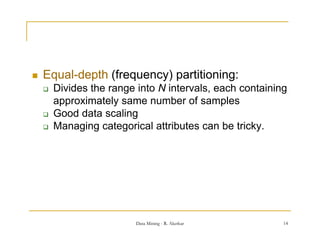
   Equal depth
    Equal-depth (frequency) partitioning:
       Divides the range into N intervals, each containing
        approximately same number of samples
       Good data scaling
       Managing categorical attributes can be tricky.


                          Data Mining - R. Akerkar        14
Exercise 1

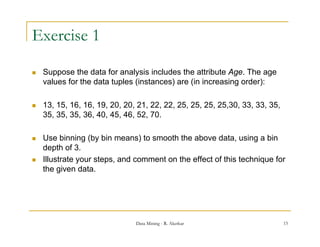
   Suppose the data for analysis includes the attribute Age. The age
    values for the data tuples (instances) are (in increasing order):

   13, 15, 16, 16, 19, 20, 20, 21, 22, 22, 25, 25, 25, 25,30, 33, 33, 35,
      , , , , , , , , , , , , , , , , , ,
    35, 35, 35, 36, 40, 45, 46, 52, 70.

   Use binning (by bin means) to smooth the above data using a bin
                                                      data,
    depth of 3.
   Illustrate your steps, and comment on the effect of this technique for
    the given data
                data.


                               Data Mining - R. Akerkar                      15
Data Integration
             g
   Data integration:
       combines data from multiple sources into a coherent store

   Schema integration
       Entity identification
        E tit id tifi ti problem: identify real world entities f
                               bl     id tif      l   ld titi from
        multiple data sources, e.g., A.cust-id  B.cust-#
       integrate metadata from different sources

   Detecting and resolving data value conflicts
       for the same real world entity, attribute values from different
        sources
        so rces are different
       possible reasons: different representations, different scales,
        e.g., metric vs. British units


                              Data Mining - R. Akerkar                16
Handling Redundancy in Data Integration

   Redundant data occur often when integration of multiple databases
       The same attribute may have different names in different
        databases
       One attribute may be a “derived” attribute in another table e g
                                derived                       table, e.g.,
        annual revenue
   Redundant data may be able to be detected by correlation analysis
   Careful integration of the data from multiple sources may help
    reduce/avoid redundancies and inconsistencies and improve mining
    speed and quality


                               Data Mining - R. Akerkar                      17
Correlation Analysis

   Redundancies can be detected by this method.
   Given two attributes, such analysis can measure how strongly one
    attribute implies the other, based on available data.

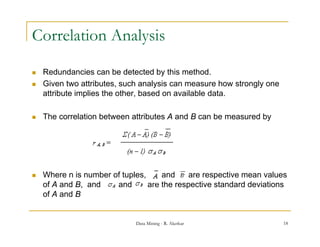
   The correlation between attributes A and B can be measured by


   Where n is number of tuples,     and     are respective mean values
    of A and B, and    and       are the respective standard deviations
    of A and B


                             Data Mining - R. Akerkar                  18
Correlation Analysis
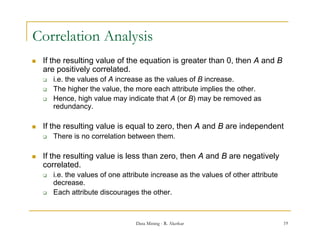
   If the resulting value of the equation is greater than 0, then A and B
    are positively correlated.
       i.e. the l
        i th values of A i
                        f increase as th values of B i
                                       the l        f increase.
       The higher the value, the more each attribute implies the other.
       Hence, high value may indicate that A (or B) may be removed as
        redundancy.
        redundancy

   If the resulting value is equal to zero, then A and B are independent
       There is no correlation between them.

   If the resulting value is less than zero, then A and B are negatively
    correlated.
       i.e. the values of one attribute increase as the values of other attribute
        decrease.
       Each attribute discourages the other.


                                   Data Mining - R. Akerkar                          19
Correlation Analysis


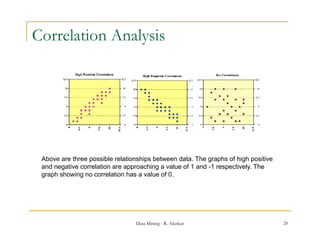
 Above are three possible relationships between data. The graphs of high positive
 and negative correlation are approaching a value of 1 and -1 respectively. The
 graph showing no correlation has a value of 0.


                                 Data Mining - R. Akerkar                           20
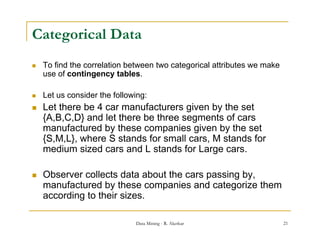
Categorical Data
   To find the correlation between two categorical attributes we make
    use of contingency tables.
                  g     y

   Let us consider the following:
   Let there be 4 car manufacturers given by the set
    {A,B,C,D} and let there be three segments of cars
    manufactured by these companies given by the set
    {S,M,L},
    {S M L} where S stands for small cars M stands for
                                      cars,
    medium sized cars and L stands for Large cars.

   Observer collects data about the cars passing by,
    manufactured by these companies and categorize them
    according to their sizes.

                              Data Mining - R. Akerkar                   21
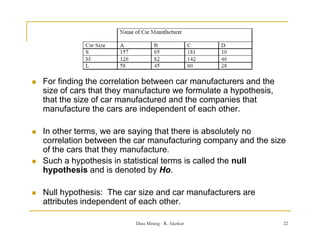
   For finding the correlation between car manufacturers and the
    size of cars that they manufacture we formulate a hypothesis,
    that the size of car manufactured and the companies that
    manufacture the cars are independent of each other
                                                  other.

   In other terms, we are saying that there is absolutely no
    correlation between the car manufacturing company and the size
    of the cars that they manufacture.
   Such a hypothesis in statistical terms is called the null
    hypothesis and is denoted by Ho Ho.

   Null hypothesis: The car size and car manufacturers are
    attributes independent of each other.
                                   other

                            Data Mining - R. Akerkar                22
Data Transformation
   Smoothing: remove noise from data (binning and regression)
   Aggregation: summarization data cube construction
                 summarization,
   E.g. Daily sales data aggregated to compute monthly and annual total
    amount.
   Generalization: concept hierarchy climbing


   Normalization is useful for classification algorithms involving neural nets,
    clustering etc..
   Normalization: attribute data are scaled to fall within a small, specified range
    such as – 1.0 to 1.0
       min-max normalization
       z-score normalization
       normalization by decimal scaling
   Attribute/feature construction
       New attributes constructed f
                                   from the given ones

                                 Data Mining - R. Akerkar                          23
Data Transformation: Normalization
   min-max normalization (This type of normalization transforms the data into a
    desired range, usually [0,1]. )


             v  minA
       v'              (new _ maxA  new _ minA)  new _ minA
            maxA  minA

    where, [minA, maxA] is the initial range and [new_minA, new_maxA] is the
          ,[    ,     ]                   g      [        ,         ]
    new range.
    e.g.: If v = 73600 in [12000, 98000] Then v’ = 0.716 in the range [0, 1].
    Here value for “income” is transformed to 0.716


    It preserves the relationship among th original d t values.
                 th    l ti   hi        the i i l data l

                                      Data Mining - R. Akerkar                 24
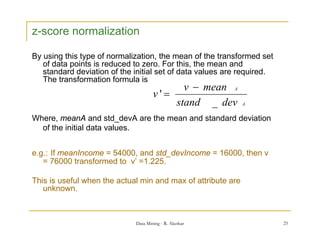
z-score normalization

By using this type of normalization, the mean of the transformed set
   of data points is reduced to zero. For this, the mean and
   standard deviation of the initial set of data values are required.
   The t
   Th transformation formula is
             f      ti f     l i
                                           v  mean A
                                     v'
                                         stand _ dev          A


Where, meanA and std_devA are the mean and standard deviation
  of the initial data values.


e.g.: If meanIncome = 54000, and std_devIncome = 16000, then v
   = 76000 transformed to v’ =1.225.

This is useful when the actual min and max of attribute are
   unknown.


                             Data Mining - R. Akerkar                   25
Normalisation by Decimal Scaling
   This type of scaling transforms the data into a range between [-
    1,1]. The transformation formula is

                                  v
                             v'                j
                                 10
Where j is the smallest integer such that Max(|           v' |)<1

   e.g.: Suppose recorded value of A is in initial range [-991, 99], k is
    3, and v = -991 becomes v' = -0.991.
   The
    Th mean absolute value of A is 991.
                b l t     l   f i 991
   To normalise, we divide each value by 1000 (i.e. j = 3) so -991
    normalises -0.991


                               Data Mining - R. Akerkar                      26
Exercise 2
   Using the data for Age in previous Question, answer the following:

a) Use min-max normalization to transform the value 35 for age into the
   range [0.0; 1.0].

b) Use z-score normalization to transform the value 35 for age, where
   the standard deviation of age is 12.94.

c) Use normalization by decimal scaling to transform the value 35 for
   age.

d) Comment on which method you would prefer to use for the given
   data, giving reasons as to why.


                              Data Mining - R. Akerkar                   27
What Is Prediction?
   Prediction is similar to classification
       First, construct a model
       Second, use model to predict unknown value
           Major method for prediction is regression
               Linear and multiple regression
               Non-linear regression
   Prediction is different from classification
    P di ti i diff        tf      l   ifi ti
       Classification refers to predict categorical class label
       Prediction models continuous-valued functions
   E.g. A model to predict the salary of university graduate with 15 years of
    work experience.


                                     Data Mining - R. Akerkar               28
Regression
   Regression shows a relationship between the average values of
    two variables.
   Thus regression is very useful in estimating and predicting the
    average value of one variable for a given value of other variable.
   The estimate or prediction may be made with the help of a
    regression line.

   There are two types of variables in regression analysis-
    independent variable and dependent variable.
   The variable whose value is to be predicted is called dependent
    variable and th variable whose value i used f prediction i
        i bl   d the   i bl    h       l is      d for    di ti is
    called independent variable.


                             Data Mining - R. Akerkar                 29
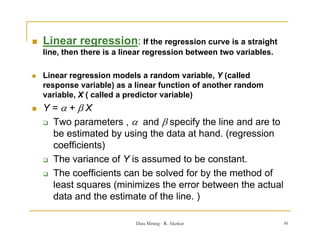
   Linear regression: If the regression curve is a straight
             g                  g                        g
    line, then there is a linear regression between two variables.

   Linear regression models a random variable, Y (called
                                           variable
    response variable) as a linear function of another random
    variable, X ( called a predictor variable)
   Y=+X
     Two parameters ,  and  specify the line and are to
      be estimated by using the data at hand. (regression
      coefficients)
     The variance of Y is assumed to be constant.

     Th coefficients can be solved f
      The      ffi i t     b     l d for b th method of
                                           by the th d f
      least squares (minimizes the error between the actual
      data and the estimate of the line. )

                             Data Mining - R. Akerkar                30
Linear Regression

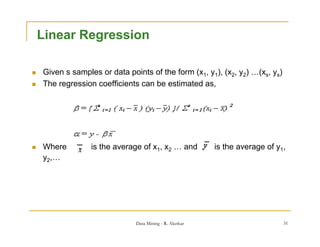
   Given s samples or data points of the form (x1, y1), (x2, y2) …(xs, ys)
   The regression coefficients can be estimated as,


   Where         is the average of x1, x2 … and          is the average of y1,
    y2,…


                               Data Mining - R. Akerkar                       31
Multiple Regression

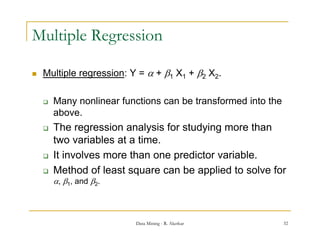
   Multiple regression: Y =  + 1 X1 + 2 X2.
         p     g

       Many nonlinear functions can be transformed into the
        above.
       The regression analysis for studying more than
        two variables at a time
                           time.
       It involves more than one predictor variable.
       Method of least square can be applied to solve for
        , 1, and 2.


                          Data Mining - R. Akerkar             32
Non-Linear Regression

   If the curve of regression is not a straight line, i.e., a first degree
    equation in the variables x and y, then it is called a non-linear
    regression or curvilinear regression

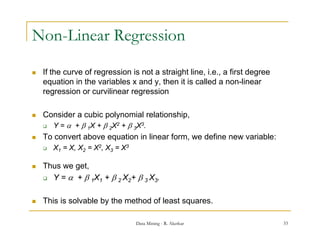
   Consider a cubic polynomial relationship,
     Y =  +  1X +  2X2 +  3X3.

   To convert above equation in linear form, we define new variable:
       X1 = X, X2 = X2, X3 = X3

   Thus we get,
            g
     Y =  +  1X1 +  2 X2+  3 X3.


   This is solvable by the method of least squares
                                            squares.

                                   Data Mining - R. Akerkar                   33
Exercise 3
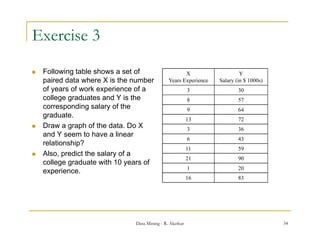
   Following table shows a set of                    X                    Y
    paired data where X is the number          Years Experience   Salary (in $ 1000s)
    of years of work experience of a                      3               30
    college graduates and Y is the                        8               57
    corresponding salary of the                           9               64
    graduate.
                                                          13              72
   Draw a graph of the data. Do X                        3               36
    and Y seem to have a linear
                                                          6               43
    relationship?
                                                          11              59
   Also, predict the salary of a
                                                          21              90
    college graduate with 10 years of
                                                          1               20
    experience.
    experience
                                                          16              83


                               Data Mining - R. Akerkar                                 34
Assignment
                                                                X            Y
                                                          Midterm exam   Final exam
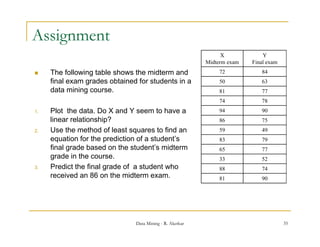
    The following table shows the midterm and                72            84
     final exam grades obtained for students in a             50            63
     data mining course.                                      81            77
                                                              74            78
1.   Plot the data. Do X and Y seem to have a                 94            90
     linear relationship?                                     86            75
2.   Use the method of least squares to find an               59            49
     equation for the prediction of a student’s
                                      student s               83            79
     final grade based on the student’s midterm               65            77
     grade in the course.                                     33            52
3.   Predict the final grade of a student who
                       g                                      88            74
     received an 86 on the midterm exam.                      81            90


                               Data Mining - R. Akerkar                               35

Statistics and Data Mining

  • 1.
    Statistics & DataMining R. Akerkar TMRF, Kolhapur, India Data Mining - R. Akerkar 1
  • 2.
    Why Data Preprocessing?  Data in the real world is dirty y  incomplete: lacking attribute values, lacking certain attributes of interest, or containing only aggregate data  e.g., occupation= e g occupation=“”  noisy: containing errors or outliers  e.g., Salary=“-10”  inconsistent: containing discrepancies in codes or names  e.g., Age=“42” Birthday=“03/07/1997”  e.g., Was rating “1,2,3”, now rating “A, B, C 1,2,3 , A, C”  e.g., discrepancy between duplicate records  This is the Thi i th real world… l ld Data Mining - R. Akerkar 2
  • 3.
    Why Is DataDirty? y y  Incomplete data comes from  n/a data value when collected /  different consideration between the time when the data was collected and when it is analyzed.  human/hardware/software problems  Noisy data comes from the process of data  Collection instrument’s f lt C ll ti i t t’ fault  Data entry  transmission  Inconsistent data comes from  Different data sources  Functional d F ti l dependency violation d i l ti Data Mining - R. Akerkar 3
  • 4.
    Why Is DataPreprocessing Important?  No quality data no quality mining results! data,  Quality decisions must be based on quality data  e.g., duplicate or missing data may cause incorrect or even g, p g y misleading statistics.  Data warehouse needs consistent integration of quality data  Data extraction, cleaning, and transformation comprises the majority of the work of building a data warehouse. Bill warehouse —Bill Inmon Data Mining - R. Akerkar 4
  • 5.
    Major Tasks inData Preprocessing  Data cleaning  Fill in missing values, smooth noisy data, and resolve inconsistencies  Data integration  Integration of multiple databases, data cubes, or files  Data transformation  Normalization and aggregation ( a distance based mining algorithms provide better results if data is normalized and scaled to range.)  Data reduction  Obtains reduced representation in volume but p p produces the same or similar analytical results (correlation analysis).  Data discretization  Part of data reduction but with particular importance, especially for p p p y numerical data. Data Mining - R. Akerkar 5
  • 6.
    Forms of datapreprocessing Data Mining - R. Akerkar 6
  • 7.
    Data Cleaning g  Importance  “Data l “D t cleaning i one of th th i is f the three bi biggest problems i t bl in data warehousing”—Ralph Kimball  “Data cleaning is the number one problem in data warehousing”—DCI survey h i ” DCI  Data cleaning tasks  Fill in missing values (time consuming)  Identify outliers and smooth out noisy data  Correct inconsistent data  Resolve redundancy caused by data integration y y g Data Mining - R. Akerkar 7
  • 8.
    Missing Data g  Data is not always available  E.g., E g many tuples have no recorded value for several attributes attributes, such as customer income in sales data  Missing data may be due to  equipment malfunction  inconsistent with other recorded data and thus deleted  data not entered due to misunderstanding  certain data may not be considered important at the time of entry  not register history or changes of the data  Missing data may need to be inferred. Data Mining - R. Akerkar 8
  • 9.
    How to HandleMissing Data?  Ignore the tuple: usually done when class label is missing (assuming the tasks in classification—not effective when the percentage of missing values per attribute varies considerably.  Fill in the missing value manually: t di i th i i l ll tedious + i f infeasible? ibl ?  Fill in it automatically with  a global constant : e g “unknown”, a new class?! e.g., unknown  the attribute mean  the attribute mean for all samples belonging to the same class: smarter  the most probable value: inference-based such as Bayesian formula or decision tree or regression. Data Mining - R. Akerkar 9
  • 10.
    Noisy Data  Noise: random error or variance in a measured variable.  For example, for a numeric attribute “price” how can we smooth out the data to remove the noise.  Incorrect attribute values may due to  faulty data collection instruments  data entry problems  data transmission problems  technology limitation gy  inconsistency in naming convention Data Mining - R. Akerkar 10
  • 11.
    How to HandleNoisy Data?  Binning method:  first sort data and partition into (equi-depth) bins  then one can smooth by bin means, smooth by bin median, smooth by bin boundaries etc boundaries, etc.  Regression g  smooth by fitting the data into regression functions Data Mining - R. Akerkar 11
  • 12.
    Binning Methods forData Smoothing * Binning methods smooth a sorted data by consulting its neighborhood. Then sorted values are distributed in number of buckets. * Sorted data for price (in dollars): 4, 8, 9, 15, 21, 21, 24, 25, 26, 28, 29, 34 * Partition into (equi-depth) bins of depth 4: - Bin 1: 4, 8, 9, 15 - Bin 2: 21, 21, 24, 25 - Bin 3: 26, 28, 29, 34 * Smoothing by bin means: - Bin 1: 9, 9, 9, 9 - Bin 2: 23, 23, 23, 23 - Bin 3: 29, 29, 29, 29 * S Smoothing by bin boundaries: thi b bi b d i - Bin 1: 4, 4, 4, 15 Similarly, smoothing - Bin 2: 21, 21, 25, 25 by bin median can - Bin 3: 26, 26, 26, 34 , , , be employed. Data Mining - R. Akerkar 12
  • 13.
    Simple Discretization Methods:Binning  Equal-width (distance) partitioning:  Divides the Di id th range i t N i t into intervals of equal size: l f l i uniform grid  if A and B are the lowest and highest values of the g attribute, the width of intervals will be: W = (B –A)/N.  The most straightforward, but outliers may dominate presentation  Skewed data is not handled well.  Binning is Bi i i applied t each i di id l f t li d to h individual feature ( (or attribute). It does not use the class information. Data Mining - R. Akerkar 13
  • 14.
    Equal depth Equal-depth (frequency) partitioning:  Divides the range into N intervals, each containing approximately same number of samples  Good data scaling  Managing categorical attributes can be tricky. Data Mining - R. Akerkar 14
  • 15.
    Exercise 1  Suppose the data for analysis includes the attribute Age. The age values for the data tuples (instances) are (in increasing order):  13, 15, 16, 16, 19, 20, 20, 21, 22, 22, 25, 25, 25, 25,30, 33, 33, 35, , , , , , , , , , , , , , , , , , , 35, 35, 35, 36, 40, 45, 46, 52, 70.  Use binning (by bin means) to smooth the above data using a bin data, depth of 3.  Illustrate your steps, and comment on the effect of this technique for the given data data. Data Mining - R. Akerkar 15
  • 16.
    Data Integration g  Data integration:  combines data from multiple sources into a coherent store  Schema integration  Entity identification E tit id tifi ti problem: identify real world entities f bl id tif l ld titi from multiple data sources, e.g., A.cust-id  B.cust-#  integrate metadata from different sources  Detecting and resolving data value conflicts  for the same real world entity, attribute values from different sources so rces are different  possible reasons: different representations, different scales, e.g., metric vs. British units Data Mining - R. Akerkar 16
  • 17.
    Handling Redundancy inData Integration  Redundant data occur often when integration of multiple databases  The same attribute may have different names in different databases  One attribute may be a “derived” attribute in another table e g derived table, e.g., annual revenue  Redundant data may be able to be detected by correlation analysis  Careful integration of the data from multiple sources may help reduce/avoid redundancies and inconsistencies and improve mining speed and quality Data Mining - R. Akerkar 17
  • 18.
    Correlation Analysis  Redundancies can be detected by this method.  Given two attributes, such analysis can measure how strongly one attribute implies the other, based on available data.  The correlation between attributes A and B can be measured by  Where n is number of tuples, and are respective mean values of A and B, and and are the respective standard deviations of A and B Data Mining - R. Akerkar 18
  • 19.
    Correlation Analysis  If the resulting value of the equation is greater than 0, then A and B are positively correlated.  i.e. the l i th values of A i f increase as th values of B i the l f increase.  The higher the value, the more each attribute implies the other.  Hence, high value may indicate that A (or B) may be removed as redundancy. redundancy  If the resulting value is equal to zero, then A and B are independent  There is no correlation between them.  If the resulting value is less than zero, then A and B are negatively correlated.  i.e. the values of one attribute increase as the values of other attribute decrease.  Each attribute discourages the other. Data Mining - R. Akerkar 19
  • 20.
    Correlation Analysis Aboveare three possible relationships between data. The graphs of high positive and negative correlation are approaching a value of 1 and -1 respectively. The graph showing no correlation has a value of 0. Data Mining - R. Akerkar 20
  • 21.
    Categorical Data  To find the correlation between two categorical attributes we make use of contingency tables. g y  Let us consider the following:  Let there be 4 car manufacturers given by the set {A,B,C,D} and let there be three segments of cars manufactured by these companies given by the set {S,M,L}, {S M L} where S stands for small cars M stands for cars, medium sized cars and L stands for Large cars.  Observer collects data about the cars passing by, manufactured by these companies and categorize them according to their sizes. Data Mining - R. Akerkar 21
  • 22.
    For finding the correlation between car manufacturers and the size of cars that they manufacture we formulate a hypothesis, that the size of car manufactured and the companies that manufacture the cars are independent of each other other.  In other terms, we are saying that there is absolutely no correlation between the car manufacturing company and the size of the cars that they manufacture.  Such a hypothesis in statistical terms is called the null hypothesis and is denoted by Ho Ho.  Null hypothesis: The car size and car manufacturers are attributes independent of each other. other Data Mining - R. Akerkar 22
  • 23.
    Data Transformation  Smoothing: remove noise from data (binning and regression)  Aggregation: summarization data cube construction summarization,  E.g. Daily sales data aggregated to compute monthly and annual total amount.  Generalization: concept hierarchy climbing  Normalization is useful for classification algorithms involving neural nets, clustering etc..  Normalization: attribute data are scaled to fall within a small, specified range such as – 1.0 to 1.0  min-max normalization  z-score normalization  normalization by decimal scaling  Attribute/feature construction  New attributes constructed f from the given ones Data Mining - R. Akerkar 23
  • 24.
    Data Transformation: Normalization  min-max normalization (This type of normalization transforms the data into a desired range, usually [0,1]. ) v  minA v'  (new _ maxA  new _ minA)  new _ minA maxA  minA where, [minA, maxA] is the initial range and [new_minA, new_maxA] is the ,[ , ] g [ , ] new range. e.g.: If v = 73600 in [12000, 98000] Then v’ = 0.716 in the range [0, 1]. Here value for “income” is transformed to 0.716 It preserves the relationship among th original d t values. th l ti hi the i i l data l Data Mining - R. Akerkar 24
  • 25.
    z-score normalization By usingthis type of normalization, the mean of the transformed set of data points is reduced to zero. For this, the mean and standard deviation of the initial set of data values are required. The t Th transformation formula is f ti f l i v  mean A v' stand _ dev A Where, meanA and std_devA are the mean and standard deviation of the initial data values. e.g.: If meanIncome = 54000, and std_devIncome = 16000, then v = 76000 transformed to v’ =1.225. This is useful when the actual min and max of attribute are unknown. Data Mining - R. Akerkar 25
  • 26.
    Normalisation by DecimalScaling  This type of scaling transforms the data into a range between [- 1,1]. The transformation formula is v v' j 10 Where j is the smallest integer such that Max(| v' |)<1  e.g.: Suppose recorded value of A is in initial range [-991, 99], k is 3, and v = -991 becomes v' = -0.991.  The Th mean absolute value of A is 991. b l t l f i 991  To normalise, we divide each value by 1000 (i.e. j = 3) so -991 normalises -0.991 Data Mining - R. Akerkar 26
  • 27.
    Exercise 2  Using the data for Age in previous Question, answer the following: a) Use min-max normalization to transform the value 35 for age into the range [0.0; 1.0]. b) Use z-score normalization to transform the value 35 for age, where the standard deviation of age is 12.94. c) Use normalization by decimal scaling to transform the value 35 for age. d) Comment on which method you would prefer to use for the given data, giving reasons as to why. Data Mining - R. Akerkar 27
  • 28.
    What Is Prediction?  Prediction is similar to classification  First, construct a model  Second, use model to predict unknown value  Major method for prediction is regression  Linear and multiple regression  Non-linear regression  Prediction is different from classification P di ti i diff tf l ifi ti  Classification refers to predict categorical class label  Prediction models continuous-valued functions  E.g. A model to predict the salary of university graduate with 15 years of work experience. Data Mining - R. Akerkar 28
  • 29.
    Regression  Regression shows a relationship between the average values of two variables.  Thus regression is very useful in estimating and predicting the average value of one variable for a given value of other variable.  The estimate or prediction may be made with the help of a regression line.  There are two types of variables in regression analysis- independent variable and dependent variable.  The variable whose value is to be predicted is called dependent variable and th variable whose value i used f prediction i i bl d the i bl h l is d for di ti is called independent variable. Data Mining - R. Akerkar 29
  • 30.
    Linear regression: If the regression curve is a straight g g g line, then there is a linear regression between two variables.  Linear regression models a random variable, Y (called variable response variable) as a linear function of another random variable, X ( called a predictor variable)  Y=+X  Two parameters ,  and  specify the line and are to be estimated by using the data at hand. (regression coefficients)  The variance of Y is assumed to be constant.  Th coefficients can be solved f The ffi i t b l d for b th method of by the th d f least squares (minimizes the error between the actual data and the estimate of the line. ) Data Mining - R. Akerkar 30
  • 31.
    Linear Regression  Given s samples or data points of the form (x1, y1), (x2, y2) …(xs, ys)  The regression coefficients can be estimated as,  Where is the average of x1, x2 … and is the average of y1, y2,… Data Mining - R. Akerkar 31
  • 32.
    Multiple Regression  Multiple regression: Y =  + 1 X1 + 2 X2. p g  Many nonlinear functions can be transformed into the above.  The regression analysis for studying more than two variables at a time time.  It involves more than one predictor variable.  Method of least square can be applied to solve for , 1, and 2. Data Mining - R. Akerkar 32
  • 33.
    Non-Linear Regression  If the curve of regression is not a straight line, i.e., a first degree equation in the variables x and y, then it is called a non-linear regression or curvilinear regression  Consider a cubic polynomial relationship,  Y =  +  1X +  2X2 +  3X3.  To convert above equation in linear form, we define new variable:  X1 = X, X2 = X2, X3 = X3  Thus we get, g  Y =  +  1X1 +  2 X2+  3 X3.  This is solvable by the method of least squares squares. Data Mining - R. Akerkar 33
  • 34.
    Exercise 3  Following table shows a set of X Y paired data where X is the number Years Experience Salary (in $ 1000s) of years of work experience of a 3 30 college graduates and Y is the 8 57 corresponding salary of the 9 64 graduate. 13 72  Draw a graph of the data. Do X 3 36 and Y seem to have a linear 6 43 relationship? 11 59  Also, predict the salary of a 21 90 college graduate with 10 years of 1 20 experience. experience 16 83 Data Mining - R. Akerkar 34
  • 35.
    Assignment X Y Midterm exam Final exam  The following table shows the midterm and 72 84 final exam grades obtained for students in a 50 63 data mining course. 81 77 74 78 1. Plot the data. Do X and Y seem to have a 94 90 linear relationship? 86 75 2. Use the method of least squares to find an 59 49 equation for the prediction of a student’s student s 83 79 final grade based on the student’s midterm 65 77 grade in the course. 33 52 3. Predict the final grade of a student who g 88 74 received an 86 on the midterm exam. 81 90 Data Mining - R. Akerkar 35