SEMANTIC
NETS
Submitted to :
Ma’am Amita
Sharma
Efforts by:
Harshita Virwani
(BCA Sem - 6)
Meaning of semantic nets
• Semantic nets were originally proposed in the
early 1960s by M. Ross Quillian to represent
the meaning of English words
• The basic idea behind semantic nets is that
how it carries meaning of the concept and how
is related with other concepts
• Semantic nets consist of nodes, links (edges)
and link labels.
ELEMENTS USEDIN SEMANTIC NETS
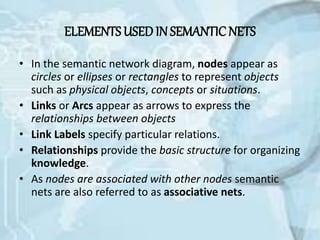
• In the semantic network diagram, nodes appear as
circles or ellipses or rectangles to represent objects
such as physical objects, concepts or situations.
• Links or Arcs appear as arrows to express the
relationships between objects
• Link Labels specify particular relations.
• Relationships provide the basic structure for organizing
knowledge.
• As nodes are associated with other nodes semantic
nets are also referred to as associative nets.
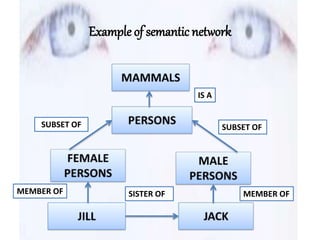
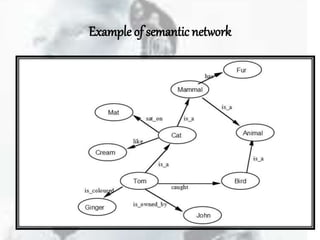
Example of semantic network
IS A
SUBSET OF SUBSET OF
MEMBER OF MEMBER OFSISTER OF
Example of semantic network
Is intended to represent the data:
• Tom is a cat.
• Tom caught a bird.
• Tom is owned by John.
• Tom is ginger in color.
• Cats like cream.
• The cat sat on the mat.
• A cat is a mammal.
• A bird is an animal.
• All mammals are animals.
• Mammals have fur.
INTERSECTION SEARCH
In semantic nets, to find
relationships among objects are
determined by spreading activation
out from each of 2 nodes and
identify where the activation
meets. This process is called
intersection search.
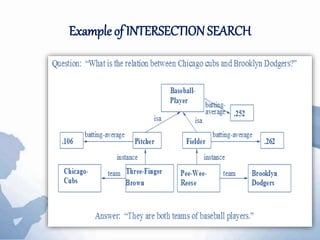
Example of INTERSECTION SEARCH
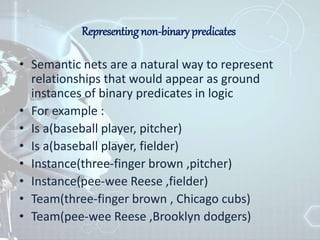
Representingnon-binary predicates
• Semantic nets are a natural way to represent
relationships that would appear as ground
instances of binary predicates in logic
• For example :
• Is a(baseball player, pitcher)
• Is a(baseball player, fielder)
• Instance(three-finger brown ,pitcher)
• Instance(pee-wee Reese ,fielder)
• Team(three-finger brown , Chicago cubs)
• Team(pee-wee Reese ,Brooklyn dodgers)
Score(cubs,dodgers,5-3)
Representing non-binary predicates
Making some important distinctions
• By defining the relationship the complexity of
the relation can also be easily represented in
semantic nets .
• For example : tom weight is 60 kg.
GREATER THAN
PARTITIONEDSEMANTICNETS
 Hendrix developed the partitioned semantic network
to represent the difference between the description of
an individual object or process and the description of a
set of objects. The set description involves
quantification.
 Hendrix partitioned a semantic network whereby a
semantic network, loosely speaking, can be divided
into one or more networks for the description of an
individual.
 The central idea of partitioning is to allow groups,
nodes and arcs to be bundled together into units called
spaces – fundamental entities in partitioned networks,
on the same level as nodes and arcs
PARTITIONEDSEMANTICNETS
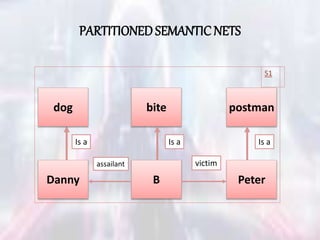
• Suppose that we wish to make a specific
statement about a dog, Danny, who has
bitten a postman, Peter:
– " Danny the dog bit Peter the postman"
• Hendrix’s Partitioned network would express
this statement as an ordinary semantic
network:
Danny
bite
B
postman
Peter
Is a Is a Is a
assailant victim
S1
dog
PARTITIONEDSEMANTICNETS
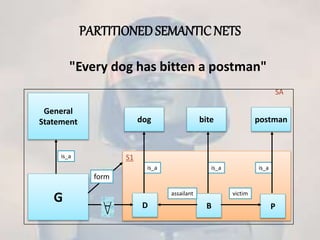
"Every dog has bitten a postman"
General
Statement dog
D
bite
B
postman
P
is_a is_a is_a
assailant victim
S1
G
form

SA
is_a
PARTITIONEDSEMANTICNETS
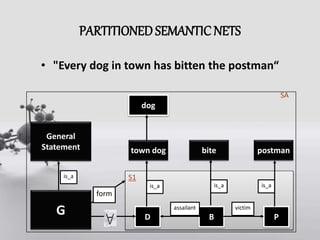
• "Every dog in town has bitten the postman“
General
Statement town dog
D
bite
B
postman
P
is_a is_a is_a
assailant victim
S1
G
form
SA
is_a

dog
"John believes that pizza is tasty"
John
believes
event
pizza tasty
object property
agent
is_a
object
has
is_a is_a
space
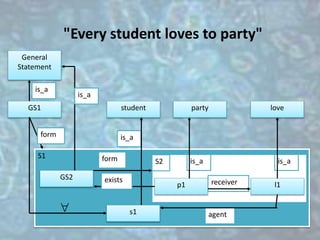
"Every student loves to party"
GS1
General
Statement
student party love
p1 l1
agent
is_a
is_a
receiver
is_a is_aS2
GS2
s1
S1

is_a
form
exists
form
advantages
• Easy to visualise and understand.
• The knowledge engineer can arbitrarily
defined the relationships.
• Related knowledge is easily
categorised.
• Efficient in space requirements.
• Related knowledge is
easily clustered.
disadvantages
• Inheritance (particularly from
multiple sources and when
exceptions in inheritance are
wanted) can cause problems.
• Facts placed inappropriately
cause problems.
• No standards about node and arc values
• This not describes the attributes.
Semantic nets in artificial intelligence

Semantic nets in artificial intelligence

  • 1.
    SEMANTIC NETS Submitted to : Ma’amAmita Sharma Efforts by: Harshita Virwani (BCA Sem - 6)
  • 2.
    Meaning of semanticnets • Semantic nets were originally proposed in the early 1960s by M. Ross Quillian to represent the meaning of English words • The basic idea behind semantic nets is that how it carries meaning of the concept and how is related with other concepts • Semantic nets consist of nodes, links (edges) and link labels.
  • 3.
    ELEMENTS USEDIN SEMANTICNETS • In the semantic network diagram, nodes appear as circles or ellipses or rectangles to represent objects such as physical objects, concepts or situations. • Links or Arcs appear as arrows to express the relationships between objects • Link Labels specify particular relations. • Relationships provide the basic structure for organizing knowledge. • As nodes are associated with other nodes semantic nets are also referred to as associative nets.
  • 4.
    Example of semanticnetwork IS A SUBSET OF SUBSET OF MEMBER OF MEMBER OFSISTER OF
  • 5.
  • 6.
    Example of semanticnetwork Is intended to represent the data: • Tom is a cat. • Tom caught a bird. • Tom is owned by John. • Tom is ginger in color. • Cats like cream. • The cat sat on the mat. • A cat is a mammal. • A bird is an animal. • All mammals are animals. • Mammals have fur.
  • 7.
    INTERSECTION SEARCH In semanticnets, to find relationships among objects are determined by spreading activation out from each of 2 nodes and identify where the activation meets. This process is called intersection search.
  • 8.
  • 9.
    Representingnon-binary predicates • Semanticnets are a natural way to represent relationships that would appear as ground instances of binary predicates in logic • For example : • Is a(baseball player, pitcher) • Is a(baseball player, fielder) • Instance(three-finger brown ,pitcher) • Instance(pee-wee Reese ,fielder) • Team(three-finger brown , Chicago cubs) • Team(pee-wee Reese ,Brooklyn dodgers)
  • 10.
  • 11.
    Making some importantdistinctions • By defining the relationship the complexity of the relation can also be easily represented in semantic nets . • For example : tom weight is 60 kg.
  • 12.
  • 13.
    PARTITIONEDSEMANTICNETS  Hendrix developedthe partitioned semantic network to represent the difference between the description of an individual object or process and the description of a set of objects. The set description involves quantification.  Hendrix partitioned a semantic network whereby a semantic network, loosely speaking, can be divided into one or more networks for the description of an individual.  The central idea of partitioning is to allow groups, nodes and arcs to be bundled together into units called spaces – fundamental entities in partitioned networks, on the same level as nodes and arcs
  • 14.
    PARTITIONEDSEMANTICNETS • Suppose thatwe wish to make a specific statement about a dog, Danny, who has bitten a postman, Peter: – " Danny the dog bit Peter the postman" • Hendrix’s Partitioned network would express this statement as an ordinary semantic network:
  • 15.
    Danny bite B postman Peter Is a Isa Is a assailant victim S1 dog PARTITIONEDSEMANTICNETS
  • 16.
    PARTITIONEDSEMANTICNETS "Every dog hasbitten a postman" General Statement dog D bite B postman P is_a is_a is_a assailant victim S1 G form  SA is_a
  • 17.
    PARTITIONEDSEMANTICNETS • "Every dogin town has bitten the postman“ General Statement town dog D bite B postman P is_a is_a is_a assailant victim S1 G form SA is_a  dog
  • 18.
    "John believes thatpizza is tasty" John believes event pizza tasty object property agent is_a object has is_a is_a space
  • 19.
    "Every student lovesto party" GS1 General Statement student party love p1 l1 agent is_a is_a receiver is_a is_aS2 GS2 s1 S1  is_a form exists form
  • 20.
    advantages • Easy tovisualise and understand. • The knowledge engineer can arbitrarily defined the relationships. • Related knowledge is easily categorised. • Efficient in space requirements. • Related knowledge is easily clustered.
  • 21.
    disadvantages • Inheritance (particularlyfrom multiple sources and when exceptions in inheritance are wanted) can cause problems. • Facts placed inappropriately cause problems. • No standards about node and arc values • This not describes the attributes.