Statistics for Tool
Standardization
Dr. Suresh Kumar Murugesan PhD
Overview
1. What is statistics?
2. Why statistics?
3. Types of Statistics
4. Statistics for tool
Standardization
5. Tips to researchers
Dr. Suresh Kumar Murugesan PhD +91 9750406463 sureshkumar800@yahoo.com
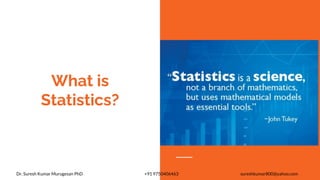
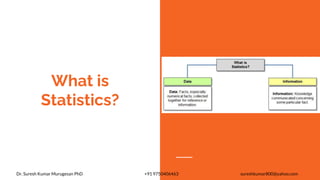
What is
Statistics?
Dr. Suresh Kumar Murugesan PhD +91 9750406463 sureshkumar800@yahoo.com
What is
Statistics?
Dr. Suresh Kumar Murugesan PhD +91 9750406463 sureshkumar800@yahoo.com
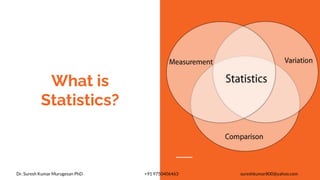
What is
Statistics?
Dr. Suresh Kumar Murugesan PhD +91 9750406463 sureshkumar800@yahoo.com
Whats is
Statistics?
Statistics is the
science of collecting,
organising,
analysing and
interpreting data in
order to make
decisions.
Dr. Suresh Kumar Murugesan PhD +91 9750406463 sureshkumar800@yahoo.com
Skills
required for
Statisticians
● Strong Foundation in Mathematical
Statistics
● Logical Thinking & Ability to Comprehend
Key Facts
● Ability to Interact with people from various
fields to understand the problems
● Strong Background in Statistical
Computing
● Ability to stay updated on recent literature
& statistical software
● Versatility in solving problems
Dr. Suresh Kumar Murugesan PhD +91 9750406463 sureshkumar800@yahoo.com
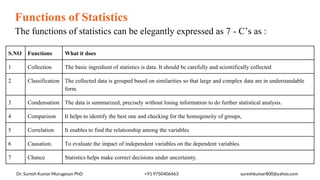
S.NO Functions What it does
1 Collection The basic ingredient of statistics is data. It should be carefully and scientifically collected
2 Classification The collected data is grouped based on similarities so that large and complex data are in understandable
form.
3 Condensation The data is summarized, precisely without losing information to do further statistical analysis.
4 Comparison It helps to identify the best one and checking for the homogeneity of groups,
5 Correlation It enables to find the relationship among the variables
6 Causation. To evaluate the impact of independent variables on the dependent variables.
7 Chance Statistics helps make correct decisions under uncertainty.
Functions of Statistics
The functions of statistics can be elegantly expressed as 7 - C’s as :
Dr. Suresh Kumar Murugesan PhD +91 9750406463 sureshkumar800@yahoo.com
The
general
guidelines
for
a
good
questionnaire
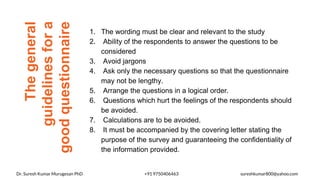
1. The wording must be clear and relevant to the study
2. Ability of the respondents to answer the questions to be
considered
3. Avoid jargons
4. Ask only the necessary questions so that the questionnaire
may not be lengthy.
5. Arrange the questions in a logical order.
6. Questions which hurt the feelings of the respondents should
be avoided.
7. Calculations are to be avoided.
8. It must be accompanied by the covering letter stating the
purpose of the survey and guaranteeing the confidentiality of
the information provided.
Dr. Suresh Kumar Murugesan PhD +91 9750406463 sureshkumar800@yahoo.com
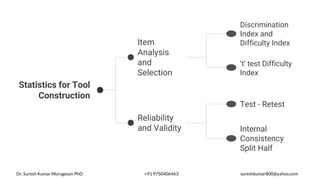
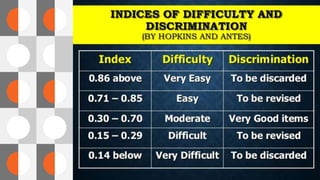
Discrimination
Index and
Difficulty Index
Item
Analysis
and
Selection
Statistics for Tool
Construction
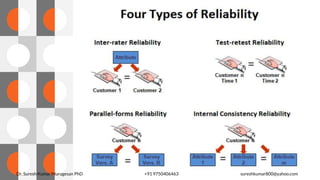
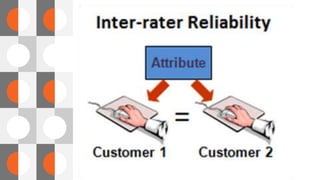
Reliability
and Validity
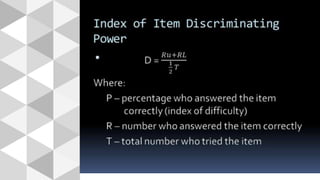
‘t’ test Difficulty
Index
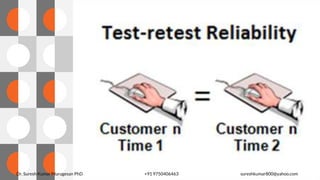
Test - Retest
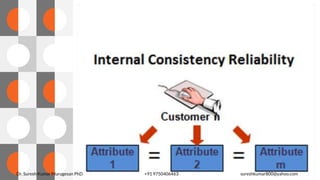
Internal
Consistency
Split Half
Dr. Suresh Kumar Murugesan PhD +91 9750406463 sureshkumar800@yahoo.com
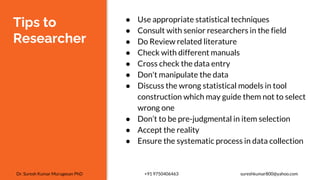
Tips to
Researcher
● Use appropriate statistical techniques
● Consult with senior researchers in the field
● Do Review related literature
● Check with different manuals
● Cross check the data entry
● Don't manipulate the data
● Discuss the wrong statistical models in tool
construction which may guide them not to select
wrong one
● Don’t to be pre-judgmental in item selection
● Accept the reality
● Ensure the systematic process in data collection
Dr. Suresh Kumar Murugesan PhD +91 9750406463 sureshkumar800@yahoo.com
Reference
1. https://www.sixsigma-institute.org/What_Is_Statistics.php
2. http://tnschools.gov.in/media/textbooks/11_Statistics_EM.pdf
3. https://www.allassignmenthelp.com/blog/free-statistics-software/
4. https://research-methodology.net/research-methodology/reliability-validity-
and-repeatability/research-reliability/
5. https://www.slideshare.net/YeeBeeChoo/topic-8b-item-analysis
Dr. Suresh Kumar Murugesan PhD +91 9750406463 sureshkumar800@yahoo.com
Statistics for tool standardisation

Statistics for tool standardisation

  • 1.
    Statistics for Tool Standardization Dr.Suresh Kumar Murugesan PhD
  • 2.
    Overview 1. What isstatistics? 2. Why statistics? 3. Types of Statistics 4. Statistics for tool Standardization 5. Tips to researchers Dr. Suresh Kumar Murugesan PhD +91 9750406463 sureshkumar800@yahoo.com
  • 3.
    What is Statistics? Dr. SureshKumar Murugesan PhD +91 9750406463 sureshkumar800@yahoo.com
  • 4.
    What is Statistics? Dr. SureshKumar Murugesan PhD +91 9750406463 sureshkumar800@yahoo.com
  • 5.
    What is Statistics? Dr. SureshKumar Murugesan PhD +91 9750406463 sureshkumar800@yahoo.com
  • 6.
    Whats is Statistics? Statistics isthe science of collecting, organising, analysing and interpreting data in order to make decisions. Dr. Suresh Kumar Murugesan PhD +91 9750406463 sureshkumar800@yahoo.com
  • 7.
    Skills required for Statisticians ● StrongFoundation in Mathematical Statistics ● Logical Thinking & Ability to Comprehend Key Facts ● Ability to Interact with people from various fields to understand the problems ● Strong Background in Statistical Computing ● Ability to stay updated on recent literature & statistical software ● Versatility in solving problems Dr. Suresh Kumar Murugesan PhD +91 9750406463 sureshkumar800@yahoo.com
  • 8.
    S.NO Functions Whatit does 1 Collection The basic ingredient of statistics is data. It should be carefully and scientifically collected 2 Classification The collected data is grouped based on similarities so that large and complex data are in understandable form. 3 Condensation The data is summarized, precisely without losing information to do further statistical analysis. 4 Comparison It helps to identify the best one and checking for the homogeneity of groups, 5 Correlation It enables to find the relationship among the variables 6 Causation. To evaluate the impact of independent variables on the dependent variables. 7 Chance Statistics helps make correct decisions under uncertainty. Functions of Statistics The functions of statistics can be elegantly expressed as 7 - C’s as : Dr. Suresh Kumar Murugesan PhD +91 9750406463 sureshkumar800@yahoo.com
  • 9.
    Dr. Suresh KumarMurugesan PhD +91 9750406463 sureshkumar800@yahoo.com
  • 10.
    The general guidelines for a good questionnaire 1. The wordingmust be clear and relevant to the study 2. Ability of the respondents to answer the questions to be considered 3. Avoid jargons 4. Ask only the necessary questions so that the questionnaire may not be lengthy. 5. Arrange the questions in a logical order. 6. Questions which hurt the feelings of the respondents should be avoided. 7. Calculations are to be avoided. 8. It must be accompanied by the covering letter stating the purpose of the survey and guaranteeing the confidentiality of the information provided. Dr. Suresh Kumar Murugesan PhD +91 9750406463 sureshkumar800@yahoo.com
  • 11.
    Dr. Suresh KumarMurugesan PhD +91 9750406463 sureshkumar800@yahoo.com
  • 12.
    Discrimination Index and Difficulty Index Item Analysis and Selection Statisticsfor Tool Construction Reliability and Validity ‘t’ test Difficulty Index Test - Retest Internal Consistency Split Half Dr. Suresh Kumar Murugesan PhD +91 9750406463 sureshkumar800@yahoo.com
  • 14.
    Dr. Suresh KumarMurugesan PhD +91 9750406463 sureshkumar800@yahoo.com
  • 15.
    Dr. Suresh KumarMurugesan PhD +91 9750406463 sureshkumar800@yahoo.com
  • 16.
    Dr. Suresh KumarMurugesan PhD +91 9750406463 sureshkumar800@yahoo.com
  • 17.
    Dr. Suresh KumarMurugesan PhD +91 9750406463 sureshkumar800@yahoo.com
  • 20.
    Dr. Suresh KumarMurugesan PhD +91 9750406463 sureshkumar800@yahoo.com
  • 22.
    Dr. Suresh KumarMurugesan PhD +91 9750406463 sureshkumar800@yahoo.com
  • 23.
    Dr. Suresh KumarMurugesan PhD +91 9750406463 sureshkumar800@yahoo.com
  • 24.
    Dr. Suresh KumarMurugesan PhD +91 9750406463 sureshkumar800@yahoo.com
  • 25.
    Tips to Researcher ● Useappropriate statistical techniques ● Consult with senior researchers in the field ● Do Review related literature ● Check with different manuals ● Cross check the data entry ● Don't manipulate the data ● Discuss the wrong statistical models in tool construction which may guide them not to select wrong one ● Don’t to be pre-judgmental in item selection ● Accept the reality ● Ensure the systematic process in data collection Dr. Suresh Kumar Murugesan PhD +91 9750406463 sureshkumar800@yahoo.com
  • 26.
    Reference 1. https://www.sixsigma-institute.org/What_Is_Statistics.php 2. http://tnschools.gov.in/media/textbooks/11_Statistics_EM.pdf 3.https://www.allassignmenthelp.com/blog/free-statistics-software/ 4. https://research-methodology.net/research-methodology/reliability-validity- and-repeatability/research-reliability/ 5. https://www.slideshare.net/YeeBeeChoo/topic-8b-item-analysis Dr. Suresh Kumar Murugesan PhD +91 9750406463 sureshkumar800@yahoo.com