Tele Counselling
Dr.Suresh Kumar Murugesan PhD
Yellow
Pond
About the Presenter
● Dr.Suresh Kumar Murugesan is a passionate Professor, researcher
and Mental Health Practitioner from Madurai, Tamil Nadu, India
● At present he is Heading the department of Psychology, The
American College, Madurai and Adjunct Professor of School of
Behavioural Sciences and Education at TAU
● He is very keen in learning new research studies in behavioural
Sciences and open to learn.
● His ultimate aim is to make impression in the field of Knowledge
● His area of specializations are Psychometry, Counselling &
Psychotherapy
Yellow
Pond
Disclaimer
● This presentation is prepared
for learning purpose only and
all the images and pictures
used in this presentation are
taken from google image
search.
● Due recognition was given to
all the material collected from
the various sources.
● Any name or reference is
missed kindly bring it to the
notice of the presenter for
inclusion.
● Email -
sureshkumar800@yahoo.com
Thank you
Yellow
Pond
What?
Yellow
Pond
Tele Counselling
Telephone counseling refers to any type of psychological service performed
over the telephone.
Teletherapy is mental health counseling over the phone or online.
Yellow
Pond
Other Close Terminology
● Teletherapy
● Telehealth
● Tele Psychotherapy
● Telemedicine
● Telephone Counselling
● Tele mental Health
● Tele Psychology
● Tele Guidance
● Telepsychiatry
Yellow
Pond
Telephone Counselling
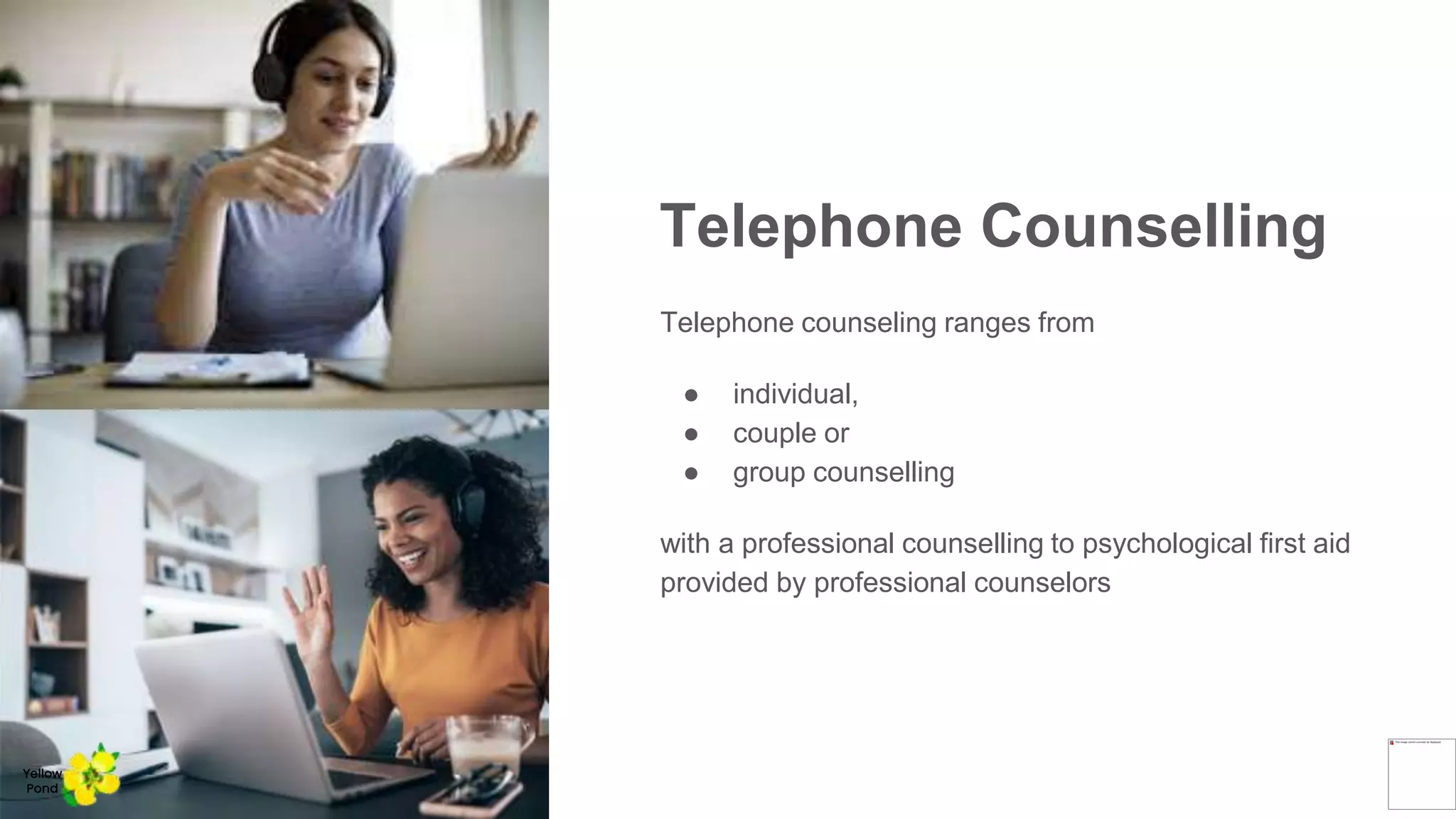
Telephone counseling ranges from
● individual,
● couple or
● group counselling
with a professional counselling to psychological first aid
provided by professional counselors
Yellow
Pond
Modes of Tele
Counselling
Tele Counselling refers to the provision of counselling
services using telecommunication technologies including
● email,
● text messaging,
● video conferencing,
● online chat,
● messaging, or
● internet phone.
Yellow
Pond
Tele Counselling
Tele counselling is any remote counselling that uses
technology to help the counsellor and client communicate.
Some examples of teletherapy include:
● doing counselling sessions over the phone
● having a group chat for group therapy
● using videoconferencing for individual, couples, or
group counselling
● receiving counselling via email or instant messenger
● using apps that connect clients to counsellors and
offer counselling within the app
Yellow
Pond
Who?
Yellow
Pond
Who can provide tele
Counselling?
Although anyone can offer to support another person
online or over the phone, only trained professionals can
describe their services as therapy. Professionally qualified
Counselors can provide tele counselling .
Some examples of professionals who may provide tele
Counselling include:
● Qualified professional counselors
● Qualified marriage and family therapists
● Qualified clinical social workers
● Qualified psychologists
● Qualified psychiatrists
Yellow
Pond
Why?
Yellow
Pond
Telehealth and Counselling
Use of telehealth, especially for mental health care, has increased rapidly
because of the desire to provide health care to underserved populations,
reduce health care costs, and meet consumers’ desires (Glueckauf et al.,
2003).
Yellow
Pond
Barriers to Face to Face
Counselling
A number of barriers to traditional face-to-face counselling
may prevent people from obtaining the help they need,
including transportation issues, need for childcare,
perceived stigma, and difficulty leaving work (Bee, Lovell,
Lidbetter, Easton, & Gask, 2010; Mohr et al., 2005).
Yellow
Pond
Barrier to Counselling
Over two thirds of depressed patients in a primary care
setting reported at least one practical barrier (e.g.,
transportation difficulties) that hampered their ability to
attend counselling/psychotherapy regularly (Mohr et al.
2006).
Telephone-delivered psychotherapy can minimize such
barriers, either as the primary method of delivering
psychotherapy or as an adjunct to face-to-face
psychotherapy.
Yellow
Pond
Convenience
Telephone-delivered psychotherapy offers increased client convenience with
respect to location and flexible timing of appointments (Simon, Ludman, Tutty,
Operskalski, & Von Korff, 2004; Tutty, Ludman, & Simon, 2005; Tutty,
Spangler, Poppleton, Ludman, & Simon, 2010).
Yellow
Pond
Privacy
Clients can complete sessions at home in privacy, which
may reduce concerns about stigma related to mental
health treatment (Mozer, Franklin, & Rose, 2008; Simon et
al., 2004) and potentially be less threatening than face-to-
face sessions for some clients.
Yellow
Pond
Cater all
In essence, psychotherapy by telephone makes treatment available to people
who may not otherwise receive mental health care (Mohr et al., 2010; Simon et
al., 2004).
Yellow
Pond
Older / Rural Client
Clients who could benefit from improved
access to psychotherapy include older
adults, individuals who lack local service
providers (especially rural residents),
homebound individuals or those with
chronic medical illnesses, active military
personnel who may prefer care from
military providers, and incarcerated clients
(Glueckauf et al., 2003).
Yellow
Pond
Benefits
Yellow
Pond
Benefits of Tele
Counselling
For clients
Most research suggests that tele counselling can be as
effective as in-person counselling. The benefits of seeking
research-supported tele counselling with a professional
counsellors include:
● Greater access to care:
● Lower costs
● High satisfaction
● More privacy
● Better public health
● Positive Mental Health
Yellow
Pond
Greater access to care
Some people are unable to use traditional counselling due
to
● physical disabilities,
● geographic location, or
● scheduling issues.
Yellow
Pond
Lower costs
● Tele counselling may help clients save money on
treatment.
● Clients are also likely to incur fewer counselling-
associated expenses when they do not have to
travel to receive treatment or pay for child care.
Yellow
Pond
High satisfaction
Users of quality tele counselling report high satisfaction with treatment.
Yellow
Pond
More privacy:
People who choose tele counselling do not have to sit in busy waiting rooms
but can seek treatment in the privacy of their own homes. For some, this
alleviates privacy concerns.
Yellow
Pond
Better public health:
The COVID-19 health crisis demonstrates that the ability
to seek medical care at home can slow the spread of
illness and protect vulnerable populations.
Yellow
Pond
Mental Health
Tele counselling allows people to get mental health treatment and positive
mental health training at home without risking the spread of infection during
epidemics and pandemics.
Yellow
Pond
For therapists
Some therapists may find that teletherapy suits
their personal style and allows them to meet their
practice goals. Some benefits include:
● Reduced overheads
● The ability to reach more clients.
● A shorter commute
Yellow
Pond
Reduced overheads:
● Maintaining an office can be expensive.
● Counsellors who switch to a telehealth-
only model can eliminate many of their
overheads.
● Those who offer part-time tele
Counselling may be able to rent office
space on just a few days of the week,
lowering costs.
Yellow
Pond
The ability to reach
more clients:
● Telehealth may improve access to
therapy for people with disabilities,
financial worries, transportation
difficulties, and other barriers.
● This improved access enables
counsellors to help more people.
Widening their potential consumer
base can help therapists earn more
money.
Yellow
Pond
A shorter commute:
A therapist who exclusively offers tele
counselling may be able to support clients
from home, reducing or eliminating their
commute.
Yellow
Pond
Challenges
Yellow
Pond
Challenges in tele Counselling
Challenges Suggested Ways to Address Challenge
Lack of control over
environment
Set boundaries and require privacy at the start of the relationship
Privacy/confidentiality Complete written informed consent for treatment reviewing service that will be provided and
limits of confidentiality when using electronic communications (e.g., wireless telephones, cell
phones); verify that person on phone is the client
Therapeutic alliance Set expectations for psychotherapy; inform clients that they will have the psychotherapist's
undivided attention; provide picture of psychotherapist; carefully attend to nonverbal cues
Ethical/legal issues Practice only in state in which licensed; review informed consent for treatment prior to the start
of treatment
Crisis situations Exclude patients who are actively suicidal at intake; have knowledge of resources available to
clients within their county/town
Psychotherapist adjustment
to telephone psychotherapy
Provide training that focuses on strengthening and modifying reflective listening skills, use of
psychotherapist's voice to convey warmth and emotion, and attentiveness to solely auditory
cues from clients
Yellow
Pond
Limitations
Yellow
Pond
Limitations and
disadvantages of tele
Counselling
For therapy clients
Telet Counselling is not for everyone. Some
drawbacks include:
● Compliance
● Therapy environment
● Technical difficulties
● Communication
Yellow
Pond
Compliance:
The Health Insurance Portability and
Accountability Act (HIPAA) requires healthcare
providers, including counsellor, to protect
patient or client privacy.
Unsecure chat and other programmes may
expose sensitive data, so clients should work
only with counsellors who encrypt data.
Yellow
Pond
Therapy
environment:
For people with little privacy at home,
finding the time and space for therapy can
be stressful.
Treatment in the office may offer a low
stress alternative to treatment at home.
Yellow
Pond
Technical
difficulties:
● Slow internet connections, glitches in
video software, and communication
delays can make online therapy feel
more stressful and less personal.
● For people who lack technological
proficiency or do not trust digital
platforms, telehealth may not be a
good option.
Yellow
Pond
Communication:
Communicating across a digital channel
can make it more difficult to read body
language and other subtle cues.
Email and phone therapy eliminate these
forms of communication.
Yellow
Pond
Limitations For Tele
Counsellors
Some challenges that counselors may
face with digital therapy include:
● Ethical and legal issues
● More client anonymity
● Client privacy
● Communication barriers
Yellow
Pond
Ethical and legal
issues:
● Therapists must comply with state
licensing board regulations in both the
state where they practice and the state
where they treat a client.
● This compliance can require significant
legal knowledge, and violating the law
could endanger a therapist’s license.
Yellow
Pond
More client anonymity:
● When therapists meet with clients on
a digital platform, it may be more
difficult to support those who pose a
danger to themselves or others.
● Clients may even be able to conceal
their identities.
● Therapists have a duty to warn the
proper authorities if a client is at risk
of harming themselves or others,
and client anonymity can make this
more difficult, potentially interfering
with the therapist’s ethical
obligations.
Yellow
Pond
Client privacy:
● Therapists must comply
with Ethical guidelines and
other privacy laws.
● Choosing the right
platform and taking
proactive steps to secure
client data demands time
and technical proficiency.
Yellow
Pond
Communication
barriers:
● It can take longer to establish a
strong rapport with clients over digital
networks.
● Some therapists may struggle to
read body language and other subtle
forms of communication, making it
more difficult to offer high quality
treatment.
Yellow
Pond
How?
Yellow
Pond
How Tele Counselling Works?
In this stage, the organization should promote what are
the services will be provided?, What are benefits?, Who
can access? Etc in Social Media, in Person, other channels
Awareness
1. Consent form
2. Booking an appointment
3. Collection of Preliminary data and
4. Sharing the session link to the client
Initiation
● Rapport building - Counsellor and Client,
● Applying counselling skills to make the client to
understand the current state and enable them
to make their own decision
● Feedback and Evaluation
Counselling Process
Termination of the session and Follow up
Termination
Yellow
Pond
How a teletherapy session works
While it is possible to do teletherapy via email or phone, contemporary telemental health sessions typically use video chat.
The therapeutic process is similar to in-person therapy. It usually begins with a few initial sessions during which the therapist and client
get to know one another and discuss treatment goals. After that, the therapist may dig more deeply into the client’s issues, make
recommendations for behavioral changes, and encourage the client to reflect on their emotions.
The therapist may ask the client to take steps to ensure confidentiality. These might include:
● logging on from a private network
● keeping their computer locked to prevent others from viewing the session
● accessing therapy via an encrypted therapy platform
Clients should also ask their therapists what specific steps they take to protect client confidentiality and prevent third parties from
viewing sessions or session notes.
Counselling Session Recording Form
(Name of the Institute/Hospital/Centre with address)
Client record no._____________
COUNSELLORS SESSION NOTES
Client name:
Age:
Gender:
Psychometric Assessment:
Session number & date:
Duration of session:
Session Participants:
Counselling technique / method:
Individual Objectives of the session:
1.
2.
3.
4.
Key issues/themes discussed: (Psychosocial
stressors/Interpersonal problems/Intrapsychic
conflicts/Crisis situations/Conduct difficulties/Behavioural
difficulties/ Emotional difficulties/ Developmental
difficulties/ Adjustment issues/ Addictive
behaviours/Others)
Counselling techniques used:
Counsellors observations and reflections:
Plan for next session:
Date for next session:
Counsellor Name:
Qualification:
Date
Signature:
Yellow
Pond
References
1. Zawn Villines (April 20, 2020). Teletherapy: How it works. https://www.medicalnewstoday.com/articles/teletherapy
2. TelePsychotherapy Guideline by NIMHANS. https://nimhans.ac.in/wp-content/uploads/2020/04/Guidelines-for-
Telepsychotherapy-Services-17.4.2020.pdf
3. Therapist (21st February, 2014). Learn more about telephone counselling. https://www.counselling-
directory.org.uk/memberarticles/learn-more-about-telephone-counselling
4. Arteo (Unknown). Telephone counselling pros and cons. https://www.uktherapyguide.com/news-and-blog/telephone-
counselling-pros-and-cons/nblog1180
5. SNEHA Tele Counselling Manual. https://snehamumbai.org/wp-content/uploads/2020/11/Telecounselling-Manual.pdf
6. Brenes, G. A., Ingram, C. W., & Danhauer, S. C. (2011). Benefits and Challenges of Conducting Psychotherapy by Telephone. Professional
psychology, research and practice, 42(6), 543–549. https://doi.org/10.1037/a0026135

Tele counselling

  • 1.
    Tele Counselling Dr.Suresh KumarMurugesan PhD Yellow Pond
  • 2.
    About the Presenter ●Dr.Suresh Kumar Murugesan is a passionate Professor, researcher and Mental Health Practitioner from Madurai, Tamil Nadu, India ● At present he is Heading the department of Psychology, The American College, Madurai and Adjunct Professor of School of Behavioural Sciences and Education at TAU ● He is very keen in learning new research studies in behavioural Sciences and open to learn. ● His ultimate aim is to make impression in the field of Knowledge ● His area of specializations are Psychometry, Counselling & Psychotherapy Yellow Pond
  • 3.
    Disclaimer ● This presentationis prepared for learning purpose only and all the images and pictures used in this presentation are taken from google image search. ● Due recognition was given to all the material collected from the various sources. ● Any name or reference is missed kindly bring it to the notice of the presenter for inclusion. ● Email - sureshkumar800@yahoo.com Thank you Yellow Pond
  • 4.
  • 5.
    Tele Counselling Telephone counselingrefers to any type of psychological service performed over the telephone. Teletherapy is mental health counseling over the phone or online. Yellow Pond
  • 6.
    Other Close Terminology ●Teletherapy ● Telehealth ● Tele Psychotherapy ● Telemedicine ● Telephone Counselling ● Tele mental Health ● Tele Psychology ● Tele Guidance ● Telepsychiatry Yellow Pond
  • 7.
    Telephone Counselling Telephone counselingranges from ● individual, ● couple or ● group counselling with a professional counselling to psychological first aid provided by professional counselors Yellow Pond
  • 8.
    Modes of Tele Counselling TeleCounselling refers to the provision of counselling services using telecommunication technologies including ● email, ● text messaging, ● video conferencing, ● online chat, ● messaging, or ● internet phone. Yellow Pond
  • 9.
    Tele Counselling Tele counsellingis any remote counselling that uses technology to help the counsellor and client communicate. Some examples of teletherapy include: ● doing counselling sessions over the phone ● having a group chat for group therapy ● using videoconferencing for individual, couples, or group counselling ● receiving counselling via email or instant messenger ● using apps that connect clients to counsellors and offer counselling within the app Yellow Pond
  • 10.
  • 11.
    Who can providetele Counselling? Although anyone can offer to support another person online or over the phone, only trained professionals can describe their services as therapy. Professionally qualified Counselors can provide tele counselling . Some examples of professionals who may provide tele Counselling include: ● Qualified professional counselors ● Qualified marriage and family therapists ● Qualified clinical social workers ● Qualified psychologists ● Qualified psychiatrists Yellow Pond
  • 12.
  • 13.
    Telehealth and Counselling Useof telehealth, especially for mental health care, has increased rapidly because of the desire to provide health care to underserved populations, reduce health care costs, and meet consumers’ desires (Glueckauf et al., 2003). Yellow Pond
  • 14.
    Barriers to Faceto Face Counselling A number of barriers to traditional face-to-face counselling may prevent people from obtaining the help they need, including transportation issues, need for childcare, perceived stigma, and difficulty leaving work (Bee, Lovell, Lidbetter, Easton, & Gask, 2010; Mohr et al., 2005). Yellow Pond
  • 15.
    Barrier to Counselling Overtwo thirds of depressed patients in a primary care setting reported at least one practical barrier (e.g., transportation difficulties) that hampered their ability to attend counselling/psychotherapy regularly (Mohr et al. 2006). Telephone-delivered psychotherapy can minimize such barriers, either as the primary method of delivering psychotherapy or as an adjunct to face-to-face psychotherapy. Yellow Pond
  • 16.
    Convenience Telephone-delivered psychotherapy offersincreased client convenience with respect to location and flexible timing of appointments (Simon, Ludman, Tutty, Operskalski, & Von Korff, 2004; Tutty, Ludman, & Simon, 2005; Tutty, Spangler, Poppleton, Ludman, & Simon, 2010). Yellow Pond
  • 17.
    Privacy Clients can completesessions at home in privacy, which may reduce concerns about stigma related to mental health treatment (Mozer, Franklin, & Rose, 2008; Simon et al., 2004) and potentially be less threatening than face-to- face sessions for some clients. Yellow Pond
  • 18.
    Cater all In essence,psychotherapy by telephone makes treatment available to people who may not otherwise receive mental health care (Mohr et al., 2010; Simon et al., 2004). Yellow Pond
  • 19.
    Older / RuralClient Clients who could benefit from improved access to psychotherapy include older adults, individuals who lack local service providers (especially rural residents), homebound individuals or those with chronic medical illnesses, active military personnel who may prefer care from military providers, and incarcerated clients (Glueckauf et al., 2003). Yellow Pond
  • 20.
  • 21.
    Benefits of Tele Counselling Forclients Most research suggests that tele counselling can be as effective as in-person counselling. The benefits of seeking research-supported tele counselling with a professional counsellors include: ● Greater access to care: ● Lower costs ● High satisfaction ● More privacy ● Better public health ● Positive Mental Health Yellow Pond
  • 22.
    Greater access tocare Some people are unable to use traditional counselling due to ● physical disabilities, ● geographic location, or ● scheduling issues. Yellow Pond
  • 23.
    Lower costs ● Telecounselling may help clients save money on treatment. ● Clients are also likely to incur fewer counselling- associated expenses when they do not have to travel to receive treatment or pay for child care. Yellow Pond
  • 24.
    High satisfaction Users ofquality tele counselling report high satisfaction with treatment. Yellow Pond
  • 25.
    More privacy: People whochoose tele counselling do not have to sit in busy waiting rooms but can seek treatment in the privacy of their own homes. For some, this alleviates privacy concerns. Yellow Pond
  • 26.
    Better public health: TheCOVID-19 health crisis demonstrates that the ability to seek medical care at home can slow the spread of illness and protect vulnerable populations. Yellow Pond
  • 27.
    Mental Health Tele counsellingallows people to get mental health treatment and positive mental health training at home without risking the spread of infection during epidemics and pandemics. Yellow Pond
  • 28.
    For therapists Some therapistsmay find that teletherapy suits their personal style and allows them to meet their practice goals. Some benefits include: ● Reduced overheads ● The ability to reach more clients. ● A shorter commute Yellow Pond
  • 29.
    Reduced overheads: ● Maintainingan office can be expensive. ● Counsellors who switch to a telehealth- only model can eliminate many of their overheads. ● Those who offer part-time tele Counselling may be able to rent office space on just a few days of the week, lowering costs. Yellow Pond
  • 30.
    The ability toreach more clients: ● Telehealth may improve access to therapy for people with disabilities, financial worries, transportation difficulties, and other barriers. ● This improved access enables counsellors to help more people. Widening their potential consumer base can help therapists earn more money. Yellow Pond
  • 31.
    A shorter commute: Atherapist who exclusively offers tele counselling may be able to support clients from home, reducing or eliminating their commute. Yellow Pond
  • 32.
  • 33.
    Challenges in teleCounselling Challenges Suggested Ways to Address Challenge Lack of control over environment Set boundaries and require privacy at the start of the relationship Privacy/confidentiality Complete written informed consent for treatment reviewing service that will be provided and limits of confidentiality when using electronic communications (e.g., wireless telephones, cell phones); verify that person on phone is the client Therapeutic alliance Set expectations for psychotherapy; inform clients that they will have the psychotherapist's undivided attention; provide picture of psychotherapist; carefully attend to nonverbal cues Ethical/legal issues Practice only in state in which licensed; review informed consent for treatment prior to the start of treatment Crisis situations Exclude patients who are actively suicidal at intake; have knowledge of resources available to clients within their county/town Psychotherapist adjustment to telephone psychotherapy Provide training that focuses on strengthening and modifying reflective listening skills, use of psychotherapist's voice to convey warmth and emotion, and attentiveness to solely auditory cues from clients Yellow Pond
  • 34.
  • 35.
    Limitations and disadvantages oftele Counselling For therapy clients Telet Counselling is not for everyone. Some drawbacks include: ● Compliance ● Therapy environment ● Technical difficulties ● Communication Yellow Pond
  • 36.
    Compliance: The Health InsurancePortability and Accountability Act (HIPAA) requires healthcare providers, including counsellor, to protect patient or client privacy. Unsecure chat and other programmes may expose sensitive data, so clients should work only with counsellors who encrypt data. Yellow Pond
  • 37.
    Therapy environment: For people withlittle privacy at home, finding the time and space for therapy can be stressful. Treatment in the office may offer a low stress alternative to treatment at home. Yellow Pond
  • 38.
    Technical difficulties: ● Slow internetconnections, glitches in video software, and communication delays can make online therapy feel more stressful and less personal. ● For people who lack technological proficiency or do not trust digital platforms, telehealth may not be a good option. Yellow Pond
  • 39.
    Communication: Communicating across adigital channel can make it more difficult to read body language and other subtle cues. Email and phone therapy eliminate these forms of communication. Yellow Pond
  • 40.
    Limitations For Tele Counsellors Somechallenges that counselors may face with digital therapy include: ● Ethical and legal issues ● More client anonymity ● Client privacy ● Communication barriers Yellow Pond
  • 41.
    Ethical and legal issues: ●Therapists must comply with state licensing board regulations in both the state where they practice and the state where they treat a client. ● This compliance can require significant legal knowledge, and violating the law could endanger a therapist’s license. Yellow Pond
  • 42.
    More client anonymity: ●When therapists meet with clients on a digital platform, it may be more difficult to support those who pose a danger to themselves or others. ● Clients may even be able to conceal their identities. ● Therapists have a duty to warn the proper authorities if a client is at risk of harming themselves or others, and client anonymity can make this more difficult, potentially interfering with the therapist’s ethical obligations. Yellow Pond
  • 43.
    Client privacy: ● Therapistsmust comply with Ethical guidelines and other privacy laws. ● Choosing the right platform and taking proactive steps to secure client data demands time and technical proficiency. Yellow Pond
  • 44.
    Communication barriers: ● It cantake longer to establish a strong rapport with clients over digital networks. ● Some therapists may struggle to read body language and other subtle forms of communication, making it more difficult to offer high quality treatment. Yellow Pond
  • 45.
  • 46.
    How Tele CounsellingWorks? In this stage, the organization should promote what are the services will be provided?, What are benefits?, Who can access? Etc in Social Media, in Person, other channels Awareness 1. Consent form 2. Booking an appointment 3. Collection of Preliminary data and 4. Sharing the session link to the client Initiation ● Rapport building - Counsellor and Client, ● Applying counselling skills to make the client to understand the current state and enable them to make their own decision ● Feedback and Evaluation Counselling Process Termination of the session and Follow up Termination Yellow Pond
  • 47.
    How a teletherapysession works While it is possible to do teletherapy via email or phone, contemporary telemental health sessions typically use video chat. The therapeutic process is similar to in-person therapy. It usually begins with a few initial sessions during which the therapist and client get to know one another and discuss treatment goals. After that, the therapist may dig more deeply into the client’s issues, make recommendations for behavioral changes, and encourage the client to reflect on their emotions. The therapist may ask the client to take steps to ensure confidentiality. These might include: ● logging on from a private network ● keeping their computer locked to prevent others from viewing the session ● accessing therapy via an encrypted therapy platform Clients should also ask their therapists what specific steps they take to protect client confidentiality and prevent third parties from viewing sessions or session notes.
  • 48.
    Counselling Session RecordingForm (Name of the Institute/Hospital/Centre with address) Client record no._____________ COUNSELLORS SESSION NOTES Client name: Age: Gender: Psychometric Assessment: Session number & date: Duration of session: Session Participants: Counselling technique / method: Individual Objectives of the session: 1. 2. 3. 4. Key issues/themes discussed: (Psychosocial stressors/Interpersonal problems/Intrapsychic conflicts/Crisis situations/Conduct difficulties/Behavioural difficulties/ Emotional difficulties/ Developmental difficulties/ Adjustment issues/ Addictive behaviours/Others) Counselling techniques used: Counsellors observations and reflections: Plan for next session: Date for next session: Counsellor Name: Qualification: Date Signature: Yellow Pond
  • 49.
    References 1. Zawn Villines(April 20, 2020). Teletherapy: How it works. https://www.medicalnewstoday.com/articles/teletherapy 2. TelePsychotherapy Guideline by NIMHANS. https://nimhans.ac.in/wp-content/uploads/2020/04/Guidelines-for- Telepsychotherapy-Services-17.4.2020.pdf 3. Therapist (21st February, 2014). Learn more about telephone counselling. https://www.counselling- directory.org.uk/memberarticles/learn-more-about-telephone-counselling 4. Arteo (Unknown). Telephone counselling pros and cons. https://www.uktherapyguide.com/news-and-blog/telephone- counselling-pros-and-cons/nblog1180 5. SNEHA Tele Counselling Manual. https://snehamumbai.org/wp-content/uploads/2020/11/Telecounselling-Manual.pdf 6. Brenes, G. A., Ingram, C. W., & Danhauer, S. C. (2011). Benefits and Challenges of Conducting Psychotherapy by Telephone. Professional psychology, research and practice, 42(6), 543–549. https://doi.org/10.1037/a0026135