
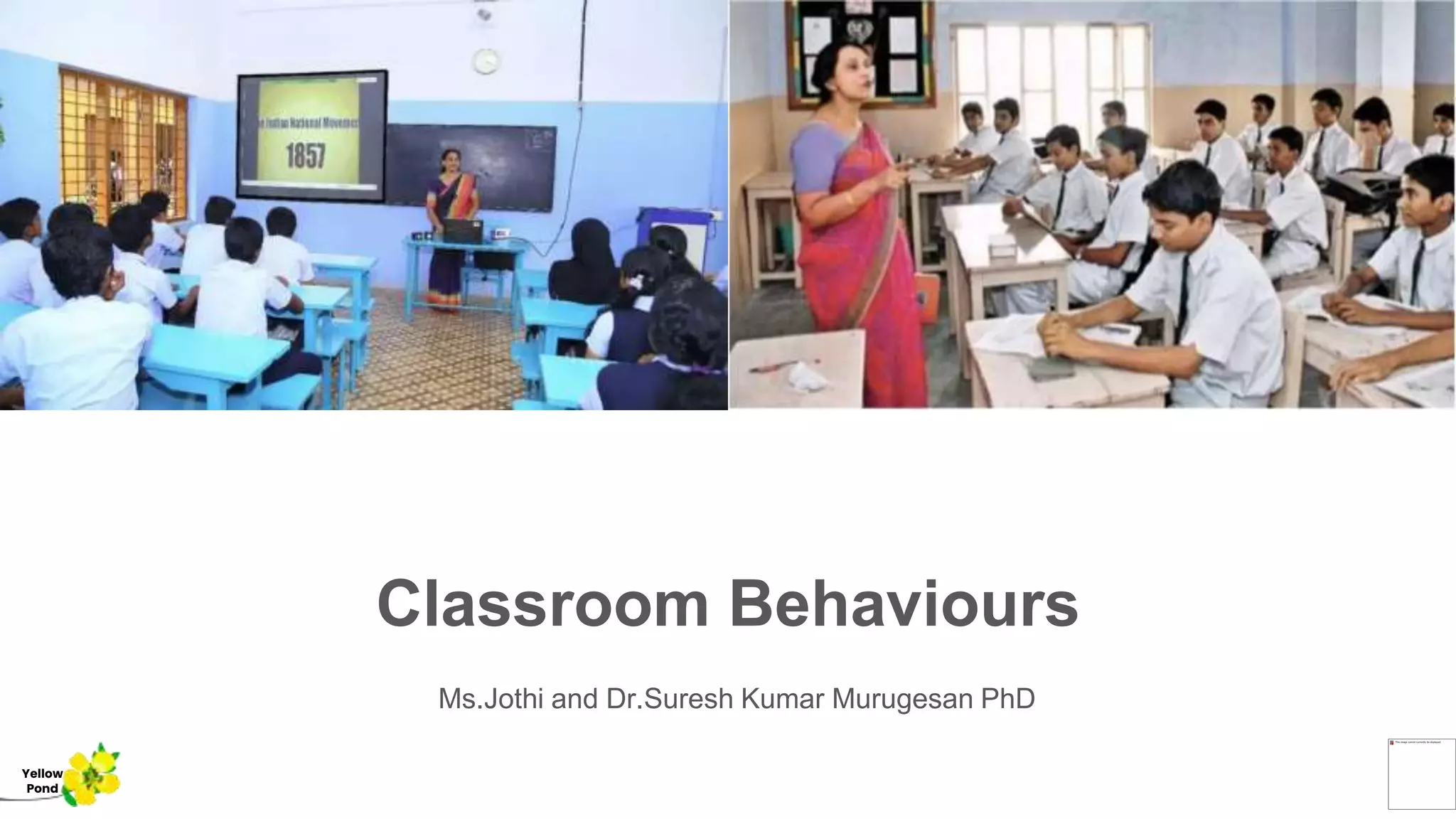









Classroom Behaviours
Ms.Jothi and Dr.Suresh Kumar Murugesan PhD
Yellow
Pond
About the Presenters
● Ms.jothi and Dr.Suresh Kumar Murugesan PhD are
the Founders of Yellow Pond Counselling and
Wellness Centre, Tamil Nadu, India
● They are passionate Positive Mental Health
Practitioners
● They are specialized in Positive Psychology and
Counselling
● They are the founding and life members of Tamil
Nadu Career Counsellors Association
● Both of them conducted many online and offline
training prorgammes on Mindfulness
Yellow
Pond
Disclaimer
● This presentation is prepared
for learning purpose only and
all the images and pictures
used in this presentation are
taken from google image
search.
● Due recognition was given to
all the material collected from
the various sources.
● Any modification or inclusion in
the presenter please contact
us.
● Email -
yellowpondmadurai@gmail.co
m Thank you
Yellow
Pond
What?
Yellow
Pond
Behaviour
the way that we act or
behave
Yellow
Pond
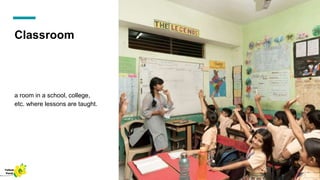
Classroom
a room in a school, college,
etc. where lessons are taught.
Yellow
Pond
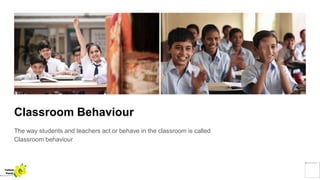
Classroom Behaviour
The way students and teachers act or behave in the classroom is called
Classroom behaviour
Yellow
Pond
Appropriate Behaviours
in Classroom
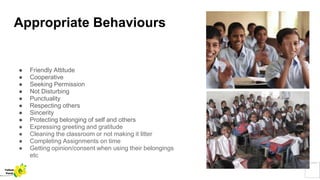
Appropriate Behaviours
● Friendly Attitude
● Cooperative
● Seeking Permission
● Not Disturbing
● Punctuality
● Respecting others
● Sincerity
● Protecting belonging of self and others
● Expressing greeting and gratitude
● Cleaning the classroom or not making it litter
● Completing Assignments on time
● Getting opinion/consent when using their belongings
etc
Yellow
Pond
Inappropriate
Behaviours
Yellow
Pond
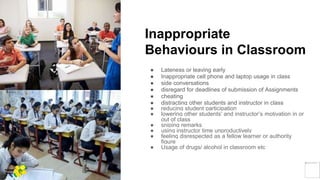
Inappropriate
Behaviours in Classroom
● Lateness or leaving early
● Inappropriate cell phone and laptop usage in class
● side conversations
● disregard for deadlines of submission of Assignments
● cheating
● distracting other students and instructor in class
● reducing student participation
● lowering other students' and instructor’s motivation in or
out of class
● sniping remarks
● using instructor time unproductively
● feeling disrespected as a fellow learner or authority
figure
● Usage of drugs/ alcohol in classroom etc
Yellow
Pond
Causes
Yellow
Pond
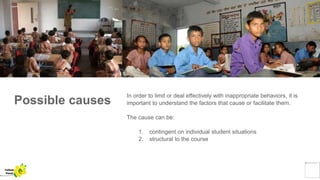
Possible causes
In order to limit or deal effectively with inappropriate behaviors, it is
important to understand the factors that cause or facilitate them.
The cause can be:
1. contingent on individual student situations
2. structural to the course
Yellow
Pond
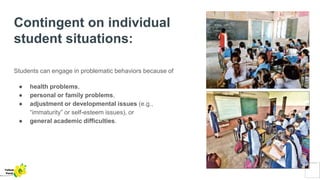
Contingent on individual
student situations:
Students can engage in problematic behaviors because of
● health problems,
● personal or family problems,
● adjustment or developmental issues (e.g.,
“immaturity” or self-esteem issues), or
● general academic difficulties.
Yellow
Pond
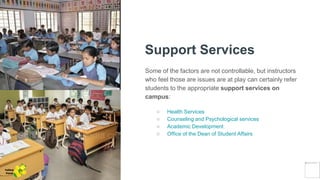
Support Services
Some of the factors are not controllable, but instructors
who feel those are issues are at play can certainly refer
students to the appropriate support services on
campus:
○ Health Services
○ Counseling and Psychological services
○ Academic Development
○ Office of the Dean of Student Affairs
Yellow
Pond
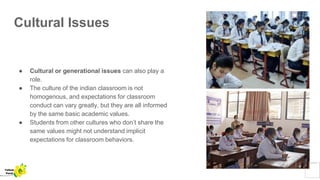
Cultural Issues
● Cultural or generational issues can also play a
role.
● The culture of the indian classroom is not
homogenous, and expectations for classroom
conduct can vary greatly, but they are all informed
by the same basic academic values.
● Students from other cultures who don’t share the
same values might not understand implicit
expectations for classroom behaviors.
Yellow
Pond
Millennial Generation
The millennial generation brings to school and college a
whole new set of values, sometimes quite at odds with the
values of previous generations, which can create some
friction.
Yellow
Pond
Millennial Generation
In particular, some sociologists point out that some
students seem to watch a lecture the same way they
watch TV. This would explain why they think they can
arrive a little late or take a break in the middle of lecture,
or why they can have side conversations or otherwise
multi-task – none of these behaviors impairs the ability to
get meaning out of a movie, and the screen barrier
between the audience and the actors makes it so that the
actors’ performance is not affected by the audience’s
behavior. (Jaffee, 1999)
Yellow
Pond
Structural to the course:
Some of the uncivil behaviors can be inadvertently
facilitated by the instructor’s behavior or the course
structure. Boice (1998) researched classroom incivilities
across a range of courses and reported several findings.
● Teacherss disagree with students about what counts as
uncivil behavior, apart from a few egregious situations.
Moreover, there is significant disagreement among
different teachers, as there is among students.
● Instructor’s age or teaching experience are not a
significant determinant of incivilities. Young/novice
instructors experience the same average level of
incivilities as older/experienced instructors.
Yellow
Pond
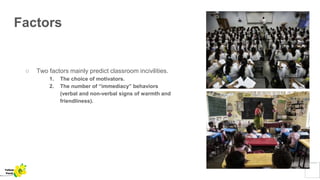
Factors
○ Two factors mainly predict classroom incivilities.
1. The choice of motivators.
2. The number of “immediacy” behaviors
(verbal and non-verbal signs of warmth and
friendliness).
Yellow
Pond
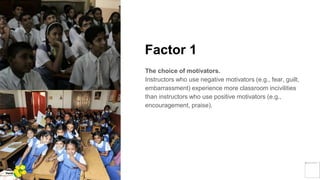
Factor 1
The choice of motivators.
Instructors who use negative motivators (e.g., fear, guilt,
embarrassment) experience more classroom incivilities
than instructors who use positive motivators (e.g.,
encouragement, praise).
Yellow
Pond
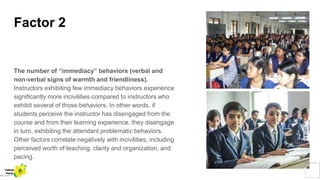
Factor 2
The number of “immediacy” behaviors (verbal and
non-verbal signs of warmth and friendliness).
Instructors exhibiting few immediacy behaviors experience
significantly more incivilities compared to instructors who
exhibit several of those behaviors. In other words, if
students perceive the instructor has disengaged from the
course and from their learning experience, they disengage
in turn, exhibiting the attendant problematic behaviors.
Other factors correlate negatively with incivilities, including
perceived worth of teaching, clarity and organization, and
pacing.
Yellow
Pond
How?
Yellow
Pond
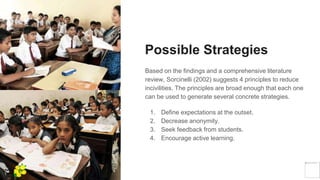
Possible Strategies
Based on the findings and a comprehensive literature
review, Sorcinelli (2002) suggests 4 principles to reduce
incivilities. The principles are broad enough that each one
can be used to generate several concrete strategies.
1. Define expectations at the outset.
2. Decrease anonymity.
3. Seek feedback from students.
4. Encourage active learning.
Yellow
Pond
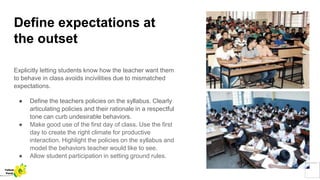
Define expectations at
the outset
Explicitly letting students know how the teacher want them
to behave in class avoids incivilities due to mismatched
expectations.
● Define the teachers policies on the syllabus. Clearly
articulating policies and their rationale in a respectful
tone can curb undesirable behaviors.
● Make good use of the first day of class. Use the first
day to create the right climate for productive
interaction. Highlight the policies on the syllabus and
model the behaviors teacher would like to see.
● Allow student participation in setting ground rules.
Yellow
Pond
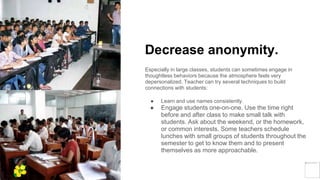
Decrease anonymity.
Especially in large classes, students can sometimes engage in
thoughtless behaviors because the atmosphere feels very
depersonalized. Teacher can try several techniques to build
connections with students:
● Learn and use names consistently.
● Engage students one-on-one. Use the time right
before and after class to make small talk with
students. Ask about the weekend, or the homework,
or common interests. Some teachers schedule
lunches with small groups of students throughout the
semester to get to know them and to present
themselves as more approachable.
Yellow
Pond
Seek feedback from
students.
● Some student incivilities are due to perceived
instructor incivilities – instructor’s own lateness or
disorganization, rudeness or interruptions when
students are speaking.
● Seek feedback to double-check student perceptions
of teacher.
● Teacher can use early course evaluations, or quick
in-class anonymous feedback with one –minute
papers.
● Teacher can also designate some students to be
class representatives and meet with them
periodically, when they can let you know of general
student concerns.
Yellow
Pond
Encourage active
learning.
Meaningful engagement has obvious benefits for student
learning and performance, but it can also bring some side
benefits with respect to student behavior in the classroom.
In fact, Sorcinelli (1991) points out that in classes that use
active learning effectively, students
○ feel more responsible for coming to class, and
coming prepared
○ perceive they pay more attention in class
○ feel more responsible for their own learning.
Yellow
Pond
Faculty
Faculty have found it helpful to:
● Outline both productive and disruptive types of behavior.
● Outline the process by which disruptive behavior will be
addressed.
● Outline consequences for ongoing disruptive behavior.
● Verbally address classroom expectations regarding
behavior on the first day of class. It is especially
effective to talk about behavior you want to see, as well
as the type that’s disruptive.
● Model the type of behavior teacher expect from the
class.
Yellow
Pond
What to Do?
Yellow
Pond
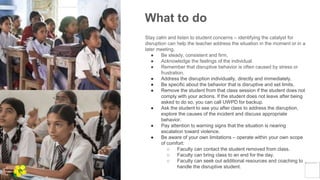
What to do
Stay calm and listen to student concerns – identifying the catalyst for
disruption can help the teacher address the situation in the moment or in a
later meeting.
● Be steady, consistent and firm.
● Acknowledge the feelings of the individual.
● Remember that disruptive behavior is often caused by stress or
frustration.
● Address the disruption individually, directly and immediately.
● Be specific about the behavior that is disruptive and set limits.
● Remove the student from that class session if the student does not
comply with your actions. If the student does not leave after being
asked to do so, you can call UWPD for backup.
● Ask the student to see you after class to address the disruption,
explore the causes of the incident and discuss appropriate
behavior.
● Pay attention to warning signs that the situation is nearing
escalation toward violence.
● Be aware of your own limitations – operate within your own scope
of comfort:
○ Faculty can contact the student removed from class.
○ Faculty can bring class to an end for the day.
○ Faculty can seek out additional resources and coaching to
handle the disruptive student.
Yellow
Pond
What to avoid?
Yellow
Pond
What to avoid
● Do not allow the behavior to continue.
● Avoid making it a class issue – address
only the student who is causing the
disruption.
● Avoid an argument or shouting match.
● Do not blame or ridicule the student, or
use sarcasm.
● Do not touch the student.
Yellow
Pond
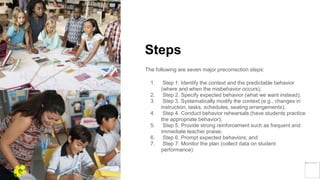
Steps
The following are seven major precorrection steps:
1. Step 1. Identify the context and the predictable behavior
(where and when the misbehavior occurs);
2. Step 2. Specify expected behavior (what we want instead);
3. Step 3. Systematically modify the context (e.g., changes in
instruction, tasks, schedules, seating arrangements);
4. Step 4. Conduct behavior rehearsals (have students practice
the appropriate behavior);
5. Step 5. Provide strong reinforcement such as frequent and
immediate teacher praise;
6. Step 6. Prompt expected behaviors; and
7. Step 7. Monitor the plan (collect data on student
performance).
Yellow
Pond
References
1. https://www.cmu.edu/teaching/designteach/teach/problemstudent.html
2. https://web.cortland.edu/andersmd/psy501/12.htm
3. https://www.hindawi.com/journals/tswj/2012/208907/
4. https://dsl.uw.edu/faculty/disruptive-behavior-in-the-classroom/best-practices/
Yellow
Pond

Classroom Behaviours.pptx

  • 1.
    Classroom Behaviours Ms.Jothi andDr.Suresh Kumar Murugesan PhD Yellow Pond
  • 2.
    About the Presenters ●Ms.jothi and Dr.Suresh Kumar Murugesan PhD are the Founders of Yellow Pond Counselling and Wellness Centre, Tamil Nadu, India ● They are passionate Positive Mental Health Practitioners ● They are specialized in Positive Psychology and Counselling ● They are the founding and life members of Tamil Nadu Career Counsellors Association ● Both of them conducted many online and offline training prorgammes on Mindfulness Yellow Pond
  • 3.
    Disclaimer ● This presentationis prepared for learning purpose only and all the images and pictures used in this presentation are taken from google image search. ● Due recognition was given to all the material collected from the various sources. ● Any modification or inclusion in the presenter please contact us. ● Email - yellowpondmadurai@gmail.co m Thank you Yellow Pond
  • 4.
  • 5.
    Behaviour the way thatwe act or behave Yellow Pond
  • 6.
    Classroom a room ina school, college, etc. where lessons are taught. Yellow Pond
  • 7.
    Classroom Behaviour The waystudents and teachers act or behave in the classroom is called Classroom behaviour Yellow Pond
  • 8.
  • 9.
    Appropriate Behaviours ● FriendlyAttitude ● Cooperative ● Seeking Permission ● Not Disturbing ● Punctuality ● Respecting others ● Sincerity ● Protecting belonging of self and others ● Expressing greeting and gratitude ● Cleaning the classroom or not making it litter ● Completing Assignments on time ● Getting opinion/consent when using their belongings etc Yellow Pond
  • 10.
  • 11.
    Inappropriate Behaviours in Classroom ●Lateness or leaving early ● Inappropriate cell phone and laptop usage in class ● side conversations ● disregard for deadlines of submission of Assignments ● cheating ● distracting other students and instructor in class ● reducing student participation ● lowering other students' and instructor’s motivation in or out of class ● sniping remarks ● using instructor time unproductively ● feeling disrespected as a fellow learner or authority figure ● Usage of drugs/ alcohol in classroom etc Yellow Pond
  • 12.
  • 13.
    Possible causes In orderto limit or deal effectively with inappropriate behaviors, it is important to understand the factors that cause or facilitate them. The cause can be: 1. contingent on individual student situations 2. structural to the course Yellow Pond
  • 14.
    Contingent on individual studentsituations: Students can engage in problematic behaviors because of ● health problems, ● personal or family problems, ● adjustment or developmental issues (e.g., “immaturity” or self-esteem issues), or ● general academic difficulties. Yellow Pond
  • 15.
    Support Services Some ofthe factors are not controllable, but instructors who feel those are issues are at play can certainly refer students to the appropriate support services on campus: ○ Health Services ○ Counseling and Psychological services ○ Academic Development ○ Office of the Dean of Student Affairs Yellow Pond
  • 16.
    Cultural Issues ● Culturalor generational issues can also play a role. ● The culture of the indian classroom is not homogenous, and expectations for classroom conduct can vary greatly, but they are all informed by the same basic academic values. ● Students from other cultures who don’t share the same values might not understand implicit expectations for classroom behaviors. Yellow Pond
  • 17.
    Millennial Generation The millennialgeneration brings to school and college a whole new set of values, sometimes quite at odds with the values of previous generations, which can create some friction. Yellow Pond
  • 18.
    Millennial Generation In particular,some sociologists point out that some students seem to watch a lecture the same way they watch TV. This would explain why they think they can arrive a little late or take a break in the middle of lecture, or why they can have side conversations or otherwise multi-task – none of these behaviors impairs the ability to get meaning out of a movie, and the screen barrier between the audience and the actors makes it so that the actors’ performance is not affected by the audience’s behavior. (Jaffee, 1999) Yellow Pond
  • 19.
    Structural to thecourse: Some of the uncivil behaviors can be inadvertently facilitated by the instructor’s behavior or the course structure. Boice (1998) researched classroom incivilities across a range of courses and reported several findings. ● Teacherss disagree with students about what counts as uncivil behavior, apart from a few egregious situations. Moreover, there is significant disagreement among different teachers, as there is among students. ● Instructor’s age or teaching experience are not a significant determinant of incivilities. Young/novice instructors experience the same average level of incivilities as older/experienced instructors. Yellow Pond
  • 20.
    Factors ○ Two factorsmainly predict classroom incivilities. 1. The choice of motivators. 2. The number of “immediacy” behaviors (verbal and non-verbal signs of warmth and friendliness). Yellow Pond
  • 21.
    Factor 1 The choiceof motivators. Instructors who use negative motivators (e.g., fear, guilt, embarrassment) experience more classroom incivilities than instructors who use positive motivators (e.g., encouragement, praise). Yellow Pond
  • 22.
    Factor 2 The numberof “immediacy” behaviors (verbal and non-verbal signs of warmth and friendliness). Instructors exhibiting few immediacy behaviors experience significantly more incivilities compared to instructors who exhibit several of those behaviors. In other words, if students perceive the instructor has disengaged from the course and from their learning experience, they disengage in turn, exhibiting the attendant problematic behaviors. Other factors correlate negatively with incivilities, including perceived worth of teaching, clarity and organization, and pacing. Yellow Pond
  • 23.
  • 24.
    Possible Strategies Based onthe findings and a comprehensive literature review, Sorcinelli (2002) suggests 4 principles to reduce incivilities. The principles are broad enough that each one can be used to generate several concrete strategies. 1. Define expectations at the outset. 2. Decrease anonymity. 3. Seek feedback from students. 4. Encourage active learning. Yellow Pond
  • 25.
    Define expectations at theoutset Explicitly letting students know how the teacher want them to behave in class avoids incivilities due to mismatched expectations. ● Define the teachers policies on the syllabus. Clearly articulating policies and their rationale in a respectful tone can curb undesirable behaviors. ● Make good use of the first day of class. Use the first day to create the right climate for productive interaction. Highlight the policies on the syllabus and model the behaviors teacher would like to see. ● Allow student participation in setting ground rules. Yellow Pond
  • 26.
    Decrease anonymity. Especially inlarge classes, students can sometimes engage in thoughtless behaviors because the atmosphere feels very depersonalized. Teacher can try several techniques to build connections with students: ● Learn and use names consistently. ● Engage students one-on-one. Use the time right before and after class to make small talk with students. Ask about the weekend, or the homework, or common interests. Some teachers schedule lunches with small groups of students throughout the semester to get to know them and to present themselves as more approachable. Yellow Pond
  • 27.
    Seek feedback from students. ●Some student incivilities are due to perceived instructor incivilities – instructor’s own lateness or disorganization, rudeness or interruptions when students are speaking. ● Seek feedback to double-check student perceptions of teacher. ● Teacher can use early course evaluations, or quick in-class anonymous feedback with one –minute papers. ● Teacher can also designate some students to be class representatives and meet with them periodically, when they can let you know of general student concerns. Yellow Pond
  • 28.
    Encourage active learning. Meaningful engagementhas obvious benefits for student learning and performance, but it can also bring some side benefits with respect to student behavior in the classroom. In fact, Sorcinelli (1991) points out that in classes that use active learning effectively, students ○ feel more responsible for coming to class, and coming prepared ○ perceive they pay more attention in class ○ feel more responsible for their own learning. Yellow Pond
  • 29.
    Faculty Faculty have foundit helpful to: ● Outline both productive and disruptive types of behavior. ● Outline the process by which disruptive behavior will be addressed. ● Outline consequences for ongoing disruptive behavior. ● Verbally address classroom expectations regarding behavior on the first day of class. It is especially effective to talk about behavior you want to see, as well as the type that’s disruptive. ● Model the type of behavior teacher expect from the class. Yellow Pond
  • 30.
  • 31.
    What to do Staycalm and listen to student concerns – identifying the catalyst for disruption can help the teacher address the situation in the moment or in a later meeting. ● Be steady, consistent and firm. ● Acknowledge the feelings of the individual. ● Remember that disruptive behavior is often caused by stress or frustration. ● Address the disruption individually, directly and immediately. ● Be specific about the behavior that is disruptive and set limits. ● Remove the student from that class session if the student does not comply with your actions. If the student does not leave after being asked to do so, you can call UWPD for backup. ● Ask the student to see you after class to address the disruption, explore the causes of the incident and discuss appropriate behavior. ● Pay attention to warning signs that the situation is nearing escalation toward violence. ● Be aware of your own limitations – operate within your own scope of comfort: ○ Faculty can contact the student removed from class. ○ Faculty can bring class to an end for the day. ○ Faculty can seek out additional resources and coaching to handle the disruptive student. Yellow Pond
  • 32.
  • 33.
    What to avoid ●Do not allow the behavior to continue. ● Avoid making it a class issue – address only the student who is causing the disruption. ● Avoid an argument or shouting match. ● Do not blame or ridicule the student, or use sarcasm. ● Do not touch the student. Yellow Pond
  • 34.
    Steps The following areseven major precorrection steps: 1. Step 1. Identify the context and the predictable behavior (where and when the misbehavior occurs); 2. Step 2. Specify expected behavior (what we want instead); 3. Step 3. Systematically modify the context (e.g., changes in instruction, tasks, schedules, seating arrangements); 4. Step 4. Conduct behavior rehearsals (have students practice the appropriate behavior); 5. Step 5. Provide strong reinforcement such as frequent and immediate teacher praise; 6. Step 6. Prompt expected behaviors; and 7. Step 7. Monitor the plan (collect data on student performance). Yellow Pond
  • 35.
    References 1. https://www.cmu.edu/teaching/designteach/teach/problemstudent.html 2. https://web.cortland.edu/andersmd/psy501/12.htm 3.https://www.hindawi.com/journals/tswj/2012/208907/ 4. https://dsl.uw.edu/faculty/disruptive-behavior-in-the-classroom/best-practices/ Yellow Pond