 For any help regarding Statistics Assignments
Visit: https://www.statisticshomeworkhelper.com
Email- info@statisticshomeworkhelper.com or call us at-+1 678 648 4277
Statistics Homework Helper
Problems from John A. Rice, Third Edition. [
C hapter.Secti on.Problem ]
1. 14.9.2. See Rscript/html Problem_l4_9_2.r 2. 14.9.4.
For modeling freshman GPA to depend linearly on high school GPA, a standard linear
regression model is:
Yi = /3o+ /31xi + ei, i = 1, 2, ... , n.
Suppose that different intercepts were to be allowed for femalses and males, and write the
model as
Yi= l p(i )/3F + IM(i)/3M + /31xi + e,;, i = 1, 2, ... , n.
where Jp(i) and JM(i) are indicator variables takingon values of Oand
1 according to whether the generder of the ith person is female or
male.
The design matrix for such a model will be
I Jp(l)
I
IM(l) X1
Jp(2) JM(2) x2
X=
lp(n) IM(n) Xn
LFemale -l
Xi
n
M
'L

"
,"
"
M ale i X
i
L M ale ,; Xi
'L
",
"n"l X
•
7
where np and nM are the number of femals and males, respectively. The regression model is
setup as
Note that xr X =
0
Statistics Homework Helper
3. 14.9.6. The 4 weighings correspond to 4 outcomes of the dependent variable y
For the regression parameter vector
/3= [ W1 ]
W2
the design matrix is
-
1
X= [ 1 i
1 1
The regression model is
Y = X /3+ e
(b). The least squares estimates of w1 and w2 are given by
= [ 1
]
= (X Tx )- l x T y
W2
Note that
(XT X) = [ ] so
and
9
(XT Y ) = [ 11
] ,
SO = [ 1 3 1 3 ] X [ 1
1 ] =
9
[ l
l
f
3 ]
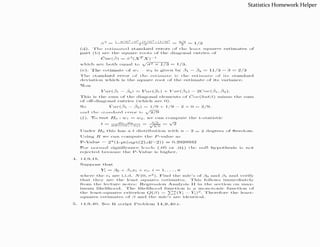
(c). The estimate of a 2 is given by the sum of squared residuals divided by n - 2, where 2 is the number of columns of
X which equals the number of regression parameters estimated.
The vector of least squares residuals is:
3
= [ = [
3
e
= [ =
: !
:
l t J
:
l tJ
y4 - f;4 7 - 20/3 1/ 3
From this we can compute
Statistics Homework Helper
Problem_14_9_2.r
Peter
Thu Apr 30 21:21:38 2015
#Problem_14_9_2.r x=c(.34,1.38,-.64,.68,1.40,-.88,-.30, -1.18, .50, -1.75) y=c(.27,1.34,-.53,.35,1.28,-.98,0.72,-.81,.64,-1.59) # (a) Fit line y=a + bx
using lm() in r plot(x,y) lmfit1<-lm(y~x) summary(lmfit1)
## ## Call: ## lm(formula = y ~ x) ## ## Residuals: ## Min 1Q Median 3Q
Max ## -0.34954 -0.16556 -0.06363 0.08067 0.87278 ## ## Coefficients: ##
Estimate Std. Error t value Pr(>|t|) ## (Intercept) 0.1081 0.1156 0.935 0.377
## x 0.8697 0.1133 7.677 5.87e-05 *** ## --- ## Signif. codes: 0 '***' 0.001 '**'
0.01 '*' 0.05 '.' 0.1 ' ' 1 ## ## Residual standard error: 0.3654 on 8 degrees of
freedom ## Multiple R-squared: 0.8805, Adjusted R-squared: 0.8655 ## F-
statistic: 58.94 on 1 and 8 DF, p-value: 5.867e-05
abline(lmfit1,col='green') lmfit1$coefficients
## (Intercept) x ## 0.1081372 0.8697151
# (b) Fit line x=c+dy using lm() in r lmfit2<-lm(x~y) summary(lmfit2)
## ## Call: ## lm(formula = x ~ y) ## ## Residuals: ## Min 1Q Median 3Q Max ## -0.91406 -0.03117 0.07484 0.20963
0.44052 ## ## Coefficients: ## Estimate Std. Error t value Pr(>|t|) ## (Intercept) -0.1149 0.1250 -0.919 0.385 ## y 1.0124
0.1319 7.677 5.87e-05 *** ## --- ## Signif. codes: 0 '***' 0.001 '**' 0.01 '*' 0.05 '.' 0.1 ' ' 1 ## ## Residual standard error:
0.3942 on 8 degrees of freedom ## Multiple R-squared: 0.8805, Adjusted R-squared: 0.8655 ## F-statistic: 58.94 on 1 and
8 DF, p-value: 5.867e-05
lmfit2$coefficients
## (Intercept) y ## -0.1148545 1.0123846
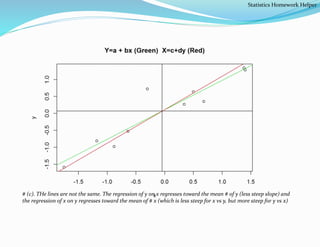
# For x = b1 + b2y # we get the y vs x line as # y=-(b1/b2) + (1/b2)x abline(a=-
lmfit2$coefficients[1]/lmfit2$coefficients[2], b=(1/lmfit2$coefficients[2]), col="red") title(main="Y=a + bx
(Green) X=c+dy (Red)") abline(h=mean(y)); abline(v=mean(x)) abline(h=mean(y));abline(v=mean(x)) # Plot
horizontal/vertical lines at y/x means
Statistics Homework Helper
# (c). THe lines are not the same. The regression of y on x regresses toward the mean # of y (less steep slope) and
the regression of x on y regresses toward the mean of # x (which is less steep for x vs y, but more steep for y vs x)
Statistics Homework Helper
# Problem_14_9_40.r
# 1.0 Read in data
# See Problem 14.9.40
# Data from calibration of a proving ring, a device for measuring force
# Hockersmith and Ku 1969).
provingring=read.table(file="Rice 3e Datasets/ASCII Comma/Chapter 14/provingring.txt",
sep=",",stringsAsFactors = FALSE,
header=TRUE)
Deflection=as.numeric(provingring$Deflection)
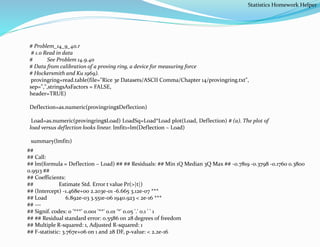
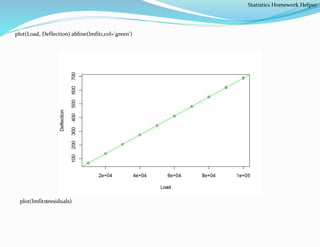
Load=as.numeric(provingring$Load) LoadSq=Load*Load plot(Load, Deflection) # (a). The plot of
load versus deflection looks linear. lmfit1=lm(Deflection ~ Load)
summary(lmfit1)
##
## Call:
## lm(formula = Deflection ~ Load) ## ## Residuals: ## Min 1Q Median 3Q Max ## -0.7819 -0.3798 -0.1760 0.3800
0.9513 ##
## Coefficients:
## Estimate Std. Error t value Pr(>|t|)
## (Intercept) -1.468e+00 2.203e-01 -6.665 3.12e-07 ***
## Load 6.892e-03 3.551e-06 1940.923 < 2e-16 ***
## ---
## Signif. codes: 0 '***' 0.001 '**' 0.01 '*' 0.05 '.' 0.1 ' ' 1
## ## Residual standard error: 0.5586 on 28 degrees of freedom
## Multiple R-squared: 1, Adjusted R-squared: 1
## F-statistic: 3.767e+06 on 1 and 28 DF, p-value: < 2.2e-16
Statistics Homework Helper
plot(Load, Deflection) abline(lmfit1,col='green')
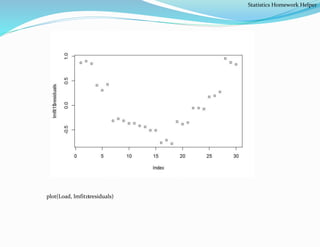
plot(lmfit1$residuals)
Statistics Homework Helper
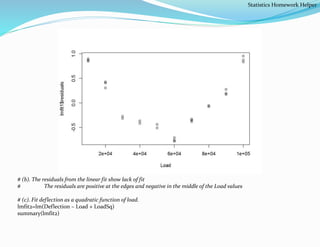
plot(Load, lmfit1$residuals)
Statistics Homework Helper
# (b). The residuals from the linear fit show lack of fit
# The residuals are positive at the edges and negative in the middle of the Load values
# (c). Fit deflection as a quadratic function of load.
lmfit2=lm(Deflection ~ Load + LoadSq)
summary(lmfit2)
Statistics Homework Helper
##
## Call:
## lm(formula = Deflection ~ Load + LoadSq)
##
## Residuals:
## Min 1Q Median 3Q Max
## -0.19832 -0.08509 0.02033 0.07533 0.14339
##
## Coefficients:
## Estimate Std. Error t value Pr(>|t|)
## (Intercept) 1.363e-01 7.284e-02 1.871 0.0722 .
## Load 6.812e-03 3.042e-06 2239.355 <2e-16 ***
## LoadSq 7.294e-10 2.695e-11 27.065 <2e-16 ***
## ---
## Signif. codes: 0 '***' 0.001 '**' 0.01 '*' 0.05 '.' 0.1 ' ' 1
##
## Residual standard error: 0.1073 on 27 degrees of freedom
## Multiple R-squared: 1, Adjusted R-squared: 1
## F-statistic: 5.11e+07 on 2 and 27 DF, p-value: < 2.2e-16
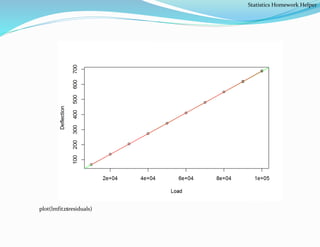
plot(Load, Deflection) abline(lmfit1,col='green') lines(Load,
lmfit2$fitted.values,col="red")
Statistics Homework Helper
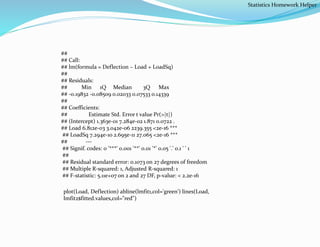
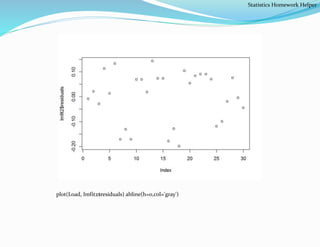
plot(lmfit2$residuals)
Statistics Homework Helper
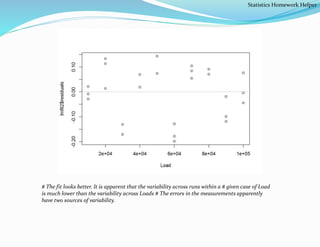
plot(Load, lmfit2$residuals) abline(h=0,col='gray')
Statistics Homework Helper
# The fit looks better. It is apparent that the variability across runs within a # given case of Load
is much lower than the variability across Loads # The errors in the measurements apparently
have two sources of variability.
Statistics Homework Helper

statistics assignment help

  • 1.
     For anyhelp regarding Statistics Assignments Visit: https://www.statisticshomeworkhelper.com Email- info@statisticshomeworkhelper.com or call us at-+1 678 648 4277 Statistics Homework Helper
  • 2.
    Problems from JohnA. Rice, Third Edition. [ C hapter.Secti on.Problem ] 1. 14.9.2. See Rscript/html Problem_l4_9_2.r 2. 14.9.4. For modeling freshman GPA to depend linearly on high school GPA, a standard linear regression model is: Yi = /3o+ /31xi + ei, i = 1, 2, ... , n. Suppose that different intercepts were to be allowed for femalses and males, and write the model as Yi= l p(i )/3F + IM(i)/3M + /31xi + e,;, i = 1, 2, ... , n. where Jp(i) and JM(i) are indicator variables takingon values of Oand 1 according to whether the generder of the ith person is female or male. The design matrix for such a model will be I Jp(l) I IM(l) X1 Jp(2) JM(2) x2 X= lp(n) IM(n) Xn LFemale -l Xi n M 'L " ," " M ale i X i L M ale ,; Xi 'L ", "n"l X • 7 where np and nM are the number of femals and males, respectively. The regression model is setup as Note that xr X = 0 Statistics Homework Helper
  • 3.
    3. 14.9.6. The4 weighings correspond to 4 outcomes of the dependent variable y For the regression parameter vector /3= [ W1 ] W2 the design matrix is - 1 X= [ 1 i 1 1 The regression model is Y = X /3+ e (b). The least squares estimates of w1 and w2 are given by = [ 1 ] = (X Tx )- l x T y W2 Note that (XT X) = [ ] so and 9 (XT Y ) = [ 11 ] , SO = [ 1 3 1 3 ] X [ 1 1 ] = 9 [ l l f 3 ] (c). The estimate of a 2 is given by the sum of squared residuals divided by n - 2, where 2 is the number of columns of X which equals the number of regression parameters estimated. The vector of least squares residuals is: 3 = [ = [ 3 e = [ = : ! : l t J : l tJ y4 - f;4 7 - 20/3 1/ 3 From this we can compute Statistics Homework Helper
  • 4.
  • 5.
    Problem_14_9_2.r Peter Thu Apr 3021:21:38 2015 #Problem_14_9_2.r x=c(.34,1.38,-.64,.68,1.40,-.88,-.30, -1.18, .50, -1.75) y=c(.27,1.34,-.53,.35,1.28,-.98,0.72,-.81,.64,-1.59) # (a) Fit line y=a + bx using lm() in r plot(x,y) lmfit1<-lm(y~x) summary(lmfit1) ## ## Call: ## lm(formula = y ~ x) ## ## Residuals: ## Min 1Q Median 3Q Max ## -0.34954 -0.16556 -0.06363 0.08067 0.87278 ## ## Coefficients: ## Estimate Std. Error t value Pr(>|t|) ## (Intercept) 0.1081 0.1156 0.935 0.377 ## x 0.8697 0.1133 7.677 5.87e-05 *** ## --- ## Signif. codes: 0 '***' 0.001 '**' 0.01 '*' 0.05 '.' 0.1 ' ' 1 ## ## Residual standard error: 0.3654 on 8 degrees of freedom ## Multiple R-squared: 0.8805, Adjusted R-squared: 0.8655 ## F- statistic: 58.94 on 1 and 8 DF, p-value: 5.867e-05 abline(lmfit1,col='green') lmfit1$coefficients ## (Intercept) x ## 0.1081372 0.8697151 # (b) Fit line x=c+dy using lm() in r lmfit2<-lm(x~y) summary(lmfit2) ## ## Call: ## lm(formula = x ~ y) ## ## Residuals: ## Min 1Q Median 3Q Max ## -0.91406 -0.03117 0.07484 0.20963 0.44052 ## ## Coefficients: ## Estimate Std. Error t value Pr(>|t|) ## (Intercept) -0.1149 0.1250 -0.919 0.385 ## y 1.0124 0.1319 7.677 5.87e-05 *** ## --- ## Signif. codes: 0 '***' 0.001 '**' 0.01 '*' 0.05 '.' 0.1 ' ' 1 ## ## Residual standard error: 0.3942 on 8 degrees of freedom ## Multiple R-squared: 0.8805, Adjusted R-squared: 0.8655 ## F-statistic: 58.94 on 1 and 8 DF, p-value: 5.867e-05 lmfit2$coefficients ## (Intercept) y ## -0.1148545 1.0123846 # For x = b1 + b2y # we get the y vs x line as # y=-(b1/b2) + (1/b2)x abline(a=- lmfit2$coefficients[1]/lmfit2$coefficients[2], b=(1/lmfit2$coefficients[2]), col="red") title(main="Y=a + bx (Green) X=c+dy (Red)") abline(h=mean(y)); abline(v=mean(x)) abline(h=mean(y));abline(v=mean(x)) # Plot horizontal/vertical lines at y/x means Statistics Homework Helper
  • 6.
    # (c). THelines are not the same. The regression of y on x regresses toward the mean # of y (less steep slope) and the regression of x on y regresses toward the mean of # x (which is less steep for x vs y, but more steep for y vs x) Statistics Homework Helper
  • 7.
    # Problem_14_9_40.r # 1.0Read in data # See Problem 14.9.40 # Data from calibration of a proving ring, a device for measuring force # Hockersmith and Ku 1969). provingring=read.table(file="Rice 3e Datasets/ASCII Comma/Chapter 14/provingring.txt", sep=",",stringsAsFactors = FALSE, header=TRUE) Deflection=as.numeric(provingring$Deflection) Load=as.numeric(provingring$Load) LoadSq=Load*Load plot(Load, Deflection) # (a). The plot of load versus deflection looks linear. lmfit1=lm(Deflection ~ Load) summary(lmfit1) ## ## Call: ## lm(formula = Deflection ~ Load) ## ## Residuals: ## Min 1Q Median 3Q Max ## -0.7819 -0.3798 -0.1760 0.3800 0.9513 ## ## Coefficients: ## Estimate Std. Error t value Pr(>|t|) ## (Intercept) -1.468e+00 2.203e-01 -6.665 3.12e-07 *** ## Load 6.892e-03 3.551e-06 1940.923 < 2e-16 *** ## --- ## Signif. codes: 0 '***' 0.001 '**' 0.01 '*' 0.05 '.' 0.1 ' ' 1 ## ## Residual standard error: 0.5586 on 28 degrees of freedom ## Multiple R-squared: 1, Adjusted R-squared: 1 ## F-statistic: 3.767e+06 on 1 and 28 DF, p-value: < 2.2e-16 Statistics Homework Helper
  • 8.
  • 9.
  • 10.
    # (b). Theresiduals from the linear fit show lack of fit # The residuals are positive at the edges and negative in the middle of the Load values # (c). Fit deflection as a quadratic function of load. lmfit2=lm(Deflection ~ Load + LoadSq) summary(lmfit2) Statistics Homework Helper
  • 11.
    ## ## Call: ## lm(formula= Deflection ~ Load + LoadSq) ## ## Residuals: ## Min 1Q Median 3Q Max ## -0.19832 -0.08509 0.02033 0.07533 0.14339 ## ## Coefficients: ## Estimate Std. Error t value Pr(>|t|) ## (Intercept) 1.363e-01 7.284e-02 1.871 0.0722 . ## Load 6.812e-03 3.042e-06 2239.355 <2e-16 *** ## LoadSq 7.294e-10 2.695e-11 27.065 <2e-16 *** ## --- ## Signif. codes: 0 '***' 0.001 '**' 0.01 '*' 0.05 '.' 0.1 ' ' 1 ## ## Residual standard error: 0.1073 on 27 degrees of freedom ## Multiple R-squared: 1, Adjusted R-squared: 1 ## F-statistic: 5.11e+07 on 2 and 27 DF, p-value: < 2.2e-16 plot(Load, Deflection) abline(lmfit1,col='green') lines(Load, lmfit2$fitted.values,col="red") Statistics Homework Helper
  • 12.
  • 13.
  • 14.
    # The fitlooks better. It is apparent that the variability across runs within a # given case of Load is much lower than the variability across Loads # The errors in the measurements apparently have two sources of variability. Statistics Homework Helper