+1 (315) 557-6473
https://www.statisticshomeworkhelper.com/
info@statisticshomeworkhelper.com
Example 1: A coin is thrown 3 times .what is the probability that atleast one
head is obtained?
Sol: Sample space = [HHH, HHT, HTH, THH, TTH, THT, HTT, TTT]
Total number of ways = 2 × 2 × 2 = 8. Fav. Cases = 7
P (A) = 7/8
OR
P (of getting at least one head) = 1 – P (no head)⇒ 1 – (1/8) = 7/8
Example 2: Find the probability of getting a numbered card when a card is
drawn from the pack of 52 cards.
Sol: Total Cards = 52. Numbered Cards = (2, 3, 4, 5, 6, 7, 8, 9, 10) 9 from each
suit 4 × 9 = 36
P (E) = 36/52 = 9/13
Example 3: There are 5 green 7 red balls. Two balls are selected one by one
without replacement. Find the probability that first is green and second is red.
Sol: P (G) × P (R) = (5/12) x (7/11) = 35/132
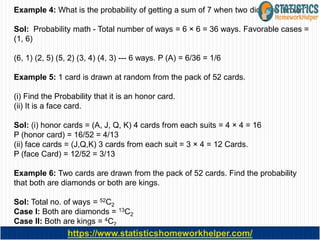
Example 4: What is the probability of getting a sum of 7 when two dice are thrown?
Sol: Probability math - Total number of ways = 6 × 6 = 36 ways. Favorable cases =
(1, 6)
(6, 1) (2, 5) (5, 2) (3, 4) (4, 3) --- 6 ways. P (A) = 6/36 = 1/6
Example 5: 1 card is drawn at random from the pack of 52 cards.
(i) Find the Probability that it is an honor card.
(ii) It is a face card.
Sol: (i) honor cards = (A, J, Q, K) 4 cards from each suits = 4 × 4 = 16
P (honor card) = 16/52 = 4/13
(ii) face cards = (J,Q,K) 3 cards from each suit = 3 × 4 = 12 Cards.
P (face Card) = 12/52 = 3/13
Example 6: Two cards are drawn from the pack of 52 cards. Find the probability
that both are diamonds or both are kings.
Sol: Total no. of ways = 52C2
Case I: Both are diamonds = 13C2
Case II: Both are kings = 4C2
P (both are diamonds or both are kings) = (13C2 + 4C2 ) / 52C2
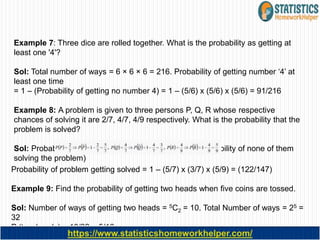
Example 7: Three dice are rolled together. What is the probability as getting at
least one '4'?
Sol: Total number of ways = 6 × 6 × 6 = 216. Probability of getting number ‘4’ at
least one time
= 1 – (Probability of getting no number 4) = 1 – (5/6) x (5/6) x (5/6) = 91/216
Example 8: A problem is given to three persons P, Q, R whose respective
chances of solving it are 2/7, 4/7, 4/9 respectively. What is the probability that the
problem is solved?
Sol: Probability of the problem getting solved = 1 – (Probability of none of them
solving the problem)
Probability of problem getting solved = 1 – (5/7) x (3/7) x (5/9) = (122/147)
Example 9: Find the probability of getting two heads when five coins are tossed.
Sol: Number of ways of getting two heads = 5C2 = 10. Total Number of ways = 25 =
32
P (two heads) = 10/32 = 5/16
Example 10: What is the probability of getting a sum of 22 or more when four
dice are thrown?
Sol: Total number of ways = 64 = 1296. Number of ways of getting a sum 22
are 6,6,6,4 = 4! / 3! = 4
6,6,5,5 = 4! / 2!2! = 6. Number of ways of getting a sum 23 is 6,6,6,5 = 4! / 3! =
4.
Number of ways of getting a sum 24 is 6,6,6,6 = 1.
Fav. Number of cases = 4 + 6 + 4 + 1 = 15 ways. P (getting a sum of 22 or
more) = 15/1296 = 5/432
Example 11: Two dice are thrown together. What is the probability that the
number obtained on one of the dice is multiple of number obtained on the other
dice?
Sol:Total number of cases = 62 = 36
Since the number on a die should be multiple of the other, the possibilities are
(1, 1) (2, 2) (3, 3) ------ (6, 6) --- 6 ways
(2, 1) (1, 2) (1, 4) (4, 1) (1, 3) (3, 1) (1, 5) (5, 1) (6, 1) (1, 6) --- 10 ways
(2, 4) (4, 2) (2, 6) (6, 2) (3, 6) (6, 3) -- 6 ways
Favorable cases are = 6 + 10 + 6 = 22. So, P (A) = 22/36 = 11/18
Sol: Total number of cases = 52C3
One card each should be selected from a different suit. The three suits can be
chosen in 4C3 was
The cards can be selected in a total of (4C3) x (13C1) x (13C1) x (13C1)
Probability = 4C3 x (13C1)3 / 52C3
= 4 x (13)3 / 52C3
Example 13: Find the probability that a leap year has 52 Sundays.
Sol: A leap year can have 52 Sundays or 53 Sundays. In a leap year, there are 366
days out of which there are 52 complete weeks & remaining 2 days. Now, these two
days can be (Sat, Sun) (Sun, Mon) (Mon, Tue) (Tue, Wed) (Wed, Thur) (Thur,
Friday) (Friday, Sat).
So there are total 7 cases out of which (Sat, Sun) (Sun, Mon) are two
favorable cases. So, P (53 Sundays) = 2 / 7
Now, P(52 Sundays) + P(53 Sundays) = 1
So, P (52 Sundays) = 1 - P(53 Sundays) = 1 – (2/7) = (5/7)
Example 14: Fifteen people sit around a circular table. What are odds against two
particular people sitting together?
Sol: 15 persons can be seated in 14! Ways. No. of ways in which two particular
people sit together is 13! × 2!
The probability of two particular persons sitting together 13!2! / 14! = 1/7
Odds against the event = 6 : 1
Example 15: Three bags contain 3 red, 7 black; 8 red, 2 black, and 4 red & 6 black
balls respectively. 1 of the bags is selected at random and a ball is drawn from it. If
the ball drawn is red, find the probability that it is drawn from the third bag.
Sol: Let E1, E2, E3 and A are the events defined as follows.
E1 = First bag is chosen
E2 = Second bag is chosen
E3 = Third bag is chosen
A = Ball drawn is red
Since there are three bags and one of the bags is chosen at random, so P (E1) =
P(E2) = P(E3) = 1 / 3
If E1 has already occurred, then first bag has been chosen which contains 3 red
and 7 black balls. The probability of drawing 1 red ball from it is 3/10. So, P (A/E1) =
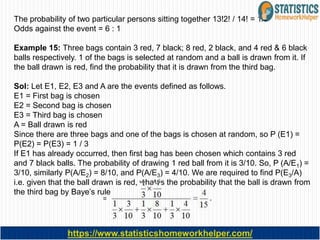
3/10, similarly P(A/E2) = 8/10, and P(A/E3) = 4/10. We are required to find P(E3/A)
i.e. given that the ball drawn is red, what is the probability that the ball is drawn from
the third bag by Baye’s rule

Probability Homework Help

  • 1.
  • 2.
    Example 1: Acoin is thrown 3 times .what is the probability that atleast one head is obtained? Sol: Sample space = [HHH, HHT, HTH, THH, TTH, THT, HTT, TTT] Total number of ways = 2 × 2 × 2 = 8. Fav. Cases = 7 P (A) = 7/8 OR P (of getting at least one head) = 1 – P (no head)⇒ 1 – (1/8) = 7/8 Example 2: Find the probability of getting a numbered card when a card is drawn from the pack of 52 cards. Sol: Total Cards = 52. Numbered Cards = (2, 3, 4, 5, 6, 7, 8, 9, 10) 9 from each suit 4 × 9 = 36 P (E) = 36/52 = 9/13 Example 3: There are 5 green 7 red balls. Two balls are selected one by one without replacement. Find the probability that first is green and second is red. Sol: P (G) × P (R) = (5/12) x (7/11) = 35/132
  • 3.
    Example 4: Whatis the probability of getting a sum of 7 when two dice are thrown? Sol: Probability math - Total number of ways = 6 × 6 = 36 ways. Favorable cases = (1, 6) (6, 1) (2, 5) (5, 2) (3, 4) (4, 3) --- 6 ways. P (A) = 6/36 = 1/6 Example 5: 1 card is drawn at random from the pack of 52 cards. (i) Find the Probability that it is an honor card. (ii) It is a face card. Sol: (i) honor cards = (A, J, Q, K) 4 cards from each suits = 4 × 4 = 16 P (honor card) = 16/52 = 4/13 (ii) face cards = (J,Q,K) 3 cards from each suit = 3 × 4 = 12 Cards. P (face Card) = 12/52 = 3/13 Example 6: Two cards are drawn from the pack of 52 cards. Find the probability that both are diamonds or both are kings. Sol: Total no. of ways = 52C2 Case I: Both are diamonds = 13C2 Case II: Both are kings = 4C2 P (both are diamonds or both are kings) = (13C2 + 4C2 ) / 52C2
  • 4.
    Example 7: Threedice are rolled together. What is the probability as getting at least one '4'? Sol: Total number of ways = 6 × 6 × 6 = 216. Probability of getting number ‘4’ at least one time = 1 – (Probability of getting no number 4) = 1 – (5/6) x (5/6) x (5/6) = 91/216 Example 8: A problem is given to three persons P, Q, R whose respective chances of solving it are 2/7, 4/7, 4/9 respectively. What is the probability that the problem is solved? Sol: Probability of the problem getting solved = 1 – (Probability of none of them solving the problem) Probability of problem getting solved = 1 – (5/7) x (3/7) x (5/9) = (122/147) Example 9: Find the probability of getting two heads when five coins are tossed. Sol: Number of ways of getting two heads = 5C2 = 10. Total Number of ways = 25 = 32 P (two heads) = 10/32 = 5/16
  • 5.
    Example 10: Whatis the probability of getting a sum of 22 or more when four dice are thrown? Sol: Total number of ways = 64 = 1296. Number of ways of getting a sum 22 are 6,6,6,4 = 4! / 3! = 4 6,6,5,5 = 4! / 2!2! = 6. Number of ways of getting a sum 23 is 6,6,6,5 = 4! / 3! = 4. Number of ways of getting a sum 24 is 6,6,6,6 = 1. Fav. Number of cases = 4 + 6 + 4 + 1 = 15 ways. P (getting a sum of 22 or more) = 15/1296 = 5/432 Example 11: Two dice are thrown together. What is the probability that the number obtained on one of the dice is multiple of number obtained on the other dice? Sol:Total number of cases = 62 = 36 Since the number on a die should be multiple of the other, the possibilities are (1, 1) (2, 2) (3, 3) ------ (6, 6) --- 6 ways (2, 1) (1, 2) (1, 4) (4, 1) (1, 3) (3, 1) (1, 5) (5, 1) (6, 1) (1, 6) --- 10 ways (2, 4) (4, 2) (2, 6) (6, 2) (3, 6) (6, 3) -- 6 ways Favorable cases are = 6 + 10 + 6 = 22. So, P (A) = 22/36 = 11/18
  • 6.
    Sol: Total numberof cases = 52C3 One card each should be selected from a different suit. The three suits can be chosen in 4C3 was The cards can be selected in a total of (4C3) x (13C1) x (13C1) x (13C1) Probability = 4C3 x (13C1)3 / 52C3 = 4 x (13)3 / 52C3 Example 13: Find the probability that a leap year has 52 Sundays. Sol: A leap year can have 52 Sundays or 53 Sundays. In a leap year, there are 366 days out of which there are 52 complete weeks & remaining 2 days. Now, these two days can be (Sat, Sun) (Sun, Mon) (Mon, Tue) (Tue, Wed) (Wed, Thur) (Thur, Friday) (Friday, Sat). So there are total 7 cases out of which (Sat, Sun) (Sun, Mon) are two favorable cases. So, P (53 Sundays) = 2 / 7 Now, P(52 Sundays) + P(53 Sundays) = 1 So, P (52 Sundays) = 1 - P(53 Sundays) = 1 – (2/7) = (5/7) Example 14: Fifteen people sit around a circular table. What are odds against two particular people sitting together? Sol: 15 persons can be seated in 14! Ways. No. of ways in which two particular people sit together is 13! × 2!
  • 7.
    The probability oftwo particular persons sitting together 13!2! / 14! = 1/7 Odds against the event = 6 : 1 Example 15: Three bags contain 3 red, 7 black; 8 red, 2 black, and 4 red & 6 black balls respectively. 1 of the bags is selected at random and a ball is drawn from it. If the ball drawn is red, find the probability that it is drawn from the third bag. Sol: Let E1, E2, E3 and A are the events defined as follows. E1 = First bag is chosen E2 = Second bag is chosen E3 = Third bag is chosen A = Ball drawn is red Since there are three bags and one of the bags is chosen at random, so P (E1) = P(E2) = P(E3) = 1 / 3 If E1 has already occurred, then first bag has been chosen which contains 3 red and 7 black balls. The probability of drawing 1 red ball from it is 3/10. So, P (A/E1) = 3/10, similarly P(A/E2) = 8/10, and P(A/E3) = 4/10. We are required to find P(E3/A) i.e. given that the ball drawn is red, what is the probability that the ball is drawn from the third bag by Baye’s rule