statisticshomeworkhelper.c
om
For any help regarding Statistics Assignment Help
visit: https://www.statisticshomeworkhelper.com
Email- info@statisticshomeworkhelper.com or call us at-+1 678 648 4277
Probabilistic Systems Analysis
Problems
statisticshomeworkhelper.com
1. Express each of the following events in terms of the events A, B and
C as well as the operations of complementation, union and
intersection:
(a) at least one of the events A, B, C occurs;
(b) at most one of the events A, B, C occurs;
(c) none of the events A, B, C occurs;
(d) all three events A, B, C occur;
(e) exactly one of the events A, B, C occurs;
(f) events A and B occur, but not C;
(g) either event A occurs or, if not, then B also does not occur.
In each case draw the corresponding Venn diagrams.
2. You flip a fair coin 3 times, determine the probability o
f the below events. Assume all sequences are equally likely.
(a) Three heads: HHH
statisticshomeworkhelper.com
(b) The sequence head, tail, head: HTH
(c) Any sequence with 2 heads and 1 tail
(d) Any sequence where the number of heads is greater than or equal to
the number of tails.
(d) Any sequence where the number of heads is greater than or equal to
the number of tails
3. Bob has a peculiar pair of four-sided dice. When he rolls the dice, the
probability of any particular outcome is proportional to the sum of the
results of each die. All outcomes that result in a particular sum are equally
likely?
(a) What is the probability of the sum being even?
(b) What is the probability of Bob rolling a 2 and a 3, in any order
4. Alice and Bob each choose at random a number in the interval [0, 2].
We assume a uniform probability law under which the probability of an
event is proportional to its area. Consider the following events:
statisticshomeworkhelper.com
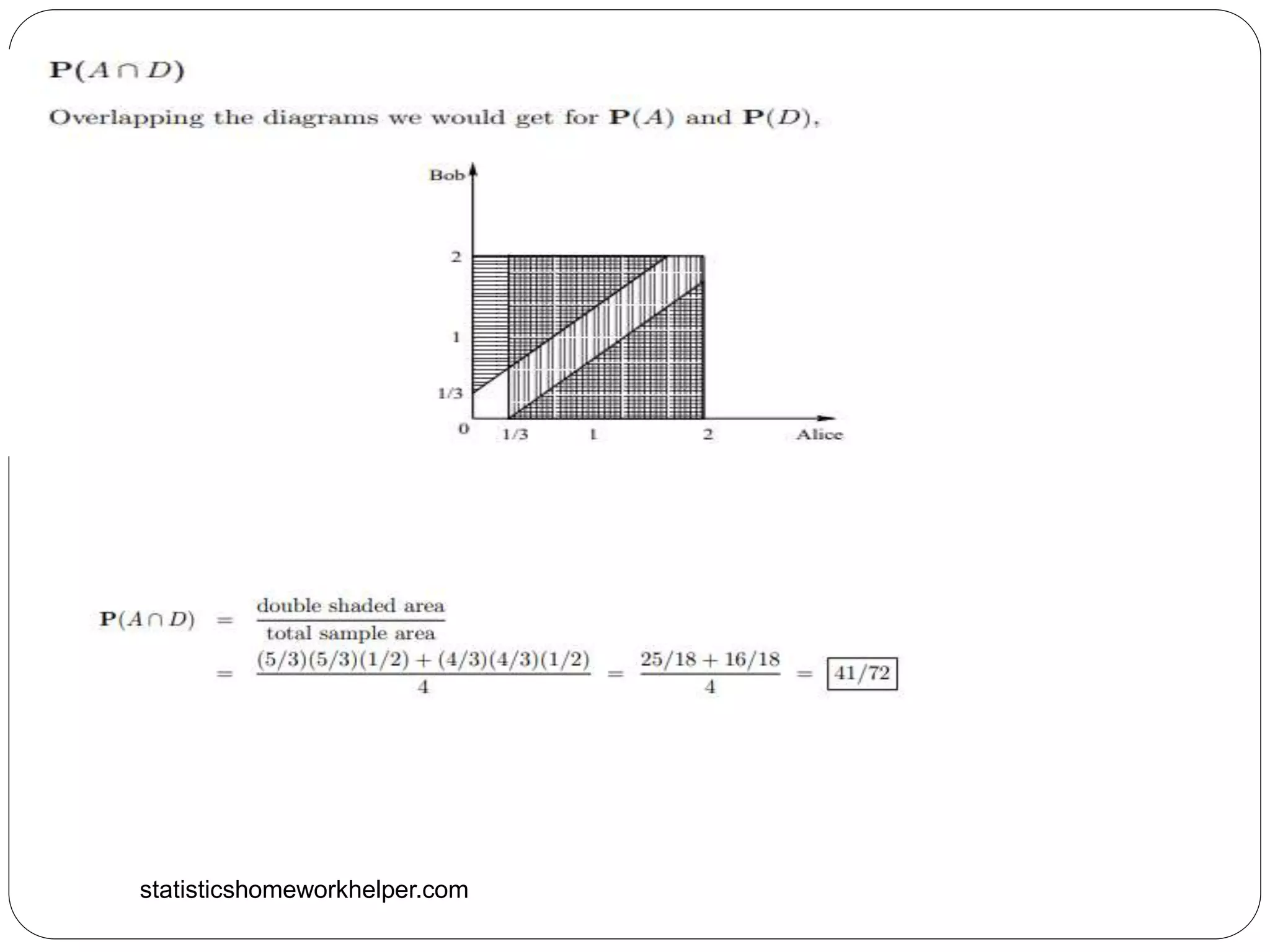
A : The magnitude of the difference of the two numbers is greater than 1/3.
B : At least one of the numbers is greater than 1/3.
C : The two numbers are equal.
D : Alice’s number is greater than 1/3.
Find the probabilities P(B), P(C), and P(A ∩ D)
5. Mike and John are playing a friendly game of darts where the dart board is a
disk with radius of 10in.
Whenever a dart falls within 1in of the center, 50 points are scored. If the point of
impact is between 1 and 3in from the center, 30 points are scored, if it is at a
distance of 3 to 5in 20 points are scored and if it is further that 5in, 10 points are
scored.
Assume that both players are skilled enough to be able to throw the dart within
the boundaries of the board.
statisticshomeworkhelper.com
Mike can place the dart uniformly on the board (i.e., the probability of the dart
falling in a given region is proportional to its area).
(a) What is the probability that Mike scores 50 points on one throw?
(b) (b) What is the probability of him scoring 30 points on one throw?
(c) (c) John is right handed and is twice more likely to throw in the right half of
the board than in the left half. Across each half, the dart falls uniformly in that
region. Answer the previous questions for John’s throw.
6. Prove that for any three events A, B and C, we have
P(A ∩ B ∩ C) ≥ P(A) + P(B) + P(C) − 2.
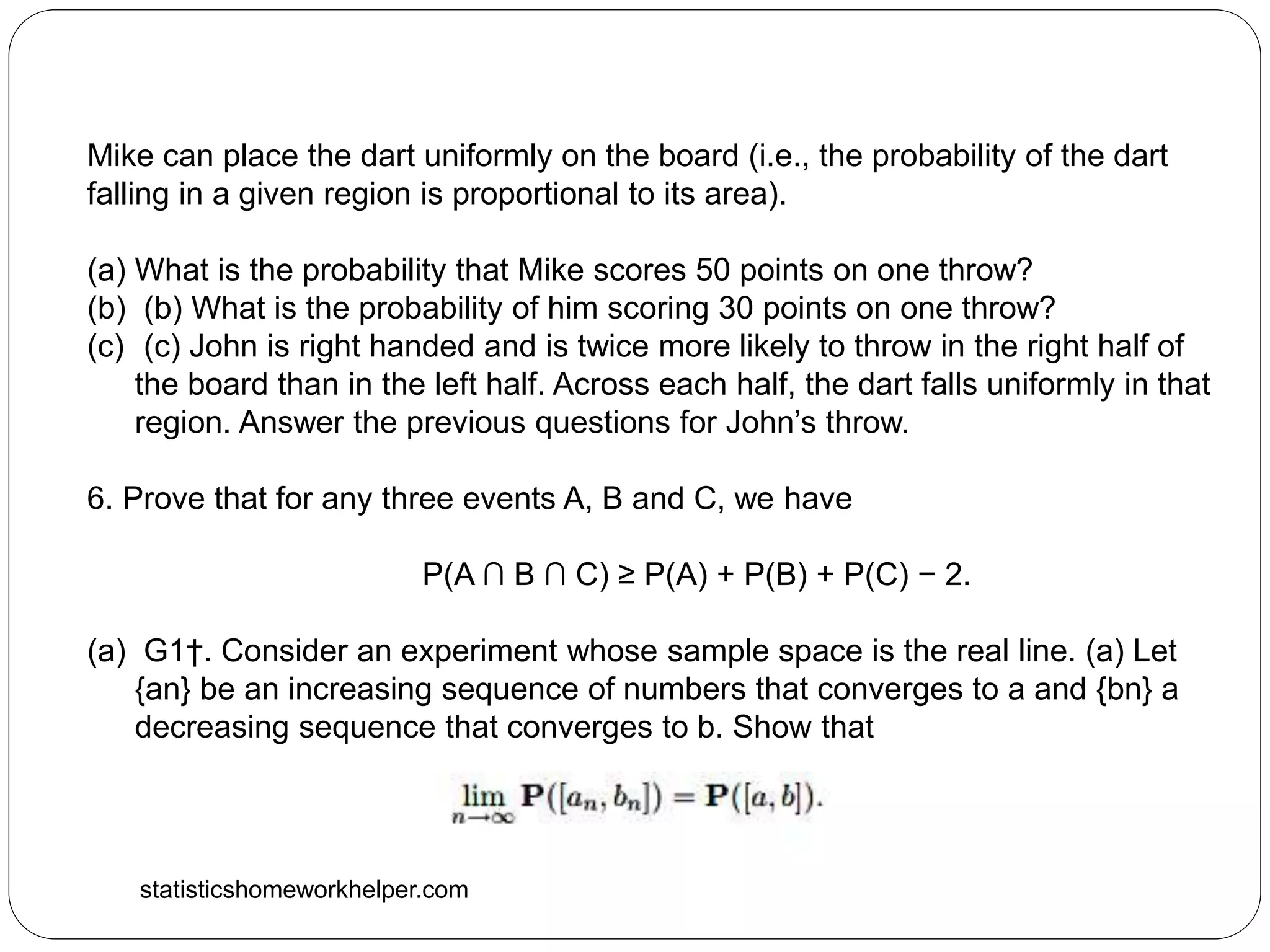
(a) G1†. Consider an experiment whose sample space is the real line. (a) Let
{an} be an increasing sequence of numbers that converges to a and {bn} a
decreasing sequence that converges to b. Show that
statisticshomeworkhelper.com
Here, the notation [a, b] stands for the closed interval {x | a ≤ x ≤ b}.
Note: This result seems intuitively obvious. The issue is to derive it
using the axioms of probability theory.
(b) Let {an} be a decreasing sequence that converges to a and {bn} an
increasing sequence that converges to b. Is it true that
Note: You may use freely the results from the problems in the text in
your proofs
statisticshomeworkhelper.com
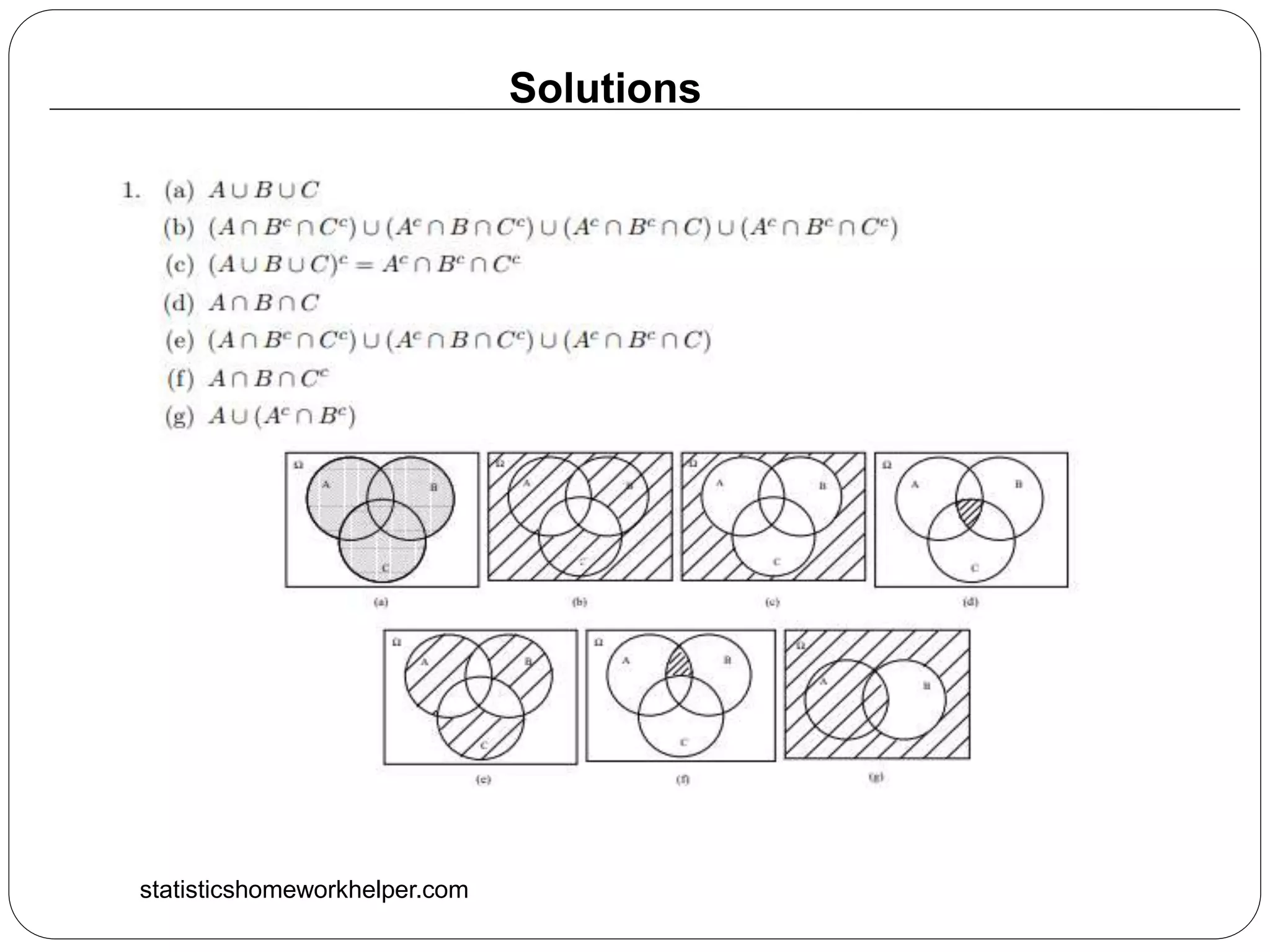
Solutions
statisticshomeworkhelper.com
2. Since all outcomes are equally likely we apply the discrete uniform
probability law to solve the problem. To solve for any event we simply count
the number of elements in the event and divide by the total number of
elements in the sample space.
There are 2 possible outcomes for each flip, and 3 flips. Thus there are 23 =
8 elements (or sequences) in the sample space.
(a) Any sequence has probability of 1/8. Therefore P({H, H, H}) = 1/8 .
(b) This is still a single sequence, thus P({H, T, H}) = 1/8 .
(c) The event of interest has 3 unique sequences, thus P({HHT, HTH, THH})
= 3/8 .
(d) The sequences where there are more heads than tails are A : {HHH, HHT,
HTH, THH}. 4 unique sequences gives us P(A) = 1/2 .
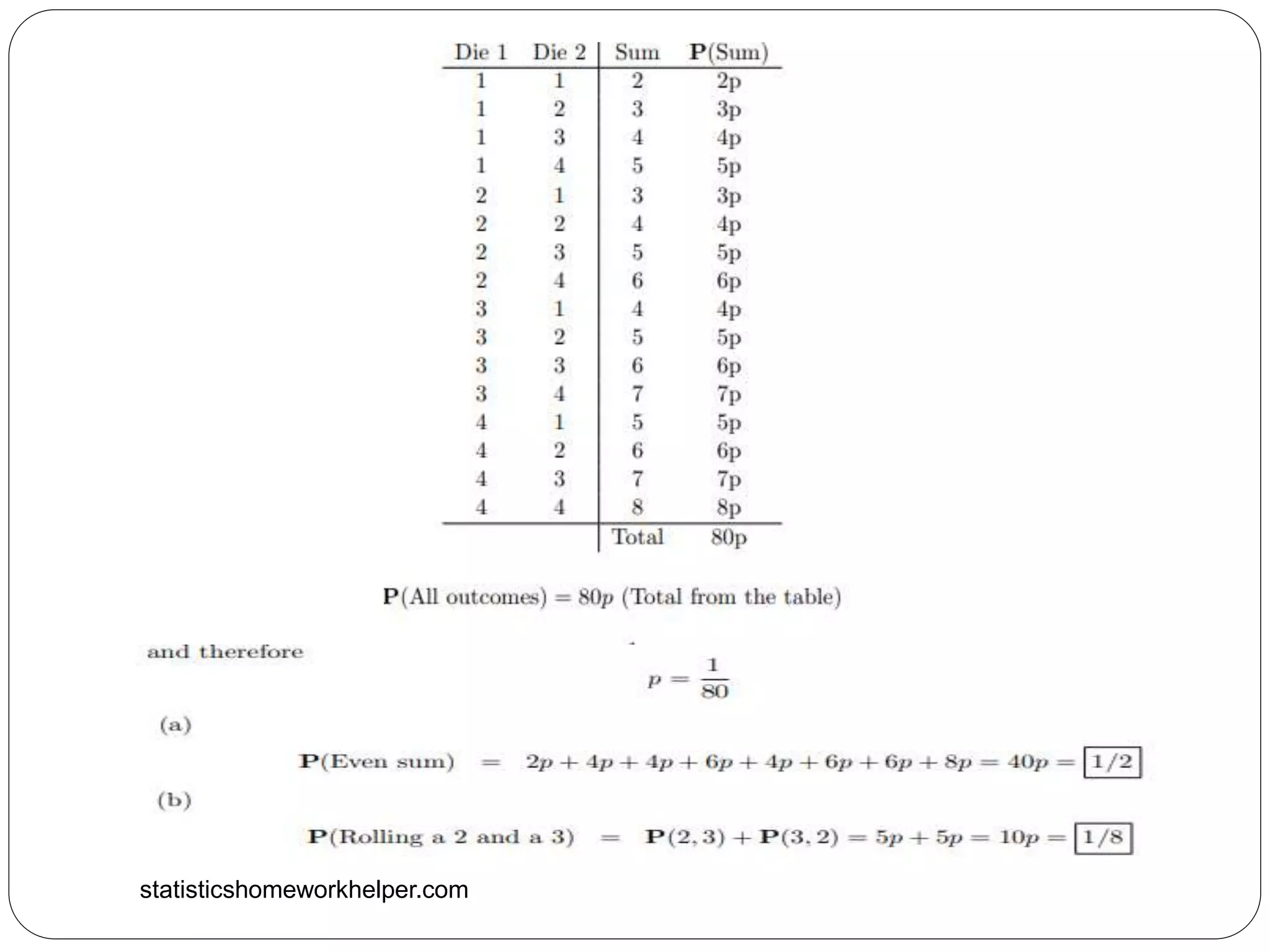
3. The easiest way to solve this problem is to make a table of some sort,
similar to the one below.
statisticshomeworkhelper.com
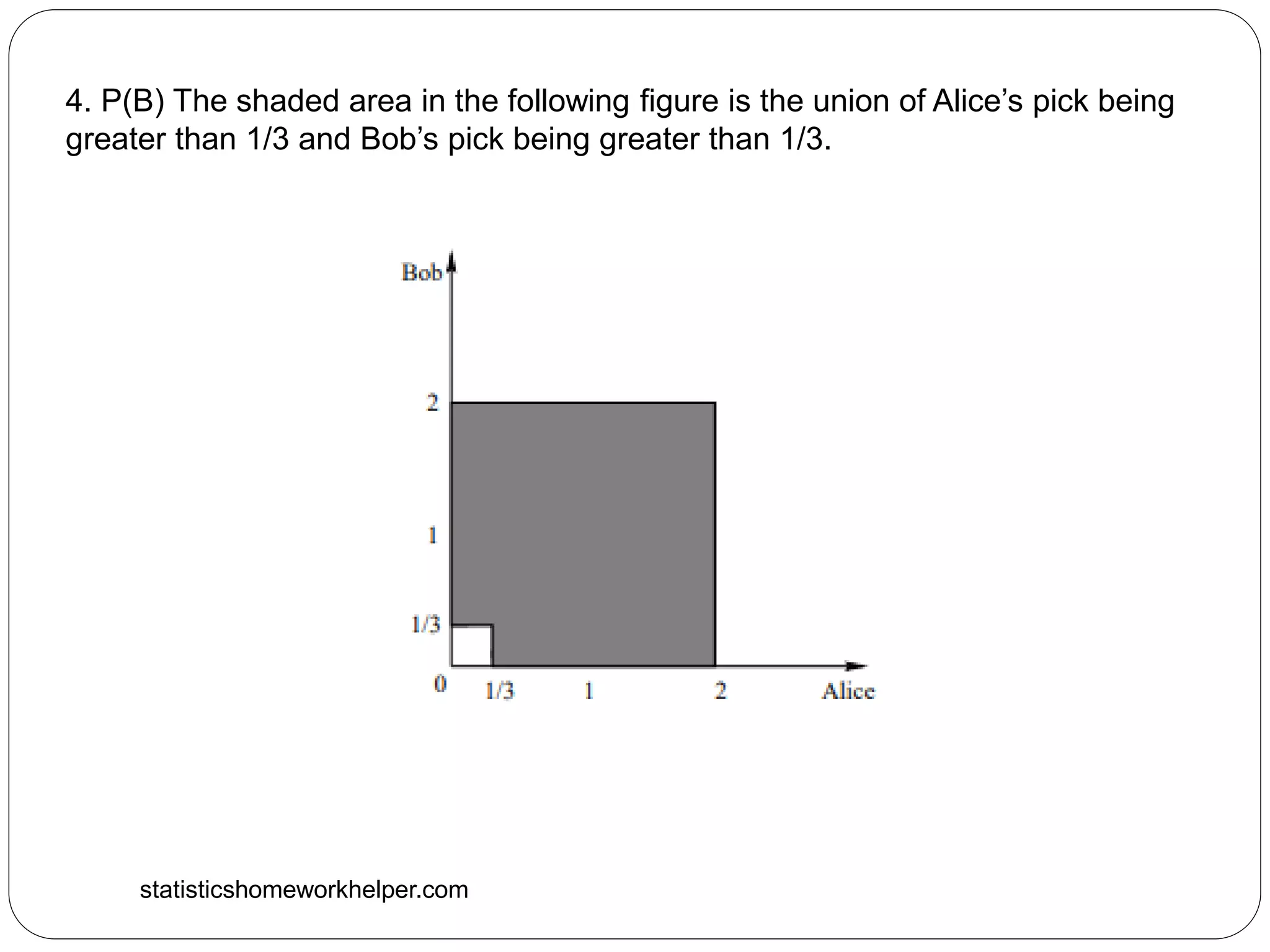
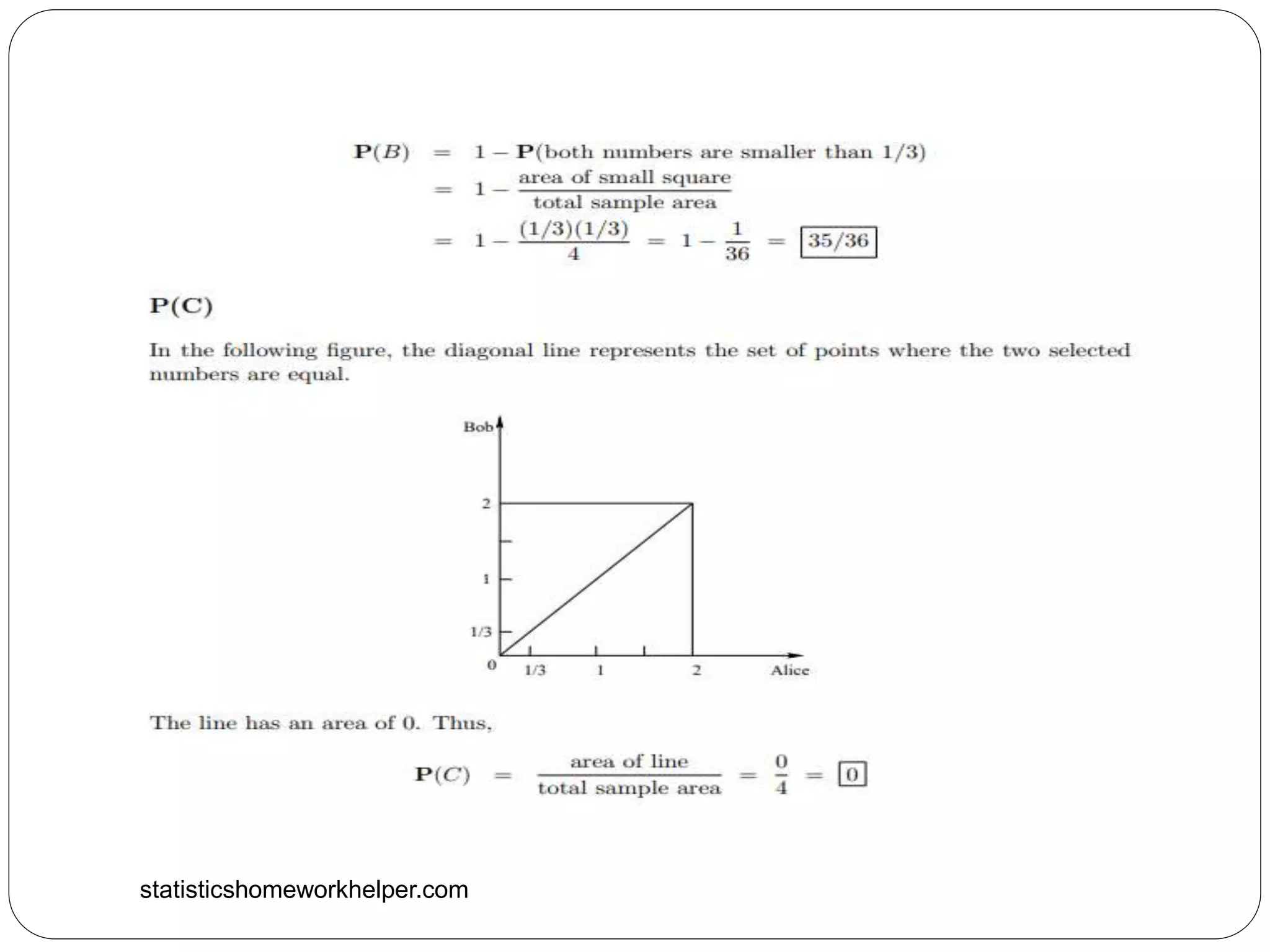
4. P(B) The shaded area in the following figure is the union of Alice’s pick being
greater than 1/3 and Bob’s pick being greater than 1/3.
statisticshomeworkhelper.com
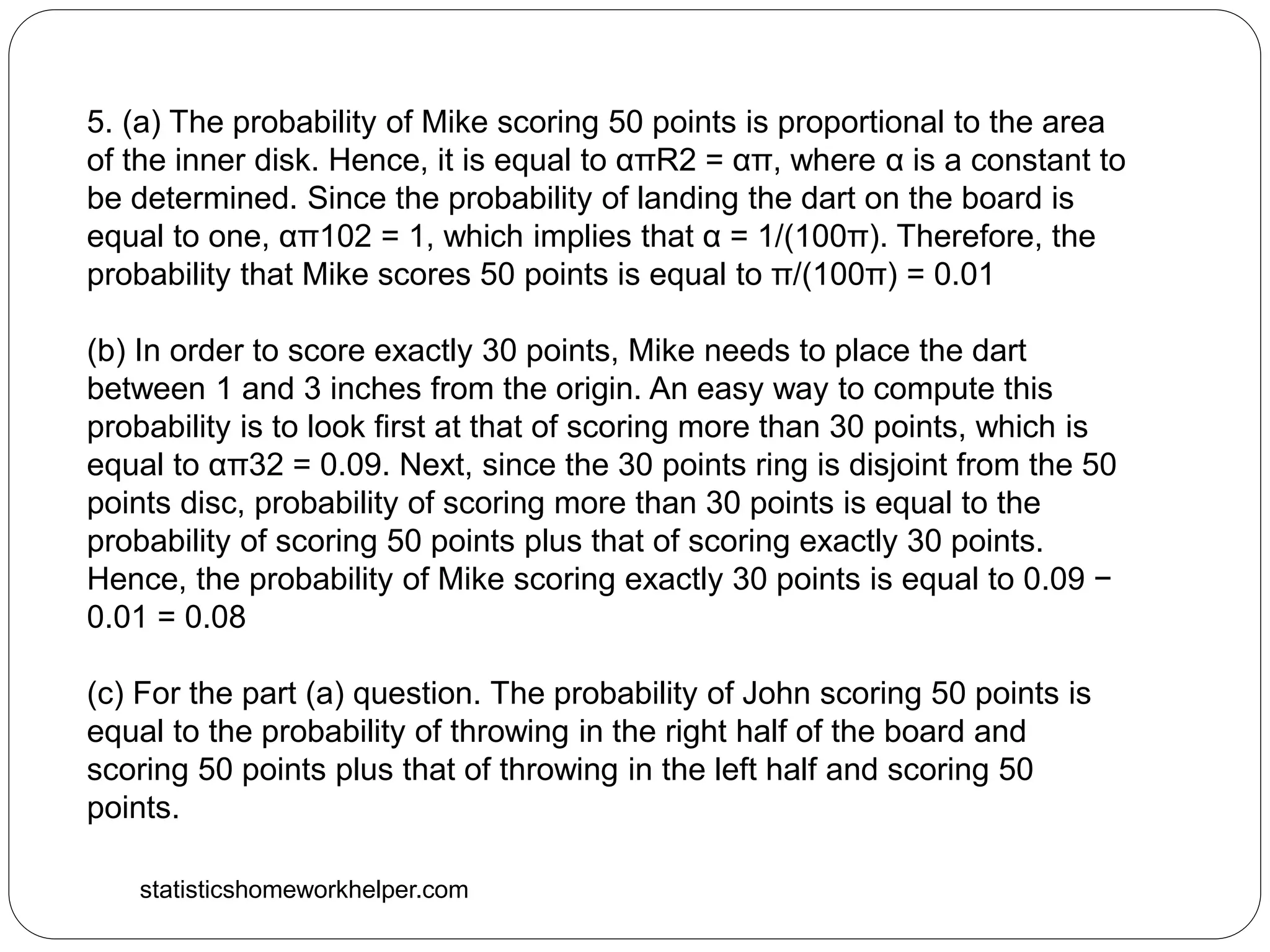
5. (a) The probability of Mike scoring 50 points is proportional to the area
of the inner disk. Hence, it is equal to απR2 = απ, where α is a constant to
be determined. Since the probability of landing the dart on the board is
equal to one, απ102 = 1, which implies that α = 1/(100π). Therefore, the
probability that Mike scores 50 points is equal to π/(100π) = 0.01
(b) In order to score exactly 30 points, Mike needs to place the dart
between 1 and 3 inches from the origin. An easy way to compute this
probability is to look first at that of scoring more than 30 points, which is
equal to απ32 = 0.09. Next, since the 30 points ring is disjoint from the 50
points disc, probability of scoring more than 30 points is equal to the
probability of scoring 50 points plus that of scoring exactly 30 points.
Hence, the probability of Mike scoring exactly 30 points is equal to 0.09 −
0.01 = 0.08
(c) For the part (a) question. The probability of John scoring 50 points is
equal to the probability of throwing in the right half of the board and
scoring 50 points plus that of throwing in the left half and scoring 50
points.
statisticshomeworkhelper.com
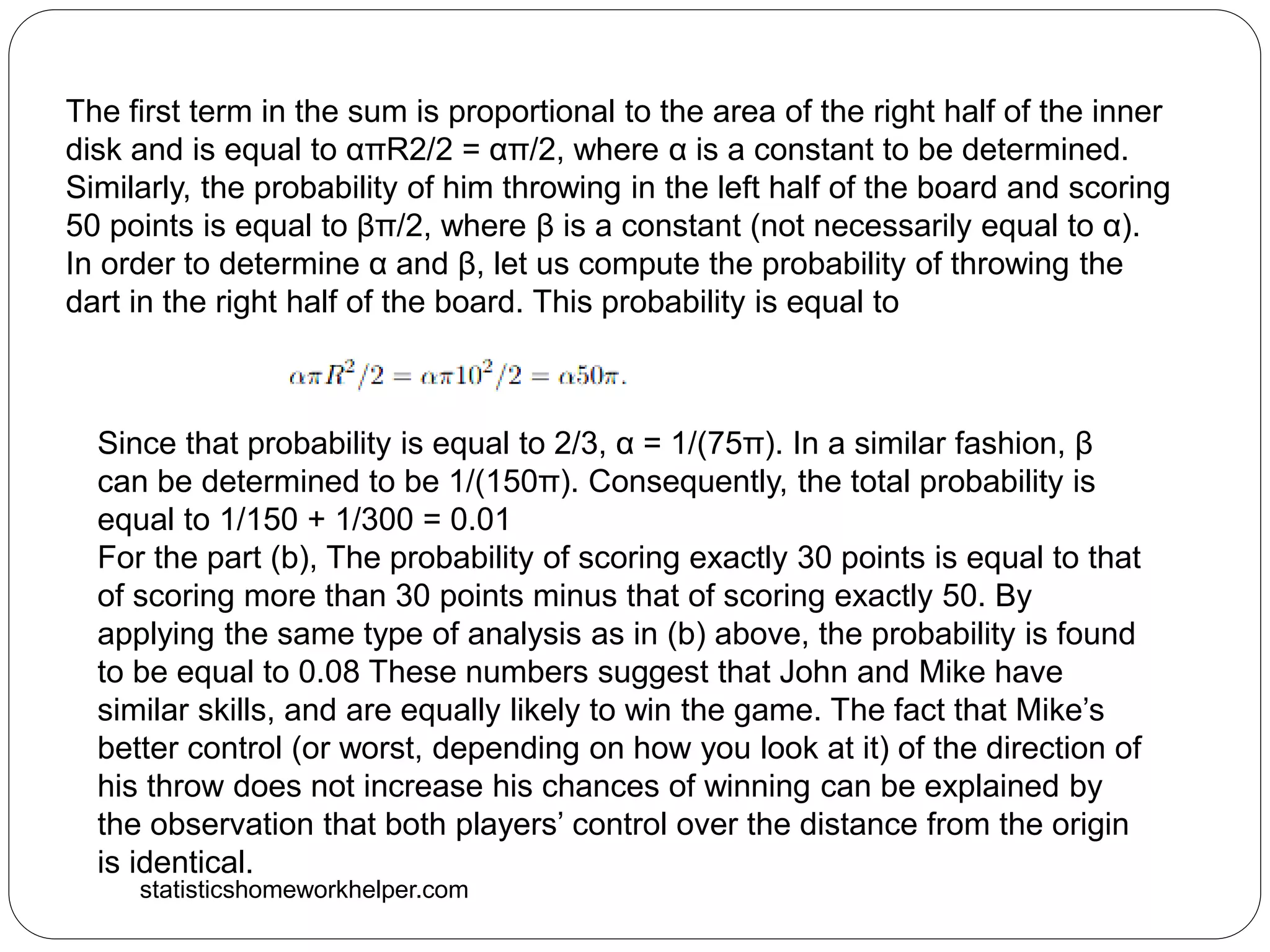
The first term in the sum is proportional to the area of the right half of the inner
disk and is equal to απR2/2 = απ/2, where α is a constant to be determined.
Similarly, the probability of him throwing in the left half of the board and scoring
50 points is equal to βπ/2, where β is a constant (not necessarily equal to α).
In order to determine α and β, let us compute the probability of throwing the
dart in the right half of the board. This probability is equal to
Since that probability is equal to 2/3, α = 1/(75π). In a similar fashion, β
can be determined to be 1/(150π). Consequently, the total probability is
equal to 1/150 + 1/300 = 0.01
For the part (b), The probability of scoring exactly 30 points is equal to that
of scoring more than 30 points minus that of scoring exactly 50. By
applying the same type of analysis as in (b) above, the probability is found
to be equal to 0.08 These numbers suggest that John and Mike have
similar skills, and are equally likely to win the game. The fact that Mike’s
better control (or worst, depending on how you look at it) of the direction of
his throw does not increase his chances of winning can be explained by
the observation that both players’ control over the distance from the origin
is identical.
statisticshomeworkhelper.com
6. See the textbook, Problem 1.11 page 55, which proves the general version
of Bonferroni’s inequality.
G1†. (a) If we define An = [an, bn] for all n, it is easy to see that the sequence
A1, A2, . . . is “monotonically decreasing,” i.e., An+1 ⊂ An for all n:

Statistical Assignment Help

  • 1.
    statisticshomeworkhelper.c om For any helpregarding Statistics Assignment Help visit: https://www.statisticshomeworkhelper.com Email- info@statisticshomeworkhelper.com or call us at-+1 678 648 4277
  • 2.
    Probabilistic Systems Analysis Problems statisticshomeworkhelper.com 1.Express each of the following events in terms of the events A, B and C as well as the operations of complementation, union and intersection: (a) at least one of the events A, B, C occurs; (b) at most one of the events A, B, C occurs; (c) none of the events A, B, C occurs; (d) all three events A, B, C occur; (e) exactly one of the events A, B, C occurs; (f) events A and B occur, but not C; (g) either event A occurs or, if not, then B also does not occur. In each case draw the corresponding Venn diagrams. 2. You flip a fair coin 3 times, determine the probability o f the below events. Assume all sequences are equally likely. (a) Three heads: HHH
  • 3.
    statisticshomeworkhelper.com (b) The sequencehead, tail, head: HTH (c) Any sequence with 2 heads and 1 tail (d) Any sequence where the number of heads is greater than or equal to the number of tails. (d) Any sequence where the number of heads is greater than or equal to the number of tails 3. Bob has a peculiar pair of four-sided dice. When he rolls the dice, the probability of any particular outcome is proportional to the sum of the results of each die. All outcomes that result in a particular sum are equally likely? (a) What is the probability of the sum being even? (b) What is the probability of Bob rolling a 2 and a 3, in any order 4. Alice and Bob each choose at random a number in the interval [0, 2]. We assume a uniform probability law under which the probability of an event is proportional to its area. Consider the following events:
  • 4.
    statisticshomeworkhelper.com A : Themagnitude of the difference of the two numbers is greater than 1/3. B : At least one of the numbers is greater than 1/3. C : The two numbers are equal. D : Alice’s number is greater than 1/3. Find the probabilities P(B), P(C), and P(A ∩ D) 5. Mike and John are playing a friendly game of darts where the dart board is a disk with radius of 10in. Whenever a dart falls within 1in of the center, 50 points are scored. If the point of impact is between 1 and 3in from the center, 30 points are scored, if it is at a distance of 3 to 5in 20 points are scored and if it is further that 5in, 10 points are scored. Assume that both players are skilled enough to be able to throw the dart within the boundaries of the board.
  • 5.
    statisticshomeworkhelper.com Mike can placethe dart uniformly on the board (i.e., the probability of the dart falling in a given region is proportional to its area). (a) What is the probability that Mike scores 50 points on one throw? (b) (b) What is the probability of him scoring 30 points on one throw? (c) (c) John is right handed and is twice more likely to throw in the right half of the board than in the left half. Across each half, the dart falls uniformly in that region. Answer the previous questions for John’s throw. 6. Prove that for any three events A, B and C, we have P(A ∩ B ∩ C) ≥ P(A) + P(B) + P(C) − 2. (a) G1†. Consider an experiment whose sample space is the real line. (a) Let {an} be an increasing sequence of numbers that converges to a and {bn} a decreasing sequence that converges to b. Show that
  • 6.
    statisticshomeworkhelper.com Here, the notation[a, b] stands for the closed interval {x | a ≤ x ≤ b}. Note: This result seems intuitively obvious. The issue is to derive it using the axioms of probability theory. (b) Let {an} be a decreasing sequence that converges to a and {bn} an increasing sequence that converges to b. Is it true that Note: You may use freely the results from the problems in the text in your proofs
  • 7.
  • 8.
    statisticshomeworkhelper.com 2. Since alloutcomes are equally likely we apply the discrete uniform probability law to solve the problem. To solve for any event we simply count the number of elements in the event and divide by the total number of elements in the sample space. There are 2 possible outcomes for each flip, and 3 flips. Thus there are 23 = 8 elements (or sequences) in the sample space. (a) Any sequence has probability of 1/8. Therefore P({H, H, H}) = 1/8 . (b) This is still a single sequence, thus P({H, T, H}) = 1/8 . (c) The event of interest has 3 unique sequences, thus P({HHT, HTH, THH}) = 3/8 . (d) The sequences where there are more heads than tails are A : {HHH, HHT, HTH, THH}. 4 unique sequences gives us P(A) = 1/2 . 3. The easiest way to solve this problem is to make a table of some sort, similar to the one below.
  • 9.
  • 10.
    statisticshomeworkhelper.com 4. P(B) Theshaded area in the following figure is the union of Alice’s pick being greater than 1/3 and Bob’s pick being greater than 1/3.
  • 11.
  • 12.
  • 13.
    statisticshomeworkhelper.com 5. (a) Theprobability of Mike scoring 50 points is proportional to the area of the inner disk. Hence, it is equal to απR2 = απ, where α is a constant to be determined. Since the probability of landing the dart on the board is equal to one, απ102 = 1, which implies that α = 1/(100π). Therefore, the probability that Mike scores 50 points is equal to π/(100π) = 0.01 (b) In order to score exactly 30 points, Mike needs to place the dart between 1 and 3 inches from the origin. An easy way to compute this probability is to look first at that of scoring more than 30 points, which is equal to απ32 = 0.09. Next, since the 30 points ring is disjoint from the 50 points disc, probability of scoring more than 30 points is equal to the probability of scoring 50 points plus that of scoring exactly 30 points. Hence, the probability of Mike scoring exactly 30 points is equal to 0.09 − 0.01 = 0.08 (c) For the part (a) question. The probability of John scoring 50 points is equal to the probability of throwing in the right half of the board and scoring 50 points plus that of throwing in the left half and scoring 50 points.
  • 14.
    statisticshomeworkhelper.com The first termin the sum is proportional to the area of the right half of the inner disk and is equal to απR2/2 = απ/2, where α is a constant to be determined. Similarly, the probability of him throwing in the left half of the board and scoring 50 points is equal to βπ/2, where β is a constant (not necessarily equal to α). In order to determine α and β, let us compute the probability of throwing the dart in the right half of the board. This probability is equal to Since that probability is equal to 2/3, α = 1/(75π). In a similar fashion, β can be determined to be 1/(150π). Consequently, the total probability is equal to 1/150 + 1/300 = 0.01 For the part (b), The probability of scoring exactly 30 points is equal to that of scoring more than 30 points minus that of scoring exactly 50. By applying the same type of analysis as in (b) above, the probability is found to be equal to 0.08 These numbers suggest that John and Mike have similar skills, and are equally likely to win the game. The fact that Mike’s better control (or worst, depending on how you look at it) of the direction of his throw does not increase his chances of winning can be explained by the observation that both players’ control over the distance from the origin is identical.
  • 15.
    statisticshomeworkhelper.com 6. See thetextbook, Problem 1.11 page 55, which proves the general version of Bonferroni’s inequality. G1†. (a) If we define An = [an, bn] for all n, it is easy to see that the sequence A1, A2, . . . is “monotonically decreasing,” i.e., An+1 ⊂ An for all n: