statisticshomeworkhelper.com
Probability and Statistics
Assignment Help
For any help regarding Statistics Homework Help visit :
https://www.statisticshomeworkhelper.com/,
Email - info@statisticshomeworkhelper.com or call us at - +1 678 648 4277
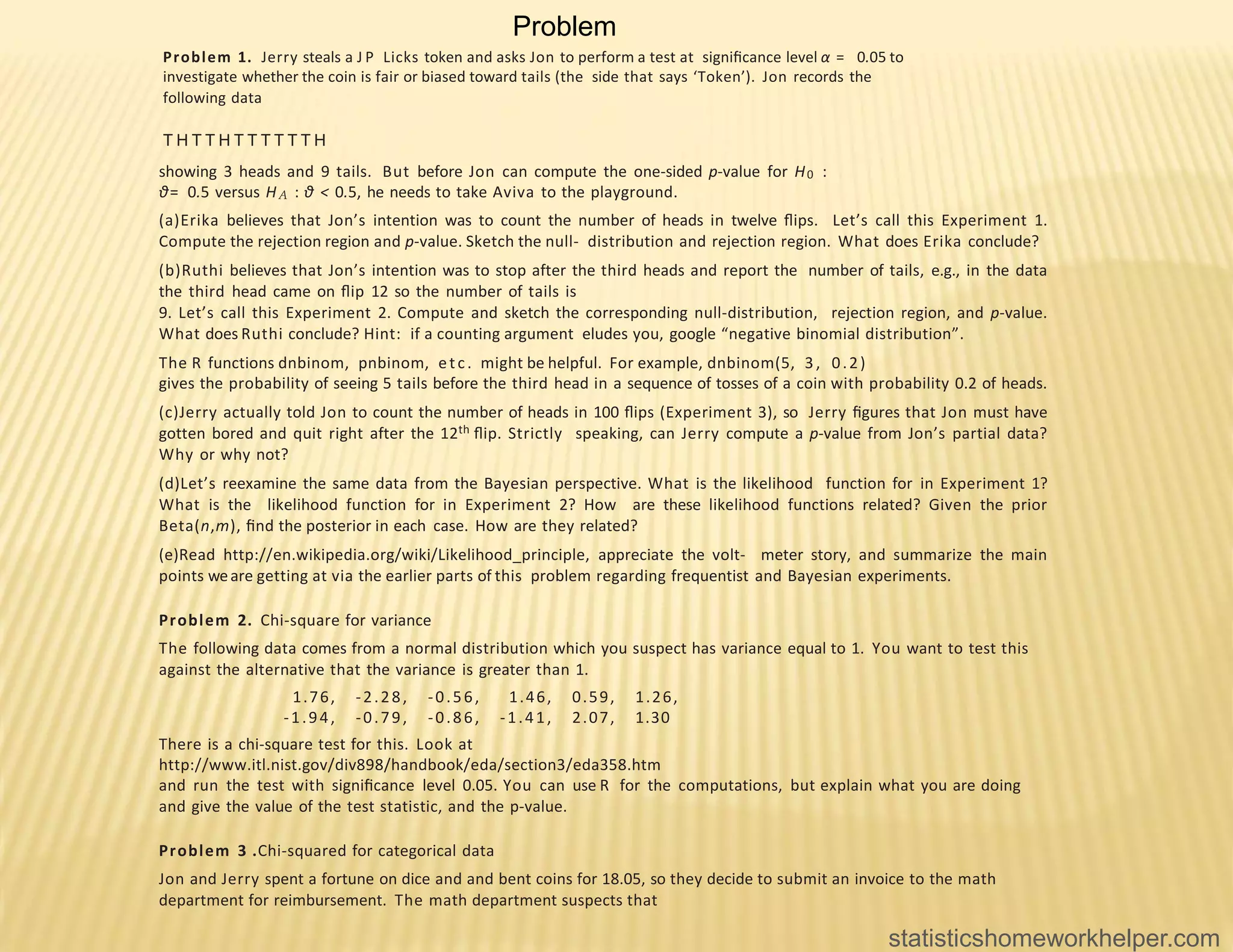
showing 3 heads and 9 tails. But before Jon can compute the one-sided p-value for H0 :
θ= 0.5 versus HA : θ < 0.5, he needs to take Aviva to the playground.
(a)Erika believes that Jon’s intention was to count the number of heads in twelve flips. Let’s call this Experiment 1.
Compute the rejection region and p-value. Sketch the null- distribution and rejection region. What does Erika conclude?
(b)Ruthi believes that Jon’s intention was to stop after the third heads and report the number of tails, e.g., in the data
the third head came on flip 12 so the number of tails is
9. Let’s call this Experiment 2. Compute and sketch the corresponding null-distribution, rejection region, and p-value.
What does Ruthi conclude? Hint: if a counting argument eludes you, google “negative binomial distribution”.
The R functions dnbinom, pnbinom, etc. might be helpful. For example, dnbinom(5, 3, 0.2)
gives the probability of seeing 5 tails before the third head in a sequence of tosses of a coin with probability 0.2 of heads.
(c)Jerry actually told Jon to count the number of heads in 100 flips (Experiment 3), so Jerry figures that Jon must have
gotten bored and quit right after the 12th flip. Strictly speaking, can Jerry compute a p-value from Jon’s partial data?
Why or why not?
(d)Let’s reexamine the same data from the Bayesian perspective. What is the likelihood function for in Experiment 1?
What is the likelihood function for in Experiment 2? How are these likelihood functions related? Given the prior
Beta(n,m), find the posterior in each case. How are they related?
(e)Read http://en.wikipedia.org/wiki/Likelihood_principle, appreciate the volt- meter story, and summarize the main
points weare getting at via the earlier parts of this problem regarding frequentist and Bayesian experiments.
Problem 2. Chi-square for variance
The following data comes from a normal distribution which you suspect has variance equal to 1. You want to test this
against the alternative that the variance is greater than 1.
1.76, -2.28, -0.56, 1.46, 0.59, 1.26,
-1.94, -0.79, -0.86, -1.41, 2.07, 1.30
There is a chi-square test for this. Look at
http://www.itl.nist.gov/div898/handbook/eda/section3/eda358.htm
and run the test with significance level 0.05. You can use R for the computations, but explain what you are doing
and give the value of the test statistic, and the p-value.
Problem 3 .Chi-squared for categorical data
Jon and Jerry spent a fortune on dice and and bent coins for 18.05, so they decide to submit an invoice to the math
department for reimbursement. The math department suspects that
statisticshomeworkhelper.com
Problem 1. Jerry steals a J P Licks token and asks Jon to perform a test at significance level α = 0.05 to
investigate whether the coin is fair or biased toward tails (the side that says ‘Token’). Jon records the
following data
T H T T H T T T T T T H
Problem
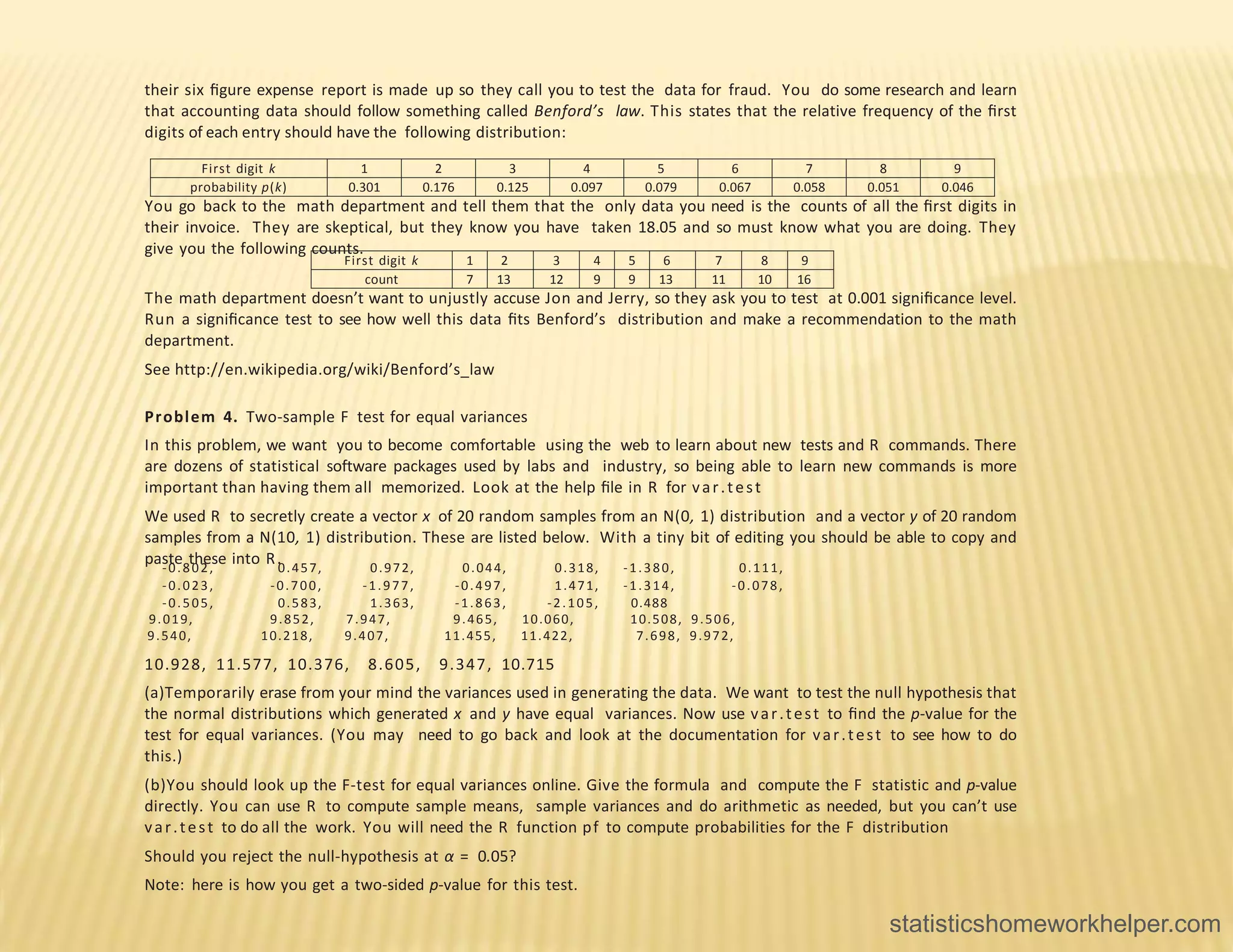
their six figure expense report is made up so they call you to test the data for fraud. You do some research and learn
that accounting data should follow something called Benford’s law. This states that the relative frequency of the first
digits of each entry should have the following distribution:
First digit k 1 2 3 4 5 6 7 8 9
probability p(k) 0.301 0.176 0.125 0.097 0.079 0.067 0.058 0.051 0.046
You go back to the math department and tell them that the only data you need is the counts of all the first digits in
their invoice. They are skeptical, but they know you have taken 18.05 and so must know what you are doing. They
give you the following counts.
First digit k 1 2 3 4 5 6 7 8 9
count 7 13 12 9 9 13 11 10 16
The math department doesn’t want to unjustly accuse Jon and Jerry, so they ask you to test at 0.001 significance level.
Run a significance test to see how well this data fits Benford’s distribution and make a recommendation to the math
department.
See http://en.wikipedia.org/wiki/Benford’s_law
Problem 4. Two-sample F test for equal variances
In this problem, we want you to become comfortable using the web to learn about new tests and R commands. There
are dozens of statistical software packages used by labs and industry, so being able to learn new commands is more
important than having them all memorized. Look at the help file in R for var.test
We used R to secretly create a vector x of 20 random samples from an N(0, 1) distribution and a vector y of 20 random
samples from a N(10, 1) distribution. These are listed below. With a tiny bit of editing you should be able to copy and
paste these into R.
-0.802, 0.457, 0.972, 0.044, 0.318, -1.380, 0.111,
-0.023, -0.700, -1.977, -0.497, 1.471, -1.314, -0.078,
-0.505, 0.583, 1.363, -1.863, -2.105, 0.488
9.019, 9.852, 7.947, 9.465, 10.060, 10.508, 9.506,
9.540, 10.218, 9.407, 11.455, 11.422, 7.698, 9.972,
10.928, 11.577, 10.376, 8.605, 9.347, 10.715
(a)Temporarily erase from your mind the variances used in generating the data. We want to test the null hypothesis that
the normal distributions which generated x and y have equal variances. Now use var.test to find the p-value for the
test for equal variances. (You may need to go back and look at the documentation for var.test to see how to do
this.)
(b)You should look up the F-test for equal variances online. Give the formula and compute the F statistic and p-value
directly. You can use R to compute sample means, sample variances and do arithmetic as needed, but you can’t use
var.test to do all the work. You will need the R function pf to compute probabilities for the F distribution
Should you reject the null-hypothesis at α = 0.05?
Note: here is how you get a two-sided p-value for this test.
statisticshomeworkhelper.com
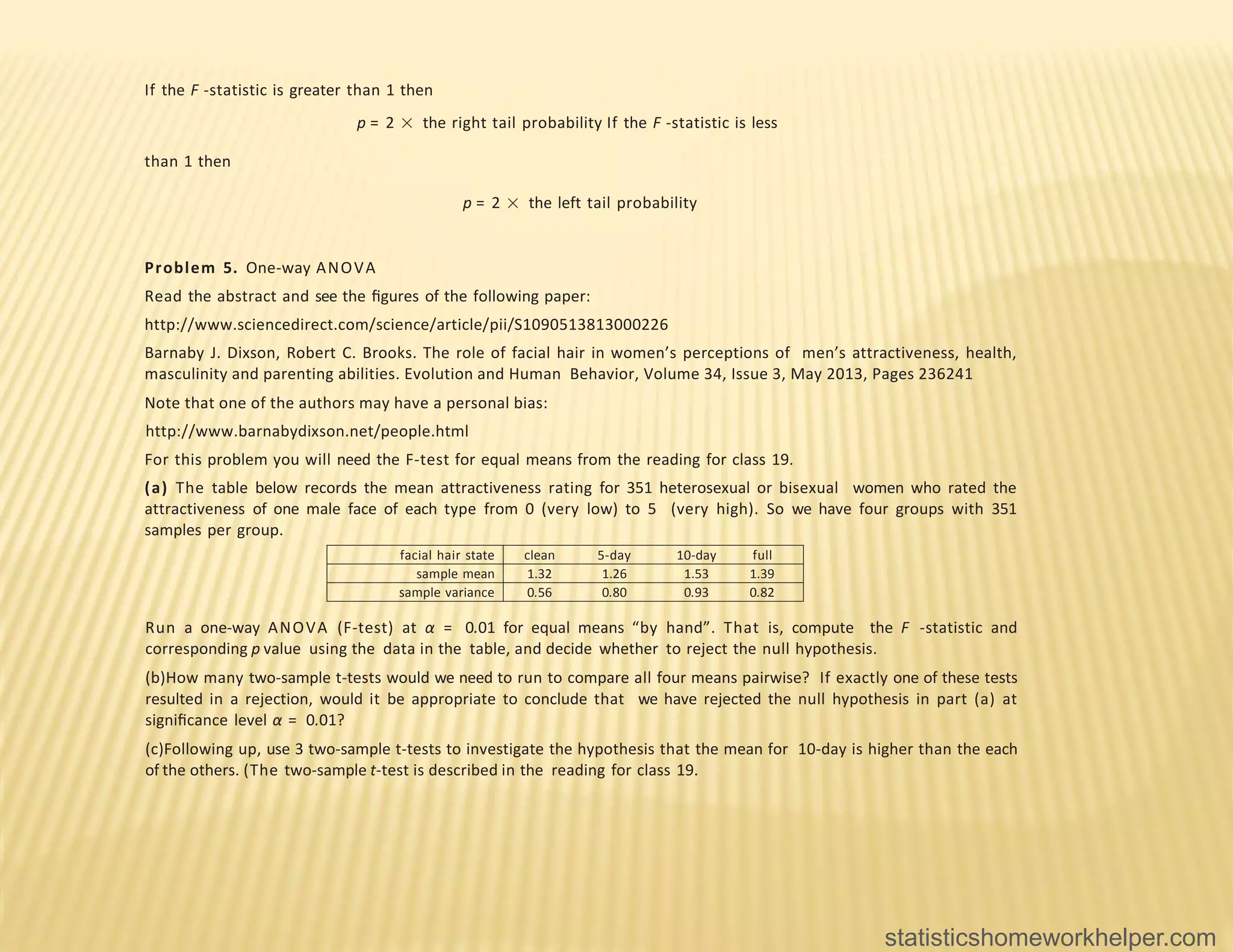
If the F -statistic is greater than 1 then
p = 2 × the right tail probability If the F -statistic is less
than 1 then
p = 2 × the left tail probability
Problem 5. One-way ANOVA
Read the abstract and see the figures of the following paper:
http://www.sciencedirect.com/science/article/pii/S1090513813000226
Barnaby J. Dixson, Robert C. Brooks. The role of facial hair in women’s perceptions of men’s attractiveness, health,
masculinity and parenting abilities. Evolution and Human Behavior, Volume 34, Issue 3, May 2013, Pages 236241
Note that one of the authors may have a personal bias:
http://www.barnabydixson.net/people.html
For this problem you will need the F-test for equal means from the reading for class 19.
(a) The table below records the mean attractiveness rating for 351 heterosexual or bisexual women who rated the
attractiveness of one male face of each type from 0 (very low) to 5 (very high). So we have four groups with 351
samples per group.
facial hair state clean 5-day 10-day full
sample mean 1.32 1.26 1.53 1.39
sample variance 0.56 0.80 0.93 0.82
Run a one-way ANOVA (F-test) at α = 0.01 for equal means “by hand”. That is, compute the F -statistic and
corresponding p value using the data in the table, and decide whether to reject the null hypothesis.
(b)How many two-sample t-tests would we need to run to compare all four means pairwise? If exactly one of these tests
resulted in a rejection, would it be appropriate to conclude that we have rejected the null hypothesis in part (a) at
significance level α = 0.01?
(c)Following up, use 3 two-sample t-tests to investigate the hypothesis that the mean for 10-day is higher than the each
of the others. (The two-sample t-test is described in the reading for class 19.
statisticshomeworkhelper.com
Solutions
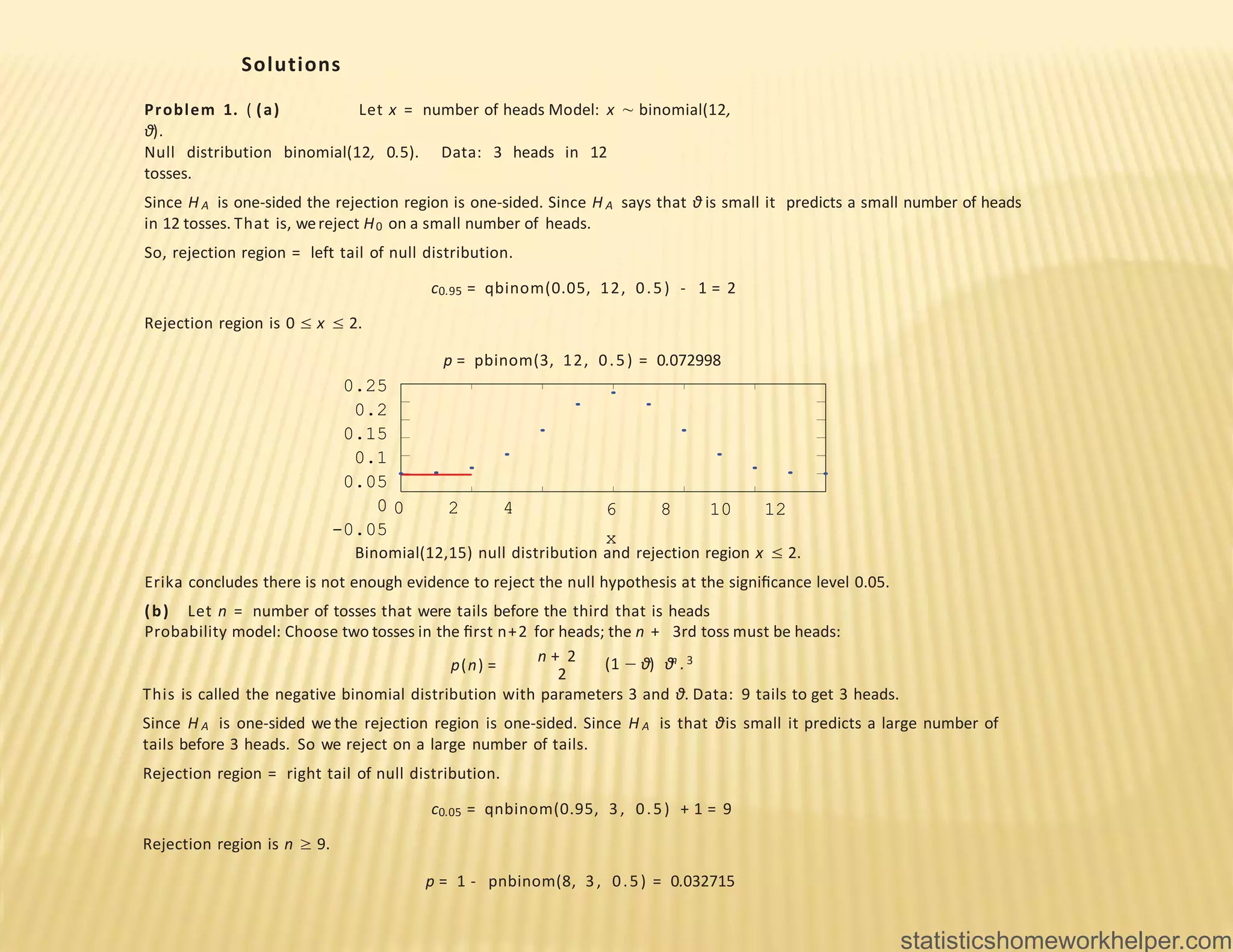
Problem 1. ( (a) Let x = number of heads Model: x ∼ binomial(12,
θ).
Null distribution binomial(12, 0.5). Data: 3 heads in 12
tosses.
Since H A is one-sided the rejection region is one-sided. Since H A says that θ is small it predicts a small number of heads
in 12 tosses. That is, wereject H0 on a small number of heads.
So, rejection region = left tail of null distribution.
c0.95 = qbinom(0.05, 12, 0.5) - 1 = 2
Rejection region is 0 ≤ x ≤ 2.
p = pbinom(3, 12, 0.5) = 0.072998
0.25
0.2
0.15
0.1
0.05
0
-0.05
0 2 4 6 8 10 12
x
Binomial(12,15) null distribution and rejection region x ≤ 2.
Erika concludes there is not enough evidence to reject the null hypothesis at the significance level 0.05.
(b) Let n = number of tosses that were tails before the third that is heads
Probability model: Choose two tosses in the first n+2 for heads; the n + 3rd toss must be heads:
p(n) =
n + 2 n 3
(1 − θ) θ .
2
This is called the negative binomial distribution with parameters 3 and θ. Data: 9 tails to get 3 heads.
Since H A is one-sided we the rejection region is one-sided. Since H A is that θis small it predicts a large number of
tails before 3 heads. So we reject on a large number of tails.
Rejection region = right tail of null distribution.
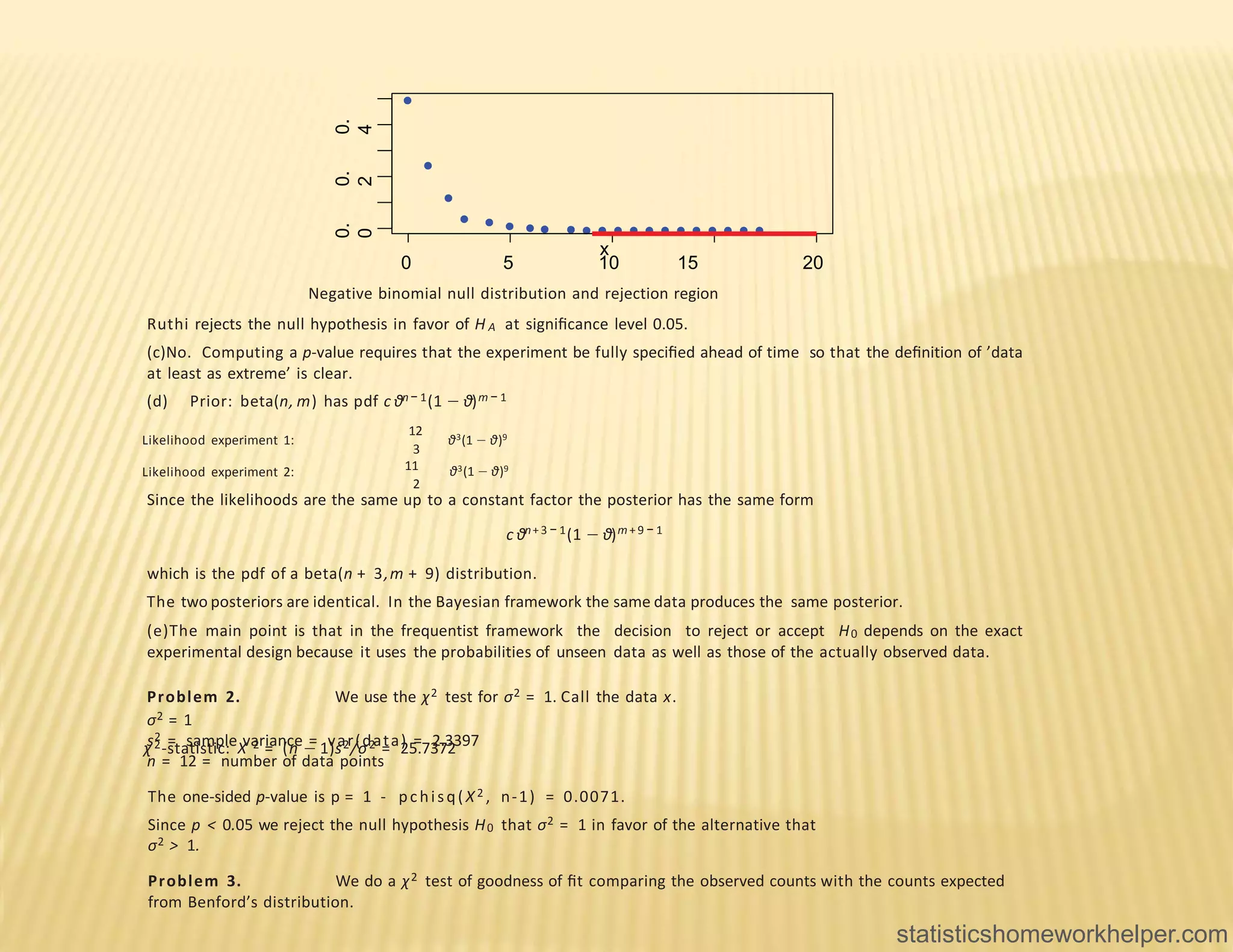
c0.05 = qnbinom(0.95, 3, 0.5) + 1 = 9
Rejection region is n ≥ 9.
p = 1 - pnbinom(8, 3, 0.5) = 0.032715
statisticshomeworkhelper.com
● ● ● ● ● ● ● ● ● ● ● ● ● ● ●
0.
0
0.
2
0.
4
●
●
●
● ● ●
0 5 10 15 20
x
Negative binomial null distribution and rejection region
χ 2-statistic: X 2 = (n − 1)s2/σ2 = 25.7372
The one-sided p-value is p = 1 - pchisq(X2 , n-1) = 0.0071.
Since p < 0.05 we reject the null hypothesis H0 that σ2 = 1 in favor of the alternative that
σ2 > 1.
Ruthi rejects the null hypothesis in favor of H A at significance level 0.05.
(c)No. Computing a p-value requires that the experiment be fully specified ahead of time so that the definition of ’data
at least as extreme’ is clear.
(d) Prior: beta(n, m) has pdf c θn− 1(1 − θ)m− 1
Since the likelihoods are the same up to a constant factor the posterior has the same form
c θn+ 3 − 1(1 − θ)m+ 9 − 1
which is the pdf of a beta(n + 3,m + 9) distribution.
The two posteriors are identical. In the Bayesian framework the same data produces the same posterior.
(e)The main point is that in the frequentist framework the decision to reject or accept H0 depends on the exact
experimental design because it uses the probabilities of unseen data as well as those of the actually observed data.
Problem 2. We use the χ2 test for σ2 = 1. Call the data x.
σ2 = 1
s2 = sample variance = var(data) = 2.3397
n = 12 = number of data points
Likelihood experiment 1:
12
3
θ3(1 − θ)9
Likelihood experiment 2: 11 θ3(1 − θ)9
2
Problem 3. We do a χ2 test of goodness of fit comparing the observed counts with the counts expected
from Benford’s distribution.
statisticshomeworkhelper.com
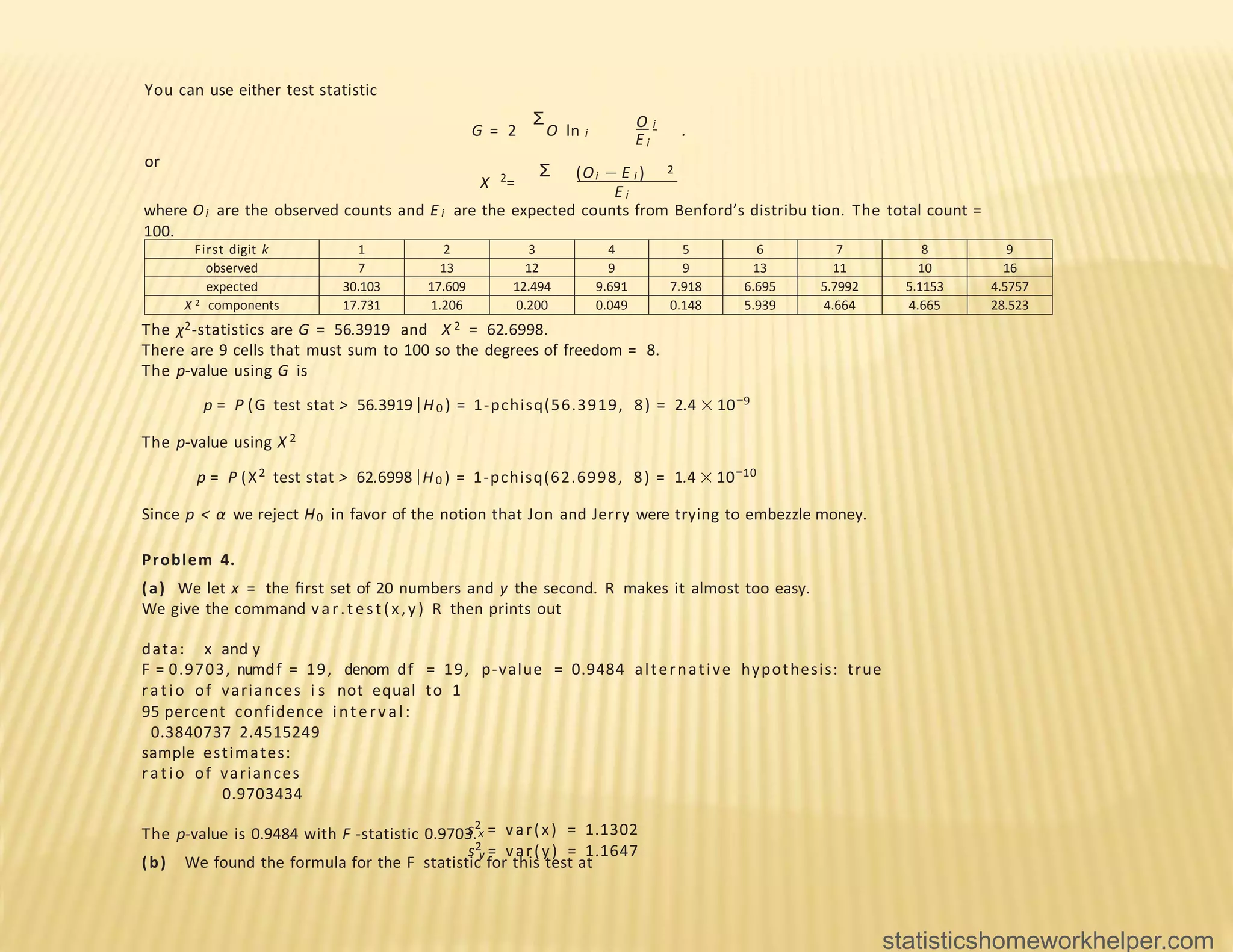
First digit k 1 2 3 4 5 6 7 8 9
observed 7 13 12 9 9 13 11 10 16
expected 30.103 17.609 12.494 9.691 7.918 6.695 5.7992 5.1153 4.5757
X 2 components 17.731 1.206 0.200 0.049 0.148 5.939 4.664 4.665 28.523
You can use either test statistic
Σ O i
i
G = 2 O ln .
E i
or
Σ (Oi − E i ) 2
2
X =
E i
where Oi are the observed counts and E i are the expected counts from Benford’s distribu tion. The total count =
100.
The χ2-statistics are G = 56.3919 and X 2 = 62.6998.
There are 9 cells that must sum to 100 so the degrees of freedom = 8.
The p-value using G is
p = P (G test stat > 56.3919 |H0 ) = 1-pchisq(56.3919, 8) = 2.4 × 10⁻⁹
The p-value using X 2
p = P (X2 test stat > 62.6998 |H0 ) = 1-pchisq(62.6998, 8) = 1.4 × 10⁻¹⁰
Since p < α we reject H0 in favor of the notion that Jon and Jerry were trying to embezzle money.
Problem 4.
(a) We let x = the first set of 20 numbers and y the second. R makes it almost too easy.
We give the command var.test(x,y) R then prints out
data: x and y
F = 0.9703, numdf = 19, denom df = 19, p-value = 0.9484 alternative hypothesis: true
ratio of variances i s not equal to 1
95 percent confidence interval:
0.3840737 2.4515249
sample estimates:
ratio of variances
0.9703434
The p-value is 0.9484 with F -statistic 0.9703.
(b) We found the formula for the F statistic for this test at
s2 = var(x) = 1.1302
x
y
s2 = var(y) = 1.1647
statisticshomeworkhelper.com
Our F -statistic is
s2
f s t at = x = 0.9703
s2
y
The degrees are freedom are both 19. Since the F -statistic is less than 1, the p-value is
p = 2*pf(fstat, 19, 19)) = 0.9484
which matches our result in part (a).
Problem 5. (a) Let’s specify the assumptions and hypotheses for this test. We have 4 groups of data:
Clean, 5-day, 10-day, full
Assumptions: Each group of data is drawn from a normal distribution with the same variance σ2; all data is drawn
independently.
H0: the means of all the normal distributions are equal.
HA : not all the means are equal.
The test compares the between group variance with the within group variance. Under the null hypothesis both are
estimates of σ2, so their ratio should be about 1. We’ll reject H0 if this ratio is far from 1.
We used R to do the computation. Here’s the code.
mns = c(1.32, 1.26, 1.53, 1.39)
v = c(0.56, 0.80, 0.93, 0.82)
m = 351 # number of samples per group n = length(mns) # number
of groups
msb= m*var(mns) # between group variance msw= mean(v) # within
group variance f s t at = msb/msw
df1 = n-1; df2 = n*(m-1)
p = 1 - p f ( f s t at , df1,df2)
print(fstat) print(p)
This produced an F -statistic of 6.09453 and p = 0.00041. Since the p-value is much smaller than 0.05 we reject H0.
( )
4
2
(b) To compare all 4 means 2 at time would require = 6 t-tests. If we run six tests it
is not appropriate to claim the significance level of each one is the significance level of the
collection.
(c) We compare 10-day beards with each of the others. In each case we have: H0: the
means are the same
HA : the 10-day mean is greater than the other mean.
Note carefully that this is a one-sided test while the F -test in part (b) is a two-sided test.
From the class 19 reading we have the t-statistic for two samples. Since both samples have the same size m = 351 the
formula looks a little simpler.
x̄ − ȳ
t = ,
sx¯−y¯
statisticshomeworkhelper.com
t-stat one-sided p-value F-stat
clean 3.22314 0.00066 10.38866
5-day 3.84587 0.00007 14.79069
full 1.98273 0.02389 3.93120
where the pooled sample variance is
P
m
s2 + s2
s2 = x y
Note: the test assumes equal variances which we should verify in each case. This raises the issue of multiple tests from
the same data, but it is legitimate to do this as exploratory analyis which merely suggests directions for further study.
The following table shows the one-sided, 2-sample t-test comparing the mean of the 10-day growth against the other
three states.
We also give the F -statistic for the two samples. You can check that the F -statistic for two-samples is just the
square of the t-statistic.
We reiterate, with multiple testing the true significance level of the test is larger than the significance level for each
individual test.
statisticshomeworkhelper.com

statistics assignment help

  • 1.
    statisticshomeworkhelper.com Probability and Statistics AssignmentHelp For any help regarding Statistics Homework Help visit : https://www.statisticshomeworkhelper.com/, Email - info@statisticshomeworkhelper.com or call us at - +1 678 648 4277
  • 2.
    showing 3 headsand 9 tails. But before Jon can compute the one-sided p-value for H0 : θ= 0.5 versus HA : θ < 0.5, he needs to take Aviva to the playground. (a)Erika believes that Jon’s intention was to count the number of heads in twelve flips. Let’s call this Experiment 1. Compute the rejection region and p-value. Sketch the null- distribution and rejection region. What does Erika conclude? (b)Ruthi believes that Jon’s intention was to stop after the third heads and report the number of tails, e.g., in the data the third head came on flip 12 so the number of tails is 9. Let’s call this Experiment 2. Compute and sketch the corresponding null-distribution, rejection region, and p-value. What does Ruthi conclude? Hint: if a counting argument eludes you, google “negative binomial distribution”. The R functions dnbinom, pnbinom, etc. might be helpful. For example, dnbinom(5, 3, 0.2) gives the probability of seeing 5 tails before the third head in a sequence of tosses of a coin with probability 0.2 of heads. (c)Jerry actually told Jon to count the number of heads in 100 flips (Experiment 3), so Jerry figures that Jon must have gotten bored and quit right after the 12th flip. Strictly speaking, can Jerry compute a p-value from Jon’s partial data? Why or why not? (d)Let’s reexamine the same data from the Bayesian perspective. What is the likelihood function for in Experiment 1? What is the likelihood function for in Experiment 2? How are these likelihood functions related? Given the prior Beta(n,m), find the posterior in each case. How are they related? (e)Read http://en.wikipedia.org/wiki/Likelihood_principle, appreciate the volt- meter story, and summarize the main points weare getting at via the earlier parts of this problem regarding frequentist and Bayesian experiments. Problem 2. Chi-square for variance The following data comes from a normal distribution which you suspect has variance equal to 1. You want to test this against the alternative that the variance is greater than 1. 1.76, -2.28, -0.56, 1.46, 0.59, 1.26, -1.94, -0.79, -0.86, -1.41, 2.07, 1.30 There is a chi-square test for this. Look at http://www.itl.nist.gov/div898/handbook/eda/section3/eda358.htm and run the test with significance level 0.05. You can use R for the computations, but explain what you are doing and give the value of the test statistic, and the p-value. Problem 3 .Chi-squared for categorical data Jon and Jerry spent a fortune on dice and and bent coins for 18.05, so they decide to submit an invoice to the math department for reimbursement. The math department suspects that statisticshomeworkhelper.com Problem 1. Jerry steals a J P Licks token and asks Jon to perform a test at significance level α = 0.05 to investigate whether the coin is fair or biased toward tails (the side that says ‘Token’). Jon records the following data T H T T H T T T T T T H Problem
  • 3.
    their six figureexpense report is made up so they call you to test the data for fraud. You do some research and learn that accounting data should follow something called Benford’s law. This states that the relative frequency of the first digits of each entry should have the following distribution: First digit k 1 2 3 4 5 6 7 8 9 probability p(k) 0.301 0.176 0.125 0.097 0.079 0.067 0.058 0.051 0.046 You go back to the math department and tell them that the only data you need is the counts of all the first digits in their invoice. They are skeptical, but they know you have taken 18.05 and so must know what you are doing. They give you the following counts. First digit k 1 2 3 4 5 6 7 8 9 count 7 13 12 9 9 13 11 10 16 The math department doesn’t want to unjustly accuse Jon and Jerry, so they ask you to test at 0.001 significance level. Run a significance test to see how well this data fits Benford’s distribution and make a recommendation to the math department. See http://en.wikipedia.org/wiki/Benford’s_law Problem 4. Two-sample F test for equal variances In this problem, we want you to become comfortable using the web to learn about new tests and R commands. There are dozens of statistical software packages used by labs and industry, so being able to learn new commands is more important than having them all memorized. Look at the help file in R for var.test We used R to secretly create a vector x of 20 random samples from an N(0, 1) distribution and a vector y of 20 random samples from a N(10, 1) distribution. These are listed below. With a tiny bit of editing you should be able to copy and paste these into R. -0.802, 0.457, 0.972, 0.044, 0.318, -1.380, 0.111, -0.023, -0.700, -1.977, -0.497, 1.471, -1.314, -0.078, -0.505, 0.583, 1.363, -1.863, -2.105, 0.488 9.019, 9.852, 7.947, 9.465, 10.060, 10.508, 9.506, 9.540, 10.218, 9.407, 11.455, 11.422, 7.698, 9.972, 10.928, 11.577, 10.376, 8.605, 9.347, 10.715 (a)Temporarily erase from your mind the variances used in generating the data. We want to test the null hypothesis that the normal distributions which generated x and y have equal variances. Now use var.test to find the p-value for the test for equal variances. (You may need to go back and look at the documentation for var.test to see how to do this.) (b)You should look up the F-test for equal variances online. Give the formula and compute the F statistic and p-value directly. You can use R to compute sample means, sample variances and do arithmetic as needed, but you can’t use var.test to do all the work. You will need the R function pf to compute probabilities for the F distribution Should you reject the null-hypothesis at α = 0.05? Note: here is how you get a two-sided p-value for this test. statisticshomeworkhelper.com
  • 4.
    If the F-statistic is greater than 1 then p = 2 × the right tail probability If the F -statistic is less than 1 then p = 2 × the left tail probability Problem 5. One-way ANOVA Read the abstract and see the figures of the following paper: http://www.sciencedirect.com/science/article/pii/S1090513813000226 Barnaby J. Dixson, Robert C. Brooks. The role of facial hair in women’s perceptions of men’s attractiveness, health, masculinity and parenting abilities. Evolution and Human Behavior, Volume 34, Issue 3, May 2013, Pages 236241 Note that one of the authors may have a personal bias: http://www.barnabydixson.net/people.html For this problem you will need the F-test for equal means from the reading for class 19. (a) The table below records the mean attractiveness rating for 351 heterosexual or bisexual women who rated the attractiveness of one male face of each type from 0 (very low) to 5 (very high). So we have four groups with 351 samples per group. facial hair state clean 5-day 10-day full sample mean 1.32 1.26 1.53 1.39 sample variance 0.56 0.80 0.93 0.82 Run a one-way ANOVA (F-test) at α = 0.01 for equal means “by hand”. That is, compute the F -statistic and corresponding p value using the data in the table, and decide whether to reject the null hypothesis. (b)How many two-sample t-tests would we need to run to compare all four means pairwise? If exactly one of these tests resulted in a rejection, would it be appropriate to conclude that we have rejected the null hypothesis in part (a) at significance level α = 0.01? (c)Following up, use 3 two-sample t-tests to investigate the hypothesis that the mean for 10-day is higher than the each of the others. (The two-sample t-test is described in the reading for class 19. statisticshomeworkhelper.com
  • 5.
    Solutions Problem 1. ((a) Let x = number of heads Model: x ∼ binomial(12, θ). Null distribution binomial(12, 0.5). Data: 3 heads in 12 tosses. Since H A is one-sided the rejection region is one-sided. Since H A says that θ is small it predicts a small number of heads in 12 tosses. That is, wereject H0 on a small number of heads. So, rejection region = left tail of null distribution. c0.95 = qbinom(0.05, 12, 0.5) - 1 = 2 Rejection region is 0 ≤ x ≤ 2. p = pbinom(3, 12, 0.5) = 0.072998 0.25 0.2 0.15 0.1 0.05 0 -0.05 0 2 4 6 8 10 12 x Binomial(12,15) null distribution and rejection region x ≤ 2. Erika concludes there is not enough evidence to reject the null hypothesis at the significance level 0.05. (b) Let n = number of tosses that were tails before the third that is heads Probability model: Choose two tosses in the first n+2 for heads; the n + 3rd toss must be heads: p(n) = n + 2 n 3 (1 − θ) θ . 2 This is called the negative binomial distribution with parameters 3 and θ. Data: 9 tails to get 3 heads. Since H A is one-sided we the rejection region is one-sided. Since H A is that θis small it predicts a large number of tails before 3 heads. So we reject on a large number of tails. Rejection region = right tail of null distribution. c0.05 = qnbinom(0.95, 3, 0.5) + 1 = 9 Rejection region is n ≥ 9. p = 1 - pnbinom(8, 3, 0.5) = 0.032715 statisticshomeworkhelper.com
  • 6.
    ● ● ●● ● ● ● ● ● ● ● ● ● ● ● 0. 0 0. 2 0. 4 ● ● ● ● ● ● 0 5 10 15 20 x Negative binomial null distribution and rejection region χ 2-statistic: X 2 = (n − 1)s2/σ2 = 25.7372 The one-sided p-value is p = 1 - pchisq(X2 , n-1) = 0.0071. Since p < 0.05 we reject the null hypothesis H0 that σ2 = 1 in favor of the alternative that σ2 > 1. Ruthi rejects the null hypothesis in favor of H A at significance level 0.05. (c)No. Computing a p-value requires that the experiment be fully specified ahead of time so that the definition of ’data at least as extreme’ is clear. (d) Prior: beta(n, m) has pdf c θn− 1(1 − θ)m− 1 Since the likelihoods are the same up to a constant factor the posterior has the same form c θn+ 3 − 1(1 − θ)m+ 9 − 1 which is the pdf of a beta(n + 3,m + 9) distribution. The two posteriors are identical. In the Bayesian framework the same data produces the same posterior. (e)The main point is that in the frequentist framework the decision to reject or accept H0 depends on the exact experimental design because it uses the probabilities of unseen data as well as those of the actually observed data. Problem 2. We use the χ2 test for σ2 = 1. Call the data x. σ2 = 1 s2 = sample variance = var(data) = 2.3397 n = 12 = number of data points Likelihood experiment 1: 12 3 θ3(1 − θ)9 Likelihood experiment 2: 11 θ3(1 − θ)9 2 Problem 3. We do a χ2 test of goodness of fit comparing the observed counts with the counts expected from Benford’s distribution. statisticshomeworkhelper.com
  • 7.
    First digit k1 2 3 4 5 6 7 8 9 observed 7 13 12 9 9 13 11 10 16 expected 30.103 17.609 12.494 9.691 7.918 6.695 5.7992 5.1153 4.5757 X 2 components 17.731 1.206 0.200 0.049 0.148 5.939 4.664 4.665 28.523 You can use either test statistic Σ O i i G = 2 O ln . E i or Σ (Oi − E i ) 2 2 X = E i where Oi are the observed counts and E i are the expected counts from Benford’s distribu tion. The total count = 100. The χ2-statistics are G = 56.3919 and X 2 = 62.6998. There are 9 cells that must sum to 100 so the degrees of freedom = 8. The p-value using G is p = P (G test stat > 56.3919 |H0 ) = 1-pchisq(56.3919, 8) = 2.4 × 10⁻⁹ The p-value using X 2 p = P (X2 test stat > 62.6998 |H0 ) = 1-pchisq(62.6998, 8) = 1.4 × 10⁻¹⁰ Since p < α we reject H0 in favor of the notion that Jon and Jerry were trying to embezzle money. Problem 4. (a) We let x = the first set of 20 numbers and y the second. R makes it almost too easy. We give the command var.test(x,y) R then prints out data: x and y F = 0.9703, numdf = 19, denom df = 19, p-value = 0.9484 alternative hypothesis: true ratio of variances i s not equal to 1 95 percent confidence interval: 0.3840737 2.4515249 sample estimates: ratio of variances 0.9703434 The p-value is 0.9484 with F -statistic 0.9703. (b) We found the formula for the F statistic for this test at s2 = var(x) = 1.1302 x y s2 = var(y) = 1.1647 statisticshomeworkhelper.com
  • 8.
    Our F -statisticis s2 f s t at = x = 0.9703 s2 y The degrees are freedom are both 19. Since the F -statistic is less than 1, the p-value is p = 2*pf(fstat, 19, 19)) = 0.9484 which matches our result in part (a). Problem 5. (a) Let’s specify the assumptions and hypotheses for this test. We have 4 groups of data: Clean, 5-day, 10-day, full Assumptions: Each group of data is drawn from a normal distribution with the same variance σ2; all data is drawn independently. H0: the means of all the normal distributions are equal. HA : not all the means are equal. The test compares the between group variance with the within group variance. Under the null hypothesis both are estimates of σ2, so their ratio should be about 1. We’ll reject H0 if this ratio is far from 1. We used R to do the computation. Here’s the code. mns = c(1.32, 1.26, 1.53, 1.39) v = c(0.56, 0.80, 0.93, 0.82) m = 351 # number of samples per group n = length(mns) # number of groups msb= m*var(mns) # between group variance msw= mean(v) # within group variance f s t at = msb/msw df1 = n-1; df2 = n*(m-1) p = 1 - p f ( f s t at , df1,df2) print(fstat) print(p) This produced an F -statistic of 6.09453 and p = 0.00041. Since the p-value is much smaller than 0.05 we reject H0. ( ) 4 2 (b) To compare all 4 means 2 at time would require = 6 t-tests. If we run six tests it is not appropriate to claim the significance level of each one is the significance level of the collection. (c) We compare 10-day beards with each of the others. In each case we have: H0: the means are the same HA : the 10-day mean is greater than the other mean. Note carefully that this is a one-sided test while the F -test in part (b) is a two-sided test. From the class 19 reading we have the t-statistic for two samples. Since both samples have the same size m = 351 the formula looks a little simpler. x̄ − ȳ t = , sx¯−y¯ statisticshomeworkhelper.com
  • 9.
    t-stat one-sided p-valueF-stat clean 3.22314 0.00066 10.38866 5-day 3.84587 0.00007 14.79069 full 1.98273 0.02389 3.93120 where the pooled sample variance is P m s2 + s2 s2 = x y Note: the test assumes equal variances which we should verify in each case. This raises the issue of multiple tests from the same data, but it is legitimate to do this as exploratory analyis which merely suggests directions for further study. The following table shows the one-sided, 2-sample t-test comparing the mean of the 10-day growth against the other three states. We also give the F -statistic for the two samples. You can check that the F -statistic for two-samples is just the square of the t-statistic. We reiterate, with multiple testing the true significance level of the test is larger than the significance level for each individual test. statisticshomeworkhelper.com