+1 (315) 557-6473
https://www.statisticshomeworkhelper.com/
info@statisticshomeworkhelper.com
Kolb Rd, Tucson,
Arizona, USA
Introduction to Statistics
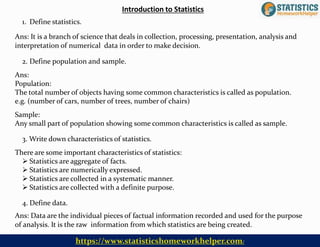
1. Define statistics.
Ans: It is a branch of science that deals in collection, processing, presentation, analysis and
interpretation of numerical data in order to make decision.
2. Define population and sample.
Ans:
Population:
The total number of objects having some common characteristics is called as population.
e.g. (number of cars, number of trees, number of chairs)
Sample:
Any small part of population showing some common characteristics is called as sample.
3. Write down characteristics of statistics.
There are some important characteristics of statistics:
 Statistics are aggregate of facts.
 Statistics are numerically expressed.
 Statistics are collected in a systematic manner.
 Statistics are collected with a definite purpose.
4. Define data.
Ans: Data are the individual pieces of factual information recorded and used for the purpose
of analysis. It is the raw information from which statistics are being created.
https://www.statisticshomeworkhelper.com/
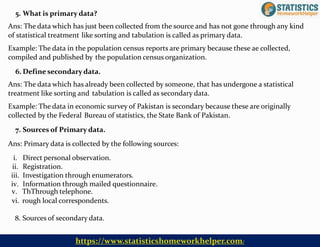
v. ThThrough telephone.
vi. rough local correspondents.
8. Sources of secondary data.
5. What is primary data?
Ans: The data which has just been collected from the source and has not gone through any kind
of statistical treatment like sorting and tabulation is called as primary data.
Example: The data in the population census reports are primary because these ae collected,
compiled and published by the population census organization.
6. Define secondary data.
Ans: The data which has already been collected by someone, that has undergone a statistical
treatment like sorting and tabulation is called as secondary data.
Example: The data in economic survey of Pakistan is secondary because these are originally
collected by the Federal Bureau of statistics, the State Bank of Pakistan.
7. Sources of Primary data.
Ans: Primary data is collected by the following sources:
i. Direct personal observation.
ii. Registration.
iii. Investigation through enumerators.
iv. Information through mailed questionnaire.
https://www.statisticshomeworkhelper.com/
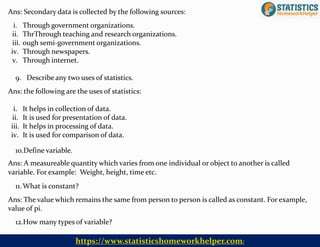
Ans: Secondary data is collected by the following sources:
i. Through government organizations.
ii. ThrThrough teaching and research organizations.
iii. ough semi-government organizations.
iv. Through newspapers.
v. Through internet.
9. Describe any two uses of statistics.
Ans: the following are the uses of statistics:
i. It helps in collection of data.
ii. It is used for presentation of data.
iii. It helps in processing of data.
iv. It is used for comparison of data.
10.Define variable.
Ans: A measureable quantity which varies from one individual or object to another is called
variable. For example: Weight, height, time etc.
11.What is constant?
Ans: The value which remains the same from person to person is called as constant. For example,
value of pi.
12.How many types of variable?
https://www.statisticshomeworkhelper.com/
16. Define descriptive statistics.
Ans: descriptive statistics deals with collection of data, its presentation in various forms, such as
tables, graphs, diagrams, averages and other measures which would describe the data. For
example, businessmen make use of descriptive statistics in presenting their annual reports.
Ans: There are two types of variables:
1 Quantitative variable 2- Qualitative variable
Quantitative variable: The variables which can be expressed numerically with or without units
are known as quantitative variables. For example: Time, Heights, weights, etc.
Qualitative variable: The variable which can be expressed in the form of qualities like: eye color, hair
color, IQ level etc.
13.Define discrete variable.
Ans: The variable which can be countable is called discrete variable. For example, number of cars,
number of chairs in the classroom, number of houses in the street etc.
14.Define continuous variable.
Ans: A measureable variable is known as continuous variable. for example, height, weight, length etc.
15.Define inferential statistics.
Ans: The phase of statistics that is concerned with the procedures and methodology for obtaining
valid conclusions is called inferential statistics.
https://www.statisticshomeworkhelper.com/

Introduction to Statistics

  • 1.
  • 2.
    Introduction to Statistics 1.Define statistics. Ans: It is a branch of science that deals in collection, processing, presentation, analysis and interpretation of numerical data in order to make decision. 2. Define population and sample. Ans: Population: The total number of objects having some common characteristics is called as population. e.g. (number of cars, number of trees, number of chairs) Sample: Any small part of population showing some common characteristics is called as sample. 3. Write down characteristics of statistics. There are some important characteristics of statistics:  Statistics are aggregate of facts.  Statistics are numerically expressed.  Statistics are collected in a systematic manner.  Statistics are collected with a definite purpose. 4. Define data. Ans: Data are the individual pieces of factual information recorded and used for the purpose of analysis. It is the raw information from which statistics are being created. https://www.statisticshomeworkhelper.com/
  • 3.
    v. ThThrough telephone. vi.rough local correspondents. 8. Sources of secondary data. 5. What is primary data? Ans: The data which has just been collected from the source and has not gone through any kind of statistical treatment like sorting and tabulation is called as primary data. Example: The data in the population census reports are primary because these ae collected, compiled and published by the population census organization. 6. Define secondary data. Ans: The data which has already been collected by someone, that has undergone a statistical treatment like sorting and tabulation is called as secondary data. Example: The data in economic survey of Pakistan is secondary because these are originally collected by the Federal Bureau of statistics, the State Bank of Pakistan. 7. Sources of Primary data. Ans: Primary data is collected by the following sources: i. Direct personal observation. ii. Registration. iii. Investigation through enumerators. iv. Information through mailed questionnaire. https://www.statisticshomeworkhelper.com/
  • 4.
    Ans: Secondary datais collected by the following sources: i. Through government organizations. ii. ThrThrough teaching and research organizations. iii. ough semi-government organizations. iv. Through newspapers. v. Through internet. 9. Describe any two uses of statistics. Ans: the following are the uses of statistics: i. It helps in collection of data. ii. It is used for presentation of data. iii. It helps in processing of data. iv. It is used for comparison of data. 10.Define variable. Ans: A measureable quantity which varies from one individual or object to another is called variable. For example: Weight, height, time etc. 11.What is constant? Ans: The value which remains the same from person to person is called as constant. For example, value of pi. 12.How many types of variable? https://www.statisticshomeworkhelper.com/
  • 5.
    16. Define descriptivestatistics. Ans: descriptive statistics deals with collection of data, its presentation in various forms, such as tables, graphs, diagrams, averages and other measures which would describe the data. For example, businessmen make use of descriptive statistics in presenting their annual reports. Ans: There are two types of variables: 1 Quantitative variable 2- Qualitative variable Quantitative variable: The variables which can be expressed numerically with or without units are known as quantitative variables. For example: Time, Heights, weights, etc. Qualitative variable: The variable which can be expressed in the form of qualities like: eye color, hair color, IQ level etc. 13.Define discrete variable. Ans: The variable which can be countable is called discrete variable. For example, number of cars, number of chairs in the classroom, number of houses in the street etc. 14.Define continuous variable. Ans: A measureable variable is known as continuous variable. for example, height, weight, length etc. 15.Define inferential statistics. Ans: The phase of statistics that is concerned with the procedures and methodology for obtaining valid conclusions is called inferential statistics. https://www.statisticshomeworkhelper.com/