Probabilistic Systems Analysis
For more Queries about Statistics, Please
Visit : https://www.statisticshomeworkhelper.com/
Contact : +1 678 648 4277
Or Mail : info@statisticshomeworkhelper.com
Statistics Homework Help
Problem 1: True or False
a. Let {Xn}be a sequence of i.i.d random variables taking values in the interval[0,0.5]. Consider the
following statements:
(A) If E[X2]converges to 0 as then Xn converges to 0 in probability.
(B) If all Xn have E[Xn]=0.2 and var(Xn)converges to 0 as then Xn converges to 0.2 in
probability
(C) The sequence of random variables Zn, defined by Zn = X1 . X2 ….. Xn, converges to 0 in probability
as
Which of these statements are always true? Write True or False in each of the boxes below.
Statistics Homework Help
(A) True. The fact that implies and Hence,
one has
where we have applied Chebyshev inequality.
(B) True. Applying Chebyshev inequality gives
Hence Xn converges to E[Xn]=0.2 in probability
(C) True. For all ǫ> 0, since Zn ≤(1/2)n ⇒P(|Zn −0|≥ǫ)=0for n> −logǫ/log2.
Statistics Homework Help
b. Let Xi (i =1,2,... ) be i.i.d. random variables with mean 0 and variance 2; Yi (i =1,2,... )be
i.i.d. random variables with mean2. Assume that all variables Xi, Yj are independent. Consider the
following statements:
Which of these statements are always true? Write True or False in each of the boxes below.
Solution:
(A) True. Note that E[X1+···+Xn ] = 0 and var(X1+···+Xn )= n·2 = 2 . One can see X1+···+Xn
n nn2 nn converges to 0 in probability
B) True. Let Zi = Xi 2 and E[Zi]= 2. Note Zi are i.i.d. since Xi are i.i.d., and hence one has that Z1+···+Zn
converges to E[Zi]=2inprobability by theWLLN.
Statistics Homework Help
(C) True. Let Wi = XiYi and E[Wi]= E[Xi]E[Yi]= 0. Note Wi are i.i.d. since Xi and Yi are respectively i.i.d.,
and hence one has that W1+···+Wn converges to E[Wi]=0inprobability n by the WLLN.
c. We have i.i.d. random variables X1 ...Xn with an unknown distribution, and with μ = E[Xi]. We define
Mn =(X1 +... + Xn)/n. Consider the following statements:
(A) Mn is a maximum-likelihood estimator for μ, irrespective of the distribution of the Xi’s.
(B) Mn is a consistent estimator for μ, irrespective of the distribution of the Xi’s.
(C) Mn is an asymptotically unbiased estimator for μ, irrespective of the distribution of the Xi’s.
Which of these statements are always true? Write True or False in each of the boxes below.
Solution:
(A) False. Consider Xi follow a uniform distribution The ML estimator for μ 22 is any
value between max(X1,,Xn)−21 and min(X1,,Xn)+21 , instead of Mn
(B) True. By the WLLN, Mn converges to μ in probability and hence it is a consistent estimator.
(C) True. Since E[Mn]= E[Xi]= μ, Mn is unbiased estimator for μ and hence asymptotically unbiased.
Statistics Homework Help
Problem 2: Multiple Choice
a. Earthquakes in Sumatra occur according to a Poisson process of rate λ = 2/year. Conditioned on the
event that exactly two earthquakes take place in a year, what is the probability that both
earthquakes occur in the first three months of the year? (for simplicity, assume all months have 30
days, and each year has 12 months, i.e., 360 days).
(i) 1/12
(ii) 1/16
(iii) 64/225
(iv) 4e−4
(v) There is not enough information to determine the required probability.
(vi) None of the above.
Solution:
Consider the interval of a year be [0,1].
Statistics Homework Help
(alternative explanation)Given that exactly two earthquakes happened in12 months, each earthquake
is equally likely to happen in any month of the 12, the probability that it happens in the first 3 months
is 3/12 =1/4. The probability that both happen in the first 3 months is (1/4)2.
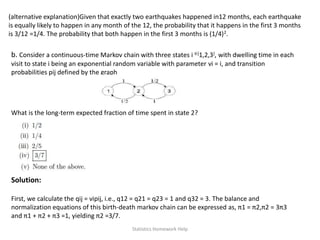
b. Consider a continuous-time Markov chain with three states i ∈{1,2,3}, with dwelling time in each
visit to state i being an exponential random variable with parameter νi = i, and transition
probabilities pij defined by the graph
What is the long-term expected fraction of time spent in state 2?
Solution:
First, we calculate the qij = νipij, i.e., q12 = q21 = q23 = 1 and q32 = 3. The balance and
normalization equations of this birth-death markov chain can be expressed as, π1 = π2,π2 = 3π3
and π1 + π2 + π3 =1, yielding π2 =3/7.
Statistics Homework Help
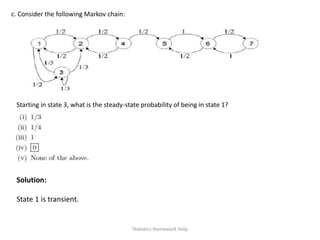
c. Consider the following Markov chain:
Starting in state 3, what is the steady-state probability of being in state 1?
Solution:
State 1 is transient.
Statistics Homework Help
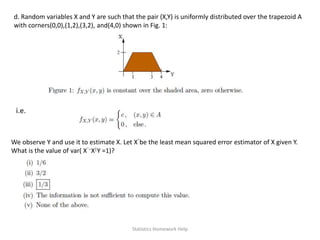
d. Random variables X and Y are such that the pair (X,Y) is uniformly distributed over the trapezoid A
with corners(0,0),(1,2),(3,2), and(4,0) shown in Fig. 1:
i.e.
We observe Y and use it to estimate X. Let Xˆbe the least mean squared error estimator of X given Y.
What is the value of var( Xˆ−X|Y =1)?
Statistics Homework Help
Solution:
fX|Y=1(x)is uniform on[0,2] therefore Xˆ= E[XY = 1] = 1 and var( Xˆ−XY = 1) = var(X|Y =1) = (2−0)2/12 =1/3.
e. X1 ...Xn are i.i.d. normal random variables with mean value μ and variance v. Both μ and v are
unknown. We define Mn =(X1 + ... + Xn)/n and
We also define Φ(x)to be the CDF for the standard normal distribution, and Ψn−1(x)to be the CDF
for the t-distribution with n −1 degrees of freedom. Which of the following choices gives an exact
99% confidence interval for μ for all n> 1?
Solution:
See Lecture 23, slides 10-12.
Statistics Homework Help
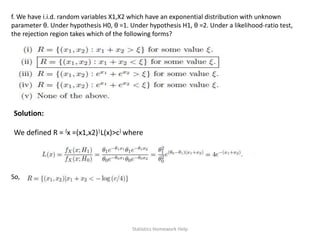
f. We have i.i.d. random variables X1,X2 which have an exponential distribution with unknown
parameter θ. Under hypothesis H0, θ =1. Under hypothesis H1, θ =2. Under a likelihood-ratio test,
the rejection region takes which of the following forms?
Solution:
We defined R = {x =(x1,x2)|L(x)>c} where
So,
Statistics Homework Help
Problem 3:
Aliens of two races(blue and green) are arriving on Earth independently according to Poisson
process distributions with parameters λb and λg respectively. The Alien Arrival Registration Service
Authority (AARSA) will begin registering alien arrivals soon.
Let T1 denote the time AARSA will function until it registers its first alien. Let G be the event that
the first alien to be registered is a green one. Let T2 be the time AARSA will function until at least
one alien of both races is registered.
(a) Express μ1 = E[T1]in terms of λg and λb. Show your work.
Answer: μ1 = E[T1]= λg+1 λb
Solution: We consider the process of arrivals of both types of Aliens. This is a merged Poisson
process with arrival rate λg+λb. T1 is the time until the first arrival, and therefore is exponentially
distributed with parameter λg + λb. Therefore μ1 = E[T1]= λg+1 λb .
One can also go about this using derived distributions, since T1 = min(T1g,T1b)where T1g and T1b are
the first arrival times of green and blue Aliens respectively (i.e., T1g and T1b are exponentially
distributed with parameters λg and λb, respectively. )
(b) Express p= P(G)in terms of λg and λb. Show your work.
Answer: P(G)= λgλ+gλb
Statistics Homework Help
Solution:
We consider the same merged Poisson process as before, with arrival rate λg+λb. Any particular
arrival of the merged process has probability λgλ+gλb of corresponding to a green Alien and probability
λgλ+bλb of corresponding to a blue Alien. The question asks for P(G)= λgλ+gλb
(c) Express μ2 = E[T2]in terms of λg and λb.
Show your work.
Answer:
Solution: ThetimeT2 until at least one green and one red Aliens have arrived can be expressed as
T2 = max(T1g,T1b), whereT1g and T1b are the first arrival times of green and blue Aliens
respectively (i.e.,T1g and T1b are exponentially distributed with parameters λg and λb,
respectively.)
The expected time till the 1st Alien arrives was calculated in (a), μ1 = E[T1]= 1 . To
λg+λb compute the remaining time we simply condition on the 1st Alien being green(e.g. event
G)or blue(event Gc), and use the memory less property of Poisson, i.e.,
Statistics Homework Help
Problem 4 :
Researcher Jill is interested in studying employment in technology firms in Dilicon Valley. She denotes
by Xi the number of employees in technology firm I and assumes that Xi are independent and
identically distributed with mean p. To estimate p, Jill randomly interviews n technology firms and
observes the number of employees in these firms.
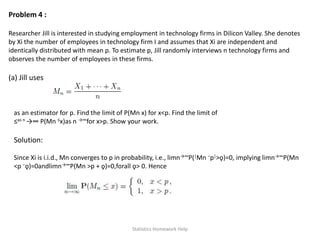
(a) Jill uses
as an estimator for p. Find the limit of P(Mn x) for x<p. Find the limit of
≤as n →∞ P(Mn ≤x)as n →∞for x>p. Show your work.
Solution:
Since Xi is i.i.d., Mn converges to p in probability, i.e., limn→∞P(|Mn −p|>ǫ)=0, implying limn→∞P(Mn
<p −ǫ)=0andlimn→∞P(Mn >p + ǫ)=0,forall ǫ> 0. Hence
Statistics Homework Help
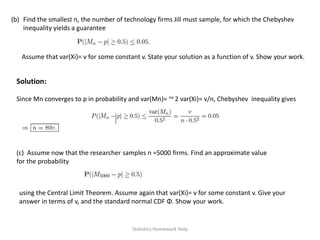
(b) Find the smallest n, the number of technology firms Jill must sample, for which the Chebyshev
inequality yields a guarantee
Assume that var(Xi)= v for some constant v. State your solution as a function of v. Show your work.
Solution:
Since Mn converges to p in probability and var(Mn)= nn 2 var(Xi)= v/n, Chebyshev inequality gives
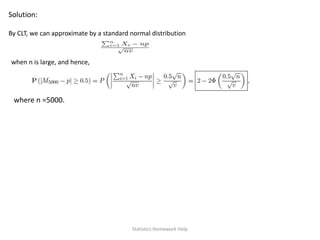
(c) Assume now that the researcher samples n =5000 firms. Find an approximate value
for the probability
using the Central Limit Theorem. Assume again that var(Xi)= v for some constant v. Give your
answer in terms of v, and the standard normal CDF Φ. Show your work.
Statistics Homework Help
Solution:
By CLT, we can approximate by a standard normal distribution
when n is large, and hence,
where n =5000.
Statistics Homework Help
Problem 5:
The Random View window factory produces window panes. After manufacturing, 1000 panes were
loaded onto a truck. The weight Wi of the i-th pane(in pounds) on the truck is modeled as a random
variable, with the assumption that the Wi’s are independent and identically distributed.
(a) Assume that the measured weight of the load on the truck was 2340 pounds, and that var (Wi)≤4.
Find an approximate 95 percent confidence interval for μ = E[Wi], using the Central Limit Theorem
(you may use the standard normal table which was handed out with this quiz). Show your work.
Answer: [2.216, 2.464]
Solution:
The sample mean estimator Θˆn = W1+···+Wn in this case is
Using the CDF Φ(z)of the standard normal available in the normal tables, we have Φ(1.96) = 0.975,
so we obtain
Statistics Homework Help
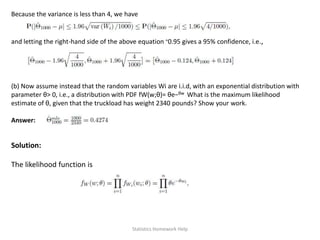
Because the variance is less than 4, we have
and letting the right-hand side of the above equation ≈0.95 gives a 95% confidence, i.e.,
(b) Now assume instead that the random variables Wi are i.i.d, with an exponential distribution with
parameter θ> 0, i.e., a distribution with PDF fW(w;θ)= θe−θw What is the maximum likelihood
estimate of θ, given that the truckload has weight 2340 pounds? Show your work.
Answer:
Solution:
The likelihood function is
Statistics Homework Help
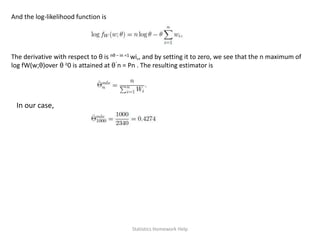
And the log-likelihood function is
The derivative with respect to θ is nθ − in =1 wi,, and by setting it to zero, we see that the n maximum of
log fW(w;θ)over θ ≥0 is attained at θˆn = Pn . The resulting estimator is
In our case,
Statistics Homework Help
Problem 6:
In Alice’s Wonderland, there are six different seasons: Fall (F), Winter (W), Spring (Sp), Summer (Su),
Bitter Cold (B), and Golden Sunshine (G). The seasons do not follow any particular order, instead, at
the beginning of each day the Head Wizard assigns the season for the day, according to the
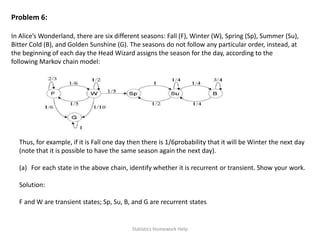
following Markov chain model:
Thus, for example, if it is Fall one day then there is 1/6probability that it will be Winter the next day
(note that it is possible to have the same season again the next day).
(a) For each state in the above chain, identify whether it is recurrent or transient. Show your work.
Solution:
F and W are transient states; Sp, Su, B, and G are recurrent states
Statistics Homework Help
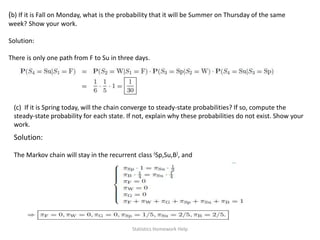
(b) If it is Fall on Monday, what is the probability that it will be Summer on Thursday of the same
week? Show your work.
Solution:
There is only one path from F to Su in three days.
(c) If it is Spring today, will the chain converge to steady-state probabilities? If so, compute the
steady-state probability for each state. If not, explain why these probabilities do not exist. Show your
work.
Solution:
The Markov chain will stay in the recurrent class {Sp,Su,B}, and
Statistics Homework Help
(d) If it is Fall today, what is the probability that Bitter Cold will never arrive in the future? Show your
work.
Solution:
Let aF and aW be the probabilities that Bitter Cold will never arrive starting from Fall and Winter,
respectively. This is equivalent to the Markov chain ends up in G.
(e) If it is Fall today, what is the expected number of days till either Summer or Golden Sunshine
arrives for the first time? Show your work.
Solution:
Let μF and μW be expected number of days till either Summer or Golden Sunshine arrives for the
first time, respectively.
Statistics Homework Help
Problem 7:
A newscast covering the final baseball game between Sed Rox and Y Nakee becomes noisy at the
crucial moment when the viewers are informed whether Y Nakee won the game. Let a be the
parameter describing the actual outcome: a = 1 if Y Nakee won, a = −1 otherwise. There were n viewers
listening to the telecast. Let Yi be the information received by viewer i (1≤i ≤ n). Under the noisy
telecast, Yi = a with probability p, and Yi = −a with probability 1 −p. Assume that the random variables Yi
are independent of each other. The viewers as a group come up with a joint estimator
(a) Find limn→∞P(Zn = a)assuming that p> 0.5 and a =1. Show your work.
Solution:
Note that
Since Yi are i.i.d. with mean E[Yi]=2p−1 and finite variance var(Yi)=1−(2p−1)2, one has, by Chebyshev
inequality, for all ǫ> 0
Statistics Homework Help
Take and the above equation implies
Therefore,
(b) Find limn→∞P(Zn = a), assuming that p=0.5 and a =1. Show your work.
Solution:
Note that
Since Yi are i.i.d. with E[Yi] = 0 and var(Yi) = 1, we can approximate as a
standard normal random variable when n goes to infinity. Thus
Statistics Homework Help

probability assignment help (2)

  • 1.
    Probabilistic Systems Analysis Formore Queries about Statistics, Please Visit : https://www.statisticshomeworkhelper.com/ Contact : +1 678 648 4277 Or Mail : info@statisticshomeworkhelper.com Statistics Homework Help
  • 2.
    Problem 1: Trueor False a. Let {Xn}be a sequence of i.i.d random variables taking values in the interval[0,0.5]. Consider the following statements: (A) If E[X2]converges to 0 as then Xn converges to 0 in probability. (B) If all Xn have E[Xn]=0.2 and var(Xn)converges to 0 as then Xn converges to 0.2 in probability (C) The sequence of random variables Zn, defined by Zn = X1 . X2 ….. Xn, converges to 0 in probability as Which of these statements are always true? Write True or False in each of the boxes below. Statistics Homework Help
  • 3.
    (A) True. Thefact that implies and Hence, one has where we have applied Chebyshev inequality. (B) True. Applying Chebyshev inequality gives Hence Xn converges to E[Xn]=0.2 in probability (C) True. For all ǫ> 0, since Zn ≤(1/2)n ⇒P(|Zn −0|≥ǫ)=0for n> −logǫ/log2. Statistics Homework Help
  • 4.
    b. Let Xi(i =1,2,... ) be i.i.d. random variables with mean 0 and variance 2; Yi (i =1,2,... )be i.i.d. random variables with mean2. Assume that all variables Xi, Yj are independent. Consider the following statements: Which of these statements are always true? Write True or False in each of the boxes below. Solution: (A) True. Note that E[X1+···+Xn ] = 0 and var(X1+···+Xn )= n·2 = 2 . One can see X1+···+Xn n nn2 nn converges to 0 in probability B) True. Let Zi = Xi 2 and E[Zi]= 2. Note Zi are i.i.d. since Xi are i.i.d., and hence one has that Z1+···+Zn converges to E[Zi]=2inprobability by theWLLN. Statistics Homework Help
  • 5.
    (C) True. LetWi = XiYi and E[Wi]= E[Xi]E[Yi]= 0. Note Wi are i.i.d. since Xi and Yi are respectively i.i.d., and hence one has that W1+···+Wn converges to E[Wi]=0inprobability n by the WLLN. c. We have i.i.d. random variables X1 ...Xn with an unknown distribution, and with μ = E[Xi]. We define Mn =(X1 +... + Xn)/n. Consider the following statements: (A) Mn is a maximum-likelihood estimator for μ, irrespective of the distribution of the Xi’s. (B) Mn is a consistent estimator for μ, irrespective of the distribution of the Xi’s. (C) Mn is an asymptotically unbiased estimator for μ, irrespective of the distribution of the Xi’s. Which of these statements are always true? Write True or False in each of the boxes below. Solution: (A) False. Consider Xi follow a uniform distribution The ML estimator for μ 22 is any value between max(X1,,Xn)−21 and min(X1,,Xn)+21 , instead of Mn (B) True. By the WLLN, Mn converges to μ in probability and hence it is a consistent estimator. (C) True. Since E[Mn]= E[Xi]= μ, Mn is unbiased estimator for μ and hence asymptotically unbiased. Statistics Homework Help
  • 6.
    Problem 2: MultipleChoice a. Earthquakes in Sumatra occur according to a Poisson process of rate λ = 2/year. Conditioned on the event that exactly two earthquakes take place in a year, what is the probability that both earthquakes occur in the first three months of the year? (for simplicity, assume all months have 30 days, and each year has 12 months, i.e., 360 days). (i) 1/12 (ii) 1/16 (iii) 64/225 (iv) 4e−4 (v) There is not enough information to determine the required probability. (vi) None of the above. Solution: Consider the interval of a year be [0,1]. Statistics Homework Help
  • 7.
    (alternative explanation)Given thatexactly two earthquakes happened in12 months, each earthquake is equally likely to happen in any month of the 12, the probability that it happens in the first 3 months is 3/12 =1/4. The probability that both happen in the first 3 months is (1/4)2. b. Consider a continuous-time Markov chain with three states i ∈{1,2,3}, with dwelling time in each visit to state i being an exponential random variable with parameter νi = i, and transition probabilities pij defined by the graph What is the long-term expected fraction of time spent in state 2? Solution: First, we calculate the qij = νipij, i.e., q12 = q21 = q23 = 1 and q32 = 3. The balance and normalization equations of this birth-death markov chain can be expressed as, π1 = π2,π2 = 3π3 and π1 + π2 + π3 =1, yielding π2 =3/7. Statistics Homework Help
  • 8.
    c. Consider thefollowing Markov chain: Starting in state 3, what is the steady-state probability of being in state 1? Solution: State 1 is transient. Statistics Homework Help
  • 9.
    d. Random variablesX and Y are such that the pair (X,Y) is uniformly distributed over the trapezoid A with corners(0,0),(1,2),(3,2), and(4,0) shown in Fig. 1: i.e. We observe Y and use it to estimate X. Let Xˆbe the least mean squared error estimator of X given Y. What is the value of var( Xˆ−X|Y =1)? Statistics Homework Help
  • 10.
    Solution: fX|Y=1(x)is uniform on[0,2]therefore Xˆ= E[XY = 1] = 1 and var( Xˆ−XY = 1) = var(X|Y =1) = (2−0)2/12 =1/3. e. X1 ...Xn are i.i.d. normal random variables with mean value μ and variance v. Both μ and v are unknown. We define Mn =(X1 + ... + Xn)/n and We also define Φ(x)to be the CDF for the standard normal distribution, and Ψn−1(x)to be the CDF for the t-distribution with n −1 degrees of freedom. Which of the following choices gives an exact 99% confidence interval for μ for all n> 1? Solution: See Lecture 23, slides 10-12. Statistics Homework Help
  • 11.
    f. We havei.i.d. random variables X1,X2 which have an exponential distribution with unknown parameter θ. Under hypothesis H0, θ =1. Under hypothesis H1, θ =2. Under a likelihood-ratio test, the rejection region takes which of the following forms? Solution: We defined R = {x =(x1,x2)|L(x)>c} where So, Statistics Homework Help
  • 12.
    Problem 3: Aliens oftwo races(blue and green) are arriving on Earth independently according to Poisson process distributions with parameters λb and λg respectively. The Alien Arrival Registration Service Authority (AARSA) will begin registering alien arrivals soon. Let T1 denote the time AARSA will function until it registers its first alien. Let G be the event that the first alien to be registered is a green one. Let T2 be the time AARSA will function until at least one alien of both races is registered. (a) Express μ1 = E[T1]in terms of λg and λb. Show your work. Answer: μ1 = E[T1]= λg+1 λb Solution: We consider the process of arrivals of both types of Aliens. This is a merged Poisson process with arrival rate λg+λb. T1 is the time until the first arrival, and therefore is exponentially distributed with parameter λg + λb. Therefore μ1 = E[T1]= λg+1 λb . One can also go about this using derived distributions, since T1 = min(T1g,T1b)where T1g and T1b are the first arrival times of green and blue Aliens respectively (i.e., T1g and T1b are exponentially distributed with parameters λg and λb, respectively. ) (b) Express p= P(G)in terms of λg and λb. Show your work. Answer: P(G)= λgλ+gλb Statistics Homework Help
  • 13.
    Solution: We consider thesame merged Poisson process as before, with arrival rate λg+λb. Any particular arrival of the merged process has probability λgλ+gλb of corresponding to a green Alien and probability λgλ+bλb of corresponding to a blue Alien. The question asks for P(G)= λgλ+gλb (c) Express μ2 = E[T2]in terms of λg and λb. Show your work. Answer: Solution: ThetimeT2 until at least one green and one red Aliens have arrived can be expressed as T2 = max(T1g,T1b), whereT1g and T1b are the first arrival times of green and blue Aliens respectively (i.e.,T1g and T1b are exponentially distributed with parameters λg and λb, respectively.) The expected time till the 1st Alien arrives was calculated in (a), μ1 = E[T1]= 1 . To λg+λb compute the remaining time we simply condition on the 1st Alien being green(e.g. event G)or blue(event Gc), and use the memory less property of Poisson, i.e., Statistics Homework Help
  • 14.
    Problem 4 : ResearcherJill is interested in studying employment in technology firms in Dilicon Valley. She denotes by Xi the number of employees in technology firm I and assumes that Xi are independent and identically distributed with mean p. To estimate p, Jill randomly interviews n technology firms and observes the number of employees in these firms. (a) Jill uses as an estimator for p. Find the limit of P(Mn x) for x<p. Find the limit of ≤as n →∞ P(Mn ≤x)as n →∞for x>p. Show your work. Solution: Since Xi is i.i.d., Mn converges to p in probability, i.e., limn→∞P(|Mn −p|>ǫ)=0, implying limn→∞P(Mn <p −ǫ)=0andlimn→∞P(Mn >p + ǫ)=0,forall ǫ> 0. Hence Statistics Homework Help
  • 15.
    (b) Find thesmallest n, the number of technology firms Jill must sample, for which the Chebyshev inequality yields a guarantee Assume that var(Xi)= v for some constant v. State your solution as a function of v. Show your work. Solution: Since Mn converges to p in probability and var(Mn)= nn 2 var(Xi)= v/n, Chebyshev inequality gives (c) Assume now that the researcher samples n =5000 firms. Find an approximate value for the probability using the Central Limit Theorem. Assume again that var(Xi)= v for some constant v. Give your answer in terms of v, and the standard normal CDF Φ. Show your work. Statistics Homework Help
  • 16.
    Solution: By CLT, wecan approximate by a standard normal distribution when n is large, and hence, where n =5000. Statistics Homework Help
  • 17.
    Problem 5: The RandomView window factory produces window panes. After manufacturing, 1000 panes were loaded onto a truck. The weight Wi of the i-th pane(in pounds) on the truck is modeled as a random variable, with the assumption that the Wi’s are independent and identically distributed. (a) Assume that the measured weight of the load on the truck was 2340 pounds, and that var (Wi)≤4. Find an approximate 95 percent confidence interval for μ = E[Wi], using the Central Limit Theorem (you may use the standard normal table which was handed out with this quiz). Show your work. Answer: [2.216, 2.464] Solution: The sample mean estimator Θˆn = W1+···+Wn in this case is Using the CDF Φ(z)of the standard normal available in the normal tables, we have Φ(1.96) = 0.975, so we obtain Statistics Homework Help
  • 18.
    Because the varianceis less than 4, we have and letting the right-hand side of the above equation ≈0.95 gives a 95% confidence, i.e., (b) Now assume instead that the random variables Wi are i.i.d, with an exponential distribution with parameter θ> 0, i.e., a distribution with PDF fW(w;θ)= θe−θw What is the maximum likelihood estimate of θ, given that the truckload has weight 2340 pounds? Show your work. Answer: Solution: The likelihood function is Statistics Homework Help
  • 19.
    And the log-likelihoodfunction is The derivative with respect to θ is nθ − in =1 wi,, and by setting it to zero, we see that the n maximum of log fW(w;θ)over θ ≥0 is attained at θˆn = Pn . The resulting estimator is In our case, Statistics Homework Help
  • 20.
    Problem 6: In Alice’sWonderland, there are six different seasons: Fall (F), Winter (W), Spring (Sp), Summer (Su), Bitter Cold (B), and Golden Sunshine (G). The seasons do not follow any particular order, instead, at the beginning of each day the Head Wizard assigns the season for the day, according to the following Markov chain model: Thus, for example, if it is Fall one day then there is 1/6probability that it will be Winter the next day (note that it is possible to have the same season again the next day). (a) For each state in the above chain, identify whether it is recurrent or transient. Show your work. Solution: F and W are transient states; Sp, Su, B, and G are recurrent states Statistics Homework Help
  • 21.
    (b) If itis Fall on Monday, what is the probability that it will be Summer on Thursday of the same week? Show your work. Solution: There is only one path from F to Su in three days. (c) If it is Spring today, will the chain converge to steady-state probabilities? If so, compute the steady-state probability for each state. If not, explain why these probabilities do not exist. Show your work. Solution: The Markov chain will stay in the recurrent class {Sp,Su,B}, and Statistics Homework Help
  • 22.
    (d) If itis Fall today, what is the probability that Bitter Cold will never arrive in the future? Show your work. Solution: Let aF and aW be the probabilities that Bitter Cold will never arrive starting from Fall and Winter, respectively. This is equivalent to the Markov chain ends up in G. (e) If it is Fall today, what is the expected number of days till either Summer or Golden Sunshine arrives for the first time? Show your work. Solution: Let μF and μW be expected number of days till either Summer or Golden Sunshine arrives for the first time, respectively. Statistics Homework Help
  • 23.
    Problem 7: A newscastcovering the final baseball game between Sed Rox and Y Nakee becomes noisy at the crucial moment when the viewers are informed whether Y Nakee won the game. Let a be the parameter describing the actual outcome: a = 1 if Y Nakee won, a = −1 otherwise. There were n viewers listening to the telecast. Let Yi be the information received by viewer i (1≤i ≤ n). Under the noisy telecast, Yi = a with probability p, and Yi = −a with probability 1 −p. Assume that the random variables Yi are independent of each other. The viewers as a group come up with a joint estimator (a) Find limn→∞P(Zn = a)assuming that p> 0.5 and a =1. Show your work. Solution: Note that Since Yi are i.i.d. with mean E[Yi]=2p−1 and finite variance var(Yi)=1−(2p−1)2, one has, by Chebyshev inequality, for all ǫ> 0 Statistics Homework Help
  • 24.
    Take and theabove equation implies Therefore, (b) Find limn→∞P(Zn = a), assuming that p=0.5 and a =1. Show your work. Solution: Note that Since Yi are i.i.d. with E[Yi] = 0 and var(Yi) = 1, we can approximate as a standard normal random variable when n goes to infinity. Thus Statistics Homework Help