Statistical Thinking and Data Analysis
For any Statistics related queries,
Call us at - +1 678 648 4277
You can mail us at - info@statisticsassignmenthelp.com, or
reach us at - https://www.statisticsassignmenthelp.com/
Statistics Assignment Help
Exercise 1
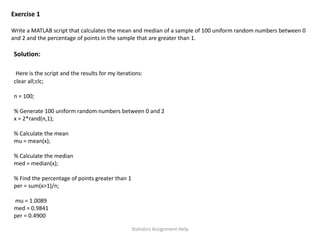
Write a MATLAB script that calculates the mean and median of a sample of 100 uniform random numbers between 0
and 2 and the percentage of points in the sample that are greater than 1.
Solution:
Here is the script and the results for my iterations:
clear all;clc;
n = 100;
% Generate 100 uniform random numbers between 0 and 2
x = 2*rand(n,1);
% Calculate the mean
mu = mean(x);
% Calculate the median
med = median(x);
% Find the percentage of points greater than 1
per = sum(x>1)/n;
mu = 1.0089
med = 0.9841
per = 0.4900
Statistics Assignment Help
Exercise 2
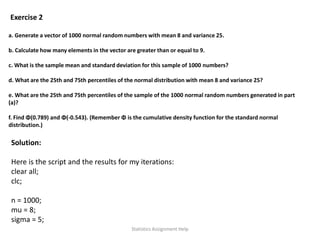
a. Generate a vector of 1000 normal random numbers with mean 8 and variance 25.
b. Calculate how many elements in the vector are greater than or equal to 9.
c. What is the sample mean and standard deviation for this sample of 1000 numbers?
d. What are the 25th and 75th percentiles of the normal distribution with mean 8 and variance 25?
e. What are the 25th and 75th percentiles of the sample of the 1000 normal random numbers generated in part
(a)?
f. Find Φ(0.789) and Φ(‐0.543). (Remember Φ is the cumulative density function for the standard normal
distribution.)
Solution:
Here is the script and the results for my iterations:
clear all;
clc;
n = 1000;
mu = 8;
sigma = 5;
Statistics Assignment Help
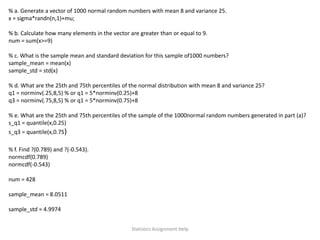
% a. Generate a vector of 1000 normal random numbers with mean 8 and variance 25.
x = sigma*randn(n,1)+mu;
% b. Calculate how many elements in the vector are greater than or equal to 9.
num = sum(x>=9)
% c. What is the sample mean and standard deviation for this sample of1000 numbers?
sample_mean = mean(x)
sample_std = std(x)
% d. What are the 25th and 75th percentiles of the normal distribution with mean 8 and variance 25?
q1 = norminv(.25,8,5) % or q1 = 5*norminv(0.25)+8
q3 = norminv(.75,8,5) % or q1 = 5*norminv(0.75)+8
% e. What are the 25th and 75th percentiles of the sample of the 1000normal random numbers generated in part (a)?
s_q1 = quantile(x,0.25)
s_q3 = quantile(x,0.75)
% f. Find ?(0.789) and ?(-0.543).
normcdf(0.789)
normcdf(-0.543)
num = 428
sample_mean = 8.0511
sample_std = 4.9974
Statistics Assignment Help
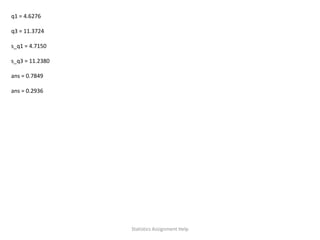
q1 = 4.6276
q3 = 11.3724
s_q1 = 4.7150
s_q3 = 11.2380
ans = 0.7849
ans = 0.2936
Statistics Assignment Help
Exercise 3
a. Generate a vector of 1000 Poisson random numbers with λ = 2.
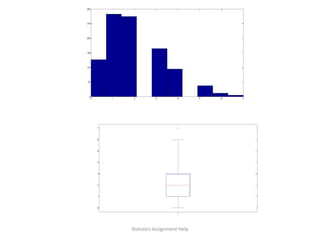
b. Make a histogram and a boxplot of the 1000 numbers from part (a).
Solution:
Here is the script and the plots for my iterations:
clear all;
clc;
close all;
n = 1000;
lambda = 2;
% a. Generate a vector of 1000 Poisson random numbers with ? = 2.
x = poissrnd(lambda,n,1);
% b. Make a histogram and a boxplot of the 1000 numbers from part (a).
figure;hist(x);
figure;boxplot(x);
Statistics Assignment Help
Exercise 4
Answer questions (a) – (c) from 4.36 in your textbook.
Solution:
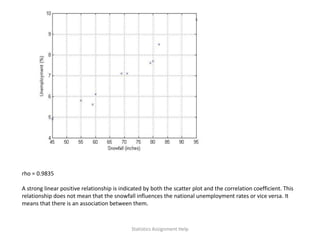
Here is the script and a scatterplot:
clear all;
close all;
clc;
snowfall = [45 59 82 80 71 60 55 69 79 95];
unemployment = [4.9 5.6 8.5 7.7 7.1 6.1 5.8 7.1 7.6 9.7];
% Scatterplot
plot(snowfall, unemployment, 'x');
grid;
xlabel('Snowfall (inches)');
ylabel('Unemployment (%)');
% Calculates the correlation coefficient
rho = corr(snowfall',unemployment');
Statistics Assignment Help
rho = 0.9835
A strong linear positive relationship is indicated by both the scatter plot and the correlation coefficient. This
relationship does not mean that the snowfall influences the national unemployment rates or vice versa. It
means that there is an association between them.
Statistics Assignment Help
Exercise 5
Answer questions (a) – (d) from 4.44 in your textbook.
Solution:
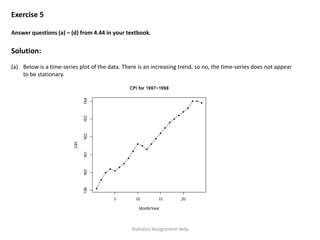
(a) Below is a time-series plot of the data. There is an increasing trend, so no, the time-series does not appear
to be stationary.
Statistics Assignment Help
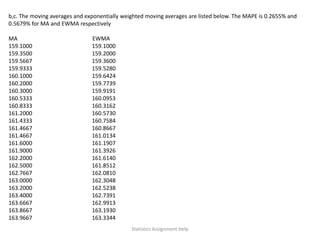
b,c. The moving averages and exponentially weighted moving averages are listed below. The MAPE is 0.2655% and
0.5679% for MA and EWMA respectively
MA EWMA
159.1000 159.1000
159.3500 159.2000
159.5667 159.3600
159.9333 159.5280
160.1000 159.6424
160.2000 159.7739
160.3000 159.9191
160.5333 160.0953
160.8333 160.3162
161.2000 160.5730
161.4333 160.7584
161.4667 160.8667
161.4667 161.0134
161.6000 161.1907
161.9000 161.3926
162.2000 161.6140
162.5000 161.8512
162.7667 162.0810
163.0000 162.3048
163.2000 162.5238
163.4000 162.7391
163.6667 162.9913
163.8667 163.1930
163.9667 163.3344
Statistics Assignment Help
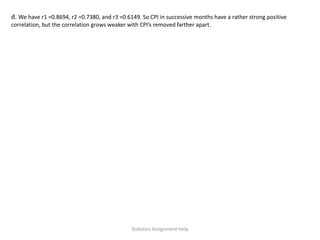
d. We have r1 =0.8694, r2 =0.7380, and r3 =0.6149. So CPI in successive months have a rather strong positive
correlation, but the correlation grows weaker with CPI’s removed farther apart.
Statistics Assignment Help

Data Analysis Assignment Help

  • 1.
    Statistical Thinking andData Analysis For any Statistics related queries, Call us at - +1 678 648 4277 You can mail us at - info@statisticsassignmenthelp.com, or reach us at - https://www.statisticsassignmenthelp.com/ Statistics Assignment Help
  • 2.
    Exercise 1 Write aMATLAB script that calculates the mean and median of a sample of 100 uniform random numbers between 0 and 2 and the percentage of points in the sample that are greater than 1. Solution: Here is the script and the results for my iterations: clear all;clc; n = 100; % Generate 100 uniform random numbers between 0 and 2 x = 2*rand(n,1); % Calculate the mean mu = mean(x); % Calculate the median med = median(x); % Find the percentage of points greater than 1 per = sum(x>1)/n; mu = 1.0089 med = 0.9841 per = 0.4900 Statistics Assignment Help
  • 3.
    Exercise 2 a. Generatea vector of 1000 normal random numbers with mean 8 and variance 25. b. Calculate how many elements in the vector are greater than or equal to 9. c. What is the sample mean and standard deviation for this sample of 1000 numbers? d. What are the 25th and 75th percentiles of the normal distribution with mean 8 and variance 25? e. What are the 25th and 75th percentiles of the sample of the 1000 normal random numbers generated in part (a)? f. Find Φ(0.789) and Φ(‐0.543). (Remember Φ is the cumulative density function for the standard normal distribution.) Solution: Here is the script and the results for my iterations: clear all; clc; n = 1000; mu = 8; sigma = 5; Statistics Assignment Help
  • 4.
    % a. Generatea vector of 1000 normal random numbers with mean 8 and variance 25. x = sigma*randn(n,1)+mu; % b. Calculate how many elements in the vector are greater than or equal to 9. num = sum(x>=9) % c. What is the sample mean and standard deviation for this sample of1000 numbers? sample_mean = mean(x) sample_std = std(x) % d. What are the 25th and 75th percentiles of the normal distribution with mean 8 and variance 25? q1 = norminv(.25,8,5) % or q1 = 5*norminv(0.25)+8 q3 = norminv(.75,8,5) % or q1 = 5*norminv(0.75)+8 % e. What are the 25th and 75th percentiles of the sample of the 1000normal random numbers generated in part (a)? s_q1 = quantile(x,0.25) s_q3 = quantile(x,0.75) % f. Find ?(0.789) and ?(-0.543). normcdf(0.789) normcdf(-0.543) num = 428 sample_mean = 8.0511 sample_std = 4.9974 Statistics Assignment Help
  • 5.
    q1 = 4.6276 q3= 11.3724 s_q1 = 4.7150 s_q3 = 11.2380 ans = 0.7849 ans = 0.2936 Statistics Assignment Help
  • 6.
    Exercise 3 a. Generatea vector of 1000 Poisson random numbers with λ = 2. b. Make a histogram and a boxplot of the 1000 numbers from part (a). Solution: Here is the script and the plots for my iterations: clear all; clc; close all; n = 1000; lambda = 2; % a. Generate a vector of 1000 Poisson random numbers with ? = 2. x = poissrnd(lambda,n,1); % b. Make a histogram and a boxplot of the 1000 numbers from part (a). figure;hist(x); figure;boxplot(x); Statistics Assignment Help
  • 7.
  • 8.
    Exercise 4 Answer questions(a) – (c) from 4.36 in your textbook. Solution: Here is the script and a scatterplot: clear all; close all; clc; snowfall = [45 59 82 80 71 60 55 69 79 95]; unemployment = [4.9 5.6 8.5 7.7 7.1 6.1 5.8 7.1 7.6 9.7]; % Scatterplot plot(snowfall, unemployment, 'x'); grid; xlabel('Snowfall (inches)'); ylabel('Unemployment (%)'); % Calculates the correlation coefficient rho = corr(snowfall',unemployment'); Statistics Assignment Help
  • 9.
    rho = 0.9835 Astrong linear positive relationship is indicated by both the scatter plot and the correlation coefficient. This relationship does not mean that the snowfall influences the national unemployment rates or vice versa. It means that there is an association between them. Statistics Assignment Help
  • 10.
    Exercise 5 Answer questions(a) – (d) from 4.44 in your textbook. Solution: (a) Below is a time-series plot of the data. There is an increasing trend, so no, the time-series does not appear to be stationary. Statistics Assignment Help
  • 11.
    b,c. The movingaverages and exponentially weighted moving averages are listed below. The MAPE is 0.2655% and 0.5679% for MA and EWMA respectively MA EWMA 159.1000 159.1000 159.3500 159.2000 159.5667 159.3600 159.9333 159.5280 160.1000 159.6424 160.2000 159.7739 160.3000 159.9191 160.5333 160.0953 160.8333 160.3162 161.2000 160.5730 161.4333 160.7584 161.4667 160.8667 161.4667 161.0134 161.6000 161.1907 161.9000 161.3926 162.2000 161.6140 162.5000 161.8512 162.7667 162.0810 163.0000 162.3048 163.2000 162.5238 163.4000 162.7391 163.6667 162.9913 163.8667 163.1930 163.9667 163.3344 Statistics Assignment Help
  • 12.
    d. We haver1 =0.8694, r2 =0.7380, and r3 =0.6149. So CPI in successive months have a rather strong positive correlation, but the correlation grows weaker with CPI’s removed farther apart. Statistics Assignment Help