STATISTICAL DOWNSCALING
USING SDSM
Department of Geophysical and Meteorology
Bogor Agricultural University
Indonesia
1
I Putu Santikayasa, PhD
psantika@gmail.com
statistical donwscaling - I Putu Santikayasa
Outlines
1. Introduction
2. Global Circulation Model
3. Downscaling
4. SDSM
5. Case study
statistical donwscaling - I Putu Santikayasa 2
Introduction
Global Circulation
Model
statistical donwscaling - I Putu Santikayasa 3
Future climate projection
Scenario
statistical donwscaling - I Putu Santikayasa 4
GCM output resolution
statistical donwscaling - I Putu Santikayasa 5
statistical donwscaling - I Putu Santikayasa 6
Downscaling
Method to obtain local-
scale weather and climate,
particularly at the surface level,
from regional-scale
atmospheric variables that are
provided by GCMs
statistical donwscaling - I Putu Santikayasa 7
Downscaling technique
1. Dynamical climate modelling
2. Synoptic weather typing
3. Stochastic weather generation
4. Transfer-function approaches
Statistical
downscaling
statistical donwscaling - I Putu Santikayasa 8
Dynamic downscaling
• Dynamical downscaling involves the nesting of a higher
resolution Regional Climate Model (RCM) within a coarser
resolution GCM.
statistical donwscaling - I Putu Santikayasa 9
Limitations of RCM
• Computationally demanding (Costly)
• The scenarios produced by RCMs are also sensitive to
the boundary conditions used to initiate experiments
statistical donwscaling - I Putu Santikayasa 10
Weather typing
• Weather typing approaches involve grouping local
meteorological data in relation to prevailing patterns of
atmospheric circulation.
• E.g. cluster analysis, self-organising map, and extreme
value distribution
statistical donwscaling - I Putu Santikayasa 11
Stochastic weather generators
• Modifying the parameters of conventional weather
generators.
• E.g Markov-type procedures, conditional probability
statistical donwscaling - I Putu Santikayasa 12
Transfer Function
• Transfer-function downscaling methods rely on empirical
relationships between local scale predictands and
regional scale predictor(s)
• E.g. Regression, canonical correlation analysis, and
artificial neural networks
statistical donwscaling - I Putu Santikayasa 13
statistical donwscaling - I Putu Santikayasa 14
SDSM
Statistical downscaling model
• SDSM is a decision support tool for assessing local
climate change impacts
• SDSM facilitates the rapid development of multiple, low-
cost, single-site scenarios of daily surface weather
variables under current and future regional climate
forcing.
• The software performs the additional tasks
• predictor variable pre-screening
• model calibration
• basic diagnostic testing
• statistical analyses and
• graphing of climate data.
http://co-public.lboro.ac.uk/cocwd/SDSM/
statistical donwscaling - I Putu Santikayasa 15
7 steps
to be performed in SDSM
1. Quality control and data transformation
2. Screening of predictor variables
3. Model calibration
4. Weather generation
5. Statistical analyses
6. Graphing model output
7. Scenario generation
statistical donwscaling - I Putu Santikayasa 16
1
2
3
4 7
5
6
statistical donwscaling - I Putu Santikayasa 17
Getting started
• Installation
• Data preparation
• Start>Program>SDSM
statistical donwscaling - I Putu Santikayasa 18
Application setting
• Year length
• Standard start/end date
• Allow Negative Values
• Event Threshold
• Missing Data Identifier
• Random Number Seed
• Default File Directory
statistical donwscaling - I Putu Santikayasa 19
Advanced settings
• Model Transformation
• Variance Inflation
• Bias Correction
• Conditional Selection
• Optimisation Algorithm
• Settings File
statistical donwscaling - I Putu Santikayasa 20
1. Quality Control and Data Transformation
• Quality control : To check an input file for missing data
and/or suspect values
statistical donwscaling - I Putu Santikayasa 21
Quality control and data transformation
• Data transformation
statistical donwscaling - I Putu Santikayasa 22
2. Screening Predictors Variables
• Identifying empirical relationships between gridded
predictors (such as mean sea level pressure) and single
site predictands (such as station precipitation)
• Central to all statistical downscaling methods
• The most time consuming step in the process
• As the guidance on selecting the appropriate predictor
variables for model calibration
statistical donwscaling - I Putu Santikayasa 23
statistical donwscaling - I Putu Santikayasa 24
Screening predictors setup
• Select predictand file
• Select predictor variables
• Data: start/end date, analysis period
• Process: unconditional/conditional
• Significant level
• Autoregressive
statistical donwscaling - I Putu Santikayasa 25
Screening variables
• investigate the percentage of variance explained by
specific predictand–predictor pairs. The strength of
individual predictors often varies markedly on a month by
month basis
Tmin :
temp,rhum,r500
statistical donwscaling - I Putu Santikayasa 26
Correlation matrix
• investigate inter–variable
correlations for specified sub–
periods (annual, seasonal or
monthly).
• partial correlations between
the selected predictors and
predictand.
• help to identify the amount of
explanatory power that is
unique to each predictor.
statistical donwscaling - I Putu Santikayasa 27
Scatterplot
• Used for visual inspections of
inter–variable behaviour for
specified sub–periods (annual,
seasonal or monthly).
• Indicate the nature of the
association (linear, non–linear,
etc.), whether or not data
transformation(s) may be
needed, and the importance of
outliers.
statistical donwscaling - I Putu Santikayasa 28
3. Model Calibration
• Constructs downscaling models based on multiple
regression equations, given daily weather data (the
predictand) and regional–scale, atmospheric (predictor)
variables
statistical donwscaling - I Putu Santikayasa 29
Model Calibration
• Select Predictand File
• Output PAR file
• Data Period
• Model type
• Process
• Autoregression
• Residual analysis
• Chow test
• Histogram catagories
statistical donwscaling - I Putu Santikayasa 30
statistical donwscaling - I Putu Santikayasa 31
4. Weather Generator
• Produces ensembles of synthetic daily weather series
given observed (or NCEP re–analysis) atmospheric
predictor variables and regression model weights
produced by the Calibrate Model operation
• Enables the verification of calibrated models (assuming
the availability of independent data) as well as the
synthesis of artificial time series representative of present
climate conditions
• Used to reconstruct predictands or to infill missing data
statistical donwscaling - I Putu Santikayasa 32
Weather generator
• Select Parameter File
• Select Predictor Directory
• Save To .OUT File
• View Details
• Synthesis Start/Length
• Ensemble Size
statistical donwscaling - I Putu Santikayasa 33
5. Statistical Analysis
• Summary statistic
• Observed
• modeled
statistical donwscaling - I Putu Santikayasa 34
Statistical Analysis
• Data sources
• Select input/output
• Analysis period
• Ensemble size
• Select required analysis
statistical donwscaling - I Putu Santikayasa 35
Statistical Analysis
statistical donwscaling - I Putu Santikayasa 36
Frequency Analysis
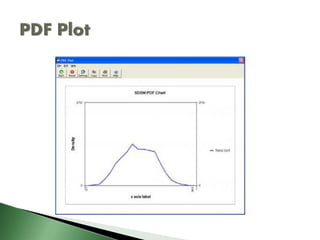
• allows the User to plot various distribution diagnostics for
both modelled (ensemble members) and observed data
statistical donwscaling - I Putu Santikayasa 37
Frequency Analysis
• Select Observed Data and/or modelled data
• Analysis Period
• Data Period
• Apply threshold
• PDF Categories
• Save result
statistical donwscaling - I Putu Santikayasa 38
Quantile-Quantile (Q-Q) Plot
statistical donwscaling - I Putu Santikayasa 39
PDF Plot
statistical donwscaling - I Putu Santikayasa 40
Line Plot
statistical donwscaling - I Putu Santikayasa 41
Extreme value analysis
Empirical
Generalised
Extreme
Value
Gumbel Streched
Exponential
statistical donwscaling - I Putu Santikayasa 42
6. Scenario Generation
• Produces ensembles of synthetic daily weather series
given daily atmospheric predictor variables supplied by a
GCM (either under present or future greenhouse gas
forcing). The GCM predictor variables must be normalised
with respect to a reference period (or control run) and
available for all variables used in model calibration
statistical donwscaling - I Putu Santikayasa 43
Scenario Generation
• Check settings: Year Length Standard Start/End Date
• Select Parameter File
• GCM Directory
• Select Output File
statistical donwscaling - I Putu Santikayasa 44
7. Graphing Monthly Statistics
• Enables the User to plot monthly statistics produced by
the Summary Statistics
• Graphing options allow the comparison of two sets of
results and hence rapid assessment of downscaled
versus observed, or present versus future climate
scenarios
statistical donwscaling - I Putu Santikayasa 45
Graphing Monthly Statistics
statistical donwscaling - I Putu Santikayasa 46
Graphing Monthly Statistics
Observed
Simulated from
NCEP
statistical donwscaling - I Putu Santikayasa 47
Graphing Monthly Statistics
Observed
Simulated from
NCEP
statistical donwscaling - I Putu Santikayasa 48
Thank you
statistical donwscaling - I Putu Santikayasa 49

Statistical downscaling sdsm

  • 1.
    STATISTICAL DOWNSCALING USING SDSM Departmentof Geophysical and Meteorology Bogor Agricultural University Indonesia 1 I Putu Santikayasa, PhD psantika@gmail.com statistical donwscaling - I Putu Santikayasa
  • 2.
    Outlines 1. Introduction 2. GlobalCirculation Model 3. Downscaling 4. SDSM 5. Case study statistical donwscaling - I Putu Santikayasa 2
  • 3.
  • 4.
    Future climate projection Scenario statisticaldonwscaling - I Putu Santikayasa 4
  • 5.
    GCM output resolution statisticaldonwscaling - I Putu Santikayasa 5
  • 6.
    statistical donwscaling -I Putu Santikayasa 6
  • 7.
    Downscaling Method to obtainlocal- scale weather and climate, particularly at the surface level, from regional-scale atmospheric variables that are provided by GCMs statistical donwscaling - I Putu Santikayasa 7
  • 8.
    Downscaling technique 1. Dynamicalclimate modelling 2. Synoptic weather typing 3. Stochastic weather generation 4. Transfer-function approaches Statistical downscaling statistical donwscaling - I Putu Santikayasa 8
  • 9.
    Dynamic downscaling • Dynamicaldownscaling involves the nesting of a higher resolution Regional Climate Model (RCM) within a coarser resolution GCM. statistical donwscaling - I Putu Santikayasa 9
  • 10.
    Limitations of RCM •Computationally demanding (Costly) • The scenarios produced by RCMs are also sensitive to the boundary conditions used to initiate experiments statistical donwscaling - I Putu Santikayasa 10
  • 11.
    Weather typing • Weathertyping approaches involve grouping local meteorological data in relation to prevailing patterns of atmospheric circulation. • E.g. cluster analysis, self-organising map, and extreme value distribution statistical donwscaling - I Putu Santikayasa 11
  • 12.
    Stochastic weather generators •Modifying the parameters of conventional weather generators. • E.g Markov-type procedures, conditional probability statistical donwscaling - I Putu Santikayasa 12
  • 13.
    Transfer Function • Transfer-functiondownscaling methods rely on empirical relationships between local scale predictands and regional scale predictor(s) • E.g. Regression, canonical correlation analysis, and artificial neural networks statistical donwscaling - I Putu Santikayasa 13
  • 14.
    statistical donwscaling -I Putu Santikayasa 14
  • 15.
    SDSM Statistical downscaling model •SDSM is a decision support tool for assessing local climate change impacts • SDSM facilitates the rapid development of multiple, low- cost, single-site scenarios of daily surface weather variables under current and future regional climate forcing. • The software performs the additional tasks • predictor variable pre-screening • model calibration • basic diagnostic testing • statistical analyses and • graphing of climate data. http://co-public.lboro.ac.uk/cocwd/SDSM/ statistical donwscaling - I Putu Santikayasa 15
  • 16.
    7 steps to beperformed in SDSM 1. Quality control and data transformation 2. Screening of predictor variables 3. Model calibration 4. Weather generation 5. Statistical analyses 6. Graphing model output 7. Scenario generation statistical donwscaling - I Putu Santikayasa 16
  • 17.
  • 18.
    Getting started • Installation •Data preparation • Start>Program>SDSM statistical donwscaling - I Putu Santikayasa 18
  • 19.
    Application setting • Yearlength • Standard start/end date • Allow Negative Values • Event Threshold • Missing Data Identifier • Random Number Seed • Default File Directory statistical donwscaling - I Putu Santikayasa 19
  • 20.
    Advanced settings • ModelTransformation • Variance Inflation • Bias Correction • Conditional Selection • Optimisation Algorithm • Settings File statistical donwscaling - I Putu Santikayasa 20
  • 21.
    1. Quality Controland Data Transformation • Quality control : To check an input file for missing data and/or suspect values statistical donwscaling - I Putu Santikayasa 21
  • 22.
    Quality control anddata transformation • Data transformation statistical donwscaling - I Putu Santikayasa 22
  • 23.
    2. Screening PredictorsVariables • Identifying empirical relationships between gridded predictors (such as mean sea level pressure) and single site predictands (such as station precipitation) • Central to all statistical downscaling methods • The most time consuming step in the process • As the guidance on selecting the appropriate predictor variables for model calibration statistical donwscaling - I Putu Santikayasa 23
  • 24.
    statistical donwscaling -I Putu Santikayasa 24
  • 25.
    Screening predictors setup •Select predictand file • Select predictor variables • Data: start/end date, analysis period • Process: unconditional/conditional • Significant level • Autoregressive statistical donwscaling - I Putu Santikayasa 25
  • 26.
    Screening variables • investigatethe percentage of variance explained by specific predictand–predictor pairs. The strength of individual predictors often varies markedly on a month by month basis Tmin : temp,rhum,r500 statistical donwscaling - I Putu Santikayasa 26
  • 27.
    Correlation matrix • investigateinter–variable correlations for specified sub– periods (annual, seasonal or monthly). • partial correlations between the selected predictors and predictand. • help to identify the amount of explanatory power that is unique to each predictor. statistical donwscaling - I Putu Santikayasa 27
  • 28.
    Scatterplot • Used forvisual inspections of inter–variable behaviour for specified sub–periods (annual, seasonal or monthly). • Indicate the nature of the association (linear, non–linear, etc.), whether or not data transformation(s) may be needed, and the importance of outliers. statistical donwscaling - I Putu Santikayasa 28
  • 29.
    3. Model Calibration •Constructs downscaling models based on multiple regression equations, given daily weather data (the predictand) and regional–scale, atmospheric (predictor) variables statistical donwscaling - I Putu Santikayasa 29
  • 30.
    Model Calibration • SelectPredictand File • Output PAR file • Data Period • Model type • Process • Autoregression • Residual analysis • Chow test • Histogram catagories statistical donwscaling - I Putu Santikayasa 30
  • 31.
    statistical donwscaling -I Putu Santikayasa 31
  • 32.
    4. Weather Generator •Produces ensembles of synthetic daily weather series given observed (or NCEP re–analysis) atmospheric predictor variables and regression model weights produced by the Calibrate Model operation • Enables the verification of calibrated models (assuming the availability of independent data) as well as the synthesis of artificial time series representative of present climate conditions • Used to reconstruct predictands or to infill missing data statistical donwscaling - I Putu Santikayasa 32
  • 33.
    Weather generator • SelectParameter File • Select Predictor Directory • Save To .OUT File • View Details • Synthesis Start/Length • Ensemble Size statistical donwscaling - I Putu Santikayasa 33
  • 34.
    5. Statistical Analysis •Summary statistic • Observed • modeled statistical donwscaling - I Putu Santikayasa 34
  • 35.
    Statistical Analysis • Datasources • Select input/output • Analysis period • Ensemble size • Select required analysis statistical donwscaling - I Putu Santikayasa 35
  • 36.
  • 37.
    Frequency Analysis • allowsthe User to plot various distribution diagnostics for both modelled (ensemble members) and observed data statistical donwscaling - I Putu Santikayasa 37
  • 38.
    Frequency Analysis • SelectObserved Data and/or modelled data • Analysis Period • Data Period • Apply threshold • PDF Categories • Save result statistical donwscaling - I Putu Santikayasa 38
  • 39.
    Quantile-Quantile (Q-Q) Plot statisticaldonwscaling - I Putu Santikayasa 39
  • 40.
    PDF Plot statistical donwscaling- I Putu Santikayasa 40
  • 41.
    Line Plot statistical donwscaling- I Putu Santikayasa 41
  • 42.
    Extreme value analysis Empirical Generalised Extreme Value GumbelStreched Exponential statistical donwscaling - I Putu Santikayasa 42
  • 43.
    6. Scenario Generation •Produces ensembles of synthetic daily weather series given daily atmospheric predictor variables supplied by a GCM (either under present or future greenhouse gas forcing). The GCM predictor variables must be normalised with respect to a reference period (or control run) and available for all variables used in model calibration statistical donwscaling - I Putu Santikayasa 43
  • 44.
    Scenario Generation • Checksettings: Year Length Standard Start/End Date • Select Parameter File • GCM Directory • Select Output File statistical donwscaling - I Putu Santikayasa 44
  • 45.
    7. Graphing MonthlyStatistics • Enables the User to plot monthly statistics produced by the Summary Statistics • Graphing options allow the comparison of two sets of results and hence rapid assessment of downscaled versus observed, or present versus future climate scenarios statistical donwscaling - I Putu Santikayasa 45
  • 46.
    Graphing Monthly Statistics statisticaldonwscaling - I Putu Santikayasa 46
  • 47.
    Graphing Monthly Statistics Observed Simulatedfrom NCEP statistical donwscaling - I Putu Santikayasa 47
  • 48.
    Graphing Monthly Statistics Observed Simulatedfrom NCEP statistical donwscaling - I Putu Santikayasa 48
  • 49.
    Thank you statistical donwscaling- I Putu Santikayasa 49