AGR-411,4(0+4) : Village Attachment
CROP-WEATHERMODELING
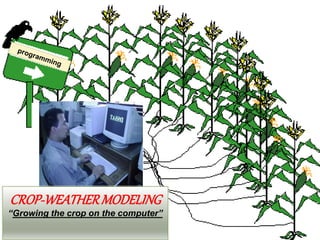
“Growing the crop on the computer”
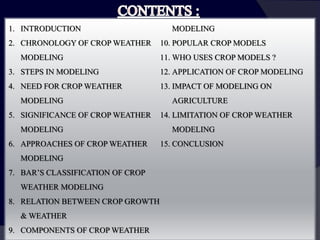
1. INTRODUCTION
2. CHRONOLOGY OF CROP WEATHER
MODELING
3. STEPS IN MODELING
4. NEED FOR CROP WEATHER
MODELING
5. SIGNIFICANCE OF CROP WEATHER
MODELING
6. APPROACHES OF CROP WEATHER
MODELING
7. BAR’S CLASSIFICATION OF CROP
WEATHER MODELING
8. RELATION BETWEEN CROP GROWTH
& WEATHER
9. COMPONENTS OF CROP WEATHER
MODELING
10. POPULAR CROP MODELS
11. WHO USES CROP MODELS ?
12. APPLICATION OF CROP MODELING
13. IMPACT OF MODELING ON
AGRICULTURE
14. LIMITATION OF CROP WEATHER
MODELING
15. CONCLUSION
YEAR DEVELOPMENTS
1960 Simple water-balance models
1965 Model photosynthetic rates of crop canopies (De Wit )
1970 Elementary Crop growth Simulator construction(ELCROS) by de Wit et al.
1977 Introduction of micrometeorology in the models & quantification of canopy
resistance (Goudriaan)
1978 Basic Crop growth Simulator (BACROS) [de Wit and Goudriaan]
1982 International Benchmark Sites Network for Agro-technology Transfer(IBSNAT)
began the development of a model (University of Hawaii) Decision Support System for
Agro- Technology Transfer (DSSAT)
1992 James reviewed the history of attempts to quantify the relationships between crop
yield and water use from the early work on simple water-balance models in the 1960s
to the development of crop growth simulation models in the 1980s.
1994 ORYZA1 (Kropff et al., 1994)
1994 India’s Ist crop model WTGROWS followed by the construction of ORYZA1N
1995 INFOCROP model developed that can control 16 crops
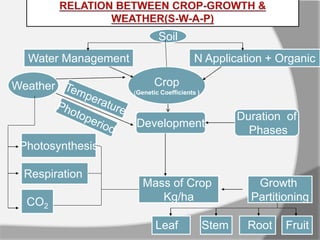
Water Management N Application + Organic
Crop
(Genetic Coefficients )
Development
Mass of Crop
Kg/ha
Duration of
Phases
Growth
Partitioning
Leaf Stem Root Fruit
Weather
CO2
Photosynthesis
Respiration
Soil
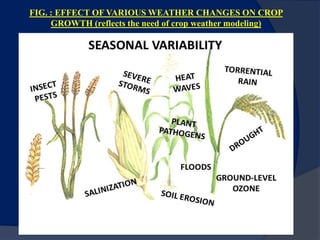
FIG. : EFFECT OF VARIOUS WEATHER CHANGES ON CROP
GROWTH (reflects the need of crop weather modeling)
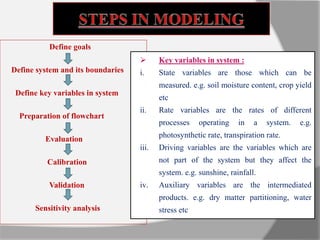
Define goals
Define system and its boundaries
Define key variables in system
Preparation of flowchart
Evaluation
Calibration
Validation
Sensitivity analysis
 Key variables in system :
i. State variables are those which can be
measured. e.g. soil moisture content, crop yield
etc
ii. Rate variables are the rates of different
processes operating in a system. e.g.
photosynthetic rate, transpiration rate.
iii. Driving variables are the variables which are
not part of the system but they affect the
system. e.g. sunshine, rainfall.
iv. Auxiliary variables are the intermediated
products. e.g. dry matter partitioning, water
stress etc
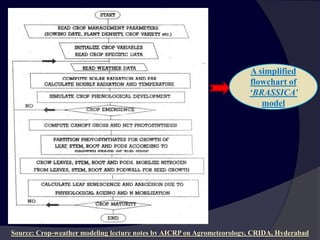
A simplified
flowchart of
‘BRASSICA’
model
Source: Crop-weather modeling lecture notes by AICRP on Agrometeorology, CRIDA, Hyderabad
The main purpose of developing the crop-weather models are:
 To understand crop weather interactions, processes involved and their
limitations.
 To assess the effect of environment, crop genotype and management
of input resources on crop yields, and to quantify the yield gaps with
existing knowledge.
 To undertake strategic and policy decisions to increase the
productivity of resource based efficient cropping systems.
 Powerful tools for on-farm management, regional land-use issues, policy planning,
scientific investigation and educational activities.
 Quantifies knowledge in a format that can provide scientists with techniques and
methodology for evaluation and additional experiments of related theories.
 Development of computer software programs that simplify access to simulations
whose results can be used by both scientists and non-scientists.
 Serve as decision support systems for agricultural practitioners
 Tool for integrating scientific knowledge on whole plant responses to environment
and management variables
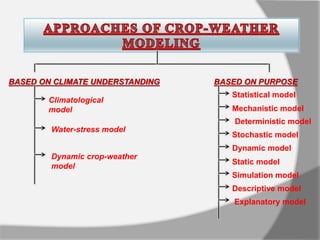
BASED ON CLIMATE UNDERSTANDING
Climatological
model
Water-stress model
Dynamic crop-weather
model
BASED ON PURPOSE
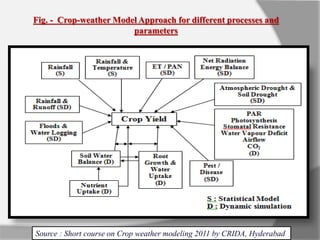
Statistical model
Mechanistic model
Deterministic model
Descriptive model
Stochastic model
Simulation model
Dynamic model
Static model
Explanatory model
Fig. - Crop-weather Model Approach for different processes and
parameters
Source : Short course on Crop weather modeling 2011 by CRIDA, Hyderabad
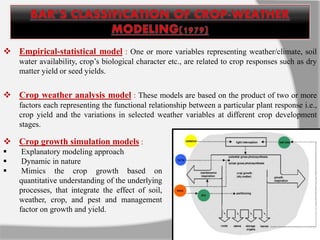
 Empirical-statistical model : One or more variables representing weather/climate, soil
water availability, crop’s biological character etc., are related to crop responses such as dry
matter yield or seed yields.
 Crop growth simulation models :
 Explanatory modeling approach
 Dynamic in nature
 Mimics the crop growth based on
quantitative understanding of the underlying
processes, that integrate the effect of soil,
weather, crop, and pest and management
factor on growth and yield.
 Crop weather analysis model : These models are based on the product of two or more
factors each representing the functional relationship between a particular plant response i.e.,
crop yield and the variations in selected weather variables at different crop development
stages.
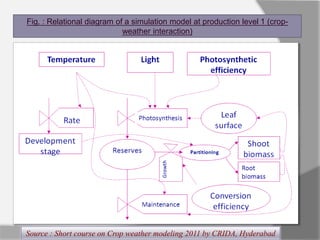
Fig. : Relational diagram of a simulation model at production level 1 (crop-
weather interaction)
Source : Short course on Crop weather modeling 2011 by CRIDA, Hyderabad
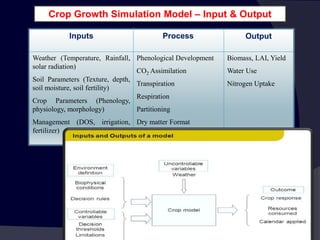
Crop Growth Simulation Model – Input & Output
Inputs Process Output
Weather (Temperature, Rainfall,
solar radiation)
Soil Parameters (Texture, depth,
soil moisture, soil fertility)
Crop Parameters (Phenology,
physiology, morphology)
Management (DOS, irrigation,
fertilizer)
Phenological Development
CO2 Assimilation
Transpiration
Respiration
Partitioning
Dry matter Format
Biomass, LAI, Yield
Water Use
Nitrogen Uptake
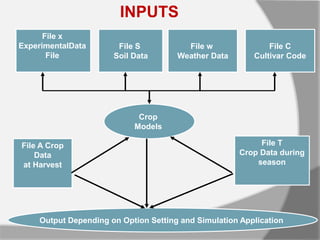
File x
ExperimentalData
File
File C
Cultivar Code
File A Crop
Data
at Harvest
File T
Crop Data during
season
Output Depending on Option Setting and Simulation Application
File w
Weather Data
File S
Soil Data
Crop
Models
INPUTS
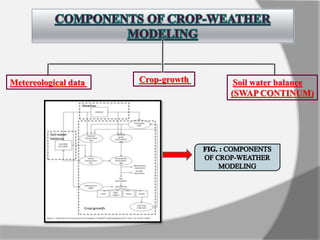
Metereological data Crop-growth Soil water balance
(SWAP CONTINUM)
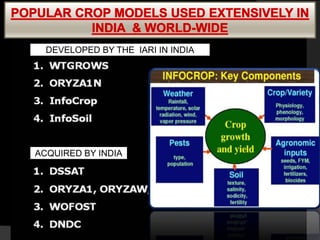
DEVELOPED BY THE IARI IN INDIA
ACQUIRED BY INDIA
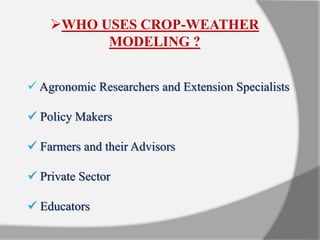
 Agronomic Researchers and Extension Specialists
 Policy Makers
 Farmers and their Advisors
 Private Sector
 Educators
WHO USES CROP-WEATHER
MODELING ?
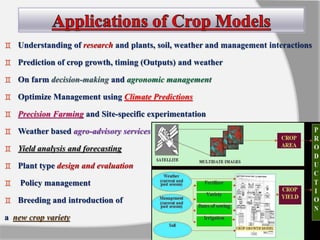
 Understanding of research and plants, soil, weather and management interactions
 Prediction of crop growth, timing (Outputs) and weather
 On farm decision-making and agronomic management
 Optimize Management using Climate Predictions
 Precision Farming and Site-specific experimentation
 Weather based agro-advisory services
 Yield analysis and forecasting
 Plant type design and evaluation
 Policy management
 Breeding and introduction of
a new crop variety
 Evaluation of optimum management for cultural practice in crop production.
 Evaluate weather risk via weather forecasting
 Proper crop surveillance with respect to pests, diseases and deficiency & excess
of nutrients.
 Yield prediction and forecasting
 These are resource conserving tools.
 Solve various practical problems in agriculture.
 ‰Helps to prepare adaptation strategies to minimize the negative impacts of
climate change
 Identification of the precise reasons for yield gap at farmer’s field
 Forecasting crop yields.
 ‰Evaluate cultivar stability under long term weather conditions
Inaccurate projections of natural processes
Unreliable and unrealistic projections of changes in climate variability
Crop models are not universal ( no site specificity).
 Misuse of models
Inappropriate for Heterogeneous plot
Inherent soil heterogeneity over relatively small distances
Model performance is limited to the quality of input data.
Sampling errors also contribute to inaccuracies in the observed data.
Rudimentary model validation methodology
Plant, soil and meteorological data are rarely precise and come from nearby
sites.
An ideal crop model cannot be developed because of complex biological system
An intensely calibrated and evaluated model can be used to effectively conduct research that in
the end save time and money and significantly contribute to developing sustainable agriculture
that meets the world’s needs for food.
Crop-weather modeling is developed as an excellent research tool.
Crop growth model is a very effective tool for predicting possible impacts of climatic change
on crop growth and yield.
Crop growth models are useful for solving various practical problems in agriculture.
Various kinds of models such as Statistical, Mechanistic, Deterministic, Stochastic, Dynamic,
Static, Simulations are in use for assessing and predicting crop growth and yield.
R 12013(crop weather modeling)

R 12013(crop weather modeling)

  • 1.
  • 2.
  • 3.
    1. INTRODUCTION 2. CHRONOLOGYOF CROP WEATHER MODELING 3. STEPS IN MODELING 4. NEED FOR CROP WEATHER MODELING 5. SIGNIFICANCE OF CROP WEATHER MODELING 6. APPROACHES OF CROP WEATHER MODELING 7. BAR’S CLASSIFICATION OF CROP WEATHER MODELING 8. RELATION BETWEEN CROP GROWTH & WEATHER 9. COMPONENTS OF CROP WEATHER MODELING 10. POPULAR CROP MODELS 11. WHO USES CROP MODELS ? 12. APPLICATION OF CROP MODELING 13. IMPACT OF MODELING ON AGRICULTURE 14. LIMITATION OF CROP WEATHER MODELING 15. CONCLUSION
  • 5.
    YEAR DEVELOPMENTS 1960 Simplewater-balance models 1965 Model photosynthetic rates of crop canopies (De Wit ) 1970 Elementary Crop growth Simulator construction(ELCROS) by de Wit et al. 1977 Introduction of micrometeorology in the models & quantification of canopy resistance (Goudriaan) 1978 Basic Crop growth Simulator (BACROS) [de Wit and Goudriaan] 1982 International Benchmark Sites Network for Agro-technology Transfer(IBSNAT) began the development of a model (University of Hawaii) Decision Support System for Agro- Technology Transfer (DSSAT) 1992 James reviewed the history of attempts to quantify the relationships between crop yield and water use from the early work on simple water-balance models in the 1960s to the development of crop growth simulation models in the 1980s. 1994 ORYZA1 (Kropff et al., 1994) 1994 India’s Ist crop model WTGROWS followed by the construction of ORYZA1N 1995 INFOCROP model developed that can control 16 crops
  • 6.
    Water Management NApplication + Organic Crop (Genetic Coefficients ) Development Mass of Crop Kg/ha Duration of Phases Growth Partitioning Leaf Stem Root Fruit Weather CO2 Photosynthesis Respiration Soil
  • 7.
    FIG. : EFFECTOF VARIOUS WEATHER CHANGES ON CROP GROWTH (reflects the need of crop weather modeling)
  • 8.
    Define goals Define systemand its boundaries Define key variables in system Preparation of flowchart Evaluation Calibration Validation Sensitivity analysis  Key variables in system : i. State variables are those which can be measured. e.g. soil moisture content, crop yield etc ii. Rate variables are the rates of different processes operating in a system. e.g. photosynthetic rate, transpiration rate. iii. Driving variables are the variables which are not part of the system but they affect the system. e.g. sunshine, rainfall. iv. Auxiliary variables are the intermediated products. e.g. dry matter partitioning, water stress etc
  • 9.
    A simplified flowchart of ‘BRASSICA’ model Source:Crop-weather modeling lecture notes by AICRP on Agrometeorology, CRIDA, Hyderabad
  • 10.
    The main purposeof developing the crop-weather models are:  To understand crop weather interactions, processes involved and their limitations.  To assess the effect of environment, crop genotype and management of input resources on crop yields, and to quantify the yield gaps with existing knowledge.  To undertake strategic and policy decisions to increase the productivity of resource based efficient cropping systems.
  • 11.
     Powerful toolsfor on-farm management, regional land-use issues, policy planning, scientific investigation and educational activities.  Quantifies knowledge in a format that can provide scientists with techniques and methodology for evaluation and additional experiments of related theories.  Development of computer software programs that simplify access to simulations whose results can be used by both scientists and non-scientists.  Serve as decision support systems for agricultural practitioners  Tool for integrating scientific knowledge on whole plant responses to environment and management variables
  • 12.
    BASED ON CLIMATEUNDERSTANDING Climatological model Water-stress model Dynamic crop-weather model BASED ON PURPOSE Statistical model Mechanistic model Deterministic model Descriptive model Stochastic model Simulation model Dynamic model Static model Explanatory model
  • 13.
    Fig. - Crop-weatherModel Approach for different processes and parameters Source : Short course on Crop weather modeling 2011 by CRIDA, Hyderabad
  • 14.
     Empirical-statistical model: One or more variables representing weather/climate, soil water availability, crop’s biological character etc., are related to crop responses such as dry matter yield or seed yields.  Crop growth simulation models :  Explanatory modeling approach  Dynamic in nature  Mimics the crop growth based on quantitative understanding of the underlying processes, that integrate the effect of soil, weather, crop, and pest and management factor on growth and yield.  Crop weather analysis model : These models are based on the product of two or more factors each representing the functional relationship between a particular plant response i.e., crop yield and the variations in selected weather variables at different crop development stages.
  • 15.
    Fig. : Relationaldiagram of a simulation model at production level 1 (crop- weather interaction) Source : Short course on Crop weather modeling 2011 by CRIDA, Hyderabad
  • 16.
    Crop Growth SimulationModel – Input & Output Inputs Process Output Weather (Temperature, Rainfall, solar radiation) Soil Parameters (Texture, depth, soil moisture, soil fertility) Crop Parameters (Phenology, physiology, morphology) Management (DOS, irrigation, fertilizer) Phenological Development CO2 Assimilation Transpiration Respiration Partitioning Dry matter Format Biomass, LAI, Yield Water Use Nitrogen Uptake
  • 17.
    File x ExperimentalData File File C CultivarCode File A Crop Data at Harvest File T Crop Data during season Output Depending on Option Setting and Simulation Application File w Weather Data File S Soil Data Crop Models INPUTS
  • 18.
    Metereological data Crop-growthSoil water balance (SWAP CONTINUM)
  • 19.
    DEVELOPED BY THEIARI IN INDIA ACQUIRED BY INDIA
  • 20.
     Agronomic Researchersand Extension Specialists  Policy Makers  Farmers and their Advisors  Private Sector  Educators WHO USES CROP-WEATHER MODELING ?
  • 21.
     Understanding ofresearch and plants, soil, weather and management interactions  Prediction of crop growth, timing (Outputs) and weather  On farm decision-making and agronomic management  Optimize Management using Climate Predictions  Precision Farming and Site-specific experimentation  Weather based agro-advisory services  Yield analysis and forecasting  Plant type design and evaluation  Policy management  Breeding and introduction of a new crop variety
  • 22.
     Evaluation ofoptimum management for cultural practice in crop production.  Evaluate weather risk via weather forecasting  Proper crop surveillance with respect to pests, diseases and deficiency & excess of nutrients.  Yield prediction and forecasting  These are resource conserving tools.  Solve various practical problems in agriculture.  ‰Helps to prepare adaptation strategies to minimize the negative impacts of climate change  Identification of the precise reasons for yield gap at farmer’s field  Forecasting crop yields.  ‰Evaluate cultivar stability under long term weather conditions
  • 23.
    Inaccurate projections ofnatural processes Unreliable and unrealistic projections of changes in climate variability Crop models are not universal ( no site specificity).  Misuse of models Inappropriate for Heterogeneous plot Inherent soil heterogeneity over relatively small distances Model performance is limited to the quality of input data. Sampling errors also contribute to inaccuracies in the observed data. Rudimentary model validation methodology Plant, soil and meteorological data are rarely precise and come from nearby sites. An ideal crop model cannot be developed because of complex biological system
  • 24.
    An intensely calibratedand evaluated model can be used to effectively conduct research that in the end save time and money and significantly contribute to developing sustainable agriculture that meets the world’s needs for food. Crop-weather modeling is developed as an excellent research tool. Crop growth model is a very effective tool for predicting possible impacts of climatic change on crop growth and yield. Crop growth models are useful for solving various practical problems in agriculture. Various kinds of models such as Statistical, Mechanistic, Deterministic, Stochastic, Dynamic, Static, Simulations are in use for assessing and predicting crop growth and yield.