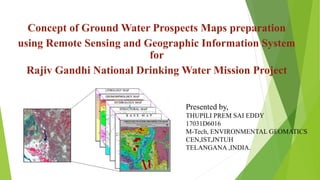
Concept of Ground Water Prospects Maps preparation
using Remote Sensing and Geographic Information System
for
Rajiv Gandhi National Drinking Water Mission Project
Presented by,
THUPILI PREM SAI EDDY
17031D6016
M-Tech, ENVIRONMENTAL GEOMATICS
CEN,IST,JNTUH
TELANGANA ,INDIA.
RAJIV GANDHI NATIONAL DRINKING WATER
MISSION PROJECT
The Government of India (Department of Drinking Water Supply), through
the Rajiv Gandhi National Drinking Water Mission (RGNDWM)
supplements the efforts of the State Governments to accelerate the pace of
coverage of drinking water supply to Non Covered (NC), Partially Covered
(PC) and quality affected rural habitations with mission approach by
providing Central assistance under the Accelerated Rural Water Supply
Program (ARWSP).
As part of supplying the drinking water to these habitations, the RGNDWM
has approached the NRSC/ISRO to provide scientific data on drinking water
sources (ground water source) to the non-covered (NC) and partially-covered
(PC) habitations, within the radius of 1.5 km in case of plain areas and within
100m elevation in case of hilly terrain, using the satellite data.
•WHAT is GROUND WATER PROSPECTS MAP?
•WHY do we need to prepare it?
•Need for scientific data base for the country!
INTRODUCTION
OBJECTIVES
The objective of the project is to prepare the ‘ground water
prospects maps’, corresponding to Survey of India topo-sheet on
1:50,000 scale, covering all the habitations. The map has to show
a) prospective zones for ground water occurrence
b) tentative locations for constructing recharge structures.
METHODS OF GROUND WATER EXPLORATION
A. Surface investigation
B. Geophysical measurements
C. Subsurface investigation
Geological formations have distinct physical properties that affect the flow of groundwater and
determine the yield of a well. These properties include;
Effective porosity – the percentage of interconnected space in rock and soil that can contain water.
Hydraulic conductivity (K) – indicates how easily water moves through the aquifer.
Transmissivity (T) – is the ability of the aquifer to transmit water (T = K * saturated thickness of
aquifer).
Storativity – the ability of a confined aquifer to take up or release water in response to a change in
head resulting from recharge or extraction.
GROUND WATER PROSPECTS MAPPING –
THE CONCEPT
1.Ground water controlling factors
2.Hydro-geomorphological units
3.Relevance of Satellite Data
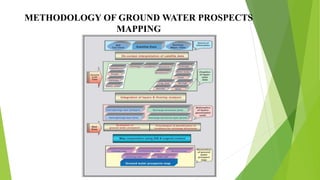
The total methodology can be divided into two main parts:
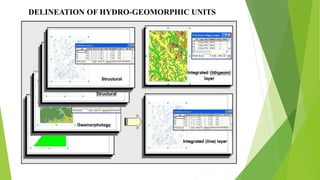
•The first part deals with the delineation of hydro-geomorphic units considering
parameters influencing the hydro geological properties. It consists of a) creation of
individual thematic layers on lithology, geomorphology, structures, hydrology along
with base map details based on the visual interpretation of satellite data in
conjunction with limited field / existing data, and b) derivation of hydrogeomorphic
units by integrating the thematic data.
•The second part deals with the evaluation of hydrogeomorphic units based on
hydrogeological characteristics of controlling parameters. It consists of a) estimation
of ground water prospects by taking into account the well observatory data, and b)
identification of suitable locations for constructing recharge structures along with
prioritization of the units.
METHODOLOGY OF GROUND WATER PROSPECTS
MAPPING
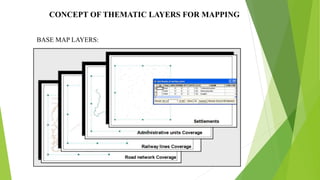
CONCEPT OF THEMATIC LAYERS FOR MAPPING
BASE MAP LAYERS:
CONCEPT OF THEMATIC LAYERS FOR MAPPING
LITHOLOGY LAYERS:
CONCEPT OF THEMATIC LAYERS FOR MAPPING
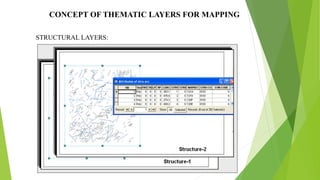
STRUCTURAL LAYERS:
CONCEPT OF THEMATIC LAYERS FOR MAPPING
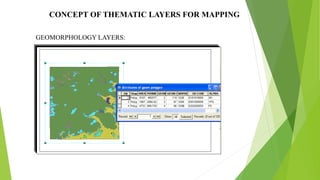
GEOMORPHOLOGY LAYERS:
CONCEPT OF THEMATIC LAYERS FOR MAPPING
HYDROLOGY LAYERS:
DELINEATION OF HYDRO-GEOMORPHIC UNITS
Apart from this, certain field studies are to be performed such
as:
•Evaluation of aquifer material
•Assessment of Recharge Conditions
•Types of wells suitable
•Expected Yield range
•Success rate of wells / Homogeneity of the map unit
•Water Quality
•Ground water irrigated area
•Selection of Sites for artificial recharge Structures
•Types of recharge structures
GENERATION OF GROUND WATER PROSPECTS MAP
• Map layouts
• Map composition
• Creation of Legend
• Classification Systems
SCOPE AND LIMITATIONS OF GROUND WATER
PROSPECTS MAPS
SCOPE:
• Ground water prospects maps may be used by the field Officers of the departments concerned in the
respective states to select the sites at appropriate places
• It helps mainly in identification of prospective locations for narrowing down target zones for follow-up
detailed hydro-geological and geophysical surveys at appropriate places for drilling.
• These maps are the good inputs for aquifer mapping.
• One of the input for resource estimation for future ground water development for the given area.
• The maps are prepared based on the availability recharge conditions i.e rainfall, depth to water table,
availability of water in the water bodies during the period of the mapping. Hence depth and yield will
vary.
• VIBGYOR colours scheme is maintained for indicating yield and hatching pattern for depth. In does not
mean that entire polygon gives the same yield but it varies within the unit due to heterogeneity. Hence
sometimes yield may go one step up or down. It is because of rain fall variations.
• Maps help in identifying the ground water exploitation areas (through ground water irrigated patches) for
addressing the suitable recharge structures for improving the ground water levels.
LIMITATIONS
• Limitations
• Pin pointing bore / tube well points (41/2” & 61/2” dia) may not be accurate.
• Depth variations
• Yield variations
• Variations in estimated success rate
• Low yields/poor yields along the fracture areas
Thank you 

Ground water prospects map

  • 1.
    Concept of GroundWater Prospects Maps preparation using Remote Sensing and Geographic Information System for Rajiv Gandhi National Drinking Water Mission Project Presented by, THUPILI PREM SAI EDDY 17031D6016 M-Tech, ENVIRONMENTAL GEOMATICS CEN,IST,JNTUH TELANGANA ,INDIA.
  • 2.
    RAJIV GANDHI NATIONALDRINKING WATER MISSION PROJECT The Government of India (Department of Drinking Water Supply), through the Rajiv Gandhi National Drinking Water Mission (RGNDWM) supplements the efforts of the State Governments to accelerate the pace of coverage of drinking water supply to Non Covered (NC), Partially Covered (PC) and quality affected rural habitations with mission approach by providing Central assistance under the Accelerated Rural Water Supply Program (ARWSP). As part of supplying the drinking water to these habitations, the RGNDWM has approached the NRSC/ISRO to provide scientific data on drinking water sources (ground water source) to the non-covered (NC) and partially-covered (PC) habitations, within the radius of 1.5 km in case of plain areas and within 100m elevation in case of hilly terrain, using the satellite data.
  • 3.
    •WHAT is GROUNDWATER PROSPECTS MAP? •WHY do we need to prepare it? •Need for scientific data base for the country! INTRODUCTION
  • 4.
    OBJECTIVES The objective ofthe project is to prepare the ‘ground water prospects maps’, corresponding to Survey of India topo-sheet on 1:50,000 scale, covering all the habitations. The map has to show a) prospective zones for ground water occurrence b) tentative locations for constructing recharge structures.
  • 5.
    METHODS OF GROUNDWATER EXPLORATION A. Surface investigation B. Geophysical measurements C. Subsurface investigation Geological formations have distinct physical properties that affect the flow of groundwater and determine the yield of a well. These properties include; Effective porosity – the percentage of interconnected space in rock and soil that can contain water. Hydraulic conductivity (K) – indicates how easily water moves through the aquifer. Transmissivity (T) – is the ability of the aquifer to transmit water (T = K * saturated thickness of aquifer). Storativity – the ability of a confined aquifer to take up or release water in response to a change in head resulting from recharge or extraction.
  • 6.
    GROUND WATER PROSPECTSMAPPING – THE CONCEPT 1.Ground water controlling factors 2.Hydro-geomorphological units 3.Relevance of Satellite Data
  • 7.
    The total methodologycan be divided into two main parts: •The first part deals with the delineation of hydro-geomorphic units considering parameters influencing the hydro geological properties. It consists of a) creation of individual thematic layers on lithology, geomorphology, structures, hydrology along with base map details based on the visual interpretation of satellite data in conjunction with limited field / existing data, and b) derivation of hydrogeomorphic units by integrating the thematic data. •The second part deals with the evaluation of hydrogeomorphic units based on hydrogeological characteristics of controlling parameters. It consists of a) estimation of ground water prospects by taking into account the well observatory data, and b) identification of suitable locations for constructing recharge structures along with prioritization of the units.
  • 8.
    METHODOLOGY OF GROUNDWATER PROSPECTS MAPPING
  • 9.
    CONCEPT OF THEMATICLAYERS FOR MAPPING BASE MAP LAYERS:
  • 10.
    CONCEPT OF THEMATICLAYERS FOR MAPPING LITHOLOGY LAYERS:
  • 11.
    CONCEPT OF THEMATICLAYERS FOR MAPPING STRUCTURAL LAYERS:
  • 12.
    CONCEPT OF THEMATICLAYERS FOR MAPPING GEOMORPHOLOGY LAYERS:
  • 13.
    CONCEPT OF THEMATICLAYERS FOR MAPPING HYDROLOGY LAYERS:
  • 14.
  • 15.
    Apart from this,certain field studies are to be performed such as: •Evaluation of aquifer material •Assessment of Recharge Conditions •Types of wells suitable •Expected Yield range •Success rate of wells / Homogeneity of the map unit •Water Quality •Ground water irrigated area •Selection of Sites for artificial recharge Structures •Types of recharge structures
  • 16.
    GENERATION OF GROUNDWATER PROSPECTS MAP • Map layouts • Map composition • Creation of Legend • Classification Systems
  • 17.
    SCOPE AND LIMITATIONSOF GROUND WATER PROSPECTS MAPS SCOPE: • Ground water prospects maps may be used by the field Officers of the departments concerned in the respective states to select the sites at appropriate places • It helps mainly in identification of prospective locations for narrowing down target zones for follow-up detailed hydro-geological and geophysical surveys at appropriate places for drilling. • These maps are the good inputs for aquifer mapping. • One of the input for resource estimation for future ground water development for the given area. • The maps are prepared based on the availability recharge conditions i.e rainfall, depth to water table, availability of water in the water bodies during the period of the mapping. Hence depth and yield will vary. • VIBGYOR colours scheme is maintained for indicating yield and hatching pattern for depth. In does not mean that entire polygon gives the same yield but it varies within the unit due to heterogeneity. Hence sometimes yield may go one step up or down. It is because of rain fall variations. • Maps help in identifying the ground water exploitation areas (through ground water irrigated patches) for addressing the suitable recharge structures for improving the ground water levels.
  • 18.
    LIMITATIONS • Limitations • Pinpointing bore / tube well points (41/2” & 61/2” dia) may not be accurate. • Depth variations • Yield variations • Variations in estimated success rate • Low yields/poor yields along the fracture areas
  • 19.