Module
2
DC Circuit
Version 2 EE IIT, Kharagpur
Lesson
6
Wye (Y) - Delta (∆) OR
Delta (∆)-Wye (Y)
Transformations
Version 2 EE IIT, Kharagpur
Objectives
• A part of a larger circuit that is configured with three terminal network Y (or Δ )
to convert into an equivalent Δ (or Y ) through transformations.
• Application of these transformations will be studied by solving resistive circuits.
L.6.1 Introduction
There are certain circuit configurations that cannot be simplified by series-parallel
combination alone. A simple transformation based on mathematical technique is readily
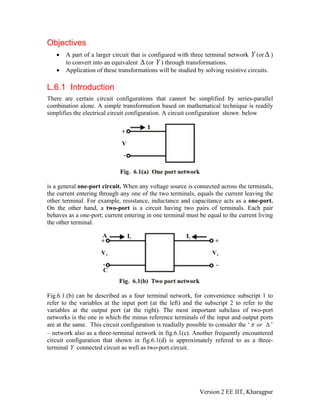
simplifies the electrical circuit configuration. A circuit configuration shown below
is a general one-port circuit. When any voltage source is connected across the terminals,
the current entering through any one of the two terminals, equals the current leaving the
other terminal. For example, resistance, inductance and capacitance acts as a one-port.
On the other hand, a two-port is a circuit having two pairs of terminals. Each pair
behaves as a one-port; current entering in one terminal must be equal to the current living
the other terminal.
Fig.6.1.(b) can be described as a four terminal network, for convenience subscript 1 to
refer to the variables at the input port (at the left) and the subscript 2 to refer to the
variables at the output port (at the right). The most important subclass of two-port
networks is the one in which the minus reference terminals of the input and output ports
are at the same. This circuit configuration is readially possible to consider the ‘ orπ Δ ’
– network also as a three-terminal network in fig.6.1(c). Another frequently encountered
circuit configuration that shown in fig.6.1(d) is approximately refered to as a three-
terminal Y connected circuit as well as two-port circuit.
Version 2 EE IIT, Kharagpur
The name derives from the shape or configuration of the circuit diagrams, which look
respectively like the letter Y and the Greek capital letter Δ.
L.6.1.1 Delta (Δ) – Wye (Y) conversion
These configurations may often be handled by the use of a Δ −Y or − ΔY transformation.
One of the most basic three-terminal network equivalent is that of three resistors
connected in “Delta ” and in “Wye( ”. These two circuits identified in fig.L6.1(e)
and Fig.L.6.1(f) are sometimes part of a larger circuit and obtained their names from their
configurations. These three terminal networks can be redrawn as four-terminal networks
as shown in fig.L.6.1(c) and fig.L.6.1(d). We can obtain useful expression for direct
( )Δ )Y
Version 2 EE IIT, Kharagpur
transformation or conversion from Δ to Y or Y to Δ by considering that for
equivalence the two networks have the same resistance when looked at the similar pairs
of terminals.
L.6.2 Conversion from Delta (Δ) to Star or Wye (Y)
Let us consider the network shown in fig.6.1(e) (or fig. ) and assumed the
resistances ( ) in
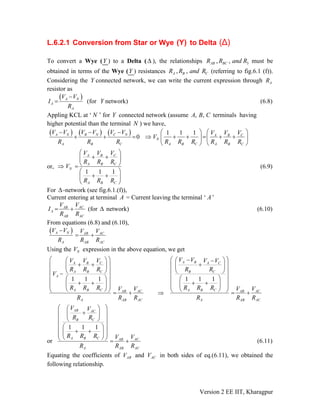
6.1( )c →
, ,AB BC CAR R and R Δ network are known. Our problem is to find the
values of in Wye (Y ) network (see fig.6.1(e)) that will produce the
same resistance when measured between similar pairs of terminals. We can write the
equivalence resistance between any two terminals in the following form.
, ,A B CR R and R
Between &A C terminals:
( )CA AB BC
A C
AB BC C
R R R
R R
AR R R
+
+ =
+ +
(6.1)
Between terminals:&C B
( )BA AB CA
C B
AB BC C
R R R
R R
AR R R
+
+ =
+ +
(6.2)
Between &B A terminals:
( )AB CA BC
B A
AB BC C
R R R
R R
AR R R
+
+ =
+ +
(6.3)
By combining above three equations, one can write an expression as given below.
AB BC BC CA CA AB
A B C
AB BC CA
R R R R R R
R R R
R R R
+ +
+ + =
+ +
(6.4)
Subtracting equations (6.2), (6.1), and (6.3) from (6.4) equations, we can write the
express for unknown resistances of Wye (Y ) network as
AB CA
A
AB BC CA
R R
R
R R R
=
+ +
(6.5)
AB BC
B
AB BC CA
R R
R
R R R
=
+ +
(6.6)
BC CA
C
AB BC CA
R R
R
R R R
=
+ +
(6.7)
Version 2 EE IIT, Kharagpur
L.6.2.1 Conversion from Star or Wye (Y) to Delta (Δ)
To convert a Wye (Y ) to a Delta (Δ ), the relationships must be
obtained in terms of the Wye (Y
3, ,AB BCR R and R
) resistances (referring to fig.6.1 (f)).
Considering the Y connected network, we can write the current expression through
, ,A B CR R and R
AR
resistor as
( )A N
A
A
V V
I
R
−
= (for Y network) (6.8)
Appling KCL at ‘ ’ for Y connected network (assumeN , ,A B C terminals having
higher potential than the terminal ) we have,N
( ) ( ) ( ) 0A N B N C N
A B C
V V V V V V
R R R
− − −
+ + =
1 1 1 CA B
N
A B C A B C
VV V
V
R R R R R R
⎛ ⎞ ⎛
⇒ + + = + +⎜ ⎟ ⎜
⎝ ⎠ ⎝
⎞
⎟
⎠
or,
1 1 1
CA B
A B C
N
A B C
VV V
R R R
V
R R R
⎛ ⎞
+ +⎜ ⎟
⎝⇒ =
⎛ ⎞
+ +⎜ ⎟
⎝ ⎠
⎠ (6.9)
For -network (see fig.6.1.(f)),Δ
Current entering at terminal A = Current leaving the terminal ‘ A’
ACAB
A
AB A
VV
I
CR R
= + (for network) (6.10)Δ
From equations (6.8) and (6.10),
( )A N ACAB
A AB AC
V V VV
R R R
−
= +
Using the expression in the above equation, we getNV
1 1 1
CA B
A B C
A
A B C ACAB
A AB AC
VV V
R R R
V
R R R VV
R R R
⎛ ⎞⎛ ⎞
+ +⎜ ⎟⎜ ⎟
⎝ ⎠⎜ ⎟−
⎜ ⎟⎛ ⎞
+ +⎜ ⎟⎜ ⎟⎜ ⎟
⎝ ⎠⎝ ⎠ = + ⇒
1 1 1
A B A C
B C
A B C ACAB
A AB AC
V V V V
R R
R R R VV
R R R
⎛ ⎞−⎛ ⎞−
+⎜ ⎟⎜ ⎟
⎝ ⎠⎜ ⎟
⎜ ⎟⎛ ⎞
+ +⎜ ⎟⎜ ⎟⎜ ⎟
⎝ ⎠⎝ ⎠ = +
or
1 1 1
AB AC
B C
A B C ACAB
A AB AC
V V
R R
R R R VV
R R R
⎛ ⎞⎛ ⎞
+⎜ ⎟⎜ ⎟
⎝ ⎠⎜ ⎟
⎜ ⎟⎛ ⎞
+ +⎜ ⎟⎜ ⎟⎜ ⎟
⎝ ⎠⎝ ⎠ = + (6.11)
Equating the coefficients of and in both sides of eq.(6.11), we obtained the
following relationship.
ABV ACV
Version 2 EE IIT, Kharagpur
1 1
1 1 1
A B
AB A B
AB C
A B
A B C
R R
R R R
R R
R R
R R R
= ⇒ = +
⎛ ⎞
+ +⎜ ⎟
⎝ ⎠
+ (6.12)
1 1
1 1 1
A C
AC A C
AC B
A C
A B C
R R
R R R
R R
R R
R R R
= ⇒ = +
⎛ ⎞
+ +⎜ ⎟
⎝ ⎠
+ (6.13)
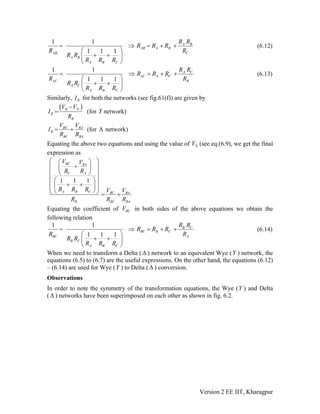
Similarly, BI for both the networks (see fig.61(f)) are given by
( )B N
B
B
V V
I
R
−
= (for Y network)
BC BA
B
BC BA
V V
I
R R
= + (for network)Δ
Equating the above two equations and using the value of (see eq.(6.9), we get the final
expression as
NV
1 1 1
BC BA
C A
A B C BC BA
B BC
V V
R R
R R R V V
BAR R R
⎛ ⎞⎛ ⎞
+⎜ ⎟⎜ ⎟
⎝ ⎠⎜ ⎟
⎜ ⎟⎛ ⎞
+ +⎜ ⎟⎜ ⎟⎜ ⎟
⎝ ⎠⎝ ⎠ = +
Equating the coefficient of in both sides of the above equations we obtain the
following relation
BCV
1 1
1 1 1
B C
BC B C
BC A
B C
A B C
R R
R R R
R R
R R
R R R
= ⇒ = +
⎛ ⎞
+ +⎜ ⎟
⎝ ⎠
+ (6.14)
When we need to transform a Delta (Δ ) network to an equivalent Wye (Y ) network, the
equations (6.5) to (6.7) are the useful expressions. On the other hand, the equations (6.12)
– (6.14) are used for Wye (Y ) to Delta (Δ ) conversion.
Observations
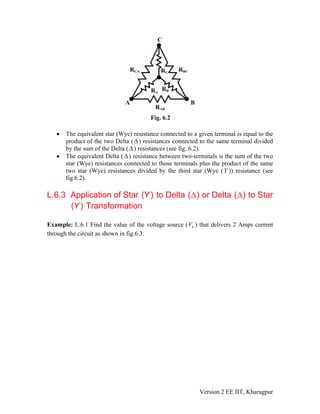
In order to note the symmetry of the transformation equations, the Wye (Y ) and Delta
(Δ ) networks have been superimposed on each other as shown in fig. 6.2.
Version 2 EE IIT, Kharagpur
• The equivalent star (Wye) resistance connected to a given terminal is equal to the
product of the two Delta (Δ) resistances connected to the same terminal divided
by the sum of the Delta ( Δ) resistances (see fig. 6.2).
• The equivalent Delta ( ) resistance between two-terminals is the sum of the two
star (Wye) resistances connected to those terminals plus the product of the same
two star (Wye) resistances divided by the third star (Wye (Y )) resistance (see
fig.6.2).
Δ
L.6.3 Application of Star ( )Y to Delta Δ( ) or Delta Δ( ) to Star
( )Y Transformation
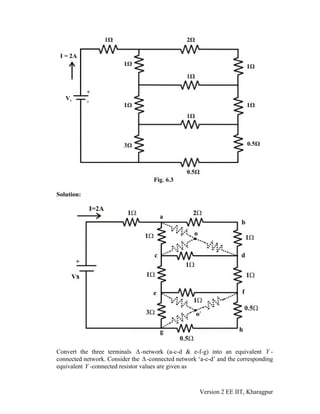
Example: L.6.1 Find the value of the voltage source ( ) that delivers 2 Amps current
through the circuit as shown in fig.6.3.
SV
Version 2 EE IIT, Kharagpur
Solution:
Convert the three terminals Δ-network (a-c-d & e-f-g) into an equivalent Y -
connected network. Consider the Δ-connected network ‘a-c-d’ and the corresponding
equivalent Y -connected resistor values are given as
Version 2 EE IIT, Kharagpur
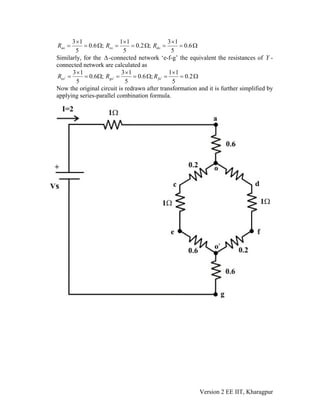
3 1 1 1 3 1
0.6 ; 0.2 ; 0.6
5 5 5
ao co doR R R
× × ×
= = Ω = = Ω = = Ω
Similarly, for the -connected network ‘e-f-g’ the equivalent the resistances of Y -
connected network are calculated as
Δ
3 1 3 1 1 1
0.6 ; 0.6 ; 0.2
5 5 5
eo go foR R R′ ′ ′
× × ×
= = Ω = = Ω = = Ω
Now the original circuit is redrawn after transformation and it is further simplified by
applying series-parallel combination formula.
Version 2 EE IIT, Kharagpur
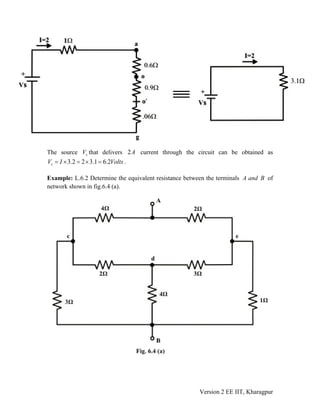
The source sV that delivers 2A current through the circuit can be obtained as
.3.2 2 3.1 6.2sV I Volts= × = × =
Example: L.6.2 Determine the equivalent resistance between the terminals A and B of
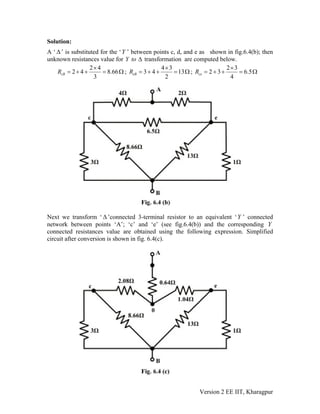
network shown in fig.6.4 (a).
Version 2 EE IIT, Kharagpur
Solution:
A ‘ ’ is substituted for the ‘Y ’ between points c, d, and e as shown in fig.6.4(b); then
unknown resistances value for Y t
Δ
o Δ transformation are computed below.
2 4
2 4 8.66
3
cBR
×
= + + = Ω ;
4 3
3 4 13
2
eBR
×
= + + = Ω ;
2 3
2 3 6.5
4
ceR
×
= + + = Ω
Next we transform ‘ Δ’connected 3-terminal resistor to an equivalent ‘Y ’ connected
network between points ‘A’; ‘c’ and ‘e’ (see fig.6.4(b)) and the corresponding Y
connected resistances value are obtained using the following expression. Simplified
circuit after conversion is shown in fig. 6.4(c).
Version 2 EE IIT, Kharagpur
4 2
0.64 ;
4 2 6.5
AoR
×
= = Ω
+ +
4 6.5
2.08 ;
4 2 6.5
coR
×
= = Ω
+ +
6.5 2
1.04 ;
4 2 6.5
eoR
×
= = Ω
+ +
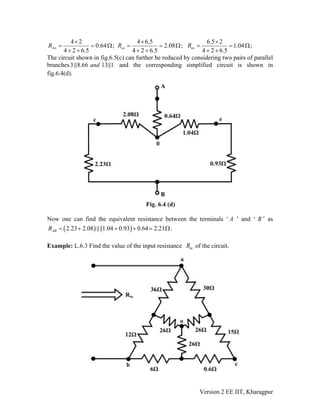
The circuit shown in fig.6.5(c) can further be reduced by considering two pairs of parallel
branches and the corresponding simplified circuit is shown in
fig.6.4(d).
3 8.66 13 1and
Now one can find the equivalent resistance between the terminals ‘ A ’ and ‘ B ’ as
( ) ( )2.23 2.08 1.04 0.93 0.64 2.21ABR = + + + = Ω .
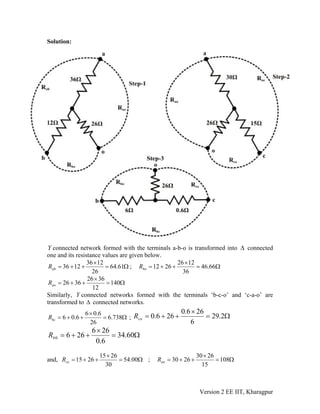
Example: L.6.3 Find the value of the input resistance of the circuit.inR
Version 2 EE IIT, Kharagpur
Solution:
Y connected network formed with the terminals a-b-o is transformed into Δ connected
one and its resistance values are given below.
Ω=
×
++= 61.64
26
1236
1236abR ; Ω=
×
++= 66.46
36
1226
2612boR
Ω=
×
++= 140
12
3626
3626aoR
Similarly, connected networks formed with the terminals ‘b-c-o’ and ‘c-a-o’ are
transformed to connected networks.
Y
Δ
Ω=
×
++= 738.6
26
6.06
6.06bcR ; Ω=
×
++= 2.29
6
266.0
266.0coR
Ω=
×
++= 60.34
6.0
266
2660bR
and, Ω=
×
++= 00.54
30
2615
2615coR ; Ω=
×
++= 108
15
2630
2630aoR
Version 2 EE IIT, Kharagpur
Ω=
×
++= 31.62
26
1530
1530acR
Note that the two resistances are connected in parallel (140 108 ) between the points ‘a’
and ‘o’. Similarly, between the points ‘b’ and ‘o’ two resistances are connected in parallel
( 46.66 34.6) and resistances 54.0Ω and 29.2Ω are connected in parallel between the
points ‘c’ and ‘o’.
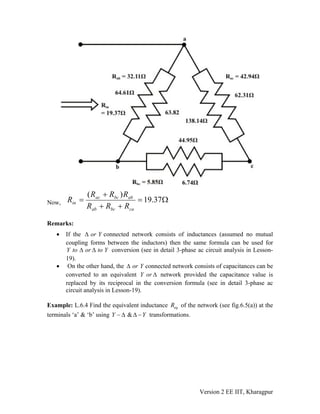
Now Y connected network formed with the terminal ‘a-b-c’ is converted to equivalent
connected network.Δ
Version 2 EE IIT, Kharagpur
Now, Ω=
++
+
= 37.19
)(
cabcab
abbcac
in
RRR
RRR
R
Remarks:
• If the connected network consists of inductances (assumed no mutual
coupling forms between the inductors) then the same formula can be used for
conversion (see in detail 3-phase ac circuit analysis in Lesson-
19).
or YΔ
Y to or to YΔ Δ
• On the other hand, the connected network consists of capacitances can be
converted to an equivalent
or YΔ
ΔY or network provided the capacitance value is
replaced by its reciprocal in the conversion formula (see in detail 3-phase ac
circuit analysis in Lesson-19).
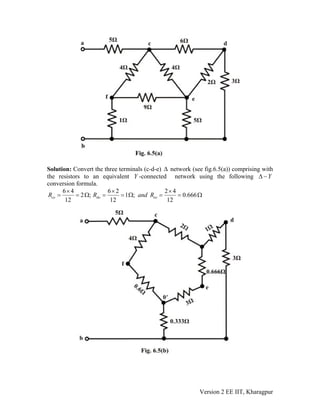
Example: L.6.4 Find the equivalent inductance of the network (see fig.6.5(a)) at the
terminals ‘a’ & ‘b’ using transformations.
eqR
&Y − Δ Δ −Y
Version 2 EE IIT, Kharagpur
Solution: Convert the three terminals (c-d-e) Δ network (see fig.6.5(a)) comprising with
the resistors to an equivalent Y -connected network using the following YΔ −
conversion formula.
6 4 6 2 2 4
2 ; 1 ; 0.666
12 12 12
co do eoR R and R
× × ×
= = Ω = = Ω = = Ω
Version 2 EE IIT, Kharagpur
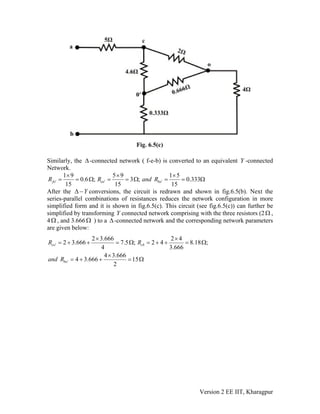
Similarly, the -connected network ( f-e-b) is converted to an equivalent Y -connected
Network.
Δ
1 9 5 9 1 5
0.6 ; 3 ; 0.333
15 15 15
fo eo boR R and R′ ′ ′
× × ×
= = Ω = = Ω = = Ω
After the conversions, the circuit is redrawn and shown in fig.6.5(b). Next the
series-parallel combinations of resistances reduces the network configuration in more
simplified form and it is shown in fig.6.5(c). This circuit (see fig.6.5(c)) can further be
simplified by transforming Y connected network comprising with the three resistors (2
YΔ −
Ω ,
4Ω , and 3.666 ) to a -connected network and the corresponding network parameters
are given below:
Ω Δ
2 3.666 2 4
2 3.666 7.5 ; 2 4 8.18 ;
4 3.666
4 3.666
4 3.666 15
2
co cb
bo
R R
and R
′
′
× ×
= + + = Ω = + + = Ω
×
= + + = Ω
Version 2 EE IIT, Kharagpur
Simplified form of the circuit is drawn and shown in fig.6.5(d) and one can easily find
out the equivalent resistance between the terminals ‘a’ and ‘b’ using the series-
parallel formula. From fig.6.5(d), one can write the expression for the total equivalent
resistance at the terminals ‘a’ and ‘b’ as
eqR
eqR
( ) ( )
[ ] ( )
5 4.6 || 7.5 0.333||15 ||8.18
5 2.85 0.272 ||8.18 5 3.122 ||8.18
7.26
eqR ⎡ ⎤= + +⎣ ⎦
= + + = +
= Ω
L.6.3 Test Your Understanding [Marks: 40]
T.1 Apply transformations only to find the value of the Current that
drives the circuit as shown in fig.6.6. [8]
Y or Y− Δ Δ − I
Version 2 EE IIT, Kharagpur
(ans: 10.13 )Ω
T.2 Find the current throughI 4Ω resistor using Y − Δ or YΔ − transformation
technique only for the circuit shown in fig.6.7. [10]
(ans: 7.06 A )
T.3 For the circuit shown in fig.6.8, find without performing any conversion. [4]eqR
(Ans.6 )Ω
Version 2 EE IIT, Kharagpur
T.4 For the circuit shown in fig.6.9, calculate the equivalent inductance for each
circuit and justify your answer conceptually. [6]
eqR
(ans. )1 2eq eqR R=
T.5 Find the value of for the circuit of fig.6.10 when the switch is open and when
the switch is closed. [4]
eqR
(Ans. ; )8.75eqR = Ω 7.5eqR = Ω
T.6 For the circuit shown in fig.6.11, find the value of the resistance ‘ ’ so that the
equivalent capacitance between the terminals ‘a’ and b’ is 20.
R
57Ω . [6]
(Ans.30 )Ω
Version 2 EE IIT, Kharagpur
T.7 conversion is often useful in reducing the ------------ of a resistor
network ---------- to the beginning nodal or mesh analysis. [1]
Y or Y− Δ Δ −
T.8 Is it possible to find the current through a branch or to find a voltage across the
branch using conversions only? If so, justify your answer. [1]/Y − Δ Δ −Y
___________________________________________________________
Version 2 EE IIT, Kharagpur

Star delta

  • 1.
  • 2.
    Lesson 6 Wye (Y) -Delta (∆) OR Delta (∆)-Wye (Y) Transformations Version 2 EE IIT, Kharagpur
  • 3.
    Objectives • A partof a larger circuit that is configured with three terminal network Y (or Δ ) to convert into an equivalent Δ (or Y ) through transformations. • Application of these transformations will be studied by solving resistive circuits. L.6.1 Introduction There are certain circuit configurations that cannot be simplified by series-parallel combination alone. A simple transformation based on mathematical technique is readily simplifies the electrical circuit configuration. A circuit configuration shown below is a general one-port circuit. When any voltage source is connected across the terminals, the current entering through any one of the two terminals, equals the current leaving the other terminal. For example, resistance, inductance and capacitance acts as a one-port. On the other hand, a two-port is a circuit having two pairs of terminals. Each pair behaves as a one-port; current entering in one terminal must be equal to the current living the other terminal. Fig.6.1.(b) can be described as a four terminal network, for convenience subscript 1 to refer to the variables at the input port (at the left) and the subscript 2 to refer to the variables at the output port (at the right). The most important subclass of two-port networks is the one in which the minus reference terminals of the input and output ports are at the same. This circuit configuration is readially possible to consider the ‘ orπ Δ ’ – network also as a three-terminal network in fig.6.1(c). Another frequently encountered circuit configuration that shown in fig.6.1(d) is approximately refered to as a three- terminal Y connected circuit as well as two-port circuit. Version 2 EE IIT, Kharagpur
  • 4.
    The name derivesfrom the shape or configuration of the circuit diagrams, which look respectively like the letter Y and the Greek capital letter Δ. L.6.1.1 Delta (Δ) – Wye (Y) conversion These configurations may often be handled by the use of a Δ −Y or − ΔY transformation. One of the most basic three-terminal network equivalent is that of three resistors connected in “Delta ” and in “Wye( ”. These two circuits identified in fig.L6.1(e) and Fig.L.6.1(f) are sometimes part of a larger circuit and obtained their names from their configurations. These three terminal networks can be redrawn as four-terminal networks as shown in fig.L.6.1(c) and fig.L.6.1(d). We can obtain useful expression for direct ( )Δ )Y Version 2 EE IIT, Kharagpur
  • 5.
    transformation or conversionfrom Δ to Y or Y to Δ by considering that for equivalence the two networks have the same resistance when looked at the similar pairs of terminals. L.6.2 Conversion from Delta (Δ) to Star or Wye (Y) Let us consider the network shown in fig.6.1(e) (or fig. ) and assumed the resistances ( ) in 6.1( )c → , ,AB BC CAR R and R Δ network are known. Our problem is to find the values of in Wye (Y ) network (see fig.6.1(e)) that will produce the same resistance when measured between similar pairs of terminals. We can write the equivalence resistance between any two terminals in the following form. , ,A B CR R and R Between &A C terminals: ( )CA AB BC A C AB BC C R R R R R AR R R + + = + + (6.1) Between terminals:&C B ( )BA AB CA C B AB BC C R R R R R AR R R + + = + + (6.2) Between &B A terminals: ( )AB CA BC B A AB BC C R R R R R AR R R + + = + + (6.3) By combining above three equations, one can write an expression as given below. AB BC BC CA CA AB A B C AB BC CA R R R R R R R R R R R R + + + + = + + (6.4) Subtracting equations (6.2), (6.1), and (6.3) from (6.4) equations, we can write the express for unknown resistances of Wye (Y ) network as AB CA A AB BC CA R R R R R R = + + (6.5) AB BC B AB BC CA R R R R R R = + + (6.6) BC CA C AB BC CA R R R R R R = + + (6.7) Version 2 EE IIT, Kharagpur
  • 6.
    L.6.2.1 Conversion fromStar or Wye (Y) to Delta (Δ) To convert a Wye (Y ) to a Delta (Δ ), the relationships must be obtained in terms of the Wye (Y 3, ,AB BCR R and R ) resistances (referring to fig.6.1 (f)). Considering the Y connected network, we can write the current expression through , ,A B CR R and R AR resistor as ( )A N A A V V I R − = (for Y network) (6.8) Appling KCL at ‘ ’ for Y connected network (assumeN , ,A B C terminals having higher potential than the terminal ) we have,N ( ) ( ) ( ) 0A N B N C N A B C V V V V V V R R R − − − + + = 1 1 1 CA B N A B C A B C VV V V R R R R R R ⎛ ⎞ ⎛ ⇒ + + = + +⎜ ⎟ ⎜ ⎝ ⎠ ⎝ ⎞ ⎟ ⎠ or, 1 1 1 CA B A B C N A B C VV V R R R V R R R ⎛ ⎞ + +⎜ ⎟ ⎝⇒ = ⎛ ⎞ + +⎜ ⎟ ⎝ ⎠ ⎠ (6.9) For -network (see fig.6.1.(f)),Δ Current entering at terminal A = Current leaving the terminal ‘ A’ ACAB A AB A VV I CR R = + (for network) (6.10)Δ From equations (6.8) and (6.10), ( )A N ACAB A AB AC V V VV R R R − = + Using the expression in the above equation, we getNV 1 1 1 CA B A B C A A B C ACAB A AB AC VV V R R R V R R R VV R R R ⎛ ⎞⎛ ⎞ + +⎜ ⎟⎜ ⎟ ⎝ ⎠⎜ ⎟− ⎜ ⎟⎛ ⎞ + +⎜ ⎟⎜ ⎟⎜ ⎟ ⎝ ⎠⎝ ⎠ = + ⇒ 1 1 1 A B A C B C A B C ACAB A AB AC V V V V R R R R R VV R R R ⎛ ⎞−⎛ ⎞− +⎜ ⎟⎜ ⎟ ⎝ ⎠⎜ ⎟ ⎜ ⎟⎛ ⎞ + +⎜ ⎟⎜ ⎟⎜ ⎟ ⎝ ⎠⎝ ⎠ = + or 1 1 1 AB AC B C A B C ACAB A AB AC V V R R R R R VV R R R ⎛ ⎞⎛ ⎞ +⎜ ⎟⎜ ⎟ ⎝ ⎠⎜ ⎟ ⎜ ⎟⎛ ⎞ + +⎜ ⎟⎜ ⎟⎜ ⎟ ⎝ ⎠⎝ ⎠ = + (6.11) Equating the coefficients of and in both sides of eq.(6.11), we obtained the following relationship. ABV ACV Version 2 EE IIT, Kharagpur
  • 7.
    1 1 1 11 A B AB A B AB C A B A B C R R R R R R R R R R R R = ⇒ = + ⎛ ⎞ + +⎜ ⎟ ⎝ ⎠ + (6.12) 1 1 1 1 1 A C AC A C AC B A C A B C R R R R R R R R R R R R = ⇒ = + ⎛ ⎞ + +⎜ ⎟ ⎝ ⎠ + (6.13) Similarly, BI for both the networks (see fig.61(f)) are given by ( )B N B B V V I R − = (for Y network) BC BA B BC BA V V I R R = + (for network)Δ Equating the above two equations and using the value of (see eq.(6.9), we get the final expression as NV 1 1 1 BC BA C A A B C BC BA B BC V V R R R R R V V BAR R R ⎛ ⎞⎛ ⎞ +⎜ ⎟⎜ ⎟ ⎝ ⎠⎜ ⎟ ⎜ ⎟⎛ ⎞ + +⎜ ⎟⎜ ⎟⎜ ⎟ ⎝ ⎠⎝ ⎠ = + Equating the coefficient of in both sides of the above equations we obtain the following relation BCV 1 1 1 1 1 B C BC B C BC A B C A B C R R R R R R R R R R R R = ⇒ = + ⎛ ⎞ + +⎜ ⎟ ⎝ ⎠ + (6.14) When we need to transform a Delta (Δ ) network to an equivalent Wye (Y ) network, the equations (6.5) to (6.7) are the useful expressions. On the other hand, the equations (6.12) – (6.14) are used for Wye (Y ) to Delta (Δ ) conversion. Observations In order to note the symmetry of the transformation equations, the Wye (Y ) and Delta (Δ ) networks have been superimposed on each other as shown in fig. 6.2. Version 2 EE IIT, Kharagpur
  • 8.
    • The equivalentstar (Wye) resistance connected to a given terminal is equal to the product of the two Delta (Δ) resistances connected to the same terminal divided by the sum of the Delta ( Δ) resistances (see fig. 6.2). • The equivalent Delta ( ) resistance between two-terminals is the sum of the two star (Wye) resistances connected to those terminals plus the product of the same two star (Wye) resistances divided by the third star (Wye (Y )) resistance (see fig.6.2). Δ L.6.3 Application of Star ( )Y to Delta Δ( ) or Delta Δ( ) to Star ( )Y Transformation Example: L.6.1 Find the value of the voltage source ( ) that delivers 2 Amps current through the circuit as shown in fig.6.3. SV Version 2 EE IIT, Kharagpur
  • 9.
    Solution: Convert the threeterminals Δ-network (a-c-d & e-f-g) into an equivalent Y - connected network. Consider the Δ-connected network ‘a-c-d’ and the corresponding equivalent Y -connected resistor values are given as Version 2 EE IIT, Kharagpur
  • 10.
    3 1 11 3 1 0.6 ; 0.2 ; 0.6 5 5 5 ao co doR R R × × × = = Ω = = Ω = = Ω Similarly, for the -connected network ‘e-f-g’ the equivalent the resistances of Y - connected network are calculated as Δ 3 1 3 1 1 1 0.6 ; 0.6 ; 0.2 5 5 5 eo go foR R R′ ′ ′ × × × = = Ω = = Ω = = Ω Now the original circuit is redrawn after transformation and it is further simplified by applying series-parallel combination formula. Version 2 EE IIT, Kharagpur
  • 11.
    The source sVthat delivers 2A current through the circuit can be obtained as .3.2 2 3.1 6.2sV I Volts= × = × = Example: L.6.2 Determine the equivalent resistance between the terminals A and B of network shown in fig.6.4 (a). Version 2 EE IIT, Kharagpur
  • 12.
    Solution: A ‘ ’is substituted for the ‘Y ’ between points c, d, and e as shown in fig.6.4(b); then unknown resistances value for Y t Δ o Δ transformation are computed below. 2 4 2 4 8.66 3 cBR × = + + = Ω ; 4 3 3 4 13 2 eBR × = + + = Ω ; 2 3 2 3 6.5 4 ceR × = + + = Ω Next we transform ‘ Δ’connected 3-terminal resistor to an equivalent ‘Y ’ connected network between points ‘A’; ‘c’ and ‘e’ (see fig.6.4(b)) and the corresponding Y connected resistances value are obtained using the following expression. Simplified circuit after conversion is shown in fig. 6.4(c). Version 2 EE IIT, Kharagpur
  • 13.
    4 2 0.64 ; 42 6.5 AoR × = = Ω + + 4 6.5 2.08 ; 4 2 6.5 coR × = = Ω + + 6.5 2 1.04 ; 4 2 6.5 eoR × = = Ω + + The circuit shown in fig.6.5(c) can further be reduced by considering two pairs of parallel branches and the corresponding simplified circuit is shown in fig.6.4(d). 3 8.66 13 1and Now one can find the equivalent resistance between the terminals ‘ A ’ and ‘ B ’ as ( ) ( )2.23 2.08 1.04 0.93 0.64 2.21ABR = + + + = Ω . Example: L.6.3 Find the value of the input resistance of the circuit.inR Version 2 EE IIT, Kharagpur
  • 14.
    Solution: Y connected networkformed with the terminals a-b-o is transformed into Δ connected one and its resistance values are given below. Ω= × ++= 61.64 26 1236 1236abR ; Ω= × ++= 66.46 36 1226 2612boR Ω= × ++= 140 12 3626 3626aoR Similarly, connected networks formed with the terminals ‘b-c-o’ and ‘c-a-o’ are transformed to connected networks. Y Δ Ω= × ++= 738.6 26 6.06 6.06bcR ; Ω= × ++= 2.29 6 266.0 266.0coR Ω= × ++= 60.34 6.0 266 2660bR and, Ω= × ++= 00.54 30 2615 2615coR ; Ω= × ++= 108 15 2630 2630aoR Version 2 EE IIT, Kharagpur
  • 15.
    Ω= × ++= 31.62 26 1530 1530acR Note thatthe two resistances are connected in parallel (140 108 ) between the points ‘a’ and ‘o’. Similarly, between the points ‘b’ and ‘o’ two resistances are connected in parallel ( 46.66 34.6) and resistances 54.0Ω and 29.2Ω are connected in parallel between the points ‘c’ and ‘o’. Now Y connected network formed with the terminal ‘a-b-c’ is converted to equivalent connected network.Δ Version 2 EE IIT, Kharagpur
  • 16.
    Now, Ω= ++ + = 37.19 )( cabcab abbcac in RRR RRR R Remarks: •If the connected network consists of inductances (assumed no mutual coupling forms between the inductors) then the same formula can be used for conversion (see in detail 3-phase ac circuit analysis in Lesson- 19). or YΔ Y to or to YΔ Δ • On the other hand, the connected network consists of capacitances can be converted to an equivalent or YΔ ΔY or network provided the capacitance value is replaced by its reciprocal in the conversion formula (see in detail 3-phase ac circuit analysis in Lesson-19). Example: L.6.4 Find the equivalent inductance of the network (see fig.6.5(a)) at the terminals ‘a’ & ‘b’ using transformations. eqR &Y − Δ Δ −Y Version 2 EE IIT, Kharagpur
  • 17.
    Solution: Convert thethree terminals (c-d-e) Δ network (see fig.6.5(a)) comprising with the resistors to an equivalent Y -connected network using the following YΔ − conversion formula. 6 4 6 2 2 4 2 ; 1 ; 0.666 12 12 12 co do eoR R and R × × × = = Ω = = Ω = = Ω Version 2 EE IIT, Kharagpur
  • 18.
    Similarly, the -connectednetwork ( f-e-b) is converted to an equivalent Y -connected Network. Δ 1 9 5 9 1 5 0.6 ; 3 ; 0.333 15 15 15 fo eo boR R and R′ ′ ′ × × × = = Ω = = Ω = = Ω After the conversions, the circuit is redrawn and shown in fig.6.5(b). Next the series-parallel combinations of resistances reduces the network configuration in more simplified form and it is shown in fig.6.5(c). This circuit (see fig.6.5(c)) can further be simplified by transforming Y connected network comprising with the three resistors (2 YΔ − Ω , 4Ω , and 3.666 ) to a -connected network and the corresponding network parameters are given below: Ω Δ 2 3.666 2 4 2 3.666 7.5 ; 2 4 8.18 ; 4 3.666 4 3.666 4 3.666 15 2 co cb bo R R and R ′ ′ × × = + + = Ω = + + = Ω × = + + = Ω Version 2 EE IIT, Kharagpur
  • 19.
    Simplified form ofthe circuit is drawn and shown in fig.6.5(d) and one can easily find out the equivalent resistance between the terminals ‘a’ and ‘b’ using the series- parallel formula. From fig.6.5(d), one can write the expression for the total equivalent resistance at the terminals ‘a’ and ‘b’ as eqR eqR ( ) ( ) [ ] ( ) 5 4.6 || 7.5 0.333||15 ||8.18 5 2.85 0.272 ||8.18 5 3.122 ||8.18 7.26 eqR ⎡ ⎤= + +⎣ ⎦ = + + = + = Ω L.6.3 Test Your Understanding [Marks: 40] T.1 Apply transformations only to find the value of the Current that drives the circuit as shown in fig.6.6. [8] Y or Y− Δ Δ − I Version 2 EE IIT, Kharagpur
  • 20.
    (ans: 10.13 )Ω T.2Find the current throughI 4Ω resistor using Y − Δ or YΔ − transformation technique only for the circuit shown in fig.6.7. [10] (ans: 7.06 A ) T.3 For the circuit shown in fig.6.8, find without performing any conversion. [4]eqR (Ans.6 )Ω Version 2 EE IIT, Kharagpur
  • 21.
    T.4 For thecircuit shown in fig.6.9, calculate the equivalent inductance for each circuit and justify your answer conceptually. [6] eqR (ans. )1 2eq eqR R= T.5 Find the value of for the circuit of fig.6.10 when the switch is open and when the switch is closed. [4] eqR (Ans. ; )8.75eqR = Ω 7.5eqR = Ω T.6 For the circuit shown in fig.6.11, find the value of the resistance ‘ ’ so that the equivalent capacitance between the terminals ‘a’ and b’ is 20. R 57Ω . [6] (Ans.30 )Ω Version 2 EE IIT, Kharagpur
  • 22.
    T.7 conversion isoften useful in reducing the ------------ of a resistor network ---------- to the beginning nodal or mesh analysis. [1] Y or Y− Δ Δ − T.8 Is it possible to find the current through a branch or to find a voltage across the branch using conversions only? If so, justify your answer. [1]/Y − Δ Δ −Y ___________________________________________________________ Version 2 EE IIT, Kharagpur