Standby Power Systems for Hospitals:
The Debate: Is Paralleling Generators a Good Idea?
Webcast Announcements
Technical problems?
• Click on the HELP button
• Send a question from the Question window
Slides:
• Click “Enlarge slides” button to view expanded window and slides should change
automatically
• Click on “Download slides” for PDF of all slides
AIA-certified continuing education credits or PDHs:
• Take 10-question exam
• Get 8 answers right to pass
• Hardcopy certificate mailed within 30 days
Archive:
• Within 7 days, an archive with Q&A will be posted
• We will send an email to registered attendees with link
• Can also view from www.csemag.com home page
Power Control Systems for
Mission Critical Facilities
Control Systems for Onsite
Power Generation and Distribution
Custom Designed and Built
to Your Specific Requirements
The Industry’s Most Responsive
Factory-Direct Field Service
Standby Power Systems for Hospitals:
The Debate: Is Paralleling Generators a Good Idea?
Tom Divine, PE, Project
Manager and Electrical
Engineer, Smith Seckman
Reid, Inc. (SSR), Houston.
Today’s Presenters:
Michael Ivanovich,
Editor-in-Chief & Moderator,
Consulting-Specifying Engineer
Kenneth Lovorn, PE,
President and Chief Engineer,
Lovorn Engineering
Associates, Pittsburgh.
Paralleling Generators –
A Good Idea?
May 14, 2009
Tom Divine
Answer
Yes, it’s a good idea.
Paralleled systems have:
• more reliability,
• more flexibility, and
• better performance
than single-generator systems
Overview
Anatomy of a Generator Paralleling Scheme (simplified)
• Single Generator
• Requirements for Paralleling
• Multiple Generators
• Additional Functions
Costs
Advantages of Paralleled vs. Single Generators
Single Generator
Controls required:
• Engine Controller (EC)
– Starts and stops the engine
– Protects engine from damage
– Provides alarms and engine status
• Governor (GOV)
– Controls engine speed
• Voltage Regulator (VR)
– Controls alternator excitation
EC
GOV
VR G
ENG
BKR
LOAD
ENG – Engine
G - Generator
Single Generator - Disadvantages
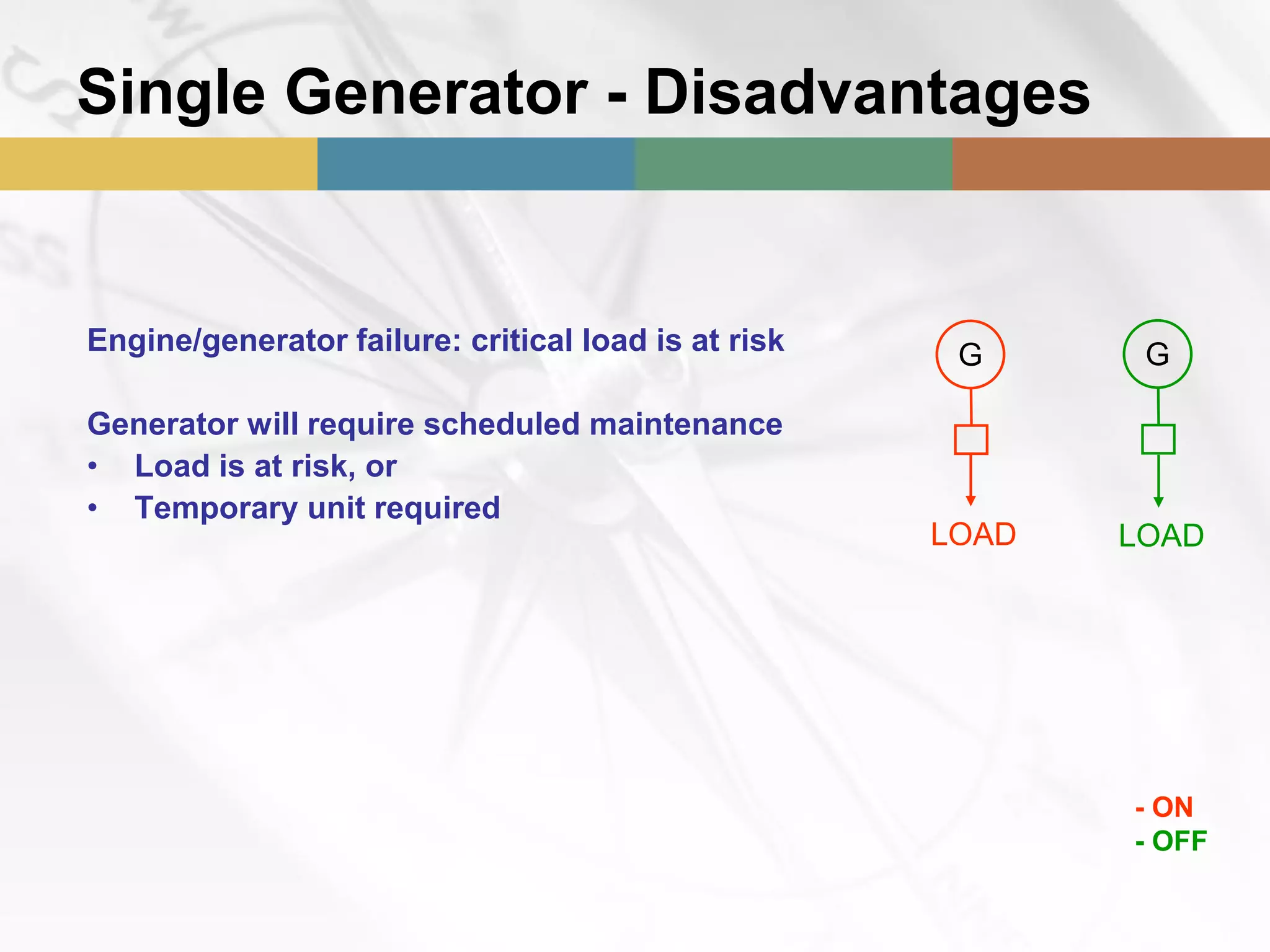
Engine/generator failure: critical load is at risk
Generator will require scheduled maintenance
• Load is at risk, or
• Temporary unit required
G G
LOAD LOAD
- ON
- OFF
Solution – Paralleled Generators
Operate multiple, smaller generators on a common bus
• Maintains service when some, but not all, units fail
• AC generators don’t intrinsically operate in parallel
– Fairly sophisticated controls required for parallel operation
• To initiate
• To maintain
G GG G
Requirements for Paralleling
Four requirements for paralleling:
Equal
Frequencies
Equal Phase
Angles
Equal
Voltages
Same Phase
Rotation
Controlled by paralleling system in real time
Go / No Go:
Monitored only
Multiple Generators (simplified)
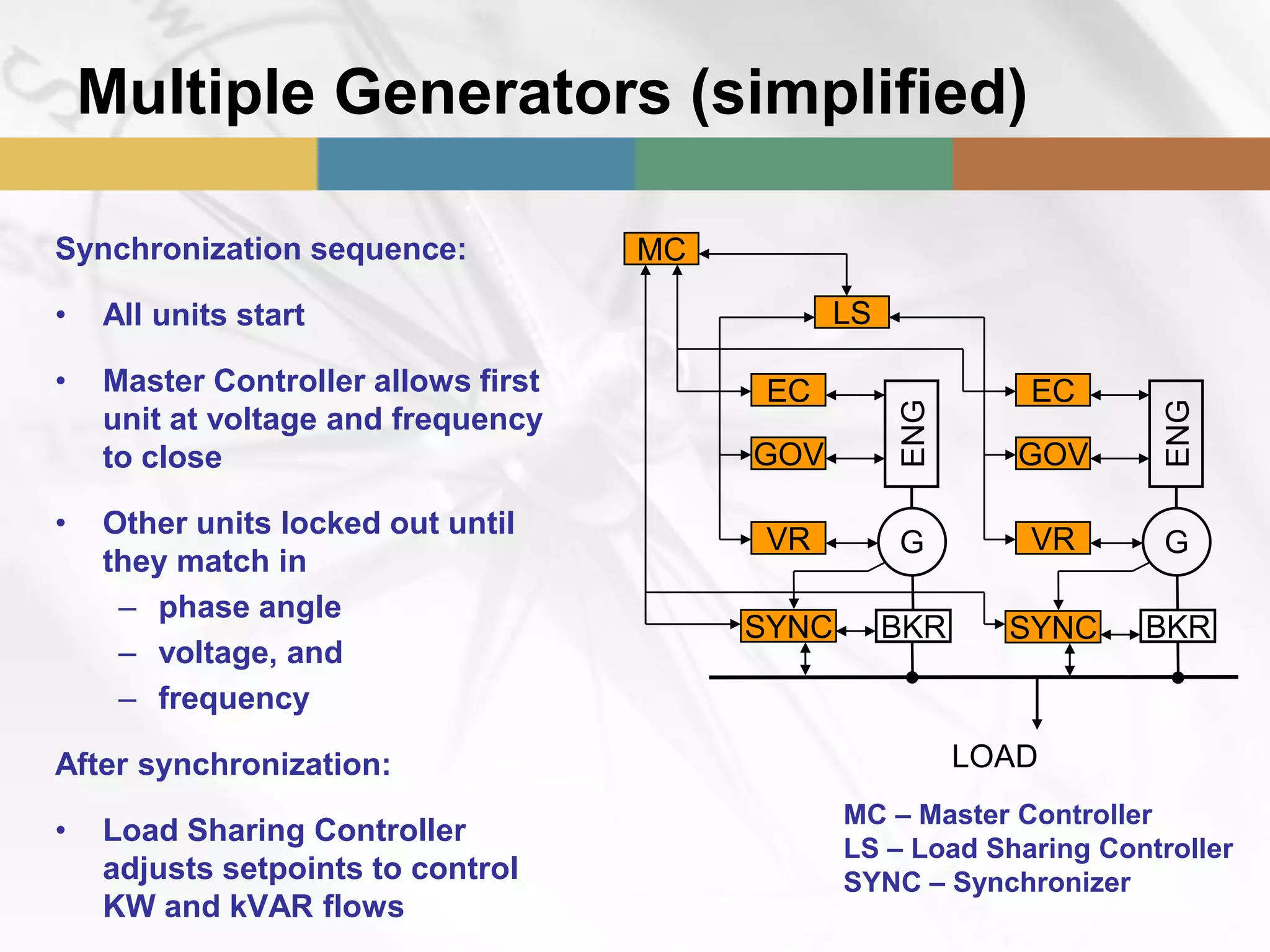
Synchronization sequence:
• All units start
• Master Controller allows first
unit at voltage and frequency
to close
• Other units locked out until
they match in
– phase angle
– voltage, and
– frequency
After synchronization:
• Load Sharing Controller
adjusts setpoints to control
KW and kVAR flows
EC
GOV
VR G
ENG
BKR
LOAD
MC – Master Controller
LS – Load Sharing Controller
SYNC – Synchronizer
EC
GOV
VR G
ENG
BKR
LS
MC
SYNC SYNC
Reliability
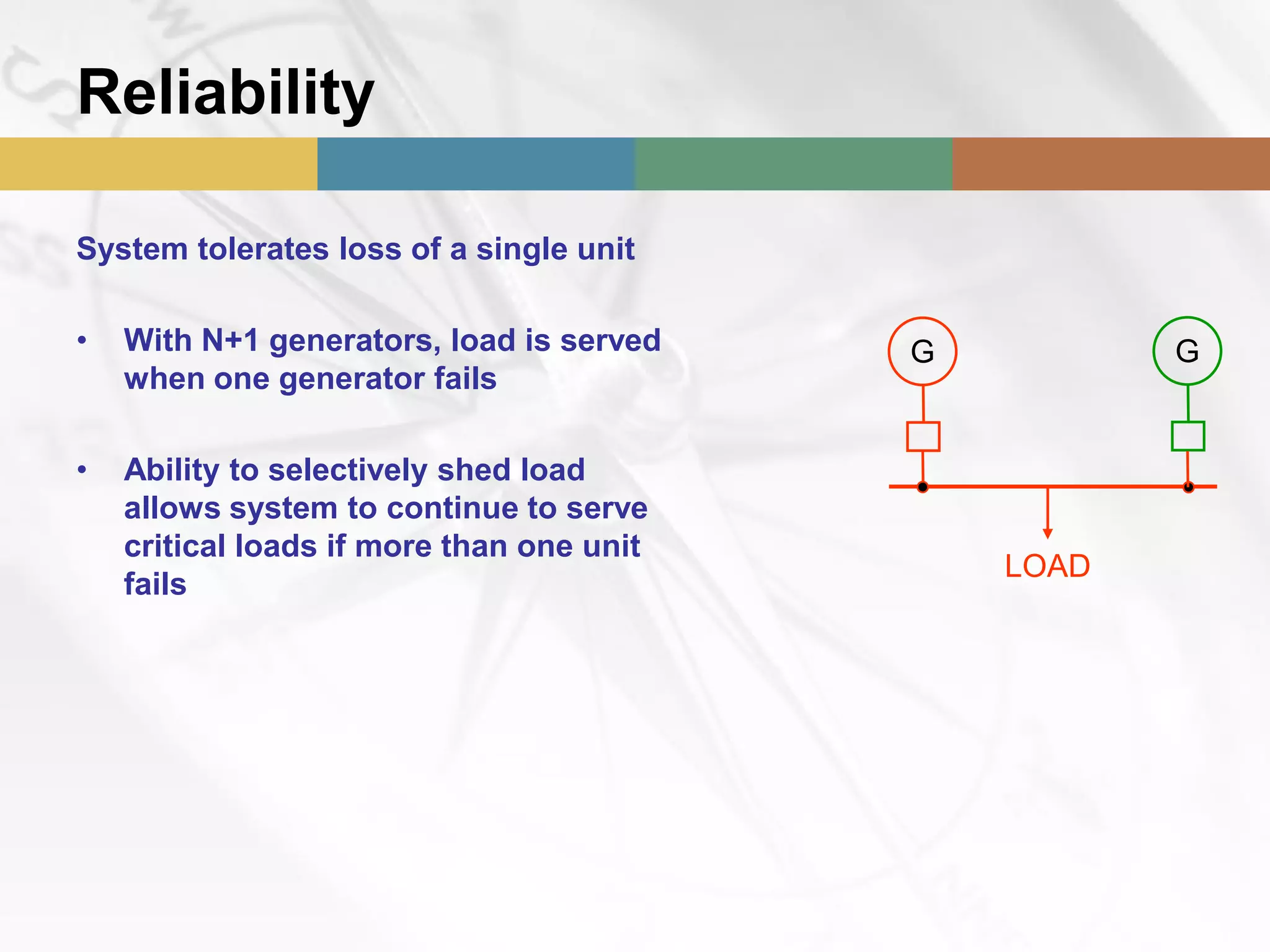
System tolerates loss of a single unit
• With N+1 generators, load is served
when one generator fails
• Ability to selectively shed load
allows system to continue to serve
critical loads if more than one unit
fails
G G
LOAD
Additional Functions
Load Shed / Load Restore
• Disconnects loads if overload is imminent
• Responds to loss of generator
• Restores loads as conditions improve
TO LOAD CONTROL
EQUIPMENT – ATS’s,
DISTRIBUTION
G
MC
G
LOAD
Additional Functions
Load Demand
• Shuts down unneeded generators
• Generators run more efficiently
– extending available runtime,
– without wet-stacking at low load
• Restarts units as needed
G
MC
G
LOAD
Design Considerations
Generator Sizing:
• Minimum size generally driven by performance requirements
– Life Safety and Critical branches on within ten seconds
– Minimum size is the projected peak load on these two branches
• N+1 generators required for reliable service to low-priority loads
– Otherwise, reliability for low-priority loads is actually decreased.
• Provision for load growth must be made at installation
Costs
Wide variation in cost of paralleling equipment with:
• Size and number of generators
• Generator voltage
• Required functions
• Level of customization required to meet specifications
• Amount and type of distribution
Range: about $20K - $110K per generator, excluding distribution
• Source: Informal survey of vendors.
Other costs:
• Space requirements
• System complexity requires highly skilled technicians
Hardware
Paralleling gear will typically contain:
• A Master Control cabinet
• Multiple Generator Control cabinets
• Distribution cabinets
Alternatives to discrete controls:
• Unitized controllers,
• Distributed controls,
– with control unit and circuit breaker packaged with generator
Advantages
Flexibility
• Generator Sizing
– Design to cost or operational targets
– Lower maintenance for smaller units
• Operation
– Wide load range without under-loading units
More Advantages
Reliability
• Serves all loads under single-unit failure
• Serves critical loads under multiple-unit failure
Ease of expansion
• Generators can be added as load increases
– If addressed in initial design
Maintenance
• Single generator can be taken out of service in N+1 system
And More Advantages
Performance
• Paralleled system is stiffer than multiple single-unit systems
Mature technology
• Large installed base
• Issues are thoroughly tested and well-understood
27
27
Eaton’s Electrical Group
With 2008 net sales of $15.4 billion, Eaton is recognized
around the world for power quality and innovation
Powerware power quality and reliability products
Cutler-Hammer power distribution and control equipment
28
28
Cutler-Hammer® Safety
Switch Quick Connect
Cutler-Hammer Roll-Up
Generator Termination Box
Cutler-Hammer Switchboard
Quick Connect Systems
Portable Generator Connection Solutions
29
29
Caterpillar Paralleling
Switchgear*
Cutler-Hammer Automatic
Transfer Switches
*Eaton, through a joint venture relationship with Caterpillar Corporation, offers Caterpillar
Switchgear with PowerLynx Control Technology
Permanent Generator Connection Solutions
30
30
• MRI, CT, X-ray, PET
• Ultrasound,
Mammography
• Trauma Centers
• Cath Labs
• Special and Clinical
Labs
• Blood Analyzers
Protecting Diagnostic Imaging: UPS
Power problems cause sensitive electronics to fail resulting
in unplanned downtime, system lock-ups, and expensive
maintenance costs.
UPS for:
31
31
Protecting IT Systems: UPS
• Pharmacy
• Clinical Labs
• PACS / RIS
• Computerized Physician Order
Entry
• Nurses Stations
• Patient Monitoring Systems
• Patient Records
Hospital IT systems are now mission critical. Power
problems cause data loss and equipment failures.
UPS for:
32
32
Dedicated Consultant Site
www.eaton.com/consultant
• Order free copy of Eaton’s
Consultant Application Guide
• Sign up for Eaton’s
Consultant Newsletter
• Check out our Lunch &
Learn portal
• Product & service information
• And more!
Kenneth L. Lovorn, President & Chief Engineer
Lovorn Engineering Associates, LLC
May 14, 2009
Hospital Emergency Power
• Dump expensive paralleling equipment
• Design for generator back-up
• Load shedding of Priority 3 equipment
• Concentrate funding on generator sets
Advantages






Lower construction costs
Elimination of the paralleling cabinet
Less total area required
Equivalent or better reliability
Design to serve initial load
Ease of expansion as load grows
More difficult to implement
Requires switches in series
Disadvantages
Dumping the Paralleling
Equipment
Basic paralleling system is sophisticated
Paralleling cabinet fails, system fails
Generators and Transfer Switches
Multiple generators without paralleling
Unequal generator sizing
Inherit Priority 3 Load Shedding
Additional load transfer switch
Priority 3 loads and transfer switches
Real-World Application
Existing Hospital 800 kW generator
Expansion of 400 kW emergency capacity
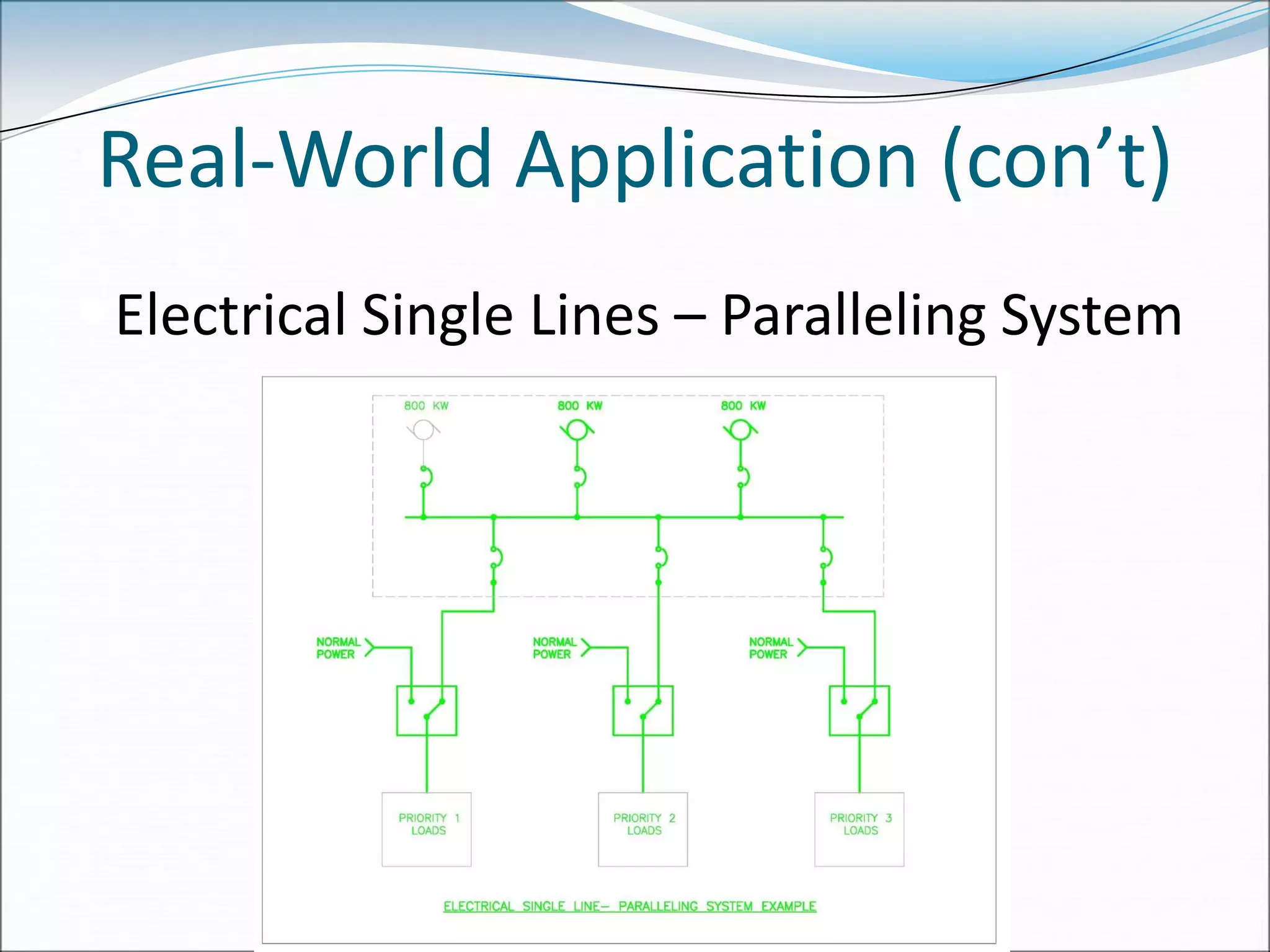
Paralleling system parameters
 Add two 800 kW generators
 Add a paralleling line-up
 Implement a Priority 3 load shedding
scheme
Real-World Application (con’t)
 Multiple generator-transfer switch system
 Add one 1500 kW generator
 Add emergency-only distribution panel
 Priority 1 and 2 loads to 800 kW generator
 Serve all Priority 3 from 1500 kW generator
 Second transfer switches for Priority 1 and 2 loads
 If the 1500 kW generator fails, Priority 3 loads off
 Savings - $500,000+
Real-World Application (con’t)
Electrical Single Lines – Paralleling System
Real-World Application (con’t)
 Electrical Single Lines – Generator/Transfer Switch System
The right way to parallel engine-generators
ASCO Series 7000
Engine-Generator Paralleling
Control Switchgear
Custom Engineered
• Hospitals
• Business-critical
facilities
• Commercial
buildings
• Industrial
complexes
Digital Control
• Synchronizes, manages and parallels
• Load management, bus optimization
• Sophisticated communications
capabilities
• Power system monitoring
and protection
• Design and development
engineering
• Expert product
and project managers
• Knowledgeable
applications engineers
• Skilled sales force
• Best-in-the-industry
commissioning and
field service
Deep Resources
Ensure Your Success
Call 800-800-ASCO
Email: CustomerCare@asco.com

Standby power systems for hospitals

  • 1.
    Standby Power Systemsfor Hospitals: The Debate: Is Paralleling Generators a Good Idea?
  • 2.
    Webcast Announcements Technical problems? •Click on the HELP button • Send a question from the Question window Slides: • Click “Enlarge slides” button to view expanded window and slides should change automatically • Click on “Download slides” for PDF of all slides AIA-certified continuing education credits or PDHs: • Take 10-question exam • Get 8 answers right to pass • Hardcopy certificate mailed within 30 days Archive: • Within 7 days, an archive with Q&A will be posted • We will send an email to registered attendees with link • Can also view from www.csemag.com home page
  • 3.
    Power Control Systemsfor Mission Critical Facilities
  • 4.
    Control Systems forOnsite Power Generation and Distribution
  • 5.
    Custom Designed andBuilt to Your Specific Requirements
  • 6.
    The Industry’s MostResponsive Factory-Direct Field Service
  • 7.
    Standby Power Systemsfor Hospitals: The Debate: Is Paralleling Generators a Good Idea? Tom Divine, PE, Project Manager and Electrical Engineer, Smith Seckman Reid, Inc. (SSR), Houston. Today’s Presenters: Michael Ivanovich, Editor-in-Chief & Moderator, Consulting-Specifying Engineer Kenneth Lovorn, PE, President and Chief Engineer, Lovorn Engineering Associates, Pittsburgh.
  • 8.
    Paralleling Generators – AGood Idea? May 14, 2009 Tom Divine
  • 9.
    Answer Yes, it’s agood idea. Paralleled systems have: • more reliability, • more flexibility, and • better performance than single-generator systems
  • 10.
    Overview Anatomy of aGenerator Paralleling Scheme (simplified) • Single Generator • Requirements for Paralleling • Multiple Generators • Additional Functions Costs Advantages of Paralleled vs. Single Generators
  • 11.
    Single Generator Controls required: •Engine Controller (EC) – Starts and stops the engine – Protects engine from damage – Provides alarms and engine status • Governor (GOV) – Controls engine speed • Voltage Regulator (VR) – Controls alternator excitation EC GOV VR G ENG BKR LOAD ENG – Engine G - Generator
  • 12.
    Single Generator -Disadvantages Engine/generator failure: critical load is at risk Generator will require scheduled maintenance • Load is at risk, or • Temporary unit required G G LOAD LOAD - ON - OFF
  • 13.
    Solution – ParalleledGenerators Operate multiple, smaller generators on a common bus • Maintains service when some, but not all, units fail • AC generators don’t intrinsically operate in parallel – Fairly sophisticated controls required for parallel operation • To initiate • To maintain G GG G
  • 14.
    Requirements for Paralleling Fourrequirements for paralleling: Equal Frequencies Equal Phase Angles Equal Voltages Same Phase Rotation Controlled by paralleling system in real time Go / No Go: Monitored only
  • 15.
    Multiple Generators (simplified) Synchronizationsequence: • All units start • Master Controller allows first unit at voltage and frequency to close • Other units locked out until they match in – phase angle – voltage, and – frequency After synchronization: • Load Sharing Controller adjusts setpoints to control KW and kVAR flows EC GOV VR G ENG BKR LOAD MC – Master Controller LS – Load Sharing Controller SYNC – Synchronizer EC GOV VR G ENG BKR LS MC SYNC SYNC
  • 16.
    Reliability System tolerates lossof a single unit • With N+1 generators, load is served when one generator fails • Ability to selectively shed load allows system to continue to serve critical loads if more than one unit fails G G LOAD
  • 17.
    Additional Functions Load Shed/ Load Restore • Disconnects loads if overload is imminent • Responds to loss of generator • Restores loads as conditions improve TO LOAD CONTROL EQUIPMENT – ATS’s, DISTRIBUTION G MC G LOAD
  • 18.
    Additional Functions Load Demand •Shuts down unneeded generators • Generators run more efficiently – extending available runtime, – without wet-stacking at low load • Restarts units as needed G MC G LOAD
  • 19.
    Design Considerations Generator Sizing: •Minimum size generally driven by performance requirements – Life Safety and Critical branches on within ten seconds – Minimum size is the projected peak load on these two branches • N+1 generators required for reliable service to low-priority loads – Otherwise, reliability for low-priority loads is actually decreased. • Provision for load growth must be made at installation
  • 20.
    Costs Wide variation incost of paralleling equipment with: • Size and number of generators • Generator voltage • Required functions • Level of customization required to meet specifications • Amount and type of distribution Range: about $20K - $110K per generator, excluding distribution • Source: Informal survey of vendors. Other costs: • Space requirements • System complexity requires highly skilled technicians
  • 21.
    Hardware Paralleling gear willtypically contain: • A Master Control cabinet • Multiple Generator Control cabinets • Distribution cabinets Alternatives to discrete controls: • Unitized controllers, • Distributed controls, – with control unit and circuit breaker packaged with generator
  • 22.
    Advantages Flexibility • Generator Sizing –Design to cost or operational targets – Lower maintenance for smaller units • Operation – Wide load range without under-loading units
  • 23.
    More Advantages Reliability • Servesall loads under single-unit failure • Serves critical loads under multiple-unit failure Ease of expansion • Generators can be added as load increases – If addressed in initial design Maintenance • Single generator can be taken out of service in N+1 system
  • 24.
    And More Advantages Performance •Paralleled system is stiffer than multiple single-unit systems Mature technology • Large installed base • Issues are thoroughly tested and well-understood
  • 25.
    27 27 Eaton’s Electrical Group With2008 net sales of $15.4 billion, Eaton is recognized around the world for power quality and innovation Powerware power quality and reliability products Cutler-Hammer power distribution and control equipment
  • 26.
    28 28 Cutler-Hammer® Safety Switch QuickConnect Cutler-Hammer Roll-Up Generator Termination Box Cutler-Hammer Switchboard Quick Connect Systems Portable Generator Connection Solutions
  • 27.
    29 29 Caterpillar Paralleling Switchgear* Cutler-Hammer Automatic TransferSwitches *Eaton, through a joint venture relationship with Caterpillar Corporation, offers Caterpillar Switchgear with PowerLynx Control Technology Permanent Generator Connection Solutions
  • 28.
    30 30 • MRI, CT,X-ray, PET • Ultrasound, Mammography • Trauma Centers • Cath Labs • Special and Clinical Labs • Blood Analyzers Protecting Diagnostic Imaging: UPS Power problems cause sensitive electronics to fail resulting in unplanned downtime, system lock-ups, and expensive maintenance costs. UPS for:
  • 29.
    31 31 Protecting IT Systems:UPS • Pharmacy • Clinical Labs • PACS / RIS • Computerized Physician Order Entry • Nurses Stations • Patient Monitoring Systems • Patient Records Hospital IT systems are now mission critical. Power problems cause data loss and equipment failures. UPS for:
  • 30.
    32 32 Dedicated Consultant Site www.eaton.com/consultant •Order free copy of Eaton’s Consultant Application Guide • Sign up for Eaton’s Consultant Newsletter • Check out our Lunch & Learn portal • Product & service information • And more!
  • 31.
    Kenneth L. Lovorn,President & Chief Engineer Lovorn Engineering Associates, LLC May 14, 2009
  • 32.
    Hospital Emergency Power •Dump expensive paralleling equipment • Design for generator back-up • Load shedding of Priority 3 equipment • Concentrate funding on generator sets
  • 33.
    Advantages       Lower construction costs Eliminationof the paralleling cabinet Less total area required Equivalent or better reliability Design to serve initial load Ease of expansion as load grows More difficult to implement Requires switches in series Disadvantages
  • 34.
    Dumping the Paralleling Equipment Basicparalleling system is sophisticated Paralleling cabinet fails, system fails
  • 35.
    Generators and TransferSwitches Multiple generators without paralleling Unequal generator sizing
  • 36.
    Inherit Priority 3Load Shedding Additional load transfer switch Priority 3 loads and transfer switches
  • 37.
    Real-World Application Existing Hospital800 kW generator Expansion of 400 kW emergency capacity Paralleling system parameters  Add two 800 kW generators  Add a paralleling line-up  Implement a Priority 3 load shedding scheme
  • 38.
    Real-World Application (con’t) Multiple generator-transfer switch system  Add one 1500 kW generator  Add emergency-only distribution panel  Priority 1 and 2 loads to 800 kW generator  Serve all Priority 3 from 1500 kW generator  Second transfer switches for Priority 1 and 2 loads  If the 1500 kW generator fails, Priority 3 loads off  Savings - $500,000+
  • 39.
    Real-World Application (con’t) ElectricalSingle Lines – Paralleling System
  • 40.
    Real-World Application (con’t) Electrical Single Lines – Generator/Transfer Switch System
  • 41.
    The right wayto parallel engine-generators ASCO Series 7000 Engine-Generator Paralleling Control Switchgear
  • 42.
    Custom Engineered • Hospitals •Business-critical facilities • Commercial buildings • Industrial complexes
  • 43.
    Digital Control • Synchronizes,manages and parallels • Load management, bus optimization • Sophisticated communications capabilities • Power system monitoring and protection
  • 44.
    • Design anddevelopment engineering • Expert product and project managers • Knowledgeable applications engineers • Skilled sales force • Best-in-the-industry commissioning and field service Deep Resources
  • 45.
    Ensure Your Success Call800-800-ASCO Email: CustomerCare@asco.com