Angelo Baggini, angelo.baggini@unibg.it, Bergamo University - Engineering Department
Via Marconi 5, 24044 Dalmine (BG) – Italy
Power Transformers
Energy performance standards
and regulations around the world
Power Transformers
Energy performance standards
and regulations around the world
1. Background
2. Policy instruments
3. Reference standards
4. Energy performance
metric categories
Background
Power Transformers
Energy performance standards
and regulations around the world
Effect of multiple transformation
4
0,98 x 0,98 x 0,98 x 0,98 x 0,98 = 0,90
Age versus losses in transformers
Age distribution of population vers. no load and load losses increasingly
13,90%
21,46%
27,23%
34,84%
43,26%
52,98%
64,04%
75,24%
87,37%
2,29%
5,45%
9,71%
21,85%
30,25%
38,94%
47,87%
58,07%
69,99%
83,74%
8,09%
3,48%
15,24%
1,48%
3,57%
6,38%
10,03%
14,68%
20,98%
29,14%
39,20%
51,27%
65,39%
81,69%
0,00%
10,00%
20,00%
30,00%
40,00%
50,00%
60,00%
70,00%
80,00%
90,00%
100,00%
1945-
1949
1950-
1954
1955-
1959
1960-
1964
1965-
1969
1970-
1974
1975-
1979
1980-
1984
1985-
1989
1990-
1994
1995-
1999
2000-
2004
Σ Po increasingly
Σ Pk increasingly
Population increasingly
SEEDT
5
For example
Policy instruments
Power Transformers
Energy performance standards
and regulations around the world
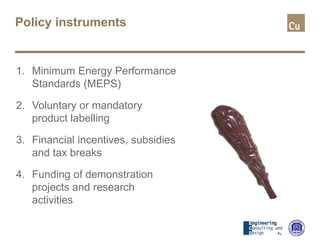
Policy instruments
1. Minimum Energy Performance
Standards (MEPS)
2. Voluntary or mandatory
product labelling
3. Financial incentives, subsidies
and tax breaks
4. Funding of demonstration
projects and research
activities
8
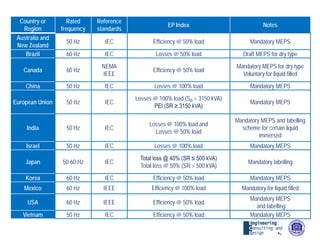
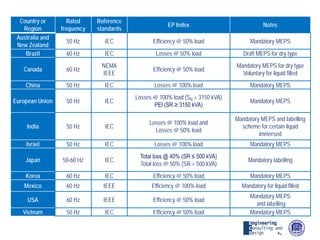
Country or
Region
Rated
frequency
Reference
standards
EP Index Notes
Australia and
New Zealand
50 Hz IEC Efficiency @ 50% load Mandatory MEPS
Brazil 60 Hz IEC Losses @ 50% load Draft MEPS for dry type
Canada 60 Hz
NEMA
IEEE
Efficiency @ 50% load
Mandatory MEPS for dry type
Voluntary for liquid filled
China 50 Hz IEC Losses @ 100% load Mandatory MEPS
European Union 50 Hz IEC
Losses @ 100% load (SR < 3150 kVA)
PEI (SR ≥ 3150 kVA)
Mandatory MEPS
India 50 Hz IEC
Losses @ 100% load and
Losses @ 50% load
Mandatory MEPS and labelling
scheme for certain liquid
immersed
Israel 50 Hz IEC Losses @ 100% load Mandatory MEPS
Japan 50-60 Hz IEC
Total loss @ 40% (SR ≤ 500 kVA)
Total loss @ 50% (SR > 500 kVA)
Mandatory labelling
Korea 60 Hz IEC Efficiency @ 50% load Mandatory MEPS
Mexico 60 Hz IEEE Efficiency @ 100% load Mandatory for liquid filled
USA 60 Hz IEEE Efficiency @ 50% load
Mandatory MEPS
and labelling
Vietnam 50 Hz IEC Efficiency @ 50% load Mandatory MEPS
9
Reference standards
Power Transformers
Energy performance standards
and regulations around the world
Reference standards
IEC 60076-X series: Power transformers
EN 50588-1: Medium power transformers 50 Hz, with highest voltage for equipment not
exceeding 36 kV - Part 1: General requirements
EN 50629: Energy performance of large power transformers (Um > 36 kV or Sr ≥ 40
MVA)
IEEE C57.12.90: Test code for liquid-immersed distribution, power and regulating
transformers
IEEE C57.12.91: Test code for dry-type distribution and power transformers
IEEE C57.12.00: General requirements for Liquid immersed distribution, power and
regulating transformers
NEMA TP 2-2005: Standards test methods for measuring the energy consumption of
distribution transformers
11
Reference standards
Backgrounds
• Rated power definition
• Reference temperature
• Rated frequency
• Rated maximum voltages of the equipment
12
Reference standards
Rated power definition
.1
Power Transformers
Energy performance standards
and regulations around the world
Backgrounds
Rated power definition
14
Backgrounds
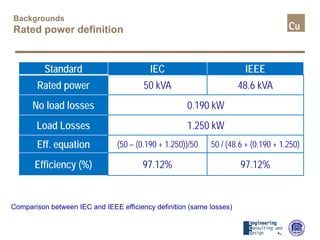
Rated power definition
15
Standard IEC IEEE
Rated power 50 kVA 48.6 kVA
No load losses 0.190 kW
Load Losses 1.250 kW
Eff. equation (50 – (0.190 + 1.250))/50 50 / (48.6 + (0.190 + 1.250)
Efficiency (%) 97.12% 97.12%
Comparison between IEC and IEEE efficiency definition (same losses)
Backgrounds
Rated power definition
16
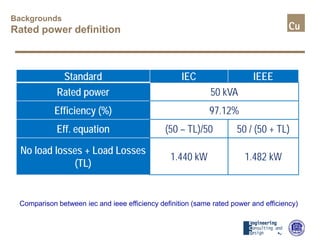
Standard IEC IEEE
Rated power 50 kVA
Efficiency (%) 97.12%
Eff. equation (50 – TL)/50 50 / (50 + TL)
No load losses + Load Losses
(TL)
1.440 kW 1.482 kW
Comparison between iec and ieee efficiency definition (same rated power and efficiency)
Reference standards
Reference temperature
.2
Power Transformers
Energy performance standards
and regulations around the world
Backgrounds
Reference temperature
18
Standard Ref. Temperature
IEC 75°C
EU Regulation 75°C
IEEE 85°C
US DOE 55°C
Comparison between reference temperatures for liquid immersed transformers
Reference standards
Rated frequency
.3
Power Transformers
Energy performance standards
and regulations around the world
Backgrounds
Rated frequency
At lower frequencies (50 Hz):
• more core material (and conductor material consequently)
• larger and more expensive transformers
At higher frequencies (60 Hz):
• both the NLL and LL feature higher eddy current losses
Suitable conversion factors
To take note of the energy performances of each transformer at its specific
operating conditions
20
Reference standards
Rated voltages
.4
Power Transformers
Energy performance standards
and regulations around the world
Backgrounds
Rated maximum voltages of the equipment
the lower the VR of the LV winding
the higher the VR of the HV winding
the higher the expected losses
22
Energy performance
metric categories
Power Transformers
Energy performance standards
and regulations around the world
Country or
Region
Rated
frequency
Reference
standards
EP Index Notes
Australia and
New Zealand
50 Hz IEC Efficiency @ 50% load Mandatory MEPS
Brazil 60 Hz IEC Losses @ 50% load Draft MEPS for dry type
Canada 60 Hz
NEMA
IEEE
Efficiency @ 50% load
Mandatory MEPS for dry type
Voluntary for liquid filled
China 50 Hz IEC Losses @ 100% load Mandatory MEPS
European Union 50 Hz IEC
Losses @ 100% load (SR < 3150 kVA)
PEI (SR ≥ 3150 kVA)
Mandatory MEPS
India 50 Hz IEC
Losses @ 100% load and
Losses @ 50% load
Mandatory MEPS and labelling
scheme for certain liquid
immersed
Israel 50 Hz IEC Losses @ 100% load Mandatory MEPS
Japan 50-60 Hz IEC
Total loss @ 40% (SR ≤ 500 kVA)
Total loss @ 50% (SR > 500 kVA)
Mandatory labelling
Korea 60 Hz IEC Efficiency @ 50% load Mandatory MEPS
Mexico 60 Hz IEEE Efficiency @ 100% load Mandatory for liquid filled
USA 60 Hz IEEE Efficiency @ 50% load
Mandatory MEPS
and labelling
Vietnam 50 Hz IEC Efficiency @ 50% load Mandatory MEPS
24
Energy performance metric categories
Maximum LL and NLL
@ maximum load
Maximum total LL+NLL
@ a particular load factor
Minimum efficiency
@ a particular load factor
25
Maximum LL and NLL
26
• Unification for future developments of scale economies, interchangeability, etc...
• NLL and LL never greater than a certain value regardless of the applied load. A
minimum level of performance is assured whatever the level of loading applied to
the transformer.
• Maximum losses are not dependent from the application but only from the
product
• The knowledge of the load profile to be used for ex ante optimization is typically
not enough to reach the theoretical optimum
• Flexibility related to efficiency approaches is a pro but leaves more space than a
loss list to distorted behavior of the market and frauds etc.
• Setting a mandatory maximum level of load and no load losses does not mean
that it’s not possible to standardize or simply to choose other values optimizing
each specific application.
EU Regulation 548/14
3 ph transformers with Sr ≤3150 kVA
Oil immersed 1,1-24 kV
Sr AAAo AAo Ao Bo Co
kVA W W W W W
25 35 63 70 90 100
50 45 81 90 110 125
100 75 131 145 180 210
160 105 189 210 260 300
250 150 270 300 360 425
315 180 324 360 440 520
400 220 387 430 520 610
500 260 459 510 610 720
630 300 540 600 730 860
800 330 585 650 800 930
1000 390 693 770 940 1100
1250 480 855 950 1150 1350
1600 600 1080 1200 1450 1700
2000 730 1305 1450 1800 2100
2500 880 1575 1750 2150 2500
3150 1100 1980 2200 2700 3150
Sr Ak Bk Ck Vcc
kVA W W W %
25 600 725 900 4
50 750 875 1100 4
100 1250 1475 1750 4
160 1700 2000 2350 4
250 2350 2750 3250 4
315 2800 3250 3900 4
400 3250 3850 4600 4
500 3900 4600 5500 4
630 4600 5400 6500 4 or 6
800 6000 7000 8400 6
1000 7600 9000 10500 6
1250 9500 11000 13500 6
1600 12000 14000 17000 6
2000 15000 18000 21000 6
2500 18500 22000 26500 6
3150 23000 27500 33000 6
NO load losses Load losses
27
Maximum total LL + NLL
28
implicit least cost point of manufacturer at a given
loading point, which may or may not be optimal for a
given market
Minimum efficiency
29
• neutral technological metric,
flexibility in designing
• optimized transformer for specific
application
• optimal loading point may not
coincide with the average loading
• procurement practice:
• LPTs few very important units
specified by expert
professionals one by one
• MPTs produced in thousands
of units for the general market
Efficiency(%)
Load(%)
100
0 20 40 60 80 100
0
Minimum efficiency
Peak Efficiency Index
PEI = 1 −
2(P0+Pc0)
Sr
P0+Pc0
Pk
 P0 = no load losses*
 Pc0 = electrical power required by the cooling system for no load operation
 Pk = load losses* corrected to reference temperature**
 Sr = rated power of the transformer on which Pk is based
* measured at rated voltage and rated frequency, on the rated tap
** 20 °C + Average winding rise (i.e. 90 °C for OD cooled transformers, 85 °C for ON or OF cooled transformers)
30
Minimum efficiency
Peak Efficiency Index
Efficiency(%)
Load(%)
100
0 20 40 60 80 100
31
EU Regulation 548/14
3 ph transformers with Sr >3150 kVA
Sr PEI (%)
(kVA) A AA
4000 99,465 99,532
5000 99,483 99,588
6300 99,510 99,571
8000 99,535 99,593
10000 99,560 99,615
12500 99,588 99,640
16000 99,615 99,663
20000 99,639 99,684
25000 99,657 99700
31500 99,671 99,712
40000 99,684 99,724
Liquid immersed
Sr Peak efficiency (%)
(kVA) A AA
4000 99,348 99,382
5000 99,354 99,387
6300 99,356 99,389
8000 99,357 99,390
10000 99,357 99,390
Dry type
PEAK EFFICIENCY INDEX
32
Minimum efficiency
Peack efficiency index
33
Also energy performances of units required to transform
reactive power only
not depending from the application but related to the
product only
mismatch between the no load and load loss ratio which
minimizes the transformer cost and the one which
optimizes the energy performance during service
Power Transformers
Energy performance standards
and regulations around the world
1. Background
2. Policy instruments
3. Reference standards
4. Energy performance
metric categories
Thank you
| Presentation title and date
For more information please contact
Angelo Baggini
Università di Bergamo
Dipartimento di Ingegneria
Viale Marconi 5,
24044 Dalmine (BG) Italy
email: angelo.baggini@unibg.it
ECD Engineering Consulting and Design
Via Maffi 21 27100 PAVIA Italy

Power Transformers regulations - MEPS

  • 1.
    Angelo Baggini, angelo.baggini@unibg.it,Bergamo University - Engineering Department Via Marconi 5, 24044 Dalmine (BG) – Italy Power Transformers Energy performance standards and regulations around the world
  • 2.
    Power Transformers Energy performancestandards and regulations around the world 1. Background 2. Policy instruments 3. Reference standards 4. Energy performance metric categories
  • 3.
    Background Power Transformers Energy performancestandards and regulations around the world
  • 4.
    Effect of multipletransformation 4 0,98 x 0,98 x 0,98 x 0,98 x 0,98 = 0,90
  • 5.
    Age versus lossesin transformers Age distribution of population vers. no load and load losses increasingly 13,90% 21,46% 27,23% 34,84% 43,26% 52,98% 64,04% 75,24% 87,37% 2,29% 5,45% 9,71% 21,85% 30,25% 38,94% 47,87% 58,07% 69,99% 83,74% 8,09% 3,48% 15,24% 1,48% 3,57% 6,38% 10,03% 14,68% 20,98% 29,14% 39,20% 51,27% 65,39% 81,69% 0,00% 10,00% 20,00% 30,00% 40,00% 50,00% 60,00% 70,00% 80,00% 90,00% 100,00% 1945- 1949 1950- 1954 1955- 1959 1960- 1964 1965- 1969 1970- 1974 1975- 1979 1980- 1984 1985- 1989 1990- 1994 1995- 1999 2000- 2004 Σ Po increasingly Σ Pk increasingly Population increasingly SEEDT 5
  • 6.
  • 7.
    Policy instruments Power Transformers Energyperformance standards and regulations around the world
  • 8.
    Policy instruments 1. MinimumEnergy Performance Standards (MEPS) 2. Voluntary or mandatory product labelling 3. Financial incentives, subsidies and tax breaks 4. Funding of demonstration projects and research activities 8
  • 9.
    Country or Region Rated frequency Reference standards EP IndexNotes Australia and New Zealand 50 Hz IEC Efficiency @ 50% load Mandatory MEPS Brazil 60 Hz IEC Losses @ 50% load Draft MEPS for dry type Canada 60 Hz NEMA IEEE Efficiency @ 50% load Mandatory MEPS for dry type Voluntary for liquid filled China 50 Hz IEC Losses @ 100% load Mandatory MEPS European Union 50 Hz IEC Losses @ 100% load (SR < 3150 kVA) PEI (SR ≥ 3150 kVA) Mandatory MEPS India 50 Hz IEC Losses @ 100% load and Losses @ 50% load Mandatory MEPS and labelling scheme for certain liquid immersed Israel 50 Hz IEC Losses @ 100% load Mandatory MEPS Japan 50-60 Hz IEC Total loss @ 40% (SR ≤ 500 kVA) Total loss @ 50% (SR > 500 kVA) Mandatory labelling Korea 60 Hz IEC Efficiency @ 50% load Mandatory MEPS Mexico 60 Hz IEEE Efficiency @ 100% load Mandatory for liquid filled USA 60 Hz IEEE Efficiency @ 50% load Mandatory MEPS and labelling Vietnam 50 Hz IEC Efficiency @ 50% load Mandatory MEPS 9
  • 10.
    Reference standards Power Transformers Energyperformance standards and regulations around the world
  • 11.
    Reference standards IEC 60076-Xseries: Power transformers EN 50588-1: Medium power transformers 50 Hz, with highest voltage for equipment not exceeding 36 kV - Part 1: General requirements EN 50629: Energy performance of large power transformers (Um > 36 kV or Sr ≥ 40 MVA) IEEE C57.12.90: Test code for liquid-immersed distribution, power and regulating transformers IEEE C57.12.91: Test code for dry-type distribution and power transformers IEEE C57.12.00: General requirements for Liquid immersed distribution, power and regulating transformers NEMA TP 2-2005: Standards test methods for measuring the energy consumption of distribution transformers 11
  • 12.
    Reference standards Backgrounds • Ratedpower definition • Reference temperature • Rated frequency • Rated maximum voltages of the equipment 12
  • 13.
    Reference standards Rated powerdefinition .1 Power Transformers Energy performance standards and regulations around the world
  • 14.
  • 15.
    Backgrounds Rated power definition 15 StandardIEC IEEE Rated power 50 kVA 48.6 kVA No load losses 0.190 kW Load Losses 1.250 kW Eff. equation (50 – (0.190 + 1.250))/50 50 / (48.6 + (0.190 + 1.250) Efficiency (%) 97.12% 97.12% Comparison between IEC and IEEE efficiency definition (same losses)
  • 16.
    Backgrounds Rated power definition 16 StandardIEC IEEE Rated power 50 kVA Efficiency (%) 97.12% Eff. equation (50 – TL)/50 50 / (50 + TL) No load losses + Load Losses (TL) 1.440 kW 1.482 kW Comparison between iec and ieee efficiency definition (same rated power and efficiency)
  • 17.
    Reference standards Reference temperature .2 PowerTransformers Energy performance standards and regulations around the world
  • 18.
    Backgrounds Reference temperature 18 Standard Ref.Temperature IEC 75°C EU Regulation 75°C IEEE 85°C US DOE 55°C Comparison between reference temperatures for liquid immersed transformers
  • 19.
    Reference standards Rated frequency .3 PowerTransformers Energy performance standards and regulations around the world
  • 20.
    Backgrounds Rated frequency At lowerfrequencies (50 Hz): • more core material (and conductor material consequently) • larger and more expensive transformers At higher frequencies (60 Hz): • both the NLL and LL feature higher eddy current losses Suitable conversion factors To take note of the energy performances of each transformer at its specific operating conditions 20
  • 21.
    Reference standards Rated voltages .4 PowerTransformers Energy performance standards and regulations around the world
  • 22.
    Backgrounds Rated maximum voltagesof the equipment the lower the VR of the LV winding the higher the VR of the HV winding the higher the expected losses 22
  • 23.
    Energy performance metric categories PowerTransformers Energy performance standards and regulations around the world
  • 24.
    Country or Region Rated frequency Reference standards EP IndexNotes Australia and New Zealand 50 Hz IEC Efficiency @ 50% load Mandatory MEPS Brazil 60 Hz IEC Losses @ 50% load Draft MEPS for dry type Canada 60 Hz NEMA IEEE Efficiency @ 50% load Mandatory MEPS for dry type Voluntary for liquid filled China 50 Hz IEC Losses @ 100% load Mandatory MEPS European Union 50 Hz IEC Losses @ 100% load (SR < 3150 kVA) PEI (SR ≥ 3150 kVA) Mandatory MEPS India 50 Hz IEC Losses @ 100% load and Losses @ 50% load Mandatory MEPS and labelling scheme for certain liquid immersed Israel 50 Hz IEC Losses @ 100% load Mandatory MEPS Japan 50-60 Hz IEC Total loss @ 40% (SR ≤ 500 kVA) Total loss @ 50% (SR > 500 kVA) Mandatory labelling Korea 60 Hz IEC Efficiency @ 50% load Mandatory MEPS Mexico 60 Hz IEEE Efficiency @ 100% load Mandatory for liquid filled USA 60 Hz IEEE Efficiency @ 50% load Mandatory MEPS and labelling Vietnam 50 Hz IEC Efficiency @ 50% load Mandatory MEPS 24
  • 25.
    Energy performance metriccategories Maximum LL and NLL @ maximum load Maximum total LL+NLL @ a particular load factor Minimum efficiency @ a particular load factor 25
  • 26.
    Maximum LL andNLL 26 • Unification for future developments of scale economies, interchangeability, etc... • NLL and LL never greater than a certain value regardless of the applied load. A minimum level of performance is assured whatever the level of loading applied to the transformer. • Maximum losses are not dependent from the application but only from the product • The knowledge of the load profile to be used for ex ante optimization is typically not enough to reach the theoretical optimum • Flexibility related to efficiency approaches is a pro but leaves more space than a loss list to distorted behavior of the market and frauds etc. • Setting a mandatory maximum level of load and no load losses does not mean that it’s not possible to standardize or simply to choose other values optimizing each specific application.
  • 27.
    EU Regulation 548/14 3ph transformers with Sr ≤3150 kVA Oil immersed 1,1-24 kV Sr AAAo AAo Ao Bo Co kVA W W W W W 25 35 63 70 90 100 50 45 81 90 110 125 100 75 131 145 180 210 160 105 189 210 260 300 250 150 270 300 360 425 315 180 324 360 440 520 400 220 387 430 520 610 500 260 459 510 610 720 630 300 540 600 730 860 800 330 585 650 800 930 1000 390 693 770 940 1100 1250 480 855 950 1150 1350 1600 600 1080 1200 1450 1700 2000 730 1305 1450 1800 2100 2500 880 1575 1750 2150 2500 3150 1100 1980 2200 2700 3150 Sr Ak Bk Ck Vcc kVA W W W % 25 600 725 900 4 50 750 875 1100 4 100 1250 1475 1750 4 160 1700 2000 2350 4 250 2350 2750 3250 4 315 2800 3250 3900 4 400 3250 3850 4600 4 500 3900 4600 5500 4 630 4600 5400 6500 4 or 6 800 6000 7000 8400 6 1000 7600 9000 10500 6 1250 9500 11000 13500 6 1600 12000 14000 17000 6 2000 15000 18000 21000 6 2500 18500 22000 26500 6 3150 23000 27500 33000 6 NO load losses Load losses 27
  • 28.
    Maximum total LL+ NLL 28 implicit least cost point of manufacturer at a given loading point, which may or may not be optimal for a given market
  • 29.
    Minimum efficiency 29 • neutraltechnological metric, flexibility in designing • optimized transformer for specific application • optimal loading point may not coincide with the average loading • procurement practice: • LPTs few very important units specified by expert professionals one by one • MPTs produced in thousands of units for the general market Efficiency(%) Load(%) 100 0 20 40 60 80 100 0
  • 30.
    Minimum efficiency Peak EfficiencyIndex PEI = 1 − 2(P0+Pc0) Sr P0+Pc0 Pk  P0 = no load losses*  Pc0 = electrical power required by the cooling system for no load operation  Pk = load losses* corrected to reference temperature**  Sr = rated power of the transformer on which Pk is based * measured at rated voltage and rated frequency, on the rated tap ** 20 °C + Average winding rise (i.e. 90 °C for OD cooled transformers, 85 °C for ON or OF cooled transformers) 30
  • 31.
    Minimum efficiency Peak EfficiencyIndex Efficiency(%) Load(%) 100 0 20 40 60 80 100 31
  • 32.
    EU Regulation 548/14 3ph transformers with Sr >3150 kVA Sr PEI (%) (kVA) A AA 4000 99,465 99,532 5000 99,483 99,588 6300 99,510 99,571 8000 99,535 99,593 10000 99,560 99,615 12500 99,588 99,640 16000 99,615 99,663 20000 99,639 99,684 25000 99,657 99700 31500 99,671 99,712 40000 99,684 99,724 Liquid immersed Sr Peak efficiency (%) (kVA) A AA 4000 99,348 99,382 5000 99,354 99,387 6300 99,356 99,389 8000 99,357 99,390 10000 99,357 99,390 Dry type PEAK EFFICIENCY INDEX 32
  • 33.
    Minimum efficiency Peack efficiencyindex 33 Also energy performances of units required to transform reactive power only not depending from the application but related to the product only mismatch between the no load and load loss ratio which minimizes the transformer cost and the one which optimizes the energy performance during service
  • 34.
    Power Transformers Energy performancestandards and regulations around the world 1. Background 2. Policy instruments 3. Reference standards 4. Energy performance metric categories
  • 35.
    Thank you | Presentationtitle and date For more information please contact Angelo Baggini Università di Bergamo Dipartimento di Ingegneria Viale Marconi 5, 24044 Dalmine (BG) Italy email: angelo.baggini@unibg.it ECD Engineering Consulting and Design Via Maffi 21 27100 PAVIA Italy