THYROID FUNCTION
TESTS
THYROID-STIMULATING HORMONE
■ Thyroid-stimulating hormone (TSH) is
produced by the basophil cells of the
adenohypophysis in response to stimulation
by its hypothalamic releasing factor,
thyrotropin-releasing hormone (TRH).
■ TRH responds to decreased circulating
levels of thyroid hormones, as well as to
intense cold, psychological tension, and
increased metabolic need, and it
stimulates the adenohypophysis to secrete
TSH. TSH accelerates all aspects of
hormone production by the thyroid gland
and enhances hPRL release. Measuring TSH
provides useful information about both
hypophyseal and thyroid gland function.
■ Hypersecretion of TSH by the adenohypophysis
(e.g., because of TSH-secreting pituitary tumors)
causes hyperthyroidism as a result of excessive
stimulation of the thyroid gland. Elevated TSH
levels are also seen with prolonged emotional
stress and are more common in colder climates.
Primary hypothyroidism (i.e., hypothyroidism
caused by disorders involving the thyroid gland
itself) leads to elevated TSH levels because of
normal feedback mechanisms. TSH levels are
normally elevated at birth.
Reference Values
■ Newborns <25 mU/L
■ Children and adults <10 mU/L
■ INTERFERING FACTORS
-Aspirin, adrenocorticosteroids, and
heparin may produce decreased TSH levels.
-Lithium carbonate and potassium iodide
may produce elevated TSH levels.
-Falsely increased levels may occur in
hydatidiform mole, choriocarcinoma,
embryonal carcinoma of the testes,
pregnancy, and postmenopausal states
characterized by high FSH and LH levels.
■ INDICATIONS FOR THYROID-STIMULATING
HORMONE TEST
Signs and symptoms of hypothyroidism,
hyperthyroidism, or suspected pituitary or
hypothalamic dysfunction, or
hypothyroidism or hyperthyroidism
combined with suspected pituitary or
hypothalamic dysfunction:
-Elevated levels are seen with primary
hypothyroidism.
■ -Decreased or undetectable levels are
associated with secondary hypothyroidism
caused by pituitary or hypothalamic
hypofunction.
-Decreased levels are seen with primary
hyperthyroidism.
-Elevated levels may indicate secondary
hyperthyroidism resulting from pituitary
hyperactivity (e.g., caused by tumor).
-Differentiation of functional euthyroidism
from true hypothyroidism in debilitated
individuals, with the former indicated by
normal levels
■ NURSING CARE BEFORE THE PROCEDURE
Client preparation is the same as that for
any study involving collection of a
peripheral blood sample.
It is recommended that drugs known to
alter TSH levels be withheld for 12 to 24
hours before the test, although this
practice should be confirmed with the
person ordering the study
■ THE PROCEDURE
A venipuncture is performed and the sample is
collected in a red-topped tube. The sample
should be handled gently to avoid hemolysis and
transported promptly to the laboratory.
The test for TSH is used on newborns to screen
for congenital hypothyroidism. It is performed by
obtaining a sample of blood from a heelstick and
saturating a spot on a special filter paper with
the blood. A kit is available for this test; it
contains a
comparison chart to identify elevations.
■ NURSING CARE AFTER THE PROCEDURE
Care and assessment after the procedure
are the same as for any study involving the
collection of a peripheral blood sample.
Resume any medications withheld before
the test.
Complications and precautions: Note the
relation of TSH to levels of other thyroid
tests indicating hypothyroidism as opposed
to other thyroid disorders.
Thyroid and Parathyroid Hormones
■ The thyroid gland synthesizes and releases
thyroxine (T4) and triiodothyronine (T3) in
response to stimulation by TSH, which is
secreted by the adenohypophysis. The
thyroid gland synthesizes its hormones from
iodine and the essential amino acid
tyrosine.
■ The main function of thyroid hormones is to
increase the metabolic activities of most
tissues by increasing the oxidative enzymes
in the cells. This increase, in turn, causes
increased oxygen consumption and
increased utilization of carbohydrates,
proteins, fats, and vitamins. Thyroid
hormones also
mobilize electrolytes and are necessary for
the
conversion of carotene to vitamin A
■ Alterations in thyroid hormone production may
be caused by disorders affecting the
hypothalamus, which secretes thyrotropin-
releasing hormone in response to circulating T4
and T3 levels; the pituitary gland; or the thyroid
gland itself. Such alterations may affect all body
systems. Hypothyroidism is the general term for
the hypometabolic state induced by deficient
thyroid hormone secretion, whereas
hyperthyroidism indicates excessive production
of thyroid hormones.
a)THYROXINE
■ Thyroxine (T4) is measured by competitive
protein binding or by radioimmunoassay. In
competitive protein binding, the affinity
between T4 and TBG is exploited. Reagent
TBG fully saturated with radiolabeled T4 is
incubated with T4 extracted from the
client’s serum.
■ TheT4 from the test serum displaces the
radiolabeled T4 in the amount present. This
procedure is known as T4 by displacement
(T4 D), T4 by competitive binding (T4 CPB),
and T4 MurphyPattee (T4 MP). T4
measured by radioimmunoassay (T4 RIA) is
the preferred method to measure T4
because it is not affected by circulating
iodinated substances.
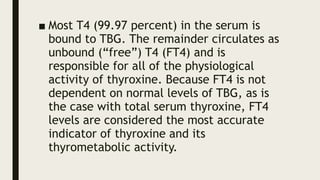
■ Most T4 (99.97 percent) in the serum is
bound to TBG. The remainder circulates as
unbound (“free”) T4 (FT4) and is
responsible for all of the physiological
activity of thyroxine. Because FT4 is not
dependent on normal levels of TBG, as is
the case with total serum thyroxine, FT4
levels are considered the most accurate
indicator of thyroxine and its
thyrometabolic activity.
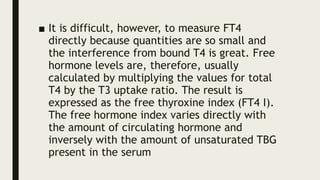
■ It is difficult, however, to measure FT4
directly because quantities are so small and
the interference from bound T4 is great. Free
hormone levels are, therefore, usually
calculated by multiplying the values for total
T4 by the T3 uptake ratio. The result is
expressed as the free thyroxine index (FT4 I).
The free hormone index varies directly with
the amount of circulating hormone and
inversely with the amount of unsaturated TBG
present in the serum
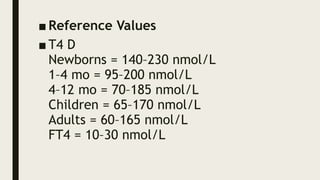
■ Reference Values
■ T4 D
Newborns = 140–230 nmol/L
1–4 mo = 95–200 nmol/L
4–12 mo = 70–185 nmol/L
Children = 65–170 nmol/L
Adults = 60–165 nmol/L
FT4 = 10–30 nmol/L
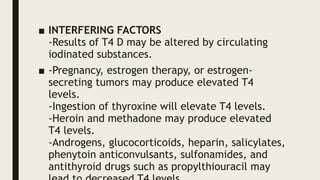
■ INTERFERING FACTORS
-Results of T4 D may be altered by circulating
iodinated substances.
■ -Pregnancy, estrogen therapy, or estrogen-
secreting tumors may produce elevated T4
levels.
-Ingestion of thyroxine will elevate T4 levels.
-Heroin and methadone may produce elevated
T4 levels.
-Androgens, glucocorticoids, heparin, salicylates,
phenytoin anticonvulsants, sulfonamides, and
antithyroid drugs such as propylthiouracil may
TRIIODOTHYRONINE
■ Although produced in smaller quantities than T4,
triiodothyronine (T3) is physiologically more
significant. The competitive protein-binding
techniques that are useful in measuring T4 are
not used to measure T3 because it is present in
smaller amounts and has less affinity for TBG
than for T4. Thus, T3 is measured only by
radioimmunoassay
■ INDICATIONS FOR TRIIODOTHYRONINE
TEST
Support for diagnosing hyperthyroidism in
clients with normal T4 levels, with early
hyperthyroidism and T3 thyrotoxicosis
indicated by elevated T3 levels in the
presence of normal T4 levels.
■ Support for diagnosing “euthyroid sick”
syndrome in severely ill clients with protein
deficiency, as indicated by low T3 levels,
normal FT3 levels, and elevated rT3 levels
Reference Values
■ Newborns = 1.3–2.6 nmol/L
Adults = 1.2–3.0 nmol/L
FT3 = 0.003–0.009 nmol/L
Reverse triiodothyronine (rT3) = 0.58–0.67
nmol/L
THANK YOU

Thyroid function tests.pptx

  • 1.
  • 2.
    THYROID-STIMULATING HORMONE ■ Thyroid-stimulatinghormone (TSH) is produced by the basophil cells of the adenohypophysis in response to stimulation by its hypothalamic releasing factor, thyrotropin-releasing hormone (TRH).
  • 3.
    ■ TRH respondsto decreased circulating levels of thyroid hormones, as well as to intense cold, psychological tension, and increased metabolic need, and it stimulates the adenohypophysis to secrete TSH. TSH accelerates all aspects of hormone production by the thyroid gland and enhances hPRL release. Measuring TSH provides useful information about both hypophyseal and thyroid gland function.
  • 4.
    ■ Hypersecretion ofTSH by the adenohypophysis (e.g., because of TSH-secreting pituitary tumors) causes hyperthyroidism as a result of excessive stimulation of the thyroid gland. Elevated TSH levels are also seen with prolonged emotional stress and are more common in colder climates. Primary hypothyroidism (i.e., hypothyroidism caused by disorders involving the thyroid gland itself) leads to elevated TSH levels because of normal feedback mechanisms. TSH levels are normally elevated at birth.
  • 5.
    Reference Values ■ Newborns<25 mU/L ■ Children and adults <10 mU/L
  • 6.
    ■ INTERFERING FACTORS -Aspirin,adrenocorticosteroids, and heparin may produce decreased TSH levels. -Lithium carbonate and potassium iodide may produce elevated TSH levels. -Falsely increased levels may occur in hydatidiform mole, choriocarcinoma, embryonal carcinoma of the testes, pregnancy, and postmenopausal states characterized by high FSH and LH levels.
  • 7.
    ■ INDICATIONS FORTHYROID-STIMULATING HORMONE TEST Signs and symptoms of hypothyroidism, hyperthyroidism, or suspected pituitary or hypothalamic dysfunction, or hypothyroidism or hyperthyroidism combined with suspected pituitary or hypothalamic dysfunction: -Elevated levels are seen with primary hypothyroidism.
  • 8.
    ■ -Decreased orundetectable levels are associated with secondary hypothyroidism caused by pituitary or hypothalamic hypofunction. -Decreased levels are seen with primary hyperthyroidism. -Elevated levels may indicate secondary hyperthyroidism resulting from pituitary hyperactivity (e.g., caused by tumor). -Differentiation of functional euthyroidism from true hypothyroidism in debilitated individuals, with the former indicated by normal levels
  • 9.
    ■ NURSING CAREBEFORE THE PROCEDURE Client preparation is the same as that for any study involving collection of a peripheral blood sample. It is recommended that drugs known to alter TSH levels be withheld for 12 to 24 hours before the test, although this practice should be confirmed with the person ordering the study
  • 10.
    ■ THE PROCEDURE Avenipuncture is performed and the sample is collected in a red-topped tube. The sample should be handled gently to avoid hemolysis and transported promptly to the laboratory. The test for TSH is used on newborns to screen for congenital hypothyroidism. It is performed by obtaining a sample of blood from a heelstick and saturating a spot on a special filter paper with the blood. A kit is available for this test; it contains a comparison chart to identify elevations.
  • 11.
    ■ NURSING CAREAFTER THE PROCEDURE Care and assessment after the procedure are the same as for any study involving the collection of a peripheral blood sample. Resume any medications withheld before the test. Complications and precautions: Note the relation of TSH to levels of other thyroid tests indicating hypothyroidism as opposed to other thyroid disorders.
  • 12.
    Thyroid and ParathyroidHormones ■ The thyroid gland synthesizes and releases thyroxine (T4) and triiodothyronine (T3) in response to stimulation by TSH, which is secreted by the adenohypophysis. The thyroid gland synthesizes its hormones from iodine and the essential amino acid tyrosine.
  • 13.
    ■ The mainfunction of thyroid hormones is to increase the metabolic activities of most tissues by increasing the oxidative enzymes in the cells. This increase, in turn, causes increased oxygen consumption and increased utilization of carbohydrates, proteins, fats, and vitamins. Thyroid hormones also mobilize electrolytes and are necessary for the conversion of carotene to vitamin A
  • 14.
    ■ Alterations inthyroid hormone production may be caused by disorders affecting the hypothalamus, which secretes thyrotropin- releasing hormone in response to circulating T4 and T3 levels; the pituitary gland; or the thyroid gland itself. Such alterations may affect all body systems. Hypothyroidism is the general term for the hypometabolic state induced by deficient thyroid hormone secretion, whereas hyperthyroidism indicates excessive production of thyroid hormones.
  • 15.
    a)THYROXINE ■ Thyroxine (T4)is measured by competitive protein binding or by radioimmunoassay. In competitive protein binding, the affinity between T4 and TBG is exploited. Reagent TBG fully saturated with radiolabeled T4 is incubated with T4 extracted from the client’s serum.
  • 16.
    ■ TheT4 fromthe test serum displaces the radiolabeled T4 in the amount present. This procedure is known as T4 by displacement (T4 D), T4 by competitive binding (T4 CPB), and T4 MurphyPattee (T4 MP). T4 measured by radioimmunoassay (T4 RIA) is the preferred method to measure T4 because it is not affected by circulating iodinated substances.
  • 17.
    ■ Most T4(99.97 percent) in the serum is bound to TBG. The remainder circulates as unbound (“free”) T4 (FT4) and is responsible for all of the physiological activity of thyroxine. Because FT4 is not dependent on normal levels of TBG, as is the case with total serum thyroxine, FT4 levels are considered the most accurate indicator of thyroxine and its thyrometabolic activity.
  • 18.
    ■ It isdifficult, however, to measure FT4 directly because quantities are so small and the interference from bound T4 is great. Free hormone levels are, therefore, usually calculated by multiplying the values for total T4 by the T3 uptake ratio. The result is expressed as the free thyroxine index (FT4 I). The free hormone index varies directly with the amount of circulating hormone and inversely with the amount of unsaturated TBG present in the serum
  • 19.
    ■ Reference Values ■T4 D Newborns = 140–230 nmol/L 1–4 mo = 95–200 nmol/L 4–12 mo = 70–185 nmol/L Children = 65–170 nmol/L Adults = 60–165 nmol/L FT4 = 10–30 nmol/L
  • 20.
    ■ INTERFERING FACTORS -Resultsof T4 D may be altered by circulating iodinated substances. ■ -Pregnancy, estrogen therapy, or estrogen- secreting tumors may produce elevated T4 levels. -Ingestion of thyroxine will elevate T4 levels. -Heroin and methadone may produce elevated T4 levels. -Androgens, glucocorticoids, heparin, salicylates, phenytoin anticonvulsants, sulfonamides, and antithyroid drugs such as propylthiouracil may
  • 21.
    TRIIODOTHYRONINE ■ Although producedin smaller quantities than T4, triiodothyronine (T3) is physiologically more significant. The competitive protein-binding techniques that are useful in measuring T4 are not used to measure T3 because it is present in smaller amounts and has less affinity for TBG than for T4. Thus, T3 is measured only by radioimmunoassay
  • 22.
    ■ INDICATIONS FORTRIIODOTHYRONINE TEST Support for diagnosing hyperthyroidism in clients with normal T4 levels, with early hyperthyroidism and T3 thyrotoxicosis indicated by elevated T3 levels in the presence of normal T4 levels. ■ Support for diagnosing “euthyroid sick” syndrome in severely ill clients with protein deficiency, as indicated by low T3 levels, normal FT3 levels, and elevated rT3 levels
  • 23.
    Reference Values ■ Newborns= 1.3–2.6 nmol/L Adults = 1.2–3.0 nmol/L FT3 = 0.003–0.009 nmol/L Reverse triiodothyronine (rT3) = 0.58–0.67 nmol/L
  • 24.

Editor's Notes

  • #13 Most of the body’s iodine is ingested as iodide through dietary intake and is absorbed into the bloodstream from the gastrointestinal tract. One-third of the absorbed iodide enters the thyroid gland; the remaining two-thirds is excreted in the urine. In the thyroid gland, enzymes oxidize iodide to iodine.
  • #14 Although the mechanism is not known, thyroid hormones are essential for the development of the central nervous system. Thyroid-deficient infants may suffer irreversible brain damage (cretinism).
  • #15 An additional hormone produced by the thyroid gland is calcitonin, which is secreted in response to high serum calcium levels. Calcitonin causes an increase in calcium reabsorption by bone, thus lowering serum calcium.