
UNDETECTABLE TSH COULD BE A TSH
VARIANT; CASE OF A YOUNG
ASYMPTOMATIC NEPALESE MALE
Santosh Pradhan1, Vivek Pant1, Keyoor Gautam2, Devish Pyakurel2, Abha Shrestha2
1Department of Clinical Biochemistry, Samyak Diagnostic; Jawalakhel, Lalitpur
2Department of Pathology, Samyak Diagnostic; Jawalakhel, Lalitpur, Nepal
Journal of Diabetes and Endocrinology Association of Nepal 2019; 3 (1): (34-37)
ISSN Print 2594-3367 ISSN Online 2631-2107
1
Presented by:
Dipesh Tamrakar
MSc. Clinical Biochemistry
ABSTRACT
 Thyroid function tests are frequently ordered test.
 Infrequently, the automated thyroid hormone assay system is
subjected to interference which may yield false results, thus leading to
inappropriate diagnosis and management.
 We report an unusual case of clinically misdiagnosed subclinical
hyperthyroidism with undetectable TSH due to negative interference
in particular TSH assay platforms in a young Nepalese male.
2
INTRODUCTION
 TFT; Routine investigation in the clinical laboratory.
 Clinical and biochemical phenotype correlation is required for the
correct interpretation of thyroid hormone test result.
 Measurement of thyroid hormones in serum by IMMUNOASSAY
method.
 False results due to interference in immunoassay method.
 Potential for inappropriate diagnosis and management of the disease. 3
 Common causes of interference in thyroid hormone measurement
are
 intake of biotin containing multivitamins by patient.
 Presence of heterophile antibodies, rheumatoid factor or
paraprotein in patient’s serum.
 It should be noted that high affinity of the noncovalent biotin-
streptavidin interaction has been extensively used in competitive
immunoassays.
 Thus, additional immunoassay interference that should be taken into
consideration in discordant thyroid hormone measurement is anti-
streptavidin antibodies, anti-ruthenium antibodies and thyroid
hormone autoantibodies. 4
 Thyroid hormone immunoassay is based on antibody targeted against
two different region of TSH dimer.
 Whenever the immunogenicity of patients TSH is altered due to
change in peptide sequence of TSH, then some immunoassays
cannot detect this TSH although the biological function of TSH is
retained.
 This normal TSH variant leads to misdiagnosis of subclinical
hyperthyroidism in the absence of clinical symptoms.
 Here is a presentation of a case of 25 years male, who is a medical
student and was misdiagnosed with subclinical hyperthyroidism
possibly due to TSH variant.
5
CASE REPORT
 A 25 years old male ordered his thyroid function test (TFT) as a
routine checkup along with other tests at one of the private
laboratory in Kathmandu.
 He had no past illness and was completely normal while performing
test.
 He had normal serum free triiodothyronine (T3) and free thyroxine
(T4) level but TSH 3rd generation was less than 0.01.
6
 He repeated his test after two weeks at same laboratory and the TFT
findings were the same.
 He went for endocrinology consultation where he was diagnosed
with subclinical hyperthyroidism.
 He was advised to perform additional test like anti thyroid peroxidase
antibody (TPO antibody) and antithyroglobulin.
 He was also advised to start treatment.
7
 He crosschecked his TFT few days later before starting treatment at next
private laboratory in Kathmandu.
 This time his serum fT3, fT4 and TSH were in normal range.
 He had no viral illness and neck pain during the past 3 months.
 He was not taking multivitamins or levothyroxine and had no major illness.
 At this time his reports for anti TPO and antithyroglobulin were available
which were negative.
 We repeated the thyroid function test at our laboratory and again the
serum TSH level was less than 0.01. 8
 In the first laboratory where TSH was undetected, they were using
Siemens Advia Centaur XP immunoassay.
 The second laboratory where the TFT test was normal, were using
Roche immunoassay system.
 At our laboratory we are using both Siemens and Abbott Architect
immunoassay.
 We discussed with the patient and repeated the test in Abbott TSH
immunoassay system, where the results were normal.
 The patient was then explained about the TSH variant and was
reassured that he does not need treatment for this condition.
9
DISCUSSION
 TSH is routinely measured in the clinical laboratory to diagnose and
monitor thyroid disorders.
 Third-generation serum TSH assays have the highest sensitivity for
assessing thyroid disorders.
 Immunoassay system is currently the method of choice in clinical
laboratories for the measurement of thyroid hormones.
 However, immunoassays are vulnerable to different types of
interference that can result in discordant result of thyroid function
test.
10
 Common interferences are due to presence of macro-TSH, biotin, anti-
streptavidin antibodies, anti-ruthenium antibodies, and heterophilic
antibodies.
 The manufacturers of immunoassay try to limit their impact of interference
by adding blockers in reagent or by warning users via information provided
in kit inserts.
 Ideally, discrepancies with biochemical parameters of TFT and clinical
findings provide clue to the interference.
 Clinical history, regarding intake of multivitamins or other drugs, history of
blood transfusion, autoimmune diseases or contact with animals or any
discordant lab result in the past, should be taken. 11
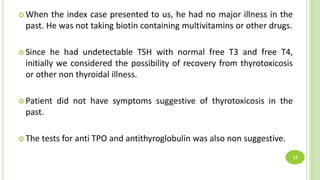
 When the index case presented to us, he had no major illness in the
past. He was not taking biotin containing multivitamins or other drugs.
 Since he had undetectable TSH with normal free T3 and free T4,
initially we considered the possibility of recovery from thyrotoxicosis
or other non thyroidal illness.
 Patient did not have symptoms suggestive of thyrotoxicosis in the
past.
 The tests for anti TPO and antithyroglobulin was also non suggestive.
12
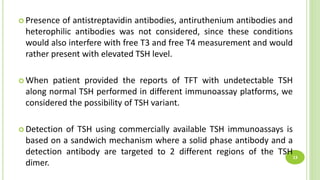
 Presence of antistreptavidin antibodies, antiruthenium antibodies and
heterophilic antibodies was not considered, since these conditions
would also interfere with free T3 and free T4 measurement and would
rather present with elevated TSH level.
 When patient provided the reports of TFT with undetectable TSH
along normal TSH performed in different immunoassay platforms, we
considered the possibility of TSH variant.
 Detection of TSH using commercially available TSH immunoassays is
based on a sandwich mechanism where a solid phase antibody and a
detection antibody are targeted to 2 different regions of the TSH
dimer.
13
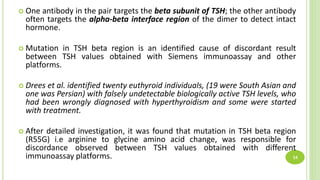
 One antibody in the pair targets the beta subunit of TSH; the other antibody
often targets the alpha-beta interface region of the dimer to detect intact
hormone.
 Mutation in TSH beta region is an identified cause of discordant result
between TSH values obtained with Siemens immunoassay and other
platforms.
 Drees et al. identified twenty euthyroid individuals, (19 were South Asian and
one was Persian) with falsely undetectable biologically active TSH levels, who
had been wrongly diagnosed with hyperthyroidism and some were started
with treatment.
 After detailed investigation, it was found that mutation in TSH beta region
(R55G) i.e arginine to glycine amino acid change, was responsible for
discordance observed between TSH values obtained with different
immunoassay platforms. 14
 This arginine-55 is part of an epitope recognized by antibodies used in
some immunoassays, explaining loss of TSH immunoreactivity in such
platforms.
 In our patient TSH determined by Siemens assay was undetectable but
his serum TSH was found to be normal when determined by Roche and
Abbott Immunoassay system.
 Thus, testing the serum with different auto analyzer should be
considered when erroneous TSH result is suspected.
 We could not perform TSH beta region gene sequencing due to financial
constraint. 15
CONCLUSION
 Physicians practicing endocrinology need to be aware about basic
principle of immunoassay and types of interferences.
 In addition, collaboration between physician and laboratory personnel
is needed to minimize the potential for inappropriate treatment.
 The high frequency of TSH-beta region mutation in our population
mandates that, undetectable TSH readings in euthyroid patients
should be reanalyzed using an alternate TSH assay.
16
 What analyzer to rely on??
 Which test principle to trust??
 Do our analyzer & test method are certified??
 Do IQC & calibration address all the problems??
 Are we going through details on test protocol??
 Are we concern with our reagent constituents??
 How does our reagents in use are being produced??
 Do our reagent shipment and storage is proper??
 What are optimum condition variance (OCV)??
 Why do we need different model of alternative analyzers??
17
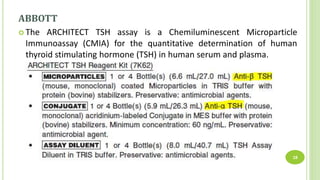
ABBOTT
 The ARCHITECT TSH assay is a Chemiluminescent Microparticle
Immunoassay (CMIA) for the quantitative determination of human
thyroid stimulating hormone (TSH) in human serum and plasma.
18
19
20
21
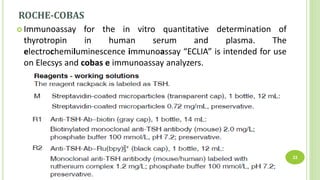
ROCHE-COBAS
 Immunoassay for the in vitro quantitative determination of
thyrotropin in human serum and plasma. The
electrochemiluminescence immunoassay “ECLIA” is intended for use
on Elecsys and cobas e immunoassay analyzers.
22
23
24
DIASORIN
 The method for the quantitative determination of TSH is a sandwich
chemiluminescence immunoassay.
25
VITROS 3600
26
27
28
The high dose hook effect refers
to measured levels of antigen
displaying a significantly lower
absorbance than the actual level
present in a sample.
29
SIEMENS
30
31
32
33
34
35
36
37

Case presentation about TSH variants

  • 1.
    UNDETECTABLE TSH COULDBE A TSH VARIANT; CASE OF A YOUNG ASYMPTOMATIC NEPALESE MALE Santosh Pradhan1, Vivek Pant1, Keyoor Gautam2, Devish Pyakurel2, Abha Shrestha2 1Department of Clinical Biochemistry, Samyak Diagnostic; Jawalakhel, Lalitpur 2Department of Pathology, Samyak Diagnostic; Jawalakhel, Lalitpur, Nepal Journal of Diabetes and Endocrinology Association of Nepal 2019; 3 (1): (34-37) ISSN Print 2594-3367 ISSN Online 2631-2107 1 Presented by: Dipesh Tamrakar MSc. Clinical Biochemistry
  • 2.
    ABSTRACT  Thyroid functiontests are frequently ordered test.  Infrequently, the automated thyroid hormone assay system is subjected to interference which may yield false results, thus leading to inappropriate diagnosis and management.  We report an unusual case of clinically misdiagnosed subclinical hyperthyroidism with undetectable TSH due to negative interference in particular TSH assay platforms in a young Nepalese male. 2
  • 3.
    INTRODUCTION  TFT; Routineinvestigation in the clinical laboratory.  Clinical and biochemical phenotype correlation is required for the correct interpretation of thyroid hormone test result.  Measurement of thyroid hormones in serum by IMMUNOASSAY method.  False results due to interference in immunoassay method.  Potential for inappropriate diagnosis and management of the disease. 3
  • 4.
     Common causesof interference in thyroid hormone measurement are  intake of biotin containing multivitamins by patient.  Presence of heterophile antibodies, rheumatoid factor or paraprotein in patient’s serum.  It should be noted that high affinity of the noncovalent biotin- streptavidin interaction has been extensively used in competitive immunoassays.  Thus, additional immunoassay interference that should be taken into consideration in discordant thyroid hormone measurement is anti- streptavidin antibodies, anti-ruthenium antibodies and thyroid hormone autoantibodies. 4
  • 5.
     Thyroid hormoneimmunoassay is based on antibody targeted against two different region of TSH dimer.  Whenever the immunogenicity of patients TSH is altered due to change in peptide sequence of TSH, then some immunoassays cannot detect this TSH although the biological function of TSH is retained.  This normal TSH variant leads to misdiagnosis of subclinical hyperthyroidism in the absence of clinical symptoms.  Here is a presentation of a case of 25 years male, who is a medical student and was misdiagnosed with subclinical hyperthyroidism possibly due to TSH variant. 5
  • 6.
    CASE REPORT  A25 years old male ordered his thyroid function test (TFT) as a routine checkup along with other tests at one of the private laboratory in Kathmandu.  He had no past illness and was completely normal while performing test.  He had normal serum free triiodothyronine (T3) and free thyroxine (T4) level but TSH 3rd generation was less than 0.01. 6
  • 7.
     He repeatedhis test after two weeks at same laboratory and the TFT findings were the same.  He went for endocrinology consultation where he was diagnosed with subclinical hyperthyroidism.  He was advised to perform additional test like anti thyroid peroxidase antibody (TPO antibody) and antithyroglobulin.  He was also advised to start treatment. 7
  • 8.
     He crosscheckedhis TFT few days later before starting treatment at next private laboratory in Kathmandu.  This time his serum fT3, fT4 and TSH were in normal range.  He had no viral illness and neck pain during the past 3 months.  He was not taking multivitamins or levothyroxine and had no major illness.  At this time his reports for anti TPO and antithyroglobulin were available which were negative.  We repeated the thyroid function test at our laboratory and again the serum TSH level was less than 0.01. 8
  • 9.
     In thefirst laboratory where TSH was undetected, they were using Siemens Advia Centaur XP immunoassay.  The second laboratory where the TFT test was normal, were using Roche immunoassay system.  At our laboratory we are using both Siemens and Abbott Architect immunoassay.  We discussed with the patient and repeated the test in Abbott TSH immunoassay system, where the results were normal.  The patient was then explained about the TSH variant and was reassured that he does not need treatment for this condition. 9
  • 10.
    DISCUSSION  TSH isroutinely measured in the clinical laboratory to diagnose and monitor thyroid disorders.  Third-generation serum TSH assays have the highest sensitivity for assessing thyroid disorders.  Immunoassay system is currently the method of choice in clinical laboratories for the measurement of thyroid hormones.  However, immunoassays are vulnerable to different types of interference that can result in discordant result of thyroid function test. 10
  • 11.
     Common interferencesare due to presence of macro-TSH, biotin, anti- streptavidin antibodies, anti-ruthenium antibodies, and heterophilic antibodies.  The manufacturers of immunoassay try to limit their impact of interference by adding blockers in reagent or by warning users via information provided in kit inserts.  Ideally, discrepancies with biochemical parameters of TFT and clinical findings provide clue to the interference.  Clinical history, regarding intake of multivitamins or other drugs, history of blood transfusion, autoimmune diseases or contact with animals or any discordant lab result in the past, should be taken. 11
  • 12.
     When theindex case presented to us, he had no major illness in the past. He was not taking biotin containing multivitamins or other drugs.  Since he had undetectable TSH with normal free T3 and free T4, initially we considered the possibility of recovery from thyrotoxicosis or other non thyroidal illness.  Patient did not have symptoms suggestive of thyrotoxicosis in the past.  The tests for anti TPO and antithyroglobulin was also non suggestive. 12
  • 13.
     Presence ofantistreptavidin antibodies, antiruthenium antibodies and heterophilic antibodies was not considered, since these conditions would also interfere with free T3 and free T4 measurement and would rather present with elevated TSH level.  When patient provided the reports of TFT with undetectable TSH along normal TSH performed in different immunoassay platforms, we considered the possibility of TSH variant.  Detection of TSH using commercially available TSH immunoassays is based on a sandwich mechanism where a solid phase antibody and a detection antibody are targeted to 2 different regions of the TSH dimer. 13
  • 14.
     One antibodyin the pair targets the beta subunit of TSH; the other antibody often targets the alpha-beta interface region of the dimer to detect intact hormone.  Mutation in TSH beta region is an identified cause of discordant result between TSH values obtained with Siemens immunoassay and other platforms.  Drees et al. identified twenty euthyroid individuals, (19 were South Asian and one was Persian) with falsely undetectable biologically active TSH levels, who had been wrongly diagnosed with hyperthyroidism and some were started with treatment.  After detailed investigation, it was found that mutation in TSH beta region (R55G) i.e arginine to glycine amino acid change, was responsible for discordance observed between TSH values obtained with different immunoassay platforms. 14
  • 15.
     This arginine-55is part of an epitope recognized by antibodies used in some immunoassays, explaining loss of TSH immunoreactivity in such platforms.  In our patient TSH determined by Siemens assay was undetectable but his serum TSH was found to be normal when determined by Roche and Abbott Immunoassay system.  Thus, testing the serum with different auto analyzer should be considered when erroneous TSH result is suspected.  We could not perform TSH beta region gene sequencing due to financial constraint. 15
  • 16.
    CONCLUSION  Physicians practicingendocrinology need to be aware about basic principle of immunoassay and types of interferences.  In addition, collaboration between physician and laboratory personnel is needed to minimize the potential for inappropriate treatment.  The high frequency of TSH-beta region mutation in our population mandates that, undetectable TSH readings in euthyroid patients should be reanalyzed using an alternate TSH assay. 16
  • 17.
     What analyzerto rely on??  Which test principle to trust??  Do our analyzer & test method are certified??  Do IQC & calibration address all the problems??  Are we going through details on test protocol??  Are we concern with our reagent constituents??  How does our reagents in use are being produced??  Do our reagent shipment and storage is proper??  What are optimum condition variance (OCV)??  Why do we need different model of alternative analyzers?? 17
  • 18.
    ABBOTT  The ARCHITECTTSH assay is a Chemiluminescent Microparticle Immunoassay (CMIA) for the quantitative determination of human thyroid stimulating hormone (TSH) in human serum and plasma. 18
  • 19.
  • 20.
  • 21.
  • 22.
    ROCHE-COBAS  Immunoassay forthe in vitro quantitative determination of thyrotropin in human serum and plasma. The electrochemiluminescence immunoassay “ECLIA” is intended for use on Elecsys and cobas e immunoassay analyzers. 22
  • 23.
  • 24.
  • 25.
    DIASORIN  The methodfor the quantitative determination of TSH is a sandwich chemiluminescence immunoassay. 25
  • 26.
  • 27.
  • 28.
    28 The high dosehook effect refers to measured levels of antigen displaying a significantly lower absorbance than the actual level present in a sample.
  • 29.
  • 30.
  • 31.
  • 32.
  • 33.
  • 34.
  • 35.
  • 36.
  • 37.

Editor's Notes

  • #6 Beta & alpha-beta interface region subunit of TSH
  • #11 monoclonal-monoclonal antibody configuration in immuno-metric methods gained enhanced specificity and sensitivity. This is due to the specificity of monoclonal antibodies and to various highly sensitive labels, including chemiluminescent tags, fluorophores, photoproteins and new enzymes. These features made it possible to measure reproducibly (CV <20%) very low concentration of TSH. Has functional sensitivity in the range of 0.01 to 0.02 mIU/L.
  • #19 MES is the common name for the compound 2-ethanesulfonic acid. Its chemical structure contains a morpholine ring
  • #27 Acetanilide An immunometric immunoassay technique is used,which involves the simultaneous reaction of TSH present in the sample with a biotinylated antibody (mouse monoclonal anti‑whole TSH) and a horseradish peroxidase (HRP)-labeled antibody conjugate (mouse monoclonal anti-TSH β-subunit). The antigen-antibody complex is captured by streptavidin on the wells. Unbound materials are removed by washing. The bound HRP conjugate is measured by a luminescent reaction. A reagent containing luminogenic substrates (a luminol derivative and a peracid salt) and an electron transfer agent, is added to the wells. The HRP in the bound conjugate catalyzes the oxidation of the luminol derivative, producing light. The electron transfer agent (a substituted acetanilide) increases the level of light produced and prolongs its emission. The light signals are read by the system. The amount of HRP conjugate bound is directly proportional to the concentration of TSH present.
  • #29 This appears when a simultaneous ELISA assay is saturated by a very high concentration of sample antigen binding to all available sites on both the solid phase antibody as well as the detection antibody and thereby preventing the sandwich-formation. The antigen-saturated detection antibodies in solution will be washed off giving a falsely low signal. A “hook” is observed in the curve when data is plotted as a signal versus antigen concentration.
  • #33 FITC (fluorescein isothiocyanate) is a fluorochrome dye widely used as an antibodyor other probe marker HEPES (4-(2-hydroxyethyl)-1-piperazineethanesulfonic acid) is a zwitterionic sulfonic acid bufferingagent;