Submitted by
DR summiya akram
Microbiology SCHOLAR
 Overview
• What is quality
• Quality control
• Tools of quality control
• Calculation and use of QC statistics
• Calculation of mean and standard deviation
• Creating a levey Jennings chart
• Westguard rule
• Quality assurance
• Components of quality assurance
• Quality management system
• Factors affecting QC
• references
 In manufacturing, a measure of excellence or a
state of being free from defects, deficiencies
and significant variations. It is brought about
strict and consistent commitment to certain
standards that achieve uniformity of a product
to satisfy specific user.
 Good quality support provision of high quality
health-care.
 Generate confidence in lab results and ensure
credibility of lab.
 Quality control in the medical laboratory is a
statistical process used to monitor and evaluate
the analytical process that produces patient
results
 A quality control product is a patient-like
material ideally made from human serum, urine
or spinal fluid. A control product can be a liquid
or freeze dried (lyophilized) material and is
composed of one or more constituents (analytes)
of known concentration. Control products should
be tested in the same manner as patient
samples.
 A quality control product usually contains many
different analytes. For example, a general
chemistry control can contain any number of
chemistry analytes including potassium, glucose,
albumin and calcium.
 Regular Testing
 Good laboratory practice requires testing normal
and abnormal controls for each test at least
daily to monitor the analytical process. If the
test is stable for less than 24 hours or some
change has occurred which could potentially
affect the test stability, controls should be
assayed more frequently.
 . The lab-defined range is calculated from QC
data collected from testing of normal and
abnormal controls.
1. Inspection
2. Control charts
3. Preto diagrams
4. Statistical sampling
5. Flow charting
6. Trend analysis
 QC statistics for each test performed in the laboratory are
calculated from the QC database collected by regular
testing of control products. The data collected is specific
for each level of control.
 The most fundamental statistics used by the laboratory
are the mean [x] and standard deviation [s].
 To calculate a mean for a
specific level of control,
first, add all the values
collected for that control.
Then divide the sum of
these values by the total
number of values.
 The mean (or average) is
the laboratory’s best
estimate of the analyte’s
true value for a specific
level of control.
 Standard deviation is a
statistic that quantifies
how close numerical
values (i.e., QC values)
are in relation to each
other.
 Standard deviation is
calculated for control
products from the same
data used to calculate the
mean.
 It provides the laboratory
an estimate of test
consistency at specific
concentrations.
 Standard deviation is commonly used for
preparing Levey-Jennings (L-J or LJ) charts
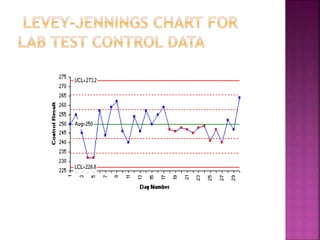
 The Levey-Jennings chart is used to graph
successive (run-to-run or day-to-day) quality
control values.
 A chart is created for each test and level of
control. The first step is to calculate decision
limits
 These limits are ±1s, ±2s and ±3s from the mean.
 The Levey-Jennings chart we have developed
can be overlaid onto a bell-shaped curve to
illustrate the overall distribution of quality
control value
 When an analytical process is within control,
approximately 68% of all QC values fall within ±1
standard deviation (1s).
 Likewise 95.5% of all QC values fall within ±2
standard deviations (2s) of the mean. About 4.5%
of all data will be outside the ±2s limits when
the analytical process is in control.
 Approximately 99.7% of all QC values are found
to be within ±3 standard deviations (3s) of the
mean.
 As only 0.3%, or 3 out of 1000 points, will fall
outside the ±3s limits, any value outside of ±3s is
considered to be associated with a significant
error condition and patient results should not be
reported.
 The elements of the Westgard system are based
on principles of statistical process control used
in industry nationwide since the 1950s.
 There are six basic rules in the Westgard
scheme. These rules are used individually or in
combination to evaluate the quality of analytical
runs.
 Westgard devised a shorthand notation for
expressing quality control rules.
 Most of the quality control rules can be
expressed as NL where N represents the number
of control observations to be evaluated and L
represents the statistical limit for evaluating the
control observations
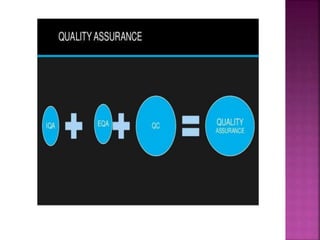
 . QA is defined as the overall program that
ensures that the final results reported by the
laboratory are as correct and accurate as
possible.
 Involves following up to make sure every
thing is done correctly and fulfill
requirements of the product.
 Quality assurance may be provide by the
project team or any other responsible one
for maintaining and assisting with the
maintenance of quality for the product.
1. Strategy level is long term decision to improve
quality.
2. Tactical level is medium term decision for
training, facilities, operation of quality
assurance.
3. Operational level is day to day operation(SOP’s
work sheets)
1. Organization and supervision
2. Personnel
3. Equipment
4. Purchasing and inventory
5. Documents and records
6. Process control
7. Information management
8. Occurrence management
9. Assessment
10. Customer service
11. Process improvement
12. Facilities and safety
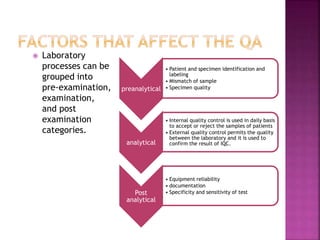
 Laboratory
processes can be
grouped into
pre-examination,
examination,
and post
examination
categories.
preanalytical
• Patient and specimen identification and
labeling
• Mismatch of sample
• Specimen quality
analytical
• Internal quality control is used in daily basis
to accept or reject the samples of patients
• External quality control permits the quality
between the laboratory and it is used to
confirm the result of IQC.
Post
analytical
• Equipment reliability
• documentation
• Specificity and sensitivity of test
1. Kusum M, Silva P. Quality standards in health laboratories, implementation in
Thailand: a novel approach. World Health Organization Regional Office for South-East
Asia, 2005, SEAHLM-386 (http://www.searo.who.int/LinkFiles/Publications_SEA-HLM-
386__a4___2_.pdf, accessed 11 April 2011).
2. Kumari S, Bhatia R. Guidelines for peripheral and intermediate laboratories in quality
assurance in bacteriology and immunology. World Health Organization Regional Office
for South-East Asia, Series No. 28, 2003.
3. Silva P. Guidelines on establishment of accreditation of health laboratories. World
Health Organization Regional Office for South-East Asia, 2007.
4. International Standards Organization (ISO) 8258. Shewhart Control Charts. Corrected,
1993, Geneva, Switzerland.
5. International Standards Organization/International Electro technical Commission
(ISO/IEC) 17025. General Requirements for the Competence of Testing and Calibration
Laboratories. December 1999, 26 pp.
6. Kirby, H.W. 1954. Decay and Growth Tables for the Naturally Occurring Radioactive
Series. Anal. Chem. 26:6, p. 1063-1071.
7. Lin, Z., Inn, K.G.W., and Fiilben, J. J. 2001. An alternative statistical approach for
interlaboratory comparison data evaluation. J. Radio analytical and Nuclear
Chemistry, 248:1, 163-173.

Qc and qa

  • 2.
    Submitted by DR summiyaakram Microbiology SCHOLAR
  • 3.
     Overview • Whatis quality • Quality control • Tools of quality control • Calculation and use of QC statistics • Calculation of mean and standard deviation • Creating a levey Jennings chart • Westguard rule • Quality assurance • Components of quality assurance • Quality management system • Factors affecting QC • references
  • 4.
     In manufacturing,a measure of excellence or a state of being free from defects, deficiencies and significant variations. It is brought about strict and consistent commitment to certain standards that achieve uniformity of a product to satisfy specific user.  Good quality support provision of high quality health-care.  Generate confidence in lab results and ensure credibility of lab.
  • 5.
     Quality controlin the medical laboratory is a statistical process used to monitor and evaluate the analytical process that produces patient results  A quality control product is a patient-like material ideally made from human serum, urine or spinal fluid. A control product can be a liquid or freeze dried (lyophilized) material and is composed of one or more constituents (analytes) of known concentration. Control products should be tested in the same manner as patient samples.
  • 6.
     A qualitycontrol product usually contains many different analytes. For example, a general chemistry control can contain any number of chemistry analytes including potassium, glucose, albumin and calcium.  Regular Testing  Good laboratory practice requires testing normal and abnormal controls for each test at least daily to monitor the analytical process. If the test is stable for less than 24 hours or some change has occurred which could potentially affect the test stability, controls should be assayed more frequently.
  • 7.
     . Thelab-defined range is calculated from QC data collected from testing of normal and abnormal controls.
  • 8.
    1. Inspection 2. Controlcharts 3. Preto diagrams 4. Statistical sampling 5. Flow charting 6. Trend analysis
  • 9.
     QC statisticsfor each test performed in the laboratory are calculated from the QC database collected by regular testing of control products. The data collected is specific for each level of control.  The most fundamental statistics used by the laboratory are the mean [x] and standard deviation [s].
  • 10.
     To calculatea mean for a specific level of control, first, add all the values collected for that control. Then divide the sum of these values by the total number of values.  The mean (or average) is the laboratory’s best estimate of the analyte’s true value for a specific level of control.  Standard deviation is a statistic that quantifies how close numerical values (i.e., QC values) are in relation to each other.  Standard deviation is calculated for control products from the same data used to calculate the mean.  It provides the laboratory an estimate of test consistency at specific concentrations.
  • 11.
     Standard deviationis commonly used for preparing Levey-Jennings (L-J or LJ) charts  The Levey-Jennings chart is used to graph successive (run-to-run or day-to-day) quality control values.  A chart is created for each test and level of control. The first step is to calculate decision limits  These limits are ±1s, ±2s and ±3s from the mean.  The Levey-Jennings chart we have developed can be overlaid onto a bell-shaped curve to illustrate the overall distribution of quality control value
  • 12.
     When ananalytical process is within control, approximately 68% of all QC values fall within ±1 standard deviation (1s).  Likewise 95.5% of all QC values fall within ±2 standard deviations (2s) of the mean. About 4.5% of all data will be outside the ±2s limits when the analytical process is in control.  Approximately 99.7% of all QC values are found to be within ±3 standard deviations (3s) of the mean.  As only 0.3%, or 3 out of 1000 points, will fall outside the ±3s limits, any value outside of ±3s is considered to be associated with a significant error condition and patient results should not be reported.
  • 14.
     The elementsof the Westgard system are based on principles of statistical process control used in industry nationwide since the 1950s.  There are six basic rules in the Westgard scheme. These rules are used individually or in combination to evaluate the quality of analytical runs.  Westgard devised a shorthand notation for expressing quality control rules.  Most of the quality control rules can be expressed as NL where N represents the number of control observations to be evaluated and L represents the statistical limit for evaluating the control observations
  • 15.
     . QAis defined as the overall program that ensures that the final results reported by the laboratory are as correct and accurate as possible.  Involves following up to make sure every thing is done correctly and fulfill requirements of the product.  Quality assurance may be provide by the project team or any other responsible one for maintaining and assisting with the maintenance of quality for the product.
  • 16.
    1. Strategy levelis long term decision to improve quality. 2. Tactical level is medium term decision for training, facilities, operation of quality assurance. 3. Operational level is day to day operation(SOP’s work sheets)
  • 17.
    1. Organization andsupervision 2. Personnel 3. Equipment 4. Purchasing and inventory 5. Documents and records 6. Process control 7. Information management 8. Occurrence management 9. Assessment 10. Customer service 11. Process improvement 12. Facilities and safety
  • 18.
     Laboratory processes canbe grouped into pre-examination, examination, and post examination categories. preanalytical • Patient and specimen identification and labeling • Mismatch of sample • Specimen quality analytical • Internal quality control is used in daily basis to accept or reject the samples of patients • External quality control permits the quality between the laboratory and it is used to confirm the result of IQC. Post analytical • Equipment reliability • documentation • Specificity and sensitivity of test
  • 21.
    1. Kusum M,Silva P. Quality standards in health laboratories, implementation in Thailand: a novel approach. World Health Organization Regional Office for South-East Asia, 2005, SEAHLM-386 (http://www.searo.who.int/LinkFiles/Publications_SEA-HLM- 386__a4___2_.pdf, accessed 11 April 2011). 2. Kumari S, Bhatia R. Guidelines for peripheral and intermediate laboratories in quality assurance in bacteriology and immunology. World Health Organization Regional Office for South-East Asia, Series No. 28, 2003. 3. Silva P. Guidelines on establishment of accreditation of health laboratories. World Health Organization Regional Office for South-East Asia, 2007. 4. International Standards Organization (ISO) 8258. Shewhart Control Charts. Corrected, 1993, Geneva, Switzerland. 5. International Standards Organization/International Electro technical Commission (ISO/IEC) 17025. General Requirements for the Competence of Testing and Calibration Laboratories. December 1999, 26 pp. 6. Kirby, H.W. 1954. Decay and Growth Tables for the Naturally Occurring Radioactive Series. Anal. Chem. 26:6, p. 1063-1071. 7. Lin, Z., Inn, K.G.W., and Fiilben, J. J. 2001. An alternative statistical approach for interlaboratory comparison data evaluation. J. Radio analytical and Nuclear Chemistry, 248:1, 163-173.