Standardization & Codification
Presented by :
Manoj kumar
Standardization
According to ISO “standardization is an activity
giving solution to repetitive application essentially in
the sphere of science, technology and economics. Aim
at the achievement of the optimum degree of order in
a given context.
What to standardize?
Usually starts with a core product as the
foundation.
Various features are added, these may differ
according to the country market.
Can also involve modular design, where various
features are packaged as modules, different
assembly combinations in different markets.
100% standardization is rare.
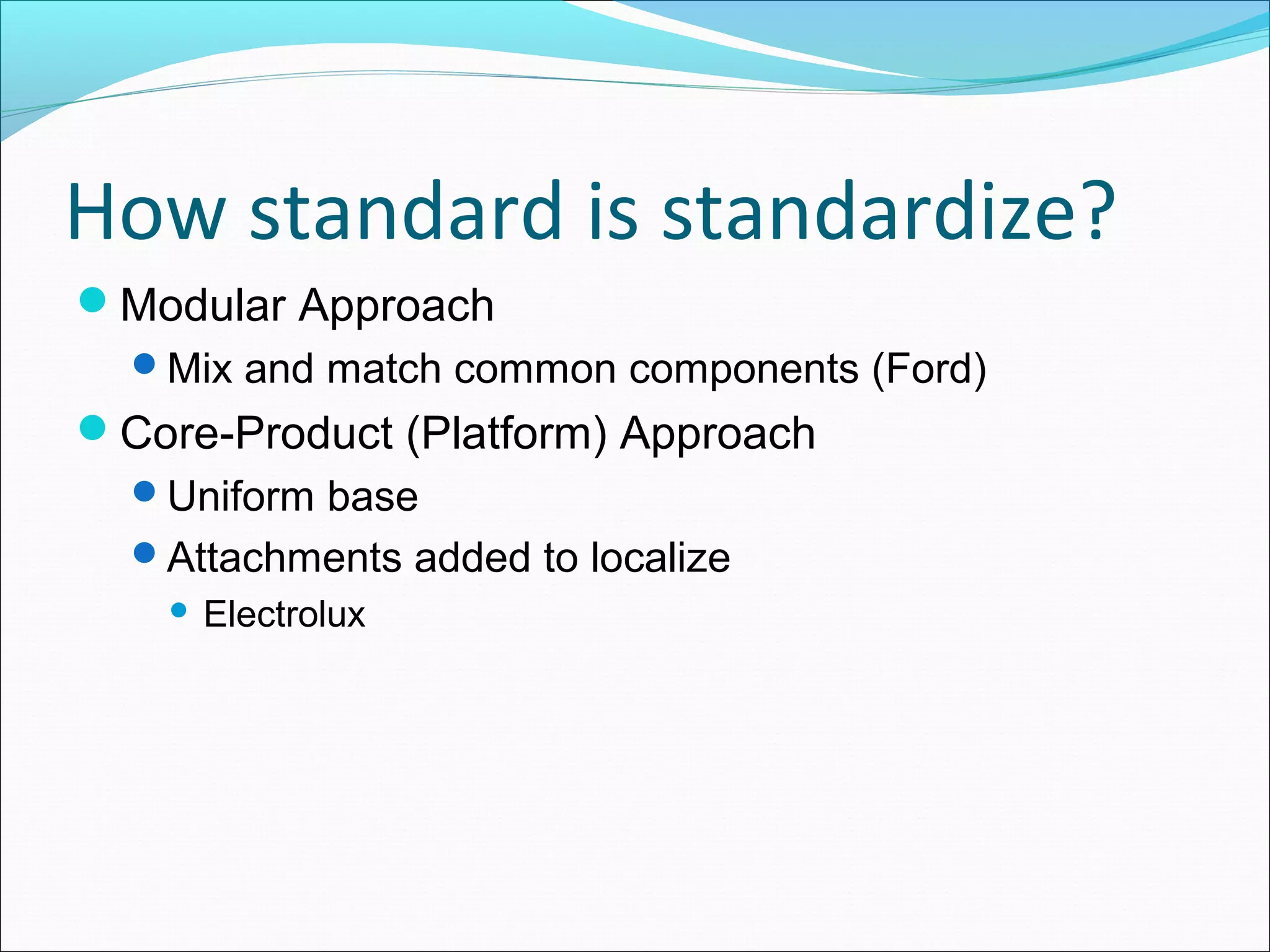
How standard is standardize?
Modular Approach
Mix and match common components (Ford)
Core-Product (Platform) Approach
Uniform base
Attachments added to localize
 Electrolux
Objective of Standardization
To achieve maximum overall economy. This may
be in terms of cost, human effort, construction of
essential material and judicious choice of raw
material.
Reduction in materials cost, reduction of storage
and inventory.
Indigenization and import substitutions.
Improvement in quality.
Continued…
Availability of standardized materials, reduction in
the cost of maintenance and services.
Elimination of wastes and scrap.
Achieving higher productivity and higher profit.
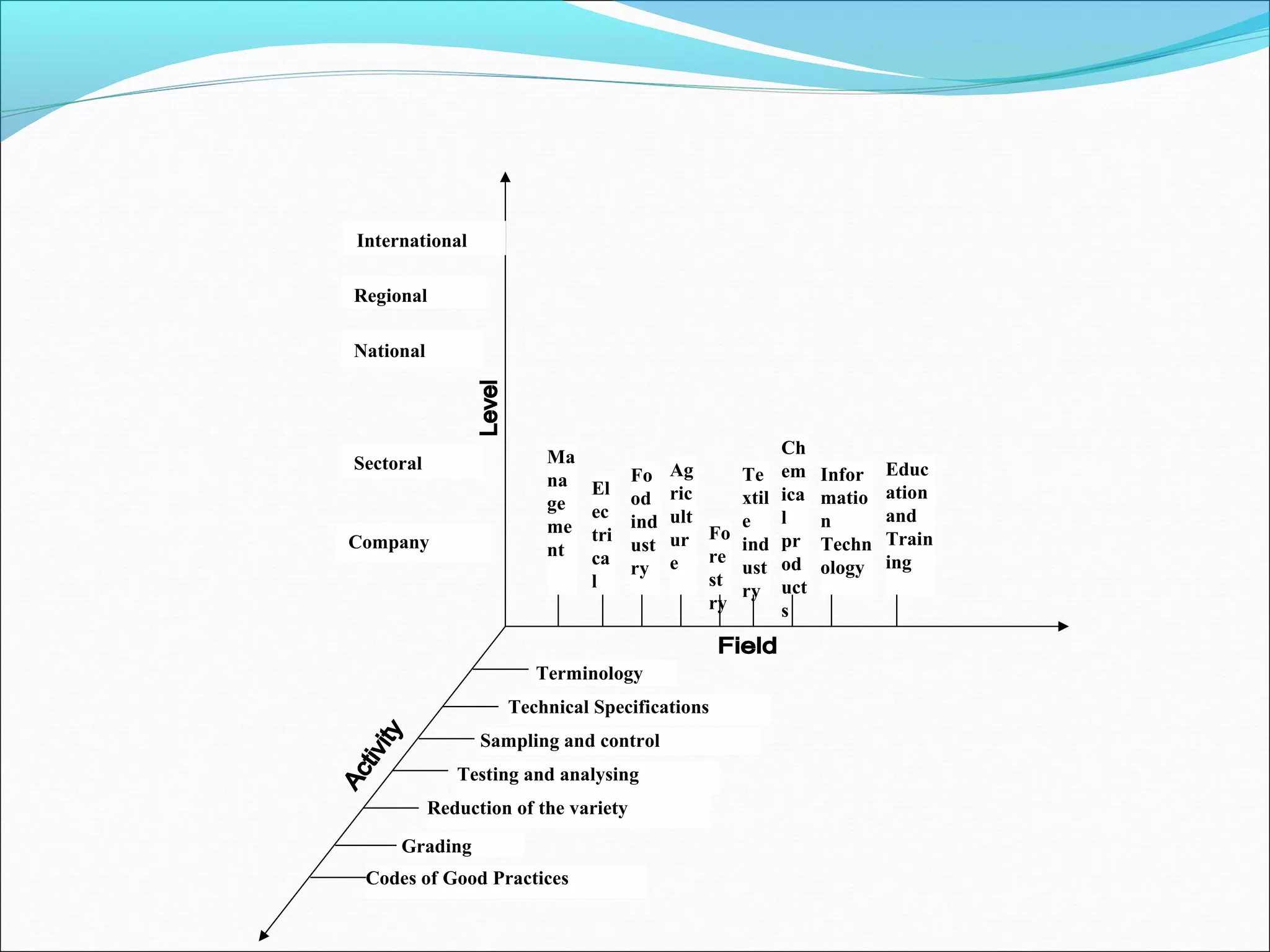
International
Regional
National
Sectoral
Company
Terminology
Technical Specifications
Sampling and control
Testing and analysing
Reduction of the variety
Grading
Codes of Good Practices
El
ec
tri
ca
l
Fo
od
ind
ust
ry
Ag
ric
ult
ur
e
Fo
re
st
ry
Te
xtil
e
ind
ust
ry
Ch
em
ica
l
pr
od
uct
s
Infor
matio
n
Techn
ology
Educ
ation
and
Train
ing
Ma
na
ge
me
nt
Product standards
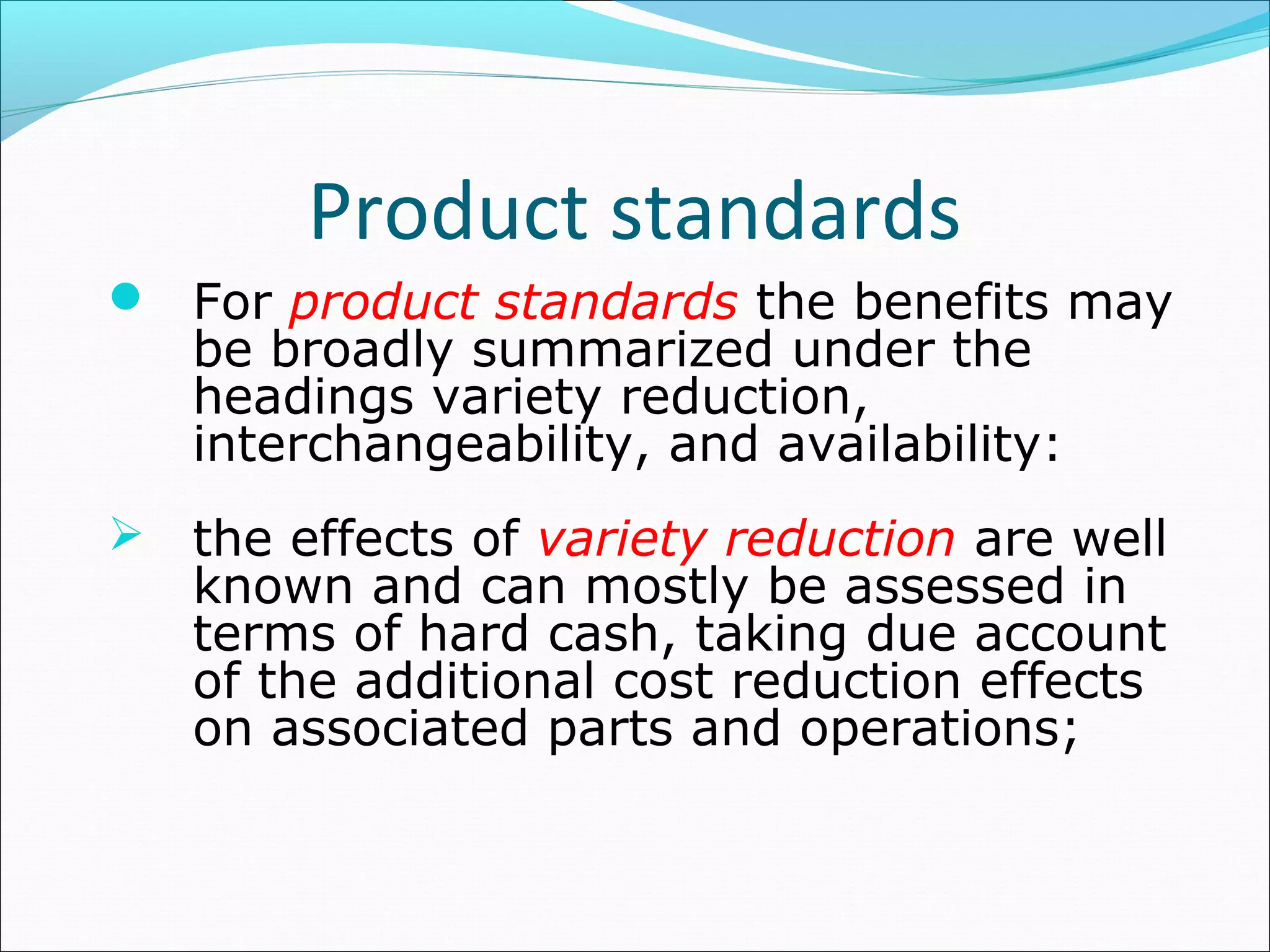
 For product standards the benefits may
be broadly summarized under the
headings variety reduction,
interchangeability, and availability:
 the effects of variety reduction are well
known and can mostly be assessed in
terms of hard cash, taking due account
of the additional cost reduction effects
on associated parts and operations;
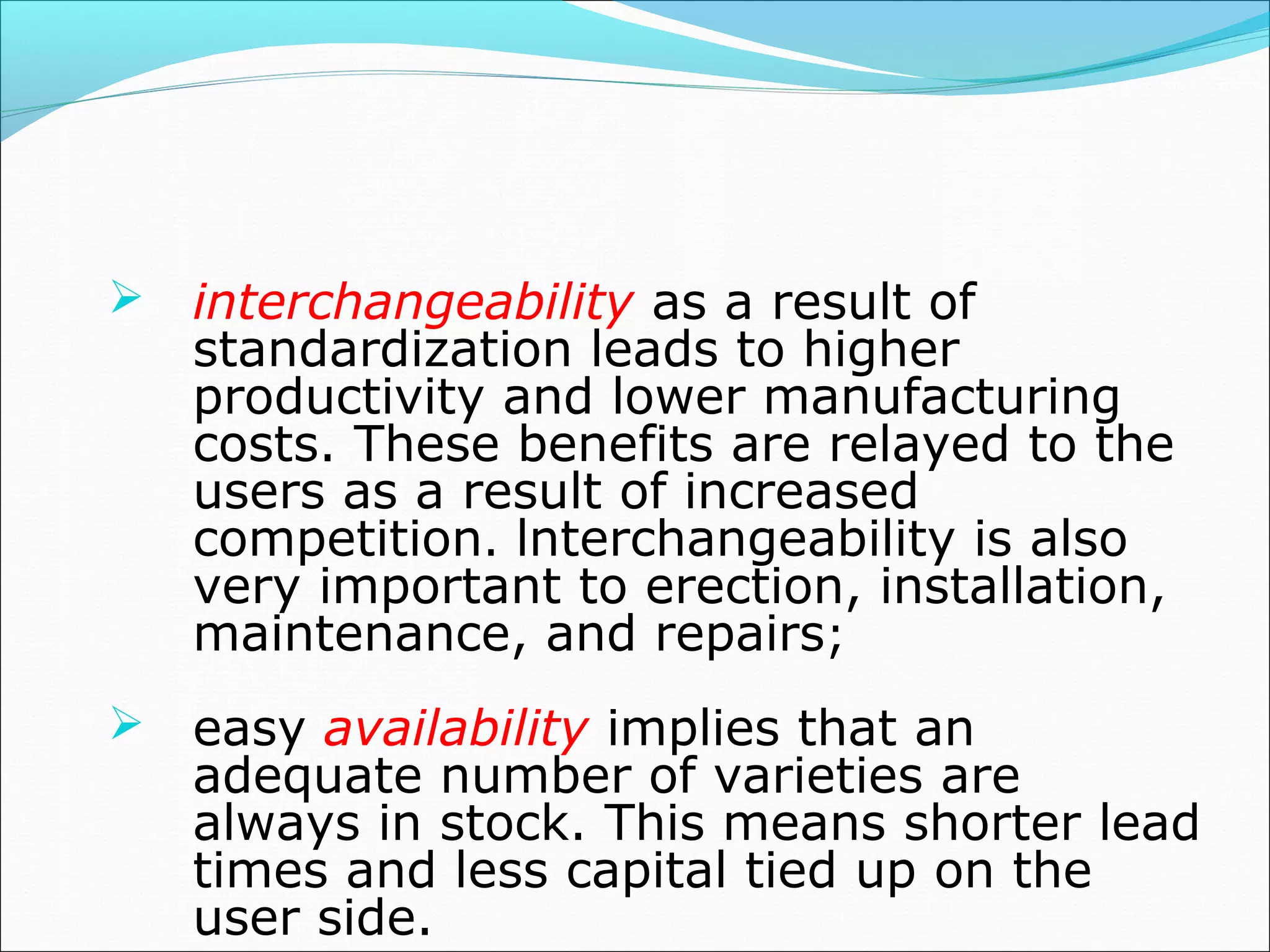
 interchangeability as a result of
standardization leads to higher
productivity and lower manufacturing
costs. These benefits are relayed to the
users as a result of increased
competition. lnterchangeability is also
very important to erection, installation,
maintenance, and repairs;
 easy availability implies that an
adequate number of varieties are
always in stock. This means shorter lead
times and less capital tied up on the
user side.
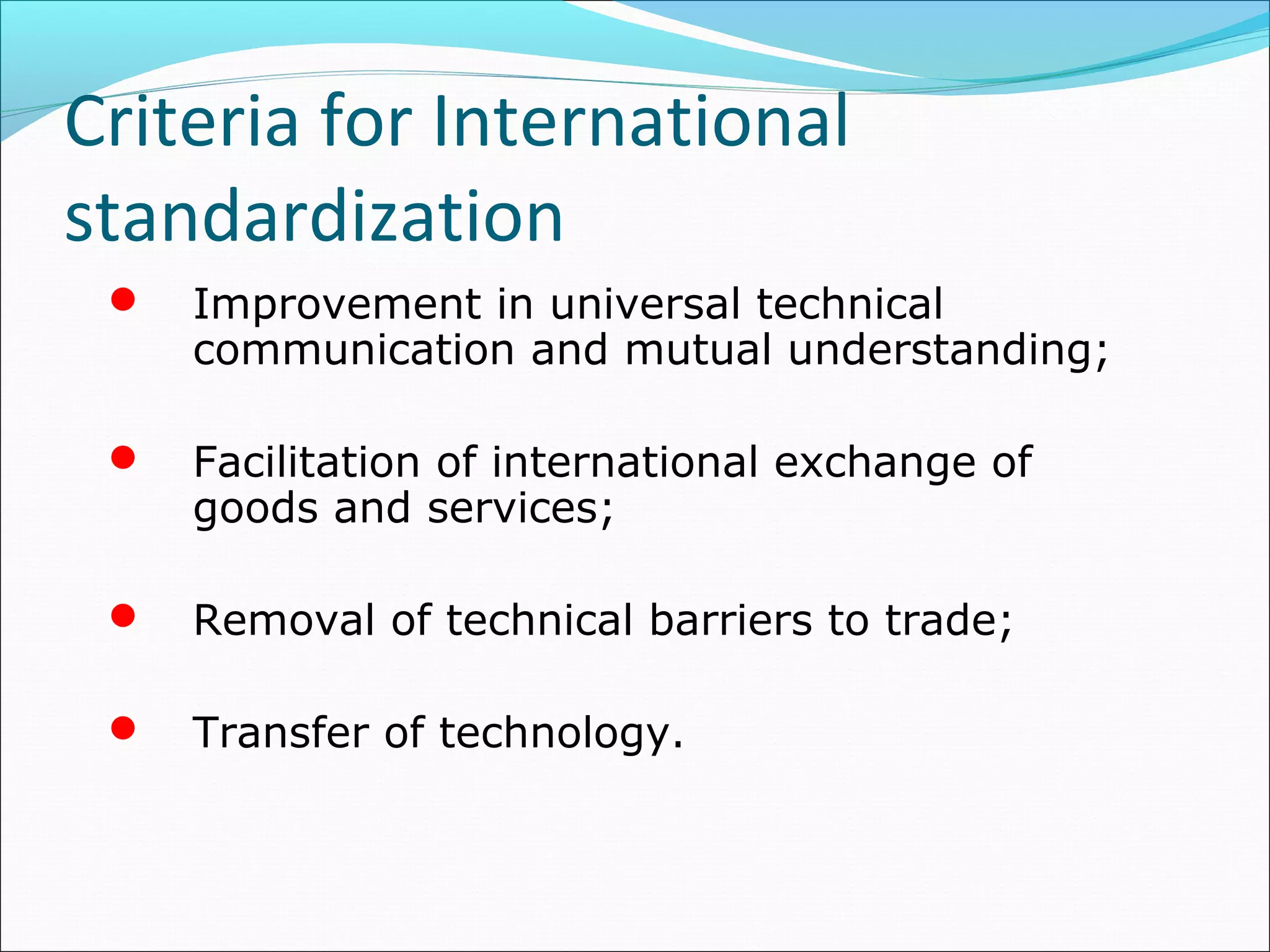
Criteria for International
standardization
 Improvement in universal technical
communication and mutual understanding;
 Facilitation of international exchange of
goods and services;
 Removal of technical barriers to trade;
 Transfer of technology.
Continued…
 Uniform terminology is created
 Sizes and dimensions are co-ordinated and adapted
 Variety is reduced
 Function requirements and characteristics are specified
 Unambiguous testing methods are established
Advantages of standardization
Cost reduction
Improved quality(reliability)
Global customers(mobility)
Synergy and Brand equity
Centralized R & D
Drawbacks of standardization
Lack of uniqueness
Vulnerability to Trade barriers(more barriers, less
standardization)
Strong local competitors
Definitions
Codification in an industry is the systematic concise
representation of equipment, raw materials, tools,
spares, supplies etc.in an abbreviated form employing
alphabets, numerals, colours, symbols etc.
Benefits
Important factor in indenting, purchasing and issuing
activities.
Wrong identification results in wrong purchases.
Words description can be used but they are too
long,totally inadequate and Prone to errors.
• Accurate and logical identification.
• Avoidance of Long and unweilding
description.
• Prevention of duplication.
• Product Simplification.
• Efficient Purchasing.
• Minimizing of clerical work.
• Efficient Purchasing.
• Accurate ane reliable accounting and
recording.
• Easier computerisation.
• Better alternative selection
• Simplifies Costing
Stages of Scientific
Codification
Identification – To know the type of material in detail
Classification – Description, Nature, Source or origin.
Codification – As per the requirement and the system
Special Characteristics
Simple
Brief
Flexible
Unique
Layout should be easy to handle
Self Decoding
Objective Oriented
Speed
Unambiguity
Saving of efforts
Space saving on forms
 Ease of classification,
 Mechanization
Characteristics of Codes
Code should be Simple.
Code should be unique.
Coding should be compact, concise and consistent.
Code should be sufficiently flexible to meet future
demands
Objectives of Codification
Accurate and logical identification
 Prevention of duplication
Standardisation and reduction of varieties
Efficient purchasing
Easy computerization
Basic System
Arbitrary system
Numerical System
 Mnemonic system or alpha numeric system
Decimal system
Brisch system
Kodak system
Brisch System
Concieved by Mr.E.G.Brisch with J.Gombinski.
Divides all facets of organisation into number of main
categories according to nature of business.
The first block gives major classification e.g packing,
raw materials etc.
Brisch System
The second block gives next level of classification
based on the type of materials.
The third block gives the lowest level of classification
normally the specifications.
• Originated by Eastman Kodak Company.
• Based on numerical system of codification
and combines all good other points.
• The system employs ten digit codes.
• The Materials are classified according to
Purchase categorisation rather than their
nature.
• Divided into few broad classification called
Basic Classification.
Kodak System
The basic classification is restricted to 100.
Each class is then further divided into sub classes.
Eg – 40(Cutting Tools)0(drills)
Each sub class is again further sub divided
Eg – 400-00
Colour Coding
Here colours are used to identify the content.
Generally is used for Pipelines, Rawmaterials,
lubricants etc.
Advantages
Provides absolute clarity to the supplier as to what is
required by the buyer.
Eleminates need to create company‘s specifications.
Allows accurate comparison of quotes.
Variety reduction
Allows buying from more than one manufacturer.
Advantages
Reduces inspection and quality costs.
Allows firm to enter into a running contract.
Ensures interchangability of Parts.
Routinises procurement efforts and reduces clerical
work.
Reduces procurement lead time.
THANK
YOU……

Standardization & codification by manoj 12 mt07ind014

  • 1.
  • 2.
    Standardization According to ISO“standardization is an activity giving solution to repetitive application essentially in the sphere of science, technology and economics. Aim at the achievement of the optimum degree of order in a given context.
  • 3.
    What to standardize? Usuallystarts with a core product as the foundation. Various features are added, these may differ according to the country market. Can also involve modular design, where various features are packaged as modules, different assembly combinations in different markets. 100% standardization is rare.
  • 4.
    How standard isstandardize? Modular Approach Mix and match common components (Ford) Core-Product (Platform) Approach Uniform base Attachments added to localize  Electrolux
  • 5.
    Objective of Standardization Toachieve maximum overall economy. This may be in terms of cost, human effort, construction of essential material and judicious choice of raw material. Reduction in materials cost, reduction of storage and inventory. Indigenization and import substitutions. Improvement in quality.
  • 6.
    Continued… Availability of standardizedmaterials, reduction in the cost of maintenance and services. Elimination of wastes and scrap. Achieving higher productivity and higher profit.
  • 7.
    International Regional National Sectoral Company Terminology Technical Specifications Sampling andcontrol Testing and analysing Reduction of the variety Grading Codes of Good Practices El ec tri ca l Fo od ind ust ry Ag ric ult ur e Fo re st ry Te xtil e ind ust ry Ch em ica l pr od uct s Infor matio n Techn ology Educ ation and Train ing Ma na ge me nt
  • 8.
    Product standards  Forproduct standards the benefits may be broadly summarized under the headings variety reduction, interchangeability, and availability:  the effects of variety reduction are well known and can mostly be assessed in terms of hard cash, taking due account of the additional cost reduction effects on associated parts and operations;
  • 9.
     interchangeability asa result of standardization leads to higher productivity and lower manufacturing costs. These benefits are relayed to the users as a result of increased competition. lnterchangeability is also very important to erection, installation, maintenance, and repairs;  easy availability implies that an adequate number of varieties are always in stock. This means shorter lead times and less capital tied up on the user side.
  • 10.
    Criteria for International standardization Improvement in universal technical communication and mutual understanding;  Facilitation of international exchange of goods and services;  Removal of technical barriers to trade;  Transfer of technology.
  • 11.
    Continued…  Uniform terminologyis created  Sizes and dimensions are co-ordinated and adapted  Variety is reduced  Function requirements and characteristics are specified  Unambiguous testing methods are established
  • 12.
    Advantages of standardization Costreduction Improved quality(reliability) Global customers(mobility) Synergy and Brand equity Centralized R & D
  • 13.
    Drawbacks of standardization Lackof uniqueness Vulnerability to Trade barriers(more barriers, less standardization) Strong local competitors
  • 15.
    Definitions Codification in anindustry is the systematic concise representation of equipment, raw materials, tools, spares, supplies etc.in an abbreviated form employing alphabets, numerals, colours, symbols etc.
  • 16.
    Benefits Important factor inindenting, purchasing and issuing activities. Wrong identification results in wrong purchases. Words description can be used but they are too long,totally inadequate and Prone to errors.
  • 17.
    • Accurate andlogical identification. • Avoidance of Long and unweilding description. • Prevention of duplication. • Product Simplification. • Efficient Purchasing.
  • 18.
    • Minimizing ofclerical work. • Efficient Purchasing. • Accurate ane reliable accounting and recording. • Easier computerisation. • Better alternative selection • Simplifies Costing
  • 19.
    Stages of Scientific Codification Identification– To know the type of material in detail Classification – Description, Nature, Source or origin. Codification – As per the requirement and the system
  • 20.
    Special Characteristics Simple Brief Flexible Unique Layout shouldbe easy to handle Self Decoding Objective Oriented
  • 21.
    Speed Unambiguity Saving of efforts Spacesaving on forms  Ease of classification,  Mechanization
  • 22.
    Characteristics of Codes Codeshould be Simple. Code should be unique. Coding should be compact, concise and consistent. Code should be sufficiently flexible to meet future demands
  • 23.
    Objectives of Codification Accurateand logical identification  Prevention of duplication Standardisation and reduction of varieties Efficient purchasing Easy computerization
  • 24.
    Basic System Arbitrary system NumericalSystem  Mnemonic system or alpha numeric system Decimal system Brisch system Kodak system
  • 25.
    Brisch System Concieved byMr.E.G.Brisch with J.Gombinski. Divides all facets of organisation into number of main categories according to nature of business. The first block gives major classification e.g packing, raw materials etc.
  • 26.
    Brisch System The secondblock gives next level of classification based on the type of materials. The third block gives the lowest level of classification normally the specifications.
  • 27.
    • Originated byEastman Kodak Company. • Based on numerical system of codification and combines all good other points. • The system employs ten digit codes. • The Materials are classified according to Purchase categorisation rather than their nature. • Divided into few broad classification called Basic Classification.
  • 28.
    Kodak System The basicclassification is restricted to 100. Each class is then further divided into sub classes. Eg – 40(Cutting Tools)0(drills) Each sub class is again further sub divided Eg – 400-00
  • 29.
    Colour Coding Here coloursare used to identify the content. Generally is used for Pipelines, Rawmaterials, lubricants etc.
  • 30.
    Advantages Provides absolute clarityto the supplier as to what is required by the buyer. Eleminates need to create company‘s specifications. Allows accurate comparison of quotes. Variety reduction Allows buying from more than one manufacturer.
  • 31.
    Advantages Reduces inspection andquality costs. Allows firm to enter into a running contract. Ensures interchangability of Parts. Routinises procurement efforts and reduces clerical work. Reduces procurement lead time.
  • 32.

Editor's Notes

  • #27 Brisch System     The Brisch system consist of seven digits applied in three stages. The items are grouped into suitable preliminary categories, such as assemblies, sub-assemblies,components and off the shelf items. After these preliminary categories, items are grouped within the respective class in order to bring similar items together. The Brisch system through it consists only of seven digits, is quite comprehensive as the basis is on logical major groupings.        
  • #29 Kodak System     The Kodak system consists of 10 digits of numerical code. The logic of major grouping is based on sources of supply. All materials are divided into 100 basic classifications, contributed only by procurement considerations. For instance, a bolt is listed as hardware item if this is listed in hardware catalogues and available with hardware suppliers. If this bolt is available as a part of the machine, it will be available under maintenance.