Systematic conciserepresentation of equipment, raw
material, tools, spares, suppliers .
Coding refers to the process of assigning symbols to the
parts.
Coding is define as process of allocating symbol to the
parts. The symbol represent design characteristics of
parts , manufacturing attributes or both.
CODING
3.
IMPORTANCE OF CODING
Due to industrial requirement organization has to
store large no. materials. Therefore there should be
some mean of identifying them hence Coding is used.
Classification and codification of materials are steps in
maintaining stores in a systematic way.
Materials are coded in such way that storing, issuing
and identifying of materials become easy.
4.
CRITERIA FOR EFFECTIVECODING
Code should be Simple.
Code should be unique.
Coding should be compact, concise and consistent.
Code should be sufficiently flexible to meet future
demands.
5.
OBJECTIVES OF CODING
To bring all similar items together under one
classification or group.
To classify an item according to its nature of
characteristics.
To avoid duplication and confusion.
To fix essential parameters to specify an item.
6.
ADVANTAGES OF CODING
The long names and description of items need not to be
repeated every time.
Systematic grouping for correct identification of similar items.
Avoids duplicate stocks of same items.
Reduction in sizes and varieties.
Helps in standardization of materials.
7.
Ensures accuracyin correspondence, records and
postings of receipts and issues in appropriate
records.
The storing of materials, sorting and documentation
becomes easier.
It helps in location of materials.
It helps in accounting and costing.
It is useful for purchase department to select
suppliers.
It is useful for communication of information about
materials.
8.
DISADVANTAGES OF CODING
The mistakes may be in writing codes and it is
difficult to find out correct codes.
Codes may be misunderstood.
When large number of codes is used for different
materials, there may be confusion and it may be
difficult to locate the materials without knowing the
codes.
9.
STORES VOCABULARY
Whenlarge number of materials have been given codes, it
becomes difficult to remember them. For easy reference,
the organization is publishing the codes and names of
materials in books.
The stores vocabulary may be published in number of
volumes of books when large number of materials are
required in the organization.
Number of volumes of books may be categorized
depending upon group of materials required in the
organization
Example: In the Railways, the categories of materials
required are in lakhs.
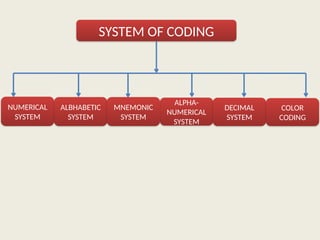
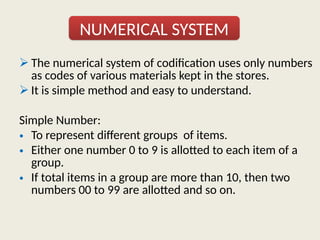
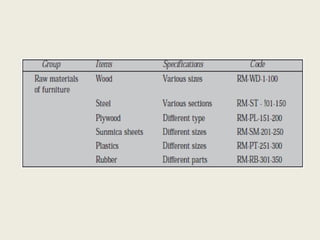
The numericalsystem of codification uses only numbers
as codes of various materials kept in the stores.
It is simple method and easy to understand.
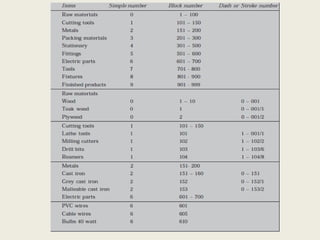
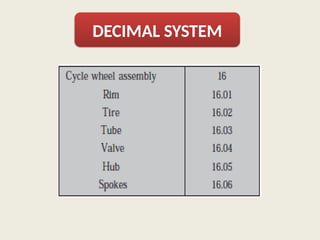
Simple Number:
• To represent different groups of items.
• Either one number 0 to 9 is allotted to each item of a
group.
• If total items in a group are more than 10, then two
numbers 00 to 99 are allotted and so on.
NUMERICAL SYSTEM
12.
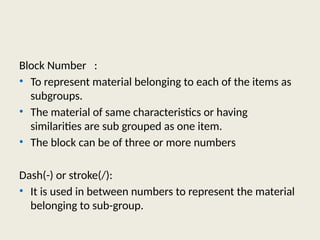
Block Number :
•To represent material belonging to each of the items as
subgroups.
• The material of same characteristics or having
similarities are sub grouped as one item.
• The block can be of three or more numbers
Dash(-) or stroke(/):
• It is used in between numbers to represent the material
belonging to sub-group.
14.
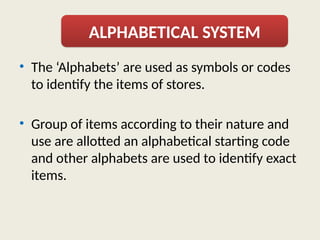
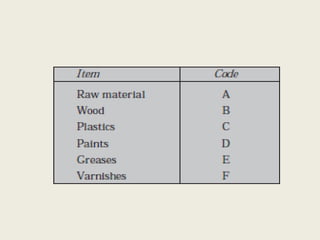
• The ‘Alphabets’are used as symbols or codes
to identify the items of stores.
• Group of items according to their nature and
use are allotted an alphabetical starting code
and other alphabets are used to identify exact
items.
ALPHABETICAL SYSTEM
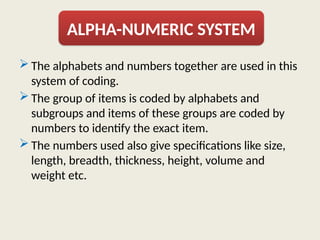
The alphabetsand numbers together are used in this
system of coding.
The group of items is coded by alphabets and
subgroups and items of these groups are coded by
numbers to identify the exact item.
The numbers used also give specifications like size,
length, breadth, thickness, height, volume and
weight etc.
ALPHA-NUMERIC SYSTEM
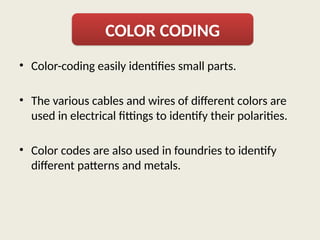
• Color-coding easilyidentifies small parts.
• The various cables and wires of different colors are
used in electrical fittings to identify their polarities.
• Color codes are also used in foundries to identify
different patterns and metals.
COLOR CODING
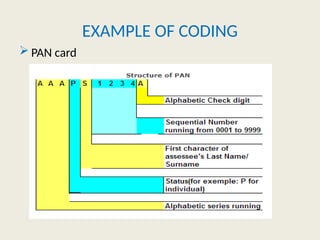
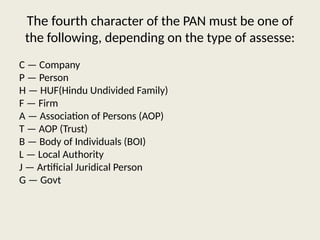
The fourth characterof the PAN must be one of
the following, depending on the type of assesse:
C — Company
P — Person
H — HUF(Hindu Undivided Family)
F — Firm
A — Association of Persons (AOP)
T — AOP (Trust)
B — Body of Individuals (BOI)
L — Local Authority
J — Artificial Juridical Person
G — Govt
23.
REFERENCES
Sadiwala, C.M.,& Sasiwala, Ritesh C. (2007).
MATERIALS AND FINANCIAL MANAGEMENT. New
Delhi: New Age International Publisher.
< http://
www.citeman.com/4466-codification-in-materials-m
anagement.html
>
< http://
www.shareyouressays.com/116388/8-common-met
hods-of-of-store-management-and-codification
>
<http://
www.materialsmanagement.info/inventory/invento
24.
QUESTIONS
What iscoding?
Write down importance of coding?
What are different type of coding ? Explain
it with example.
What are advantages and disadvantages of
coding?
Give any real life (daily routing) example of
coding?




![Production & Operation Management Chapter24[1]](https://cdn.slidesharecdn.com/ss_thumbnails/chapter241-140613051634-phpapp02-thumbnail.jpg?width=640&height=640&fit=bounds)


![[DSC Europe 25] Predrag Maletic - Scaling AI in Banking – Our Strategic Journ...](https://cdn.slidesharecdn.com/ss_thumbnails/qu2onv0aruwlvqtygmxx-predrag-maletic-scaling-ai-in-banking-260123083019-6cf1da1d-thumbnail.jpg?width=640&height=640&fit=bounds)


