ISO
INTERNATIONAL
ORGANIZATION FOR
STANDARDIZATION
I.S.O. or ISO?
• ISO is not an acronym, but was derived from a
Greek word “isos” meaning “equal”. The relation to
standards is that if two objects meet the same
standard, they should be equal.
• The International Organization for Standardization
is a voluntary organization whose members are
recognized standard authorities, each one
representing one country.
• The American National Standards Institute (ANSI)
is the United States Representative to ISO.
• ISO Main Headquarters in located in Geneva,
Switzerland.
Some History
• (AQAP) Allied Quality Assurance Publication..WW11.
A series of publications on everything from
production efficiency to selection of suppliers.
• AQAP Series was adopted by the UK Ministry of
Defense for the British Arms Forces.
• A trickle down effect was more organizations began
to require Quality Assurance Programs from their
Suppliers.
• 1979 British Standard (BS) 5750 adopted based
largely on the AQAP Series. The British version
addressed the diversity issues emerging in the
requirements for different organizations.
More History
• BS 5750 was so effective, it was
adopted with very little changes by
ISO in 1987 as ISO 9000.
• The formation of the European Union
and the perception that it (ISO) was
required in order to do business with
Europe, lead to the widespread
acceptance of the ISO series.
MIL-Q-9858 & MIL-I-45208
USA
• ONE SIZE FITS ALL APPROACH
• NO ALLOWANCE FOR INNOVATIONS-
PROCESS MATURITY
• POTENTIAL CUSTOMER COST SAVINGS
LOST
• DETAILED DESIGN SPECS REPLACED
WITH PERFORMANCE-BASED SPECS.
• IN 1996, THESE MODELS WERE
SUPERCEDED WITH ANSI/ASQC Q-9000
SERIES
Commercial- Military
Integration
1994-Acquisition Reform
• Reduce total ownership costs
• Reduce acquisition time
• Promote standardization of
materials, facilities,and engineering
practices to improve military
readiness
Defense Standardization
Program
• Gov’t unique specifications were a
barrier to commercial-military
integration
• Cancelled or inactivated thousands
of documents
• Greater reliance on the use of non-
government standards
Every ISO Member Body is
responsible for:
• Informing potentially interested parties in the
country of relevant international standardization
opportunities/initiatives
• Ensuring that a concerted view of the country’s
interest is presented during international
negotiations leading to standards agreement
• Providing their share of financial support for the
central operations of ISO, through the payment of
membership dues
• Representing vendors, manufacturers, consumers,
professionals and government of it’s country
Other Members
• Correspondent Member-usually an
organization in a country which does not yet have a fully
developed national standards activity. Do not take an active
part in the technical and policy development work, but are
kept fully informed about the work of interest to them
• Subscriber Membership-established for
countries with very small economies. Subscribers
members pay reduced membership fees that nevertheless
allow them to maintain contact with international
standardization.
How is it financed?
• Membership dues-80%
• Sales of Standards and other Publications-20%
• Subscriptions are expressed in units and
calculated in Swiss francs
• Factors affecting dues: gross national product
(GNP) and Value of imports and exports
• Others expenditures: Voluntary time and travel
for approx. 30,000 experts (several hundred
million Swiss francs per year)
Who does the work?
• A highly decentralized hierarchy of some 2850 technical
committees, subcommittees and working groups. Hence
the 30000 experts. The premise is that equal partners come
together in the resolution of global standardization
problems
• Qualified representatives of;
industry
research institutes
government authorities
consumer bodies
international organizations from all over the world
The Goal of ISO
• Enhanced product Quality and Reliability at a
reasonable price
• Improved health and safety and environmental
protection and reduction of waste-(ISO 14000)
• Greater compatibility and interoperability of
goods and services
• Reduction in the number of models and thus,
reduction in costs
• Increased distribution efficiency and ease of
maintenance
• Simplification for improved usability
ISO and WTO
• Strategic partnership-common goal of
promoting free and fair global trading
• WTO agreements require underpinning by
technical agreements (ISO)
• ISO recognized by WTO for special
technical support in relationship to new
and expanded WTO programs
Regional Partners
• ISO has recognized regional standards
organizations representing:
Africa
The Arab Countries
Commonwealth of Independent States
Europe
Latin America
The Pacific area
South-East Asia Nations
(Some) ISO “Achievements”
• ISO Film Speed Code-among
photographic equipment standards, it has
been adopted worldwide to make things
simpler for the user
• Telephone & Banking Cards-
standardization of the format means that
they can be used worldwide
• Internationally Standardized
Freight Container-air, sea
railways,highways packages interface
efficiently. Other standardized
documents identifying sensitive or
hazardous cargoes making international
trade cheaper, faster and safer.
• Paper Sizes-With ISO 216, standard
paper sizes allow economies of scale
with cost benefits to both producers and
consumers
• Symbols for Automobile
Controls-well designed symbol conveys a
clear cut message in a multi-lingual world.
These symbols are displayed in automobiles
over the world, no matter where they were
produced.
• 12,000 International Standards-
more than 300,000 pages in English and
French with terminology provided for
other languages
• Others:
Automobile bumper heights, sizes and colors
of road signs, hygiene and toxicity in the food
industry, nut /bolts combinations, light
measurement in photography, child resistant
packaging,standards for monitoring the state of
the environment and standards for safety of
machinery and protective clothing
ISO 9000 Series
• ISO 9001-applies to organizations that design, develop, produce,
install and service product (Tenergy Water, for instance)
• 20 sets of Quality System Requirements (Elements)
• ISO 9002-applies to organizations that produce, install and service
product
• 19 sets of Quality System Requirements (Elements)
• ISO 9003-applies to organizations that assure Quality through
Final Inspection and Testing.
• 16 sets of Quality System Requirements (Elements)
(missing 4.4, 4.6, 4.9 and 4.19)
What exactly is ISO 9001?
• A series of Standardized Quality System
“Frameworks” which are designed to
detect and prevent Quality problems.
• There are 20 Elements in the ISO 9001
Standard. Each element outlines Quality
issues which the company is required to
address as part of the Quality System in
order to be certified or compliant.
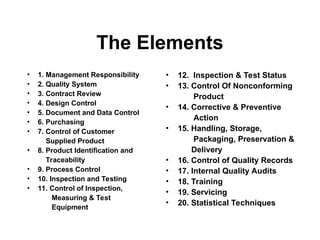
The Elements
• 1. Management Responsibility
• 2. Quality System
• 3. Contract Review
• 4. Design Control
• 5. Document and Data Control
• 6. Purchasing
• 7. Control of Customer
Supplied Product
• 8. Product Identification and
Traceability
• 9. Process Control
• 10. Inspection and Testing
• 11. Control of Inspection,
Measuring & Test
Equipment
• 12. Inspection & Test Status
• 13. Control Of Nonconforming
Product
• 14. Corrective & Preventive
Action
• 15. Handling, Storage,
Packaging, Preservation &
Delivery
• 16. Control of Quality Records
• 17. Internal Quality Audits
• 18. Training
• 19. Servicing
• 20. Statistical Techniques
4.1 Management
Responsibility
• Commitment
• Overall Plan
• Steering Committee
• Quality Objectives
• Management Review
• Appoint a senior executive ( The management
Representative) to manage the quality system and
give him/her the necessary authority to
maintain it
Management Responsibility
2
• Define a Quality Policy. Policy should describe
company’s attitude towards Quality
• Identify and provide resources for people to
manage, perform and verify Quality System work
• Define Quality System responsibilities; insure
Quality System personnel have the authority to
carry out these responsibilities and ensure that
interactions between these personnel are clearly
specified. Document this well.
• Define a procedure that Senior Managers can use
to review the effectiveness of the Quality System
4.2 Quality System
• Develop the Quality System
• A manual that describes it
• Procedures, processes that are consistent
with Quality Policy
• Quality plans to show how you intend to
fulfill quality system requirements
• Develop plans for product, processes,
projects and Customer Contracts
4.3 Contract Review
• Determine Requirements
• Procedure to ensure that all contractual
requirements are acceptable before
agreement to provide product to customer
• System for documenting review of
customer contracts and sales orders
• Procedure to amending contracts and
ensuring changes are communicated
throughout the organization
4.4 Design Control
• Procedures to control the design and
development process
• Identify groups involved and communication
methods
• Procedure to control design outputs
• Design outputs at all stages verified
• Design modifications-how are changes
implemented?
• Design inputs identified, documented, reviewed,
flaws and deficiencies are resolved
Design Control 2
• 4.4.1 General
• 4.4.2 Design and
development
planning
• 4.4.3
Organizational and
Technical
Interfaces
• 4.4.4 Design Input
• Design Output
• Design review
• Design verification
• Design validation
• Design Changes
4.5 Document & Data
Control
• Develop procedures to control
quality system documents, records
and data
• Procedures to review, approve and
manage all quality system
documents, records and data
• Procedures to control changes to
documents and data
4.6 Purchasing
• Supplier Selection-
based on capability,
performance history
• Customer
Requirements
Flowdown
• Ensure P.O.’s
document precisely
what to buy
• Purchase Order
change control
• Procedures to verify
the acceptability of
purchases to you and
the Customer
• List of Approved
Suppliers-procedure
to add or delete from
the list
• Use of approved
Suppliers
4.7 Control of Customer
Supplied Product
• Correct & undamaged when received
• Record & report to Customer
damage, etc.
• Traceable ownership
• Identification and Use
• Protect and Maintain (how & who)
• Dispose as Customer directs
4.8 Product Identification
and Traceability
• Identify and document products at every
step from purchase through all stages of
handling, storage, production, delivery,
installation and servicing
• Prevent product mixing
• Trace product or product batches by
means of unique identifiers and record
keeping
4.9 Process Control
• Develop procedures to plan, monitor
and control production, installation
and servicing processes
• Develop a record keeping system
that monitors and controls process
personnel and equipment
• Insure that all important processes
qualities are monitored and recorded
4.10 Inspection & Testing
• Quality Plan-decide where, when and
how-(incoming, in-process and final
inspections)
• How records are maintained
• Identification (Acceptance/Rejection)
• Disposition (Acceptance/Rejection)
• Procedures to ensure product meets
all requirements prior to shipping
4.11 Control of Inspection,
Measuring & Test Equipm’t
• Develop procedures to control,
calibrate and maintain inspection,
measuring/test equipment (hardware
and software)
• Ensure measurement equipment is
appropriate, effective and secure
• Calibration procedures for all quality
measuring and test equipment
4.12 Inspection & Test
Status
• Identify conformance
status-accept/reject at all points of
production process
• The test status of the product is
documented and respected
throughout the production,
installation and service process
4.13 Control of
Nonconforming Product
• Prevent from
unintended use
• Documented
• Identify and segregate
• Disposition by
qualified personnel
(MRB)
• Observe contractural
or regulatory
limitations
• Identify root cause of
defect
• Record of
dispositions
• Reinspect/retest after
rework and repair
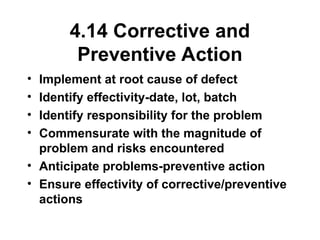
4.14 Corrective and
Preventive Action
• Implement at root cause of defect
• Identify effectivity-date, lot, batch
• Identify responsibility for the problem
• Commensurate with the magnitude of
problem and risks encountered
• Anticipate problems-preventive action
• Ensure effectivity of corrective/preventive
actions
4.15 Handling, Storage,
Packaging, Preservation &
Delivery
• Methods to prevent damage or
deterioration through all stages of
production
• Designate storage areas
• Periodic assessment of material in storage
• Identify shelf-life sensitive items
• Protect to destination when required
4.16 Control of Quality
Records
• What records are “Quality Records”?
• How long to retain, where, how?
• Define storage conditions
• Customer availability
• Hard copy or electronic media
• Protect from unauthorized access
and subsequent alteration
4.17 Internal Quality Audits
• What we say we do
• Measure performance
of the Quality System
• Scheduled events
performed by
qualified auditors
independent of their
functions
• Objective evidence
• Report to
management for
review
• Discuss with auditee
• Timely and
appropriate corrective
action
• Follow up for
effectiveness
4.18 Training
• Identify needs
• Who to train?
• Who will provide
the training?
• How will training
be provided?
• Quality system
training
• What is training
schedule?
• How will training
effectiveness be
measured?
• What training
records will be
generated?
4.19 Servicing
• Installation
• Returned product-not defective
• Technical information
• Trained personnel
• Procedures, materials, equipment
• Train customer personnel
4.20 Statistical Techniques
• Establish, control & verify process
capability
• Measure product characteristics
• Defined by qualified personnel
• Documented procedures
WHY DO WE NEED IT?
• can be Customer driven.
• Inspires more confidence in products
and services that conform to the
same standards
• Improves internal controls
• Increases employee involvement
• provides a competitive edge
Benefits for me?
• Potential increase in business
volume which means job stability
• Outlet for ideas affecting Quality
• More control of your job
• Decrease in uncertainty of
expectations
• Less stress
Does it change how we do
things?
• No, in most cases. It means we
document what we are already doing.
• “Document what you do and do what
you say you do.”
• There would be some areas that will
require written procedures to meet
certain specific requirements.
The Process(in a nutshell)
• Create procedures
that meet the ISO
Model for a Quality
Management
System
• Train internal
auditors to perform
system audits.
• Independent third
party audit
conducted by a
Registrar for
certification
• Maintain quality
system. Audited
every six months
to remain certified
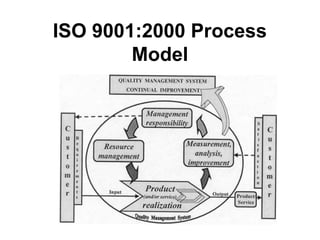
ISO 9001:2000 Process
Model
ISO 9001:2000
• Why are standards
being revised?
• What are the major
changes?
• What do we do
now?
When will it happen?
• Final standard release is scheduled for
December 15, 2000.
• In three (3) years from the actual
publication release, ISO 9002 and ISO
9003 and all associated guidelines will be
history.
• ISO 9001 Quality Management Systems
will have to be amended to comply with
the new standard.
Why the need for change?
• ISO required 5-year standards review
• Difficult for small businesses
• Oriented towards manufacturing
• Proliferation of guideline standards
• Need to reduce documentation
Some Changes
• ISO 9001-ISO 9002-ISO 9003 (3 Stds)
will become ISO 9001:2000 (1Std)
• 20 Sections(Elements) Structure will
become main 5 Sections based on 8
Principles
• From a Quality Management System
to a Business Management System
KEY NEW REQUIREMENTS
• Process
oriented/continual
improvement
• Increased emphasis on
role of Top
Management
• Consideration of legal
and regulatory
requirements
• Establishment of
measurable
objectives/planning
• Determination of
training effectiveness
• Measurement and
analysis of system
performance (process
and product)
• Monitoring of
information and
customer satisfaction
dissatisfaction
• Increased attention to
resource availability
Let’s make believe
• Contract Review-procedures to assure your
customer needs and expectations are converted
to Customer Requirements
• Established employee awareness and training
programs
• Defined processes for evaluating the training
program’s effectiveness
• Defined processes for internal communication
More make believe
• Defined processes for communicating with
Customers regarding: product information, order
handling, and processing, customer complaints
and customer feedback.
• Added employee communication and training
processes to create awareness of Customer
requirements and importance of meeting them
• Defined processes to measure Customer
satisfaction, which may include existing
Customer complaint process
A few more
• Defined processes for collection and
analysis of quality performance data, and
use of the data to facilitate continual
improvement
• Established Quality objectives and plans
to support the Quality Policy
• Specific quality policy language to include
a commitment to continual improvement
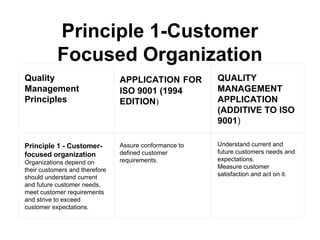
Quality
Management
Principles
APPLICATION FOR
ISO 9001 (1994
EDITION)
QUALITY
MANAGEMENT
APPLICATION
(ADDITIVE TO ISO
9001)
Principle 1 - Customer-
focused organization
Organizations depend on
their customers and therefore
should understand current
and future customer needs,
meet customer requirements
and strive to exceed
customer expectations.
Assure conformance to
defined customer
requirements.
Understand current and
future customers needs and
expectations.
Measure customer
satisfaction and act on it.
Principle 1-Customer
Focused Organization
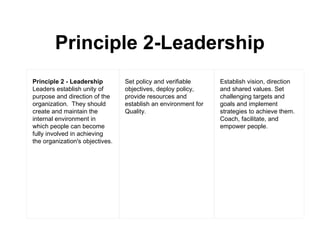
Principle 2 - Leadership
Leaders establish unity of
purpose and direction of the
organization. They should
create and maintain the
internal environment in
which people can become
fully involved in achieving
the organization's objectives.
Set policy and verifiable
objectives, deploy policy,
provide resources and
establish an environment for
Quality.
Establish vision, direction
and shared values. Set
challenging targets and
goals and implement
strategies to achieve them.
Coach, facilitate, and
empower people.
Principle 2-Leadership
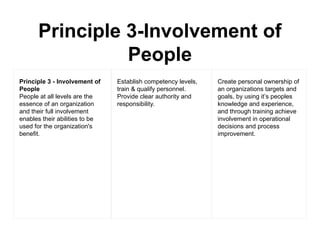
Principle 3 - Involvement of
People
People at all levels are the
essence of an organization
and their full involvement
enables their abilities to be
used for the organization's
benefit.
Establish competency levels,
train & qualify personnel.
Provide clear authority and
responsibility.
Create personal ownership of
an organizations targets and
goals, by using it’s peoples
knowledge and experience,
and through training achieve
involvement in operational
decisions and process
improvement.
Principle 3-Involvement of
People
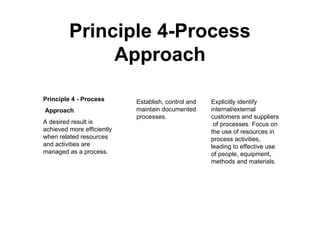
Principle 4-Process
Approach
Principle 4 - Process
Approach
A desired result is
achieved more efficiently
when related resources
and activities are
managed as a process.
Establish, control and
maintain documented
processes.
Explicitly identify
internal/external
customers and suppliers
of processes. Focus on
the use of resources in
process activities,
leading to effective use
of people, equipment,
methods and materials.
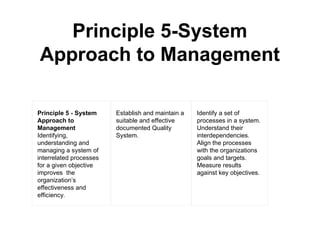
Principle 5 - System
Approach to
Management
Identifying,
understanding and
managing a system of
interrelated processes
for a given objective
improves the
organization’s
effectiveness and
efficiency.
Establish and maintain a
suitable and effective
documented Quality
System.
Identify a set of
processes in a system.
Understand their
interdependencies.
Align the processes
with the organizations
goals and targets.
Measure results
against key objectives.
Principle 5-System
Approach to Management
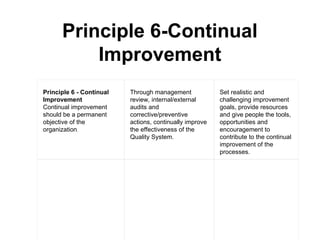
Principle 6-Continual
Improvement
Principle 6 - Continual
Improvement
Continual improvement
should be a permanent
objective of the
organization.
Through management
review, internal/external
audits and
corrective/preventive
actions, continually improve
the effectiveness of the
Quality System.
Set realistic and
challenging improvement
goals, provide resources
and give people the tools,
opportunities and
encouragement to
contribute to the continual
improvement of the
processes.
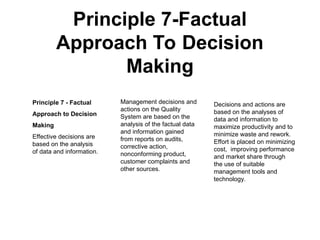
Principle 7-Factual
Approach To Decision
Making
Principle 7 - Factual
Approach to Decision
Making
Effective decisions are
based on the analysis
of data and information.
Management decisions and
actions on the Quality
System are based on the
analysis of the factual data
and information gained
from reports on audits,
corrective action,
nonconforming product,
customer complaints and
other sources.
Decisions and actions are
based on the analyses of
data and information to
maximize productivity and to
minimize waste and rework.
Effort is placed on minimizing
cost, improving performance
and market share through
the use of suitable
management tools and
technology.
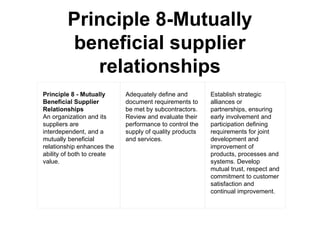
Principle 8 - Mutually
Beneficial Supplier
Relationships
An organization and its
suppliers are
interdependent, and a
mutually beneficial
relationship enhances the
ability of both to create
value.
Adequately define and
document requirements to
be met by subcontractors.
Review and evaluate their
performance to control the
supply of quality products
and services.
Establish strategic
alliances or
partnerships, ensuring
early involvement and
participation defining
requirements for joint
development and
improvement of
products, processes and
systems. Develop
mutual trust, respect and
commitment to customer
satisfaction and
continual improvement.
Principle 8-Mutually
beneficial supplier
relationships
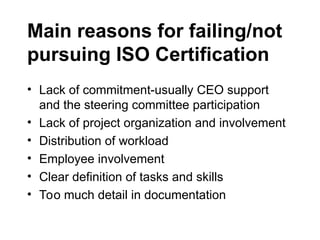
Main reasons for failing/not
pursuing ISO Certification
• Lack of commitment-usually CEO support
and the steering committee participation
• Lack of project organization and involvement
• Distribution of workload
• Employee involvement
• Clear definition of tasks and skills
• Too much detail in documentation
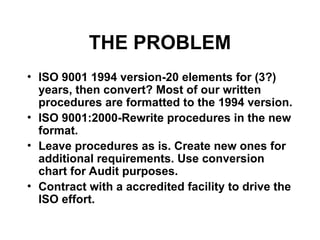
THE PROBLEM
• ISO 9001 1994 version-20 elements for (3?)
years, then convert? Most of our written
procedures are formatted to the 1994 version.
• ISO 9001:2000-Rewrite procedures in the new
format.
• Leave procedures as is. Create new ones for
additional requirements. Use conversion
chart for Audit purposes.
• Contract with a accredited facility to drive the
ISO effort.
“WE” CAN DO THIS

ISO_Overview.ppt PRESENTATION ON INTERNATIONAL

  • 1.
  • 2.
    I.S.O. or ISO? •ISO is not an acronym, but was derived from a Greek word “isos” meaning “equal”. The relation to standards is that if two objects meet the same standard, they should be equal. • The International Organization for Standardization is a voluntary organization whose members are recognized standard authorities, each one representing one country. • The American National Standards Institute (ANSI) is the United States Representative to ISO. • ISO Main Headquarters in located in Geneva, Switzerland.
  • 3.
    Some History • (AQAP)Allied Quality Assurance Publication..WW11. A series of publications on everything from production efficiency to selection of suppliers. • AQAP Series was adopted by the UK Ministry of Defense for the British Arms Forces. • A trickle down effect was more organizations began to require Quality Assurance Programs from their Suppliers. • 1979 British Standard (BS) 5750 adopted based largely on the AQAP Series. The British version addressed the diversity issues emerging in the requirements for different organizations.
  • 4.
    More History • BS5750 was so effective, it was adopted with very little changes by ISO in 1987 as ISO 9000. • The formation of the European Union and the perception that it (ISO) was required in order to do business with Europe, lead to the widespread acceptance of the ISO series.
  • 5.
    MIL-Q-9858 & MIL-I-45208 USA •ONE SIZE FITS ALL APPROACH • NO ALLOWANCE FOR INNOVATIONS- PROCESS MATURITY • POTENTIAL CUSTOMER COST SAVINGS LOST • DETAILED DESIGN SPECS REPLACED WITH PERFORMANCE-BASED SPECS. • IN 1996, THESE MODELS WERE SUPERCEDED WITH ANSI/ASQC Q-9000 SERIES
  • 6.
    Commercial- Military Integration 1994-Acquisition Reform •Reduce total ownership costs • Reduce acquisition time • Promote standardization of materials, facilities,and engineering practices to improve military readiness
  • 7.
    Defense Standardization Program • Gov’tunique specifications were a barrier to commercial-military integration • Cancelled or inactivated thousands of documents • Greater reliance on the use of non- government standards
  • 8.
    Every ISO MemberBody is responsible for: • Informing potentially interested parties in the country of relevant international standardization opportunities/initiatives • Ensuring that a concerted view of the country’s interest is presented during international negotiations leading to standards agreement • Providing their share of financial support for the central operations of ISO, through the payment of membership dues • Representing vendors, manufacturers, consumers, professionals and government of it’s country
  • 9.
    Other Members • CorrespondentMember-usually an organization in a country which does not yet have a fully developed national standards activity. Do not take an active part in the technical and policy development work, but are kept fully informed about the work of interest to them • Subscriber Membership-established for countries with very small economies. Subscribers members pay reduced membership fees that nevertheless allow them to maintain contact with international standardization.
  • 10.
    How is itfinanced? • Membership dues-80% • Sales of Standards and other Publications-20% • Subscriptions are expressed in units and calculated in Swiss francs • Factors affecting dues: gross national product (GNP) and Value of imports and exports • Others expenditures: Voluntary time and travel for approx. 30,000 experts (several hundred million Swiss francs per year)
  • 11.
    Who does thework? • A highly decentralized hierarchy of some 2850 technical committees, subcommittees and working groups. Hence the 30000 experts. The premise is that equal partners come together in the resolution of global standardization problems • Qualified representatives of; industry research institutes government authorities consumer bodies international organizations from all over the world
  • 12.
    The Goal ofISO • Enhanced product Quality and Reliability at a reasonable price • Improved health and safety and environmental protection and reduction of waste-(ISO 14000) • Greater compatibility and interoperability of goods and services • Reduction in the number of models and thus, reduction in costs • Increased distribution efficiency and ease of maintenance • Simplification for improved usability
  • 13.
    ISO and WTO •Strategic partnership-common goal of promoting free and fair global trading • WTO agreements require underpinning by technical agreements (ISO) • ISO recognized by WTO for special technical support in relationship to new and expanded WTO programs
  • 14.
    Regional Partners • ISOhas recognized regional standards organizations representing: Africa The Arab Countries Commonwealth of Independent States Europe Latin America The Pacific area South-East Asia Nations
  • 15.
    (Some) ISO “Achievements” •ISO Film Speed Code-among photographic equipment standards, it has been adopted worldwide to make things simpler for the user • Telephone & Banking Cards- standardization of the format means that they can be used worldwide • Internationally Standardized Freight Container-air, sea railways,highways packages interface efficiently. Other standardized documents identifying sensitive or hazardous cargoes making international trade cheaper, faster and safer. • Paper Sizes-With ISO 216, standard paper sizes allow economies of scale with cost benefits to both producers and consumers • Symbols for Automobile Controls-well designed symbol conveys a clear cut message in a multi-lingual world. These symbols are displayed in automobiles over the world, no matter where they were produced. • 12,000 International Standards- more than 300,000 pages in English and French with terminology provided for other languages • Others: Automobile bumper heights, sizes and colors of road signs, hygiene and toxicity in the food industry, nut /bolts combinations, light measurement in photography, child resistant packaging,standards for monitoring the state of the environment and standards for safety of machinery and protective clothing
  • 16.
    ISO 9000 Series •ISO 9001-applies to organizations that design, develop, produce, install and service product (Tenergy Water, for instance) • 20 sets of Quality System Requirements (Elements) • ISO 9002-applies to organizations that produce, install and service product • 19 sets of Quality System Requirements (Elements) • ISO 9003-applies to organizations that assure Quality through Final Inspection and Testing. • 16 sets of Quality System Requirements (Elements) (missing 4.4, 4.6, 4.9 and 4.19)
  • 17.
    What exactly isISO 9001? • A series of Standardized Quality System “Frameworks” which are designed to detect and prevent Quality problems. • There are 20 Elements in the ISO 9001 Standard. Each element outlines Quality issues which the company is required to address as part of the Quality System in order to be certified or compliant.
  • 18.
    The Elements • 1.Management Responsibility • 2. Quality System • 3. Contract Review • 4. Design Control • 5. Document and Data Control • 6. Purchasing • 7. Control of Customer Supplied Product • 8. Product Identification and Traceability • 9. Process Control • 10. Inspection and Testing • 11. Control of Inspection, Measuring & Test Equipment • 12. Inspection & Test Status • 13. Control Of Nonconforming Product • 14. Corrective & Preventive Action • 15. Handling, Storage, Packaging, Preservation & Delivery • 16. Control of Quality Records • 17. Internal Quality Audits • 18. Training • 19. Servicing • 20. Statistical Techniques
  • 19.
    4.1 Management Responsibility • Commitment •Overall Plan • Steering Committee • Quality Objectives • Management Review • Appoint a senior executive ( The management Representative) to manage the quality system and give him/her the necessary authority to maintain it
  • 20.
    Management Responsibility 2 • Definea Quality Policy. Policy should describe company’s attitude towards Quality • Identify and provide resources for people to manage, perform and verify Quality System work • Define Quality System responsibilities; insure Quality System personnel have the authority to carry out these responsibilities and ensure that interactions between these personnel are clearly specified. Document this well. • Define a procedure that Senior Managers can use to review the effectiveness of the Quality System
  • 21.
    4.2 Quality System •Develop the Quality System • A manual that describes it • Procedures, processes that are consistent with Quality Policy • Quality plans to show how you intend to fulfill quality system requirements • Develop plans for product, processes, projects and Customer Contracts
  • 22.
    4.3 Contract Review •Determine Requirements • Procedure to ensure that all contractual requirements are acceptable before agreement to provide product to customer • System for documenting review of customer contracts and sales orders • Procedure to amending contracts and ensuring changes are communicated throughout the organization
  • 23.
    4.4 Design Control •Procedures to control the design and development process • Identify groups involved and communication methods • Procedure to control design outputs • Design outputs at all stages verified • Design modifications-how are changes implemented? • Design inputs identified, documented, reviewed, flaws and deficiencies are resolved
  • 24.
    Design Control 2 •4.4.1 General • 4.4.2 Design and development planning • 4.4.3 Organizational and Technical Interfaces • 4.4.4 Design Input • Design Output • Design review • Design verification • Design validation • Design Changes
  • 25.
    4.5 Document &Data Control • Develop procedures to control quality system documents, records and data • Procedures to review, approve and manage all quality system documents, records and data • Procedures to control changes to documents and data
  • 26.
    4.6 Purchasing • SupplierSelection- based on capability, performance history • Customer Requirements Flowdown • Ensure P.O.’s document precisely what to buy • Purchase Order change control • Procedures to verify the acceptability of purchases to you and the Customer • List of Approved Suppliers-procedure to add or delete from the list • Use of approved Suppliers
  • 27.
    4.7 Control ofCustomer Supplied Product • Correct & undamaged when received • Record & report to Customer damage, etc. • Traceable ownership • Identification and Use • Protect and Maintain (how & who) • Dispose as Customer directs
  • 28.
    4.8 Product Identification andTraceability • Identify and document products at every step from purchase through all stages of handling, storage, production, delivery, installation and servicing • Prevent product mixing • Trace product or product batches by means of unique identifiers and record keeping
  • 29.
    4.9 Process Control •Develop procedures to plan, monitor and control production, installation and servicing processes • Develop a record keeping system that monitors and controls process personnel and equipment • Insure that all important processes qualities are monitored and recorded
  • 30.
    4.10 Inspection &Testing • Quality Plan-decide where, when and how-(incoming, in-process and final inspections) • How records are maintained • Identification (Acceptance/Rejection) • Disposition (Acceptance/Rejection) • Procedures to ensure product meets all requirements prior to shipping
  • 31.
    4.11 Control ofInspection, Measuring & Test Equipm’t • Develop procedures to control, calibrate and maintain inspection, measuring/test equipment (hardware and software) • Ensure measurement equipment is appropriate, effective and secure • Calibration procedures for all quality measuring and test equipment
  • 32.
    4.12 Inspection &Test Status • Identify conformance status-accept/reject at all points of production process • The test status of the product is documented and respected throughout the production, installation and service process
  • 33.
    4.13 Control of NonconformingProduct • Prevent from unintended use • Documented • Identify and segregate • Disposition by qualified personnel (MRB) • Observe contractural or regulatory limitations • Identify root cause of defect • Record of dispositions • Reinspect/retest after rework and repair
  • 34.
    4.14 Corrective and PreventiveAction • Implement at root cause of defect • Identify effectivity-date, lot, batch • Identify responsibility for the problem • Commensurate with the magnitude of problem and risks encountered • Anticipate problems-preventive action • Ensure effectivity of corrective/preventive actions
  • 35.
    4.15 Handling, Storage, Packaging,Preservation & Delivery • Methods to prevent damage or deterioration through all stages of production • Designate storage areas • Periodic assessment of material in storage • Identify shelf-life sensitive items • Protect to destination when required
  • 36.
    4.16 Control ofQuality Records • What records are “Quality Records”? • How long to retain, where, how? • Define storage conditions • Customer availability • Hard copy or electronic media • Protect from unauthorized access and subsequent alteration
  • 37.
    4.17 Internal QualityAudits • What we say we do • Measure performance of the Quality System • Scheduled events performed by qualified auditors independent of their functions • Objective evidence • Report to management for review • Discuss with auditee • Timely and appropriate corrective action • Follow up for effectiveness
  • 38.
    4.18 Training • Identifyneeds • Who to train? • Who will provide the training? • How will training be provided? • Quality system training • What is training schedule? • How will training effectiveness be measured? • What training records will be generated?
  • 39.
    4.19 Servicing • Installation •Returned product-not defective • Technical information • Trained personnel • Procedures, materials, equipment • Train customer personnel
  • 40.
    4.20 Statistical Techniques •Establish, control & verify process capability • Measure product characteristics • Defined by qualified personnel • Documented procedures
  • 41.
    WHY DO WENEED IT? • can be Customer driven. • Inspires more confidence in products and services that conform to the same standards • Improves internal controls • Increases employee involvement • provides a competitive edge
  • 42.
    Benefits for me? •Potential increase in business volume which means job stability • Outlet for ideas affecting Quality • More control of your job • Decrease in uncertainty of expectations • Less stress
  • 43.
    Does it changehow we do things? • No, in most cases. It means we document what we are already doing. • “Document what you do and do what you say you do.” • There would be some areas that will require written procedures to meet certain specific requirements.
  • 44.
    The Process(in anutshell) • Create procedures that meet the ISO Model for a Quality Management System • Train internal auditors to perform system audits. • Independent third party audit conducted by a Registrar for certification • Maintain quality system. Audited every six months to remain certified
  • 45.
  • 46.
    ISO 9001:2000 • Whyare standards being revised? • What are the major changes? • What do we do now?
  • 47.
    When will ithappen? • Final standard release is scheduled for December 15, 2000. • In three (3) years from the actual publication release, ISO 9002 and ISO 9003 and all associated guidelines will be history. • ISO 9001 Quality Management Systems will have to be amended to comply with the new standard.
  • 48.
    Why the needfor change? • ISO required 5-year standards review • Difficult for small businesses • Oriented towards manufacturing • Proliferation of guideline standards • Need to reduce documentation
  • 49.
    Some Changes • ISO9001-ISO 9002-ISO 9003 (3 Stds) will become ISO 9001:2000 (1Std) • 20 Sections(Elements) Structure will become main 5 Sections based on 8 Principles • From a Quality Management System to a Business Management System
  • 50.
    KEY NEW REQUIREMENTS •Process oriented/continual improvement • Increased emphasis on role of Top Management • Consideration of legal and regulatory requirements • Establishment of measurable objectives/planning • Determination of training effectiveness • Measurement and analysis of system performance (process and product) • Monitoring of information and customer satisfaction dissatisfaction • Increased attention to resource availability
  • 51.
    Let’s make believe •Contract Review-procedures to assure your customer needs and expectations are converted to Customer Requirements • Established employee awareness and training programs • Defined processes for evaluating the training program’s effectiveness • Defined processes for internal communication
  • 52.
    More make believe •Defined processes for communicating with Customers regarding: product information, order handling, and processing, customer complaints and customer feedback. • Added employee communication and training processes to create awareness of Customer requirements and importance of meeting them • Defined processes to measure Customer satisfaction, which may include existing Customer complaint process
  • 53.
    A few more •Defined processes for collection and analysis of quality performance data, and use of the data to facilitate continual improvement • Established Quality objectives and plans to support the Quality Policy • Specific quality policy language to include a commitment to continual improvement
  • 54.
    Quality Management Principles APPLICATION FOR ISO 9001(1994 EDITION) QUALITY MANAGEMENT APPLICATION (ADDITIVE TO ISO 9001) Principle 1 - Customer- focused organization Organizations depend on their customers and therefore should understand current and future customer needs, meet customer requirements and strive to exceed customer expectations. Assure conformance to defined customer requirements. Understand current and future customers needs and expectations. Measure customer satisfaction and act on it. Principle 1-Customer Focused Organization
  • 55.
    Principle 2 -Leadership Leaders establish unity of purpose and direction of the organization. They should create and maintain the internal environment in which people can become fully involved in achieving the organization's objectives. Set policy and verifiable objectives, deploy policy, provide resources and establish an environment for Quality. Establish vision, direction and shared values. Set challenging targets and goals and implement strategies to achieve them. Coach, facilitate, and empower people. Principle 2-Leadership
  • 56.
    Principle 3 -Involvement of People People at all levels are the essence of an organization and their full involvement enables their abilities to be used for the organization's benefit. Establish competency levels, train & qualify personnel. Provide clear authority and responsibility. Create personal ownership of an organizations targets and goals, by using it’s peoples knowledge and experience, and through training achieve involvement in operational decisions and process improvement. Principle 3-Involvement of People
  • 57.
    Principle 4-Process Approach Principle 4- Process Approach A desired result is achieved more efficiently when related resources and activities are managed as a process. Establish, control and maintain documented processes. Explicitly identify internal/external customers and suppliers of processes. Focus on the use of resources in process activities, leading to effective use of people, equipment, methods and materials.
  • 58.
    Principle 5 -System Approach to Management Identifying, understanding and managing a system of interrelated processes for a given objective improves the organization’s effectiveness and efficiency. Establish and maintain a suitable and effective documented Quality System. Identify a set of processes in a system. Understand their interdependencies. Align the processes with the organizations goals and targets. Measure results against key objectives. Principle 5-System Approach to Management
  • 59.
    Principle 6-Continual Improvement Principle 6- Continual Improvement Continual improvement should be a permanent objective of the organization. Through management review, internal/external audits and corrective/preventive actions, continually improve the effectiveness of the Quality System. Set realistic and challenging improvement goals, provide resources and give people the tools, opportunities and encouragement to contribute to the continual improvement of the processes.
  • 60.
    Principle 7-Factual Approach ToDecision Making Principle 7 - Factual Approach to Decision Making Effective decisions are based on the analysis of data and information. Management decisions and actions on the Quality System are based on the analysis of the factual data and information gained from reports on audits, corrective action, nonconforming product, customer complaints and other sources. Decisions and actions are based on the analyses of data and information to maximize productivity and to minimize waste and rework. Effort is placed on minimizing cost, improving performance and market share through the use of suitable management tools and technology.
  • 61.
    Principle 8 -Mutually Beneficial Supplier Relationships An organization and its suppliers are interdependent, and a mutually beneficial relationship enhances the ability of both to create value. Adequately define and document requirements to be met by subcontractors. Review and evaluate their performance to control the supply of quality products and services. Establish strategic alliances or partnerships, ensuring early involvement and participation defining requirements for joint development and improvement of products, processes and systems. Develop mutual trust, respect and commitment to customer satisfaction and continual improvement. Principle 8-Mutually beneficial supplier relationships
  • 62.
    Main reasons forfailing/not pursuing ISO Certification • Lack of commitment-usually CEO support and the steering committee participation • Lack of project organization and involvement • Distribution of workload • Employee involvement • Clear definition of tasks and skills • Too much detail in documentation
  • 63.
    THE PROBLEM • ISO9001 1994 version-20 elements for (3?) years, then convert? Most of our written procedures are formatted to the 1994 version. • ISO 9001:2000-Rewrite procedures in the new format. • Leave procedures as is. Create new ones for additional requirements. Use conversion chart for Audit purposes. • Contract with a accredited facility to drive the ISO effort.
  • 64.