Introduction to
international standards
and standardisation
processes
Carina Svensson, Programme Manager – Swedish Standards Institute (SIS)
Wherever you are, you’re
surrounded by standards
3
Key challenges identified
n All countries, especially developing countries need to become
”standard setters” and not only ”standard takers”
n International standards need to be trade supportive not trade
barriers
n Active involvement in development of standards internationally
will enhance possibilities for effective implementation of
standards nationally
n International standards – to become applicable and relevant to
as many countries around the globe
n International standards – support local private companies
(SMEs) competitiveness on global markets
n Support a stakeholder driven standardisation process to
increase the expertise and different perspectives incorporated in
the standard
n Standard implementation – increase the practical usage of
standards applicable to various products and services
4
International standards linkage to other
areas of importance
Good environmental and sustainable practice promoted
in ISO standards
Reduced environmental impact from production
Improved trade opportunities through better access to
global markets
Improved consumer protection and safety
Supportive of development of national legislation
Improved influence by stakeholders from private sector
in regulations/standards that they are directly affected
by
Increased global relevance and appliance of ISO
standards
5
ISO
International Standards
Organisation
ISO rules
 1 member / country in ISO
 1 member = 1 vote
ISO maintaining and developing more than
18,500 standards
ISO 14000 Environmental management, ISO 9000 Quality Management,
ISO 26000 Guidance on Social Responsibility, ISO 50001 Energy
management, ISO 31000 Risk management, ISO 22000 Food Safety
ISO Membership categories 2013
163 members/countries
 Full members (112 countries):
– Voting rights, 1 vote / country
– Right to participate in technical work
 Correspondent member (47 countries):
– Rights to attend meetings as Observers
– Reduced fees
 Subscriber members (4 countries):
– Information rights
– Reduced fees
2024-06-23 8
Global Relevance
“The required characteristic of an
International Standard that can be
used/implemented as broadly as
possible by affected industries and
other stakeholders in markets
around the world”
8
ISO/Technical Management Board (TMB) definition:
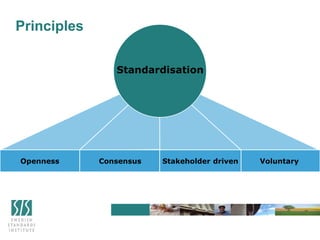
Consensus Voluntary
Stakeholder driven
Openness
Standardisation
Principles
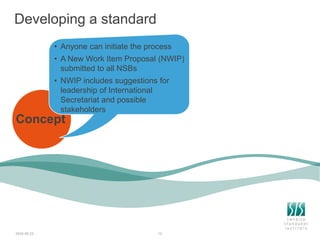
Developing a standard
2024-06-23 10
• Anyone can initiate the process
• A New Work Item Proposal (NWIP)
submitted to all NSBs
• NWIP includes suggestions for
leadership of International
Secretariat and possible
stakeholders
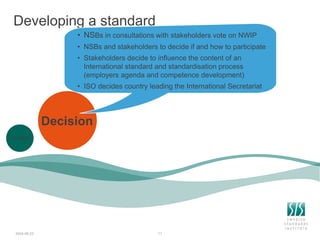
Concept
Developing a standard
2024-06-23 11
• NSBs in consultations with stakeholders vote on NWIP
• NSBs and stakeholders to decide if and how to participate
• Stakeholders decide to influence the content of an
International standard and standardisation process
(employers agenda and competence development)
• ISO decides country leading the International Secretariat
Decision
Concept
2024-06-23 12
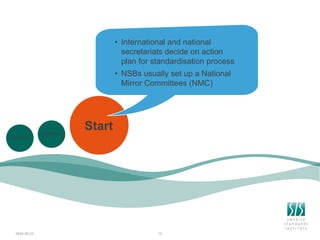
• International and national
secretariats decide on action
plan for standardisation process
• NSBs usually set up a National
Mirror Committees (NMC)
Start
Concept
Decision
Developing a standard
2024-06-23 13
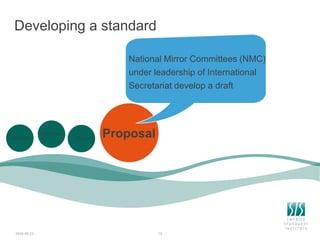
National Mirror Committees (NMC)
under leadership of International
Secretariat develop a draft
Proposal
Concept
Decision
Start
Developing a standard
2024-06-23 14
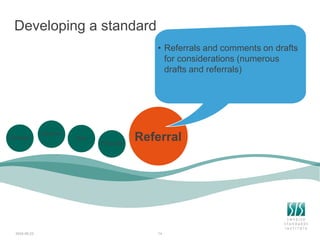
• Referrals and comments on drafts
for considerations (numerous
drafts and referrals)
Referral
Concept
Decision
Start
Proposal
Developing a standard
2024-06-23 15
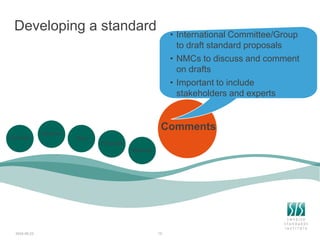
• International Committee/Group
to draft standard proposals
• NMCs to discuss and comment
on drafts
• Important to include
stakeholders and experts
Comments
Concept
Decision
Start
Proposal
Referral
Developing a standard
2024-06-23 16
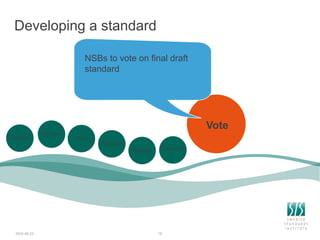
NSBs to vote on final draft
standard
Vote
Concept
Decision
Start
Proposal
Referral Comments
Developing a standard
2024-06-23 17
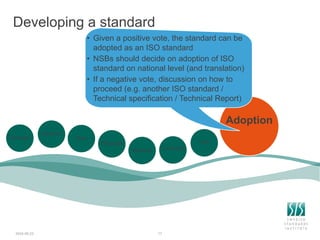
Adoption
Concept
Decision
Start
Proposal
Referral Comments
Vote
• Given a positive vote, the standard can be
adopted as an ISO standard
• NSBs should decide on adoption of ISO
standard on national level (and translation)
• If a negative vote, discussion on how to
proceed (e.g. another ISO standard /
Technical specification / Technical Report)
Developing a standard
2024-06-23 18
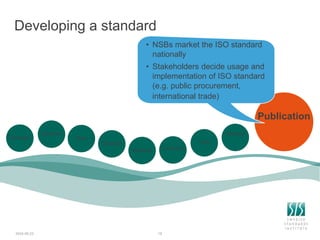
Publication
Concept
Decision
Start
Decision
Referral Comments
Adoption
• NSBs market the ISO standard
nationally
• Stakeholders decide usage and
implementation of ISO standard
(e.g. public procurement,
international trade)
Vote
What is Competitive Advantages?
… a basis for the firm’s long term success?
… a basis for value creation?
”When two or more firms compete within the same
market, one firm possesses a competitive advantage
over its rivals when it earns a persistently higher rate
of profit (or has the potential to earn a persistently
higher rate of profit)”
- R. M. Grant 2000
Sustainable Competitive
Advantages
- reflected on Products/Services
Quality of the product and quality of customer
service
Design
Innovative product / service
Customized product / service with integrated
services
Environmental friendly
Economic Advantages of standardisation
 Compatibility – compability standards between different parts and components are
essential
 Quality & Safety – increase quality and reduce risks for defective products/bad
services
 Variety Reduction - standards limits the production of a certain product to a
certain range of characteristics such as size, quality and other technical specifications
 Communication of Technical Parameters – supports trade and trade
agreements between different producers in the world
 Reduce Trade barriers – harmonization of standards and lower the costs for
certifying local products
 Reduce Transaction Cost – Standards reduce transaction costs by improving
recognition of technical characteristics and avoidance of buyer dissatisfaction.
 Use across different markets – way forward for international trade, global
applicability, harmonization of standards, facilitation of time delivery
products/services, disseminate different technologies
Economic Advantages of standardisation
 Compatibility – compability standards between different parts and components are
essential
 Quality & Safety – increase quality and reduce risks for defective products/bad
services
 Variety Reduction - standards limits the production of a certain product to a
certain range of characteristics such as size, quality and other technical specifications
 Communication of Technical Parameters – supports trade and trade
agreements between different producers in the world
 Reduce Trade barriers – harmonization of standards and lower the costs for
certifying local products
 Reduce Transaction Cost – Standards reduce transaction costs by improving
recognition of technical characteristics and avoidance of buyer dissatisfaction.
 Use across different markets – way forward for international trade, global
applicability, harmonization of standards, facilitation of time delivery
products/services, disseminate different technologies
Reduce environmental impacts
Less insurance premium
Improved operational efficiency
Better utilization of materials & resources
Reduced costs and wastage
Increased access to world markets
Improved staff morale and work environment
Assurance to interested parties
Enhanced corporate image
Encourages partnership between industry and
regulators
Environmental Advantages
Social Advantages
Standards enable Regulatory bodies to
implement technical regulations
Are used for conformity assessment - enhance
confidence
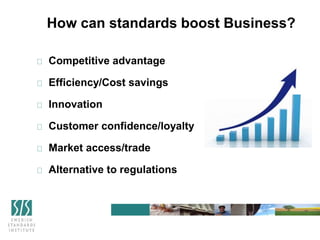
How can standards boost Business?
Competitive advantage
Efficiency/Cost savings
Innovation
Customer confidence/loyalty
Market access/trade
Alternative to regulations
Benefits of Standardisation
…To Manufactures:
Rationalize different varieties of products
Decrease the volume of products in the store and also
the manufacturer cost
Improve the management and design
Speed up the management of orders
Facilitate the exportation and marketing of products
Simplify purchasing management
Protection of consumer & community interests
….To the Public service:
Simplify the production of legal text
Establish quality, environmental and
safety policies
Help to the economical development
Facilitate the business
Benefits of Standardisation
….To the Consumer:
Establish quality and safety level to the services and
products
Inform to the characteristic of the products
Make easier the comparison between the different
offers
Consistent user interfaces
System reliability and durability
Reliability of information
Interoperability & compatibility
More transparency in the market
Benefits of Standardisation
……To the Trade
Minimization of delays, correspondence and
discussions resulting from inaccurate or
incomplete specifications of the stores
ordered
Workable basis for acceptance or rejection
of goods and for dealing with consequential
disputes
Benefits of Standardisation

carina_svensson_standardisation_introduction.pptx

  • 1.
    Introduction to international standards andstandardisation processes Carina Svensson, Programme Manager – Swedish Standards Institute (SIS)
  • 2.
    Wherever you are,you’re surrounded by standards
  • 3.
    3 Key challenges identified nAll countries, especially developing countries need to become ”standard setters” and not only ”standard takers” n International standards need to be trade supportive not trade barriers n Active involvement in development of standards internationally will enhance possibilities for effective implementation of standards nationally n International standards – to become applicable and relevant to as many countries around the globe n International standards – support local private companies (SMEs) competitiveness on global markets n Support a stakeholder driven standardisation process to increase the expertise and different perspectives incorporated in the standard n Standard implementation – increase the practical usage of standards applicable to various products and services
  • 4.
    4 International standards linkageto other areas of importance Good environmental and sustainable practice promoted in ISO standards Reduced environmental impact from production Improved trade opportunities through better access to global markets Improved consumer protection and safety Supportive of development of national legislation Improved influence by stakeholders from private sector in regulations/standards that they are directly affected by Increased global relevance and appliance of ISO standards
  • 5.
  • 6.
    ISO rules  1member / country in ISO  1 member = 1 vote ISO maintaining and developing more than 18,500 standards ISO 14000 Environmental management, ISO 9000 Quality Management, ISO 26000 Guidance on Social Responsibility, ISO 50001 Energy management, ISO 31000 Risk management, ISO 22000 Food Safety
  • 7.
    ISO Membership categories2013 163 members/countries  Full members (112 countries): – Voting rights, 1 vote / country – Right to participate in technical work  Correspondent member (47 countries): – Rights to attend meetings as Observers – Reduced fees  Subscriber members (4 countries): – Information rights – Reduced fees
  • 8.
    2024-06-23 8 Global Relevance “Therequired characteristic of an International Standard that can be used/implemented as broadly as possible by affected industries and other stakeholders in markets around the world” 8 ISO/Technical Management Board (TMB) definition:
  • 9.
  • 10.
    Developing a standard 2024-06-2310 • Anyone can initiate the process • A New Work Item Proposal (NWIP) submitted to all NSBs • NWIP includes suggestions for leadership of International Secretariat and possible stakeholders Concept
  • 11.
    Developing a standard 2024-06-2311 • NSBs in consultations with stakeholders vote on NWIP • NSBs and stakeholders to decide if and how to participate • Stakeholders decide to influence the content of an International standard and standardisation process (employers agenda and competence development) • ISO decides country leading the International Secretariat Decision Concept
  • 12.
    2024-06-23 12 • Internationaland national secretariats decide on action plan for standardisation process • NSBs usually set up a National Mirror Committees (NMC) Start Concept Decision
  • 13.
    Developing a standard 2024-06-2313 National Mirror Committees (NMC) under leadership of International Secretariat develop a draft Proposal Concept Decision Start
  • 14.
    Developing a standard 2024-06-2314 • Referrals and comments on drafts for considerations (numerous drafts and referrals) Referral Concept Decision Start Proposal
  • 15.
    Developing a standard 2024-06-2315 • International Committee/Group to draft standard proposals • NMCs to discuss and comment on drafts • Important to include stakeholders and experts Comments Concept Decision Start Proposal Referral
  • 16.
    Developing a standard 2024-06-2316 NSBs to vote on final draft standard Vote Concept Decision Start Proposal Referral Comments
  • 17.
    Developing a standard 2024-06-2317 Adoption Concept Decision Start Proposal Referral Comments Vote • Given a positive vote, the standard can be adopted as an ISO standard • NSBs should decide on adoption of ISO standard on national level (and translation) • If a negative vote, discussion on how to proceed (e.g. another ISO standard / Technical specification / Technical Report)
  • 18.
    Developing a standard 2024-06-2318 Publication Concept Decision Start Decision Referral Comments Adoption • NSBs market the ISO standard nationally • Stakeholders decide usage and implementation of ISO standard (e.g. public procurement, international trade) Vote
  • 19.
    What is CompetitiveAdvantages? … a basis for the firm’s long term success? … a basis for value creation? ”When two or more firms compete within the same market, one firm possesses a competitive advantage over its rivals when it earns a persistently higher rate of profit (or has the potential to earn a persistently higher rate of profit)” - R. M. Grant 2000
  • 20.
    Sustainable Competitive Advantages - reflectedon Products/Services Quality of the product and quality of customer service Design Innovative product / service Customized product / service with integrated services Environmental friendly
  • 21.
    Economic Advantages ofstandardisation  Compatibility – compability standards between different parts and components are essential  Quality & Safety – increase quality and reduce risks for defective products/bad services  Variety Reduction - standards limits the production of a certain product to a certain range of characteristics such as size, quality and other technical specifications  Communication of Technical Parameters – supports trade and trade agreements between different producers in the world  Reduce Trade barriers – harmonization of standards and lower the costs for certifying local products  Reduce Transaction Cost – Standards reduce transaction costs by improving recognition of technical characteristics and avoidance of buyer dissatisfaction.  Use across different markets – way forward for international trade, global applicability, harmonization of standards, facilitation of time delivery products/services, disseminate different technologies
  • 22.
    Economic Advantages ofstandardisation  Compatibility – compability standards between different parts and components are essential  Quality & Safety – increase quality and reduce risks for defective products/bad services  Variety Reduction - standards limits the production of a certain product to a certain range of characteristics such as size, quality and other technical specifications  Communication of Technical Parameters – supports trade and trade agreements between different producers in the world  Reduce Trade barriers – harmonization of standards and lower the costs for certifying local products  Reduce Transaction Cost – Standards reduce transaction costs by improving recognition of technical characteristics and avoidance of buyer dissatisfaction.  Use across different markets – way forward for international trade, global applicability, harmonization of standards, facilitation of time delivery products/services, disseminate different technologies
  • 23.
    Reduce environmental impacts Lessinsurance premium Improved operational efficiency Better utilization of materials & resources Reduced costs and wastage Increased access to world markets Improved staff morale and work environment Assurance to interested parties Enhanced corporate image Encourages partnership between industry and regulators Environmental Advantages
  • 24.
    Social Advantages Standards enableRegulatory bodies to implement technical regulations Are used for conformity assessment - enhance confidence
  • 25.
    How can standardsboost Business? Competitive advantage Efficiency/Cost savings Innovation Customer confidence/loyalty Market access/trade Alternative to regulations
  • 26.
    Benefits of Standardisation …ToManufactures: Rationalize different varieties of products Decrease the volume of products in the store and also the manufacturer cost Improve the management and design Speed up the management of orders Facilitate the exportation and marketing of products Simplify purchasing management Protection of consumer & community interests
  • 27.
    ….To the Publicservice: Simplify the production of legal text Establish quality, environmental and safety policies Help to the economical development Facilitate the business Benefits of Standardisation
  • 28.
    ….To the Consumer: Establishquality and safety level to the services and products Inform to the characteristic of the products Make easier the comparison between the different offers Consistent user interfaces System reliability and durability Reliability of information Interoperability & compatibility More transparency in the market Benefits of Standardisation
  • 29.
    ……To the Trade Minimizationof delays, correspondence and discussions resulting from inaccurate or incomplete specifications of the stores ordered Workable basis for acceptance or rejection of goods and for dealing with consequential disputes Benefits of Standardisation