Standard Operating Procedures (SOPs)
www.optimumfx.com
Intent of Session
• To understand Standard Operating Procedures
• To explain how these are put together
• To understand the opportunities to use them in
the work environment
What are they?
• When we buy something like a mobile phone, there are
usually two user documents:
– A manual – 20 pages or more of detailed text
– A ‘Quick Guide’ – normally one piece of paper with graphics
• We can consider the Standard Operating Procedure as
our ‘manual’, and the One Point Lesson as the ‘Quick
Guide’
• Standard Operating Procedure – detail on how the
each step of the task is performed, used as a reference
Why use SOPs?
• A successful business needs committed workers who
complete work procedures consistently and accurately
• It also requires all involved to contribute their experience,
knowledge, and ideas to constant improvement for the future
• Standard operating procedures get everyone driving toward
outstanding performance and success
• Well-written standard operating procedures provide direction,
improve communication, reduce training time, and improve
work consistency
SOP Use
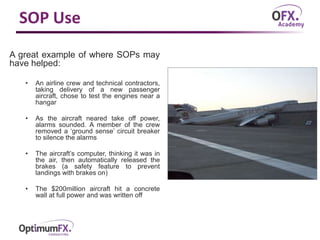
A great example of where SOPs may
have helped:
• An airline crew and technical contractors,
taking delivery of a new passenger
aircraft, chose to test the engines near a
hangar
• As the aircraft neared take off power,
alarms sounded. A member of the crew
removed a ‘ground sense’ circuit breaker
to silence the alarms
• The aircraft’s computer, thinking it was in
the air, then automatically released the
brakes (a safety feature to prevent
landings with brakes on)
• The $200million aircraft hit a concrete
wall at full power and was written off
Where are SOPs relevant?
• The SOP development process is an excellent way for managers,
workers, and technical advisers to cooperate for everyone’s
benefit
• Standard operating procedures used in combination with planned
training and regular performance feedback lead to an effective
and motivated workforce
• Managers and teams benefit from consistent work performance
and predictable results
• They are required to comply with ISO standards
• They should be kept live and relevant to the what is actually
going on in the workplace – updated where necessary
Identifying Opportunities for SOPs
Some clues that a Standard Operating Procedure is needed:
• Team is unable to complete a task because the individual with the
knowledge is absent – why doesn’t everyone else know?
• Consistent delays or errors due to lack of what other team members
would consider basic knowledge – how can we make sure everyone
knows what to do?
• Frequent requests for the same set of information or training – do
we need something people can refer to?
• ‘Near misses’ – narrowly avoided potential failures with product
quality or safety – what is the best way to stop it happening for real?
About Standard Operating Procedures
• A written document or instruction detailing all the steps and
activities of a process or procedure
• All quality impacting processes and procedures should be
documented in Standard Operating Procedures (SOPs)
•
• SOPs should form the basis for the routine training program of
each employee
• SOPs should be regularly updated to ensure compliance to
the regulatory requirements and working practices
• Procedural changes or adjustments should be reflected by
updates to the SOP
Definition of a ‘Standard’
A standard is the “best, safest, and easiest way
to do a job or task which ensures consistent
quality, cost and delivery to the customer”
• How can we ensure we achieve this consistently?
• How can we identify and share best practice?
• How can we ensure training is carried out
thoroughly?
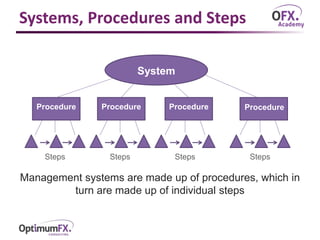
Systems, Procedures and Steps
Management systems are made up of procedures, which in
turn are made up of individual steps
System
Procedure Procedure Procedure Procedure
Steps Steps Steps Steps
Systems, Procedures and Steps
• Management systems are made up of work procedures. For
example, before production can begin, the line must be
correctly set up. After production, changeover and possibly
cleaning will need to take place. These are examples of
procedures that when put together make up the production
management system
• Finally, steps are the smaller actions that when put together
form a procedure. The small steps are where variation
among different workers takes place if procedures are not
standardised
• Managers can use standard operating procedures to help
ensure everyone performs each procedure the same way
every time
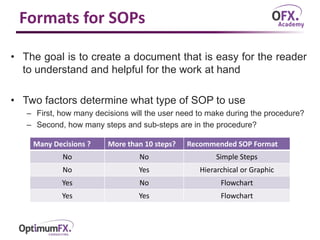
Formats for SOPs
• The goal is to create a document that is easy for the reader
to understand and helpful for the work at hand
• Two factors determine what type of SOP to use
– First, how many decisions will the user need to make during the procedure?
– Second, how many steps and sub-steps are in the procedure?
Many Decisions ? More than 10 steps? Recommended SOP Format
No No Simple Steps
No Yes Hierarchical or Graphic
Yes No Flowchart
Yes Yes Flowchart
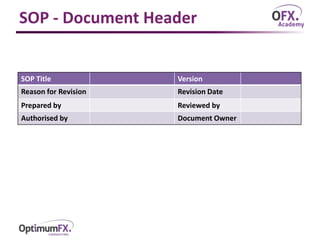
SOP - Document Header
SOP Title Version
Reason for Revision Revision Date
Prepared by Reviewed by
Authorised by Document Owner
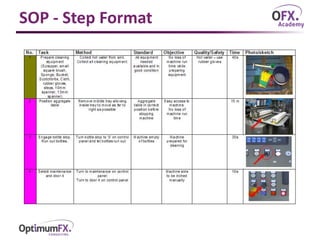
SOP - Step Format
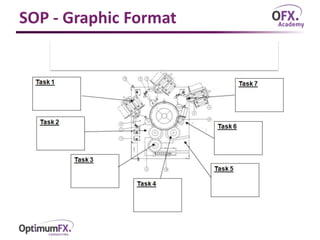
SOP - Graphic Format
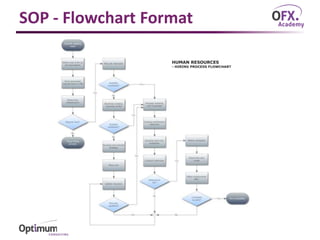
SOP - Flowchart Format
Developing and Implementing SOP’s
1. Plan for Results – start with business goal in mind
2. First Draft – select a format – there will be revisions – perfection
will come later
3. Internal Review – ask each team member to review and comment
and revise the procedure if necessary
4. External Review – do the same for your technical teams
5. Testing – have someone perform each step exactly as in the
procedure, while the writer watches – revise anything that causes
hesitation or confusion
6. Post – Make a final draft and post in workplaces and the central
master SOP file
7. Train – train, or re-train everyone involved to follow the procedure
Effective Writing of SOPs
• SOP instructions should be easily understood by anyone
using them.
• Which do we prefer?:
– “Make sure that you clean out all of the old caps from the cap hopper
before you refill with new materials”
– OR “Empty all old caps before adding new materials”
• Use abbreviations and acronyms sparingly. They may be
easily understood by engineers or technical staff, but do
the operators know them?
What If
• Without SOP’s we risk:
– Tasks being performed inconsistently
– Delays and errors through individuals not having the correct information
available
– Inconsistencies in training
– Heavy reliance on those with procedural knowledge
• With SOP’s we have:
– The opportunity to share best practice knowledge
– A proven method which everyone can follows
– Training documents readily available
– Knowledge available for everyone to use effectively

Standard operating procedures (SOPs)

  • 1.
    Standard Operating Procedures(SOPs) www.optimumfx.com
  • 2.
    Intent of Session •To understand Standard Operating Procedures • To explain how these are put together • To understand the opportunities to use them in the work environment
  • 3.
    What are they? •When we buy something like a mobile phone, there are usually two user documents: – A manual – 20 pages or more of detailed text – A ‘Quick Guide’ – normally one piece of paper with graphics • We can consider the Standard Operating Procedure as our ‘manual’, and the One Point Lesson as the ‘Quick Guide’ • Standard Operating Procedure – detail on how the each step of the task is performed, used as a reference
  • 4.
    Why use SOPs? •A successful business needs committed workers who complete work procedures consistently and accurately • It also requires all involved to contribute their experience, knowledge, and ideas to constant improvement for the future • Standard operating procedures get everyone driving toward outstanding performance and success • Well-written standard operating procedures provide direction, improve communication, reduce training time, and improve work consistency
  • 5.
    SOP Use A greatexample of where SOPs may have helped: • An airline crew and technical contractors, taking delivery of a new passenger aircraft, chose to test the engines near a hangar • As the aircraft neared take off power, alarms sounded. A member of the crew removed a ‘ground sense’ circuit breaker to silence the alarms • The aircraft’s computer, thinking it was in the air, then automatically released the brakes (a safety feature to prevent landings with brakes on) • The $200million aircraft hit a concrete wall at full power and was written off
  • 6.
    Where are SOPsrelevant? • The SOP development process is an excellent way for managers, workers, and technical advisers to cooperate for everyone’s benefit • Standard operating procedures used in combination with planned training and regular performance feedback lead to an effective and motivated workforce • Managers and teams benefit from consistent work performance and predictable results • They are required to comply with ISO standards • They should be kept live and relevant to the what is actually going on in the workplace – updated where necessary
  • 7.
    Identifying Opportunities forSOPs Some clues that a Standard Operating Procedure is needed: • Team is unable to complete a task because the individual with the knowledge is absent – why doesn’t everyone else know? • Consistent delays or errors due to lack of what other team members would consider basic knowledge – how can we make sure everyone knows what to do? • Frequent requests for the same set of information or training – do we need something people can refer to? • ‘Near misses’ – narrowly avoided potential failures with product quality or safety – what is the best way to stop it happening for real?
  • 8.
    About Standard OperatingProcedures • A written document or instruction detailing all the steps and activities of a process or procedure • All quality impacting processes and procedures should be documented in Standard Operating Procedures (SOPs) • • SOPs should form the basis for the routine training program of each employee • SOPs should be regularly updated to ensure compliance to the regulatory requirements and working practices • Procedural changes or adjustments should be reflected by updates to the SOP
  • 9.
    Definition of a‘Standard’ A standard is the “best, safest, and easiest way to do a job or task which ensures consistent quality, cost and delivery to the customer” • How can we ensure we achieve this consistently? • How can we identify and share best practice? • How can we ensure training is carried out thoroughly?
  • 10.
    Systems, Procedures andSteps Management systems are made up of procedures, which in turn are made up of individual steps System Procedure Procedure Procedure Procedure Steps Steps Steps Steps
  • 11.
    Systems, Procedures andSteps • Management systems are made up of work procedures. For example, before production can begin, the line must be correctly set up. After production, changeover and possibly cleaning will need to take place. These are examples of procedures that when put together make up the production management system • Finally, steps are the smaller actions that when put together form a procedure. The small steps are where variation among different workers takes place if procedures are not standardised • Managers can use standard operating procedures to help ensure everyone performs each procedure the same way every time
  • 12.
    Formats for SOPs •The goal is to create a document that is easy for the reader to understand and helpful for the work at hand • Two factors determine what type of SOP to use – First, how many decisions will the user need to make during the procedure? – Second, how many steps and sub-steps are in the procedure? Many Decisions ? More than 10 steps? Recommended SOP Format No No Simple Steps No Yes Hierarchical or Graphic Yes No Flowchart Yes Yes Flowchart
  • 13.
    SOP - DocumentHeader SOP Title Version Reason for Revision Revision Date Prepared by Reviewed by Authorised by Document Owner
  • 14.
    SOP - StepFormat
  • 15.
  • 16.
  • 17.
    Developing and ImplementingSOP’s 1. Plan for Results – start with business goal in mind 2. First Draft – select a format – there will be revisions – perfection will come later 3. Internal Review – ask each team member to review and comment and revise the procedure if necessary 4. External Review – do the same for your technical teams 5. Testing – have someone perform each step exactly as in the procedure, while the writer watches – revise anything that causes hesitation or confusion 6. Post – Make a final draft and post in workplaces and the central master SOP file 7. Train – train, or re-train everyone involved to follow the procedure
  • 18.
    Effective Writing ofSOPs • SOP instructions should be easily understood by anyone using them. • Which do we prefer?: – “Make sure that you clean out all of the old caps from the cap hopper before you refill with new materials” – OR “Empty all old caps before adding new materials” • Use abbreviations and acronyms sparingly. They may be easily understood by engineers or technical staff, but do the operators know them?
  • 19.
    What If • WithoutSOP’s we risk: – Tasks being performed inconsistently – Delays and errors through individuals not having the correct information available – Inconsistencies in training – Heavy reliance on those with procedural knowledge • With SOP’s we have: – The opportunity to share best practice knowledge – A proven method which everyone can follows – Training documents readily available – Knowledge available for everyone to use effectively