STANDARD OPERATING
PROCEDURES.(SOP’S).
PREPAREDBY-
PRIYANKA PRASAD
M.PHARM.
RCPSR, BHILAI.
CONTENTS
INTRODUCTION ----------------------------------------------------------------- 1
WHY IS IT ESSENTIAL------------------------------------------------------------- 2
FDA'S THREE GOLDEN RULE ON DOCUMENTATION------------------3
AIMS----------------------------------------------------------------------------------
4
GENERAL AREAS COVERED BY SOP---------------------------------------5
TYPES OF SOP’S---------------------------------------------------------------6&7
SOP WRITING STYLE--------------------------------------------------------------8
CONTENTS OF SOP---------------------------------------------------------------9
PROCESS OF SOP---------------------------------------------------------------10
PARENTERAL PREPARATIONS------------------------------------------------11
SOP FOR FILLING OF AMPULES---------------------------------------12 &13
DO’S---------------------------------------------------------------------------------
14
DON’T’S-----------------------------------------------------------------------------
15
INTRODUCTION :
• A standard operating procedure ( SOP) is
a set of step-by-step
instructions compiled by an organization
to help carry out complex routine
operations.
• Standard Operating Procedures (SOPs)
are essential for any plant’s
effectiveness and efficiency, and they
are a regulatory requirement in the
pharmaceutical industry
• KEYWORDS :
• SOP – Standard
Operating Procedure
• Step – by – step
instructions.
• For effectiveness and
efficiency.
• BACKBONE OF EVERY
PHARMACEUTICAL
INDUSTRY.
WHY IS IT ESSENTIAL?
The manufacturers of health care products rely on precision, rigor and
consistency to produce reliable products for patients, physicians and
consumers, time and time again. To drive the kind of culture that consistently
and effectively produces results of this nature, companies must first create a
culture where quality objectives are transparent, well understood, and acted
upon routinely, and thus the need to develop a well maintained record of
every correct procedures carried out came, which was known as
Standard Operating Procedures (SOP’s).
FDA’S THREE GOLDEN RULES ON
PROPER DOCUMENTATION
1. If it isn’t written down, it didn’t happen.
2. If it isn’t written down properly, it didn’t happen
either.
3. Never forget Rule 1 and 2.
AIMS.
 To maintain the equilibrium in quality control and quality assurance.
The purpose of an SOP is to carry out the operations correctly and always in
the same manner.
Uniformity of performance.
 To serve as a reference for teaching purposes about the process for which the
SOP was written.
It should be available at the place where the work is done.
Elevate the status of pharmacists and enhance their motivation for better
performance.
 Reduce miscommunication and failure to comply with industry regulations.
 To provide guidelines for accurate and on time data collection.
GENERAL AREAS COVERED BY SOP
SOP for Drug Lists.
SOP for handling of equipments in laboratories/ industries.
SOP for Procurement of Medicines
SOP for Receiving Drugs into Pharmacy
SOP for Drug Storage
SOP for Vaccine Storage
SOP for Temperature Control
SOP for Issue and Delivery of Drugs to Dispensary/Satellite Pharmacies/Wards
/Other Units.
SOP for Dispensing.
SOP for Patients Counselling
CONTINUED….
 SOP for Procurement, Dispensing and Distribution of Narcotic Drugs and
Poisons. SOP for Disposal of Expired Drugs
SOP for Clinical Ward Round
SOP for Training of Intern Pharmacists SOP for Continuing Education
SOP for Drug Revolving Fund (DRF) Scheme
SOP for Drug Information Service (DIS)/Drug Information Centre (DIC).
SOP for Dress Code
SOP for Therapeutic Drug Monitoring (TDM)
SOP for Screening Prescriptions
SOP for Preparing a Drug Formulary.
SOP for counselling of Handicapped Patients
SOP for Compounding of Medicines
TYPES OF SOP’S
Fundamental SOP : These gives instructions how to make SOP’s of other
categories.
Methodical SOP : These describe a complete testing system or method of
investigation
Analytical method
Preparation of Reagent
Quality Assurance
For operating instruments, equipment and apparatus
Safety & Precautions
Receiving and registration of sample
To deal with complaints
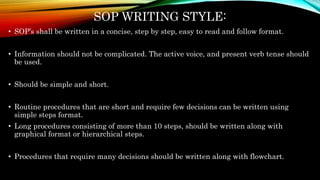
SOP WRITING STYLE:
• SOP’s shall be written in a concise, step by step, easy to read and follow format.
• Information should not be complicated. The active voice, and present verb tense should
be used.
• Should be simple and short.
• Routine procedures that are short and require few decisions can be written using
simple steps format.
• Long procedures consisting of more than 10 steps, should be written along with
graphical format or hierarchical steps.
• Procedures that require many decisions should be written along with flowchart.
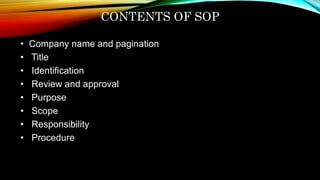
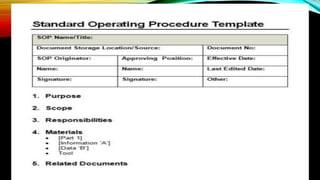
CONTENTS OF SOP
• Company name and pagination
• Title
• Identification
• Review and approval
• Purpose
• Scope
• Responsibility
• Procedure
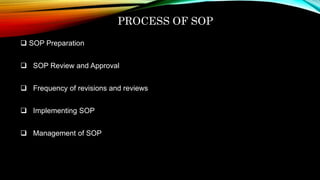
PROCESS OF SOP
 SOP Preparation
 SOP Review and Approval
 Frequency of revisions and reviews
 Implementing SOP
 Management of SOP
PARENTERAL PREPARATIONS:
• Parenteral term is derived from Greek word Para meaning
Outside, and Enterone meaning Intestine.
• Parenteral preparations are sterile preparations containing
one or more active ingredients intended for administration by
injection, infusion or implantation into the body.
• CLASSIFICATION :-
• Parenteral preparations are of 2 types:-
a. Large volume parenterals.
b. Small volume parenterals.
SOP FOR FILLING OF AMPULES
• Make sure that the filling area has been cleaned properly.
• Switch on the laminar flow and make sure that it has been wiped with 70% IPA.
• Feed the ampoules to an inclined charging hopper.
• The ampoules are passed continuously through rotating feeding wheel to the
conveyor.
• The ampoule conveyor carries the ampoules vertically at an angle of 300.
• Pass nitrogen(inert gas) into empty ampoules.
CONTINUED…
• The volume to be filled passes through the pumps into the ampoules.
• Again pass the nitrogen into the filled ampoules.
• The filled ampoules are moved to sealing station for sealing.
• Make sure that the sealing has been done before the inert gas can diffuse out.
• Collect the sealed ampoules through the collection hopper and send for labelling.
DO’S
• Write in present tense. Don’t use past tense, condition of future tense unless you have
good reason to do so.
• Avoid ambiguity and be concise.
• Reduce the word count where possible without changing the meaning of the text.
• Keep the words short and get to point.
• Highlight exceptions. Use a symbol to flag that this is an exception and how to handle it.
• Highlight warnings and use a larger or a warning icon.
DON'TS
• Introduce acronyms without explaining what it means.
• Don’t use the word “ may “, “ if possible” as it implies
that the user can do something under conditions. Instead
be positive and tell them what to do.
• Because SOP’s are a set of INSTRUCTIONS, not
CONDITIONS.
QUESTIONS FREQUENTLY ASKED:-
• SHORT NOTES:
• Standard Operating Procedures for parenteral preparations.
{OR}
• SOP of any one dosage form. {OR}
• SOP.
Standard operating procedures

Standard operating procedures

  • 1.
  • 2.
    CONTENTS INTRODUCTION ----------------------------------------------------------------- 1 WHYIS IT ESSENTIAL------------------------------------------------------------- 2 FDA'S THREE GOLDEN RULE ON DOCUMENTATION------------------3 AIMS---------------------------------------------------------------------------------- 4 GENERAL AREAS COVERED BY SOP---------------------------------------5 TYPES OF SOP’S---------------------------------------------------------------6&7 SOP WRITING STYLE--------------------------------------------------------------8 CONTENTS OF SOP---------------------------------------------------------------9 PROCESS OF SOP---------------------------------------------------------------10 PARENTERAL PREPARATIONS------------------------------------------------11 SOP FOR FILLING OF AMPULES---------------------------------------12 &13 DO’S--------------------------------------------------------------------------------- 14 DON’T’S----------------------------------------------------------------------------- 15
  • 3.
    INTRODUCTION : • Astandard operating procedure ( SOP) is a set of step-by-step instructions compiled by an organization to help carry out complex routine operations. • Standard Operating Procedures (SOPs) are essential for any plant’s effectiveness and efficiency, and they are a regulatory requirement in the pharmaceutical industry • KEYWORDS : • SOP – Standard Operating Procedure • Step – by – step instructions. • For effectiveness and efficiency. • BACKBONE OF EVERY PHARMACEUTICAL INDUSTRY.
  • 4.
    WHY IS ITESSENTIAL? The manufacturers of health care products rely on precision, rigor and consistency to produce reliable products for patients, physicians and consumers, time and time again. To drive the kind of culture that consistently and effectively produces results of this nature, companies must first create a culture where quality objectives are transparent, well understood, and acted upon routinely, and thus the need to develop a well maintained record of every correct procedures carried out came, which was known as Standard Operating Procedures (SOP’s).
  • 5.
    FDA’S THREE GOLDENRULES ON PROPER DOCUMENTATION 1. If it isn’t written down, it didn’t happen. 2. If it isn’t written down properly, it didn’t happen either. 3. Never forget Rule 1 and 2.
  • 6.
    AIMS.  To maintainthe equilibrium in quality control and quality assurance. The purpose of an SOP is to carry out the operations correctly and always in the same manner. Uniformity of performance.  To serve as a reference for teaching purposes about the process for which the SOP was written. It should be available at the place where the work is done. Elevate the status of pharmacists and enhance their motivation for better performance.  Reduce miscommunication and failure to comply with industry regulations.  To provide guidelines for accurate and on time data collection.
  • 7.
    GENERAL AREAS COVEREDBY SOP SOP for Drug Lists. SOP for handling of equipments in laboratories/ industries. SOP for Procurement of Medicines SOP for Receiving Drugs into Pharmacy SOP for Drug Storage SOP for Vaccine Storage SOP for Temperature Control SOP for Issue and Delivery of Drugs to Dispensary/Satellite Pharmacies/Wards /Other Units. SOP for Dispensing. SOP for Patients Counselling
  • 8.
    CONTINUED….  SOP forProcurement, Dispensing and Distribution of Narcotic Drugs and Poisons. SOP for Disposal of Expired Drugs SOP for Clinical Ward Round SOP for Training of Intern Pharmacists SOP for Continuing Education SOP for Drug Revolving Fund (DRF) Scheme SOP for Drug Information Service (DIS)/Drug Information Centre (DIC). SOP for Dress Code SOP for Therapeutic Drug Monitoring (TDM) SOP for Screening Prescriptions SOP for Preparing a Drug Formulary. SOP for counselling of Handicapped Patients SOP for Compounding of Medicines
  • 9.
    TYPES OF SOP’S FundamentalSOP : These gives instructions how to make SOP’s of other categories. Methodical SOP : These describe a complete testing system or method of investigation Analytical method Preparation of Reagent Quality Assurance For operating instruments, equipment and apparatus Safety & Precautions Receiving and registration of sample To deal with complaints
  • 10.
    SOP WRITING STYLE: •SOP’s shall be written in a concise, step by step, easy to read and follow format. • Information should not be complicated. The active voice, and present verb tense should be used. • Should be simple and short. • Routine procedures that are short and require few decisions can be written using simple steps format. • Long procedures consisting of more than 10 steps, should be written along with graphical format or hierarchical steps. • Procedures that require many decisions should be written along with flowchart.
  • 11.
    CONTENTS OF SOP •Company name and pagination • Title • Identification • Review and approval • Purpose • Scope • Responsibility • Procedure
  • 12.
    PROCESS OF SOP SOP Preparation  SOP Review and Approval  Frequency of revisions and reviews  Implementing SOP  Management of SOP
  • 13.
    PARENTERAL PREPARATIONS: • Parenteralterm is derived from Greek word Para meaning Outside, and Enterone meaning Intestine. • Parenteral preparations are sterile preparations containing one or more active ingredients intended for administration by injection, infusion or implantation into the body. • CLASSIFICATION :- • Parenteral preparations are of 2 types:- a. Large volume parenterals. b. Small volume parenterals.
  • 15.
    SOP FOR FILLINGOF AMPULES • Make sure that the filling area has been cleaned properly. • Switch on the laminar flow and make sure that it has been wiped with 70% IPA. • Feed the ampoules to an inclined charging hopper. • The ampoules are passed continuously through rotating feeding wheel to the conveyor. • The ampoule conveyor carries the ampoules vertically at an angle of 300. • Pass nitrogen(inert gas) into empty ampoules.
  • 16.
    CONTINUED… • The volumeto be filled passes through the pumps into the ampoules. • Again pass the nitrogen into the filled ampoules. • The filled ampoules are moved to sealing station for sealing. • Make sure that the sealing has been done before the inert gas can diffuse out. • Collect the sealed ampoules through the collection hopper and send for labelling.
  • 18.
    DO’S • Write inpresent tense. Don’t use past tense, condition of future tense unless you have good reason to do so. • Avoid ambiguity and be concise. • Reduce the word count where possible without changing the meaning of the text. • Keep the words short and get to point. • Highlight exceptions. Use a symbol to flag that this is an exception and how to handle it. • Highlight warnings and use a larger or a warning icon.
  • 19.
    DON'TS • Introduce acronymswithout explaining what it means. • Don’t use the word “ may “, “ if possible” as it implies that the user can do something under conditions. Instead be positive and tell them what to do. • Because SOP’s are a set of INSTRUCTIONS, not CONDITIONS.
  • 20.
    QUESTIONS FREQUENTLY ASKED:- •SHORT NOTES: • Standard Operating Procedures for parenteral preparations. {OR} • SOP of any one dosage form. {OR} • SOP.

Editor's Notes

  • #2 RUNGTA COLLEGE OF PHARMACUETICAL SCIENCE AND RESEARCH, BHILAI.
  • #3 RUNGTA COLLEGE OF PHARMACUETICAL SCIENCE AND RESEARCH, BHILAI.
  • #4 RUNGTA COLLEGE OF PHARMACUETICAL SCIENCE AND RESEARCH, BHILAI.
  • #5 RUNGTA COLLEGE OF PHARMACUETICAL SCIENCE AND RESEARCH, BHILAI.
  • #6 RUNGTA COLLEGE OF PHARMACUETICAL SCIENCE AND RESEARCH, BHILAI.
  • #7 RUNGTA COLLEGE OF PHARMACUETICAL SCIENCE AND RESEARCH, BHILAI.
  • #8 RUNGTA COLLEGE OF PHARMACUETICAL SCIENCE AND RESEARCH, BHILAI.
  • #9 RUNGTA COLLEGE OF PHARMACUETICAL SCIENCE AND RESEARCH, BHILAI.
  • #10 RUNGTA COLLEGE OF PHARMACUETICAL SCIENCE AND RESEARCH, BHILAI.
  • #11 RUNGTA COLLEGE OF PHARMACUETICAL SCIENCE AND RESEARCH, BHILAI.
  • #12 RUNGTA COLLEGE OF PHARMACUETICAL SCIENCE AND RESEARCH, BHILAI.
  • #13 RUNGTA COLLEGE OF PHARMACUETICAL SCIENCE AND RESEARCH, BHILAI.
  • #15 RUNGTA COLLEGE OF PHARMACUETICAL SCIENCE AND RESEARCH, BHILAI.
  • #16 RUNGTA COLLEGE OF PHARMACUETICAL SCIENCE AND RESEARCH, BHILAI.
  • #17 RUNGTA COLLEGE OF PHARMACUETICAL SCIENCE AND RESEARCH, BHILAI.
  • #19 RUNGTA COLLEGE OF PHARMACUETICAL SCIENCE AND RESEARCH, BHILAI.
  • #20 RUNGTA COLLEGE OF PHARMACUETICAL SCIENCE AND RESEARCH, BHILAI.
  • #22 RUNGTA COLLEGE OF PHARMACUETICAL SCIENCE AND RESEARCH, BHILAI.