SUBMITTED BY:-
JINENDRA JAIN
 Sum/total of all the characteristics of a
product/service that has a bearing upon the
utilization of the product/service to the
entire satisfaction of the end user.
Consistency
 Accuracy
 Precision
Right result
 First time
 Every time
 Standard Operating Procedure is a step by
step procedure
 Directions as established by a Quality Square
Industry involved in facility producing a
product, testing or research.
 A Standard Procedure does not need
explanation or publication because it is
standard.
 The procedure for describing the writing,
revising and approving of SOPs and the
control of distribution of SOPs is one of the
important Quality Assurance procedure.
“Quality is everyone's responsibility”
-W. Edwards Deming
 GOOD MANUFACTURING PRACTICES AND
REQUIREMENTS OF PREMISES, PLANT AND
EQUIPMENT FOR PHARMACEUTICAL PRODUCTS.
 Note: - To achieve the objectives listed below,
each licensee shall evolve appropriate
methodology, systems and procedures which
shall be documented and maintained for
inspection and reference; and the manufacturing
premises shall be used exclusively for production
of drugs and no other manufacturing activity
shall be undertaken therein.
[SCHEDULE M]
 CFR Part 211 : Current Good Manufacturing Practice For
Finished Pharmaceuticals
 Subpart F 211.100 Written Procedures and Deviations
 “(a) There shall be written procedure for production and
process control designed to assure that drug product have
the identity, strength, quality and purity, they purport or
are represented to possess.”
 (b) Written production and process control procedures
shall be followed in the execution of the various
production and process control functions and shall be
documented at the time of performance. Any deviation
from the written procedures shall be recorded and
justified. “
CFR Part 820 : Quality System Regulation
Sec. 820.40 Document controls.
Sec. 820.70 Production and process controls.
Sec. 820.80 Receiving, in-process, and finished
device acceptance.
 “Firms must “establish and maintain” procedures. To do
so, companies should define, document (either on paper or
electronically), and implement standard operating
procedures (SOPs). Additionally, companies must then
follow up, review, and revise these documents as needed.
 ISO 9001- 2008, Clause 4.2 : Documentation requirements
“Documented procedure”, has to be established,
documented, implemented and maintained.”
 IS/ISO 14001 : 2004 , Clause 4.5.4 : Control of records
“ The organization shall establish, implement and maintain a
procedure(s) for the identification, storage , protection,
retrieval, retention and disposal of records.”
 IS 18001 : 2007 , Clause 4.4.5 : Control of Documents
“ The organization shall establish, implement and maintain a
procedure(s) for the Controlling all documents required by
the OH&S management systems and by this standard.”
 ICH Good Manufacturing Practice Guide for API Q7, Section
6 Documentations and Records
“ All documents related to the manufacture of intermediates
or APIs should be prepared, reviewed, approved, and
distributed according to written procedures.”
 To perform a job properly.
 To ensure that production operations are
performed consistently.
 To ensure that processes continue
uninterrupted and are completed on a
prescribed schedule.
 To ensure that no failures occur in
manufacturing and other processes for which
the SOP was written.
 To ensure that approved procedures are
followed in compliance with company and
government regulations.
 To serve as a training document for teaching
users about the process.
 To serve as a checklist for co-workers who
observe job performance to reinforce proper
performance.
 To serve as a checklist for auditors.
 To serve as an historical record for the
Change over.
 To serve as an explanation in review of
accident investigations.
 Should be written by individuals knowledgeable
with the activity and subject-matter experts.
 By an individual who performs the tasks
routinely or someone who is directly responsible
for the performance of the task like…
Those who will perform the job
Those who will perform maintenance on equipment involved in
an SOP
Engineers or others who design equipment and processes
Technical initiator
Safety personnel
Environmental personnel
Equipment manufacturers
 Title page
 Hester’s Logo
 Header with title of
SOP
 Department Name
 Effective date
 Revision date
 Review date
 Page No
 Regulatory basis
 Reference documents
 Purpose
 Scope
 Responsibilities &
accountabilities
 Procedure
 Footer
Approving Signatures
Prepared by
Checked by
Approved by
 Stamp
Controlled Copy/Master Copy
QA Stamp
The content of a Standard-Operation-Procedure should include
the following minimum
 STANDARD OPERATING PROCEDURE
 Logo of the Industry.
 Document Number
 SOP Number
 Title of the SOP
 History of SOP
 Revision Date
 Writer
 Replace page if any
 Checked by
 Approved by
 Logo of Company must be at below. Any other Logo will
not be approved.
 Header : from Top Distance = 0.13
 Header Table for Title: Total Height : 0.2
 Then Do Auto fit as below
 Footer : From Bottom Distance = 0.13
 Paper Size = A4
 Page Margin : RIGHT , LEFT, TOP, BOTTOM = 1”
Page Indent and Spacing LEFT, RIGHT, BEFORE, AFETR = 0”
 Line Space: 1.0”
Table should be in the following format
TABLE: Row Height Space = 2'
Text Font
Font Style = Tahoma, Font Size = 10
 Master copy
Original Signed copy
 Controlled copy
Used at actual working place
 Uncontrolled copy
For information purpose only
 Obsolete copy
For obsolete activity
 Superseded copy
Previous copy which is replaced with new one
 Approved Copy
For the Dossier and regulatory submission
 SOPs provide a specific view of all the main
steps whereas guidelines are significantly
more detailed.
 Some SOPs have a two-tiered system that
includes both SOPs and guidelines.
1. Incorporate points by which one can get idea
why to do that job and complete picture of the
responsibilities for doing a job properly.
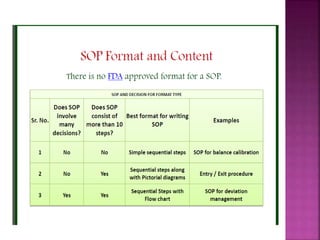
2. If your SOP goes beyond 10 steps, then break
the long SOP into several logical sub-job SOPs.
3. Write SOPs for people who perform under
different interpersonal circumstances.
 Write some SOPs for people who work alone.
 Write some SOPs for two or more people who
work together as a team.
 Write some SOPs for people who will supervise
other people doing a job.
4. Write some SOPs for people who not familiar
with rules generally understood by your
employees. For example, you may write for
contractors, vendors or suppliers.
5. Consider the work culture within which people
work.
6. Consider the age, education, knowledge, skill,
experience and training, and work culture of the
individuals who will be performing the SOP
steps.
7. Once you have completed writing an SOP, have
several workers test it and give you feedback.
8. Review the effectiveness of SOPs after a few
weeks and when Processes and equipment
changed and make changes as per it.
 Review period for the Hester’s Document is 2
years.
 SOP review will focus on the document’s
content, context, format and grammar.
 Review factors and criteria are :
 Adherence to standards
 Consistency and traceability
 Readability, comprehensibility, and general understandability
 Technical adequacy and feasibility of approach
 Degree of completeness
 Testability of requirements
 Use of appropriate requirement, design, or coding techniques
 Appropriate level of details
Routine revision
 At the end of the review period by HOD concerned to the
particular SOP will review and revise if required.
 If there is no change then HOD just give the review report
that this SOP doesn’t require review and continue the
same for the next review period.
During the review period revision
 By the process owner with the approval of the HOD, fill up
the DCC form and SOP will be revised with new revision
and effective date.
 As per the same Previous version will be Superseded or
Obsolete.
 Final approval of the any type of the change in the SOP is
given only by the QA department.
 The most important step for implementing the
SOP in working area, train or retrain the user.
 While training the user, trainer should share the
reason WHY, SOP must performed correctly.
People are much more to follow when they
understand importance of procedure.
 Trainer should explain and demonstrate how
each step in the SOP will be performed and
should assure them this will increase Quality of
product by providing safety and accuracy which
will ultimately increase the confidence of the
user.
 There should be the record for issue and distribution
of the SOPs.
 It is the responsibility of the process owner to
Ensures that SOPs are current.
Eliminates obsolete SOPs.
Ensures that SOPs meet their quality requirements
and are user friendly.
Manages SOP change controls.
Distributes SOPs.
Ensures that new or changed SOPs are valid only after
training has occurred and provides training about the
SOP system.
Measures system performance and periodically reports
results to management
Continuously improves the system.
 http://www.wildfire.gov/pmu/pmo-
rchive/products/documents/Review_Guidelin
es.pdf
 SLIDESHARE
 ISO GUIDELINE
 GMP
 WIKEPEDIA
Standard operating procedure(sop)assignment

Standard operating procedure(sop)assignment

  • 1.
  • 2.
     Sum/total ofall the characteristics of a product/service that has a bearing upon the utilization of the product/service to the entire satisfaction of the end user.
  • 3.
    Consistency  Accuracy  Precision Rightresult  First time  Every time
  • 4.
     Standard OperatingProcedure is a step by step procedure  Directions as established by a Quality Square Industry involved in facility producing a product, testing or research.  A Standard Procedure does not need explanation or publication because it is standard.
  • 5.
     The procedurefor describing the writing, revising and approving of SOPs and the control of distribution of SOPs is one of the important Quality Assurance procedure. “Quality is everyone's responsibility” -W. Edwards Deming
  • 6.
     GOOD MANUFACTURINGPRACTICES AND REQUIREMENTS OF PREMISES, PLANT AND EQUIPMENT FOR PHARMACEUTICAL PRODUCTS.  Note: - To achieve the objectives listed below, each licensee shall evolve appropriate methodology, systems and procedures which shall be documented and maintained for inspection and reference; and the manufacturing premises shall be used exclusively for production of drugs and no other manufacturing activity shall be undertaken therein. [SCHEDULE M]
  • 7.
     CFR Part211 : Current Good Manufacturing Practice For Finished Pharmaceuticals  Subpart F 211.100 Written Procedures and Deviations  “(a) There shall be written procedure for production and process control designed to assure that drug product have the identity, strength, quality and purity, they purport or are represented to possess.”  (b) Written production and process control procedures shall be followed in the execution of the various production and process control functions and shall be documented at the time of performance. Any deviation from the written procedures shall be recorded and justified. “
  • 8.
    CFR Part 820: Quality System Regulation Sec. 820.40 Document controls. Sec. 820.70 Production and process controls. Sec. 820.80 Receiving, in-process, and finished device acceptance.  “Firms must “establish and maintain” procedures. To do so, companies should define, document (either on paper or electronically), and implement standard operating procedures (SOPs). Additionally, companies must then follow up, review, and revise these documents as needed.
  • 9.
     ISO 9001-2008, Clause 4.2 : Documentation requirements “Documented procedure”, has to be established, documented, implemented and maintained.”  IS/ISO 14001 : 2004 , Clause 4.5.4 : Control of records “ The organization shall establish, implement and maintain a procedure(s) for the identification, storage , protection, retrieval, retention and disposal of records.”  IS 18001 : 2007 , Clause 4.4.5 : Control of Documents “ The organization shall establish, implement and maintain a procedure(s) for the Controlling all documents required by the OH&S management systems and by this standard.”  ICH Good Manufacturing Practice Guide for API Q7, Section 6 Documentations and Records “ All documents related to the manufacture of intermediates or APIs should be prepared, reviewed, approved, and distributed according to written procedures.”
  • 10.
     To performa job properly.  To ensure that production operations are performed consistently.  To ensure that processes continue uninterrupted and are completed on a prescribed schedule.  To ensure that no failures occur in manufacturing and other processes for which the SOP was written.  To ensure that approved procedures are followed in compliance with company and government regulations.
  • 11.
     To serveas a training document for teaching users about the process.  To serve as a checklist for co-workers who observe job performance to reinforce proper performance.  To serve as a checklist for auditors.  To serve as an historical record for the Change over.  To serve as an explanation in review of accident investigations.
  • 13.
     Should bewritten by individuals knowledgeable with the activity and subject-matter experts.  By an individual who performs the tasks routinely or someone who is directly responsible for the performance of the task like… Those who will perform the job Those who will perform maintenance on equipment involved in an SOP Engineers or others who design equipment and processes Technical initiator Safety personnel Environmental personnel Equipment manufacturers
  • 15.
     Title page Hester’s Logo  Header with title of SOP  Department Name  Effective date  Revision date  Review date  Page No  Regulatory basis  Reference documents  Purpose  Scope  Responsibilities & accountabilities  Procedure  Footer Approving Signatures Prepared by Checked by Approved by  Stamp Controlled Copy/Master Copy QA Stamp The content of a Standard-Operation-Procedure should include the following minimum
  • 16.
     STANDARD OPERATINGPROCEDURE  Logo of the Industry.  Document Number  SOP Number  Title of the SOP  History of SOP  Revision Date  Writer  Replace page if any  Checked by  Approved by
  • 17.
     Logo ofCompany must be at below. Any other Logo will not be approved.  Header : from Top Distance = 0.13  Header Table for Title: Total Height : 0.2  Then Do Auto fit as below  Footer : From Bottom Distance = 0.13  Paper Size = A4  Page Margin : RIGHT , LEFT, TOP, BOTTOM = 1” Page Indent and Spacing LEFT, RIGHT, BEFORE, AFETR = 0”  Line Space: 1.0” Table should be in the following format TABLE: Row Height Space = 2' Text Font Font Style = Tahoma, Font Size = 10
  • 18.
     Master copy OriginalSigned copy  Controlled copy Used at actual working place  Uncontrolled copy For information purpose only  Obsolete copy For obsolete activity  Superseded copy Previous copy which is replaced with new one  Approved Copy For the Dossier and regulatory submission
  • 19.
     SOPs providea specific view of all the main steps whereas guidelines are significantly more detailed.  Some SOPs have a two-tiered system that includes both SOPs and guidelines.
  • 21.
    1. Incorporate pointsby which one can get idea why to do that job and complete picture of the responsibilities for doing a job properly. 2. If your SOP goes beyond 10 steps, then break the long SOP into several logical sub-job SOPs. 3. Write SOPs for people who perform under different interpersonal circumstances.  Write some SOPs for people who work alone.  Write some SOPs for two or more people who work together as a team.  Write some SOPs for people who will supervise other people doing a job.
  • 22.
    4. Write someSOPs for people who not familiar with rules generally understood by your employees. For example, you may write for contractors, vendors or suppliers. 5. Consider the work culture within which people work. 6. Consider the age, education, knowledge, skill, experience and training, and work culture of the individuals who will be performing the SOP steps. 7. Once you have completed writing an SOP, have several workers test it and give you feedback. 8. Review the effectiveness of SOPs after a few weeks and when Processes and equipment changed and make changes as per it.
  • 23.
     Review periodfor the Hester’s Document is 2 years.  SOP review will focus on the document’s content, context, format and grammar.  Review factors and criteria are :  Adherence to standards  Consistency and traceability  Readability, comprehensibility, and general understandability  Technical adequacy and feasibility of approach  Degree of completeness  Testability of requirements  Use of appropriate requirement, design, or coding techniques  Appropriate level of details
  • 24.
    Routine revision  Atthe end of the review period by HOD concerned to the particular SOP will review and revise if required.  If there is no change then HOD just give the review report that this SOP doesn’t require review and continue the same for the next review period. During the review period revision  By the process owner with the approval of the HOD, fill up the DCC form and SOP will be revised with new revision and effective date.  As per the same Previous version will be Superseded or Obsolete.  Final approval of the any type of the change in the SOP is given only by the QA department.
  • 25.
     The mostimportant step for implementing the SOP in working area, train or retrain the user.  While training the user, trainer should share the reason WHY, SOP must performed correctly. People are much more to follow when they understand importance of procedure.  Trainer should explain and demonstrate how each step in the SOP will be performed and should assure them this will increase Quality of product by providing safety and accuracy which will ultimately increase the confidence of the user.
  • 26.
     There shouldbe the record for issue and distribution of the SOPs.  It is the responsibility of the process owner to Ensures that SOPs are current. Eliminates obsolete SOPs. Ensures that SOPs meet their quality requirements and are user friendly. Manages SOP change controls. Distributes SOPs. Ensures that new or changed SOPs are valid only after training has occurred and provides training about the SOP system. Measures system performance and periodically reports results to management Continuously improves the system.
  • 27.