
Oracle Clinical / Remote Data
Capture Implementation Standards
and Best Practices
Lori Venable
Thank you for joining. We will begin shortly.
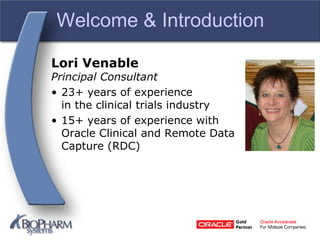
Welcome & Introduction
Lori Venable
Principal Consultant
• 23+ years of experience
in the clinical trials industry
• 15+ years of experience with
Oracle Clinical and Remote Data
Capture (RDC)
Today’s Agenda
Time Topic
10:00-10:05 Welcome and Introduction
10:05-10:10 Who, What and Why?
10:10-10:20 Common Themes
10:20-10:25 Training
10:25-10:30 User Roles and Functions
10:30-10:35 SOPs and WINs
10:35-10:45 Implementation and Usage Standards
10:45-11:00 Q&A
Who, What and Why?
• Who is the intended audience?
– Non-OC/RDC Users evaluating the
application
– New users of OC/RDC who are defining
their implementation standards, SOPs,
WINs, etc.
– Current OC/RDC Users contemplating an
upgrade to newer version and/or
modifications to existing practices
• What is a Best Practice?
 A method, process, activity, incentive, or reward that is believed
to be more effective at delivering a particular outcome than any
other technique, method, process, etc. when applied to a
particular condition or circumstance.
en.wikipedia.org/wiki/Best_practice
 A way or method of accomplishing a business function or process
that is considered to be superior to all other known methods.
www.qaproject.org/methods/resglossary
 A best practice is a business process with demonstrated ability
to achieve superior results. Best practices represent proven
methodologies for consistently and effectively achieving a
business objective.
www.hrsdc.gc.ca/eng/workplaceskills/oles/2009/glossary
Who, What and Why?
Who, What and Why?
• Why are standards important?
– In order to really capitalize on the
functionality within OC/RDC, standards
are critical
– Standardization helps minimize study
setup time immensely – reusability of
standard objects, processes, etc.
– Increase in efficiency
– Increase in quality
– Increase in productivity
– Decrease in time and money
Common Themes …
• Teamwork
– Right level of inclusion
– Cross-functional partnership
– Recognize contributions and needs of ALL
members
– Communication
– Buy-in from all team members
– Active participation
– Are there global needs?
– Benefits for proper level of team
involvement are phenomenal
Common Themes
• Standards … standards … standards
– Increase ease and speed of use for OC/RDC
– Increase efficiency and productivity
• Process Improvement
– Continuous
– Debriefing after all projects
– Receptivity
– DON’T BE AFRAID to change!
• Use your resources!
Training …
• Application(s) … OC / RDC
– Formal training … e.g., BioPharm
– Right level of ‘inclusion’
– Hands-on users vs one-off users vs mgmt
– Delivery method
– Instructor-led (onsite vs public)
– Online web-based
– Hands-on exercises
– Internal ‘train the trainer’
– Consistent material
… cont…
Training …
• Application(s) … (cont…)
– “Just-in-Time” training
– Not too early
– Plan ‘play’/practice time in training environment
– Pilot study(ies)
– What study(ies) to use
– Helps in making decisions and planning standard
processes
– Self education …
– LOTs of resources available
– Learn from your mistakes (you WILL make
some!)
• Processes
– Assess current processes and future needs
– Formal and informal
– Internal and/or external (e.g, BioPharm)
– SOPs / WINs
– Process Improvements
Training …
• Other training considerations
– Cross-functional education & understanding
– The “whats” and “whys”
– Ongoing
– Retraining
– Certification / proof of training
Training
User Roles and Functions
• Clearly outline all needed roles/
functions
• Current resource availability
• Company size
• Internal vs external resources
• User account creation and
maintenance
– Pre-requisites
• Other considerations
– Frequency of some tasks
Standard Operating Procedures…
Best Practices:
 SOPs should be very high-level, with minimal
detail – the overview of “WHAT” we do
 Begin to draft SOPs during the training and
pilot(s)
 Right level of inclusion
 Train users on the SOPs as part as part of
system training
 Recommended: 6-12 SOPs for OC/RDC
SOPs associated with OC/RDC typically include information
about the setup and use of the application(s) in conjunction with
the day-to-day collection and management of clinical trial data.
• Review and assess current SOPs and
business processes
– Identify gaps and requirements gathering
• Consider other departments
– Overlaps? … gaps? … inconsistencies?
• SOPs are subject to audit
– Do not reference other documents in SOPs
• Ideal: finalize before “go live”
– Reality: not quite ready
– Document … document … document
SOPs
Work Instructions (WINs) …
Best Practices:
 WINs should be more detailed … the “HOW” we
do it
 Develop WINs concurrently with SOPs
 Right level of inclusion
 Train users on the WINs as part as part of
system training
 Each SOP should have at least one supplemental
WIN (generally 1-7 WINs per SOP)
Work Instructions provide detailed steps on how to
perform a specific task or function in OC/RDC
• Supplement the SOPs with the
detailed step-by-step “HOW TO”
• Supplement to training
• Review and assess current processes
– Identify gaps and requirements gathering
• Consider other departments
– Overlaps? … gaps? … inconsistencies?
WINs …
• WINs are not subject to audit
– Freely reference other documents/sources
• Attachments common
– Checklists, quick reference guides, etc.
• Less formal than SOPs
– Still need inclusion, review, finalization, etc
– Easier to update/modify
• Ideal: finalize before “go live”
– Reality: still in development
WINs
• OC / RDC implementation is most
successful with strong commitment to
standards
• 80/20 rule
– Protocols, CRFs, edit checks, cross-study
consistencies, etc.
– OC/RDC implementation standards
• But … recognize need for flexibility
– Communicate the “costs” of deviations from
standards
– May need to challenge some requests
Implementation and Usage
Standards …
• Maintenance of standards
– CRFs, OC objects, DMP, SOPs, WINs, training
materials, processes, other resources/tools
– Everyone’s responsibility
• Process Improvement (again! )
– Openness to change
– “Think outside the box”
Implementation and Usage
Standards
Summary
• Keep in mind our common themes:
– It’s all a team effort
– Communication
– Standards … standards … standards
– Process Improvement … ongoing, continuous
– Don’t be afraid to make mistakes … be open
to learning from them
– Take advantage of all the resources you have
at your disposal
Q&A
Closing
Thank you for attending!
This webinar will be posted on
www.biopharm.com
within 24 hours
Contact BioPharm Systems
United States: +1 877 654 0033
EMEA: +44 (0) 1865 910200
Email Address: info@biopharm.com
(also Vicky Green: vgreen@biopharm.com)

Oracle Clinical and RDC Implementation Standards and Best Practices

  • 1.
    Oracle Clinical /Remote Data Capture Implementation Standards and Best Practices Lori Venable Thank you for joining. We will begin shortly.
  • 2.
    Welcome & Introduction LoriVenable Principal Consultant • 23+ years of experience in the clinical trials industry • 15+ years of experience with Oracle Clinical and Remote Data Capture (RDC)
  • 3.
    Today’s Agenda Time Topic 10:00-10:05Welcome and Introduction 10:05-10:10 Who, What and Why? 10:10-10:20 Common Themes 10:20-10:25 Training 10:25-10:30 User Roles and Functions 10:30-10:35 SOPs and WINs 10:35-10:45 Implementation and Usage Standards 10:45-11:00 Q&A
  • 4.
    Who, What andWhy? • Who is the intended audience? – Non-OC/RDC Users evaluating the application – New users of OC/RDC who are defining their implementation standards, SOPs, WINs, etc. – Current OC/RDC Users contemplating an upgrade to newer version and/or modifications to existing practices
  • 5.
    • What isa Best Practice?  A method, process, activity, incentive, or reward that is believed to be more effective at delivering a particular outcome than any other technique, method, process, etc. when applied to a particular condition or circumstance. en.wikipedia.org/wiki/Best_practice  A way or method of accomplishing a business function or process that is considered to be superior to all other known methods. www.qaproject.org/methods/resglossary  A best practice is a business process with demonstrated ability to achieve superior results. Best practices represent proven methodologies for consistently and effectively achieving a business objective. www.hrsdc.gc.ca/eng/workplaceskills/oles/2009/glossary Who, What and Why?
  • 6.
    Who, What andWhy? • Why are standards important? – In order to really capitalize on the functionality within OC/RDC, standards are critical – Standardization helps minimize study setup time immensely – reusability of standard objects, processes, etc. – Increase in efficiency – Increase in quality – Increase in productivity – Decrease in time and money
  • 7.
    Common Themes … •Teamwork – Right level of inclusion – Cross-functional partnership – Recognize contributions and needs of ALL members – Communication – Buy-in from all team members – Active participation – Are there global needs? – Benefits for proper level of team involvement are phenomenal
  • 8.
    Common Themes • Standards… standards … standards – Increase ease and speed of use for OC/RDC – Increase efficiency and productivity • Process Improvement – Continuous – Debriefing after all projects – Receptivity – DON’T BE AFRAID to change! • Use your resources!
  • 9.
    Training … • Application(s)… OC / RDC – Formal training … e.g., BioPharm – Right level of ‘inclusion’ – Hands-on users vs one-off users vs mgmt – Delivery method – Instructor-led (onsite vs public) – Online web-based – Hands-on exercises – Internal ‘train the trainer’ – Consistent material … cont…
  • 10.
    Training … • Application(s)… (cont…) – “Just-in-Time” training – Not too early – Plan ‘play’/practice time in training environment – Pilot study(ies) – What study(ies) to use – Helps in making decisions and planning standard processes – Self education … – LOTs of resources available – Learn from your mistakes (you WILL make some!)
  • 11.
    • Processes – Assesscurrent processes and future needs – Formal and informal – Internal and/or external (e.g, BioPharm) – SOPs / WINs – Process Improvements Training …
  • 12.
    • Other trainingconsiderations – Cross-functional education & understanding – The “whats” and “whys” – Ongoing – Retraining – Certification / proof of training Training
  • 13.
    User Roles andFunctions • Clearly outline all needed roles/ functions • Current resource availability • Company size • Internal vs external resources • User account creation and maintenance – Pre-requisites • Other considerations – Frequency of some tasks
  • 14.
    Standard Operating Procedures… BestPractices:  SOPs should be very high-level, with minimal detail – the overview of “WHAT” we do  Begin to draft SOPs during the training and pilot(s)  Right level of inclusion  Train users on the SOPs as part as part of system training  Recommended: 6-12 SOPs for OC/RDC SOPs associated with OC/RDC typically include information about the setup and use of the application(s) in conjunction with the day-to-day collection and management of clinical trial data.
  • 15.
    • Review andassess current SOPs and business processes – Identify gaps and requirements gathering • Consider other departments – Overlaps? … gaps? … inconsistencies? • SOPs are subject to audit – Do not reference other documents in SOPs • Ideal: finalize before “go live” – Reality: not quite ready – Document … document … document SOPs
  • 16.
    Work Instructions (WINs)… Best Practices:  WINs should be more detailed … the “HOW” we do it  Develop WINs concurrently with SOPs  Right level of inclusion  Train users on the WINs as part as part of system training  Each SOP should have at least one supplemental WIN (generally 1-7 WINs per SOP) Work Instructions provide detailed steps on how to perform a specific task or function in OC/RDC
  • 17.
    • Supplement theSOPs with the detailed step-by-step “HOW TO” • Supplement to training • Review and assess current processes – Identify gaps and requirements gathering • Consider other departments – Overlaps? … gaps? … inconsistencies? WINs …
  • 18.
    • WINs arenot subject to audit – Freely reference other documents/sources • Attachments common – Checklists, quick reference guides, etc. • Less formal than SOPs – Still need inclusion, review, finalization, etc – Easier to update/modify • Ideal: finalize before “go live” – Reality: still in development WINs
  • 19.
    • OC /RDC implementation is most successful with strong commitment to standards • 80/20 rule – Protocols, CRFs, edit checks, cross-study consistencies, etc. – OC/RDC implementation standards • But … recognize need for flexibility – Communicate the “costs” of deviations from standards – May need to challenge some requests Implementation and Usage Standards …
  • 20.
    • Maintenance ofstandards – CRFs, OC objects, DMP, SOPs, WINs, training materials, processes, other resources/tools – Everyone’s responsibility • Process Improvement (again! ) – Openness to change – “Think outside the box” Implementation and Usage Standards
  • 21.
    Summary • Keep inmind our common themes: – It’s all a team effort – Communication – Standards … standards … standards – Process Improvement … ongoing, continuous – Don’t be afraid to make mistakes … be open to learning from them – Take advantage of all the resources you have at your disposal
  • 22.
  • 23.
    Closing Thank you forattending! This webinar will be posted on www.biopharm.com within 24 hours Contact BioPharm Systems United States: +1 877 654 0033 EMEA: +44 (0) 1865 910200 Email Address: info@biopharm.com (also Vicky Green: vgreen@biopharm.com)