IMS
Contents:
Following points will be discussed
● History
● IMS Structure
● Document Structure
● Benefits of ISO(IMS)
● R&D, AACL & Standard systems
( Status : Past, present and future)
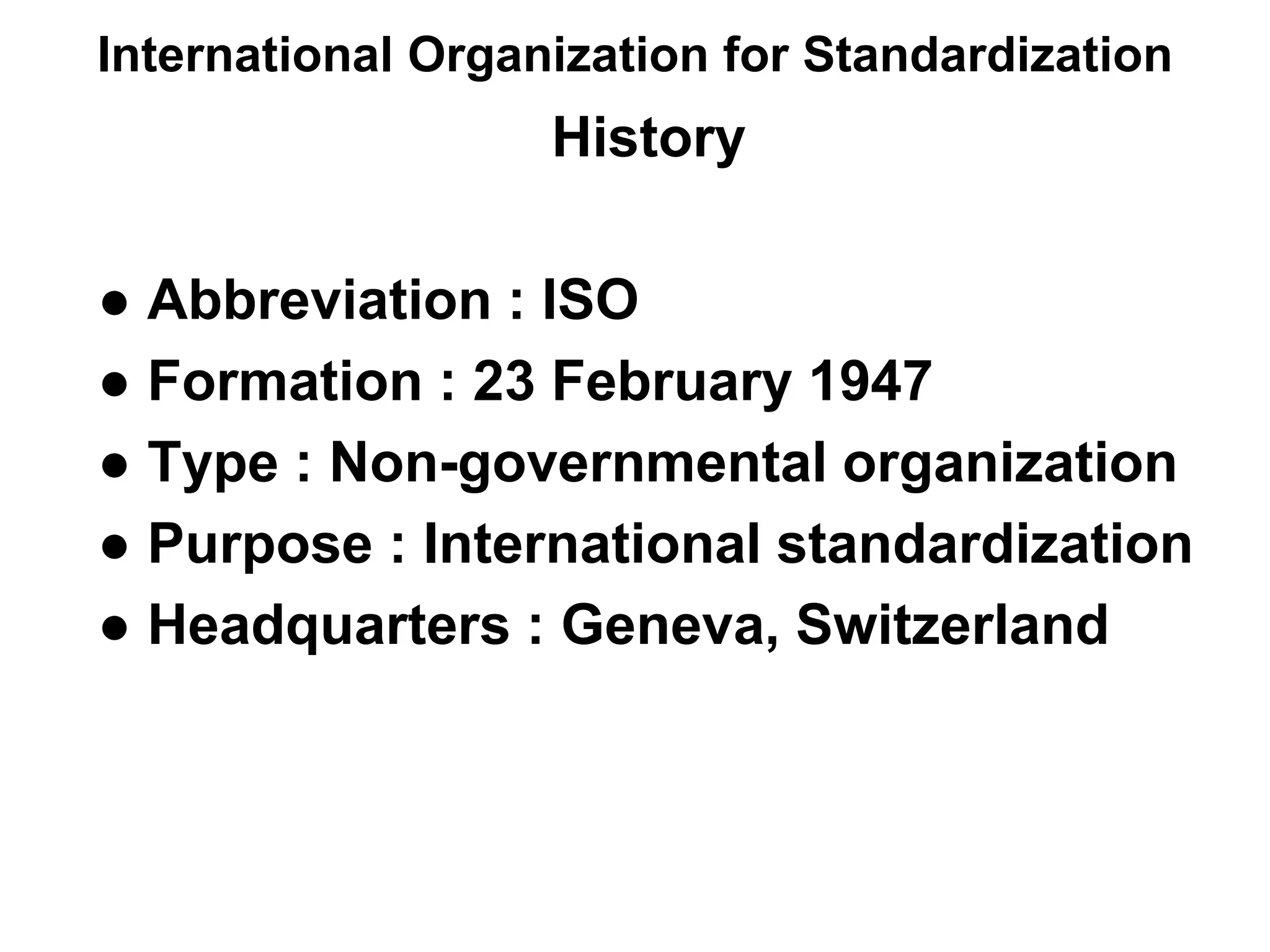
International Organization for Standardization
History
● Abbreviation : ISO
● Formation : 23 February 1947
● Type : Non-governmental organization
● Purpose : International standardization
● Headquarters : Geneva, Switzerland
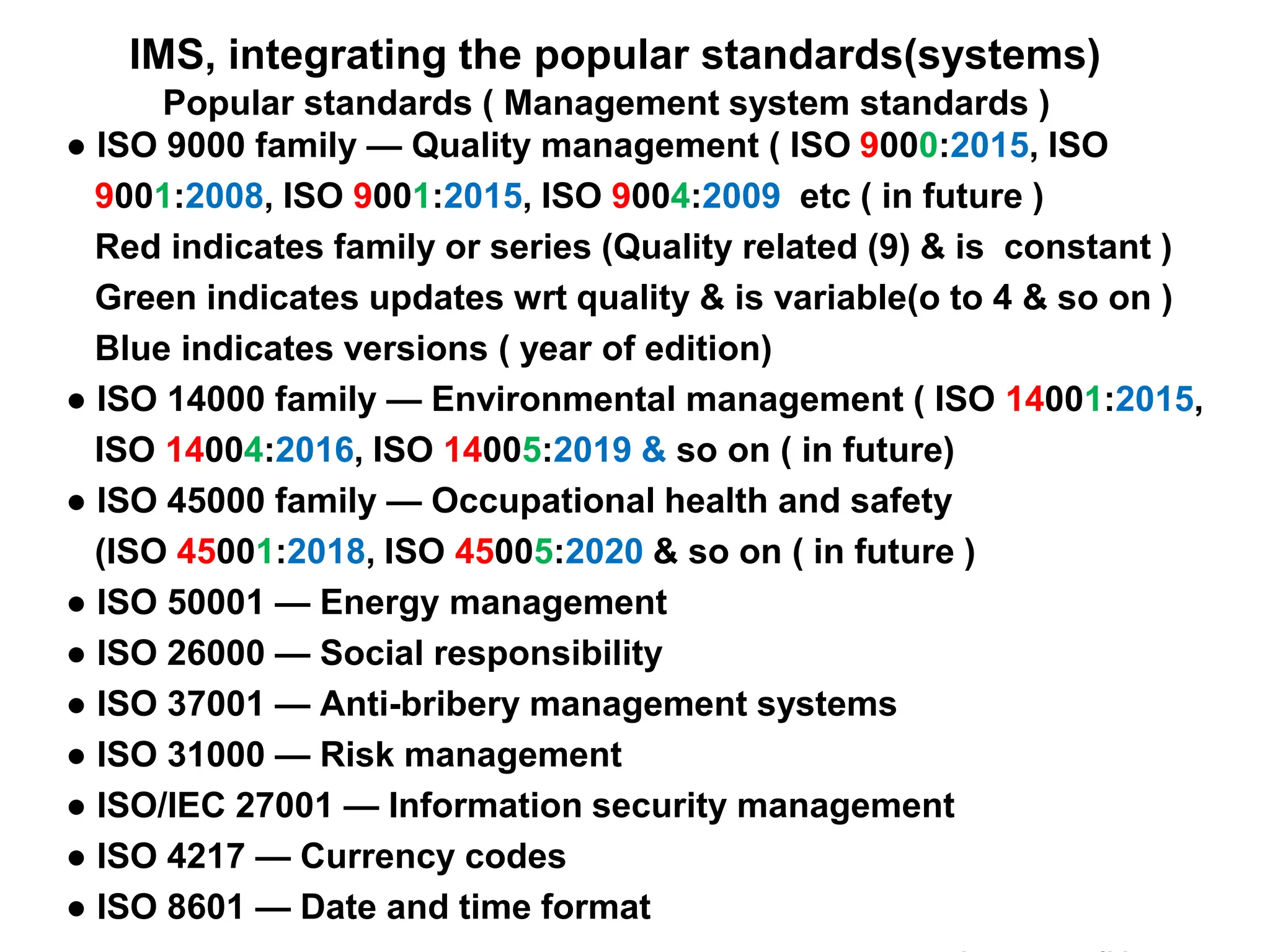
IMS, integrating the popular standards(systems)
Popular standards ( Management system standards )
● ISO 9000 family — Quality management ( ISO 9000:2015, ISO
9001:2008, ISO 9001:2015, ISO 9004:2009 etc ( in future )
Red indicates family or series (Quality related (9) & is constant )
Green indicates updates wrt quality & is variable(o to 4 & so on )
Blue indicates versions ( year of edition)
● ISO 14000 family — Environmental management ( ISO 14001:2015,
ISO 14004:2016, ISO 14005:2019 & so on ( in future)
● ISO 45000 family — Occupational health and safety
(ISO 45001:2018, ISO 45005:2020 & so on ( in future )
● ISO 50001 — Energy management
● ISO 26000 — Social responsibility
● ISO 37001 — Anti-bribery management systems
● ISO 31000 — Risk management
● ISO/IEC 27001 — Information security management
● ISO 4217 — Currency codes
● ISO 8601 — Date and time format
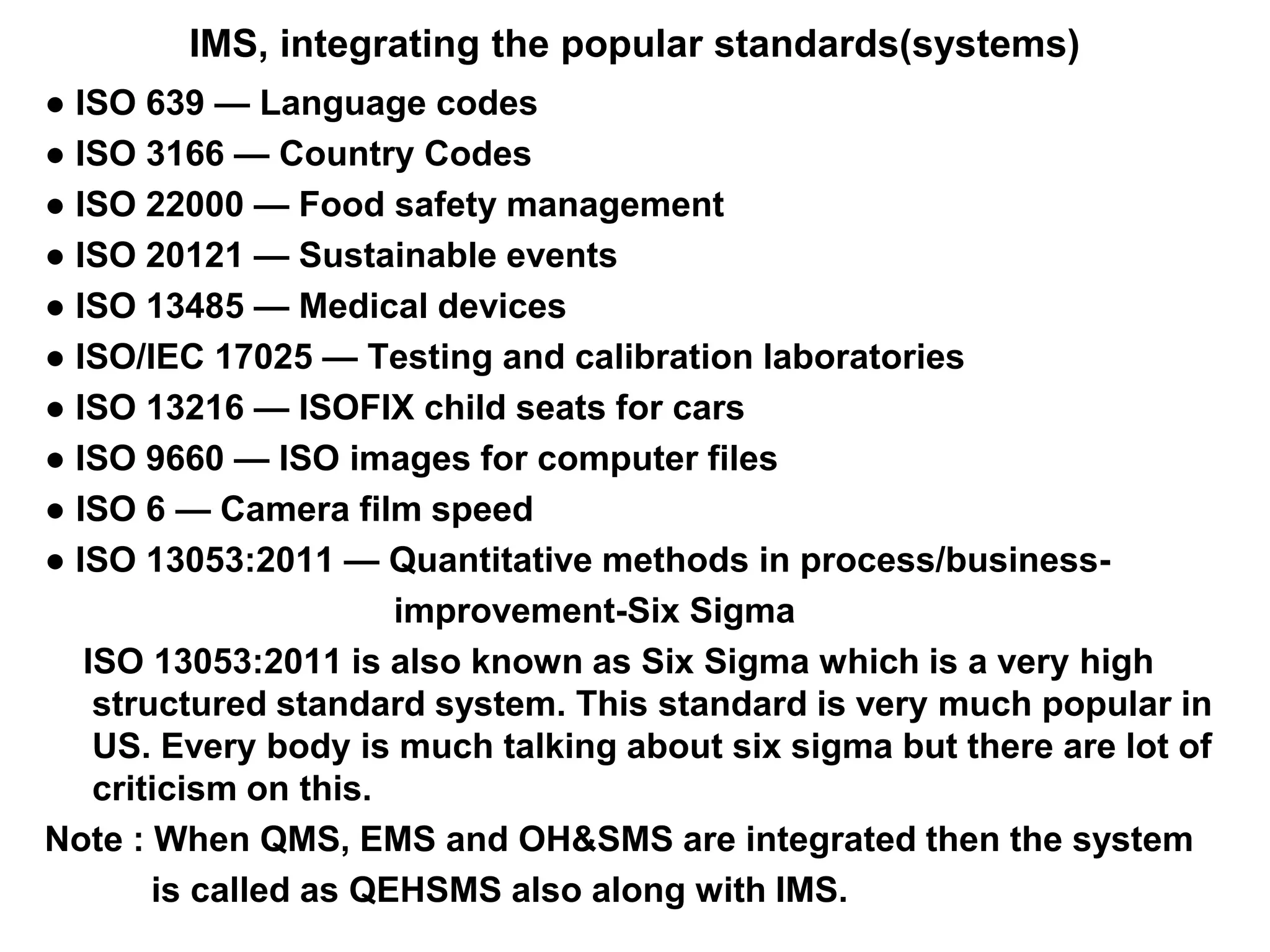
IMS, integrating the popular standards(systems)
● ISO 639 — Language codes
● ISO 3166 — Country Codes
● ISO 22000 — Food safety management
● ISO 20121 — Sustainable events
● ISO 13485 — Medical devices
● ISO/IEC 17025 — Testing and calibration laboratories
● ISO 13216 — ISOFIX child seats for cars
● ISO 9660 — ISO images for computer files
● ISO 6 — Camera film speed
● ISO 13053:2011 — Quantitative methods in process/business-
improvement-Six Sigma
ISO 13053:2011 is also known as Six Sigma which is a very high
structured standard system. This standard is very much popular in
US. Every body is much talking about six sigma but there are lot of
criticism on this.
Note : When QMS, EMS and OH&SMS are integrated then the system
is called as QEHSMS also along with IMS.
ISO accreditation , authorization & certification flow
IAF ( International Accreditation Forum)
NAB (National Accreditation Board)(UKAS(UK), ANAB(USA), NABCB(INDIA) etc)
CB (Certification Body) (Bureau Veritas, Intertek, Tuv Nord, TuvSud, BSI,SGS etc)
Companies / Organizations ( AACL, XYZ limited etc)
Notes: IAF & NAB do not do the auditing & certification activity.
IAF will monitor, authorize & designate NAB.
NAB will monitor, authorize & designate CB.
CB will conduct audit and issue certificate
UKAS (United Kingdom Accreditation Service)
ANAB (American National Accreditation Board)
NABCB (National Accreditation Board for Certification Bodies, INDIA)
For Alkyl Amines Chemicals CB is Bureau Veritas and NAB is UKAS(UK)
Difference between ISO certificate & ISO accredited certificate
Benefits of IMS
An organization / company will be benefited in terms of …..
● Improving Performance
● Eliminating Redundancies
● Accountability
● Establishing Consistency
● Reducing Bureaucracy
● Cost Reduction
● Optimize Processes and Resources
● Reducing Maintenance
● Integrated Audits
● Facilitating Decision Making
Reference : https://integrated-standards.com/articles/ims-benefits/
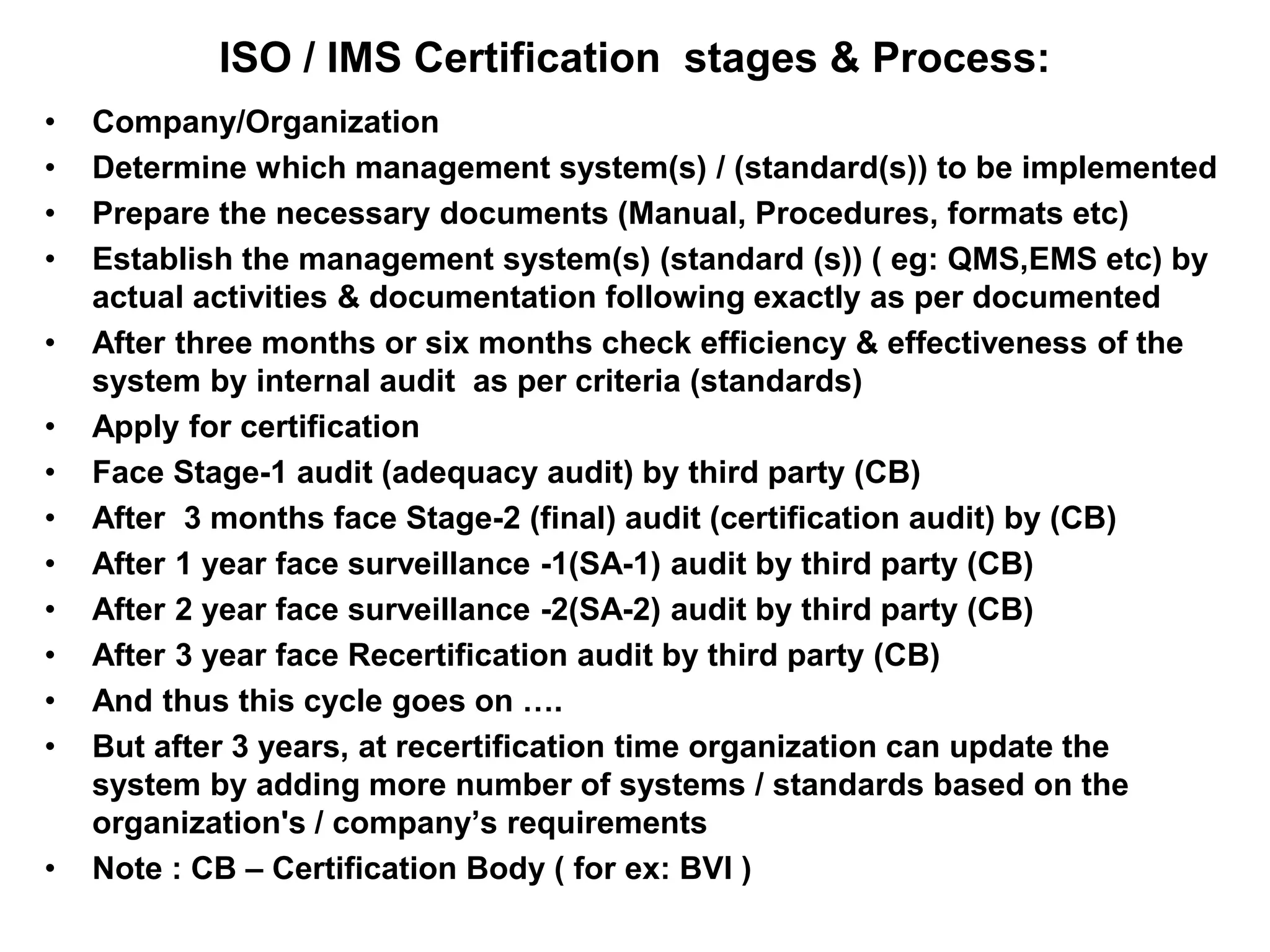
ISO / IMS Certification stages & Process:
• Company/Organization
• Determine which management system(s) / (standard(s)) to be implemented
• Prepare the necessary documents (Manual, Procedures, formats etc)
• Establish the management system(s) (standard (s)) ( eg: QMS,EMS etc) by
actual activities & documentation following exactly as per documented
• After three months or six months check efficiency & effectiveness of the
system by internal audit as per criteria (standards)
• Apply for certification
• Face Stage-1 audit (adequacy audit) by third party (CB)
• After 3 months face Stage-2 (final) audit (certification audit) by (CB)
• After 1 year face surveillance -1(SA-1) audit by third party (CB)
• After 2 year face surveillance -2(SA-2) audit by third party (CB)
• After 3 year face Recertification audit by third party (CB)
• And thus this cycle goes on ….
• But after 3 years, at recertification time organization can update the
system by adding more number of systems / standards based on the
organization's / company’s requirements
• Note : CB – Certification Body ( for ex: BVI )
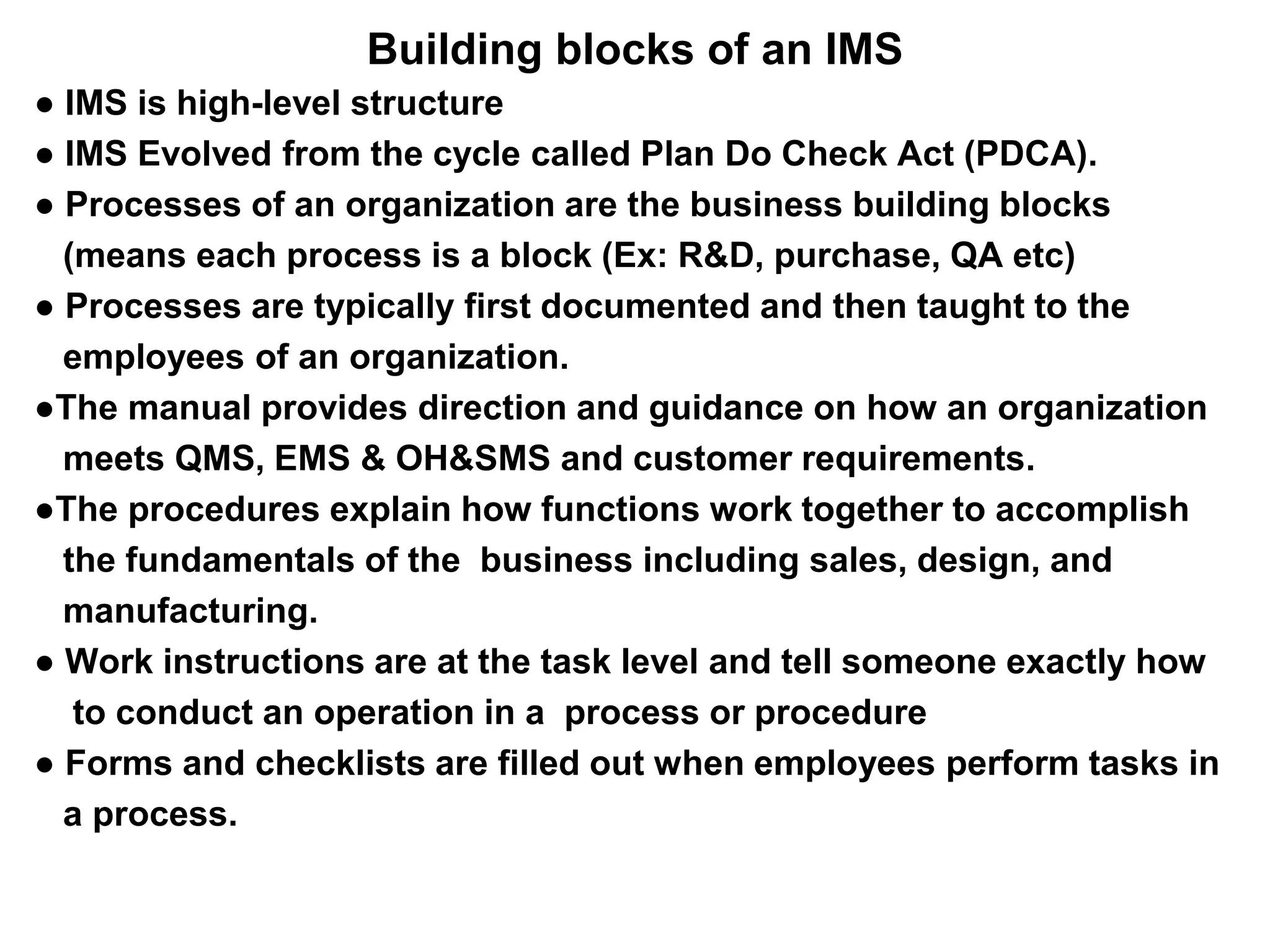
Building blocks of an IMS
● IMS is high-level structure
● IMS Evolved from the cycle called Plan Do Check Act (PDCA).
● Processes of an organization are the business building blocks
(means each process is a block (Ex: R&D, purchase, QA etc)
● Processes are typically first documented and then taught to the
employees of an organization.
●The manual provides direction and guidance on how an organization
meets QMS, EMS & OH&SMS and customer requirements.
●The procedures explain how functions work together to accomplish
the fundamentals of the business including sales, design, and
manufacturing.
● Work instructions are at the task level and tell someone exactly how
to conduct an operation in a process or procedure
● Forms and checklists are filled out when employees perform tasks in
a process.
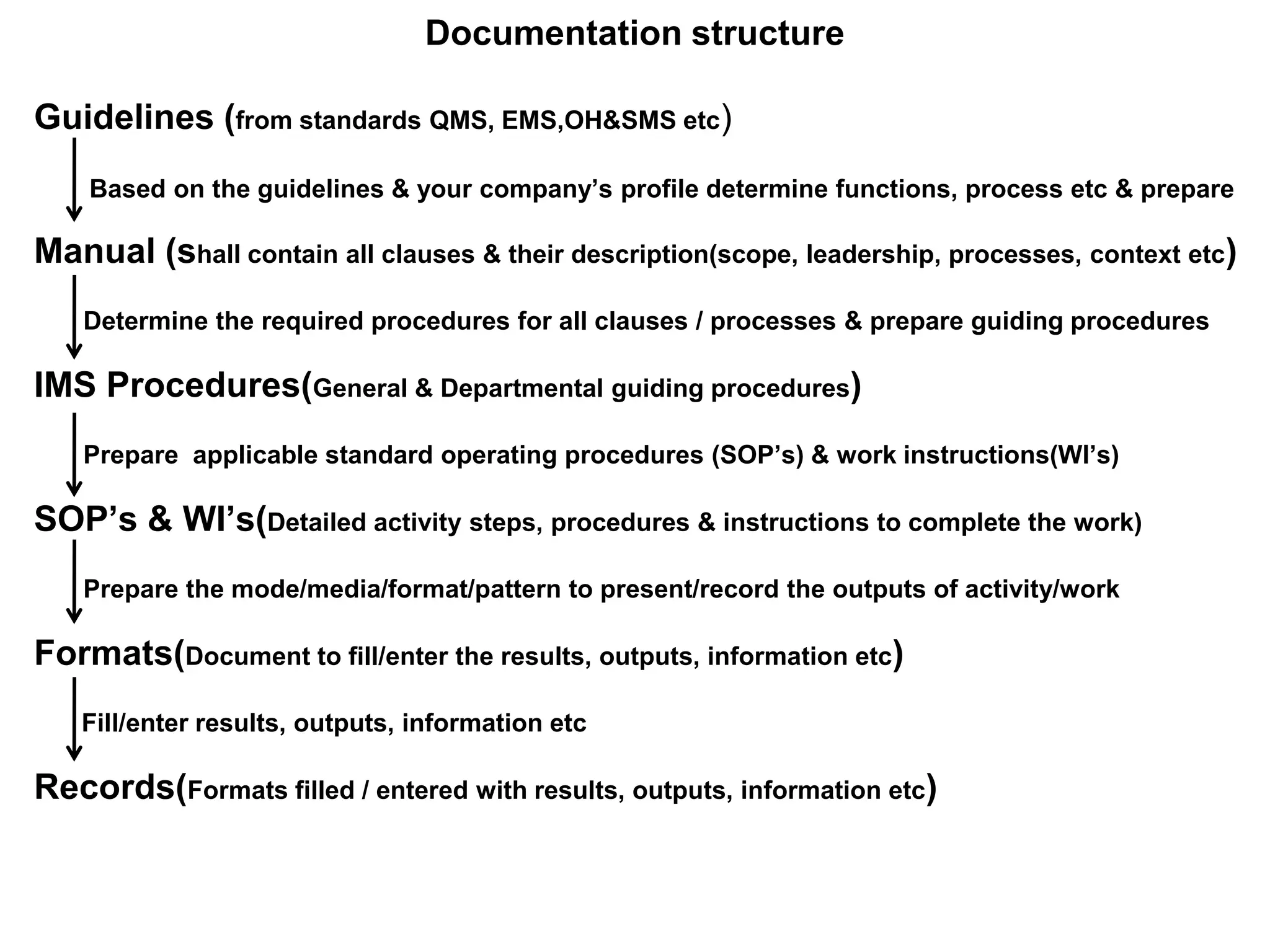
Documentation structure
Guidelines (from standards QMS, EMS,OH&SMS etc)
Based on the guidelines & your company’s profile determine functions, process etc & prepare
Manual (shall contain all clauses & their description(scope, leadership, processes, context etc)
Determine the required procedures for all clauses / processes & prepare guiding procedures
IMS Procedures(General & Departmental guiding procedures)
Prepare applicable standard operating procedures (SOP’s) & work instructions(WI’s)
SOP’s & WI’s(Detailed activity steps, procedures & instructions to complete the work)
Prepare the mode/media/format/pattern to present/record the outputs of activity/work
Formats(Document to fill/enter the results, outputs, information etc)
Fill/enter results, outputs, information etc
Records(Formats filled / entered with results, outputs, information etc)
Actual documentation structure in daily activities / practice
Actual order Reverse order Example
Guidelines Records EDS (TAA-BNo.01distilation data)
( Clause No.:8.3.3 a to d )
Manual / Process Formats Form/SYNTH/H/05
( Clause No.:8.3.3 a to e & 8.3.5 a to d )
IMS Procedures SOP’s & WI’s SOP / Daily WI Register
( Clause No.:8.3.4 a to f )
SOP’s & WI’s IMS Procedures IMSP/SYNTH/H/05
( Clause No.:8.3.2 a to j )
Formats Manual / Process Process-5 (PR-5) (R&D synthesis)
( Clause No.:8.3.1 )
Records Guidelines QMS, ISO9001:2015
(Clause No: 8.3 Design & Development
of products & services) & 8.3.1 The
Organization shall establish & maintain
a design & .….
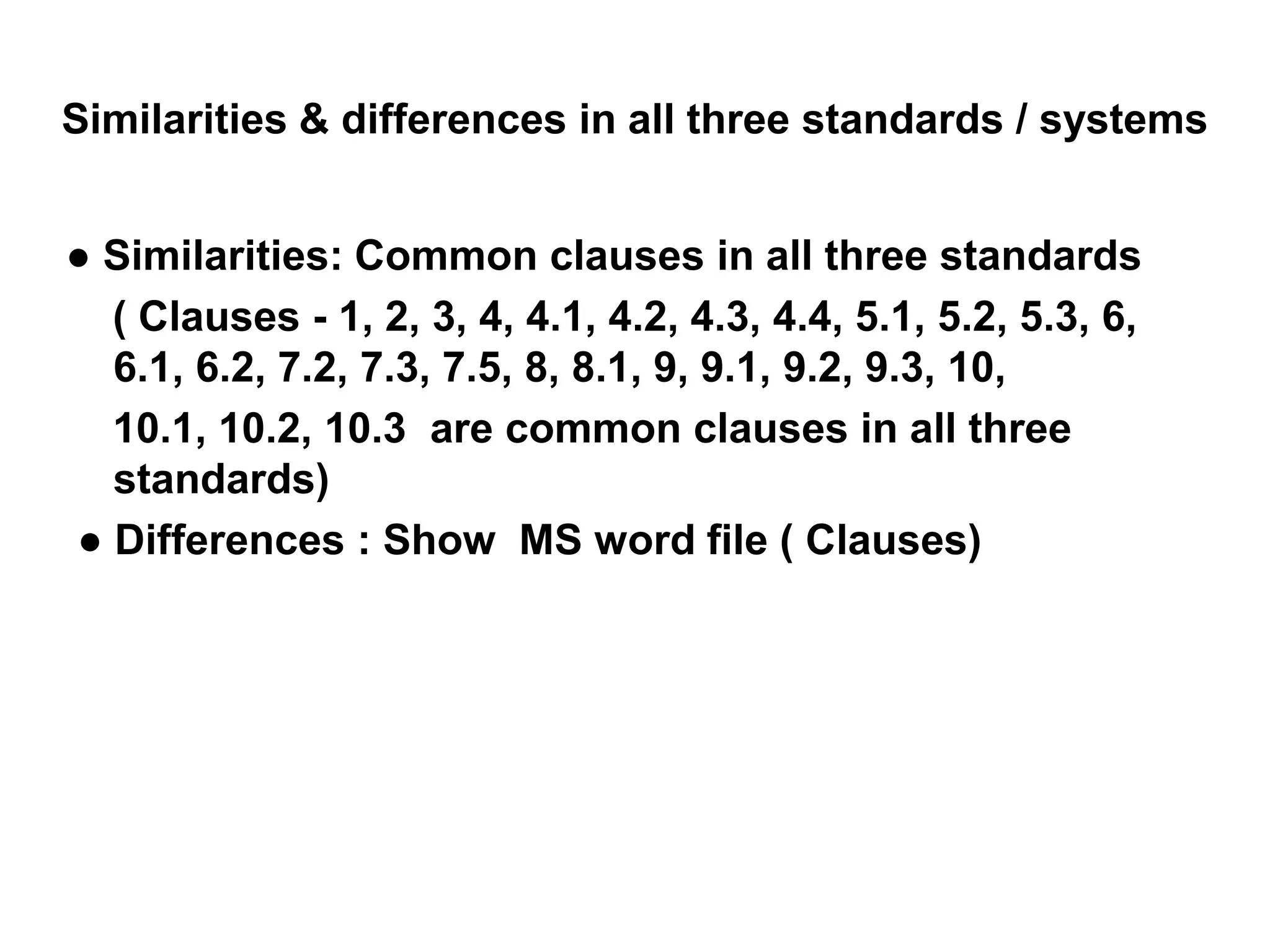
Similarities & differences in all three standards / systems
● Similarities: Common clauses in all three standards
( Clauses - 1, 2, 3, 4, 4.1, 4.2, 4.3, 4.4, 5.1, 5.2, 5.3, 6,
6.1, 6.2, 7.2, 7.3, 7.5, 8, 8.1, 9, 9.1, 9.2, 9.3, 10,
10.1, 10.2, 10.3 are common clauses in all three
standards)
● Differences : Show MS word file ( Clauses)
R&D, AACL & Standard systems
( Status : Past, present and future)
● Past : ISO 9001:2015 ( QMS ) Implemented in 01-01-2018 and
certified by BVI under UKAS(UK) and certificate is
valid till October 2021
● Present : R&D AACL is in a process of recertification with
an inclusion of two more systems (EMS & OH&SMS) along
with current QMS. Means we are in a process of being IMS
certified. IMS stage-1 audit will be conducted in September’21
● Future : Probably from November 2021 R&D AACL will be IMS
certified and probably from November 2022 R&D IMS will be
merged with all locations of AACL for integrated audits
contd….
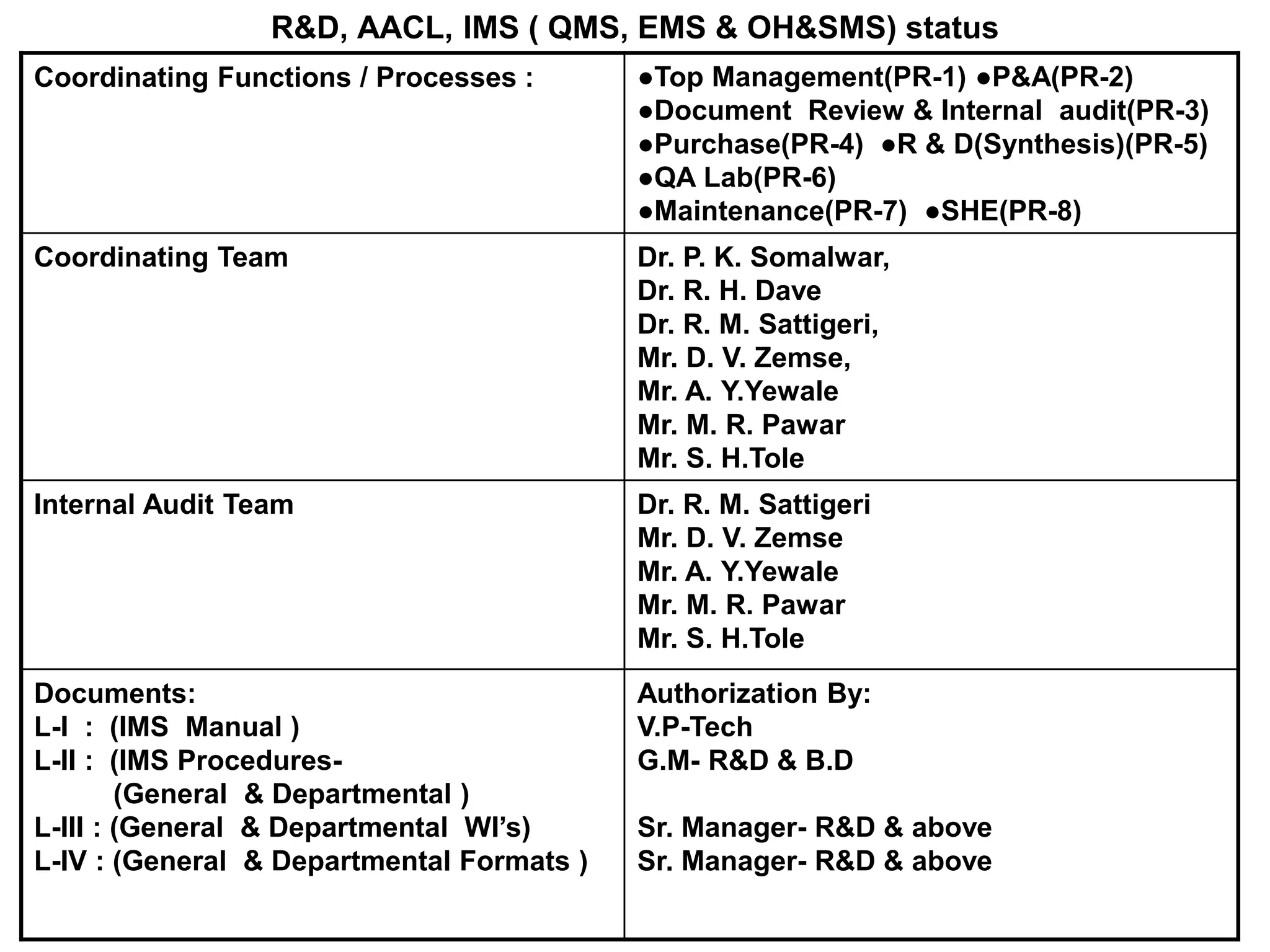
R&D, AACL, IMS ( QMS, EMS & OH&SMS) status
Coordinating Functions / Processes : ●Top Management(PR-1) ●P&A(PR-2)
●Document Review & Internal audit(PR-3)
●Purchase(PR-4) ●R & D(Synthesis)(PR-5)
●QA Lab(PR-6)
●Maintenance(PR-7) ●SHE(PR-8)
Coordinating Team Dr. P. K. Somalwar,
Dr. R. H. Dave
Dr. R. M. Sattigeri,
Mr. D. V. Zemse,
Mr. A. Y.Yewale
Mr. M. R. Pawar
Mr. S. H.Tole
Internal Audit Team Dr. R. M. Sattigeri
Mr. D. V. Zemse
Mr. A. Y.Yewale
Mr. M. R. Pawar
Mr. S. H.Tole
Documents:
L-I : (IMS Manual )
L-II : (IMS Procedures-
(General & Departmental )
L-III : (General & Departmental WI’s)
L-IV : (General & Departmental Formats )
Authorization By:
V.P-Tech
G.M- R&D & B.D
Sr. Manager- R&D & above
Sr. NO Designation / additional responsibility Remarks
1 Vice President – Technical Chairman
2 General Manager – R&D & B.D Member
3 Sr. Manager - R&D Member
4 FH – Synthesis-1 to 5 Member
5 DC (DOCUMENT COORDINATOR) Member
6 FH - EQ , I/C – EQ - 1 to I/C - EQ - 4 Member
7 I/C - WM Member
8 I/C - Chemical stores Member
9 FH - SHE Member
10 FH - ANA Member
11 I/C - Glassware Member
Management Review Committee ( MRC)
R&D, AACL, IMS ( QMS, EMS & OH&SMS) Processes and Procedures
Sr. NO Heading Description
1 IMS Processes PR-1 TO PR-8 ( 8 Processes)
2 IMS
General Procedures
IMSP/GEN/H/01 TO IMSP/GEN/H/11
( 11 Procedures )
3 IMS
Departmental Procedures
Synthesis ( 19 Procedures)
IMSP/SYNTH/H/01 TO IMSP/SYNTH/H/19
Purchase ( 2 Procedures)
IMSP/PUR/H/01 TO IMSP/PUR/H/02
Equipments ( 3 Procedures )
IMSP/EQ/H/01 TO IMSP/EQ/H/03
Analytical ( 7 Procedures )
IMSP/ANA/H/01 TO IQMSP/ANA/H/07
P & A ( 4 procedures)
IMSP/P&A /V/01 TO IMSP/P&A/V/04
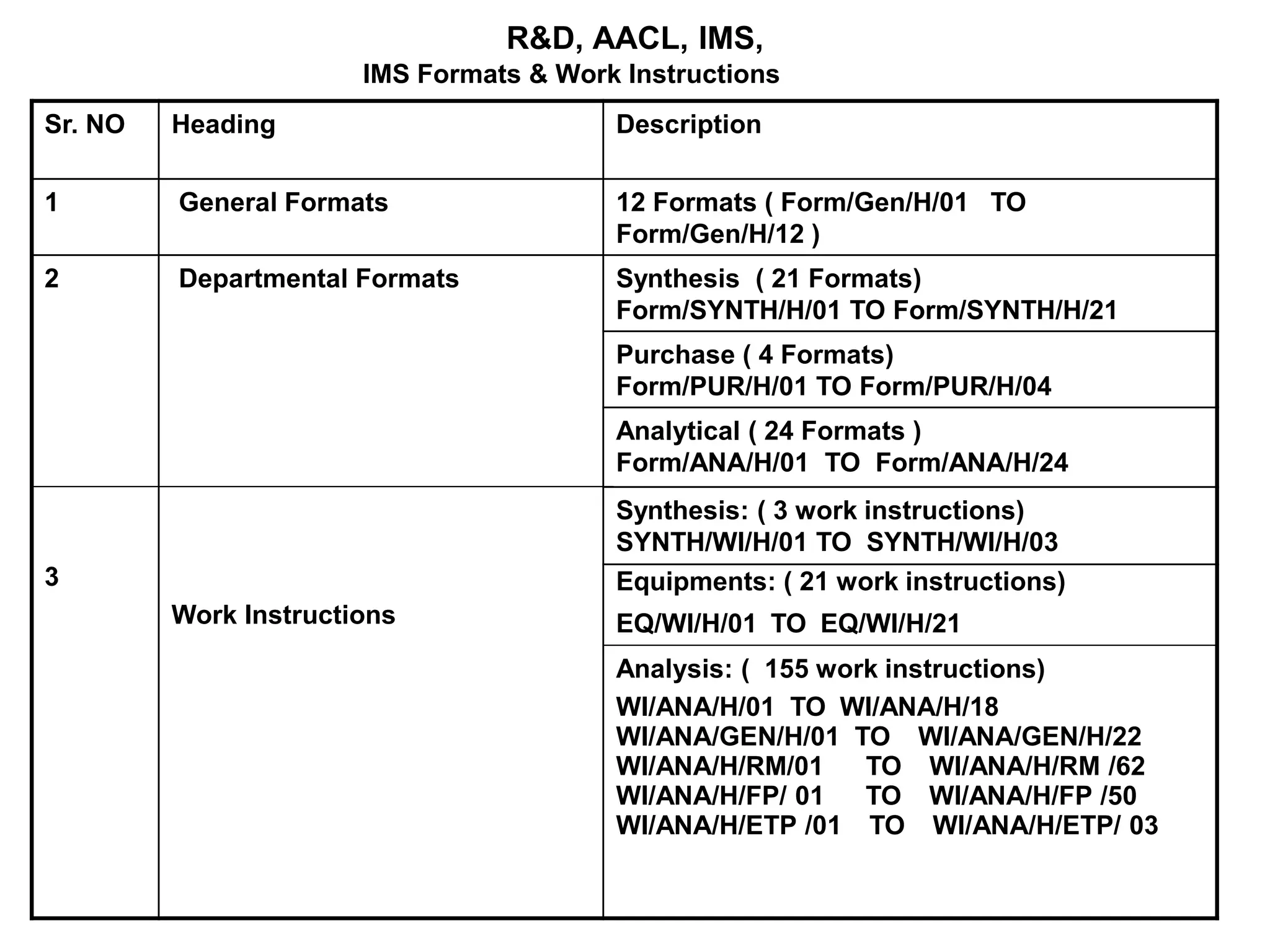
R&D, AACL, IMS,
IMS Formats & Work Instructions
Sr. NO Heading Description
1 General Formats 12 Formats ( Form/Gen/H/01 TO
Form/Gen/H/12 )
2
3
Departmental Formats
Work Instructions
Synthesis ( 21 Formats)
Form/SYNTH/H/01 TO Form/SYNTH/H/21
Purchase ( 4 Formats)
Form/PUR/H/01 TO Form/PUR/H/04
Analytical ( 24 Formats )
Form/ANA/H/01 TO Form/ANA/H/24
Synthesis: ( 3 work instructions)
SYNTH/WI/H/01 TO SYNTH/WI/H/03
Equipments: ( 21 work instructions)
EQ/WI/H/01 TO EQ/WI/H/21
Analysis: ( 155 work instructions)
WI/ANA/H/01 TO WI/ANA/H/18
WI/ANA/GEN/H/01 TO WI/ANA/GEN/H/22
WI/ANA/H/RM/01 TO WI/ANA/H/RM /62
WI/ANA/H/FP/ 01 TO WI/ANA/H/FP /50
WI/ANA/H/ETP /01 TO WI/ANA/H/ETP/ 03
R&D, AACL, IMS
List of Processes
Sr.
NO.
Process
Number
Process Title
1 PR-1 Top Management
2 PR-2 Document Review & Internal audit
3 PR-3 P & A
4 PR-4 Purchase
5 PR-5 R & D
6 PR-6 Q. A. Lab
7 PR-7 Maintenance
8 PR-8 SHE ( Safety Health Environment)

Training- integrated management system (iso)

  • 1.
    IMS Contents: Following points willbe discussed ● History ● IMS Structure ● Document Structure ● Benefits of ISO(IMS) ● R&D, AACL & Standard systems ( Status : Past, present and future)
  • 2.
    International Organization forStandardization History ● Abbreviation : ISO ● Formation : 23 February 1947 ● Type : Non-governmental organization ● Purpose : International standardization ● Headquarters : Geneva, Switzerland
  • 3.
    IMS, integrating thepopular standards(systems) Popular standards ( Management system standards ) ● ISO 9000 family — Quality management ( ISO 9000:2015, ISO 9001:2008, ISO 9001:2015, ISO 9004:2009 etc ( in future ) Red indicates family or series (Quality related (9) & is constant ) Green indicates updates wrt quality & is variable(o to 4 & so on ) Blue indicates versions ( year of edition) ● ISO 14000 family — Environmental management ( ISO 14001:2015, ISO 14004:2016, ISO 14005:2019 & so on ( in future) ● ISO 45000 family — Occupational health and safety (ISO 45001:2018, ISO 45005:2020 & so on ( in future ) ● ISO 50001 — Energy management ● ISO 26000 — Social responsibility ● ISO 37001 — Anti-bribery management systems ● ISO 31000 — Risk management ● ISO/IEC 27001 — Information security management ● ISO 4217 — Currency codes ● ISO 8601 — Date and time format
  • 4.
    IMS, integrating thepopular standards(systems) ● ISO 639 — Language codes ● ISO 3166 — Country Codes ● ISO 22000 — Food safety management ● ISO 20121 — Sustainable events ● ISO 13485 — Medical devices ● ISO/IEC 17025 — Testing and calibration laboratories ● ISO 13216 — ISOFIX child seats for cars ● ISO 9660 — ISO images for computer files ● ISO 6 — Camera film speed ● ISO 13053:2011 — Quantitative methods in process/business- improvement-Six Sigma ISO 13053:2011 is also known as Six Sigma which is a very high structured standard system. This standard is very much popular in US. Every body is much talking about six sigma but there are lot of criticism on this. Note : When QMS, EMS and OH&SMS are integrated then the system is called as QEHSMS also along with IMS.
  • 5.
    ISO accreditation ,authorization & certification flow IAF ( International Accreditation Forum) NAB (National Accreditation Board)(UKAS(UK), ANAB(USA), NABCB(INDIA) etc) CB (Certification Body) (Bureau Veritas, Intertek, Tuv Nord, TuvSud, BSI,SGS etc) Companies / Organizations ( AACL, XYZ limited etc) Notes: IAF & NAB do not do the auditing & certification activity. IAF will monitor, authorize & designate NAB. NAB will monitor, authorize & designate CB. CB will conduct audit and issue certificate UKAS (United Kingdom Accreditation Service) ANAB (American National Accreditation Board) NABCB (National Accreditation Board for Certification Bodies, INDIA) For Alkyl Amines Chemicals CB is Bureau Veritas and NAB is UKAS(UK) Difference between ISO certificate & ISO accredited certificate
  • 6.
    Benefits of IMS Anorganization / company will be benefited in terms of ….. ● Improving Performance ● Eliminating Redundancies ● Accountability ● Establishing Consistency ● Reducing Bureaucracy ● Cost Reduction ● Optimize Processes and Resources ● Reducing Maintenance ● Integrated Audits ● Facilitating Decision Making Reference : https://integrated-standards.com/articles/ims-benefits/
  • 7.
    ISO / IMSCertification stages & Process: • Company/Organization • Determine which management system(s) / (standard(s)) to be implemented • Prepare the necessary documents (Manual, Procedures, formats etc) • Establish the management system(s) (standard (s)) ( eg: QMS,EMS etc) by actual activities & documentation following exactly as per documented • After three months or six months check efficiency & effectiveness of the system by internal audit as per criteria (standards) • Apply for certification • Face Stage-1 audit (adequacy audit) by third party (CB) • After 3 months face Stage-2 (final) audit (certification audit) by (CB) • After 1 year face surveillance -1(SA-1) audit by third party (CB) • After 2 year face surveillance -2(SA-2) audit by third party (CB) • After 3 year face Recertification audit by third party (CB) • And thus this cycle goes on …. • But after 3 years, at recertification time organization can update the system by adding more number of systems / standards based on the organization's / company’s requirements • Note : CB – Certification Body ( for ex: BVI )
  • 8.
    Building blocks ofan IMS ● IMS is high-level structure ● IMS Evolved from the cycle called Plan Do Check Act (PDCA). ● Processes of an organization are the business building blocks (means each process is a block (Ex: R&D, purchase, QA etc) ● Processes are typically first documented and then taught to the employees of an organization. ●The manual provides direction and guidance on how an organization meets QMS, EMS & OH&SMS and customer requirements. ●The procedures explain how functions work together to accomplish the fundamentals of the business including sales, design, and manufacturing. ● Work instructions are at the task level and tell someone exactly how to conduct an operation in a process or procedure ● Forms and checklists are filled out when employees perform tasks in a process.
  • 9.
    Documentation structure Guidelines (fromstandards QMS, EMS,OH&SMS etc) Based on the guidelines & your company’s profile determine functions, process etc & prepare Manual (shall contain all clauses & their description(scope, leadership, processes, context etc) Determine the required procedures for all clauses / processes & prepare guiding procedures IMS Procedures(General & Departmental guiding procedures) Prepare applicable standard operating procedures (SOP’s) & work instructions(WI’s) SOP’s & WI’s(Detailed activity steps, procedures & instructions to complete the work) Prepare the mode/media/format/pattern to present/record the outputs of activity/work Formats(Document to fill/enter the results, outputs, information etc) Fill/enter results, outputs, information etc Records(Formats filled / entered with results, outputs, information etc)
  • 10.
    Actual documentation structurein daily activities / practice Actual order Reverse order Example Guidelines Records EDS (TAA-BNo.01distilation data) ( Clause No.:8.3.3 a to d ) Manual / Process Formats Form/SYNTH/H/05 ( Clause No.:8.3.3 a to e & 8.3.5 a to d ) IMS Procedures SOP’s & WI’s SOP / Daily WI Register ( Clause No.:8.3.4 a to f ) SOP’s & WI’s IMS Procedures IMSP/SYNTH/H/05 ( Clause No.:8.3.2 a to j ) Formats Manual / Process Process-5 (PR-5) (R&D synthesis) ( Clause No.:8.3.1 ) Records Guidelines QMS, ISO9001:2015 (Clause No: 8.3 Design & Development of products & services) & 8.3.1 The Organization shall establish & maintain a design & .….
  • 11.
    Similarities & differencesin all three standards / systems ● Similarities: Common clauses in all three standards ( Clauses - 1, 2, 3, 4, 4.1, 4.2, 4.3, 4.4, 5.1, 5.2, 5.3, 6, 6.1, 6.2, 7.2, 7.3, 7.5, 8, 8.1, 9, 9.1, 9.2, 9.3, 10, 10.1, 10.2, 10.3 are common clauses in all three standards) ● Differences : Show MS word file ( Clauses)
  • 12.
    R&D, AACL &Standard systems ( Status : Past, present and future) ● Past : ISO 9001:2015 ( QMS ) Implemented in 01-01-2018 and certified by BVI under UKAS(UK) and certificate is valid till October 2021 ● Present : R&D AACL is in a process of recertification with an inclusion of two more systems (EMS & OH&SMS) along with current QMS. Means we are in a process of being IMS certified. IMS stage-1 audit will be conducted in September’21 ● Future : Probably from November 2021 R&D AACL will be IMS certified and probably from November 2022 R&D IMS will be merged with all locations of AACL for integrated audits contd….
  • 13.
    R&D, AACL, IMS( QMS, EMS & OH&SMS) status Coordinating Functions / Processes : ●Top Management(PR-1) ●P&A(PR-2) ●Document Review & Internal audit(PR-3) ●Purchase(PR-4) ●R & D(Synthesis)(PR-5) ●QA Lab(PR-6) ●Maintenance(PR-7) ●SHE(PR-8) Coordinating Team Dr. P. K. Somalwar, Dr. R. H. Dave Dr. R. M. Sattigeri, Mr. D. V. Zemse, Mr. A. Y.Yewale Mr. M. R. Pawar Mr. S. H.Tole Internal Audit Team Dr. R. M. Sattigeri Mr. D. V. Zemse Mr. A. Y.Yewale Mr. M. R. Pawar Mr. S. H.Tole Documents: L-I : (IMS Manual ) L-II : (IMS Procedures- (General & Departmental ) L-III : (General & Departmental WI’s) L-IV : (General & Departmental Formats ) Authorization By: V.P-Tech G.M- R&D & B.D Sr. Manager- R&D & above Sr. Manager- R&D & above
  • 14.
    Sr. NO Designation/ additional responsibility Remarks 1 Vice President – Technical Chairman 2 General Manager – R&D & B.D Member 3 Sr. Manager - R&D Member 4 FH – Synthesis-1 to 5 Member 5 DC (DOCUMENT COORDINATOR) Member 6 FH - EQ , I/C – EQ - 1 to I/C - EQ - 4 Member 7 I/C - WM Member 8 I/C - Chemical stores Member 9 FH - SHE Member 10 FH - ANA Member 11 I/C - Glassware Member Management Review Committee ( MRC)
  • 15.
    R&D, AACL, IMS( QMS, EMS & OH&SMS) Processes and Procedures Sr. NO Heading Description 1 IMS Processes PR-1 TO PR-8 ( 8 Processes) 2 IMS General Procedures IMSP/GEN/H/01 TO IMSP/GEN/H/11 ( 11 Procedures ) 3 IMS Departmental Procedures Synthesis ( 19 Procedures) IMSP/SYNTH/H/01 TO IMSP/SYNTH/H/19 Purchase ( 2 Procedures) IMSP/PUR/H/01 TO IMSP/PUR/H/02 Equipments ( 3 Procedures ) IMSP/EQ/H/01 TO IMSP/EQ/H/03 Analytical ( 7 Procedures ) IMSP/ANA/H/01 TO IQMSP/ANA/H/07 P & A ( 4 procedures) IMSP/P&A /V/01 TO IMSP/P&A/V/04
  • 16.
    R&D, AACL, IMS, IMSFormats & Work Instructions Sr. NO Heading Description 1 General Formats 12 Formats ( Form/Gen/H/01 TO Form/Gen/H/12 ) 2 3 Departmental Formats Work Instructions Synthesis ( 21 Formats) Form/SYNTH/H/01 TO Form/SYNTH/H/21 Purchase ( 4 Formats) Form/PUR/H/01 TO Form/PUR/H/04 Analytical ( 24 Formats ) Form/ANA/H/01 TO Form/ANA/H/24 Synthesis: ( 3 work instructions) SYNTH/WI/H/01 TO SYNTH/WI/H/03 Equipments: ( 21 work instructions) EQ/WI/H/01 TO EQ/WI/H/21 Analysis: ( 155 work instructions) WI/ANA/H/01 TO WI/ANA/H/18 WI/ANA/GEN/H/01 TO WI/ANA/GEN/H/22 WI/ANA/H/RM/01 TO WI/ANA/H/RM /62 WI/ANA/H/FP/ 01 TO WI/ANA/H/FP /50 WI/ANA/H/ETP /01 TO WI/ANA/H/ETP/ 03
  • 17.
    R&D, AACL, IMS Listof Processes Sr. NO. Process Number Process Title 1 PR-1 Top Management 2 PR-2 Document Review & Internal audit 3 PR-3 P & A 4 PR-4 Purchase 5 PR-5 R & D 6 PR-6 Q. A. Lab 7 PR-7 Maintenance 8 PR-8 SHE ( Safety Health Environment)