What causes the division between
the North and the South
Standard 8
Issue of Slavery
• Demand for land and also Cotton Gin led to
expansion of slavery in South
• In North, expansion of industries did not need
slave labor
• Causing a major cultural and economic divide
between North and South
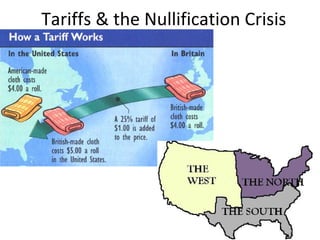
• Tariffs typically benefited North and not South
Slave Rebellions Throughout theSlave Rebellions Throughout the
AmericasAmericas
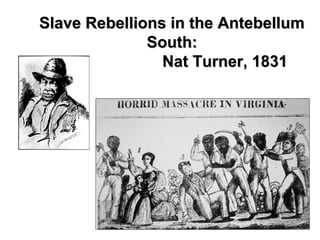
Slave Rebellions in the AntebellumSlave Rebellions in the Antebellum
South:South:
Nat Turner, 1831Nat Turner, 1831
Abolitionism
• William Lloyd Garrison,
publisher of the The Liberator,
first appeared in 1831 and sent
shock waves across the entire
country
– He argued about gradual
emancipation and said that there
needed to be an immediate end
to slavery at once
– He supported racial equality.
Abolitionism
Free blacks, such as Frederick Douglass,
who had escaped from slavery in Maryland,
also joined the abolitionist movement
To abolitionists, slavery was a moral, not an
economic question
But most of all, abolitionists denounced
slavery as contrary to Christian teaching
1845 --> The Narrative of the Life
Of Frederick Douglass
1847 --> started his own newspaper called
“The North Star”
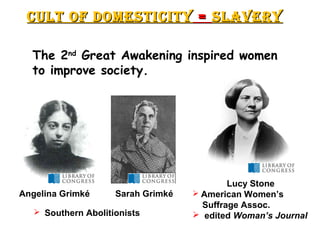
Cult of DomestiCityCult of DomestiCity == slaveryslavery
The 2nd
Great Awakening inspired women
to improve society.
Angelina Grimké Sarah Grimké
 Southern Abolitionists
Lucy Stone
 American Women’s
Suffrage Assoc.
 edited Woman’s Journal
R2-9
Missouri Compromise
• 1819- Missouri wants to become 23rd
state
• House of Reps passes Tallmadge Amendment
– Slaves born in Missouri after it becomes a state
would be freed at 25
• Voted down in Senate
Missouri Compromise
Tariffs & the Nullification Crisis
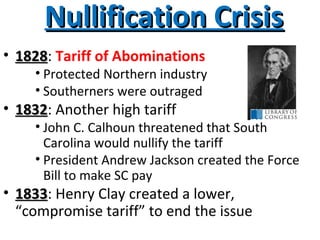
Nullification CrisisNullification Crisis
• 18281828: Tariff of Abominations
• Protected Northern industry
• Southerners were outraged
• 18321832: Another high tariff
• John C. Calhoun threatened that South
Carolina would nullify the tariff
• President Andrew Jackson created the Force
Bill to make SC pay
• 18331833: Henry Clay created a lower,
“compromise tariff” to end the issue
What was Sectionalism?What was Sectionalism?
• Sectional, or regional loyalties were
present in Congress from the beginning,
but they became stronger during and
after the 1820s.
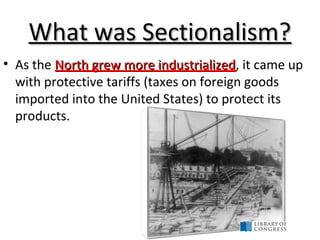
What was Sectionalism?What was Sectionalism?
• As the North grew more industrializedNorth grew more industrialized, it came up
with protective tariffs (taxes on foreign goods
imported into the United States) to protect its
products.
What was Sectionalism?What was Sectionalism?
• Because the South remained agriculturalSouth remained agricultural, it did not
want tariffs that would raise the prices of the
manufactured goods it needed.
• Congress served as the battleground
for sectional rivalries and alliances.
• Although both the Whig and
Democratic parties were national
organizations, electing members of
Congress from all regions, increasingly
members crossed party lines to stand
together to defend their common
sectional interests.
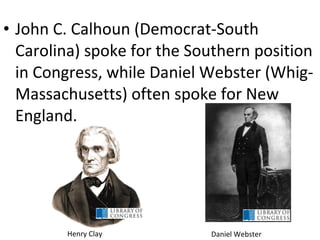
• John C. Calhoun (Democrat-South
Carolina) spoke for the Southern position
in Congress, while Daniel Webster (Whig-
Massachusetts) often spoke for New
England.
Daniel WebsterHenry Clay
Conflict in Texas
• Southerners want more land for cotton
• Confusion as to if they can enter or not
• Stephen F Austin leads families into Texas
• Santa Anna brings army in
Lone Star Rebellion
• Battle of Alamo
• Goliad
• Sam Houston and Battle
of San Jacinto
– Santa Anna captured
forced to recognize
Texas as independent
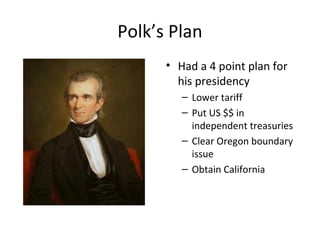
Polk’s Plan
• Had a 4 point plan for
his presidency
– Lower tariff
– Put US $$ in
independent treasuries
– Clear Oregon boundary
issue
– Obtain California
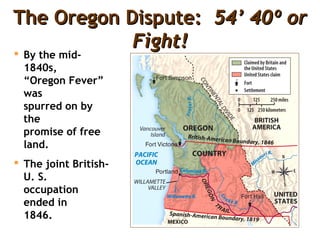
The Oregon Dispute:The Oregon Dispute: 54’ 40º or54’ 40º or
Fight!Fight!
 By the mid-
1840s,
“Oregon Fever”
was
spurred on by
the
promise of free
land.
 The joint British-
U. S.
occupation
ended in
1846.
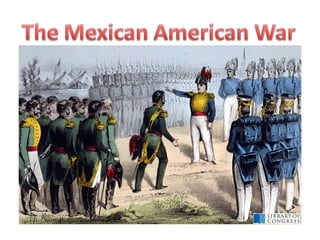
• It was an armed conflict between the United
States and Mexico from 1846 to 1848 in the
wake of the 1845 U.S. annexation of Texas,
which Mexico considered part of its territory
despite the 1836 Texas Revolution.
The Mexican–American War
• Mexico accepted the Rio Grande as its
national border, and the loss of Texas.
• Meanwhile gold was discovered in
California, which immediately became an
international magnet for the California
Gold Rush.
The Mexican–American War
Treaty of Guadalupe HidalgoTreaty of Guadalupe Hidalgo
•Mexico ceded the MexicanMexico ceded the Mexican
Cession to U.S.Cession to U.S.
•Rio Grande River boundaryRio Grande River boundary
between U.S. and Mexicobetween U.S. and Mexico
•U.S. paid Mexico $15 millionU.S. paid Mexico $15 million
• The major consequence of the war was the
Mexican Cession of the territories of Californiaterritories of California
and New Mexicoand New Mexico to the United States in
exchange for $15 million.
• In addition, the United States forgave debt
owed by the Mexican government to U.S.
citizens.
The Mexican–American War
Gadsden Purchase
Wilmot Proviso
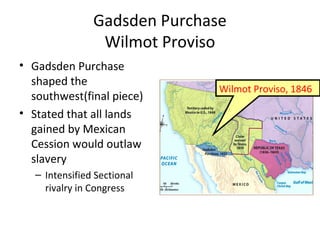
• Gadsden Purchase
shaped the
southwest(final piece)
• Stated that all lands
gained by Mexican
Cession would outlaw
slavery
– Intensified Sectional
rivalry in Congress
Wilmot Proviso, 1846
Most intense debate in U.S. HistoryMost intense debate in U.S. History
•John C. CalhounJohn C. Calhoun
•North should honor the Constitution
and enforce the Fugitive Slave Law
•South wanted California
•threatened to secede from U.S.
•U.S. should have two Presidents---
one from the North and one for the
South
Comp of 1850
•Daniel WebsterDaniel Webster
•Secession is impractical &
impossible
•How would we split the land?
•The military?
•Compromise at all cost
•Preserve the Union
•Henry ClayHenry Clay
•The Great Compromiser, with
John C. Calhoun, Daniel Webster
and Stephen Douglas, propose
this compromise.
Compromise of 1850
• California wanted to join the union, but
problems arose…free or slave state?
• Henry Clay “The Great Compromiser” issues a
proposal that sparks the most heated debate
in US History
– Cali a free state, NM and TX border resolved,
outlaw slave trade in DC
– Congress could not interfere with slave trade,
Fugitive Slave Law
•U.S. Senator from the state of IllinoisU.S. Senator from the state of Illinois
•Solve the slavery issue was throughSolve the slavery issue was through
Popular SovereigntyPopular Sovereignty
•let the people in each territorylet the people in each territory
decide through the process of votingdecide through the process of voting
whether they want slavery or not.whether they want slavery or not.
•Along with Henry Clay, DanielAlong with Henry Clay, Daniel
Webster and John C. Calhoun theyWebster and John C. Calhoun they
proposed theproposed the Compromise of 1850Compromise of 1850
•Calif. A free stateCalif. A free state
•enforce Fugitive Slave Lawenforce Fugitive Slave Law
•Popular SovereigntyPopular Sovereignty
•stop slave trade in Washington, D.C.stop slave trade in Washington, D.C.
Picture/S.Douglas
Map Comp of 1850
Popular SovereigntyPopular Sovereignty
Allow the people in a
territory to vote on
whether they want
slavery to exist or
not in their state.
ABOLITIONISTS RESPOND
Denounced by
Abolitionists
Harriet Beecher Stowe’s,
Uncle Tom’s Cabin is
published
Abolitionists refuse to
enforce the law
Underground Railroad
becomes more active

Standard 8

  • 1.
    What causes thedivision between the North and the South Standard 8
  • 2.
    Issue of Slavery •Demand for land and also Cotton Gin led to expansion of slavery in South • In North, expansion of industries did not need slave labor • Causing a major cultural and economic divide between North and South • Tariffs typically benefited North and not South
  • 3.
    Slave Rebellions ThroughouttheSlave Rebellions Throughout the AmericasAmericas
  • 4.
    Slave Rebellions inthe AntebellumSlave Rebellions in the Antebellum South:South: Nat Turner, 1831Nat Turner, 1831
  • 5.
    Abolitionism • William LloydGarrison, publisher of the The Liberator, first appeared in 1831 and sent shock waves across the entire country – He argued about gradual emancipation and said that there needed to be an immediate end to slavery at once – He supported racial equality.
  • 6.
    Abolitionism Free blacks, suchas Frederick Douglass, who had escaped from slavery in Maryland, also joined the abolitionist movement To abolitionists, slavery was a moral, not an economic question But most of all, abolitionists denounced slavery as contrary to Christian teaching 1845 --> The Narrative of the Life Of Frederick Douglass 1847 --> started his own newspaper called “The North Star”
  • 7.
    Cult of DomestiCityCultof DomestiCity == slaveryslavery The 2nd Great Awakening inspired women to improve society. Angelina Grimké Sarah Grimké  Southern Abolitionists Lucy Stone  American Women’s Suffrage Assoc.  edited Woman’s Journal R2-9
  • 8.
    Missouri Compromise • 1819-Missouri wants to become 23rd state • House of Reps passes Tallmadge Amendment – Slaves born in Missouri after it becomes a state would be freed at 25 • Voted down in Senate
  • 9.
  • 10.
    Tariffs & theNullification Crisis
  • 11.
    Nullification CrisisNullification Crisis •18281828: Tariff of Abominations • Protected Northern industry • Southerners were outraged • 18321832: Another high tariff • John C. Calhoun threatened that South Carolina would nullify the tariff • President Andrew Jackson created the Force Bill to make SC pay • 18331833: Henry Clay created a lower, “compromise tariff” to end the issue
  • 12.
    What was Sectionalism?Whatwas Sectionalism? • Sectional, or regional loyalties were present in Congress from the beginning, but they became stronger during and after the 1820s.
  • 13.
    What was Sectionalism?Whatwas Sectionalism? • As the North grew more industrializedNorth grew more industrialized, it came up with protective tariffs (taxes on foreign goods imported into the United States) to protect its products.
  • 14.
    What was Sectionalism?Whatwas Sectionalism? • Because the South remained agriculturalSouth remained agricultural, it did not want tariffs that would raise the prices of the manufactured goods it needed.
  • 15.
    • Congress servedas the battleground for sectional rivalries and alliances. • Although both the Whig and Democratic parties were national organizations, electing members of Congress from all regions, increasingly members crossed party lines to stand together to defend their common sectional interests.
  • 16.
    • John C.Calhoun (Democrat-South Carolina) spoke for the Southern position in Congress, while Daniel Webster (Whig- Massachusetts) often spoke for New England. Daniel WebsterHenry Clay
  • 17.
    Conflict in Texas •Southerners want more land for cotton • Confusion as to if they can enter or not • Stephen F Austin leads families into Texas • Santa Anna brings army in
  • 18.
    Lone Star Rebellion •Battle of Alamo • Goliad • Sam Houston and Battle of San Jacinto – Santa Anna captured forced to recognize Texas as independent
  • 19.
    Polk’s Plan • Hada 4 point plan for his presidency – Lower tariff – Put US $$ in independent treasuries – Clear Oregon boundary issue – Obtain California
  • 20.
    The Oregon Dispute:TheOregon Dispute: 54’ 40º or54’ 40º or Fight!Fight!  By the mid- 1840s, “Oregon Fever” was spurred on by the promise of free land.  The joint British- U. S. occupation ended in 1846.
  • 22.
    • It wasan armed conflict between the United States and Mexico from 1846 to 1848 in the wake of the 1845 U.S. annexation of Texas, which Mexico considered part of its territory despite the 1836 Texas Revolution. The Mexican–American War
  • 23.
    • Mexico acceptedthe Rio Grande as its national border, and the loss of Texas. • Meanwhile gold was discovered in California, which immediately became an international magnet for the California Gold Rush. The Mexican–American War
  • 24.
    Treaty of GuadalupeHidalgoTreaty of Guadalupe Hidalgo •Mexico ceded the MexicanMexico ceded the Mexican Cession to U.S.Cession to U.S. •Rio Grande River boundaryRio Grande River boundary between U.S. and Mexicobetween U.S. and Mexico •U.S. paid Mexico $15 millionU.S. paid Mexico $15 million
  • 25.
    • The majorconsequence of the war was the Mexican Cession of the territories of Californiaterritories of California and New Mexicoand New Mexico to the United States in exchange for $15 million. • In addition, the United States forgave debt owed by the Mexican government to U.S. citizens. The Mexican–American War
  • 26.
    Gadsden Purchase Wilmot Proviso •Gadsden Purchase shaped the southwest(final piece) • Stated that all lands gained by Mexican Cession would outlaw slavery – Intensified Sectional rivalry in Congress Wilmot Proviso, 1846
  • 28.
    Most intense debatein U.S. HistoryMost intense debate in U.S. History •John C. CalhounJohn C. Calhoun •North should honor the Constitution and enforce the Fugitive Slave Law •South wanted California •threatened to secede from U.S. •U.S. should have two Presidents--- one from the North and one for the South Comp of 1850 •Daniel WebsterDaniel Webster •Secession is impractical & impossible •How would we split the land? •The military? •Compromise at all cost •Preserve the Union •Henry ClayHenry Clay •The Great Compromiser, with John C. Calhoun, Daniel Webster and Stephen Douglas, propose this compromise.
  • 29.
    Compromise of 1850 •California wanted to join the union, but problems arose…free or slave state? • Henry Clay “The Great Compromiser” issues a proposal that sparks the most heated debate in US History – Cali a free state, NM and TX border resolved, outlaw slave trade in DC – Congress could not interfere with slave trade, Fugitive Slave Law
  • 30.
    •U.S. Senator fromthe state of IllinoisU.S. Senator from the state of Illinois •Solve the slavery issue was throughSolve the slavery issue was through Popular SovereigntyPopular Sovereignty •let the people in each territorylet the people in each territory decide through the process of votingdecide through the process of voting whether they want slavery or not.whether they want slavery or not. •Along with Henry Clay, DanielAlong with Henry Clay, Daniel Webster and John C. Calhoun theyWebster and John C. Calhoun they proposed theproposed the Compromise of 1850Compromise of 1850 •Calif. A free stateCalif. A free state •enforce Fugitive Slave Lawenforce Fugitive Slave Law •Popular SovereigntyPopular Sovereignty •stop slave trade in Washington, D.C.stop slave trade in Washington, D.C. Picture/S.Douglas
  • 31.
    Map Comp of1850 Popular SovereigntyPopular Sovereignty Allow the people in a territory to vote on whether they want slavery to exist or not in their state.
  • 32.
    ABOLITIONISTS RESPOND Denounced by Abolitionists HarrietBeecher Stowe’s, Uncle Tom’s Cabin is published Abolitionists refuse to enforce the law Underground Railroad becomes more active

Editor's Notes

  • #27 Kearney captured New Mexico & Frémont took California Scott occupied Mexico City