STAIRCASESG.NAGESH  KUMAR Sr. Asst. Prof.
Stairs are the medium through which a person can travel from one horizontal level to another  horizontal level although it connects two different horizontal levels.STAIRS
STAIRCASE: A stair is a set of steps leading from one floor to the other. It is provided to afford the means of ascent and descent between various floors of the building. The room or enclosure of the building, in which the stair is located, is known as  staircase.The opening or space occupied by the stair is known as a stairway. In a domestic building the stairs should be centrally located to provide easy access to all rooms. In public buildings, stairs should be located near the entrance. Stairs may be constructed by timber, bricks, stone, steel or reinforced cement concrete.
Staircases provide access and communication between floors in multi-storey buildings, and are a path by which fire can spread from one floor to another. Staircase, therefore, must be enclosed by fire resisting walls, floors, ceiling and doors. It is desirable that the linings to the walls and the ceilings are non- combustible and of low flame spread. Another important aspect in the design of stairs is the strength aspect. It must be designed to carry certain loads, which are similar to those used for the design of floor.
STAIRS AND ITS TYPESSingle flight straight stairs
Double flight straight stairs
Quarter turn newel
Half turn newel
Open well stairs
Dog legged stairs
Bifurcated stairs
Circular stairs
Spiral stairs
Geometrical stairsDOUBLE FLIGHT STRAIGHT STAIRSHere the stairs posses two landings while running straight in the complete flight. QUARTER TURN NEWELIn quarter turn newel the stairs run straight in a flight and after reaching the landing the stairs it turns to either left or right at ninety degree and its runs again till it reaches the consecutive horizontal level.
Types of StairsQuarter Turn
HALF TURN NEWELIn half turn newel stairs the stairs runs straight and after reaching the landing it turns to left or right and then climbs up to next two to three steps and reaches a landing and these steps again turns in the direction from where the user was approaching reaching finally  to the consecutive horizontal level.OPEN WELL STAIRS These are like normal doglegged stairs but the only difference is that after reaching the landing the stairs ends up with a railing instead of the wall..
Stair Types
DOG LEGGED STAIRSDog legged stairs are the stairs in which the user climbs up to a flight turns at one eighty degree and then climb stairs in opposite directionBIFURCATED STAIRSIn bifurcated stairs the stairs runs at a flight an as it reaches the landing the stairs runs from left and right side reaching the same horizontal level these stairs are provided generally in atrium of a building.
CIRCULAR STAIRSThe stairs made in in a circular form are known as the circular staircase.
SPIRAL STAIRSThose stairs which are in spiral form is known as spiral staircase.Spiral
GEOMETRIC  STAIRSGeometric
The technical terms associated with the design and constructions of stairs are:TREAD: it is the upper horizontal portion of a step upon which the foot is placed while ascending or descending.RISER: it is the vertical portion of a step providing a support to the tread. FLIGHT: this is defined as an unbroken series of steps between landings.LANDING: it is the level platform at the top or bottom of a flight between the floors. A landing facilitates change of direction and provides an opportunity for taking rest during the use of the stair. 
2 Flights1 FlightDefinition – Flights Between LandingsDogleg Closed RiserStraight Open Riser
Half Space LandingChange stair direction 180⁰
Landing width = width of stair (min 750mm)
Used in Dogleg StairsQuarter Space LandingChange Stair Direction 90⁰
Landing Width & Length = Stair Width
Forms Quarter Turn Stair (min 750mm)Intermediate LandingAllows the Stair to continue in same direction
Required where more than 18 Risers
May be used to give a rest
Width = Stair Width
Length = Stair Width or greaterQuarter Space Landing
    RISE: it is the vertical distance between two successive tread faces.GOING: it is the horizontal distance between two successive riser faces. STRINGS AND STRINGERS: these are the slopping members which support the steps in a stair. They run along the slope of the stair.NEWEL POST: newel post is a vertical member which is placed at the ends of flights to connect the ends of strings and hand rail.
    BALUSTER: it is vertical member of wood or metal, supporting the hand rail.HAND RAIL: it is the surrounded or moulded member of wood or metal following generally the contour of the nosing line, and fixed on the top of balusters.
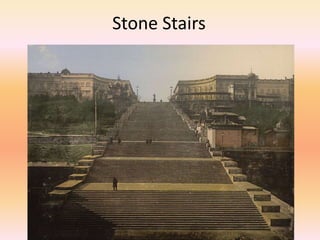
STAIRS OF DIFFERENT MATERIALSTIMBER STAIRS: these stairs are light in weight and easy to construct, but they have very poor fire resistance. They are used only for small rise residential buildings. Sometimes, fire resisting hard wood of proper thickness may be used.STONE STAIRS: these are widely used at places where ashlar stone is readily available. Stone stairs are quite strong and rigid, though they are very heavy. Stone used for construction of stairs should be hard, strong and resistant to wear. The simplest form of stone stairs is those supported on both the ends, though an open well stair case can also be built.BRICK STAIRS: these are not very common, except at the entrance. However, brick stairs of single straight flight are often made in village houses. The stairs consist of either solid wall, or also, arched openings may be left for obtaining storage space.
METAL STAIRS: stairs of mild steel or cast iron are used only as emergency stairs. They are not common in residential and public buildings, though they are strong and fire resistant. These are commonly used in factories, godowns, workshops, etc.R.C.C: these are the stairs widely used for residential, public and industrial buildings. They are strong, hard wearing and fire resisting. These are usually cast- in – situ and a wide variety of finishes can be used on these.
Timber Stairs
Metal Stairs
Concrete Stairs
Stone Stairs
Glass Stair
Combination of Materials
Parts of Stairs
Parts of Stairs
Parts of Stairs
Parts of Stairs
Parts of Stairs
Parts of Stairs
Parts of Stairs
Parts of Stairs
Parts of Stairs
Parts of Stairs
Parts of Stairs
WindersTreads that are taperedMust have same rise as the flightsMaximum of 3 treads per quarter turnMust be same width at centre on widths < 1mIf stair > 1m same width 400mm from inside handrail
Winders
MODELS OF STAIRS
Stair Types
Stair TypesDouble Closed Stair
Stair Types
Stair Types
Double Open Sided Stairs
In this case one side is closed while the other is open
The Bracketed Stairs refers to decoration & Cut StringAlso Known as Cut String
Quarter Turn StairOpen Newel Stair
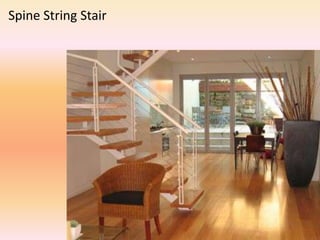
Spine String Stair
GEOMETRICAL  STAIRS
Definitions
Rise & Going must stay the same within flight
THANK YOU
Quarter Turn Stair
BCA Requirements
Stair Requirements
Calculate StairNo Restriction on Going Best Going 2R + G Between 550 to 700Midpoint = 625Determine Total Rise = 2700Say 175mm Select suitable Rise = 2700/175 = 15.429  Divide Total Rise by RiseEither 15 or 16 Risers          = 2700/15 = 180mm 		                   2700/16 = 168.75mm		Use 180mm is closer  to 175mm
Determine Best GoingBCA states that going must be within the range2 x Rise (R) + Going(G) = 550 to 700	We can assume that the best answer is the Midpoint (550 + 700)/2 = 625Best Going	2R + G = 625Best Going	G = 625 – 2R
Calculate StairNo Restriction on Going Best Going 2R + G Between 550 to 700Midpoint = 625Determine Total Rise = 2700Say 175mm Select suitable Rise = 2700/175 = 15.429  Divide Total Rise by RiseEither 15 or 16 Risers          = 2700/15 = 180mm (Use)		                   2700/16 = 168.75mmDetermine Best Going 	2R + G = 625			G = 625 – 2RBest Going for180 Riser	265 = 625 – 2 x 180EitherRise 180Going 265
Calculate StairNo Restriction on Going UseRise 180Going 265 15 Risers14 Goings
Calculate StairRestriction on Going Best Going 2R + G Between 550 to 700Midpoint = 625Preferred Rise 175mmDivide Total Rise by Rise = 2700/175 = 15.429 Either 15 or 16 Risers      = 2700/15 = 180mm		               2700/16 = 168.75Use 180mmDetermine Best Going3800/14 = 271.43 + 2 x 180 = 631. 43 (Closest)3800/15 = 253.33 + 2 x 168.75 = 59115 Risers14 Goings UseRise 180Going 271.43
Calculate Stair Flight with Quarter TurnStair width 900mmOnce an Intermediate Landing is introduced the top flight becomes constrained
Calculate Stair Flight with Quarter TurnBest Going 2R + G Between 550 to 700Midpoint = 625G = 625 – 2RStair width 900mmPreferred Rise = 165mm2700/165 =  16 .36416    2700/16= 168.75 (3.75 Diff)2700/17= 158.824 (6.176 Diff)Use  Rise = 168.75Best Going =  625 – 2R		     = 625 – 2 x 168.75		     = 287.51800/287.5 = 6.2616  1800/6 = 300   (12.5 Diff)1800/7 = 257.143 (30.357 Diff)Rise = 168.364Going = 300
Calculate StairConstrained Flight with Quarter TurnBest Going 2R + G Between 550 to 700Midpoint = 625625- 2 x 180 = 265Stair width 900mmFrom Previous we know15 Risers at 180Length of 1st Flight = 2700 - 900Divide by Best Going  = 1800/265		       = 6.79Going Either 1800 /6 = 300mm 	       1800/7 =  257mm257.14 is Closest to 265
Calculate StairConstrained Flight with Half Space LandingPreferred Riser 170mm3600/170 = 21.17621  3600/21 = 171.4293600/22 = 163.636Use 171.429mmBest Going = 625 – 2R		     = 625 – 2 x 171.429                   = 282.142Length of 1st Flight = 4050 – 900		  = 3150Divide by Best Going  = 3150/282.142		       = 11.1611	3150/11 = 286.364-	3150/12 = 262.500Use 286.364Stair width 900mm
Calculate StairConstrained Flight with Half Space LandingPreferred Riser 170mmRise 	171.429mmGoing	 286.364Stair width 900mm
Calculate StairConstrained Flight with Quarter Turn WindersPreferred Riser 170mm4100/170 = 24.11824 	4100/24 = 170.83325 	4100/24 = 164Use Rise 170.833Best Going625 – 2R = BG625 – 2 x 170.833 = 283.3342650/ 283.334 = 9.3532650/9 = 294.444 (USE)2650/10 = 265Rise 170.833Going 268.75Stair width 900mm
Calculate StairConstrained Flight with Quarter Turn WindersPreferred Riser 170mm4100/170 = 24.11824 	4100/24 = 170.83325 	4100/24 = 164Use Rise 170.833Best Going625 – 2R = BG625 – 2 x 170.833 = 283.3342650/ 283.334 = 9.3532650/9 = 294.444 (USE)2650/10 = 265Rise 170.833Going 294.444Stair width 900mm
Calculate StairConstrained Flight with Half Space LandingStair width 950mmPreferred Riser 170mm3400/170 = 203400/20 = 170 RiseBest Going = 625 – 2R		    = 625 – 2 x 170		    = 2852400/285 = 8.4218  2400/8 = 300  (15 Diff)2400/9 = 266.667 (18.3 Diff)Rise 170Going 300
Calculate StairConstrained Flight with Half Space LandingStair width 950mmPreferred Riser 170mm3400/170 = 203400/20 = 170 RiseBest Going = 625 – 2R		    = 625 – 2 x 170		    = 2852400/285 = 8.4218  2400/8 = 300  (15 Diff)2400/9 = 266.667 (18.3 Diff)Rise 170Going 300With all examples either answer will comply and you should consult with your client and/or Architect
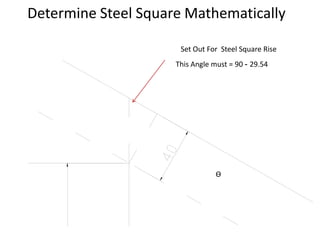
Determine Steel Square Mathematically40mm Margin
Determine Steel Square Mathematically

Staircases gnk(1)

  • 1.
  • 2.
    Stairs are themedium through which a person can travel from one horizontal level to another horizontal level although it connects two different horizontal levels.STAIRS
  • 3.
    STAIRCASE: A stairis a set of steps leading from one floor to the other. It is provided to afford the means of ascent and descent between various floors of the building. The room or enclosure of the building, in which the stair is located, is known as staircase.The opening or space occupied by the stair is known as a stairway. In a domestic building the stairs should be centrally located to provide easy access to all rooms. In public buildings, stairs should be located near the entrance. Stairs may be constructed by timber, bricks, stone, steel or reinforced cement concrete.
  • 4.
    Staircases provide accessand communication between floors in multi-storey buildings, and are a path by which fire can spread from one floor to another. Staircase, therefore, must be enclosed by fire resisting walls, floors, ceiling and doors. It is desirable that the linings to the walls and the ceilings are non- combustible and of low flame spread. Another important aspect in the design of stairs is the strength aspect. It must be designed to carry certain loads, which are similar to those used for the design of floor.
  • 5.
    STAIRS AND ITSTYPESSingle flight straight stairs
  • 6.
  • 7.
  • 8.
  • 9.
  • 10.
  • 11.
  • 12.
  • 13.
  • 14.
    Geometrical stairsDOUBLE FLIGHTSTRAIGHT STAIRSHere the stairs posses two landings while running straight in the complete flight. QUARTER TURN NEWELIn quarter turn newel the stairs run straight in a flight and after reaching the landing the stairs it turns to either left or right at ninety degree and its runs again till it reaches the consecutive horizontal level.
  • 15.
  • 16.
    HALF TURN NEWELInhalf turn newel stairs the stairs runs straight and after reaching the landing it turns to left or right and then climbs up to next two to three steps and reaches a landing and these steps again turns in the direction from where the user was approaching reaching finally to the consecutive horizontal level.OPEN WELL STAIRS These are like normal doglegged stairs but the only difference is that after reaching the landing the stairs ends up with a railing instead of the wall..
  • 17.
  • 18.
    DOG LEGGED STAIRSDoglegged stairs are the stairs in which the user climbs up to a flight turns at one eighty degree and then climb stairs in opposite directionBIFURCATED STAIRSIn bifurcated stairs the stairs runs at a flight an as it reaches the landing the stairs runs from left and right side reaching the same horizontal level these stairs are provided generally in atrium of a building.
  • 21.
    CIRCULAR STAIRSThe stairsmade in in a circular form are known as the circular staircase.
  • 22.
    SPIRAL STAIRSThose stairswhich are in spiral form is known as spiral staircase.Spiral
  • 23.
  • 25.
    The technical termsassociated with the design and constructions of stairs are:TREAD: it is the upper horizontal portion of a step upon which the foot is placed while ascending or descending.RISER: it is the vertical portion of a step providing a support to the tread. FLIGHT: this is defined as an unbroken series of steps between landings.LANDING: it is the level platform at the top or bottom of a flight between the floors. A landing facilitates change of direction and provides an opportunity for taking rest during the use of the stair. 
  • 26.
    2 Flights1 FlightDefinition– Flights Between LandingsDogleg Closed RiserStraight Open Riser
  • 27.
    Half Space LandingChangestair direction 180⁰
  • 28.
    Landing width =width of stair (min 750mm)
  • 29.
    Used in DoglegStairsQuarter Space LandingChange Stair Direction 90⁰
  • 30.
    Landing Width &Length = Stair Width
  • 31.
    Forms Quarter TurnStair (min 750mm)Intermediate LandingAllows the Stair to continue in same direction
  • 32.
    Required where morethan 18 Risers
  • 33.
    May be usedto give a rest
  • 34.
  • 35.
    Length = StairWidth or greaterQuarter Space Landing
  • 36.
    RISE: it is the vertical distance between two successive tread faces.GOING: it is the horizontal distance between two successive riser faces. STRINGS AND STRINGERS: these are the slopping members which support the steps in a stair. They run along the slope of the stair.NEWEL POST: newel post is a vertical member which is placed at the ends of flights to connect the ends of strings and hand rail.
  • 37.
    BALUSTER: it is vertical member of wood or metal, supporting the hand rail.HAND RAIL: it is the surrounded or moulded member of wood or metal following generally the contour of the nosing line, and fixed on the top of balusters.
  • 38.
    STAIRS OF DIFFERENTMATERIALSTIMBER STAIRS: these stairs are light in weight and easy to construct, but they have very poor fire resistance. They are used only for small rise residential buildings. Sometimes, fire resisting hard wood of proper thickness may be used.STONE STAIRS: these are widely used at places where ashlar stone is readily available. Stone stairs are quite strong and rigid, though they are very heavy. Stone used for construction of stairs should be hard, strong and resistant to wear. The simplest form of stone stairs is those supported on both the ends, though an open well stair case can also be built.BRICK STAIRS: these are not very common, except at the entrance. However, brick stairs of single straight flight are often made in village houses. The stairs consist of either solid wall, or also, arched openings may be left for obtaining storage space.
  • 39.
    METAL STAIRS: stairsof mild steel or cast iron are used only as emergency stairs. They are not common in residential and public buildings, though they are strong and fire resistant. These are commonly used in factories, godowns, workshops, etc.R.C.C: these are the stairs widely used for residential, public and industrial buildings. They are strong, hard wearing and fire resisting. These are usually cast- in – situ and a wide variety of finishes can be used on these.
  • 40.
  • 41.
  • 42.
  • 43.
  • 44.
  • 45.
  • 46.
  • 47.
  • 48.
  • 49.
  • 50.
  • 51.
  • 52.
  • 53.
  • 54.
  • 55.
  • 56.
  • 57.
    WindersTreads that aretaperedMust have same rise as the flightsMaximum of 3 treads per quarter turnMust be same width at centre on widths < 1mIf stair > 1m same width 400mm from inside handrail
  • 58.
  • 59.
  • 61.
  • 62.
  • 63.
  • 64.
  • 65.
  • 66.
    In this caseone side is closed while the other is open
  • 67.
    The Bracketed Stairsrefers to decoration & Cut StringAlso Known as Cut String
  • 68.
  • 69.
  • 72.
  • 77.
  • 78.
    Rise & Goingmust stay the same within flight
  • 80.
  • 81.
  • 83.
  • 84.
  • 85.
    Calculate StairNo Restrictionon Going Best Going 2R + G Between 550 to 700Midpoint = 625Determine Total Rise = 2700Say 175mm Select suitable Rise = 2700/175 = 15.429 Divide Total Rise by RiseEither 15 or 16 Risers = 2700/15 = 180mm 2700/16 = 168.75mm Use 180mm is closer to 175mm
  • 86.
    Determine Best GoingBCAstates that going must be within the range2 x Rise (R) + Going(G) = 550 to 700 We can assume that the best answer is the Midpoint (550 + 700)/2 = 625Best Going 2R + G = 625Best Going G = 625 – 2R
  • 87.
    Calculate StairNo Restrictionon Going Best Going 2R + G Between 550 to 700Midpoint = 625Determine Total Rise = 2700Say 175mm Select suitable Rise = 2700/175 = 15.429 Divide Total Rise by RiseEither 15 or 16 Risers = 2700/15 = 180mm (Use) 2700/16 = 168.75mmDetermine Best Going 2R + G = 625 G = 625 – 2RBest Going for180 Riser 265 = 625 – 2 x 180EitherRise 180Going 265
  • 88.
    Calculate StairNo Restrictionon Going UseRise 180Going 265 15 Risers14 Goings
  • 89.
    Calculate StairRestriction onGoing Best Going 2R + G Between 550 to 700Midpoint = 625Preferred Rise 175mmDivide Total Rise by Rise = 2700/175 = 15.429 Either 15 or 16 Risers = 2700/15 = 180mm 2700/16 = 168.75Use 180mmDetermine Best Going3800/14 = 271.43 + 2 x 180 = 631. 43 (Closest)3800/15 = 253.33 + 2 x 168.75 = 59115 Risers14 Goings UseRise 180Going 271.43
  • 90.
    Calculate Stair Flightwith Quarter TurnStair width 900mmOnce an Intermediate Landing is introduced the top flight becomes constrained
  • 91.
    Calculate Stair Flightwith Quarter TurnBest Going 2R + G Between 550 to 700Midpoint = 625G = 625 – 2RStair width 900mmPreferred Rise = 165mm2700/165 = 16 .36416 2700/16= 168.75 (3.75 Diff)2700/17= 158.824 (6.176 Diff)Use Rise = 168.75Best Going = 625 – 2R = 625 – 2 x 168.75 = 287.51800/287.5 = 6.2616 1800/6 = 300 (12.5 Diff)1800/7 = 257.143 (30.357 Diff)Rise = 168.364Going = 300
  • 92.
    Calculate Stair Flightwith Quarter TurnBest Going 2R + G Between 550 to 700Midpoint = 625G = 625 – 2RStair width 900mmPreferred Rise = 165mm2700/165 = 16 .36416 2700/16= 168.75 (3.75 Diff)2700/17= 158.824 (6.176 Diff)Use Rise = 168.75Best Going = 625 – 2R = 625 – 2 x 168.75 = 287.51800/287.5 = 6.2616 1800/6 = 300 (12.5 Diff)1800/7 = 257.143 (30.357 Diff)Rise = 168.364Going = 300
  • 93.
    Calculate StairConstrained Flightwith Quarter TurnBest Going 2R + G Between 550 to 700Midpoint = 625625- 2 x 180 = 265Stair width 900mmFrom Previous we know15 Risers at 180Length of 1st Flight = 2700 - 900Divide by Best Going = 1800/265 = 6.79Going Either 1800 /6 = 300mm 1800/7 = 257mm257.14 is Closest to 265
  • 94.
    Calculate StairConstrained Flightwith Half Space LandingPreferred Riser 170mm3600/170 = 21.17621 3600/21 = 171.4293600/22 = 163.636Use 171.429mmBest Going = 625 – 2R = 625 – 2 x 171.429 = 282.142Length of 1st Flight = 4050 – 900 = 3150Divide by Best Going = 3150/282.142 = 11.1611 3150/11 = 286.364- 3150/12 = 262.500Use 286.364Stair width 900mm
  • 95.
    Calculate StairConstrained Flightwith Half Space LandingPreferred Riser 170mmRise 171.429mmGoing 286.364Stair width 900mm
  • 96.
    Calculate StairConstrained Flightwith Quarter Turn WindersPreferred Riser 170mm4100/170 = 24.11824 4100/24 = 170.83325 4100/24 = 164Use Rise 170.833Best Going625 – 2R = BG625 – 2 x 170.833 = 283.3342650/ 283.334 = 9.3532650/9 = 294.444 (USE)2650/10 = 265Rise 170.833Going 268.75Stair width 900mm
  • 97.
    Calculate StairConstrained Flightwith Quarter Turn WindersPreferred Riser 170mm4100/170 = 24.11824 4100/24 = 170.83325 4100/24 = 164Use Rise 170.833Best Going625 – 2R = BG625 – 2 x 170.833 = 283.3342650/ 283.334 = 9.3532650/9 = 294.444 (USE)2650/10 = 265Rise 170.833Going 294.444Stair width 900mm
  • 98.
    Calculate StairConstrained Flightwith Half Space LandingStair width 950mmPreferred Riser 170mm3400/170 = 203400/20 = 170 RiseBest Going = 625 – 2R = 625 – 2 x 170 = 2852400/285 = 8.4218 2400/8 = 300 (15 Diff)2400/9 = 266.667 (18.3 Diff)Rise 170Going 300
  • 99.
    Calculate StairConstrained Flightwith Half Space LandingStair width 950mmPreferred Riser 170mm3400/170 = 203400/20 = 170 RiseBest Going = 625 – 2R = 625 – 2 x 170 = 2852400/285 = 8.4218 2400/8 = 300 (15 Diff)2400/9 = 266.667 (18.3 Diff)Rise 170Going 300With all examples either answer will comply and you should consult with your client and/or Architect
  • 100.
    Determine Steel SquareMathematically40mm Margin
  • 101.