STAIRCASE
INTRODUCTION
 Stairs is a set of steps which give access from floor to
floor.
 The room or enclosure of the building, in which stair is
located is known as staircase.
 Staircase provides access & communication between f
loors in multi-storey buildings and is a path by which
fire can spread from one floor to another.
 It may be constructed of RCC, Timber, Metal , etc.
TECHNICAL TERMS :
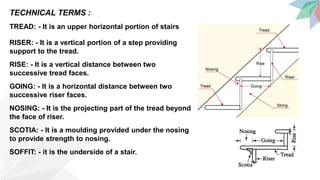
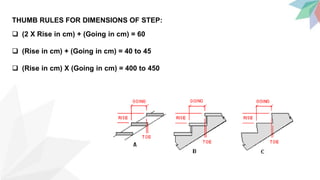
TREAD: - It is an upper horizontal portion of stairs
RISER: - It is a vertical portion of a step providing
support to the tread.
RISE: - It is a vertical distance between two
successive tread faces.
GOING: - It is a horizontal distance between two
successive riser faces.
NOSING: - It is the projecting part of the tread beyond
the face of riser.
SCOTIA: - It is a moulding provided under the nosing
to provide strength to nosing.
SOFFIT: - it is the underside of a stair.
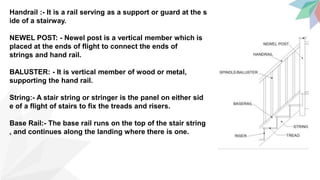
Handrail :- It is a rail serving as a support or guard at the s
ide of a stairway.
NEWEL POST: - Newel post is a vertical member which is
placed at the ends of flight to connect the ends of
strings and hand rail.
BALUSTER: - It is vertical member of wood or metal,
supporting the hand rail.
String:- A stair string or stringer is the panel on either sid
e of a flight of stairs to fix the treads and risers.
Base Rail:- The base rail runs on the top of the stair string
, and continues along the landing where there is one.
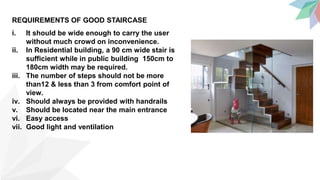
REQUIREMENTS OF GOOD STAIRCASE
i. It should be wide enough to carry the user
without much crowd on inconvenience.
ii. In Residential building, a 90 cm wide stair is
sufficient while in public building 150cm to
180cm width may be required.
iii. The number of steps should not be more
than12 & less than 3 from comfort point of
view.
iv. Should always be provided with handrails
v. Should be located near the main entrance
vi. Easy access
vii. Good light and ventilation
THUMB RULES FOR DIMENSIONS OF STEP:
 (2 X Rise in cm) + (Going in cm) = 60
 (Rise in cm) + (Going in cm) = 40 to 45
 (Rise in cm) X (Going in cm) = 400 to 450
STRAIGHT STAIRCASE
If the space available for stair case is narrow and long, straight stairs may be
provided. In this type all steps are in one direction.
They may be provided in single flight or in two flights with landing in between.
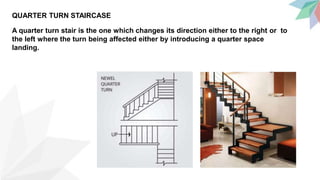
QUARTER TURN STAIRCASE
A quarter turn stair is the one which changes its direction either to the right or to
the left where the turn being affected either by introducing a quarter space
landing.
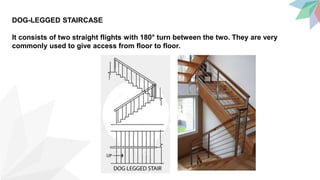
DOG-LEGGED STAIRCASE
It consists of two straight flights with 180° turn between the two. They are very
commonly used to give access from floor to floor.
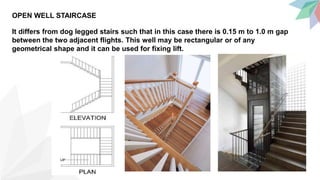
OPEN WELL STAIRCASE
It differs from dog legged stairs such that in this case there is 0.15 m to 1.0 m gap
between the two adjacent flights. This well may be rectangular or of any
geometrical shape and it can be used for fixing lift.
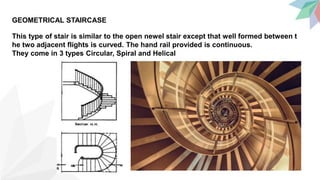
GEOMETRICAL STAIRCASE
This type of stair is similar to the open newel stair except that well formed between t
he two adjacent flights is curved. The hand rail provided is continuous.
They come in 3 types Circular, Spiral and Helical
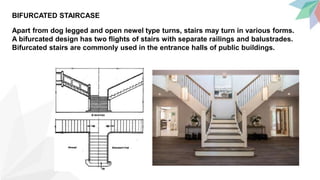
BIFURCATED STAIRCASE
Apart from dog legged and open newel type turns, stairs may turn in various forms.
A bifurcated design has two flights of stairs with separate railings and balustrades.
Bifurcated stairs are commonly used in the entrance halls of public buildings.
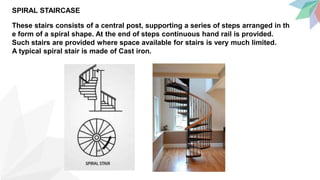
SPIRAL STAIRCASE
These stairs consists of a central post, supporting a series of steps arranged in th
e form of a spiral shape. At the end of steps continuous hand rail is provided.
Such stairs are provided where space available for stairs is very much limited.
A typical spiral stair is made of Cast iron.
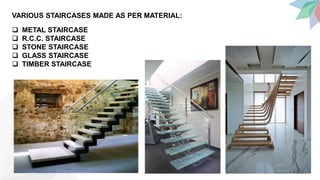
VARIOUS STAIRCASES MADE AS PER MATERIAL:
 METAL STAIRCASE
 R.C.C. STAIRCASE
 STONE STAIRCASE
 GLASS STAIRCASE
 TIMBER STAIRCASE

STAIRCASES.pptx

  • 1.
  • 2.
    INTRODUCTION  Stairs isa set of steps which give access from floor to floor.  The room or enclosure of the building, in which stair is located is known as staircase.  Staircase provides access & communication between f loors in multi-storey buildings and is a path by which fire can spread from one floor to another.  It may be constructed of RCC, Timber, Metal , etc.
  • 3.
    TECHNICAL TERMS : TREAD:- It is an upper horizontal portion of stairs RISER: - It is a vertical portion of a step providing support to the tread. RISE: - It is a vertical distance between two successive tread faces. GOING: - It is a horizontal distance between two successive riser faces. NOSING: - It is the projecting part of the tread beyond the face of riser. SCOTIA: - It is a moulding provided under the nosing to provide strength to nosing. SOFFIT: - it is the underside of a stair.
  • 4.
    Handrail :- Itis a rail serving as a support or guard at the s ide of a stairway. NEWEL POST: - Newel post is a vertical member which is placed at the ends of flight to connect the ends of strings and hand rail. BALUSTER: - It is vertical member of wood or metal, supporting the hand rail. String:- A stair string or stringer is the panel on either sid e of a flight of stairs to fix the treads and risers. Base Rail:- The base rail runs on the top of the stair string , and continues along the landing where there is one.
  • 5.
    REQUIREMENTS OF GOODSTAIRCASE i. It should be wide enough to carry the user without much crowd on inconvenience. ii. In Residential building, a 90 cm wide stair is sufficient while in public building 150cm to 180cm width may be required. iii. The number of steps should not be more than12 & less than 3 from comfort point of view. iv. Should always be provided with handrails v. Should be located near the main entrance vi. Easy access vii. Good light and ventilation
  • 6.
    THUMB RULES FORDIMENSIONS OF STEP:  (2 X Rise in cm) + (Going in cm) = 60  (Rise in cm) + (Going in cm) = 40 to 45  (Rise in cm) X (Going in cm) = 400 to 450
  • 7.
    STRAIGHT STAIRCASE If thespace available for stair case is narrow and long, straight stairs may be provided. In this type all steps are in one direction. They may be provided in single flight or in two flights with landing in between.
  • 8.
    QUARTER TURN STAIRCASE Aquarter turn stair is the one which changes its direction either to the right or to the left where the turn being affected either by introducing a quarter space landing.
  • 9.
    DOG-LEGGED STAIRCASE It consistsof two straight flights with 180° turn between the two. They are very commonly used to give access from floor to floor.
  • 10.
    OPEN WELL STAIRCASE Itdiffers from dog legged stairs such that in this case there is 0.15 m to 1.0 m gap between the two adjacent flights. This well may be rectangular or of any geometrical shape and it can be used for fixing lift.
  • 11.
    GEOMETRICAL STAIRCASE This typeof stair is similar to the open newel stair except that well formed between t he two adjacent flights is curved. The hand rail provided is continuous. They come in 3 types Circular, Spiral and Helical
  • 12.
    BIFURCATED STAIRCASE Apart fromdog legged and open newel type turns, stairs may turn in various forms. A bifurcated design has two flights of stairs with separate railings and balustrades. Bifurcated stairs are commonly used in the entrance halls of public buildings.
  • 13.
    SPIRAL STAIRCASE These stairsconsists of a central post, supporting a series of steps arranged in th e form of a spiral shape. At the end of steps continuous hand rail is provided. Such stairs are provided where space available for stairs is very much limited. A typical spiral stair is made of Cast iron.
  • 14.
    VARIOUS STAIRCASES MADEAS PER MATERIAL:  METAL STAIRCASE  R.C.C. STAIRCASE  STONE STAIRCASE  GLASS STAIRCASE  TIMBER STAIRCASE