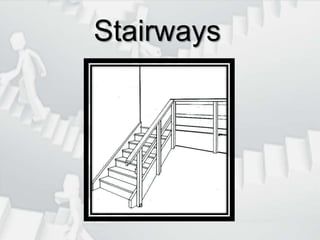
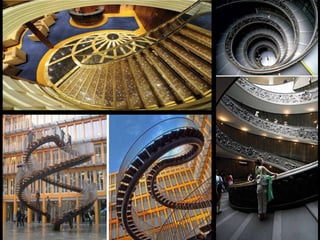
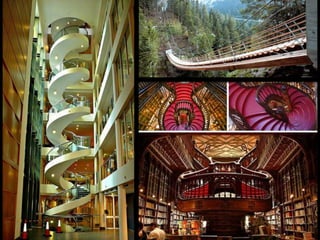
Stairways
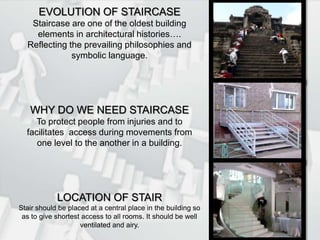
EVOLUTION OF STAIRCASEStaircase are one of the oldest building elements in architectural histories…. Reflecting the prevailing philosophies and symbolic language.WHY DO WE NEED STAIRCASETo protect people from injuries and to facilitates  access during movements from one level to the another in a building.LOCATION OF STAIRStair should be placed at a central place in the building so as to give shortest access to all rooms. It should be well ventilated and airy.
PRINCIPLES TO BE OBSERVED WHILE PLANNING AND DESIGNING A STAIR1.  Width of Stair: It should not be less than 1.00m.2.  Length of flight: The number of steps in a single flight should not be more than 12.3.  Pitch of the stair: It should be between 25  to 404.  Width of landing: It should be 150mm, more than the width of stair.5.  Winders or kite steps: Odd shaped steps should be avoided and incase found      necessary. These should be provided at the start of a stair.6.  Han-rails: It should be 750 to 850 mm in height from the top of respective step or      landing.7.  Step proportions: The size of rise and tread in a stair should be kept uniform      through out the whole stair.8.  Headroom: Minimum of 2000mm of clear headroom is required above the pitch line  Following proportions are recommended:(i)  Residential buildings-   Tread=250 mm                                        Rise=160 mm(ii)  Public buildings -    Tread=300 mm                                    Rise=150 mm (iii) Industrial buildings, Railway station,                                   etc    Tread =not less then 250 mm                                   	      =250 to 300 mm                                             Rise =not less then 150 mm                                   	    =150 to 190 mm o  o
Otherwise work out the sizes of rise and tread by using any one of the following proportions(i)   (2xRise)+(Going), In mm=550 to 600 mm(ii)  Rise x tread, both in cm = 400 to 410 cm2.(iii) With basic proportion of going 300 mm and rise 150 mm, add 10 mm to rise for every 20 mm deduction from going e.g. For a going of 280 mm the rise will be 160 mm. 	The above rules act as guide but the actual sizes depend upon the availability of space, while planning stairs practical-field.
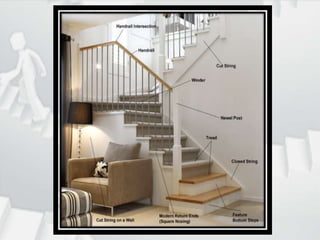
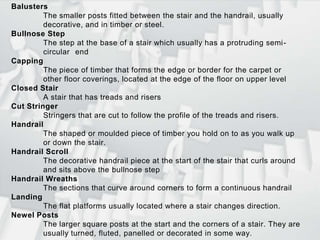
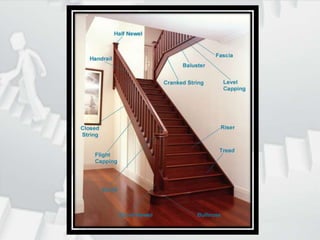
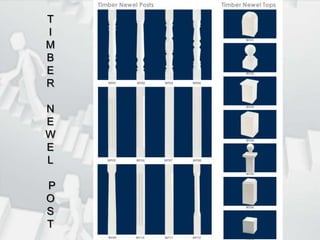
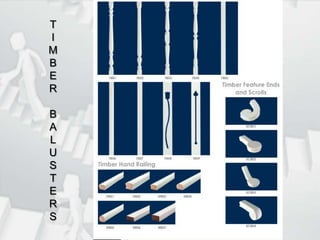
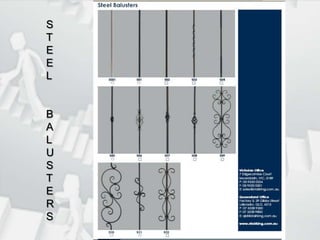
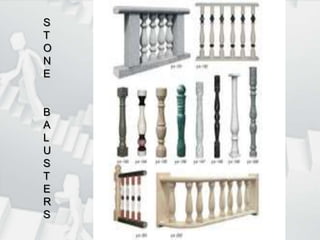
BalustersThe smaller posts fitted between the stair and the handrail, usually 	decorative, and in timber or steel.Bullnose StepThe step at the base of a stair which usually has a protruding semi-	circular 	endCappingThe piece of timber that forms the edge or border for the carpet or 	other floor coverings, located at the edge of the floor on upper levelClosed StairA stair that has treads and risersCut StringerStringers that are cut to follow the profile of the treads and risers.HandrailThe shaped or moulded piece of timber you hold on to as you walk up 	or down the stair. Handrail ScrollThe decorative handrail piece at the start of the stair that curls around 	and sits above the bullnose stepHandrail WreathsThe sections that curve around corners to form a continuous handrailLandingThe flat platforms usually located where a stair changes direction. Newel PostsThe larger square posts at the start and the corners of a stair. They are 	usually turned, fluted, panelled or decorated in some way.
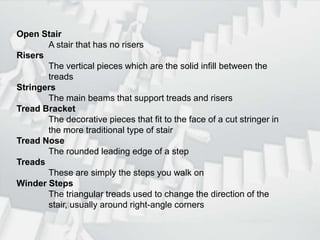
Open StairA stair that has no risersRisersThe vertical pieces which are the solid infill between the 	treadsStringersThe main beams that support treads and risersTread BracketThe decorative pieces that fit to the face of a cut stringer in 	the more traditional type of stairTread NoseThe rounded leading edge of a stepTreadsThese are simply the steps you walk onWinder StepsThe triangular treads used to change the direction of the 	stair, usually around right-angle corners
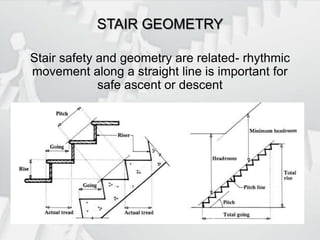
STAIR GEOMETRYStair safety and geometry are related- rhythmic movement along a straight line is important for safe ascent or descent
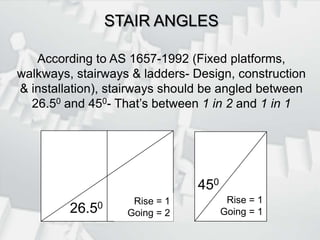
STAIR ANGLESAccording to AS 1657-1992 (Fixed platforms, walkways, stairways & ladders- Design, construction & installation), stairways should be angled between 26.50 and 450-That’s between 1 in 2 and 1 in 1Rise = 1Going = 1Rise = 1Going = 245026.50
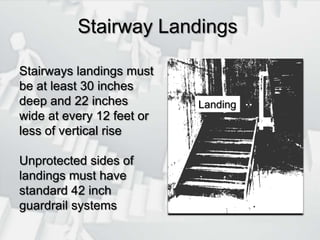
Stairway LandingsStairways landings must be at least 30 inches deep and 22 inches wide at every 12 feet or less of vertical riseUnprotected sides of landings must have standard 42 inch guardrail systemsLanding
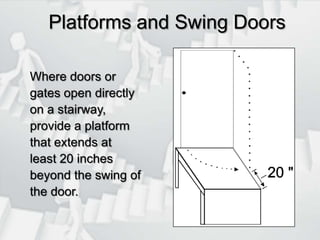
Platforms and Swing DoorsWhere doors or gates open directly on a stairway, provide a platform that extends at least 20 inches beyond the swing of the door.
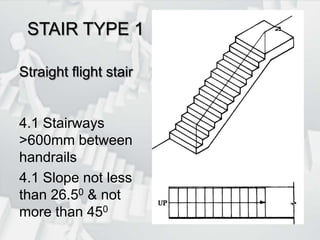
STAIR TYPE 1Straight flight stair4.1 Stairways >600mm between handrails4.1 Slope not less than 26.50 & not more than 450
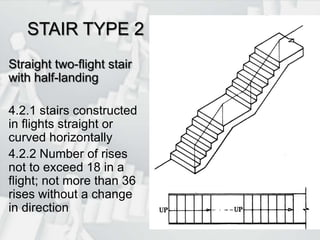
STAIR TYPE 2Straight two-flight stair with half-landing4.2.1 stairs constructed in flights straight or curved horizontally4.2.2 Number of rises not to exceed 18 in a flight; not more than 36 rises without a change in direction
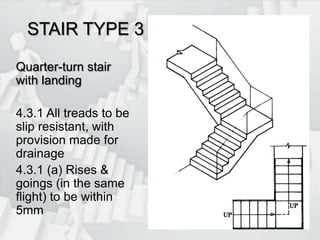
STAIR TYPE 3Quarter-turn stair with landing4.3.1 All treads to be slip resistant, with provision made for drainage4.3.1 (a) Rises & goings (in the same flight) to be within ± 5mm
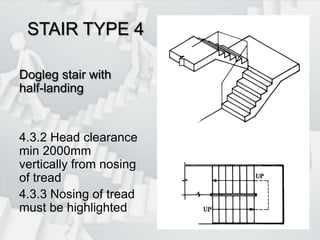
STAIR TYPE 4Dogleg stair with half-landing4.3.2 Head clearance min 2000mm vertically from nosing of tread4.3.3 Nosing of tread must be highlighted
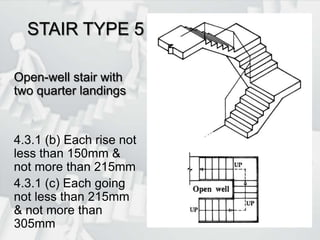
STAIR TYPE 5Open-well stair with two quarter landings4.3.1 (b) Each rise not less than 150mm & not more than 215mm4.3.1 (c) Each going not less than 215mm & not more than 305mm
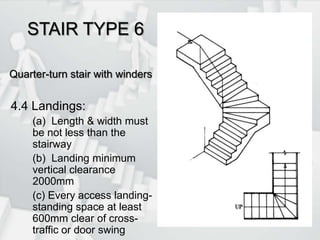
STAIR TYPE 6   Quarter-turn stair withwinders   4.4 Landings:(a)  Length & width must be not less than the stairway(b)  Landing minimum vertical clearance 2000mm(c) Every access landing- standing space at least 600mm clear of cross-traffic or door swing
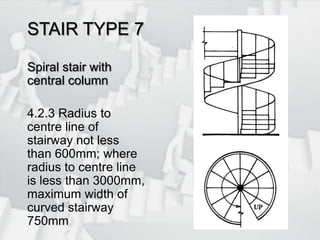
STAIR TYPE 7Spiral stair with central column4.2.3 Radius to centre line of stairway not less than 600mm; where radius to centre line is less than 3000mm, maximum width of curved stairway 750mm
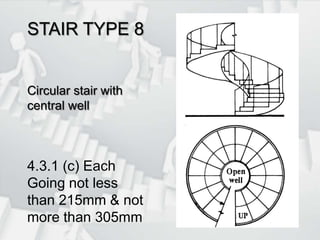
STAIR TYPE 8Circular stair with central well4.3.1 (c) Each Going not less than 215mm & not more than 305mm
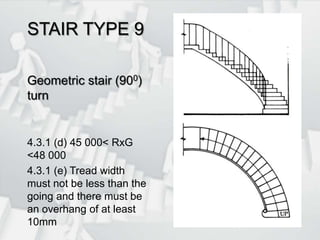
STAIR TYPE 9Geometric stair (900) turn4.3.1 (d) 45 000< RxG <48 0004.3.1 (e) Tread width must not be less than the going and there must be an overhang of at least 10mm
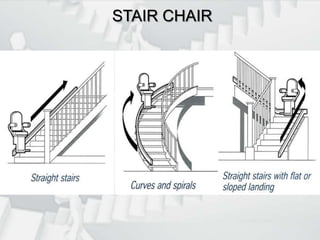
STAIR CHAIR
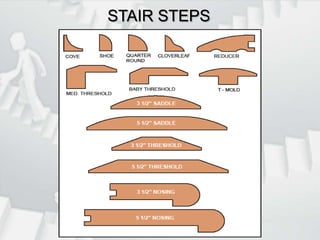
STAIR STEPS
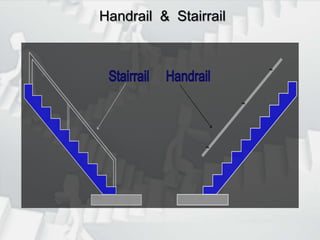
Handrail  &  Stairrail
TIMBERNEWEL POST
TIMBERBALUSTERS
STEELBALUSTERS
STONEBALUSTERS
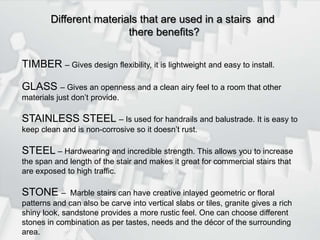
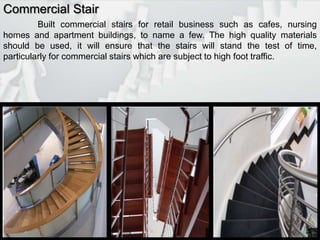
Different materials that are used in a stairs  and  there benefits?TIMBER – Gives design flexibility, it is lightweight and easy to install.GLASS – Gives an openness and a clean airy feel to a room that other materials just don’t provide.STAINLESS STEEL – Is used for handrails and balustrade. It is easy to keep clean and is non-corrosive so it doesn’t rust.STEEL – Hardwearing and incredible strength. This allows you to increase the span and length of the stair and makes it great for commercial stairs that are exposed to high traffic.STONE –  Marble stairs can have creative inlayed geometric or floral patterns and can also be carve into vertical slabs or tiles, granite gives a rich shiny look, sandstone provides a more rustic feel. One can choose different stones in combination as per tastes, needs and the décor of the surrounding area.
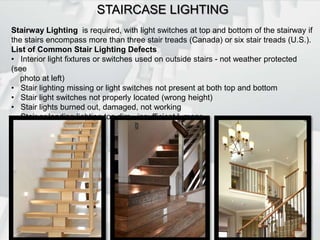
STAIRCASE LIGHTINGStairway Lighting  is required, with light switches at top and bottom of the stairway if the stairs encompass more than three stair treads (Canada) or six stair treads (U.S.).List of Common Stair Lighting Defects   Interior light fixtures or switches used on outside stairs - not weather protected (see         photo at left)   Stair lighting missing or light switches not present at both top and bottom
   Stair light switches not properly located (wrong height)
   Stair lights burned out, damaged, not working
   Stair or landing lighting too dim - insufficient lumensTHINGS TO BE KEPT IN MIND   Define
   Winder steps
   Hang on
   It’s a long way to the top
   Stair generosity
   Plan. plan, plan
   Dimensions
   Check with the experts
   Continuous handrail
   Riser positions, the size of handrails
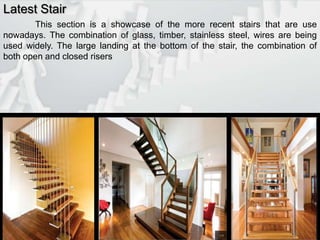
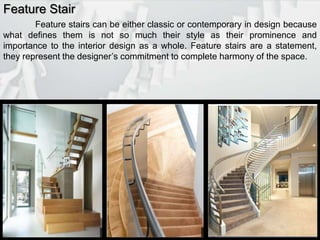
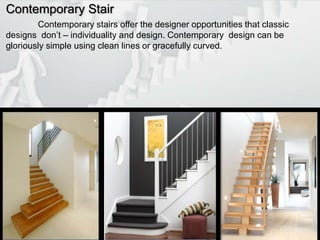
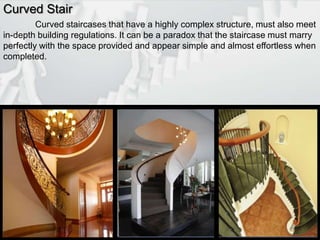
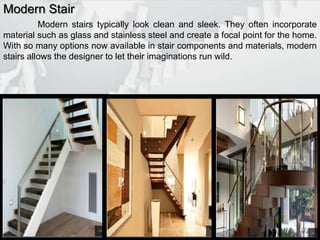
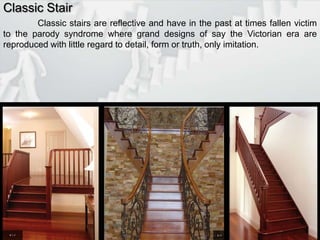
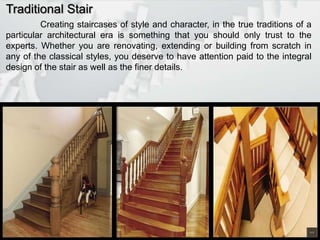
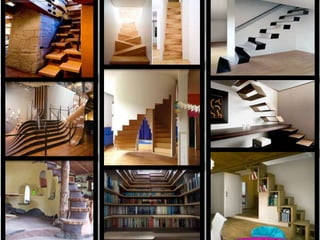
   Finishing the jobLatest Stair	This section is a showcase of the more recent stairs that are use nowadays. The combination of glass, timber, stainless steel, wires are being used widely. The large landing at the bottom of the stair, the combination of both open and closed risers 

Stairs

  • 1.
  • 2.
    EVOLUTION OF STAIRCASEStaircaseare one of the oldest building elements in architectural histories…. Reflecting the prevailing philosophies and symbolic language.WHY DO WE NEED STAIRCASETo protect people from injuries and to facilitates access during movements from one level to the another in a building.LOCATION OF STAIRStair should be placed at a central place in the building so as to give shortest access to all rooms. It should be well ventilated and airy.
  • 3.
    PRINCIPLES TO BEOBSERVED WHILE PLANNING AND DESIGNING A STAIR1.  Width of Stair: It should not be less than 1.00m.2.  Length of flight: The number of steps in a single flight should not be more than 12.3.  Pitch of the stair: It should be between 25 to 404.  Width of landing: It should be 150mm, more than the width of stair.5.  Winders or kite steps: Odd shaped steps should be avoided and incase found necessary. These should be provided at the start of a stair.6.  Han-rails: It should be 750 to 850 mm in height from the top of respective step or landing.7.  Step proportions: The size of rise and tread in a stair should be kept uniform through out the whole stair.8. Headroom: Minimum of 2000mm of clear headroom is required above the pitch line  Following proportions are recommended:(i)  Residential buildings- Tread=250 mm                                        Rise=160 mm(ii)  Public buildings - Tread=300 mm                                    Rise=150 mm (iii) Industrial buildings, Railway station,                                   etc Tread =not less then 250 mm                                   =250 to 300 mm                                   Rise =not less then 150 mm                                   =150 to 190 mm o o
  • 4.
    Otherwise work outthe sizes of rise and tread by using any one of the following proportions(i)   (2xRise)+(Going), In mm=550 to 600 mm(ii)  Rise x tread, both in cm = 400 to 410 cm2.(iii) With basic proportion of going 300 mm and rise 150 mm, add 10 mm to rise for every 20 mm deduction from going e.g. For a going of 280 mm the rise will be 160 mm. The above rules act as guide but the actual sizes depend upon the availability of space, while planning stairs practical-field.
  • 6.
    BalustersThe smaller postsfitted between the stair and the handrail, usually decorative, and in timber or steel.Bullnose StepThe step at the base of a stair which usually has a protruding semi- circular endCappingThe piece of timber that forms the edge or border for the carpet or other floor coverings, located at the edge of the floor on upper levelClosed StairA stair that has treads and risersCut StringerStringers that are cut to follow the profile of the treads and risers.HandrailThe shaped or moulded piece of timber you hold on to as you walk up or down the stair. Handrail ScrollThe decorative handrail piece at the start of the stair that curls around and sits above the bullnose stepHandrail WreathsThe sections that curve around corners to form a continuous handrailLandingThe flat platforms usually located where a stair changes direction. Newel PostsThe larger square posts at the start and the corners of a stair. They are usually turned, fluted, panelled or decorated in some way.
  • 8.
    Open StairA stairthat has no risersRisersThe vertical pieces which are the solid infill between the treadsStringersThe main beams that support treads and risersTread BracketThe decorative pieces that fit to the face of a cut stringer in the more traditional type of stairTread NoseThe rounded leading edge of a stepTreadsThese are simply the steps you walk onWinder StepsThe triangular treads used to change the direction of the stair, usually around right-angle corners
  • 9.
    STAIR GEOMETRYStair safetyand geometry are related- rhythmic movement along a straight line is important for safe ascent or descent
  • 10.
    STAIR ANGLESAccording toAS 1657-1992 (Fixed platforms, walkways, stairways & ladders- Design, construction & installation), stairways should be angled between 26.50 and 450-That’s between 1 in 2 and 1 in 1Rise = 1Going = 1Rise = 1Going = 245026.50
  • 11.
    Stairway LandingsStairways landingsmust be at least 30 inches deep and 22 inches wide at every 12 feet or less of vertical riseUnprotected sides of landings must have standard 42 inch guardrail systemsLanding
  • 12.
    Platforms and SwingDoorsWhere doors or gates open directly on a stairway, provide a platform that extends at least 20 inches beyond the swing of the door.
  • 13.
    STAIR TYPE 1Straightflight stair4.1 Stairways >600mm between handrails4.1 Slope not less than 26.50 & not more than 450
  • 14.
    STAIR TYPE 2Straighttwo-flight stair with half-landing4.2.1 stairs constructed in flights straight or curved horizontally4.2.2 Number of rises not to exceed 18 in a flight; not more than 36 rises without a change in direction
  • 15.
    STAIR TYPE 3Quarter-turnstair with landing4.3.1 All treads to be slip resistant, with provision made for drainage4.3.1 (a) Rises & goings (in the same flight) to be within ± 5mm
  • 16.
    STAIR TYPE 4Doglegstair with half-landing4.3.2 Head clearance min 2000mm vertically from nosing of tread4.3.3 Nosing of tread must be highlighted
  • 17.
    STAIR TYPE 5Open-wellstair with two quarter landings4.3.1 (b) Each rise not less than 150mm & not more than 215mm4.3.1 (c) Each going not less than 215mm & not more than 305mm
  • 18.
    STAIR TYPE 6 Quarter-turn stair withwinders 4.4 Landings:(a)  Length & width must be not less than the stairway(b)  Landing minimum vertical clearance 2000mm(c) Every access landing- standing space at least 600mm clear of cross-traffic or door swing
  • 19.
    STAIR TYPE 7Spiralstair with central column4.2.3 Radius to centre line of stairway not less than 600mm; where radius to centre line is less than 3000mm, maximum width of curved stairway 750mm
  • 20.
    STAIR TYPE 8Circularstair with central well4.3.1 (c) Each Going not less than 215mm & not more than 305mm
  • 21.
    STAIR TYPE 9Geometricstair (900) turn4.3.1 (d) 45 000< RxG <48 0004.3.1 (e) Tread width must not be less than the going and there must be an overhang of at least 10mm
  • 22.
  • 23.
  • 24.
    Handrail & Stairrail
  • 25.
  • 26.
  • 27.
  • 28.
  • 29.
    Different materials thatare used in a stairs and there benefits?TIMBER – Gives design flexibility, it is lightweight and easy to install.GLASS – Gives an openness and a clean airy feel to a room that other materials just don’t provide.STAINLESS STEEL – Is used for handrails and balustrade. It is easy to keep clean and is non-corrosive so it doesn’t rust.STEEL – Hardwearing and incredible strength. This allows you to increase the span and length of the stair and makes it great for commercial stairs that are exposed to high traffic.STONE – Marble stairs can have creative inlayed geometric or floral patterns and can also be carve into vertical slabs or tiles, granite gives a rich shiny look, sandstone provides a more rustic feel. One can choose different stones in combination as per tastes, needs and the décor of the surrounding area.
  • 30.
    STAIRCASE LIGHTINGStairway Lighting is required, with light switches at top and bottom of the stairway if the stairs encompass more than three stair treads (Canada) or six stair treads (U.S.).List of Common Stair Lighting Defects Interior light fixtures or switches used on outside stairs - not weather protected (see photo at left) Stair lighting missing or light switches not present at both top and bottom
  • 31.
    Stair light switches not properly located (wrong height)
  • 32.
    Stair lights burned out, damaged, not working
  • 33.
    Stair or landing lighting too dim - insufficient lumensTHINGS TO BE KEPT IN MIND Define
  • 34.
    Winder steps
  • 35.
    Hang on
  • 36.
    It’s a long way to the top
  • 37.
    Stair generosity
  • 38.
    Plan. plan, plan
  • 39.
    Dimensions
  • 40.
    Check with the experts
  • 41.
    Continuous handrail
  • 42.
    Riser positions, the size of handrails
  • 43.
    Finishing the jobLatest Stair This section is a showcase of the more recent stairs that are use nowadays. The combination of glass, timber, stainless steel, wires are being used widely. The large landing at the bottom of the stair, the combination of both open and closed risers