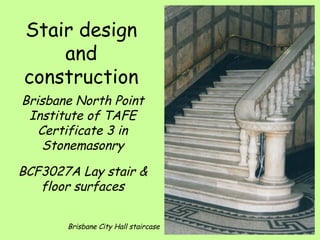
Stair design and construction Brisbane City Hall staircase Brisbane North Point Institute of TAFE Certificate 3 in Stonemasonry BCF3027A Lay stair & floor surfaces
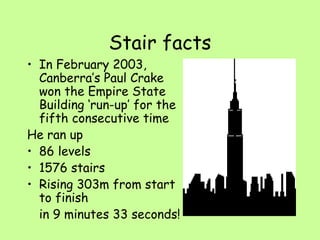
Stair facts In February 2003, Canberra’s Paul Crake won the Empire State Building ‘run-up’ for the fifth consecutive time He ran up 86 levels 1576 stairs Rising 303m from start to finish in 9 minutes 33 seconds!
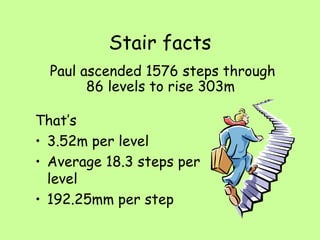
That’s  3.52m per level Average 18.3 steps per level 192.25mm per step  Stair facts Paul ascended 1576 steps through 86 levels to rise 303m
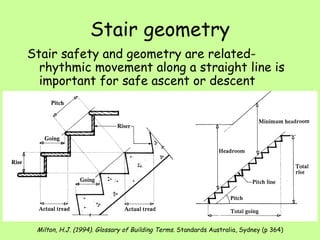
Stair geometry Stair safety and geometry are related- rhythmic movement along a straight line is important for safe ascent or descent Milton, H.J. (1994). Glossary of Building Terms.  Standards Australia, Sydney (p 364)
Stair proportions Imperial  (feet and inches) Rise (R)  ≥  6”; Going (G)  ≤  12” 2R” + G” = 23” 17”  ≤   (R” + G”)  ≤   17.5” 70”  ≤   (R” x G”)  ≤   75” Metric 150mm  ≤  R  ≤  215mm; 215mm  ≤  G  ≤  305mm 45 000  ≤   (Rmm x Gmm)   ≤   48 000
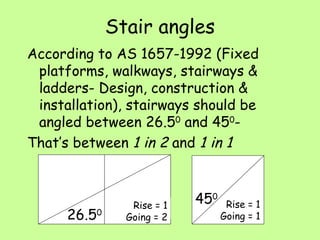
Stair angles According to AS 1657-1992 (Fixed platforms, walkways, stairways & ladders- Design, construction & installation), stairways should be angled between 26.5 0  and 45 0 - That’s between  1 in 2  and  1 in 1 26.5 0 45 0 Rise = 1 Going = 2 Rise = 1 Going = 1
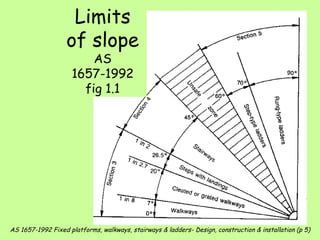
Limits of slope AS 1657-1992 fig 1.1 AS 1657-1992 Fixed platforms, walkways, stairways & ladders- Design, construction & installation (p 5)
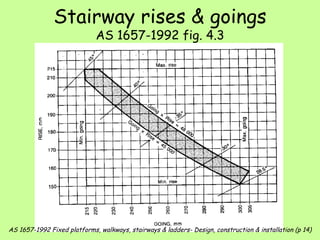
Stairway rises & goings AS 1657-1992 fig. 4.3 AS 1657-1992 Fixed platforms, walkways, stairways & ladders- Design, construction & installation (p 14)
Stair words Baluster Balustrade Go Going Handrail Headroom Rise Riser Stair Step Tread Wall string Landing Newel post Nosing Outer string Pitch Pitch line
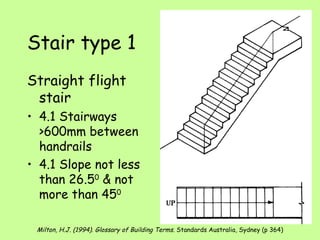
Stair type 1 Straight flight stair 4.1 Stairways >600mm between handrails 4.1 Slope not less than 26.5 0  & not more than 45 0   Milton, H.J. (1994). Glossary of Building Terms.  Standards Australia, Sydney (p 364)
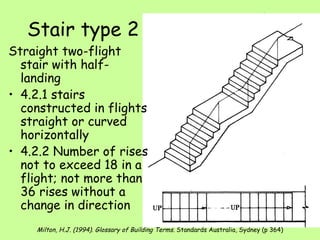
Straight two-flight stair with half-landing 4.2.1 stairs constructed in flights straight or curved horizontally   4.2.2 Number of rises not to exceed 18 in a flight; not more than 36 rises without a change in direction Stair type 2 Milton, H.J. (1994). Glossary of Building Terms.  Standards Australia, Sydney (p 364)
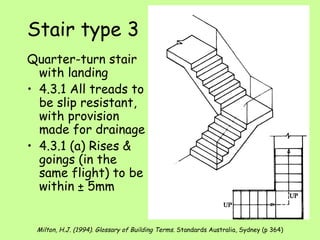
Quarter-turn stair with landing 4.3.1 All treads to be slip resistant ,  with provision made for drainage 4.3.1 (a) Rises & goings (in the same flight) to be within ± 5mm Stair type 3 Milton, H.J. (1994). Glossary of Building Terms.  Standards Australia, Sydney (p 364)
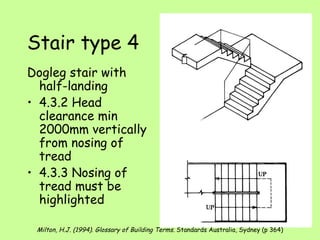
Dogleg stair with half-landing 4.3.2 Head clearance min 2000mm vertically from nosing of tread 4.3.3 Nosing of tread must be highlighted   Stair type 4 Milton, H.J. (1994). Glossary of Building Terms.  Standards Australia, Sydney (p 364)
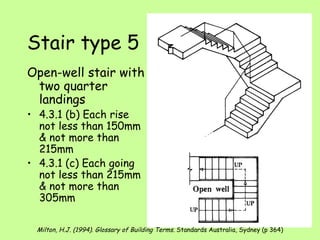
Open-well stair with two quarter landings 4.3.1 (b) Each rise not less than 150mm & not more than 215mm 4.3.1 (c) Each going not less than 215mm & not more than 305mm Stair type 5 Milton, H.J. (1994). Glossary of Building Terms.  Standards Australia, Sydney (p 364)
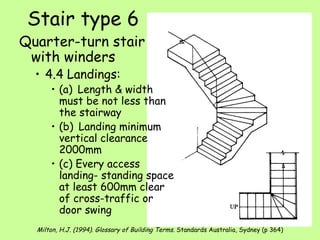
Quarter-turn stair with winders 4.4 Landings: (a)    Length & width must be not less than the stairway (b)    Landing minimum vertical clearance 2000mm (c)  Every access landing- standing space at least 600mm clear of cross-traffic or door swing   Stair type 6 Milton, H.J. (1994). Glossary of Building Terms.  Standards Australia, Sydney (p 364)
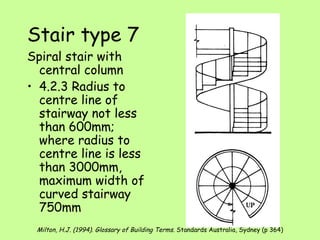
Spiral stair with central column 4.2.3 Radius to centre line of stairway not less than 600mm; where radius to centre line is less than 3000mm, maximum width of curved stairway 750mm   Stair type 7 Milton, H.J. (1994). Glossary of Building Terms.  Standards Australia, Sydney (p 364)
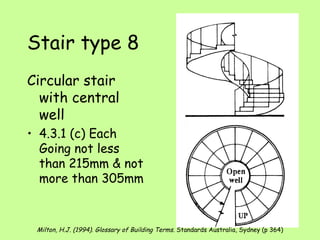
Circular stair with central well 4.3.1 (c) Each Going not less than 215mm & not more than 305mm   Stair type 8 Milton, H.J. (1994). Glossary of Building Terms.  Standards Australia, Sydney (p 364)
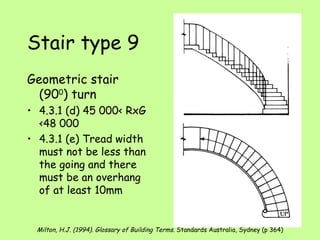
Geometric stair (90 0 ) turn 4.3.1 (d) 45 000< RxG <48 000 4.3.1 (e) Tread width must not be less than the going and there must be an overhang of at least 10mm  Stair type 9 Milton, H.J. (1994). Glossary of Building Terms.  Standards Australia, Sydney (p 364)
THE END

Stair Construction

  • 1.
    Stair design andconstruction Brisbane City Hall staircase Brisbane North Point Institute of TAFE Certificate 3 in Stonemasonry BCF3027A Lay stair & floor surfaces
  • 2.
    Stair facts InFebruary 2003, Canberra’s Paul Crake won the Empire State Building ‘run-up’ for the fifth consecutive time He ran up 86 levels 1576 stairs Rising 303m from start to finish in 9 minutes 33 seconds!
  • 3.
    That’s 3.52mper level Average 18.3 steps per level 192.25mm per step Stair facts Paul ascended 1576 steps through 86 levels to rise 303m
  • 4.
    Stair geometry Stairsafety and geometry are related- rhythmic movement along a straight line is important for safe ascent or descent Milton, H.J. (1994). Glossary of Building Terms. Standards Australia, Sydney (p 364)
  • 5.
    Stair proportions Imperial (feet and inches) Rise (R) ≥ 6”; Going (G) ≤ 12” 2R” + G” = 23” 17” ≤ (R” + G”) ≤ 17.5” 70” ≤ (R” x G”) ≤ 75” Metric 150mm ≤ R ≤ 215mm; 215mm ≤ G ≤ 305mm 45 000 ≤ (Rmm x Gmm) ≤ 48 000
  • 6.
    Stair angles Accordingto AS 1657-1992 (Fixed platforms, walkways, stairways & ladders- Design, construction & installation), stairways should be angled between 26.5 0 and 45 0 - That’s between 1 in 2 and 1 in 1 26.5 0 45 0 Rise = 1 Going = 2 Rise = 1 Going = 1
  • 7.
    Limits of slopeAS 1657-1992 fig 1.1 AS 1657-1992 Fixed platforms, walkways, stairways & ladders- Design, construction & installation (p 5)
  • 8.
    Stairway rises &goings AS 1657-1992 fig. 4.3 AS 1657-1992 Fixed platforms, walkways, stairways & ladders- Design, construction & installation (p 14)
  • 9.
    Stair words BalusterBalustrade Go Going Handrail Headroom Rise Riser Stair Step Tread Wall string Landing Newel post Nosing Outer string Pitch Pitch line
  • 10.
    Stair type 1Straight flight stair 4.1 Stairways >600mm between handrails 4.1 Slope not less than 26.5 0 & not more than 45 0 Milton, H.J. (1994). Glossary of Building Terms. Standards Australia, Sydney (p 364)
  • 11.
    Straight two-flight stairwith half-landing 4.2.1 stairs constructed in flights straight or curved horizontally 4.2.2 Number of rises not to exceed 18 in a flight; not more than 36 rises without a change in direction Stair type 2 Milton, H.J. (1994). Glossary of Building Terms. Standards Australia, Sydney (p 364)
  • 12.
    Quarter-turn stair withlanding 4.3.1 All treads to be slip resistant , with provision made for drainage 4.3.1 (a) Rises & goings (in the same flight) to be within ± 5mm Stair type 3 Milton, H.J. (1994). Glossary of Building Terms. Standards Australia, Sydney (p 364)
  • 13.
    Dogleg stair withhalf-landing 4.3.2 Head clearance min 2000mm vertically from nosing of tread 4.3.3 Nosing of tread must be highlighted Stair type 4 Milton, H.J. (1994). Glossary of Building Terms. Standards Australia, Sydney (p 364)
  • 14.
    Open-well stair withtwo quarter landings 4.3.1 (b) Each rise not less than 150mm & not more than 215mm 4.3.1 (c) Each going not less than 215mm & not more than 305mm Stair type 5 Milton, H.J. (1994). Glossary of Building Terms. Standards Australia, Sydney (p 364)
  • 15.
    Quarter-turn stair withwinders 4.4 Landings: (a)   Length & width must be not less than the stairway (b)    Landing minimum vertical clearance 2000mm (c) Every access landing- standing space at least 600mm clear of cross-traffic or door swing Stair type 6 Milton, H.J. (1994). Glossary of Building Terms. Standards Australia, Sydney (p 364)
  • 16.
    Spiral stair withcentral column 4.2.3 Radius to centre line of stairway not less than 600mm; where radius to centre line is less than 3000mm, maximum width of curved stairway 750mm Stair type 7 Milton, H.J. (1994). Glossary of Building Terms. Standards Australia, Sydney (p 364)
  • 17.
    Circular stair withcentral well 4.3.1 (c) Each Going not less than 215mm & not more than 305mm Stair type 8 Milton, H.J. (1994). Glossary of Building Terms. Standards Australia, Sydney (p 364)
  • 18.
    Geometric stair (900 ) turn 4.3.1 (d) 45 000< RxG <48 000 4.3.1 (e) Tread width must not be less than the going and there must be an overhang of at least 10mm Stair type 9 Milton, H.J. (1994). Glossary of Building Terms. Standards Australia, Sydney (p 364)
  • 19.