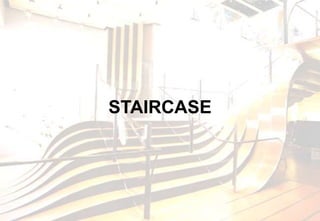
STAIRCASE
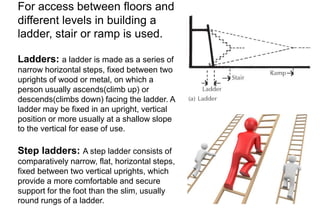
For access between floors and
different levels in building a
ladder, stair or ramp is used.
Ladders: a ladder is made as a series of
narrow horizontal steps, fixed between two
uprights of wood or metal, on which a
person usually ascends(climb up) or
descends(climbs down) facing the ladder. A
ladder may be fixed in an upright, vertical
position or more usually at a shallow slope
to the vertical for ease of use.
Step ladders: A step ladder consists of
comparatively narrow, flat, horizontal steps,
fixed between two vertical uprights, which
provide a more comfortable and secure
support for the foot than the slim, usually
round rungs of a ladder.
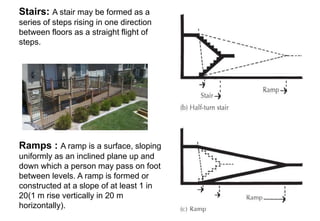
Stairs: A stair may be formed as a
series of steps rising in one direction
between floors as a straight flight of
steps.
Ramps : A ramp is a surface, sloping
uniformly as an inclined plane up and
down which a person may pass on foot
between levels. A ramp is formed or
constructed at a slope of at least 1 in
20(1 m rise vertically in 20 m
horizontally).
INTRODUCTION TO STAIRS
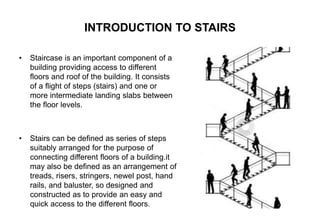
• Staircase is an important component of a
building providing access to different
floors and roof of the building. It consists
of a flight of steps (stairs) and one or
more intermediate landing slabs between
the floor levels.
• Stairs can be defined as series of steps
suitably arranged for the purpose of
connecting different floors of a building.it
may also be defined as an arrangement of
treads, risers, stringers, newel post, hand
rails, and baluster, so designed and
constructed as to provide an easy and
quick access to the different floors.
FUNCTIONAL REQUIREMENTS
STRENGTH
Able to support for movement between floors, including dead and imposed
load.
SAFETY IN USE
Comply with the Building Regulation in determining the rise ,tread, headroom
and dimensions of the handrails and guarding.
Should be constructed of materials that are capable of maintaining strength
and stability for a period of time sufficient to escape to the outside.
FIRE SAFETY
The steps and the width should be adequate for the safe escape to
the outside.
PRIMARY FUNCTIONS
• Provide an access from one floor to another.
• Provide a safe means of travel between floors.
• Provide a degree of insulation where part of a separating
element between compartments in a building.
• Provide an easy mean of travel between floors.
• Provide a suitable means of escape in case of fire.
• Provide a mean of conveying fittings and furniture between floor levels.
Note:
For residential buildings the size of step commonly adopted is 250 mm x 160
mm.
For public buildings the adopted size of step varies from 270 mm x 150 mm to
300 mm x130 mm.
TECHNICAL TERMS
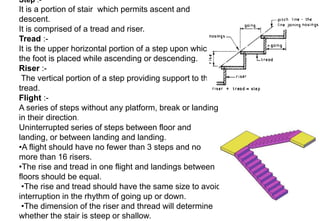
Step :-
It is a portion of stair which permits ascent and
descent.
It is comprised of a tread and riser.
Tread :-
It is the upper horizontal portion of a step upon which
the foot is placed while ascending or descending.
Riser :-
The vertical portion of a step providing support to the
tread.
Flight :-
A series of steps without any platform, break or landing
in their direction.
Uninterrupted series of steps between floor and
landing, or between landing and landing.
•A flight should have no fewer than 3 steps and no
more than 16 risers.
•The rise and tread in one flight and landings between
floors should be equal.
•The rise and tread should have the same size to avoid
interruption in the rhythm of going up or down.
•The dimension of the riser and thread will determine
whether the stair is steep or shallow.
Half turn stair
Quarter turn stair
Landing:
A platform or resting place provided between
two flights. A landing extending right across a
stair case is termed as half space landing and
the one extending only half across a staircase is
called a quarter space landing.
Going of step:
It is the horizontal distance between two
successive
riser faces.
Rise of steps:
It is the vertical distance between two successive
tread
faces.
Nosing:
It is the projecting part of the tread beyond
the face of the riser.
It is rounded to give good architectural
effect.
Scotia:
It is a moulding provided under the nosing
to
improve the elevation of the step.
Line of Nosing:
It is an imaginary line touching of each
tread
and is parallel to the slope of the stair.
Head room:
A clearance height between the pitch line
of
the stair and the underside of the stairs,
landings and floors above the stair.
Minimum 2 m clearance from the pitch line
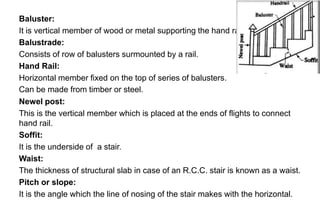
Baluster:
It is vertical member of wood or metal supporting the hand rail.
Balustrade:
Consists of row of balusters surmounted by a rail.
Hand Rail:
Horizontal member fixed on the top of series of balusters.
Can be made from timber or steel.
Newel post:
This is the vertical member which is placed at the ends of flights to connect
hand rail.
Soffit:
It is the underside of a stair.
Waist:
The thickness of structural slab in case of an R.C.C. stair is known as a waist.
Pitch or slope:
It is the angle which the line of nosing of the stair makes with the horizontal.
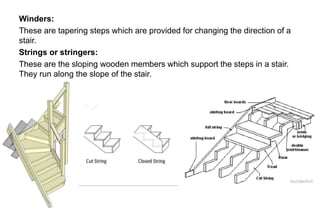
Winders:
These are tapering steps which are provided for changing the direction of a
stair.
Strings or stringers:
These are the sloping wooden members which support the steps in a stair.
They run along the slope of the stair.
CLASSIFICATION OF STAIRS
• Straight stairs
• Turning stairs
1. Quarter turn stairs(L-shaped)
2. Half turn stairs(dog-legged, open newel)
• Geometrical stairs
• Circular stairs, spiral stairs
• Bifurcated stairs
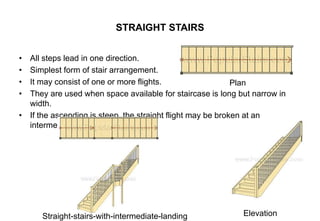
STRAIGHT STAIRS
• All steps lead in one direction.
• Simplest form of stair arrangement.
• It may consist of one or more flights.
• They are used when space available for staircase is long but narrow in
width.
• If the ascending is steep, the straight flight may be broken at an
intermediate landing.
Elevation
Plan
Straight-stairs-with-intermediate-landing
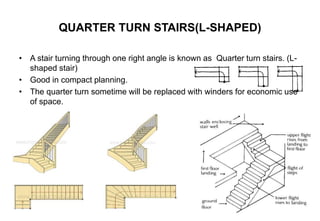
QUARTER TURN STAIRS(L-SHAPED)
• A stair turning through one right angle is known as Quarter turn stairs. (L-
shaped stair)
• Good in compact planning.
• The quarter turn sometime will be replaced with winders for economic use
of space.
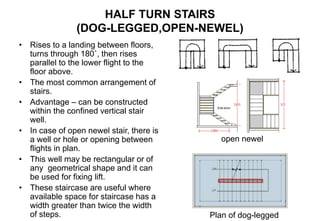
HALF TURN STAIRS
(DOG-LEGGED,OPEN-NEWEL)
• Rises to a landing between floors,
turns through 180˚, then rises
parallel to the lower flight to the
floor above.
• The most common arrangement of
stairs.
• Advantage – can be constructed
within the confined vertical stair
well.
• In case of open newel stair, there is
a well or hole or opening between
flights in plan.
• This well may be rectangular or of
any geometrical shape and it can
be used for fixing lift.
• These staircase are useful where
available space for staircase has a
width greater than twice the width
of steps.
open newel
Plan of dog-legged
GEOMETRICAL
• This is similar to open-newel stair with the difference that the open well
between the forward and backward flight is curved.
• In this form of stair, the change in direction is obtained through winders.
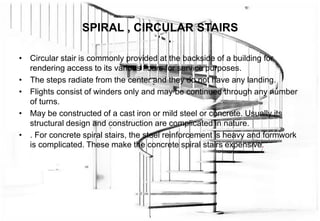
SPIRAL , CIRCULAR STAIRS
• Circular stair is commonly provided at the backside of a building for
rendering access to its various floors for service purposes.
• The steps radiate from the center and they do not have any landing.
• Flights consist of winders only and may be continued through any number
of turns.
• May be constructed of a cast iron or mild steel or concrete. Usually its
structural design and construction are complicated in nature.
• . For concrete spiral stairs, the steel reinforcement is heavy and formwork
is complicated. These make the concrete spiral stairs expensive.
CIRCULAR
SPIRAL
BIFURCATED STAIRS
• This type of stair is provided in modern public buildings.
• Flights are so arranged that there is a wide flight at the start which is sub-
divided into narrow flights at the mid landing.
• The two narrow flights start from either side of the mid-landing.
STAIRS OF DIFFERENT MATERIALS
TIMBER
METAL
STONE
R.C.C.
BRICK
BRICK STAIRS
• not frequently used.
• may be built of solid masonry construction or arches may be provided in a
lower portion.
• When arches are provided, the total masonry work is reduced and
cupboards may be provided in this hollow space.
• The treads and risers are finished with suitable flooring material.
• A brick stairs may be made of solid construction or arches may be
provided as shown.
Stone is placed
above to give
additional touch
Built-up steps…stone is placed above
to give additional touch

Staircases

  • 1.
  • 2.
    For access betweenfloors and different levels in building a ladder, stair or ramp is used. Ladders: a ladder is made as a series of narrow horizontal steps, fixed between two uprights of wood or metal, on which a person usually ascends(climb up) or descends(climbs down) facing the ladder. A ladder may be fixed in an upright, vertical position or more usually at a shallow slope to the vertical for ease of use. Step ladders: A step ladder consists of comparatively narrow, flat, horizontal steps, fixed between two vertical uprights, which provide a more comfortable and secure support for the foot than the slim, usually round rungs of a ladder.
  • 3.
    Stairs: A stairmay be formed as a series of steps rising in one direction between floors as a straight flight of steps. Ramps : A ramp is a surface, sloping uniformly as an inclined plane up and down which a person may pass on foot between levels. A ramp is formed or constructed at a slope of at least 1 in 20(1 m rise vertically in 20 m horizontally).
  • 4.
    INTRODUCTION TO STAIRS •Staircase is an important component of a building providing access to different floors and roof of the building. It consists of a flight of steps (stairs) and one or more intermediate landing slabs between the floor levels. • Stairs can be defined as series of steps suitably arranged for the purpose of connecting different floors of a building.it may also be defined as an arrangement of treads, risers, stringers, newel post, hand rails, and baluster, so designed and constructed as to provide an easy and quick access to the different floors.
  • 5.
    FUNCTIONAL REQUIREMENTS STRENGTH Able tosupport for movement between floors, including dead and imposed load. SAFETY IN USE Comply with the Building Regulation in determining the rise ,tread, headroom and dimensions of the handrails and guarding. Should be constructed of materials that are capable of maintaining strength and stability for a period of time sufficient to escape to the outside. FIRE SAFETY The steps and the width should be adequate for the safe escape to the outside.
  • 6.
    PRIMARY FUNCTIONS • Providean access from one floor to another. • Provide a safe means of travel between floors. • Provide a degree of insulation where part of a separating element between compartments in a building. • Provide an easy mean of travel between floors. • Provide a suitable means of escape in case of fire. • Provide a mean of conveying fittings and furniture between floor levels. Note: For residential buildings the size of step commonly adopted is 250 mm x 160 mm. For public buildings the adopted size of step varies from 270 mm x 150 mm to 300 mm x130 mm.
  • 7.
  • 8.
    Step :- It isa portion of stair which permits ascent and descent. It is comprised of a tread and riser. Tread :- It is the upper horizontal portion of a step upon which the foot is placed while ascending or descending. Riser :- The vertical portion of a step providing support to the tread. Flight :- A series of steps without any platform, break or landing in their direction. Uninterrupted series of steps between floor and landing, or between landing and landing. •A flight should have no fewer than 3 steps and no more than 16 risers. •The rise and tread in one flight and landings between floors should be equal. •The rise and tread should have the same size to avoid interruption in the rhythm of going up or down. •The dimension of the riser and thread will determine whether the stair is steep or shallow.
  • 9.
    Half turn stair Quarterturn stair Landing: A platform or resting place provided between two flights. A landing extending right across a stair case is termed as half space landing and the one extending only half across a staircase is called a quarter space landing. Going of step: It is the horizontal distance between two successive riser faces. Rise of steps: It is the vertical distance between two successive tread faces.
  • 10.
    Nosing: It is theprojecting part of the tread beyond the face of the riser. It is rounded to give good architectural effect. Scotia: It is a moulding provided under the nosing to improve the elevation of the step. Line of Nosing: It is an imaginary line touching of each tread and is parallel to the slope of the stair. Head room: A clearance height between the pitch line of the stair and the underside of the stairs, landings and floors above the stair. Minimum 2 m clearance from the pitch line
  • 11.
    Baluster: It is verticalmember of wood or metal supporting the hand rail. Balustrade: Consists of row of balusters surmounted by a rail. Hand Rail: Horizontal member fixed on the top of series of balusters. Can be made from timber or steel. Newel post: This is the vertical member which is placed at the ends of flights to connect hand rail. Soffit: It is the underside of a stair. Waist: The thickness of structural slab in case of an R.C.C. stair is known as a waist. Pitch or slope: It is the angle which the line of nosing of the stair makes with the horizontal.
  • 12.
    Winders: These are taperingsteps which are provided for changing the direction of a stair. Strings or stringers: These are the sloping wooden members which support the steps in a stair. They run along the slope of the stair.
  • 14.
    CLASSIFICATION OF STAIRS •Straight stairs • Turning stairs 1. Quarter turn stairs(L-shaped) 2. Half turn stairs(dog-legged, open newel) • Geometrical stairs • Circular stairs, spiral stairs • Bifurcated stairs
  • 15.
    STRAIGHT STAIRS • Allsteps lead in one direction. • Simplest form of stair arrangement. • It may consist of one or more flights. • They are used when space available for staircase is long but narrow in width. • If the ascending is steep, the straight flight may be broken at an intermediate landing. Elevation Plan Straight-stairs-with-intermediate-landing
  • 16.
    QUARTER TURN STAIRS(L-SHAPED) •A stair turning through one right angle is known as Quarter turn stairs. (L- shaped stair) • Good in compact planning. • The quarter turn sometime will be replaced with winders for economic use of space.
  • 17.
    HALF TURN STAIRS (DOG-LEGGED,OPEN-NEWEL) •Rises to a landing between floors, turns through 180˚, then rises parallel to the lower flight to the floor above. • The most common arrangement of stairs. • Advantage – can be constructed within the confined vertical stair well. • In case of open newel stair, there is a well or hole or opening between flights in plan. • This well may be rectangular or of any geometrical shape and it can be used for fixing lift. • These staircase are useful where available space for staircase has a width greater than twice the width of steps. open newel Plan of dog-legged
  • 18.
    GEOMETRICAL • This issimilar to open-newel stair with the difference that the open well between the forward and backward flight is curved. • In this form of stair, the change in direction is obtained through winders.
  • 19.
    SPIRAL , CIRCULARSTAIRS • Circular stair is commonly provided at the backside of a building for rendering access to its various floors for service purposes. • The steps radiate from the center and they do not have any landing. • Flights consist of winders only and may be continued through any number of turns. • May be constructed of a cast iron or mild steel or concrete. Usually its structural design and construction are complicated in nature. • . For concrete spiral stairs, the steel reinforcement is heavy and formwork is complicated. These make the concrete spiral stairs expensive.
  • 20.
  • 21.
    BIFURCATED STAIRS • Thistype of stair is provided in modern public buildings. • Flights are so arranged that there is a wide flight at the start which is sub- divided into narrow flights at the mid landing. • The two narrow flights start from either side of the mid-landing.
  • 22.
    STAIRS OF DIFFERENTMATERIALS TIMBER METAL STONE R.C.C. BRICK
  • 23.
    BRICK STAIRS • notfrequently used. • may be built of solid masonry construction or arches may be provided in a lower portion. • When arches are provided, the total masonry work is reduced and cupboards may be provided in this hollow space. • The treads and risers are finished with suitable flooring material. • A brick stairs may be made of solid construction or arches may be provided as shown.
  • 24.
    Stone is placed aboveto give additional touch
  • 25.
    Built-up steps…stone isplaced above to give additional touch