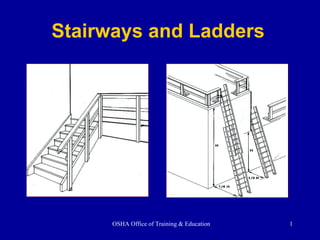
Stairways and Ladders
Stairways and ladders cause many  injuries and fatalities among construction workers  About half the injuries caused by slips, trips and falls from ladders and stairways require time off the job Hazards  Improper use of the top rung of a step ladder
At the end of this training, you should be able to list or describe: Safety guidelines and requirements for stairways used at a construction site  Safe practices and requirements for ladders   used at a construction site Slips, Trips and Falls On Stairways and Ladders
There must be a stairway or ladder at points of access where there is an elevation break of  19 inches  or more. At least one point of access must be kept clear. 19 inches Break in elevation Stairway or Ladder
Handrail vs. Stairrail Stairrail  Handrail System
Rails must be able to withstand a force of  200 pounds Handrail and Top Rail Strength
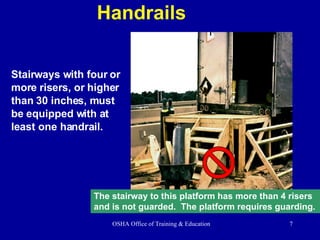
Handrails Stairways with four or more risers, or higher than 30 inches, must be equipped with at least one handrail. The stairway to this platform has more than 4 risers  and is not guarded.  The platform requires guarding.
Stairways with four or more risers or more than 30 inches high must have a stairrail  along each unprotected side or edge . Stairrails
Install between 30  and 50 degrees.  Must have uniform riser height and tread depth, with less than a 1/4-inch variation. Uniform - 30 & 50 deg. angle No more than 1/4 inch  variation in any stairway system Stairs
Only use pan stairs if filled with filler material at least to the top edge of each pan.  Pan Temporary Stairways
Stairways landings must be at least 30 inches deep and 22 inches wide at every 12 feet or less of vertical rise Unprotected sides of landings must have standard 42 inch guardrail systems Stairway Landings Landing
Where doors or gates open directly on a stairway, provide a platform that extends at least 20 inches beyond the swing of the door.   Platforms and Swing Doors
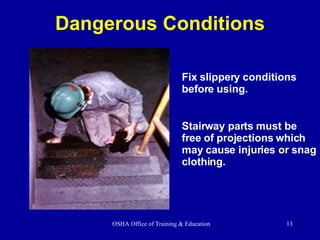
Dangerous Conditions Fix slippery conditions  before using. Stairway parts must be free of projections which may cause injuries or snag clothing.
Ladders
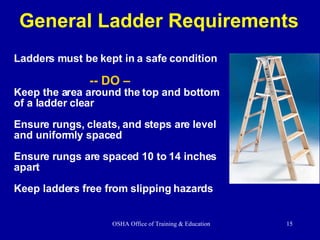
Ladders must be kept in a safe condition   -- DO –  Keep the area around the top and bottom of a ladder clear Ensure rungs, cleats, and steps are level and uniformly spaced Ensure rungs are spaced 10 to 14 inches apart Keep ladders free from slipping hazards General Ladder Requirements
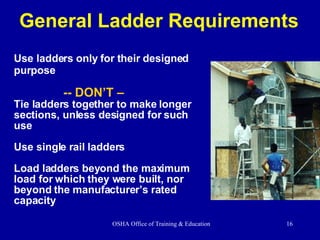
Use ladders only for their designed  purpose   -- DON’T –  Tie ladders together to make longer  sections, unless designed for such use Use single rail ladders  Load ladders beyond the maximum  load for which they were built, nor beyond the manufacturer’s rated capacity General Ladder Requirements
Securing Ladders Secure ladders to prevent accidental movement due to workplace activity Only use ladders on stable and level surfaces, unless secured Do not use ladders on slippery surfaces unless secured or provided with slip-resistant feet This ladder is not on a stable surface
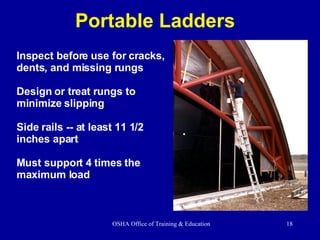
Inspect before use for cracks, dents, and missing rungs Design or treat rungs to minimize slipping Side rails -- at least 11 1/2 inches apart Must support 4 times the maximum load Portable Ladders
when ladders are the only way to enter or exit a working area with 25 or more employees when a ladder will  serve simultaneous two-way traffic Double - Cleated Ladder Use a double-cleated ladder ( with center rail) or 2 or more ladders:
Don’t paint ladders Don’t use an opaque covering (like  varnish) on a wood ladder Painting Wood  Ladders
Ladder Angle Non-self-supporting ladders: (which lean against a wall or other support) Position at  an angle where the horizontal distance from the top support to the foot of the ladder is 1/4 the working length of the ladder
When using a portable ladder for access to an upper landing surface, the side rails must extend at least 3 feet above the upper landing surface Ladder Rail Extension
Tall Fixed Ladder Requirements Equip a fixed ladder 24 feet or longer with either a: Ladder safety device Self-retracting lifelines with rest platforms every 150 feet or less Cage or well, and multiple ladder sections, each section not exceeding 50 feet
Near Energized Electrical Equipment   If using ladders where the employee or the ladder could contact exposed energized electrical equipment, they must have nonconductive siderails such as wood or fiberglass. This is an unsafe condition
Do not use the top or top step of a stepladder as a step Top Step
Don’t use crossbracing on the rear of a stepladder for climbing - unless the ladder is designed for that On this ladder the back rungs  are designed for use Crossbracing
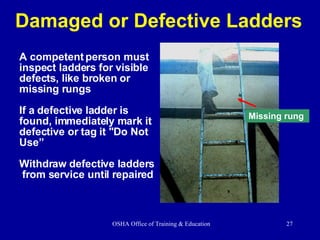
A competent person must inspect ladders for visible defects, like broken or missing rungs If a defective ladder is found, immediately mark it defective or tag it "Do Not Use” Withdraw defective ladders  from service until repaired Damaged or Defective Ladders Missing rung
Face the ladder when going up or down Use at least one hand to grab the ladder when going up or down Do not carry any object or load that could cause you to lose balance Climbing the Ladder
A competent person must train each employee in the following areas, as applicable: The nature of fall hazards in the work area The correct procedures for erecting,  maintaining, and disassembling the fall protection systems to be used The proper construction, use, placement, and care in handling of all stairways and ladders The maximum intended load-carrying capacities of ladders Training
Summary Key Components for Stairway Safety Treads Rails  handrails stairrails guardrails Landings and Platforms
Summary Key Components for Ladder Safety A competent person must inspect Use the correct ladder for the job Use the correct angle, supports, treads,  cross braces and rails  Don’t overload  Your employer must train you in proper use of a ladder

Stairs and Ladders

  • 1.
  • 2.
    Stairways and ladderscause many injuries and fatalities among construction workers About half the injuries caused by slips, trips and falls from ladders and stairways require time off the job Hazards Improper use of the top rung of a step ladder
  • 3.
    At the endof this training, you should be able to list or describe: Safety guidelines and requirements for stairways used at a construction site Safe practices and requirements for ladders used at a construction site Slips, Trips and Falls On Stairways and Ladders
  • 4.
    There must bea stairway or ladder at points of access where there is an elevation break of 19 inches or more. At least one point of access must be kept clear. 19 inches Break in elevation Stairway or Ladder
  • 5.
    Handrail vs. StairrailStairrail Handrail System
  • 6.
    Rails must beable to withstand a force of 200 pounds Handrail and Top Rail Strength
  • 7.
    Handrails Stairways withfour or more risers, or higher than 30 inches, must be equipped with at least one handrail. The stairway to this platform has more than 4 risers and is not guarded. The platform requires guarding.
  • 8.
    Stairways with fouror more risers or more than 30 inches high must have a stairrail along each unprotected side or edge . Stairrails
  • 9.
    Install between 30 and 50 degrees. Must have uniform riser height and tread depth, with less than a 1/4-inch variation. Uniform - 30 & 50 deg. angle No more than 1/4 inch variation in any stairway system Stairs
  • 10.
    Only use panstairs if filled with filler material at least to the top edge of each pan. Pan Temporary Stairways
  • 11.
    Stairways landings mustbe at least 30 inches deep and 22 inches wide at every 12 feet or less of vertical rise Unprotected sides of landings must have standard 42 inch guardrail systems Stairway Landings Landing
  • 12.
    Where doors orgates open directly on a stairway, provide a platform that extends at least 20 inches beyond the swing of the door. Platforms and Swing Doors
  • 13.
    Dangerous Conditions Fixslippery conditions before using. Stairway parts must be free of projections which may cause injuries or snag clothing.
  • 14.
  • 15.
    Ladders must bekept in a safe condition -- DO – Keep the area around the top and bottom of a ladder clear Ensure rungs, cleats, and steps are level and uniformly spaced Ensure rungs are spaced 10 to 14 inches apart Keep ladders free from slipping hazards General Ladder Requirements
  • 16.
    Use ladders onlyfor their designed purpose -- DON’T – Tie ladders together to make longer sections, unless designed for such use Use single rail ladders Load ladders beyond the maximum load for which they were built, nor beyond the manufacturer’s rated capacity General Ladder Requirements
  • 17.
    Securing Ladders Secureladders to prevent accidental movement due to workplace activity Only use ladders on stable and level surfaces, unless secured Do not use ladders on slippery surfaces unless secured or provided with slip-resistant feet This ladder is not on a stable surface
  • 18.
    Inspect before usefor cracks, dents, and missing rungs Design or treat rungs to minimize slipping Side rails -- at least 11 1/2 inches apart Must support 4 times the maximum load Portable Ladders
  • 19.
    when ladders arethe only way to enter or exit a working area with 25 or more employees when a ladder will serve simultaneous two-way traffic Double - Cleated Ladder Use a double-cleated ladder ( with center rail) or 2 or more ladders:
  • 20.
    Don’t paint laddersDon’t use an opaque covering (like varnish) on a wood ladder Painting Wood Ladders
  • 21.
    Ladder Angle Non-self-supportingladders: (which lean against a wall or other support) Position at an angle where the horizontal distance from the top support to the foot of the ladder is 1/4 the working length of the ladder
  • 22.
    When using aportable ladder for access to an upper landing surface, the side rails must extend at least 3 feet above the upper landing surface Ladder Rail Extension
  • 23.
    Tall Fixed LadderRequirements Equip a fixed ladder 24 feet or longer with either a: Ladder safety device Self-retracting lifelines with rest platforms every 150 feet or less Cage or well, and multiple ladder sections, each section not exceeding 50 feet
  • 24.
    Near Energized ElectricalEquipment If using ladders where the employee or the ladder could contact exposed energized electrical equipment, they must have nonconductive siderails such as wood or fiberglass. This is an unsafe condition
  • 25.
    Do not usethe top or top step of a stepladder as a step Top Step
  • 26.
    Don’t use crossbracingon the rear of a stepladder for climbing - unless the ladder is designed for that On this ladder the back rungs are designed for use Crossbracing
  • 27.
    A competent personmust inspect ladders for visible defects, like broken or missing rungs If a defective ladder is found, immediately mark it defective or tag it "Do Not Use” Withdraw defective ladders from service until repaired Damaged or Defective Ladders Missing rung
  • 28.
    Face the ladderwhen going up or down Use at least one hand to grab the ladder when going up or down Do not carry any object or load that could cause you to lose balance Climbing the Ladder
  • 29.
    A competent personmust train each employee in the following areas, as applicable: The nature of fall hazards in the work area The correct procedures for erecting, maintaining, and disassembling the fall protection systems to be used The proper construction, use, placement, and care in handling of all stairways and ladders The maximum intended load-carrying capacities of ladders Training
  • 30.
    Summary Key Componentsfor Stairway Safety Treads Rails handrails stairrails guardrails Landings and Platforms
  • 31.
    Summary Key Componentsfor Ladder Safety A competent person must inspect Use the correct ladder for the job Use the correct angle, supports, treads, cross braces and rails Don’t overload Your employer must train you in proper use of a ladder

Editor's Notes

  • #2 1926 Subpart X - Stairways and Ladders This presentation is designed to assist trainers conducting OSHA 10-hour Construction Industry outreach training for workers. Since workers are the target audience, this presentation emphasizes hazard identification, avoidance, and control – not standards. No attempt has been made to treat the topic exhaustively. It is essential that trainers tailor their presentations to the needs and understanding of their audience. This presentation is not a substitute for any of the provisions of the Occupational Safety and Health Act of 1970 or for any standards issued by the U.S. Department of Labor. Mention of trade names, commercial products, or organizations does not imply endorsement by the U.S. Department of Labor.