BOOM LIFTS

HAZARDS AND SAFE OPERATION
OSHA REQUIREMENTS
1926.21(b)(2)
The employer shall instruct each employee in the recognition and avoidance of unsafe
conditions and the regulations applicable to his work environment to control or eliminate any
hazards or other exposure to illness or injury. What are the hazards?
FALL PROTECTION

GUARDRAIL
 Fall protection on a boom
lift is the guardrail.
OSHA also states that all
workers shall stand
firmly on the floor of the
basket, and shall not sit or
climb on the edge of the
basket or use planks,
ladders, or other devices
for a work position.

1926.453(b)(2)(iv)

 To meet the
requirements of OSHA
standards, a fall
restraint system can be
used.
APPROPRIATE PROTECTION


• OSHA says:
•

The principle function of the protection device is to restrain the bucket
occupant to the extent that he/she cannot leave the bucket, either on
his/her own volition or due to an impact to the lift that might otherwise
tend to eject him/her.

• I can’t emphasize enough that we are dealing with restraint
here…
• OSHA Compliance will cite the use of a fall protection lanyard
and shock absorber…if the length of the lanyard assembly is
such that the employee could leave the bucket with the devices
in use and in place.
FALL ARREST OR RESTRAINT?


•
•

Interpretation Letter #20070823-7896
Question 1: Section 1926.453(b)(2)(v) requires employees to tie off
to the boom or the basket when working from an aerial lift. In
addition, 1926.502(d)(16)(iii) provides that a personal fall arrest
system shall be rigged such that an employee can neither free fall
more than six feet, nor contact any lower level. The manufacturer
of a particular shock absorbing lanyard sets a minimum anchor
point elevation for the lanyard of 18-1/2’ to prevent contact with a
lower level in the event of a fall. My concern centers around the
fact that, when raising an employee from a work surface, or upon
returning an employee to a work surface, the employee at times
will be at elevations that are less than 18-1/2’.

•

DOES THIS PRECLUDE ITS USE AS A FALL PROTECTION
SYSTEM IN AN AERIAL LIFT?
PROHIBITION OF CERTAIN LANYARDS


 Interpretation Letter #20070823-7896
 Answer 1: … The lanyard you describe would not
meet that criterion when the aerial lift’s work
platform is at heights less than 18-1/2’. Even if the
working level of the aerial lift will ultimately be
higher than 18-1/2’, 1926.453(b)(2)(v) requires fall
protection for employees in aerial lifts at lesser
heights as well. Since the fall protection system you
describe would not meet the requirements of
1926.502(d)(16)(iii) under these conditions, it would
be prohibited.
PREOPERATIONAL INSPECTION
EACH DAY, prior to operating
an aerial lift, a preoperational
inspection shall be conducted.
Check for:
 Leaks
 Broken or unattached wires
 Gouges in the tires
 Missing parts
 Alterations
 Any kind of damage
 If you find any of the above,
DO NOT OPERATE THE
LIFT! Report it to your
supervisor.



 Look under both hoods.
 Check for broken wiring,
leaks, and damage to any
component.
 Ensure the hydraulic fluid
registers in the sight glass.
 CHECK THE OIL.
 Walk completely around the
Boom lift and check for
damage to any component,
leaks, broken or unattached
wires, gouges in the tires,
missing parts and
alterations.
NEVER ACCEPT
DEFICIENT CONDITIONS
UNDER THE HOODS
HYDRAULIC
FLUID

FUEL

OIL


CONTROLS

PREOPERATIONAL
INSPECTION

Check the fuel,
motor oil and
hydraulic oil levels.
Test ground
controls.
BIG RED BUTTON
Emergency stop
Used to stop the function of the
machine in an emergency.

Always push this in when you are
finished using the machine.
BASKET CONTROLS


TEST BASKET CONTROLS FOR FUNCTIONALITY
MASTER CONTROL
With the exception of starting the machine, controls will not function unless the
master control is engaged.
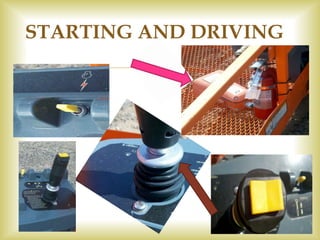
STARTING AND DRIVING


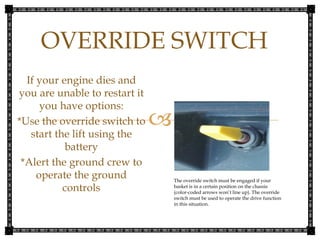
OVERRIDE SWITCH
If your engine dies and
you are unable to restart it
you have options:
*Use the override switch to
start the lift using the
battery
*Alert the ground crew to
operate the ground
controls


The override switch must be engaged if your
basket is in a certain position on the chassis
(color-coded arrows won’t line up). The override
switch must be used to operate the drive function
in this situation.
COLOR CODED ARROWS/DRIVE
ORIENTATION OVERRIDE



DRIVE ORIENTATION
OVERRIDE SWITCH
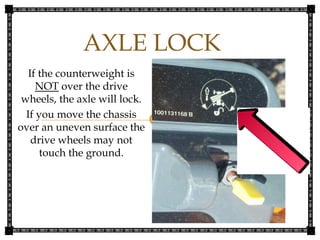
AXLE LOCK
If the counterweight is
NOT over the drive
wheels, the axle will lock.
If you move the chassis
over an uneven surface the
drive wheels may not
touch the ground.


ANCHOR POINTS
Anchor points are located on either side
of the control box. An additional
anchor point is located near the access
gate.


LOAD LIMITS
Never exceed the load limit of the machine
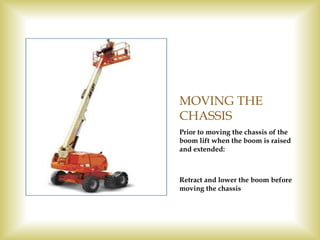
MOVING THE
CHASSIS
Prior to moving the chassis of the
boom lift when the boom is raised
and extended:

Retract and lower the boom before
moving the chassis
SOME REASONS WHY

PINCH POINTS

 Keep hands and body
parts inside the basket
and never place any
part of your body in a
pinch point.

 Maintain situational
awareness when
nearing structures or
objects.

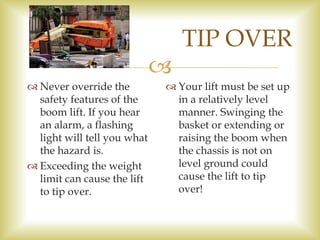
 Never override the
safety features of the
boom lift. If you hear
an alarm, a flashing
light will tell you what
the hazard is.
 Exceeding the weight
limit can cause the lift
to tip over.

TIP OVER

 Your lift must be set up
in a relatively level
manner. Swinging the
basket or extending or
raising the boom when
the chassis is not on
level ground could
cause the lift to tip
over!
ELECTRICAL HAZARDS


 Maintain required
distances from
electrical power lines
and other electrical
hazards.

 Machine must be
grounded by a
qualified electrician
when working near
overhead power lines.
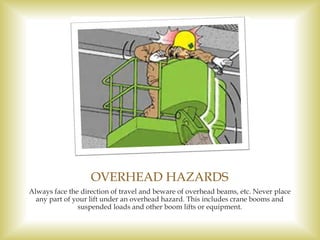
OVERHEAD HAZARDS
Always face the direction of travel and beware of overhead beams, etc. Never place
any part of your lift under an overhead hazard. This includes crane booms and
suspended loads and other boom lifts or equipment.
TRAVEL PATH HAZARDS


 Walk down the travel
path prior to operating
the lift, especially
where soft spots, holes,
ruts, etc. may exist.

 Other work groups and
their equipment, site
equipment and
materials, and traffic
areas may impact
conditions.
FIRES

 What would you do if
you were extended in
the air and a fire in the
basket control panel
occurred?

 Having a currently
inspected and
operational fire
extinguisher in the
basket could save your
life.
WHAT FOLLOWS

FINAL WRITTEN TEST
PRACTICAL TRAINING
PRACTICAL TRAINING



THIS WILL CONSIST OF ACTUAL OPERATION OF A BOOM LIFT.
YOUR INSTRUCTOR WILL BE IN THE BASKET WITH YOU. YOU
WILL NOT BE AUTHORIZED TO OPERATE A BOOM LIFT ALONE
UNTIL YOU HAVE SUCCESSFULLY COMPLETED TRAINING
WITH AN AUTHORIZED INSTRUCTOR.

Boom lift training

  • 1.
  • 2.
    OSHA REQUIREMENTS 1926.21(b)(2) The employershall instruct each employee in the recognition and avoidance of unsafe conditions and the regulations applicable to his work environment to control or eliminate any hazards or other exposure to illness or injury. What are the hazards?
  • 3.
    FALL PROTECTION  GUARDRAIL  Fallprotection on a boom lift is the guardrail. OSHA also states that all workers shall stand firmly on the floor of the basket, and shall not sit or climb on the edge of the basket or use planks, ladders, or other devices for a work position. 1926.453(b)(2)(iv)  To meet the requirements of OSHA standards, a fall restraint system can be used.
  • 4.
    APPROPRIATE PROTECTION  • OSHAsays: • The principle function of the protection device is to restrain the bucket occupant to the extent that he/she cannot leave the bucket, either on his/her own volition or due to an impact to the lift that might otherwise tend to eject him/her. • I can’t emphasize enough that we are dealing with restraint here… • OSHA Compliance will cite the use of a fall protection lanyard and shock absorber…if the length of the lanyard assembly is such that the employee could leave the bucket with the devices in use and in place.
  • 5.
    FALL ARREST ORRESTRAINT?  • • Interpretation Letter #20070823-7896 Question 1: Section 1926.453(b)(2)(v) requires employees to tie off to the boom or the basket when working from an aerial lift. In addition, 1926.502(d)(16)(iii) provides that a personal fall arrest system shall be rigged such that an employee can neither free fall more than six feet, nor contact any lower level. The manufacturer of a particular shock absorbing lanyard sets a minimum anchor point elevation for the lanyard of 18-1/2’ to prevent contact with a lower level in the event of a fall. My concern centers around the fact that, when raising an employee from a work surface, or upon returning an employee to a work surface, the employee at times will be at elevations that are less than 18-1/2’. • DOES THIS PRECLUDE ITS USE AS A FALL PROTECTION SYSTEM IN AN AERIAL LIFT?
  • 6.
    PROHIBITION OF CERTAINLANYARDS   Interpretation Letter #20070823-7896  Answer 1: … The lanyard you describe would not meet that criterion when the aerial lift’s work platform is at heights less than 18-1/2’. Even if the working level of the aerial lift will ultimately be higher than 18-1/2’, 1926.453(b)(2)(v) requires fall protection for employees in aerial lifts at lesser heights as well. Since the fall protection system you describe would not meet the requirements of 1926.502(d)(16)(iii) under these conditions, it would be prohibited.
  • 7.
    PREOPERATIONAL INSPECTION EACH DAY,prior to operating an aerial lift, a preoperational inspection shall be conducted. Check for:  Leaks  Broken or unattached wires  Gouges in the tires  Missing parts  Alterations  Any kind of damage  If you find any of the above, DO NOT OPERATE THE LIFT! Report it to your supervisor.   Look under both hoods.  Check for broken wiring, leaks, and damage to any component.  Ensure the hydraulic fluid registers in the sight glass.  CHECK THE OIL.  Walk completely around the Boom lift and check for damage to any component, leaks, broken or unattached wires, gouges in the tires, missing parts and alterations.
  • 8.
  • 9.
  • 10.
  • 11.
    PREOPERATIONAL INSPECTION Check the fuel, motoroil and hydraulic oil levels. Test ground controls.
  • 12.
    BIG RED BUTTON Emergencystop Used to stop the function of the machine in an emergency. Always push this in when you are finished using the machine.
  • 13.
    BASKET CONTROLS  TEST BASKETCONTROLS FOR FUNCTIONALITY
  • 14.
    MASTER CONTROL With theexception of starting the machine, controls will not function unless the master control is engaged.
  • 15.
  • 16.
    OVERRIDE SWITCH If yourengine dies and you are unable to restart it you have options: *Use the override switch to start the lift using the battery *Alert the ground crew to operate the ground controls  The override switch must be engaged if your basket is in a certain position on the chassis (color-coded arrows won’t line up). The override switch must be used to operate the drive function in this situation.
  • 17.
    COLOR CODED ARROWS/DRIVE ORIENTATIONOVERRIDE  DRIVE ORIENTATION OVERRIDE SWITCH
  • 18.
    AXLE LOCK If thecounterweight is NOT over the drive wheels, the axle will lock. If you move the chassis over an uneven surface the drive wheels may not touch the ground. 
  • 19.
    ANCHOR POINTS Anchor pointsare located on either side of the control box. An additional anchor point is located near the access gate. 
  • 20.
    LOAD LIMITS Never exceedthe load limit of the machine
  • 21.
    MOVING THE CHASSIS Prior tomoving the chassis of the boom lift when the boom is raised and extended: Retract and lower the boom before moving the chassis
  • 22.
  • 23.
    PINCH POINTS   Keephands and body parts inside the basket and never place any part of your body in a pinch point.  Maintain situational awareness when nearing structures or objects.
  • 24.
      Never overridethe safety features of the boom lift. If you hear an alarm, a flashing light will tell you what the hazard is.  Exceeding the weight limit can cause the lift to tip over. TIP OVER  Your lift must be set up in a relatively level manner. Swinging the basket or extending or raising the boom when the chassis is not on level ground could cause the lift to tip over!
  • 25.
    ELECTRICAL HAZARDS   Maintainrequired distances from electrical power lines and other electrical hazards.  Machine must be grounded by a qualified electrician when working near overhead power lines.
  • 26.
    OVERHEAD HAZARDS Always facethe direction of travel and beware of overhead beams, etc. Never place any part of your lift under an overhead hazard. This includes crane booms and suspended loads and other boom lifts or equipment.
  • 27.
    TRAVEL PATH HAZARDS  Walk down the travel path prior to operating the lift, especially where soft spots, holes, ruts, etc. may exist.  Other work groups and their equipment, site equipment and materials, and traffic areas may impact conditions.
  • 28.
    FIRES   What wouldyou do if you were extended in the air and a fire in the basket control panel occurred?  Having a currently inspected and operational fire extinguisher in the basket could save your life.
  • 29.
    WHAT FOLLOWS  FINAL WRITTENTEST PRACTICAL TRAINING
  • 30.
    PRACTICAL TRAINING  THIS WILLCONSIST OF ACTUAL OPERATION OF A BOOM LIFT. YOUR INSTRUCTOR WILL BE IN THE BASKET WITH YOU. YOU WILL NOT BE AUTHORIZED TO OPERATE A BOOM LIFT ALONE UNTIL YOU HAVE SUCCESSFULLY COMPLETED TRAINING WITH AN AUTHORIZED INSTRUCTOR.