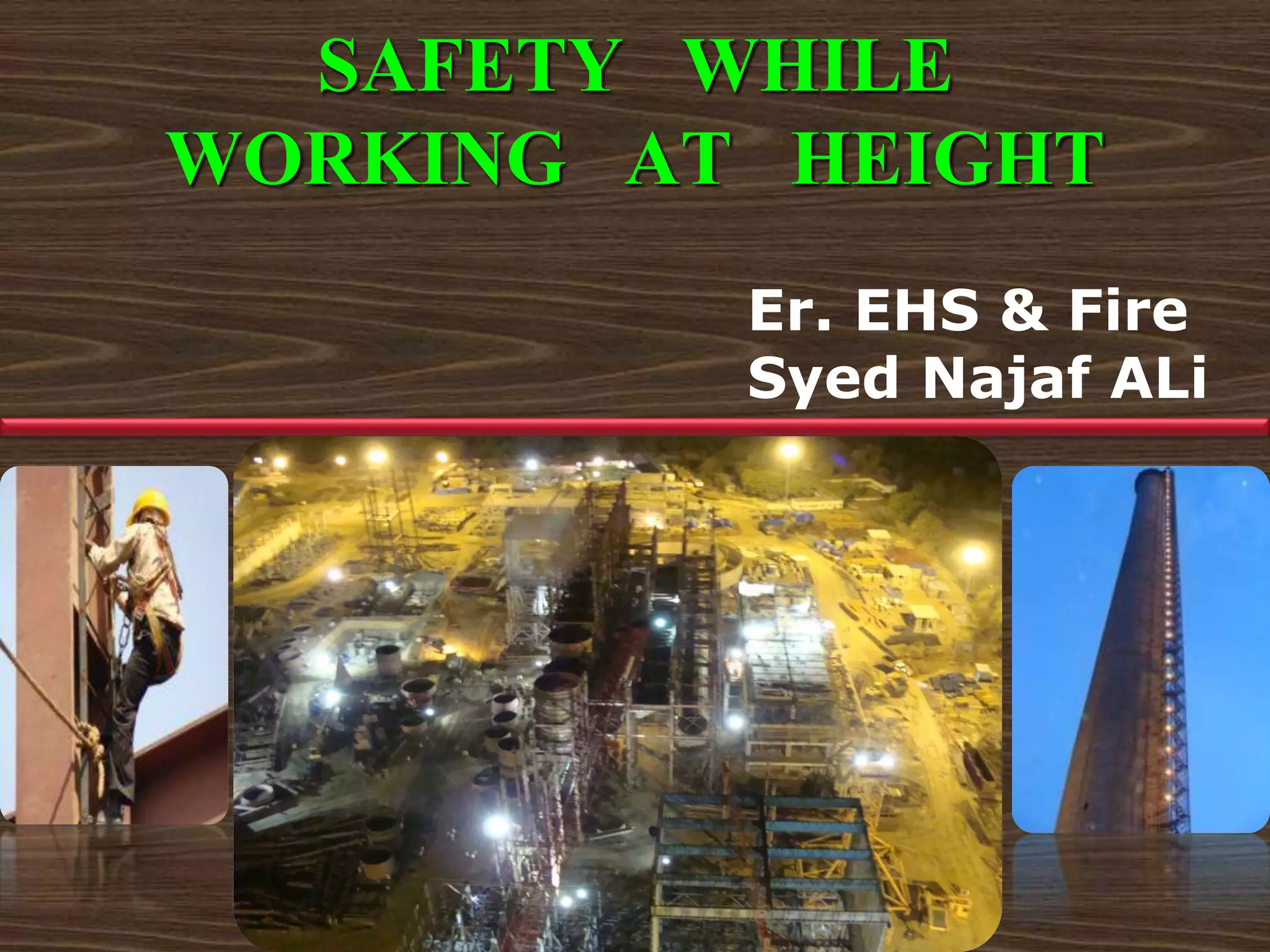



SAFETY WHILE
WORKING AT HEIGHT
Er. EHS & Fire
Syed Najaf ALi
Safety while working at
height
Risk & Hazard
The term hazard is used to
describe the potential of a compound
to cause damage. Risk refers to the
probability that potential harm
occurs.
Hazard is the potential to
cause harm; risk on the other
hand is the likelihood of harm
Objective
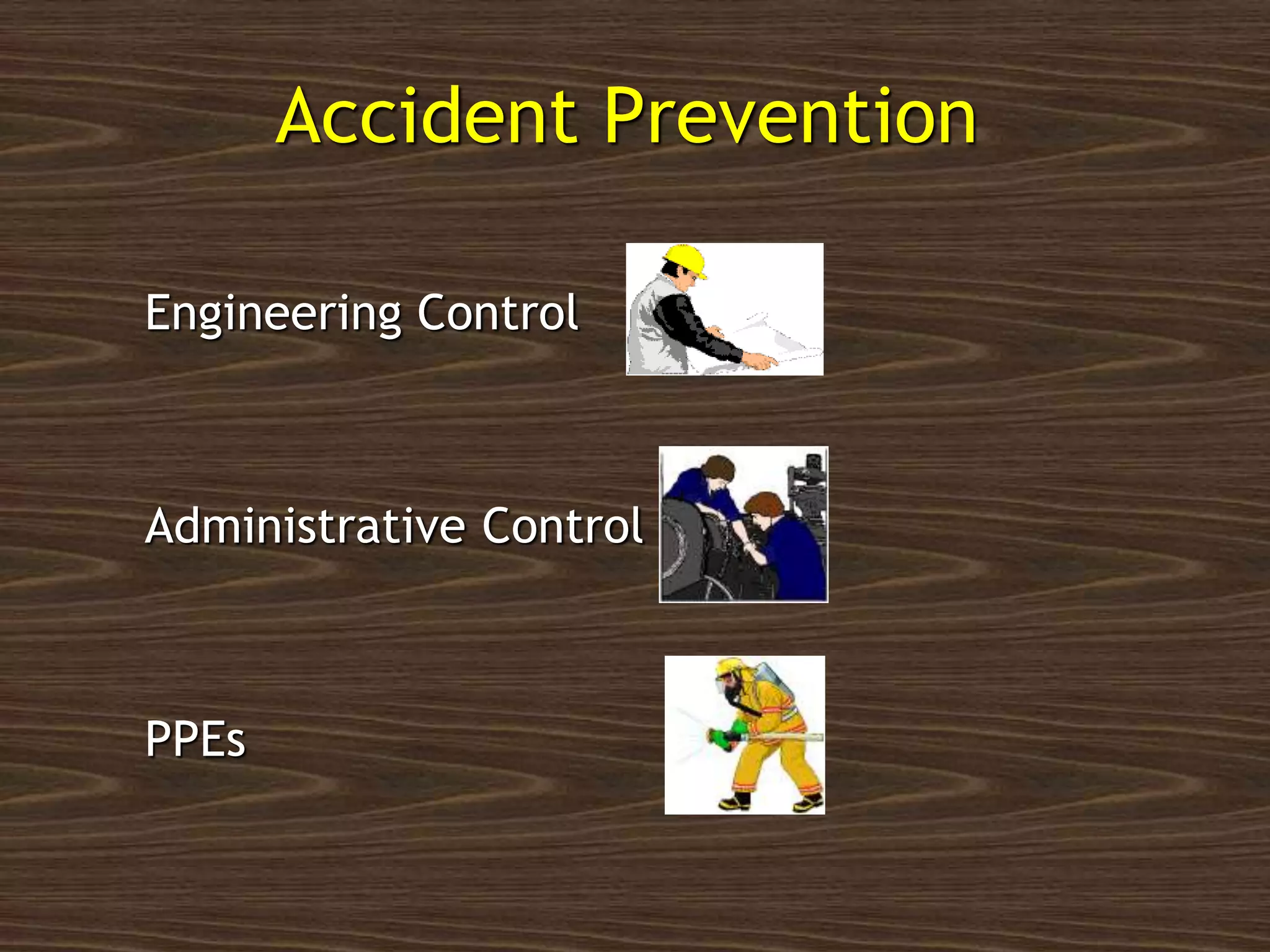
Accident Prevention
Engineering Control
Administrative Control
PPEs
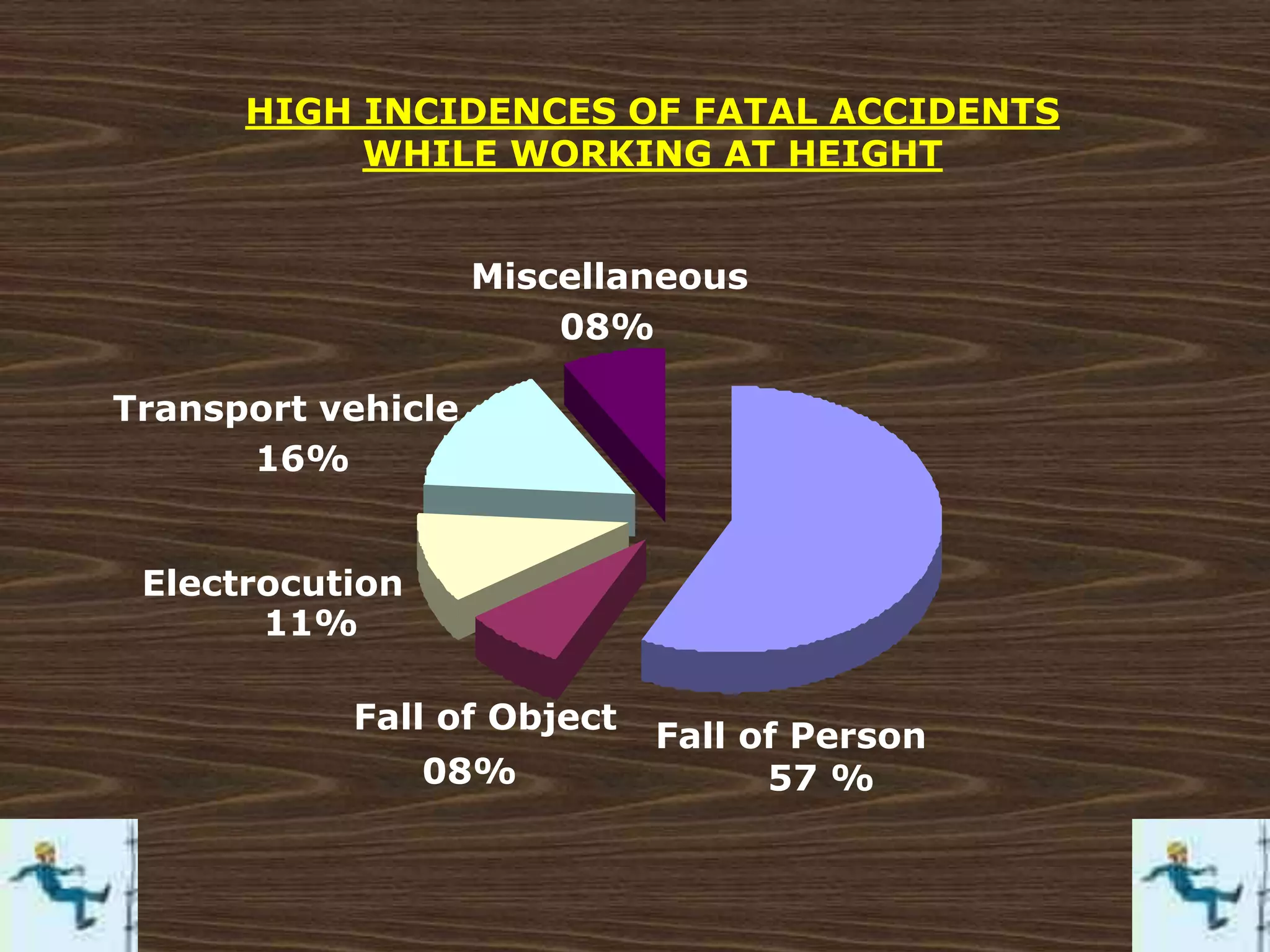
Fall of Object
Electrocution
Transport vehicle
Miscellaneous
HIGH INCIDENCES OF FATAL ACCIDENTS
WHILE WORKING AT HEIGHT
08%
11%
16%
08%
Fall of Person
57 %
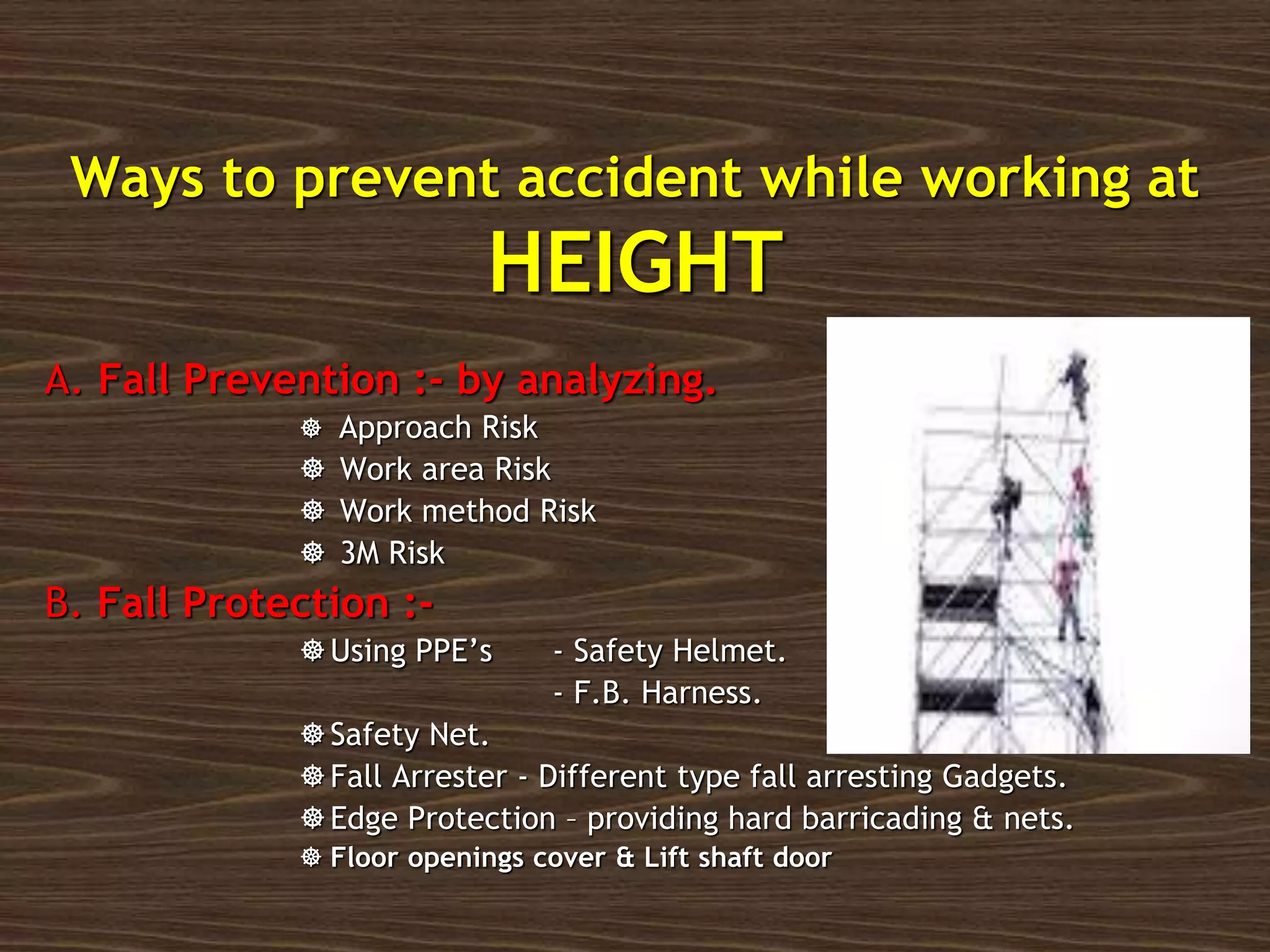
Ways to prevent accident while working at
HEIGHT
A. Fall Prevention :- by analyzing.
 Approach Risk
 Work area Risk
 Work method Risk
 3M Risk
B. Fall Protection :-
Using PPE’s - Safety Helmet.
- F.B. Harness.
Safety Net.
Fall Arrester - Different type fall arresting Gadgets.
Edge Protection – providing hard barricading & nets.
 Floor openings cover & Lift shaft door
FALL PREVENTION
METHODS
We shall discuss about;
 Ladders
 Ramps
 Scaffoldings
 Working Platforms
 Working On roofs & Fragile roofs
FALL PREVENTION
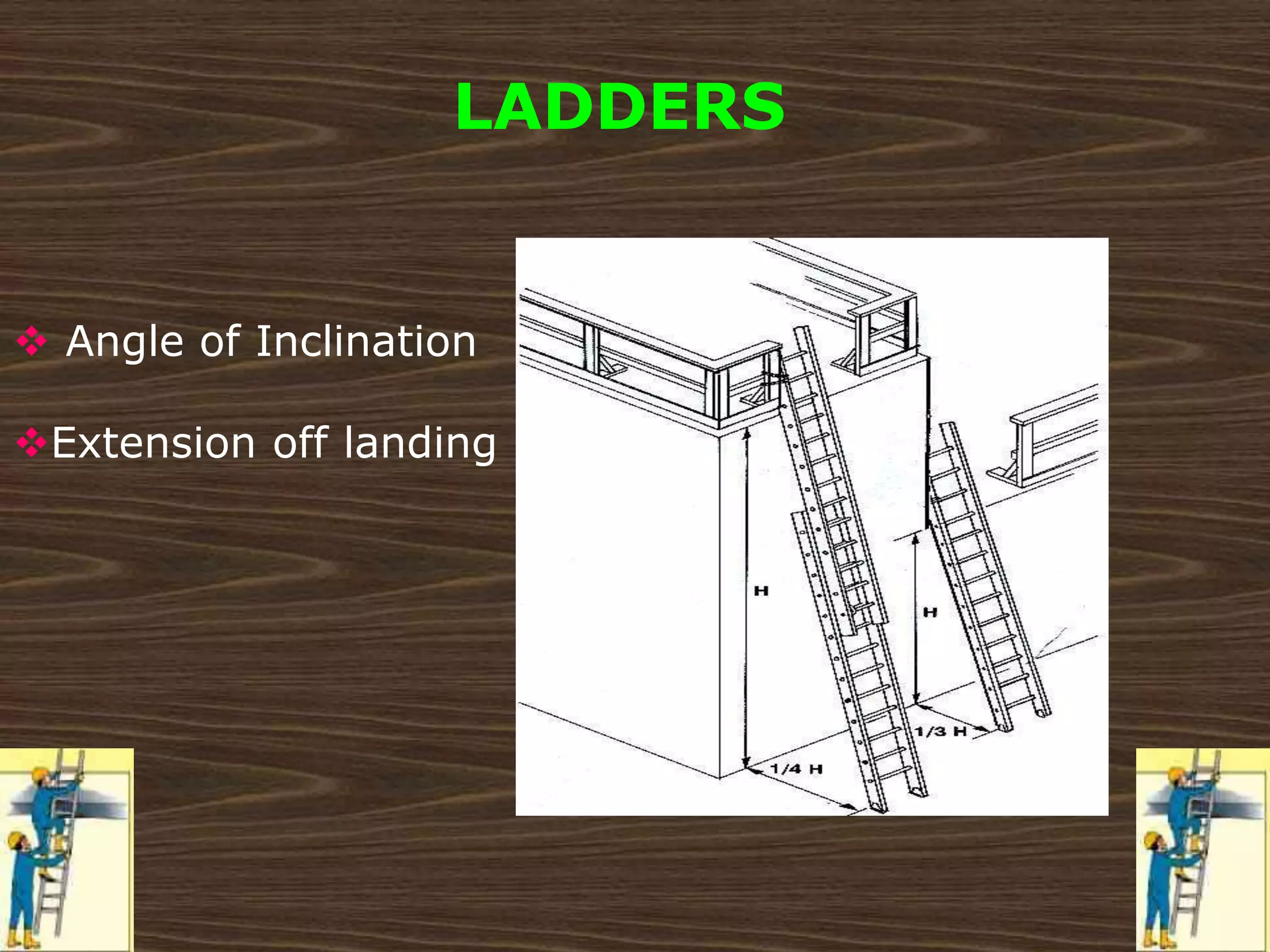
 Angle of Inclination
Extension off landing
LADDERS
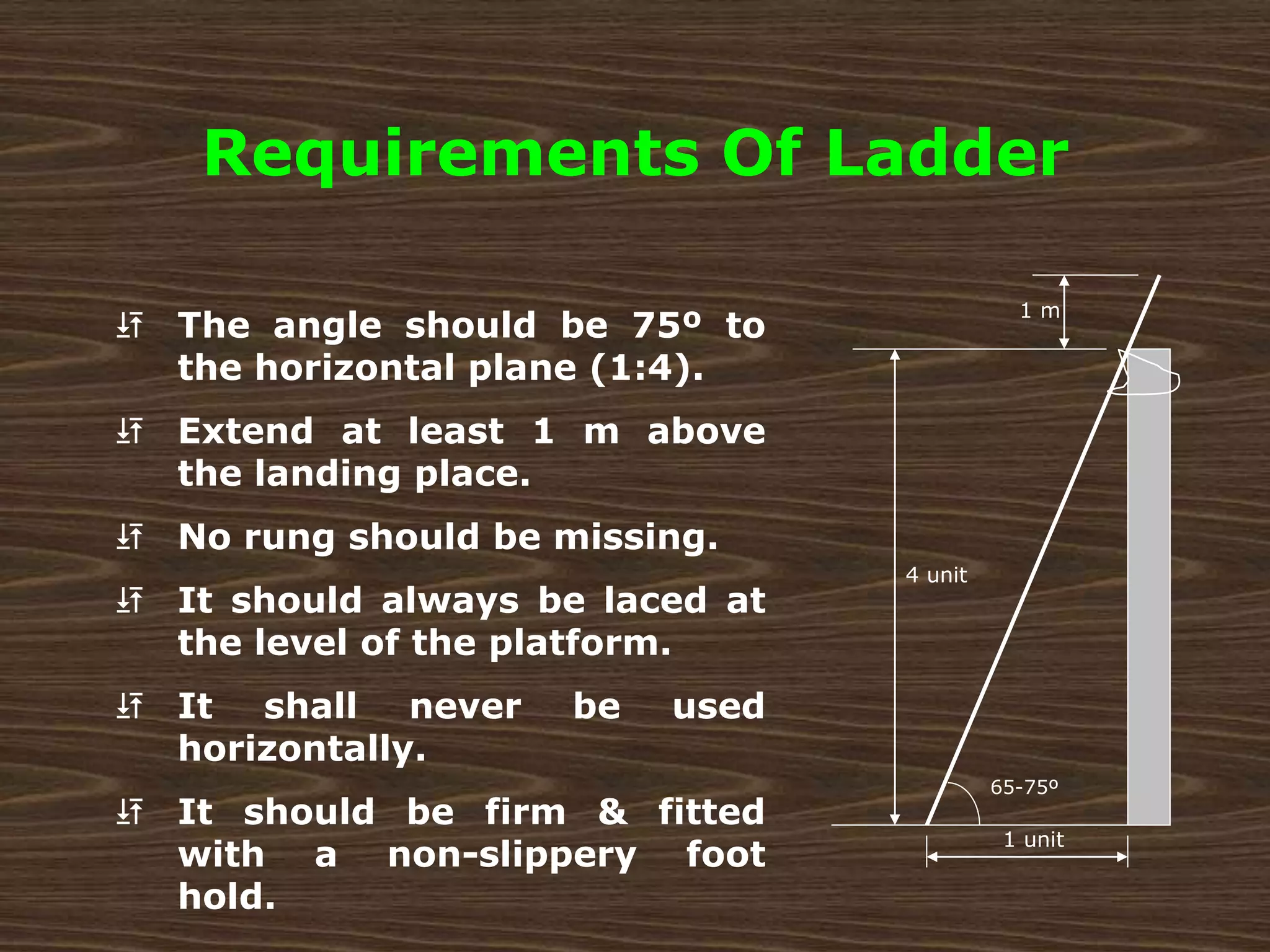
 The angle should be 75º to
the horizontal plane (1:4).
 Extend at least 1 m above
the landing place.
 No rung should be missing.
 It should always be laced at
the level of the platform.
 It shall never be used
horizontally.
 It should be firm & fitted
with a non-slippery foot
hold.
65-75º
4 unit
1 unit
1 m
Requirements Of Ladder
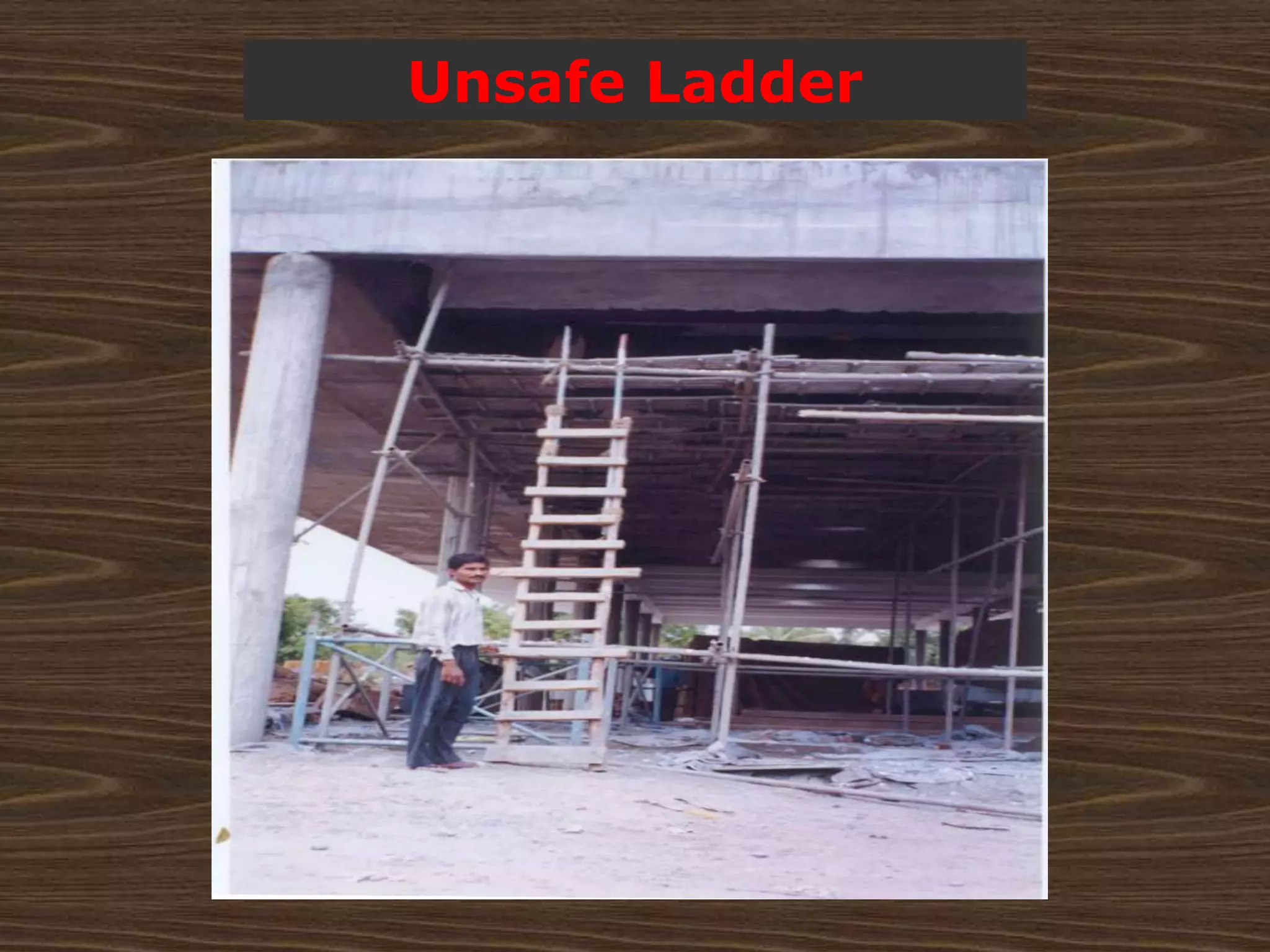
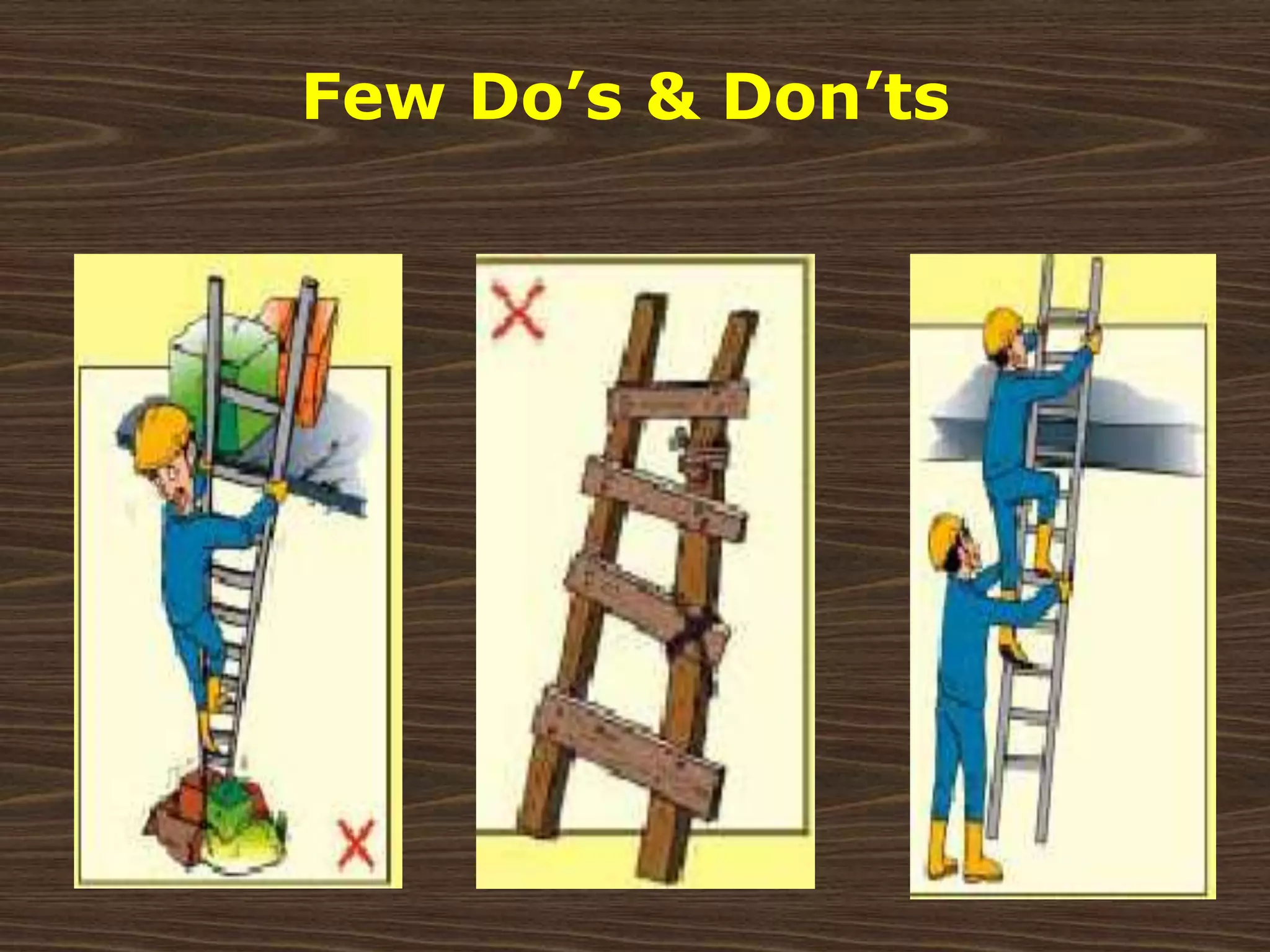
Unsafe Ladder
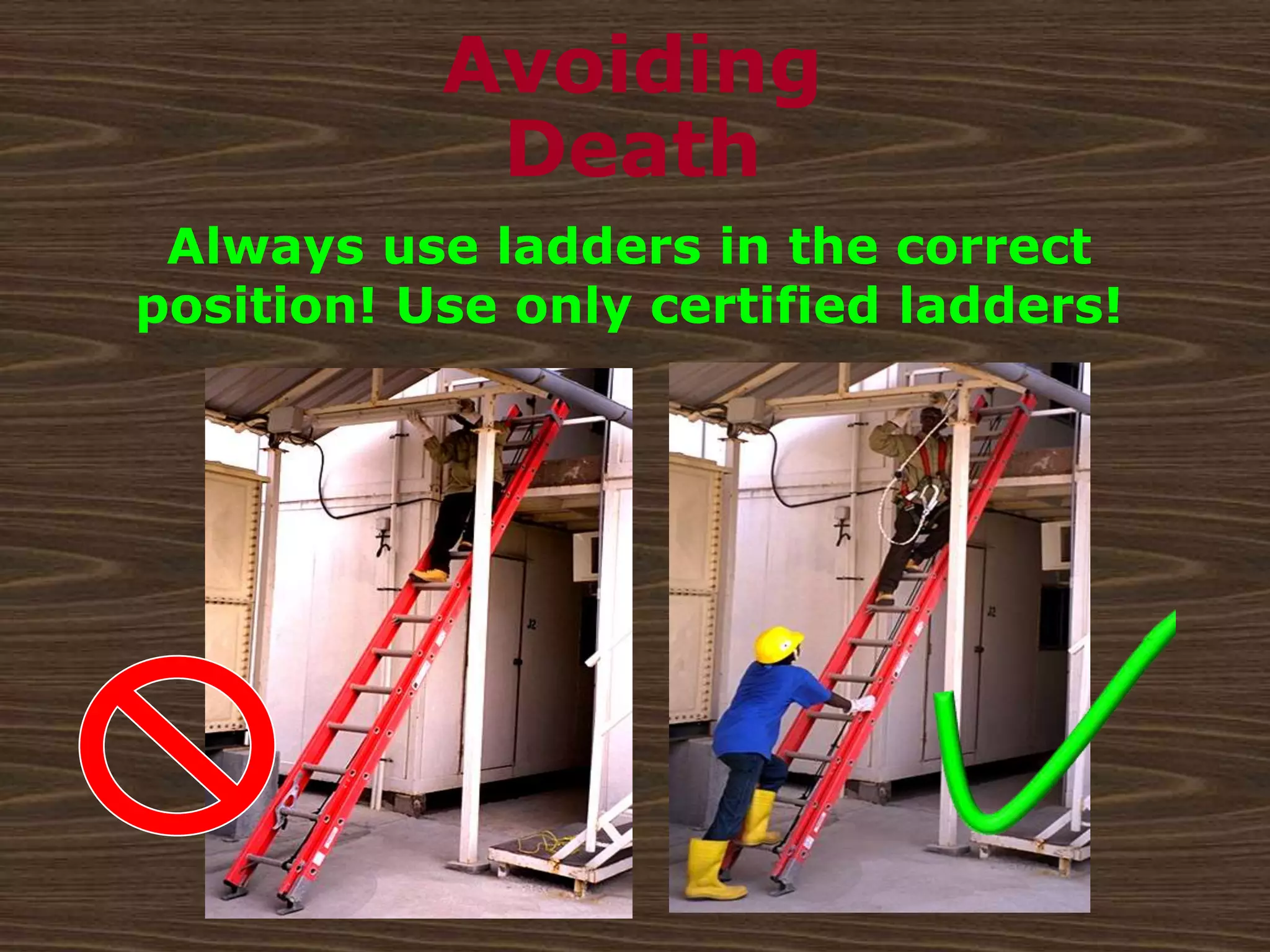
Avoiding
Death
Always use ladders in the correct
position! Use only certified ladders!
Few Do’s & Don’ts
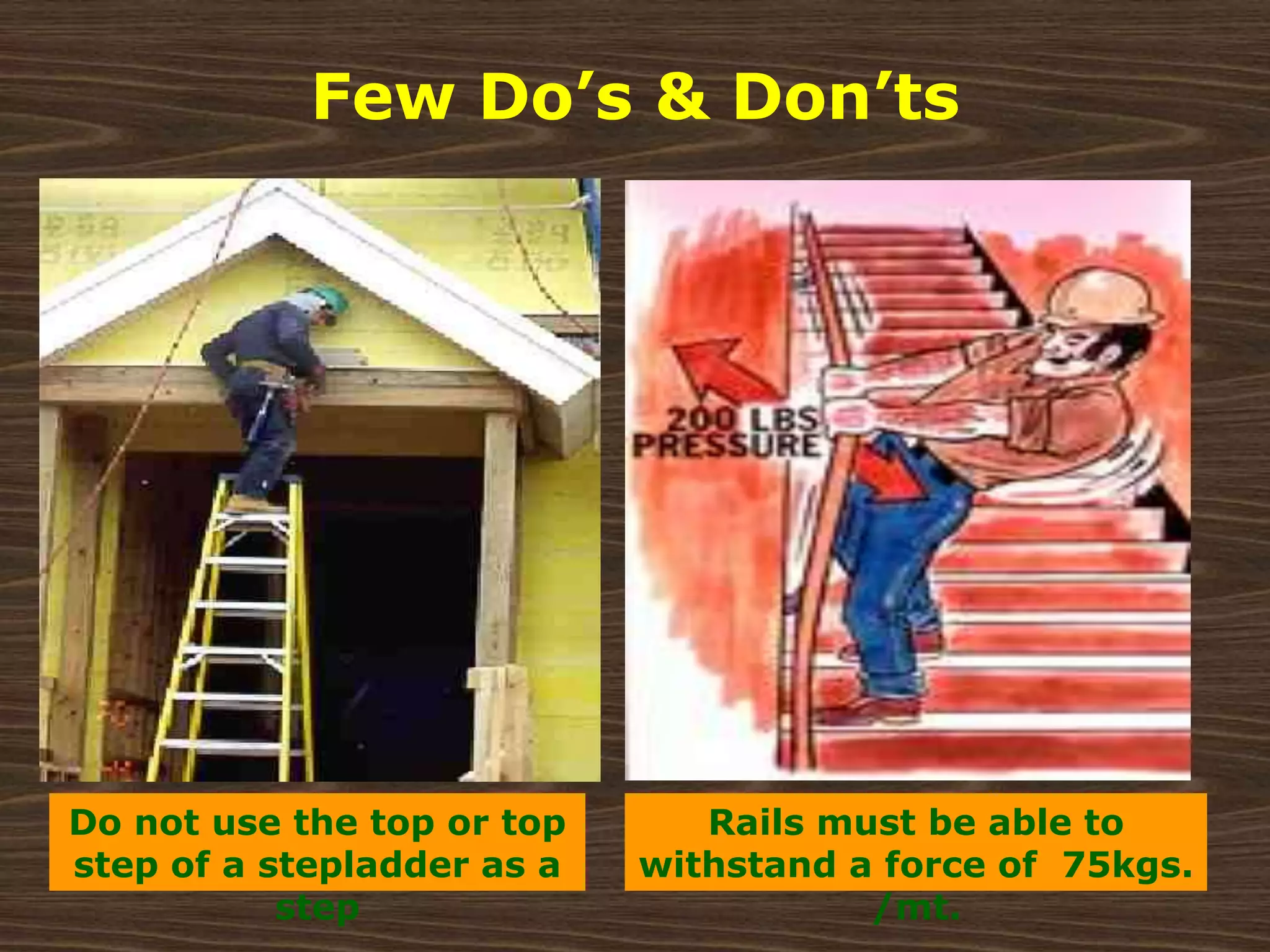
Do not use the top or top
step of a stepladder as a
step
Rails must be able to
withstand a force of 75kgs.
/mt.
Few Do’s & Don’ts
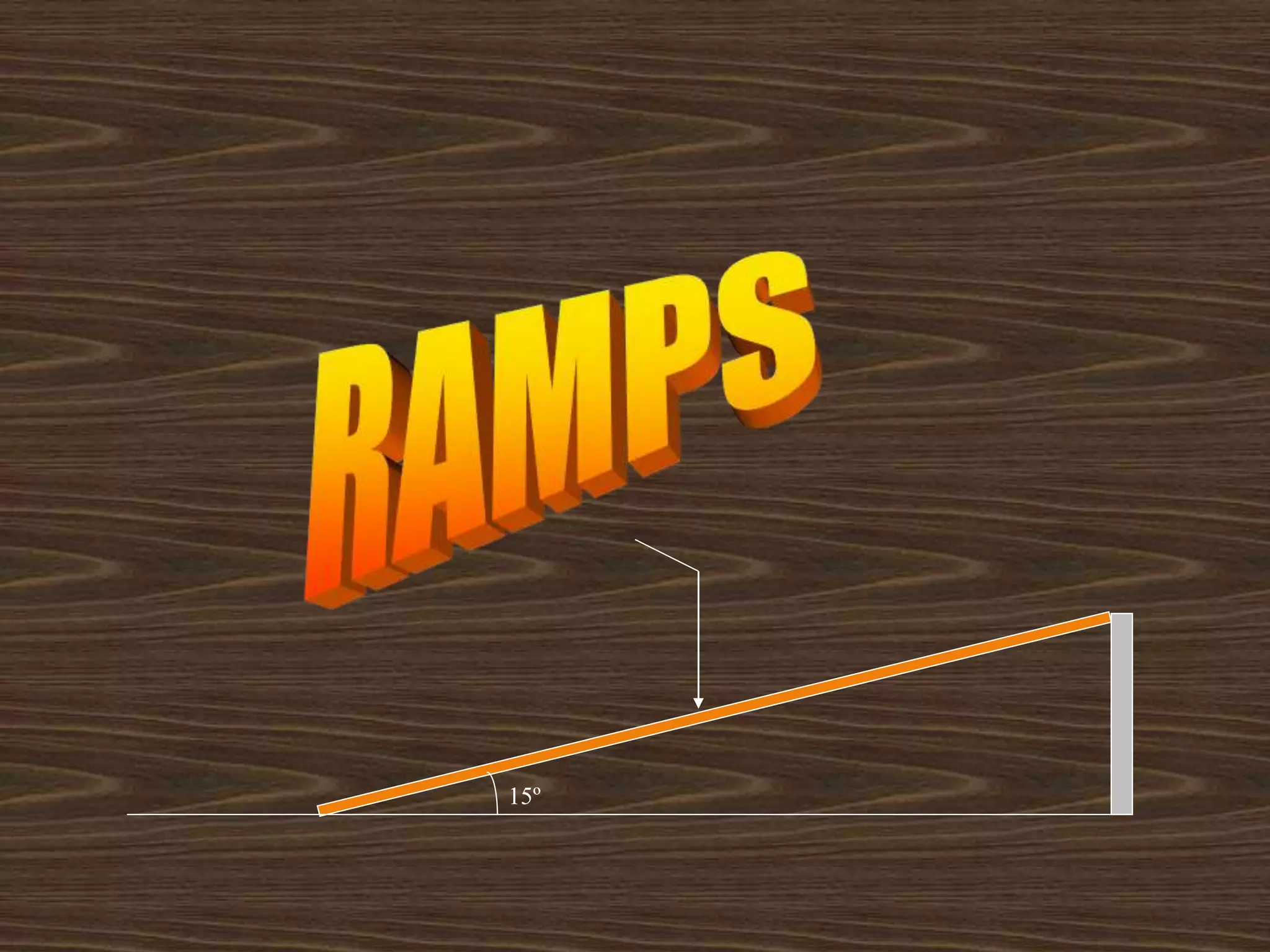
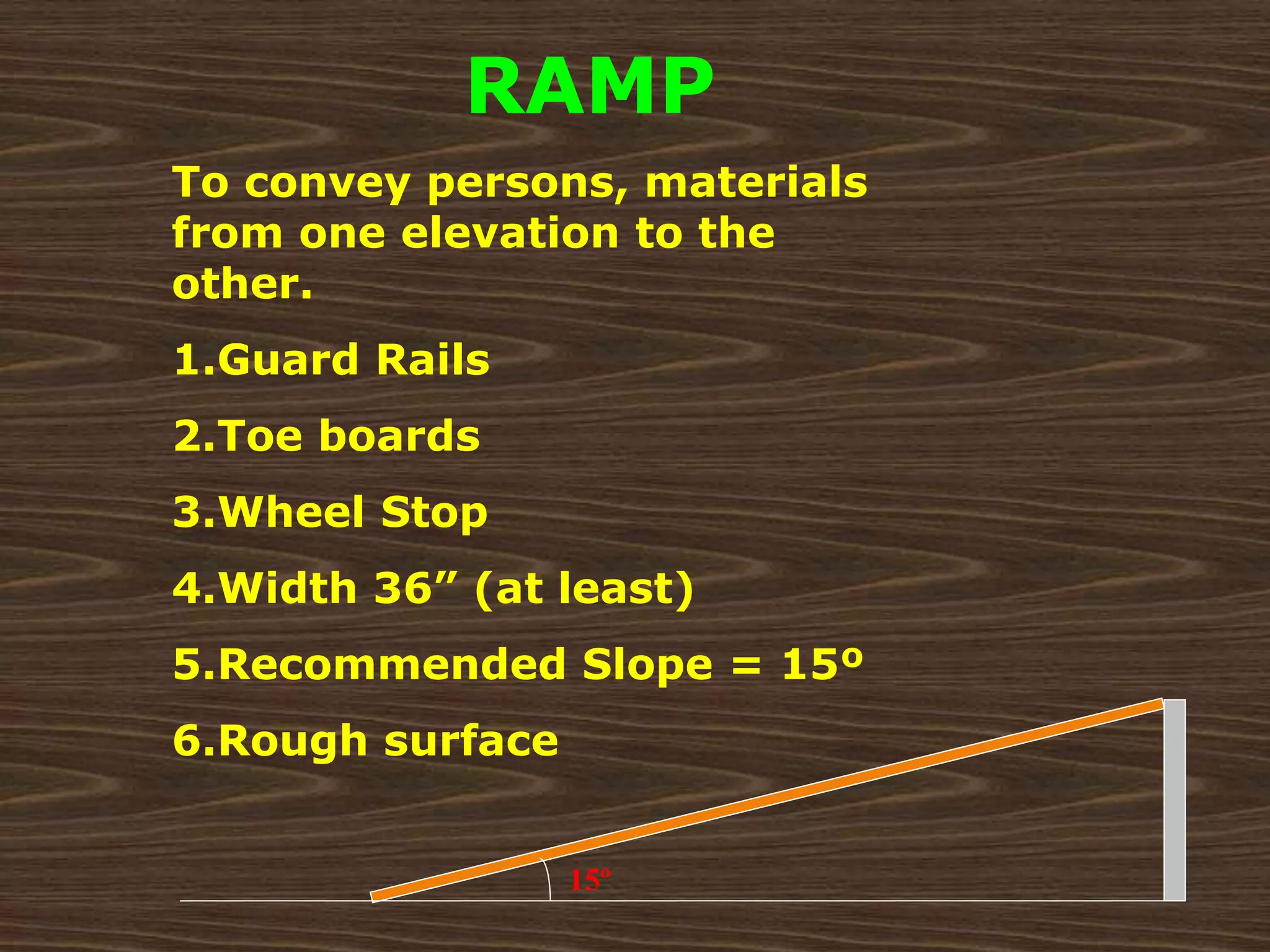
15º
15º
RAMP
To convey persons, materials
from one elevation to the
other.
1.Guard Rails
2.Toe boards
3.Wheel Stop
4.Width 36” (at least)
5.Recommended Slope = 15º
6.Rough surface
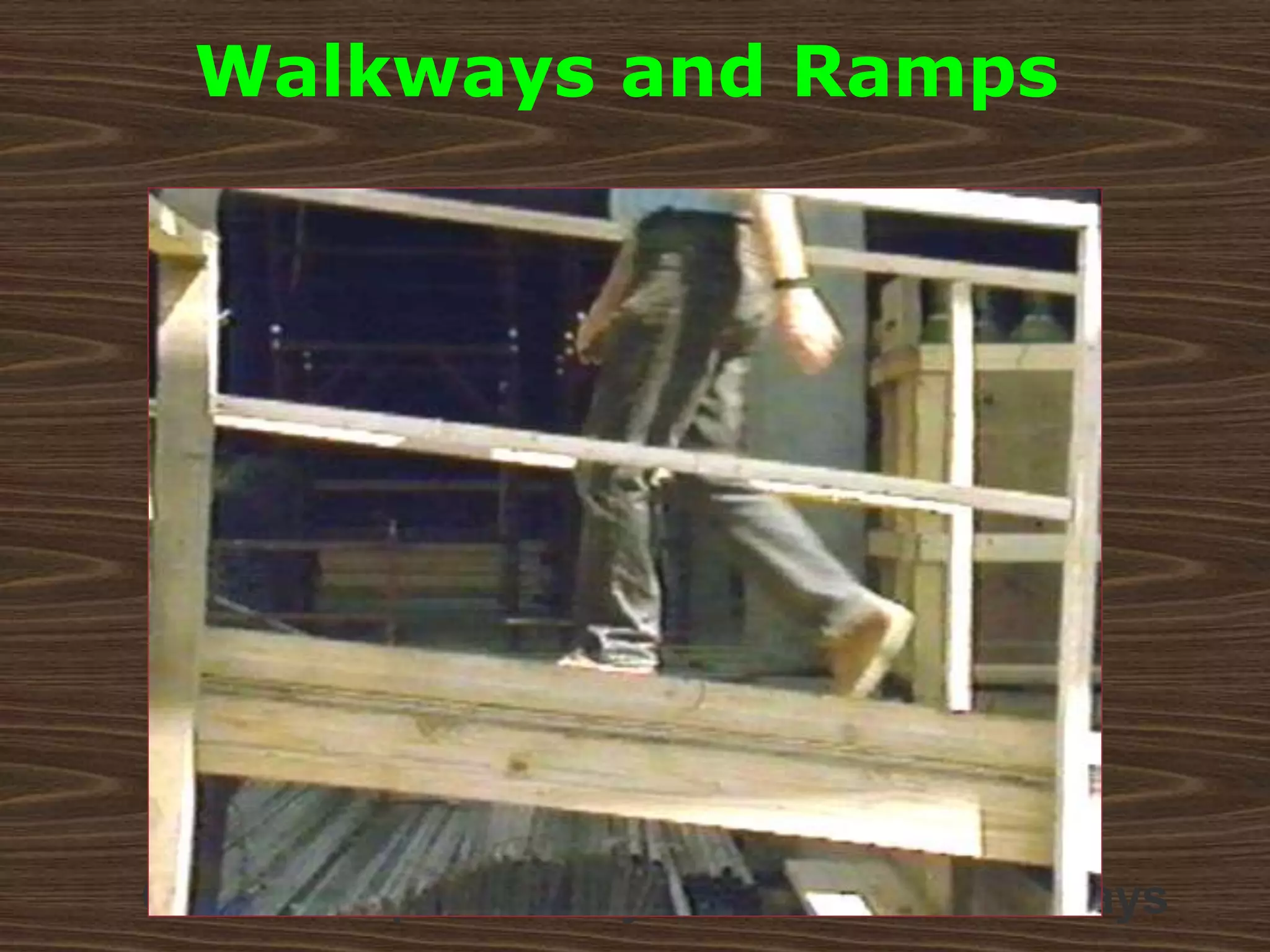
Guard ramps, runways, and other walkways
Walkways and Ramps
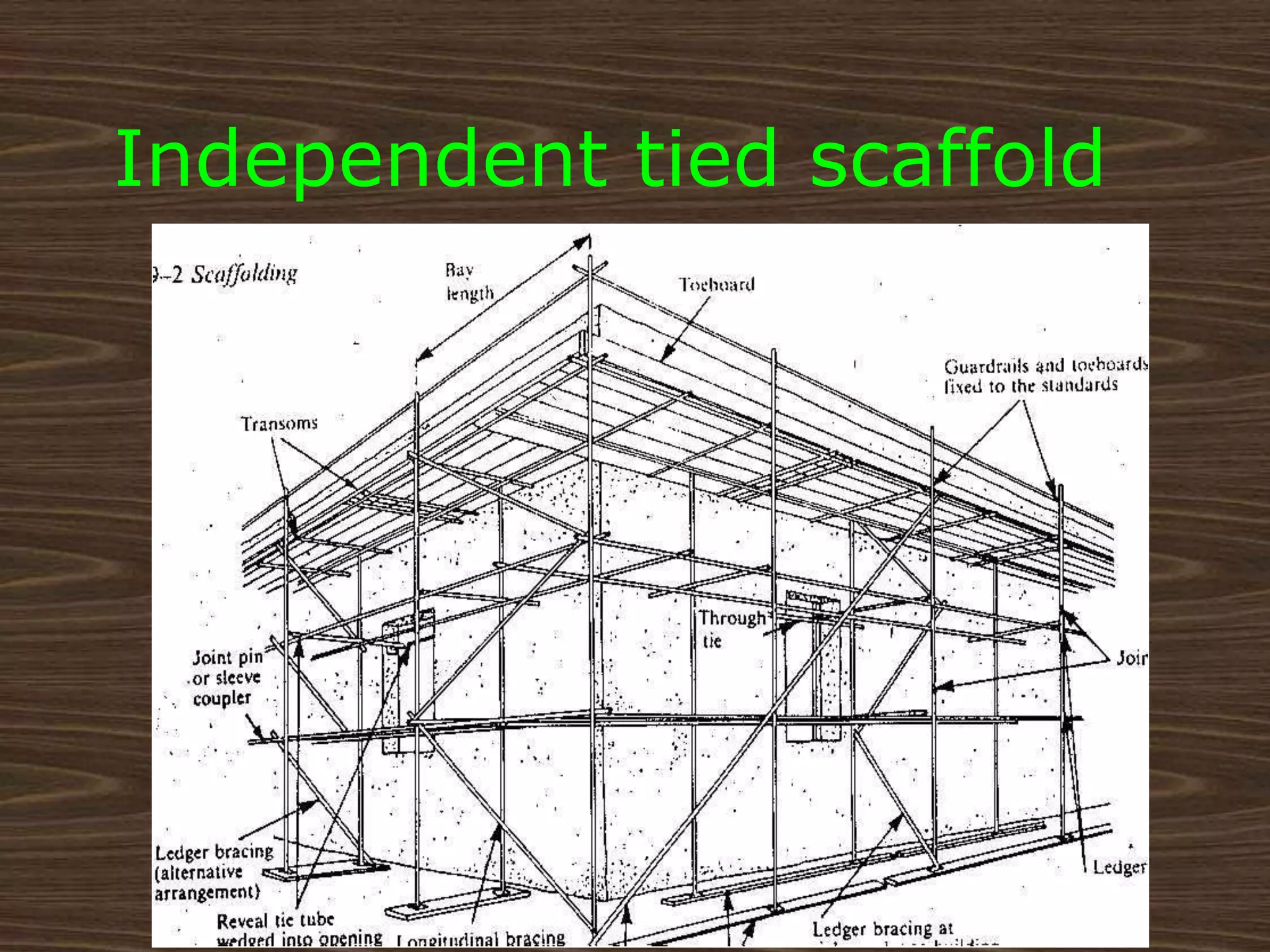
Independent tied scaffold
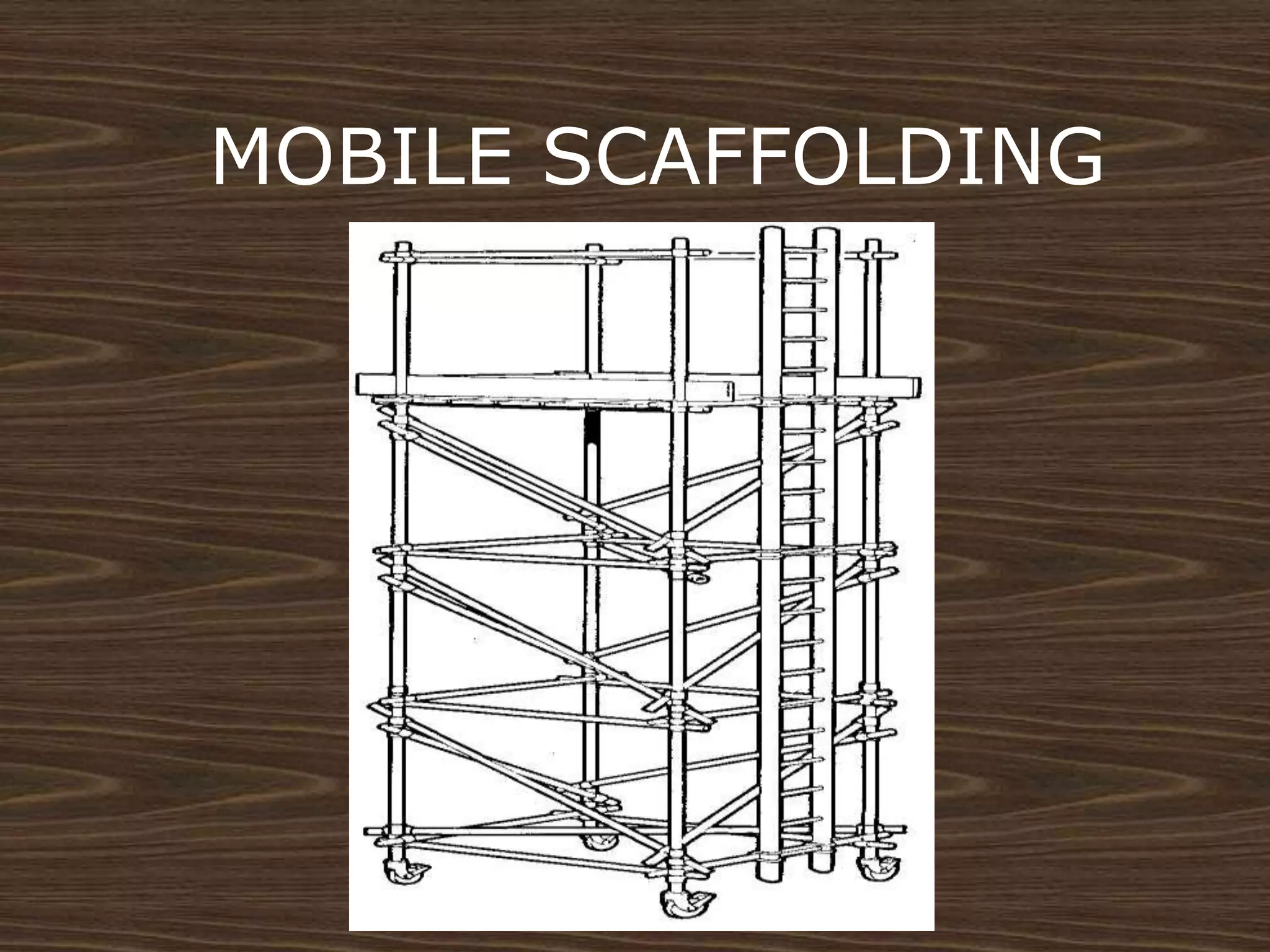
MOBILE SCAFFOLDING
Precautions to be taken:
• Surface - firm, level and compacted.
• Sole plates below the base plates.
• Sole plate - at least should extend 600 mm
beyond the vertical pipes.
• Double pin to be provided at the coupler
joints.
• Doka staging should be braced at every height
of 6 m.
• Sufficient diagonal bracing.
Safety in Scaffolding
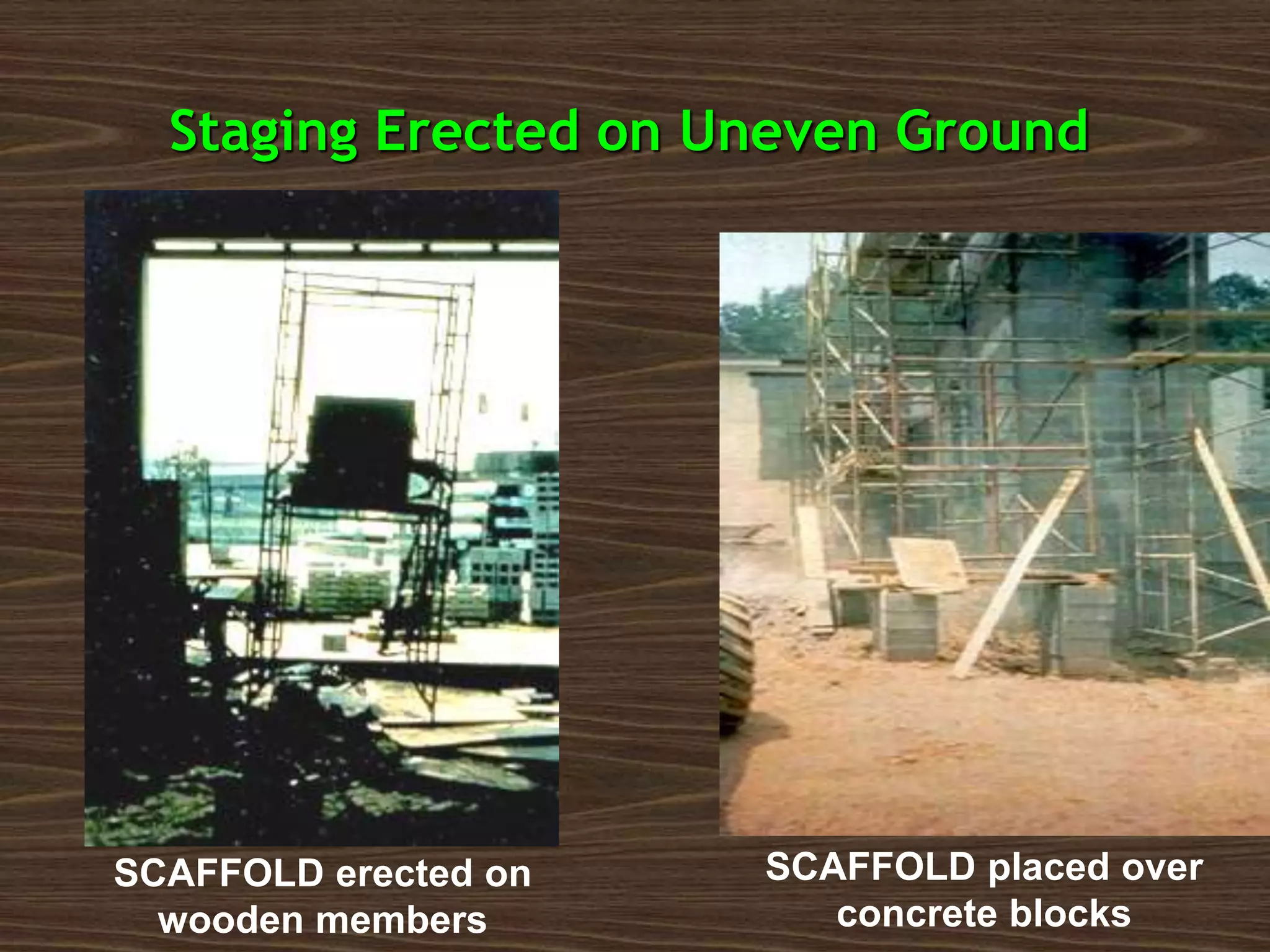
SCAFFOLD erected on
wooden members
SCAFFOLD placed over
concrete blocks
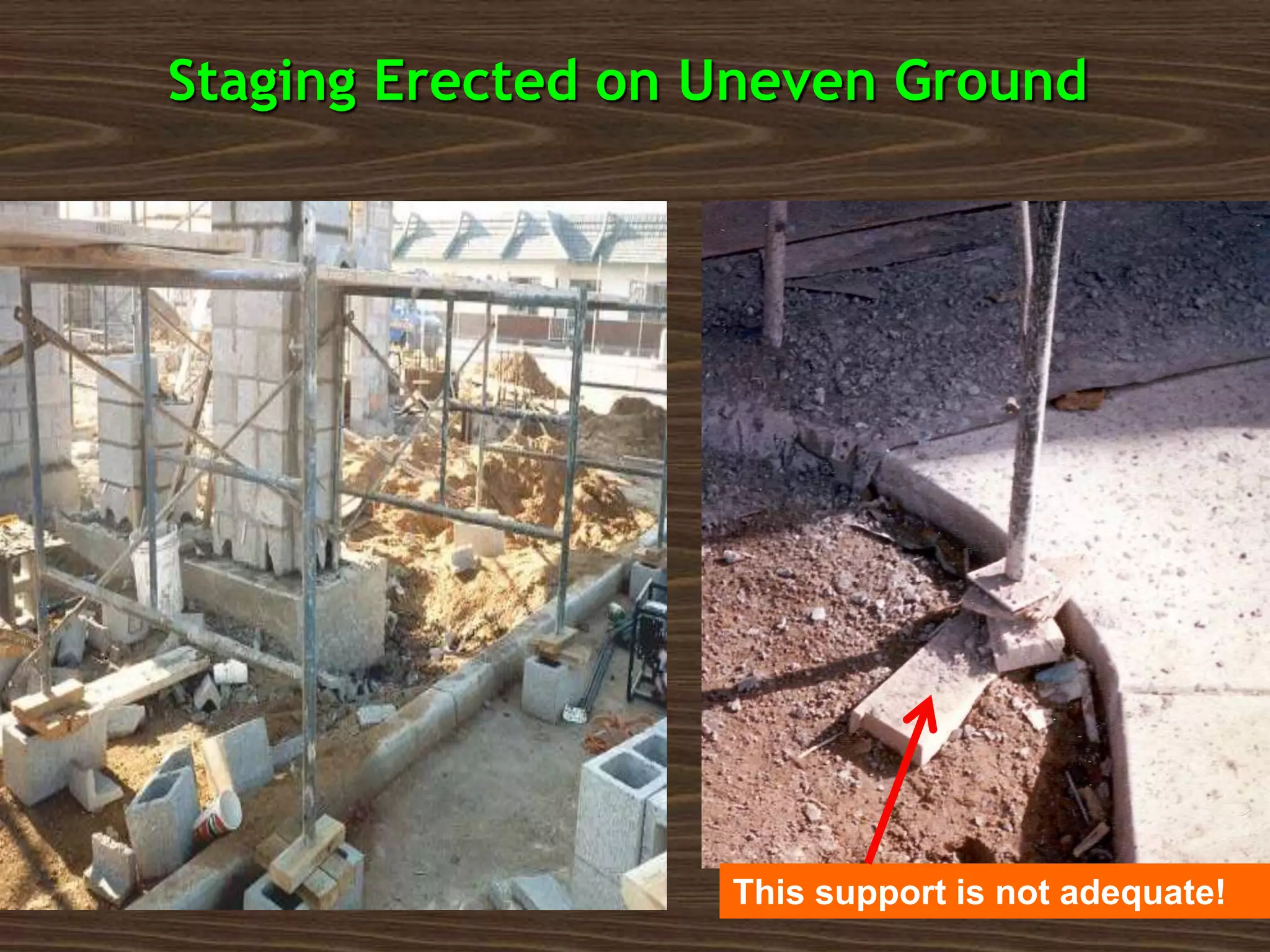
Staging Erected on Uneven Ground
This support is not adequate!
Working at the unsecured edge
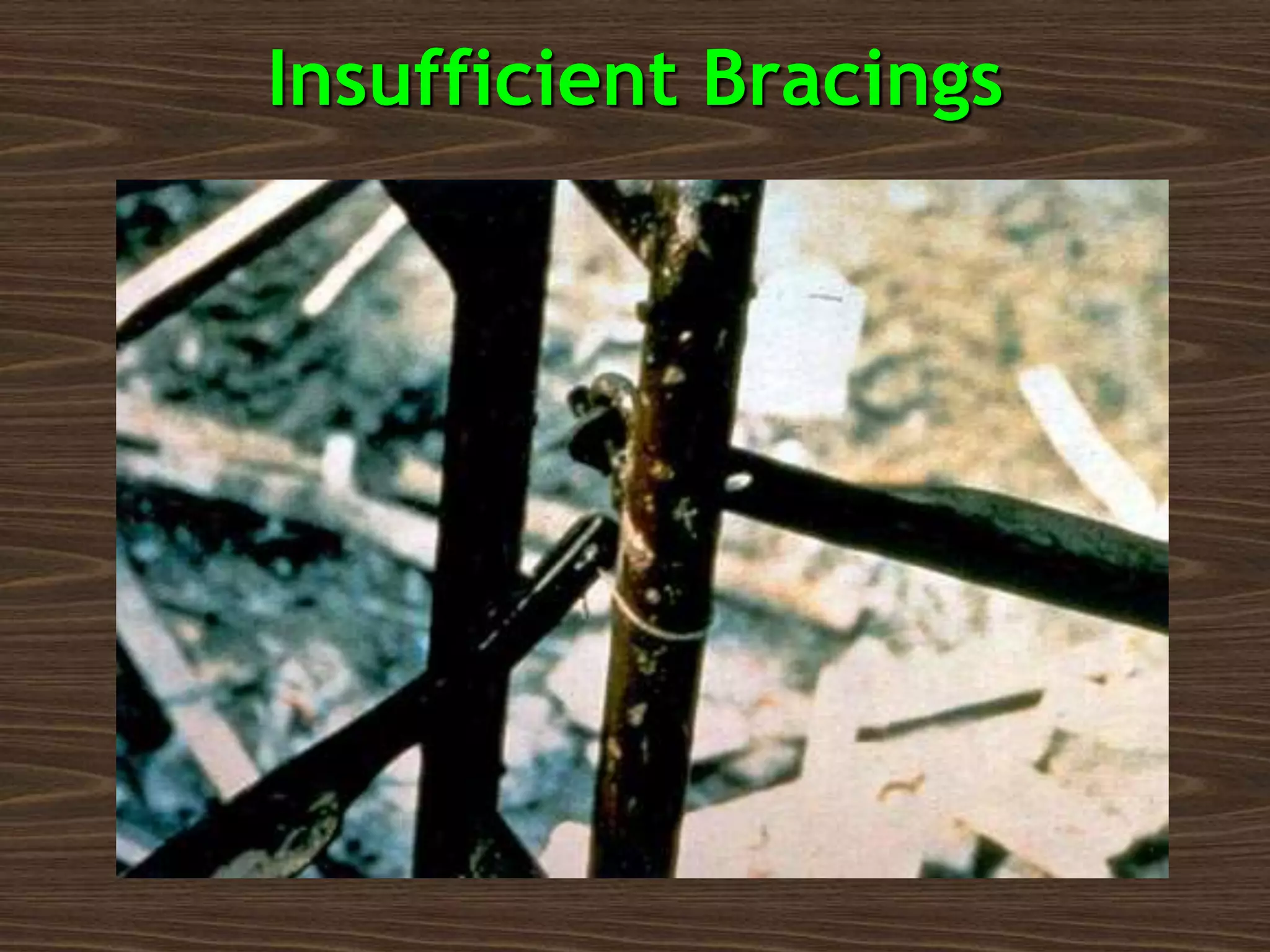
Insufficient Bracings
Damaged Scaffolding Parts
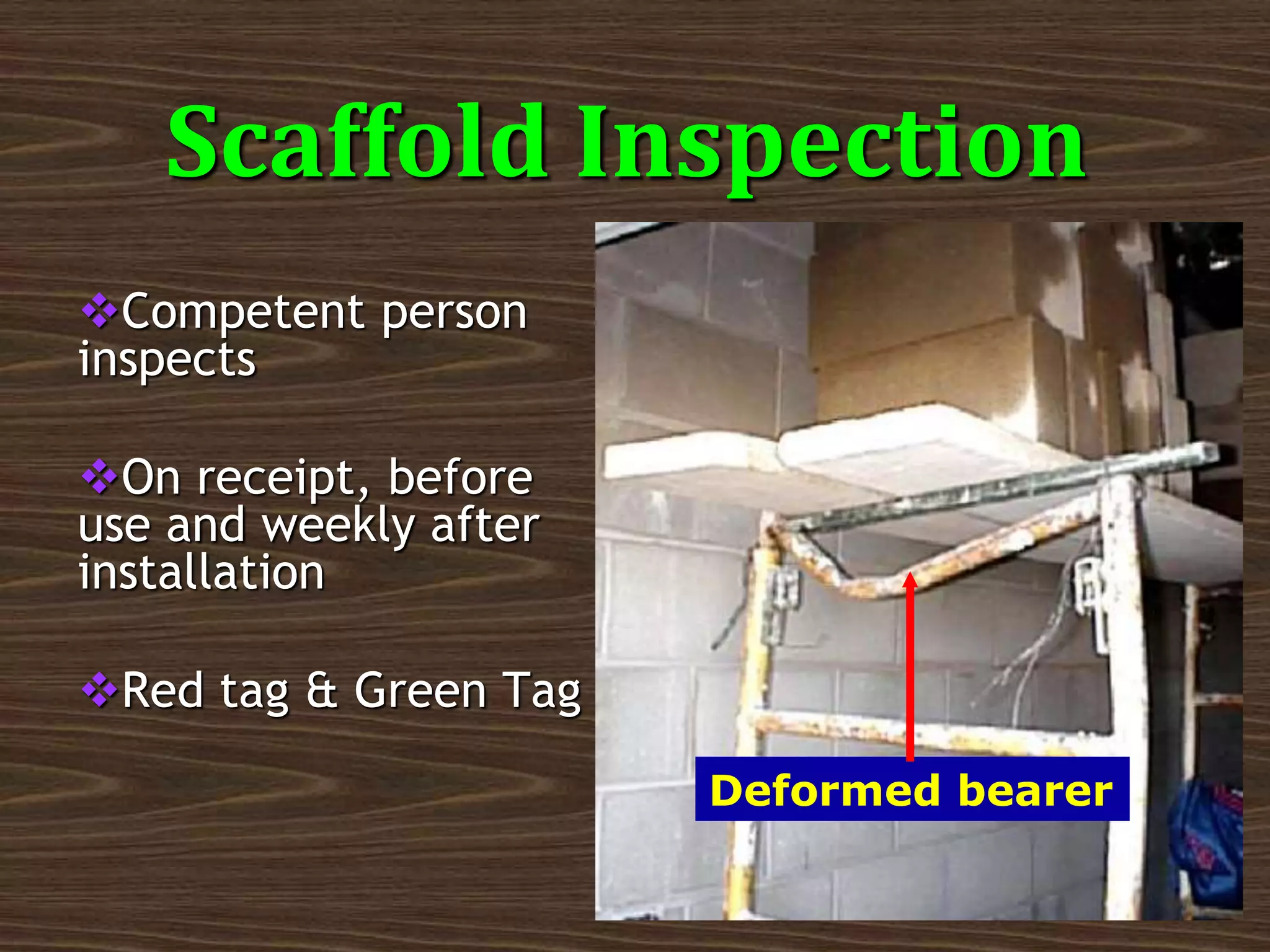
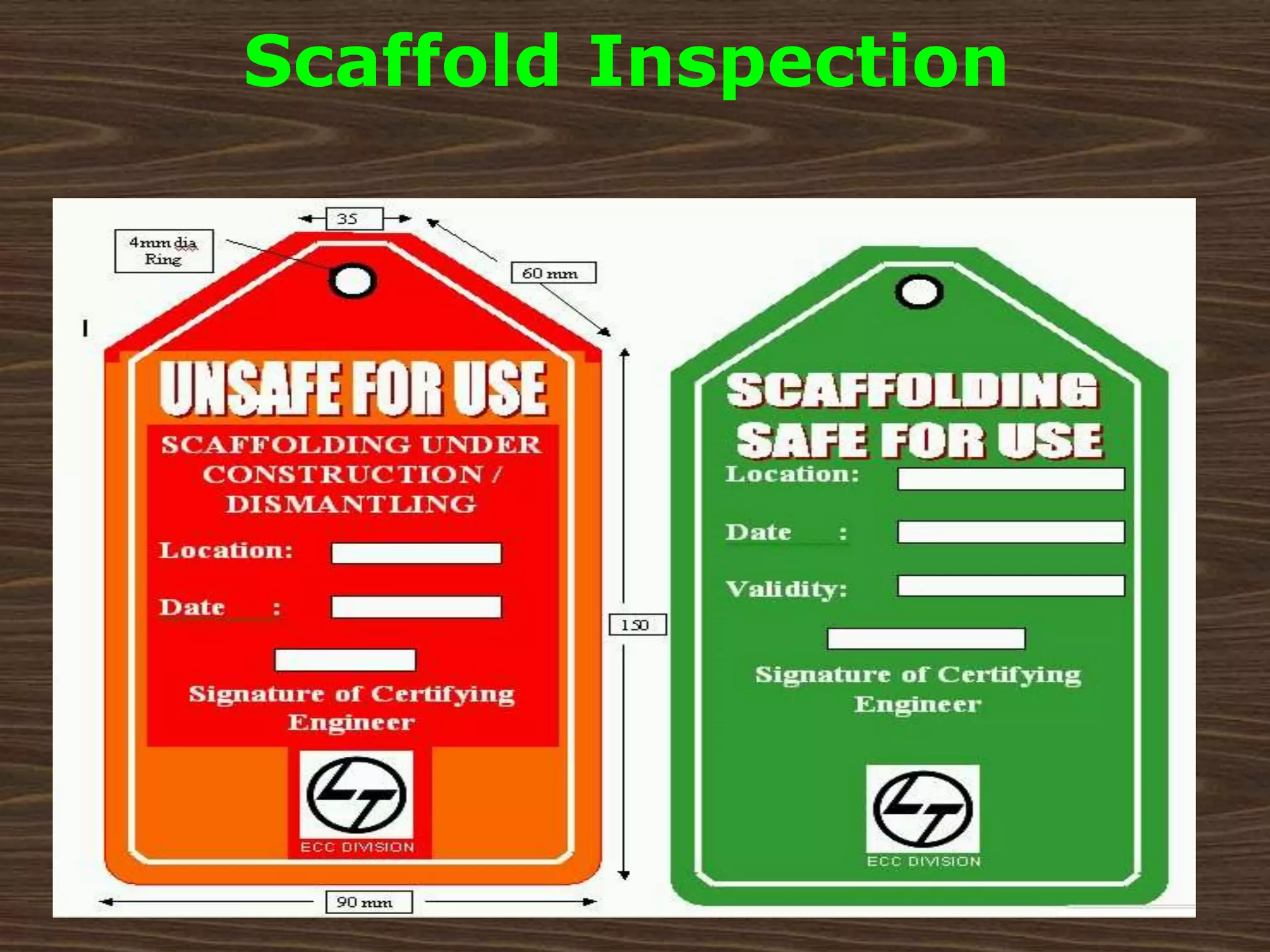
Competent person
inspects
On receipt, before
use and weekly after
installation
Red tag & Green Tag
Deformed bearer
Scaffold Inspection
Scaffold Inspection
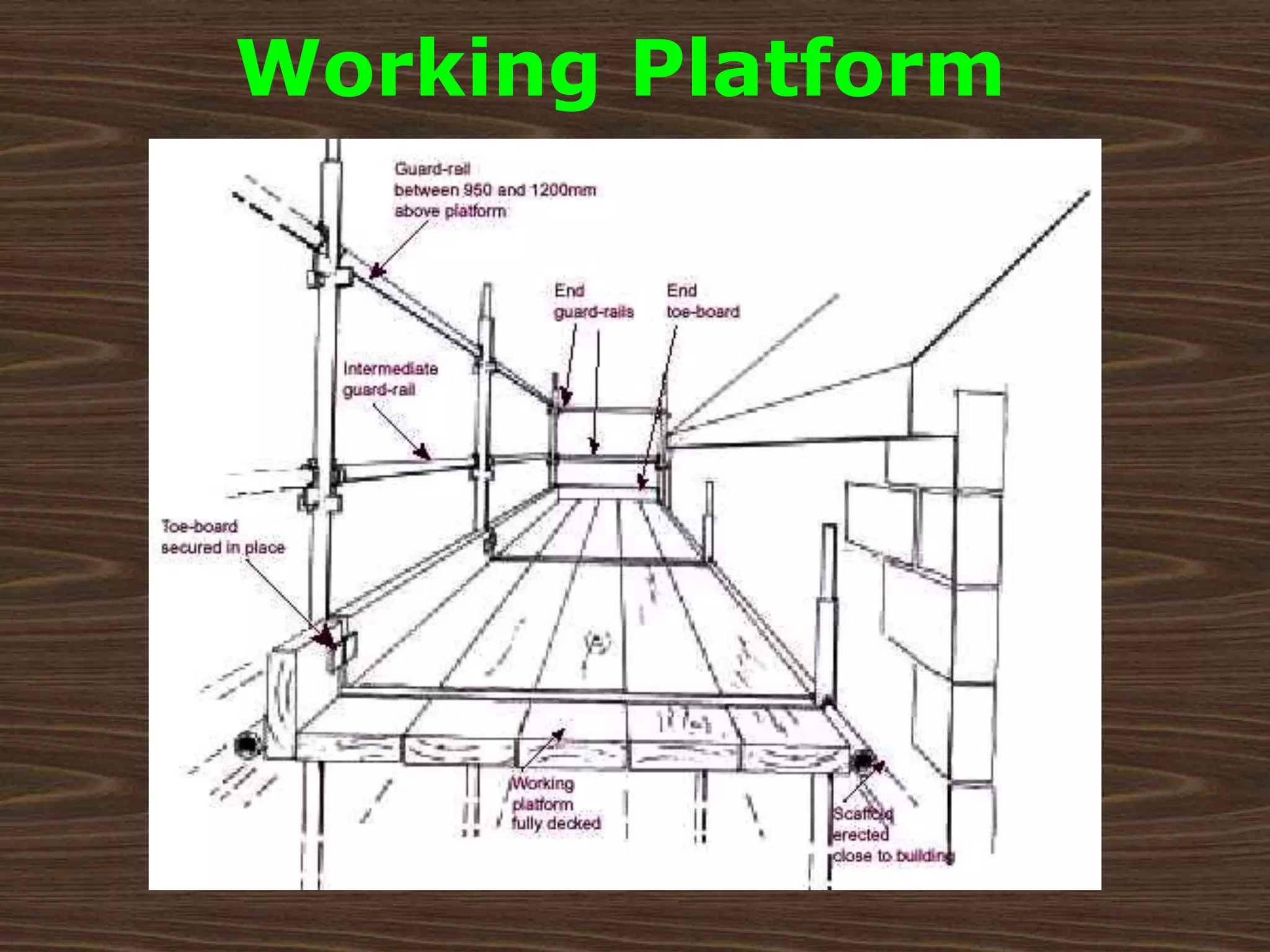
Working Platform
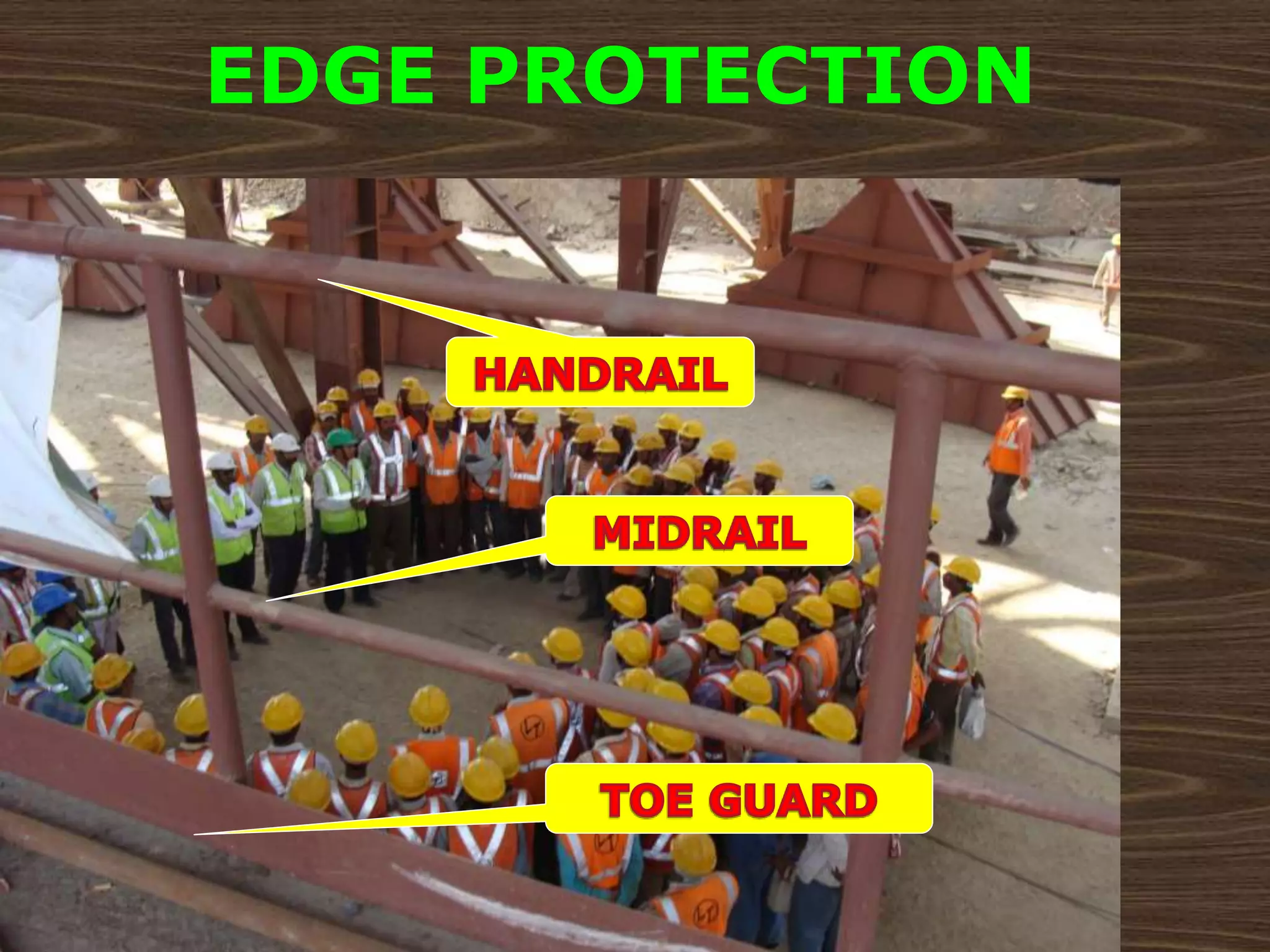
EDGE PROTECTION
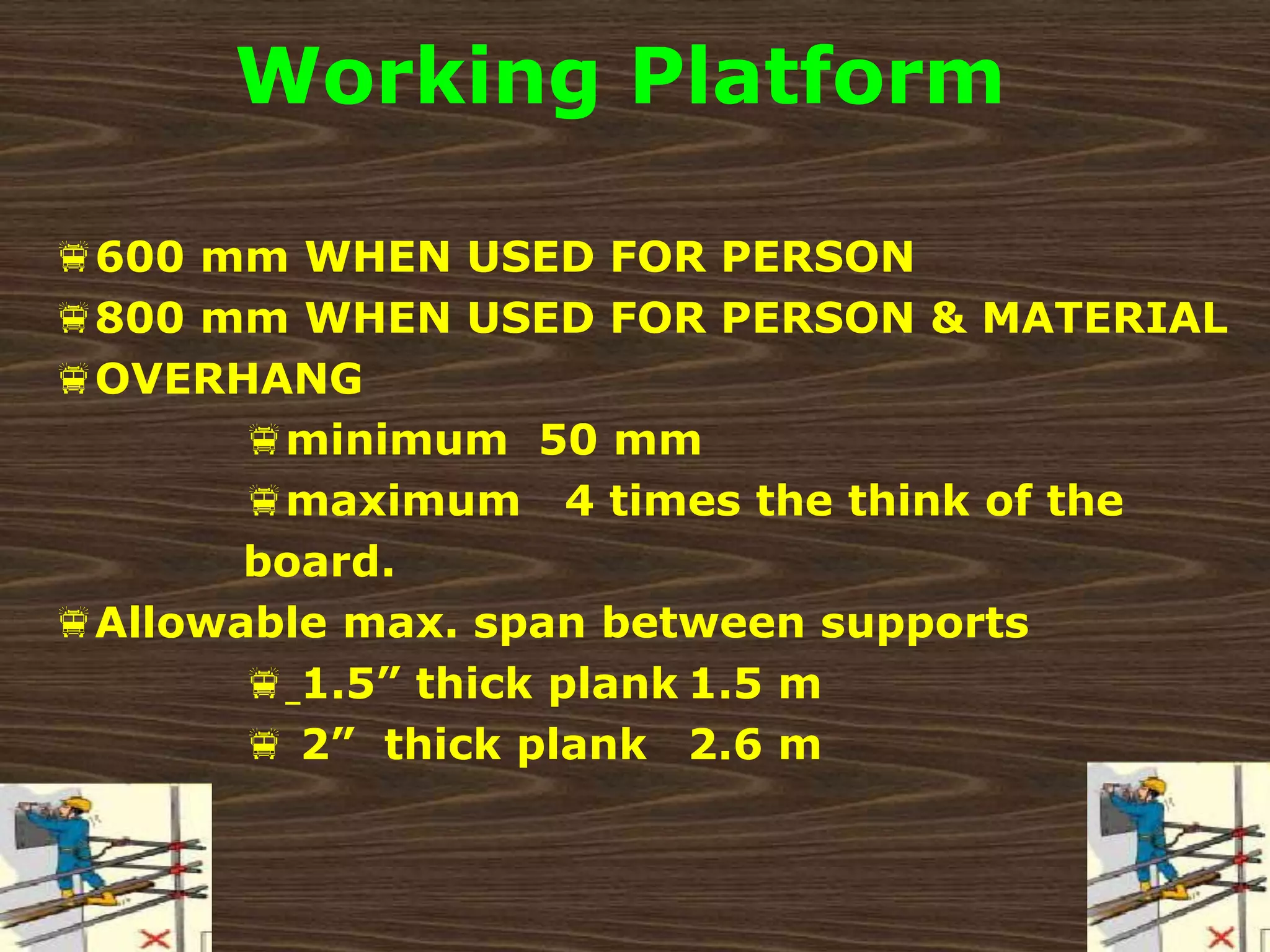
600 mm WHEN USED FOR PERSON
800 mm WHEN USED FOR PERSON & MATERIAL
OVERHANG
minimum 50 mm
maximum 4 times the think of the
board.
Allowable max. span between supports
 1.5” thick plank 1.5 m
 2” thick plank 2.6 m
Working Platform
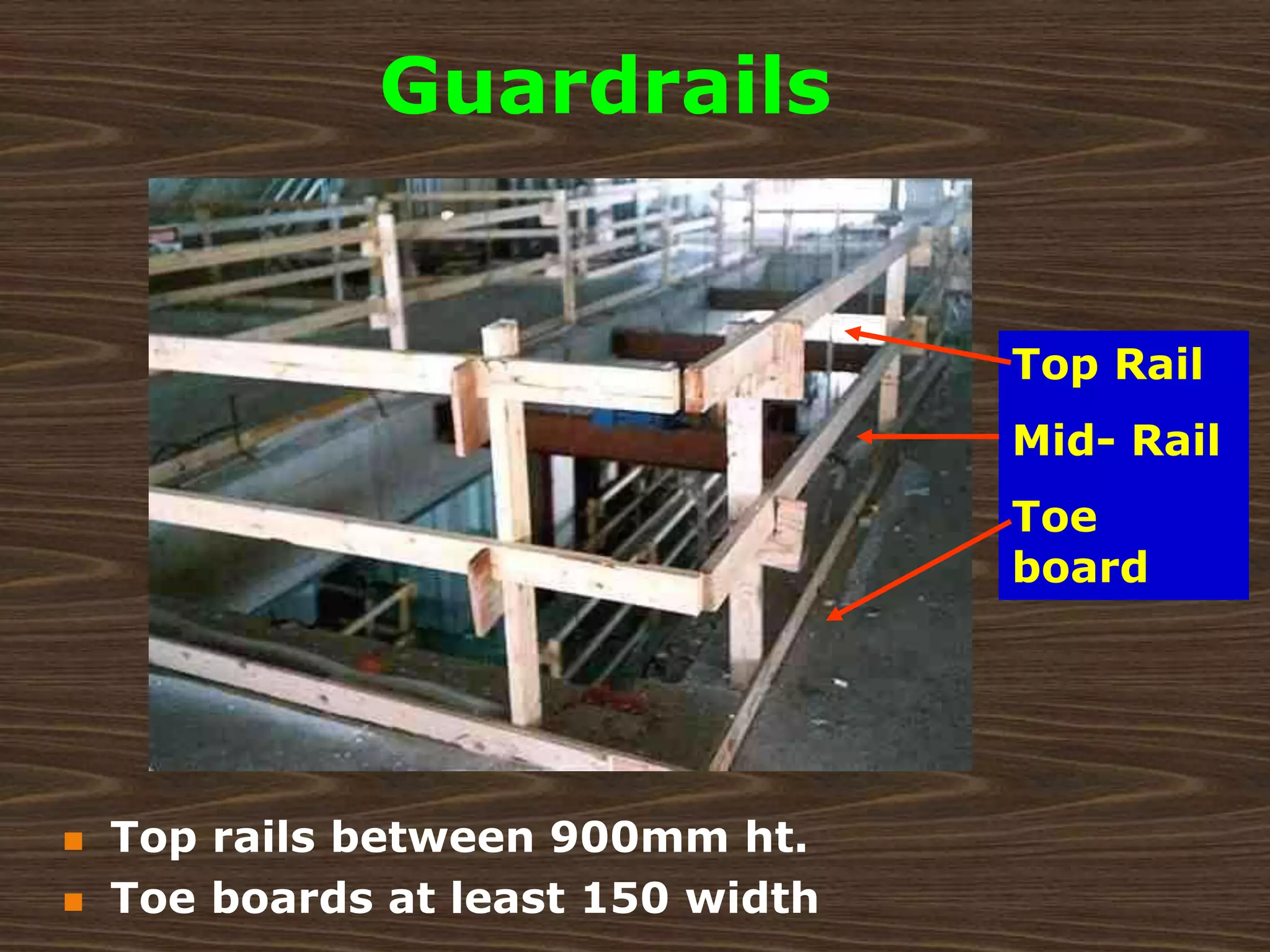
 Top rails between 900mm ht.
 Toe boards at least 150 width
Top Rail
Mid- Rail
Toe
board
Guardrails
 Covered or Guarded
 Work permit
system for
opening Man-hole
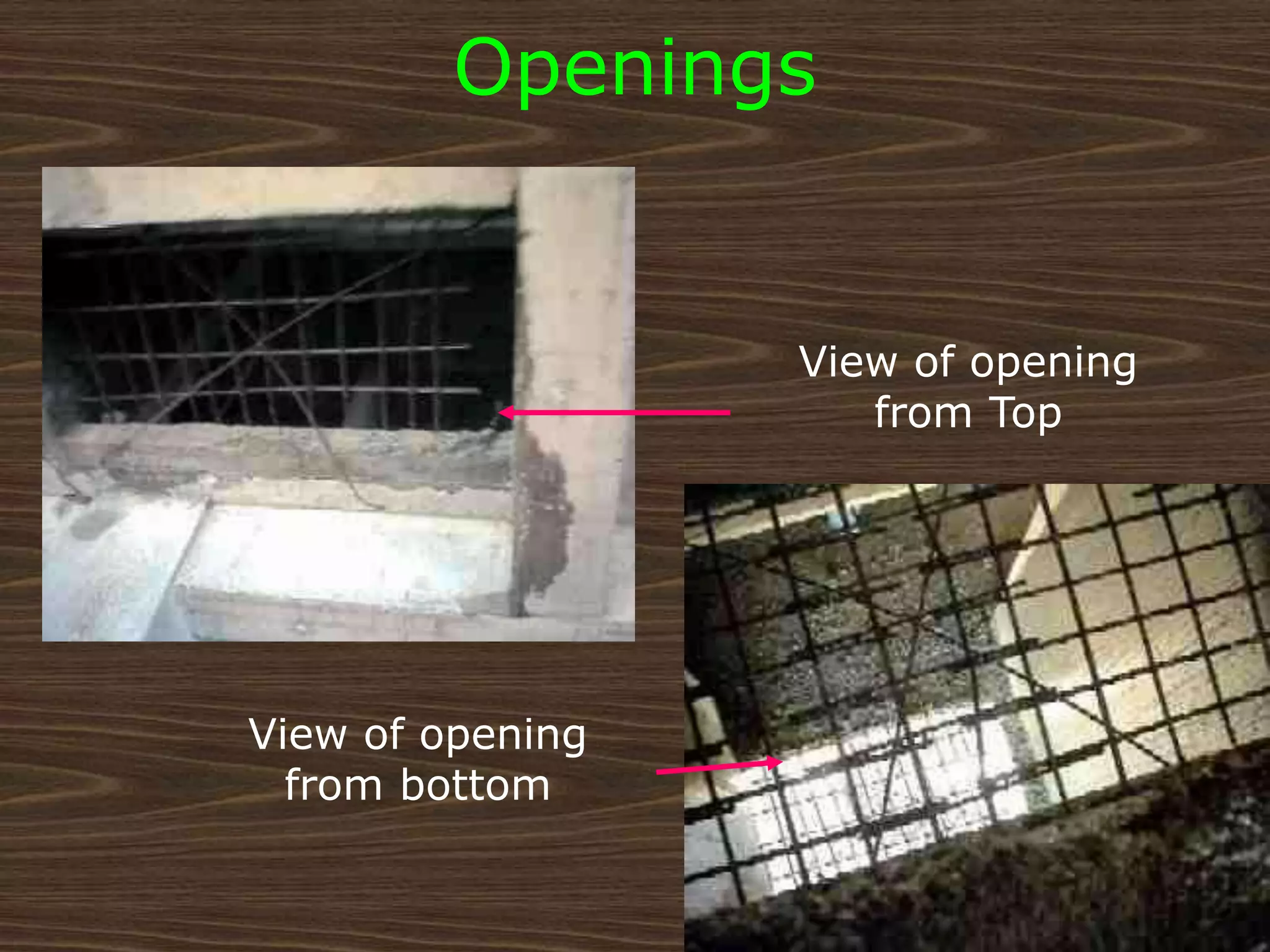
Openings
View of opening
from bottom
View of opening
from Top
Openings
Opening covered
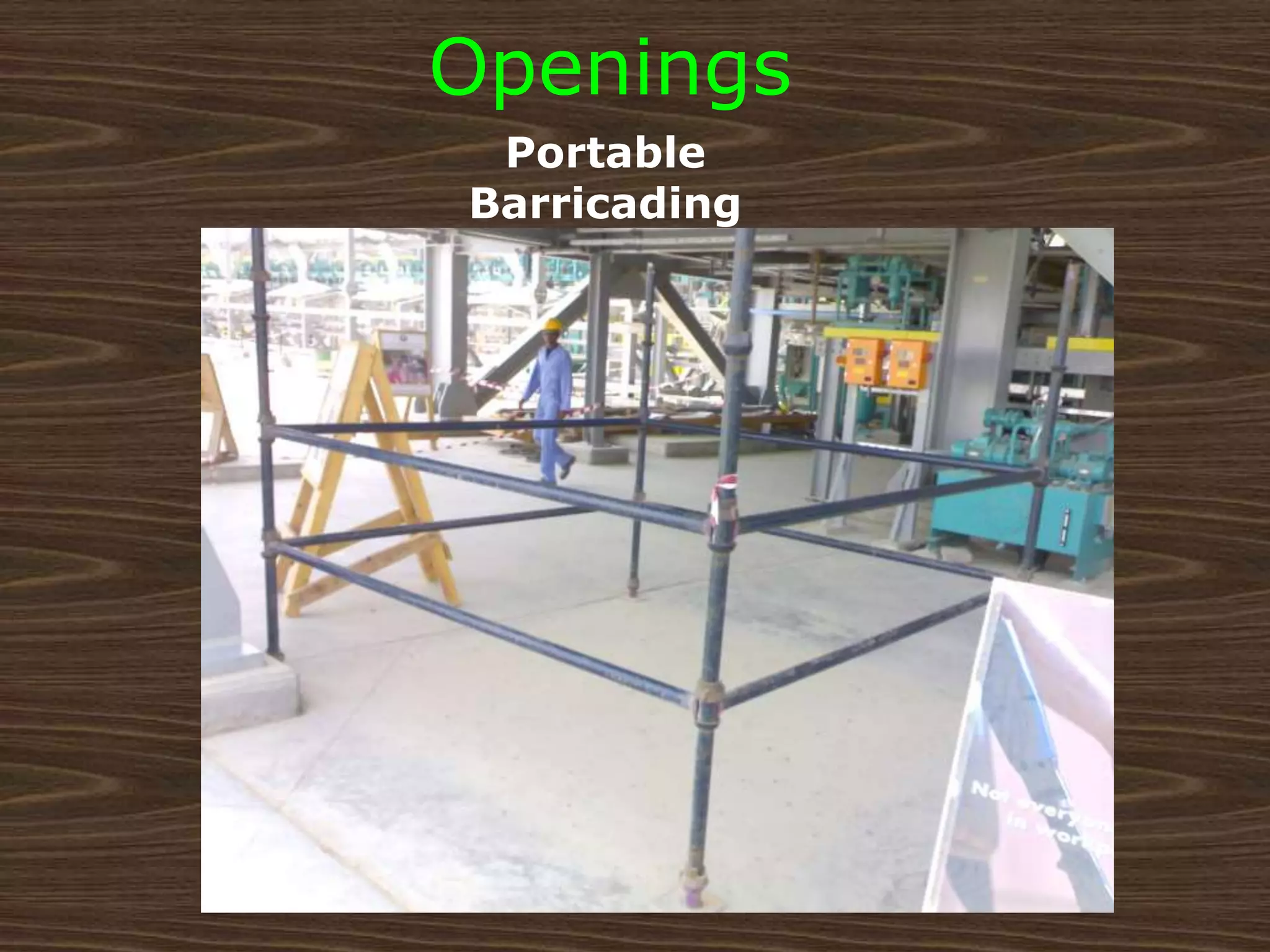
Portable
Barricading
Openings
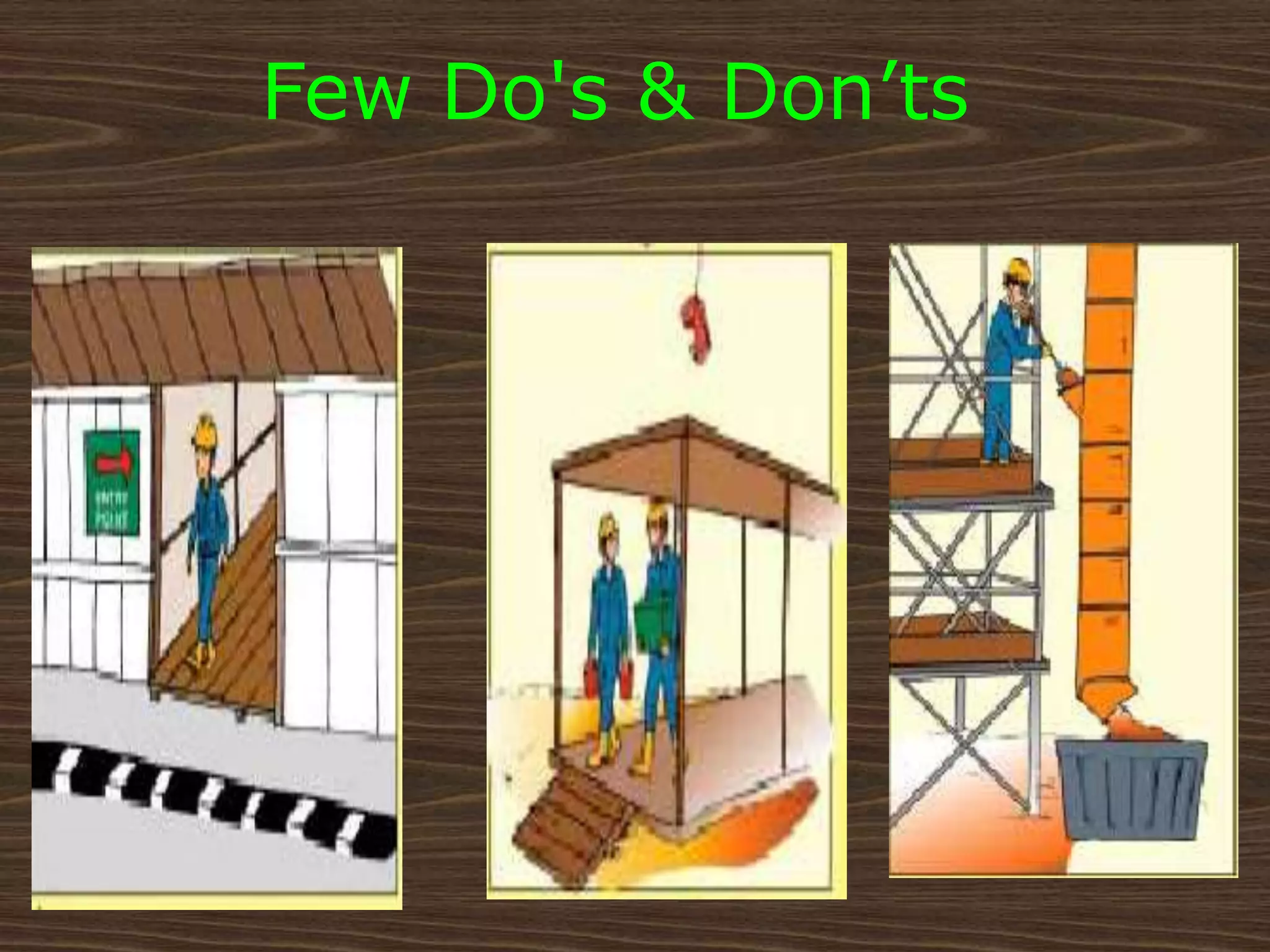
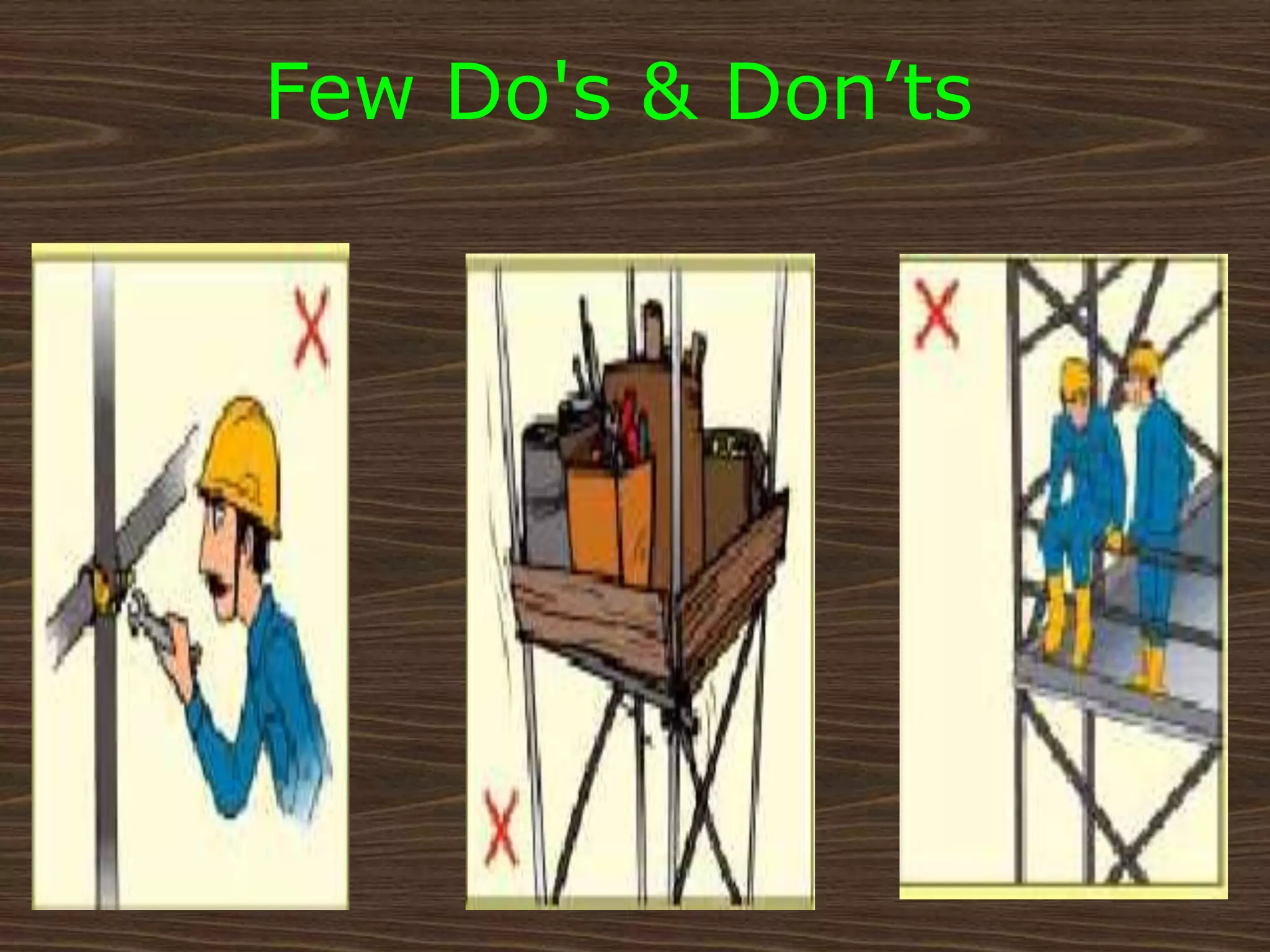
Few Do's & Don’ts
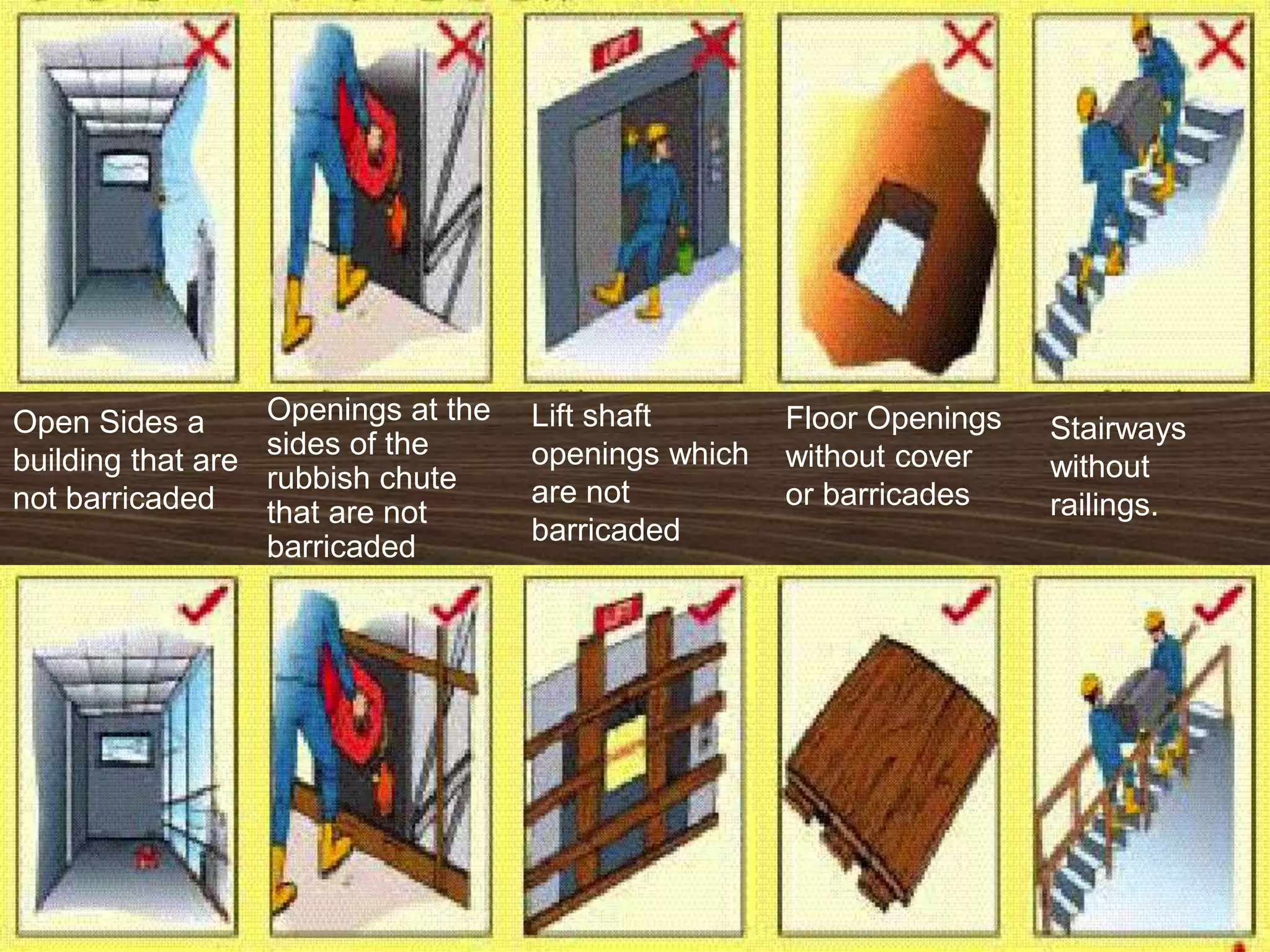
Open Sides a
building that are
not barricaded
Openings at the
sides of the
rubbish chute
that are not
barricaded
Lift shaft
openings which
are not
barricaded
Floor Openings
without cover
or barricades
Stairways
without
railings.
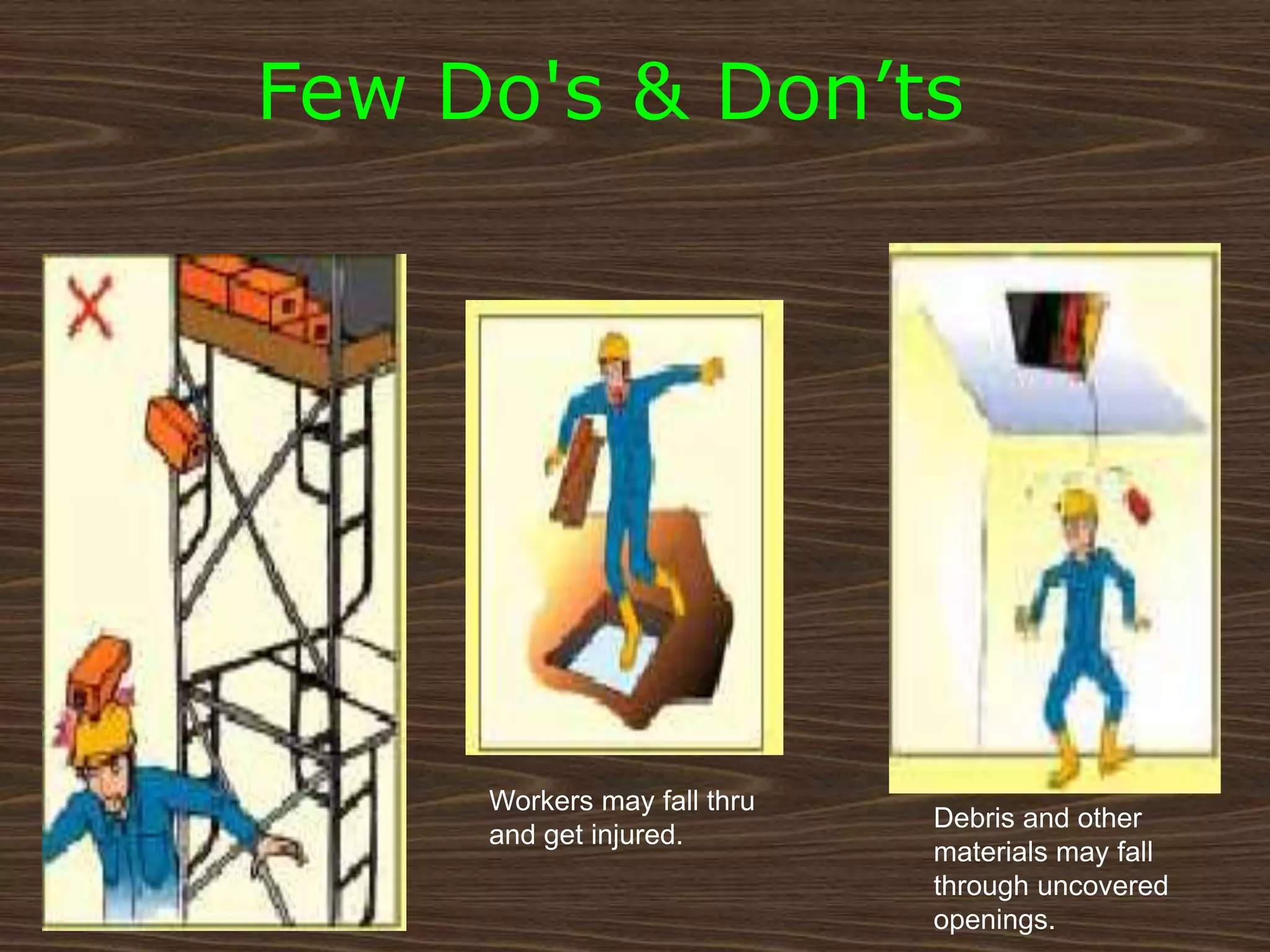
Debris and other
materials may fall
through uncovered
openings.
Workers may fall thru
and get injured.
Few Do's & Don’ts
Few Do's & Don’ts
Few Do's & Don’ts
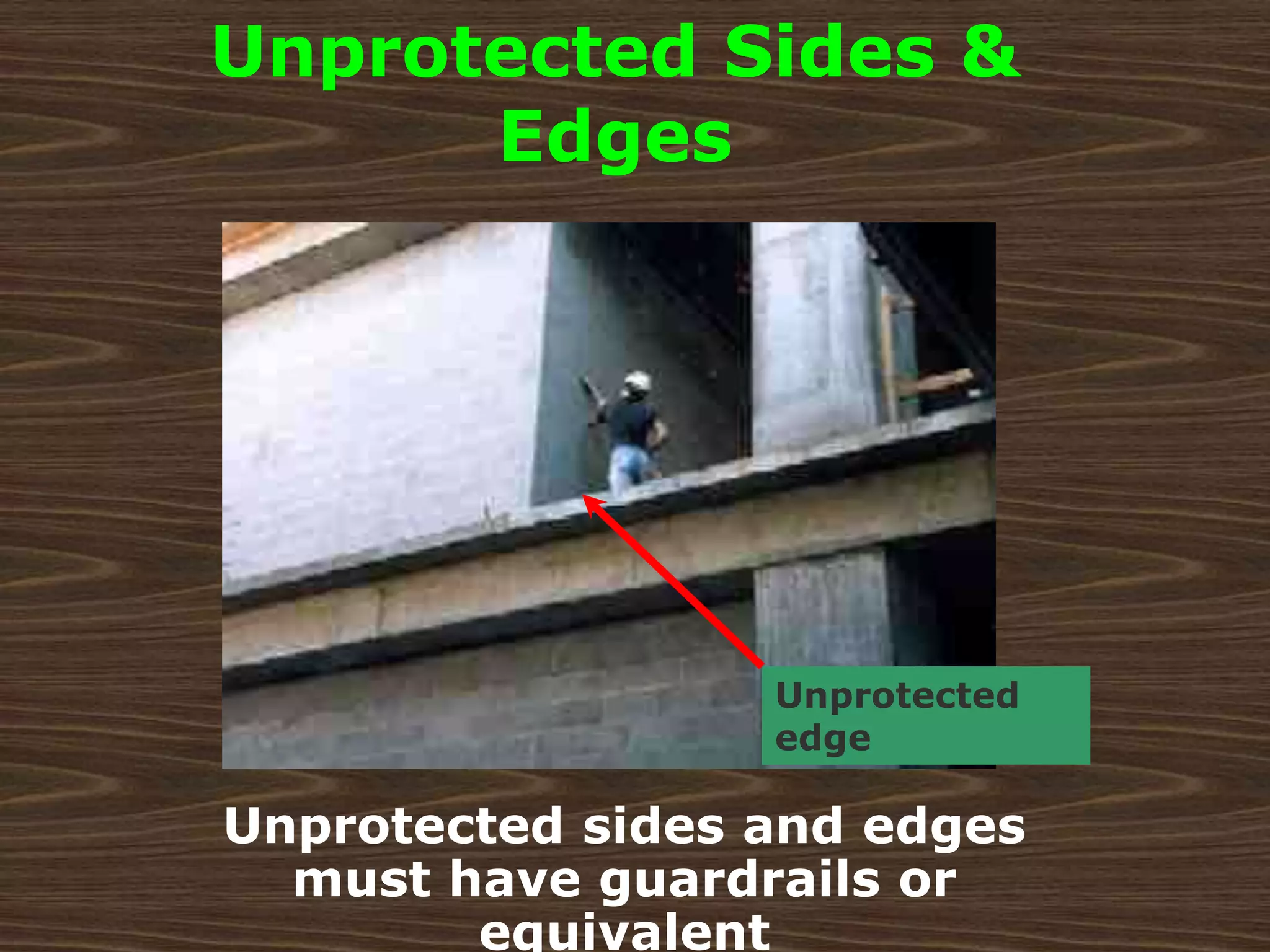
Unprotected
edge
Unprotected Sides &
Edges
Unprotected sides and edges
must have guardrails or
equivalent
Sides & Edges - Improper
Guarding
This 1/4" nylon rope alone is not a
proper way to guard this open floor
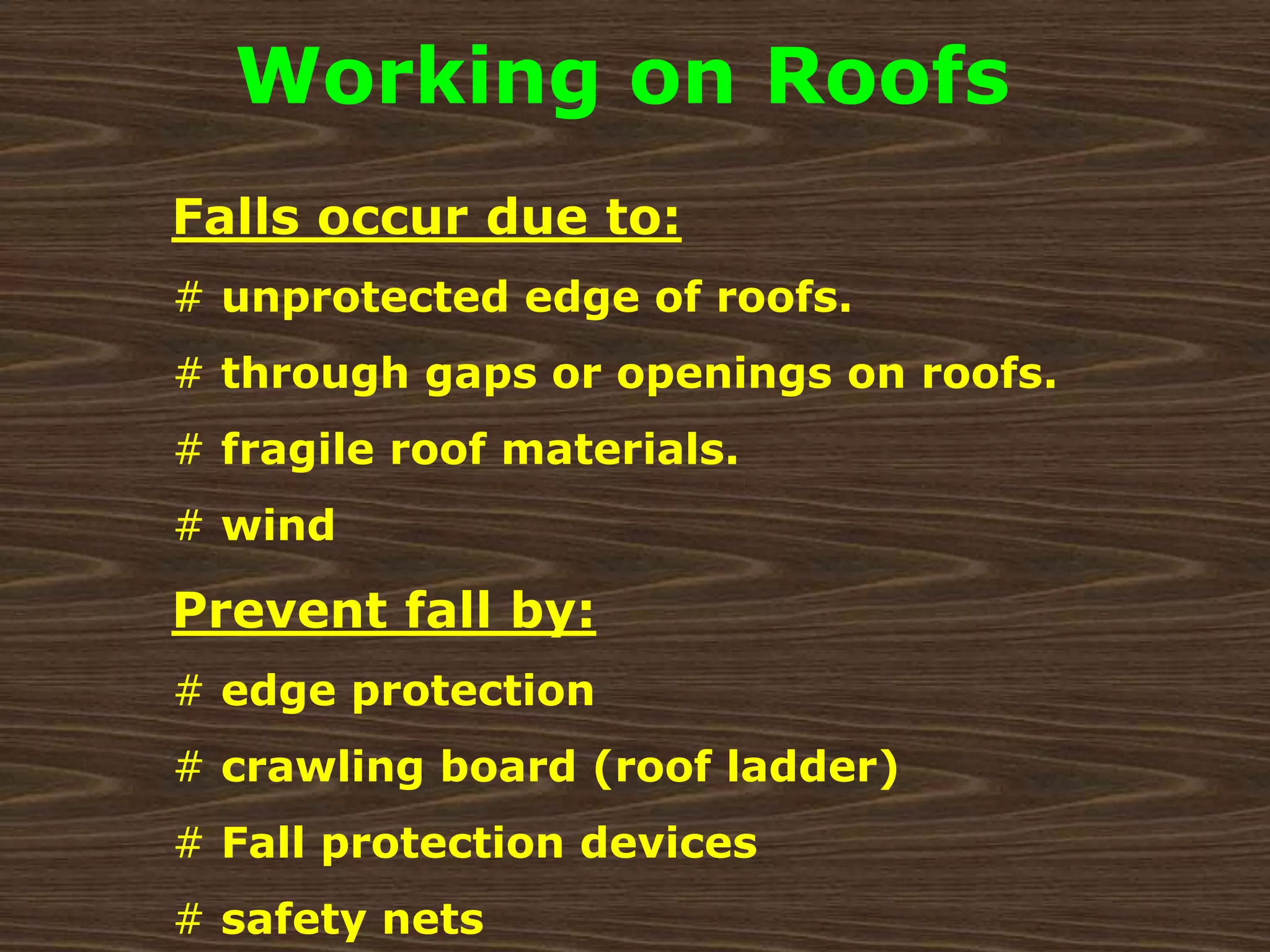
Working on Roofs
Falls occur due to:
# unprotected edge of roofs.
# through gaps or openings on roofs.
# fragile roof materials.
# wind
Prevent fall by:
# edge protection
# crawling board (roof ladder)
# Fall protection devices
# safety nets
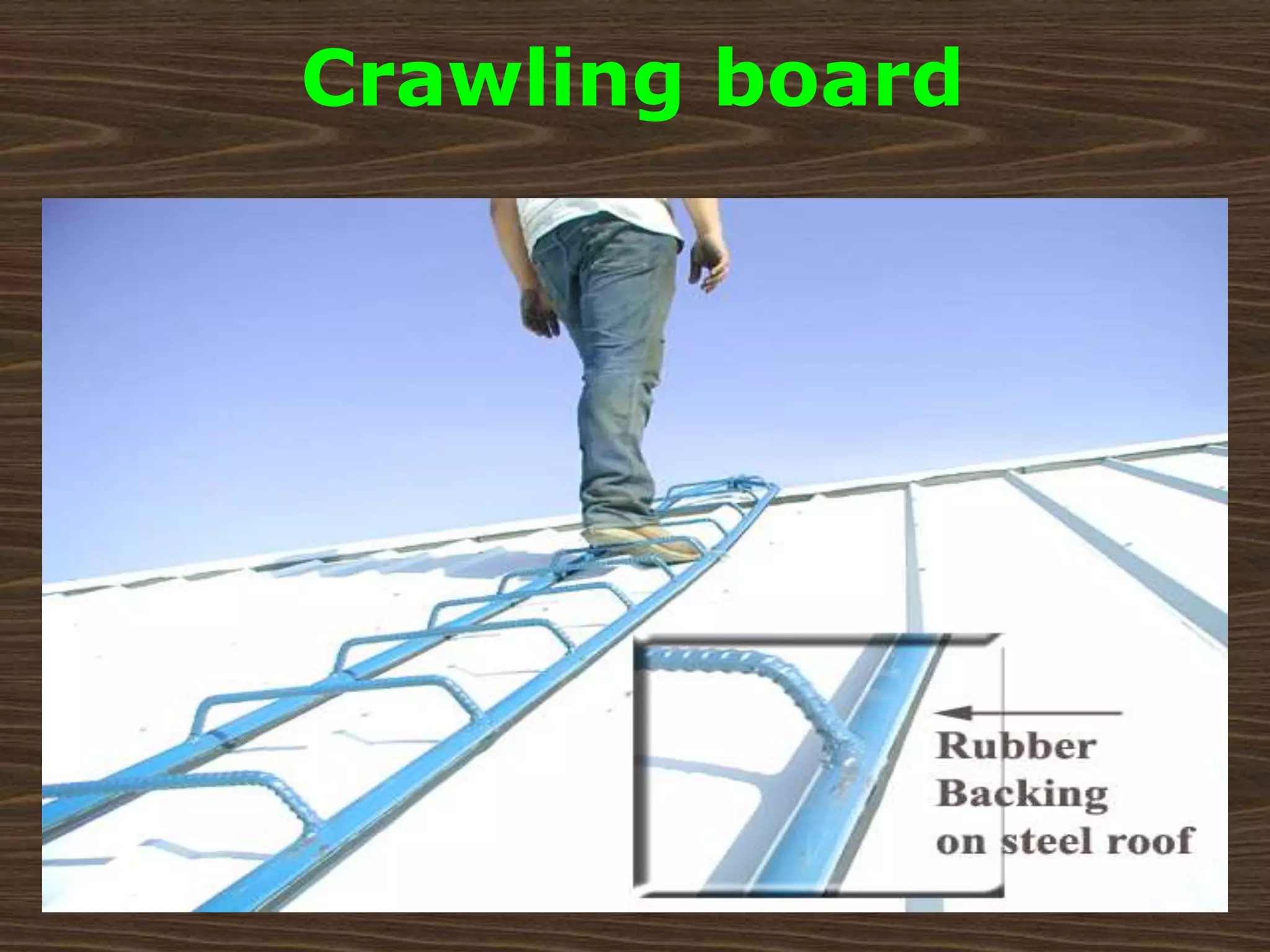
Crawling board
•For ascending / egress on the sloped
roofs.
•With Edge protection.
•Shall not carry tools while in travel.
Crawling board
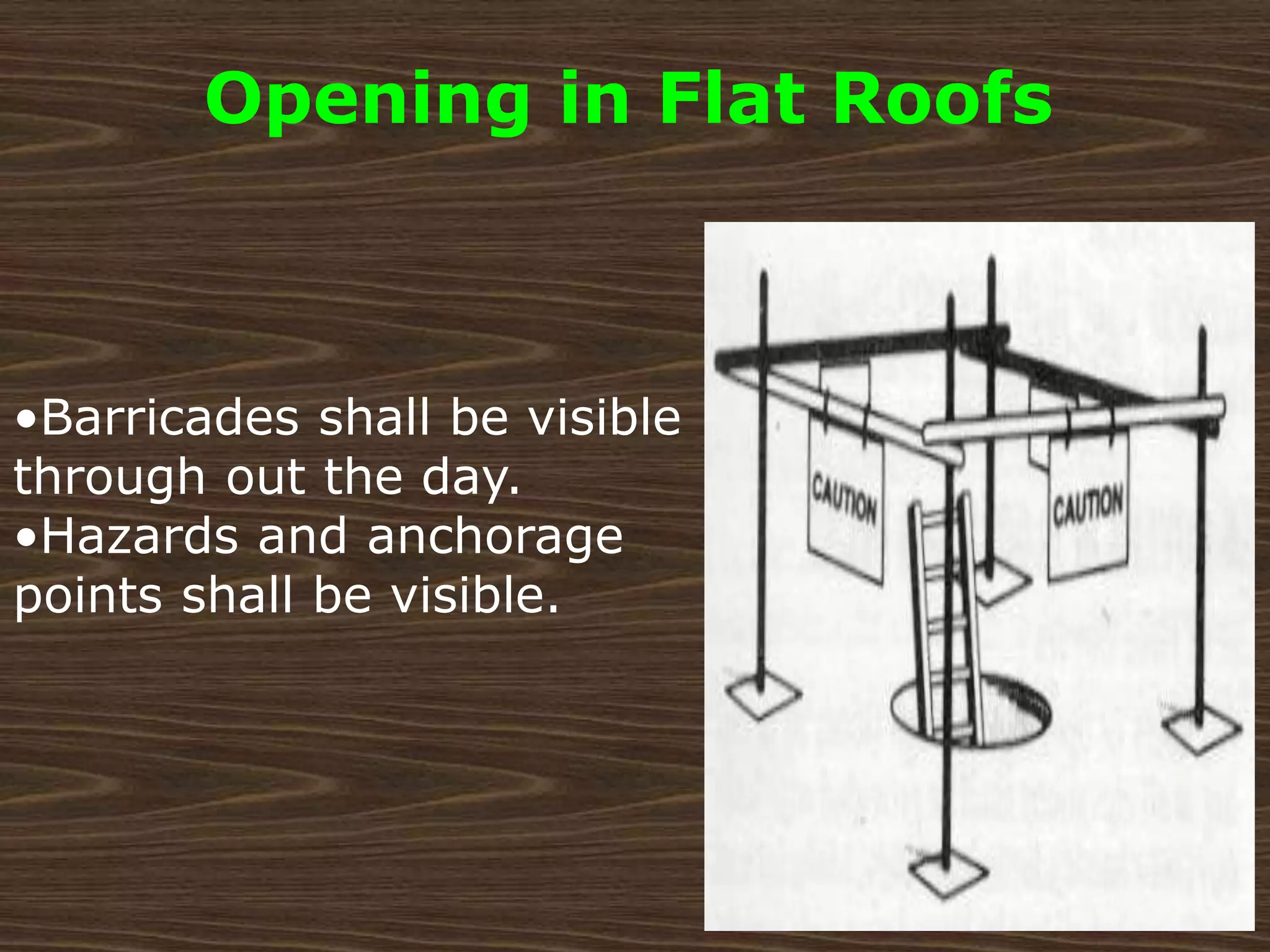
Opening in Flat Roofs
•Barricades shall be visible
through out the day.
•Hazards and anchorage
points shall be visible.
FALL PROTECTION
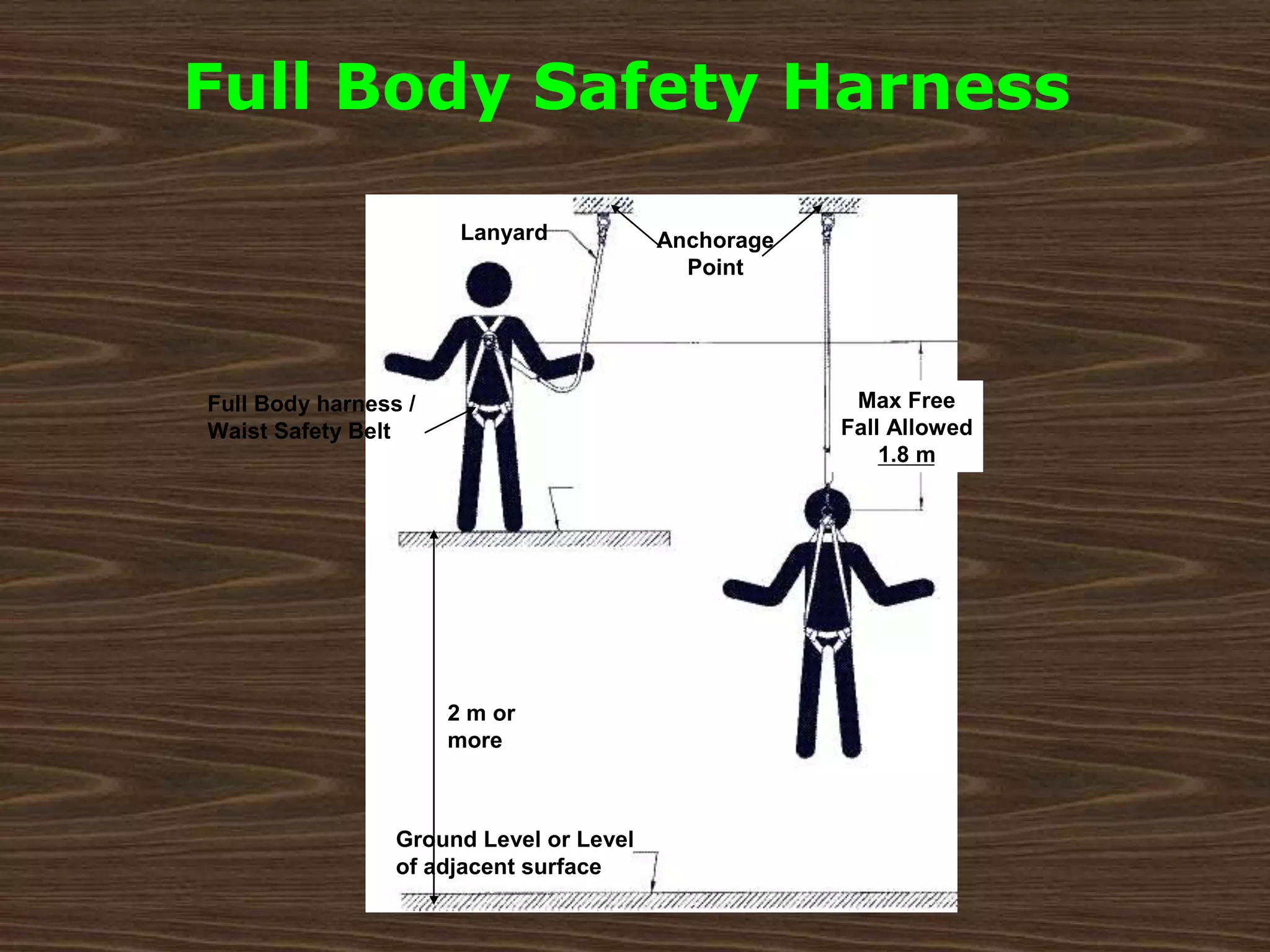
For working at 2.0 meter & more
height.
•Lanyard will be anchored to a
fixed
anchor point.
•Free-fall not to exceed 1.80
meter.
•Lanyard not more than 3 meter.
Full Body Safety Harness
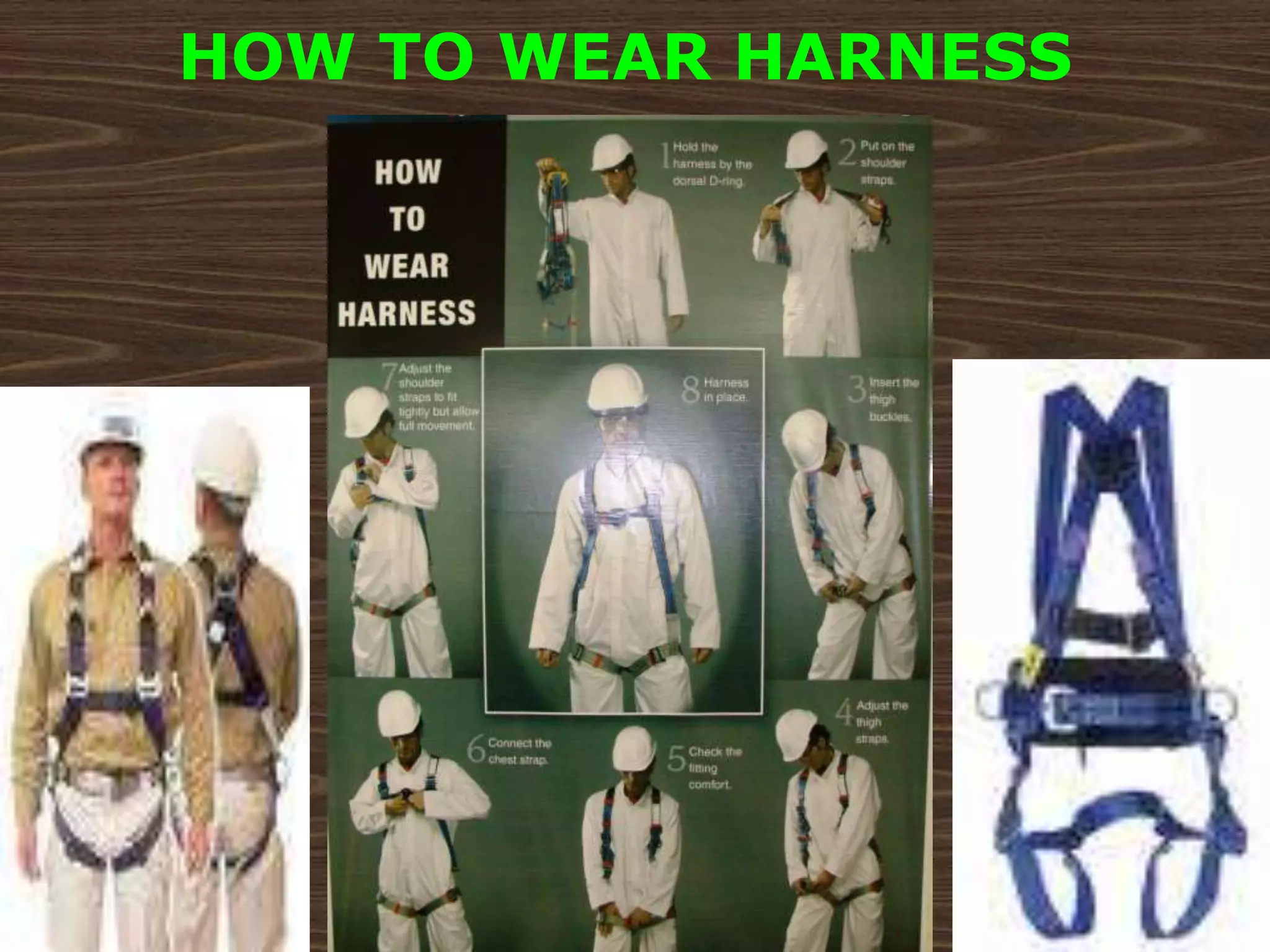
HOW TO WEAR HARNESS
Lanyard Anchorage
Point
Max Free
Fall Allowed
1.8 m
2 m or
more
Ground Level or Level
of adjacent surface
Full Body harness /
Waist Safety Belt
Full Body Safety Harness
Life Line
•It is a static line.
•Used while moving at height.
•Nylon / PP rope of 25 mm minimum
dia.
•Must facilitate shifting of lanyard.
Must be independent of any platform
anchorage and capable of supporting at least
5,000 lbs. per worker
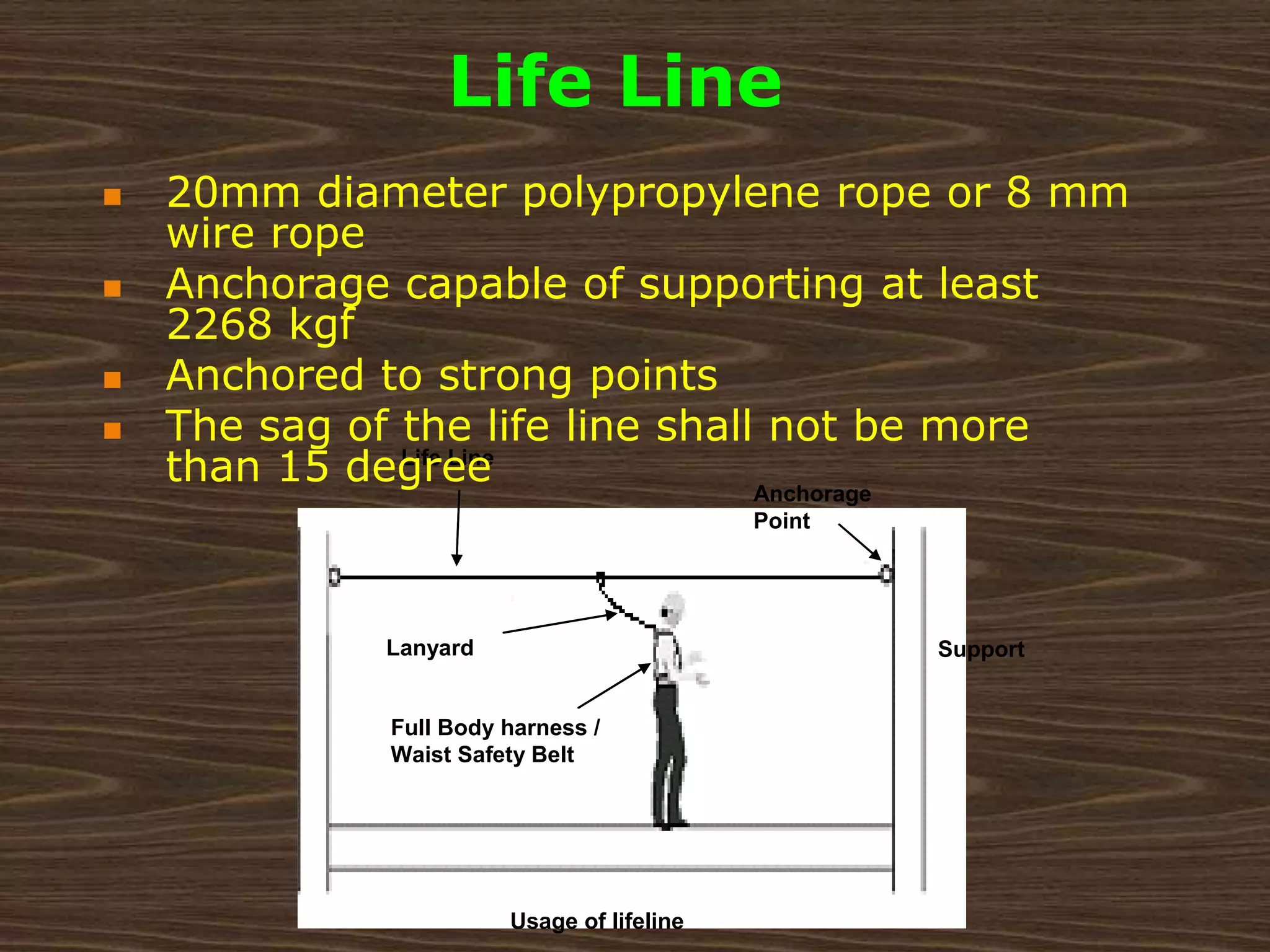
Anchorage
Point
Usage of lifeline
Support
Lanyard
Full Body harness /
Waist Safety Belt
Life Line
 20mm diameter polypropylene rope or 8 mm
wire rope
 Anchorage capable of supporting at least
2268 kgf
 Anchored to strong points
 The sag of the life line shall not be more
than 15 degree
Life Line
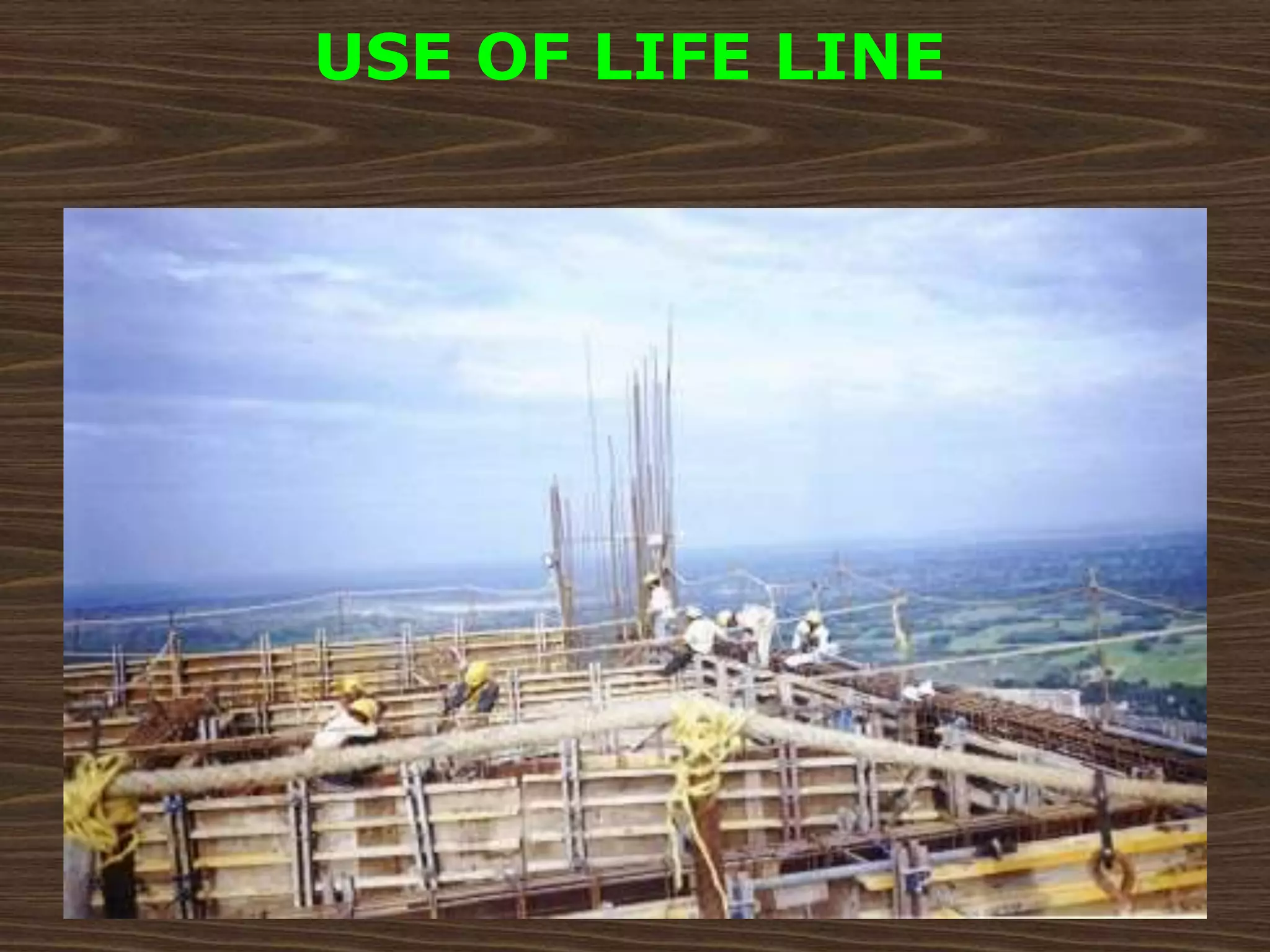
USE OF LIFE LINE
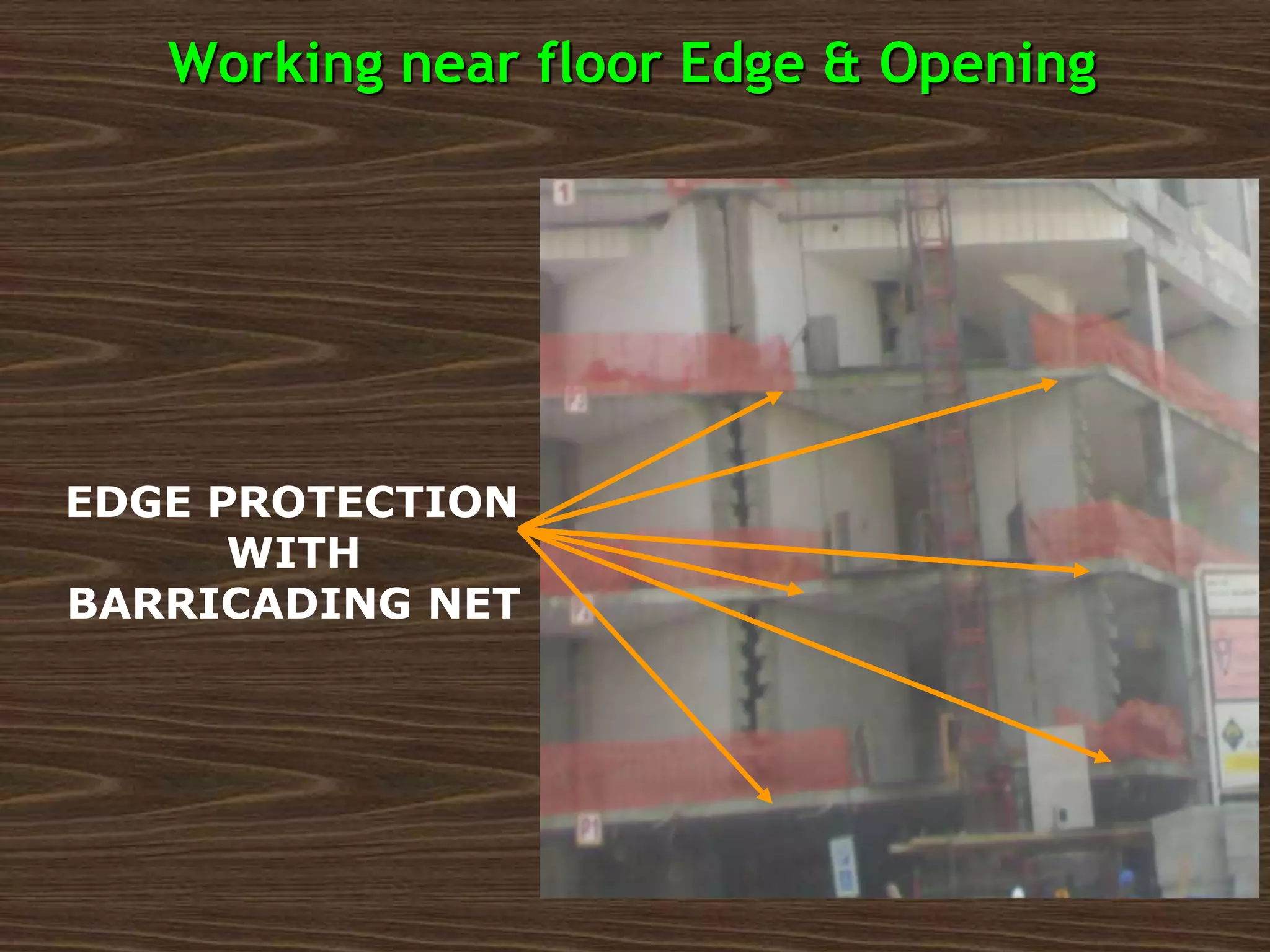
Working near floor Edge & Opening
EDGE PROTECTION
WITH
BARRICADING NET
Rope Grab Fall Arrester
Full Body
Harness
Class -L
Ladder
Rope
Grab Fall
Arrestor
Vertical
Life Line
 Rope grab fall arrestors used during vertical movement
such as ascending or descending Scaffold towers, vertical
ladders etc.
 Rope grab fall arrestors used to protect fall of workers
during vertical movement such as ascending or
descending Scaffold towers, vertical ladders etc.
GRAB TYPE FALL ARRESTER
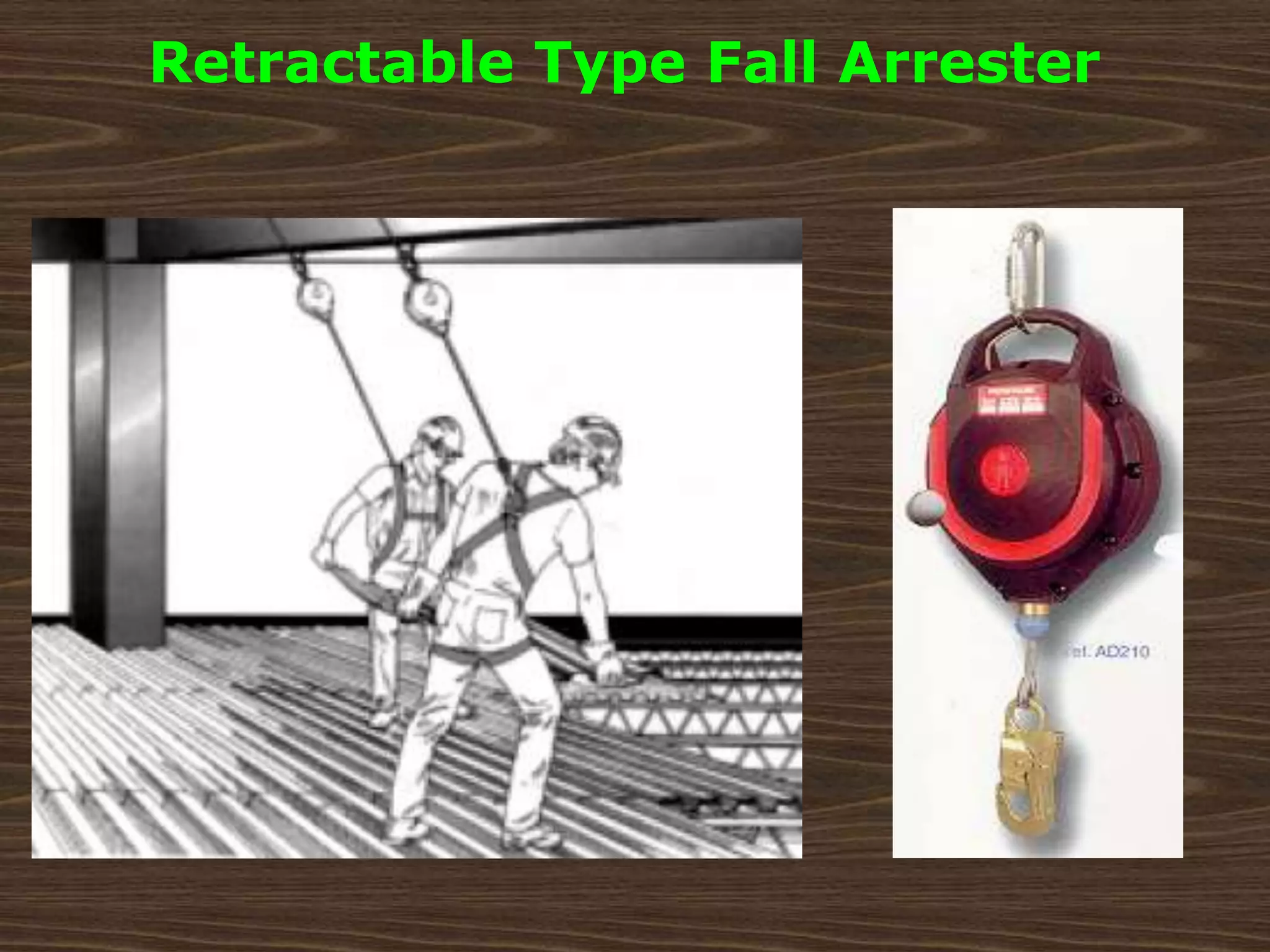
Retractable Type Fall Arrester
Retractable fall arrestors shall be
used in places where high risk of fall
of workmen persists.
This fall arrestor can be directly
anchored to the anchorage or can be
used in conjunction with a lifeline
Retractable Type Fall Arrester
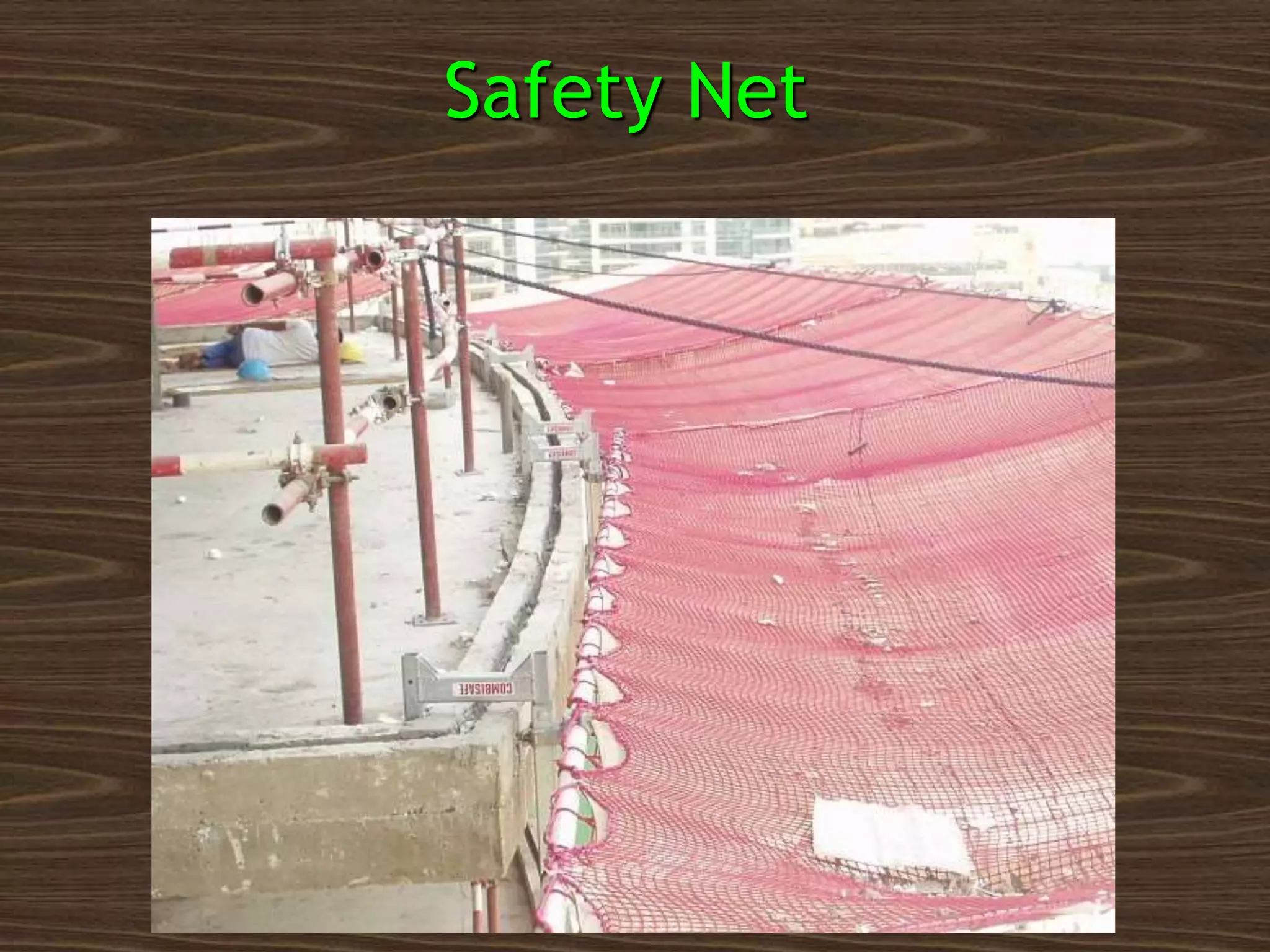
Safety Net
Safety net protects
Person from falling
 Protect person working below
 Safety net distance should not exceed 7.5 m
 Net shall extend Ht.
 up to 1.5 m 2.40 m
 1.5 to 3.0 m 3.00 m
 > 3.0 m 4.00 m
 Person from falling
 Tie cord at every 1 m
 Border rope to withstand 5000 lbs (2268kg)
 Drop test - 180 kg from 1 m above the
working area
Safety Net
provided in
the exterior
of the
building to
prevent fall
of men and
material.
Safety Net
Safety Net
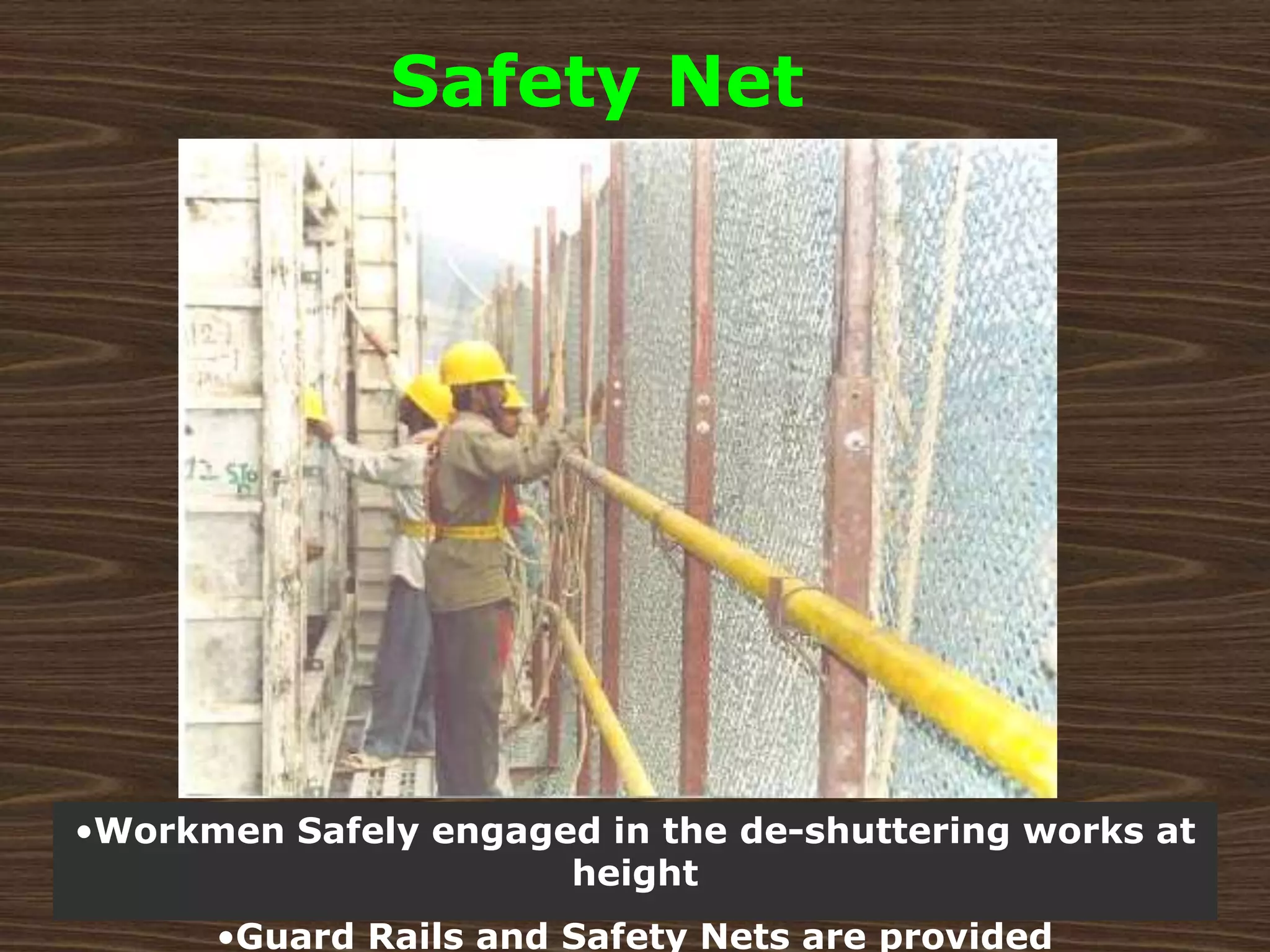
•Workmen Safely engaged in the de-shuttering works at
height
•Guard Rails and Safety Nets are provided
Safety Net
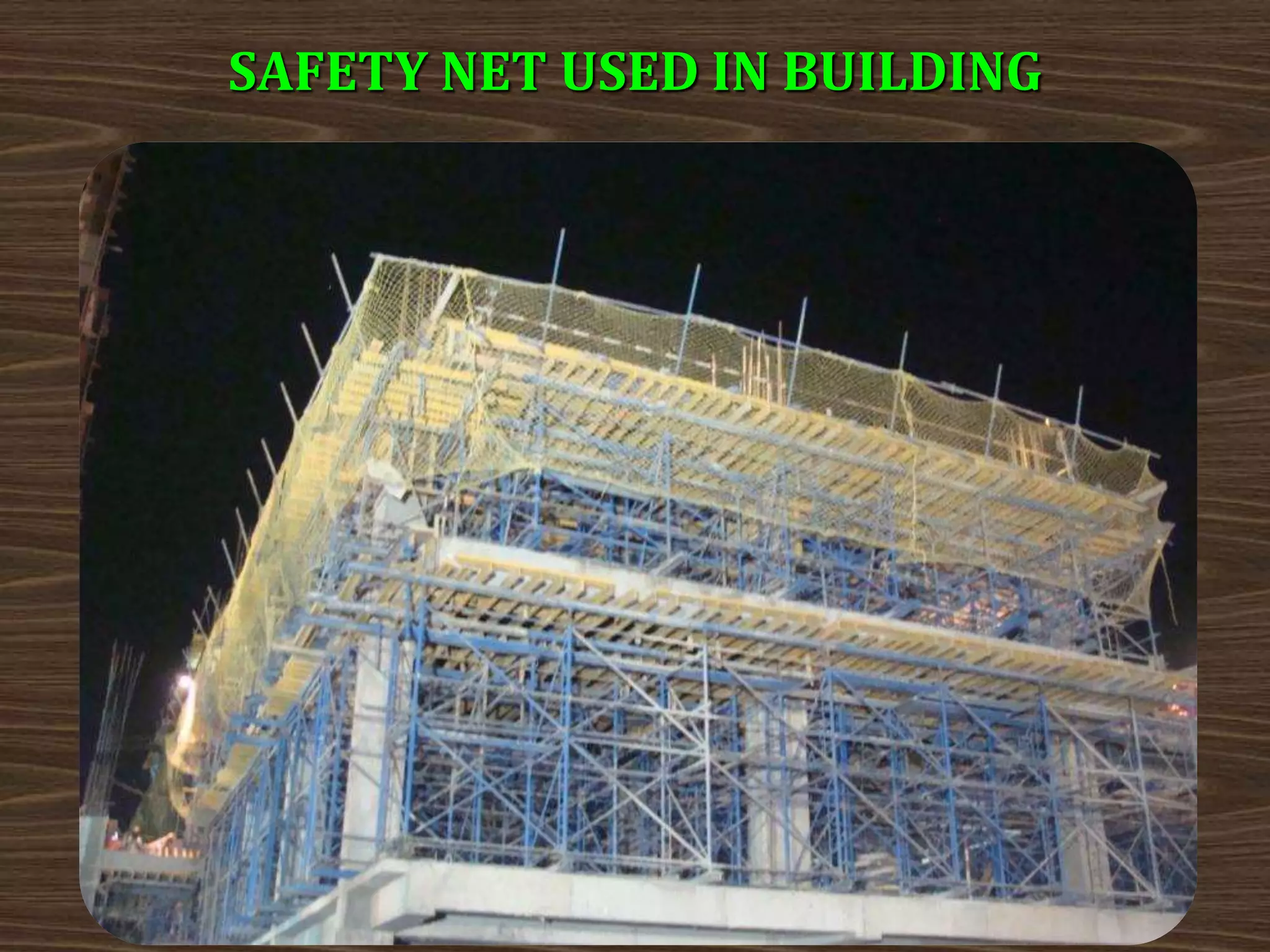
SAFETY NET USED IN BUILDING
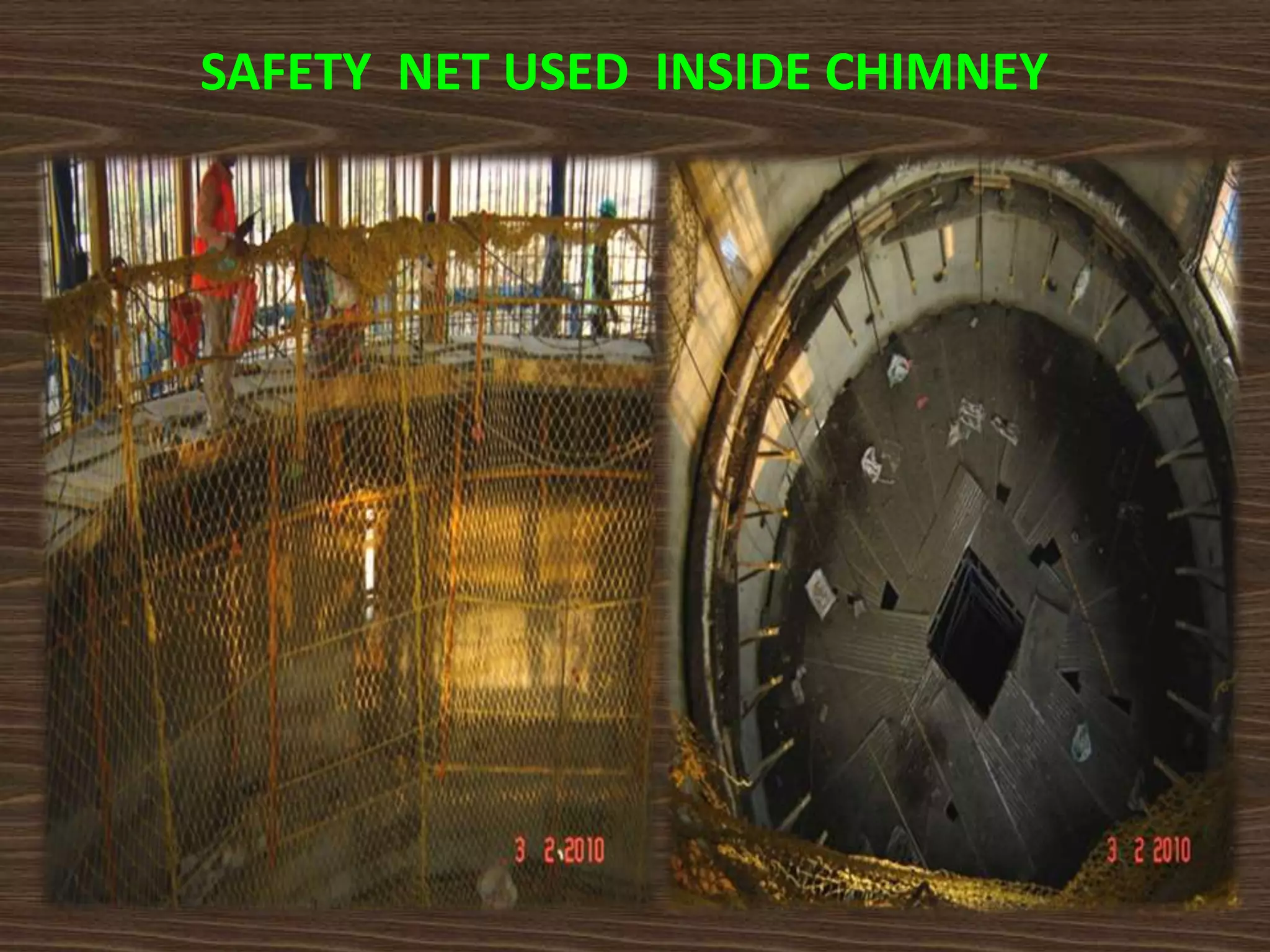
SAFETY NET USED INSIDE CHIMNEY
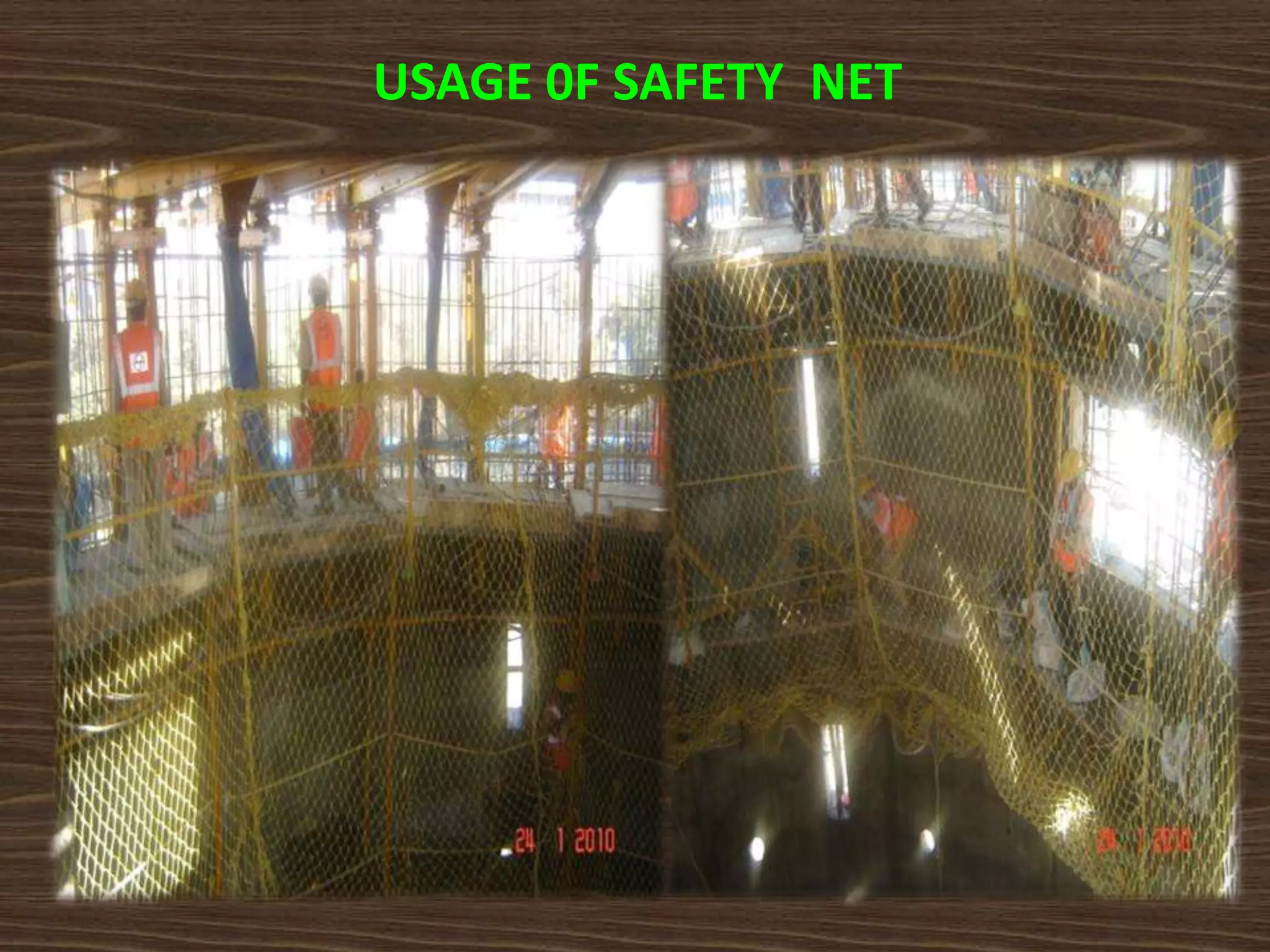
USAGE 0F SAFETY NET
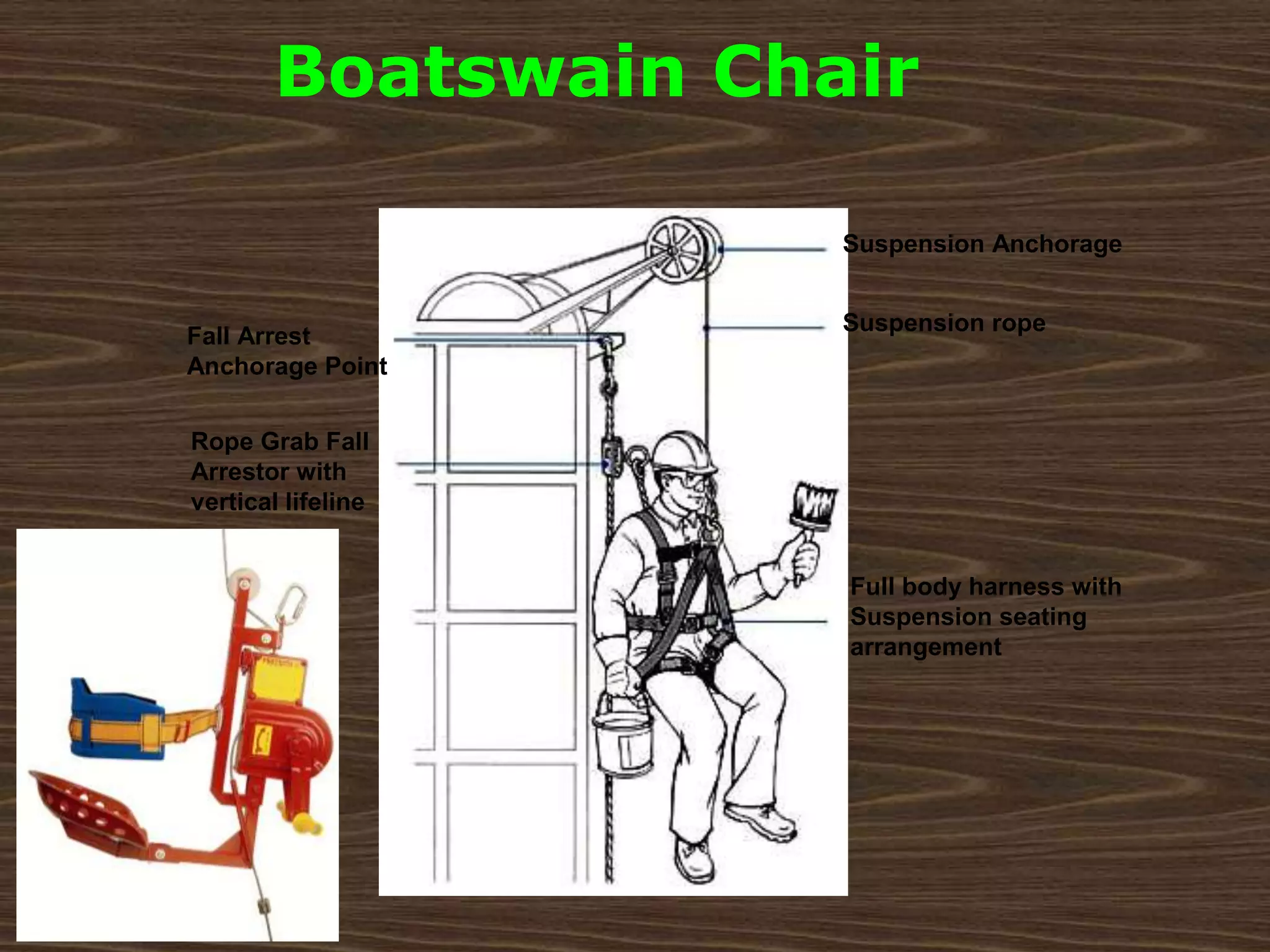
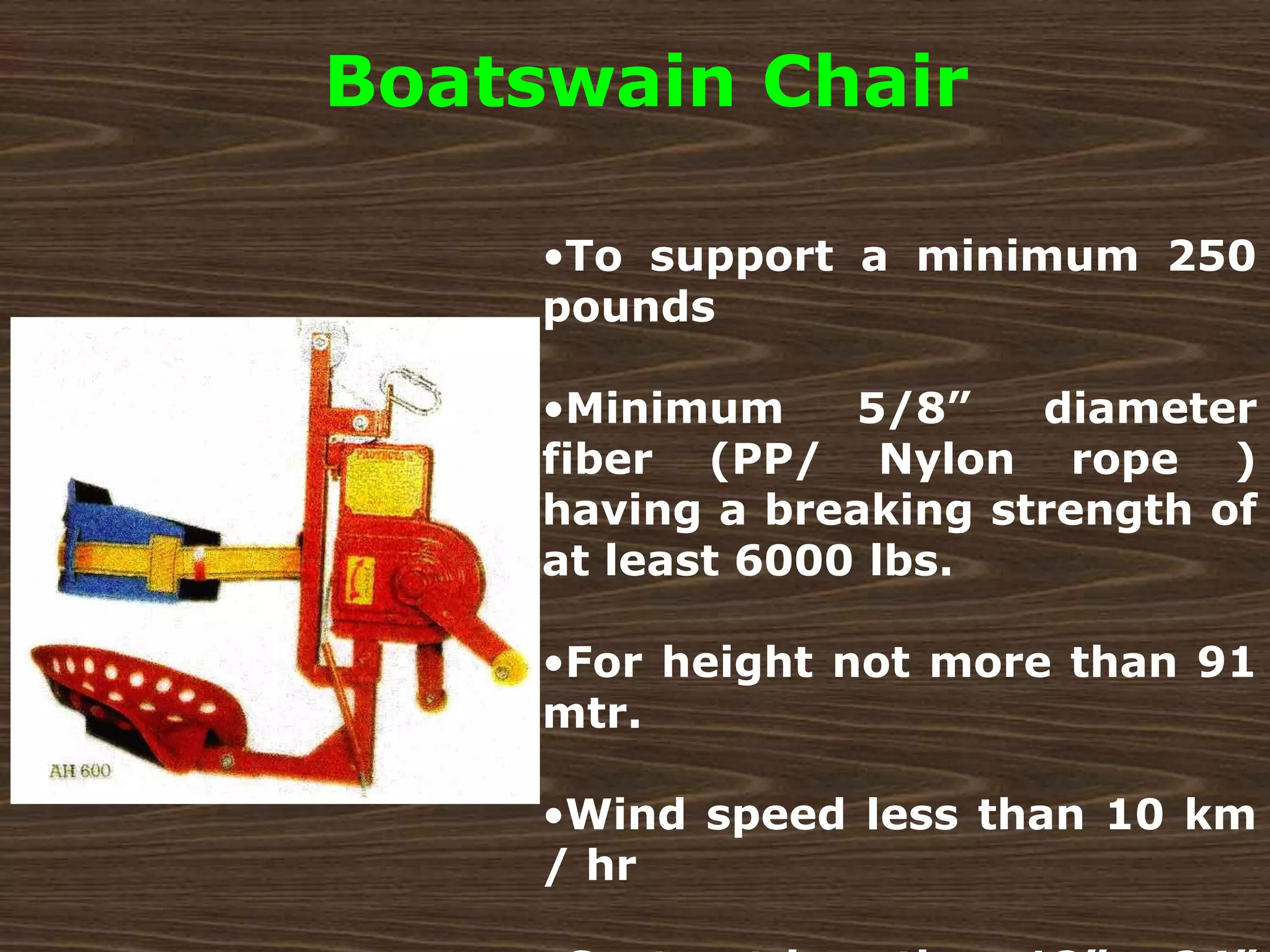
Boatswain Chair
Suspension Anchorage
Suspension rope
Full body harness with
Suspension seating
arrangement
Fall Arrest
Anchorage Point
Rope Grab Fall
Arrestor with
vertical lifeline
•To support a minimum 250
pounds
•Minimum 5/8” diameter
fiber (PP/ Nylon rope )
having a breaking strength of
at least 6000 lbs.
•For height not more than 91
mtr.
•Wind speed less than 10 km
/ hr
Boatswain Chair
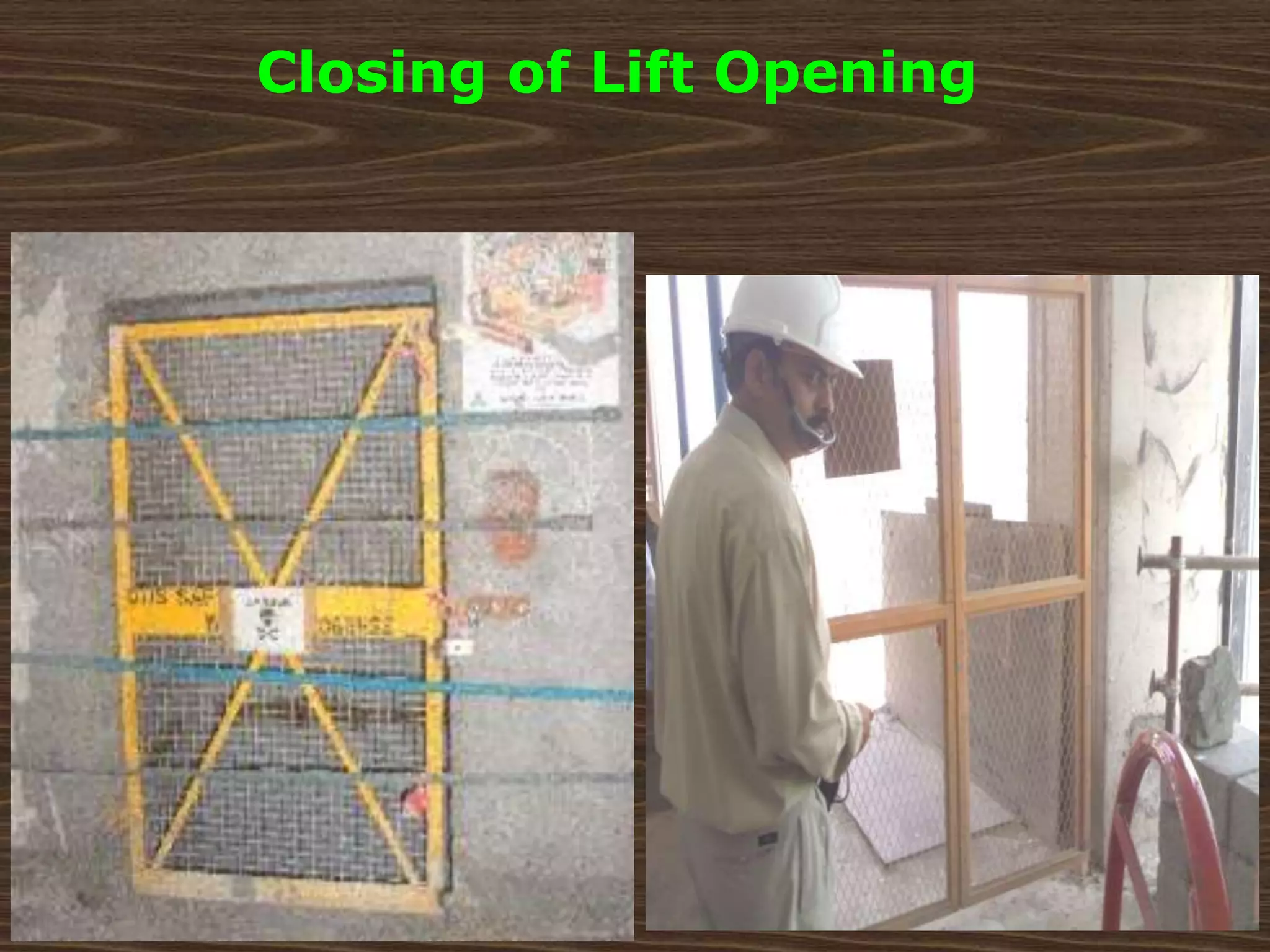
Closing of Lift Opening
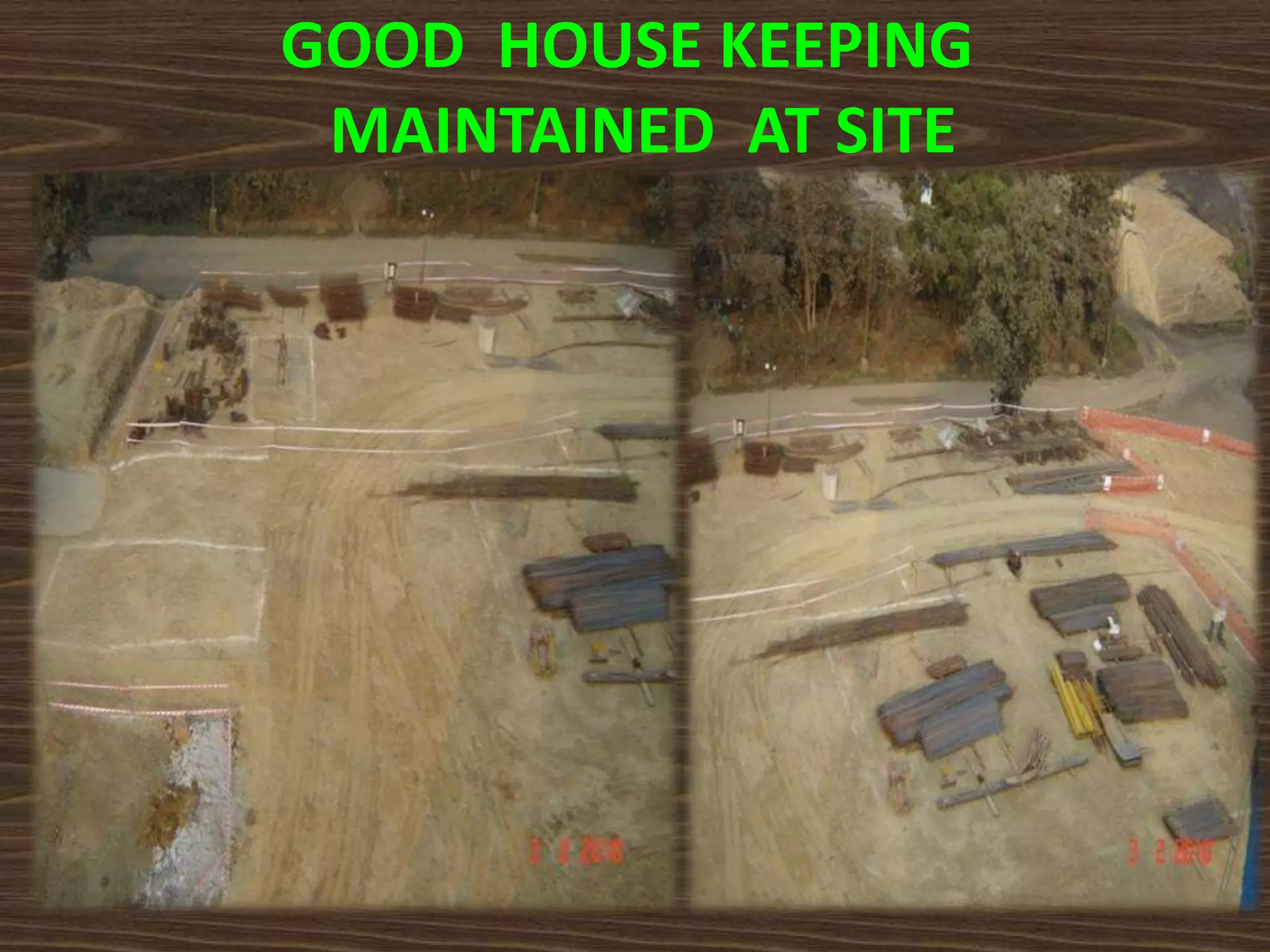
GOOD HOUSE KEEPING AT SITE
GOOD HOUSE KEEPING
MAINTAINED AT SITE
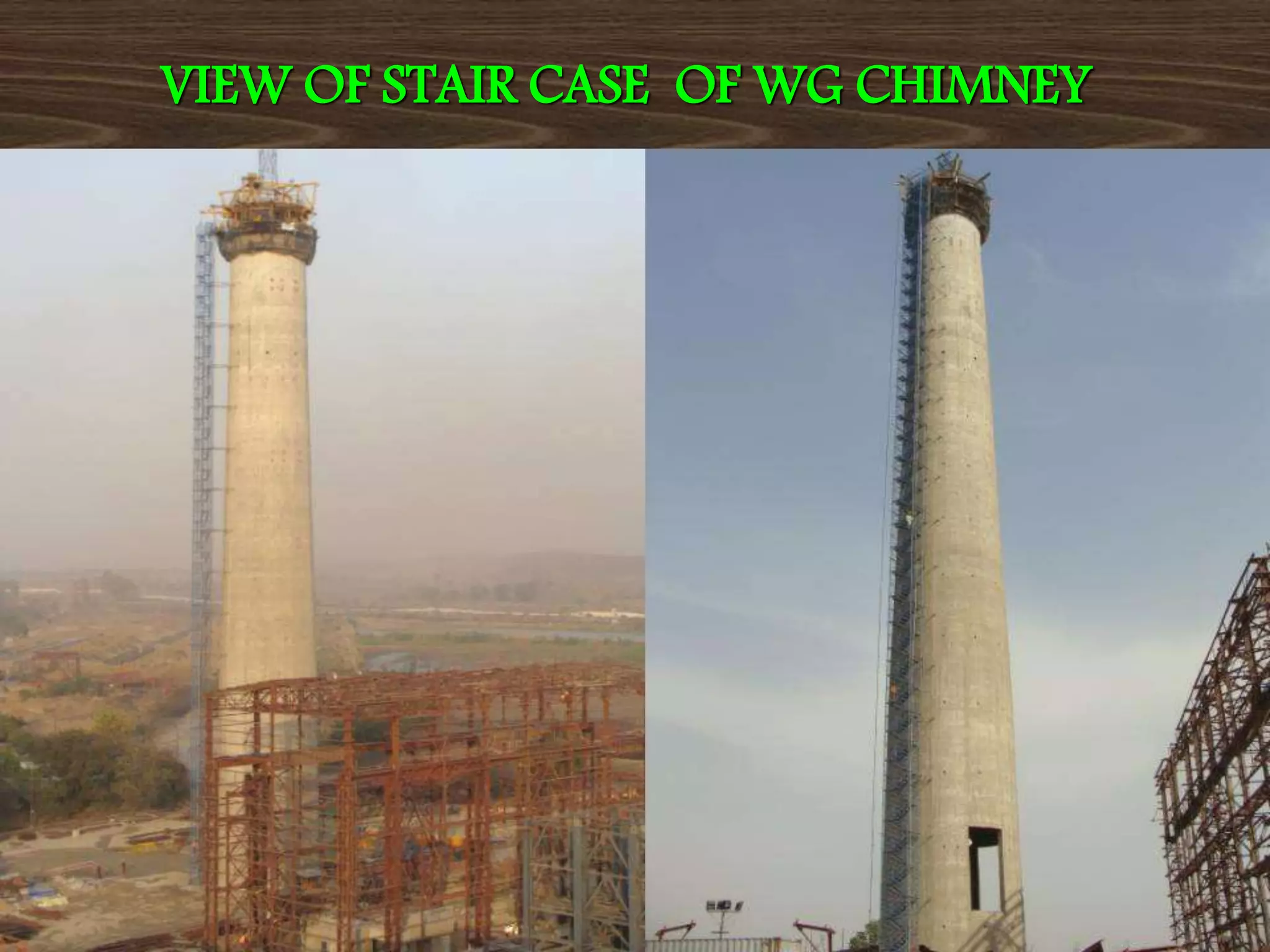
VIEW OF STAIR CASE OF WG CHIMNEY
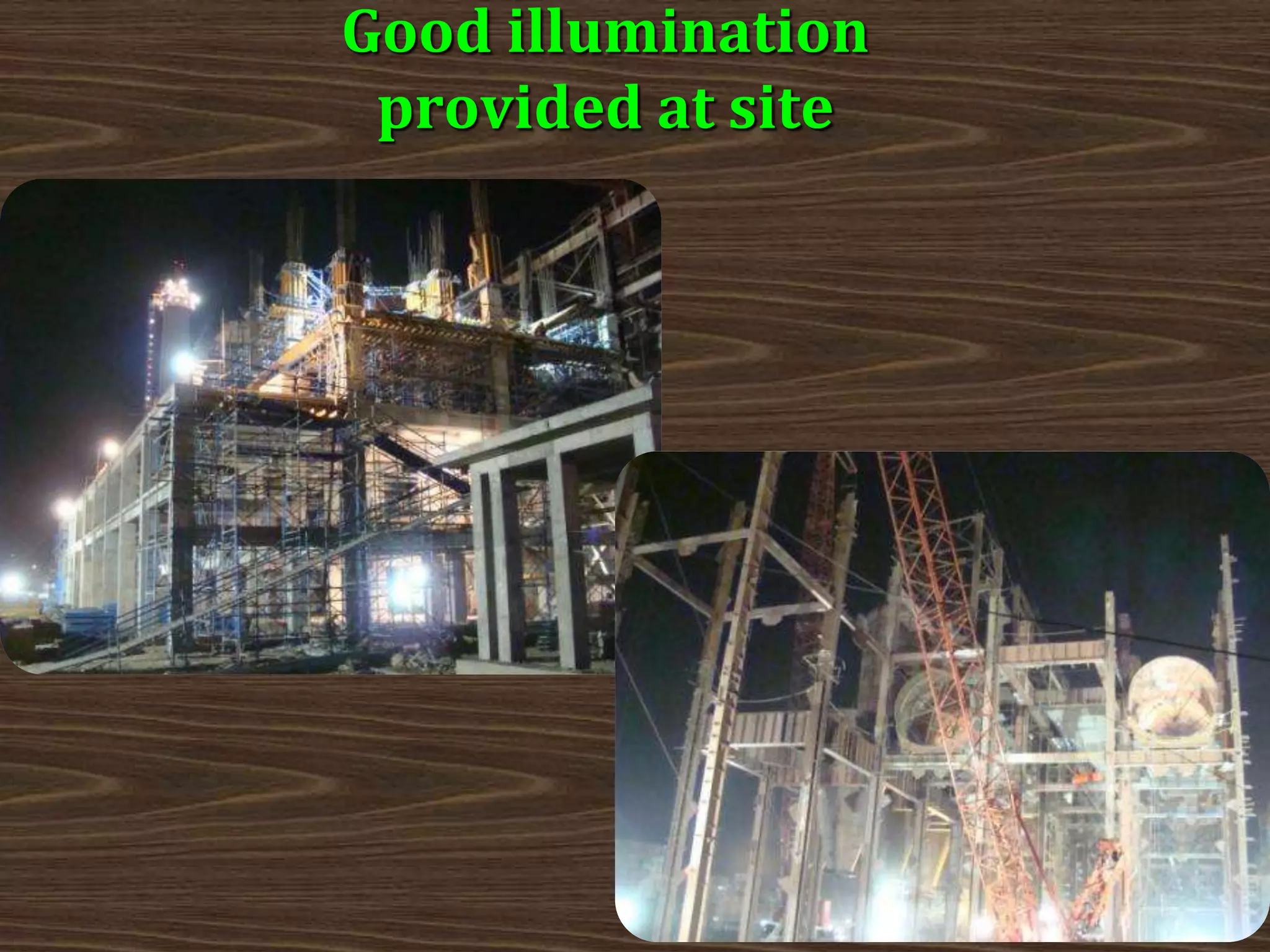
Good illumination
provided at site
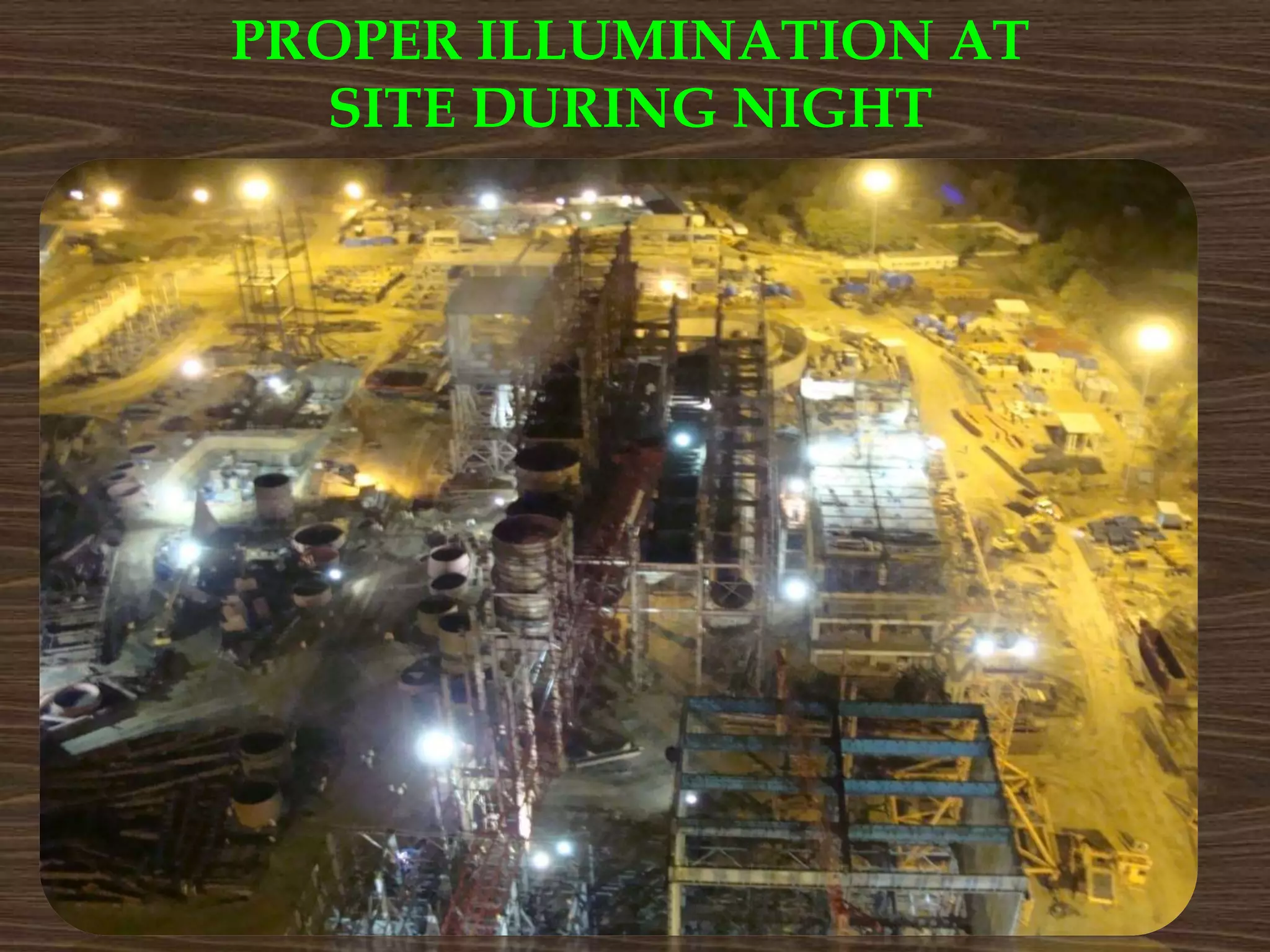
PROPER ILLUMINATION AT
SITE DURING NIGHT
Training given to workmen
Before working at height
Training program for rescue
on emergency from height
No one can go back and change a bad
beginning
But anyone can start now and
create a successful ending.

Safety while working at height

  • 1.
    SAFETY WHILE WORKING ATHEIGHT Er. EHS & Fire Syed Najaf ALi
  • 2.
  • 3.
    Risk & Hazard Theterm hazard is used to describe the potential of a compound to cause damage. Risk refers to the probability that potential harm occurs. Hazard is the potential to cause harm; risk on the other hand is the likelihood of harm Objective
  • 4.
  • 5.
    Fall of Object Electrocution Transportvehicle Miscellaneous HIGH INCIDENCES OF FATAL ACCIDENTS WHILE WORKING AT HEIGHT 08% 11% 16% 08% Fall of Person 57 %
  • 6.
    Ways to preventaccident while working at HEIGHT A. Fall Prevention :- by analyzing.  Approach Risk  Work area Risk  Work method Risk  3M Risk B. Fall Protection :- Using PPE’s - Safety Helmet. - F.B. Harness. Safety Net. Fall Arrester - Different type fall arresting Gadgets. Edge Protection – providing hard barricading & nets.  Floor openings cover & Lift shaft door
  • 7.
  • 8.
    We shall discussabout;  Ladders  Ramps  Scaffoldings  Working Platforms  Working On roofs & Fragile roofs FALL PREVENTION
  • 9.
     Angle ofInclination Extension off landing LADDERS
  • 10.
     The angleshould be 75º to the horizontal plane (1:4).  Extend at least 1 m above the landing place.  No rung should be missing.  It should always be laced at the level of the platform.  It shall never be used horizontally.  It should be firm & fitted with a non-slippery foot hold. 65-75º 4 unit 1 unit 1 m Requirements Of Ladder
  • 11.
  • 12.
    Avoiding Death Always use laddersin the correct position! Use only certified ladders!
  • 13.
    Few Do’s &Don’ts
  • 14.
    Do not usethe top or top step of a stepladder as a step Rails must be able to withstand a force of 75kgs. /mt. Few Do’s & Don’ts
  • 15.
  • 16.
    15º RAMP To convey persons,materials from one elevation to the other. 1.Guard Rails 2.Toe boards 3.Wheel Stop 4.Width 36” (at least) 5.Recommended Slope = 15º 6.Rough surface
  • 17.
    Guard ramps, runways,and other walkways Walkways and Ramps
  • 18.
  • 19.
  • 20.
    Precautions to betaken: • Surface - firm, level and compacted. • Sole plates below the base plates. • Sole plate - at least should extend 600 mm beyond the vertical pipes. • Double pin to be provided at the coupler joints. • Doka staging should be braced at every height of 6 m. • Sufficient diagonal bracing. Safety in Scaffolding
  • 21.
    SCAFFOLD erected on woodenmembers SCAFFOLD placed over concrete blocks Staging Erected on Uneven Ground
  • 22.
    Staging Erected onUneven Ground This support is not adequate!
  • 23.
    Working at theunsecured edge
  • 24.
  • 25.
  • 26.
    Competent person inspects On receipt,before use and weekly after installation Red tag & Green Tag Deformed bearer Scaffold Inspection
  • 27.
  • 29.
  • 30.
  • 31.
    600 mm WHENUSED FOR PERSON 800 mm WHEN USED FOR PERSON & MATERIAL OVERHANG minimum 50 mm maximum 4 times the think of the board. Allowable max. span between supports  1.5” thick plank 1.5 m  2” thick plank 2.6 m Working Platform
  • 32.
     Top railsbetween 900mm ht.  Toe boards at least 150 width Top Rail Mid- Rail Toe board Guardrails
  • 33.
     Covered orGuarded  Work permit system for opening Man-hole Openings
  • 34.
    View of opening frombottom View of opening from Top Openings
  • 35.
  • 36.
  • 37.
    Few Do's &Don’ts
  • 38.
    Open Sides a buildingthat are not barricaded Openings at the sides of the rubbish chute that are not barricaded Lift shaft openings which are not barricaded Floor Openings without cover or barricades Stairways without railings.
  • 39.
    Debris and other materialsmay fall through uncovered openings. Workers may fall thru and get injured. Few Do's & Don’ts
  • 40.
    Few Do's &Don’ts
  • 41.
    Few Do's &Don’ts
  • 42.
    Unprotected edge Unprotected Sides & Edges Unprotectedsides and edges must have guardrails or equivalent
  • 43.
    Sides & Edges- Improper Guarding This 1/4" nylon rope alone is not a proper way to guard this open floor
  • 45.
    Working on Roofs Fallsoccur due to: # unprotected edge of roofs. # through gaps or openings on roofs. # fragile roof materials. # wind Prevent fall by: # edge protection # crawling board (roof ladder) # Fall protection devices # safety nets
  • 46.
    Crawling board •For ascending/ egress on the sloped roofs. •With Edge protection. •Shall not carry tools while in travel.
  • 47.
  • 48.
    Opening in FlatRoofs •Barricades shall be visible through out the day. •Hazards and anchorage points shall be visible.
  • 49.
  • 50.
    For working at2.0 meter & more height. •Lanyard will be anchored to a fixed anchor point. •Free-fall not to exceed 1.80 meter. •Lanyard not more than 3 meter. Full Body Safety Harness
  • 51.
    HOW TO WEARHARNESS
  • 52.
    Lanyard Anchorage Point Max Free FallAllowed 1.8 m 2 m or more Ground Level or Level of adjacent surface Full Body harness / Waist Safety Belt Full Body Safety Harness
  • 53.
    Life Line •It isa static line. •Used while moving at height. •Nylon / PP rope of 25 mm minimum dia. •Must facilitate shifting of lanyard. Must be independent of any platform anchorage and capable of supporting at least 5,000 lbs. per worker
  • 54.
    Anchorage Point Usage of lifeline Support Lanyard FullBody harness / Waist Safety Belt Life Line  20mm diameter polypropylene rope or 8 mm wire rope  Anchorage capable of supporting at least 2268 kgf  Anchored to strong points  The sag of the life line shall not be more than 15 degree Life Line
  • 55.
  • 56.
    Working near floorEdge & Opening
  • 57.
    Working near floorEdge & Opening EDGE PROTECTION WITH BARRICADING NET
  • 58.
    Rope Grab FallArrester Full Body Harness Class -L Ladder Rope Grab Fall Arrestor Vertical Life Line  Rope grab fall arrestors used during vertical movement such as ascending or descending Scaffold towers, vertical ladders etc.  Rope grab fall arrestors used to protect fall of workers during vertical movement such as ascending or descending Scaffold towers, vertical ladders etc.
  • 59.
  • 60.
  • 61.
  • 62.
    Retractable fall arrestorsshall be used in places where high risk of fall of workmen persists. This fall arrestor can be directly anchored to the anchorage or can be used in conjunction with a lifeline Retractable Type Fall Arrester
  • 63.
    Safety Net Safety netprotects Person from falling  Protect person working below  Safety net distance should not exceed 7.5 m  Net shall extend Ht.  up to 1.5 m 2.40 m  1.5 to 3.0 m 3.00 m  > 3.0 m 4.00 m  Person from falling  Tie cord at every 1 m  Border rope to withstand 5000 lbs (2268kg)  Drop test - 180 kg from 1 m above the working area
  • 64.
    Safety Net provided in theexterior of the building to prevent fall of men and material. Safety Net
  • 65.
  • 66.
    •Workmen Safely engagedin the de-shuttering works at height •Guard Rails and Safety Nets are provided Safety Net
  • 67.
    SAFETY NET USEDIN BUILDING
  • 68.
    SAFETY NET USEDINSIDE CHIMNEY
  • 69.
  • 70.
    Boatswain Chair Suspension Anchorage Suspensionrope Full body harness with Suspension seating arrangement Fall Arrest Anchorage Point Rope Grab Fall Arrestor with vertical lifeline
  • 71.
    •To support aminimum 250 pounds •Minimum 5/8” diameter fiber (PP/ Nylon rope ) having a breaking strength of at least 6000 lbs. •For height not more than 91 mtr. •Wind speed less than 10 km / hr Boatswain Chair
  • 72.
  • 73.
  • 74.
  • 75.
    VIEW OF STAIRCASE OF WG CHIMNEY
  • 76.
  • 77.
  • 78.
    Training given toworkmen Before working at height
  • 79.
    Training program forrescue on emergency from height
  • 80.
    No one cango back and change a bad beginning But anyone can start now and create a successful ending.