
Ladder SafetyLadder Safety
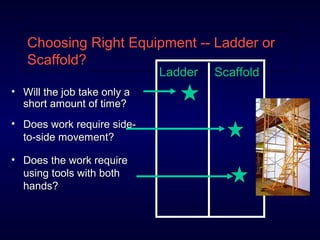
Choosing Right Equipment -- Ladder orChoosing Right Equipment -- Ladder or
Scaffold?Scaffold?
• Will the job take only aWill the job take only a
short amount of time?short amount of time?
• Does work require side-Does work require side-
to-side movement?to-side movement?
• Does the work requireDoes the work require
using tools with bothusing tools with both
hands?hands?
LadderLadder ScaffoldScaffold
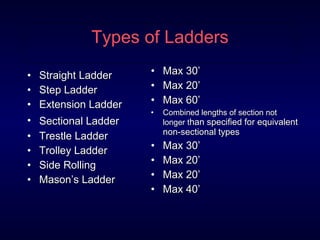
• Straight LadderStraight Ladder
• Step LadderStep Ladder
• Extension LadderExtension Ladder
• Sectional LadderSectional Ladder
• Trestle LadderTrestle Ladder
• Trolley LadderTrolley Ladder
• Side RollingSide Rolling
• Mason’s LadderMason’s Ladder
• Max 30’Max 30’
• Max 20’Max 20’
• Max 60’Max 60’
• Combined lengths of section notCombined lengths of section not
longer tlonger than specified for equivalenthan specified for equivalent
non-sectional typesnon-sectional types
• Max 30’Max 30’
• Max 20’Max 20’
• Max 20’Max 20’
• Max 40’Max 40’
Types of Ladders
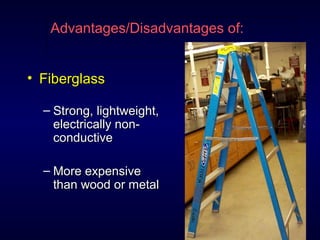
Advantages/Disadvantages of:
• FiberglassFiberglass
– Strong, lightweight,Strong, lightweight,
electrically non-electrically non-
conductiveconductive
– More expensiveMore expensive
than wood or metalthan wood or metal
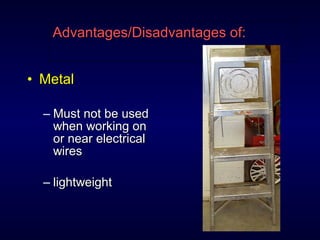
• MetalMetal
– Must not be usedMust not be used
when working onwhen working on
or near electricalor near electrical
wireswires
– lightweightlightweight
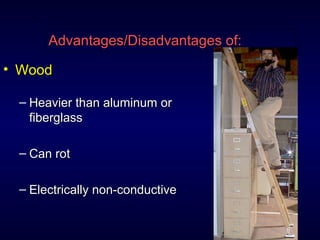
Advantages/Disadvantages of:Advantages/Disadvantages of:
• WoodWood
– Heavier than aluminum orHeavier than aluminum or
fiberglassfiberglass
– Can rotCan rot
– Electrically non-conductiveElectrically non-conductive
Extension LaddersExtension Ladders
• AlwaysAlways raise extension ladders so thatraise extension ladders so that
the upper section overlaps and rests onthe upper section overlaps and rests on
the bottom section.the bottom section.
• The upper section must always overlapThe upper section must always overlap
on the climbing sideon the climbing side of the extensionof the extension
ladder.ladder.
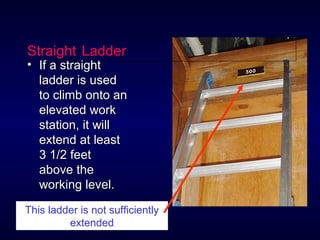
StraightStraight LadderLadder
• If a straightIf a straight
ladder is usedladder is used
to climb onto anto climb onto an
elevated workelevated work
station, it willstation, it will
extend at leastextend at least
3 1/2 feet3 1/2 feet
above theabove the
working level.working level.
This ladder is not sufficiently
extended
Load Limits -- Step LaddersLoad Limits -- Step Ladders
• Select a ladder designed to hold theSelect a ladder designed to hold the
necessary load, including worker andnecessary load, including worker and
equipment:equipment:
– Type IType I ---- industrial stepladder for heavy duty,industrial stepladder for heavy duty,
such as utilities, contractors and industrial usesuch as utilities, contractors and industrial use
– Type IIType II ---- commercial stepladder for mediumcommercial stepladder for medium
duty, painters office, light industrialduty, painters office, light industrial (not(not
recommended at UWM)recommended at UWM)
– Type IIIType III ---- HouseholdHousehold (not allowed at UWM)(not allowed at UWM)
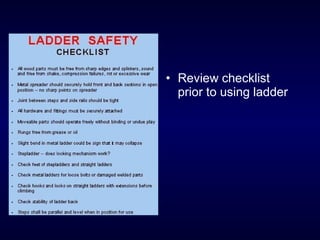
• Review checklist
prior to using ladder
Immediately remove ladder from service ifImmediately remove ladder from service if
inspection findsinspection finds:
• Broken or missing steps,Broken or missing steps,
rungs or cleatsrungs or cleats
• Broken or damaged side railsBroken or damaged side rails
• Other faulty equipment suchOther faulty equipment such
as missing feet, damagedas missing feet, damaged
connections, broken rivetsconnections, broken rivets
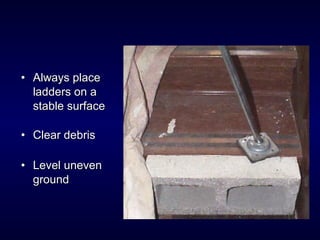
• Always placeAlways place
ladders on aladders on a
stable surfacestable surface
• Clear debrisClear debris
• Level unevenLevel uneven
groundground
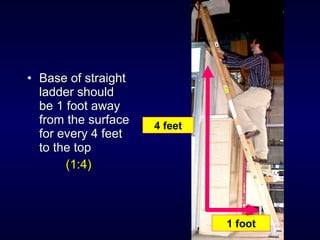
• Base of straightBase of straight
ladder shouldladder should
be 1 foot awaybe 1 foot away
from the surfacefrom the surface
for every 4 feetfor every 4 feet
to the topto the top
(1:4)(1:4)
1 foot
4 feet
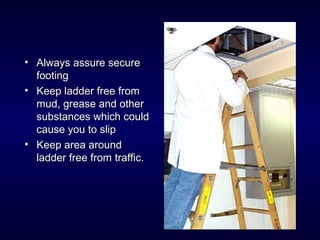
• Always assure secureAlways assure secure
footingfooting
• Keep ladder free fromKeep ladder free from
mud, grease and othermud, grease and other
substances which couldsubstances which could
cause you to slipcause you to slip
• Keep area aroundKeep area around
ladder free from traffic.ladder free from traffic.
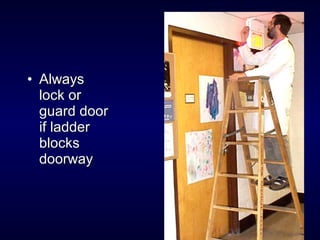
• AlwaysAlways
lock orlock or
guard doorguard door
if ladderif ladder
blocksblocks
doorwaydoorway
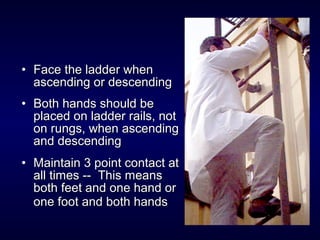
• Face the ladder whenFace the ladder when
ascending or descendingascending or descending
• Both hands should beBoth hands should be
placed on ladder rails, notplaced on ladder rails, not
on rungs, when ascendingon rungs, when ascending
and descendingand descending
• Maintain 3 point contact atMaintain 3 point contact at
all times -- This meansall times -- This means
both feet and one hand orboth feet and one hand or
one foot and both handsone foot and both hands
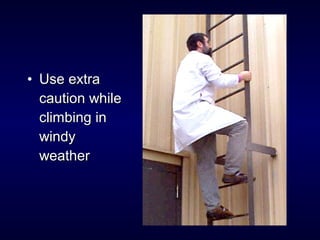
• Use extraUse extra
caution whilecaution while
climbing inclimbing in
windywindy
weatherweather
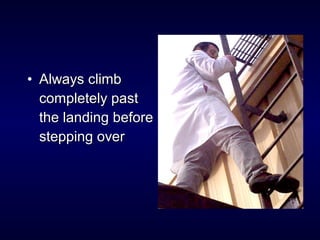
• Always climbAlways climb
completely pastcompletely past
the landing beforethe landing before
stepping overstepping over
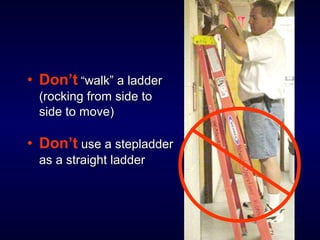
• Don’t ““walk” a ladderwalk” a ladder
(rocking from side to(rocking from side to
side to move)side to move)
• Don’t use a stepladderuse a stepladder
as a straight ladderas a straight ladder
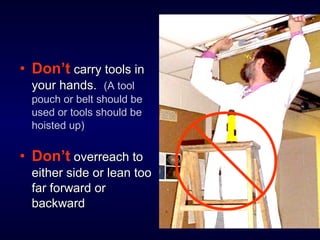
• Don’t carry tools incarry tools in
your hands.your hands. (A tool(A tool
pouch or belt should bepouch or belt should be
used or tools should beused or tools should be
hoisted up)hoisted up)
• Don’t overreach tooverreach to
either side or lean tooeither side or lean too
far forward orfar forward or
backwardbackward
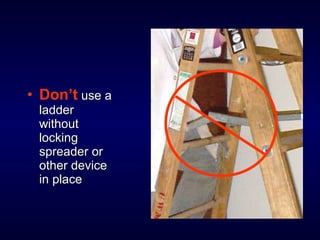
• Don’t use ause a
ladderladder
withoutwithout
lockinglocking
spreader orspreader or
other deviceother device
in placein place
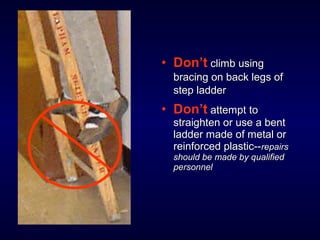
• Don’t climb usingclimb using
bracing on back legs ofbracing on back legs of
step ladderstep ladder
• Don’t attempt toattempt to
straighten or use a bentstraighten or use a bent
ladder made of metal orladder made of metal or
reinforced plastic--reinforced plastic--repairsrepairs
should be made by qualifiedshould be made by qualified
personnelpersonnel
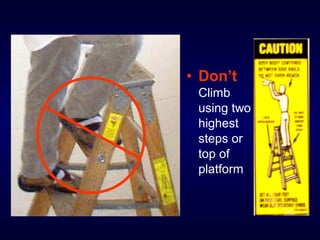
• Don’t
Climb
using two
highest
steps or
top of
platform
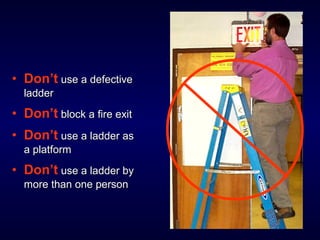
• Don’t use a defectiveuse a defective
ladderladder
• Don’t block a fire exitblock a fire exit
• Don’t use a ladder asuse a ladder as
a platforma platform
• Don’t use a ladder byuse a ladder by
more than one personmore than one person
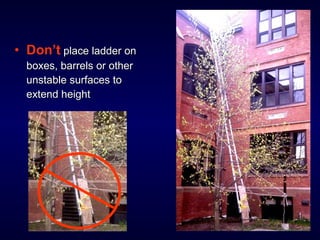
• Don’t place ladder onplace ladder on
boxes, barrels or otherboxes, barrels or other
unstable surfaces tounstable surfaces to
extend heightextend height
• Don’t use a ladder if you areuse a ladder if you are
feeling dizzy, light-headed, arefeeling dizzy, light-headed, are
excessively tired, onexcessively tired, on
medication, have recentlymedication, have recently
consumed alcohol or areconsumed alcohol or are
otherwise temporarily impaired.otherwise temporarily impaired.
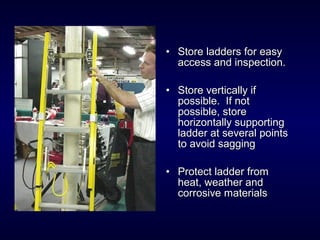
• Store ladders for easyStore ladders for easy
access and inspection.access and inspection.
• Store vertically ifStore vertically if
possible. If notpossible. If not
possible, storepossible, store
horizontally supportinghorizontally supporting
ladder at several pointsladder at several points
to avoid saggingto avoid sagging
• Protect ladder fromProtect ladder from
heat, weather andheat, weather and
corrosive materialscorrosive materials
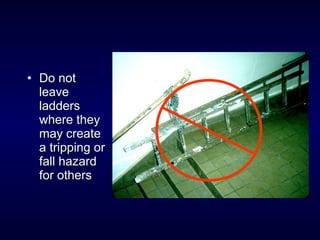
• Do notDo not
leaveleave
laddersladders
where theywhere they
may createmay create
a tripping ora tripping or
fall hazardfall hazard
for othersfor others
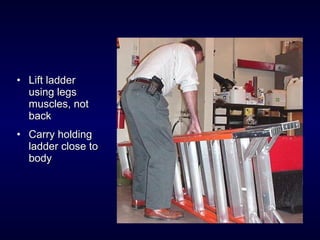
• Lift ladderLift ladder
using legsusing legs
muscles, notmuscles, not
backback
• Carry holdingCarry holding
ladder close toladder close to
bodybody
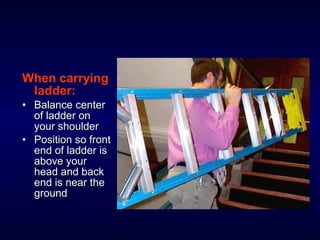
When carrying
ladder:
• Balance centerBalance center
of ladder onof ladder on
your shoulderyour shoulder
• Position so frontPosition so front
end of ladder isend of ladder is
above yourabove your
head and backhead and back
end is near theend is near the
groundground
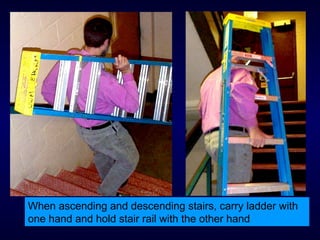
When ascending and descending stairs, carry ladder with
one hand and hold stair rail with the other hand
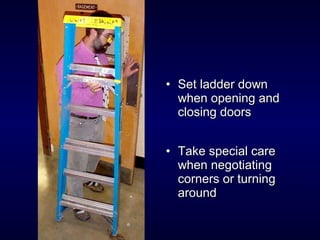
• Set ladder downSet ladder down
when opening andwhen opening and
closing doorsclosing doors
• Take special careTake special care
when negotiatingwhen negotiating
corners or turningcorners or turning
aroundaround
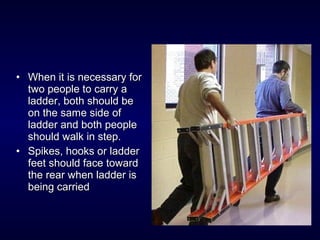
• When it is necessary forWhen it is necessary for
two people to carry atwo people to carry a
ladder, both should beladder, both should be
on the same side ofon the same side of
ladder and both peopleladder and both people
should walk in step.should walk in step.
• Spikes, hooks or ladderSpikes, hooks or ladder
feet should face towardfeet should face toward
the rear when ladder isthe rear when ladder is
being carriedbeing carried
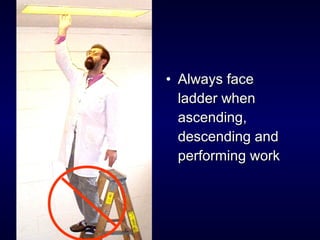
• Always faceAlways face
ladder whenladder when
ascending,ascending,
descending anddescending and
performing workperforming work
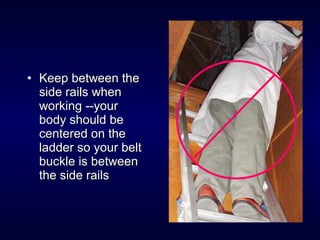
• Keep between theKeep between the
side rails whenside rails when
working --yourworking --your
body should bebody should be
centered on thecentered on the
ladder so your beltladder so your belt
buckle is betweenbuckle is between
the side railsthe side rails
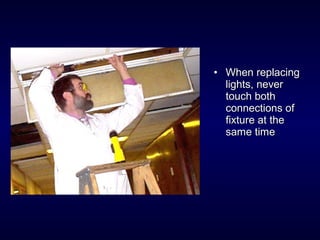
• When replacingWhen replacing
lights, neverlights, never
touch bothtouch both
connections ofconnections of
fixture at thefixture at the
same timesame time
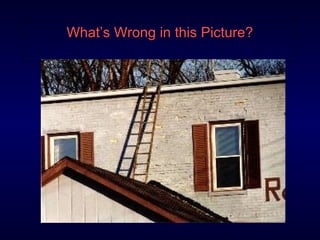
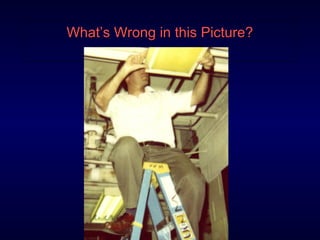
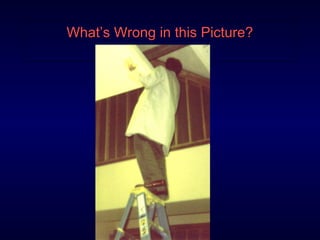
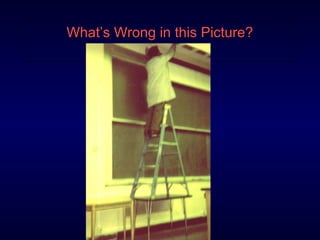
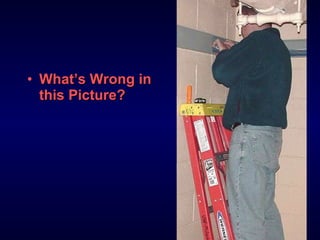
What’s Wrong in this Picture?What’s Wrong in this Picture?
• What’s Wrong inWhat’s Wrong in
this Picture?this Picture?

Ladder Safety

  • 1.
  • 3.
    Choosing Right Equipment-- Ladder orChoosing Right Equipment -- Ladder or Scaffold?Scaffold? • Will the job take only aWill the job take only a short amount of time?short amount of time? • Does work require side-Does work require side- to-side movement?to-side movement? • Does the work requireDoes the work require using tools with bothusing tools with both hands?hands? LadderLadder ScaffoldScaffold
  • 4.
    • Straight LadderStraightLadder • Step LadderStep Ladder • Extension LadderExtension Ladder • Sectional LadderSectional Ladder • Trestle LadderTrestle Ladder • Trolley LadderTrolley Ladder • Side RollingSide Rolling • Mason’s LadderMason’s Ladder • Max 30’Max 30’ • Max 20’Max 20’ • Max 60’Max 60’ • Combined lengths of section notCombined lengths of section not longer tlonger than specified for equivalenthan specified for equivalent non-sectional typesnon-sectional types • Max 30’Max 30’ • Max 20’Max 20’ • Max 20’Max 20’ • Max 40’Max 40’ Types of Ladders
  • 5.
    Advantages/Disadvantages of: • FiberglassFiberglass –Strong, lightweight,Strong, lightweight, electrically non-electrically non- conductiveconductive – More expensiveMore expensive than wood or metalthan wood or metal
  • 6.
    • MetalMetal – Mustnot be usedMust not be used when working onwhen working on or near electricalor near electrical wireswires – lightweightlightweight Advantages/Disadvantages of:Advantages/Disadvantages of:
  • 7.
    Advantages/Disadvantages of:Advantages/Disadvantages of: •WoodWood – Heavier than aluminum orHeavier than aluminum or fiberglassfiberglass – Can rotCan rot – Electrically non-conductiveElectrically non-conductive
  • 8.
    Extension LaddersExtension Ladders •AlwaysAlways raise extension ladders so thatraise extension ladders so that the upper section overlaps and rests onthe upper section overlaps and rests on the bottom section.the bottom section. • The upper section must always overlapThe upper section must always overlap on the climbing sideon the climbing side of the extensionof the extension ladder.ladder.
  • 9.
    StraightStraight LadderLadder • Ifa straightIf a straight ladder is usedladder is used to climb onto anto climb onto an elevated workelevated work station, it willstation, it will extend at leastextend at least 3 1/2 feet3 1/2 feet above theabove the working level.working level. This ladder is not sufficiently extended
  • 10.
    Load Limits --Step LaddersLoad Limits -- Step Ladders • Select a ladder designed to hold theSelect a ladder designed to hold the necessary load, including worker andnecessary load, including worker and equipment:equipment: – Type IType I ---- industrial stepladder for heavy duty,industrial stepladder for heavy duty, such as utilities, contractors and industrial usesuch as utilities, contractors and industrial use – Type IIType II ---- commercial stepladder for mediumcommercial stepladder for medium duty, painters office, light industrialduty, painters office, light industrial (not(not recommended at UWM)recommended at UWM) – Type IIIType III ---- HouseholdHousehold (not allowed at UWM)(not allowed at UWM)
  • 11.
  • 12.
    Immediately remove ladderfrom service ifImmediately remove ladder from service if inspection findsinspection finds: • Broken or missing steps,Broken or missing steps, rungs or cleatsrungs or cleats • Broken or damaged side railsBroken or damaged side rails • Other faulty equipment suchOther faulty equipment such as missing feet, damagedas missing feet, damaged connections, broken rivetsconnections, broken rivets
  • 13.
    • Always placeAlwaysplace ladders on aladders on a stable surfacestable surface • Clear debrisClear debris • Level unevenLevel uneven groundground
  • 14.
    • Base ofstraightBase of straight ladder shouldladder should be 1 foot awaybe 1 foot away from the surfacefrom the surface for every 4 feetfor every 4 feet to the topto the top (1:4)(1:4) 1 foot 4 feet
  • 15.
    • Always assuresecureAlways assure secure footingfooting • Keep ladder free fromKeep ladder free from mud, grease and othermud, grease and other substances which couldsubstances which could cause you to slipcause you to slip • Keep area aroundKeep area around ladder free from traffic.ladder free from traffic.
  • 16.
    • AlwaysAlways lock orlockor guard doorguard door if ladderif ladder blocksblocks doorwaydoorway
  • 17.
    • Face theladder whenFace the ladder when ascending or descendingascending or descending • Both hands should beBoth hands should be placed on ladder rails, notplaced on ladder rails, not on rungs, when ascendingon rungs, when ascending and descendingand descending • Maintain 3 point contact atMaintain 3 point contact at all times -- This meansall times -- This means both feet and one hand orboth feet and one hand or one foot and both handsone foot and both hands
  • 18.
    • Use extraUseextra caution whilecaution while climbing inclimbing in windywindy weatherweather
  • 19.
    • Always climbAlwaysclimb completely pastcompletely past the landing beforethe landing before stepping overstepping over
  • 20.
    • Don’t ““walk”a ladderwalk” a ladder (rocking from side to(rocking from side to side to move)side to move) • Don’t use a stepladderuse a stepladder as a straight ladderas a straight ladder
  • 21.
    • Don’t carrytools incarry tools in your hands.your hands. (A tool(A tool pouch or belt should bepouch or belt should be used or tools should beused or tools should be hoisted up)hoisted up) • Don’t overreach tooverreach to either side or lean tooeither side or lean too far forward orfar forward or backwardbackward
  • 22.
    • Don’t useause a ladderladder withoutwithout lockinglocking spreader orspreader or other deviceother device in placein place
  • 23.
    • Don’t climbusingclimb using bracing on back legs ofbracing on back legs of step ladderstep ladder • Don’t attempt toattempt to straighten or use a bentstraighten or use a bent ladder made of metal orladder made of metal or reinforced plastic--reinforced plastic--repairsrepairs should be made by qualifiedshould be made by qualified personnelpersonnel
  • 24.
  • 25.
    • Don’t usea defectiveuse a defective ladderladder • Don’t block a fire exitblock a fire exit • Don’t use a ladder asuse a ladder as a platforma platform • Don’t use a ladder byuse a ladder by more than one personmore than one person
  • 26.
    • Don’t placeladder onplace ladder on boxes, barrels or otherboxes, barrels or other unstable surfaces tounstable surfaces to extend heightextend height
  • 27.
    • Don’t usea ladder if you areuse a ladder if you are feeling dizzy, light-headed, arefeeling dizzy, light-headed, are excessively tired, onexcessively tired, on medication, have recentlymedication, have recently consumed alcohol or areconsumed alcohol or are otherwise temporarily impaired.otherwise temporarily impaired.
  • 28.
    • Store laddersfor easyStore ladders for easy access and inspection.access and inspection. • Store vertically ifStore vertically if possible. If notpossible. If not possible, storepossible, store horizontally supportinghorizontally supporting ladder at several pointsladder at several points to avoid saggingto avoid sagging • Protect ladder fromProtect ladder from heat, weather andheat, weather and corrosive materialscorrosive materials
  • 29.
    • Do notDonot leaveleave laddersladders where theywhere they may createmay create a tripping ora tripping or fall hazardfall hazard for othersfor others
  • 30.
    • Lift ladderLiftladder using legsusing legs muscles, notmuscles, not backback • Carry holdingCarry holding ladder close toladder close to bodybody
  • 31.
    When carrying ladder: • BalancecenterBalance center of ladder onof ladder on your shoulderyour shoulder • Position so frontPosition so front end of ladder isend of ladder is above yourabove your head and backhead and back end is near theend is near the groundground
  • 32.
    When ascending anddescending stairs, carry ladder with one hand and hold stair rail with the other hand
  • 33.
    • Set ladderdownSet ladder down when opening andwhen opening and closing doorsclosing doors • Take special careTake special care when negotiatingwhen negotiating corners or turningcorners or turning aroundaround
  • 34.
    • When itis necessary forWhen it is necessary for two people to carry atwo people to carry a ladder, both should beladder, both should be on the same side ofon the same side of ladder and both peopleladder and both people should walk in step.should walk in step. • Spikes, hooks or ladderSpikes, hooks or ladder feet should face towardfeet should face toward the rear when ladder isthe rear when ladder is being carriedbeing carried
  • 35.
    • Always faceAlwaysface ladder whenladder when ascending,ascending, descending anddescending and performing workperforming work
  • 36.
    • Keep betweentheKeep between the side rails whenside rails when working --yourworking --your body should bebody should be centered on thecentered on the ladder so your beltladder so your belt buckle is betweenbuckle is between the side railsthe side rails
  • 37.
    • When replacingWhenreplacing lights, neverlights, never touch bothtouch both connections ofconnections of fixture at thefixture at the same timesame time
  • 38.
    What’s Wrong inthis Picture?What’s Wrong in this Picture?
  • 39.
    What’s Wrong inthis Picture?What’s Wrong in this Picture?
  • 40.
    What’s Wrong inthis Picture?What’s Wrong in this Picture?
  • 41.
    What’s Wrong inthis Picture?What’s Wrong in this Picture?
  • 42.
    • What’s WronginWhat’s Wrong in this Picture?this Picture?