Ladder Safety in Construction
Developed by Division of Occupational Safety and Health
September, 2009
Ladder Safety in Construction
Falls from ladders are one of the leading
causes of injuries in the construction trade.
The majority of the falls are caused by misuse,
faulty ladders or carelessness.
The Ladder Safety Rule (WAC 296-876) was
written to reduce or eliminate these mishaps.
This presentation provides some basic safety
practices on ladder use based on these
regulations.
Improperly getting on or off the
ladder
Loss of balance
Setting up the ladder improperly
Overreaching while on the
ladder
Mis-stepping or slipping while
climbing or descending
Common causes of ladder injuries
Other causes of falls from ladders
 Lack of training on safe ladder use
 Using the wrong type ladder for the job
 Exceeding the ladder weight capacity
 Climbing ladder with tools or material in hands
 Climbing or descending not facing the ladder
 Oil, grease or mud on ladder rungs
 Ladder not secure at the base or top
 Ladder not set up at the proper angle
 Ladder not extended 3 feet above upper surface
 Using the top step of a step ladder
 Placing ladder on unstable surfaces
 Over-reaching beyond the side rails of the ladder
Ladder Training
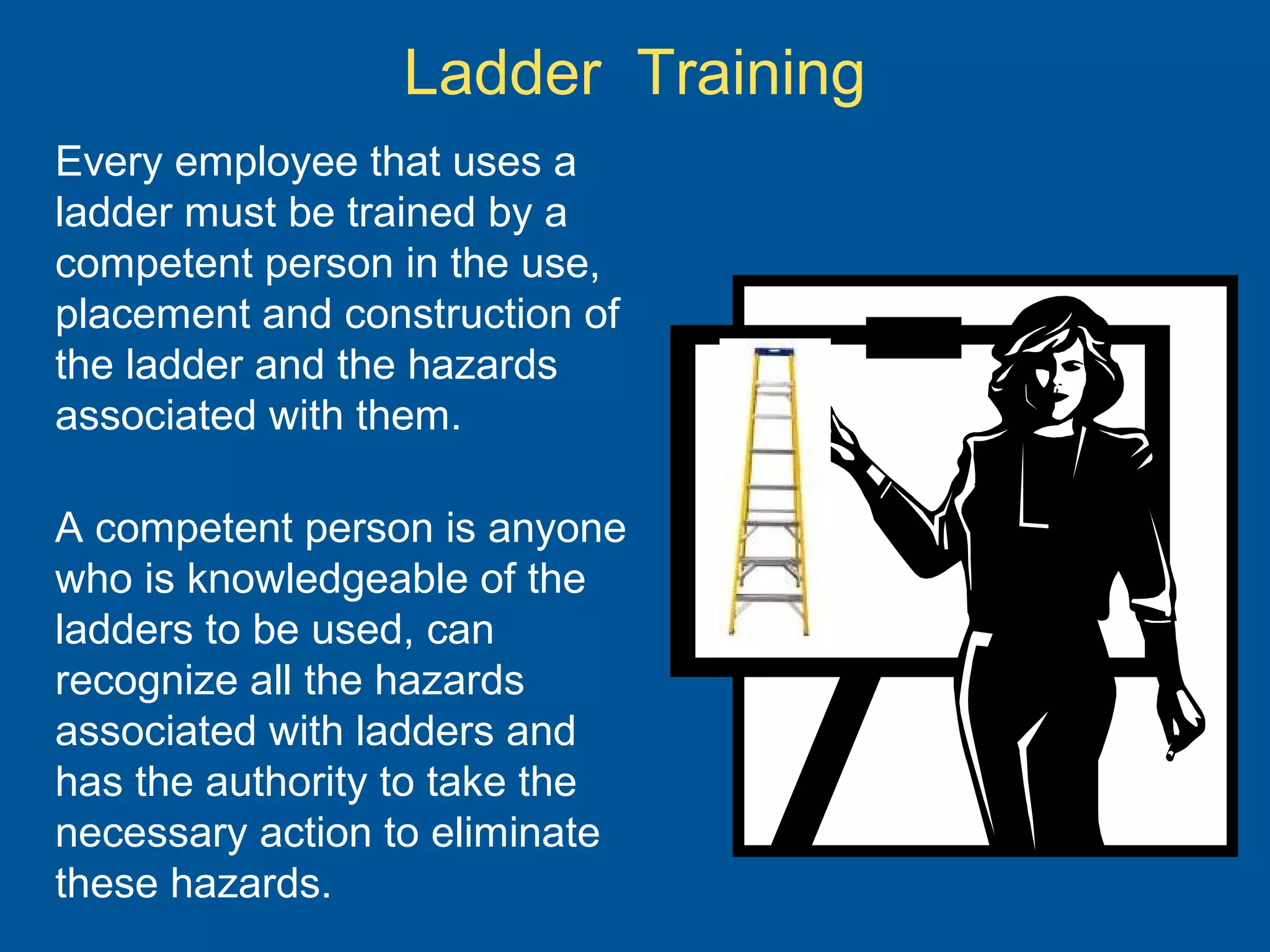
Every employee that uses a
ladder must be trained by a
competent person in the use,
placement and construction of
the ladder and the hazards
associated with them.
A competent person is anyone
who is knowledgeable of the
ladders to be used, can
recognize all the hazards
associated with ladders and
has the authority to take the
necessary action to eliminate
these hazards.
These include stepladders and have one or two extra
legs that are attached to the ladder for support. They
do not require a structure to support them.
Self-supporting ladders
Tripod LadderFiberglass stepladder
Wood stepladder Trestle ladder
Ladder Parts – Step Ladder
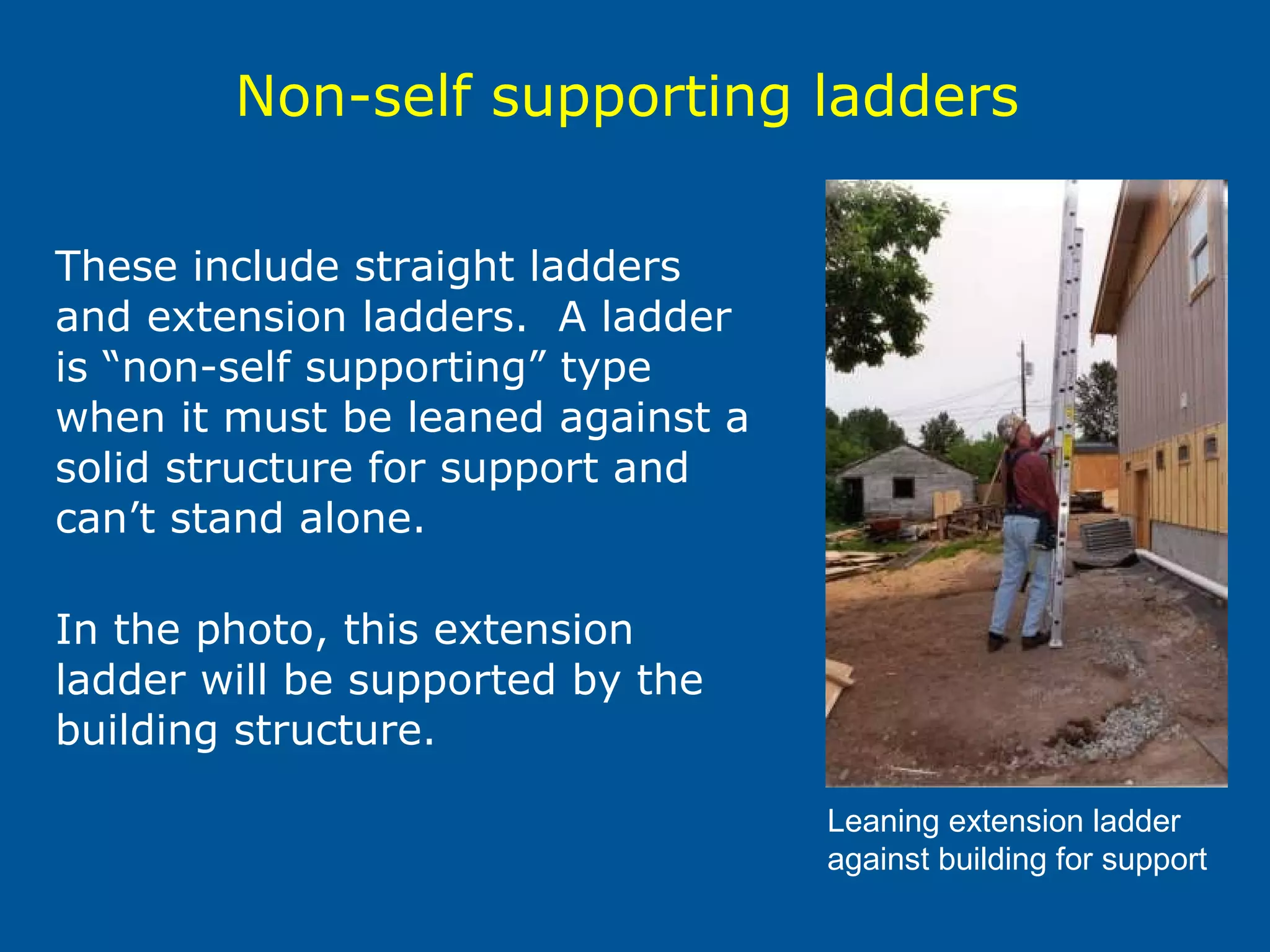
These include straight ladders
and extension ladders. A ladder
is “non-self supporting” type
when it must be leaned against a
solid structure for support and
can’t stand alone.
In the photo, this extension
ladder will be supported by the
building structure.
Leaning extension ladder
against building for support
Non-self supporting ladders
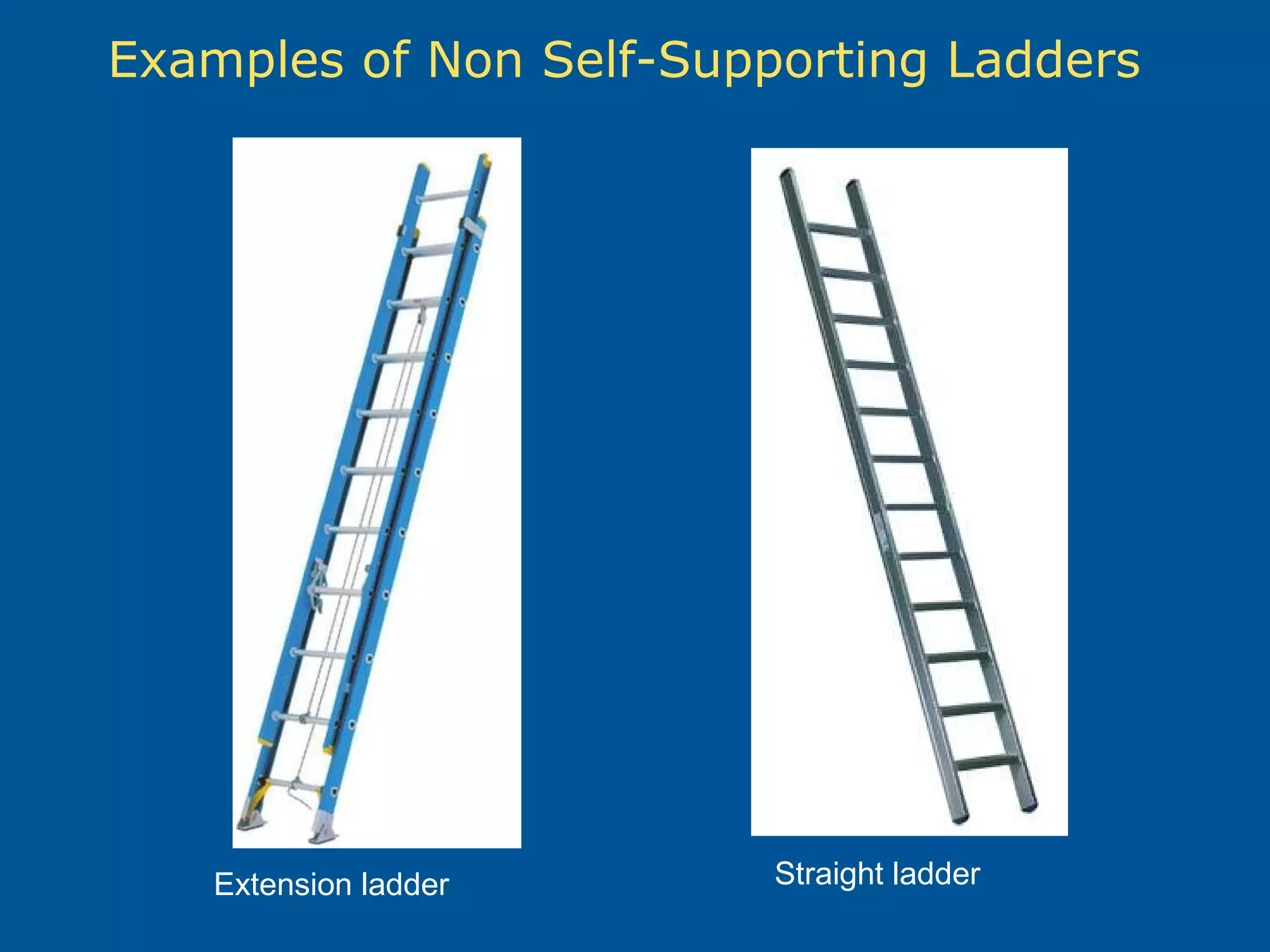
Examples of Non Self-Supporting Ladders
Extension ladder Straight ladder
Extension Ladder parts
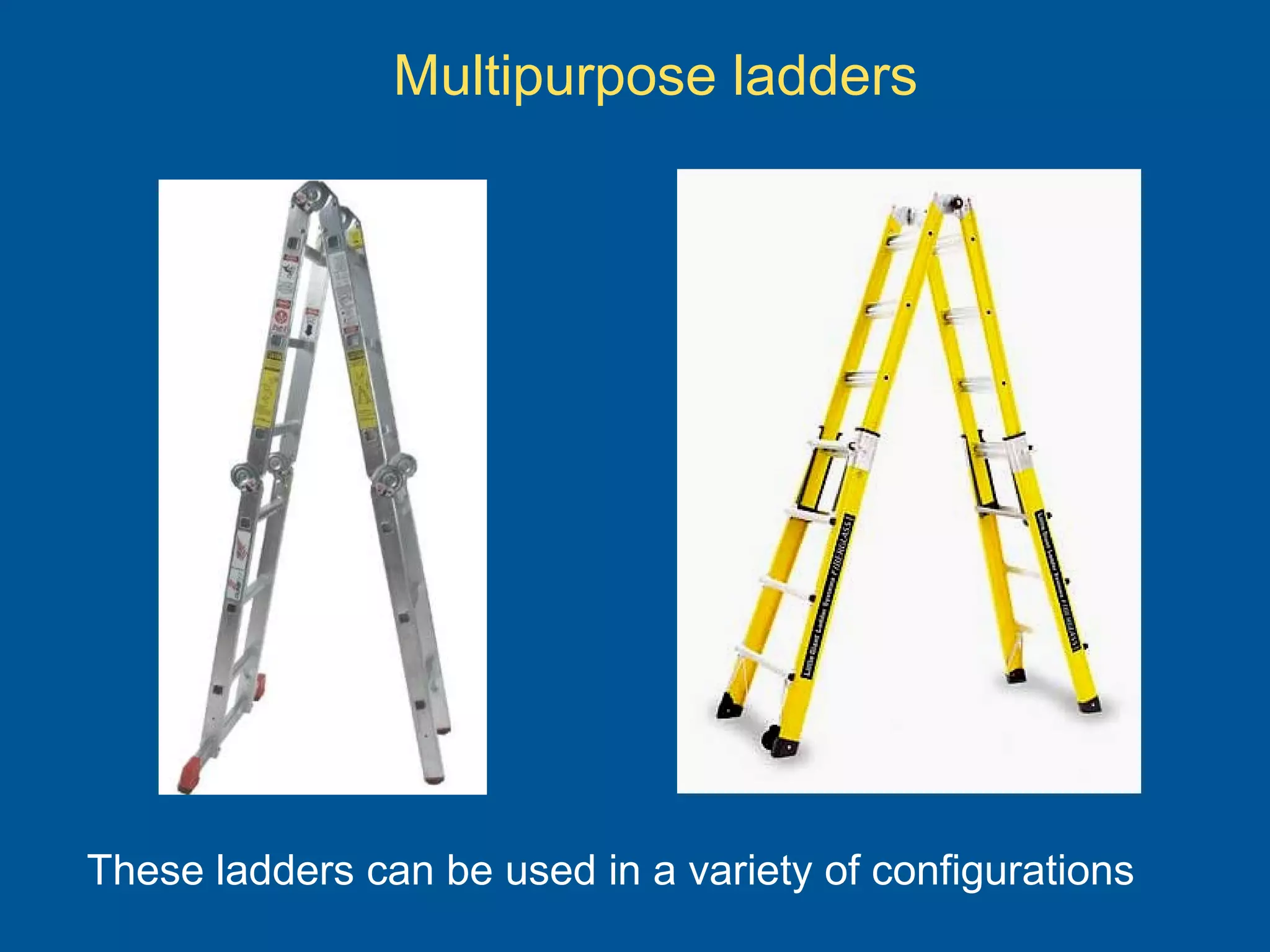
Multipurpose ladders
These ladders can be used in a variety of configurations
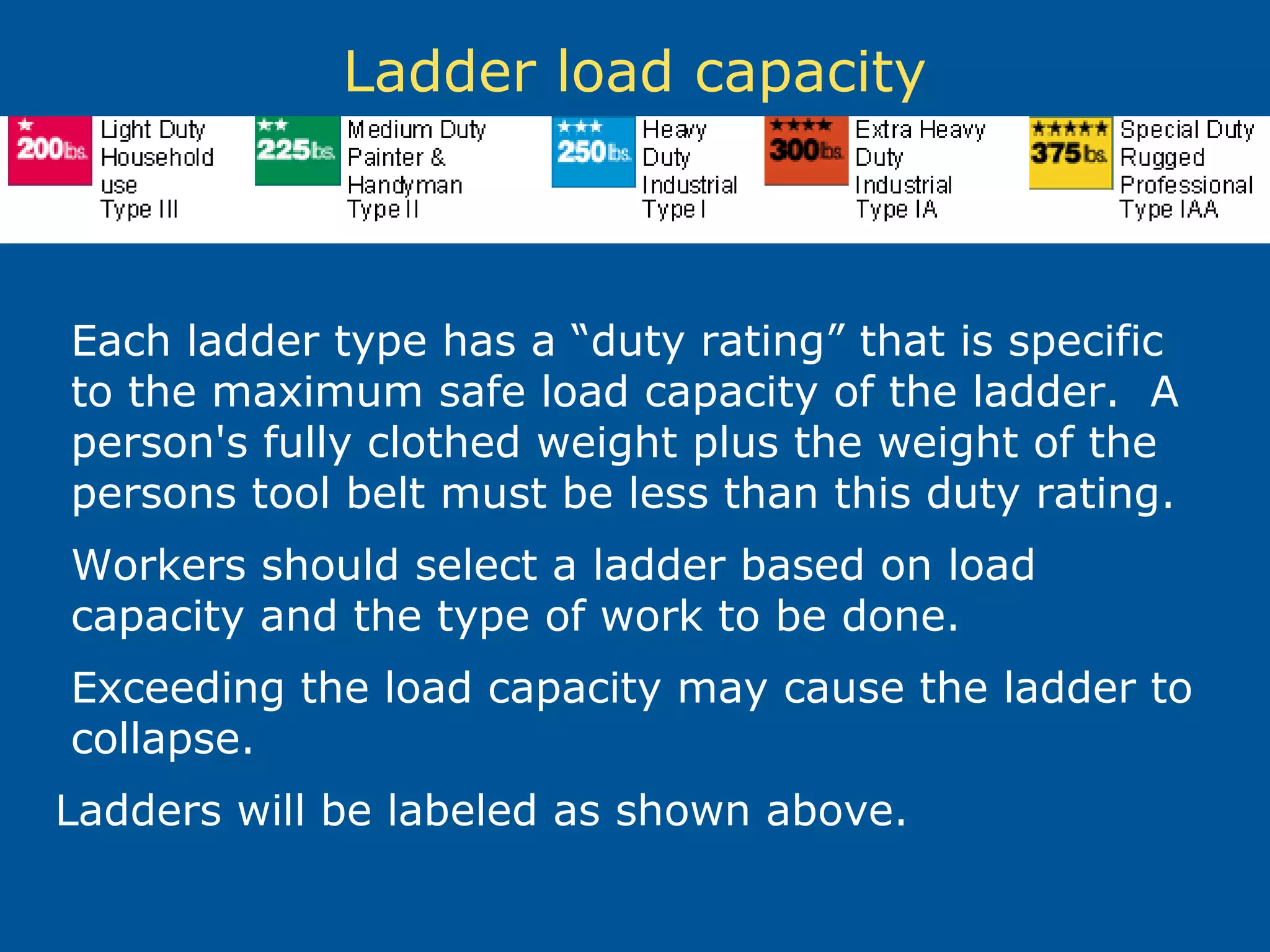
Ladder load capacity
Each ladder type has a “duty rating” that is specific
to the maximum safe load capacity of the ladder. A
person's fully clothed weight plus the weight of the
persons tool belt must be less than this duty rating.
Workers should select a ladder based on load
capacity and the type of work to be done.
Exceeding the load capacity may cause the ladder to
collapse.
Ladders will be labeled as shown above.
Keep Ladders in a Good Condition
Ensure the following:
- Side rails aren't bent, broken, or split
- Rungs, cleats, or steps aren't bent, broken, or missing
- All bolts and rivets are in place and securely tighten
- Joint between the side rails and the individual rungs/steps is tight
- Safety feet are not excessively worn
- Hardware and fittings are securely attached and working properly
- Ropes aren't frayed or badly worn
- Moveable parts operate freely without binding or excessive play.
- Metal components aren't corroded.
- No other faulty or defective components exist.
- Any auxiliary equipment is securely attached, not excessively
worn and functions properly.
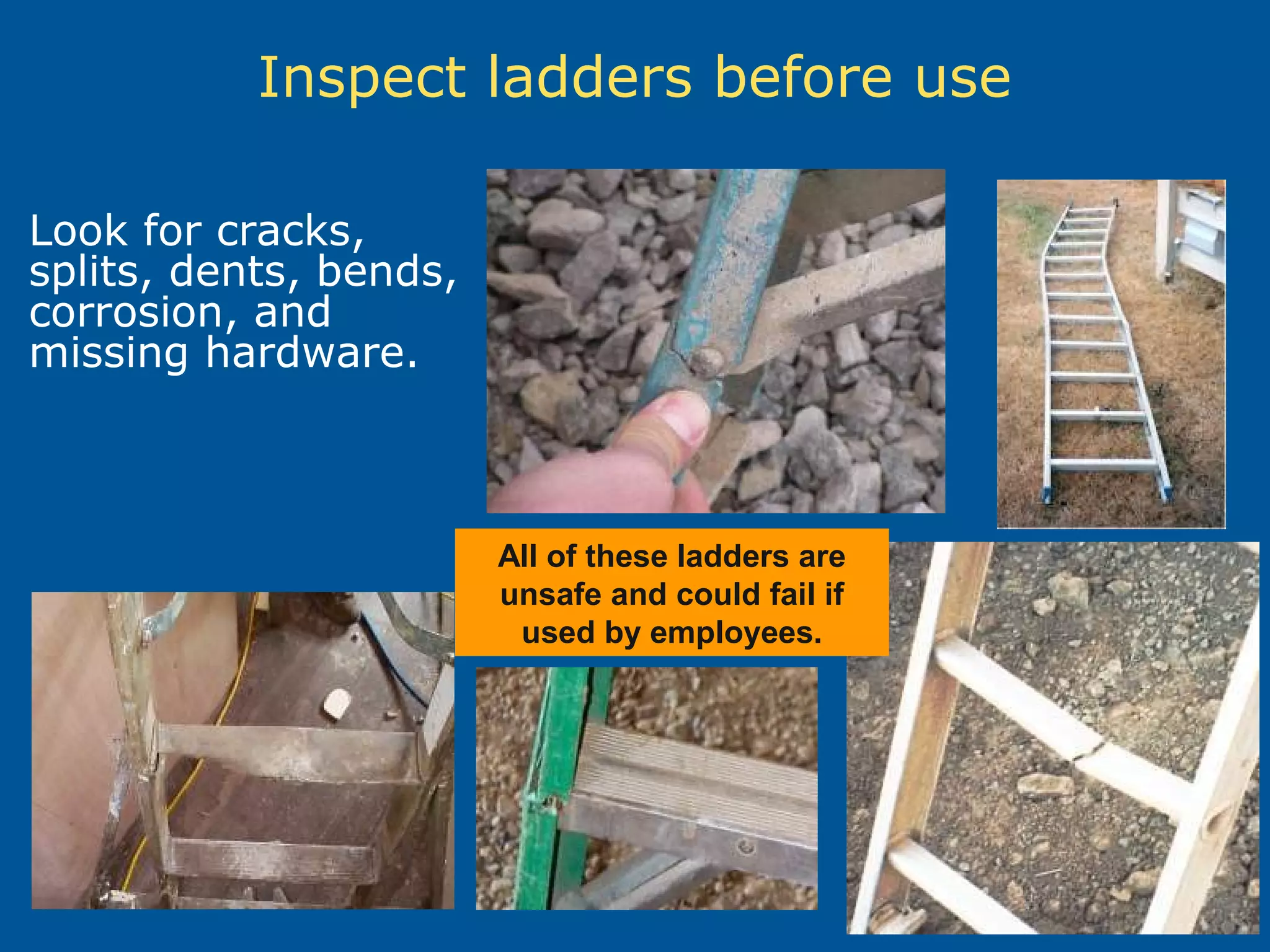
Inspect ladders before use
Look for cracks,
splits, dents, bends,
corrosion, and
missing hardware.
All of these ladders are
unsafe and could fail if
used by employees.
Mud, Oil or Grease
Keep shoes/boots free of
slippery substances.
Inspect ladder rungs for any
oil, grease, mud or other
slippery substances which
could affect traction.
Ladder Positioning
Position ladders so that they are:
 Not in the paths of workers walking through,
 Not in front of unblocked exits,
 Not in front of doors that can open out into the ladder,
 Not on boxes, barrels or other unstable surfaces,
 On solid footing and level at the bottom,
 Stable at the top with each rail supported equally,
 Against a structure capable of supporting the intended load,
 Away from debris and other hazards.
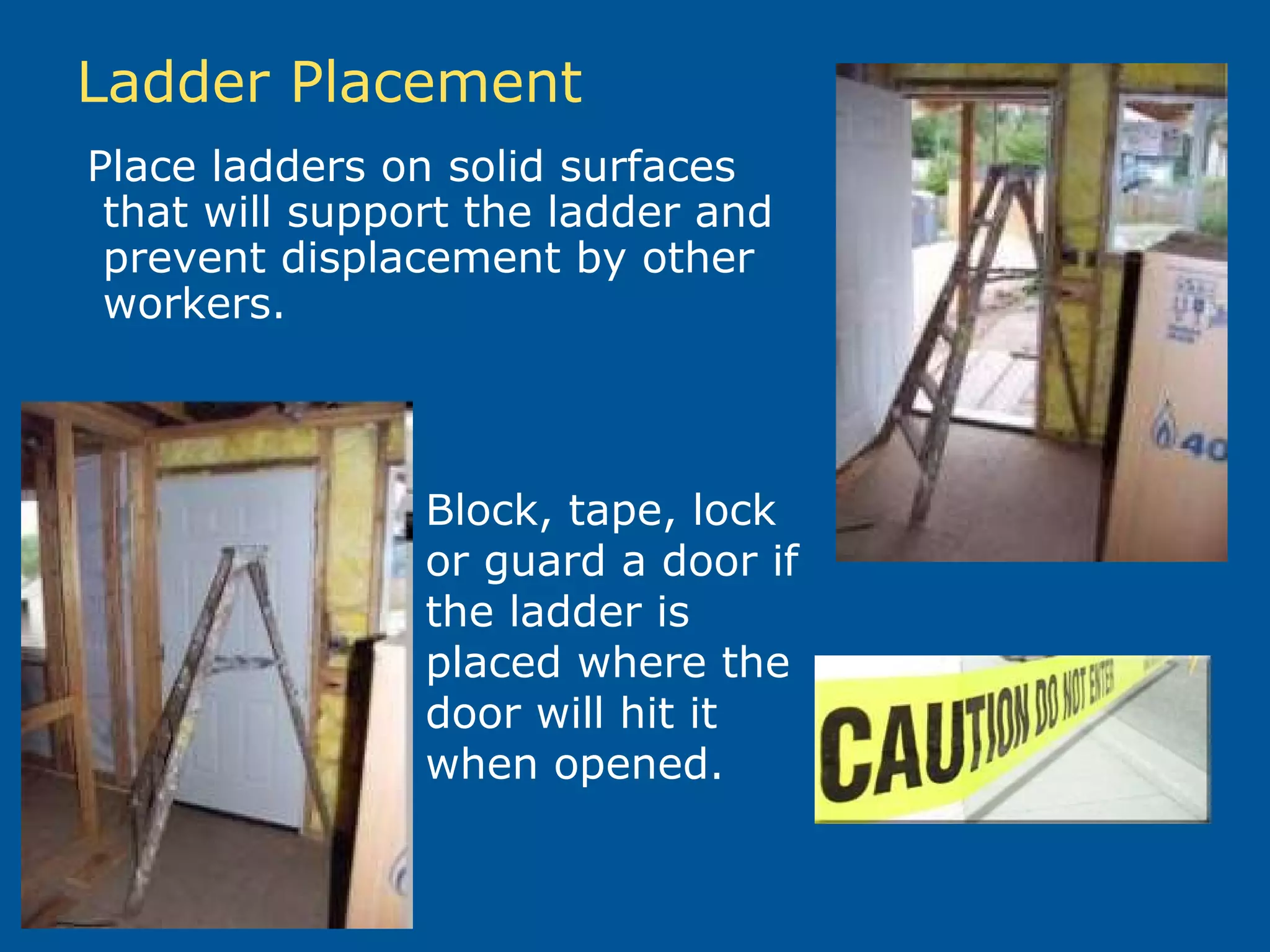
Ladder Placement
Place ladders on solid surfaces
that will support the ladder and
prevent displacement by other
workers.
Block, tape, lock
or guard a door if
the ladder is
placed where the
door will hit it
when opened.
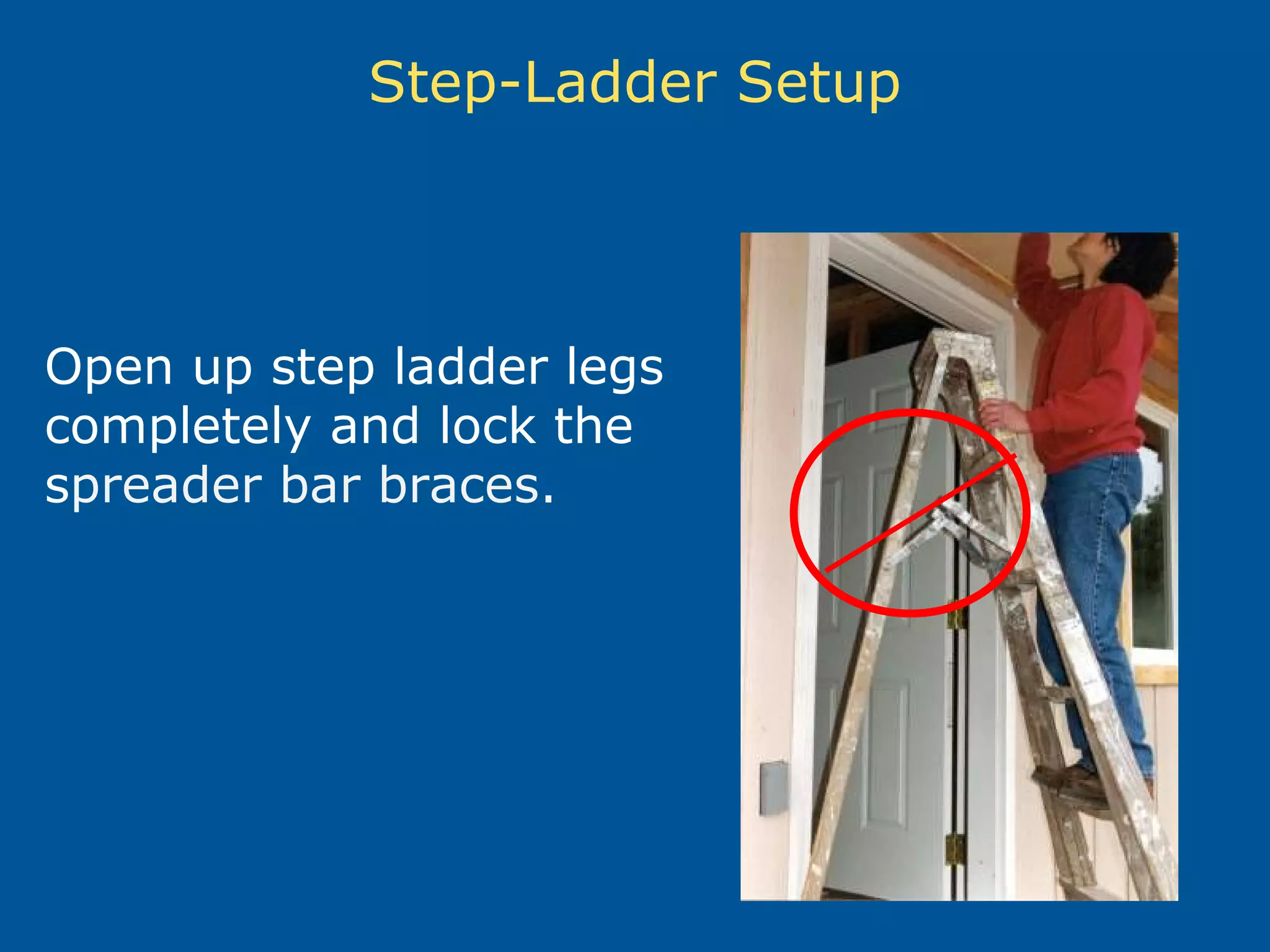
Step-Ladder Setup
Open up step ladder legs
completely and lock the
spreader bar braces.
Never use the top of a step ladder
step ladder too
short for this job
Warning labels on stepladders clearly state that
the top step and top cap are not to be used as a
step. The higher you are on a step ladder, the
less stable it becomes.
Doing this…. …could lead to this!!
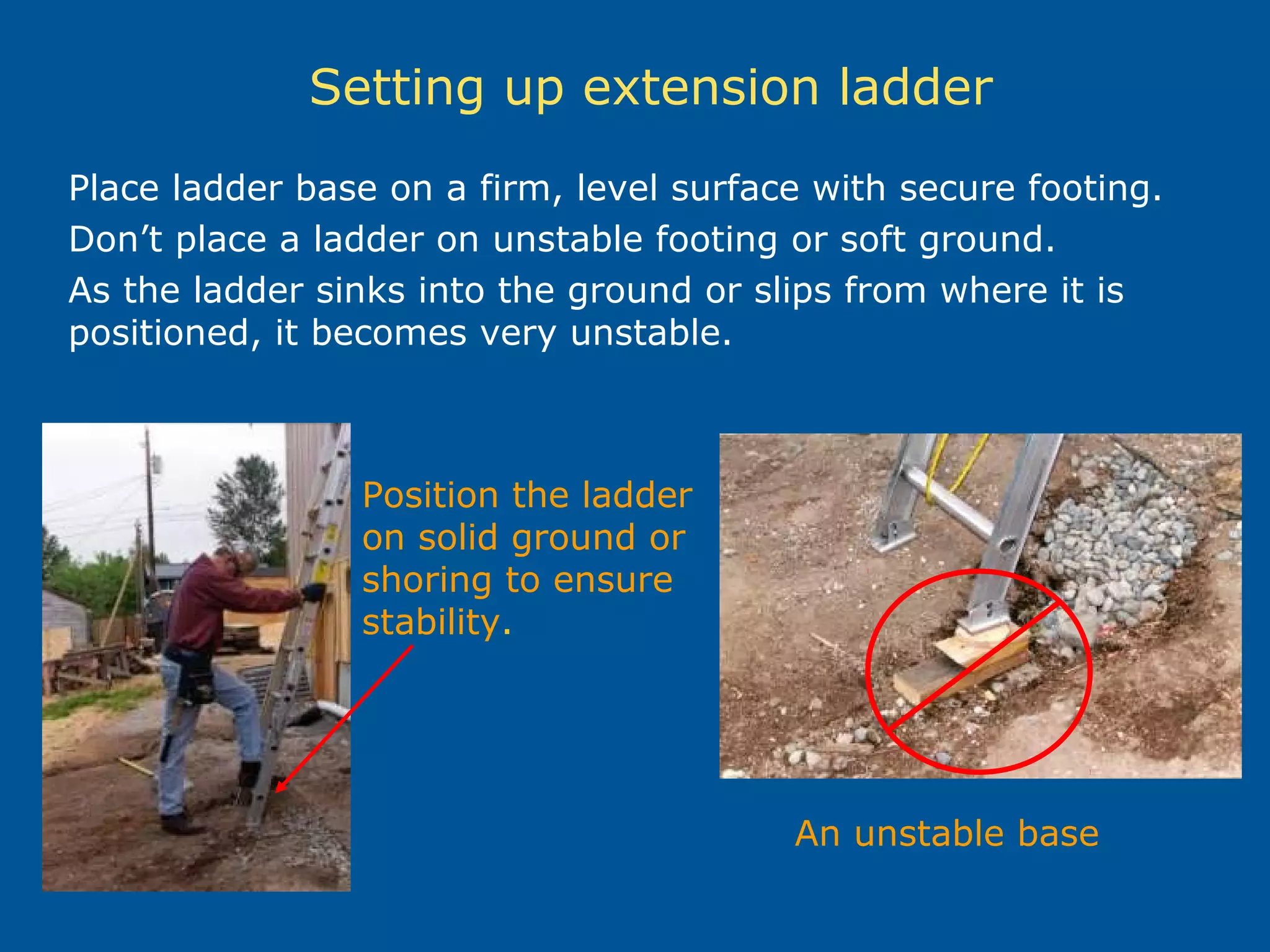
Setting up extension ladder
Place ladder base on a firm, level surface with secure footing.
Don’t place a ladder on unstable footing or soft ground.
As the ladder sinks into the ground or slips from where it is
positioned, it becomes very unstable.
Position the ladder
on solid ground or
shoring to ensure
stability.
An unstable base
Setting up an extension ladder
When working from an
extension ladder, make
sure it is set up at a 4:1
angle with secure
footing on a firm level
surface.
For accessing an upper
level, make sure the
extension ladder is set
up at a 4:1 angle on a
firm, level surface and
the side rails extend at
least 3’ above the
surface to be accessed.
Lastly, make sure the
extension ladder is
secured at the top and
bottom
Proper ladder set-up Improper ladder set-up
(not 3 ft. above roof line)
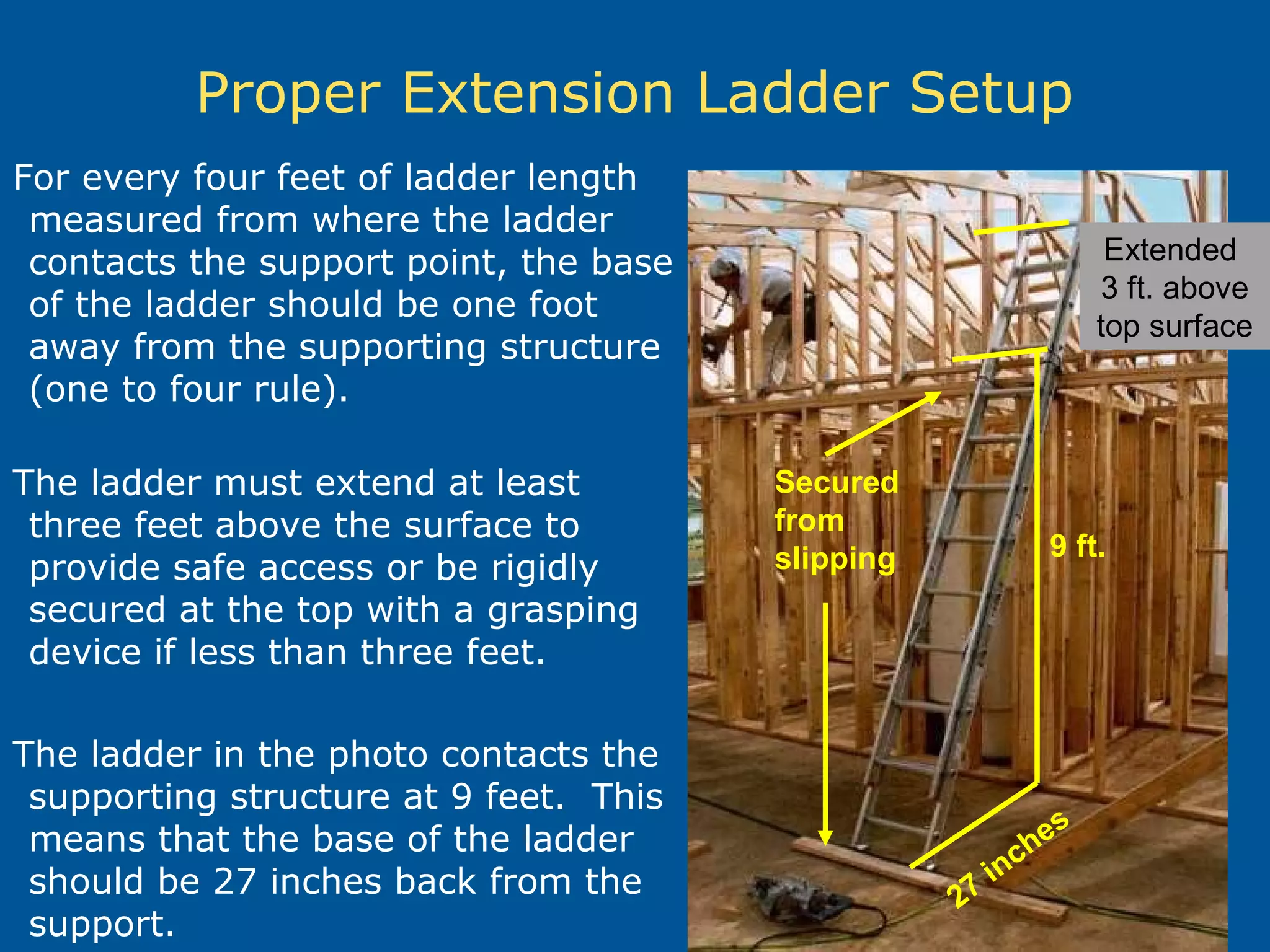
Proper Extension Ladder Setup
For every four feet of ladder length
measured from where the ladder
contacts the support point, the base
of the ladder should be one foot
away from the supporting structure
(one to four rule).
The ladder must extend at least
three feet above the surface to
provide safe access or be rigidly
secured at the top with a grasping
device if less than three feet.
The ladder in the photo contacts the
supporting structure at 9 feet. This
means that the base of the ladder
should be 27 inches back from the
support.
27
inches
9 ft.
Secured
from
slipping
Extended
3 ft. above
top surface
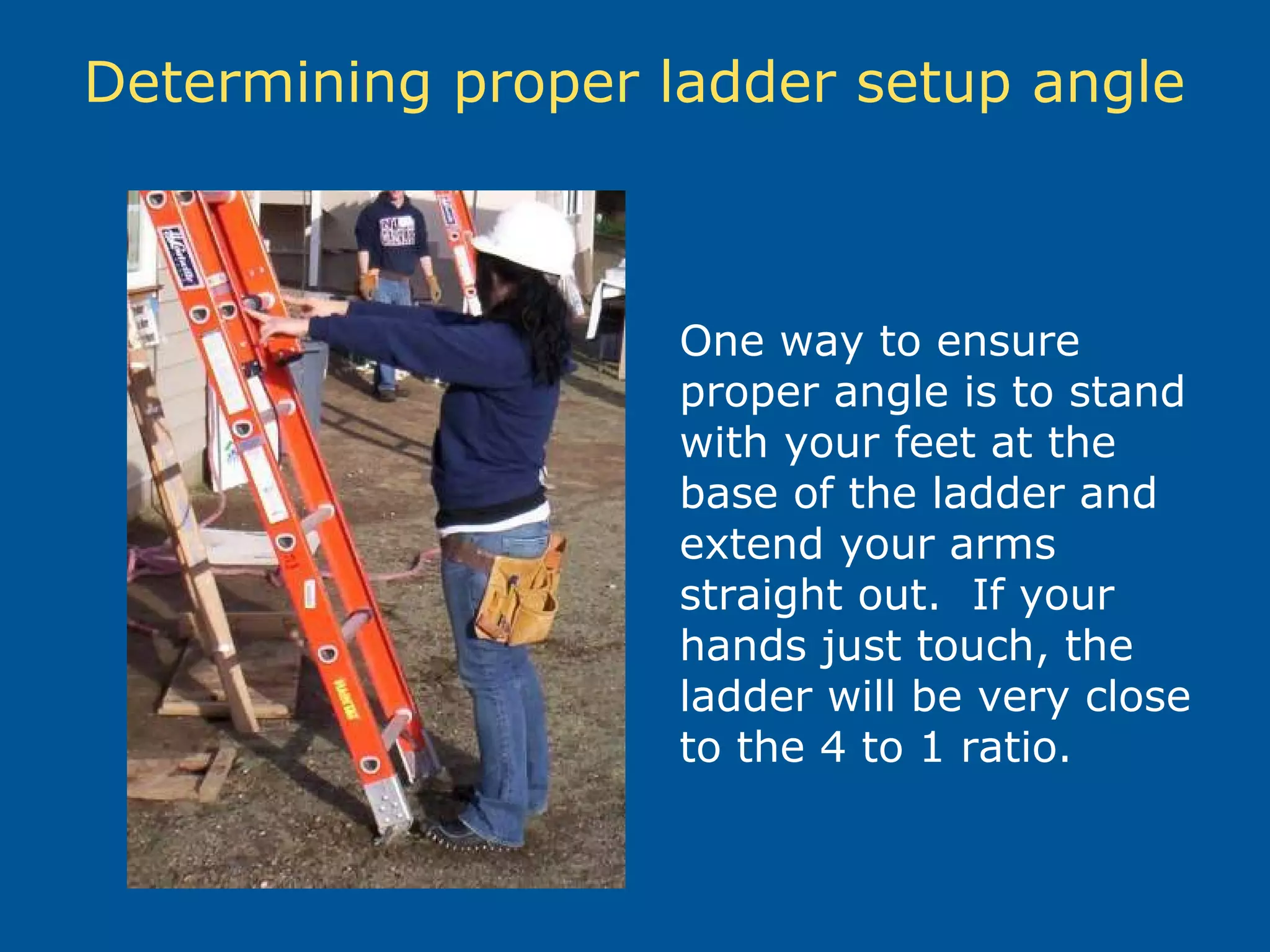
Determining proper ladder setup angle
One way to ensure
proper angle is to stand
with your feet at the
base of the ladder and
extend your arms
straight out. If your
hands just touch, the
ladder will be very close
to the 4 to 1 ratio.
Ladder set-up on uneven ground
Ladder can be set up straight and level on just about
any type of uneven surface using ladder levels
attached to the side rails.
Straight ladder stabilizers
The straight ladder side rails must be equally
supported at the top, unless the ladder is equipped
with an adequate stabilizer.
Ladders with top stabilizers
Climbing or descending a ladder
When climbing a ladder, you must have both hands
free and face the ladder. This allows for three points
of contact with the ladder at all times and reduces the
chances of falling. The three point contact is two
hands and one foot or one hand and two feet.
This way
Not this way
Climbing and descending
This worker does not have both
hands free to hold onto the
ladder while climbing or
descending the ladder.
Proper ladder climbing with
tools on belt and both
hands free
Overreaching from the sides
Doing this…. Could result in this!
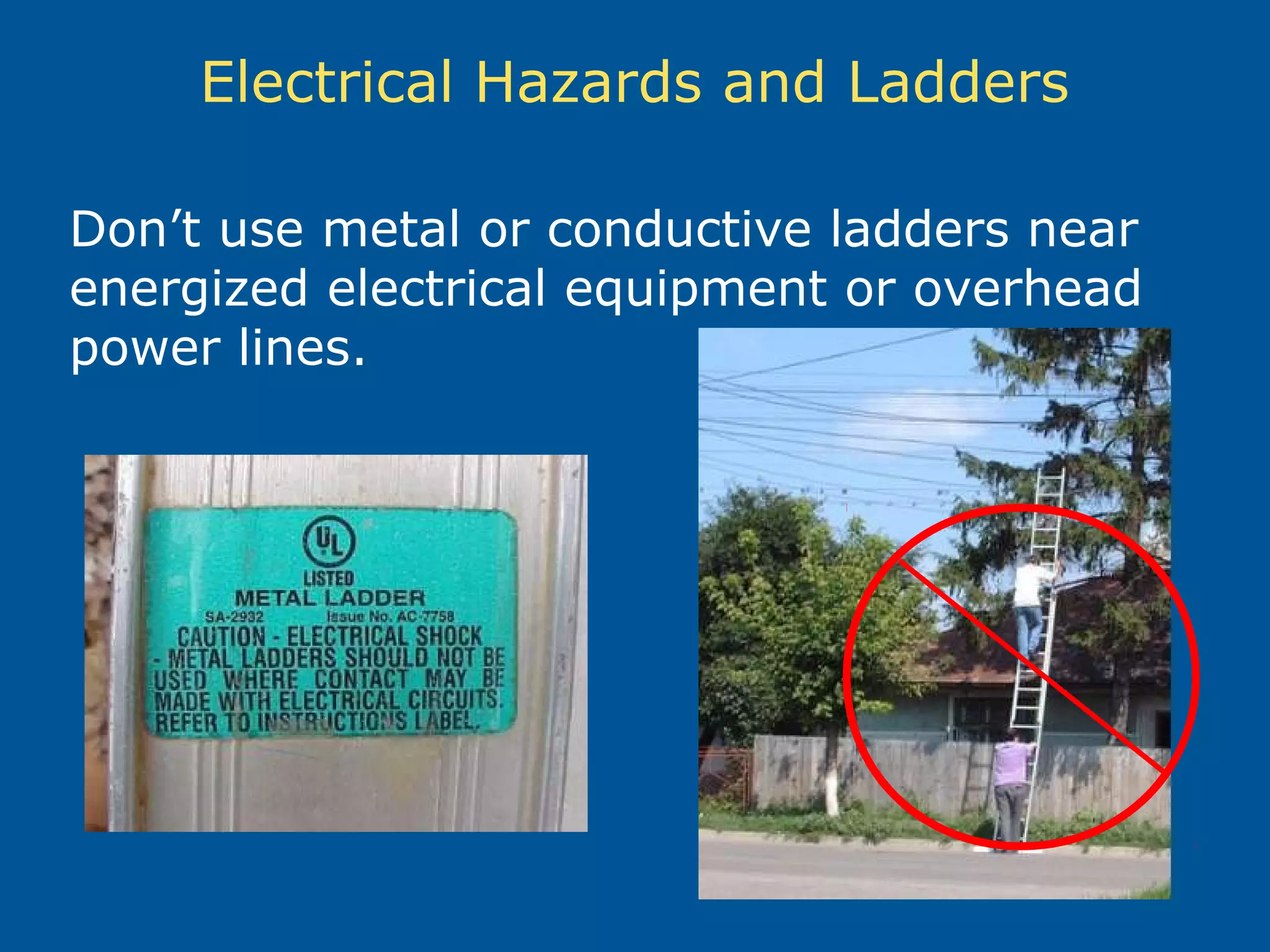
Electrical Hazards and Ladders
Don’t use metal or conductive ladders near
energized electrical equipment or overhead
power lines.
Tying Extension ladders
Don’t tie or fasten ladder sections together to make a
longer ladder, unless the manufacturer specifically
endorses this modification using hardware fittings
designed for that purpose.
Ladder misuse
A ladder must be used only for purposes
specifically recommended by the manufacturer.
The ladder in this photo is being as a ramp to
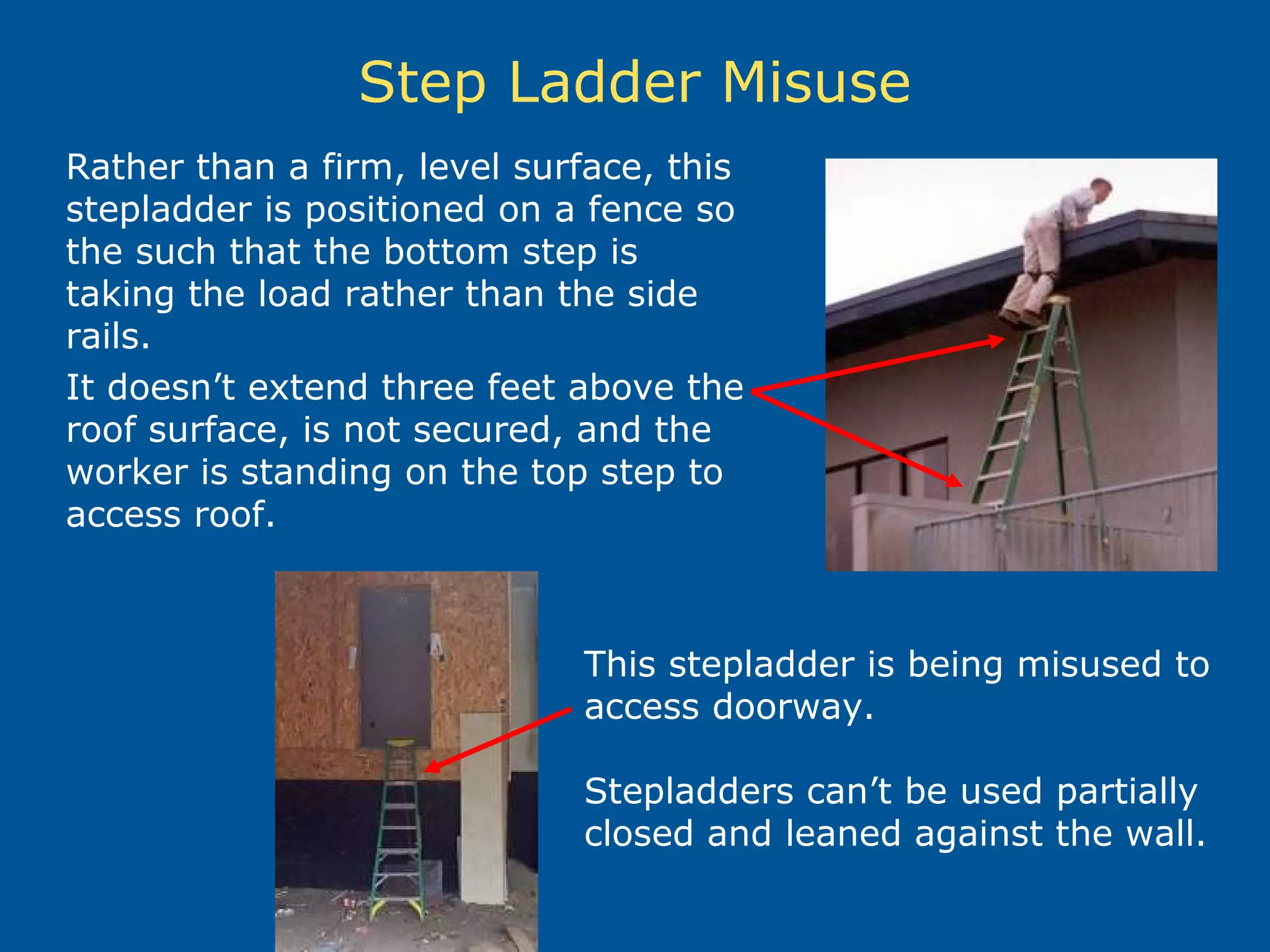
Step Ladder Misuse
Rather than a firm, level surface, this
stepladder is positioned on a fence so
the such that the bottom step is
taking the load rather than the side
rails.
It doesn’t extend three feet above the
roof surface, is not secured, and the
worker is standing on the top step to
access roof.
This stepladder is being misused to
access doorway.
Stepladders can’t be used partially
closed and leaned against the wall.
Stepladder Misuse
A 3-legged step-
ladder with the
worker standing
on the top cap
and balancing
on one foot.
(Also, no safety
glasses while using a
nail gun and hard hat
is worn backwards)
Step ladder misuse
This step ladder is not
fully opened with
spreader bar locked and
the step ladder side rails
are straddling a scaffold
plank being set up in a
position not intended by
the manufacturer.
Hazardous Ladder Use
A 3-legged step-ladder
leaned against a 2x4
nailed across the
window.
A repair patch on the
left front side rail of
ladder.
No fall protection in use
while working at height.
Hazardous ladder use
Unsecured, folded step-ladder
set on an angled shed roof so
that only the tips of the side
rails lay on roof.
Extension ladder not extended
at least 3-feet above roof, set
up at an angle greater than a
4:1, and it’s not secured top
and bottom to prevent
movement.
No fall protection being used
while on this walking/working
surface.
Ladder Misuse
Two workers using two
step-ladders leaned
against wall, set up over
wood debris, with the far
worker standing on the top
step. (also, third worker needs
fall protection)
A better choice in ladders would make this job easier!!
More safe ladder practices
Use a ladder only when you are mentally alert and physically able.
Don’t let your belt buckle pass beyond either ladder side rails.
Hold the ladder with one hand while working with the other.
Don't hurry or skip rungs /steps when using the ladder.
Be careful when pushing or pulling anything while up on a ladder.
A few more ladder safe practices
Don't test a ladder by jumping on it.
Don't paint a wood ladder.
Don't use any ladder that has been exposed to fire or other strong
chemicals.
Protect ladders from environmental elements such as: excessive
heat or cold.
Don't drop or throw ladders.
Store ladders out of the way of other employees.
Secure ladders firmly when transporting on vehicles.
More Information
OSHA Construction eTool – ladders
CPWR – Ladder Safety (safety meeting
topic)
CPWR Video – ladder safety (online video)
L & I Video Library (several videos on ladder
safety)

Ladder Safety in Construction

  • 1.
    Ladder Safety inConstruction Developed by Division of Occupational Safety and Health September, 2009
  • 2.
    Ladder Safety inConstruction Falls from ladders are one of the leading causes of injuries in the construction trade. The majority of the falls are caused by misuse, faulty ladders or carelessness. The Ladder Safety Rule (WAC 296-876) was written to reduce or eliminate these mishaps. This presentation provides some basic safety practices on ladder use based on these regulations.
  • 3.
    Improperly getting onor off the ladder Loss of balance Setting up the ladder improperly Overreaching while on the ladder Mis-stepping or slipping while climbing or descending Common causes of ladder injuries
  • 4.
    Other causes offalls from ladders  Lack of training on safe ladder use  Using the wrong type ladder for the job  Exceeding the ladder weight capacity  Climbing ladder with tools or material in hands  Climbing or descending not facing the ladder  Oil, grease or mud on ladder rungs  Ladder not secure at the base or top  Ladder not set up at the proper angle  Ladder not extended 3 feet above upper surface  Using the top step of a step ladder  Placing ladder on unstable surfaces  Over-reaching beyond the side rails of the ladder
  • 5.
    Ladder Training Every employeethat uses a ladder must be trained by a competent person in the use, placement and construction of the ladder and the hazards associated with them. A competent person is anyone who is knowledgeable of the ladders to be used, can recognize all the hazards associated with ladders and has the authority to take the necessary action to eliminate these hazards.
  • 6.
    These include stepladdersand have one or two extra legs that are attached to the ladder for support. They do not require a structure to support them. Self-supporting ladders Tripod LadderFiberglass stepladder Wood stepladder Trestle ladder
  • 7.
    Ladder Parts –Step Ladder
  • 8.
    These include straightladders and extension ladders. A ladder is “non-self supporting” type when it must be leaned against a solid structure for support and can’t stand alone. In the photo, this extension ladder will be supported by the building structure. Leaning extension ladder against building for support Non-self supporting ladders
  • 9.
    Examples of NonSelf-Supporting Ladders Extension ladder Straight ladder
  • 10.
  • 11.
    Multipurpose ladders These ladderscan be used in a variety of configurations
  • 12.
    Ladder load capacity Eachladder type has a “duty rating” that is specific to the maximum safe load capacity of the ladder. A person's fully clothed weight plus the weight of the persons tool belt must be less than this duty rating. Workers should select a ladder based on load capacity and the type of work to be done. Exceeding the load capacity may cause the ladder to collapse. Ladders will be labeled as shown above.
  • 13.
    Keep Ladders ina Good Condition Ensure the following: - Side rails aren't bent, broken, or split - Rungs, cleats, or steps aren't bent, broken, or missing - All bolts and rivets are in place and securely tighten - Joint between the side rails and the individual rungs/steps is tight - Safety feet are not excessively worn - Hardware and fittings are securely attached and working properly - Ropes aren't frayed or badly worn - Moveable parts operate freely without binding or excessive play. - Metal components aren't corroded. - No other faulty or defective components exist. - Any auxiliary equipment is securely attached, not excessively worn and functions properly.
  • 14.
    Inspect ladders beforeuse Look for cracks, splits, dents, bends, corrosion, and missing hardware. All of these ladders are unsafe and could fail if used by employees.
  • 15.
    Mud, Oil orGrease Keep shoes/boots free of slippery substances. Inspect ladder rungs for any oil, grease, mud or other slippery substances which could affect traction.
  • 16.
    Ladder Positioning Position laddersso that they are:  Not in the paths of workers walking through,  Not in front of unblocked exits,  Not in front of doors that can open out into the ladder,  Not on boxes, barrels or other unstable surfaces,  On solid footing and level at the bottom,  Stable at the top with each rail supported equally,  Against a structure capable of supporting the intended load,  Away from debris and other hazards.
  • 17.
    Ladder Placement Place ladderson solid surfaces that will support the ladder and prevent displacement by other workers. Block, tape, lock or guard a door if the ladder is placed where the door will hit it when opened.
  • 18.
    Step-Ladder Setup Open upstep ladder legs completely and lock the spreader bar braces.
  • 19.
    Never use thetop of a step ladder step ladder too short for this job Warning labels on stepladders clearly state that the top step and top cap are not to be used as a step. The higher you are on a step ladder, the less stable it becomes. Doing this…. …could lead to this!!
  • 20.
    Setting up extensionladder Place ladder base on a firm, level surface with secure footing. Don’t place a ladder on unstable footing or soft ground. As the ladder sinks into the ground or slips from where it is positioned, it becomes very unstable. Position the ladder on solid ground or shoring to ensure stability. An unstable base
  • 21.
    Setting up anextension ladder When working from an extension ladder, make sure it is set up at a 4:1 angle with secure footing on a firm level surface. For accessing an upper level, make sure the extension ladder is set up at a 4:1 angle on a firm, level surface and the side rails extend at least 3’ above the surface to be accessed. Lastly, make sure the extension ladder is secured at the top and bottom Proper ladder set-up Improper ladder set-up (not 3 ft. above roof line)
  • 22.
    Proper Extension LadderSetup For every four feet of ladder length measured from where the ladder contacts the support point, the base of the ladder should be one foot away from the supporting structure (one to four rule). The ladder must extend at least three feet above the surface to provide safe access or be rigidly secured at the top with a grasping device if less than three feet. The ladder in the photo contacts the supporting structure at 9 feet. This means that the base of the ladder should be 27 inches back from the support. 27 inches 9 ft. Secured from slipping Extended 3 ft. above top surface
  • 23.
    Determining proper laddersetup angle One way to ensure proper angle is to stand with your feet at the base of the ladder and extend your arms straight out. If your hands just touch, the ladder will be very close to the 4 to 1 ratio.
  • 24.
    Ladder set-up onuneven ground Ladder can be set up straight and level on just about any type of uneven surface using ladder levels attached to the side rails.
  • 25.
    Straight ladder stabilizers Thestraight ladder side rails must be equally supported at the top, unless the ladder is equipped with an adequate stabilizer. Ladders with top stabilizers
  • 26.
    Climbing or descendinga ladder When climbing a ladder, you must have both hands free and face the ladder. This allows for three points of contact with the ladder at all times and reduces the chances of falling. The three point contact is two hands and one foot or one hand and two feet. This way Not this way
  • 27.
    Climbing and descending Thisworker does not have both hands free to hold onto the ladder while climbing or descending the ladder. Proper ladder climbing with tools on belt and both hands free
  • 28.
    Overreaching from thesides Doing this…. Could result in this!
  • 29.
    Electrical Hazards andLadders Don’t use metal or conductive ladders near energized electrical equipment or overhead power lines.
  • 30.
    Tying Extension ladders Don’ttie or fasten ladder sections together to make a longer ladder, unless the manufacturer specifically endorses this modification using hardware fittings designed for that purpose.
  • 31.
    Ladder misuse A laddermust be used only for purposes specifically recommended by the manufacturer. The ladder in this photo is being as a ramp to
  • 32.
    Step Ladder Misuse Ratherthan a firm, level surface, this stepladder is positioned on a fence so the such that the bottom step is taking the load rather than the side rails. It doesn’t extend three feet above the roof surface, is not secured, and the worker is standing on the top step to access roof. This stepladder is being misused to access doorway. Stepladders can’t be used partially closed and leaned against the wall.
  • 33.
    Stepladder Misuse A 3-leggedstep- ladder with the worker standing on the top cap and balancing on one foot. (Also, no safety glasses while using a nail gun and hard hat is worn backwards)
  • 34.
    Step ladder misuse Thisstep ladder is not fully opened with spreader bar locked and the step ladder side rails are straddling a scaffold plank being set up in a position not intended by the manufacturer.
  • 35.
    Hazardous Ladder Use A3-legged step-ladder leaned against a 2x4 nailed across the window. A repair patch on the left front side rail of ladder. No fall protection in use while working at height.
  • 36.
    Hazardous ladder use Unsecured,folded step-ladder set on an angled shed roof so that only the tips of the side rails lay on roof. Extension ladder not extended at least 3-feet above roof, set up at an angle greater than a 4:1, and it’s not secured top and bottom to prevent movement. No fall protection being used while on this walking/working surface.
  • 37.
    Ladder Misuse Two workersusing two step-ladders leaned against wall, set up over wood debris, with the far worker standing on the top step. (also, third worker needs fall protection) A better choice in ladders would make this job easier!!
  • 38.
    More safe ladderpractices Use a ladder only when you are mentally alert and physically able. Don’t let your belt buckle pass beyond either ladder side rails. Hold the ladder with one hand while working with the other. Don't hurry or skip rungs /steps when using the ladder. Be careful when pushing or pulling anything while up on a ladder.
  • 39.
    A few moreladder safe practices Don't test a ladder by jumping on it. Don't paint a wood ladder. Don't use any ladder that has been exposed to fire or other strong chemicals. Protect ladders from environmental elements such as: excessive heat or cold. Don't drop or throw ladders. Store ladders out of the way of other employees. Secure ladders firmly when transporting on vehicles.
  • 40.
    More Information OSHA ConstructioneTool – ladders CPWR – Ladder Safety (safety meeting topic) CPWR Video – ladder safety (online video) L & I Video Library (several videos on ladder safety)