Safety Training
Working at Heights
Falls are the leading cause of deaths in the
construction industry.
Most fatalities occur when employees fall from open-
sided floors and through floor openings.
Falls from as little as .5 meter can cause serious lost-
time accidents and sometimes death.
Falls in Construction
The Fall Protection Hierarchy shall be considered when
designing fall protection solutions for both existing and new
facilities.
Unprotected falls from elevation usually result in
serious debilitating injury or death. Falls can be
prevented through the use of proper prevention and
arrest systems. All work from elevated work surfaces
will be accomplished without any risk of falling to a
lower level. This goal is achieved by adhering to the
following fall protection hierarchy:
Fall Protection Hierarchy
Remove the hazard: avoid working at heights. Bring the
work down to the ground level whenever possible.
If work at heights is unavoidable, secure the elevated work
area with a passive fall prevention barrier system, such as
guardrails.
When a barrier system is not feasible because of the
physical characteristics of the work environment or the
infrequency of access, use an approved fall restraint system
or a MEWP (Motorized Elevated Work Platform)
If no other option is feasible, a properly engineered and
approved fall arrest system can be used in conjunction with
a rescue plan.
Fall Protection Hierarchy
Personal Fall
Arrest System
(PFAS)
Guardrails and work
platforms
Safety Nets
Fall Protection Options
Top rails between 100 cm and 115 cm tall
Mid-Rail located 30 – 40 cm below top rail
Toeboards at least 10 cm high
Guardrails
Top Rail
Mid- Rail
Toeboard
Rails must be able
to withstand a force
of 200 pounds/ 90
Kilograms
Handrail and
Top Rail Strength
Safety Nets
Place safety nets as close as possible below where employees
are working. Safety nets must be installed and inspected
by a competent person
Personal Fall Arrest Systems
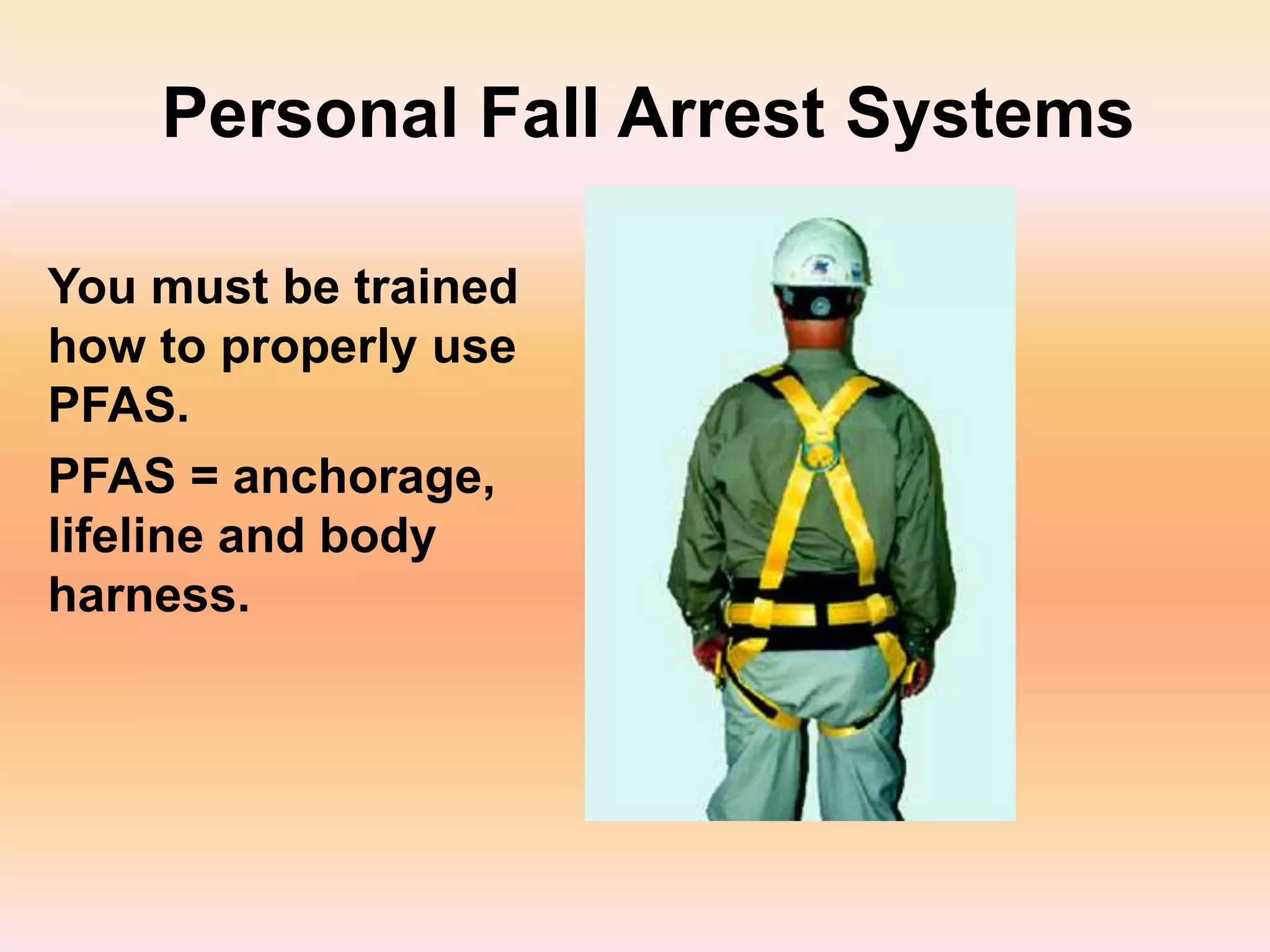
You must be trained
how to properly use
PFAS.
PFAS = anchorage,
lifeline and body
harness.
Must be independent
of any platform
anchorage and
capable of
supporting at least
5,000 lbs/ 2,250 Kilo
per worker
Safety Line Anchorages
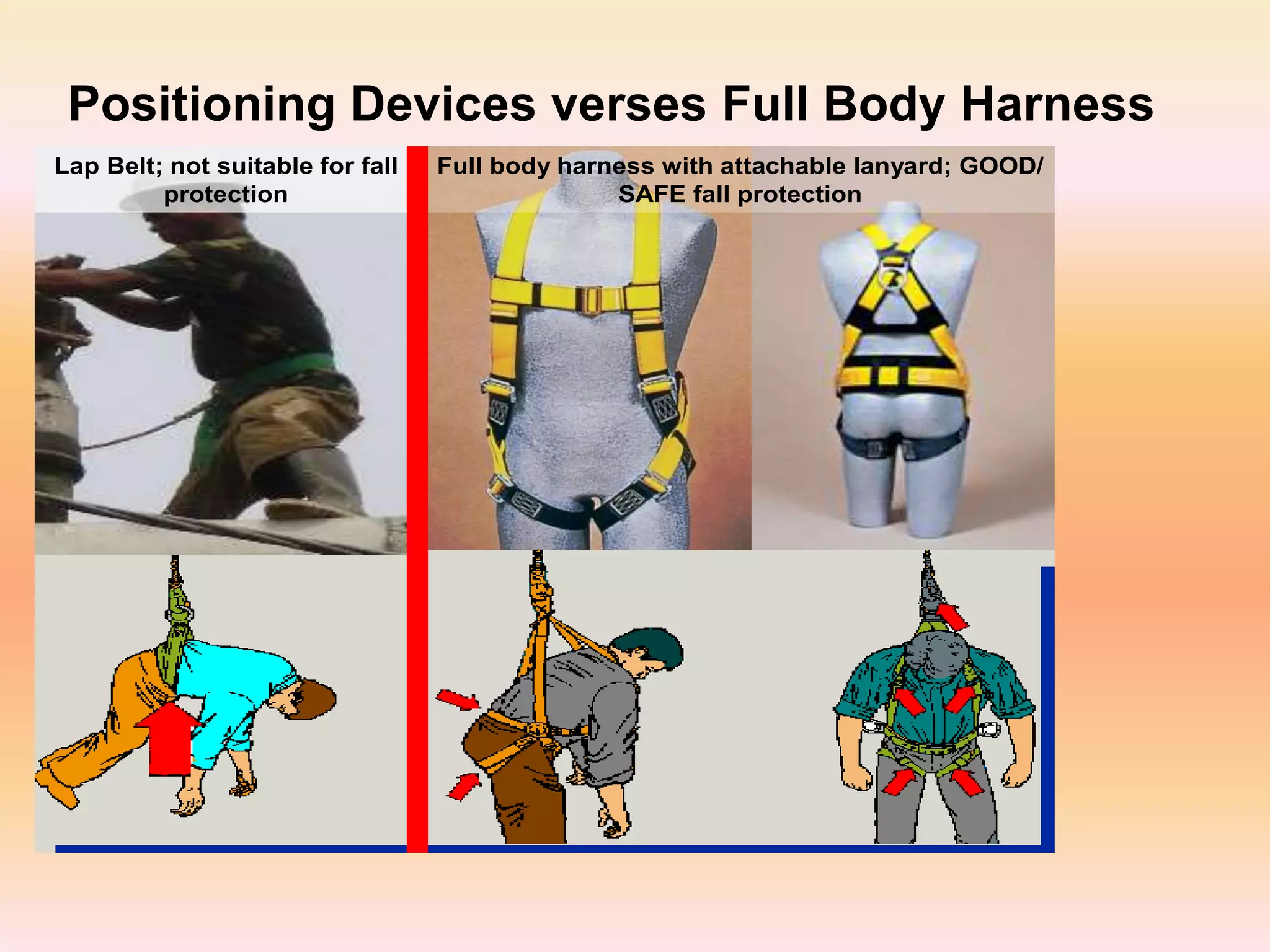
Lap Belt; not suitable for fall
protection
Full body harness with attachable lanyard; GOOD/
SAFE fall protection
Positioning Devices verses Full Body Harness
When Fall Protection is Needed
Walkways & ramps
Unprotected sides & edges
Wall openings
Holes
Scaffolds
Work platforms
False work
Concrete forms & rebar
Open excavations
MEWP (Motorized Elevated Work Platform)
Scissor lifts
Man riding baskets (crane lifted)
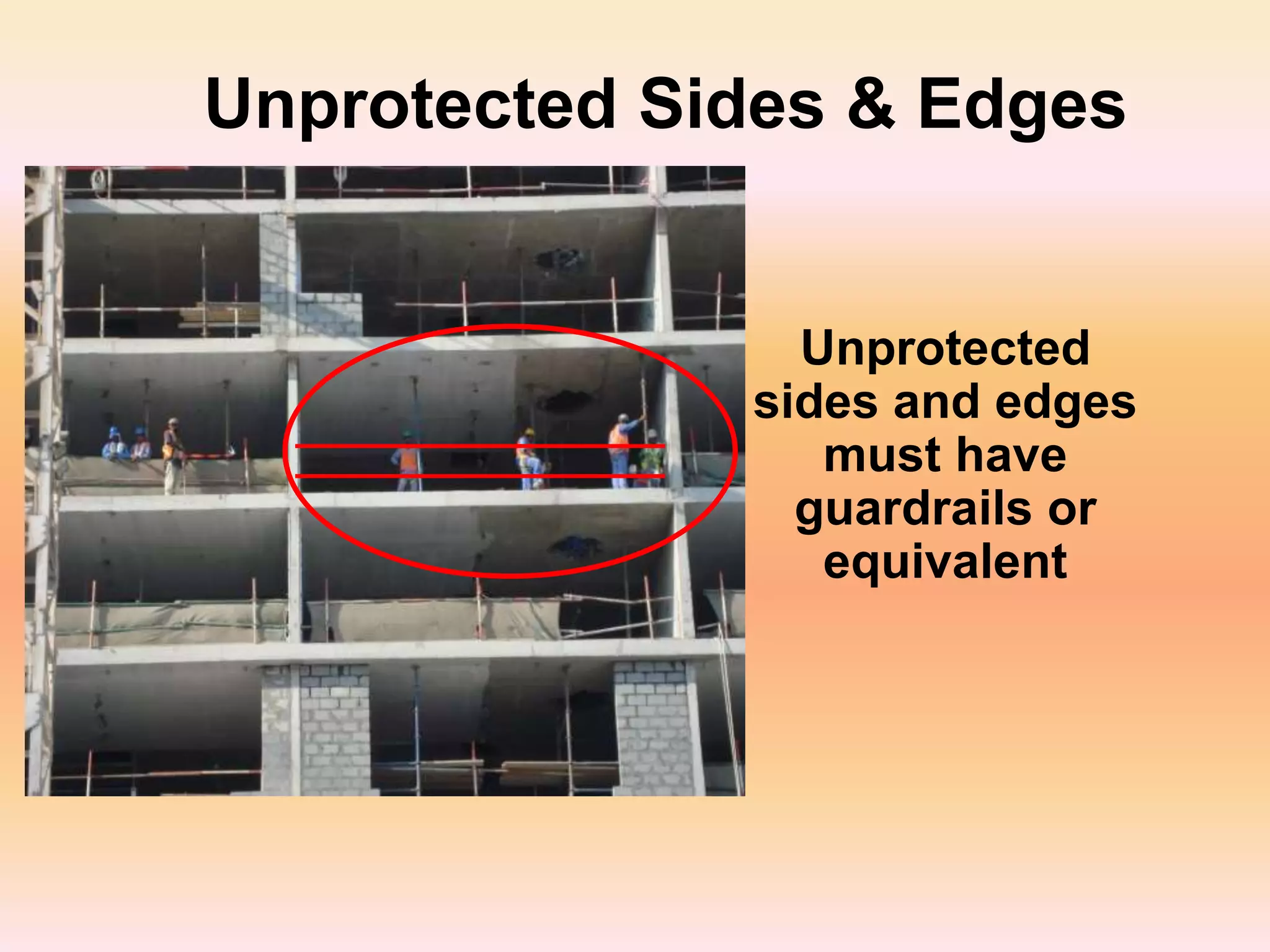
Unprotected
sides and edges
must have
guardrails or
equivalent
Unprotected Sides & Edges
Sides & Edges - Improper Guarding
This ¼ inch/ 7 mm nylon rope is not a
proper way to guard an open floor
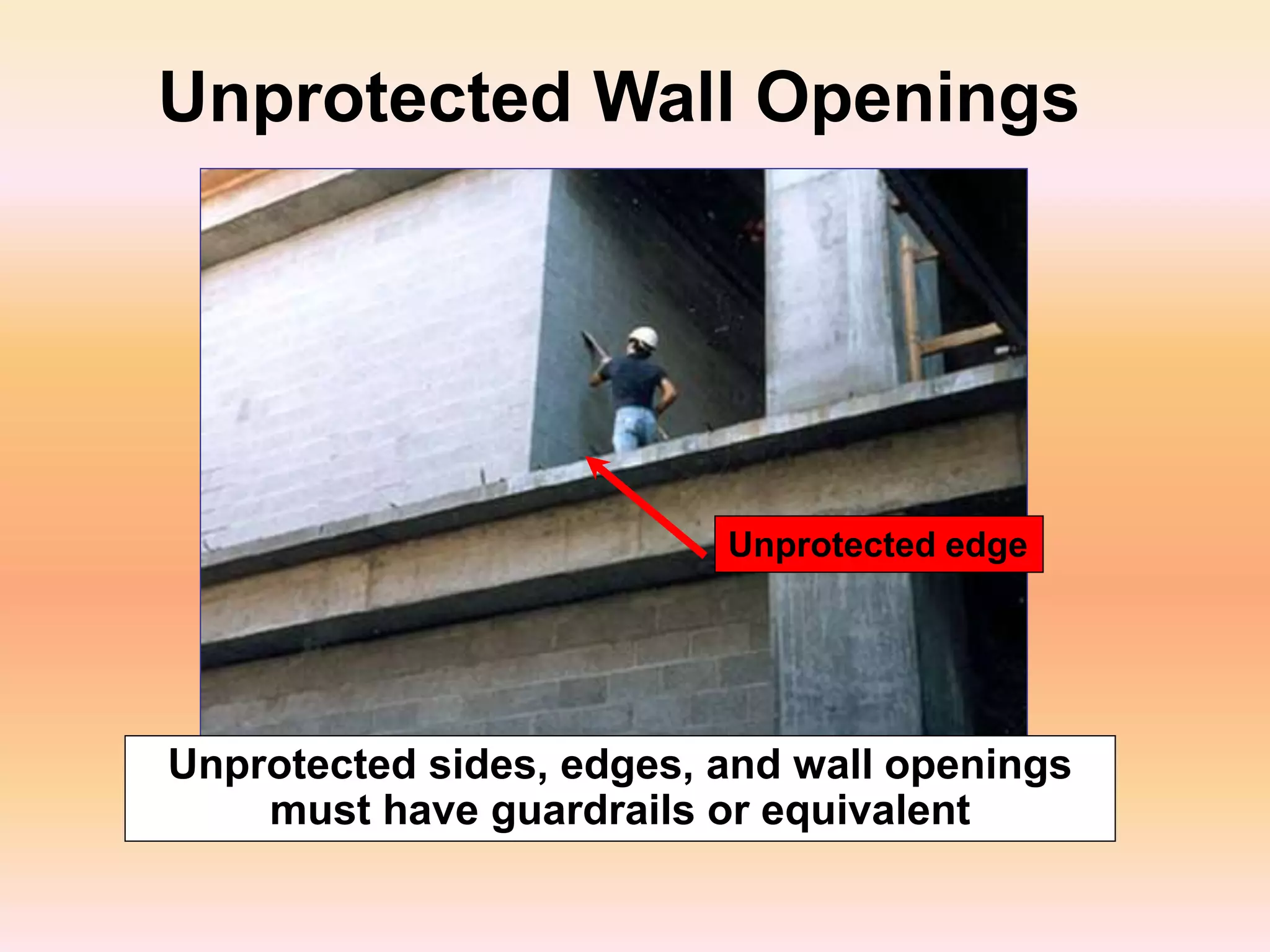
Unprotected edge
Unprotected Wall Openings
Unprotected sides, edges, and wall openings
must have guardrails or equivalent
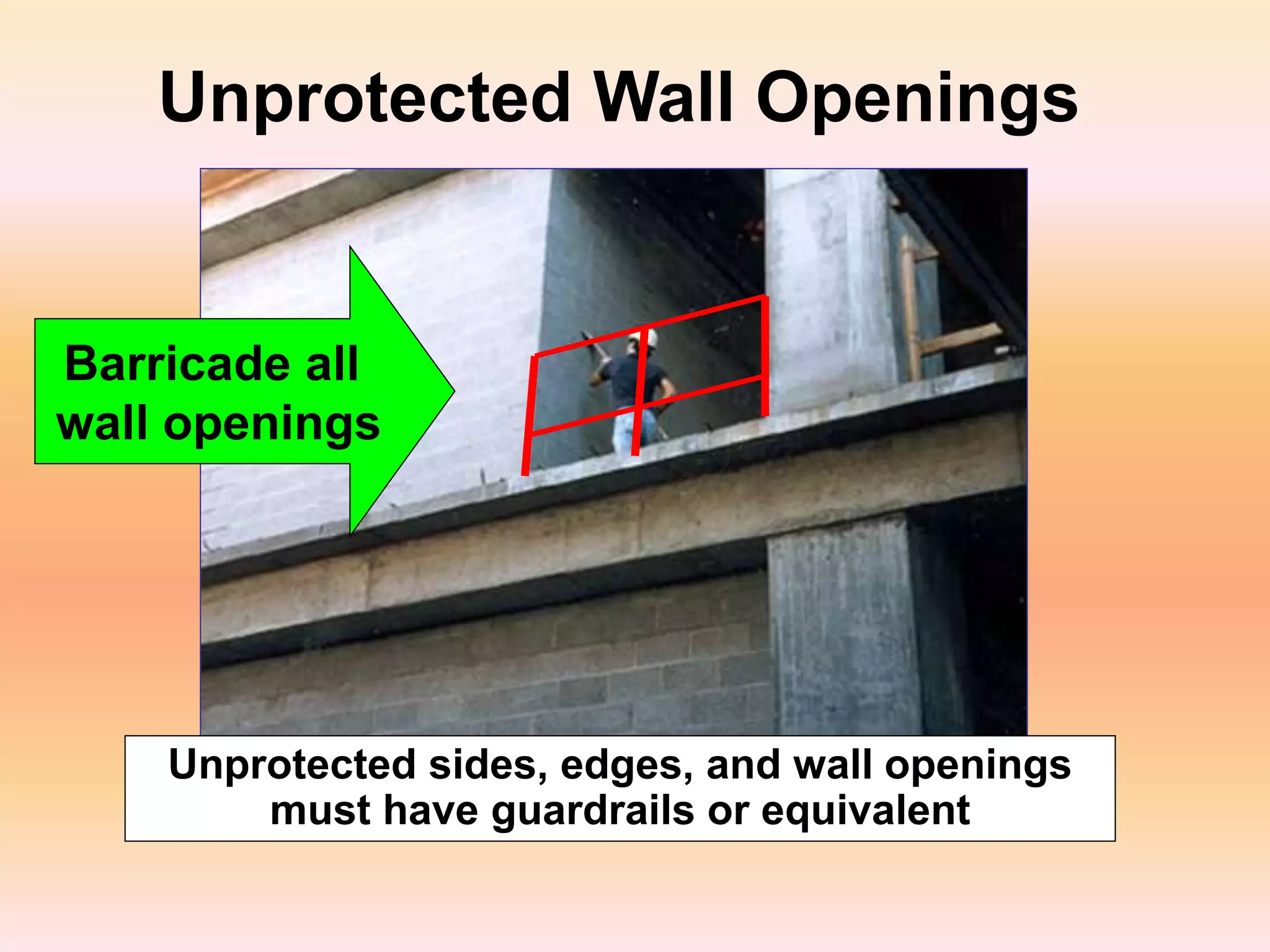
Unprotected Wall Openings
Unprotected sides, edges, and wall openings
must have guardrails or equivalent
Barricade all
wall openings
Sky Lights, Holes, and Other Openings
Holes must be protected. This opening could be
made safe by using a guardrail, or strong cover
Sky Lights, Holes, and Other Openings
This opening was made safe by using a
guardrail system
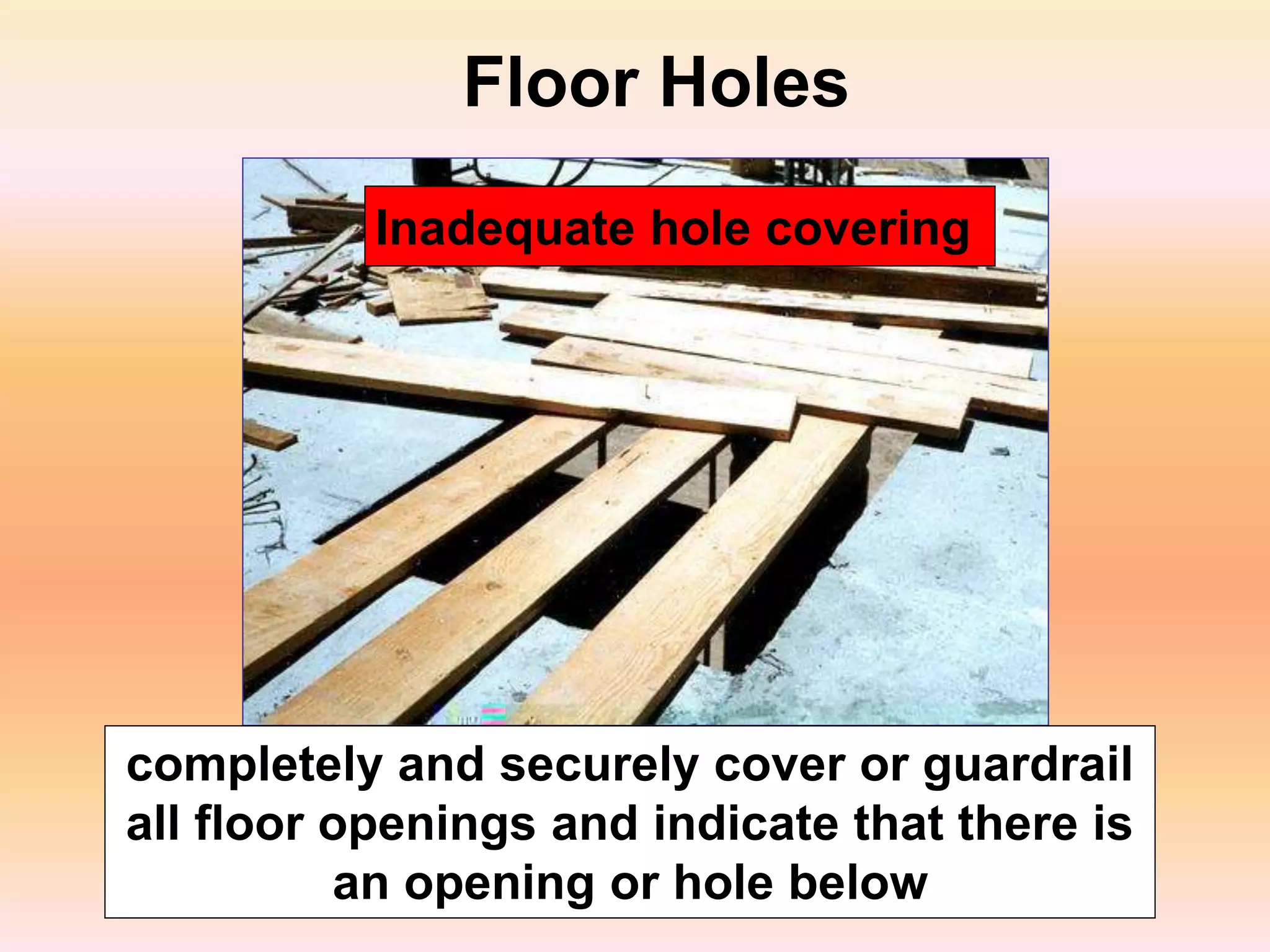
completely and securely cover or guardrail
all floor openings and indicate that there is
an opening or hole below
Floor Holes
Inadequate hole covering
completely and securely cover all floor
openings and indicate that there is an
opening or hole below
Floor Holes
Properly
Covered
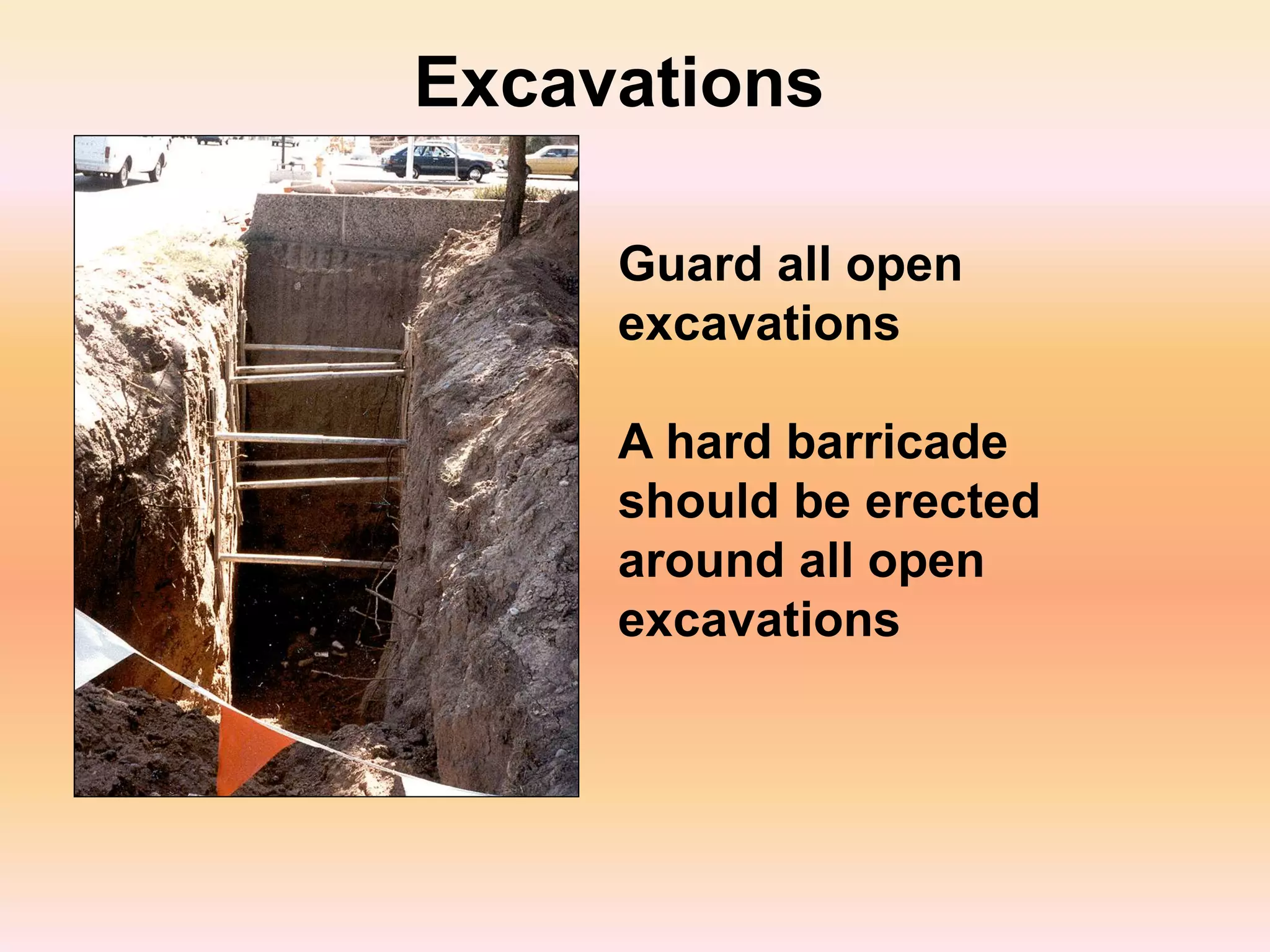
Guard all open
excavations
A hard barricade
should be erected
around all open
excavations
Excavations
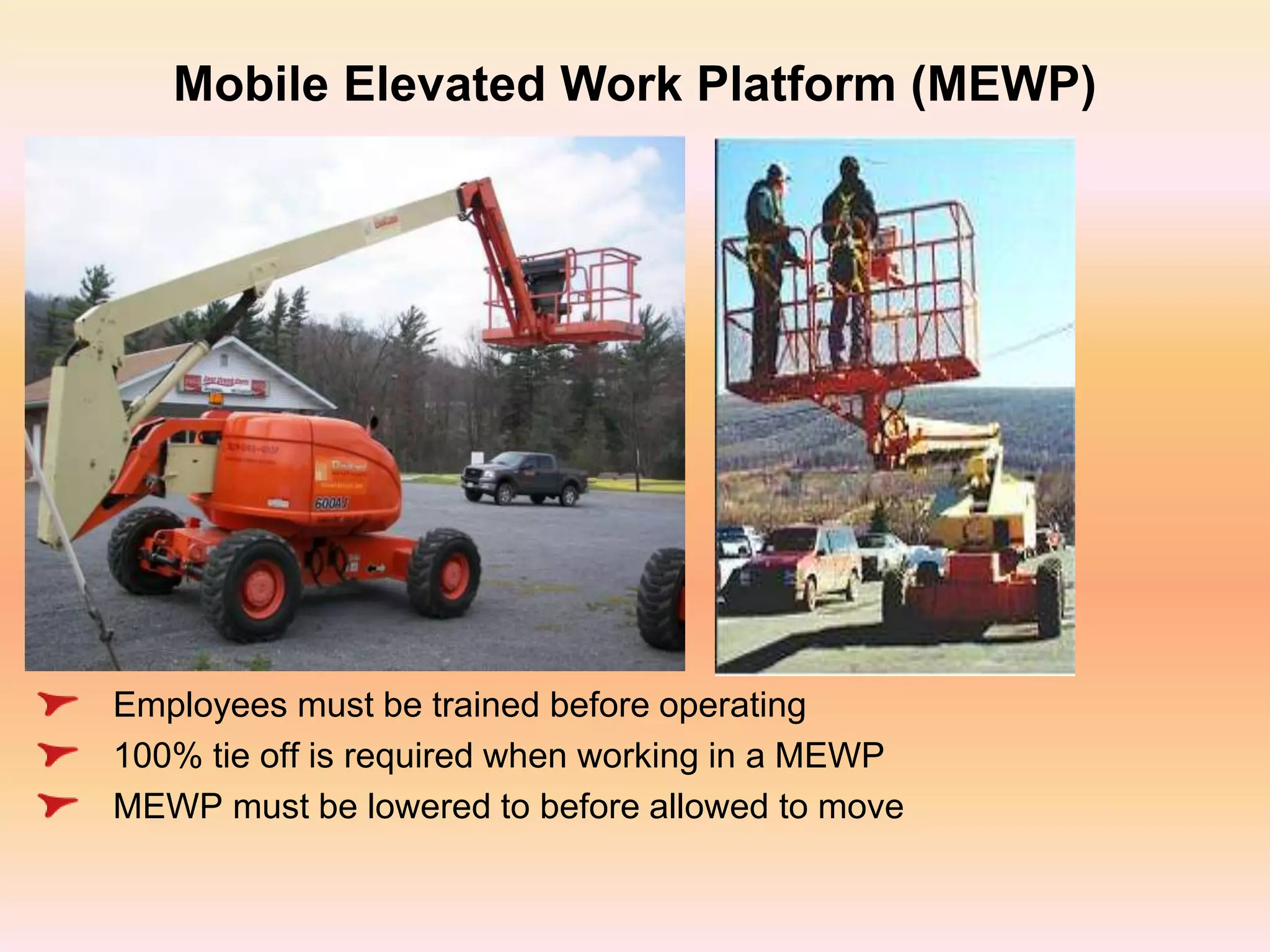
Mobile Elevated Work Platform (MEWP)
Employees must be trained before operating
100% tie off is required when working in a MEWP
MEWP must be lowered to before allowed to move
Scissor lifts
Employees must be
trained before operating
100% tie off is required
when operating a
scissor lift
Scissor lifts should only
be used on solid level
ground
Scissor lifts must be
lowered before allowed
to move
Mobile Equipment
Do not use equipment or shovels as personnel lifting equipment
Do not ride in the buckets
Crane lifted man baskets
Man baskets must be designed
for and only used to lift workers
Must be 3rd party certified to lift
workers and display safe
working load
100% tie off with fall harness and
lanyard when in man basket
Ladders are to be used for light duty
tasks for a duration not to exceed ½
hour
The maximum step ladder height is 2
meters
Job/ hand built ladders will not be
used
Only one person allowed per ladder
Do not climb or stand above
maximum safe working height
(normally on the top 2 steps)
Keep the area around the ladder clear
Ensure rungs are not deformed or
damaged
Do not tie or lash ladders together to
make them longer
Have someone secure hold/ secure
ladder if needed
General Ladder Requirements
Handrails
Stairways with three or
more risers, or higher
than 30 inches/ 75 cm,
must be equipped with
handrail.
The stairway to this platform has more than 4 risers
and is not guarded. The platform requires guarding.
Dangerous Conditions
Fix or clean slippery
conditions
Stairway parts must be
free of projections which
may cause injuries or
snag clothing
Clean all debris, trip
hazards, and material
storage from stairways
Securing Ladders
Secure ladders to
prevent accidental
movement due to
workplace activity
Only use ladders on
stable and level
surfaces, unless
secured
Do not use ladders on
slippery surfaces
unless secured or
provided with slip-
resistant feet
This ladder is not on a
stable surface
Ladder Angle
Non-self-supporting ladders:
(which lean against a wall or
other support)
Position at an angle where
the horizontal distance from
the top support to the foot
of the ladder is 1/4 the
working length of the ladder
When using a portable
ladder for access to an
upper landing surface,
the side rails must
extend above the upper
landing surface to allow
for employees safe
access to the
Ladder Rail Extension
Face the ladder when
going up or down
Use the 3 point rule
Do not carry any
objects, tools, or
loads that could
cause you to lose
balance
Climbing the Ladder
Near Energized Electrical
Equipment
If using ladders where the
employee or the ladder
could contact exposed
energized electrical
equipment, they must
have nonconductive
siderails or fiberglass.
This is an unsafe condition
Do not go above the
safe working area of a
step ladder; get a
longer ladder to safely
complete the task
Top Step
A competent person must
inspect ladders for visible
defects, like broken or
missing rungs
If a defective ladder is
found, immediately mark it
defective or tag it "Do Not
Use”
Remove defective ladders
from service
Damaged or Defective Ladders
Missing rung
NOT
ALLOWED
DO NOT use drums or
other objects to increase
scaffold or work platform
height
NO JOB
BUILT
LADDERS
Summary
If you can fall you must be protected
Use fall protection systems on:
– Walkways & ramps
– Unprotected sides & edges
– Wall openings
– Holes
– Scaffolds
– Work platforms
– False work
– Concrete forms & rebar
– Open excavations
– MEWP (Motorized Elevated Work Platform)
– Scissor lifts
– Man riding baskets (crane lifted)
Protective measures include guardrails, covers, safety nets, and
Personal Fall Arrest Systems
Thank You

A fall protection

  • 1.
  • 2.
    Falls are theleading cause of deaths in the construction industry. Most fatalities occur when employees fall from open- sided floors and through floor openings. Falls from as little as .5 meter can cause serious lost- time accidents and sometimes death. Falls in Construction
  • 3.
    The Fall ProtectionHierarchy shall be considered when designing fall protection solutions for both existing and new facilities. Unprotected falls from elevation usually result in serious debilitating injury or death. Falls can be prevented through the use of proper prevention and arrest systems. All work from elevated work surfaces will be accomplished without any risk of falling to a lower level. This goal is achieved by adhering to the following fall protection hierarchy: Fall Protection Hierarchy
  • 4.
    Remove the hazard:avoid working at heights. Bring the work down to the ground level whenever possible. If work at heights is unavoidable, secure the elevated work area with a passive fall prevention barrier system, such as guardrails. When a barrier system is not feasible because of the physical characteristics of the work environment or the infrequency of access, use an approved fall restraint system or a MEWP (Motorized Elevated Work Platform) If no other option is feasible, a properly engineered and approved fall arrest system can be used in conjunction with a rescue plan. Fall Protection Hierarchy
  • 5.
    Personal Fall Arrest System (PFAS) Guardrailsand work platforms Safety Nets Fall Protection Options
  • 6.
    Top rails between100 cm and 115 cm tall Mid-Rail located 30 – 40 cm below top rail Toeboards at least 10 cm high Guardrails Top Rail Mid- Rail Toeboard
  • 7.
    Rails must beable to withstand a force of 200 pounds/ 90 Kilograms Handrail and Top Rail Strength
  • 8.
    Safety Nets Place safetynets as close as possible below where employees are working. Safety nets must be installed and inspected by a competent person
  • 9.
    Personal Fall ArrestSystems You must be trained how to properly use PFAS. PFAS = anchorage, lifeline and body harness.
  • 10.
    Must be independent ofany platform anchorage and capable of supporting at least 5,000 lbs/ 2,250 Kilo per worker Safety Line Anchorages
  • 11.
    Lap Belt; notsuitable for fall protection Full body harness with attachable lanyard; GOOD/ SAFE fall protection Positioning Devices verses Full Body Harness
  • 12.
    When Fall Protectionis Needed Walkways & ramps Unprotected sides & edges Wall openings Holes Scaffolds Work platforms False work Concrete forms & rebar Open excavations MEWP (Motorized Elevated Work Platform) Scissor lifts Man riding baskets (crane lifted)
  • 13.
    Unprotected sides and edges musthave guardrails or equivalent Unprotected Sides & Edges
  • 14.
    Sides & Edges- Improper Guarding This ¼ inch/ 7 mm nylon rope is not a proper way to guard an open floor
  • 15.
    Unprotected edge Unprotected WallOpenings Unprotected sides, edges, and wall openings must have guardrails or equivalent
  • 16.
    Unprotected Wall Openings Unprotectedsides, edges, and wall openings must have guardrails or equivalent Barricade all wall openings
  • 17.
    Sky Lights, Holes,and Other Openings Holes must be protected. This opening could be made safe by using a guardrail, or strong cover
  • 18.
    Sky Lights, Holes,and Other Openings This opening was made safe by using a guardrail system
  • 19.
    completely and securelycover or guardrail all floor openings and indicate that there is an opening or hole below Floor Holes Inadequate hole covering
  • 20.
    completely and securelycover all floor openings and indicate that there is an opening or hole below Floor Holes Properly Covered
  • 21.
    Guard all open excavations Ahard barricade should be erected around all open excavations Excavations
  • 22.
    Mobile Elevated WorkPlatform (MEWP) Employees must be trained before operating 100% tie off is required when working in a MEWP MEWP must be lowered to before allowed to move
  • 23.
    Scissor lifts Employees mustbe trained before operating 100% tie off is required when operating a scissor lift Scissor lifts should only be used on solid level ground Scissor lifts must be lowered before allowed to move
  • 24.
    Mobile Equipment Do notuse equipment or shovels as personnel lifting equipment Do not ride in the buckets
  • 25.
    Crane lifted manbaskets Man baskets must be designed for and only used to lift workers Must be 3rd party certified to lift workers and display safe working load 100% tie off with fall harness and lanyard when in man basket
  • 26.
    Ladders are tobe used for light duty tasks for a duration not to exceed ½ hour The maximum step ladder height is 2 meters Job/ hand built ladders will not be used Only one person allowed per ladder Do not climb or stand above maximum safe working height (normally on the top 2 steps) Keep the area around the ladder clear Ensure rungs are not deformed or damaged Do not tie or lash ladders together to make them longer Have someone secure hold/ secure ladder if needed General Ladder Requirements
  • 27.
    Handrails Stairways with threeor more risers, or higher than 30 inches/ 75 cm, must be equipped with handrail. The stairway to this platform has more than 4 risers and is not guarded. The platform requires guarding.
  • 28.
    Dangerous Conditions Fix orclean slippery conditions Stairway parts must be free of projections which may cause injuries or snag clothing Clean all debris, trip hazards, and material storage from stairways
  • 29.
    Securing Ladders Secure laddersto prevent accidental movement due to workplace activity Only use ladders on stable and level surfaces, unless secured Do not use ladders on slippery surfaces unless secured or provided with slip- resistant feet This ladder is not on a stable surface
  • 30.
    Ladder Angle Non-self-supporting ladders: (whichlean against a wall or other support) Position at an angle where the horizontal distance from the top support to the foot of the ladder is 1/4 the working length of the ladder
  • 31.
    When using aportable ladder for access to an upper landing surface, the side rails must extend above the upper landing surface to allow for employees safe access to the Ladder Rail Extension
  • 32.
    Face the ladderwhen going up or down Use the 3 point rule Do not carry any objects, tools, or loads that could cause you to lose balance Climbing the Ladder
  • 33.
    Near Energized Electrical Equipment Ifusing ladders where the employee or the ladder could contact exposed energized electrical equipment, they must have nonconductive siderails or fiberglass. This is an unsafe condition
  • 34.
    Do not goabove the safe working area of a step ladder; get a longer ladder to safely complete the task Top Step
  • 35.
    A competent personmust inspect ladders for visible defects, like broken or missing rungs If a defective ladder is found, immediately mark it defective or tag it "Do Not Use” Remove defective ladders from service Damaged or Defective Ladders Missing rung
  • 36.
  • 37.
    DO NOT usedrums or other objects to increase scaffold or work platform height
  • 38.
  • 53.
    Summary If you canfall you must be protected Use fall protection systems on: – Walkways & ramps – Unprotected sides & edges – Wall openings – Holes – Scaffolds – Work platforms – False work – Concrete forms & rebar – Open excavations – MEWP (Motorized Elevated Work Platform) – Scissor lifts – Man riding baskets (crane lifted) Protective measures include guardrails, covers, safety nets, and Personal Fall Arrest Systems
  • 54.