1
BY ABAYNEH BELIHUN
AKSUM UNIVERSITY
DEPARTMENT OF ANAESTHESIOLOGY
NOV 2015
2
3
ļ‚˜ Anesthesia is essential for the practice of surgery.
ļ‚˜ Since its beginning in 1842 it has evolved in to a recognized
specialty providing continuous improvement in patient care
ļ‚˜ Anesthetists receive lives of patients in her/ his hands.
ļ‚˜ It is a duty to administer the safest anesthetic possible, to protect the
patient and to give full attention for the anesthetized patient.
4
ļ‚˜ To carry out the responsibility, every anesthetist needs a
foundation of medical science and understand the
principles of anesthesia.
ļ‚˜ A sound knowledge of physiology and pharmacology is
essential, together with an understanding of āˆ†s brought
about by illness or injury.
5
Anesthesia
ļ‚˜ The absence or abolition of sensation, especially that of pain
induced by drugs especially as a means of facilitation to surgical
procedures.
ļ‚˜ Anesthesiology- The art and science of rendering a patient
insensible to pain by the administration of anesthetic agents and
related drugs and procedures.
ļ‚˜ An anesthetist – A qualified HCP who administers anesthetics to
produce total or partial loss of sensation in patients during surgical
or diagnostic procedures.
ļ‚˜ Nurse anesthetist- A nurse who specializes in administration of
anesthesia
ļ‚˜ Anesthesiologist- A physician specialist in anesthesia practice t
6
ļ‚˜ Before the discovery of inhalational agents pain was
considered or believed to be an inevitable outcome of
surgery.
ļ‚˜ Today, major surgery without adequate anesthesia would
be unthinkable, and probably constitute grounds for
malpractice litigation.
ļ‚˜ Recent development dating back only 160 years.
7
ļ‚˜ Early Analgesia: Dioscorides, a Greek physician from the
first century AD, commented on the analgesia of
mandragora, a drug prepared from the bark and leaves
of the mandrake plant.
ļ‚˜ He stated that the plant substance could be boiled in
wine, strained, and used when they wish to produce
anesthesia.
ļ‚˜ Alcohol was another element of the pre-ether
armamentarium because it was thought to induce stupor
and blunt the impact of pain.
8
ļ‚˜ Inhaled anesthetics: Prior to the hypodermic syringe &
needle (1855) and routine venous access, ingestion and
inhalation were the only known routes of administering
medicines to gain systemic effects.
ļ‚˜ Ether (1540): Ether was prepared by Valerius Cordus, and
called "sweet oil of vitriol". It was not used as an anesthetic
until 19th C when William Morton (1846), a Boston dentist,
used it.
ļ‚˜ Halothane (developed in 1951; released in 1956),
methoxyflurane (developed in 1958; released in 1960),
enflurane (developed in 1963; released in 1973), and
isoflurane (developed in 1965; released in 1981).
9
Nitrous oxide (1772)
ļ‚˜ Joseph Priestley in England prepared nitrous oxide but it
was not used as an anesthetic until about 1870.
ļ‚˜ Humphrey Davy first noted its analgesic properties in
1800.
ļ‚˜ Gardner Colton and Horace Wells are credited with
having first used nitrous oxide as an anesthetic in
10
Chloroform (1847):
ļ‚˜ James Simpson, a Scottish obstetrician, used chloroform
as an anesthetic agent.
ļ‚˜ Gained considerable notoriety after John Snow used it
during the deliveries of Queen Victoria (1853) for the
birth of Prince Leopold, thus giving the royal stamp of
approval.
ļ‚˜ For the next 50 years ether and chloroform dominated
the anesthetic scene.
11
Local/regional anesthesia:
ļ‚˜ It is the art of rendering a part of the body insensible for
surgical operation or manipulation.
ļ‚˜ The origin of modern LA is credited to Carl Koller, an
ophthalmologist, who demonstrated the use of topical cocaine
for surgical anesthesia of the eye in 1884.
ļ‚˜ Procaine was synthesized in 1904.
ļ‚˜ Additional local anesthetics subsequently introduced clinically
include dibucaine (1930), tetracaine (1932), lidocaine (1947),
chloroprocaine (1955), mepivacaine (1957), prilocaine (1960),
bupivacaine (1963), and etidocaine (1972).
12
Intravenous anesthesia:
ļ‚˜ Followed invention of the hypodermic syringe & needle (Alexander
Wood in 1855. )
ļ‚˜ Early attempts at IV anaesthesia included the use of chloral hydrate
(1872), chloroform and ether (1909), & the combination of morphine &
scopolamine (1916).
ļ‚˜ Barbiturates were synthesized in 1903 by Fischer and von Mering.
ļ‚˜ The first barbiturate used for induction of anaesthesia was diethyl
barbituric acid (barbital), but it was not until the introduction of
hexobarbital in 1927 that barbiturate induction became a popular
technique.
13
ļ‚˜ Thiopental synthesized in 1932 and remains the most
common induction agent for anaesthesia.
ļ‚˜ Ketamine, released in 1970, the first IV agent associated
with minimal cardiac and respiratory depression.
14
Muscle relaxants:
ļ‚˜ The use of curare (1942) was a milestone in anesthesia.
ļ‚˜ Curare facilitated tracheal intubation & provided abdominal
relaxation
ļ‚˜ Sux was synthesized by Bovet in 1949 & released in 1951; become
a standard agent for facilitating tracheal intubation.
ļ‚˜ Until recently, Sux remained unparalleled in its onset, but its
occasional side effects continued to fuel the search for a
comparable substitute.
ļ‚˜ Recently introduced agents that come close to this goal include
vecuronium, atracurium, pipecuronium, doxacurium, rocuronium,
and cis-atracurium
15
Opioids:
ļ‚˜ Morphine was isolated from opium in 1805.
ļ‚˜ The concept of balanced anesthesia, was introduced in
1926 by Lundy and evolved to consist of thiopental for
induction, nitrous oxide for amnesia, meperidine (or any
opioid) for analgesia, and curare for muscle relaxation.
ļ‚˜ Opioids (Morphine, fentanyl, sufentanil, and alfentanil)
prevent patient awareness and suppressing autonomic
responses during surgery.
16
Early Anesthesia Delivery Systems
ļ‚˜ The transition from ether inhalers and chloroform-soaked
handkerchiefs to more sophisticated anesthesia delivery
equipment, ETI set such as laryngoscope, ETT, etc and
monitoring equipments.
ļ‚˜ Safer in recent years 2˚ improvements in
pharmacological agents and the introduction of
sophisticated technology and patient monitoring .
17
DEFINITION 1
ā€œAnesthesia is a medical procedure which is
deliberately produced to make a patient
insensible to pain either in a part or in the
whole of the body by which diagnostic and
surgical procedure are done while the patient
safety and comforts are maintained.ā€ 18
ļ‚˜ Anesthesia, risky procedure and may take the patient life in
danger…permanent organ damage and death
ļ‚˜ Vigilance is the logo!!!
ļ‚˜ Although risky anesthesia is now much safer and more
pleasant than the previous period.
19
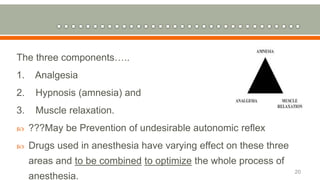
The three components…..
1. Analgesia
2. Hypnosis (amnesia) and
3. Muscle relaxation.
ļ‚˜ ???May be Prevention of undesirable autonomic reflex
ļ‚˜ Drugs used in anesthesia have varying effect on these three
areas and to be combined to optimize the whole process of
anesthesia.
20
A. Hypnosis (amnesia): a state of sleep or unconsciousness
which enable the patient unaware any events
B. Analgesia: Insensitivity to pain + loss of consciousness.
C. Muscle relaxation: aided by drugs which affect skeletal muscle
function and decrease the muscle tone by which immobility and
relaxation of the skeletal muscle produced ….surgery will be
proceeded at ease.
21
An anesthetic procedure should:
ļ‚˜ Abolish pain
ļ‚˜ Be Completely reversible.
ļ‚˜ Be Safe!...
• Comfort- important
• Safety - essential and must come first.
ļ‚˜ Provide good operating conditions.
• E.g. good relaxation for abdominal surgery.
ļ‚˜ Be acceptable to the patient.
22
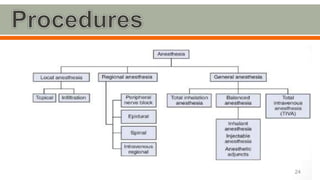
ļ‚˜ General anesthesia:- a drug-induced reversible depression of the
CNS resulting in the loss of response to & perception of all external
stimuli.
ļ‚˜ Regional anesthesia:-(central, regional, peripheral) -the art of
rendering a part of the body insensible for surgical operation or23
.
24
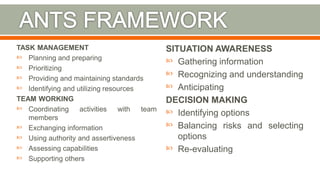
TASK MANAGEMENT
ļ‚˜ Planning and preparing
ļ‚˜ Prioritizing
ļ‚˜ Providing and maintaining standards
ļ‚˜ Identifying and utilizing resources
TEAM WORKING
ļ‚˜ Coordinating activities with team
members
ļ‚˜ Exchanging information
ļ‚˜ Using authority and assertiveness
ļ‚˜ Assessing capabilities
ļ‚˜ Supporting others
SITUATION AWARENESS
ļ‚˜ Gathering information
ļ‚˜ Recognizing and understanding
ļ‚˜ Anticipating
DECISION MAKING
ļ‚˜ Identifying options
ļ‚˜ Balancing risks and selecting
options
ļ‚˜ Re-evaluating
25
Skills for organising resources & required activities to achieve
goals.
1. Planning and preparing
Developing in advance primary & contingency
strategies for managing tasks, reviewing & updating
them.
26
 Behavioural markers for good practice-- lays out drugs and
equipment needed before starting case.
 Behavioural markers for poor practice--does not ask for drugs
or equipment until the last minute or does not have
emergency/ alternative drugs
27
2. Prioritising
scheduling tasks, activities, issues etc., according to
importance, being able to identify key issues and
allocate attention to them accordingly, and avoiding
being distracted by less important or irrelevant matters.
ļ‚˜ Behavioural markers for good practice--negotiates
sequence of cases on list with Surgeon
ļ‚˜ Behavioural markers for poor practice-- fails to allocate
attention to critical areas
28
3. Providing and maintaining standards – supporting safety and
quality by adhering to accepted principles ; following codes of
good practice, treatment protocols or guidelines, & mental
checklists.
ļ‚˜ Behavioural markers for good practice--cross-checks drug
labels, checks machine at beginning of each session,
maintains accurate anaesthetic records
ļ‚˜ Behavioural markers for poor practice--does not check blood
with pt and notes, fails to confirm patient identity and consent
details
29
4. Identifying and utilising resources– Establishing the
necessary, and available, requirements for task
completion (e.g. people, expertise, equipment, time) and
using them to accomplish goals with minimum stress,
work overload
ļ‚˜ Good practice-- allocates tasks to appropriate
member(s).
30
ļ‚˜ Skills for working in a group to ensure effective joint
task completion and team member satisfaction.
5. Co-ordinating activities with team members – working
together with others, for both physical and cognitive
activities; understanding the roles and responsibilities,
and ensuring that a collaborative approach is employed.
31
ļ‚˜ Behavioural markers for good practice
o confirms roles and responsibilities of team members, discusses
case with surgeons or colleagues
ļ‚˜ Behavioural markers for Poor practice
o Does not co-ordinate with surgeon(s) and other groups
o Relies too much on familiarity of team for getting things done……..
makes assumptions, takes things for granted
32
6. Exchanging information – giving and receiving the
knowledge and data necessary for team co-ordination
and task completion
good practice--gives situation updates/reports key
events
poor practice-- gives inadequate handover briefing
33
7. Using authority and assertiveness – leading the team
&/or the task, accepting a non-leading role when
appropriate; adopting a suitably forceful manner to make
a point
Good practice- takes over task leadership as required
Poor practice--does not allow others to put forward their
case 34
8. Assessing capabilities – judging different team members’
skills, and their ability to deal with a situation.
Good practice-asks new team member about their
Experience
Poor practice-allows team to accept case beyond its level
of expertise 35
9. Supporting others
Providing physical, cognitive or emotional help to members
Good practice- acknowledges concerns of others
Poor practice- asks for information at difficult/high workload
time for someone else
36
10. SITUATION AWARENESS: Skills for developing and
maintaining an overall awareness of the work setting based
on observing all relevant aspects of the theatre environment
(patient, team, time, displays, equipment); understanding
what they mean, and thinking ahead about what could happen
next. 37
11.Gathering information – actively and specifically
collecting data about the situation by continuously
observing the whole environment and monitoring all
available data sources and cues and verifying data to
confirm their reliability (i.e. that they are not artefactual)
Good practice- watches surgical procedure, verify status
Poor practice-does not ask questions to orient self to
situation during hand-over
38
12. Anticipating – asking ā€˜what if’ questions and thinking ahead
about potential outcomes and consequences of actions,
intervention, non-intervention, etc
o Good practice- reviews the effects of an intervention
o Poor practice- does not foresee undesirable drug interactions
39
ļ‚˜ Skills for reaching a judgement to select a course of action or
make a diagnosis about a situation, in both normal conditions
and in time-pressured crisis situations
13.Identifying options – generating alternative possibilities or
courses of action to be considered in making a decision or
solving a problem.
14.Balancing risks and selecting options – assessing hazards to
weigh up the threats or benefits of a situation, considering the
advantages and disadvantages of different courses of action
40
15. Re-evaluating – continually reviewing suitability of
options identified, assessed and selected; and re-
assessing the situation following implementation of a
given action.
ļ‚˜ Good practice- Re-assesses patient after Intervention
ļ‚˜ Poor practice- Fails to allow adequate time for
intervention to take effect 41
ļ‚˜ An ideal anesthetic technique would incorporate
o Optimal patient safety and satisfaction
o Provide excellent operating conditions
o Allow rapid recovery
o Avoid postoperative side effects.
42
In addition, the chosen technique would be
o Low in cost,
o Allow early transfer or discharge from the PACU,
o Optimize postoperative pain control, and
o Permit optimal operating room efficiency, including turnover
times. 43
The anesthesia provider must
o Evaluate the medical condition
o Know unique needs of each patient,
o Select an acceptable anesthetic technique, and
o Make recommendation to the patient.
44
Preparation for anesthesia
ļ‚˜ Never induce anesthesia when alone, trained assistant must
be available.
ļ‚˜ correct pt scheduled for correct operation on the correct
side.
ļ‚˜ Check patient has been properly prepared and NPO.
• Solid food for 8HRS,
• Milk feed up to 4HRS.
• Clear fluids are regarded as safe up to 3Hrs preop if gastric function is
normal.
ļ‚˜ Measure PR and BP, and try to make the pt as relaxed and
comfortable as possible.
45
Before you give an anesthetic and going a critical moment make sure checked
and
functional of the following items.
ļ‚˜ Apparatus you intend to use, or might need, is available and working
ļ‚˜ If you are using compressed gases, there is enough gas and a
reserve oxygen cylinder is available
ļ‚˜ The anesthetic vaporizers are connected
46
ļ‚˜ The breathing system that delivers gas to the patient is securely
and correctly assembled
ļ‚˜ Breathing circuits are clean
ļ‚˜ Resuscitation apparatus is present and working
ļ‚˜ Laryngoscope, tracheal tubes and suction apparatus are ready
and decontaminated
ļ‚˜ Needles and syringes are sterile: never use the same syringe or
needle for more than one patient
ļ‚˜ Any other drugs you might need are in the room
47
ļ‚˜ Always begin your anesthetic with the pt lying on a table
or trolley that can be rapidly tilted into a head-down
position in case of sudden hypotension or vomiting.
ļ‚˜ Before inducing anesthesia, always ensure appropriate
size of cannula in a large vein is available and working
properly
ļ‚˜ RA needs the same preparation as of GA. 48
Initiation of anesthesia (Induction):
ļ‚˜ GA may be initiated by the administration of IV drugs or
VAA.
ļ‚˜ GA renders a patient insensible to pain (analgesia);
make the patient unaware of the procedure (amnesia);
and muscle relaxation for surgical purposes.
ļ‚˜ Vigilance, to be alert to danger or threats, is essential.
ļ‚˜ The patient is reliant upon the anesthetist to maintain a
patent airway, provide adequate oxygenation, and
support of adequate heart function.
49
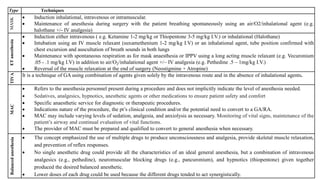
Type TechniquesMASK
ļ‚· Induction inhalational, intravenous or intramuscular.
ļ‚· Maintenance of anesthesia during surgery with the patient breathing spontaneously using an air/O2/inhalational agent (e.g.
halothane +/- IV analgesia)
ETanesthesia
ļ‚· Induction either intravenous ( e.g. Ketamine 1-2 mg/kg or Thiopentone 3-5 mg/kg I.V.) or inhalational (Halothane)
ļ‚· Intubation using an IV muscle relaxant (suxamethenium 1-2 mg/kg I.V) or an inhalational agent, tube position confirmed with
chest excursion and auscultation of breath sounds in both lungs
ļ‚· Maintenance with spontaneous respiration as for mask anaesthesia or IPPV using a long acting muscle relaxant (e.g. Vecuronium
.05 - .1 mg/kg I.V) in addition to air/O2/inhalational agent +/– IV analgesia (e.g. Pethedine .5 – 1mg/kg I.V.)
ļ‚· Reversal of the muscle relaxation at the end of surgery (Neostigmine + Atropine)
TIVA
It is a technique of GA using combination of agents given solely by the intravenous route and in the absence of inhalational agents.
MAC
ļ‚· Refers to the anesthesia personnel present during a procedure and does not implicitly indicate the level of anesthesia needed.
ļ‚· Sedatives, analgesics, hypnotics, anesthetic agents or other medications to ensure patient safety and comfort
ļ‚· Specific anaesthetic service for diagnostic or therapeutic procedures.
ļ‚· Indications nature of the procedure, the pt’s clinical condition and/or the potential need to convert to a GA/RA.
ļ‚· MAC may include varying levels of sedation, analgesia, and anxiolysis as necessary. Monitoring of vital signs, maintenance of the
patient’s airway and continual evaluation of vital functions.
ļ‚· The provider of MAC must be prepared and qualified to convert to general anesthesia when necessary.
Balancedanesthesia
ļ‚· The concept emphasized the use of multiple drugs to produce unconsciousness and analgesia, provide skeletal muscle relaxation,
and prevention of reflex responses.
ļ‚· No single anesthetic drug could provide all the characteristics of an ideal general anesthesia, but a combination of intravenous
analgesics (e.g., pethedine), neuromuscular blocking drugs (e.g., pancuronium), and hypnotics (thiopentone) given together
produced the desired balanced anesthetic.
ļ‚· Lower doses of each drug could be used because the different drugs tended to act synergistically. 50
Intravenous induction of GA
ļ‚˜ The administration of anesthetic drugs (propofol, thiopental, or
ketamine) to produce rapid onset of unconsciousness
ļ‚˜ usually used in adult patients by the IV administration of an
anesthetic.
ļ‚˜ Ventilation can be sustained via a face mask or a LMA may be
inserted or a neuromuscular blocking drug may be given IV to
facilitate direct laryngoscopy before tracheal intubation
51
Intramuscular induction:
ļ‚˜ Uncooperative children
ļ‚˜ Usually ketamine….increase in secretions….Atropine 0.1 to
0.2mg/kg
ļ‚˜ Patients sometimes complain afterwards of vivid dreams and
hallucinations, an experience of seeing an imaginary scene or
hearing an imaginary sound as clearly as if it were really there.
ļ‚˜ Diazepam before or at the end of anesthesia can reduce these.
ļ‚˜ Hallucinations may not occur if ketamine is used only for induction
and is followed by inhalational anesthetic.
52
Inhalation induction:
ļ‚˜ The administration of VAA (e.g., halothane) through a
mask
ļ‚˜ Often used in the pediatric population.
ļ‚˜ After VAA induction, a dep (sux 1-2 mg/kg) or NDNMBDs
(Vecuronium 0.08- 0.1 mg/kg) is administered IV to
provide the skeletal muscle relaxation to facilitate
laryngoscopy.
ļ‚˜ If ETI is not accomplished, anesthesia can be
maintained by inhalation via a facemask or LMA
53
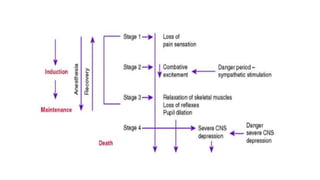
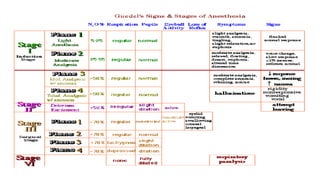
ļ‚˜ Four main stages are recognized based upon
• Patient’s body movements,
• Respiratory rhythm,
• Oculomotor reflexes, and
• Muscle tone.
54
ļ‚˜ First Guedel used in assessment of stages of anesthesia
using ether inhalation anesthesia and now it is prove useful in
your assessment of the patient under GA with halogenated
inhalational anesthetic agents(e.g., pediatric inductions with
halothane).
ļ‚˜ These signs will not be helpful if you are performing an
anesthetic with IV anesthetics and using muscle relaxants.
ļ‚˜ Atropine may affect the pupillary size and make eye size
unusable size.
ļ‚˜ During recovery from an inhaled GA, the stages will be
reversed as the patient regains consciousness
55
Stage 1- Amnesia and analgesia stage:
ļ‚˜ Conscious & rational, however perception of pain is
diminished.
ļ‚˜ From beginning of the anesthetic to the loss of
consciousness.
ļ‚˜ During this stage the patient will demonstrate the following:
o Able to open eyes on command
o Breathe normally
o Maintain protective reflexes
o Tolerate mild painful stimuli
56
Stage 2- Delirium stage:
ļ‚˜ Starts with the loss of consciousness, ends with the
appearance of a regular pattern of breathing and loss of eye
lid reflex.
ļ‚˜ Excitement is noted.
ļ‚˜ Children will often exhibit this stage during an inhaled
induction.
ļ‚˜ The patient may demonstrate the following during this stage:
o Movement of limbs and tense struggle
o Irregular breathing
o Breath holding
o Pupils become dilated but reactive to light
57
Stage 3- Surgical Anesthesia:
ļ‚˜ This stage begins with the resumption of regular breathing pattern
and ends at the cessation of respiration.
ļ‚˜ Surgery generally occurs during one of the four levels of stage 3.
ļ‚˜ No response to surgical incision.
58
Level 1
ļ‚˜ The patient may exhibit the following signs during this
level:
o Pupillary dilatation may occur but the pupils will
become smaller
o Absence of pupillary reaction to light
o Eye lid reflex disappears
o Respiration is regular
o Vomiting reflex is abolished
59
Level 2:
The patient may exhibit the following signs during this level:
o Eyes become fixed in the midline
o Decrease in the activity of the IC and thoracic
muscles during respiration
o Laryngospasm reflex disappears
o General muscle tone becomes more flaccid
60
Level 3:
The patient may exhibit the following signs during this level:
o ICM activity decreases to the point of cessation
o Respiration may come from only the diaphragm
o Pupils become more dilated
61
Level 4:
ļ‚˜ The patient may exhibit the following signs during this
level:
o Paralysis of ICM
o Cessation of spontaneous respiration
o Pupils become very dilated
62
Stage 4 Anesthetic Overdose:
ļ‚˜ This stage represents an overdose.
ļ‚˜ Action must be taken to decrease the inhaled anesthetic
or cardiac arrest may occur.
ļ‚˜ The patient may exhibit the following signs:
o Cessation of spontaneous respiration
o Severe bradycardia and hypotension
o Cardiac arrest
o Absence of all reflexes
63
64
65
66
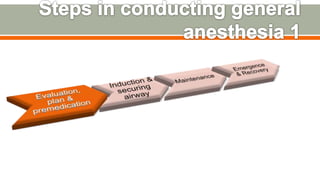
First step of general anesthesia: Preop evaln, anesthesia
plan
and premedication
ļ‚˜ Safe conduction of anesthesia depends on
o Preoperative evaluation,
o Anesthesia plan,
o Monitoring &
o Responding to homeostatic āˆ† throughout anesthesia and operation.
67
ļ‚˜ The fundamental purpose of preoperative evaluation is
o To obtain pertinent information regarding the patient's current
and past medical history and
o To formulate an assessment of the patient's intraoperative risk
and requisite clinical optimization.
68
ļ‚˜ At a minimum, the preanesthesia visit should include
o An interview with the patient to review the medical history
(including medications, allergies, coexisting diseases, and
previous operations),
o An appropriate physical examination,
o Review of laboratory data,
o Consultation with the operating surgical team and/or involvement
of other specialties according the patient’s condition and need,
and
o A formulation and discussion of the planned anesthetic with the
patient.
69
To be valuable, performing a preoperative test implies
that an increased perioperative risk exists when the
results are abnormal and a reduced risk exists when
the abnormality is corrected.
70
ļ‚˜ Following preoperative evaluation and obtaining
informed consent an anesthetic plan should be
formulated that will optimally accommodate the patient's
baseline physiological state, including
• Any medical conditions
• Previous operations
• The planned procedure
• Drug sensitivities
• Previous anesthetic experiences, and
• Psychological makeup
71
ļ‚˜ Inadequate preoperative planning & errors in pt
preparation are the most common causes of anesthetic
complications.
ļ‚˜ Anesthesia and elective operations should not proceed
until the patient is in optimal medical condition.
72
ļ‚˜ Anesthesia plan may include
o Premedication for anxiolysis (diazepam 5-10 mg orally/IV),
o Prophylaxis of aspiration (metoclopramide 10mg IV/orally,
Cimetidine 200-300mg orally or Ranitidine 150mg orally),
o Drying airway (Atropine 0.5 – 1mg), etc and
o Withholding some drugs like oral hypoglycemic agent
73
ļ‚˜ Second step of general anesthesia: Induction and
securing the airway
Induction
ļ‚˜ Process of initiating GA(unconsciousness) by
administration of drug or combination of drugs
ļ‚˜ The most critical phase in the whole process.
74
ļ‚˜ Selection of drugs for induction and maintenance of
anesthesia depends on
o The patient preexisting condition and
o Type of anesthetic planned.
ļ‚˜ Before induction,
o Minimum basic standard monitor should be applied & base line
values are recorded
o Intravenous access should be opened always before anesthesia.
75
ļ‚˜ Before administering anesthesia we have to administer 100%
oxygen for 3 to 5 minutes to replace the air which contains 78
% of nitrogen in the FRC of the lungs with oxygen.
ļ‚˜ This practice should increase the margin of safety during
periods of UAW obstruction or apnea that may accompany
induction of anesthesia.
76
ļ‚˜ Induction of GA can be achieved by
o IV induction agents (e.g., Ketamine 1-2 mg IV or 5- 10 mg IM,
Thiopentone 3-5mg IV & propofol 1-2.5 mg/kg) or
o Inhalation of VAA (e.g., halothane) or combination of both.
ļ‚˜ In addition to the induction drug, most patients receive an injection
of narcotic analgesic (e.g., pethedine .5 to 1 mg/kg, Fentanyl 1-2
µg/kg).
77
Third step: Maintenance
ļ‚˜ It is the time from the end of induction to emergence phase in
which procedures are performed safely.
ļ‚˜ Drugs used to initiate the anesthetic are beginning to wear off,
the pt must be kept anesthetized using a maintenance agent.
ļ‚˜ For the most part, this refers to the delivery of anesthetic
gases into the patient's lungs.
ļ‚˜ These may be inhaled as the patient breathes himself or
delivered under pressure by bagging manually, or each
mechanical breath of a ventilator.
78
ļ‚˜ Usually the most stable part of the anesthesia.
ļ‚˜ However, it is important to understand that anesthesia is
a continuum of different depths.
ļ‚˜ A level of anesthesia and relaxation that is satisfactory
for surgery to the skin of an extremity may be inadequate
for manipulation of the bowel.
ļ‚˜ Appropriate levels of anesthesia must be chosen both for
the planned procedure and for its various stages.
79
ļ‚˜ If muscle relaxants have not been used, inadequate
anesthesia is easy to spot.
ļ‚˜ The patient will move, cough, or obstruct his airway if the
anesthetic is too light for the stimulus being given.
ļ‚˜ If muscle relaxants have been used, then clearly the patient is
unable to demonstrate any of these phenomena.
ļ‚˜ In these pts, rely on observation of autonomic phenomena
such as HTN, tachycardia, sweating, and capillary dilation.
ļ‚˜ Excessive anesthetic depth is associated with decreased HR
& BP, and can jeopardize perfusion of vital organs.
80
Emergence
ļ‚˜ Phase of awakening
ļ‚˜ Should ideally be smooth and gradual awakening in a controlled
env’t.
ļ‚˜ Experience and close communication enable to predict the time at
which the application of dressings and casts will be complete.
ļ‚˜ In advance of that time, anesthetic vapors have been decreased or
even switched off to allow time for them to be excreted by the lungs.
ļ‚˜ Reverse residual MR using Neostigmine 0.2 – 0.5mg/kg
ļ‚˜ Removal of ETT or other airway device when the pt has sufficient81
Recovery phase
ļ‚˜ The patient recovering from anesthesia should be
monitored for common problems postop to ensure their
safety, providing for a smooth and uneventful recovery.
ļ‚˜ Common complications may include, Hypoxemia related
to AWObsn or inadequate respn, hypoVx, HN,
hypothermia, pain, nausea and vomiting and āˆ†HR and
rhythm
ļ‚˜ These should be addressed PACU until full recovery of
consciousness and complications are managed.
82
ļ‚˜ Documentation
ļ‚˜ written relevant information about the patient which contains
o An evidence of client findings,
o Detail of procedure and
o Events happened during the procedure.
ļ‚˜ It is an indicator of quality care and is the responsibility of an
anesthetist to record throughout the procedure on time.
ļ‚˜ While anesthesia care is a continuum, it is usually viewed as
consisting of preanesthesia, intraoperative/procedural anesthesia
and post anesthesia components.
ļ‚˜ Anesthesia care should be documented to reflect these components
and to facilitate review.
83
ļ‚˜ It is the art of rendering a part of the body insensible for
surgical operation or manipulation based on the concept
that the pain is conveyed by nerve fibers which are
amenable to interruption anywhere along their path way.
84
85
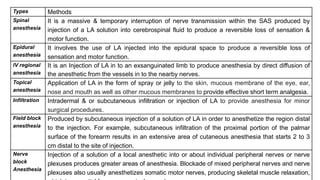
Types Methods
Spinal
anesthesia
It is a massive & temporary interruption of nerve transmission within the SAS produced by
injection of a LA solution into cerebrospinal fluid to produce a reversible loss of sensation &
motor function.
Epidural
anesthesia
It involves the use of LA injected into the epidural space to produce a reversible loss of
sensation and motor function.
IV regional
anesthesia
It is an Injection of LA in to an exsanguinated limb to produce anesthesia by direct diffusion of
the anesthetic from the vessels in to the nearby nerves.
Topical
anesthesia
Application of LA in the form of spray or jelly to the skin, mucous membrane of the eye, ear,
nose and mouth as well as other mucous membranes to provide effective short term analgesia.
Infiltration Intradermal & or subcutaneous infiltration or injection of LA to provide anesthesia for minor
surgical procedures.
Field block
anesthesia
Produced by subcutaneous injection of a solution of LA in order to anesthetize the region distal
to the injection. For example, subcutaneous infiltration of the proximal portion of the palmar
surface of the forearm results in an extensive area of cutaneous anesthesia that starts 2 to 3
cm distal to the site of injection.
Nerve
block
Anesthesia
Injection of a solution of a local anesthetic into or about individual peripheral nerves or nerve
plexuses produces greater areas of anesthesia. Blockade of mixed peripheral nerves and nerve
plexuses also usually anesthetizes somatic motor nerves, producing skeletal muscle relaxation,
ļ‚˜ Issues related to preoperative preparation of
clients who are undergoing anesthesia and
surgery
87
ļ‚˜ Designed to present the pt for surgery in the
best possible condition.
Goals
 Assessing the risk of coexisting diseases,
 Modifying risks,
 Addressing patients’ concerns, and
 Discussing options for anesthesia care.
 Reducing costs
88
ļ‚˜ What is the indication for the proposed surgery?
o Small bowel obstruction- aspiration and the need for RSI
o Lung resection- the need for pulmonary testing and perioperative
monitoring
o Carotid endarterectomy- extensive neurologic examination and R/O
CAD
ļ‚˜ Is it elective or an emergency?
ļ‚˜ What are the inherent risks of this surgery? 89
ļ‚˜ Does the patient have coexisting medical problems?
ļ‚˜ Does the surgery or anesthesia care plan need to be modified
because of them?
ļ‚˜ Has the patient had anesthesia before?
o Previous reactions, allergies, eg propofol (egg allergy?), MH,
Recorded difficulties, Post sux apnea………
ļ‚˜ Any risk factors for difficult AWMx?
90
ļ‚˜ Anesthetic history:
o Chart Review (response to various drugs, intubation
difficulties, allergic responses & Post operative
problems.)
o Any suggestive history of problems encountered during
91
ļ‚˜ Family anesthetic history
o Certain abnormal and possibly dangerous responses
to drugs (e.g. MH, Sux apnea) tend to run in families.
92
Medical history
ļ‚˜ Respiratory problems: cough, sputum,
smoking, asthma, exercise intolerance
(Angina, myocardial stress without failing,
CAD, +Chest pain= extensive CAD),
breathlessness, history of previous TB,
bronchitis……
ļ‚˜ CV disease: Difficulty in breathing,
palpitation, chest pain, ankle edema
ļ‚˜ Previous heart attacks 93
ļ‚˜ Hypertension
o Postop Myocardial ischemia, ventricular dysrhythmia
o +tobacco=CAD
ļ‚˜ Asthma- airway hypersensitivity, adrenal insufficiency 2˚ steroids
ļ‚˜ OSA- The need for preop CPAP, respiratory depressant effects of
IAA, sedatives and opioids
94
ļ‚˜ Other illnesses, e.g. DM, renal disease, hiatus hernia,
epilepsy
ļ‚˜ Alcohol and drug intake
ļ‚˜ Allergies
ļ‚˜ Smoking habits(cessation for even 2 days decrease
carboxyhg level, abolish nicotine effect, and improve mucous
clearance ……8 weeks may be wow!) 95
Coexisting diseases that influence anesthesia
management 1
1. Musculoskeletal
o Muscular dystrophy
o Myotonic dystrophy
o Myasthenia gravis
o Myasthenic syndrome
o Familial periodic paralysis
o Gullain –Barre syndrome
96
Coexisting diseases that influence anesthesia
management 2
2. CNS
o Multiple sclerosis
o Epilepsy
o Parkinson’s disease
o Alzheimer disease
o Amyotrophic lateral sclerosis
o Creutzfeldt - jakob disease
97
Coexisting diseases that influence anesthesia
management 3
Anemias
o Nutritional deficiency
o Hemolytic
o Hemoglobinopathies
o Thalassemias
98
Coexisting diseases that influence anesthesia
management 4
Collagen vascular
o Rheumathoid arthritis
o SLE
o Scleroderma
o Polymyositis
99
Coexisting diseases that influence anesthesia
management
Skin
o Epidermolysis bullosa
o Pemphigus
100
Past surgical procedures
ļ‚˜ Operations on the heart, lungs, kidneys and CNS may
tend to interfere with vital functions under anesthesia.
101
Drug History
1. Antihypertensive drugs:
 ↓peripheral vascular tone…interfere with circulatory homeostasis
 Difficulty compensation for stresses: Blood loss, āˆ†posture, IPPV.
 React badly to drugs such as thiopentone which can cause a fall in BP.
 Anti htnsive drugs have to be continued till morning of operation.
 Expected heavy bleeding- enalapril has to be discontinued a day b4.
 Patients on loop diuretics has to have e¯ determination B4 operation.
102
2. Prolonged steroid therapy (> 10mg prednisolone/day)
results in atrophy of the adrenal glands …cannot secrete
extra hormones in time of stress.
Collapse, with a fall of BP. Stress dose of hydrocortisone
50-100 before and after operation.
103
3. Monoamine oxidase inhibitors (MAOI):
 VS narcotic analgesics … result in - severe hypo or
hypertension, coma, convulsions, Cheyne Stokes respiration and
death.
 VS presser drugs … potentiate the side effects of barbiturates.
104
4. Beta-blockers:
 The patients may remain on these drugs but they cannot
compensate efficiently, in the face of CV stress and drugs that
decrease BP or HR has to be titrated according to response.
105
5. Diuretics:
 Prolonged diuretic therapy interferes with electrolyte balance.
 This must be checked pre-operatively (especially potassium).
106
5. Insulin and other oral glycemic control drugs:
 Schedule as a first case.
 There should be a possibility to have regular insulin intraop.
107
7. Antibiotics:
 Large doses– neomycin, streptomycin etc–potentiate NDMR
action
108
8. Phenothiazines:
o cause peripheral vasodilatation and result in a fall in BP.
o Also potentiate the action of narcotics and barbiturates…use in
smaller doses.
109
General examination
ļ‚˜ General appearance: age and approximate wt. Is the pt
dysphonic? Nervous? Sweating? Or suffering from
anemia, cyanosis, jaundice, edema, dehydration (any
evidence of early dehydration. Note: T⁰, skin turgor,
tongue, UOP, pulse, superficial veins etc)
110
ļ‚˜ Pathological problems: difficulty in opening the jaws,
difficulty in extending the neck, tumors or inflammn of the
neck, burns, contractures of the neck.
ļ‚˜ Psychological state of the patient. This will influence
the choice b/n RA or GA and also the premedication
required.
111
Airway examination:
ļ‚˜ Any anatomical features that hinder maintenance of a
clear airway.
112
System Examination
1. Respiratory system
ļ‚˜ Inspection
o Note rate and type of breathing is it noisy, labored, and obstructed.
o Shape of chest and movement of the chest.
o Deformities of the spine, Sputum color, quantity (if any) of nasal discharge.
o Cyanosis central or peripheral, Clubbing of fingers.
113
ļ‚˜ Palpation
o Confirm chest movement.
o Note the position of the trachea.
o Check for the presence of enlarged supraclavicular lymph
nodes.
114
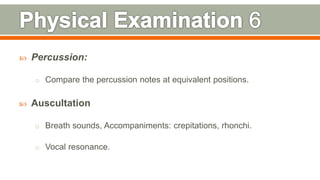
ļ‚˜ Percussion:
o Compare the percussion notes at equivalent positions.
ļ‚˜ Auscultation
o Breath sounds, Accompaniments: crepitations, rhonchi.
o Vocal resonance.
115
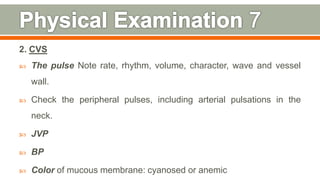
2. CVS
ļ‚˜ The pulse Note rate, rhythm, volume, character, wave and vessel
wall.
ļ‚˜ Check the peripheral pulses, including arterial pulsations in the
neck.
ļ‚˜ JVP
ļ‚˜ BP
ļ‚˜ Color of mucous membrane: cyanosed or anemic 116
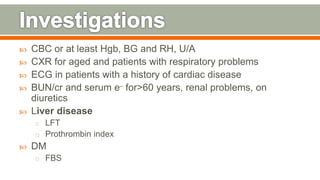
ļ‚˜ CBC or at least Hgb, BG and RH, U/A
ļ‚˜ CXR for aged and patients with respiratory problems
ļ‚˜ ECG in patients with a history of cardiac disease
ļ‚˜ BUN/cr and serum eĀÆ for>60 years, renal problems, on
diuretics
ļ‚˜ Liver disease
o LFT
o Prothrombin index
ļ‚˜ DM
o FBS
117
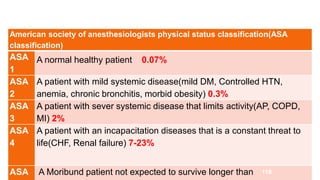
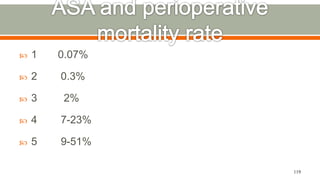
American society of anesthesiologists physical status classification(ASA
classification)
ASA
1
A normal healthy patient 0.07%
ASA
2
A patient with mild systemic disease(mild DM, Controlled HTN,
anemia, chronic bronchitis, morbid obesity) 0.3%
ASA
3
A patient with sever systemic disease that limits activity(AP, COPD,
MI) 2%
ASA
4
A patient with an incapacitation diseases that is a constant threat to
life(CHF, Renal failure) 7-23%
ASA A Moribund patient not expected to survive longer than 118
119
ļ‚˜ 1 0.07%
ļ‚˜ 2 0.3%
ļ‚˜ 3 2%
ļ‚˜ 4 7-23%
ļ‚˜ 5 9-51%
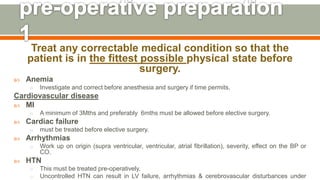
Treat any correctable medical condition so that the
patient is in the fittest possible physical state before
surgery.
ļ‚˜ Anemia
o Investigate and correct before anesthesia and surgery if time permits.
Cardiovascular disease
ļ‚˜ MI
o A minimum of 3Mths and preferably 6mths must be allowed before elective surgery.
ļ‚˜ Cardiac failure
o must be treated before elective surgery.
ļ‚˜ Arrhythmias
o Work up on origin (supra ventricular, ventricular, atrial fibrillation), severity, effect on the BP or
CO.
ļ‚˜ HTN
o This must be treated pre-operatively.
o Uncontrolled HTN can result in LV failure, arrhythmias & cerebrovascular disturbances under
120
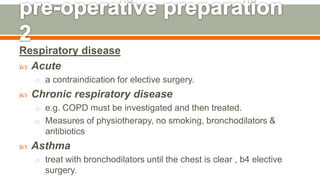
Respiratory disease
ļ‚˜ Acute
o a contraindication for elective surgery.
ļ‚˜ Chronic respiratory disease
o e.g. COPD must be investigated and then treated.
o Measures of physiotherapy, no smoking, bronchodilators &
antibiotics
ļ‚˜ Asthma
o treat with bronchodilators until the chest is clear , b4 elective
surgery. 121
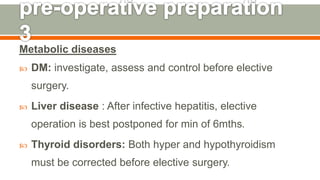
Metabolic diseases
ļ‚˜ DM: investigate, assess and control before elective
surgery.
ļ‚˜ Liver disease : After infective hepatitis, elective
operation is best postponed for min of 6mths.
ļ‚˜ Thyroid disorders: Both hyper and hypothyroidism
must be corrected before elective surgery.
122
Fluid Imbalance
ļ‚˜ More common in patients for emergency surgery.
ļ‚˜ Volume of circulating fluid should be corrected.
ļ‚˜ Causes: blood loss, burns, vomiting, diarrhea, loss through
fistulae, loss into the gut (ileus), deficient intake, excessive loss
through the skin (especially in the extremes of age) and
excessive urinary loss.
ļ‚˜ Sp and Sx suggesting dehydration:
o Thirst, Dry mouth, Diminished skin turgor, Rapid PR, Decreased UOP,
fallen BP
ļ‚˜ A high BUN and a raised specific gravity of urine confirm the Dx123
Electrolyte imbalance
ļ‚˜ Na+ and k+ imbalance esp. must be corrected pre-op.
ļ‚˜ A low potassium level can result in HN, arrhythmias and
cardiac arrest.
ļ‚˜ Skeletal and smooth muscle weakness interfere with the
action of relaxant drugs.
ļ‚˜ A high potassium level -cardiac arrhythmias.
124
Smoking
ļ‚˜ Increases intra and post-op morbidity due to associated
bronchial exudation and bronchospasm.
ļ‚˜ It should ideally be discontinued for more than 6wks pre-op.
ļ‚˜ However, cessation for even 24 hours pre-op reduces the
morbidity.
Special problems related to emergency surgery
ļ‚˜ Patients presenting for emergency surgery pose the problems of:
• Full stomach.
• Hypovolemia due to blood or fluid loss.
125
The unfasted patient (full stomach)
ļ‚˜ If possible delay surgery for at least 6HRS.
ļ‚˜ However, the gastric emptying time is usually prolonged in emergencies.
ļ‚˜ The stomach may be emptied using a NG or OGT of the largest possible
bore.
ļ‚˜ Sodium citrate (a non-particulate antacid) counteracts the acidity
ļ‚˜ H2 blockers i.e. ranitidine 300mg given at least 1 hour prior decreases
acidity
ļ‚˜ Metoclopramide 10mg given at the same time may benefit.
ļ‚˜ Omeprazole 40mg given 2–6 hours prior reduces gastric acid.
ļ‚˜ Regional techniques may be the safest.
ļ‚˜ RSI should be used during GA unless an awake intubation is indicated.126
Before the patient leaves the ward a senior nurse should:
ļ‚˜ Check the identity of the patient
ļ‚˜ Check the site and side of the operation
ļ‚˜ Ensure the consent form is signed
ļ‚˜ At least every child <age of 12 must be weighed
ļ‚˜ Grossly underwt and overwt adults must also be weighed
ļ‚˜ Ensure that fasting rules have been observed
ļ‚˜ Remove lipstick, nail varnish, etc.
ļ‚˜ Remove dentures, artificial limbs and artificial eyes
ļ‚˜ Empty bladder
ļ‚˜ Dress the patient in a linen gown with an identification label
ļ‚˜ Give premedication if any
127
Fasting guidelines
ļ‚˜ Elective cases
o Adults: no solid food for 8 hrs; clear liquids or water up to 2 hrs
preop.
o Children: no solid food for 8 hrs; non-human milk up to 6 hours;
breast milk up to 4 hrs; water up to 2 hrs preop.
ļ‚˜ Emergency cases:
o If possible, delay surgery for 8 hrs since the last solid food
intake;
o RSI.
128
Premedication:
ļ‚˜ Administration of drugs before operation, with the general aims of
lessening anxiety and fear and contributing to the ease and safety of
the anesthetic.
129
Purposes of premedication
ļ‚˜ To alleviate anxiety and fear
ļ‚˜ To prevent pain during cannulations, RA or positioning
ļ‚˜ To facilitate smooth induction & reduce anesthetic required
ļ‚˜ To reduce the volume and acidity of gastric contents
ļ‚˜ To reduce secretions especially salivary and of bronchial
ļ‚˜ To prevent undesirable reflexes, e.g. bradycardia
ļ‚˜ To provide anti–asthma and anti–allergy therapy if relevant
ļ‚˜ To reduce PONV
130
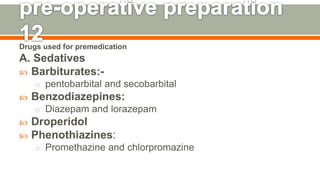
Drugs used for premedication
A. Sedatives
ļ‚˜ Barbiturates:-
o pentobarbital and secobarbital
ļ‚˜ Benzodiazepines:
o Diazepam and lorazepam
ļ‚˜ Droperidol
ļ‚˜ Phenothiazines:
o Promethazine and chlorpromazine
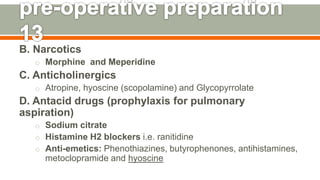
131
B. Narcotics
o Morphine and Meperidine
C. Anticholinergics
o Atropine, hyoscine (scopolamine) and Glycopyrrolate
D. Antacid drugs (prophylaxis for pulmonary
aspiration)
o Sodium citrate
o Histamine H2 blockers i.e. ranitidine
o Anti-emetics: Phenothiazines, butyrophenones, antihistamines,
metoclopramide and hyoscine
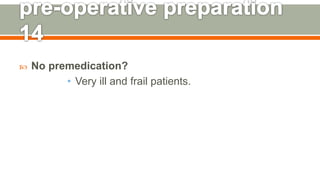
132
ļ‚˜ No premedication?
• Very ill and frail patients.
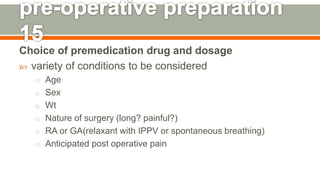
133
Choice of premedication drug and dosage
ļ‚˜ variety of conditions to be considered
o Age
o Sex
o Wt
o Nature of surgery (long? painful?)
o RA or GA(relaxant with IPPV or spontaneous breathing)
o Anticipated post operative pain
134
Important points regarding choice of drugs
ļ‚˜ Narcotics such as pethedine or morphine (unless otherwise
contraindicated) if the patient is in pain, e.g. from fractured
femur.
ļ‚˜ Narcotics cause RD & should not be used in head injured
patients unless facilities for pre & postop long term MV
available.
ļ‚˜ Avoid sedative in patients with raised ICP.
ļ‚˜ Avoid Narcotics in C/S and operative obstetrics, e.g. forceps
delivery. They can be given when the baby is born.
ļ‚˜ Narcotic is not used in children under the age of 12 mths.
135
ļ‚˜ Smaller doses of narcotics are used in
o Poor risk patients
o The elderly
o The very young
ļ‚˜ Pethedine and atropine are prescribed 30-45 minutes
preop.
ļ‚˜ In asthmatics a combination of pethedine, promethazine
and atropine. A salbutamol nebulizer prior to surgery.
136
ļ‚˜ In regional anaesthesia tranquilizers such as midazolam or
diazepam may be used.
ļ‚˜ Narcotic i.e pethedine to provide analgesia so that patient
will be comfortable when local anesthetic begins to wear off.
ļ‚˜ Chlorpromazine or other benzodiazepines (diazepam) are
good drugs to use in premedicating patients receiving
ketamine anaesthesia.
ļ‚˜ The hypertension and hallucinations that follow ketamine
are minimised.
137
Consent may be implied (i.e. the patient willingly cooperates with the
procedure), or expressed in written form.
ļ‚˜ All competent patients have the right to give or withhold consent for
treatment or examination.
ļ‚˜ To obtain consent, the patient must be given sufficient details and
information about the procedure to enable a proper decision to be
taken.
ļ‚˜ Any procedure undertaken without the patient's consent may be
considered an assault in a civil court.
138
Information:
ļ‚˜ To allow patient and/or family make a considered judgment.
o A description of the proposed procedure.
o Alternative options.
o Possible complications and their likelihood.
o Benefits versus risks.
139
140
141
142
143

introduction to anesthesia

  • 1.
    1 BY ABAYNEH BELIHUN AKSUMUNIVERSITY DEPARTMENT OF ANAESTHESIOLOGY NOV 2015
  • 2.
  • 3.
  • 4.
    ļ‚˜ Anesthesia isessential for the practice of surgery. ļ‚˜ Since its beginning in 1842 it has evolved in to a recognized specialty providing continuous improvement in patient care ļ‚˜ Anesthetists receive lives of patients in her/ his hands. ļ‚˜ It is a duty to administer the safest anesthetic possible, to protect the patient and to give full attention for the anesthetized patient. 4
  • 5.
    ļ‚˜ To carryout the responsibility, every anesthetist needs a foundation of medical science and understand the principles of anesthesia. ļ‚˜ A sound knowledge of physiology and pharmacology is essential, together with an understanding of āˆ†s brought about by illness or injury. 5
  • 6.
    Anesthesia ļ‚˜ The absenceor abolition of sensation, especially that of pain induced by drugs especially as a means of facilitation to surgical procedures. ļ‚˜ Anesthesiology- The art and science of rendering a patient insensible to pain by the administration of anesthetic agents and related drugs and procedures. ļ‚˜ An anesthetist – A qualified HCP who administers anesthetics to produce total or partial loss of sensation in patients during surgical or diagnostic procedures. ļ‚˜ Nurse anesthetist- A nurse who specializes in administration of anesthesia ļ‚˜ Anesthesiologist- A physician specialist in anesthesia practice t 6
  • 7.
    ļ‚˜ Before thediscovery of inhalational agents pain was considered or believed to be an inevitable outcome of surgery. ļ‚˜ Today, major surgery without adequate anesthesia would be unthinkable, and probably constitute grounds for malpractice litigation. ļ‚˜ Recent development dating back only 160 years. 7
  • 8.
    ļ‚˜ Early Analgesia:Dioscorides, a Greek physician from the first century AD, commented on the analgesia of mandragora, a drug prepared from the bark and leaves of the mandrake plant. ļ‚˜ He stated that the plant substance could be boiled in wine, strained, and used when they wish to produce anesthesia. ļ‚˜ Alcohol was another element of the pre-ether armamentarium because it was thought to induce stupor and blunt the impact of pain. 8
  • 9.
    ļ‚˜ Inhaled anesthetics:Prior to the hypodermic syringe & needle (1855) and routine venous access, ingestion and inhalation were the only known routes of administering medicines to gain systemic effects. ļ‚˜ Ether (1540): Ether was prepared by Valerius Cordus, and called "sweet oil of vitriol". It was not used as an anesthetic until 19th C when William Morton (1846), a Boston dentist, used it. ļ‚˜ Halothane (developed in 1951; released in 1956), methoxyflurane (developed in 1958; released in 1960), enflurane (developed in 1963; released in 1973), and isoflurane (developed in 1965; released in 1981). 9
  • 10.
    Nitrous oxide (1772) ļ‚˜Joseph Priestley in England prepared nitrous oxide but it was not used as an anesthetic until about 1870. ļ‚˜ Humphrey Davy first noted its analgesic properties in 1800. ļ‚˜ Gardner Colton and Horace Wells are credited with having first used nitrous oxide as an anesthetic in 10
  • 11.
    Chloroform (1847): ļ‚˜ JamesSimpson, a Scottish obstetrician, used chloroform as an anesthetic agent. ļ‚˜ Gained considerable notoriety after John Snow used it during the deliveries of Queen Victoria (1853) for the birth of Prince Leopold, thus giving the royal stamp of approval. ļ‚˜ For the next 50 years ether and chloroform dominated the anesthetic scene. 11
  • 12.
    Local/regional anesthesia: ļ‚˜ Itis the art of rendering a part of the body insensible for surgical operation or manipulation. ļ‚˜ The origin of modern LA is credited to Carl Koller, an ophthalmologist, who demonstrated the use of topical cocaine for surgical anesthesia of the eye in 1884. ļ‚˜ Procaine was synthesized in 1904. ļ‚˜ Additional local anesthetics subsequently introduced clinically include dibucaine (1930), tetracaine (1932), lidocaine (1947), chloroprocaine (1955), mepivacaine (1957), prilocaine (1960), bupivacaine (1963), and etidocaine (1972). 12
  • 13.
    Intravenous anesthesia: ļ‚˜ Followedinvention of the hypodermic syringe & needle (Alexander Wood in 1855. ) ļ‚˜ Early attempts at IV anaesthesia included the use of chloral hydrate (1872), chloroform and ether (1909), & the combination of morphine & scopolamine (1916). ļ‚˜ Barbiturates were synthesized in 1903 by Fischer and von Mering. ļ‚˜ The first barbiturate used for induction of anaesthesia was diethyl barbituric acid (barbital), but it was not until the introduction of hexobarbital in 1927 that barbiturate induction became a popular technique. 13
  • 14.
    ļ‚˜ Thiopental synthesizedin 1932 and remains the most common induction agent for anaesthesia. ļ‚˜ Ketamine, released in 1970, the first IV agent associated with minimal cardiac and respiratory depression. 14
  • 15.
    Muscle relaxants: ļ‚˜ Theuse of curare (1942) was a milestone in anesthesia. ļ‚˜ Curare facilitated tracheal intubation & provided abdominal relaxation ļ‚˜ Sux was synthesized by Bovet in 1949 & released in 1951; become a standard agent for facilitating tracheal intubation. ļ‚˜ Until recently, Sux remained unparalleled in its onset, but its occasional side effects continued to fuel the search for a comparable substitute. ļ‚˜ Recently introduced agents that come close to this goal include vecuronium, atracurium, pipecuronium, doxacurium, rocuronium, and cis-atracurium 15
  • 16.
    Opioids: ļ‚˜ Morphine wasisolated from opium in 1805. ļ‚˜ The concept of balanced anesthesia, was introduced in 1926 by Lundy and evolved to consist of thiopental for induction, nitrous oxide for amnesia, meperidine (or any opioid) for analgesia, and curare for muscle relaxation. ļ‚˜ Opioids (Morphine, fentanyl, sufentanil, and alfentanil) prevent patient awareness and suppressing autonomic responses during surgery. 16
  • 17.
    Early Anesthesia DeliverySystems ļ‚˜ The transition from ether inhalers and chloroform-soaked handkerchiefs to more sophisticated anesthesia delivery equipment, ETI set such as laryngoscope, ETT, etc and monitoring equipments. ļ‚˜ Safer in recent years 2˚ improvements in pharmacological agents and the introduction of sophisticated technology and patient monitoring . 17
  • 18.
    DEFINITION 1 ā€œAnesthesia isa medical procedure which is deliberately produced to make a patient insensible to pain either in a part or in the whole of the body by which diagnostic and surgical procedure are done while the patient safety and comforts are maintained.ā€ 18
  • 19.
    ļ‚˜ Anesthesia, riskyprocedure and may take the patient life in danger…permanent organ damage and death ļ‚˜ Vigilance is the logo!!! ļ‚˜ Although risky anesthesia is now much safer and more pleasant than the previous period. 19
  • 20.
    The three components….. 1.Analgesia 2. Hypnosis (amnesia) and 3. Muscle relaxation. ļ‚˜ ???May be Prevention of undesirable autonomic reflex ļ‚˜ Drugs used in anesthesia have varying effect on these three areas and to be combined to optimize the whole process of anesthesia. 20
  • 21.
    A. Hypnosis (amnesia):a state of sleep or unconsciousness which enable the patient unaware any events B. Analgesia: Insensitivity to pain + loss of consciousness. C. Muscle relaxation: aided by drugs which affect skeletal muscle function and decrease the muscle tone by which immobility and relaxation of the skeletal muscle produced ….surgery will be proceeded at ease. 21
  • 22.
    An anesthetic procedureshould: ļ‚˜ Abolish pain ļ‚˜ Be Completely reversible. ļ‚˜ Be Safe!... • Comfort- important • Safety - essential and must come first. ļ‚˜ Provide good operating conditions. • E.g. good relaxation for abdominal surgery. ļ‚˜ Be acceptable to the patient. 22
  • 23.
    ļ‚˜ General anesthesia:-a drug-induced reversible depression of the CNS resulting in the loss of response to & perception of all external stimuli. ļ‚˜ Regional anesthesia:-(central, regional, peripheral) -the art of rendering a part of the body insensible for surgical operation or23
  • 24.
  • 25.
    TASK MANAGEMENT ļ‚˜ Planningand preparing ļ‚˜ Prioritizing ļ‚˜ Providing and maintaining standards ļ‚˜ Identifying and utilizing resources TEAM WORKING ļ‚˜ Coordinating activities with team members ļ‚˜ Exchanging information ļ‚˜ Using authority and assertiveness ļ‚˜ Assessing capabilities ļ‚˜ Supporting others SITUATION AWARENESS ļ‚˜ Gathering information ļ‚˜ Recognizing and understanding ļ‚˜ Anticipating DECISION MAKING ļ‚˜ Identifying options ļ‚˜ Balancing risks and selecting options ļ‚˜ Re-evaluating 25
  • 26.
    Skills for organisingresources & required activities to achieve goals. 1. Planning and preparing Developing in advance primary & contingency strategies for managing tasks, reviewing & updating them. 26
  • 27.
     Behavioural markersfor good practice-- lays out drugs and equipment needed before starting case.  Behavioural markers for poor practice--does not ask for drugs or equipment until the last minute or does not have emergency/ alternative drugs 27
  • 28.
    2. Prioritising scheduling tasks,activities, issues etc., according to importance, being able to identify key issues and allocate attention to them accordingly, and avoiding being distracted by less important or irrelevant matters. ļ‚˜ Behavioural markers for good practice--negotiates sequence of cases on list with Surgeon ļ‚˜ Behavioural markers for poor practice-- fails to allocate attention to critical areas 28
  • 29.
    3. Providing andmaintaining standards – supporting safety and quality by adhering to accepted principles ; following codes of good practice, treatment protocols or guidelines, & mental checklists. ļ‚˜ Behavioural markers for good practice--cross-checks drug labels, checks machine at beginning of each session, maintains accurate anaesthetic records ļ‚˜ Behavioural markers for poor practice--does not check blood with pt and notes, fails to confirm patient identity and consent details 29
  • 30.
    4. Identifying andutilising resources– Establishing the necessary, and available, requirements for task completion (e.g. people, expertise, equipment, time) and using them to accomplish goals with minimum stress, work overload ļ‚˜ Good practice-- allocates tasks to appropriate member(s). 30
  • 31.
    ļ‚˜ Skills forworking in a group to ensure effective joint task completion and team member satisfaction. 5. Co-ordinating activities with team members – working together with others, for both physical and cognitive activities; understanding the roles and responsibilities, and ensuring that a collaborative approach is employed. 31
  • 32.
    ļ‚˜ Behavioural markersfor good practice o confirms roles and responsibilities of team members, discusses case with surgeons or colleagues ļ‚˜ Behavioural markers for Poor practice o Does not co-ordinate with surgeon(s) and other groups o Relies too much on familiarity of team for getting things done…….. makes assumptions, takes things for granted 32
  • 33.
    6. Exchanging information– giving and receiving the knowledge and data necessary for team co-ordination and task completion good practice--gives situation updates/reports key events poor practice-- gives inadequate handover briefing 33
  • 34.
    7. Using authorityand assertiveness – leading the team &/or the task, accepting a non-leading role when appropriate; adopting a suitably forceful manner to make a point Good practice- takes over task leadership as required Poor practice--does not allow others to put forward their case 34
  • 35.
    8. Assessing capabilities– judging different team members’ skills, and their ability to deal with a situation. Good practice-asks new team member about their Experience Poor practice-allows team to accept case beyond its level of expertise 35
  • 36.
    9. Supporting others Providingphysical, cognitive or emotional help to members Good practice- acknowledges concerns of others Poor practice- asks for information at difficult/high workload time for someone else 36
  • 37.
    10. SITUATION AWARENESS:Skills for developing and maintaining an overall awareness of the work setting based on observing all relevant aspects of the theatre environment (patient, team, time, displays, equipment); understanding what they mean, and thinking ahead about what could happen next. 37
  • 38.
    11.Gathering information –actively and specifically collecting data about the situation by continuously observing the whole environment and monitoring all available data sources and cues and verifying data to confirm their reliability (i.e. that they are not artefactual) Good practice- watches surgical procedure, verify status Poor practice-does not ask questions to orient self to situation during hand-over 38
  • 39.
    12. Anticipating –asking ā€˜what if’ questions and thinking ahead about potential outcomes and consequences of actions, intervention, non-intervention, etc o Good practice- reviews the effects of an intervention o Poor practice- does not foresee undesirable drug interactions 39
  • 40.
    ļ‚˜ Skills forreaching a judgement to select a course of action or make a diagnosis about a situation, in both normal conditions and in time-pressured crisis situations 13.Identifying options – generating alternative possibilities or courses of action to be considered in making a decision or solving a problem. 14.Balancing risks and selecting options – assessing hazards to weigh up the threats or benefits of a situation, considering the advantages and disadvantages of different courses of action 40
  • 41.
    15. Re-evaluating –continually reviewing suitability of options identified, assessed and selected; and re- assessing the situation following implementation of a given action. ļ‚˜ Good practice- Re-assesses patient after Intervention ļ‚˜ Poor practice- Fails to allow adequate time for intervention to take effect 41
  • 42.
    ļ‚˜ An idealanesthetic technique would incorporate o Optimal patient safety and satisfaction o Provide excellent operating conditions o Allow rapid recovery o Avoid postoperative side effects. 42
  • 43.
    In addition, thechosen technique would be o Low in cost, o Allow early transfer or discharge from the PACU, o Optimize postoperative pain control, and o Permit optimal operating room efficiency, including turnover times. 43
  • 44.
    The anesthesia providermust o Evaluate the medical condition o Know unique needs of each patient, o Select an acceptable anesthetic technique, and o Make recommendation to the patient. 44
  • 45.
    Preparation for anesthesia ļ‚˜Never induce anesthesia when alone, trained assistant must be available. ļ‚˜ correct pt scheduled for correct operation on the correct side. ļ‚˜ Check patient has been properly prepared and NPO. • Solid food for 8HRS, • Milk feed up to 4HRS. • Clear fluids are regarded as safe up to 3Hrs preop if gastric function is normal. ļ‚˜ Measure PR and BP, and try to make the pt as relaxed and comfortable as possible. 45
  • 46.
    Before you givean anesthetic and going a critical moment make sure checked and functional of the following items. ļ‚˜ Apparatus you intend to use, or might need, is available and working ļ‚˜ If you are using compressed gases, there is enough gas and a reserve oxygen cylinder is available ļ‚˜ The anesthetic vaporizers are connected 46
  • 47.
    ļ‚˜ The breathingsystem that delivers gas to the patient is securely and correctly assembled ļ‚˜ Breathing circuits are clean ļ‚˜ Resuscitation apparatus is present and working ļ‚˜ Laryngoscope, tracheal tubes and suction apparatus are ready and decontaminated ļ‚˜ Needles and syringes are sterile: never use the same syringe or needle for more than one patient ļ‚˜ Any other drugs you might need are in the room 47
  • 48.
    ļ‚˜ Always beginyour anesthetic with the pt lying on a table or trolley that can be rapidly tilted into a head-down position in case of sudden hypotension or vomiting. ļ‚˜ Before inducing anesthesia, always ensure appropriate size of cannula in a large vein is available and working properly ļ‚˜ RA needs the same preparation as of GA. 48
  • 49.
    Initiation of anesthesia(Induction): ļ‚˜ GA may be initiated by the administration of IV drugs or VAA. ļ‚˜ GA renders a patient insensible to pain (analgesia); make the patient unaware of the procedure (amnesia); and muscle relaxation for surgical purposes. ļ‚˜ Vigilance, to be alert to danger or threats, is essential. ļ‚˜ The patient is reliant upon the anesthetist to maintain a patent airway, provide adequate oxygenation, and support of adequate heart function. 49
  • 50.
    Type TechniquesMASK ļ‚· Inductioninhalational, intravenous or intramuscular. ļ‚· Maintenance of anesthesia during surgery with the patient breathing spontaneously using an air/O2/inhalational agent (e.g. halothane +/- IV analgesia) ETanesthesia ļ‚· Induction either intravenous ( e.g. Ketamine 1-2 mg/kg or Thiopentone 3-5 mg/kg I.V.) or inhalational (Halothane) ļ‚· Intubation using an IV muscle relaxant (suxamethenium 1-2 mg/kg I.V) or an inhalational agent, tube position confirmed with chest excursion and auscultation of breath sounds in both lungs ļ‚· Maintenance with spontaneous respiration as for mask anaesthesia or IPPV using a long acting muscle relaxant (e.g. Vecuronium .05 - .1 mg/kg I.V) in addition to air/O2/inhalational agent +/– IV analgesia (e.g. Pethedine .5 – 1mg/kg I.V.) ļ‚· Reversal of the muscle relaxation at the end of surgery (Neostigmine + Atropine) TIVA It is a technique of GA using combination of agents given solely by the intravenous route and in the absence of inhalational agents. MAC ļ‚· Refers to the anesthesia personnel present during a procedure and does not implicitly indicate the level of anesthesia needed. ļ‚· Sedatives, analgesics, hypnotics, anesthetic agents or other medications to ensure patient safety and comfort ļ‚· Specific anaesthetic service for diagnostic or therapeutic procedures. ļ‚· Indications nature of the procedure, the pt’s clinical condition and/or the potential need to convert to a GA/RA. ļ‚· MAC may include varying levels of sedation, analgesia, and anxiolysis as necessary. Monitoring of vital signs, maintenance of the patient’s airway and continual evaluation of vital functions. ļ‚· The provider of MAC must be prepared and qualified to convert to general anesthesia when necessary. Balancedanesthesia ļ‚· The concept emphasized the use of multiple drugs to produce unconsciousness and analgesia, provide skeletal muscle relaxation, and prevention of reflex responses. ļ‚· No single anesthetic drug could provide all the characteristics of an ideal general anesthesia, but a combination of intravenous analgesics (e.g., pethedine), neuromuscular blocking drugs (e.g., pancuronium), and hypnotics (thiopentone) given together produced the desired balanced anesthetic. ļ‚· Lower doses of each drug could be used because the different drugs tended to act synergistically. 50
  • 51.
    Intravenous induction ofGA ļ‚˜ The administration of anesthetic drugs (propofol, thiopental, or ketamine) to produce rapid onset of unconsciousness ļ‚˜ usually used in adult patients by the IV administration of an anesthetic. ļ‚˜ Ventilation can be sustained via a face mask or a LMA may be inserted or a neuromuscular blocking drug may be given IV to facilitate direct laryngoscopy before tracheal intubation 51
  • 52.
    Intramuscular induction: ļ‚˜ Uncooperativechildren ļ‚˜ Usually ketamine….increase in secretions….Atropine 0.1 to 0.2mg/kg ļ‚˜ Patients sometimes complain afterwards of vivid dreams and hallucinations, an experience of seeing an imaginary scene or hearing an imaginary sound as clearly as if it were really there. ļ‚˜ Diazepam before or at the end of anesthesia can reduce these. ļ‚˜ Hallucinations may not occur if ketamine is used only for induction and is followed by inhalational anesthetic. 52
  • 53.
    Inhalation induction: ļ‚˜ Theadministration of VAA (e.g., halothane) through a mask ļ‚˜ Often used in the pediatric population. ļ‚˜ After VAA induction, a dep (sux 1-2 mg/kg) or NDNMBDs (Vecuronium 0.08- 0.1 mg/kg) is administered IV to provide the skeletal muscle relaxation to facilitate laryngoscopy. ļ‚˜ If ETI is not accomplished, anesthesia can be maintained by inhalation via a facemask or LMA 53
  • 54.
    ļ‚˜ Four mainstages are recognized based upon • Patient’s body movements, • Respiratory rhythm, • Oculomotor reflexes, and • Muscle tone. 54
  • 55.
    ļ‚˜ First Guedelused in assessment of stages of anesthesia using ether inhalation anesthesia and now it is prove useful in your assessment of the patient under GA with halogenated inhalational anesthetic agents(e.g., pediatric inductions with halothane). ļ‚˜ These signs will not be helpful if you are performing an anesthetic with IV anesthetics and using muscle relaxants. ļ‚˜ Atropine may affect the pupillary size and make eye size unusable size. ļ‚˜ During recovery from an inhaled GA, the stages will be reversed as the patient regains consciousness 55
  • 56.
    Stage 1- Amnesiaand analgesia stage: ļ‚˜ Conscious & rational, however perception of pain is diminished. ļ‚˜ From beginning of the anesthetic to the loss of consciousness. ļ‚˜ During this stage the patient will demonstrate the following: o Able to open eyes on command o Breathe normally o Maintain protective reflexes o Tolerate mild painful stimuli 56
  • 57.
    Stage 2- Deliriumstage: ļ‚˜ Starts with the loss of consciousness, ends with the appearance of a regular pattern of breathing and loss of eye lid reflex. ļ‚˜ Excitement is noted. ļ‚˜ Children will often exhibit this stage during an inhaled induction. ļ‚˜ The patient may demonstrate the following during this stage: o Movement of limbs and tense struggle o Irregular breathing o Breath holding o Pupils become dilated but reactive to light 57
  • 58.
    Stage 3- SurgicalAnesthesia: ļ‚˜ This stage begins with the resumption of regular breathing pattern and ends at the cessation of respiration. ļ‚˜ Surgery generally occurs during one of the four levels of stage 3. ļ‚˜ No response to surgical incision. 58
  • 59.
    Level 1 ļ‚˜ Thepatient may exhibit the following signs during this level: o Pupillary dilatation may occur but the pupils will become smaller o Absence of pupillary reaction to light o Eye lid reflex disappears o Respiration is regular o Vomiting reflex is abolished 59
  • 60.
    Level 2: The patientmay exhibit the following signs during this level: o Eyes become fixed in the midline o Decrease in the activity of the IC and thoracic muscles during respiration o Laryngospasm reflex disappears o General muscle tone becomes more flaccid 60
  • 61.
    Level 3: The patientmay exhibit the following signs during this level: o ICM activity decreases to the point of cessation o Respiration may come from only the diaphragm o Pupils become more dilated 61
  • 62.
    Level 4: ļ‚˜ Thepatient may exhibit the following signs during this level: o Paralysis of ICM o Cessation of spontaneous respiration o Pupils become very dilated 62
  • 63.
    Stage 4 AnestheticOverdose: ļ‚˜ This stage represents an overdose. ļ‚˜ Action must be taken to decrease the inhaled anesthetic or cardiac arrest may occur. ļ‚˜ The patient may exhibit the following signs: o Cessation of spontaneous respiration o Severe bradycardia and hypotension o Cardiac arrest o Absence of all reflexes 63
  • 64.
  • 65.
  • 66.
  • 67.
    First step ofgeneral anesthesia: Preop evaln, anesthesia plan and premedication ļ‚˜ Safe conduction of anesthesia depends on o Preoperative evaluation, o Anesthesia plan, o Monitoring & o Responding to homeostatic āˆ† throughout anesthesia and operation. 67
  • 68.
    ļ‚˜ The fundamentalpurpose of preoperative evaluation is o To obtain pertinent information regarding the patient's current and past medical history and o To formulate an assessment of the patient's intraoperative risk and requisite clinical optimization. 68
  • 69.
    ļ‚˜ At aminimum, the preanesthesia visit should include o An interview with the patient to review the medical history (including medications, allergies, coexisting diseases, and previous operations), o An appropriate physical examination, o Review of laboratory data, o Consultation with the operating surgical team and/or involvement of other specialties according the patient’s condition and need, and o A formulation and discussion of the planned anesthetic with the patient. 69
  • 70.
    To be valuable,performing a preoperative test implies that an increased perioperative risk exists when the results are abnormal and a reduced risk exists when the abnormality is corrected. 70
  • 71.
    ļ‚˜ Following preoperativeevaluation and obtaining informed consent an anesthetic plan should be formulated that will optimally accommodate the patient's baseline physiological state, including • Any medical conditions • Previous operations • The planned procedure • Drug sensitivities • Previous anesthetic experiences, and • Psychological makeup 71
  • 72.
    ļ‚˜ Inadequate preoperativeplanning & errors in pt preparation are the most common causes of anesthetic complications. ļ‚˜ Anesthesia and elective operations should not proceed until the patient is in optimal medical condition. 72
  • 73.
    ļ‚˜ Anesthesia planmay include o Premedication for anxiolysis (diazepam 5-10 mg orally/IV), o Prophylaxis of aspiration (metoclopramide 10mg IV/orally, Cimetidine 200-300mg orally or Ranitidine 150mg orally), o Drying airway (Atropine 0.5 – 1mg), etc and o Withholding some drugs like oral hypoglycemic agent 73
  • 74.
    ļ‚˜ Second stepof general anesthesia: Induction and securing the airway Induction ļ‚˜ Process of initiating GA(unconsciousness) by administration of drug or combination of drugs ļ‚˜ The most critical phase in the whole process. 74
  • 75.
    ļ‚˜ Selection ofdrugs for induction and maintenance of anesthesia depends on o The patient preexisting condition and o Type of anesthetic planned. ļ‚˜ Before induction, o Minimum basic standard monitor should be applied & base line values are recorded o Intravenous access should be opened always before anesthesia. 75
  • 76.
    ļ‚˜ Before administeringanesthesia we have to administer 100% oxygen for 3 to 5 minutes to replace the air which contains 78 % of nitrogen in the FRC of the lungs with oxygen. ļ‚˜ This practice should increase the margin of safety during periods of UAW obstruction or apnea that may accompany induction of anesthesia. 76
  • 77.
    ļ‚˜ Induction ofGA can be achieved by o IV induction agents (e.g., Ketamine 1-2 mg IV or 5- 10 mg IM, Thiopentone 3-5mg IV & propofol 1-2.5 mg/kg) or o Inhalation of VAA (e.g., halothane) or combination of both. ļ‚˜ In addition to the induction drug, most patients receive an injection of narcotic analgesic (e.g., pethedine .5 to 1 mg/kg, Fentanyl 1-2 µg/kg). 77
  • 78.
    Third step: Maintenance ļ‚˜It is the time from the end of induction to emergence phase in which procedures are performed safely. ļ‚˜ Drugs used to initiate the anesthetic are beginning to wear off, the pt must be kept anesthetized using a maintenance agent. ļ‚˜ For the most part, this refers to the delivery of anesthetic gases into the patient's lungs. ļ‚˜ These may be inhaled as the patient breathes himself or delivered under pressure by bagging manually, or each mechanical breath of a ventilator. 78
  • 79.
    ļ‚˜ Usually themost stable part of the anesthesia. ļ‚˜ However, it is important to understand that anesthesia is a continuum of different depths. ļ‚˜ A level of anesthesia and relaxation that is satisfactory for surgery to the skin of an extremity may be inadequate for manipulation of the bowel. ļ‚˜ Appropriate levels of anesthesia must be chosen both for the planned procedure and for its various stages. 79
  • 80.
    ļ‚˜ If musclerelaxants have not been used, inadequate anesthesia is easy to spot. ļ‚˜ The patient will move, cough, or obstruct his airway if the anesthetic is too light for the stimulus being given. ļ‚˜ If muscle relaxants have been used, then clearly the patient is unable to demonstrate any of these phenomena. ļ‚˜ In these pts, rely on observation of autonomic phenomena such as HTN, tachycardia, sweating, and capillary dilation. ļ‚˜ Excessive anesthetic depth is associated with decreased HR & BP, and can jeopardize perfusion of vital organs. 80
  • 81.
    Emergence ļ‚˜ Phase ofawakening ļ‚˜ Should ideally be smooth and gradual awakening in a controlled env’t. ļ‚˜ Experience and close communication enable to predict the time at which the application of dressings and casts will be complete. ļ‚˜ In advance of that time, anesthetic vapors have been decreased or even switched off to allow time for them to be excreted by the lungs. ļ‚˜ Reverse residual MR using Neostigmine 0.2 – 0.5mg/kg ļ‚˜ Removal of ETT or other airway device when the pt has sufficient81
  • 82.
    Recovery phase ļ‚˜ Thepatient recovering from anesthesia should be monitored for common problems postop to ensure their safety, providing for a smooth and uneventful recovery. ļ‚˜ Common complications may include, Hypoxemia related to AWObsn or inadequate respn, hypoVx, HN, hypothermia, pain, nausea and vomiting and āˆ†HR and rhythm ļ‚˜ These should be addressed PACU until full recovery of consciousness and complications are managed. 82
  • 83.
    ļ‚˜ Documentation ļ‚˜ writtenrelevant information about the patient which contains o An evidence of client findings, o Detail of procedure and o Events happened during the procedure. ļ‚˜ It is an indicator of quality care and is the responsibility of an anesthetist to record throughout the procedure on time. ļ‚˜ While anesthesia care is a continuum, it is usually viewed as consisting of preanesthesia, intraoperative/procedural anesthesia and post anesthesia components. ļ‚˜ Anesthesia care should be documented to reflect these components and to facilitate review. 83
  • 84.
    ļ‚˜ It isthe art of rendering a part of the body insensible for surgical operation or manipulation based on the concept that the pain is conveyed by nerve fibers which are amenable to interruption anywhere along their path way. 84
  • 85.
    85 Types Methods Spinal anesthesia It isa massive & temporary interruption of nerve transmission within the SAS produced by injection of a LA solution into cerebrospinal fluid to produce a reversible loss of sensation & motor function. Epidural anesthesia It involves the use of LA injected into the epidural space to produce a reversible loss of sensation and motor function. IV regional anesthesia It is an Injection of LA in to an exsanguinated limb to produce anesthesia by direct diffusion of the anesthetic from the vessels in to the nearby nerves. Topical anesthesia Application of LA in the form of spray or jelly to the skin, mucous membrane of the eye, ear, nose and mouth as well as other mucous membranes to provide effective short term analgesia. Infiltration Intradermal & or subcutaneous infiltration or injection of LA to provide anesthesia for minor surgical procedures. Field block anesthesia Produced by subcutaneous injection of a solution of LA in order to anesthetize the region distal to the injection. For example, subcutaneous infiltration of the proximal portion of the palmar surface of the forearm results in an extensive area of cutaneous anesthesia that starts 2 to 3 cm distal to the site of injection. Nerve block Anesthesia Injection of a solution of a local anesthetic into or about individual peripheral nerves or nerve plexuses produces greater areas of anesthesia. Blockade of mixed peripheral nerves and nerve plexuses also usually anesthetizes somatic motor nerves, producing skeletal muscle relaxation,
  • 87.
    ļ‚˜ Issues relatedto preoperative preparation of clients who are undergoing anesthesia and surgery 87
  • 88.
    ļ‚˜ Designed topresent the pt for surgery in the best possible condition. Goals  Assessing the risk of coexisting diseases,  Modifying risks,  Addressing patients’ concerns, and  Discussing options for anesthesia care.  Reducing costs 88
  • 89.
    ļ‚˜ What isthe indication for the proposed surgery? o Small bowel obstruction- aspiration and the need for RSI o Lung resection- the need for pulmonary testing and perioperative monitoring o Carotid endarterectomy- extensive neurologic examination and R/O CAD ļ‚˜ Is it elective or an emergency? ļ‚˜ What are the inherent risks of this surgery? 89
  • 90.
    ļ‚˜ Does thepatient have coexisting medical problems? ļ‚˜ Does the surgery or anesthesia care plan need to be modified because of them? ļ‚˜ Has the patient had anesthesia before? o Previous reactions, allergies, eg propofol (egg allergy?), MH, Recorded difficulties, Post sux apnea……… ļ‚˜ Any risk factors for difficult AWMx? 90
  • 91.
    ļ‚˜ Anesthetic history: oChart Review (response to various drugs, intubation difficulties, allergic responses & Post operative problems.) o Any suggestive history of problems encountered during 91
  • 92.
    ļ‚˜ Family anesthetichistory o Certain abnormal and possibly dangerous responses to drugs (e.g. MH, Sux apnea) tend to run in families. 92
  • 93.
    Medical history ļ‚˜ Respiratoryproblems: cough, sputum, smoking, asthma, exercise intolerance (Angina, myocardial stress without failing, CAD, +Chest pain= extensive CAD), breathlessness, history of previous TB, bronchitis…… ļ‚˜ CV disease: Difficulty in breathing, palpitation, chest pain, ankle edema ļ‚˜ Previous heart attacks 93
  • 94.
    ļ‚˜ Hypertension o PostopMyocardial ischemia, ventricular dysrhythmia o +tobacco=CAD ļ‚˜ Asthma- airway hypersensitivity, adrenal insufficiency 2˚ steroids ļ‚˜ OSA- The need for preop CPAP, respiratory depressant effects of IAA, sedatives and opioids 94
  • 95.
    ļ‚˜ Other illnesses,e.g. DM, renal disease, hiatus hernia, epilepsy ļ‚˜ Alcohol and drug intake ļ‚˜ Allergies ļ‚˜ Smoking habits(cessation for even 2 days decrease carboxyhg level, abolish nicotine effect, and improve mucous clearance ……8 weeks may be wow!) 95
  • 96.
    Coexisting diseases thatinfluence anesthesia management 1 1. Musculoskeletal o Muscular dystrophy o Myotonic dystrophy o Myasthenia gravis o Myasthenic syndrome o Familial periodic paralysis o Gullain –Barre syndrome 96
  • 97.
    Coexisting diseases thatinfluence anesthesia management 2 2. CNS o Multiple sclerosis o Epilepsy o Parkinson’s disease o Alzheimer disease o Amyotrophic lateral sclerosis o Creutzfeldt - jakob disease 97
  • 98.
    Coexisting diseases thatinfluence anesthesia management 3 Anemias o Nutritional deficiency o Hemolytic o Hemoglobinopathies o Thalassemias 98
  • 99.
    Coexisting diseases thatinfluence anesthesia management 4 Collagen vascular o Rheumathoid arthritis o SLE o Scleroderma o Polymyositis 99
  • 100.
    Coexisting diseases thatinfluence anesthesia management Skin o Epidermolysis bullosa o Pemphigus 100
  • 101.
    Past surgical procedures ļ‚˜Operations on the heart, lungs, kidneys and CNS may tend to interfere with vital functions under anesthesia. 101
  • 102.
    Drug History 1. Antihypertensivedrugs:  ↓peripheral vascular tone…interfere with circulatory homeostasis  Difficulty compensation for stresses: Blood loss, āˆ†posture, IPPV.  React badly to drugs such as thiopentone which can cause a fall in BP.  Anti htnsive drugs have to be continued till morning of operation.  Expected heavy bleeding- enalapril has to be discontinued a day b4.  Patients on loop diuretics has to have eĀÆ determination B4 operation. 102
  • 103.
    2. Prolonged steroidtherapy (> 10mg prednisolone/day) results in atrophy of the adrenal glands …cannot secrete extra hormones in time of stress. Collapse, with a fall of BP. Stress dose of hydrocortisone 50-100 before and after operation. 103
  • 104.
    3. Monoamine oxidaseinhibitors (MAOI):  VS narcotic analgesics … result in - severe hypo or hypertension, coma, convulsions, Cheyne Stokes respiration and death.  VS presser drugs … potentiate the side effects of barbiturates. 104
  • 105.
    4. Beta-blockers:  Thepatients may remain on these drugs but they cannot compensate efficiently, in the face of CV stress and drugs that decrease BP or HR has to be titrated according to response. 105
  • 106.
    5. Diuretics:  Prolongeddiuretic therapy interferes with electrolyte balance.  This must be checked pre-operatively (especially potassium). 106
  • 107.
    5. Insulin andother oral glycemic control drugs:  Schedule as a first case.  There should be a possibility to have regular insulin intraop. 107
  • 108.
    7. Antibiotics:  Largedoses– neomycin, streptomycin etc–potentiate NDMR action 108
  • 109.
    8. Phenothiazines: o causeperipheral vasodilatation and result in a fall in BP. o Also potentiate the action of narcotics and barbiturates…use in smaller doses. 109
  • 110.
    General examination ļ‚˜ Generalappearance: age and approximate wt. Is the pt dysphonic? Nervous? Sweating? Or suffering from anemia, cyanosis, jaundice, edema, dehydration (any evidence of early dehydration. Note: T⁰, skin turgor, tongue, UOP, pulse, superficial veins etc) 110
  • 111.
    ļ‚˜ Pathological problems:difficulty in opening the jaws, difficulty in extending the neck, tumors or inflammn of the neck, burns, contractures of the neck. ļ‚˜ Psychological state of the patient. This will influence the choice b/n RA or GA and also the premedication required. 111
  • 112.
    Airway examination: ļ‚˜ Anyanatomical features that hinder maintenance of a clear airway. 112
  • 113.
    System Examination 1. Respiratorysystem ļ‚˜ Inspection o Note rate and type of breathing is it noisy, labored, and obstructed. o Shape of chest and movement of the chest. o Deformities of the spine, Sputum color, quantity (if any) of nasal discharge. o Cyanosis central or peripheral, Clubbing of fingers. 113
  • 114.
    ļ‚˜ Palpation o Confirmchest movement. o Note the position of the trachea. o Check for the presence of enlarged supraclavicular lymph nodes. 114
  • 115.
    ļ‚˜ Percussion: o Comparethe percussion notes at equivalent positions. ļ‚˜ Auscultation o Breath sounds, Accompaniments: crepitations, rhonchi. o Vocal resonance. 115
  • 116.
    2. CVS ļ‚˜ Thepulse Note rate, rhythm, volume, character, wave and vessel wall. ļ‚˜ Check the peripheral pulses, including arterial pulsations in the neck. ļ‚˜ JVP ļ‚˜ BP ļ‚˜ Color of mucous membrane: cyanosed or anemic 116
  • 117.
    ļ‚˜ CBC orat least Hgb, BG and RH, U/A ļ‚˜ CXR for aged and patients with respiratory problems ļ‚˜ ECG in patients with a history of cardiac disease ļ‚˜ BUN/cr and serum eĀÆ for>60 years, renal problems, on diuretics ļ‚˜ Liver disease o LFT o Prothrombin index ļ‚˜ DM o FBS 117
  • 118.
    American society ofanesthesiologists physical status classification(ASA classification) ASA 1 A normal healthy patient 0.07% ASA 2 A patient with mild systemic disease(mild DM, Controlled HTN, anemia, chronic bronchitis, morbid obesity) 0.3% ASA 3 A patient with sever systemic disease that limits activity(AP, COPD, MI) 2% ASA 4 A patient with an incapacitation diseases that is a constant threat to life(CHF, Renal failure) 7-23% ASA A Moribund patient not expected to survive longer than 118
  • 119.
    119 ļ‚˜ 1 0.07% ļ‚˜2 0.3% ļ‚˜ 3 2% ļ‚˜ 4 7-23% ļ‚˜ 5 9-51%
  • 120.
    Treat any correctablemedical condition so that the patient is in the fittest possible physical state before surgery. ļ‚˜ Anemia o Investigate and correct before anesthesia and surgery if time permits. Cardiovascular disease ļ‚˜ MI o A minimum of 3Mths and preferably 6mths must be allowed before elective surgery. ļ‚˜ Cardiac failure o must be treated before elective surgery. ļ‚˜ Arrhythmias o Work up on origin (supra ventricular, ventricular, atrial fibrillation), severity, effect on the BP or CO. ļ‚˜ HTN o This must be treated pre-operatively. o Uncontrolled HTN can result in LV failure, arrhythmias & cerebrovascular disturbances under 120
  • 121.
    Respiratory disease ļ‚˜ Acute oa contraindication for elective surgery. ļ‚˜ Chronic respiratory disease o e.g. COPD must be investigated and then treated. o Measures of physiotherapy, no smoking, bronchodilators & antibiotics ļ‚˜ Asthma o treat with bronchodilators until the chest is clear , b4 elective surgery. 121
  • 122.
    Metabolic diseases ļ‚˜ DM:investigate, assess and control before elective surgery. ļ‚˜ Liver disease : After infective hepatitis, elective operation is best postponed for min of 6mths. ļ‚˜ Thyroid disorders: Both hyper and hypothyroidism must be corrected before elective surgery. 122
  • 123.
    Fluid Imbalance ļ‚˜ Morecommon in patients for emergency surgery. ļ‚˜ Volume of circulating fluid should be corrected. ļ‚˜ Causes: blood loss, burns, vomiting, diarrhea, loss through fistulae, loss into the gut (ileus), deficient intake, excessive loss through the skin (especially in the extremes of age) and excessive urinary loss. ļ‚˜ Sp and Sx suggesting dehydration: o Thirst, Dry mouth, Diminished skin turgor, Rapid PR, Decreased UOP, fallen BP ļ‚˜ A high BUN and a raised specific gravity of urine confirm the Dx123
  • 124.
    Electrolyte imbalance ļ‚˜ Na+and k+ imbalance esp. must be corrected pre-op. ļ‚˜ A low potassium level can result in HN, arrhythmias and cardiac arrest. ļ‚˜ Skeletal and smooth muscle weakness interfere with the action of relaxant drugs. ļ‚˜ A high potassium level -cardiac arrhythmias. 124
  • 125.
    Smoking ļ‚˜ Increases intraand post-op morbidity due to associated bronchial exudation and bronchospasm. ļ‚˜ It should ideally be discontinued for more than 6wks pre-op. ļ‚˜ However, cessation for even 24 hours pre-op reduces the morbidity. Special problems related to emergency surgery ļ‚˜ Patients presenting for emergency surgery pose the problems of: • Full stomach. • Hypovolemia due to blood or fluid loss. 125
  • 126.
    The unfasted patient(full stomach) ļ‚˜ If possible delay surgery for at least 6HRS. ļ‚˜ However, the gastric emptying time is usually prolonged in emergencies. ļ‚˜ The stomach may be emptied using a NG or OGT of the largest possible bore. ļ‚˜ Sodium citrate (a non-particulate antacid) counteracts the acidity ļ‚˜ H2 blockers i.e. ranitidine 300mg given at least 1 hour prior decreases acidity ļ‚˜ Metoclopramide 10mg given at the same time may benefit. ļ‚˜ Omeprazole 40mg given 2–6 hours prior reduces gastric acid. ļ‚˜ Regional techniques may be the safest. ļ‚˜ RSI should be used during GA unless an awake intubation is indicated.126
  • 127.
    Before the patientleaves the ward a senior nurse should: ļ‚˜ Check the identity of the patient ļ‚˜ Check the site and side of the operation ļ‚˜ Ensure the consent form is signed ļ‚˜ At least every child <age of 12 must be weighed ļ‚˜ Grossly underwt and overwt adults must also be weighed ļ‚˜ Ensure that fasting rules have been observed ļ‚˜ Remove lipstick, nail varnish, etc. ļ‚˜ Remove dentures, artificial limbs and artificial eyes ļ‚˜ Empty bladder ļ‚˜ Dress the patient in a linen gown with an identification label ļ‚˜ Give premedication if any 127
  • 128.
    Fasting guidelines ļ‚˜ Electivecases o Adults: no solid food for 8 hrs; clear liquids or water up to 2 hrs preop. o Children: no solid food for 8 hrs; non-human milk up to 6 hours; breast milk up to 4 hrs; water up to 2 hrs preop. ļ‚˜ Emergency cases: o If possible, delay surgery for 8 hrs since the last solid food intake; o RSI. 128
  • 129.
    Premedication: ļ‚˜ Administration ofdrugs before operation, with the general aims of lessening anxiety and fear and contributing to the ease and safety of the anesthetic. 129
  • 130.
    Purposes of premedication ļ‚˜To alleviate anxiety and fear ļ‚˜ To prevent pain during cannulations, RA or positioning ļ‚˜ To facilitate smooth induction & reduce anesthetic required ļ‚˜ To reduce the volume and acidity of gastric contents ļ‚˜ To reduce secretions especially salivary and of bronchial ļ‚˜ To prevent undesirable reflexes, e.g. bradycardia ļ‚˜ To provide anti–asthma and anti–allergy therapy if relevant ļ‚˜ To reduce PONV 130
  • 131.
    Drugs used forpremedication A. Sedatives ļ‚˜ Barbiturates:- o pentobarbital and secobarbital ļ‚˜ Benzodiazepines: o Diazepam and lorazepam ļ‚˜ Droperidol ļ‚˜ Phenothiazines: o Promethazine and chlorpromazine 131
  • 132.
    B. Narcotics o Morphineand Meperidine C. Anticholinergics o Atropine, hyoscine (scopolamine) and Glycopyrrolate D. Antacid drugs (prophylaxis for pulmonary aspiration) o Sodium citrate o Histamine H2 blockers i.e. ranitidine o Anti-emetics: Phenothiazines, butyrophenones, antihistamines, metoclopramide and hyoscine 132
  • 133.
    ļ‚˜ No premedication? •Very ill and frail patients. 133
  • 134.
    Choice of premedicationdrug and dosage ļ‚˜ variety of conditions to be considered o Age o Sex o Wt o Nature of surgery (long? painful?) o RA or GA(relaxant with IPPV or spontaneous breathing) o Anticipated post operative pain 134
  • 135.
    Important points regardingchoice of drugs ļ‚˜ Narcotics such as pethedine or morphine (unless otherwise contraindicated) if the patient is in pain, e.g. from fractured femur. ļ‚˜ Narcotics cause RD & should not be used in head injured patients unless facilities for pre & postop long term MV available. ļ‚˜ Avoid sedative in patients with raised ICP. ļ‚˜ Avoid Narcotics in C/S and operative obstetrics, e.g. forceps delivery. They can be given when the baby is born. ļ‚˜ Narcotic is not used in children under the age of 12 mths. 135
  • 136.
    ļ‚˜ Smaller dosesof narcotics are used in o Poor risk patients o The elderly o The very young ļ‚˜ Pethedine and atropine are prescribed 30-45 minutes preop. ļ‚˜ In asthmatics a combination of pethedine, promethazine and atropine. A salbutamol nebulizer prior to surgery. 136
  • 137.
    ļ‚˜ In regionalanaesthesia tranquilizers such as midazolam or diazepam may be used. ļ‚˜ Narcotic i.e pethedine to provide analgesia so that patient will be comfortable when local anesthetic begins to wear off. ļ‚˜ Chlorpromazine or other benzodiazepines (diazepam) are good drugs to use in premedicating patients receiving ketamine anaesthesia. ļ‚˜ The hypertension and hallucinations that follow ketamine are minimised. 137
  • 138.
    Consent may beimplied (i.e. the patient willingly cooperates with the procedure), or expressed in written form. ļ‚˜ All competent patients have the right to give or withhold consent for treatment or examination. ļ‚˜ To obtain consent, the patient must be given sufficient details and information about the procedure to enable a proper decision to be taken. ļ‚˜ Any procedure undertaken without the patient's consent may be considered an assault in a civil court. 138
  • 139.
    Information: ļ‚˜ To allowpatient and/or family make a considered judgment. o A description of the proposed procedure. o Alternative options. o Possible complications and their likelihood. o Benefits versus risks. 139
  • 140.
  • 141.
  • 142.
  • 143.