Slide 1 Walters April 2007
Training Workshop on
Pharmaceutical Development with
focus on Paediatric Formulations
Protea Hotel
Victoria Junction, Waterfront
Cape Town, South Africa
Date: 16 to 20 April 2007
Pharmaceutical Development
Slide 2 Walters April 2007
Pharmaceutical Development
Stability testing of Finished
Pharmaceutical Products (FPPs)
Presenter: Susan Walters
Email: susanw@netspeed.com.au
Fax: (61) 2 6281 6948 (email is preferred)
Slide 3 Walters April 2007
Stability testing of FPPs
Outline of presentation
We will:
Review relevant guidelines
Define the objectives of stability testing
Outline the design & conduct of stability studies for finished
products
Determine a shelf life based on study results
Discuss what to include in reports of stability studies
Slide 4 Walters April 2007
Objectives of stability testing:
What is the purpose?
"…… to provide evidence on how the quality of a drug
substance or drug product varies with time under the
influence of a variety of environmental factors such as
temperature, humidity & light, & enables
recommended storage conditions, re-test periods &
shelf lives to be established”
(ICH) 2003
Slide 5 Walters April 2007
Variables that might affect the stability of a given
API & dosage form
 Formulation
 Packaging
 Site and method of manufacture
– API
– Finished product
 Batch size
 Batch to batch variability
– The importance of process validation & quality risk management
 Container labelling
 Changes to product
Slide 6 Walters April 2007
Stability testing
- Development studies
- Characterise compatibility with common excipients
- Characterise stability profile of API
- Eg susceptibility to acid, base, light, oxygen etc……
- Characterise stability profile of early formulations
- Especially susceptibility to heat, humidity & light
- Confirmatory studies
- Long term & accelerated studies on the product as it is to be registered
- In practice design is now largely dictated by ICH guidelines
Slide 7 Walters April 2007
What does a regulator want to see demonstrated in the
registration dataset?
- The product maintains relevant quality
characteristics within the acceptable range:
- In proposed registration formulation & container/closure system
- For whole of shelf life
- At permitted extremes of storage
- Over all batches
- When manufactured at all registered sites (API & finished
product)
- After any changes
Slide 8 Walters April 2007
Relevant guidelines
 Many countries have their own guidelines concerning stability testing & other
registration topics
 But if a manufacturer wishes to market a product in several countries, it is
simpler to use one of the international guidelines, such as those of WHO &
ICH
So how widely are WHO & ICH guidelines accepted?
 Most countries will accept data generated according to ICH guidelines
 Many countries will accept data generated according to WHO guidelines, &
especially when the product in question has been prequalified by WHO
– But possibly not ICH countries
 Whilst ICH guidelines are more detailed than those of WHO, there are few
‘in-principle’ differences, except in relation to testing conditions for hot &
humid climates
Slide 9 Walters April 2007
ICH stability guidelines - 1
Q1A(R2) Stability Testing of New Drug Substances
& Products
Q1B Stability Testing : Photostability Testing of
New Drug Substances & Products
Q1C Stability Testing for New Dosage Forms
Available via
http://www.ich.org/cache/compo/276-254-1.html
Slide 10 Walters April 2007
ICH stability guidelines - 2
Q1D Bracketing and Matrixing Designs for Stability
Testing of New Drug Substances and Products
Q1E Evaluation of Stability Data
Q1F Stability Data Package for Registration
Applications in Climatic Zones III and IV Withdrawn
Also available via
http://www.ich.org/cache/compo/276-254-1.html
Slide 11 Walters April 2007
ICH stability guidelines - 3
Remember that these have been adopted in the
European Union, the United States, and Japan
Technically ICH guidelines apply only to new
APIs & products made from them. But most
regulators give ICH guidelines considerable
weight when deciding requirements for non-new
APIs.
Slide 12 Walters April 2007
WHO stability guidelines - 1
“Guidelines for stability testing of pharmaceutical
products containing well established drug
substances in conventional dosage forms”
WHO (1996)
Available via
http://whqlibdoc.who.int/trs/WHO_TRS_863_(p1-p98).pd
Note:
– Applies to ‘Well established drug substances’
– Applies to ‘Conventional dosage forms’
– These guidelines are under revision : See h
ttp://www.who.int/medicines/services/expertcommittees/pharmpre
Slide 13 Walters April 2007
WHO stability guidelines - 2
So what are the types of product to which WHO
guidelines (1996) do not apply?
– New chemical entities (NCEs)
• And possibly also new dosage forms of NCEs
– New combinations of actives
– Modified release dosage forms, including
• Slow release products
• Transdermal patches
• Modified release injections
Slide 14 Walters April 2007
Stability guidelines for WHO’s Prequalification
Program (PQP) - 1
Stability testing: Section 3.11 of Guideline on
Submission of Documentation for Prequalification of
Multisource (Generic) Finished Pharmaceutical Products
(FPPs) Used in the Treatment of HIV/AIDS, Malaria &
Tuberculosis
– Available via http://mednet3.who.int/prequal/
– Are consistent with ICH guidelines
– There are extensive cross references to ICH guidelines
– Effectively the PQP text is a practical interpretation of ICH guidelines
Slide 15 Walters April 2007
Stability guidelines for WHO’s PQP - 2
“Extension of the WHO list of stable (not easily
degradable ARV) APIs”
WHO (2006)
– Also available via http://mednet3.who.int/prequal/
– Read this carefully. It describes circumstances in
which a tentative 2-year shelf life may be allocated
to certain APIs & FPPs, subject to a number of
strict conditions.
Slide 16 Walters April 2007
Stability report formats for WHO’s PQP
Annex 3: Model stability report of API
Annex 4: Model stability report of
capsules/tablets
Also available via
http://mednet3.who.int/prequal/
Slide 17 Walters April 2007
Terminology –
adapted from ICH 2000 (1)
- Production batch:
- A batch manufactured at production scale using production
equipment & in a production facility as specified in the
registration application
- Pilot scale batch:
- A batch manufactured by a procedure “fully representative
of & simulating” full production scale. For tablets & capsules,
this means 100,000 units or 1/10th
of production scale,
whichever is the larger
Slide 18 Walters April 2007
Terminology –
adapted from ICH 2000 (2)
Re-test period: API
– The period of time for which the API remains within
specification when stored under the recommended conditions in
the proposed bulk storage container
– “After this period, the batch should be retested for compliance
with specifications & then used immediately” [if in compliance]
Slide 19 Walters April 2007
Terminology –
adapted from ICH 2000 (3)
- Accelerated testing
- Studies designed to increase the rate of chemical degradation or physical
change by means of exaggerated storage conditions
- Intermediate testing
- Studies at 30degC/60%RH, intended for extrapolation to long term storage at
25degC [provided that 25degC is appropriate for the market in question]
- Stress testing
- API: Studies which elucidate intrinsic stab of API. Normally during development.
Normally more stressful than ‘accelerated’ testing.
- Finished product: Studies of effect of ‘severe’ conditions. Eg freeze/thaw cycling
for suspensions & emulsions, low humidity for aqueous liquids in moisture-
permeable containers.
Slide 20 Walters April 2007
Terminology –
adapted from ICH 2000 (4)
In-use stability testing:
– Establishes the “period of time during which a multidose
product can be used whilst retaining quality within an
accepted specification once the container is opened”
ICH 2000
• For example:
– liquids that are reconstituted prior to use
– effervescent tablets in a moisture-proof container (eg Al screw-
cap tube)
– ophthalmic products (especially with respect to preservative
efficacy)
Slide 21 Walters April 2007
Terminology –
adapted from ICH 2000 (5)
Climatic zones:
– Partition of the world into three temperature classes based on
kinetic averaging of monthly temperatures, & subdivision of
the hottest class into predominantly wet or predominantly dry
– Zones (Futscher & Schumacher 1972):
• I Temperate (21o
C/45%RH)
• II Subtropical (25o
C/60%RH with possibly high RH)
• III Hot & dry (30o
C/35%RH)
• IV Hot & wet (30o
C/70%RH)
– The temperatures above are kinetic averages
Slide 22 Walters April 2007
Extract of WHO Technical Report Series 937
Expert committee on specifications for pharmaceutical preparations
(2006): Quality assurance: Stability testing conditions
“The Secretariat reminded the Committee that the WHO guidelines had
been revised in the light of harmonization efforts in collaboration with
ICH. Subsequently focus had been placed within regional
harmonization initiatives on the recommendations for hot and humid
conditions (referred to as Zone IV). After extensive discussion the
Committee reached consensus that the WHO stability guidelines be
amended to reflect conditions for Zone IV as follows:
— Zone IVa (30 degrees Celsius and 65% relative humidity); and
— Zone IVb (30 degrees Celsius and 75% relative humidity).
It was agreed that each individual Member State within the former
Zone IV would need to indicate whether its territory should be
classified as Zone IVa or IVb.”
Slide 23 Walters April 2007
Consequently…
Each nation within zone IV must now
decide whether to adopt a stability test
condition of
– 30o
C & 65%RH, or
– 30o
C & 75%RH
ASEAN nations & Brazil have adopted 30o
C
& 75%RH
Slide 24 Walters April 2007
Terminology –
adapted from ICH 2000 (6)
Reduced study designs:
- Bracketing
- A design in which only the extremes are tested
at all time points, eg strength, pack size,
container fill
- Matrixing
- Designs in which a selected subset of samples
is tested, eg different strengths,
container/closure systems, batches
Slide 25 Walters April 2007
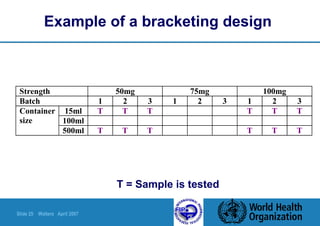
Example of a bracketing design
T = Sample is tested
Strength 50mg 75mg 100mg
Batch 1 2 3 1 2 3 1 2 3
15ml T T T T T T
100ml
Container
size
500ml T T T T T T
Slide 26 Walters April 2007
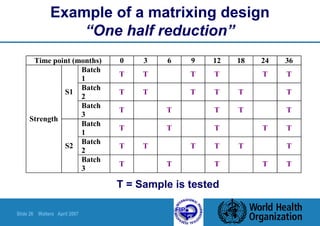
Example of a matrixing design
“One half reduction”
T = Sample is tested
Time point (months) 0 3 6 9 12 18 24 36
Batch
1
T T T T T T
Batch
2
T T T T T TS1
Batch
3
T T T T T
Batch
1
T T T T T
Batch
2
T T T T T T
Strength
S2
Batch
3
T T T T T
Slide 27 Walters April 2007
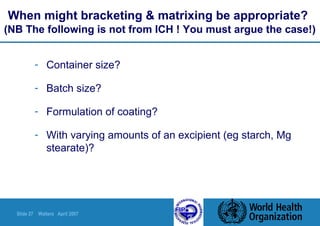
When might bracketing & matrixing be appropriate?
(NB The following is not from ICH ! You must argue the case!)
- Container size?
- Batch size?
- Formulation of coating?
- With varying amounts of an excipient (eg starch, Mg
stearate)?
Slide 28 Walters April 2007
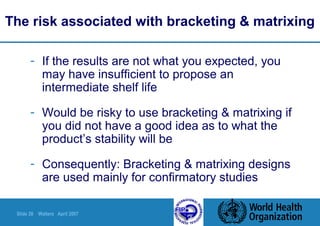
The risk associated with bracketing & matrixing
- If the results are not what you expected, you
may have insufficient to propose an
intermediate shelf life
- Would be risky to use bracketing & matrixing if
you did not have a good idea as to what the
product’s stability will be
- Consequently: Bracketing & matrixing designs
are used mainly for confirmatory studies
Slide 29 Walters April 2007
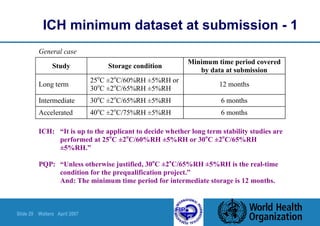
ICH minimum dataset at submission - 1
 
General case
Study Storage condition
Minimum time period covered
by data at submission
Long term 
25o
C ±2o
C/60%RH ±5%RH or 
30o
C ±2o
C/65%RH ±5%RH 
12 months 
Intermediate  30o
C ±2o
C/65%RH ±5%RH  6 months 
Accelerated  40o
C ±2o
C/75%RH ±5%RH  6 months 
 
ICH: “It is up to the applicant to decide whether long term stability studies are
performed at 25o
C ±2o
C/60%RH ±5%RH or 30o
C ±2o
C/65%RH
±5%RH.”
 
PQP: “Unless otherwise justified, 30o
C ±2o
C/65%RH ±5%RH is the real-time
condition for the prequalification project.”
And: The minimum time period for intermediate storage is 12 months.
Slide 30 Walters April 2007
ICH minimum dataset at submission - 2
 
FPPs packaged in impermeable containers need not be
stored under controlled humidity conditions
There are different minimum conditions for:
– Liquid products packaged in semi-permeable containers
[relating to potential loss of solvent]
– Products intended for storage in a refrigerator, freezer or deep-
freeze
Slide 31 Walters April 2007
Classes of degradation
- Chemical
- Physical
- Microbiological
Slide 32 Walters April 2007
Chemical degradation
Has been dealt with by Dr Elder
Slide 33 Walters April 2007
Physical degradation
(≡ physicochemical degradation)
- Physical properties can change too!
- Important attributes vary with dosage form
- Bottom line is relevance to quality, safety & efficacy
- Examples for liquid formulations:
- Appearance, colour, odour, pH, clarity (solutions) and freedom from visible particulate
contamination, size range of particulate contamination (large volume parenterals),
particle size distribution (suspensions), micelle size distribution (micellar solutions),
resuspendability (suspensions), viscosity, moisture content (powders for reconstitution),
phase separation (emulsions)
- See other examples at http://www.tga.gov.au/pmeds/argpmap14.pdf
Slide 34 Walters April 2007
Other forms of physical deterioration may include:
- Leaching
- Absorption (into container walls)
- Adsorption (on to container walls)
- Volatilisation (eg sertraline base, glyceryl trinitrate)
- Altered particle size distribution
- Loss of higher order molecular structure (normally
only for biological medicines)
- Denaturation
- Aggregation
Slide 35 Walters April 2007
Minimising physical deterioration
- Some examples:
- When prone to adsorption on to, or absorption into,
packaging materials, use resistant packaging
materials, such as good quality glass
- When prone to volatilisation:
- Use a non-volatile salt (if possible)
- Use packaging materials that are resistant to vapour transfer
- When prone to altered particle size in suspensions:
- Formulate a continuous phase in which the active is less soluble
Slide 36 Walters April 2007
Proliferation of microbes in non-sterile products
Consequences may include:
– Infection of the patient
– Formation of endotoxins (≡ pyrogens)
– Foul odour
- Formation of gas
- Change in colour
- Cloudiness
- Hydrolysis
Microbiological deterioration
Slide 37 Walters April 2007
Minimising microbiological deterioration of non-
sterile products
- Control the microbial load of API &
excipients
- Validate & monitor manufacturing
conditions
- Include antimicrobial preservatives in
formulations
- NB Normally only bacteriostatic & not bactericidal
Slide 38 Walters April 2007
Appropriate tests for stability studies - 1
- Normally test same attributes as for routine
QC
- May use other methodology for stability testing
(avoid for dissolution rate) but must be
validated
- Avoid changing methodology mid-study
(unless correcting a clear deficiency)
Slide 39 Walters April 2007
Appropriate tests for stability studies - 2
- Quantitate degradation products if possible, even if
the assay is specific for the API
- But can be difficult to quantitate impurities if there are no
reference standards & relative response factors are
unknown → semiquantitative estimates
- Regulatory authorities usually expect an approximate
mass balance
- Appropriate physical tests vary with dosage form.
- Remember to conduct preservative efficacy tests
too, in addition to assay of any antimicrobial
preservative
Slide 40 Walters April 2007
For all stability studies
Validate the analytical methodology!
– See relevant guidelines, especially:
• Validation of analytical procedures: Terminology
– ICH Q2B 1994
• Validation of analytical procedures: Methodology
– ICH Q2B 1996
Use stability-indicating assays
Slide 41 Walters April 2007
Dissolution rate
- Avoid using a method different to that in routine
QC
- Most regulatory authorities, including PQP, prefer
dissolution profiles rather than single time points
during stability testing. Better ability to detect
trends.
Slide 42 Walters April 2007
Frequency of testing during a stability study - ICH
 “For long term studies, frequency of testing should be
sufficient to establish the stability profile of the
pharmaceutical product”
 “For products with a proposed shelf life of at least 12 months,
the frequency of testing in the long term storage condition
should normally be every 3 months over the first year, every 6
months over the second year, & annually thereafter
throughout the proposed shelf life.
 Other frequencies are suggested for accelerated &
intermediate storage conditions.
 ICH 2003
Slide 43 Walters April 2007
Some notes concerning reporting (1)
- It is rarely appropriate to cite only average results
- For the benefit of the manufacturer & the DRA
- Dissolution results on individual tablets (not only mean results)
- It’s certainly OK to cite mean & derived results as well
- Assay results should be reported as absolute values
- And not only as values normalised for initial results, ie % of initial
- Test methods must be recorded with the study report
- By the time that stability studies are conducted on finished product, is possible that
more than one method has been used
Slide 44 Walters April 2007
Some notes concerning reporting (2)
- Numerical results should be provided wherever possible
- Not just ‘complies’
- If results are below the limit of quantitation, they should
be reported as ‘below LQC’ or similar wording
- ‘Not detectable’ is acceptable provided it is defined & reasonable
- Results that are out of the ordinary should be discussed
- Product labelling should be consistent with stability data.
For example:
- Solvents for reconstitution
- Recommendations for mixing of injections with other injections
Slide 45 Walters April 2007
Evaluation / Interpretation of the results
So what’s the shelf life?
Slide 46 Walters April 2007
First point
The validity of an assigned shelf life
depends upon:
- The results of stability studies, &
- Whether the batches used in the stability
studies accurately model those to be
marketed, &
- Whether analytical methodology was
adequately validated
Slide 47 Walters April 2007
Assigning a shelf life
Assigning a shelf life is easier if results are available:
- For the full duration of the proposed shelf life
- At the maximum recommended storage conditions
- For all formulations & manufacturing methods
- In exactly the packaging to be registered
- At all sites of manufacture of finished product & API
If these conditions are not met, that’s when shelf life
assignment becomes difficult.
– There will be arguments between manufacturers &
registration/prequalification authorities
– There will be delays in approving the product
Slide 48 Walters April 2007
 “Where the data show so little degradation & so little variability
that it is apparent from looking at the data that the requested
shelf life will be granted, it is normally unnecessary to go
through the formal statistical analysis but only to provide a
justification for the omission”
 ICH 2003 & PQP 2005
Statistical estimation of shelf life - 1
In other words: If it is blindingly obvious that there is minimal
change in the parameter in question, is unnecessary to
conduct the numerical/statistical analysis.
Slide 49 Walters April 2007
Statistical estimation of shelf life - 2
“An approach for analyzing data of a quantitative
attribute that is expected to change with time is to
determine the time at which the 95% one-sided
confidence interval for the mean curve intersects the
acceptance criterion”
 ICH 2000
Slide 50 Walters April 2007
Statistical estimation of shelf life - 3
Is there any degradation of any relevant product
characteristic?
• If no, then shelf life assignment is straightforward based on the labelled
storage conditions & the time for which testing has been conducted
• If yes (that is there is at least some degradation/change):
• Conduct a statistical analysis using a suitable software package
• Consider:
 Statistical pooling of results for multiple batches
 Estimation of time to degrade to expiry limits using a 95% confidence interval
• See the file concerning software packages
– NB I am not recommending any of these software packages!
– Conduct your own Internet search! Then evaluate cost against usefulness to
your company.
Slide 51 Walters April 2007
Statistical estimation of shelf life - 4
Superimposition of a 95% confidence interval on to the
regression line for stability data from Bolton 1984
NB This is an old graph & it describes a very unstable product
Slide 52 Walters April 2007
What are the limitations of this statistical
algorithm?
- It applies only to quantitative attributes
- Does not apply for example to colour tests, or to semiquantitative
comparisons such as TLC limit tests
- It may be unreliable for physical attributes
- Such as dissolution tests & discoloration
- Use your judgement! Look at the slope of the curve.
Does the change accelerate with time?
Slide 53 Walters April 2007
“Any evaluation should consider not only the assay
but also the degradation products & other appropriate
attributes”
ICH 2003
Estimation of shelf life
In other words: If evaluation of different (but relevant) attributes leads to
different conclusions as to shelf life, the shortest of these shelf lives
should be chosen.
Slide 54 Walters April 2007
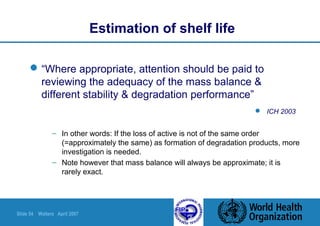
“Where appropriate, attention should be paid to
reviewing the adequacy of the mass balance &
different stability & degradation performance”
 ICH 2003
Estimation of shelf life
– In other words: If the loss of active is not of the same order
(=approximately the same) as formation of degradation products, more
investigation is needed.
– Note however that mass balance will always be approximate; it is
rarely exact.
Slide 55 Walters April 2007
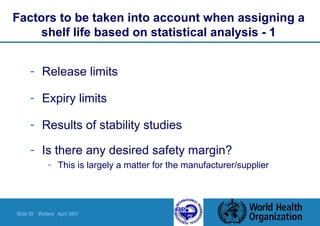
Factors to be taken into account when assigning a
shelf life based on statistical analysis - 1
- Release limits
- Expiry limits
- Results of stability studies
- Is there any desired safety margin?
- This is largely a matter for the manufacturer/supplier
Slide 56 Walters April 2007
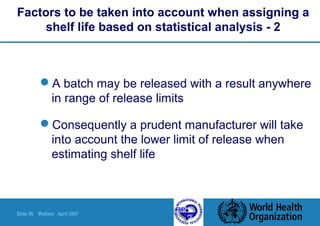
Factors to be taken into account when assigning a
shelf life based on statistical analysis - 2
A batch may be released with a result anywhere
in range of release limits
Consequently a prudent manufacturer will take
into account the lower limit of release when
estimating shelf life
Slide 57 Walters April 2007
Combining results for several
batches
Poolability
Slide 58 Walters April 2007
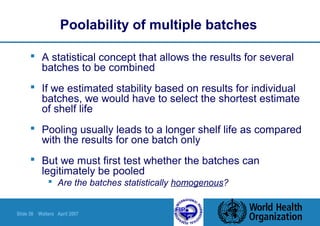
Poolability of multiple batches
 A statistical concept that allows the results for several
batches to be combined
 If we estimated stability based on results for individual
batches, we would have to select the shortest estimate
of shelf life
 Pooling usually leads to a longer shelf life as compared
with the results for one batch only
 But we must first test whether the batches can
legitimately be pooled
 Are the batches statistically homogenous?
Slide 59 Walters April 2007
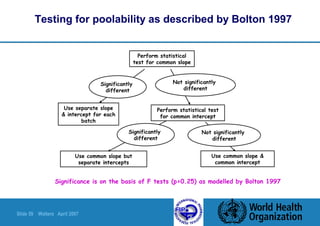
Testing for poolability as described by Bolton 1997
Perform statistical
test for common slope
Perform statistical test
for common intercept
Use common slope &
common intercept
Use separate slope
& intercept for each
batch
Use common slope but
separate intercepts
Significance is on the basis of F tests (p>0.25) as modelled by Bolton 1997
Significantly
different
Significantly
different
Not significantly
different
Not significantly
different
Slide 60 Walters April 2007
Extrapolation beyond real-time data - 1
 “Limited extrapolation of the real time data from the long
term storage condition beyond the observed range to
extend the shelf life can be undertaken at approval time, if
justified. This justification should be based on what is
known about the mechanisms of degradation, the results of
testing under accelerated conditions, the goodness of fit of
any mathematical model, batch size, existence of
supporting stability data, etc. However, this extrapolation
assumes that the same degradation relationship will
continue to apply beyond the observed data.”
 ICH 2000
Slide 61 Walters April 2007
Extrapolation beyond real-time data - 2
“If long term data are supported by results from
accelerated studies the retest period/shelf life
may be extended beyond the end of the long-
term studies. The proposed retest period or
shelf life can be up to twice, but should not be
more than 12 months beyond, the period
covered by long-term data”. ”
PQP 2005
Slide 62 Walters April 2007
References
References in your CD may be useful:
- Regulatory guidelines
- Sources of climate-controlled cabinets
- Software for processing stability data
- Most include laboratory information management for the
data
Slide 63 Walters April 2007
Pharmaceutical Development
Summary and conclusion
Stability data submitted during the registration process
should confirm that all batches of the FPP will remain
of acceptable quality when stored in the marketing
container, at the most extreme storage conditions
permitted by container labelling & prescribing
information, for the duration of the shelf life
Any subsequent variations (for example to site or
method of manufacture of the API or FPP) should be
shown not to reduce the shelf life as defined above

Stability

  • 1.
    Slide 1 WaltersApril 2007 Training Workshop on Pharmaceutical Development with focus on Paediatric Formulations Protea Hotel Victoria Junction, Waterfront Cape Town, South Africa Date: 16 to 20 April 2007 Pharmaceutical Development
  • 2.
    Slide 2 WaltersApril 2007 Pharmaceutical Development Stability testing of Finished Pharmaceutical Products (FPPs) Presenter: Susan Walters Email: susanw@netspeed.com.au Fax: (61) 2 6281 6948 (email is preferred)
  • 3.
    Slide 3 WaltersApril 2007 Stability testing of FPPs Outline of presentation We will: Review relevant guidelines Define the objectives of stability testing Outline the design & conduct of stability studies for finished products Determine a shelf life based on study results Discuss what to include in reports of stability studies
  • 4.
    Slide 4 WaltersApril 2007 Objectives of stability testing: What is the purpose? "…… to provide evidence on how the quality of a drug substance or drug product varies with time under the influence of a variety of environmental factors such as temperature, humidity & light, & enables recommended storage conditions, re-test periods & shelf lives to be established” (ICH) 2003
  • 5.
    Slide 5 WaltersApril 2007 Variables that might affect the stability of a given API & dosage form  Formulation  Packaging  Site and method of manufacture – API – Finished product  Batch size  Batch to batch variability – The importance of process validation & quality risk management  Container labelling  Changes to product
  • 6.
    Slide 6 WaltersApril 2007 Stability testing - Development studies - Characterise compatibility with common excipients - Characterise stability profile of API - Eg susceptibility to acid, base, light, oxygen etc…… - Characterise stability profile of early formulations - Especially susceptibility to heat, humidity & light - Confirmatory studies - Long term & accelerated studies on the product as it is to be registered - In practice design is now largely dictated by ICH guidelines
  • 7.
    Slide 7 WaltersApril 2007 What does a regulator want to see demonstrated in the registration dataset? - The product maintains relevant quality characteristics within the acceptable range: - In proposed registration formulation & container/closure system - For whole of shelf life - At permitted extremes of storage - Over all batches - When manufactured at all registered sites (API & finished product) - After any changes
  • 8.
    Slide 8 WaltersApril 2007 Relevant guidelines  Many countries have their own guidelines concerning stability testing & other registration topics  But if a manufacturer wishes to market a product in several countries, it is simpler to use one of the international guidelines, such as those of WHO & ICH So how widely are WHO & ICH guidelines accepted?  Most countries will accept data generated according to ICH guidelines  Many countries will accept data generated according to WHO guidelines, & especially when the product in question has been prequalified by WHO – But possibly not ICH countries  Whilst ICH guidelines are more detailed than those of WHO, there are few ‘in-principle’ differences, except in relation to testing conditions for hot & humid climates
  • 9.
    Slide 9 WaltersApril 2007 ICH stability guidelines - 1 Q1A(R2) Stability Testing of New Drug Substances & Products Q1B Stability Testing : Photostability Testing of New Drug Substances & Products Q1C Stability Testing for New Dosage Forms Available via http://www.ich.org/cache/compo/276-254-1.html
  • 10.
    Slide 10 WaltersApril 2007 ICH stability guidelines - 2 Q1D Bracketing and Matrixing Designs for Stability Testing of New Drug Substances and Products Q1E Evaluation of Stability Data Q1F Stability Data Package for Registration Applications in Climatic Zones III and IV Withdrawn Also available via http://www.ich.org/cache/compo/276-254-1.html
  • 11.
    Slide 11 WaltersApril 2007 ICH stability guidelines - 3 Remember that these have been adopted in the European Union, the United States, and Japan Technically ICH guidelines apply only to new APIs & products made from them. But most regulators give ICH guidelines considerable weight when deciding requirements for non-new APIs.
  • 12.
    Slide 12 WaltersApril 2007 WHO stability guidelines - 1 “Guidelines for stability testing of pharmaceutical products containing well established drug substances in conventional dosage forms” WHO (1996) Available via http://whqlibdoc.who.int/trs/WHO_TRS_863_(p1-p98).pd Note: – Applies to ‘Well established drug substances’ – Applies to ‘Conventional dosage forms’ – These guidelines are under revision : See h ttp://www.who.int/medicines/services/expertcommittees/pharmpre
  • 13.
    Slide 13 WaltersApril 2007 WHO stability guidelines - 2 So what are the types of product to which WHO guidelines (1996) do not apply? – New chemical entities (NCEs) • And possibly also new dosage forms of NCEs – New combinations of actives – Modified release dosage forms, including • Slow release products • Transdermal patches • Modified release injections
  • 14.
    Slide 14 WaltersApril 2007 Stability guidelines for WHO’s Prequalification Program (PQP) - 1 Stability testing: Section 3.11 of Guideline on Submission of Documentation for Prequalification of Multisource (Generic) Finished Pharmaceutical Products (FPPs) Used in the Treatment of HIV/AIDS, Malaria & Tuberculosis – Available via http://mednet3.who.int/prequal/ – Are consistent with ICH guidelines – There are extensive cross references to ICH guidelines – Effectively the PQP text is a practical interpretation of ICH guidelines
  • 15.
    Slide 15 WaltersApril 2007 Stability guidelines for WHO’s PQP - 2 “Extension of the WHO list of stable (not easily degradable ARV) APIs” WHO (2006) – Also available via http://mednet3.who.int/prequal/ – Read this carefully. It describes circumstances in which a tentative 2-year shelf life may be allocated to certain APIs & FPPs, subject to a number of strict conditions.
  • 16.
    Slide 16 WaltersApril 2007 Stability report formats for WHO’s PQP Annex 3: Model stability report of API Annex 4: Model stability report of capsules/tablets Also available via http://mednet3.who.int/prequal/
  • 17.
    Slide 17 WaltersApril 2007 Terminology – adapted from ICH 2000 (1) - Production batch: - A batch manufactured at production scale using production equipment & in a production facility as specified in the registration application - Pilot scale batch: - A batch manufactured by a procedure “fully representative of & simulating” full production scale. For tablets & capsules, this means 100,000 units or 1/10th of production scale, whichever is the larger
  • 18.
    Slide 18 WaltersApril 2007 Terminology – adapted from ICH 2000 (2) Re-test period: API – The period of time for which the API remains within specification when stored under the recommended conditions in the proposed bulk storage container – “After this period, the batch should be retested for compliance with specifications & then used immediately” [if in compliance]
  • 19.
    Slide 19 WaltersApril 2007 Terminology – adapted from ICH 2000 (3) - Accelerated testing - Studies designed to increase the rate of chemical degradation or physical change by means of exaggerated storage conditions - Intermediate testing - Studies at 30degC/60%RH, intended for extrapolation to long term storage at 25degC [provided that 25degC is appropriate for the market in question] - Stress testing - API: Studies which elucidate intrinsic stab of API. Normally during development. Normally more stressful than ‘accelerated’ testing. - Finished product: Studies of effect of ‘severe’ conditions. Eg freeze/thaw cycling for suspensions & emulsions, low humidity for aqueous liquids in moisture- permeable containers.
  • 20.
    Slide 20 WaltersApril 2007 Terminology – adapted from ICH 2000 (4) In-use stability testing: – Establishes the “period of time during which a multidose product can be used whilst retaining quality within an accepted specification once the container is opened” ICH 2000 • For example: – liquids that are reconstituted prior to use – effervescent tablets in a moisture-proof container (eg Al screw- cap tube) – ophthalmic products (especially with respect to preservative efficacy)
  • 21.
    Slide 21 WaltersApril 2007 Terminology – adapted from ICH 2000 (5) Climatic zones: – Partition of the world into three temperature classes based on kinetic averaging of monthly temperatures, & subdivision of the hottest class into predominantly wet or predominantly dry – Zones (Futscher & Schumacher 1972): • I Temperate (21o C/45%RH) • II Subtropical (25o C/60%RH with possibly high RH) • III Hot & dry (30o C/35%RH) • IV Hot & wet (30o C/70%RH) – The temperatures above are kinetic averages
  • 22.
    Slide 22 WaltersApril 2007 Extract of WHO Technical Report Series 937 Expert committee on specifications for pharmaceutical preparations (2006): Quality assurance: Stability testing conditions “The Secretariat reminded the Committee that the WHO guidelines had been revised in the light of harmonization efforts in collaboration with ICH. Subsequently focus had been placed within regional harmonization initiatives on the recommendations for hot and humid conditions (referred to as Zone IV). After extensive discussion the Committee reached consensus that the WHO stability guidelines be amended to reflect conditions for Zone IV as follows: — Zone IVa (30 degrees Celsius and 65% relative humidity); and — Zone IVb (30 degrees Celsius and 75% relative humidity). It was agreed that each individual Member State within the former Zone IV would need to indicate whether its territory should be classified as Zone IVa or IVb.”
  • 23.
    Slide 23 WaltersApril 2007 Consequently… Each nation within zone IV must now decide whether to adopt a stability test condition of – 30o C & 65%RH, or – 30o C & 75%RH ASEAN nations & Brazil have adopted 30o C & 75%RH
  • 24.
    Slide 24 WaltersApril 2007 Terminology – adapted from ICH 2000 (6) Reduced study designs: - Bracketing - A design in which only the extremes are tested at all time points, eg strength, pack size, container fill - Matrixing - Designs in which a selected subset of samples is tested, eg different strengths, container/closure systems, batches
  • 25.
    Slide 25 WaltersApril 2007 Example of a bracketing design T = Sample is tested Strength 50mg 75mg 100mg Batch 1 2 3 1 2 3 1 2 3 15ml T T T T T T 100ml Container size 500ml T T T T T T
  • 26.
    Slide 26 WaltersApril 2007 Example of a matrixing design “One half reduction” T = Sample is tested Time point (months) 0 3 6 9 12 18 24 36 Batch 1 T T T T T T Batch 2 T T T T T TS1 Batch 3 T T T T T Batch 1 T T T T T Batch 2 T T T T T T Strength S2 Batch 3 T T T T T
  • 27.
    Slide 27 WaltersApril 2007 When might bracketing & matrixing be appropriate? (NB The following is not from ICH ! You must argue the case!) - Container size? - Batch size? - Formulation of coating? - With varying amounts of an excipient (eg starch, Mg stearate)?
  • 28.
    Slide 28 WaltersApril 2007 The risk associated with bracketing & matrixing - If the results are not what you expected, you may have insufficient to propose an intermediate shelf life - Would be risky to use bracketing & matrixing if you did not have a good idea as to what the product’s stability will be - Consequently: Bracketing & matrixing designs are used mainly for confirmatory studies
  • 29.
    Slide 29 WaltersApril 2007 ICH minimum dataset at submission - 1   General case Study Storage condition Minimum time period covered by data at submission Long term  25o C ±2o C/60%RH ±5%RH or  30o C ±2o C/65%RH ±5%RH  12 months  Intermediate  30o C ±2o C/65%RH ±5%RH  6 months  Accelerated  40o C ±2o C/75%RH ±5%RH  6 months    ICH: “It is up to the applicant to decide whether long term stability studies are performed at 25o C ±2o C/60%RH ±5%RH or 30o C ±2o C/65%RH ±5%RH.”   PQP: “Unless otherwise justified, 30o C ±2o C/65%RH ±5%RH is the real-time condition for the prequalification project.” And: The minimum time period for intermediate storage is 12 months.
  • 30.
    Slide 30 WaltersApril 2007 ICH minimum dataset at submission - 2   FPPs packaged in impermeable containers need not be stored under controlled humidity conditions There are different minimum conditions for: – Liquid products packaged in semi-permeable containers [relating to potential loss of solvent] – Products intended for storage in a refrigerator, freezer or deep- freeze
  • 31.
    Slide 31 WaltersApril 2007 Classes of degradation - Chemical - Physical - Microbiological
  • 32.
    Slide 32 WaltersApril 2007 Chemical degradation Has been dealt with by Dr Elder
  • 33.
    Slide 33 WaltersApril 2007 Physical degradation (≡ physicochemical degradation) - Physical properties can change too! - Important attributes vary with dosage form - Bottom line is relevance to quality, safety & efficacy - Examples for liquid formulations: - Appearance, colour, odour, pH, clarity (solutions) and freedom from visible particulate contamination, size range of particulate contamination (large volume parenterals), particle size distribution (suspensions), micelle size distribution (micellar solutions), resuspendability (suspensions), viscosity, moisture content (powders for reconstitution), phase separation (emulsions) - See other examples at http://www.tga.gov.au/pmeds/argpmap14.pdf
  • 34.
    Slide 34 WaltersApril 2007 Other forms of physical deterioration may include: - Leaching - Absorption (into container walls) - Adsorption (on to container walls) - Volatilisation (eg sertraline base, glyceryl trinitrate) - Altered particle size distribution - Loss of higher order molecular structure (normally only for biological medicines) - Denaturation - Aggregation
  • 35.
    Slide 35 WaltersApril 2007 Minimising physical deterioration - Some examples: - When prone to adsorption on to, or absorption into, packaging materials, use resistant packaging materials, such as good quality glass - When prone to volatilisation: - Use a non-volatile salt (if possible) - Use packaging materials that are resistant to vapour transfer - When prone to altered particle size in suspensions: - Formulate a continuous phase in which the active is less soluble
  • 36.
    Slide 36 WaltersApril 2007 Proliferation of microbes in non-sterile products Consequences may include: – Infection of the patient – Formation of endotoxins (≡ pyrogens) – Foul odour - Formation of gas - Change in colour - Cloudiness - Hydrolysis Microbiological deterioration
  • 37.
    Slide 37 WaltersApril 2007 Minimising microbiological deterioration of non- sterile products - Control the microbial load of API & excipients - Validate & monitor manufacturing conditions - Include antimicrobial preservatives in formulations - NB Normally only bacteriostatic & not bactericidal
  • 38.
    Slide 38 WaltersApril 2007 Appropriate tests for stability studies - 1 - Normally test same attributes as for routine QC - May use other methodology for stability testing (avoid for dissolution rate) but must be validated - Avoid changing methodology mid-study (unless correcting a clear deficiency)
  • 39.
    Slide 39 WaltersApril 2007 Appropriate tests for stability studies - 2 - Quantitate degradation products if possible, even if the assay is specific for the API - But can be difficult to quantitate impurities if there are no reference standards & relative response factors are unknown → semiquantitative estimates - Regulatory authorities usually expect an approximate mass balance - Appropriate physical tests vary with dosage form. - Remember to conduct preservative efficacy tests too, in addition to assay of any antimicrobial preservative
  • 40.
    Slide 40 WaltersApril 2007 For all stability studies Validate the analytical methodology! – See relevant guidelines, especially: • Validation of analytical procedures: Terminology – ICH Q2B 1994 • Validation of analytical procedures: Methodology – ICH Q2B 1996 Use stability-indicating assays
  • 41.
    Slide 41 WaltersApril 2007 Dissolution rate - Avoid using a method different to that in routine QC - Most regulatory authorities, including PQP, prefer dissolution profiles rather than single time points during stability testing. Better ability to detect trends.
  • 42.
    Slide 42 WaltersApril 2007 Frequency of testing during a stability study - ICH  “For long term studies, frequency of testing should be sufficient to establish the stability profile of the pharmaceutical product”  “For products with a proposed shelf life of at least 12 months, the frequency of testing in the long term storage condition should normally be every 3 months over the first year, every 6 months over the second year, & annually thereafter throughout the proposed shelf life.  Other frequencies are suggested for accelerated & intermediate storage conditions.  ICH 2003
  • 43.
    Slide 43 WaltersApril 2007 Some notes concerning reporting (1) - It is rarely appropriate to cite only average results - For the benefit of the manufacturer & the DRA - Dissolution results on individual tablets (not only mean results) - It’s certainly OK to cite mean & derived results as well - Assay results should be reported as absolute values - And not only as values normalised for initial results, ie % of initial - Test methods must be recorded with the study report - By the time that stability studies are conducted on finished product, is possible that more than one method has been used
  • 44.
    Slide 44 WaltersApril 2007 Some notes concerning reporting (2) - Numerical results should be provided wherever possible - Not just ‘complies’ - If results are below the limit of quantitation, they should be reported as ‘below LQC’ or similar wording - ‘Not detectable’ is acceptable provided it is defined & reasonable - Results that are out of the ordinary should be discussed - Product labelling should be consistent with stability data. For example: - Solvents for reconstitution - Recommendations for mixing of injections with other injections
  • 45.
    Slide 45 WaltersApril 2007 Evaluation / Interpretation of the results So what’s the shelf life?
  • 46.
    Slide 46 WaltersApril 2007 First point The validity of an assigned shelf life depends upon: - The results of stability studies, & - Whether the batches used in the stability studies accurately model those to be marketed, & - Whether analytical methodology was adequately validated
  • 47.
    Slide 47 WaltersApril 2007 Assigning a shelf life Assigning a shelf life is easier if results are available: - For the full duration of the proposed shelf life - At the maximum recommended storage conditions - For all formulations & manufacturing methods - In exactly the packaging to be registered - At all sites of manufacture of finished product & API If these conditions are not met, that’s when shelf life assignment becomes difficult. – There will be arguments between manufacturers & registration/prequalification authorities – There will be delays in approving the product
  • 48.
    Slide 48 WaltersApril 2007  “Where the data show so little degradation & so little variability that it is apparent from looking at the data that the requested shelf life will be granted, it is normally unnecessary to go through the formal statistical analysis but only to provide a justification for the omission”  ICH 2003 & PQP 2005 Statistical estimation of shelf life - 1 In other words: If it is blindingly obvious that there is minimal change in the parameter in question, is unnecessary to conduct the numerical/statistical analysis.
  • 49.
    Slide 49 WaltersApril 2007 Statistical estimation of shelf life - 2 “An approach for analyzing data of a quantitative attribute that is expected to change with time is to determine the time at which the 95% one-sided confidence interval for the mean curve intersects the acceptance criterion”  ICH 2000
  • 50.
    Slide 50 WaltersApril 2007 Statistical estimation of shelf life - 3 Is there any degradation of any relevant product characteristic? • If no, then shelf life assignment is straightforward based on the labelled storage conditions & the time for which testing has been conducted • If yes (that is there is at least some degradation/change): • Conduct a statistical analysis using a suitable software package • Consider:  Statistical pooling of results for multiple batches  Estimation of time to degrade to expiry limits using a 95% confidence interval • See the file concerning software packages – NB I am not recommending any of these software packages! – Conduct your own Internet search! Then evaluate cost against usefulness to your company.
  • 51.
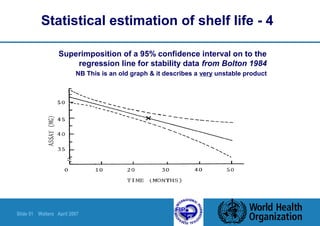
    Slide 51 WaltersApril 2007 Statistical estimation of shelf life - 4 Superimposition of a 95% confidence interval on to the regression line for stability data from Bolton 1984 NB This is an old graph & it describes a very unstable product
  • 52.
    Slide 52 WaltersApril 2007 What are the limitations of this statistical algorithm? - It applies only to quantitative attributes - Does not apply for example to colour tests, or to semiquantitative comparisons such as TLC limit tests - It may be unreliable for physical attributes - Such as dissolution tests & discoloration - Use your judgement! Look at the slope of the curve. Does the change accelerate with time?
  • 53.
    Slide 53 WaltersApril 2007 “Any evaluation should consider not only the assay but also the degradation products & other appropriate attributes” ICH 2003 Estimation of shelf life In other words: If evaluation of different (but relevant) attributes leads to different conclusions as to shelf life, the shortest of these shelf lives should be chosen.
  • 54.
    Slide 54 WaltersApril 2007 “Where appropriate, attention should be paid to reviewing the adequacy of the mass balance & different stability & degradation performance”  ICH 2003 Estimation of shelf life – In other words: If the loss of active is not of the same order (=approximately the same) as formation of degradation products, more investigation is needed. – Note however that mass balance will always be approximate; it is rarely exact.
  • 55.
    Slide 55 WaltersApril 2007 Factors to be taken into account when assigning a shelf life based on statistical analysis - 1 - Release limits - Expiry limits - Results of stability studies - Is there any desired safety margin? - This is largely a matter for the manufacturer/supplier
  • 56.
    Slide 56 WaltersApril 2007 Factors to be taken into account when assigning a shelf life based on statistical analysis - 2 A batch may be released with a result anywhere in range of release limits Consequently a prudent manufacturer will take into account the lower limit of release when estimating shelf life
  • 57.
    Slide 57 WaltersApril 2007 Combining results for several batches Poolability
  • 58.
    Slide 58 WaltersApril 2007 Poolability of multiple batches  A statistical concept that allows the results for several batches to be combined  If we estimated stability based on results for individual batches, we would have to select the shortest estimate of shelf life  Pooling usually leads to a longer shelf life as compared with the results for one batch only  But we must first test whether the batches can legitimately be pooled  Are the batches statistically homogenous?
  • 59.
    Slide 59 WaltersApril 2007 Testing for poolability as described by Bolton 1997 Perform statistical test for common slope Perform statistical test for common intercept Use common slope & common intercept Use separate slope & intercept for each batch Use common slope but separate intercepts Significance is on the basis of F tests (p>0.25) as modelled by Bolton 1997 Significantly different Significantly different Not significantly different Not significantly different
  • 60.
    Slide 60 WaltersApril 2007 Extrapolation beyond real-time data - 1  “Limited extrapolation of the real time data from the long term storage condition beyond the observed range to extend the shelf life can be undertaken at approval time, if justified. This justification should be based on what is known about the mechanisms of degradation, the results of testing under accelerated conditions, the goodness of fit of any mathematical model, batch size, existence of supporting stability data, etc. However, this extrapolation assumes that the same degradation relationship will continue to apply beyond the observed data.”  ICH 2000
  • 61.
    Slide 61 WaltersApril 2007 Extrapolation beyond real-time data - 2 “If long term data are supported by results from accelerated studies the retest period/shelf life may be extended beyond the end of the long- term studies. The proposed retest period or shelf life can be up to twice, but should not be more than 12 months beyond, the period covered by long-term data”. ” PQP 2005
  • 62.
    Slide 62 WaltersApril 2007 References References in your CD may be useful: - Regulatory guidelines - Sources of climate-controlled cabinets - Software for processing stability data - Most include laboratory information management for the data
  • 63.
    Slide 63 WaltersApril 2007 Pharmaceutical Development Summary and conclusion Stability data submitted during the registration process should confirm that all batches of the FPP will remain of acceptable quality when stored in the marketing container, at the most extreme storage conditions permitted by container labelling & prescribing information, for the duration of the shelf life Any subsequent variations (for example to site or method of manufacture of the API or FPP) should be shown not to reduce the shelf life as defined above

Editor's Notes

  • #2 <number> नवंबर 3, 2015
  • #3 <number> नवंबर 3, 2015
  • #4 <number> नवंबर 3, 2015
  • #5 <number> नवंबर 3, 2015
  • #6 <number> नवंबर 3, 2015
  • #7 <number> नवंबर 3, 2015
  • #8 <number> नवंबर 3, 2015
  • #9 <number> नवंबर 3, 2015
  • #10 <number> नवंबर 3, 2015
  • #11 <number> नवंबर 3, 2015
  • #12 <number> नवंबर 3, 2015
  • #13 <number> नवंबर 3, 2015
  • #14 <number> नवंबर 3, 2015
  • #15 <number> नवंबर 3, 2015
  • #16 <number> नवंबर 3, 2015
  • #17 <number> नवंबर 3, 2015
  • #18 <number> नवंबर 3, 2015
  • #19 <number> नवंबर 3, 2015
  • #20 <number> नवंबर 3, 2015 Accelerated testing: Intended to allow extrapolation of conditions at max recd storage conditions Or to “evaluate effect of short term excursions outside label storage conditions” Intermediate testing: Relevant if want to label product as “Store below 25degC”. Stress testing: For API, means devt studies Examples of stress tests for finished product might be cycling temps (eg emulsions, creams), refrigeration for liquids which are or might be stored at low temp. Not sure what is referred to for mdis – FDA mentions possibility of testing at 25degC/75%RH for 1/3 of shelf life if moisture resistant packaging needed (?dpis).
  • #21 <number> नवंबर 3, 2015
  • #22 <number> नवंबर 3, 2015 Zones originally proposed by Futscher & Schumacher Grimm subsequently elaborated mean annual %RH and kinetic temps for world regions based on meteorological data.
  • #23 <number> नवंबर 3, 2015
  • #24 <number> नवंबर 3, 2015
  • #25 <number> नवंबर 3, 2015 Reduced study designs: ICH emphasises: Bracketing not applicable to APIs Matrixing has “limited utility” Are risks involved in conducting reduced study designs, and must justify use in each case In general, I suspect that ICH is implying (but not actually stating) that bracketing and matrixing is appropriate when there is a reasonable expectation that there will be no significant change. Bracketing: Assumes that intermediate conditions (ie those not tested) are intermediate in all respects. Eg if test different cap strengths, that all strengths are made from same granulation with different compression weights. Matrixing: I would add that can matrix temps, but ICH does not specifically mention that so might not get through TGA Fff Fff
  • #26 <number> नवंबर 3, 2015 This is an example of a bracketing design. The table was taken from the current ICH draft entitled “Bracketing and matrixing designs for stability testing of new drug substances and products”. In this design, 12 sets of tests are conducted at each time point instead of 15. Intermediate strength does not have to be same formulation, so long as is all ingredients in the intermediate strength are intermediate in proportion between upper and lower strengths. As we said earlier today, these designs do carry a risk in that if one element of the design shows instability, may be left with a very incomplete dataset. For example if the 50mg strength showed instability, have no acceptable data on the 75mg strength either. I have seen cases of instability of a strength at one end of a range, even with tablets. So prudence would suggest would not undertake this design unless already have some data on these or related formulations.
  • #27 <number> नवंबर 3, 2015 A number of matrix designs are tabulated in the ICH guideline, of which this is one. ICH describes this as a “Matrixing design on time points for a product with two strengths; One-half reduction”. Describes a product for which three batches of each strength have been put on test. Samples of every strength and batch are tested at the beginning and at the end of the study, and at the 12 months time point. At the intermediate time points, only half of the samples are tested.
  • #28 <number> नवंबर 3, 2015 EXERCISE What are some other situations in which bracketing and matrixing may be appropriate?
  • #29 <number> नवंबर 3, 2015 EXERCISE What are some other situations in which bracketing and matrixing may be appropriate?
  • #30 <number> नवंबर 3, 2015 If you think you have seen this table before, you have. It is identical to the one for APIs.
  • #31 <number> नवंबर 3, 2015 If you think you have seen this table before, you have. It is identical to the one for APIs.
  • #32 <number> नवंबर 3, 2015
  • #33 <number> नवंबर 3, 2015
  • #34 <number> नवंबर 3, 2015
  • #35 <number> नवंबर 3, 2015
  • #36 <number> नवंबर 3, 2015
  • #37 <number> नवंबर 3, 2015
  • #38 <number> नवंबर 3, 2015
  • #39 <number> नवंबर 3, 2015
  • #40 <number> नवंबर 3, 2015
  • #41 <number> नवंबर 3, 2015
  • #42 <number> नवंबर 3, 2015 Avoid using a method different to that in routine QC (less critical for assay during dissolution test) Very difficult to interpret results in terms of compliance with specifications over time, if for example the rotation speed is different to that in routine QC TGA has preference for dissolution profiles rather than single time points, even for IR products Certainly provides more information than single point tests Is a requirement for prolonged release products
  • #43 <number> नवंबर 3, 2015 ICH requirements are the minimum. More frequent testing, especially in early stages, allows earlier detection of a problem. See the sensible TGA comment (from 1970s and in 1994 AGRD)
  • #44 <number> नवंबर 3, 2015 Is rarely appropriate to cite only average results hides information For benefit of your company & the DRA Eg dissolution results on 6 tablets By all means cite mean & derived results too (eg std dev) Assay results should be reported as absolute values (and not only as values normalised for initial results, ie % of initial) By all means provide percent of initial as well Record test methods By the time that stability studies ar conducted on finished product, likely to be > one method that could have been used
  • #45 <number> नवंबर 3, 2015 Give numerical results wherever possible ie not just ‘complies’ If results are below limit of quantitation, report as ‘below LQC’ or similar wording Results that are out of the ordinary: Eg discolouration of a tablet May need further investigation Pre-empt questions from regulator Avoid embarrassing qns years after the event Check product labelling for statements relevant to stability results, & ensure data have been provided - Eg Solvents for dilution (example of soluble hydrochloride that was recommended for dilution in 0.9% NaCl). On conducting the study, drug precipitated out of solution. HClde was not as soluble as manufacturer had thought – had not done calculations. Recommendations for mixing with other injections
  • #46 <number> नवंबर 3, 2015 Give numerical results wherever possible ie not just ‘complies’ If results are below limit of quantitation, report as ‘below LQC’ or similar wording Results that are out of the ordinary: Eg discolouration of a tablet May need further investigation Pre-empt questions from regulator Avoid embarrassing qns years after the event Check product labelling for statements relevant to stability results, & ensure data have been provided - Eg Solvents for dilution (example of soluble hydrochloride that was recommended for dilution in 0.9% NaCl). On conducting the study, drug precipitated out of solution. HClde was not as soluble as manufacturer had thought – had not done calculations. Recommendations for mixing with other injections
  • #47 <number> नवंबर 3, 2015
  • #48 <number> नवंबर 3, 2015 Unfortunately manufacturers are not always in the position of having exactly this information Especially generic manufacturers who may have decided to develop and register the product in the last year.
  • #49 <number> नवंबर 3, 2015
  • #50 <number> नवंबर 3, 2015 Most pharmaceuticals are complex systems in which kinetic equations do not apply. FDA (and now ICH) addressed this by suggesting a numerical estimation of trends, ie not predicated on kinetic equations.
  • #51 <number> नवंबर 3, 2015 Most pharmaceuticals are complex systems in which kinetic equations do not apply. FDA (and now ICH) addressed this by suggesting a numerical estimation of trends, ie not predicated on kinetic equations.
  • #52 <number> नवंबर 3, 2015 This is a graph of assay of a product against time at a given storage condition. -Taken from FDA guideline of 1987 Shows 95% confidence interval for loss of active after least squares regression Program for calculation is on FDA website: www.fda.gov/cder/sas/index.html Less reliable for deterioration of physicochemical properties, which can show non-linear changes, eg sudden deterioration such as formation of a precipitate.
  • #53 <number> नवंबर 3, 2015 Most pharmaceuticals are complex systems in which kinetic equations do not apply. FDA (and now ICH) addressed this by suggesting a numerical estimation of trends, ie not predicated on kinetic equations.
  • #54 <number> नवंबर 3, 2015
  • #55 <number> नवंबर 3, 2015
  • #56 <number> नवंबर 3, 2015 Safety margin? Bracketed because not a regulatory requirement A prudent manufacturer may wish to incorporate a safety margin intothe estimate of shelf life. Minimise possibility of recalls, with attendant publicity
  • #57 <number> नवंबर 3, 2015 A batch may be released with a result anywhere in range of release limits. So starting point for that calculation is lower limit of release Applies to all tests Eg impurities, content of preservative
  • #58 <number> नवंबर 3, 2015 Most pharmaceuticals are complex systems in which kinetic equations do not apply. FDA (and now ICH) addressed this by suggesting a numerical estimation of trends, ie not predicated on kinetic equations.
  • #59 <number> नवंबर 3, 2015 Most pharmaceuticals are complex systems in which kinetic equations do not apply. FDA (and now ICH) addressed this by suggesting a numerical estimation of trends, ie not predicated on kinetic equations.
  • #60 <number> नवंबर 3, 2015
  • #61 <number> नवंबर 3, 2015
  • #62 <number> नवंबर 3, 2015
  • #63 <number> नवंबर 3, 2015 Defined “In-use” stability earlier today. EXERCISE: What other examples might there be of in-use stability that should be addressed in stability studies? [Possible answers: -Pdr for injn reconstituted before use -Mixing of injectable with LVPs -Heating of injectable with solid particles before use (see fluorouracil injection DBL “If a ppt has formed as a result of exposure to low temperature, redissolve by heating to 60degC accompanied by vigorous shaking. Allow to cool to body temperature prior to use”. ) Antibiotics po lqds for reconstitution by a pharmacist prior to use Issue of separate labelling after reconstitution]
  • #64 <number> नवंबर 3, 2015