ST-Segment Elevation Myocardial Infarction
650,000 - new AMI 450,000 - recurrent AMI each year early (30-day) mortality rate - ~30% 1 of every 25 patients who survives the initial hospitalization dies in the first year after AMI  Mortality is approximately fourfold higher in elderly patients (over age 75)
 
STEMI usually occurs when coronary blood flow decreases abruptly after a thrombotic occlusion of a coronary artery previously affected by atherosclerosis Coronary artery thrombus develops rapidly at a site of vascular injury cigarette smoking Hypertension lipid accumulation STEMI occurs when the surface of an atherosclerotic plaque becomes disrupted and conditions favor thrombogenesis coronary plaques prone to disruption rich lipid core and a thin fibrous cap
platelet monolayer forms at the site of the disrupted plaque agonists promote platelet activation(collagen, ADP, epinephrine, serotonin) platelet cross-linking and aggregation thromboxane A 2  (a potent local vasoconstrictor) is released Factors VII and X are activated, ultimately leading to the conversion of prothrombin to thrombin, which then converts fibrinogen to fibrin conformational change in the glycoprotein IIb/IIIa receptor  further platelet activation and potential resistance to fibrinolysis develops Fluid-phase and clot-bound thrombin participate in an autoamplification reaction leading to further activation of the coagulation cascade.  Coronary artery eventually becomes occluded by a thrombus containing platelet aggregates and fibrin strands. high affinity for amino acid sequences on soluble adhesive proteins  (fibrinogen - can bind to two different platelets simultaneously
The amount of myocardial damage caused by coronary occlusion depends on  (1) territory supplied by the affected vessel (2) whether or not the vessel becomes totally occluded (3) duration of coronary occlusion (4) quantity of blood supplied by collateral vessels (5) demand for oxygen of the myocardium (6) native factors that can produce early spontaneous lysis of the occlusive thrombus (7) adequacy of myocardial perfusion in the infarct zone
Clinical Presentation
Elderly sudden-onset breathlessness Other less common presentations (with or without pain)  sudden loss of consciousness confusional state sensation of profound weakness appearance of an arrhythmia unexplained drop in arterial pressure
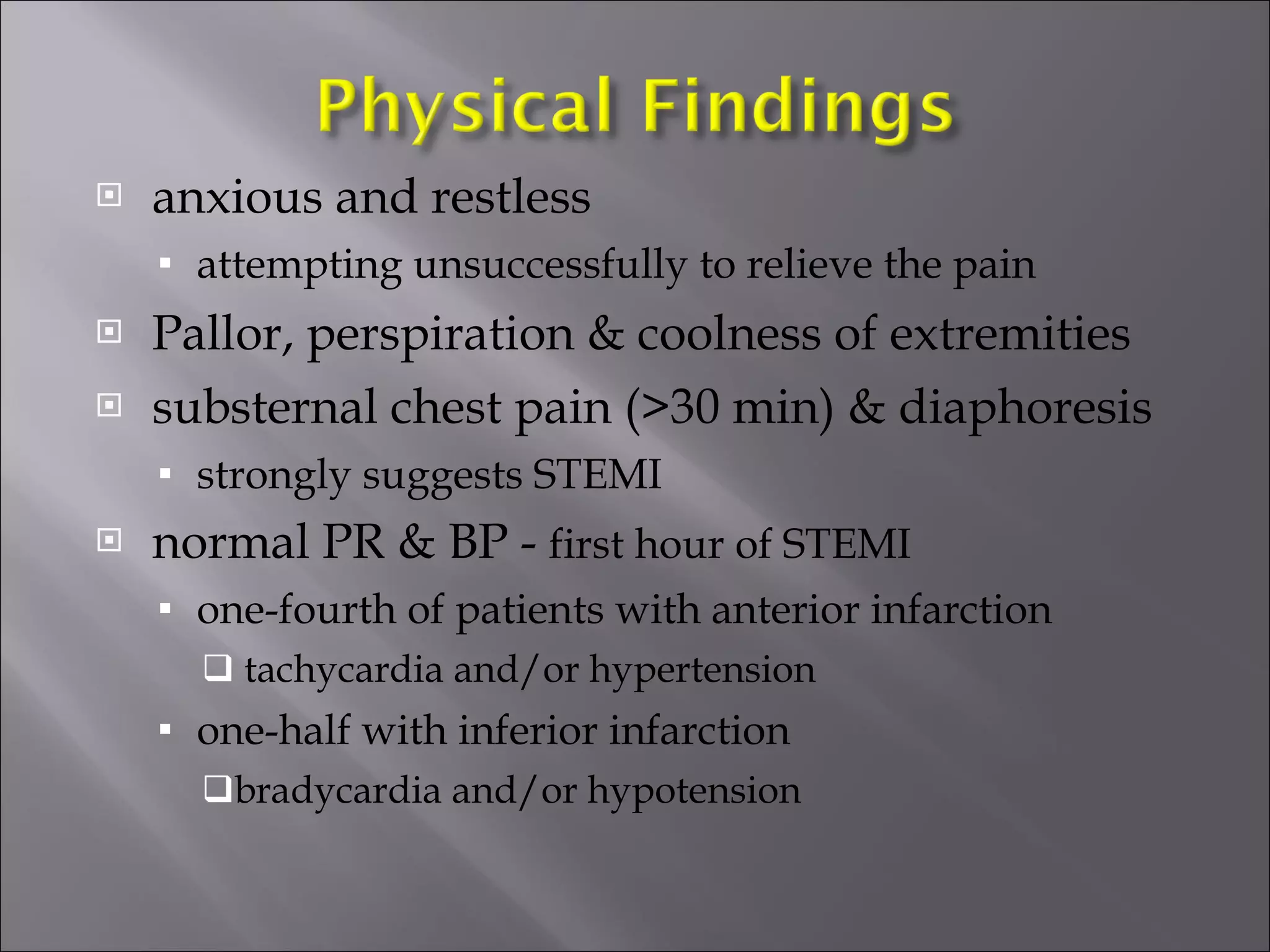
anxious and restless attempting unsuccessfully to relieve the pain Pallor, perspiration & coolness of extremities  substernal chest pain (>30 min) & diaphoresis strongly suggests STEMI normal PR & BP -  first hour of STEMI one-fourth of patients with anterior infarction tachycardia and/or hypertension one-half with inferior infarction bradycardia and/or hypotension
MI progresses through the following temporal stages:  acute  - first few hours to7 days healing  – 7 to 28 days healed  - 29 days Laboratory tests of value in confirming the diagnosis may be divided into four groups:  ECG serum cardiac biomarkers cardiac imaging nonspecific indices of tissue  necrosis and inflammation
Initial stage total occlusion of an epicardial coronary artery produces ST-segment elevation evolve Q waves on the ECG
small proportion of patients initially presenting with ST-segment elevation will not develop Q waves  obstructing thrombus is not totally occlusive obstruction is transient rich collateral network is present ischemic discomfort but  without  ST-segment elevation and serum cardiac biomarker of necrosis is detected NSTEMI is ultimately made
Proteins released from necrotic  heart muscle after STEMI rate of liberation differs depending  intracellular location, molecular weight, & local blood and lymphatic flow detectable in the peripheral blood once the capacity of the cardiac lymphatics to clear the interstitium of the infarct zone is exceeded and spillover into the venous circulation occurs
amino acid sequences different from those of the skeletal muscle increase after STEMI to levels >20 times higher than the upper reference limit preferred biochemical markers for MI   Levels remain elevated for  7–10 days  after STEMI
4–8 h (normal by 48–72 h) lack of specificity for STEMI elevated with skeletal muscle disease or trauma (intramuscular injection)  MB isoenzyme of CK   advantage over total CK not present in significant concentrations in extracardiac tissue ratio (relative index) of CKMB mass:CK activity  2.5   Suggests myocardial rather than a skeletal muscle source for the CKMB elevation
Polymorphonuclear leukocytosis appears few hours after the onset of pain persists for 3–7 days WBC often reaches levels of 12,000–15,000/L Erythrocyte Sedimentation Rate   rises more slowly than WBC peaking during first week 1 or 2 weeks
Abnormalities of wall motion on  2-D echo aids in management decisions patient should receive reperfusion therapy estimation of left ventricular (LV) function serves as an indication for therapy with an inhibitor of the renin-angiotensin-aldosterone system Doppler echocardiography detection and quantitation of a ventricular septal defect and mitral regurgitation
 
two general classes of complications:  (1) electrical complications (arrhythmias) (2) mechanical complications ("pump failure“)  ventricular fibrillation : MC cause of out of hospital deaths occur first 24 h of the onset of symptoms
major elements of prehospital care of patients with suspected STEMI recognition of symptoms by the patient and prompt seeking of medical attention rapid deployment of an emergency medical team capable of performing resuscitative maneuvers  expeditious transportation of the patient to a hospital facility expeditious implementation of reperfusion therapy
Goals control of cardiac discomfort rapid identification of patients who are candidates for urgent reperfusion therapy triage of lower-risk patients to the appropriate location in the hospital avoidance of inappropriate discharge of patients with STEMI
Aspirin essential in the management of patients with suspected STEMI Rapid inhibition of cyclooxygenase-1 in platelets followed by a reduction of thromboxane A 2  levels  160–325 mg tablet  75–162 mg PO OD Hypoxemia 2–4 L/min for the first 6–12 h after infarction Reassessed
Sublingual nitroglycerin 0.4 mg up to three doses (5-min intervals) diminish chest discomfort decreasing myocardial oxygen demand (by lowering preload)  increasing myocardial oxygen supply (by dilating infarct-related coronary vessels or collateral vessels) intravenous nitroglycerin return of chest discomfort evidence of ongoing ischemia (ST-segment or T-wave shifts)
Contraindication low systolic arterial pressure (<90 mmHg) clinical suspicion of right ventricular infarction  inferior infarction on ECG elevated jugular venous pressure clear lungs hypotension patients taking phosphodiesterase-5 inhibitor sildenafil within the preceding 24 h idiosyncratic reaction to nitrates - sudden marked hypotension IV atropine
Morphine   2–4 mg repetitive (every 5 min) IV effective analgesic for the pain associated with STEMI reduce sympathetically mediated arteriolar and venous constriction reduce cardiac output and arterial pressure elevation of the legs volume expansion with IV saline vagotonic effect bradycardia or advanced degrees of heart block IV atropine 0.5 mg Control of Discomfort
Intravenous  beta blockers control pain effectively in some patients diminishing myocardial O 2  demand (ischemia) reduce the risks of reinfarction and ventricular fibrillation Metoprolol 5 mg every 2–5 min (3 doses) heart rate >60 bpm systolic pressure >100 mmHg PR interval <0.24 s rales that are no higher than 10 cm up from the diaphragm 50 mg every 6 h for 48 h PO followed by 100 mg every 12 h Fifteen minutes after the last intravenous dose Control of Discomfort
Primary tool for screening patients  initial 12-lead ECG ST-segment elevation of at least 2 mm in two contiguous precordial leads and 1 mm in two adjacent limb leads candidate for  reperfusion therapy absence of ST-segment elevation fibrinolysis is not helpful
Primary Percutaneous Coronary Intervention   angioplasty and/or stenting without preceding fibrinolysis effective in restoring perfusion in STEMI in first few hours of MI Advantages applicable to patients with contraindications to fibrinolytic therapy more effective than fibrinolysis in opening occluded coronary arteries generally preferred over  fibrinolysis when diagnosis is in doubt presence of cardiogenic shock bleeding risk  symptoms for at least 2–3 h when the clot is more mature and less easily lysed by fibrinolytic drugs
Fibrinolysis ideally initiated within 30 min of presentation (door-to-needle time 30 min) principal goal :  prompt restoration of full coronary arterial patency Promotes conversion of plasminogen to plasmin then lyses fibrin thrombi
fibrinolytic agents tissue plasminogen activator (tPA) 15 mg bolus followed by 50 mg intravenously over the first 30 min followed by 35 mg over the next 60 min Streptokinase 1.5 million units (MU) intravenously over 1 h tenecteplase (TNK) single weight-based intravenous bolus of 0.53 mg/kg over 10 s reteplase (rPA)   double-bolus regimen consisting of a 10-MU bolus given over 2–3 min, followed by a second 10-MU bolus 30 min later
 
Clear contraindications history of cerebrovascular hemorrhage at any time nonhemorrhagic stroke or other cerebrovascular event within the past year marked hypertension at any time during the acute presentation systolic arterial pressure >180 mmHg diastolic pressure >110 mmHg suspicion of aortic dissection active internal bleeding (excluding menses)
Relative contraindications current use of anticoagulants  recent (<2 weeks) invasive or surgical procedure or prolonged (>10 min) cardiopulmonary resuscitation known bleeding diathesis Pregnancy hemorrhagic ophthalmic condition active peptic ulcer disease history of severe hypertension that is currently adequately controlled
Streptokinase  Allergic reactions ~2% of patients should not receive streptokinase within preceding 5 days - 2 yrs Hypotension 4–10% Hemorrhage Hemorrhagic stroke most serious complication ~0.5–0.9%  increases with advancing age
Coronary Care Units permits continuous monitoring Activity bed rest for the first 12 h absence of complications Encouraged an upright posture by dangling their feet over the side of the bed and sitting in a chair within the first 24 h  absence of hypotension and other complications 2nd or 3rd day patients – ambulate with increasing duration and frequency day 3 after infarction ambulate to a goal of 185 m (600 ft) at least three times a day
Diet NPO or clear liquids by mouth - first 4–12 h 30% of total calories as fat and have a cholesterol content of 300 mg/d Complex carbohydrates should make up 50–55% of total calories Bowels stool softener such as dioctyl sodium sulfosuccinate (200 mg/d) laxative Sedation require sedation to withstand the period of enforced inactivity with tranquillity Diazepam (5 mg) Oxazepam (15–30 mg) Lorazepam (0.5–2 mg) three or four times daily
 
Aspirin standard antiplatelet agent Aspirin + Clopidogrel reduces the risk of clinical events death reinfarction stroke
unfractionated heparin (UFH) standard antithrombin agent helps to maintain patency of the infarct-related artery when added to aspirin and fibrinolytic agents recommended dose initial bolus of 60 U/kg (maximum 4000 U) followed by an initial infusion of 12 U/kg per hour (maximum 1000 U/h)
low-molecular-weight heparin (LMWH): alternative to UFH  Advantages:  high bioavailability permitting administration subcutaneously reliable anticoagulation without monitoring greater antiXa:IIa activity Enoxaparin
Benefits Acute intravenous beta blockade improves the myocardial O 2  supply-demand relationship decreases pain reduces infarct size decreases the incidence of serious ventricular arrhythmias Given for secondary prevention after an infarction  reduction in mortality rate is seen with beta blockers
reduce the mortality rate after STEMI additive to those achieved with aspirin and beta blockers mechanism reduction in ventricular remodeling after infarction with a subsequent reduction in the risk of congestive heart failure (CHF)
patients who are intolerant of ACE inhibitors who have either clinical or radiological signs of heart failure Long-term aldosterone blockade should be prescribed for STEMI patients without significant renal dysfunction creatinine 2.5 mg/dL in men and 2.0 mg/dL in women hyperkalemia (potassium 5.0 mEq/L) LV ejection fraction 40 percent symptomatic heart failure or diabetes mellitus
http://familymedicine.page.tl

ST- Segment Elevation Myocardial Infarction

  • 1.
  • 2.
    650,000 - newAMI 450,000 - recurrent AMI each year early (30-day) mortality rate - ~30% 1 of every 25 patients who survives the initial hospitalization dies in the first year after AMI Mortality is approximately fourfold higher in elderly patients (over age 75)
  • 3.
  • 4.
    STEMI usually occurswhen coronary blood flow decreases abruptly after a thrombotic occlusion of a coronary artery previously affected by atherosclerosis Coronary artery thrombus develops rapidly at a site of vascular injury cigarette smoking Hypertension lipid accumulation STEMI occurs when the surface of an atherosclerotic plaque becomes disrupted and conditions favor thrombogenesis coronary plaques prone to disruption rich lipid core and a thin fibrous cap
  • 5.
    platelet monolayer formsat the site of the disrupted plaque agonists promote platelet activation(collagen, ADP, epinephrine, serotonin) platelet cross-linking and aggregation thromboxane A 2 (a potent local vasoconstrictor) is released Factors VII and X are activated, ultimately leading to the conversion of prothrombin to thrombin, which then converts fibrinogen to fibrin conformational change in the glycoprotein IIb/IIIa receptor further platelet activation and potential resistance to fibrinolysis develops Fluid-phase and clot-bound thrombin participate in an autoamplification reaction leading to further activation of the coagulation cascade. Coronary artery eventually becomes occluded by a thrombus containing platelet aggregates and fibrin strands. high affinity for amino acid sequences on soluble adhesive proteins (fibrinogen - can bind to two different platelets simultaneously
  • 6.
    The amount ofmyocardial damage caused by coronary occlusion depends on (1) territory supplied by the affected vessel (2) whether or not the vessel becomes totally occluded (3) duration of coronary occlusion (4) quantity of blood supplied by collateral vessels (5) demand for oxygen of the myocardium (6) native factors that can produce early spontaneous lysis of the occlusive thrombus (7) adequacy of myocardial perfusion in the infarct zone
  • 7.
  • 8.
    Elderly sudden-onset breathlessnessOther less common presentations (with or without pain) sudden loss of consciousness confusional state sensation of profound weakness appearance of an arrhythmia unexplained drop in arterial pressure
  • 9.
    anxious and restlessattempting unsuccessfully to relieve the pain Pallor, perspiration & coolness of extremities substernal chest pain (>30 min) & diaphoresis strongly suggests STEMI normal PR & BP - first hour of STEMI one-fourth of patients with anterior infarction tachycardia and/or hypertension one-half with inferior infarction bradycardia and/or hypotension
  • 10.
    MI progresses throughthe following temporal stages: acute - first few hours to7 days healing – 7 to 28 days healed - 29 days Laboratory tests of value in confirming the diagnosis may be divided into four groups: ECG serum cardiac biomarkers cardiac imaging nonspecific indices of tissue necrosis and inflammation
  • 11.
    Initial stage totalocclusion of an epicardial coronary artery produces ST-segment elevation evolve Q waves on the ECG
  • 12.
    small proportion ofpatients initially presenting with ST-segment elevation will not develop Q waves obstructing thrombus is not totally occlusive obstruction is transient rich collateral network is present ischemic discomfort but without ST-segment elevation and serum cardiac biomarker of necrosis is detected NSTEMI is ultimately made
  • 13.
    Proteins released fromnecrotic heart muscle after STEMI rate of liberation differs depending intracellular location, molecular weight, & local blood and lymphatic flow detectable in the peripheral blood once the capacity of the cardiac lymphatics to clear the interstitium of the infarct zone is exceeded and spillover into the venous circulation occurs
  • 14.
    amino acid sequencesdifferent from those of the skeletal muscle increase after STEMI to levels >20 times higher than the upper reference limit preferred biochemical markers for MI Levels remain elevated for 7–10 days after STEMI
  • 15.
    4–8 h (normalby 48–72 h) lack of specificity for STEMI elevated with skeletal muscle disease or trauma (intramuscular injection) MB isoenzyme of CK advantage over total CK not present in significant concentrations in extracardiac tissue ratio (relative index) of CKMB mass:CK activity 2.5 Suggests myocardial rather than a skeletal muscle source for the CKMB elevation
  • 16.
    Polymorphonuclear leukocytosis appearsfew hours after the onset of pain persists for 3–7 days WBC often reaches levels of 12,000–15,000/L Erythrocyte Sedimentation Rate rises more slowly than WBC peaking during first week 1 or 2 weeks
  • 17.
    Abnormalities of wallmotion on 2-D echo aids in management decisions patient should receive reperfusion therapy estimation of left ventricular (LV) function serves as an indication for therapy with an inhibitor of the renin-angiotensin-aldosterone system Doppler echocardiography detection and quantitation of a ventricular septal defect and mitral regurgitation
  • 18.
  • 19.
    two general classesof complications: (1) electrical complications (arrhythmias) (2) mechanical complications (&quot;pump failure“) ventricular fibrillation : MC cause of out of hospital deaths occur first 24 h of the onset of symptoms
  • 20.
    major elements ofprehospital care of patients with suspected STEMI recognition of symptoms by the patient and prompt seeking of medical attention rapid deployment of an emergency medical team capable of performing resuscitative maneuvers expeditious transportation of the patient to a hospital facility expeditious implementation of reperfusion therapy
  • 21.
    Goals control ofcardiac discomfort rapid identification of patients who are candidates for urgent reperfusion therapy triage of lower-risk patients to the appropriate location in the hospital avoidance of inappropriate discharge of patients with STEMI
  • 22.
    Aspirin essential inthe management of patients with suspected STEMI Rapid inhibition of cyclooxygenase-1 in platelets followed by a reduction of thromboxane A 2 levels 160–325 mg tablet 75–162 mg PO OD Hypoxemia 2–4 L/min for the first 6–12 h after infarction Reassessed
  • 23.
    Sublingual nitroglycerin 0.4mg up to three doses (5-min intervals) diminish chest discomfort decreasing myocardial oxygen demand (by lowering preload) increasing myocardial oxygen supply (by dilating infarct-related coronary vessels or collateral vessels) intravenous nitroglycerin return of chest discomfort evidence of ongoing ischemia (ST-segment or T-wave shifts)
  • 24.
    Contraindication low systolicarterial pressure (<90 mmHg) clinical suspicion of right ventricular infarction inferior infarction on ECG elevated jugular venous pressure clear lungs hypotension patients taking phosphodiesterase-5 inhibitor sildenafil within the preceding 24 h idiosyncratic reaction to nitrates - sudden marked hypotension IV atropine
  • 25.
    Morphine 2–4 mg repetitive (every 5 min) IV effective analgesic for the pain associated with STEMI reduce sympathetically mediated arteriolar and venous constriction reduce cardiac output and arterial pressure elevation of the legs volume expansion with IV saline vagotonic effect bradycardia or advanced degrees of heart block IV atropine 0.5 mg Control of Discomfort
  • 26.
    Intravenous betablockers control pain effectively in some patients diminishing myocardial O 2 demand (ischemia) reduce the risks of reinfarction and ventricular fibrillation Metoprolol 5 mg every 2–5 min (3 doses) heart rate >60 bpm systolic pressure >100 mmHg PR interval <0.24 s rales that are no higher than 10 cm up from the diaphragm 50 mg every 6 h for 48 h PO followed by 100 mg every 12 h Fifteen minutes after the last intravenous dose Control of Discomfort
  • 27.
    Primary tool forscreening patients initial 12-lead ECG ST-segment elevation of at least 2 mm in two contiguous precordial leads and 1 mm in two adjacent limb leads candidate for reperfusion therapy absence of ST-segment elevation fibrinolysis is not helpful
  • 28.
    Primary Percutaneous CoronaryIntervention angioplasty and/or stenting without preceding fibrinolysis effective in restoring perfusion in STEMI in first few hours of MI Advantages applicable to patients with contraindications to fibrinolytic therapy more effective than fibrinolysis in opening occluded coronary arteries generally preferred over fibrinolysis when diagnosis is in doubt presence of cardiogenic shock bleeding risk symptoms for at least 2–3 h when the clot is more mature and less easily lysed by fibrinolytic drugs
  • 29.
    Fibrinolysis ideally initiatedwithin 30 min of presentation (door-to-needle time 30 min) principal goal : prompt restoration of full coronary arterial patency Promotes conversion of plasminogen to plasmin then lyses fibrin thrombi
  • 30.
    fibrinolytic agents tissueplasminogen activator (tPA) 15 mg bolus followed by 50 mg intravenously over the first 30 min followed by 35 mg over the next 60 min Streptokinase 1.5 million units (MU) intravenously over 1 h tenecteplase (TNK) single weight-based intravenous bolus of 0.53 mg/kg over 10 s reteplase (rPA) double-bolus regimen consisting of a 10-MU bolus given over 2–3 min, followed by a second 10-MU bolus 30 min later
  • 31.
  • 32.
    Clear contraindications historyof cerebrovascular hemorrhage at any time nonhemorrhagic stroke or other cerebrovascular event within the past year marked hypertension at any time during the acute presentation systolic arterial pressure >180 mmHg diastolic pressure >110 mmHg suspicion of aortic dissection active internal bleeding (excluding menses)
  • 33.
    Relative contraindications currentuse of anticoagulants recent (<2 weeks) invasive or surgical procedure or prolonged (>10 min) cardiopulmonary resuscitation known bleeding diathesis Pregnancy hemorrhagic ophthalmic condition active peptic ulcer disease history of severe hypertension that is currently adequately controlled
  • 34.
    Streptokinase Allergicreactions ~2% of patients should not receive streptokinase within preceding 5 days - 2 yrs Hypotension 4–10% Hemorrhage Hemorrhagic stroke most serious complication ~0.5–0.9% increases with advancing age
  • 35.
    Coronary Care Unitspermits continuous monitoring Activity bed rest for the first 12 h absence of complications Encouraged an upright posture by dangling their feet over the side of the bed and sitting in a chair within the first 24 h absence of hypotension and other complications 2nd or 3rd day patients – ambulate with increasing duration and frequency day 3 after infarction ambulate to a goal of 185 m (600 ft) at least three times a day
  • 36.
    Diet NPO orclear liquids by mouth - first 4–12 h 30% of total calories as fat and have a cholesterol content of 300 mg/d Complex carbohydrates should make up 50–55% of total calories Bowels stool softener such as dioctyl sodium sulfosuccinate (200 mg/d) laxative Sedation require sedation to withstand the period of enforced inactivity with tranquillity Diazepam (5 mg) Oxazepam (15–30 mg) Lorazepam (0.5–2 mg) three or four times daily
  • 37.
  • 38.
    Aspirin standard antiplateletagent Aspirin + Clopidogrel reduces the risk of clinical events death reinfarction stroke
  • 39.
    unfractionated heparin (UFH)standard antithrombin agent helps to maintain patency of the infarct-related artery when added to aspirin and fibrinolytic agents recommended dose initial bolus of 60 U/kg (maximum 4000 U) followed by an initial infusion of 12 U/kg per hour (maximum 1000 U/h)
  • 40.
    low-molecular-weight heparin (LMWH):alternative to UFH Advantages: high bioavailability permitting administration subcutaneously reliable anticoagulation without monitoring greater antiXa:IIa activity Enoxaparin
  • 41.
    Benefits Acute intravenousbeta blockade improves the myocardial O 2 supply-demand relationship decreases pain reduces infarct size decreases the incidence of serious ventricular arrhythmias Given for secondary prevention after an infarction reduction in mortality rate is seen with beta blockers
  • 42.
    reduce the mortalityrate after STEMI additive to those achieved with aspirin and beta blockers mechanism reduction in ventricular remodeling after infarction with a subsequent reduction in the risk of congestive heart failure (CHF)
  • 43.
    patients who areintolerant of ACE inhibitors who have either clinical or radiological signs of heart failure Long-term aldosterone blockade should be prescribed for STEMI patients without significant renal dysfunction creatinine 2.5 mg/dL in men and 2.0 mg/dL in women hyperkalemia (potassium 5.0 mEq/L) LV ejection fraction 40 percent symptomatic heart failure or diabetes mellitus
  • 44.