SSL and TLS
 Essentials
Securing the Web


Stephen Thomas
SSL & TLS Essentials
Securing the Web


Stephen A. Thomas


Wiley Computer Publishing
John Wiley & Sons, Inc.
New York • Chichester • Weinheim • Brisbane • Singapore • Toronto
Publisher: Robert Ipsen
Editor: Marjorie Spencer
Assistant Editor: Margaret Hendrey
Text Design & Composition: Stephen Thomas
Designations used by companies to distinguish their products are often claimed as
trademarks. In all instances where John Wiley & Sons, Inc., is aware of a claim, the
product names appear in initial capital or all capital letters. Readers, however,
should contact the appropriate companies for more complete information regarding
trademarks and registration.
This book is printed on acid-free paper.

Copyright © 2000 by Stephen A. Thomas. All rights reserved.
Published by John Wiley & Sons, Inc.
Published simultaneously in Canada.
No part of this publication may be reproduced, stored in a retrieval system or trans-
mitted in any form or by any means, electronic, mechanical, photocopying, re-
cording, scanning or otherwise, except as permitted under Section 107 or 108 of the
1976 United States Copyright Act, without either the prior written permission of the
Publisher, or authorization through payment of the appropriate per-copy fee to the
Copyright Clearance Center, 222 Rosewood Drive, Danvers, ma 01923, (978) 750-
8400, fax (978) 750-4744. Requests to the Publisher for permission should be ad-
dressed to the Permissions Department, John Wiley & Sons, Inc., 605 Third Avenue,
New York, ny 10158-0012, (212) 850-6011, fax (212) 850-6008, email perm-
req@wiley.com.
This publication is designed to provide accurate and authoritative information in re-
gard to the subject matter covered. It is sold with the understanding that the pub-
lisher is not engaged in professional services. If professional advice or other expert
assistance is required, the services of a competent professional person should be
sought.
Library of Congress Cataloging-in-Publication Data:
Thomas, Stephen A., 1962-
   ssl and tls essentials : securing the Web / Stephen A. Thomas.
        p. cm.
   Includes index.
   isbn 0-471-38354-6 (pbk./cd-rom : alk. paper)
   1. Computer networks--Security measures. 2. World Wide Web--Security
   measures. 3. Computer network protocols. I. Title.
   tk5105.59 .t49 2000
   005.8--dc21                           99-058910
Printed in the United States of America.
10   9 8 7 6 5 4 3 2   1
For Kelsie,
Zookeeper of Mango the Flamingo.
Contents


Chapter 1: Introduction                                      1

   1.1   Web Security and Electronic Commerce                2
   1.2   History of ssl and tls                              4
   1.3   Approaches to Network Security                      6
         1.3.1 Separate Security Protocol                    8
         1.3.2 Application-Specific Security                 9
         1.3.3 Security within Core Protocols               10
         1.3.4 Parallel Security Protocol                   11
   1.4   Protocol Limitations                               12
         1.4.1 Fundamental Protocol Limitations             12
         1.4.2 Tool Limitations                             13
         1.4.3 Environmental Limitations                    14
   1.5   Organization of This Book                          14

Chapter 2: Basic Cryptography                               17

   2.1   Using Cryptography                                 18
         2.1.1 Keeping Secrets                              18
         2.1.2 Proving Identity                             19
         2.1.3 Verifying Information                        20
   2.2   Types of Cryptography                              21
         2.2.1 Secret Key Cryptography                      22
         2.2.2 Public Key Cryptography                      24
         2.2.3 Combining Secret & Public Key Cryptography   27
   2.3   Key Management                                     29
         2.3.1 Public Key Certificates                      29
         2.3.2 Certificate Authorities                      31
         2.3.3 Certificate Hierarchies                      33
         2.3.4 Certificate Revocation Lists                 35


                                                            ix
x                                                     SSL & TLS Essentials: Securing the Web


Chapter 3: SSL Operation                                          37

    3.1   SSL Roles                                               37
    3.2   SSL Messages                                            38
    3.3   Establishing Encrypted Communications                   39
          3.3.1 ClientHello                                       41
          3.3.2 ServerHello                                       43
          3.3.3 ServerKeyExchange                                 45
          3.3.4 ServerHelloDone                                   45
          3.3.5 ClientKeyExchange                                 45
          3.3.6 ChangeCipherSpec                                  46
          3.3.7 Finished                                          51
    3.4   Ending Secure Communications                            52
    3.5   Authenticating the Server’s Identity                    52
          3.5.1 Certificate                                       55
          3.5.2 ClientKeyExchange                                 56
    3.6   Separating Encryption from Authentication               56
          3.6.1 Certificate                                       59
          3.6.2 ServerKeyExchange                                 59
          3.6.3 ClientKeyExchange                                 59
    3.7   Authenticating the Client’s Identity                    60
          3.7.1 CertificateRequest                                61
          3.7.2 Certificate                                       62
          3.7.3 CertificateVerify                                 63
    3.8   Resuming a Previous Session                             64

Chapter 4: Message Formats                                        67

    4.1   Transport Requirements                                  68
    4.2   Record Layer                                            69
    4.3   ChangeCipherSpec Protocol                               71
    4.4   Alert Protocol                                          72
          4.4.1 Severity Level                                    72
          4.4.2 Alert Description                                 73
    4.5   Handshake Protocol                                      74
          4.5.1 HelloRequest                                      76
          4.5.2 ClientHello                                       77
Contents                                                            xi


                    4.5.3 ServerHello                               79
                    4.5.4 Certificate                               80
                    4.5.5 ServerKeyExchange                         81
                    4.5.6 CertificateRequest                        84
                    4.5.7 ServerHelloDone                           85
                    4.5.8 ClientKeyExchange                         85
                    4.5.9 CertificateVerify                         88
                    4.5.10 Finished                                 90
              4.6   Securing Messages                               92
                    4.6.1 Message Authentication Code               93
                    4.6.2 Encryption                                95
                    4.6.3 Creating Cryptographic Parameters         96
              4.7   Cipher Suites                                  102
                    4.7.1 Key Exchange Algorithms                  103
                    4.7.2 Encryption Algorithms                    104
                    4.7.3 Hash Algorithms                          104

           Chapter 5: Advanced SSL                                 105

              5.1   Compatibility with Previous Versions           105
                    5.1.1 Negotiating ssl Versions                 106
                    5.1.2 SSL Version 2.0 ClientHello              109
                    5.1.3 SSL Version 2.0 Cipher Suites            110
              5.2   Netscape International Step-Up                 111
                    5.2.1 Server Components                        112
                    5.2.2 Client Components                        112
                    5.2.3 Controlling Full-Strength Encryption     113
              5.3   Microsoft Server Gated Cryptography            115
                    5.3.1 Server Gated Cryptography Certificates   115
                    5.3.2 Cipher Suite Renegotiation               115
              5.4   The Transport Layer Security Protocol          117
                    5.4.1 TLS Protocol Version                     118
                    5.4.2 Alert Protocol Message Types             118
                    5.4.3 Message Authentication                   121
                    5.4.4 Key Material Generation                  123
                    5.4.5 CertificateVerify                        125
                    5.4.6 Finished                                 126
xii                                              SSL & TLS Essentials: Securing the Web


            5.4.7 Baseline Cipher Suites                    126
            5.4.8 Interoperability with SSL                 128
      5.5   The Future of ssl and tls                       128

Appendix A: X.509 Certificates                             131

      A.1 X.509 Certificate Overview                        132
          A.1.1 Version                                     132
          A.1.2 Serial Number                               133
          A.1.3 Algorithm Identifier                        133
          A.1.4 Issuer                                      133
          A.1.5 Period of Validity                          133
          A.1.6 Subject                                     134
          A.1.7 Subject’s Public Key                        134
          A.1.8 Issuer Unique Identifier                    134
          A.1.9 Subject Unique Identifier                   134
          A.1.10 Extensions                                 135
          A.1.11 Signature                                  135
      A.2 Abstract Syntax Notation One                      135
          A.2.1 Primitive Objects                           136
          A.2.2 Constructed Objects                         136
          A.2.3 The Object Identifier Hierarchy             137
          A.2.4 Tagging                                     139
          A.2.5 Encoding Rules                              142
      A.3 X.509 Certificate Definition                      145
          A.3.1 The Certificate Object                      145
          A.3.2 The Version Object                          146
          A.3.3 The CertificateSerialNumber Object          147
          A.3.4 The AlgorithmIdentifier Object              147
          A.3.5 The Validity Object                         148
          A.3.6 The SubjectPublicKeyInfo Object             148
          A.3.7 The Time Object                             149
          A.3.8 The Extensions Object                       149
          A.3.9 The UniqueIdentifier Object                 150
          A.3.10 The Name Object                            150
      A.4 Example Certificate                               152
Contents                                                         xiii


           Appendix B: SSL Security Checklist                   161

              B.1     Authentication Issues                     161
                      B.1.1 Certificate Authority               162
                      B.1.2 Certificate Signature               163
                      B.1.3 Certificate Validity Times          163
                      B.1.4 Certificate Revocation Status       163
                      B.1.5 Certificate Subject                 163
                      B.1.6 Diffie-Hellman Trapdoors            164
                      B.1.7 Algorithm Rollback                  164
                      B.1.8 Dropped ChangeCipherSpec Messages   165
              B.2     Encryption Issues                         166
                      B.2.1 Encryption Key Size                 166
                      B.2.2 Traffic Analysis                    167
                      B.2.3 The Bleichenbacher Attack           168
              B.3     General Issues                            170
                      B.3.1 RSA Key Size                        170
                      B.3.2 Version Rollback Attacks            171
                      B.3.3 Premature Closure                   171
                      B.3.4 SessionID Values                    172
                      B.3.5 Random Number Generation            172
                      B.3.6 Random Number Seeding               173

           References                                           175

              Protocol Standards                                175
              Certificate Formats                               176
              Cryptographic Algorithms                          177
              SSL Implementations                               178

           Glossary                                             179


           Index                                                191
1
                                         Introduction


Today alone, Dell Computer will sell more than $18 million worth of
computer equipment through the Internet. In 1999, nine million
Americans traded stocks online, accounting for one-third of all retail
stock trades. And more than 200,000 Web sites worldwide (includ-
ing sites belonging to 98 of the Fortune 100) can accept e-commerce
transactions. Commercial use of the Web continues to grow at an as-
tonishing pace, and securing Web transactions has become increas-
ingly critical to businesses, organizations, and individual users.
Fortunately, an extremely effective and widely deployed communica-
tions protocol provides exactly that security. It is the Secure Sockets
Layer protocol, more commonly known simply as ssl. The ssl pro-
tocol—along with its successor, the Transport Layer Security (tls)
protocol—is the subject of this book.
This chapter introduces ssl and tls, and provides the essential con-
text for both. It begins with a very brief look at Web security and
electronic commerce, focusing on the issues that led to the creation
of ssl. The next section follows up with a quick history of ssl and its
transformation into tls. The relationship of ssl to other network se-
curity technologies is the subject of the third section. The forth sec-
tion, “Protocol Limitations,” is an important one. Especially with
security technologies, it is critical to understand what they cannot do.
The chapter closes with an overview of the rest of this book.


                                                                      1
2                                                         SSL & TLS Essentials: Securing the Web


1.1 Web Security and Electronic Commerce
Know the enemy. Sun Tzu could not have offered any advice more ap-
propriate to security professionals. Specific security services are nec-
essarily effective against only specific threats; they may be completely
inappropriate for other security threats. To understand ssl, therefore,
it is essential to understand the environment for which it has been
designed.
Even though ssl is a flexible protocol that is finding use in many dif-
ferent applications, the original motivation for its development was
the Internet. The protocol’s designers needed to secure electronic
commerce and other Web transactions. That environment is certainly
perilous enough. Consider, for example, what happens when a user in
Berlin places an online order from a Web site in San Jose, California.
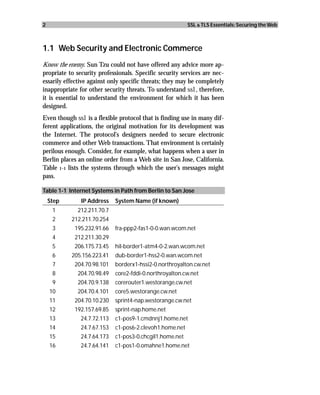
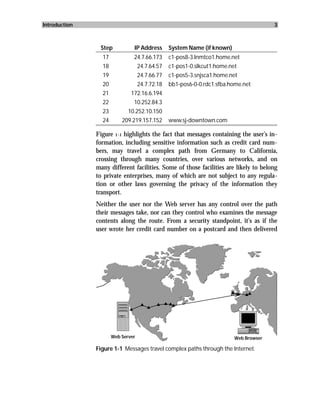
Table 1-1 lists the systems through which the user’s messages might
pass.

Table 1-1 Internet Systems in Path from Berlin to San Jose
    Step       IP Address    System Name (if known)
     1       212.211.70.7
     2     212.211.70.254
     3      195.232.91.66    fra-ppp2-fas1-0-0.wan.wcom.net
     4      212.211.30.29
     5      206.175.73.45    hil-border1-atm4-0-2.wan.wcom.net
     6     205.156.223.41    dub-border1-hss2-0.wan.wcom.net
     7      204.70.98.101    borderx1-hssi2-0.northroyalton.cw.net
     8       204.70.98.49    core2-fddi-0.northroyalton.cw.net
     9       204.70.9.138    corerouter1.westorange.cw.net
    10       204.70.4.101    core5.westorange.cw.net
    11      204.70.10.230    sprint4-nap.westorange.cw.net
    12      192.157.69.85    sprint-nap.home.net
    13         24.7.72.113   c1-pos9-1.cmdnnj1.home.net
    14         24.7.67.153   c1-pos6-2.clevoh1.home.net
    15         24.7.64.173   c1-pos3-0.chcgil1.home.net
    16         24.7.64.141   c1-pos1-0.omahne1.home.net
Introduction                                                                           3


                Step           IP Address       System Name (if known)
                 17            24.7.66.173      c1-pos8-3.lnmtco1.home.net
                 18                24.7.64.57   c1-pos1-0.slkcut1.home.net
                 19                24.7.66.77   c1-pos5-3.snjsca1.home.net
                 20                24.7.72.18   bb1-pos6-0-0.rdc1.sfba.home.net
                 21           172.16.6.194
                 22            10.252.84.3
                 23          10.252.10.150
                 24       209.219.157.152       www.sj-downtown.com

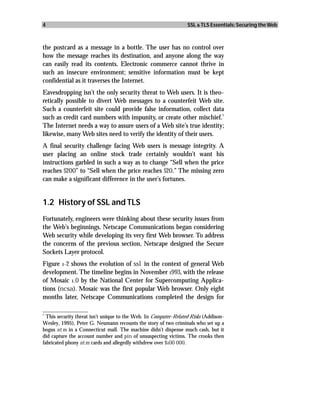
               Figure 1-1 highlights the fact that messages containing the user’s in-
               formation, including sensitive information such as credit card num-
               bers, may travel a complex path from Germany to California,
               crossing through many countries, over various networks, and on
               many different facilities. Some of those facilities are likely to belong
               to private enterprises, many of which are not subject to any regula-
               tion or other laws governing the privacy of the information they
               transport.
               Neither the user nor the Web server has any control over the path
               their messages take, nor can they control who examines the message
               contents along the route. From a security standpoint, it’s as if the
               user wrote her credit card number on a postcard and then delivered


                      Web Server                                         Web Browser

               Figure 1-1 Messages travel complex paths through the Internet.
4                                                                 SSL & TLS Essentials: Securing the Web


the postcard as a message in a bottle. The user has no control over
how the message reaches its destination, and anyone along the way
can easily read its contents. Electronic commerce cannot thrive in
such an insecure environment; sensitive information must be kept
confidential as it traverses the Internet.
Eavesdropping isn’t the only security threat to Web users. It is theo-
retically possible to divert Web messages to a counterfeit Web site.
Such a counterfeit site could provide false information, collect data
                                                                      1
such as credit card numbers with impunity, or create other mischief.
The Internet needs a way to assure users of a Web site’s true identity;
likewise, many Web sites need to verify the identity of their users.
A final security challenge facing Web users is message integrity. A
user placing an online stock trade certainly wouldn’t want his
instructions garbled in such a way as to change “Sell when the price
reaches $200” to “Sell when the price reaches $20.” The missing zero
can make a significant difference in the user’s fortunes.


1.2 History of SSL and TLS
Fortunately, engineers were thinking about these security issues from
the Web’s beginnings. Netscape Communications began considering
Web security while developing its very first Web browser. To address
the concerns of the previous section, Netscape designed the Secure
Sockets Layer protocol.
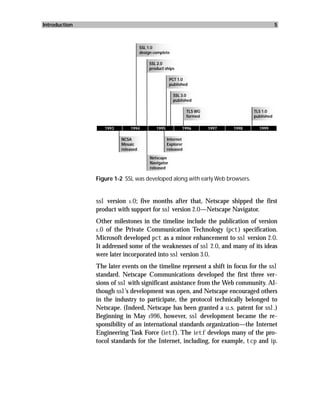
Figure 1-2 shows the evolution of ssl in the context of general Web
development. The timeline begins in November 1993, with the release
of Mosaic 1.0 by the National Center for Supercomputing Applica-
tions (ncsa). Mosaic was the first popular Web browser. Only eight
months later, Netscape Communications completed the design for
_________________
1
  This security threat isn’t unique to the Web. In Computer-Related Risks (Addison-
Wesley, 1995), Peter G. Neumann recounts the story of two criminals who set up a
bogus atm in a Connecticut mall. The machine didn’t dispense much cash, but it
did capture the account number and pin of unsuspecting victims. The crooks then
fabricated phony atm cards and allegedly withdrew over $100 000.
Introduction                                                                                        5


                                       SSL 1.0
                                       design complete

                                           SSL 2.0
                                           product ships

                                                        PCT 1.0
                                                        published

                                                         SSL 3.0
                                                         published

                                                                 TLS WG                 TLS 1.0
                                                                 formed                 published

                     1993       1994           1995           1996        1997   1998     1999

                            NCSA                      Internet
                            Mosaic                    Explorer
                            released                  released

                                            Netscape
                                            Navigator
                                            released

               Figure 1-2 SSL was developed along with early Web browsers.


               ssl version 1.0; five months after that, Netscape shipped the first
               product with support for ssl version 2.0—Netscape Navigator.
               Other milestones in the timeline include the publication of version
               1.0 of the Private Communication Technology (pct) specification.
               Microsoft developed pct as a minor enhancement to ssl version 2.0.
               It addressed some of the weaknesses of ssl 2.0, and many of its ideas
               were later incorporated into ssl version 3.0.
               The later events on the timeline represent a shift in focus for the ssl
               standard. Netscape Communications developed the first three ver-
               sions of ssl with significant assistance from the Web community. Al-
               though ssl’s development was open, and Netscape encouraged others
               in the industry to participate, the protocol technically belonged to
               Netscape. (Indeed, Netscape has been granted a u.s. patent for ssl.)
               Beginning in May 1996, however, ssl development became the re-
               sponsibility of an international standards organization—the Internet
               Engineering Task Force (ietf). The ietf develops many of the pro-
               tocol standards for the Internet, including, for example, tcp and ip.
6                                                        SSL & TLS Essentials: Securing the Web


To avoid the appearance of bias toward any particular company, the          SSL vs. TLS
ietf renamed ssl to Transport Layer Security (tls). The final version
                                                                            Because SSL is
of the first official tls specification was released in January 1999.       more widely
Despite the change of names, tls is nothing more than a new ver-            used and much
                                                                            better known
sion of ssl. In fact, there are far fewer differences between tls 1.0
                                                                            than TLS, the
and ssl 3.0 than there are between ssl 3.0 and ssl 2.0. Section 5.4         main text of this
details the differences between ssl and tls, but check the sidebars         book describes
for more information.                                                       SSL rather than
                                                                            TLS. The differ-
Support for ssl is now built in to nearly all browsers and Web serv-
                                                                            ences between
ers. For users of Netscape Navigator or Microsoft’s Internet Explorer,      the two are very
ssl operates nearly transparently. Observant users might notice the         minor, however.
“https:” prefix for an ssl-secured url, or they may see a small icon        Sidebars such as
that each browser displays when ssl is in use. (Figure 1-3 shows the        this one will note
padlock symbol that Internet Explorer displays in the bottom status         all those differ-
bar; Navigator shows a similar icon.) For the most part, however, ssl       ences.
simply works, safely providing confidentiality, authentication, and
message integrity to its Web users.
Today’s popular Web servers also include support for ssl. It’s usually
a simple task to enable ssl in the server. As we’ll see, though, to sup-
port secure Web browsing, a Web server must do more than simply
enable the ssl protocol. The server must also obtain a public key cer-
tificate from an organization that Web browsers trust. For users on
the public Internet, those organizations are generally public certifi-
cate authorities. Popular certificate authorities include at&t Certifi-
cate Services, gte CyberTrust, KeyWitness International, Microsoft,
Thawte Consulting, and VeriSign. The next chapter includes further
discussions of certificate authorities (primarily in section 2.3.2), and
appendix a provides details on public key certificates.


1.3 Approaches to Network Security
The Secure Sockets Layer protocol provides effective security for
Web transactions, but it is not the only possible approach. The Inter-
net architecture relies on layers of protocols, each building on the
services of those below it. Many of these different protocol layers can
Introduction                                                                                        7


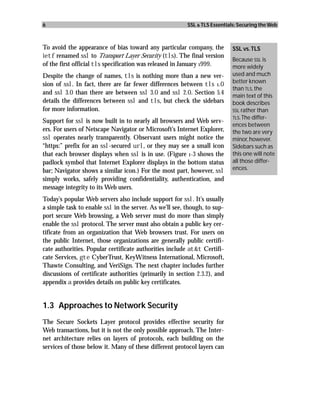
               Figure 1-3 Web browsers such as Internet Explorer include SSL.
               support security services, though each has its own advantages and
               disadvantages. As we’ll see in this section, the designers of ssl chose
               to create an entirely new protocol layer for security. It is also possible
               to include security services in the application protocol or to add them
               to a core networking protocol. As another alternative, applications
               can rely on parallel protocols for some security services. All of these
               options have been considered for securing Web transactions, and ac-
               tual protocols exist for each alternative. Table 1-2 summarizes the ad-
               vantages of each approach, and this section considers each of the
               possible approaches in more detail.

               Table 1-2 Different Approaches to Network Security
                Protocol Architecture           Example             A     B      C     D        E
                Separate Protocol Layer         SSL
                Application Layer               S-HTTP
                Integrated with Core            IPSEC
                Parallel Protocol               Kerberos
                Benefits:   A – Full Security B – Multiple Applications C – Tailored Services
                            D – Transparent to Application E – Easy to Deploy
8                                                                SSL & TLS Essentials: Securing the Web


1.3.1 Separate Security Protocol

The designers of the Secure Sockets Layer decided to create a sepa-
rate protocol just for security. In effect, they added a layer to the
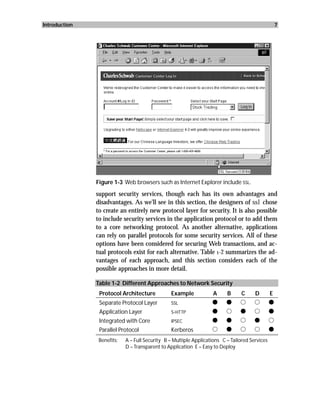
Internet’s protocol architecture. The left side of figure 1-4 shows the
key protocols for Web communications. At the bottom is the Inter-
net Protocol (ip). This protocol is responsible for routing messages
across networks from their source to their destination. The Transmis-
sion Control Protocol (tcp) builds on the services of ip to ensure
that the communication is reliable. At the top is the Hypertext
Transfer Protocol; http understands the details of the interaction
between Web browsers and Web servers.
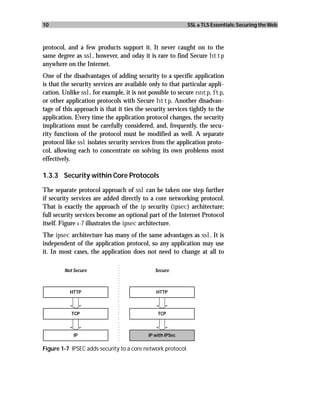
As the right side of the figure indicates, ssl adds security by acting as
a separate security protocol, inserting itself between the http appli-
cation and tcp. By acting as a new protocol, ssl requires very few
changes in the protocols above and below. The http application in-
terfaces with ssl nearly the same way it would with tcp in the ab-
sence of security. And, as far as tcp is concerned, ssl is just another
application using its services.
In addition to requiring minimal changes to existing implementa-
tions, this approach has another significant benefit: It allows ssl to
support applications other than http. The main motivation behind
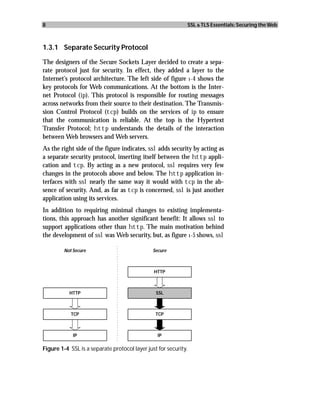
the development of ssl was Web security, but, as figure 1-5 shows, ssl

         Not Secure                            Secure


                                               HTTP


           HTTP                                 SSL


            TCP                                 TCP


             IP                                  IP

Figure 1-4 SSL is a separate protocol layer just for security.
Introduction                                                                           9


                HTTP     NNTP       FTP


                          SSL


                          TCP


                           IP

               Figure 1-5 SSL can add security to applications other than HTTP.

               is also used to add security to other Internet applications, including
               those of the Net News Transfer Protocol (nntp) and the File Trans-
               fer Protocol (ftp).

               1.3.2 Application-Specific Security

               Although the designers of ssl chose a different strategy, it is also
               possible to add security services directly in an application protocol.
               Indeed, standard http does include some extremely rudimentary se-
               curity features; however, those security features don’t provide ade-
               quate protection for real electronic commerce. At about the same
               time Netscape was designing ssl, another group of protocol design-
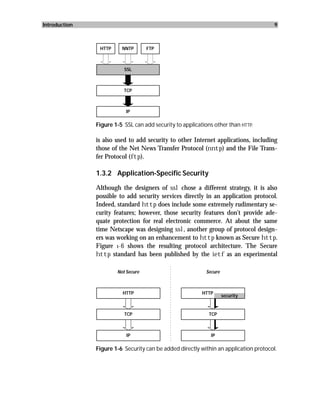
               ers was working on an enhancement to http known as Secure http.
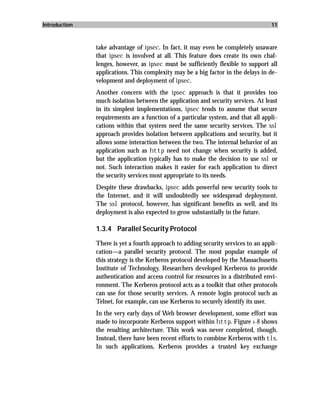
               Figure 1-6 shows the resulting protocol architecture. The Secure
               http standard has been published by the ietf as an experimental

                       Not Secure                          Secure


                         HTTP                             HTTP
                                                                    security


                          TCP                                TCP


                           IP                                IP

               Figure 1-6 Security can be added directly within an application protocol.
10                                                           SSL & TLS Essentials: Securing the Web


protocol, and a few products support it. It never caught on to the
same degree as ssl, however, and oday it is rare to find Secure http
anywhere on the Internet.
One of the disadvantages of adding security to a specific application
is that the security services are available only to that particular appli-
cation. Unlike ssl, for example, it is not possible to secure nntp, ftp,
or other application protocols with Secure http. Another disadvan-
tage of this approach is that it ties the security services tightly to the
application. Every time the application protocol changes, the security
implications must be carefully considered, and, frequently, the secu-
rity functions of the protocol must be modified as well. A separate
protocol like ssl isolates security services from the application proto-
col, allowing each to concentrate on solving its own problems most
effectively.

1.3.3 Security within Core Protocols

The separate protocol approach of ssl can be taken one step further
if security services are added directly to a core networking protocol.
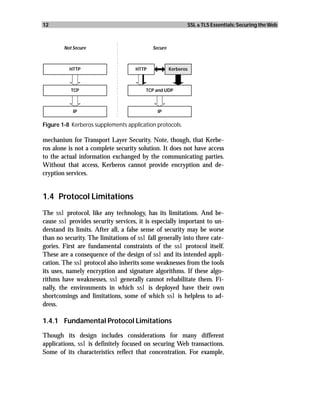
That is exactly the approach of the ip security (ipsec) architecture;
full security services become an optional part of the Internet Protocol
itself. Figure 1-7 illustrates the ipsec architecture.
The ipsec architecture has many of the same advantages as ssl. It is
independent of the application protocol, so any application may use
it. In most cases, the application does not need to change at all to

        Not Secure                            Secure


           HTTP                               HTTP


           TCP                                 TCP


            IP                             IP with IPSec

Figure 1-7 IPSEC adds security to a core network protocol.
Introduction                                                                       11


               take advantage of ipsec. In fact, it may even be completely unaware
               that ipsec is involved at all. This feature does create its own chal-
               lenges, however, as ipsec must be sufficiently flexible to support all
               applications. This complexity may be a big factor in the delays in de-
               velopment and deployment of ipsec.
               Another concern with the ipsec approach is that it provides too
               much isolation between the application and security services. At least
               in its simplest implementations, ipsec tends to assume that secure
               requirements are a function of a particular system, and that all appli-
               cations within that system need the same security services. The ssl
               approach provides isolation between applications and security, but it
               allows some interaction between the two. The internal behavior of an
               application such as http need not change when security is added,
               but the application typically has to make the decision to use ssl or
               not. Such interaction makes it easier for each application to direct
               the security services most appropriate to its needs.
               Despite these drawbacks, ipsec adds powerful new security tools to
               the Internet, and it will undoubtedly see widespread deployment.
               The ssl protocol, however, has significant benefits as well, and its
               deployment is also expected to grow substantially in the future.

               1.3.4 Parallel Security Protocol

               There is yet a fourth approach to adding security services to an appli-
               cation—a parallel security protocol. The most popular example of
               this strategy is the Kerberos protocol developed by the Massachusetts
               Institute of Technology. Researchers developed Kerberos to provide
               authentication and access control for resources in a distributed envi-
               ronment. The Kerberos protocol acts as a toolkit that other protocols
               can use for those security services. A remote login protocol such as
               Telnet, for example, can use Kerberos to securely identify its user.
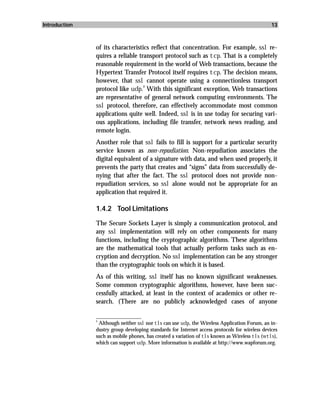
               In the very early days of Web browser development, some effort was
               made to incorporate Kerberos support within http. Figure 1-8 shows
               the resulting architecture. This work was never completed, though.
               Instead, there have been recent efforts to combine Kerberos with tls.
               In such applications, Kerberos provides a trusted key exchange
12                                                         SSL & TLS Essentials: Securing the Web


        Not Secure                         Secure


          HTTP                      HTTP            Kerberos


           TCP                          TCP and UDP


            IP                               IP

Figure 1-8 Kerberos supplements application protocols.

mechanism for Transport Layer Security. Note, though, that Kerbe-
ros alone is not a complete security solution. It does not have access
to the actual information exchanged by the communicating parties.
Without that access, Kerberos cannot provide encryption and de-
cryption services.


1.4 Protocol Limitations
The ssl protocol, like any technology, has its limitations. And be-
cause ssl provides security services, it is especially important to un-
derstand its limits. After all, a false sense of security may be worse
than no security. The limitations of ssl fall generally into three cate-
gories. First are fundamental constraints of the ssl protocol itself.
These are a consequence of the design of ssl and its intended appli-
cation. The ssl protocol also inherits some weaknesses from the tools
its uses, namely encryption and signature algorithms. If these algo-
rithms have weaknesses, ssl generally cannot rehabilitate them. Fi-
nally, the environments in which ssl is deployed have their own
shortcomings and limitations, some of which ssl is helpless to ad-
dress.

1.4.1 Fundamental Protocol Limitations

Though its design includes considerations for many different
applications, ssl is definitely focused on securing Web transactions.
Some of its characteristics reflect that concentration. For example,
Introduction                                                                                    13


               of its characteristics reflect that concentration. For example, ssl re-
               quires a reliable transport protocol such as tcp. That is a completely
               reasonable requirement in the world of Web transactions, because the
               Hypertext Transfer Protocol itself requires tcp. The decision means,
               however, that ssl cannot operate using a connectionless transport
                                   2
               protocol like udp. With this significant exception, Web transactions
               are representative of general network computing environments. The
               ssl protocol, therefore, can effectively accommodate most common
               applications quite well. Indeed, ssl is in use today for securing vari-
               ous applications, including file transfer, network news reading, and
               remote login.
               Another role that ssl fails to fill is support for a particular security
               service known as non-repudiation. Non-repudiation associates the
               digital equivalent of a signature with data, and when used properly, it
               prevents the party that creates and “signs” data from successfully de-
               nying that after the fact. The ssl protocol does not provide non-
               repudiation services, so ssl alone would not be appropriate for an
               application that required it.

               1.4.2 Tool Limitations

               The Secure Sockets Layer is simply a communication protocol, and
               any ssl implementation will rely on other components for many
               functions, including the cryptographic algorithms. These algorithms
               are the mathematical tools that actually perform tasks such as en-
               cryption and decryption. No ssl implementation can be any stronger
               than the cryptographic tools on which it is based.
               As of this writing, ssl itself has no known significant weaknesses.
               Some common cryptographic algorithms, however, have been suc-
               cessfully attacked, at least in the context of academics or other re-
               search. (There are no publicly acknowledged cases of anyone

               _________________
               2
                 Although neither ssl nor tls can use udp, the Wireless Application Forum, an in-
               dustry group developing standards for Internet access protocols for wireless devices
               such as mobile phones, has created a variation of tls known as Wireless tls (wtls),
               which can support udp. More information is available at http://www.wapforum.org.
14                                                                 SSL & TLS Essentials: Securing the Web


exploiting these theoretical weaknesses in a commercial context.)
Appendix b describes the publicly reported attacks in more detail,
but, in general, ssl implementations must consider not only the secu-
rity of ssl, but also that of the cryptographic services on which it is
built.

1.4.3 Environmental Limitations

A network protocol alone can only provide security for information
as it transits a network. No network protocol protects data before it is
sent or after it arrives at its destination. This is the only known
weakness in Web security that has been successfully exploited in an
actual commercial setting. Unfortunately, it has been exploited more
            3
than once.
Security in any computer network, whether the public Internet or
private facilities, is a function of all the elements that make up that
network. It depends on the network security protocols, the computer
systems that use those protocols, and the human beings who use
those computers. No network security protocol can protect against
the confidential printout carelessly left on a cafeteria table.
The Secure Sockets Layer protocol is a strong and effective security
tool, but it is only a single tool. True security requires many such
tools, and a comprehensive plan to employ them.


1.5 Organization of This Book
Four more chapters and two appendices make up the rest of this
book. Chapter 2 looks at some of the essential principles of cryptog-
raphy and cryptographic algorithms. Although, strictly speaking,
these algorithms are not part of the ssl protocol, a good bit of the
protocol’s design depends on general cryptographic principles. With-
out getting too deep into the mathematics of cryptography, chapter 2
_________________
3
  See, for example, the 8 November 1996 edition of The Wall Street Journal (page b6)
or the 11 July 1997 issue of The San Francisco Chronicle (page c3).
Introduction                                                                       15


               examines those essential principles. Chapter 3 begins the examination
               of ssl in earnest. It describes the ssl protocol in operation. It dis-
               cusses the contents of ssl messages, but only in general terms. The
               chapter explains what ssl does without getting bogged down in the
               details of how it does it. Chapter 4, on the other hand, focuses exclu-
               sively on those details. It documents the format of all ssl messages,
               as well as the cryptographic calculations ssl uses to construct them.
               Chapter 5 provides additional details about ssl. It describes how the
               current version of ssl operates with previous ssl versions, and how
               Netscape and Microsoft have each augmented ssl with techniques
               that promote strong encryption worldwide, while adhering to United
               States export restrictions. This chapter also provides complete cover-
               age of Transport Layer Security, detailing all the differences between
               tls and ssl.
               Appendix a provides additional details on public key certificates.
               These certificates, which conform to the x.509 standard, are critical
               to the operation of ssl, even though they are not part of the protocol
               itself. The appendix includes a brief introduction to Abstract Syntax
               Notation One, the language that the x.509 standard uses to docu-
               ment certificates. Appendix b presents a security checklist for ssl. It
               includes a list of good practices for the development of ssl imple-
               mentations, and defenses against all known attacks against ssl-
               secured systems.
2
                        Basic Cryptography


The Web may be a relatively new way to communicate, but securing
the Web relies on the same principles that have secured other com-
munications media for thousands of years. In fact, the digital nature
of the Web actually makes it easier to apply these techniques. In ad-
dition, systems on the Web can take advantage of new and powerful
security technology. This chapter takes a brief look at the important
principles that govern communications security.
The scientific discipline that studies communications security is cryp-
tography, and several concepts from modern cryptography are indis-
pensable to the Secure Sockets Layer protocol. The first of the
following three sections describes the uses of cryptography. The next
section looks in more detail at two particular types of cryptography—
secret key cryptography and public key cryptography. As the names
imply, keys are an important part of both types, and this chapter con-
cludes by discussing the management of these keys. Key manage-
ment plays a critical role in the operation of ssl.
As the following text implies, cryptography relies heavily on a
mathematical foundation. But understanding the mathematics of
cryptography is not essential for understanding ssl. For that reason,
this chapter contains very little mathematics. Readers who are inter-
ested in a more thorough understanding of cryptography are invited
to consult the texts described in the References section of this book.


                                                                    17
18                                                             SSL & TLS Essentials: Securing the Web


2.1 Using Cryptography
The word cryptography is derived from the Greek for “secret writ-
ing.” The task of keeping information secret is probably the one most
often associated with cryptography. Indeed, protecting secret infor-
mation is an important mission for cryptographers, but, as this sec-
tion shows, cryptography has other uses as well. Two that are
particularly important to ssl are proving identity and verifying
information. Table 2-1 summarizes the main topics of this section.

Table 2-1 Important Uses of Cryptography
 Use                          Service             Protects Against
 Keeping secrets              Confidentiality     Eavesdropping
 Proving identity             Authentication      Forgery and masquerade
 Verifying information        Message integrity   Alteration


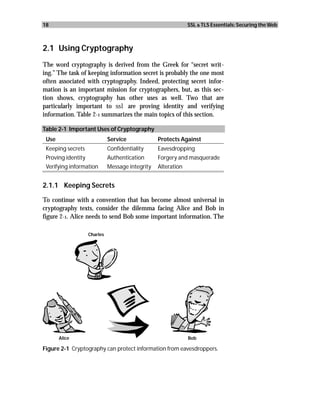
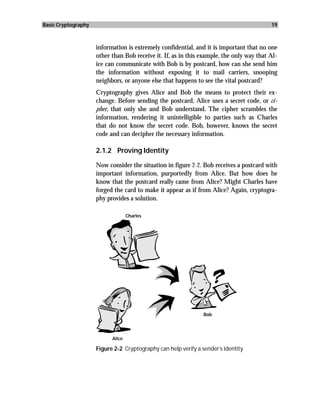
2.1.1 Keeping Secrets

To continue with a convention that has become almost universal in
cryptography texts, consider the dilemma facing Alice and Bob in
figure 2-1. Alice needs to send Bob some important information. The

                    Charles


       Alice                                                   Bob

Figure 2-1 Cryptography can protect information from eavesdroppers.
Basic Cryptography                                                                        19


                     information is extremely confidential, and it is important that no one
                     other than Bob receive it. If, as in this example, the only way that Al-
                     ice can communicate with Bob is by postcard, how can she send him
                     the information without exposing it to mail carriers, snooping
                     neighbors, or anyone else that happens to see the vital postcard?
                     Cryptography gives Alice and Bob the means to protect their ex-
                     change. Before sending the postcard, Alice uses a secret code, or ci-
                     pher, that only she and Bob understand. The cipher scrambles the
                     information, rendering it unintelligible to parties such as Charles
                     that do not know the secret code. Bob, however, knows the secret
                     code and can decipher the necessary information.

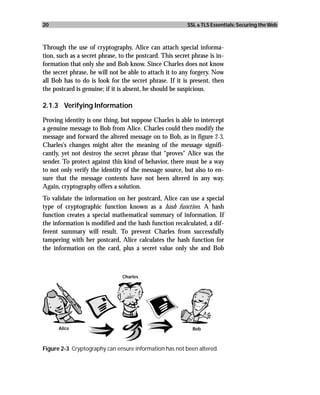
                     2.1.2 Proving Identity

                     Now consider the situation in figure 2-2. Bob receives a postcard with
                     important information, purportedly from Alice. But how does he
                     know that the postcard really came from Alice? Might Charles have
                     forged the card to make it appear as if from Alice? Again, cryptogra-
                     phy provides a solution.

                                   Charles


                                                                Bob


                           Alice

                     Figure 2-2 Cryptography can help verify a sender’s identity.
20                                                        SSL & TLS Essentials: Securing the Web


Through the use of cryptography, Alice can attach special informa-
tion, such as a secret phrase, to the postcard. This secret phrase is in-
formation that only she and Bob know. Since Charles does not know
the secret phrase, he will not be able to attach it to any forgery. Now
all Bob has to do is look for the secret phrase. If it is present, then
the postcard is genuine; if it is absent, he should be suspicious.

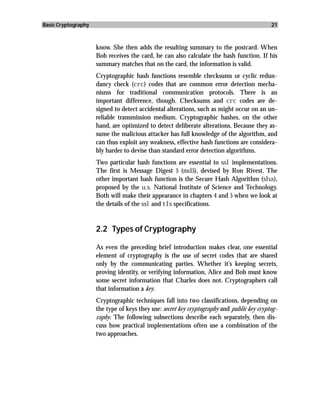
2.1.3 Verifying Information

Proving identity is one thing, but suppose Charles is able to intercept
a genuine message to Bob from Alice. Charles could then modify the
message and forward the altered message on to Bob, as in figure 2-3.
Charles’s changes might alter the meaning of the message signifi-
cantly, yet not destroy the secret phrase that “proves” Alice was the
sender. To protect against this kind of behavior, there must be a way
to not only verify the identity of the message source, but also to en-
sure that the message contents have not been altered in any way.
Again, cryptography offers a solution.
To validate the information on her postcard, Alice can use a special
type of cryptographic function known as a hash function. A hash
function creates a special mathematical summary of information. If
the information is modified and the hash function recalculated, a dif-
ferent summary will result. To prevent Charles from successfully
tampering with her postcard, Alice calculates the hash function for
the information on the card, plus a secret value only she and Bob


                                Charles


      Alice                                                 Bob


Figure 2-3 Cryptography can ensure information has not been altered.
Basic Cryptography                                                                          21


                     know. She then adds the resulting summary to the postcard. When
                     Bob receives the card, he can also calculate the hash function. If his
                     summary matches that on the card, the information is valid.
                     Cryptographic hash functions resemble checksums or cyclic redun-
                     dancy check (crc) codes that are common error detection mecha-
                     nisms for traditional communication protocols. There is an
                     important difference, though. Checksums and crc codes are de-
                     signed to detect accidental alterations, such as might occur on an un-
                     reliable transmission medium. Cryptographic hashes, on the other
                     hand, are optimized to detect deliberate alterations. Because they as-
                     sume the malicious attacker has full knowledge of the algorithm, and
                     can thus exploit any weakness, effective hash functions are considera-
                     bly harder to devise than standard error detection algorithms.
                     Two particular hash functions are essential to ssl implementations.
                     The first is Message Digest 5 (md5), devised by Ron Rivest. The
                     other important hash function is the Secure Hash Algorithm (sha),
                     proposed by the u.s. National Institute of Science and Technology.
                     Both will make their appearance in chapters 4 and 5 when we look at
                     the details of the ssl and tls specifications.


                     2.2 Types of Cryptography

                     As even the preceding brief introduction makes clear, one essential
                     element of cryptography is the use of secret codes that are shared
                     only by the communicating parties. Whether it’s keeping secrets,
                     proving identity, or verifying information, Alice and Bob must know
                     some secret information that Charles does not. Cryptographers call
                     that information a key.
                     Cryptographic techniques fall into two classifications, depending on
                     the type of keys they use: secret key cryptography and public key cryptog-
                     raphy. The following subsections describe each separately, then dis-
                     cuss how practical implementations often use a combination of the
                     two approaches.
22                                                         SSL & TLS Essentials: Securing the Web


2.2.1 Secret Key Cryptography

With secret key cryptography, both parties know the same informa-
tion—the key—and both endeavor to keep that key secret from eve-
ryone else. This is how most people think of cryptography in general,
and, for nearly all of the several-thousand-year history of secret
codes, it was the only form of cryptography known. The critical as-
pect of secret key cryptography is that both parties know the same
secret information. For this reason, it has the technical name symmet-
ric encryption.
Encryption algorithms, or ciphers, based on secret key techniques are
usually just mathematical transformations on the data to be en-
crypted, combined with the secret key itself. The approach resembles
a carnival shell game, with the secret key serving as the initial loca-
tion of the pea. Bits are swapped around and combined with each
other in very complicated ways, and yet the various transformations
can readily be undone, provided one knows the key. As a hint of the
complexities involved, Figure 2-4 illustrates one of the more common
encryption algorithms. The figure also introduces two common cryp-
tographic terms—plaintext, information before encryption, and ci-
phertext, information in its encrypted form. Plaintext is vulnerable to
attackers; ciphertext, at least in theory, is not.
An important quality that determines the effectiveness of a cipher is
the size of the secret key. The larger the key, the more difficult it is to
break the code. To understand why this is the case, consider an algo-
rithm with an extremely small key size: 2 bits. In this example, the
algorithm itself really wouldn’t matter. After all, with 2 bits there are
only four possible keys. An attacker who obtained encrypted data
could simply try all four possibilities.
Cryptographers also characterize symmetric encryption algorithms
according to how they process input data. Ciphers may be either
stream ciphers or block ciphers. Stream ciphers process input data a byte
at a time, and can accept any size of input for encryption. Block ci-
phers, in contrast, operate only on fixed-sized blocks of data—
typically 8 bytes in size. Block ciphers are require less computation
resources, and they are generally slightly less vulnerable to attack
Basic Cryptography                                                                                    23


                                                                                            Data to
                                               plaintext
                                                                                            Protect

                                        initial permutation


                               L0                                    R0
                                                                                     K1

                                +                  f


                             L1 = R0                         R1 = L0 + f(R0,K1)
                                                                                     K2

                                +                  f


                             L2 = R1                         R2 = L1 + f(R1,K2)            Secret
                                                                                           Key

                               [repeated 12 more times]

                                                                                     K15

                                +                  f


                            L15 = R14                       R15 = L14 + f(R14,K15)
                                                                                     K16

                                +                  f


                      R16 = L15 + f(R15,K16)                      L15 = R15


                                        inverse permutation

                                                                                            Hidden
                                               ciphertext
                                                                                            Data

                     Figure 2-4 The DES cipher hides data by scrambling it with a secret key.

                     (and, thus, are by far the more common type). They are, however,
                     slightly less convenient to use. The input data itself is the source of
                     the inconvenience; it is rarely the same size as the cipher’s block. En-
                     crypting data using a block cipher requires breaking the data into
                     blocks, and, if the last block doesn’t contain exactly the right amount
                     of data, adding dummy data, known as padding, to fill it out.
                     Block ciphers also usually require an initialization vector of dummy
                     data to begin the encryption process. The initialization vector primes
24                                                      SSL & TLS Essentials: Securing the Web


the algorithm with irrelevant information, enabling the cipher to
build up to full strength before the actual plaintext appears.
Table 2-2 lists the symmetric ciphers most commonly used with the
Secure Sockets Layer protocol.

Table 2-2 Symmetric Encryption Algorithms
 Abbreviation   Algorithm                                  Type
 DES            Data Encryption Standard                   Block
 3DES           Triple-Strength Data Encryption Standard   Block
 RC2            Rivest Cipher 2                            Block
 RC4            Rivest Cipher 4                            Stream


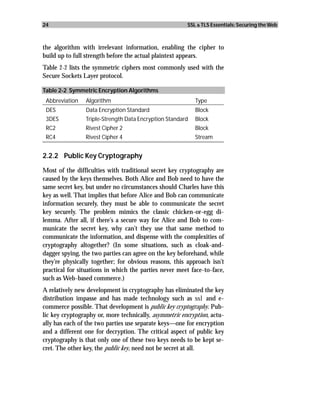
2.2.2 Public Key Cryptography

Most of the difficulties with traditional secret key cryptography are
caused by the keys themselves. Both Alice and Bob need to have the
same secret key, but under no circumstances should Charles have this
key as well. That implies that before Alice and Bob can communicate
information securely, they must be able to communicate the secret
key securely. The problem mimics the classic chicken-or-egg di-
lemma. After all, if there’s a secure way for Alice and Bob to com-
municate the secret key, why can’t they use that same method to
communicate the information, and dispense with the complexities of
cryptography altogether? (In some situations, such as cloak-and-
dagger spying, the two parties can agree on the key beforehand, while
they’re physically together; for obvious reasons, this approach isn’t
practical for situations in which the parties never meet face-to-face,
such as Web-based commerce.)
A relatively new development in cryptography has eliminated the key
distribution impasse and has made technology such as ssl and e-
commerce possible. That development is public key cryptography. Pub-
lic key cryptography or, more technically, asymmetric encryption, actu-
ally has each of the two parties use separate keys—one for encryption
and a different one for decryption. The critical aspect of public key
cryptography is that only one of these two keys needs to be kept se-
cret. The other key, the public key, need not be secret at all.
Basic Cryptography                                                                              25


                     Although it seems a bit like magic, this has a solid mathematical ba-
                     sis. Fundamentally, asymmetric encryption is based on mathematical
                     problems that are mush easier to generate than they are to solve. As
                     an example, anyone with a pocket calculator can compute the prod-
                     uct of 113 and 293 and get the correct answer of 33 109. It is much
                     more difficult, however, to use the same pocket calculator to work a
                     similar problem in reverse. Which two whole numbers, when multi-
                                                              1
                     plied together, yield the product 29 213?
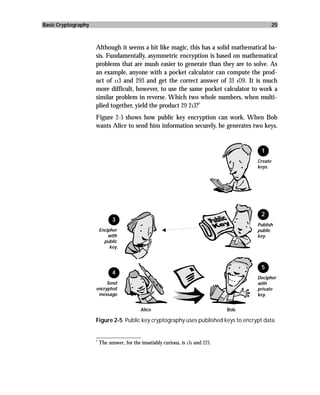
                     Figure 2-5 shows how public key encryption can work. When Bob
                     wants Alice to send him information securely, he generates two keys.


                                                                                        1
                                                                                       Create
                                                                                       keys.


                                                                                        2
                             3
                                                                                       Publish
                      Encipher                                                         public
                          with                                                         key.
                        public
                           key.


                                                                                        5
                             4
                                                                                       Decipher
                          Send                                                         with
                     encrypted                                                         private
                      message.                                                         key.


                                           Alice                                 Bob

                     Figure 2-5 Public key cryptography uses published keys to encrypt data.

                     _________________
                     1
                       The answer, for the insatiably curious, is 131 and 223.
26                                                         SSL & TLS Essentials: Securing the Web


One is the private key, which Bob keeps completely to himself. Con-
versely, Bob advertises the public key, conceptually even by publishing
it in a newspaper. Alice reads the newspaper to find out the public
key, then uses it to encrypt the information. When Bob receives Al-
ice’s postcard, his private key enables him to decipher the message.
Since only Bob has his private key, only Bob can successfully decrypt
the information. Even Alice would be unable to do so.
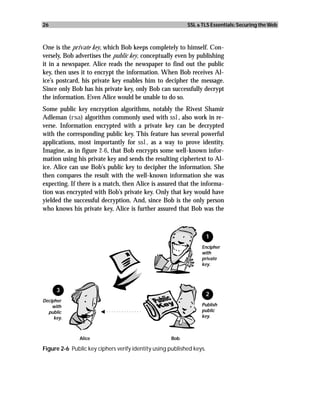
Some public key encryption algorithms, notably the Rivest Shamir
Adleman (rsa) algorithm commonly used with ssl, also work in re-
verse. Information encrypted with a private key can be decrypted
with the corresponding public key. This feature has several powerful
applications, most importantly for ssl, as a way to prove identity.
Imagine, as in figure 2-6, that Bob encrypts some well-known infor-
mation using his private key and sends the resulting ciphertext to Al-
ice. Alice can use Bob’s public key to decipher the information. She
then compares the result with the well-known information she was
expecting. If there is a match, then Alice is assured that the informa-
tion was encrypted with Bob’s private key. Only that key would have
yielded the successful decryption. And, since Bob is the only person
who knows his private key, Alice is further assured that Bob was the


                                                                      1
                                                                 Encipher
                                                                 with
                                                                 private
                                                                 key.


      3
                                                                      2
Decipher
    with                                                         Publish
  public                                                         public
     key.                                                        key.


               Alice                                Bob

Figure 2-6 Public key ciphers verify identity using published keys.
Basic Cryptography                                                                        27


                     one who sent the information. Through this approach, Bob has
                     proven his identity to Alice.
                     Reversible public key algorithms such as rsa can also provide an-
                     other important service: the digital equivalent of a signature. Suppose
                     that Bob needs information from Alice. And further suppose that it
                     is important that Alice not be able to later deny sending him the in-
                     formation, either to Bob or to an independent third party (such as a
                     judge). In effect, Bob needs Alice to sign the information. To accom-
                     plish this, Alice can encrypt the information with her private key.
                     Since anyone can obtain her public key, anyone can decipher the in-
                     formation. Only Alice, however, knows her private key, so only Alice
                     could have encrypted the information in the first place.
                     Some public key algorithms can only be used for digital signatures;
                     they cannot provide encryption services. One such algorithm impor-
                     tant to ssl is the Digital Signature Algorithm (dsa).

                     2.2.3 Combining Secret and Public Key Cryptography

                     Public key encryption is a powerful tool, but in most practical im-
                     plementations it suffers from one serious disadvantage—the encryp-
                     tion operation is extremely complex. Complex mathematical
                     operations can place a strain on some systems, requiring more proc-
                     essing capacity than the systems would otherwise need. If there were
                     no alternatives, then most implementations requiring security might
                     accept the higher system cost; fortunately, there is a relatively simple
                     way to get the benefits of public key encryption while avoiding most
                     of the system performance costs. The optimum approach uses a
                     combination of secret key and public key cryptography.
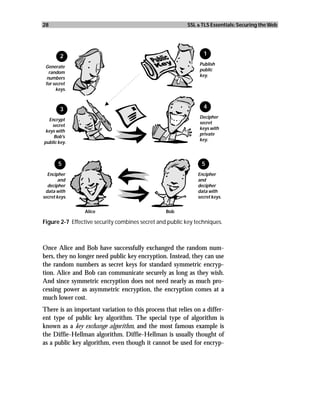
                     Figure 2-7 shows how this combination can work in practice. To be-
                     gin, Bob creates a public and private key, and then he publicizes the
                     public key. He does not share the private key with anyone. Alice, who
                     wishes to send confidential data to Bob, retrieves his public key. She
                     also generates a collection of random numbers. Once Alice has Bob’s
                     public key, she encrypts those random numbers and sends them to
                     Bob. Since only Bob has his private key, only Bob can decipher Al-
                     ice’s message and extract the random numbers.
28                                                        SSL & TLS Essentials: Securing the Web


        2                                                       1
                                                               Publish
 Generate
                                                               public
   random
                                                               key.
  numbers
 for secret
      keys.


        3                                                       4
                                                               Decipher
  Encrypt
                                                               secret
    secret
                                                               keys with
 keys with
                                                               private
     Bob's
                                                               key.
public key.


       5                                                        5
  Encipher                                                    Encipher
        and                                                   and
  decipher                                                    decipher
 data with                                                    data with
secret keys.                                                  secret keys.


                Alice                            Bob

Figure 2-7 Effective security combines secret and public key techniques.


Once Alice and Bob have successfully exchanged the random num-
bers, they no longer need public key encryption. Instead, they can use
the random numbers as secret keys for standard symmetric encryp-
tion. Alice and Bob can communicate securely as long as they wish.
And since symmetric encryption does not need nearly as much pro-
cessing power as asymmetric encryption, the encryption comes at a
much lower cost.
There is an important variation to this process that relies on a differ-
ent type of public key algorithm. The special type of algorithm is
known as a key exchange algorithm, and the most famous example is
the Diffie-Hellman algorithm. Diffie-Hellman is usually thought of
as a public key algorithm, even though it cannot be used for encryp-
Basic Cryptography                                                                           29


                     tion or for digital signatures. Rather, Diffie-Hellman allows two par-
                     ties to securely establish a secret number using only public messages.
                     Diffie-Hellman is an alternative to steps 1–4 of figure 2-7.
                     One final note on figure 2-7: As the next chapter details, this is actu-
                     ally a simplified view of basic ssl operation. Figure 3-1 shows a dif-
                     ferent version of the same process.


                     2.3 Key Management
                     Key management is a challenge to all forms of cryptography. Public
                     key cryptography improves the situation; at least the keys that the
                     parties exchange do not have to be kept secret from the rest of the
                     world. Still, the public key must be exchanged reliably.
                     In the previous examples, Alice has hypothetically retrieved Bob’s
                     public keys from the newspaper. Suppose, however, that the nefarious
                     Charles was able to print a phony newspaper (with a phony public
                     key for Bob) and sneak it into Alice’s driveway in the morning in
                     place of her real paper. How would Alice know of the fraud?
                     It is exactly this problem that has led to the creation of public key
                     certificates and certificate authorities. Although unnoticed by most
                     casual Internet users, these are critical to the Secure Sockets Layer
                     protocol and Web commerce.

                     2.3.1 Public Key Certificates

                     In many ways, public key certificates are the digital equivalent of a
                     driver’s license. Although certificates may belong to computer sys-
                     tems instead of individuals, they share three important characteristics
                     with driver’s licenses. First, they each identify their subjects by in-
                     cluding the subjects’ names. Second, they assert key information
                     about the subject. A driver’s license declares that the subject has cer-
                     tain privileges (i.e., driving a car), while a certificate affirms the sub-
                     ject’s public key (and perhaps other privileges). Finally, both a
                     certificate and a driver’s license are issued by a trusted organization,
                     either a governmental agency or a certificate authority.
30                                                           SSL & TLS Essentials: Securing the Web


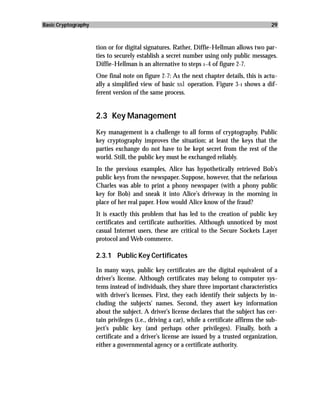
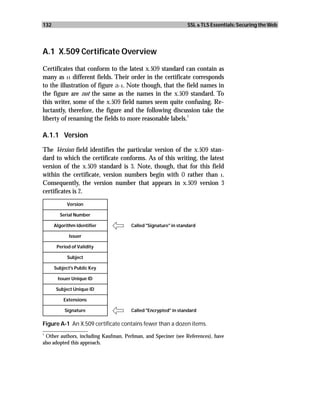
Figure 2-8 shows the contents of a typical public key certificate. Ap-
pendix a discusses this particular certificate format in detail, but only
a few of the fields are truly important. The first of those is the issuer
field, which identifies the organization that has issued the certificate.
This information is critical to a person or computer system that ex-
amines a certificate because it determines whether the certificate can
be trusted. The next important field is the period of validity. Like
driver’s licenses, certificates expire after a certain time. The next field
identifies the subject of the certificate, and it is followed by the sub-
ject’s public key.
The final field of the certificate is also important. That field is the is-
suer’s signature, which is a digital signature of the contents of the cer-
tificate. The issuer creates this signature by encrypting a hash of the
certificate with its private key. Any system that knows the issuer’s
public key can verify the signature and ensure the validity of the cer-
tificate. Since this field can be a bit confusing, it is worthwhile to
emphasize that the issuer creates the signature using its own private
key, while the certificate itself contains the subject’s public key.


           Version

       Serial Number

     Algorithm Identifier

            Issuer

      Period of Validity

           Subject

     Subject's Public Key

      Issuer Unique ID

      Subject Unique ID

         Extensions

          Signature

Figure 2-8 A public key certificate validates a subject’s public key.
Basic Cryptography                                                                             31


                     2.3.2 Certificate Authorities

                     The issuer of a public key certificate is traditionally known as a cer-
                     tificate authority (ca), and certificate authorities play a vital role in es-
                     tablishing trust among a community of users. As the previous
                     subsection indicates, the certificate authority digitally signs all cer-
                     tificates, attesting to the validity of the public keys they contain. If
                     users trust the certificate authority, they can trust any certificate that
                     ca issues.
                     In many cases, a certificate authority can be identified as either a pri-
                     vate or a public ca. Private authorities include organizations that is-
                     sue certificates strictly for their own users. A corporation, for
                     example, may issue public key certificates for its employees. (Actually,
                     they would issue the certificates for the employees’ computers.) The
                     company could then set up its internal network to require appro-
                     priate certificates before granting access to critical data. Although
                     systems within the company’s computer network could trust the
                     company’s certificates, outside systems, including, for example, public
                     Web servers, would be unlikely to do so. A private certificate author-
                     ity issues certificates for use on its own private networks.
                     But the Internet is a public network, and Web security generally re-
                     lies on public certificate authorities. A public certificate authority is-
                     sues certificates to the general public, and it can certify the identity
                     of both individuals and organizations. Public authorities act as the
                     digital equivalent of notary publics, certifying the identity of any
                     party that presents appropriate credentials. For a company that
                     wishes to establish a secure Web site, those credentials may include a
                     Dun & Bradstreet d-u-n-s number, a business license, articles of in-
                     corporation, or sec filings that establish the company’s corporate
                     identity.
                     Certificate authorities are themselves frequently identified by their
                     certificates, but their certificates differ from standard certificates in
                     one important respect: the subject and the issuer are one and the
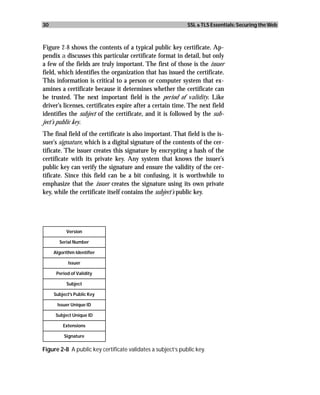
                     same. The certificate authority certifies its own identity. Figure 2-9
                     highlights the fact that the public key in a ca certificate is also the
                     public key that verifies the certificate’s signature. This is a critical
32                                                         SSL & TLS Essentials: Securing the Web


           Version

       Serial Number

     Algorithm Identifier

            Issuer
                                    Issuer and
      Period of Validity            Subject are
                                    the same.
           Subject

     Subject's Public Key

      Issuer Unique ID              Subject's
                                    Public Key
      Subject Unique ID             verifies the
                                    certificate's
         Extensions                 Signature.

          Signature

Figure 2-9 CA certificates have the same issuer and subject.

distinction from normal certificates. Any party that receives a normal
certificate can check the certificate’s signature to decide whether to
trust the public key in that certificate. As long as the certificate’s sig-
nature is valid and the issuer is trustworthy, then the receiving party
can safely trust the public key. With a ca certificate, on the other
hand, verifying the certificate’s signature does not help to establish
trust. Any party that could forge a ca certificate would know the
forged private key, and could thus easily generate the matching cer-
tificate signature. The validity of ca certificates must be established
by other methods.
In the case of Web commerce security, the validity of certificate au-
thorities depends largely on the browser manufacturers. Both Micro-
soft’s Internet Explorer and Netscape’s Navigator by default
recognize the certificates from important public certificate authori-
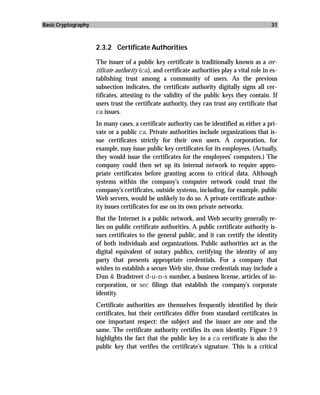
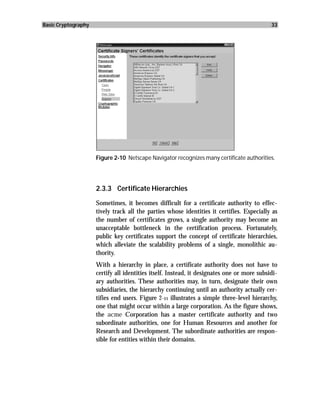
ties. Figure 2-10 shows some of the certificate authorities Netscape
recognizes. (The full list, as of this writing, includes more than 50 au-
thorities.) Although both Netscape and Microsoft allow users to in-
stall additional certificate authorities into their browsers, most secure
Web sites elect to use a certificate that doesn’t require this extra ef-
fort from their users.
Basic Cryptography                                                                          33


                     Figure 2-10 Netscape Navigator recognizes many certificate authorities.


                     2.3.3 Certificate Hierarchies

                     Sometimes, it becomes difficult for a certificate authority to effec-
                     tively track all the parties whose identities it certifies. Especially as
                     the number of certificates grows, a single authority may become an
                     unacceptable bottleneck in the certification process. Fortunately,
                     public key certificates support the concept of certificate hierarchies,
                     which alleviate the scalability problems of a single, monolithic au-
                     thority.
                     With a hierarchy in place, a certificate authority does not have to
                     certify all identities itself. Instead, it designates one or more subsidi-
                     ary authorities. These authorities may, in turn, designate their own
                     subsidiaries, the hierarchy continuing until an authority actually cer-
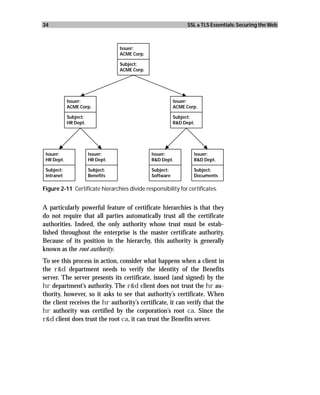
                     tifies end users. Figure 2-11 illustrates a simple three-level hierarchy,
                     one that might occur within a large corporation. As the figure shows,
                     the acme Corporation has a master certificate authority and two
                     subordinate authorities, one for Human Resources and another for
                     Research and Development. The subordinate authorities are respon-
                     sible for entities within their domains.
34                                                              SSL & TLS Essentials: Securing the Web


                                  Issuer:
                                  ACME Corp.

                                  Subject:
                                  ACME Corp.


            Issuer:                                       Issuer:
            ACME Corp.                                    ACME Corp.

            Subject:                                      Subject:
            HR Dept.                                      R&D Dept.


 Issuer:               Issuer:                 Issuer:            Issuer:
 HR Dept.              HR Dept.                R&D Dept.          R&D Dept.

 Subject:              Subject:                Subject:           Subject:
 Intranet              Benefits                Software           Documents

Figure 2-11 Certificate hierarchies divide responsibility for certificates.


A particularly powerful feature of certificate hierarchies is that they
do not require that all parties automatically trust all the certificate
authorities. Indeed, the only authority whose trust must be estab-
lished throughout the enterprise is the master certificate authority.
Because of its position in the hierarchy, this authority is generally
known as the root authority.
To see this process in action, consider what happens when a client in
the r&d department needs to verify the identity of the Benefits
server. The server presents its certificate, issued (and signed) by the
hr department’s authority. The r&d client does not trust the hr au-
thority, however, so it asks to see that authority’s certificate. When
the client receives the hr authority’s certificate, it can verify that the
hr authority was certified by the corporation’s root ca. Since the
r&d client does trust the root ca, it can trust the Benefits server.
Basic Cryptography                                                                            35


                     2.3.4 Certificate Revocation Lists

                     Before leaving the subject of public key certificates, there is one loose
                     end to tie up. So far, we’ve seen how certificate authorities issue cer-
                     tificates, but what about the reverse process? What happens if a ca
                     issues a certificate by mistake and wants to correct itself? Or what if a
                     subject accidentally reveals its private key, so its certified public key is
                     no longer safe to use? To solve these types of problems, certificate au-
                     thorities use certificate revocation lists. A certificate revocation list,
                     or crl for short, is a list of certificates that the authority has previ-
                     ously issued, but no longer considers valid. The certificates them-
                     selves still appear legitimate; their signatures are correct, and their
                     validity periods are appropriate. Nonetheless, the ca needs to indi-
                     cate that they can no longer be trusted. The authority cannot change
                     the certificates since they’ve already been issued, so the best it can do
                     is maintain a list of these revoked certificates. It is the responsibility
                     of any party that trusts another’s certificate to check with the certifi-
                     cate authority to make sure the certificate has not been revoked. This
                     function is not the responsibility of the ssl protocol, so we won’t dis-
                     cuss it in any depth. It is noteworthy to consider, though, that the
                     current Web commerce infrastructure does not have an effective (and
                     widely supported) means for systems to check a certificate against a
                     crl. For that reason, there is no practical way to revoke a traditional
                     Web commerce certificate.
3
                                     SSL Operation


With an understanding of some of the key concepts of cryptography,
we can now look closely at the operation of the Secure Sockets Layer
(ssl) protocol. Although ssl is not an extremely complicated proto-
col, it does offer several options and variations. This chapter explains
ssl by starting with the simplest case: establishing an encrypted
communications channel. It then considers successively more com-
plex options, including authenticating the communicating parties,
separating encryption from authentication, and resuming a previously
established session. Within these sections, you will discover the full
power of ssl.
The ssl protocol consists of a set of messages and rules about when
to send (and not to send) each one. In this chapter, we consider what
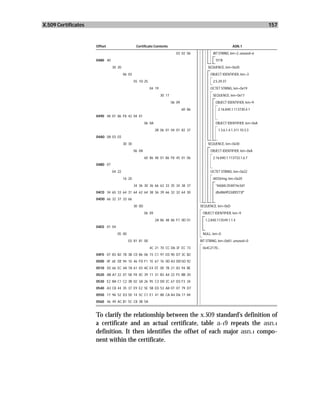
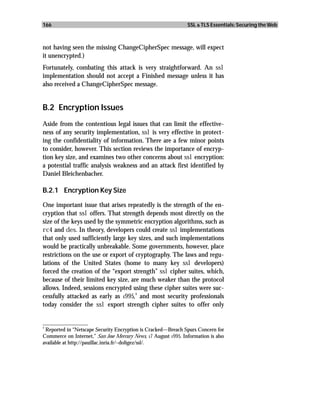
those messages are, the general information they contain, and how
systems use the different messages in a communications session. We
do not, however, explore the detailed message formats: the bits and
bytes that make up ssl messages as they transit across a network.
That detail is the subject of chapter 4. Neither do we spend time here
on the detailed cryptographic computations ssl requires; those, too,
are a topic for the next chapter. This chapter concentrates on the big
picture. The details will be much easier to understand once you have
an appreciation of the overall operation of the Secure Sockets Layer.


3.1 SSL Roles
The Secure Sockets Layer protocol defines two different roles for the
communicating parties. One system is always a client, while the other


                                                                     37
38                                                           SSL & TLS Essentials: Securing the Web


is a server. The distinction is very important, because ssl requires the
two systems to behave very differently. The client is the system that
initiates the secure communications; the server responds to the cli-
ent’s request. In the most common use of ssl, secure Web browsing,
the Web browser is the ssl client and the Web site is the ssl server.
These same two roles apply to all applications that use ssl, and the
examples in this chapter (indeed, throughout the book) will clearly
distinguish them.
For ssl itself, the most important distinctions between clients and
servers are their actions during the negotiation of security parame-
ters. Since the client initiates a communication, it has the
responsibility of proposing a set of ssl options to use for the
exchange. The server selects from the client’s proposed options,
deciding what the two systems will actually use. Although the final
decision rests with the server, the server can only choose from among
those options that the client originally proposed.


3.2 SSL Messages
When ssl clients and servers communicate, they do so by exchang-
ing ssl messages. Technically, ssl defines different levels of messages,
but that topic is best left for Chapter 4. Since this chapter concen-
trates strictly on functionality, distinguishing between the various ssl
levels is not critical. Table 3-1 lists the ssl messages at all levels of the
protocol, in alphabetical order. The remaining sections in this chapter
show how systems use these messages in their communications.

Table 3-1 SSL Messages
 Message                 Description
 Alert                   Informs the other party of a possible security
                         breach or communication failure.
 ApplicationData         Actual information that the two parties ex-
                         change, which is encrypted, authenticated,
                         and/or verified by SSL.
 Certificate             A message that carries the sender’s public key
                         certificate.
SSL Operation                                                                                39


                 Message              Description
                 CertificateRequest   A request by the server that the client provide
                                      its public key certificate.
                 CertificateVerify    A message from the client that verifies that it
                                      knows the private key corresponding to its pub-
                                      lic key certificate.
                 ChangeCipherSpec     An indication to begin using agreed-upon secu-
                                      rity services (such as encryption).
                 ClientHello          A message from the client indicating the secu-
                                      rity services it desires and is capable of support-
                                      ing.
                 ClientKeyExchange    A message from the client carrying crypto-
                                      graphic keys for the communications.
                 Finished             An indication that all initial negotiations are
                                      complete and secure communications have
                                      been established.
                 HelloRequest         A request by the server that the client start (or
                                      restart) the SSL negotiation process.
                 ServerHello          A message from the server indicating the secu-
                                      rity services that will be used for the communi-
                                      cations.
                 ServerHelloDone      An indication from the server that it has com-
                                      pleted all its requests of the client for establish-
                                      ing communications.
                 ServerKeyExchange    A message from the server carrying crypto-
                                      graphic keys for the communications.


                3.3 Establishing Encrypted Communications
                The most basic function that an ssl client and server can perform is
                establishing a channel for encrypted communications. Figure 3-1
                shows the ssl message exchange this operation requires, and table 3-2
                summarizes the steps in the figure. This section looks at these steps
                in more detail by considering each message in the exchange.
40                                                           SSL & TLS Essentials: Securing the Web


         Client                                                      Server

           1      ClientHello

                                                       ServerHello    2

                                               ServerKeyExchange      3

                                                  ServerHelloDone     4

           5      ClientKeyExchange

           6      ChangeCipherSpec

           7      Finished

                                                ChangeCipherSpec      8

                                                          Finished    9

Figure 3-1 SSL uses 9 messages to establish encrypted communications.


Table 3-2 Negotiation of Encrypted Communications
 Step      Action
     1     Client sends ClientHello message proposing SSL options.
     2     Server responds with ServerHello message selecting the SSL
           options.
     3     Server sends its public key information in ServerKeyExchange
           message.
     4     Server concludes its part of the negotiation with ServerHello-
           Done message.
     5     Client sends session key information (encrypted with server’s
           public key) in ClientKeyExchange message.
     6     Client sends ChangeCipherSpec message to activate the nego-
           tiated options for all future messages it will send.
SSL Operation                                                                                    41


                    Step      Action
                      7       Client sends Finished message to let the server check the newly
                              activated options.
                      8       Server sends ChangeCipherSpec message to activate the nego-
                              tiated options for all future messages it will send.
                      9       Server sends Finished message to let the client check the newly
                              activated options.


                   3.3.1 ClientHello

                   The ClientHello message starts the ssl communication between the
                   two parties. The client uses this message to ask the server to begin
                   negotiating security services by using ssl. Table 3-3 lists the impor-
                   tant components of a ClientHello message.

                   Table 3-3 ClientHello Components
                    Field                     Use
                    Version                   Identifies the highest version of the SSL proto-
                                              col that the client can support.
                    RandomNumber              A 32-byte random number used to seed the
                                              cryptographic calculations.
                    SessionID                 Identifies a specific SSL session.
                    CipherSuites              A list of cryptographic parameters that the cli-
                                              ent can support.
                    CompressionMeth-          Identifies data compression methods that the
                    ods                       client can support.

                   The Version field of the ClientHello message contains the highest
 SSL vs. TLS
                   version number of ssl that the client can support. The current ssl
 The TLS proto-    version is 3.0, and it is by far the most widely deployed on the Inter-
 col uses a ver-   net. (But see the sidebar for information on tls.) Note that a server
 sion value of
                   may assume that the client can support all ssl versions up to and in-
 3.1 instead of
 3.0.              cluding the value of this field. If, for example, a client sends a version
                   3.0 ClientHello to a server that only supports version 2.0 of ssl, the
                   server may respond with version 2.0 messages that it expects the cli-
                   ent to understand. In such cases, that client can decide to continue
                   with the ssl session using version 2.0 functionality, or it can abandon
42                                                         SSL & TLS Essentials: Securing the Web


the communication attempt. Section 5.1 includes additional informa-
tion about compatibility with previous versions.
The RandomNumber field, as you might expect, contains a random
number. This random value, along with a similar random value that
the server creates, provides the seed for critical cryptographic calcula-
tions. Chapter 4 has the details. The ssl specification suggests that
four of this field’s 32 bytes consist of the time and date. The ssl pro-
tocol does not require a particular level of accuracy for this value, as it
is not intended to provide an accurate time indication. Instead, the
specification suggests using the date and time as a way to ensure that
the client never uses the same random value twice. This precaution
protects against an impostor copying old ssl messages from a legiti-
mate client and reusing them to establish a counterfeit session.
The remaining 28 bytes of this value should be a “cryptographically
secure” random number. Security is not something we ordinarily as-
sociate with randomness, but it is important in this case. Most com-
puter programs use a technique known as pseudorandom number
generation to create random numbers. When used correctly, this ap-
proach does yield numbers that have the appearance of randomness.
However, the technique does have a serious flaw when used in a se-
curity context: if an attacker knows the exact algorithm and one ran-
dom value, that attacker can correctly predict all future random
values. This knowledge might allow the attacker to anticipate a par-
ticular future value and prepare an attack against it. To prevent this
type of attack, ssl implementations should use a different technique
for generating random numbers; typically, they use one based on
cryptographic algorithms.
The next field in the ClientHello message is SessionID. Although all
ClientHello messages may include this field, in this example, the
field is meaningless and would be empty. Section 3.8 presents an ex-
ample of how the SessionID field may be used.
The CipherSuites field allows a client to list the various cryptographic
services that the client can support, including exact algorithms and
key sizes. The server actually makes the final decision as to which
cryptographic services will be used for the communication, but it is
SSL Operation                                                                            43


                limited to choosing from this list. Chapter 4 describes the format of
                this field in detail, including the various algorithms and key size op-
                tions that ssl defines.
                The CompressionMethods field is, in theory, similar to the Cipher-
                Suites field. In it, the client may list all of the various data compres-
                sion methods that it can support. Compression methods are an
                important part of ssl because encryption has significant conse-
                quences on the effectiveness of any data compression techniques. En-
                cryption changes the mathematical properties of information in a
                way that makes data compression virtually impossible. In fact, if it
                were possible to compress encrypted data, that would likely indicate a
                security weakness in the encryption algorithm. For this reason, if two
                parties are going to employ data compression for a communication, it
                is important that they compress their data before encrypting it. The
                ssl protocol accommodates this behavior by including the capacity
                for data compression, and by making sure that the compression oc-
                curs before encryption. In the current version of ssl, however, no ac-
                tual compression methods have been defined. This field, therefore,
                currently is of limited use. In the future, additional compression
                methods may be defined and added to the tls (but not ssl) specifi-
                cations.

                3.3.2 ServerHello

                When the server receives the ClientHello message, it responds with a
                ServerHello. As table 3-4 shows, the contents of a ServerHello are
                much the same as a ClientHello. There are a few important differ-
                ences, though, which we’ll examine in this subsection. In general,
                where the client makes suggestions in its ClientHello message, the
                server makes the final decision in its ServerHello.

                Table 3-4 ServerHello Components
                 Field                Use
                 Version              Identifies the version of the SSL protocol to be
                                      used for this communication.
                 RandomNumber         A 32-byte random number used to seed the
                                      cryptographic calculations.
44                                                            SSL & TLS Essentials: Securing the Web


 Field                 Use
 SessionID             Identifies the specific SSL session.
 CipherSuite           The cryptographic parameters to be used for this
                       communication.
 Compression-          The data compression method to be used for this
 Method                communication.

The Version field is the first example of a server making a final deci-          SSL vs. TLS
sion for the communications. The ClientHello’s version simply iden-              The TLS proto-
tifies which ssl versions the client can support. The ServerHello’s              col uses a ver-
version, on the other hand, determines the ssl version that the com-             sion value of
munication will use. A server is not completely free to choose any ssl           3.1 instead of
version, however; it cannot pick a version newer than the latest that            3.0.
the client can support. If the client does not like the server’s choice, it
may abandon the communication. As of this writing, nearly all ssl
clients and servers support version 3.0 of the ssl protocol.
The RandomNumber field of the ServerHello is essentially the same
as in the ClientHello, though this random value is chosen by the
server. Along with the client’s value, this number seeds important
cryptographic calculations. The server’s value does share the same
properties as in the ClientHello. Four of the 32 bytes are the date and
time (to avoid repeating random values); the remaining bytes should
be created by a cryptographically secure random number generator.
The SessionID field of a ServerHello may contain a value, unlike the
ClientHello’s field just discussed. The value in this case uniquely
identifies this particular ssl communication, or session. The main rea-
son for explicitly identifying a particular ssl session is to refer to it
again later. Section 3.8 shows an example of how a client can use this
facility to speed up the ssl negotiation process. If the server does not
intend the session to ever be reused, it can omit the SessionID field
from its ServerHello message.
The CipherSuite field (note that the name is singular, not plural, as in
the case of a ClientHello) determines the exact cryptographic pa-
rameters, specifically algorithms and key sizes, to be used for the ses-
sion. The server must select a single cipher suite from among those
listed by the client in its ClientHello message.
SSL Operation                                                                        45


                The CompressionMethod field is also singular for a ServerHello. In
                theory, the server uses this field to identify the data compression to
                be used for the session. Again, the server must pick from among
                those listed in the ClientHello. Current ssl versions have not defined
                any compression methods, however, so this field has no practical util-
                ity.

                3.3.3 ServerKeyExchange

                In this example, the server follows its ServerHello message with a
                ServerKeyExchange message. This message complements the Cipher-
                Suite field of the ServerHello. While the CipherSuite field indicates
                the cryptographic algorithms and key sizes, this message contains the
                public key information itself. The exact format of the key informa-
                tion depends on the particular public key algorithm used. For the rsa
                algorithm, for example, the server includes the modulus and public
                exponent of the server’s rsa public key.
                Note that the ServerKeyExchange message is transmitted without
                encryption, so that only public key information can be safely in-
                cluded within it. The client will use the server’s public key to encrypt
                a session key, which the parties will use to actually encrypt the appli-
                cation data for the session.

                3.3.4 ServerHelloDone

                The ServerHelloDone message tells the client that the server has fin-
                ished with its initial negotiation messages. The message itself con-
                tains no other information, but it is important to the client, because
                once the client receives a ServerHelloDone, it can move to the next
                phase of establishing the secure communications.

                3.3.5 ClientKeyExchange

                When the server has finished its part of the initial ssl negotiation,
                the client responds with a ClientKeyExchange message. Just as the
                ServerKeyExchange provides the key information for the server, the
                ClientKeyExchange tells the server the client’s key information. In
46                                                         SSL & TLS Essentials: Securing the Web


this case, however, the key information is for the symmetric encryp-
tion algorithm both parties will use for the session. Furthermore, the
information in the client’s message is encrypted using the public key
of the server. This encryption protects the key information as it tra-
verses the network, and it allows the client to verify that the server
truly possesses the private key corresponding to its public key. Oth-
erwise, the server won’t be able to decrypt this message. This opera-
tion is an important protection against an attacker that intercepts
messages from a legitimate server and pretends to be that server by
forwarding the messages to an unsuspecting client. Since a fake
server won’t know the real server’s private key, it won’t be able to de-
crypt the ClientKeyExchange message. Without the information in
that message, communication between the two parties cannot suc-
ceed.

3.3.6 ChangeCipherSpec

After the client sends key information in a ClientKeyExchange mes-
sage, the preliminary ssl negotiation is complete. At that point, the
parties are ready to begin using the security services they have nego-
tiated. The ssl protocol defines a special message—
ChangeCipherSpec—to explicitly indicate that the security services
should now be invoked.
Since the transition to secured communication is critical, and both
parties have to get it exactly right, the ssl specification is very precise
in describing the process. First, it identifies the set of information
that defines security services. That information includes a specific
symmetric encryption algorithm, a specific message integrity algo-
rithm, and specific key material for those algorithms. The ssl specifi-
cation also recognizes that some of that information (in particular,
the key material) will be different for each direction of communica-
tion. In other words, one set of keys will secure data the client sends
to the server, and a different set of keys will secure data the server
sends to the client. (In principle, the actual algorithms could differ as
well, but ssl does not define a way to negotiate such an option.) For
any given system, whether it is a client or a server, ssl defines a write
state and a read state. The write state defines the security information
SSL Operation                                                                                         47


                for data that the system sends, and the read state defines the security
                information for data that the system receives.
                The ChangeCipherSpec message serves as the cue for a system to
                begin using its security information. Before a client or server sends a
                ChangeCipherSpec message, it must know the complete security in-
                formation it is about to activate. As soon as the system sends this
                message, it activates its write state. Similarly, as soon as a system re-


                                                          Client

                           Write             Read           1      ClientHello
                        Act     Pnd    Act       Pnd
                 Encr   null       ?   null          ?
                 MAC    null       ?   null          ?
                 key    null       ?   null          ?


                           Write             Read                                       ServerHello   2
                        Act    Pnd     Act      Pnd
                 Encr   null   DES     null     DES
                                                                                 ServerKeyExchange    3
                 MAC    null   MD5     null     MD5
                 key    null    ?      null      ?
                                                                                   ServerHelloDone    4

                           Write             Read           5      ClientKeyExchange
                        Act    Pnd     Act      Pnd
                 Encr   null   DES     null     DES
                 MAC    null   MD5     null     MD5
                 key    null   xxx     null         xxx

                           Write             Read           6      ChangeCipherSpec
                        Act    Pnd     Act      Pnd
                 Encr   DES     ?      null     DES
                                                            7      Finished
                 MAC    MD5     ?      null     MD5
                 key    xxx        ?   null         xxx


                           Write             Read                                ChangeCipherSpec     8
                        Act    Pnd     Act      Pnd
                 Encr   DES     ?      DES       ?
                                                                                           Finished   9
                 MAC    MD5        ?   MD5           ?
                 key    xxx        ?   xxx           ?


                Figure 3-2 Clients build pending cipher suites while using active ones.
48                                                                 SSL & TLS Essentials: Securing the Web


ceives a ChangeCipherSpec from its peer, the system activates its
read state. Figures 3-2 and 3-3 illustrate this process in more detail.
The first shows how the client views the process, while the second
takes the server’s perspective.
In both figures, the matrices on the side show the systems’ read and
write states. The events shown in black (as opposed to gray) cause
the systems to update their states. As the figures indicate, ssl actually
defines two separate read and write states for each system. One of


                                        Server
 1   ClientHello                                           Write          Read
                                                        Act     Pnd   Act     Pnd
                                                 Encr   null     ?    null     ?
                                                 MAC    null     ?    null     ?
                                                 key    null     ?    null     ?


                          ServerHello    2                 Write            Read
                                                        Act     Pnd   Act       Pnd
                                                 Encr   null   DES    null     DES
                   ServerKeyExchange     3
                                                 MAC    null   MD5    null     MD5
                                                 key    null    ?     null      ?
                     ServerHelloDone     4

 5   ClientKeyExchange                                     Write            Read
                                                        Act    Pnd    Act      Pnd
                                                 Encr   null   DES    null     DES
                                                 MAC    null   MD5    null     MD5
                                                 key    null   xxx    null     xxx


 6   ChangeCipherSpec                                      Write            Read
                                                        Act    Pnd    Act      Pnd
                                                 Encr   null   DES    null     DES
 7   Finished
                                                 MAC    null   MD5    null     MD5
                                                 key    null   xxx    null     xxx


                   ChangeCipherSpec      8                 Write          Read
                                                        Act     Pnd   Act     Pnd
                                                 Encr   DES      ?    DES      ?
                             Finished    9
                                                 MAC    MD5      ?    MD5      ?
                                                 key    xxx      ?    xxx      ?


Figure 3-3 SSL servers also build pending cipher suites.
SSL Operation                                                                                 49


                the states is active and the second is pending. Both the client and the
                server, therefore, maintain a total of four different states: the active
                write state, the pending write state, the active read state, and the
                pending read state. (The figures use the abbreviations “Act” and
                “Pnd” for active and pending, respectively.)
                The figures also show the key elements of a state. They are the en-
                cryption algorithm (abbreviated “Encr”), the message integrity algo-
                rithm (abbreviated “mac” for Message Authentication Code), and
                the key material. In figures 3-2 and 3-3, the systems agree to use the
                Data Encryption Standard (des) for symmetric encryption and Mes-
                sage Digest 5 (md5) for message integrity.
                As the figures show, all systems start out in active states with no se-
                curity services whatsoever. This initial condition is necessary for the
                systems to begin any communication; until they have negotiated se-
                curity services and parameters, secure communication is not possible.
                As the systems exchange ssl messages, they begin building the pend-
                ing state. First they agree on encryption and message integrity algo-
                rithms, then they exchange key information. Only then, when both
                the client and the server have full pending states, can the systems ac-
                tivate those pending states with ChangeCipherSpec messages.
                Table 3-5 details the client processing that figure 3-2 illustrates. It de-
                scribes the steps in the figure that are shown in solid black; those are
                the steps that result in a change of the client’s states.

                Table 3-5 Client State Processing
                 Step    Description
                   1     When the client initiates an SSL communication by sending a
                         ClientHello message, it sets both of its active states to null (no
                         security); initially, its pending states are unknown.
                   2     When the client receives a ServerHello message, it knows the
                         algorithms that the server has selected for the session. It up-
                         dates both of its pending states accordingly. Key information
                         for the pending states is still unknown at this point.
                   5     Once the client has built and transmitted a ClientKeyExchange
                         message, it knows the key material that will be used for the
                         communication, so it updates the pending states.
50                                                           SSL & TLS Essentials: Securing the Web


     6   When the client sends a ChangeCipherSpec message, it moves
         its pending write state to the active write state and resets the
         pending state to unknown. No changes are made to the read
         states. From this point on, all data the client sends will use DES
         encryption and MD5 authentication as indicated by the now ac-
         tive write state.
     8   When the client receives a ChangeCipherSpec, it updates the
         active read state with the pending values and resets the pend-
         ing read state to unknown. From this point on, the client will
         expect received data to be secured with DES encryption and
         MD5 authentication.


Table 3-6 outlines the processing that takes place in the server. It cor-
responds to figure 3-3.

Table 3-6 Server State Processing
 Step    Description
     1   When the server first receives a ClientHello message, it sets
         both of its active states to null; its pending states are unknown.
     2   When the server sends its ServerHello message, it knows the
         algorithms that will be used for the session, and it updates both
         of its pending states accordingly. Key information for the pend-
         ing states is still unknown at this point.
     5   Once the server has received a ClientKeyExchange message, it
         knows the key material that will be used for the communica-
         tion, so it updates the pending states appropriately.
     6   When the server receives a ChangeCipherSpec message, it
         moves its pending read state to the active read state and resets
         the pending state to unknown. No changes are made to the
         write states. From this point on, the server will expect received
         data to be secured with DES encryption and MD5 authentication.
     8   When the server sends its own ChangeCipherSpec, it updates
         the active write state with the pending values and resets the
         pending state to unknown. From this point on, all data the
         server sends will use DES encryption and MD5 authentication as
         indicated by the now active write state.

Notice from the figures that one system’s active write state is the
same as the other system’s active read state—with one exception. The
exception occurs during the transmission of a ChangeCipherSpec
SSL Operation                                                                              51


                message. As soon as one system sends this message, it updates its ac-
                tive states. The other system, however, does not change its active
                states until it receives the message. In the interim, the two systems
                are temporarily out of synchronization.

                3.3.7 Finished

                Immediately after sending their ChangeCipherSpec messages, each
                system also sends a Finished message. The Finished messages allow
                both systems to verify that the negotiation has been successful and
                that security has not been compromised. Two aspects of the Finished
                message contribute to this security. First, as the previous subsection
                explained, the Finished message itself is subject to the negotiated ci-
                pher suite. That means that it is encrypted and authenticated accord-
                ing to that suite. If the receiving party cannot successfully decrypt
                and verify the message, then clearly something has gone awry with
                the security negotiation.
                The contents of the Finished message also serve to protect the secu-
                rity of the ssl negotiation. Each Finished message contains a crypto-
                graphic hash of important information about the just-finished
                negotiation. Table 3-7 details the information that is secured by the
                hash. Notice that protected data includes the exact content of all
                handshake messages used in the exchange (though ChangeCipher-
                Spec messages are not considered “handshake” messages in the strict
                sense of the word, and thus are not included). This protects against
                an attacker who manages to insert fictitious messages or remove le-
                gitimate messages from the communication. If an attacker were able
                to do so, the client’s and server’s hash calculations would not match,
                and they would detect the compromise. Chapter 4 describes the de-
                tails of the hash calculation.

                Table 3-7 Information Authenticated by Finished Message
                 •   Key information
                 •   Contents of all previous SSL handshake messages exchanged by
                     the systems
                 •   A special value indicating whether the sender is a client or server
52                                                        SSL & TLS Essentials: Securing the Web


3.4 Ending Secure Communications
Although as a practical matter it is rarely used (primarily due to the
nature of Web sessions), ssl does have a defined procedure for end-
ing a secure communication between two parties. As figure 3-4
shows, the two systems each send a special ClosureAlert to the other.
Explicitly closing a session protects against a truncation attack, in
which an attacker is able to compromise security by prematurely ter-
minating a communication. Imagine, for example, that an attacker
was able to delete just the second phrase of the following sentence:
“Please destroy all the documents, unless you hear from me tomor-
row.” The ClosureAlert message helps systems detect such attacks. If
a system received the message “Please destroy all documents” but did
not receive a ClosureAlert, it would recognize that the complete
message may not have arrived. As mentioned, it is not always possi-
ble to receive ClosureAlert messages reliably for Web transactions.
Appendix b describes other steps Web servers and clients can take to
protect against these truncation attacks.


3.5 Authenticating the Server’s Identity
Although section 3.4 explained how ssl can establish encrypted
communications between two parties, that may not really add that
much security to the communication. With encryption alone neither


      Client                                                      Server

               ClosureAlert

                                                   ClosureAlert

Figure 3-4 ClosureAlert messages indicate the end of a secure session.
SSL Operation                                                                         53


                party can really be sure of the other’s identity. The typical reason for
                using encryption in the first place is to keep information secret from
                some third party. But if that third party were able to successfully
                masquerade as the intended recipient of the information, then en-
                cryption would serve no purpose. The data would be encrypted, but
                the attacker would have all the data necessary to decrypt it.
                To avoid this type of attack, ssl includes mechanisms that allow each
                party to authenticate the identity of the other. With these mecha-
                nisms, each party can be sure that the other is genuine, and not a
                masquerading attacker. In this section, we’ll look at how ssl enables a
                server to authenticate itself.
                A natural question is, of course, if authenticating identities is so im-
                portant, why don’t we always authenticate both parties? The answer
                lies in the nature of Web commerce. When you want to purchase
                something using your Web browser, it’s very important that the Web
                site you’re browsing is authentic. You wouldn’t want to send your
                credit card number to some imposter posing as your favorite mer-
                chant. The merchant, on the other hand, has other means for
                authenticating your identity. Once it receives a credit card number,
                for example, it can validate that number. Since the server doesn’t
                need ssl to authenticate your identity, the ssl protocol allows for
                server authentication only. (The protocol does define a process for
                authenticating clients. Section 3.7. discusses that process.)
                Table 3-8 summarizes the actions each system takes to authenticate a
                server. The same steps are shown graphically in figure 3-5. The pro-
                cess isn’t all that different from simple encryption. (Compare figure
                3-5 with figure 3-1.) The two messages in black are different when au-
                thenticating a server. Those messages, the Certificate message and
                the ClientKeyExchange message, are discussed next. All other mes-
                sages are the same as described in section 3.3.

                Table 3-8 Authenticating a Server
                 Step   Action
                   1    Client sends ClientHello message proposing SSL options.
                   2    Server responds with ServerHello selecting the SSL options.
54                                                             SSL & TLS Essentials: Securing the Web


 Step      Action
     3     Server sends its public key certificate in Certificate message.
     4     Server concludes its part of the negotiation with ServerHello-
           Done message.
     5     Client sends session key information (encrypted with server’s
           public key) in ClientKeyExchange message.
     6     Client sends ChangeCipherSpec message to activate the nego-
           tiated options for all future messages it will send.
     7     Client sends Finished message to let the server check the newly
           activated options.
     8     Server sends ChangeCipherSpec message to activate the nego-
           tiated options for all future messages it will send.
     9     Server sends Finished message to let the client check the newly
           activated options.


         Client                                                         Server

           1      ClientHello

                                                         ServerHello     2

                                                          Certificate    3

                                                   ServerHelloDone       4

           5      ClientKeyExchange

           6      ChangeCipherSpec

           7      Finished

                                                 ChangeCipherSpec        8

                                                            Finished     9

Figure 3-5 Two SSL messages authenticate a server's identity.
SSL Operation                                                                          55


                3.5.1 Certificate

                When authenticating its identity, the server sends a Certificate mes-
                sage instead of the ServerKeyExchange message section 3.3.3 de-
                scribed. The Certificate message simply contains a certificate chain
                that begins with the server’s public key certificate and ends with the
                certificate authority’s root certificate.
                The client has the responsibility to make sure it can trust the certifi-
                cate it receives from the server. That responsibility includes verifying
                the certificate signatures, validity times, and revocation status. It also
                means ensuring that the certificate authority is one that the client
                trusts. Typically, clients make this determination by knowing the
                public key of trusted certificate authorities in advance, through some
                trusted means. Netscape and Microsoft, for example, preload their
                browser software with public keys for well-known certificate authori-
                ties. Web servers that want to rely on this trust mechanism can only
                obtain their certificates (at least indirectly) from one of these well-
                known authorities.
                One additional detail in the certificate verification process can some-
                times seem subtle, but is nonetheless crucial for real security: The cli-
                ent must ensure not only that the certificate is issued by a trusted
                authority, but that the certificate also unambiguously identifies the
                party with whom it wants to communicate. Consider, for example, a
                malicious company that receives a legitimate certificate from a
                trusted certificate authority under its own name, but then turns
                around and uses that certificate illegitimately to masquerade as a
                competitor. The unsuspecting client that communicates with this
                malicious company (believing that it is communicating with the
                competitor) will receive a legitimate certificate as part of the ssl ex-
                change. The client, however, must be intelligent enough to detect
                that the certificate does not belong to the real competitor. For Web
                commerce, the key to solving this problem normally relies on the
                domain name of the server. Respected certificate authorities include
                the Internet domain name of the Web server in the certificates they
                issue. And Web browsers check the domain name in certificates they
                receive against the domain name their users attempt to contact. If,
56                                                        SSL & TLS Essentials: Securing the Web


for example, a browser tries to connect to www.goodcompany.com
and receives a certificate for www.badcompany.com, the browser
knows something is amiss no matter how valid the certificate other-
wise appears. Appendix b contains additional information on verify-
ing certificates.

3.5.2 ClientKeyExchange

The client’s ClientKeyExchange message also differs in server au-
thentication, though the difference is not major. When encryption
only is to be used, the client encrypts the information in the Client-
KeyExchange using the public key the server provides in its
ServerKeyExchange message. In this case, of course, the server is au-
thenticating itself and, thus, has sent a Certificate message instead of
a ServerKeyExchange. The client, therefore, encrypts its Client-
KeyExchange information using the public key contained in the
server’s certificate. This step is important because it allows the client
to make sure that the party with whom it is communicating actually
possesses the server’s private key. Only a system with the actual pri-
vate key will be able to decrypt this message and successfully con-
tinue the communication.


3.6 Separating Encryption from Authentication
The previous section explained how a server can send a Certificate
message instead of a ServerKeyExchange message to authenticate it-
self. One consequence of this approach is that the same public key
information used to verify the server’s identity is also used to encrypt
key material in the client’s ClientKeyExchange message. This con-
straint is not always desirable; indeed, in some cases it is actually im-
possible to support.
The impossible cases are easiest to describe. Some public key algo-
rithms (such as the Digital Signature Algorithm) can only be used
for signing. By their very design, they cannot be used for encryption.
In such cases, it will be impossible for the client to encrypt its Cli-
entKeyExchange information using the server’s public key.
SSL Operation                                                                               57


                This limitation alone would be sufficient to require greater flexibility
                from the ssl protocol, but it is worthwhile to understand why com-
                bining signing and encryption might be undesirable, even when the
                public key algorithm supports both operations. The most common
                reason for separating encryption from signing is based not on techni-
                cal considerations, but on legal ones. Some countries, including im-
                portant producers of cryptographic products such as the United
                States (at least at the time of this writing), control the use or the ex-
                port of products that include cryptography. In particular, the United
                States makes it more difficult for suppliers to export cryptographic
                products that use encryption key lengths greater than a certain
                minimum. (Key lengths less than or equal to these limits are said to


                      Client                                                       Server

                        1      ClientHello

                                                                   ServerHello       2

                                                                     Certificate     3

                                                            ServerKeyExchange        4

                                                              ServerHelloDone        5

                        6      ClientKeyExchange

                        7      ChangeCipherSpec

                        8      Finished

                                                            ChangeCipherSpec         9

                                                                      Finished      10

                Figure 3-6 Three SSL messages isolate authentication from encryption.
58                                                             SSL & TLS Essentials: Securing the Web


be exportable.) In principle, at least, the United States does not im-
pose the same restrictions on keys used for digital signatures. Systems
that fall under u.s. jurisdiction, therefore, may prefer to use the long-
est practical keys for authenticating their identity (thus providing the
strongest practical authentication), but use encryption keys that con-
form to the weaker export restrictions.
Whatever the reason, ssl does provide a mechanism for separating
server authentication from the encryption. Table 3-9 outlines the
steps involved, and figure 3-6 illustrates the entire process. The figure
highlights the three messages that are significant for separating en-
cryption and server authentication. They are the Certificate,
ServerKeyExchange, and ClientKeyExchange messages.


Table 3-9 Separating Server Authentication from Encryption
 Step     Action
     1    Client sends ClientHello message proposing SSL options.
     2    Server responds with ServerHello message selecting the SSL
          options.
     3    Server sends its public key certificate in Certificate message.
     4    Server sends the public key that the client should use to en-
          crypt the symmetric key information in a ServerKeyExchange;
          this public key is signed with the public key in the server’s cer-
          tificate.
     5    Server concludes its part of the negotiation with ServerHello-
          Done message.
     6    Client sends session key information (encrypted with the public
          key provided by the server) in a ClientKeyExchange message.
     7    Client sends ChangeCipherSpec message to activate the nego-
          tiated options for all future messages it will send.
     8    Client sends Finished message to let the server check the newly
          activated options.
     9    Server sends ChangeCipherSpec message to activate the nego-
          tiated options for all future messages it will send.
     10   Server sends Finished message to let the client check the newly
          activated options.
SSL Operation                                                                           59


                3.6.1 Certificate

                The Certificate message in this example is identical to the example
                in section 3.5, except that the public key in the server’s certificate will
                only be used to verify its identity. The client still has all the responsi-
                bilities section 3.5.1 discussed, however. It must verify the certificate’s
                signatures, validity times, and revocation status, and it must ensure
                that the certificate authority is trusted, and that the certificate was is-
                sued to the party with whom it wishes to communicate.

                3.6.2 ServerKeyExchange

                The server follows its Certificate message with a ServerKeyExchange
                message. It is this second message that contains the public key the
                client should use to encrypt session key information. The
                ServerKeyExchange is the same message that we saw when no au-
                thentication was involved, and the information contained in the mes-
                sage is the same as described in section 3.3.3—with one significant
                difference: Unlike the example of section 3.3, in which the server keys
                were sent by themselves, in this scenario, the key information is
                signed using the public key contained in the server’s certificate. This
                step is essential to give the client a way to verify that the server really
                does possess the private key corresponding to its public key certifi-
                cate.

                3.6.3 ClientKeyExchange

                The client uses a ClientKeyExchange message to finish the negotia-
                tion process, just as it does in other scenarios. As before, this message
                contains the key information for the symmetric encryption algorithm
                the two parties have selected. Also as before, this information is en-
                crypted using the server’s public key. It is important to note that the
                public key used for this encryption is the public key from the
                ServerKeyExchange message, not the public key from the server’s
                Certificate message (even if that public key algorithm supports en-
                cryption).
60                                                             SSL & TLS Essentials: Securing the Web


3.7 Authenticating the Client’s Identity
Since ssl includes mechanisms to authenticate a server’s identity, it is
natural to expect that the protocol also defines a way to authenticate
a client’s identity. Indeed, that is the case; the mechanism is very
similar to that for server authentication. You can see the whole proc-
ess in figure 3-7, which highlights the messages that are significantly
different from the message flows we’ve considered so far. Those mes-
sages are the CertificateRequest, the client’s Certificate message, and
the CertificateVerify. Table 3-10 highlights the role of those messages
by summarizing the entire message flow. The rest of this section de-
scribes them in more detail.

Table 3-10 Client Authentication
 Step     Action
     1    Client sends ClientHello message proposing SSL options.
     2    Server responds with ServerHello selecting the SSL options.
     3    Server sends its public key certificate in Certificate message.
     4    Server sends a CertificateRequest message to indicate that it
          wants to authenticate the client.
     5    Server concludes its part of the negotiation with ServerHello-
          Done message.
     6    Client sends its public key certificate in a Certificate message.
     7    Client sends session key information (encrypted with the
          server’s public key) in a ClientKeyExchange message.
     8    Client sends a CertificateVerify message, which signs importa-
          tion information about the session using the client’s private
          key; the server uses the public key from the client’s certificate
          to verify the client’s identity.
     9    Client sends a ChangeCipherSpec message to activate the ne-
          gotiated options for all future messages it will send.
     10   Client sends a Finished message to let the server check the
          newly activated options.
     11   Server sends a ChangeCipherSpec message to activate the ne-
          gotiated options for all future messages it will send.
     12   Server sends a Finished message to let the client check the
          newly activated options.
SSL Operation                                                                                61


                3.7.1 CertificateRequest

                In any ssl exchange, the server determines whether client authenti-
                cation is required. The client has no choice of its own; it simply com-
                plies with the server's wishes. If the server does require client
                authentication, it indicates that by sending a CertificateRequest mes-
                sage as part of its hello negotiation.
                As figure 3-7 indicates, the server sends the CertificateRequest after
                its own Certificate message. Although not shown in the figure, the


                      Client                                                        Server

                         1     ClientHello

                                                                     ServerHello      2

                                                                      Certificate     3

                                                              CertificateRequest      4

                                                               ServerHelloDone        5

                         6     Certificate

                         7     ClientKeyExchange

                         8     CertificateVerify

                         9     ChangeCipherSpec

                        10     Finished

                                                             ChangeCipherSpec        11

                                                                        Finished     12

                Figure 3-7 Three SSL messages authenticate a client's identity.
62                                                           SSL & TLS Essentials: Securing the Web


CertificateRequest would also follow any ServerKeyExchange mes-
sage the server sends. Note, however, that the ssl specification for-
bids a server from sending a CertificateRequest if it is not also
authenticating itself (by sending a Certificate message). This restric-
tion ensures that the client will know the server’s identity before re-
vealing its own.
The CertificateRequest message contains two fields: a list of certifi-
cate types and a list of distinguished names, as table 3-11 indicates.

Table 3-11 CertificateRequest Components
 Field                  Use
 CertificateTypes       A list of certificate types acceptable to the
                        server.
 Distinguished-         A list of distinguished names of certificate au-
 Names                  thorities acceptable to the server.

The CertificateTypes field lists the various types of certificates (dif-
ferentiated by the particular signature algorithm employed) that the
server will accept. The certificate types are listed in order of decreas-
ing preference. The DistinguishedNames field identifies the certifi-
cate authorities (denoted by their distinguished name; see appendix a)
that the server will accept. No preference is implied by the order in
which the different authorities appear in this list.

3.7.2 Certificate

A client normally responds to the certificate request by sending its
own Certificate message immediately after receiving the ServerHel-
loDone. The format of the client’s Certificate message is identical to
the server’s Certificate message that section 3.5.1 discussed; both con-
tain a certificate chain beginning with the local system’s certificate
and ending with the certificate authority’s root certificate. If a client
does not possess a certificate that meets the server’s criteria (or if it
has no certificate at all), it responds with a NoCertificateAlert. The
server can choose to ignore this alert and continue with the commu-
nication (though it will be unable to verify the client’s identity), or it
can terminate the session at that point.
SSL Operation                                                                          63


                Note that ssl only uses the client’s public key for digital signatures.
                Unlike for the server’s public key, there is no protocol function that
                uses the client’s public key for encryption. There is no need, there-
                fore, to explicitly separate client authentication from encryption, so
                ssl has no client equivalent for the ServerKeyExchange message.
                (The ClientKeyExchange, as we’ve seen, transfers symmetric key in-
                formation, not public key information.)

                3.7.3 CertificateVerify

                Simply sending a client Certificate message does not complete the
                process of authenticating the client’s identity. The client must also
                prove that it possesses the private key corresponding to the certifi-
                cate’s public key. For its proof, the client uses a CertificateVerify mes-
                sage. This message contains a digitally signed cryptographic hash of
                information available to both the client and the server. Specifically,
                the client signs a hash of the information table 3-12 lists. The server
                also has this information, and it will receive (in the Certificate mes-
                sage) the client’s public key. The server can then verify the signature
                and make sure that the client possesses the appropriate private key.

                Table 3-12 Information Authenticated by CertificateVerify Message
                 •   Key information.
                 •   Contents of all previous SSL handshake messages exchanged by
                     the systems.

                From looking at figure 3-7, you might wonder why the Certificat-
                eVerify message doesn’t immediately follow the Certificate message.
                Instead of this seemingly natural order, ssl has the client send a Cli-
                entKeyExchange message between the two. The reason for this mes-
                sage order is based on the cryptographic contents of the messages.
                The CertificateVerify message relies on cryptographic values that are
                computed and transferred to the server in the ClientKeyExchange.
                Until the server receives the ClientKeyExchange, it cannot validate
                the CertificateVerify message. (Chapter 4 contains a more detailed
                discussion of the specific computations each side employs.)
64                                                          SSL & TLS Essentials: Securing the Web


3.8 Resuming a Previous Session
As this chapter has demonstrated, establishing an ssl session may be
complex, requiring sophisticated cryptographic calculations and a
significant number of protocol messages. To minimize the overhead
of these calculations and messages, ssl defines a mechanism by
which two parties can reuse previously negotiated ssl parameters.
With this method, the parties do not need to repeat the crypto-
graphic negotiations or authentication calculations; they simply con-
tinue from where they left off before. As table 3-13 and figure 3-8
show, resuming earlier sessions notably streamlines the negotiation.

Table 3-13 Resuming a Session
 Step      Action
     1     Client sends ClientHello message specifying a previously estab-
           lished SessionID.
     2     Server responds with ServerHello message agreeing to this
           SessionID.


         Client                                                     Server

           1      ClientHello

                                                      ServerHello     2

                                               ChangeCipherSpec       3

                                                         Finished     4

           5      ChangeCipherSpec

           6      Finished

Figure 3-8 It only takes six messages to resume an SSL session.
SSL Operation                                                                         65


                 Step   Action
                   3    Server sends ChangeCipherSpec message to reactivate the ses-
                        sion’s security options for messages it will send.
                   4    Server sends Finished message to let the client check the newly
                        reactivated options.
                   5    Client sends ChangeCipherSpec message to reactivate the ne-
                        gotiated options for all future messages it will send.
                   6    Client sends Finished message to let the server check the newly
                        reactivated options.

                As the figure indicates, after the server sends it ServerHello message,
                it immediately sends ChangeCipherSpec and Finished messages.
                Similarly, the client only sends ChangeCipherSpec and Finished
                messages once it receives the ServerHello. In both cases, the
                ChangeCipherSpec directs each party to make the previously active
                cipher suite active once again.
                The key to session resumption is the ClientHello message. The client
                proposes to resume a previous session by including that session’s Ses-
                sionID value in its ClientHello. (Recall from the discussion in sec-
                tion 3.3.1 that this value is left empty when an ssl session is first
                established; the server can supply a value in its ServerHello re-
                sponse.) If the server wishes to accept the client’s proposal and re-
                sume the earlier session, it indicates its acceptance by including the
                same SessionID value in its own ServerHello. If the server elects not
                to resume the earlier session, it sends a different SessionID value and
                the full negotiation then takes place.
                Although session resumption offers a great deal of convenience and
                efficiency to the systems that use it, those systems should exercise
                some care in employing it. When a single key is employed, encryp-
                tion inevitably becomes less secure, both as more information is pro-
                tected and as time passes. Potential attackers gain more data to
                analyze and more time to perform the analysis. Systems that consider
                using ssl session resumption should weigh those considerations
                against the expected efficiency and convenience gains.
4
                                Message Formats


With chapter 3’s description of the various ssl messages and how
they’re used in mind, it is time to turn our attention to the detailed
formats of those messages. Unfortunately, at least for those used to
reading protocol specifications, the ssl standard uses a novel ap-
proach for describing that formatting, and although concise and easy
to present in textual documents, the ssl descriptions may be a bit
confusing for many networking professionals. For that reason, we’ll
use a more conventional approach—pictures—in this chapter.
The ssl protocol itself consists of several different components or-
ganized as figure 4-1 illustrates. Four different sources create ssl mes-
sages: the ChangeCipherSpec protocol, the Alert protocol, the
Handshake protocol, and applications like http. The Record Layer
protocol accepts all of these messages, then formats and frames them
appropriately, and passes them to a transport layer protocol such as
tcp for transmission.


                              HTTP


           Change                   Hand-   Appli-
 Secure               Alert
           Cipher                   shake   cation
Sockets
  Layer                Record Layer


                              TCP

Figure 4-1 SSL consists of several component protocols.


                                                                      67
68                                                               SSL & TLS Essentials: Securing the Web


This chapter begins with a discussion of the requirements ssl im-
poses on the transport protocol. It then describes the details of each
ssl component. The final subsections document the cryptographic
calculations and options available with ssl.


4.1 Transport Requirements
The Secure Sockets Layer does not exist as a protocol in isolation.
Rather, it depends on additional lower-level protocols to transport its
messages between peers. The ssl protocol requires that the lower
layer be reliable; that is, it must guarantee the successful transmission
of ssl messages without errors and in the appropriate order. In all
practical implementations, ssl relies on the Transmission Control
Protocol (tcp) to meet those requirements.


            Client                                      Server

    TCP
               1     ClientHello
Segment
                                         ServerHello     2
                                                                   TCP
                                          Certificate    3
                                                                   Segment
                                    ServerHelloDone      4

               5     ClientKeyExchange
    TCP
               6     ChangeCipherSpec
Segment
               7     Finished

                                   ChangeCipherSpec      8         TCP
                                                                   Segment
                                            Finished     9

Figure 4-2 SSL can combine messages within TCP segments.
Message Formats                                                                       69


                  Like all protocols that use tcp, ssl is self-delimiting. That means
                  that ssl can determine the beginning and end of its own messages
                  without assistance from the transport layer. To mark these beginnings
                  and endings, ssl puts its own explicit length indicator in every mes-
                  sage. This explicit delimiter lets ssl combine multiple ssl messages
                  into single tcp segments. Figure 4-2 shows a typical ssl handshake
                  sequence. Note that nine separate ssl messages result in only four
                  tcp segments. This combination conserves network resources and in-
                  creases the efficiency of the ssl protocol.


                  4.2 Record Layer
                  The Secure Sockets Layer uses its Record Layer protocol to encapsu-
                  late all messages. Figure 4-3 emphasizes the Record Layer’s position
                  in the ssl architecture. It provides a common format to frame Alert,
                  ChangeCipherSpec, Handshake, and application protocol messages.
                  The Record Layer formatting consists of 5 bytes that precede other
                  protocol messages and, if message integrity is active, a message au-
                  thentication code at the end of the message. The Record Layer is
                  also responsible for encryption if that service is active.
                  Figure 4-4 shows the structure of Record Layer formatting. Table 4-1
                  describes the figure’s individual fields, with the exception of encryp-
                  tion and message authentication codes. Those fields are the subject of
                  section 4.7. In the previous figure, multibyte fields are shown in net-

                                                HTTP


                             Change                   Hand-   Appli-
                   Secure               Alert
                             Cipher                   shake   cation
                  Sockets
                    Layer                Record Layer


                                                TCP

                  Figure 4-3 The Record Layer formats and frames all SSL messages.
70                                                                  SSL & TLS Essentials: Securing the Web


 Protocol          Version         Length...

 ...Length


             Protocol Message(s)

                                               Encrypted
                                               (Optional)


         Message Authentication Code
                 (Optional)


Figure 4-4 SSL’s Record Layer encapsulates all protocol messages.
work byte order, sometimes known as big endian. Higher-order bytes
(those that are most significant) appear first in the figures.
Table 4-1 SSL Record Layer Fields
 Field               Size           Usage
 Protocol            1 byte         Indicates which higher-layer protocol is
                                    contained in this SSL Record Layer message.
 Version             2 bytes        The major and minor version of the SSL             SSL vs. TLS
                                    specification to which this message con-
                                    forms. The current SSL version is 3.0 (but see     The TLS protocol
                                    the sidebar).                                      uses a version
 Length              2 bytes        The length of the following higher-layer           value of 3.1 in-
                                    protocol messages as a 16-bit binary num-          stead of 3.0.
                                    ber. The SSL specification requires that this
                                    value not exceed 214 (16 384).
                                            14
 Protocol            n bytes        Up to 2 (16 384) bytes of higher-layer pro-
 Messages                           tocol messages, including message authen-
                                    tication codes; the SSL Record Layer may
                                    concatenate multiple higher-layer mes-
                                    sages into a single Record Layer message.
                                    Those messages must all belong to the
                                    same higher-layer protocol. Also, as a con-
                                    sequence of this potential concatenation,
                                    each higher-layer protocol itself must be
                                    self-delimiting.

The ssl specification defines the four different higher-layer protocols
that the Record Layer can encapsulate. For any particular message,
the Protocol field indicates the specific higher-layer protocol. Table
4-2 lists the values for that field.
Message Formats                                                                        71


                  Table 4-2 Record Layer Protocol Types
                    Type Value    Protocol
                        20        ChangeCipherSpec protocol
                        21        Alert protocol
                        22        Handshake protocol
                        23        Application protocol data


                  4.3 ChangeCipherSpec Protocol
                  The ChangeCipherSpec protocol is the simplest possible protocol—
                  it has only one message. That message is the ChangeCipherSpec
                  message introduced in chapter 3. Despite this simplicity, though, ssl
                  treats ChangeCipherSpec as a separate protocol. As figure 4-5 shows,
                  it has the same position in the ssl architecture as other protocols, in-
                  cluding the Alert, Handshake, and application data.
                  At first glance, this approach might seem like overkill. Why not just
                  consider the ChangeCipherSpec message to be part of the Hand-
                  shake protocol, for example? More careful analysis, however, reveals
                  that ChangeCipherSpec messages must be a separate protocol. Oth-
                  erwise, ssl couldn’t function. The requirement arises because of the
                  record layer encapsulation. The ssl protocol applies security services
                  such as encryption to entire Record Layer messages at once. The
                  ChangeCipherSpec message, however, indicates a change in those
                  services. (Typically, it activates them.) Since encryption cannot be

                                                HTTP


                             Change                   Hand-   Appli-
                   Secure               Alert
                             Cipher                   shake   cation
                  Sockets
                    Layer                Record Layer


                                                TCP

                  Figure 4-5 ChangeCipherSpec messages are a separate protocol.
72                                                               SSL & TLS Essentials: Securing the Web


 Prot: 20   Vers: 3    0       Len: 0

     1      CCS: 1


Figure 4-6 The ChangeCipherSpec message is very simple.

applied to parts of a message, it is impossible for any other message
to follow a ChangeCipherSpec message within a Record Layer mes-
sage. The most effective way to outlaw such combinations is to de-
fine ChangeCipherSpec as a separate protocol, and that is exactly
                                1
what the ssl specification does.
The ChangeCipherSpec message itself is quite simple, as figure 4-6
shows. The figure also shows how the entire message is encapsulated
in a Record Layer message. (The Record Layer header is shaded in
the figure.) The Record Layer has a protocol type value of 20, a pro-
tocol version of 3.0, and a length of 1. The ChangeCipherSpec mes-
sage itself consists only of a single byte. It has the value 1.


4.4 Alert Protocol
Systems use the Alert protocol to signal an error or caution condition
to the other party in their communication. This function is impor-
tant enough to warrant its own protocol, and ssl assigns it protocol
type 21. As figure 4-7 illustrates, the Alert protocol, like all ssl proto-
cols, uses the Record Layer to format its messages. Figure 4-8 shows
the resulting message format. The Alert protocol itself defines two
fields: a severity level and an alert description.

4.4.1 Severity Level

The first field indicates the severity of the condition that caused the
alert. Alerts can either be warnings (with a severity level of 1) or fatal

_________________
1
  The ssl specification theoretically allows multiple ChangeCipherSpec messages in
a single Record Layer message. That would create the same problems described
above. Fortunately, however, there is no practical reason to combine messages that
way, so the problem does not arise in real implementations.
Message Formats                                                                                    73


                                                      HTTP


                                Change                      Hand-   Appli-
                   Secure                     Alert
                                Cipher                      shake   cation
                  Sockets
                    Layer                        Record Layer


                                                      TCP

                  Figure 4-7 The Alert protocol signals error conditions.

                  (severity level 2). Fatal alerts represent significant problems with the
                  communication, and require that both parties terminate the session
                  immediately. Warning alerts are not quite as drastic. A system receiv-
                  ing such an alert may decide to allow the present session to continue;
                  however, both parties must invalidate the ssl session for any future
                  connections, and they must not try to resume the session later.

                  4.4.2 Alert Description

                  The second field in an Alert protocol describes the specific error in
                  more detail. The field is a single byte, and it can take on the values
                  listed in table 4-3.

                  Table 4-3 Alert Protocol Descriptions
                   Value      Name                 Meaning
                     0        CloseNotify          The sending party indicates explicitly that it is
                                                   closing the connection; closure alerts have a
                                                   warning severity level.
                     10       Unexpected-          The sending party indicates that it received
                              Message              an improper message; this alert is always fatal.


                   Prot: 21   Vers: 3     0           Len: 0

                      2        Level     Desc.


                  Figure 4-8 Alert protocol messages have only two fields.
74                                                           SSL & TLS Essentials: Securing the Web


 Value    Name            Meaning
     20   BadRecord-      The sending party indicates that its has re-
          MAC             ceived a message for which the message au-
                          thentication code failed; this alert is always
                          fatal.
     30   Decompres-      The sending party indicates that it received
          sionFailure     data that it could not decompress; this alert is
                          always fatal.
     40   Hand-           The sending party indicates that it was not
          ShakeFailure    able to negotiate an acceptable set of security
                          services for the session; this alert is always fa-
                          tal.                                                  SSL vs. TLS
     41   NoCertificate   The sending party (which is always a client)
                          indicates that it has no certificate that can sat-    The TLS protocol
                          isfy the server’s CertificateRequest.                 eliminates alert
                                                                                description 41
     42   BadCertifi-     The sending party received a certificate that         (NoCertificate)
          cate            was corrupt (e.g. , its signature could not be        and adds a
                          verified).                                            dozen other val-
     43   Unsupported     The sending party received a certificate of a         ues.
          Certificate     type that it could not support.
     44   Certificate-    The sending party received a certificate that
          Revoked         has been revoked by the certificate authority.
     45   Certificate-    The sending party received a certificate that
          Expired         has expired.
     46   Certificate-    The sending party indicates an unspecified
          Unknown         problem with a certificate it received.
     47   IllegalParam-   The sending party indicates that it received a
          eter            handshake message with a parameter value
                          that was illegal or inconsistent with other pa-
                          rameters.


4.5 Handshake Protocol
Most of the ssl specification describes the Handshake protocol, as it
is the one primarily responsible for negotiating ssl sessions. As figure
4-9 shows, the Handshake protocol relies on the Record Layer to en-
capsulate its messages. Figure 4-10 illustrates their general format,
Message Formats                                                                       75


                                                           HTTP


                                 Change                          Hand-   Appli-
                   Secure                          Alert
                                 Cipher                          shake   cation
                  Sockets
                    Layer                           Record Layer


                                                           TCP

                  Figure 4-9 The Handshake protocol handles session negotiation.

                  and indicates that multiple handshake messages may be (and fre-
                  quently are) combined into a single Record Layer message.
                  Each handshake message begins with a single byte that defines the
                  specific type of handshake message. Table 4-4 lists the values that ssl
                  defines. The type byte is followed by 3 bytes that define the length of
                  the body of the handshake message. This length is measured in bytes
                  and it does not include the type or length fields of the message. The
                  remainder of this section describes each handshake message in detail.
                  With one exception, the text follows the order of table 4-4. Client-
                  KeyExchange is discussed before the CertificateVerify, since the Cer-
                  tificateVerify message relies on information from the ClientKey-


                   Prot: 22    Vers: 3         0       Length...
                                Msg
                   ...Length                   Msg Length...
                                Type
                   ...Length


                               Handshake Message

                    Msg
                                          Msg Length
                    Type


                               Handshake Message


                                         ...

                  Figure 4-10 Handshake protocol messages may be combined.
76                                                       SSL & TLS Essentials: Securing the Web


Exchange. This approach also follows the order of messages in actual
communication sessions more closely.

Table 4-4 Handshake Protocol Types
 Value      Handshake Protocol Type
 0          HelloRequest
 1          ClientHello
 2          ServerHello
 11         Certificate
 12         ServerKeyExchange
 13         CertificateRequest
 14         ServerHelloDone
 15         CertificateVerify
 16         ClientKeyExchange
 20         Finished


4.5.1 HelloRequest

The HelloRequest allows a server to ask a client to restart the ssl
handshake negotiation. The message is not often used (and thus does
not appear in any of the example scenarios of chapter 3), but it does
give servers additional options. If a particular connection has been in
use for so long that its security is unacceptably weakened, for exam-
ple, the server can send a HelloRequest to force to client to negotiate
new session keys. Figure 4-11 shows the format of the HelloRequest
message. As is clear from the figure, the HelloRequest is quite sim-
ple. It has a handshake message type of 0, and, since its message
body is empty, its handshake message length is also 0.


 Prot: 22   Vers: 3      0      Len: 0

      4     Type: 0    Len: 0     0

      0


Figure 4-11 HelloRequest messages use a simple format.
Message Formats                                                                       77


                   4.5.2 ClientHello

                   The ClientHello message normally begins an ssl handshake negotia-
                   tion. Figure 4-12 shows the fields that make up a ClientHello mes-
                   sage. ClientHello messages have a handshake message type of 1, and
                   a variable message body size. Two bytes immediately following the
SSL vs. TLS        message length identify the ssl protocol version. Values of 3 and 0
                   for this field indicate ssl version 3.0. Although this information is
The TLS protocol
uses a version     essentially the same as that in the Record Layer encapsulation, in
value of 3.1 in-   theory, at least, it allows the Record Layer and Handshake protocols
stead of 3.0.      to evolve independently.
                   After the protocol version, the client inserts a 32-byte random num-
                   ber. The ssl specification suggests that clients use the current date
                   and time (up to the second) as the first 4 bytes of this random num-
                   ber, but it does not demand any particular degree of accuracy. Includ-
                   ing the date and time reduces the possibility of duplicating the
                   random value, which, if it were to inadvertently occur, could com-

                    Prot: 22    Vers: 3           0        Length...

                    ...Length   Type: 1               Length...

                    ...Length   Vers: 3           0


                                ClientRandomValue
                                     (32 bytes)
                                                             ID len


                                    Session ID


                     CipherSuite length           CipherSuite 1

                       CipherSuite 2


                       CipherSuite n            Cmp len      Cmp 1

                     Cmp 2                ...                Cmp n


                   Figure 4-12 The ClientHello message proposes CipherSuites.
78                                                         SSL & TLS Essentials: Securing the Web


promise security. A client, for example, might not be able to remem-
ber previous values in between reboots or resets. Including the date
and time eliminates the possibility of duplicating an old value (as-
suming that the reboot or reset process takes at least one second).
The byte after the random value contains the length, in bytes, of the
session id; the session id itself follows next. Unless a client wishes to
resume a previous session, it leaves out the session id (and sets the id
length to 0). The ssl protocol limits session ids to 32 bytes or fewer,
but it places no constraints on their content. Note, though, that since
session ids are transmitted in ClientHellos before any encryption is
enabled, implementations should not place any information in the
session id that might, if revealed, compromise security.
The client’s list of proposed cipher suites follows the session id. The
list begins with a single byte indicating the size of the list. The size is
measured in bytes, even though cipher suites themselves are 2-byte
quantities. A client proposing five cipher suites, for example, would
set the CipherSuite length field to 10. Table 4-5 lists the ssl version
3.0 cipher suites; for details on each suite, refer to section 4.7.


Table 4-5 SSL Version 3.0 CipherSuite Values
  Value     Cipher Suite
     0,0    SSL_NULL_WITH_NULL_NULL
     0,1    SSL_RSA_WITH_NULL_MD5
     0,2    SSL_RSA_WITH_NULL_SHA
     0,3    SSL_RSA_EXPORT_WITH_RC4_40_MD5
     0,4    SSL_RSA_WITH_RC4_128_MD5
     0,5    SSL_RSA_WITH_RC4_128_SHA
     0,6    SSL_RSA_EXPORT_WITH_RC2_CBC_40_MD5
     0,7    SSL_RSA_WITH_IDEA_CBC_SHA
     0,8    SSL_RSA_EXPORT_WITH_DES40_CBC_SHA
     0,9    SSL_RSA_WITH_DES_CBC_SHA
     0,10   SSL_RSA_WITH_3DES_EDE_CBC_SHA
     0,11   SSL_DH_DSS_EXPORT_WITH_DES40_CBC_SHA
     0,12   SSL_DH_DSS_WITH_DES_CBC_SHA
Message Formats                                                                           79


SSL vs. TLS            Value   Cipher Suite
                       0,13    SSL_DH_DSS_WITH_3DES_EDE_CBC_SHA
The TLS protocol,
by default, does       0,14    SSL_DH_RSA_EXPORT_WITH_DES40_CBC_SHA
not include sup-       0,15    SSL_DH_RSA_WITH_DES_CBC_SHA
port for the For-      0,16    SSL_DH_RSA_WITH_3DES_EDE_CBC_SHA
tezza/DMS cipher
                       0,17    SSL_DHE_DSS_EXPORT_WITH_DES40_CBC_SHA
suites, the last 3
listed in the ta-      0,18    SSL_DHE_DSS_WITH_DES_CBC_SHA
ble. In addition,      0,19    SSL_DHE_DSS_WITH_3DES_EDE_CBC_SHA
the TLS stan-          0,20    SSL_DHE_RSA_EXPORT_WITH_DES40_CBC_SHA
dardization
                       0,21    SSL_DHE_RSA_WITH_DES_CBC_SHA
process makes it
much easier to         0,22    SSL_DHE_RSA_WITH_3DES_EDE_CBC_SHA
define new ci-         0,23    SSL_DH_anon_EXPORT_WITH_RC4_40_MD5
pher suites. As of     0,24    SSL_DH_anon_WITH_RC4_128_MD5
this writing, doz-
                       0,25    SSL_DH_anon_EXPORT_WITH_DES40_CBC_SHA
ens have been
proposed. In a         0,26    SSL_DH_anon_WITH_DES_CBC_SHA
similar manner,        0,27    SSL_DH_anon_WITH_3DES_EDE_CBC_SHA
TLS makes it eas-      0,28    SSL_FORTEZZA_DMS_WITH_NULL_SHA
ier to define          0,29    SSL_FORTEZZA_DMS_WITH_FORTEZZA_CBC_SHA
compression
methods.               0,30    SSL_FORTEZZA_DMS_WITH_RC4_128_SHA

                     The final fields of a ClientHello message list the compression meth-
                     ods that the client proposes for the session. The list begins with a
                     length byte; individual compression methods follow as single-byte
                     values. As a practical matter, though, no compression methods other
                     than the null compression have been defined for ssl version 3. Con-
                     sequently, all current implementations set the compression length to 1
                     and the next byte to 0, indicating no compression.

                     4.5.3 ServerHello

                     The ServerHello message closely resembles the ClientHello message,
                     as figure 4-13 shows. The only significant differences are the value of
                     the handshake message type (2 instead of 1) and the fact that the
                     server specifies a single cipher suite and compression method rather
                     than a list. The values identified by the server are those that the par-
80                                                         SSL & TLS Essentials: Securing the Web


  Prot: 22   Vers: 3          0        Length...

 ...Length   Type: 2              Length...

 ...Length   Vers: 3          0


             ServerRandomValue
                  (32 bytes)
                                         ID len


                 Session ID


                CipherSuite             Compr


Figure 4-13 The ServerHello message designates the CipherSuite.
ties will use for the session; the server must pick from among the
choices the client proposed.
The server may include, at its own discretion, a SessionID in the
ServerHello message. If the server includes this field, it will allow the
client to attempt to reuse the session at some point in the future.
Servers that don’t wish to allow a session to be reused may omit the
SessionID field by specifying a length of 0.

4.5.4 Certificate

The Certificate message is relatively straightforward, as figure 4-14
makes clear. Its Handshake protocol message type is 11, and it begins
with that message type and the standard handshake message length.
The body of the message contains a chain of public key certificates.
That chain begins with 3 bytes that indicate its length. (The value for
the chain length is always three less than the value of the message
length.) Each certificate in the chain also begins with a 3-byte field
that holds the size of the certificate. The message first indicates the
overall length of the certificate chain. Then it indicates the length of
each certificate with 3 bytes immediately preceding the certificate.
Certificate chains allow ssl to support certificate hierarchies. The
first certificate in the chain is always that of the sender. The next cer-
Message Formats                                                                           81


                   Prot: 22    Vers: 3            0      Length...

                   ...Length   Type: 11         Message Length...

                   ...Length      Certificate Chain Length

                         Certificate 1 Length


                                  Certificate 1


                                          ...

                         Certificate n Length


                                  Certificate n


                  Figure 4-14 The Certificate message contains a certificate chain.
                  tificate is that of the authority that issued the sender’s certificate. The
                  third certificate (if one is present) belongs to the ca for that author-
                  ity, and so on. The chain continues until it reaches a certificate for a
                  root certificate authority.

                  4.5.5 ServerKeyExchange

                  The ServerKeyExchange message carries key information from the
                  server to the client. Its exact format depends on the cryptographic al-
                  gorithms being used to exchange key information. The various for-
                  mats—which correspond to Diffie-Hellman, rsa, and Fortezza key
                  exchange protocols—are illustrated in figures 4-15, 4-16, and 4-17. In
                  all cases, the handshake message type has the value 12. Note that
                  there is no explicit indication in the message itself of the particular
                  format it employs. Clients must use knowledge they possess from
                  previous handshake messages (the key exchange algorithm from the
                  selected cipher suite in the ServerHello message and the signing al-
                  gorithm, if relevant, from the Certificate message) to interpret a
                  ServerKeyExchange message correctly.
                  The first of the three figures, figure 4-15, shows a ServerKeyExchange
                  message for Diffie-Hellman key exchange. The three Diffie-
82                                                      SSL & TLS Essentials: Securing the Web


 Prot: 22      Vers: 3         0         Length...

 ...Length    Type: 12              Length...

 ...Length          DH p length           DH p ...

         ...value                  DH q length

       DH q value              DH Ys length

                     DH Ys value


        Signed MD5 hash [if RSA signing]
                  (16 bytes)


     Signed SHA hash [if RSA or DSA signing]
                  (20 bytes)


Figure 4-15 ServerKeyExchange carries Diffie-Hellman parameters.

Hellman parameters (p, q, and ys) make up the first six fields after
the message length. Each parameter includes its own length, fol-
lowed by the actual value.
For rsa key exchange messages (figure 4-16), the key information
consists of the rsa modulus and public exponent. Each of those pa-
rameters is carried in the message as a length, followed by the value.


 Prot: 22      Vers: 3         0         Length...

 ...Length    Type: 12              Length...

 ...Length          RSA mod len            RSA ...

      ... mod value           RSA exp length

                    RSA exp value


        Signed MD5 hash [if RSA signing]
                  (16 bytes)


     Signed SHA hash [if RSA or DSA signing]
                  (20 bytes)


Figure 4-16 ServerKeyExchange carries RSA parameters.
Message Formats                                                                           83


                    Prot: 22   Vers: 3       0      Len: 0

                      132      Type: 12    Len: 0     0

                      128

                                   Fortezza rs
                                   (128 bytes)


                  Figure 4-17 ServerKeyExchange carries Fortezza/DMS parameters.

                  When the systems employ Fortezza/dms key exchange, the
                  ServerKeyExchange message carries the Fortezza rs value. Since rs is
                  always 128 bytes in size, there is no need for a separate length pa-
                  rameter in the ServerKeyExchange message. The handshake message
                  length of 128 is sufficient, as figure 4-17 indicates.
                  The figures also show that a ServerKeyExchange may include signed
                  parameters. Again, the exact format of those parameters depends on
                  the specific signature algorithm the server supports. If server authen-
                  tication is not part of a particular ssl session, then no signing is em-
                  ployed, and the ServerKeyExchange message ends with the Diffie-
                  Hellman, rsa, or Fortezza parameters. This option corresponds to
                  the encryption-only scenario of section 3.3.
                  If the server is not acting anonymously and has sent a Certificate
                  message, however, then the signed parameters format depends on the
                  signature algorithm indicated in the server’s certificate. If the server’s
                  certificate is for rsa signing, then the signed parameters consist of
                  the concatenation of two hashes: an md5 hash and a sha hash. Note
                  that a single signature for the combined hashes is included, not sepa-
                  rate signatures for each hash. If the server’s certificate is for dsa sign-
                  ing, then the signed parameters consist solely of a sha hash. In either
                  case, the input to the hash functions (and, thus, the data being
                  signed) is constructed as in figure 4-18.
                  That data consists of the client’s random value (from the Client-
                  Hello), followed by the server’s random value (in the ServerHello),
                  followed by the key exchange parameters (either the Diffie-Hellman
                  parameters of figure 4-15 or the rsa parameters of figure 4-16). No
                  signed parameters are included for Fortezza/dms key exchange.
84                                                                     SSL & TLS Essentials: Securing the Web


  ClientHello Random Value                 ServerHello Random Value   Server Key Parameters


  H( )


 hash

Figure 4-18 The server signs a hash of ServerKeyExchange parameters.


4.5.6 CertificateRequest

To authenticate a client’s identity, a server first sends a CertificateRe-
quest message. This message not only asks a client to send its certifi-
cate (and to sign information using the private key for that
certificate), it also tells the client which certificates are acceptable to
the server. Figure 4-19 shows the format for this information.
The CertificateRequest message is handshake message type 13; after
the handshake type and length, the message contains a list of accept-
able certificate types. This type list begins with its own length (a
one-byte value), and consists of one or more single-byte values that
identify specific certificate types. Table 4-6 lists the defined certifi-
cate type values and their meanings.


 Prot: 22    Vers: 3           0        Length...

 ...Length   Type: 13              Length...

 ...Length    CT len          CT 1         CT 2

     ...      CT n               CAs length

      CA 1 length


                    DN of CA 1


                        ...

Figure 4-19 The CertificateRequest message asks for specific certificates.
Message Formats                                                                            85


                  Table 4-6 Certificate Types
                   CT Value       Certificate Type
                          1       RSA signing and key exchange
                          2       DSA signing only
                          3       RSA signing with fixed Diffie-Hellman key exchange
                          4       DSA signing with fixed Diffie-Hellman key exchange
                          5       RSA signing with ephemeral Diffie-Hellman key exchange
                          6       DSA signing with ephemeral Diffie-Hellman exchange
                       20         Fortezza/DMS signing and key exchange

                  In addition to certificate types, the CertificateRequest message also
                  indicates which certificate authorities the server considers appropri-
                  ate. This list begins with its own 2-byte length field and then con-
                  tains one or more distinguished names. Each distinguished name has
                  its own length field, and unambiguously identifies a certificate au-
                  thority. For more details on distinguished names, see appendix a.

                  4.5.7 ServerHelloDone

                  The ServerHelloDone message concludes the server’s part of a hand-
                  shake negotiation. This message does not carry any additional infor-
                  mation; it takes the simple form of figure 4-20. The handshake
                  message type is 14, and the message body length is 0.

                  4.5.8 ClientKeyExchange

                  With a ClientKeyExchange message, the client provides the server
                  with the key materials necessary for securing the communication; the
                  exact format of the message depends on the specific key exchange al-
                  gorithm the parties are using. The three possibilities that ssl allows
                  are rsa, Diffie-Hellman, and Fortezza/dms key exchange. Figures

                   Prot: 22   Vers: 3      0      Len: 0

                      4       Type: 14   Len: 0      0

                      0


                  Figure 4-20 A ServerHelloDone message ends the server’s negotiation.
86                                                         SSL & TLS Essentials: Securing the Web


 Prot: 22    Vers: 3       0        Length...

 ...Length   Type: 16          Length...

 ...Length


         Encrypted Premaster Secret


Figure 4-21 For RSA, the ClientKeyExchange carries a premaster secret.

4-21, 4-22, and 4-23 show the message formats for each. Note that the
ClientKeyExchange message does not include an explicit indication
of the format or key exchange algorithm. Rather, both parties infer
the format by knowing the key exchange algorithm of the negotiated
cipher suite.
The first message format is for rsa key exchange. As figure 4-21 indi-
cates, the message has a handshake message type of 16, and the stan-
dard handshake message length. The message body itself consists
solely of the encrypted premaster secret. This premaster secret is en-
crypted using the public key of the server, as received in the
ServerKeyExchange or Certificate message.
The premaster secret is a preliminary step in deriving the master se-
cret for the session. (The master secret, discussed in detail in the next
subsection, is the source of all the essential cryptographic data for the
session.) For rsa key exchange, the premaster secret is simply 2 bytes
for the version of ssl the client supports (3 and 0, for version 3.0) fol-
lowed by 46 securely generated random bytes.


 Prot: 22    Vers: 3       0        Length...

 ...Length   Type: 16          Length...

 ...Length      DH Yc length


                DH Y value
                    c


Figure 4-22 For ephemeral Diffie-Hellman, ClientKeyExchange carries Yc.
Message Formats                                                                           87


                   Prot: 22     Vers: 3       0        Length...

                   ...Length   Type: 16           Length...

                   ...Length


                               Fortezza Key Material
                                    (10 values)


                  Figure 4-23 For Fortezza, the ClientKeyExchange carries key material.
                  When the key exchange protocol is Diffie-Hellman, there are two
                  possibilities for the ClientKeyExchange message. If the Diffie-
                  Hellman exchange is ephemeral, then the message takes the format
                  of figure 4-22. As the figure shows, the message body contains the
                  client’s yc value, preceded by the length of that value. If the Diffie-
                  Hellman exchange is explicit, then the yc value is carried in the cli-
                  ent’s certificate. In that case, the ClientKeyExchange will be empty.
                  For Fortezza/dms key exchange, the ClientKeyExchange message of
                  figure 4-23 requires a set of parameters. Table 4-7 lists the details.

                  Table 4-7 Fortezza/DMS ClientKeyExchange Parameters
                   Parameter                                                       Size
                   Size of the Yc value                                           2 bytes
                   The Yc value (between 64 and 128 bytes), or nothing if   0 – 128 bytes
                   Yc is in the client’s certificate
                   The client’s Rc value                                        128 bytes
                   The Key Encryption Algorithm’s public key, signed with        20 bytes
                   the client’s DSS private key
                   The client’s write key, wrapped by the Token Encryp-          12 bytes
                   tion Key ( TEK)
                   The client’s read key, wrapped by the Token Encryption Key    12 bytes
                   The client’s initialization vector                            24 bytes
                   The server’s initialization vector                            24 bytes
                   The master secret initialization vector used for en-          24 bytes
                   crypting the premaster secret
                   The premaster secret, which is a securely generated           48 bytes
                   random value, encrypted by the TEK
88                                                             SSL & TLS Essentials: Securing the Web


  Prot: 22      Vers: 3      0        Length...

 ...Length     Type: 15          Length...

 ...Length


         Signed MD5 hash [if RSA signing]
                   (16 bytes)


                Signed SHA hash
                   (20 bytes)


Figure 4-24 The CertificateVerify message contains a signed hash.

4.5.9 CertificateVerify

A client proves that it possesses the private key corresponding to its
public key certificate with a CertificateVerify message. The message,
as figure 4-24 shows, consists of hashed information digitally signed
by the client. The exact format of the information depends on
whether the client’s certificate indicates rsa or dsa signing. For rsa
certificates, two separate hashes are combined and signed: an md5
hash and a sha hash. One signature covers both hashes; there are not
two separate signatures. For dsa certificates, only a sha hash is cre-
ated and signed.
In all cases, the information that serves as input to the hash functions
(and, thus, is the information that is digitally signed) is the same.
Clients build the information in three steps. First they compute a
special value known as the master secret. Section 4.6.3 describes how
this master secret is used in various cryptographic computations; for
now, we’re only concerned with how systems create a master secret.
To calculate the master secret value, the client follows the process
given in table 4-8. Figure 4-25 shows the calculation as an equation.

Table 4-8 Master Secret Calculation
 Step        Action
     1       Begin with the 48-byte premaster secret. The client creates this
             value and sends it to the server in the ClientKeyExchange mes-
             sage. (See the previous section for details.)
Message Formats                                                                                 89


SSL vs. TLS         Step    Action
The TLS protocol      2     Calculate the SHA hash of the ASCII character ‘A’ followed by the
uses a slightly             premaster secret, the client’s random value (from the Client-
different hash              Hello) and the server’s random value (from the ServerHello).
calculation for       3     Calculate the MD5 hash of the premaster secret, followed by the
the Certificate-            output of step 2.
Verify hash; it       4     Calculate the SHA hash of the two ASCII characters ‘BB’, the pre-
does not involve            master secret, the client’s random value (from the ClientHello),
the master se-              and the server’s random value (from the ServerHello).
cret.                 5     Calculate the MD5 hash of the premaster secret followed by the
                            output of step 4.
                      6     Concatenate the results from step 5 to the results from step 3.
                      7     Calculate the SHA hash of the three ASCII characters ‘CCC’ fol-
                            lowed by the premaster secret, the client’s random value (from
                            the ClientHello), and the server’s random value (from the
                            ServerHello).
                      8     Calculate the MD5 hash of the premaster secret, followed by the
                            output of step 7.
                      9     Concatenate the results from step 8 to the results from step 6.

                   Once the client has the master secret value, it moves to the next stage
                   in building the CertificateVerify message. The client creates a hash of
                   the full contents of all previous ssl handshake messages exchanged
                   during the session, followed by the master secret, followed by the
                   single-byte value 001100110, repeated 48 times for md5 and 40 times
                   for sha. In the third step, the client creates a new hash using the
                   same master secret, followed by the binary value 01011100, repeated
                   48 times for md5 and 40 times for sha, followed by the output of the
                   intermediate hash. Figure 4-26 summarizes the entire process.

                   master secret =   MD5(premaster secret + SHA(‘A’ + premaster secret +
                                               ClientHello.random + ServerHello.random))
                                     +
                                     MD5(premaster secret + SHA(‘BB’ + premaster secret +
                                               ClientHello.random + ServerHello.random))
                                     +
                                     MD5(premaster secret + SHA(‘CCC’ + premaster secret +
                                               ClientHello.random + ServerHello.random))
                   Figure 4-25 The master secret requires six hash calculations.
90                                                            SSL & TLS Essentials: Securing the Web


     Handshake Messages...     Master Secret   48 bytes of 0x36


 MD5


     Master Secret   48 bytes of 0x5C   hash


 MD5


 hash

Figure 4-26 CertificateVerify has a signed hash of handshake messages.

4.5.10 Finished

The final handshake message is type 20, the Finished message. This
message indicates that the ssl negotiation is complete and that the
negotiated cipher suite is in effect. Indeed, the Finished message is
itself encrypted using the cipher suite parameters. Figure 4-27 shows
the format of a Finished message. As the figure indicates, though,
the actual contents may be encrypted. When an encrypted message
traverses networks, it contents are not visible.
The Finished message body consists of two hash results, one using
the md5 hash algorithm and the other using the sha hash algorithm.
Both hash calculations use the same information as input, and both
are calculated in two stages. Figure 4-28 illustrates the process each
system uses to calculate the sha hash for its Finished message. The
md5 calculation is similar.
First, the sender creates a hash of the full contents of all previous ssl
handshake messages exchanged during the session, followed by an
indication of the sender’s role, the master secret, and padding. The
sender’s role is the hexadecimal value 434c4e54 if the sender is a
Message Formats                                                                                                      91


                          Prot: 22    Vers: 3          0        Len: 0

                            56       Type: 20    Len: 0           0

                            36
                                          MD5 hash
                                          (16 bytes)
                                                                             Handshake
                                                                             message

                                                                                             Encrypted
                                          SHA hash
                                          (20 bytes)


                                            MD5
                                 Message Authentication Code                 MAC
                                          (16 bytes)


                      Figure 4-27 The Finished message uses negotiated security services.

SSL vs. TLS           client, 53525652 if a server. The padding is the binary value 001100110,
The TLS protocol      repeated 48 times for md5 and 40 times for sha.
uses a slightly
                      For the second stage, the sender creates a new hash using the master
different hash
calculation for       secret, followed by an alternate padding and the output of the inter-
the Finished          mediate hash. The second-stage padding is the binary value 01011100,
message.              repeated 48 times for md5 and 40 times for sha.
                    Handshake Messages...                  Sender's Role     Master Secret        40 bytes of 0x36


                   SHA


                    Master Secret         40 bytes of 0x5C            hash


                   SHA


                   hash

                      Figure 4-28 The Finished messages includes a signed hash.
92                                                        SSL & TLS Essentials: Securing the Web


Note the similarity between this calculation and the hash calculation
for the CertificateVerify message (see section 4.5.9). There are two
differences, however. First, the Finished hash includes the sender’s
role while the CertificateVerify hash does not. (Of course, only cli-
ents can send CertificateVerify messages.) Second, the set of hand-
shake messages will be different when the two hashes are calculated.
In either case, note that ssl does not consider ChangeCipherSpec
messages to be handshake messages (they are not part of the Hand-
shake protocol), so their contents are not included in the hash.


4.6 Securing Messages
The Finished message is the first to actually use the security services
that ssl negotiates. Once those services are in place, however, all sub-
sequent messages in the session also make use of them—even addi-
tional handshake messages, should the parties want to renegotiate
new security parameters. The most important messages, though, are
application protocol messages. Those messages contain the actual
data that the two parties want to exchange; the security requirements
of that data are what make ssl necessary. Figure 4-29 shows how ap-
plication data fits in the ssl architecture. The ssl protocol provides
both encryption and message authentication codes for the data, en-
suring that it is kept confidential and that it is not altered. The fol-
lowing two subsections detail each of these services.


                              HTTP


           Change                   Hand-   Appli-
 Secure               Alert
           Cipher                   shake   cation
Sockets
  Layer                Record Layer


                              TCP

Figure 4-29 Applications use the Record Layer directly.
Message Formats                                                                          93


                  4.6.1 Message Authentication Code

                  The Secure Sockets Layer supports two different algorithms for a
                  message authentication code (mac). As figures 4-30 and 4-31 indicate,
                  those algorithms are rsa’s Message Digest 5 (md5) and the Secure
                  Hash Algorithm (sha). The particular algorithm for any given com-
                  munications is determined by the negotiated cipher suite. Other than
                  the algorithm itself, the only difference between the two is the size of
                  the hash. The md5 algorithm generates a 16-byte hash value, while
                  sha creates a 20-byte value. In both cases, the hash result is simply
                  appended to the application data. The ssl Record Layer length value
                  includes both the application data and the authentication code. Also,
                  as the figures highlight, both the application data and the check
                  value are encrypted.
                  To calculate (or verify) the message authentication code, a system
                  uses a two-stage hash very similar to hash computations in the hand-
                  shake messages. It starts with a special value known as the mac write
                  secret, followed by padding, a 64-bit sequence number, a 16-bit value
                  with the length of the content, and, finally, by the content itself. The
                  padding is the single-byte value 001100110, repeated 48 times for md5
                  and 40 times for sha. For the second stage, the system uses the mac
                  write secret, padding, and the output of the intermediate hash. This
                  time, the padding is the binary value 01011100, repeated 48 times for
                  md5 and 40 times for sha. This result is the mac value that appears

                            Prot: 23    Vers: 3     0      Length...
                  Record
                   Layer
                            ...Length


                                        Application Data

                                                                             Encrypted


                                             MD5
                                                                       MD5
                                  Message Authentication Code
                                                                       MAC
                                           (16 bytes)


                  Figure 4-30 The MD5 MAC protects the integrity of application data.
94                                                                      SSL & TLS Essentials: Securing the Web


           Prot: 23   Vers: 3       0      Length...
Record
 Layer
          ...Length


                      Application Data


                                                                     Encrypted


                             SHA
                                                            SHA
                 Message Authentication Code
                                                            MAC
                          (20 bytes)


Figure 4-31 The SHA MAC also protects application data integrity.                          SSL vs. TLS
                                                                                           The TLS protocol
in the ssl messages. Figure 4-32 shows the process for an md5 mes-                         uses a com-
sage authentication code.                                                                  pletely different
                                                                                           calculation for
The two special values included in this calculation are the mac write
                                                                                           the message au-
secret and the sequence number. Section 4.6.3 discusses the mac                            thentication
write secret, along with other important cryptographic parameters.                         codes. See sec-
The sequence number is a count of the number of messages the par-                          tion 5.4.3.


 MAC secret    48 bytes of 0x36     seq. num.          proto. type   msg. len.    message data


 MD5


 MAC secret      48 bytes of 0x5C        hash


 MD5


 MAC

Figure 4-32 SSL calculates a message authentication code in two stages.
Message Formats                                                                        95


                  ties have exchanged. Its value is set to 0 with each ChangeCipher-
                  Spec message, and it is incremented once for each subsequent ssl
                  Record Layer message in the session.

                  4.6.2 Encryption

                  The ssl protocol supports both stream and block encryption ciphers,
                  although the message formats differ slightly. The examples illustrated
                  so far show stream encryption algorithms; they represent the simplest
                  case. Figure 4-33 shows that the information to be encrypted is sim-
                  ply the application data, followed by the message authentication
                  code. With stream encryption algorithms, no other parameters are
                  required.
                  For block encryption, on the other hand, the data to be encrypted
                  must be a multiple of the block size. And, since application data can
                  rarely be forced into specific sizes, block encryption algorithms rely
                  on padding. In this case, padding is used in the sense described in
                  section 2.2.1. Dummy data added to the application data to force its
                  length to be a multiple of the block size. In order to successfully ex-
                  tract the actual application data once the information has been en-
                  crypted, the recipient must know where the application data ends
                  and the padding begins. This requirement leads to the format of fig-
                  ure 4-34. As that figure indicates, the very last byte of the encrypted


                            Prot: 23    Vers: 3     0      Length...
                  Record
                   Layer
                            ...Length


                                        Application Data

                                                                       Encrypted


                                  Message Authentication Code


                  Figure 4-33 SSL can use stream encryption to protect application data.
96                                                               SSL & TLS Essentials: Securing the Web


          Prot: 23    Vers: 3     0      Length...
Record
 Layer
          ...Length


                      Application Data


                                                     Encrypted

                Message Authentication Code


                      Message Padding

                                         Pad len


Figure 4-34 SSL can also use block encryption ciphers.

information contains the length of the padding. After decrypting the
block, a recipient counts backward from the padding length byte to
find the end of application data.

4.6.3 Creating Cryptographic Parameters

The Secure Socket Layer’s encryption and message authentication
code algorithms rely on a collection of secret information known only
to the communicating parties. Indeed, establishing that information
securely is one of the three major purposes of the ssl handshake.
(The other two are authenticating identity and negotiating cipher
suites.)
The starting point for all the shared secret information is the master
secret, previously discussed in the context of the CertificateVerify
message. The master secret is, in turn, based on the premaster secret.
In most cases, the client picks the premaster secret by generating a
secure random number. The client then encrypts this value using the
server’s public key, and sends it to the server in the ClientKeyEx-
change message. (For Diffie-Hellman key exchange, the result of the
conventional Diffie-Hellman calculation serves as the premaster se-
Message Formats                                                                               97


                  cret. The ClientKeyExchange completes the Diffie-Hellman calcula-
                  tion.) In all cases, once the server has received the Client-
                  KeyExchange message, both parties know the same premaster secret.
                  Each then takes the premaster secret and inputs it, along with the
                  random values each chose for its Hello message, into secure hash
                  functions. After combining the hash outputs in prescribed ways, both
                  systems will have the same master secret. Tables 4-9 and 4-10 show
                  the details of these two processes. The first summarizes the rules for
                  creating the premaster secret.

                  Table 4-9 Creating the Premaster Secret
                   Key Exchange      Action
                   RSA               Client generates the premaster secret as 2 bytes
                                     containing the SSL version (binary 3 and then 0), fol-
                                     lowed by 46 securely generated random bytes.
                   Fortezza/DMS      Client generates the premaster secret as 48 securely
                                     generated random bytes.
                   Diffie-Hellman    The key created by the Diffie-Hellman computation
                                     (usually referred to as Z) is used as the premaster se-
                                     cret.

                  Table 4-10 shows how each party calculates the master secret from
                  the premaster secret. Figure 4-35 illustrates the information graphi-
                  cally, and figure 4-36 shows the same steps in the form of an equa-
                  tion.

                  Table 4-10 Calculating the Master Secret
                   Step   Action
                     1    Calculate the SHA hash of the ASCII character ‘A’ followed by the
                          premaster secret, followed by the client’s random value (from
                          the ClientHello), followed by the server’s random value (from
                          the ServerHello).
                     2    Calculate the MD5 hash of the premaster secret, followed by the
                          output of step 1.
                     3    Calculate the SHA hash of the two ASCII characters ‘BB’ followed
                          by the premaster secret, followed by the client’s random value
                          (from the ClientHello), followed by the server’s random value
                          (from the ServerHello).
98                                                                      SSL & TLS Essentials: Securing the Web


 Step       Action
     4      Calculate the MD5 hash of the premaster secret followed by the
            output of step 3.
     5      Concatenate the results from step 4 to those from step 2.
     6      Calculate the SHA hash of the three ASCII characters ‘CCC’ fol-
            lowed by the premaster secret, followed by the client’s random
            value (from the ClientHello), followed by the server’s random
            value (from the ServerHello).
     7      Calculate the MD5 hash of the premaster secret, followed by the
            output of step 6.
     8      Concatenate the results from step 7 to the results from step 5.


     'A'    Premaster Secret         Client Random      Server Random


             'BB'       Premaster Secret     Client Random      Server Random


                      'CCC'     Premaster Secret        Client Random     Server Random

 SHA


     Premaster Secret         hash         SHA


                     Premaster Secret      hash           SHA
 MD5


                  MD5
                                     Premaster Secret    hash


                                 MD5


 hash      hash     hash


     Master Secret

Figure 4-35 SSL uses hash functions to generate the master secret.
Message Formats                                                                                   99


                      master secret =    MD5(premaster secret + SHA(‘A’ + premaster secret +
                                                   ClientHello.random + ServerHello.random))
                                         +
                                         MD5(premaster secret + SHA(‘BB’ + premaster secret +
                                                   ClientHello.random + ServerHello.random))
                                         +
                                         MD5(premaster secret + SHA(‘CCC’ + premaster secret +
                                                   ClientHello.random + ServerHello.random))
                      Figure 4-36 The master secret requires six hash calculations.

                      Once each system has calculated the master secret, it is ready to gen-
SSL vs. TLS           erate the actual secret information needed for the communication.
The TLS protocol      The first step in that process is determining how much secret infor-
defines a com-        mation is necessary. The exact amount depends on the particular ci-
pletely new           pher suite and parameters that the two parties have negotiated, but
process for gen-
                      generally consists of the information that table 4-11 lists. Each party
erating key ma-
terial. See section
                      selects from that table the information that is appropriate for the ne-
5.4.4.                gotiated cipher suite, and then counts the number of bytes each value
                      requires based on the negotiated cipher suite parameters. The result
                      is the size of the required secret information.
                      Table 4-11 Shared Secret Information
                       Parameter             Secret Information
                       client write MAC      The secret value included in the message authenti-
                       secret                cation code for messages generated by the client.
                       server write MAC      The secret value included in the message authenti-
                       secret                cation code for messages generated by the server.
                       client write key      The secret key used to encrypt messages gener-
                                             ated by the client.
                       server write key      The secret key used to encrypt messages gener-
                                             ated by the server.
                       client write IV       The initialization vector for encryption performed
                                             by the client.
                       server write IV       The initialization vector for encryption performed
                                             by the server.

                      To create shared secret information, both parties use a process very
                      similar to the one that yields the master secret in the first place. Fig-
                      ure 4-37 illustrates the approach. They first calculate the sha hash of
100                                                                          SSL & TLS Essentials: Securing the Web


   'A'     Master Secret          Server Random      Client Random


            'BB'       Master Secret       Server Random      Client Random


                      'CCC'       Master Secret      Server Random       Client Random

 SHA


      Master Secret       hash          SHA


                    Master Secret       hash           SHA
 MD5

                                                                     .
                 MD5                                                     .
                                     Master Secret     hash                  .


                                  MD5


 hash     hash     hash    hash     hash       ...


                   Key Material

Figure 4-37 The master secret allows SSL to calculate key material.

the ascii character ‘a’ followed by the master secret, followed by the
server’s random value (from the ServerHello), followed by the client’s
random value (from the ClientHello).
Systems then calculate the md5 hash of the master secret, followed by
the results of the intermediate hash. If the resulting 16-byte value is
not sufficient for all the secret information, they repeat the process,
but with the ascii characters ‘bb’ instead of ‘a.’ The parties continue
repeating this calculation (with ‘ccc,’ then ‘dddd,’ then ‘eeeee,’ and
so on) as many times as necessary to generate enough secret informa-
Message Formats                                                                                            101


                      key material =     MD5(master secret + SHA(‘A’ + master secret +
                                                      ClientHello.random + ServerHello.random))
                                         +
                                         MD5(master secret + SHA(‘BB’ + master secret +
                                                      ClientHello.random + ServerHello.random))
                                         +
                                         MD5(master secret + SHA(‘CCC’ + master secret +
                                                      ClientHello.random + ServerHello.random))
                                         +
                                         …
                      Figure 4-38 The master secret seeds calculation of key material.
                      tion. Figure 4-38 shows the calculations as an equation. The results
                      yield the values of table 4-11 in order, as figure 4-39 indicates.
                      In many cases, the values of table 4-11 directly supply the secret in-
                      formation needed for the cryptographic computations. One particu-
                      lar class of cipher suites, however, requires an additional refinement.
                      Those cipher suites are known as exportable, and generally use smaller
                      key sizes for encryption. (Such cipher suites are said to be exportable
                      because systems that only use such cipher suites are, due to u.s. laws
                      and regulations, generally easier to export from the United States.)
                      For exportable cipher suites, the final secret key used for messages
                      encrypted by the client is the md5 hash of the client write key from
                      table 4-11, followed by the client’s random value (from the Client-
                      Hello), and followed by the server’s random value (from the Server-
                      Hello). Similarly, the final secret key for messages encrypted by the
                      server is the md5 hash of the server write key from the table, followed
                      by the server’s random value, and followed by the client’s random
                      value. Note, the initialization vectors are not taken from table 4-11,
                      but are simply the md5 hash of the client and server’s random values
                                                      Key Material


                   hash   hash   hash   hash   hash    hash    hash   hash      hash   hash    hash   hash


                    client MAC   server MAC    client cipher    server cipher      client IV   server IV

                  Figure 4-39 SSL extracts secret values from key material.
102                                                         SSL & TLS Essentials: Securing the Web


(for the client write iv) or the server and client’s random values (for
the server write iv).

4.7 Cipher Suites
Version 3.0 of the ssl specification defines 31 different cipher suites,
representing a varied selection of cryptographic algorithms and pa-
rameters. Table 4-12 lists those cipher suites, and indicates the key ex-
change, encryption, and hash algorithms each employs. The first
three columns, when combined, form the official ssl name of the ci-
pher suite. The rightmost column marks those cipher suites consid-
ered exportable.
Table 4-12 Cipher Suite Algorithms
 Key Exchange               Encryption               Hash      Exportable
 SSL_NULL_                  WITH_NULL_               NULL           •
 SSL_RSA_                   WITH_NULL_               MD5            •
 SSL_RSA_                   WITH_NULL_               SHA            •
 SSL_RSA_EXPORT_            WITH_RC4_40_             MD5            •
 SSL_RSA_                   WITH_RC4_128_            MD5
 SSL_RSA_                   WITH_RC4_128_            SHA
 SSL_RSA_EXPORT_            WITH_RC2_CBC_40_         MD5            •
 SSL_RSA_                   WITH_IDEA_CBC_           SHA
 SSL_RSA_EXPORT_            WITH_DES40_CBC_          SHA            •
 SSL_RSA_                   WITH_DES_CBC_            SHA
 SSL_RSA_                   WITH_3DES_EDE_CBC_       SHA
 SSL_DH_DSS_EXPORT_         WITH_DES40_CBC_          SHA            •
 SSL_DH_DSS_                WITH_DES_CBC_            SHA
 SSL_DH_DSS_                WITH_3DES_EDE_CBC_       SHA
 SSL_DH_RSA_EXPORT_         WITH_DES40_CBC_          SHA            •
 SSL_DH_RSA_                WITH_DES_CBC_            SHA
 SSL_DH_RSA_                WITH_3DES_EDE_CBC_       SHA
 SSL_DHE_DSS_EXPORT_        WITH_DES40_CBC_          SHA            •
 SSL_DHE_DSS_               WITH_DES_CBC_            SHA
 SSL_DHE_DSS_               WITH_3DES_EDE_CBC_       SHA
 SSL_DHE_RSA_EXPORT_        WITH_DES40_CBC_          SHA            •
 SSL_DHE_RSA_               WITH_DES_CBC_            SHA
 SSL_DHE_RSA_               WITH_3DES_EDE_CBC_       SHA
 SSL_DH_anon_EXPORT_        WITH_RC4_40_             MD5            •
 SSL_DH_anon_               WITH_RC4_128_            MD5
Message Formats                                                                                              103


                   Key Exchange                      Encryption                      Hash        Exportable
                   SSL_DH_anon_EXPORT_               WITH_DES40_CBC_                 SHA
                   SSL_DH_anon_                      WITH_DES_CBC_                   SHA
                   SSL_DH_anon_                      WITH_3DES_EDE_CBC_              SHA
                   SSL_FORTEZZA_DMS_                 WITH_NULL_                      SHA
                   SSL_FORTEZZA_DMS_                 WITH_FORTEZZA_CBC_              SHA
                   SSL_FORTEZZA_DMS_                 WITH_RC4_128_                   SHA


                  4.7.1 Key Exchange Algorithms
                  The ssl specification defines a total of 14 different key exchange al-
                  gorithms, counting the available variations. Table 4-13 lists those al-
                  gorithms. For those key exchange algorithms that are part of
                  exportable cipher suites, the table also indicates the size limit that
                                                               2
                  u.s. export policy defines for the algorithm.

                  Table 4-13 Key Exchange Algorithms
                   Algorithm                  Description                                   Key Size Limit
                   DHE_DSS                    Ephemeral Diffie-Hellman with DSS signa-      none
                                              tures
                   DHE_DSS_EXPORT             Ephemeral Diffie-Hellman with DSS signa-      DH: 512 bits
                                              tures
                   DHE_RSA                    Ephemeral Diffie-Hellman with RSA signa-      none
                                              tures
                   DHE_RSA_EXPORT             Ephemeral Diffie-Hellman with RSA signa-      DH: 512 bits
                                              tures                                         RSA: none
                   DH_anon                    Anonymous Diffie-Hellman                      none
                   DH_anon_EXPORT             Anonymous Diffie-Hellman                      DH: 512 bits
                   DH_DSS                     Diffie-Hellman with DSS certificates          none
                   DH_DSS_EXPORT              Diffie-Hellman with DSS certificates          DH: 512 bits
                   DH_RSA                     Diffie-Hellman with RSA certificates          none
                   DH_RSA_EXPORT              Diffie-Hellman with RSA certificates          DH: 512 bits
                                                                                            RSA: none
                   FORTEZZA_DMS               Fortezza/DMS
                   NULL                       No key exchange
                   RSA                        RSA key exchange                              none
                   RSA_EXPORT                 RSA key exchange                              RSA: 512 bits


                  _________________
                  2
                    During the writing of this book, the u.s. government announced its intention to
                  revise its export policy so as to eliminate these restrictions in many, but not all, cases.
104                                                         SSL & TLS Essentials: Securing the Web


4.7.2 Encryption Algorithms

The ssl protocol supports nine different encryption algorithms,
                                                                               SSL vs. TLS
counting variations. They can be found in table 4-14. The table also
shows the key material size (derived from the master secret, as sec-           The TLS standard
                                                                               does not include
tion 4.6.3 describes), the effective key size, and the initialization vec-
                                                                               definitions for
tor size. (In all cases other than fortezza_cbc, the iv size is also the       the Fortezza/DMS
block size.)                                                                   cipher suites. In
                                                                               addition, the TLS
Table 4-14 Encryption Algorithms                                               standardization
 Algorithm             Type          Key Material    Key Size       IV Size    process allows
 3DES_EDE_CBC          Block            24 bytes     168 bits       8 bytes    for many more
 DES_CBC               Block             8 bytes      56 bits       8 bytes    cipher suites to
 DES40_CBC             Block             5 bytes      40 bits       8 bytes    be added to the
 FORTEZZA_CBC          Block                          96 bits      20 bytes    protocol.
 IDEA_CBC              Block            16 bytes     128 bits       8 bytes
 NULL                  Stream            0 bytes       0 bits
 RC2_CBC_40            Block             5 bytes      40 bits       8 bytes
 RC4_128               Stream           16 bytes     128 bits
 RC4_40                Stream            5 bytes      40 bits


4.7.3 Hash Algorithms

The final component of an ssl cipher suite is the hash algorithm
used for the message authentication code. Table 4-15 shows the three
different hash algorithms ssl defines. It also shows the padding size
used in several ssl calculations, including the mac itself.

Table 4-15 Hash Algorithms
 Algorithm        Hash Size     Padding Size
 MD5               16 bytes         48 bytes
 NULL               0 bytes          0 bytes
 SHA               20 bytes         40 bytes
5
                                     Advanced SSL


In the two previous chapters, we’ve seen how ssl normally operates
and examined the detailed format of its messages. This chapter ex-
amines some additional facets of the protocol, advanced features that
augment its normal operation. Those advanced features include com-
patibility with earlier versions of the ssl protocol and special support
for strong cryptography under u.s. export restrictions. The chapter
concludes with a comprehensive explanation of the difference be-
tween ssl and tls.


5.1 Compatibility with Previous Versions
The latest version of the ssl specification is the third major version
of the ssl protocol. And, although ssl version 3.0 is well established,
some existing systems may support only earlier versions of the proto-
col. One of the decisions facing developers of current ssl systems is
whether to support communication with those older implementa-
tions. Adding such support will require additional work, and may re-
sult in slightly weaker security. Supporting older versions will provide
the greatest degree of interoperability, however. Fortunately, ssl ver-
sion 3.0 mechanisms can easily accommodate compatibility with ear-
lier versions.
The details of ssl versions prior to 3.0 are outside the scope of this
book. However, since compatibility with version 2.0 remains a feature
of the latest popular Web browsers, even engineers whose only con-
cern is version 3.0 may find it useful to understand some aspects of
version 2.0 compatibility. Network engineers looking at captured


                                                                    105
106                                                        SSL & TLS Essentials: Securing the Web


protocol traces, for example, may well discover version 2.0 Client-
Hello messages crossing their networks. To aid in such understand-
ing, this section looks at how systems negotiate ssl versions, the
details of the version 2.0 ClientHello message, and version 2.0 cipher
suites.

5.1.1 Negotiating SSL Versions

If a system wants to interoperate with both ssl version 2.0 and ssl
version 3.0 systems, one obvious requirement is that the system itself
must implement both ssl version 2.0 and version 3.0. It uses the ver-
sion 2.0 implementation to communicate with other version 2.0 sys-
tems, and the version 3.0 implementation to communicate with
version 3.0 systems. This simple statement raises the obvious ques-
tion: How does the system know which is which?
The answer lies in the very first message that the two parties ex-
change—the ClientHello. The next subsection describes the format
of this message in detail, but the essential element of this message is
this: a client prepared to support either version 2.0 or version 3.0
sends a version 2.0 ClientHello message. The message is a perfectly
legitimate version 2.0 message, but it contains enough hints so that a
version 3.0 server, if it’s paying attention, can recognize that the cli-
ent also supports version 3.0. Such a server responds using the ssl
version 3.0 protocol, and a normal version 3.0 handshake ensues.
Figure 5-1 shows how this negotiation works when the server only
implements ssl version 2.0. Such a server recognizes the version 2.0
ClientHello message, but it is oblivious to the special 3.0 hints. The
server treats it like any other version 2.0 message and continues the
version 2.0 handshake negotiation. In contrast, Figure 5-2 shows how
a version 3.0 server responds. The server is not only capable of under-
standing the version 2.0 ClientHello, it also understands the special
hints. The server, therefore, recognizes that the client is capable of
ssl version 3.0. It uses the standard version 3.0 handshake process for
the rest of the communication.
The server’s responsibilities are fairly simple. If it receives a standard
version 2.0 ClientHello (without the version 3.0 hints), it responds
Advanced SSL                                                                                107


               Dual Version Client                                              v2 Server

                        1       v2 ClientHello (with hints)

                                                               v2 ServerHello      2

                                          v2 handshake continues ...

               Figure 5-1 Clients can successfully negotiate with a version 2.0 server.

               using ssl version 2.0. If it receives a version 3.0 ClientHello or a ver-
               sion 2.0 ClientHello with the special hints, it responds using version
               3.0. Even servers that do not support ssl version 2.0 should still ac-
               cept and respond to the version 2.0 ClientHello with the special
               hints. Such servers can reject other version 2.0 messages.
               There is one final twist to this process. Since version 3.0 has security
               improvements over version 2.0, systems should ensure that they’re
               using version 3.0 in every possible circumstance, even when a mali-


               Dual Version Client                                              v3 Server

                            1    v2 ClientHello (with hints)

                                                               v3 ServerHello     2

                                          v3 handshake continues ...

               Figure 5-2 Clients can also negotiate with a version 3.0 server.
108                                                             SSL & TLS Essentials: Securing the Web


cious party tries to trick them into falling back to version 2.0. The
most likely threat is from a malicious system that interposes itself be-
tween the client and server. During the negotiation phase, it pretends
to be a server when talking to the client, then turns around and pre-
tends to be the client when talking to the server. Figure 5-3 shows
how such a man-in-the-middle attack might unfold. As the figure
shows, the attacker modifies the ClientHello to remove the special
version 3.0 hints. This modification will force the client and server to
use ssl version 2.0, even though both are capable of the newer (and
more secure) version 3.0.
The ssl specification defines a special technique that allows two sys-
tems to detect the attack if it were to occur. The client takes the first
step. When a dual-version client ends up using ssl version 2.0 rather
than version 3.0, it uses special padding values in the version 2.0 Cli-
entKeyExchange message. In particular, it sets the last 8 bytes of the
padding to the special binary value 00000011. This value indicates
that the client could have supported version 3.0. Normal version 2.0
servers will be oblivious to the padding value. Dual version servers


 Dual Version Client                Man-in-the-Middle            Dual Version
                                        Attacker                   Server


                  v2 ClientHello                v2 ClientHello
             1                              2
                  (with v3 hints)               (hints removed)


                       v2 ServerHello                   v2 ServerHello
                                            4                             3


                              v2 handshake continues ...
Figure 5-3 SSL protects against a version rollback attack like this one.
Advanced SSL                                                                                         109


               that receive a version 2.0 ClientKeyExchange, however, can look for
               the special padding value. If the server finds it, then an attack is oc-
               curring. Note that the attacker will not be able to modify the padding
               (and thus remove the incriminating 00000011 bytes) because the cli-
               ent encrypts that information using the server’s public key.

               5.1.2 SSL Version 2.0 ClientHello

               Even servers that support only ssl version 3.0 may still need to un-
               derstand version 2.0 ClientHello messages. As the previous subsec-
               tion indicated, they may receive such a message from a dual version
               client. The actual message contents are similar to those of the version
               3.0 ClientHello, but the format is significantly different.
               Figure 5-4 shows a typical version 2.0 ClientHello as a dual version
               client might build it. As the figure shows, the Record Layer is only 2
               bytes, and consists of a protocol type (128 is used for handshake mes-
               sages) and a single byte for the message length. The actual handshake
                                v2.0 Record Layer        ClientHello


                 Handshake
                                 128            Len              1          3        major version
                   Protocol
               minor version       0          cipher suites length       sess. ...

                               ... id len      challenge length          cipher...

                                       ...suite 1            cipher suite ...

                                 ... 2
                                                                                     cipher suites


                                                        cipher suite n


                                                    Session ID


                                                    Challenge


               Figure 5-4 Version 2.0 ClientHello messages differ from version 3.0.
110                                                       SSL & TLS Essentials: Securing the Web


message follows, beginning with the message type of 1. This value in-
dicates a ClientHello message. A 2-byte version indication follows.
Notice that the version is set to 3.0, even though this is a version 2.0
ClientHello. In effect, the client lies about the version number for
the message.
This version number is the hint mentioned previously. It tells the
server that, even though the client is sending a version 2.0 message,
the client is capable of using version 3.0. A version 2.0 server will be
able to parse the message. When it sees a version number greater
than it can support, though, it just responds with a version 2.0
ServerHello. That response directs the client to fall back to version
2.0.
The rest of the message is relatively straightforward, but note that
version 2.0 cipher suites are 3 bytes in length, rather than 2. This fact
provides a convenient way for dual version clients to propose version
3.0 cipher suites within a version 2.0 ClientHello. The client simply
prepends a single byte of 0 to the 2-byte cipher suite value from table
4-5. For example, the cipher suite ssl_ssl_rsa_with_rc4_128_md5
(represented in version 3.0 messages as 0,4) becomes, in version 2.0
messages, 0,0,4. Since all legitimate 2.0 cipher suites begin with a
value other than 0, a dual version server will be able to recognize the
modified version 3.0 cipher suites correctly.

5.1.3 SSL Version 2.0 Cipher Suites

To thoroughly understand version 2.0 ClientHello messages in the
context of version 3.0 compatibility, it is necessary to recognize the
version 2.0 cipher suites. Table 5-1 lists the values defined in the ssl
version 2.0 specification.

Table 5-1 SSL Version 2.0 Cipher Suite Values
 Value       Cipher Suite
 1,0,128     SSL_RC4_128_WITH_MD5
 2,0,128     SSL_RC4_128_EXPORT40_WITH_MD5
 3,0,128     SSL_RC2_CBC_128_CBC_WITH_MD5
 4,0,128     SSL_RC2_CBC_128_CBC_EXPORT40_WITH_MD5
Advanced SSL                                                                                         111


                5,0,128        SSL_IDEA_128_CBC_WITH_MD5
                6,0,64         SSL_DES_64_CBC_WITH_MD5
                7,0,192        SSL_DES_192_EDE3_CBC_WITH_MD5


               5.2 Netscape International Step-Up
               One of the challenges facing ssl implementations, and indeed, secu-
               rity products in general, is complying with various laws and regula-
               tions that restrict the use of cryptography. The United States, for
               example, currently treats cryptography like weapons and limits the
               ability of u.s. companies to export cryptographic products. In princi-
               ple, the goal of this policy is to avoid letting cryptographic products
               fall into the hands of terrorists and other criminals, thereby hamper-
                                                                                  1
               ing the ability of intelligence agencies to combat such criminals.
               The problem is particularly acute for companies such as Netscape
               and Microsoft. Those companies would like to make their Web
               browsers as widely available as possible, including making them
               downloadable from the Internet. Browser developers would also like
               to include the strongest possible cryptography in their products,
               however, and those two goals are in direct conflict with each other.
               Laws and regulations prevent browser developers from exporting
               software with strong cryptography, including distributing software
               using the Internet.
               Such laws, while perhaps hindering the ability of criminals to com-
               mit crimes, certainly interfere with legitimate commerce. A bank, for
               example, might like to offer banking services over the Internet, even
               to customers outside the United States. Potential customers might
               balk, however, if they knew that their Web transactions were secured
               only by the deliberately weakened cryptography required to satisfy
               u.s. export laws.

               _________________
               1
                 During the writing of this book, the u.s. government announced its intention to
               revise its export policy so as to eliminate these restrictions in many, but not all, cases.
112                                                      SSL & TLS Essentials: Securing the Web


Both Netscape and Microsoft have worked with the u.s. government
to develop a compromise approach. The Netscape approach is known
as International Step-Up, and it is the subject of this section. (Micro-
soft’s very similar Server Gated Cryptography is the topic of the next
section.)

5.2.1 Server Components

International Step-Up requires no changes at all to an ssl server im-
plementation. The server simply responds normally to all ssl version
3.0 messages. The server does supply a critical element in the Inter-
national Step-Up process, though—a special International Step-Up
certificate. Note that the ssl protocol itself does not address the con-
tents of public key certificates. It simply carries them (whatever their
contents) in Certificate messages.
International Step-Up server certificates are special in two important
ways. First, they contain a special attribute in the extended key usage
(extKeyUsage) field. Appendix a discusses this field (and certificates
in general) in more detail, but the special attribute for Netscape’s In-
ternational Step-Up includes the object identifier value of 2.16.840
.1.113730.4.1. The second important characteristic of International
Step-Up server certificates is the certificate authority that issues
them. All such certificates must be issued under the VeriSign Class 3
authority. (In theory, it would be possible for any authority to issue
International Step-Up certificates; however, as of this writing, Net-
scape’s web browser clients are pre-configured to only recognize
VeriSign as a legitimate International Step-Up certificate authority.)

5.2.2 Client Components

Most of the action with International Step-Up happens in the client.
Clients that wish to use International Step-Up are generally those
that have been licensed for export (otherwise, they would not be sub-
ject to export laws restricting the strength of their cryptography).
Such clients are not free to use strong cryptography in all cases. If
they support International Step-Up, however, the client has a latent
capability to support strong cryptography. The client is designed to
Advanced SSL                                                                       113


               keep this capability hidden from normal servers (thus it conforms to
               u.s. export regulations), but when it recognizes a server’s Interna-
               tional Step-Up certificate, it reveals its hidden capability and negoti-
               ates strong cryptography.
               Figure 5-5 shows the complete message exchange. Note that in mes-
               sage 1, the client only proposes to support export strength encryption.
               The client does this even though it is actually capable of stronger en-
               cryption; clients must do this to obtain the necessary u.s. export li-
               censes. The server has no choice but to select a cipher suite from
               among those proposed by the client, so the ServerHello message will
               indicate export-strength encryption. (At this point, the server does
               not know that the client supports International Step-Up.)
               Once the client receives message 3, however, it knows that the server
               is capable of supporting International Step-Up. It continues with the
               regular handshake negotiation (messages 4 through 9), but instead of
               beginning the exchange of application data, it starts a new negotia-
               tion with a second ClientHello message (message 10). This message
               proposes full-strength cipher suites. The server responds to this ap-
               propriately, and at the end of the second handshake with message 18,
               both parties have negotiated a full-strength cipher suite.

               5.2.3 Controlling Full-Strength Encryption

               International Step-Up is a compromise between the needs of the u.s.
               government to limit the use of full-strength cryptography abroad and
               the desire of browser manufactures to offer the strongest possible
               product to the widest possible audience. Because the u.s. government
               has verified that Netscape’s Web browser only renegotiates full-
               strength cryptography after the server has produced a special Interna-
               tional Step-Up certificate, Netscape is free to distribute its browser
               worldwide, even by Internet download. Controlling the use of full-
               strength encryption becomes a matter of controlling the issuance of
               International Step-Up certificates. Currently, only one certificate au-
               thority (VeriSign) is able to issue International Step-Up certificates,
               and the u.s. government controls which companies are allowed to
               purchase those certificates.
114                                                                 SSL & TLS Essentials: Securing the Web


           Client                                                   Server

                1    ClientHello (export cipher suites)

                                ServerHello (export cipher suite)   2

                            Certificate (International Step-Up)     3
    not
secured
                                              ServerHelloDone       4
                                                                             not
                5    ClientKeyExchange                                       secured

                6    ChangeCipherSpec

                7    Finished

                                            ChangeCipherSpec        8

                                                       Finished     9

secured         10   ClientHello (full-strength ciphers)
   with
 export                      ServerHello (full-strength cipher)     11
 cipher
   suite                                             Certificate    12       secured
                                                                             with
                                              ServerHelloDone       13       export
                                                                             cipher
                14   ClientKeyExchange                                       suite

                15   ChangeCipherSpec

 secured        16   Finished
with full-
strength                                    ChangeCipherSpec        17
   cipher
                                                                          full-
     suite                                             Finished     18
                                                                          strength

Figure 5-5 International Step-Up negotiates cipher suites twice.
Advanced SSL                                                                         115


               5.3 Microsoft Server Gated Cryptography
               Microsoft’s Internet Explorer has a capability very similar to Net-
               scape’s International Step-Up. Microsoft calls its technology Server
               Gated Cryptography (sgc), which reflects the role the server plays in
               enabling the client to use full-strength cryptography.
               The principles behind Server Gated Cryptography are identical to
               those of International Step-Up. Clients begin a negotiation by pro-
               posing only export-strength cipher suites. When they see a special
               object in the server’s certificate, however, they renegotiate the cipher
               suite using full-strength encryption algorithms. There are, however,
               two important details in which Server Gated Cryptography differs
               from International Step-Up: the specific object identifier in the
               server certificate and the exact mechanism the client uses to renego-
               tiate the handshake.

               5.3.1 Server Gated Cryptography Certificates

               Like International Step-Up, servers that qualify for Server Gated
               Cryptography use certificates with a special object identifier in the
               extended key usage field. The particular value for sgc is 1.3.6.1.4.1.-
               311.10.3.3. Equally important, those certificates are issued by a certifi-
               cate authority approved by u.s. export regulators. As of this writing,
               the only authority that has the necessary approval is VeriSign, the
               same authority that issues International Step-Up certificates. In fact,
               VeriSign does not issue separate certificates for International Step-
               Up and Server Gated Cryptography. It issues a single certificate,
               which VeriSign calls a Global Secure ID, that has both extended key
               usage objects included in it. The same server certificate, therefore,
               supports both International Step-Up and Server Gated Cryptogra-
               phy.

               5.3.2 Cipher Suite Renegotiation

               Another difference between Server Gated Cryptography and Inter-
               national Step-Up is the approach used to renegotiate the cipher suite
116                                                                 SSL & TLS Essentials: Securing the Web


          Client                                                    Server

                   1   ClientHello (export cipher suites)

                                ServerHello (export cipher suite)   2

                                           Certificate (with SGC)   3

                                               ServerHelloDone      4

                   5   ClientHello (full-strength ciphers)
    not
secured
                               ServerHello (full-strength cipher)   6
                                                                             not
                                                      Certificate   7        secured

                                               ServerHelloDone      8

                   9   ClientKeyExchange

               10      ChangeCipherSpec

               11      Finished
     full-
                                             ChangeCipherSpec       12
strength
                                                                          full-
                                                        Finished    13    strength

Figure 5-6 Server Gated Cryptography resets cipher suite negotiation.


to a full-strength version. Figure 5-6 shows the sequence of messages
for Server Gated Cryptography.
A comparison with figure 5-5 shows that the key difference begins
with step 5. While International Step-Up completes the initial hand-
shake for export-strength ciphers and renegotiates after that hand-
shake is complete, Server Gated Cryptography effectively aborts the
Advanced SSL                                                                      117


               initial handshake and sends a new ClientHello message at step 5.
               This new ClientHello proposes stronger encryption parameters, al-
               lowing the server to select full-strength security for the session.
               Two aspects of this approach to cipher suite renegotiation are worth
               elaboration. First, some of the documentation on Server Gated
               Cryptography available from Microsoft appears to imply that a spe-
               cial “reset” message precedes the second ClientHello of step 5. This is
               not the case, at least with versions 4.01 and 5.0 of Internet Explorer.
               The client simply sends a new ClientHello as soon as it receives the
               ServerHelloDone. There is nothing special about this ClientHello
               message. (It does not, for example, include a tcp reset.) With Server
               Gated Cryptography, any “reset” is merely implied by the second Cli-
               entHello. Second, the ssl standard is not completely clear as to
               whether the sgc approach is permitted. It is not clearly illegal, how-
               ever, and it does work appropriately. Given the widespread deploy-
               ment of Internet Explorer and Microsoft Web servers, the point is
               probably academic anyway.


               5.4 The Transport Layer Security Protocol
               Although the Secure Sockets Layer protocol was originally
               developed primarily by Netscape, the protocol has become so critical
               to the operation of the Internet that the Internet Engineering Task
               Force (ietf) has, with Netscape’s blessing, taken over future
               development of ssl standards. For several reasons, including a desire
               to more clearly distinguish ssl from ongoing work with the ip
               Security (ipsec) protocol, the ietf rechristened the protocol with the
               name Transport Layer Security, or tls.
               The tls specification represents a relatively modest, incremental im-
               provement to the ssl protocol. There is far less difference, for exam-
               ple, between ssl version 3.0 and tls than there is between ssl
               versions 2.0 and 3.0. In fact, there are really only a few significant
               changes between ssl and tls, which table 5-2 summarizes. The re-
               mainder of this section details these changes in seven subsections,
               which correspond to the items in table 5-2.
118                                                      SSL & TLS Essentials: Securing the Web


Table 5-2 Differences between SSL and TLS
                                        SSL v3.0           TLS v1.0
 Protocol version in messages               3.0              3.1
 Alert protocol message types               12                23
 Message authentication                  ad hoc            standard
 Key material generation                 ad hoc              PRF
 CertificateVerify                      complex             simple
 Finished                                ad hoc              PRF
 Baseline cipher suites             includes Fortezza    no Fortezza


5.4.1 TLS Protocol Version

Perhaps it is unfortunate that the ietf decided to rename ssl to tls.
That decision has certainly introduced some confusion in the version
numbers for the tls protocol. The existing Transport Layer Security
standard is named version 1.0. Indeed, it is the first version of tls.
However, in order to maintain interoperability with ssl version 3.0
systems (see section 5.4.8), the protocol version reported in the actual
protocol messages must be greater than 3.0. Because tls is a modest
rather than a drastic improvement over ssl, tls designers have speci-
fied that the protocol version that appears in tls messages be 3.1.
Presumably, should tls ever undergo a major revision itself, the new
protocol would be named version 2.0, but would be indicated in the
protocol messages as 4.0.

5.4.2 Alert Protocol Message Types

One of the areas in which tls improves on ssl is in its procedures
for notification of potential and actual security alerts. In particular,
tls defines almost twice as many alert descriptions. Table 5-3 pro-
vides the complete list of tls alerts. It also marks which of those are
new to tls (with a bullet in the leftmost column), and it emphasizes
the fact that alert description 41 (NoCertificate) was deleted in tls.
The tls specification removed this alert because, in practice, it was
difficult to implement. Successfully interpreting the NoCertificate
alert requires a high level of synchronization between the Alert and
Advanced SSL                                                                                119


               Handshake protocols, a synchronization that is otherwise not
               needed. To eliminate the requirement for this synchronization, tls
               has clients that do not have appropriate certificates simply return an
               empty Certificate message.

               Table 5-3 TLS Alert Descriptions
                    Value   Name            Meaning
                     0      CloseNotify     The sending party indicates explicitly that
                                            it is closing the connection; closure alerts
                                            have a warning severity level.
                     10     Unexpect-       The sending party indicates that it re-
                            edMessage       ceived an improper message; this alert is
                                            always fatal.
                     20     BadRecord-      The sending party indicates that it re-
                            MAC             ceived a message with a bad message au-
                                            thentication code; this alert is always fatal.
                •    21     Decryption-     The sending party indicates that a mes-
                            Failed          sage it decrypted was invalid (e.g., it was
                                            not a multiple of the block size or had
                                            invalid padding); this alert is always fatal.
                •    22     RecordOver-     The sending party indicates that a mes-
                            flow            sage it received was, after decryption or
                                            decompression, more than 214+2048 bytes;
                                            this message is always fatal.
                     30     Decompres-      The sending party indicates that it re-
                            sionFailure     ceived data that it could not decompress;
                                            this alert is always fatal.
                     40     Hand-           The sending party indicates that it was not
                            ShakeFailure    able to negotiate an acceptable set of se-
                                            curity services for the session; this alert is
                                            always fatal.
                     41     NoCertificate   The sending party (which is always a cli-
                                            ent) indicates that it has no certificate that
                                            can satisfy the server’s CertificateRequest.
                     42     BadCertifi-     The sending party received a certificate
                            cate            that was corrupt (e.g., its signature could
                                            not be verified).
                     43     Unsupport-      The sending party received a certificate of
                            edCertificate   a type that it could not support.
120                                                          SSL & TLS Essentials: Securing the Web


      Value   Name            Meaning
       44     Certificate-    The sending party received a certificate
              Revoked         that has been revoked by the certificate
                              authority.
       45     Certificate-    The sending party received a certificate
              Expired         that has expired.
       46     Certificate-    The sending party indicates an unspecified
              Unknown         problem with a received certificate.
       47     IllegalParam-   The sending party indicates that it re-
              eter            ceived a handshake message with a pa-
                              rameter value that was illegal or
                              inconsistent with other parameters.
 •     48     UnknownCA       The sending party indicates that it could
                              not identify or does not trust the certifi-
                              cate authority of a received certificate
                              chain; this message is always fatal.
 •     49     Access-         The sending party indicates that the party
              Denied          identified in the peer’s certificate does not
                              have access rights to continue negotiation;
                              this error is always fatal.
 •     50     DecodeError     The sending party indicates that a re-
                              ceived message could not be decoded be-
                              cause a field value was out of the
                              permitted range or the message length
                              was invalid; this message is always fatal.
 •     51     DecryptError    The sending party indicates that a crypto-
                              graphic operation essential to the hand-
                              shake negotiation failed.
 •     60     ExportRe-       The sending party indicates that it de-
              striction       tected a negotiation parameter not in
                              compliance with applicable U.S. export re-
                              strictions; this message is always fatal.
 •     70     Protocol-       The sending party indicates that it cannot
              Version         support the requested TLS protocol ver-
                              sion; this message is always fatal.
 •     71     Insufficient-   The sending party (always a server) indi-
              Security        cates that it requires cipher suites more
                              secure than those supported by the client;
                              this message is always fatal.
Advanced SSL                                                                         121


                    Value   Name            Meaning
                •    80     InternalError   The sending party indicates that an error
                                            local to its operation and independent of
                                            the TLS protocol (such as a memory alloca-
                                            tion failure) makes it impossible to con-
                                            tinue; this message is always fatal.
                •    90     UserCan-        The sending party indicates that it wishes
                            celed           to cancel the handshake negotiation for
                                            reasons other than a protocol failure; this
                                            message is typically a warning and should
                                            be followed by a CloseNotify.
                •   100     NoRenego-       The sender indicates that it cannot comply
                            tiation         with the peer’s request to renegotiate the
                                            TLS handshake; this message is always a
                                            warning.


               5.4.3 Message Authentication

               Another area in which tls improves on ssl is in the algorithms for
               message authentication. The way ssl message authentication com-
               bines key information and application data is rather ad hoc, created
               just for the ssl protocol. The tls protocol, on the other hand, relies
               on a standard message authentication code known as h-mac (for
               Hashed Message Authentication Code). The h-mac algorithm is a
               defined standard, and has been subjected to rigorous cryptographic
               analysis. The h-mac specification (see the References section) in-
               cludes a precise description of the approach, as well as sample source
               code, but figure 5-7 illustrates h-mac in a format that can be com-
               pared with other figures in this text. Note that h-mac does not spec-
               ify a particular hash algorithm (such as md5 or sha); rather, it works
               effectively with any competent hash algorithm.
               The tls message authentication code is a straightforward application
               of the h-mac standard. The mac is the result of the h-mac ap-
               proach, using whatever hash algorithm the negotiated cipher suite
               requires. The h-mac secret is the mac write secret derived from the
               master secret. Table 5-4 lists the information that is protected.
122                                                                      SSL & TLS Essentials: Securing the Web


           64 bytes                                           64 bytes


  secret       0, 0, 0, ..., 0                          64 bytes of 0x36
                                    Exclusive-OR


                                 exclusive-OR output               data to protect


                             H( )


                              64 bytes of 0x5C


                  Exclusive-OR


                          exclusive-OR output          hash


                      H( )


                      MAC

Figure 5-7 Hashed MAC works with any hash algorithm.


Table 5-4 Data Protected by TLS Message Authentication Code
 Data Protected by H-MAC
 • Sequence number
 • TLS protocol message type
 • TLS version (e.g., 3.1)
 • Message length
 • Message contents
Advanced SSL                                                                                       123


                        5.4.4 Key Material Generation

                        Building on the h-mac standard, tls defines a procedure for using
                        h-mac to create pseudorandom output. This procedure takes a secret
                        value and an initial seed value (which can be quite small), and se-
                        curely generates random output. The procedure can create as much
                        random output as necessary. Figure 5-8 illustrates the procedure, and
                        table 5-5 lists its steps. As with the h-mac standard, the procedure
                        does not rely on a particular hash algorithm. Any hash algorithm, in-
                        cluding md5 and sha may be used for the pseudorandom output.

                        Table 5-5 Creating Intermediate Pseudorandom Output
                         Step     Procedure
                           1      Calculate H-MAC of the secret and the seed.
                           2      Calculate H-MAC of the secret and the results of the previous
                                  step; the result is the first part of the pseudorandom output.
                           3      Calculate H-MAC of the secret and the results of the previous
                                  step; the result is the next part of the pseudorandom output.
                           4      Repeat step 3 as many times as required to product sufficient
                                  pseudorandom output.

               secret          seed


                                 H-
                                MAC


                                        H-
                                       MAC
                                                                            H-MAC


                                                H-
                                               MAC
                                                                            H-MAC
                                                                                             pseudo-
                                                                                             random
                                                            H-                               output
                                                           MAC
                                                                            H-MAC


                                                                                .
                                                                                .
                                                                                .
                        Figure 5-8 TLS uses H-MAC to generate pseudorandom output.
124                                                     SSL & TLS Essentials: Securing the Web


For one additional refinement, tls uses the pseudorandom output
procedure to create a pseudorandom function, or prf. The prf com-
bines two separate instances of the pseudorandom output procedure;
one uses the md5 hash algorithm and the other uses the sha hash al-
gorithm. The tls standard specifies a function that uses both algo-
rithms just in case one of the two is ever found to be insecure.
Should that happen, the other algorithm will still protect the data.
The prf appears in figure 5-9. It starts with a secret value, a seed
value, and a label. As the figure shows, the function splits the secret
into two parts, one for the md5 hash and the other for the sha hash.
It also combines the label and the seed into a single value. Table 5-6
lists the detailed steps. Note that the md5 and sha hash outputs are
of different lengths (16 and 20 bytes, respectively), so the pseudo-
random output generation may require a different number of itera-
tions for steps 2 and 3 in the table.


       secret              label        seed


      S1    S2             label     seed


    P-
   MD5


                         P-
                        SHA


  P-MD5                P-SHA


                      Exclusive-OR


                PRF

Figure 5-9 TLS’s Pseudorandom function uses both MD5 and SHA.
Advanced SSL                                                                            125


               Table 5-6 TLS Pseudorandom Function
                Step   Procedure
                  1    Split the secret into two equal parts; if the secret consists of an
                       odd number of bytes, include the middle byte in each part. (It’s
                       the last byte of the first part and the first byte of the second
                       part.)
                  2    Generate pseudorandom output using the first part of the se-
                       cret, the MD5 hash function, and the combined label and seed.
                  3    Generate pseudorandom output using the second part of the
                       secret, the SHA hash function, and the combined label and seed.
                  4    Exclusive-OR the results from steps 2 and 3.

               With an understanding of the tls prf, it now possible to describe
               how tls creates key material. The principle is the same as with ssl.
               Each system starts with the premaster secret; next it creates the mas-
               ter secret. Then, it generates the required key material from the mas-
               ter secret. To generate the key material, tls relies on the prf. Input
               values to the prf are the master secret (as the secret), the ascii string
               “key expansion” (as the label), and the concatenation of the server’s
               random value and the client’s random value for the seed.
               The 48-byte master secret itself is also computed using the prf. The
               input values, in this case, are the premaster secret, the ascii string
               “master secret” (as the label), and the concatenation of the client’s
               random value and the server’s random value. Figure 5-10 illustrates
               both steps in the process.


               5.4.5 CertificateVerify

               Transport Layer Security also differs from ssl in the details of the
               CertificateVerify function. In ssl, the signed information in the Cer-
               tificateVerify function consists of a complex, two-level hash of hand-
               shake messages, master secrets, and padding. (See section 4.5.8.) In
               the case of tls, the signed information is simply the handshake mes-
               sages previously exchanged during the session.
126                                                                SSL & TLS Essentials: Securing the Web


  premaster secret           "master secret"      client random   server random


                            PRF


  master secret        "key expansion"         server random   client random


                      PRF


                  key material

Figure 5-10 TLS uses its PRF to create the master secret and key material.


5.4.6 Finished

The tls specification also simplifies, slightly, the contents of the
Finished message. For tls, the sole contents of the Finished message
are 12 bytes created by applying the prf to the master secret, the label
“client finished” (for clients) or “server finished” (for servers), and the
concatenation of the md5 hash of all handshake messages and the
sha hash of all handshake messages. Figure 5-11 shows the calcula-
tion graphically.

5.4.7 Baseline Cipher Suites

As a baseline, tls supports nearly the same set of cipher suites as ssl;
however, explicit support for Fortezza/dms cipher suites has been
removed. The set of defined tls cipher suites will likely expand as
new cipher suites are developed and implemented. Because the ietf
has a well-defined process for evaluating these proposals, enhance-
ments will be much easier to add to tls than they were to ssl. Table
5-7 lists the baseline tls cipher suites, along with their values in hello
messages.
Advanced SSL                                                                        127


                   Handshake Messages...


                MD5              SHA


                 master secret          client/server label   MD5 hash   SHA hash


                                       PRF


                           verify data (12 bytes)

               Figure 5-11 TLS uses the PRF for Finished messages.


               Table 5-7 TLS Version 1.0 Baseline CipherSuite Values
                 Value    Cipher Suite
                  0,0     TLS_NULL_WITH_NULL_NULL
                  0,1     TLS_RSA_WITH_NULL_MD5
                  0,2     TLS_RSA_WITH_NULL_SHA
                  0,3     TLS_RSA_EXPORT_WITH_RC4_40_MD5
                  0,4     TLS_RSA_WITH_RC4_128_MD5
                  0,5     TLS_RSA_WITH_RC4_128_SHA
                  0,6     TLS_RSA_EXPORT_WITH_RC2_CBC_40_MD5
                  0,7     TLS_RSA_WITH_IDEA_CBC_SHA
                  0,8     TLS_RSA_EXPORT_WITH_DES40_CBC_SHA
                  0,9     TLS_RSA_WITH_DES_CBC_SHA
                 0,10     TLS_RSA_WITH_3DES_EDE_CBC_SHA
                 0,11     TLS_DH_DSS_EXPORT_WITH_DES40_CBC_SHA
                 0,12     TLS_DH_DSS_WITH_DES_CBC_SHA
                 0,13     TLS_DH_DSS_WITH_3DES_EDE_CBC_SHA
                 0,14     TLS_DH_RSA_EXPORT_WITH_DES40_CBC_SHA
128                                                       SSL & TLS Essentials: Securing the Web


  0,15    TLS_DH_RSA_WITH_DES_CBC_SHA
  0,16    TLS_DH_RSA_WITH_3DES_EDE_CBC_SHA
  0,17    TLS_DHE_DSS_EXPORT_WITH_DES40_CBC_SHA
  0,18    TLS_DHE_DSS_WITH_DES_CBC_SHA
  0,19    TLS_DHE_DSS_WITH_3DES_EDE_CBC_SHA
  0,20    TLS_DHE_RSA_EXPORT_WITH_DES40_CBC_SHA
  0,21    TLS_DHE_RSA_WITH_DES_CBC_SHA
  0,22    TLS_DHE_RSA_WITH_3DES_EDE_CBC_SHA
  0,23    TLS_DH_anon_EXPORT_WITH_RC4_40_MD5
  0,24    TLS_DH_anon_WITH_RC4_128_MD5
  0,25    TLS_DH_anon_EXPORT_WITH_DES40_CBC_SHA
  0,26    TLS_DH_anon_WITH_DES_CBC_SHA
  0,27    TLS_DH_anon_WITH_3DES_EDE_CBC_SHA


5.4.8 Interoperability with SSL

As was the case with the transition from ssl version 2.0 to ssl ver-
sion 3.0, there is a well-defined approach for systems to support both
ssl 3.0 and tls 1.0 in an interoperable manner. Indeed, the process is
essentially the same as that described in section 5.1.1. A client that
supports both ssl version 3.0 and tls version 1.0 should send an ssl
version 3.0 ClientHello, but with the protocol version set to 3.1. If the
server understands tls, it responds with a tls ServerHello; other-
wise, it responds with an ssl ServerHello, and the client knows to
fall back to ssl version 3.0. Servers that support tls, even if they
don’t support ssl, should still be prepared to accept an ssl v3.0 Cli-
entHello. If they receive such a message with the version set to 3.1,
they can safely proceed with a tls handshake.


5.5 The Future of SSL and TLS
The future evolution of ssl and tls is clearly in the hands of the
ietf, as well as developers of Web browsers, Web servers, and other
Internet systems that require security. Version 3.0 of ssl is well estab-
lished in these areas, and, as more systems connect to the Internet
Advanced SSL                                                                              129


               and more Internet transactions require security, ssl’s influence will
               only grow. Already, devices ranging from WebTV receivers to Palm
               computers include implementations of ssl or tls. In addition, appli-
               cations other than for regular Web commerce are realizing the bene-
               fits of an effective network security protocol. The Open Settlement
                         2
               Protocol, for example, relies on ssl to secure ip-based telephony ser-
               vices; and the Wireless Application Protocol Forum has defined a
                                3
               variation of tls for securing handheld devices.
               The shift from ssl as a proprietary technology to tls as an open
               standard will also strengthen the protocol. Now that tls is adminis-
               tered by an international standards organization, participation in its
               development is open to any interested party. The tls standardization
               process gives the network security community much more freedom
               to improve and enhance the protocol’s operation. Should a new vul-
               nerability be discovered, or should new, more effective cryptographic
               algorithms be developed, it will be much easier to modify tls appro-
               priately. This benefit alone insures that, under its new name, ssl will
               continue to secure Internet communications for years to come.


               _________________
               2
                 Technical Specification ts 101 321 from the European Telecommunications Stan-
               dards Institute, available at http://www.etsi.org.
               3
                 The Wireless Transport Layer Security (wtls) specification is available at
               http://www.wapforum.org.
Appendix A
                                           X.509 Certificates


The Secure Sockets Layer protocol does not depend on a particular
format for the public key certificates it exchanges. As far as ssl is
concerned, a certificate is just an arbitrary set of bytes. Practical ssl
deployments and implementations, however, depend heavily on the
specifics of those certificates. Client implementations, for example,
must verify a server’s certificate and extract the server’s public key in-
formation from the certificate in order to encrypt the Client-
KeyExchange contents. And, although the ssl protocol itself does
not worry about certificate details, a thorough understanding of pub-
lic key certificates is critical to any ssl implementation.
One particular international standard is widely accepted as the ap-
propriate format for public key certificates. That standard is from the
International Telecommunications Union (itu), and it is universally
known by its itu specification number: x.509. This appendix takes a
closer look at the x.509 standard. It begins with an overview of x.509
certificates; the overview provides a high-level description of the cer-
tificate format, but it does not include extensive detail. For readers
who want to understand x.509 at a detailed level, the following two
sections are included. Section a.2 explains Abstract Syntax Notation
One (asn.1), a special data description language used extensively in
the x.509 (and many other itu) specifications. Some understanding
of asn.1 is essential for the third section of this appendix, which
looks at x.509 certificates in depth. The fourth and final section in-
cludes a complete example certificate, which shows how to read the
actual certificate byte by byte. This section also discusses important
aspects of constructing and interpreting x.509 certificates.


                                                                      131
132                                                              SSL & TLS Essentials: Securing the Web


A.1 X.509 Certificate Overview
Certificates that conform to the latest x.509 standard can contain as
many as 11 different fields. Their order in the certificate corresponds
to the illustration of figure a-1. Note though, that the field names in
the figure are not the same as the names in the x.509 standard. To
this writer, some of the x.509 field names seem quite confusing. Re-
luctantly, therefore, the figure and the following discussion take the
                                                          1
liberty of renaming the fields to more reasonable labels.

A.1.1 Version

The Version field identifies the particular version of the x.509 stan-
dard to which the certificate conforms. As of this writing, the latest
version of the x.509 standard is 3. Note, though, that for this field
within the certificate, version numbers begin with 0 rather than 1.
Consequently, the version number that appears in x.509 version 3
certificates is 2.
            Version

        Serial Number

      Algorithm Identifier             Called "Signature" in standard

             Issuer

       Period of Validity

            Subject

      Subject's Public Key

       Issuer Unique ID

       Subject Unique ID

          Extensions

           Signature                   Called "Encrypted" in standard

Figure A-1 An X.509 certificate contains fewer than a dozen items.
_________________
1
  Other authors, including Kaufman, Perlman, and Speciner (see References), have
also adopted this approach.
X.509 Certificates                                                                         133


                     A.1.2 Serial Number

                     The Serial Number is a value assigned by the certificate authority to
                     an individual certificate. Presumably, the ca ensures that the value is
                     unique for every certificate it issues. The certificate authority has
                     complete control over this field, though, and can put any value what-
                     soever here.

                     A.1.3 Algorithm Identifier

                     The Algorithm Identifier is one of the fields that is named differently
                     in the standard. The x.509 specification calls this field the Signature.
                     That choice is particularly inappropriate, because the field doesn’t
                     contain a signature at all. Instead, as the name used here implies, the
                     field simply identifies the algorithm used to sign the certificate, as
                     well as any parameters pertinent to that algorithm. This information
                     is actually repeated in the “encrypted” part of the certificate. Most
                     implementations choose to use the information from that section, ef-
                     fectively ignoring this value.

                     A.1.4 Issuer

                     The Issuer field identifies the certificate authority that issued the cer-
                     tificate. It takes the form of a distinguished name. A distinguished
                     name is a hierarchy, often starting with a country and then dividing
                     into state or province, organizations, organizational units, and so on.
                     Theoretically, a distinguished name may extend all the way to an in-
                     dividual. Certificate authorities have historically been rather liberal in
                     their interpretation of this hierarchy. The organizational unit ele-
                     ment, for example, is often used to hold miscellaneous information
                     relating to the authority. The example certificate of section a.4 dem-
                     onstrates this practice.

                     A.1.5 Period of Validity

                     The Period of Validity identifies both the earliest and latest times that
                     the certificate is valid. Outside of the bounds this field asserts, the
                     certificate should not be considered valid.
134                                                        SSL & TLS Essentials: Securing the Web


A.1.6 Subject

The Subject field identifies the entity that owns the private key being
certified. Like the Issuer field, this field takes the form of a distin-
guished name, and, as with the Issuer, certificate authorities have his-
torically interpreted the distinguished name hierarchy quite liberally.
Generally, the most important element in the subject’s name is the
element known as the commonName. The commonName is typically
the actual name of the subject being certified.

A.1.7 Subject’s Public Key

This field contains the subject’s public key, and is, in effect, the whole
reason for the certificate. This field also identifies the algorithm and
its parameters. As an example, if the public key algorithm is rsa,
then this field will contain the modulus and public exponent. Note
that this information is different from the information in the Signa-
ture and Algorithm Identifier fields of the certificate. Those two
fields identify the algorithm of the certificate authority’s public key,
the key used to sign the certificate. This field identifies the subject’s
public key.

A.1.8 Issuer Unique Identifier

This optional field, which was introduced in x.509 version 2, permits
two different issuers to have the same Issuer distinguished name.
Such issuers would be distinguished from each other by having dif-
ferent values for the Issuer Unique Identifier. As a practical matter,
this field is rarely used.

A.1.9 Subject Unique Identifier

This optional field, also introduced in x.509 version 2, permits two
different subjects to have the same distinguished name. For example,
two different people in the same organization might be named
Stephen Thomas. Such subjects would be distinguished by different
values for this field. As a practical matter, like the Issuer Unique
Identifier, the Subject Unique Identifier field is rarely used.
X.509 Certificates                                                                        135


                     A.1.10 Extensions

                     The Extensions field was introduced in version 3 of x.509 (the latest
                     version as of this writing). It provides a place for issuers to add their
                     own private information to the certificate. As discussed in Chapter 5,
                     this is the area where the special object identifiers for Netscape’s In-
                     ternational Step-Up and Microsoft’s Server Gated Cryptography ap-
                     pear. Certificate authorities frequently use this area for miscellaneous
                     information related to the certificate. The sample certificate of sec-
                     tion a.4 includes examples of this type of information.

                     A.1.11 Signature

                     The Signature itself is the final element of an x.509 certificate. As the
                     figure notes, the specification names this field “encrypted.” The field
                     contains the algorithm identifier, a secure hash of the other fields in
                     the certificate, and a digital signature of that hash.


                     A.2 Abstract Syntax Notation One
                     The x.509 standard describes certificates using a special notation
                     known as Abstract Syntax One, or asn.1 for short. asn.1 has been
                     called many things (not all of them nice, as it can be a very complex
                     tool), but it resembles, in many respects, a programming language. It
                     is not a true programming language, because asn.1 really only defines
                     data structures; it cannot effectively describe execution logic. For
                     those familiar with the c programming language, asn.1 is roughly
                     analogous to the c source code that one typically finds in header (.h)
                     files. It has the equivalent of structs, unions, typedefs, and
                     even #defines; asn.1, however, does not include the equivalent of
                     functions.
                     Like the c language, asn.1 has well-defined primitive types, and it
                     has methods to define complex combinations of those primitive
                     types. Those topics, plus the rules for encoding asn.1 objects for
                     transmission on a network, are the subject of the following subsec-
                     tions. Please note that this entire section contains only the briefest
136                                                             SSL & TLS Essentials: Securing the Web


possible introduction to asn.1. Readers requiring an in-depth discus-
sion of asn.1 should consult the References section.

A.2.1 Primitive Objects
The asn.1 specification defines a few key objects as primitive objects.
These objects, in fact, are the only objects defined by asn.1 itself. All
other objects are created from combinations of the primitive objects.
The asn.1 primitive objects play the same role that types such as int
and char play in the c language. Table a-1 lists some of the asn.1
primitive objects commonly encountered in x.509 certificates.
Table A-1 Important ASN.1 Primitive Objects
 Object                 Description
 BIT STRING             An array of bits.
 BOOLEAN                A value that is either TRUE or FALSE.
 IA5String              An OCTET STRING in which the octets are re-
                        stricted to be valid ASCII characters.
 INTEGER                A positive or negative number (ASN.1 INTEGERs
                        have no maximum size).
 NULL                   An empty object used as a placeholder.
 OBJECT IDENTIFIER      A sequence of integers that uniquely identifies
                        a particular object registered (directly or indi-
                        rectly) with the ITU.
 OCTET STRING           An array of bytes (which ASN.1 calls octets).
 PrintableString        An OCTET STRING in which the octets are re-
                        stricted to be printable characters.
 TeletexString          An OCTET STRING in which the octets are re-
                        stricted to be characters reproducible by
                        Teletex machines.
 UTCTime                A special ASCII string containing a universal
                        time value (popularly known as Greenwich
                        Mean Time), in the format YYMMDDHHMMSSZ.


A.2.2 Constructed Objects

The asn.1 language allows users to build upon its primitive objects by
combining them into more complex objects. Just as the c language
X.509 Certificates                                                                          137


                     (to continue the earlier example) allows various combinations such as
                     struct, union, and arrays, asn.1 also provides for constructed ob-
                     jects. Table a-2 lists the most common ways to combine asn.1 primi-
                     tive types.

                     Table A-2 Important ASN.1 Constructions
                      Construct         Description
                      CHOICE            Exactly one of the following individual objects; cor-
                                        responds to a C union.
                      SEQUENCE         An ordered combination of several individual ob-
                                       jects; corresponds to a C struct.
                      SEQUENCE OF      Zero or more of the same individual object (possibly
                                       with different values) in which the order of the ob-
                                       jects is important; corresponds to a C array, though
                                       the size need not be specified.
                      SET              An unordered combination of several individual ob-
                                       jects.
                      SET OF            Zero or more of the same individual object (possibly
                                        with different values) in which the order of the ob-
                                        jects does not matter.

                     In x.509 certificates, the only constructions that commonly appear
                     are sequence, set, and choice. The example certificate of section
                     a.4 includes examples of both types.

                     A.2.3 The Object Identifier Hierarchy

                     The object identifier primitive type is a special feature of asn.1
                     that is not part of standard programming languages such as c. An
                     object identifier value refers to a specific place in a special hierar-
                     chy of objects. Every object within this hierarchy has its own unique
                     object identifier value, and, with only this value, it is possible to
                     unambiguously identify the corresponding object.
                     The itu has defined an initial hierarchy for these objects. In graphi-
                     cal form, the object hierarchy looks like figure a-2. At the highest
                     level, the hierarchy recognizes the itu, the International Standards
                     Organization (iso), and joint itu-iso objects. Many other public and
138                                                            SSL & TLS Essentials: Securing the Web


                           root


      itu(0)               iso(1)           joint-iso-itu(2)


                                                 ds(5)


                                              module(1)


                                            authFrame(7)


                                               x509(3)

Figure A-2 OBJECT IDENTIFIER values are organized as a hierarchy.

private organizations (including, for example, the ietf, the European
Telecommunications Standards Institute, and others) have their own
object hierarchies beneath one of the three top-level organizations.
The figure details one example hierarchy under the joint itu/iso
subtree. That hierarchy consists of directory services (ds), modules,
an authentication framework, and, finally, x.509. This is the main
path for x.509 objects.
As you can see, the object identifier hierarchy is a little like the
Internet’s domain name system (dns). In that system, the domain
name www.ibm.com refers (reading backward) to commercial or-
ganizations in general (.com), then a particular company (ibm), and
then a specific system belonging to that company (www.). Borrowing
from the dns tradition, object identifier values may be written us-
ing a dot notation. A period separates different levels of the hierar-
chy. Unlike domain names, object identifier values are normally
written from most general to most specific. Furthermore, levels in the
object identifier hierarchy are represented by numbers rather than
names. The x.509 branch from the tree above, therefore, commonly
appears as 2.5.1.7.3.
X.509 Certificates                                                                        139


                     A.2.4 Tagging

                     Another unique asn.1 characteristic is tagging. A tag associates a
                     unique value with a specific asn.1 object or element within an object.
                     This function sounds similar to that of an object identifier, but
                     the two concepts are really quite different. The object identifier
                     hierarchy is a global, distributed hierarchy that is actually independ-
                     ent of the asn.1 language. The asn.1 language happens to have a na-
                     tive, primitive type that represents object identifier values, but
                     other languages could support the object identifier hierarchy
                     equally well. Tags, on the other hand, are an intimate and essential
                     part of asn.1. The asn.1 language has greater flexibility than many
                     data description languages, and tags are one of the essential tools
                     asn.1 needs to support that flexibility.
                     The easiest way to sort this out is with an example, so let’s take a
                     look at some samples of asn.1. Table a-3 shows an asn.1 description
                     of a complex object. The example object (which is somewhat artifi-
                     cial in order to clarify the important concepts) has two optional
                     components and one printable string. The two optional components
                     are both object identifier values, and they could be used to indi-
                     cate the governmental level of a location. The itu, for example, has
                     defined object identifier values for country, state or province, and
                     locality, and either of these components could indicate whether the
                     location is a country, state, city, or other. The important thing to note
                     is that the sample asn.1 defines both the primaryLevel and the sec-
                     ondaryLevel to be optional. That means that a Location object
                     could have both, neither, or one or the other of these elements.

                     Table A-3 Tagging within an Object
                      ASN.1 Source
                      Location ::= SEQUENCE {
                               primaryLevel     [0] OBJECT IDENTIFIER OPTIONAL,
                               secondaryLevel [1] OBJECT IDENTIFIER OPTIONAL,
                               placeName        PrintableString }

                     Now, consider how to interpret a Location instance that contains
                     only a single element of type object identifier. Perhaps the Loca-
140                                                        SSL & TLS Essentials: Securing the Web


tion has an object identifier value of 2.5.4.6, which the itu defines
to be “country.” Does this object identifier value mean that the
location’s primary level is a country; or is it the secondary level that’s
the country? The answer lies in the bracketed numbers immediately
before each object identifier keyword. Those numbers are tags.
All primaryLevel elements will have a tag value of 0, and secondary-
Level elements have a tag of 1. Any valid Location instance will in-
clude the appropriate tag value along with the object identifier
value. A quick check of the tag value is enough to tell which object
identifier is present in the Location object.
To summarize, the object identifier hierarchy is a globally admin-
istered way to unambiguously refer to any object, and asn.1 happens
to have some built-in features that make working with the hierarchy
easy. Tags, on the other hand, are an integral part of asn.1 and are
used to distinguish particular asn.1 objects or elements from each
other.
The previous example is only one way that tags distinguish asn.1 ob-
jects from each other. The language actually has four different types
of tags: universal, application-specific, context-specific, and private-
use. What we’ve been discussing so far are context-specific tags. The
0 and 1 of table a-3 only have meaning in the context of a Location
object. Different objects could safely reuse these tag values without
the risk of confusion.
Two of the other types of tags—application-specific and private-
use—are rarely used in any asn.1, and are not relevant to x.509 cer-
tificates, so we won’t discuss them further here. Universal tags, on the
other hand, are important. They are used to distinguish between
asn.1’s primitive types and constructed objects. The asn.1 standards
define specific universal tag values for all the primitive types and
construction operations. Table a-4 lists some that are important for
x.509 certificates. Note that universal tags have the same numeric
values as context-specific tags. (The universal tag for a boolean ob-
ject is the same value, 1, as the context-specific tag for secon-
daryLevel object identifier values in the previous example.) That’s
not really a problem, though. As we’ll see, asn.1 has ways to indicate
whether a particular tag is universal or context-specific.
X.509 Certificates                                                                          141


                     Table A-4 ASN.1 Universal Tags
                      Universal Tag   ASN.1 Object
                            1          BOOLEAN
                            2          INTEGER
                            3          BIT STRING
                            4          OCTET STRING
                            5          NULL
                            6          OBJECT IDENTIFIER
                           16          SEQUENCE, SEQUENCE OF
                           17          SET, SET OF
                           19          PrintableString
                           20          TeletexString
                           22          IA5String
                           23          UTCTime

                     In addition to belonging to a class, tags are either implicit or ex-
                     plicit. By default, all tags are explicit, so the object identifier
                     elements of Location objects are both explicitly tagged. That means
                     that all primaryLevel elements will have two separate tags. The first
                     is a context-specific tag of 0 just described; the second is a universal
                     tag of 6, indicating an object identifier. Most of the time, the sec-
                     ond tag is not necessary. In our example, by identifying the element
                     as primaryLevel, the context-specific tag alone also implies that the
                     element is an object identifier. The universal tag that indicates
                     the element is an object identifier value is unnecessary. This idea
                     leads to the asn.1 of table a-5. The implicit keyword with each ele-
                     ment indicates that the second tag for the type itself is not needed.
                     So, if Location is defined as in table a-5, a primaryLevel element will
                     only have a single tag, the context-specific tag of 0. The universal tag
                     for object identifier is merely implied and not actually present.
                     Table A-5 Marking Tags as Implicit
                      ASN.1 Source
                      Location ::= SEQUENCE {
                               primaryLevel      [0] IMPLICIT OBJECT IDENTIFIER OPTIONAL,
                               secondaryLevel [1] IMPLICIT OBJECT IDENTIFIER OPTIONAL,
                               placeName         PrintableString }
142                                                        SSL & TLS Essentials: Securing the Web


A.2.5 Encoding Rules

When asn.1 is used to define actual objects that are transferred
across a communications network, it must be possible to represent
those objects to computers. Representing asn.1 objects is known as
encoding, and asn.1 defines several different approaches. For x.509
certificates, the approach is that of the Distinguished Encoding Rules,
or der for short.
The Distinguished Encoding Rules for asn.1 are relatively straight-
forward. Nearly all objects consist of the three parts that figure a-3
shows: a tag, a length, and a value. (der also has a method of encod-
ing objects whose final length is unknown when the encoding pro-
cess begins, but this method doesn’t apply to x.509 certificates.)
The first part of any encoded object is the object’s tag. Tags are en-
coded in one of two ways, depending on whether their numeric value
is less than 31. Figure a-4 shows how tag values less than 31 are en-
coded. The two most significant bits indicate the class of the tag; ta-
ble a-6 spells out their values. The next bit indicates whether the
object is primitive or constructed, and the five least significant bits
carry the tag value itself. For example, the tag for sequence is en-
coded as a hexadecimal 0x30. The class bits 00 indicate a universal
tag. The next bit is a 1 to indicate that the object is constructed, and
the five remaining bits are 10000 for the universal tag of 16.

Table A-6 Class Encoding Bit Values for Tags
 Bits   Class
 00     Universal Tag
 01     Application-Specific Tag
 10     Context-Specific Tag
 11     Private-Use Tag

        Tag             Length              Value


                    Encoded ASN.1 Object

Figure A-3 ASN.1 encodes objects as a tag, a length, and a value.
X.509 Certificates                                                                         143


                                           Tag


                                                     0 to 30


                       Class   Prim.                 Value

                     Figure A-4 Small tag values are encoded as a single byte.

                     When the tag value is greater than 30, the format shown in the bot-
                     tom of figure a-5 encodes the tag. The class and primitive bits are the
                     same as before, but the five least significant bits of the first byte are
                     all ones. The value itself is present in the subsequent bytes. The most
                     significant bit of these bytes is the extension bit. This extension bit is
                     set to 1 in all bytes but the last. The remaining bits, when concate-
                     nated together, form the complete tag value. There is no theoretical
                     limit to the number of bytes der uses to encode tag values, so der
                     can successfully encode arbitrarily large tag values.
                     The length component of each object follows a similar (but not iden-
                     tical) strategy. If the length is less than 128, it is encoded as a single
                     byte with a value equal to the length. For objects greater than 127
                     bytes in length, the most significant bit of the first byte is set to 1,
                     and the rest of that byte indicates the number of bytes in the length.
                     The length itself then follows. For example, a length of 100 00o bytes
                     appears as the hexadecimal value 0x830186a0. The first byte (0x83)
                     indicates that the length is greater than 127, and that it is present in
                     the next 3 bytes. Those bytes (0x0186a0, which is the hexadecimal
                     representation of 100 000) hold the value itself.

                                                                       Tag


                                       1         1     1       1   1                        ...


                       Class   Prim.   indicates multi-byte            Ext.   Value

                     Figure A-5 Tag values greater than 30 use a multi-byte encoding.
144                                                                 SSL & TLS Essentials: Securing the Web


The encoding of the object’s value depends on the object’s type, but
the process is relatively straightforward. String objects such as octet
string, ia5string, and utctime simply encode the individual bytes
of the string. The integer object uses two’s complement binary no-
tation, while bit string objects are encoded like octet string ob-
jects, except that the first byte after the length contains the number
of unused bits in the final byte.
The only primitive type with a tricky encoding is the object identi-
fier. For an object identifier, the encoding rules are sufficiently
complicated that they are best explained by an example. Figure a-6
shows the steps involved in encoding the object identifier value
1.0.8571.2. The first step combines the first two components of the
value (the 1 and the 0) by multiplying the first by 40 and adding the
         2
second. Then each of the resulting components is converted to a bi-
nary value, which is, in turn, grouped into 7-bit quantities. Each of
these 7-bit quantities becomes a single byte in the encoding. The
most significant bit of each byte is set to 0 on the last 7-bit quantity


                 1     .     0    .   8571     .    2

                     ×40 +


                             40       8571          2


              0101000             1000010    1111011         0000010


0 0101000            1 1000010           0 1111011           0 0000010

Figure A-6 Encoding OBJECT IDENTIFIER values takes several steps.
_________________
2
  The asn.1 designers had a reason for this approach, but, in hindsight, the resulting
complexity and political repercussions would probably cause them to reconsider if
they could. What’s done is done, however.
X.509 Certificates                                                                          145


                     of each component, and it is set to 1 on all other bytes. The final en-
                     coding of the object identifier value 1.0.8571.2 is 0x28c27b02.
                     Constructed objects defined as a sequence and set use the tag for
                     the appropriate construction, the length of the entire construction,
                     and then normal der encodings of the individual objects within the
                     construction. Again, an actual example such as that of section a.4
                     provides the best illustration of such encodings.


                     A.3 X.509 Certificate Definition
                     Although the x.509 specification contains more than 70 pages, the
                     essential definition of an x.509 certificate consists of only 45 lines of
                     asn.1 source code that define 10 objects. This section examines each
                     of those major objects.

                     A.3.1 The Certificate Object
                     The primary object for an x.509 certificate is the Certificate object
                     itself. Table a-7 shows the 14 lines of asn.1 that make up its defini-
                     tion. Line 1 highlights two key aspects of the Certificate object. First,
                     it is digitally signed. The signed construction is an asn.1 parameter-
                     ized type, essentially the same as a c-language macro. In this case, it
                     indicates that the information to be signed (the asn.1 sequence that
                     follows) is itself followed by an AlgorithmIdentifier, then by the bit
                     string containing the results of the signing algorithm.

                     Table A-7 X.509 Certificate Object
                      Line   ASN.1 Source
                       1      Certificate ::= SIGNED { SEQUENCE {
                       2         version                   [0] Version DEFAULT v1,
                       3         serialNumber              CertificateSerialNumber,
                       4         signature                 AlgorithmIdentifier,
                       5         issuer                    Name,
                       6         validity                  Validity,
                       7         subject                   Name,
                       8         subjectPublicKeyInfo SubjectPublicKeyInfo,
                       9         issuerUniqueIdentifier [1] IMPLICIT UniqueIdentifier OP-
                                                               TIONAL,
146                                                        SSL & TLS Essentials: Securing the Web


 Line   ASN.1 Source
 10                      -- if present, version must be v2 or v3
 11         subjectUniqueIdentifier [2] IMPLICIT UniqueIdentifier OP-
                                        TIONAL,
 12                      -- if present, version must be v2 or v3
 13         extensions              [3] Extensions OPTIONAL
 14                      -- If present, version must be v3 -- } }

Line 1 also shows that the Certificate object is a sequence of other
objects. Those other objects are defined by lines 2 through 14 of the
asn.1; each is discussed in following subsections. Note also that lines
10, 12, and 14 begin with a double dash, or --. This is the asn.1 nota-
tion for a comment. Comments continue to the end of the line, or, as
in line 14, until another double dash is encountered.
Most of the components of a Certificate object are a straightforward
application of their respective objects, and thus are discussed in the
following subsections. The “signature” component in line 4, however,
is a bit tricky. It merely identifies the signature algorithm that the is-
suer uses to sign the certificate; it is not actually a signature for the
certificate. Its value is also repeated as part of the signed construc-
tion, although that second occurrence is not included in the data be-
ing signed. Because of this repetition, and because the
AlgorithmIdentifier object has historically been the subject of con-
siderable confusion, many implementations simply ignore this field
in the certificate, and instead rely on the value in the signed con-
struction.

A.3.2 The Version Object

The Version object identifies which version of the x.509 standard the
certificate complies with. As table a-8 indicates, the object is a simple
integer. It takes on the values 0, 1, or 2—for version 1, 2, or 3 of
x.509, respectively.

Table A-8 X.509 Version Object
 Line   ASN.1 Source
  15    Version := INTEGER { v1(0), v2(1), v3(2) }
X.509 Certificates                                                                          147


                     A.3.3 The CertificateSerialNumber Object

                     The CertificateSerialNumber is, as table a-9 shows, an integer.

                     Table A-9 X.509 CertificateSerialNumber Object
                      Line   ASN.1 Source
                       16    CertificateSerialNumber ::= INTEGER


                     A.3.4 The AlgorithmIdentifier Object

                     The AlgorithmIdentifier object has caused a lot of confusion for ssl
                     implementations. Part of the reason is that, as table a-10 shows, the
                     x.509 specification does not fully define the object. Rather, it pro-
                     vides a framework for defining AlgorithmIdentifier objects, and
                     leaves the messy details up to other specifications. That has left the
                     door open for many different bodies, including the itu, the ietf, in-
                     dustry consortia, and proprietary vendors, to devise their own algo-
                     rithm identifiers. What makes the situation particularly frustrating is
                     that there really aren’t that many practical algorithms; the result has
                     been many different ways to refer to the same few algorithms.

                     Table A-10 X.509 AlgorithmIdentifier Object
                      Line   ASN.1 Source
                       17    AlgorithmIdentifier ::= SEQUENCE {
                       18         algorithm ALGORITHM.&id ({SupportedAlgorithms}),
                       19         parameters ALGORITHM.&Type ({SupportedAlgorithms}{
                                                     @algorithm}) OPTIONAL }
                       20    -- Definition of the following information object set is deferred,
                                    perhaps to standardized
                       21    -- profiles or to protocol implementation conformance statements.
                                    The set is required to
                       22    -- specify a table constraint on the parameters component of Algo-
                                    rithmIdentifier
                       23    -- SupportedAlgorithms ALGORITHM ::= { ... }

                     Fortunately in this case, the void left by de jure standards has been
                     filled by de facto implementations. The majority of existing ssl im-
                     plementations rely on certificates issued by VeriSign or one of its
148                                                       SSL & TLS Essentials: Securing the Web


partners. And VeriSign is generally consistent in using the following
two algorithm identifiers. For public keys, the object identifier (1
2 840 113549 1 1 1) indicates rsa public key encryption. And for digital
signatures, the object identifier (1 2 840 113549 1 1 4) represents the
combination of md5 hash and rsa signing. The sample certificate of
section a.4 includes examples of both AlgorithmIdentifier objects.
Issuers other than VeriSign are likely to use the same identifiers to
ensure interoperability with existing implementations.

A.3.5 The Validity Object

The Validity object, whose definition appears in table a-11, is a se-
quence of two times. The first is the notBefore time; the certificate
should not be considered valid until that time is reached. The second
element of the sequence is the notAfter time. This is the expiration
time for the certificate. Section a.3.7 below shows the definition of
each time value.

Table A-11 X.509 Validity Object
 Line   ASN.1 Source
  24    Validity ::= SEQUENCE {
  25       notBefore Time,
  26       notAfter Time }


A.3.6 The SubjectPublicKeyInfo Object

The subject’s public key information is carried within a SubjectPub-
licKeyInfo object. As table a-12 shows, that object contains an Algo-
rithmIdentifier, followed by the public key itself.

Table A-12 X.509 SubjectPublicKeyInfo Object
 Line   ASN.1 Source
  27    SubjectPublicKeyInfo ::= SEQUENCE {
  28      algorithm                AlgorithmIdentifier,
  29      subjectPublicKey         BIT STRING }
X.509 Certificates                                                                            149


                     A.3.7 The Time Object

                     Table a-13 shows how a Time object can be described in either of two
                     formats: as a universal time string or as a generalized time string.
                     Nearly all implementations choose the universal time string alterna-
                     tive.

                     Table A-13 X.509 Time Object
                      Line   ASN.1 Source
                       30    Time ::= CHOICE {
                       31       utcTime              UTCTime,
                       32       generalizedTime      GeneralizedTime }


                     A.3.8 The Extensions Object

                     The x.509 Extensions object is, as table a-14 indicates, a sequence of
                     one or more individual Extension objects. (Note the change from
                     plural to singular.) Each Extension consists of an identifier, an indi-
                     cation of whether the particular extension is critical, and the exten-
                     sion value. The critical element assists systems that receive a
                     certificate with extensions they do not understand. If the critical
                     element is false, then those systems can simply ignore the exten-
                     sions they cannot interpret. An extension that is critical, however,
                     should not be ignored. A system that doesn’t understand a critical ex-
                     tension should play it safe and treat the entire certificate as invalid.

                     Table A-14 X.509 Extensions
                      Line   ASN.1 Source
                       33    Extensions          ::= SEQUENCE OF Extension
                       34    Extension           ::= SEQUENCE {
                       35       extnId                  EXTENSION.&id ({ExtensionSet}),
                       36       critical                BOOLEAN DEFAULT FALSE,
                       37       extnValue               OCTET STRING
                       38               -- contains a DER encoding of a value of type &ExtnType
                       39               -- for the extension object identified by extnId -- }

                     Two particular extensions that are important to ssl are the extended
                     key usage extensions that indicate International Step-Up and Server
150                                                       SSL & TLS Essentials: Securing the Web


Gated Cryptography. (See sections 5.2 and 5.3.) Currently, any certifi-
cate that supports International Step-Up also supports Server Gated
Cryptography. Such certificates include both extensions. The extKe-
yUsage object identifier is (2 5 29 37), and its value, in this case,
consists of the sequence of object identifier values (2 16 840 1
113730 4 1) and (1 3 6 1 4 1 311 10 3 3). The example certificate of sec-
tion a.4 shows this extension in full context.

A.3.9 The UniqueIdentifier Object

The x.509 certificate includes a few objects that are not defined in
the x.509 specification itself, but are instead found in other itu rec-
ommendations. The UniqueIdentifier object is one of those exter-
nally defined objects. For completeness, table a-15 shows its
definition. Note that a UniqueIdentifier is simply an arbitrary bit
string.

Table A-15 X.500 UniqueIdentifier Object
 Line   ASN.1 Source
  40    UniqueIdentifier ::= BIT STRING


A.3.10 The Name Object

A more significant object defined outside of the x.509 specification is
the Name object. Names are used to identify both subjects and issu-
ers of certificates. As table a-16 shows, a Name is a series of Rela-
tiveDistinguishedName objects, where each of these objects is a set
of one or more attributes.

Table A-16 X.500 Name Object
 Line   ASN.1 Source
  41    Name ::= SEQUENCE OF RelativeDistinguishedName
  42    RelativeDistinguishedName ::= SET OF AttributeValueAssertion
  43    AttributeValueAssertion ::= SEQUENCE {
  44       attributeType              OBJECT IDENTIFIER
  45       attributeValue             ANY }
X.509 Certificates                                                                       151


                     The important organizing concept behind Name objects is a hierar-
                     chy. An example makes this clearer. I live in the town of Marietta.
                     That information alone, though, is not really enough to identify my
                     current hometown. There are at least 11 different cities in the United
                     States alone named Marietta. A complete identification would be the
                     town of Marietta, the state of Georgia, and the country of the United
                     States.
                     Figure a-7 shows this organization graphically. In x.509 terms, the
                     Name for my town would be something like country=us, state=ga,
                     city=Marietta. That full name consists of three separate Rela-
                     tiveDistinguishedName objects: country=us, state=ga, and city=
                     Marietta. To take the last of these RelativeDistinguishedName ob-
                     jects, it is a single AttributeValueAssertion where the attributeType is
                     city and the attributeValue is Marietta.
                     Of course, certificates are not normally issued to or by cities. They
                     typically identify a person or an organization, frequently in a business
                     context. Various official and unofficial standards define many differ-
                     ent attributes that can appear in an x.509 certificate. Table a-17 lists
                     some of the more common ones. Each type in the list consists of an
                     object identifier and an object for its value.


                                               Country:
                                             United States


                           State:               State:              State:
                          Florida              Georgia              Hawaii


                           City:                City:                City:
                          Macon                Marietta             Newnan


                     Figure A-7 Distinguished names are organized in a hierarchy.
152                                                                                        SSL & TLS Essentials: Securing the Web


Table A-17 Typical X.509 Name Attribute Types
 Attribute                                        ASN.1 Description
 countryName ::=                                  SEQUENCE { { 2 5 4 6 },
                                                  StringType( SIZE( 2 ) ) }
 organization ::=                                 SEQUENCE { { 2 5 4 10 },
                                                  StringType( SIZE( 1...64 ) ) }
 organizationalUnitName ::=                       SEQUENCE { { 2 5 4 11 },
                                                  StringType( SIZE( 1...64 ) ) }
 commonName ::=                                   SEQUENCE { { 2 5 4 3 },
                                                  StringType( SIZE( 1...64 ) ) }
 localityName ::=                                 SEQUENCE { { 2 5 4 7 },
                                                  StringType( SIZE( 1...64 ) ) }
 stateOrProvinceName ::=                          SEQUENCE { { 2 5 4 8 },
                                                  StringType( SIZE( 1...64 ) ) }
 emailAddress ::=                                 SEQUENCE { { 1 2 840 113549 1 9 1 },
                                                  IA5String }


A.4 Example Certificate
Although descriptions of asn.1 and x.509 certificates can be helpful,
full understanding comes from actually looking at a real certificate.
This section presents a complete x.509 certificate actually used for
ssl security. Table a-18 shows the full certificate, matching the en-
coded bytes with the appropriate asn.1 source. The leftmost column
in the table indicates the offset (in hexadecimal) from the beginning
of the certificate. This value is important, as further discussion in this
section refers to specific components of the certificate by reference to
their offset.

Table A-18 Example X.509 Certificate
Offset                 Certificate Contents                                          ASN.1
0000 30 82 05 64                                              SEQUENCE, len=0x564
                   30 82 04 CD                                  SEQUENCE, len=0x4CD
                                 A0 03                           EXPLICIT TAG [0], len=3
                                         02 01                    INTEGER, len=1
                                                 02                 2
                                                      02 10      INTEGER, len=0x10
X.509 Certificates                                                                                                        153


                     Offset                     Certificate Contents                                         ASN.1
                                                                                     3E    value=0x3E29...
                     0010 29 CF 54 69 08 2B 0F AB 73 2D 95 39 A5 97 2C
                                                                                     30   SEQUENCE, len=0xD
                     0020 0D
                               06 09                                                       OBJECT IDENTIFIER, len=9
                                       2A 86 48 86 F7 0D 01 01 04                           1.2.840.113549.1.1.4
                                                                          05 00            NULL, len=0
                                                                                  30 81   SEQUENCE, len=0xBA
                     0030 BA
                               31 1F                                                       SET, len=0x1F
                                       30 1D                                                SEQUENCE, len=0x1D
                                               06 03                                          OBJECT IDENTIFIER, len=3
                                                       55 04 0A                                2.5.4.10
                                                                  13 16                       PrintableString, len=0x16
                                                                          56 65 72 69          "VeriSign Trust Network"
                     0040 53 69 67 6E 20 54 72 75 73 74 20 4E 65 74 77 6F
                     0050 72 6B
                                  31 17                                                    SET, len=0x17
                                          30 15                                             SEQUENCE, len=0x15
                                                  06 03                                       OBJECT IDENTIFIER, len=3
                                                          55 04 0B                             2.5.4.11
                                                                     13 0E                    PrintableString, len=0xE
                                                                             56 65 72          "VeriSign, Inc."
                     0060 69 53 69 67 6E 2C 20 49 6E 63 2E
                                                                     31 33                 SET, len=0x33
                                                                             30 31          SEQUENCE, len=0x31
                                                                                     06       OBJECT IDENTIFIER, len=3
                     0070 03
                               55 04 0B                                                        2.5.4.11
                                          13 2A                                               PrintableString, len=0x2A
                                                  56 65 72 69 53 69 67 6E 20 49                "VeriSign International
                     0080 6E 74 65 72 6E 61 74 69 6F 6E 61 6C 20 53 65 72                      Server CA = Class 3"
                     0090 76 65 72 20 43 41 20 2D 20 43 6C 61 73 73 20 33
                     00A0 31 49                                                            SET, len=0x49
                                  30 47                                                     SEQUENCE, len=0x47
                                          06 03                                               OBJECT IDENTIFIER, len=3
                                                  55 04 0B                                     2.5.4.11
                                                             13 40                            PrintableString, len=0x40
                                                                     77 77 77 2E 76            "www.verisign.com/CPS
                     00B0 65 72 69 73 69 67 6E 2E 63 6F 6D 2F 43 50 53 20                      Incorp.by Ref.
                     00C0 49 6E 63 6F 72 70 2E 62 79 20 52 65 66 2E 20 4C                      LIABILITY LTD.(c)97
                     00D0 49 41 42 49 4C 49 54 59 20 4C 54 44 2E 28 63 29                      VeriSign"
                     00E0 39 37 20 56 65 72 69 53 69 67 6E
154                                                                                               SSL & TLS Essentials: Securing the Web


Offset                     Certificate Contents                                           ASN.1
                                                  30 1E                SEQUENCE, len=0x1E
                                                          17 0D         UTCTime, len=0xD
                                                                  39     "981203000000Z"
00F0 38 31 32 30 33 30 30 30 30 30 30 5A
                                                     17 0D              UTCTime, len=0xD
                                                             39 39       "991211235959Z"
0100 31 32 31 31 32 33 35 39 35 39 5A
                                                  30 81 89             SEQUENCE, len=0x89
                                                             31 0B      SET, len=0xB
0110 30 09                                                               SEQUENCE, len=9
             06 03                                                         OBJECT IDENTIFIER, len=3
                     55 04 06                                               2.5.4.6
                                  13 02                                    PrintableString, len=2
                                          4E 5A                             "NZ"
                                                  31 11                 SET, len=0x11
                                                          30 0F          SEQUENCE, len=0xF
                                                                  06       OBJECT IDENTIFIER, len=3
0120 03
          55 04 08                                                          2.5.4.8
                     13 08                                                 PrintableString, len=8
                             41 75 63 6B 6C 61 6E 64                        "Auckland"
                                                             31 11      SET, len=0x11
0130 30 0F                                                               SEQUENCE, len=0xF
             06 03                                                         OBJECT IDENTIFIER, len=3
                     55 04 07                                               2.5.4.7
                                  14 08                                    TeletexString, len=8
                                          41 75 63 6B 6C 61 6E              "Auckland"
0140 64
          31 19                                                         SET, len=0x19
                  30 17                                                  SEQUENCE, len=0x17
                          06 03                                            OBJECT IDENTIFIER, len=3
                                  55 04 0A                                  2.5.4.10
                                             14 10                         TeletexString, len=0x10
                                                     41 53 42 20            "ASB Bank Limited"
0150 42 61 6E 6B 20 4C 69 6D 69 74 65 64
                                                     31 1D              SET, len=0x1D
                                                             30 1B       SEQUENCE, len=0x1B
0160 06 03                                                                 OBJECT IDENTIFIER, len=3
             55 04 0B                                                       2.5.4.11
                          14 14                                            TeletexString, len=0x14
                                  49 6E 66 6F 72 6D 61 74 69                "Information Services"
0170 6F 6E 20 53 65 72 76 69 63 65 73
                                                  31 1A                 SET, len=0x1A
X.509 Certificates                                                                                                                  155


                     Offset                   Certificate Contents                                            ASN.1
                                                                           30 18           SEQUENCE, len=0x18
                                                                                   06       OBJECT IDENTIFIER, len=3
                     0180 03
                               55 04 03                                                       2.5.4.3
                                          14 11                                             TeletexString, len=0x11
                                                  77 77 77 2E 61 73 62 62 61 6E               "www.asbbank.co.nz"
                     0190 6B 2E 63 6F 2E 6E 7A
                                                     30 81 9E                           SEQUENCE, len=0x9E
                                                                30 0D                    SEQUENCE, len=0xD
                                                                        06 09              OBJECT IDENTIFIER, len=9
                                                                                2A 86       1.2.840.113549.1.1.1
                     01A0 48 86 F7 0D 01 01 01
                                                     05 00                                 NULL, len=0
                                                             03 81 8C 00                 BIT STRING, len=0x8C, unused=0
                                                                           30 81 88        0x308188...
                     01B0 02 81 80 6C BE 1F AF 40 43 3F 8C B9 77 77 40 16
                     01C0 9A CF C7 5B 9B E9 5F D8 E5 2E A0 CC A5 85 09 F6
                     01D0 67 27 EC C9 78 BF 74 96 B0 38 6C C6 93 C4 62 82
                     01E0 F8 3B 84 EB 82 1D 48 C3 2A 68 C3 08 D5 6B E3 55
                     01F0 2C AA A3 8B 81 EE 77 17 12 0A F0 03 CE CE A6 14
                     0200 DF AB EC E0 C4 B4 77 8B 97 88 A3 12 29 A2 36 A2
                     0210 9E F9 66 A0 5E 8E FD 6D FB 83 51 41 C9 0B F8 7B
                     0220 E4 15 13 D9 C8 8D 2C 83 1A A6 CE 6A A4 90 FD 11
                     0230 25 86 73 02 03 01 00 01
                                                        A3 82 02 99                     EXPLICIT TAG [3], len=0x299
                                                                        30 82 02 95      SEQUENCE, len=0x295
                     0240 30 09                                                            SEQUENCE, len=9
                                  06 03                                                     OBJECT IDENTIFER, len=3
                                          55 1D 13                                            2.5.29.19
                                                     04 02                                  OCTET STRING, len=2
                                                             30 00                            SEQUENCE, len=0
                                                                     30 82 02 1F           SEQUENCE, len=0x21F
                                                                                   06       OBJECT IDENTIFIER, len=3
                     0250 03
                               55 1D 03                                                       2.5.29.3
                                          04 82 02 16                                       OCTET STRING, len=0x216
                                                        30 82 02 12                           SEQUENCE, len=0x212
                                                                        30 82 02 0E             SEQUENCE, len=0x20E
                     0260 30 82 02 0A                                                            SEQUENCE, len=0x20A
                                          06 0B                                                    OBJECT ID., len=0xB
                                                  60 86 48 01 86 F8 45 01 07 01                         2.16.840.1.113733.1.7.1.1
                     0270 01
                               30 82 01 F9                                                         SEQUENCE, len=0x1F9
156                                                                                SSL & TLS Essentials: Securing the Web


Offset                   Certificate Contents                               ASN.1
                       16 82 01 A7                                    IA5String, len=0x1A7
                                     54 68 69 73 20 63 65              "This certificate
0280 72 74 69 66 69 63 61 74 65 20 69 6E 63 6F 72 70                   incorporates by
0290 6F 72 61 74 65 73 20 62 79 20 72 65 66 65 72 65                   reference, and its
02A0 6E 63 65 2C 20 61 6E 64 20 69 74 73 20 75 73 65                   use is strictly
02B0 20 69 73 20 73 74 72 69 63 74 6C 79 20 73 75 62                   subject to, the
02C0 6A 65 63 74 20 74 6F 2C 20 74 68 65 20 56 65 72                   VeriSign Certification
02D0 69 53 69 67 6E 20 43 65 72 74 69 66 69 63 61 74                   Practice Statement
02E0 69 6F 6E 20 50 72 61 63 74 69 63 65 20 53 74 61                   (CPS), available at:
02F0 74 65 6D 65 6E 74 20 28 43 50 53 29 2C 20 61 76                   https://www.verisign
0300 61 69 6C 61 62 6C 65 20 61 74 3A 20 68 74 74 70                   .com /CPS; by E-mail at
0310 73 3A 2F 2F 77 77 77 2E 76 65 72 69 73 69 67 6E                   CPS-requests@verisign.
0320 2E 63 6F 6D 2F 43 50 53 3B 20 62 79 20 45 2D 6D                   com; or by mail at
0330 61 69 6C 20 61 74 20 43 50 53 2D 72 65 71 75 65                   VeriSign, Inc., 2593
0340 73 74 73 40 76 65 72 69 73 69 67 6E 2E 63 6F 6D                   Coast Ave., Mountain
0350 3B 20 6F 72 20 62 79 20 6D 61 69 6C 20 61 74 20                   View, CA 94043 USA
0360 56 65 72 69 53 69 67 6E 2C 20 49 6E 63 2E 2C 20                   Tel. +1 (415) 961-8830
0370 32 35 39 33 20 43 6F 61 73 74 20 41 76 65 2E 2C                   Copyright (c) 1996
0380 20 4D 6F 75 6E 74 61 69 6E 20 56 69 65 77 2C 20                   VeriSign, Inc All Rights
0390 43 41 20 39 34 30 34 33 20 55 53 41 20 54 65 6C                   Reserved. CERTAIN
03A0 2E 20 2B 31 20 28 34 31 35 29 20 39 36 31 2D 38                   WARRANTIES
03B0 38 33 30 20 43 6F 70 79 72 69 67 68 74 20 28 63                   DISCLAIMED and
03C0 29 20 31 39 39 36 20 56 65 72 69 53 69 67 6E 2C                   LIABILITY LIMITED."
03D0 20 49 6E 63 2E 20 20 41 6C 6C 20 52 69 67 68 74
03E0 73 20 52 65 73 65 72 76 65 64 2E 20 43 45 52 54
03F0 41 49 4E 20 57 41 52 52 41 4E 54 49 45 53 20 44
0400 49 53 43 4C 41 49 4D 45 44 20 61 6E 64 20 4C 49
0410 41 42 49 4C 49 54 59 20 4C 49 4D 49 54 45 44 2E
0420 A0 0E                                                            TAG [0], len=0xE
             06 0C                                                     OBJECT ID., len=0xC
                     60 86 48 01 86 F8 45 01 07 01 01 01                 2.16.840.1.113733.1.7.1.1.1
0430 A1 0E                                                            TAG [1], len=0xE
             06 0C                                                     OBJECT ID. len=0xC
                     60 86 48 01 86 F8 45 01 07 01 01 02                 2.16.840.1.113733.1.7.1.1.2
0440 30 2C                                                            SEQUENCE, len=0x2C
             30 2A                                                     SEQUENCE, len=0x2A
                     16 28                                               IA5String, len=0x28
                             68 74 74 70 73 3A 2F 2F 77 77                 "https://www.
0450 77 2E 76 65 72 69 73 69 67 6E 2E 63 6F 6D 2F 72                       verisign.com
0460 65 70 6F 73 69 74 6F 72 79 2F 43 50 53 20                             /repository/CPS "
                                                    30 11    SEQUENCE, len=0x11
0470 06 09                                                    OBJECT IDENTIFIER, len=9
             60 86 48 01 86 F8 42 01 01                        2.16.840.1.113730.1.1
                                           04 04              OCTET STRING, len=4
X.509 Certificates                                                                                                              157


                     Offset                     Certificate Contents                                           ASN.1
                                                                            03 02 06              BIT STRING, len=2, unused=6
                     0480 40                                                                       '01'B
                               30 20                                                          SEQUENCE, len=0x20
                                       06 03                                                    OBJECT IDENTIFIER, len=3
                                               55 1D 25                                           2.5.29.37
                                                          04 19                                 OCTET STRING, len=0x19
                                                                  30 17                           SEQUENCE, len=0x17
                                                                          06 09                    OBJECT IDENTIFIER, len=9
                                                                                  60 86              2.16.840.1.113730.4.1
                     0490 48 01 86 F8 42 04 01
                                                       06 0A                                       OBJECT IDENTIFIER, len=0xA
                                                               2B 06 01 04 01 82 37                  1.3.6.1.4.1.311.10.3.3
                     04A0 0A 03 03
                                       30 30                                                  SEQUENCE, len=0x30
                                               06 0A                                            OBJECT IDENTIFIER, len=0xA
                                                       60 86 48 01 86 F8 45 01 06                 2.16.840.1.113733.1.6.7
                     04B0 07
                               04 22                                                            OCTET STRING, len=0x22
                                       16 20                                                      IA5String, len=0x20
                                               34 36 30 36 66 63 33 35 34 38 37                    "4606fc354874e3d1
                     04C0 34 65 33 64 31 64 62 64 38 36 39 66 32 32 64 30                          dbd869f22d0f273f"
                     04D0 66 32 37 33 66
                                               30 0D                                      SEQUENCE, len=0xD
                                                       06 09                               OBJECT IDENTIFIER, len=9
                                                               2A 86 48 86 F7 0D 01          1.2.840.113549.1.1.4
                     04E0 01 04
                                  05 00                                                    NULL, len=0
                                          03 81 81 00                                     BIT STRING, len=0x81, unused=0
                                                          4C 21 70 CC D6 3F EC 73          0x4C2170...
                     04F0 07 83 B2 78 3B C0 86 06 15 C1 97 ED 90 D7 3C B2
                     0500 0F 6E DE 94 10 46 FD F1 1E 67 76 0D A3 DD 5D 92
                     0510 DC 66 EC 4A 7A 61 03 AC E4 EF 00 7B 21 83 94 BE
                     0520 AB A7 22 07 58 F8 0C 39 11 31 B3 A4 22 F5 BB 20
                     0530 E2 BA C1 C2 3B 02 3A 26 95 C3 D0 2C 67 D3 F3 34
                     0540 A3 C8 44 35 37 E9 E2 5E 5B ED 53 A8 07 07 79 D7
                     0550 17 96 52 D3 50 14 5C C1 E1 41 88 CA A4 D6 17 84
                     0560 46 49 AC B1 5C C8 3B 5A


                     To clarify the relationship between the x.509 standard’s definition of
                     a certificate and an actual certificate, table a-19 repeats the asn.1
                     definition. It then identifies the offset of each major asn.1 compo-
                     nent within the certificate.
158                                                            SSL & TLS Essentials: Securing the Web


Table A-19 Offsets of X.509 Certificate Components
 Offset     ASN.1 Source
 0004       Certificate ::= SIGNED { SEQUENCE {
 0008          Version                     [0] Version DEFAULT v1,
 000D          serialNumber                CertificateSerialNumber,
 001F          signature                   AlgorithmIdentifier,
 002E          issuer                      Name,
 00EB          validity                    Validity,
 010B          subject                     Name,
 0197          subjectPublicKeyInfo SubjectPublicKeyInfo,
  n.a.         issuerUniqueIdentifier [1] IMPLICIT UniqueIdentifier OPTIONAL,
                                -- if present, version must be v2 or v3
  n.a.         subjectUniqueIdentifier [2] IMPLICIT UniqueIdentifier OP-
                                               TIONAL,
                                -- if present, version must be v2 or v3
 0238          extensions                  [3] Extensions OPTIONAL
                                -- If present, version must be v3 -- } }

The example certificate includes several object identifier values.
Table a-20 lists those that occur in the example certificate, along
with a brief description of each. Some of the values in the actual cer-
tificate are privately administered, and thus their meanings are not
publicly known.

Table A-20 OBJECT IDENTIFIER values in Example Certificate
 OBJECT IDENTIFIER                 Description                     Offset(s)
 1.2.840.113549.1.1.1              rsaEncryption                   019C
 1.2.840.113549.1.1.4              md5withRSAEncryption            0021,
                                                                   04D7
 1.3.6.1.4.1.311.10.3.3            Server Gated Cryptography       0497
 2.5.4.3                           commonName                      017F
 2.5.4.6                           countryName                     0112
 2.5.4.7                           localityName                    0132
 2.5.4.8                           stateOrProvinceName             0121
 2.5.4.10                          organizationName                0035,
                                                                   0145
 2.5.4.11                          organizationalUnitName          0056,
                                                                   0071,
X.509 Certificates                                                                               159


                      OBJECT IDENTIFIER                 Description                    Offset(s)
                                                                                       00A4,
                                                                                       0160
                      2.5.29.3                          certificatePolicies            024F
                      2.5.29.19                         basicConstraints               0242
                      2.5.29.37                         extKeyUsage                    0483
                      2.16.840.1.113730.1.1             netscape-cert-type             0470
                      2.16.840.1.113730.4.1             International Step-Up          048C
                      2.16.840.1.113733.1.6.7           VeriSign unknown               04A5
                      2.16.840.1.113733.1.7.1.1         VeriSign certificatePolicy     0264
                      2.16.840.1.113733.1.7.1.1.1       VeriSign policy qualifier      0422
                      2.16.840.1.113733.1.7.1.1.2       VeriSign policy qualifier      0432

                     To conclude this section, table a-21 shows the logical content of the
                     example certificate. It strips away the encoding information to focus
                     on the essential elements of the certificate.


                     Table A-21 Contents of Example Certificate
                      Version                       X.509 version 3
                      Serial Number                 0x3E29...
                      Algorithm Identifier          MD5 hash and RSA signing
                      Issuer:
                            Organization            VeriSign Trust Network
                            Organizational          VeriSign, Inc.
                            Unit
                            Organizational          VeriSign International Server CA = Class 3
                            Unit
                            Organizational          www.verisign.com/CPS ...
                            Unit
                      Validity:
                            Not Before              1998-12-03 00:00.00 UTC
                            Not After               1999-12-11 23:59.59 UTC
                      Subject:
                            Country                 New Zealand
                            State or Province       Auckland
160                                                    SSL & TLS Essentials: Securing the Web


      Locality             Auckland
      Organization         ASB Bank Limited
      Organizational       Information Services
      Unit
      Common Name          www.asbbank.co.nz
 Public Key Information:
      Algorithm            RSA
      Public Key           0x308188...
 Extensions:
      International Step-Up
      Server Gated Cryptography
      various VeriSign extensions
 Algorithm Identifier      MD5 hash with RSA signing
 Signature                 0x4C2170...
Appendix B
                                   SSL Security Checklist


The Secure Sockets Layer protocol has been in use for Web com-
merce for three years now, and under its new name of Transport
Layer Security, the protocol is now in its fourth revision. Engineers
now have quite a lot of experience with ssl and tls implementa-
tions, much of which has helped to improve the security of the pro-
tocol through its revisions. Security specialists have also learned quite
a lot about the relationship of ssl to other aspects of the systems that
implement it. In fact, although there are no known security flaws in
the ssl or tls protocols themselves, other weaknesses in systems us-
ing ssl have been successfully exploited, at least in academic or re-
search environments. This appendix considers those other
weaknesses. It presents them in the form of an ssl security checklist,
primarily for those readers who are designing or evaluating ssl im-
plementations. Of course, the following list is not exhaustive, and
new threats and attacks are likely to arise in the future. Readers
should certainly stay up to date with security news and events to
make sure that their implementations do not become vulnerable as
new attacks are discovered.
This appendix considers security issues related to both the authenti-
cation and the encryption services of ssl. Each service receives its
own section. In some cases, the distinction between the two is a bit
artificial, as several issues have important effects for both services.
For these, the appendix concludes with a section of general issues
that are not easily characterized.


B.1 Authentication Issues
Authentication often seems to take a back seat to encryption in secu-
rity discussions, especially in the trade press, where reports of crack-


                                                                     161
162                                                        SSL & TLS Essentials: Securing the Web


ing cryptographic algorithms receive prominent coverage. Ultimately,
however, authentication is more critical to security. How secure, after
all, is a system that establishes full-strength, encrypted communica-
tions with an attacker masquerading as the intended recipient? No
amount of encryption can prevent an unsuspecting party sending an
unauthenticated (or improperly authenticated) attacker the session
keys. Although it may be tempting to overlook them, addressing au-
thentication issues is vital to secure communication.
As this section makes clear, many of the issues of ssl authentication
revolve around x.509 certificates. There are, however, some authenti-
cation issues specific to ssl that are independent of public key certifi-
cates.

B.1.1 Certificate Authority

A certificate authority (ca) signs all x.509 certificates, and any ssl
implementation must decide whether it can trust the ca of its com-
municating peer. Typically, implementations compare the peer’s ca
with an internal list of authorities that the implementation “knows”
to be trustworthy. With this approach, it is important that the im-
plementation use the public key from its internal store to verify the
certificate, rather than the public key from the ca certificate provided
by the peer. Attackers can construct fake ca certificates that are iden-
tical to real certificates in all areas except the public key, substituting
a public key corresponding to the attacker’s private key. Only by re-
trieving ca public keys from its internal store would an implementa-
tion prevent such an attack.
If an implementation does decide to keep an internal list of trusted
certificate authorities, it must carefully consider how, if at all, it will
allow users to update that list. For short-lived implementations, such
updates may not be needed. In general, however, users will need a
way to revise the set of trusted authorities. Even ca certificates, for
example, expire eventually.
SSL Security Checklist                                                                         163


                         B.1.2 Certificate Signature

                         This point may seem obvious, but it can be easy to overlook: an ssl
                         implementation must validate all certificates it receives by verifying
                         the ca signature within them.

                         B.1.3 Certificate Validity Times

                         All ssl implementations should also check the validity period for all
                         certificates. The validity period includes both a “not before” and a
                         “not after” time; both should be verified. As an additional twist, note
                         that the asn.1 object used for time in x.509 certificates (the utctime
                         string) only provides two decimal digits for the year. All appropriate
                         y2k concerns apply.

                         B.1.4 Certificate Revocation Status

                         Implementations that operate in environments that support certifi-
                         cate revocation should check the revocation status of any certificate
                         before accepting it. Unfortunately, not all environments effectively
                         support certificate revocation. The Web, for example, does not have a
                         widely deployed mechanism for disseminating certificate revocation
                         lists. In such cases, an implementation may want to provide users an
                         alternative, perhaps by permitting the manual import of certificate
                         revocation lists.

                         B.1.5 Certificate Subject

                         Perhaps it should go without saying, but an implementation must not
                         only ensure that a certificate is valid; the implementation must also
                         make sure that it certifies the right party. An attacker may well be
                         able to get a perfectly valid certificate from a legitimate certificate
                         authority. That certificate will simply be a certificate for the attacker.
                         An implementation that tries to communicate with confidant.com,
                         and instead receives a certificate for evilhacker.com, had better notice
                         the discrepancy, no matter how valid the certificate.
164                                                                SSL & TLS Essentials: Securing the Web


Exactly how an implementation verifies that the certificate is for the
intended subject depends on the policies of the certificate authority.
VeriSign Class 3 certificates, for example, place the host name of the
certified Web site in the commonName field of the certificate’s sub-
ject. Both Netscape Navigator and Internet Explorer check this field
against the host name that the user enters in the url (or that appears
in the referring link).

B.1.6 Diffie-Hellman Trapdoors

When ssl implementations use ephemeral Diffie-Hellman key ex-
change, the server specifies a full set of Diffie-Hellman parameters.
There are, however, legitimate disagreements about what constitutes
                                                 1
sufficiently secure Diffie-Hellman parameters. Clients that support
ephemeral Diffie-Hellman key exchange should check the parame-
ters they receive from the server. They should ensure that the server
has chosen values that the client believes will provide adequate secu-
rity.

B.1.7 Algorithm Rollback

With a ServerKeyExchange message, an ssl server sends the client
public key information the client needs to encrypt the premaster se-
cret for the server. This key information is signed by the server using
the private key corresponding to the public key in the server’s Cer-
tificate message. The public key algorithm the client is to use, how-
ever, is not specified explicitly in the ServerKeyExchange message, so
that information is not signed by the server. This could make the ssl
protocol vulnerable to an algorithm rollback attack.
In an algorithm rollback attack, the attacker forces the two parties to
have different opinions as to which public key algorithm is to be used

_________________
1
  For example, in Network Security (Prentice-Hall, 1995), C. Kaufman, R. Perlman,
and M. Speciner suggest that Diffie-Hellman prime numbers should have a special
property that makes them strong primes. Bruse Schneier, on the other hand, argues in
Applied Cryptography (John Wiley & Sons, 1996) that strong primes do not improve
the security.
SSL Security Checklist                                                                                  165


                         to sign the premaster secret. The client, for example, might be fooled
                         into believing that rsa encryption is appropriate, while the server ex-
                                                                                           2
                         pects Diffie-Hellman. David Wagner and Bruce Schneier show how
                         this scenario leads to a complete breakdown of all cryptographic
                         protection. The attacker is able to read all information for the session
                         or to forge fake data in the name of either party.
                         To protect against this algorithm rollback attack, ssl client imple-
                         mentations should verify the length and number of parameters in any
                         ServerKeyExchange message. As figures 4-10 and 4-11 indicated, rsa
                         encryption requires only two parameters, while Diffie-Hellman uses
                         three. If, in any received message, the lengths of the individual pa-
                         rameters and the signed hash values do not add up to the correct
                         length of the whole message, then the client should reject the session
                         and generate an appropriate alert.

                         B.1.8 Dropped ChangeCipherSpec Messages

                         The ssl protocol does not include ChangeCipherSpec messages in
                         the handshake authentication code that Finished messages carry.
                         ChangeCipherSpec messages are omitted because ssl does not con-
                         sider them to be Handshake protocol messages. (Recall that
                         ChangeCipherSpec messages belong to their own separate ssl sub-
                         protocol.) This omission does leave ssl implementations vulnerable
                         to a particular attack when the parties use authentication-only (i.e.,
                         no encryption) sessions.
                         To take advantage of this vulnerability, the attacker simply deletes
                         the ChangeCipherSpec messages from the communication stream.
                         Both parties will receive an apparently valid Finished message and
                         begin transferring application data, without ever activating the cipher
                         suite they have negotiated. (This attack is not feasible when the ses-
                         sion uses encryption. In that case, the party sending a Finished mes-
                         sage will encrypt it, while the party receiving the Finished message,

                         _________________
                         2
                           In “Analysis of the ssl 3.0 Protocol” (see the References section); this paper was
                         the first to publish a description of this attack.
166                                                             SSL & TLS Essentials: Securing the Web


not having seen the missing ChangeCipherSpec message, will expect
it unencrypted.)
Fortunately, combating this attack is very straightforward. An ssl
implementation should not accept a Finished message unless it has
also received a ChangeCipherSpec message.


B.2 Encryption Issues
Aside from the contentious legal issues that can limit the effective-
ness of any security implementation, ssl is very effective in protect-
ing the confidentiality of information. There are a few minor points
to consider, however. This section reviews the importance of encryp-
tion key size, and examines two other concerns about ssl encryption:
a potential traffic analysis weakness and an attack first identified by
Daniel Bleichenbacher.

B.2.1 Encryption Key Size

One important issue that arises repeatedly is the strength of the en-
cryption that ssl offers. That strength depends most directly on the
size of the keys used by the symmetric encryption algorithms, such as
rc4 and des. In theory, developers could create ssl implementations
that only used sufficiently large key sizes, and such implementations
would be practically unbreakable. Some governments, however, place
restrictions on the use or export of cryptography. The laws and regu-
lations of the United States (home to many key ssl developers)
forced the creation of the “export strength” ssl cipher suites, which,
because of their limited key size, are much weaker than the protocol
allows. Indeed, sessions encrypted using these cipher suites were suc-
                                     3
cessfully attacked as early as 1995, and most security professionals
today consider the ssl export strength cipher suites to offer only

_________________
3
  Reported in “Netscape Security Encryption is Cracked—Breach Spurs Concern for
Commerce on Internet,” San Jose Mercury News, 17 August 1995. Information is also
available at http://pauillac.inria.fr/~doligez/ssl/.
SSL Security Checklist                                                                                   167


                         marginal security. The situation did not improve significantly when
                         the u.s. government relaxed its regulations to allow export of stronger
                         cryptography. The stronger 56-bit encryption was compromised in
                              4
                         1998.

                         Secure Socket Layer implementations should carefully evaluate the
                         value of the information they will protect and weigh that against the
                         strength of the security they can offer. If the information is suffi-
                         ciently valuable, and if the implementation would be subject to laws
                         or regulations that would restrict its encryption strength, compromise
                         solutions might be the most viable. Netscape’s International Step-Up
                         and Microsoft’s Server Gated Cryptography are both examples of
                         how stronger security is possible in the context of laws and regula-
                         tions.

                         B.2.2 Traffic Analysis

                         Attackers may learn a lot about a target just by observing the traffic
                         to and from that target, even if they cannot actually decrypt the in-
                         formation. Traffic analysis, as such attacks are known, is difficult to
                         defend against in an open environment such as the Internet. (Indeed,
                         many Web sites like to publicize the amount and type of traffic they
                         receive.) In any environment, however, the ssl protocol itself intro-
                         duces an additional traffic analysis vulnerability. When ssl uses a
                         stream cipher for encryption, the size of the encrypted messages can
                         reveal the size of the unencrypted data; the attacker needs only to
                                                                                              5
                         subtract the size of the message authentication code. Bennet Yee has
                         noted how this weakness could allow an attacker to discover some in-
                         formation about an encrypted session, including, for example, which
                         specific Web pages were retrieved by a user (though not the contents
                         of those pages). This weakness is not present if block encryption ci-
                         phers are used, since the padding they introduce effectively hides the
                         exact size of the plaintext data. If the application warrants it, ssl im-

                         _________________
                         4
                           See Cracking DES: Secrets of Encryption Research, Wiretap Politics & Chip Design by
                         the Electronic Frontier Foundation, published by O’Reilly & Associates in 1998.
                         5
                           As reported in Wagner and Schneier.
168                                                                 SSL & TLS Essentials: Securing the Web


plementations may choose to support only block encryption cipher
suites in order to protect against this traffic analysis attack.

B.2.3 The Bleichenbacher Attack
In 1998, Daniel Bleichenbacher, a researcher at Lucent’s Bell Labora-
tories, reported a specific active attack against security protocols that
                                                  6
use rsa encryption, including the ssl protocol. The attack takes ad-
vantage of the way the rsa encryption algorithm encodes data before
encrypting it. The encoded data (which ssl uses as a symmetric en-
cryption key) always begins with the two bytes 00 and 02. Table b-1
shows how an attacker can exploit this characteristic.
Table B-1 The Bleichenbacher Attack
 Step     Action
 1        The attacker carefully constructs many artificial ciphertext
          blocks and sends them to the target. (Since the attacker doesn’t
          know the target’s private key, the attacker won’t know how
          these ciphertext blocks will be decrypted. At this point, that is
          not important, though.)
 2        The target receives the artificial ciphertext blocks and decrypts
          them.
      a   For most of the blocks, the resulting “plaintext” will not con-
          form to the RSA encoding format. (It won’t begin with the bytes
          00 and 02.) In those cases, the target generates an error or per-
          haps ignores the communication.
      b   Occasionally a ciphertext block will happen to decrypt into
          plaintext that begins with the magic 00 and 02 bytes. In those
          cases, the target treats the decryption as successful and at-
          tempts to use the rest of the “plaintext” for its intended pur-
          pose. (Since the plaintext is effectively just random data, the
          target is likely to eventually realize that something is wrong
          with its data. By that time, however, it may be too late.)

_________________
6
  Details can be found in Bleichenbacher’s paper “Chosen Ciphertext Attacks against
Protocols Based on rsa Encryption Standard pkcs #1” in Advances in Cryptology—
Crypto'98, lncs vol. 1462, pp. 1–12, 1998, published by Springer-Verlag. The attack is
also described in rsa Laboratories’ Bulletin Number 7 (26 June 1998), available at
this writing from the rsa Web site at http://www.rsasecurity.com/rsalabs/bulletins/.
SSL Security Checklist                                                                            169


                          Step   Action
                          3      The attacker observes the target’s reaction to each artificial ci-
                                 phertext block, noting which blocks cause response 2a and
                                 which cause response 2b.
                          4      By carefully choosing its artificial ciphertext blocks, and by re-
                                 fining those choices as the attack progresses, the attacker can
                                 use sophisticated mathematical analyses to decipher a related
                                 ciphertext block, perhaps one that was actually sent to the tar-
                                 get as part of legitimate communications.

                         In practice, Bleichenbacher’s strategy does have a significant limita-
                         tion. The number of artificial ciphertext blocks it requires can be
                         quite large. For a 1024-bit rsa modulus (the standard key size for
                         Web security not subject to u.s. export restrictions), the attacker
                                                20
                         must generate about 2 (just over 1 million) different artificial cipher-
                         text blocks. This limitation will likely warn any reasonably vigilant
                         target that an attack may be under way.
                         In addition, there are several other steps that ssl implementations
                         can take to reduce their exposure to this attack. One step is to rigor-
                         ously check the decrypted plaintext before accepting it as a valid de-
                         cryption. In the case of received ClientKeyExchange messages,
                         implementations should ensure that the premaster secret is the cor-
                         rect size (48 bytes) and that the first 2 bytes are the ssl version num-
                         ber, in addition to verifying the presence of the 00 and 02 bytes.
                         Those steps alone will increase the number of artificial ciphertext
                                                              20                 40
                         blocks the attack requires from 2 to more than 2 (about 20 mil-
                         lion).
                         Another design principle that can thwart this attack is to be very par-
                         simonious in sending error responses. Ideally, an ssl implementation
                         would behave consistently, whether it was unable to decrypt a Cli-
                         entKeyExchange message or it decrypted successfully but found the
                         resulting plaintext to be invalid. One possible implementation is to
                         ignore the fact that decrypted ClientKeyExchange data does not
                         conform to the rsa encoding format. (In other words, it does not be-
                         gin with 00 02.) A convenient way to achieve this may be to replace
                         any such invalid data with random data that does conform. The server
170                                                               SSL & TLS Essentials: Securing the Web


will then detect and respond to the error just as if the invalid data
had been appropriately formatted.
Finally, please note that the symmetric encryption key that is en-
crypted by the rsa algorithm is the only information at risk from this
attack. The attack does not compromise any rsa private keys.


B.3 General Issues
A few important issues do not easily fit the categories of either au-
thentication or encryption. This section discusses those issues, in-
cluding the problems of rsa key size, version rollback attacks,
premature closures, session id values, random number generation,
and random number seeding.

B.3.1 RSA Key Size

The majority of ssl implementations today use the rsa encryption
algorithm for digital signatures and public key encryption. The
strength of the rsa algorithm depends directly on the size of the rsa
public key. Longer keys yield more secure implementations. As the
availability of computing power has increased and its cost has de-
creased, key sizes that were once thought adequately secure are now
susceptible to brute-force attacks. While the author was preparing
this manuscript, a team of researchers announced that they had suc-
                                         7
cessfully cracked an rsa key of 512 bits, the same key size that (due
to u.s. export restrictions) is commonly used to secure most Web
transactions. The team used several hundred computers full-time for
seven months, so there may not be an immediate practical threat to
existing systems, but rsa Laboratories recommends 768 bits as the
minimum acceptable key size for the rsa algorithm.
It is important to understand that a weakness or compromise of the
rsa algorithm may be far more severe than one in symmetric encryp-

_________________
7
  See http://www.rsasecurity.com/rsalabs/factoring/rsa155.html.
SSL Security Checklist                                                                         171


                         tion algorithms such as rc4 or des. Symmetric algorithms provide
                         the encryption for individual ssl sessions. If a particular symmetric
                         encryption key is compromised, only information from the session
                         that used the key is exposed. The rsa public key algorithm, however,
                         is used both to authenticate parties and to securely exchange all ses-
                         sion keys. If a particular rsa private key is compromised, then the
                         owner of that key is vulnerable to impersonation, and the informa-
                         tion from all ssl sessions with that party may be exposed.

                         B.3.2 Version Rollback Attacks

                         Secure Sockets Layer version 3.0 introduced several improvements to
                         version 2.0, including those that increased the security of the proto-
                         col. It is important, therefore, that two parties that are capable of us-
                         ing version 3.0 actually do so, instead of falling back to the less secure
                         version 2.0. As section 5.1.1 indicated, the ssl specification outlines a
                         very specific approach to protect against attacks that force a version
                         rollback. There is, however, one area that the specification does not
                         address: resumption of prior sessions. A cursory ssl implementation
                         might allow a session that had previously been established using ver-
                         sion 3.0 to be resumed using version 2.0. Such an implementation
                         would comply with the ssl standard. Careful implementations,
                         though, should not allow this behavior. If a session is established us-
                         ing ssl version 3.0, then the implementation should ensure that all
                         attempts to resume the session also use ssl version 3.0.

                         B.3.3 Premature Closure

                         Another general security issue is the threat of truncation attacks due
                         to the premature closure of an ssl session. If an attacker can delete
                         protocol messages in transit, that attacker could create a scenario in
                         which one or both of the communicating parties only receive partial
                         information. If the missing information is vital to the communica-
                         tions, the attacker will have compromised the overall security of the
                         exchange. As section 3.4 discussed, the ssl protocol defines the Clo-
                         sureAlert message to protect against this type of attack. (Although
                         the ClosureAlert can’t prevent the attack, the absence of a Clo-
172                                                      SSL & TLS Essentials: Securing the Web


sureAlert message at least alerts the parties to the potential problem.)
Unfortunately, not all environments can rely on the ClosureAlert.
Web browsing users, for example, may simply turn off their personal
computer after completing a transaction, before that computer has a
chance to send a ClosureAlert message. More thorough protection
requires that applications using ssl security be sensitive to the possi-
bility of premature closures. Web servers that support the HyperText
Transfer Protocol (http), for example, include a Content-Length
field with each page they send to a client. Clients should verify that
the amount of data they receive is consistent with this field’s value.

B.3.4 SessionID Values

The ssl specification gives servers complete flexibility to choose par-
ticular SessionID values. In making this choice, server implementa-
tion should be careful not to include any critical security information.
SessionID values are transferred in ClientHello and ServerHello
messages before any encryption is active. Their values, therefore, are
completely exposed to any potential attacker.

B.3.5 Random Number Generation

Random numbers are critical to the operation of the Secure Sockets
Layer protocol. The random numbers exchanged in ClientHello and
ServerHello messages ultimately determine the encryption key for
the session. Random numbers, however, present an interesting chal-
lenge to computer systems; software cannot do anything truly ran-
domly. Instead, software implementations typically rely on
algorithms known as pseudorandom number generators. These algo-
rithms simulate true randomness with complex mathematical calcu-
lations.
There are two problems with pseudorandom number generators that
should concern ssl and other security implementations. The first
problem is the effectiveness of the algorithms themselves. Most
software libraries generate pseudorandom numbers using a linear
congruential generator algorithm. Although such algorithms can be ef-
fective pseudorandom number generators, they can also be quite
ineffective. Furthermore, many developers seek to improve on the
SSL Security Checklist                                                                                  173


                         effective. Furthermore, many developers seek to improve on the basic
                         algorithm in ways that can, in fact, be quite disastrous. Press, Teukol-
                         sky, Vetterling, and Flannery report on one widely used pseudoran-
                         dom number generator that, in an extreme case, effectively generated
                                                         8
                         only 11 distinct random values.
                         A more serious problem with linear congruential generators is that
                         they are sequential, and completely predictable. If you know the pa-
                         rameters of the algorithm and one specific value, it is easy to predict
                         all future values that the algorithm will generate. Predictable random
                         numbers are a serious problem for any security protocol, as they allow
                         attackers to plan and prepare well into the future, waiting, perhaps,
                         for a single, compromised value to appear. Implementations of ssl,
                         therefore, should be careful not to use common pseudorandom num-
                         ber generator libraries. Fortunately, standard cryptography algo-
                         rithms, including both encryption and hash algorithms, can be
                                                                          9
                         modified to provide effective random numbers.

                         B.3.6 Random Number Seeding

                         Regardless of the algorithm implementations used to generate ran-
                         dom numbers, implementations typically must provide that algo-
                         rithm with an initial starting point, or seed. For applications other
                         than security, the primary requirement for this seed is that it be dif-
                         ferent each time it is generated. That ensures, for example, that a
                         computer game does not act the same at each playing. That has led
                         many developers to use some form of the time of day as the seed. For
                         security applications, however, random seeds not only must be differ-
                         ent, they must also be unpredictable. The time of day is rarely unpre-
                                                               10
                         dictable. Indeed, Matthew Schmid reports a successful attack

                         _________________
                         8
                            In the second edition of Numerical Recipes in C: The Art of Scientific Computing
                         (Cambridge University Press, 1992), p. 277. Chapter 7 includes a thorough (and so-
                         bering) discussion of random number generation.
                         9
                            More information is available from rsa Laboratories’ Bulletins Number 1 (22 Janu-
                         ary 1996) and Number 8 (3 September 1998), available as of this writing at
                         http://www.rsasecurity.com/rsalabs/bulletins/.
                         10
                            In a posting to the Risks Forum at http://catless.ncl.ac.uk/Risks/20.56.html.
174                                                                 SSL & TLS Essentials: Securing the Web


against several online gambling sites that rely on flawed software for
their online poker games. The software used the time of day to seed
its random number generator and, as a result, attackers were able to
successfully predict the cards in every player’s hand. Although not
strictly ssl-related, the lesson is clear: using the time of day for ran-
                                                              11
dom seeds is totally unacceptable for ssl implementations.


_________________
11
   Bulletins from rsa Laboratories, in this case Numbers 1 (22 January 1996) and 3 (25
January 1996), offer detailed advice on seeding random number generators. See
http://www.rsasecurity.com/rsalabs/bulletins/.
References


The following sources have more detailed information on many top-
ics in this text. Individual references, with commentary, are grouped
by protocol standards, certificate formats, cryptographic algorithms,
and ssl implementations.


Protocol Standards
The official specification for the Secure Sockets Layer Protocol (ver-
sion 3.0) is available in several formats from the Netscape Web site at
http://www.netscape.com/eng/ssl3/.
    Alan O. Freier, Philip Karlton, and Paul C. Kocher. The SSL Pro-
       tocol Version 3.0. Netscape Communications Corporation. 4
       March 1996.
Please note that some of the formats include errata to the original
specification. The errata itself are also available from the same site.
    SSL 3.0 Errata. 26 August 1996.
The Transport Layer Security specification is a proposed standard of
the Internet Engineering Task Force (ietf). ietf documents may be
found from the organization’s Web site at http://www.ietf.org.
    T. Dierks and C. Allen. The TLS Protocol Version 1.0 [rfc 2246].
        The Internet Engineering Task Force, January 1999.
Additional information on tls, including other related documents,
meeting minutes, and mailing list archives, is available on the ietf
Web site at http://www.ietf.org/html.charters/tls-charter.html.
Formal, detailed documents on Netscape’s International Step-Up or
Microsoft’s Server Gated Cryptography are not available as of this
writing; however, each company’s Web site does include some infor-
mation. The information Netscape makes available may be found at


                                                                   175
176                                                       SSL & TLS Essentials: Securing the Web


http://developer.netscape.com/tech/security/stepup/, while Microsoft
describes sgc at http://www.microsoft.com/security/tech/sgc/. In ad-
dition, VeriSign has some information on both enhancements in the
description of its Global Site id available from its home page at
http://www.verisign.com.
Finally, the definitive security analysis of the Secure Sockets Layer
protocol is that of David Wagner and Bruce Schneier. Their paper is
available at http://www.counterpane.com/ssl.html.
      David Wagner and Bruce Schneier. “Analysis of the ssl 3.0
         Protocol,” The Second USENIX Workshop on Electronic
         Commerce Proceedings, usenix Press, November 1996, pp. 29–
         40.

Certificate Formats
The x.509 specifications for public key certificates are available, for a
fee, from the International Telecommunications Union. These can be
purchased directly from the itu Web site at www.itu.ch. (Yes, the
itu does use ssl to secure this electronic commerce!). The x.509
standard itself contains the definition of a certificate; x.680 through
x.683 define the Abstract Syntax Notation One, and x.690 defines
the distinguished encoding rules for encoding asn.1. Note that many
of the itu specifications have amendments and corrections (which
the itu calls corrigenda) which are also available from the itu.
      Recommendation X.509 (08/97) - Information technology - Open
          Systems Interconnection - The Directory: Authentication frame-
          work. The International Telecommunications Union, August
          1997.

      Recommendation X.680 (12/97) - Information technology - Abstract
          Syntax Notation One (ASN.1): Specification of basic notation.
          The International Telecommunications Union, December
          1997.

      Recommendation X.681 (12/97) - Information technology - Abstract
          Syntax Notation One (ASN.1): Information object specification.
References                                                                       177


                     The International Telecommunications Union, December
                     1997.

                 Recommendation X.682 (12/97) - Information technology - Abstract
                     Syntax Notation One (ASN.1): Constraint specification. The In-
                     ternational Telecommunications Union, December 1997.
                 Recommendation X.683 (12/97) - Information technology - Abstract
                     Syntax Notation One (ASN.1): Parameterization of ASN.1 specifi-
                     cations. The International Telecommunications Union, De-
                     cember 1997.
                 Recommendation X.690 (12/97) - Information technology - ASN.1
                     encoding rules; Specification of Basic Encoding Rules (BER), Ca-
                     nonical Encoding Rules (CER) and Distinguished Encoding
                     Rules (DER). The International Telecommunications Union,
                     December 1997.


             Cryptographic Algorithms
             Three cryptographic algorithms of particular importance to many ssl
             implementations are the md5 and sha hash algorithms and the rsa
             public key encryption (and digital signature) algorithm. Descriptions
             of these algorithms may be found in the following references.
                 National Institute of Standards and Technology. "Secure Hash
                    Standard [nist fips pub 180-1].” u.s. Department of Com-
                    merce. Work in progress, May 31, 1994.
                 R. Rivest. The MD5 Message-Digest Algorithm [rfc 1321]. Internet
                     Engineering Task Force, April 1992.
                 R. Rivest, A. Shamir, and L. Adleman. “A Method for Obtain-
                     ing Digital Signatures and Public-Key Cryptosystems.”
                     Communications of the ACM, 21(2), pp. 120–126, February 1978.
             In addition, the following two books cover these cryptographic algo-
             rithms, as well as many others. Schneier’s work is thorough and
             comprehensive; the Kaufman et al. text is more introductory in na-
178                                                      SSL & TLS Essentials: Securing the Web


ture, with particular emphasis on security for network communica-
tions.
      C. Kaufman, R. Perlman, and M. Speciner. Network Security:
         Private Communications in a Public World. Prentice Hall, 1995.
      Bruce Schneier. Applied Cryptography Second Edition: Protocols,
         Algorithms, and Source Code in C. John Wiley and Sons, Inc.,
         1996.


SSL Implementations
In addition to reference text, some readers may appreciate actual
software source code implementations of the ssl protocol. Although
many vendors offer commercial software that implements ssl, two
source code implementations are available for free. Netscape provides
a reference implementation of ssl (currently restricted to the United
States). As of this writing, information is available from Netscape at
http://www.netscape.com/products/security/ssl/reference.html.
Additionally, the OpenSSL Project is a collaborative effort to
develop an ssl toolkit available as open source software. The project’s
home page is http://www.openssl.org/.
Glossary


Abstract Syntax Notation One (ASN.1). A language for describing
       data and data objects, used to define x.509 public key certifi-
       cates.
Active Attack. An attack against a secure communications session in
       which the attacker creates and sends his or her own messages
       or modifies legitimate messages in transit between the
       communicating parties.
Alert Description. A single-byte value that identifies the type of ssl
       alert.
Alert Message. An ssl message that indicates that the sender has
       detected an error condition.
Alert Protocol. A component of the ssl protocol that defines the
       format of Alert messages.
Alteration. An attack in which the attacker attempts to modify in-
        formation without being detected.
Asymmetric Encryption. The technical term for public key encryp-
     tion in which two different keys are used for encryption and
     decryption; one of the keys can be revealed publicly without
     compromising security.
Asymmetric Key Cryptography. Cryptography based on asymmet-
     ric encryption; depending on the particular algorithms em-
     ployed, asymmetric key cryptography can provide
     encryption/decryption or digital signature services.
Attack. An attempt to compromise or defeat the security of a com-
       munications session.
Authentication. A security service that validates the identity of a
      communicating party.


                                                                  179
180                                                      SSL & TLS Essentials: Securing the Web


BIT STRING. An asn.1 primitive object that represents an arbitrary
       number of bits.
Block Cipher. A cipher that encrypts and decrypts data only in
       fixed-size blocks.
BOOLEAN. An asn.1 primitive object that represents a value that can
     only be true or false.
Certificate. A public key certificate, digital information that identi-
        fies a subject and that subject’s public key and is digitally
        signed by an authority that certifies the information it con-
        tains.
Certificate Authority (CA). An organization that issues certificates
        and vouches for the identities of the subjects of those certifi-
        cates; also known as an issuer.
Certificate Chain. A series of certificates including a subject’s cer-
        tificate, the certificate for the root authority, and any inter-
        mediate certificate authorities; it establishes a chain of trust
        from the subject all the way to the root.
Certificate Message. An ssl handshake message that carries a cer-
        tificate chain.
CertificateRequest Message. An ssl handshake message that the
        server sends to ask the client to authenticate its identity.
Certificate Type. Part of an ssl CertificateRequest message that in-
        dicates the digital signature and public key algorithms that
        the sender will accept.
CertificateVerify Message. An ssl handshake message that the cli-
        ent sends to verify that it possesses the private key corre-
        sponding to its certificate; the client digitally signs part of
        the message using that private key.
ChangeCipherSpec Message. An ssl message that activates the
      negotiated security parameters; those parameters will be in
      effect for the next message that the sender transmits.
Glossary                                                                      181


           ChangeCipherSpec Protocol. The ssl protocol for Change-
                 CipherSpec messages.
           CHOICE. An asn.1 construction that specifies that exactly one of the
                 indicated objects may be present.
           Cipher. An algorithm that encrypts and decrypts information.
           Cipher Suite. A cipher algorithm and the parameters necessary to
                  specify its use (e.g., size of keys.)
           Ciphertext. Information that has been encrypted using a cipher.
           Class (of a tag). The context under which an asn.1 tag is defined:
                   universal, application-specific, private, and context-specific.
           Client. The party that initiates communications; clients communi-
                   cate with servers.
           ClientHello Message. An ssl handshake message that the client
                  sends to propose cipher suites for the communication.
           ClientKeyExchange Message. An ssl message that the client sends
                  to give the server information needed to construct key mate-
                  rial for the communication.
           Compression Method. A particular data compression algorithm
                 and parameters needed to specify its use.
           Confidentiality. A security service that protects information from
                  being correctly interpreted by parties other than those par-
                  ticipating in the communication.
           Cryptanalysis. The science concentrating on the study of methods
                 and techniques to defeat cryptography.
           Cryptography. The science concentrating on the study of methods
                 and techniques to provide security by mathematical manipu-
                 lation of information.
           Cryptology. The science encompassing both cryptography and
                  cryptanalysis.
           Data Encryption Standard (DES). A symmetric encryption algo-
                 rithm published by the National Institutes of Science and
182                                                     SSL & TLS Essentials: Securing the Web


        Technology as a United States standard; des is a block ci-
        pher operating on 56-bit blocks.
Decipher. To decrypt encrypted information.
Decryption. The complement of encryption, recovering the original
      information from encrypted data.
Diffie-Hellman. A key exchange algorithm developed by W. Diffie
        and M.E. Hellman; first published in 1976.
Digest Function. A cryptographic function that creates a digital
       summary of information so that, if the information is altered,
       the summary (known as a hash) will also change; also known
       as a hash function.
Digital Signature. The result of encrypting information with the
        private key of a public/private key pair; the public key can be
        used to successfully decrypt the signature, proving that only
        someone possessing the private key could have created it.
Digital Signature Algorithm (DSA). An asymmetric encryption al-
        gorithm published as a u.s. standard by the National Insti-
        tutes of Science and Technology; dsa can only be used to
        sign data.
Distinguished Encoding Rules (DER). A process for unambiguously
       converting an object specified in asn.1 into binary values for
       storage or transmission on a network.
Distinguished Name. The identity of a subject or issuer specified
       according to a hierarchy of objects defined by the itu.
Eavesdropping. An attack against the security of a communication
      in which the attacker attempts to “overhear” the communica-
      tion.
Encipher. To encrypt information by applying a cipher algorithm;
      the result is unintelligible, and the original information can
      only be recovered by someone who can decipher the result.
Encryption. The process of applying a cipher algorithm to informa-
       tion, resulting in data that is unintelligible to anyone who
Glossary                                                                    183


                   does not have sufficient information to reverse the encryp-
                   tion.
           Ephemeral Diffie-Hellman. Diffie-Hellman key exchange in which
                the necessary parameters are created just for a single com-
                munications session.
           Explicit Diffie-Hellman. Diffie-Hellman key exchange in which
                   some of the parameters are established in advance.
           Explicit Tag. A type of asn.1 tag in which the tag value for the
                   tagged object’s type is also included in the encoding.
           Exportable. Said of security products that may be easily licensed for
                  export from the United States, generally those with encryp-
                  tion algorithms that only use limited key sizes.
           File Transfer Protocol (FTP). An Internet application protocol for
                   transferring files among computer systems; ssl can provide
                   security for ftp communications.
           Finished Message. An ssl handshake message that indicates the
                  sender has completed security negotiations.
           Forgery. An attack against secure communications in which the at-
                  tacker tries to create data that appears to come from one of
                  the communicating parties.
           Fortezza. A classified encryption and key exchange algorithm de-
                  veloped by the u.s. government, the details of which are not
                  publicly known.
           Global Secure ID. The brand name for Web security certificates, is-
                  sued by VeriSign, that support International Step-Up and
                  Server Gated Cryptography.
           Handshake Protocol. A component protocol of ssl responsible for
                 negotiating security parameters.
           Hash Function. A cryptographic function that creates a digital
                 summary of information so that, if the information is altered,
                 the summary (known as a hash) will also change; also known
                 as a digest function.
184                                                     SSL & TLS Essentials: Securing the Web


Hashed MAC. A standard approach to using hash algorithms to cre-
      ate secure message authentication codes.
HelloRequest Message. An ssl handshake message with which the
       server requests that a client restart negotiations.
HyperText Transfer Protocol (HTTP). The application protocol for
      Web browsing; ssl can add security to http applications.
IA5String. An asn.1 primitive object representing a character string
       from the ascii character set.
Implicit Tag. A type of asn.1 tag in which the tag value for the
        tagged object’s type is not included in the encoding.
Initialization Vector (IV ). Random data that serves as the initial in-
         put to an encryption algorithm so that the algorithm may
         build up to full strength before it encrypts actual data.
INTEGER. An asn.1 object that represents a whole number.
International Step-Up. Developed by Netscape; an addition to
       normal ssl procedures that allows servers to determine
       whether a client can exercise latent security services that are
       otherwise not permitted by u.s. export laws; similar (but not
       identical) to Server Gated Cryptography.
International Telecommunications Union (ITU). An international
       standards body responsible for telecommunications proto-
       cols; the itu publishes the x.509 standards for public key cer-
       tificates.
Internet Engineering Task Force (IETF). An international standards
       body responsible for Internet protocols; the ietf publishes
       the Transport Layer Security specifications.
Internet Protocol (IP). The core network protocol for the Internet;
       ip is responsible for routing messages from their source to
       their destination.
IP Security Protocol (IPSEC). Enhancements to the Internet Proto-
       col that allow it to provide security services.
Glossary                                                                        185


           Issuer. An organization that issues certificates and vouches for the
                   identities of the subjects of those certificates; also known as a
                   certificate authority.
           Kerberos. A network security protocol designed to provide authori-
                 zation and access control services.
           Key. Information needed to encrypt or decrypt data; to preserve se-
                   curity, symmetric encryption algorithms must protect the
                   confidentiality of all keys, while asymmetric encryption algo-
                   rithms need only protect private keys.
           Key Exchange Algorithm. An algorithm that allows two parties to
                  agree on a secret key without actually transferring the key
                  value across an insecure channel; the best known example is
                  the Diffie-Hellman key exchange.
           Key Management. The procedures for creating and distributing
                 cryptographic keys.
           MAC Read Secret. A secret value input to a message authentication
                 code algorithm for verifying the integrity of received data;
                 one party’s mac write secret is the other party’s mac read se-
                 cret.
           MAC Write Secret. A secret value input to a message authentication
                code algorithm to generate message authentication codes for
                data that is to be transmitted; one party’s mac write secret is
                the other party’s mac read secret.
           Man-in-the-Middle Attack. An attack against secure communica-
                 tions in which the attacker interposes itself between the
                 communicating parties, relaying information between them;
                 the attacker can seek either to read the secured data or to
                 modify it.
           Masquerade. An attack against secure communications in which
                 the attacker attempts to assume the identity of one of the
                 communicating parties.
           Master Secret. The value created as the result of ssl security nego-
                  tiations, from which all secret key material is derived.
186                                                   SSL & TLS Essentials: Securing the Web


Message Authentication Code (MAC). An algorithm that uses
      cryptographic technology to create a digital summary of in-
      formation so that, if the information is altered, the summary
      (known as a hash) will also change.
Message Digest 5 (MD5). A digest function designed by Ron Rivest
      and used extensively by ssl.
Message Integrity. A security service that allows detection of any
      alteration of protected data.
Net News Transfer Protocol (NNTP). An Internet application for
      transfer of news and news group information; nntp can be
      secured with ssl.
Non-repudiation. A security service that prevents a party from
      falsely denying that it was the source of data that it did in-
      deed create.
NULL. An asn.1 primitive object that represents no information.
OBJECT IDENTIFIER. An asn.1 primitive type that represents objects
      in an internationally administered registry of values.
OCTET STRING. An asn.1 primitive type representing an arbitrary
      array of bytes.
Padding. Extra data added to information to force a specific block
      size.
Passive Attack. An attack against secure communications in which
       the attacker merely observes and monitors the communicat-
       ing parties without actively participating in the communica-
       tions.
Plaintext. Information in its unencrypted (and vulnerable) form be-
       fore encryption or after decryption.
Premaster Secret. An intermediate value ssl implementation uses
      in the process of calculating key material for a session; the
      client usually creates the premaster secret from random data
      and sends it to the server in a ClientKeyExchange message.
Glossary                                                                      187


           PrintableString. An asn.1 primitive type that represents an array of
                  characters, all of which have textual representations.
           Private Communication Technology (PCT ). A technology devel-
                  oped by Microsoft that borrows from and improves upon ssl
                  version 2.0; many of its features were incorporated into ssl
                  version 3.0.
           Private Key. One of the keys used in asymmetric cryptography; it
                  cannot be publicly revealed without compromising security,
                  but only one party to a communication needs to know its
                  value.
           Pseudorandom Function (PRF). An algorithm tls defines to gen-
                 erate random numbers for use in key material message integ-
                 rity.
           Pseudorandom Number. A number generated by a computer that
                 has all the properties of a true random number.
           Public Key. One of the keys used in asymmetric cryptography; it can
                   be publicly revealed without compromising security.
           Public Key Certificate. Digital information that identifies a subject
                  and that subject’s public key and that is digitally signed by an
                  authority that certifies the information it contains.
           Public Key Cryptography. Cryptography based on asymmetric en-
                  cryption in which two different keys are used for encryption
                  and decryption; one of the keys can be revealed publicly
                  without compromising the other key.
           Record Layer. The component of the ssl protocol responsible for
                 formatting and framing all ssl messages.
           Rivest Cipher 2 (RC2). A block cipher developed by Ron Rivest.
           Rivest Cipher 4 (RC4). A stream cipher developed by Ron Rivest.
           Rivest Shamir Adleman (RSA). An asymmetric encryption algo-
                  rithm named after its three developers; rsa supports both
                  encryption and digital signatures.
188                                                    SSL & TLS Essentials: Securing the Web


Secret Key. A key used in symmetric encryption algorithms and
       other cryptographic functions in which both parties must
       know the same key information.
Secret Key Cryptography. Cryptography based on symmetric en-
       cryption in which both parties must possess the same key in-
       formation.
Secure Hash Algorithm (SHA). A hash algorithm published as a u.s.
       standard by the National Institutes of Science and Technol-
       ogy.
Secure HyperText Transfer Protocol (S-HTTP). An addition to the
       HyperText Transfer Protocol application that provides secu-
       rity services.
Secure Sockets Layer (SSL). A separate network security protocol
       developed by Netscape and widely deployed for securing
       Web transactions.
SEQUENCE. An asn.1 construction that represents an ordered collec-
     tion of more primitive objects.
SEQUENCE OF. An asn.1 construction representing a collection of
     multiple instances of a single, more primitive object, in
     which the order of the instances is important.
Server. The party in a communication that receives and responds to
        requests initiated by the other party.
Server Gated Cryptography (SGC). Developed by Microsoft, an
       addition to normal ssl procedures that allows servers to de-
       termine whether a client can exercise latent security services
       that are otherwise not permitted by u.s. export laws; similar
       (but not identical) to International Step-Up.
ServerHello Message. An ssl handshake message in which the
       server identifies the security parameters that will be used for
       the session.
ServerHelloDone Message. An ssl handshake message that the
       server sends to indicate it has concluded its part of the hand-
       shake negotiations.
Glossary                                                                      189


           ServerKeyExchange Message. An ssl handshake message in
                  which the server sends public key information that the client
                  should use to encrypt the premaster secret.
           SessionID. The value ssl servers assign to a particular session so that
                  it may be resumed at a later point with full renegotiation.
           SET. An asn.1 construction that represents an unordered collection of
                  more primitive objects.
           SET OF. An asn.1 construction that represents a collection of multi-
                  ple instances of a single, more primitive object, in which the
                  order of the instances is not important.
           Severity Level. A component of an ssl alert message that indicates
                  whether the alert condition is fatal or merely a warning.
           Signature. The encryption of information with a private key; any-
                  one possessing the corresponding public key can verify that
                  the private key was used, but only a party with the private
                  key can create the signature.
           Stream Cipher. A cipher that can encrypt and decrypt arbitrary
                 amounts of data, in contrast to block ciphers.
           Subject. The party who possesses a private key and whose identity is
                  certified by a public key certificate.
           Symmetric Encryption. The technical term for secret key encryp-
                tion in which encryption and decryption require the same
                key information.
           Symmetric Key Cryptography. Cryptography based on symmetric
                encryption; depending on the particular algorithms em-
                ployed, symmetric key cryptography can provide encryp-
                tion/decryption and message integrity services.
           Tag. A value associated with an asn.1 object that allows that particu-
                  lar object to be unambiguously identified in encoded data.
           TeletexString. An asn.1 primitive type representing character
                  strings limited to Teletex characters.
190                                                   SSL & TLS Essentials: Securing the Web


Traffic Analysis. A passive attack against secure communications in
        which the attacker seeks to compromise security merely by
        observing the patterns and volume of traffic between the
        parties, without knowing the contents of the communica-
        tion.
Transmission Control Protocol ( TCP). A core protocol of the Inter-
      net that ensures the reliable transmission of data from source
      to destination.
Transport Layer Security ( TLS). The ietf standard version of the
      Secure Sockets Layer protocol.
UTCTime. An asn.1 primitive object that represents time according
      the universal standard (formerly known as Greenwich Mean
      Time).
X.509. An itu standard for public key certificates.
Index


A                                        Asymmetric cryptography, 24–25, 28
                                         at&t Certificate Services, 6
Abstract Syntax Notation One
                                         AttributeValueAssertion, x.509, 151
    (asn.1), 131, 135–147, 163
                                         Authentication:
    important constructions in, 137
                                             of client’s identity, 60–61
    primitive objects in, 136
                                             of messages, 121
    tags in, 139–141
                                             Secure Sockets Layer (ssl) proto-
Alert message, 38
                                                col and, 161–162
Alert protocol, 67, 69, 71–74
                                             separation of cryptography from,
    message types, 118–121
                                                56–58
AlgorithmIdentifier, 133, 145–147
                                             of server, 52–54
Algorithm rollback attack, 164–165
Algorithms. See also specific algo-
                                         B
    rithms
    cryptography, 104                    Big endian, 70
    Data Encryption Standard (des),      bit string, 136, 141, 144–145
       49–50                             Bleichenbacher attack, 166, 168–170
    Diffie-Hellman, 28–29                Block ciphers, 22–23
    Digital Signature Algorithm          Block cryptography, 95–96
       (dsa), 27, 56                     boolean, 136, 140
    Fortezza/dms, 81, 83, 85, 87, 104
    hash, 104                            C
    key exchange, 103                    Certificate authorities (ca), 6, 29, 31–
    linear congruential generator, 172       32, 80–81, 162
    Message Digest 5 (md5), 21, 49–          public key, x.509, 134
       50, 90, 93–94, 100–101, 124           root authorities and, 34
    Rivest Shamir Adleman (rsa)          Certificate chains, 80
       algorithm, 26, 45, 81–83, 85–86   Certificate hierarchies, 33–34, 80
    Secure Hash Algorithm (sha), 21,     Certificate message, 39, 55–56, 58–59,
       90–91, 93–94, 124                     62, 80–81, 86
ApplicationData message, 38              Certificate object, x.509, 145–146
Application protocol data, 69, 71
Application-specific tags, 140


                                                                              191
192                                                              SSL & TLS Essentials: Securing the Web


CertificateRequest message, 39, 61–      ClientKeyExchange message, 39, 85–
   62, 84                                    87, 96–97, 108, 131, 169
Certificate revocation lists (crl), 35       ssl operation and, 45–46, 56, 58–
Certificate revocation status, 163                 59, 63
Certificates, 29–30, 115, 163            Client’s identity, authentication of,
CertificateSerialNumber object,              60–61
   x.509, 147                            Client state processing, 49–50
Certificate types, 85                    ClosureAlert message, 52, 171–172
Certificate validity times, 163          CommonName, 134
CertificateVerify message, 39, 63, 75,   Compression methods, 43
   88–90, 92, 125                        Constructed objects, x.509, 136–137
ChangeCipherSpec message, 39, 46–        Constructions, asn.1, 137
   51, 65, 72, 92, 95, 165–166           Core protocols, security within, 10
ChangeCipherSpec protocol, 67, 69–       Cryptographic parameters, creation
   70                                        of, 96–102
choice, 137                              Cryptography, 17–35, 95–96, 166
Ciphers, 19, 22–23                           algorithms, 22, 104
Cipher suites, 48–49, 77–79, 86, 93,         asymmetric, 24–25, 28
   102, 166                                  full-strength, control of, 113
   algorithms, 102–103                       issues in, 166
   baseline, 126–128                         public key, 17, 21, 24–25, 27, 29
   exportable, 101                           secret key, 17, 21–24, 27
   renegotiation of, 115–117                 symmetric, 22, 28
   ssl version 2.0 and, 110–111              types of, 21–29
   supported by ssl, 78–79, 102–104      Cyclic redundancy check (crc), 21
   supported by tls, 126–128
Ciphertext information, 22               D
Client, vs. server, 37                   Data Encryption Standard (des),
Client components, 112                       49–50
ClientHello message, 39, 65, 83, 113,    Diffie-Hellman, 81, 83, 85–87, 96–97,
   117, 128
                                             165
   components of, 41–43                      algorithm, 28–29
   recognition of ssl versions and,          ephemeral, 86
        106–108
                                             trapdoors in, 164
   SessionID values and, 172             Digital signature, 135
   ssl cipher suites and, 77–79          Digital Signature Algorithm (dsa),
   ssl version 2.0 and, 109–110              27, 56
Index                                                                                  193


        Distinguished Encoding Rules            Hash, 89, 91–92. See also Message
            (der), 142–143                          Digest 5 (md5)
        Distinguished name, 62, 133             Hash algorithms, 104
                                                Hashed Message Authentication
        E                                           Code (h-mac), 121–122

        Electronic commerce, 2–4                Hash functions, 20–21, 97

        Encoding rules, 142                     Hello message. See ClientHello mes-

        Encrypted communications, 39–41             sage; ServerHello message
        Encryption algorithms. See algo-        HelloRequest message, 39, 76
            rithms                              h-mac. See Hashed Message Au-
        Environmental limitations, security         thentication Code (h-mac)
            and, 14                             Hypertext Transfer Protocol (http),

        European Telecommunication Stan-            8–11, 13, 67

            dards Institute, 138
        Extension bit, 143
                                                I
        Extensions field, x.509, 135            IA5String, 136, 141, 144
        Extensions object, x.509, 149           Identity, proving, 19–20
        extKeyUsage, x.509, 149                 Information, verifying, 20
                                                Initialization vector, 23
        F                                       integer, 136, 141, 144
        File Transfer Protocol (ftp), 9–10      International Standards Organiza-

        Finished message, 39, 51, 65, 90, 92,       tion (iso), 137

            126, 165–166
                                                International Step-Up, 111–116, 135,
                                                    149, 167
        Fortezza/dms, 81, 83, 85, 104
            ClientKeyExchange parameters,       International Telecommunications
               87                                   Union (itu), 131
                                                Internet Engineering Task Force
        G                                           (ietf), 5, 9, 117–118, 126, 128, 137
                                                Internet Explorer. See Microsoft,
        Global Secure id, 115
                                                    Internet Explorer
        gte CyberTrust, 6
                                                Internet Protocol (ip), 8, 117
                                                ip Security (ipsec), 10–11, 117
        H
                                                Issuer field, x.509, 133
        Handshake message, 165                  Issuer Unique Identifier, x.509, 134
        Handshake protocol, 67, 69, 74–77,
            80, 92
194                                                                SSL & TLS Essentials: Securing the Web


K                                            Server Gated Cryptography
                                                   (sgc), 112, 115–117, 135, 149, 167
Kerberos, 11–12
Key, 21–22
                                         N
    exchange algorithms, 28, 103
    expansion, 125                       Name attribute types, x.509, 152
    management of, 29                    Name object, x.509, 150
    private, 26                          National Center for Supercomputing
    public, 26–27                            Applications (ncsa), 4
    size, encryption and, 166            Net News Transfer Protocol (nntp),
    size, Rivest Shamir Adleman              9–10
       (rsa) algorithm and, 170–171      Netscape, 4–5, 55, 111–113
Key material, 101, 123, 125–126              International Step-Up, 111–116
KeyWitness International, 6                  Navigator, 4, 6, 32, 164
                                         Network security, approaches to, 6–7
L                                        NoCertificateAlert message, 62
                                         NoCertificate message, 118
Linear congruential generator algo-
                                         Non-repudiation, 13
    rithm, 172
                                         null, 136, 141
Location, tags and, 140

M                                        O
                                         object identifier, 136–141, 144–145,
Man-in-the-middle attack, 108
                                             147
Master secret, 86, 88–89, 91, 96, 100–
                                             x.509, 149, 151, 158
    101, 121, 125–126
                                         Object Identifier Hierarchy, 137–138
    calculation of, 97–99
                                         octet string, 136, 141, 144
Message authentication, 121
                                         Open Settlement Protocol, 129
Message Authentication Code
    (mac), 49, 93–95, 104
                                         P
    write secret, 93–94
Message Digest 5 (md5), 21, 49–50,       Padding, 23, 91, 95
    90, 93–94, 100–101, 124              Parameterized type, 145
Message formats, 67–104                  Period of Validity, x.509, 133
Microsoft, 5–6, 55, 111–112, 117         Plaintext information, 22
    Internet Explorer, 6, 32, 117, 164   Premaster secret, 86, 96–97, 125
    Private Communication Technol-       Previous session, resumption of, 64–
       ogy (pct), 5                          65
                                         Primitive objects, asn. 1, 136
Index                                                                                195


        PrintableString, 136, 141                 Securing messages, 92
        Private Communication Technology          Separate Security Protocol, 8–9
            (pct), 5                              sequence, 137, 141, 145–146, 148
        Private-use tags, 140                     sequence of, 137, 141
        Protocol limitations, 12–14               Serial Number, x.509 Certificates
        Pseudo-random function (prf), 124–           and, 133
            125                                   Server, vs. client, 38
        Pseudo-random number generation,          Server Gated Cryptography (sgc),
            42                                       112, 115–117, 149, 167

        Pseudo-random output, 123–124                certificates, 115
        Public key certificates, 29–30               x.509, 135
        Public key cryptography, 17, 21, 24–25,   ServerHelloDone message, 39, 45, 62,
            27, 29                                   85, 117
                                                  ServerHello message, 39, 43–45, 65,
        R                                            79–81, 83, 113, 128
        Random numbers, 27–28, 172–174               CipherSuite field of, 44
        Read state, 46–47                            CompressionMethod field of, 44–
        Record Layer message, 71–72, 74–75,              45
            77, 95                                   RandomNumber field of, 43–44
        Record Layer protocol, 67, 69–71, 93         SessionID field of, 44
        RelativeDistinguishedName, x.509,            SessionID values and, 172

            151
                                                     ssl version 2.0 and, 110

        Rivest Shamir Adleman (rsa) algo-            version field of, 43–44

            rithm, 26, 45, 81–83, 85–86           ServerKeyExchange message, 81–84,
                                                     164–165
            key size and, 170–171
        Root authority, 34                           CipherSuite field of, 45
                                                     ssl operation and, 39, 45, 55–56,
        S                                                58–59, 62–63
                                                  Server’s identity, authentication of,
        Secret key cryptography, 17, 21–24, 27
                                                     52–54
        Secure communications, ending of,
                                                  Server state processing, 50
            52
                                                  SessionID, 65, 78, 80, 172
        Secure Hash Algorithm (sha), 21,
                                                  set, 137, 141, 145
            90–91, 93–94, 124
                                                  set of, 137, 141
        Secure Sockets Layer (ssl) protocol,
                                                  Shared secret information, 99
            1,   37–38, 68–69, 121, 128–129
                                                  Signature field, x.509, 135
            security checklist for, 161–174
196                                                                    SSL & TLS Essentials: Securing the Web


ssl messages, 38–51. See also specific        U
    messages
                                              UniqueIdentifier object, x.509, 150
ssl version 2.0, 4–6, 41, 105–111, 117,
                                              Universal tags, 140
    128, 171
                                              UTCTime, 136, 141, 144
ssl version 3.0, 5–6, 41, 77–79, 102,
    105–107, 109, 117, 128, 171
                                              V
ssl versions, negotiating between,
    106–109
                                              Validity object, x.509, 148

ssl vs. tls, 6, 41, 44, 70, 74, 77, 79, 89,   VeriSign, 6, 112–113, 115, 147, 164

    91, 94, 99, 104, 118                      Version object, x.509, 146

Stream ciphers, 22                            Version rollback attacks, 171
Stream cryptography algorithms, 95
Subject, x.509, 134
                                              W
SubjectPublicKeyInfo object, x.509,           Web security, 2–4
    148                                       WebTV, 128
Subject’s public key, x.509, 134              Wireless Application Protocol Fo-
Subject Unique Identifier, x.509, 134             rum, 129
Symmetric cryptography, 22, 24, 28            Write state, 46–47

T                                             X
Tags, 139–143, 145                            x.509 Certificates, 131–159, 163
TeletexString, 136, 141                           Algorithm Identifier field of, 133
Thawte Consulting, 6                              AlgorithmIdentifier object and,
Time object, x.509, 148–149                          147

tls Message Authentication Code,                  AttributeValueAssertion and, 151
    122                                           authentication and, 162
tls protocol version, 118                         Certificate authority’s public key
Tool limitations, 13–14                              and, 134
Traffic analysis, 167                             CertificateSerialNumber object
Transport Control Protocol (tcp), 8,                 and, 147
    13,   67–68                                   components of, 157–158
Transport Layer Security (tls) Pro-               constructed objects and, 136–137
    tocol, 5, 117, 121                            contents, examples of, 159
    alert descriptions, 119–121                   definition of, 145
    future of, 128–129                            example of, 152–157
Transport requirements, 68–69                     Extensions field and, 135
Truncation attack, 52                             Extensions object and, 149
Index                                        197


        extKeyUsage and, 149
        International Step-Up and, 135
        Issuer field of, 133
        Issuer Unique Identifier and, 134
        name attribute types and, 152
        Name object and, 150
        object identifier and, 149, 151,
           158

        Period of Validity field and, 133
        primitive objects and, 136
        RelativeDistinguishedName and,
           151

        sequence and, 148
        Serial Number field of, 133
        Server Gated Cryptography (sgc)
           and, 135
        Signature field and, 135
        Subject field and, 134
        SubjectPublicKeyInfo object and,
           148

        subject’s public key and, 134
        Subject Unique Identifier and, 134
        Time object and, 148–149
        UniqueIdentifier object and, 150
        Validity object and, 148
        Version field and, 132
        Version object and, 146
About the CD-ROM
The cd-rom includes electronic editions of the full text of this book.
Due to memory constraints, illustrations in the printed book are not
available in all formats; however, key illustrations are recreated in the
electronic editions as tables. System requirements for each format are
listed below.

PalmOS

    •   Handheld computer such as the Handspring Visor, 3Com
        PalmPilot Pro, Palm III, Palm IIIe, Palm IIIx, Palm V, Palm
        Vx, Palm VII, or IBM WorkPad running PalmOS Version
        2.0 or later.
    •   At least 220k of free memory.

Windows CE

    •   Windows CE computer (Handheld, Palm, or Handheld Pro)
        running Windows CE Version 2.0 or later.
    •   At least 260k of free storage space.
    •   At least 256k of free program space.

Other Platforms

    •   Adobe Acrobat Reader version 3.0 or later, available for
        download at http://www.adobe.com.
Electronic Edition License Agreement
1. License. John Wiley & Sons, Inc. (“Wiley”) hereby grants you, and you accept, a non-exclusive and non-
transferable license, to use the accompanying CD-ROM, referred to as the “Software”.
2. Term. This License Agreement is effective until terminated. You may terminate it at any time by destroy-
ing the Software and all copies made (with or without authorization).
3. Authorized Use of Software. You shall have the right to load the [Software] on a single computer and at
single location designated by you. You may not use the Software on a network or multi-user basis. Upon
termination of this License, you agree to destroy all copies in any form. If you transfer possession of
any copy of the software to another party, your license is automatically terminated.
4. Use Restrictions. You may not (a) copy the Software, except to load it into a computer in accordance with
instructions set forth in the User’s Manual; (b) distribute copies of the Software to any other person; (c)
modify, adapt, translate, reverse, engineer, decompile, disassemble, or create derivative works based on the
Software (d) copy, download, store in a retrieval Software, publish, transmit, or otherwise reproduce, trans-
fer, store, disseminate, or use, in any form or by any means, any part of the data contained within the Soft-
ware except as expressly provided for in this License; (e) transfer, resell, sublicense, lease, or grant any other
rights of any kind to any individual copy of the Software to any other persons; (f) remove any proprietary no-
tices, labels, or marks on the Software. You shall take reasonable measures to maintain the security of the
Software.
5. Proprietary Rights. You acknowledge and agree that the Software is the sole and exclusive property of
Wiley, and the Software is licensed to you only for the term of this License and strictly under the terms
hereof. Wiley owns all right, title, and interest in and to the content of the Software. Except for the limited
rights given to you herein, all rights are reserved by Wiley.
6. Warranties, Indemnities, and Limitation of Liability. The software is provided “as is,” without
warranty of any kind, express or implied, including but not limited to the implied warranties
of merchantability or fitness for a particular purpose. Wiley neither gives nor makes any
other warranties or representations under or pursuant to this license. Wiley does not warrant,
guarantee or make any representations that the functions contained in the Software will meet your particular
requirements or that the operation of the Software will be uninterrupted or error free. The entire risk as to
the results and performance of the Software is assumed by you. If the Software disc is defective in workman-
ship or materials and Wiley is given timely notice thereof, Wiley’s sole and exclusive liability and your sole
and exclusive remedy, shall be to replace the defective disc. In the event of a defect in a disc covered by this
warranty, Wiley will replace the disc provided that you return the defective disc to Wiley together with a
copy of your receipt. If Wiley is unable to provide a disc that is free from such defects, you may terminate
this License by returning the disc and all associated documentation to Wiley for a full refund. The foregoing
states your sole remedy and Wiley’s sole obligation in the event of the occurrence of a defect coming within
the scope of the limited warranty.
In no event shall wiley, its suppliers, or anyone else who has been involved in the creation,
production or delivery of the software or documentation be liable for any loss or inaccuracy
of data of any kind or for lost profits, lost savings, or any direct, indirect, special, conse-
quential or incidental damages arising out or related in any way to the use or inability to
use the software or data, even if wiley or its suppliers have been advised of the possiblity of
such damages. This limitation of liability shall apply to any claim or cause whatsoever
whether such claim or cause is in contract, tort or otherwise.
The limited warranty set forth above is in lieu of all other express warranties, whether oral or written.
(Some states do not allow exclusions or limitations of implied warranties or liability in certain cases, so the
above exclusions and limitations may not apply to you.)
7. General.
(a) This License may not be assigned by the Licensee except upon the written consent of Wiley.
(b) The License shall be governed by the laws of the State of New York.
(c) The above warranties and indemnities shall survive the termination of this License.
(d) If the Licensee is located in Canada, the parties agree that it is their wish that this License, as well as all
other documents relating hereto, including notices, have been and shall be drawn up in the English language
only.

SSL/TLS

  • 1.
    SSL and TLS Essentials Securing the Web Stephen Thomas
  • 2.
    SSL & TLSEssentials Securing the Web Stephen A. Thomas Wiley Computer Publishing John Wiley & Sons, Inc. New York • Chichester • Weinheim • Brisbane • Singapore • Toronto
  • 3.
    Publisher: Robert Ipsen Editor:Marjorie Spencer Assistant Editor: Margaret Hendrey Text Design & Composition: Stephen Thomas Designations used by companies to distinguish their products are often claimed as trademarks. In all instances where John Wiley & Sons, Inc., is aware of a claim, the product names appear in initial capital or all capital letters. Readers, however, should contact the appropriate companies for more complete information regarding trademarks and registration. This book is printed on acid-free paper. Copyright © 2000 by Stephen A. Thomas. All rights reserved. Published by John Wiley & Sons, Inc. Published simultaneously in Canada. No part of this publication may be reproduced, stored in a retrieval system or trans- mitted in any form or by any means, electronic, mechanical, photocopying, re- cording, scanning or otherwise, except as permitted under Section 107 or 108 of the 1976 United States Copyright Act, without either the prior written permission of the Publisher, or authorization through payment of the appropriate per-copy fee to the Copyright Clearance Center, 222 Rosewood Drive, Danvers, ma 01923, (978) 750- 8400, fax (978) 750-4744. Requests to the Publisher for permission should be ad- dressed to the Permissions Department, John Wiley & Sons, Inc., 605 Third Avenue, New York, ny 10158-0012, (212) 850-6011, fax (212) 850-6008, email perm- req@wiley.com. This publication is designed to provide accurate and authoritative information in re- gard to the subject matter covered. It is sold with the understanding that the pub- lisher is not engaged in professional services. If professional advice or other expert assistance is required, the services of a competent professional person should be sought. Library of Congress Cataloging-in-Publication Data: Thomas, Stephen A., 1962- ssl and tls essentials : securing the Web / Stephen A. Thomas. p. cm. Includes index. isbn 0-471-38354-6 (pbk./cd-rom : alk. paper) 1. Computer networks--Security measures. 2. World Wide Web--Security measures. 3. Computer network protocols. I. Title. tk5105.59 .t49 2000 005.8--dc21 99-058910 Printed in the United States of America. 10 9 8 7 6 5 4 3 2 1
  • 4.
    For Kelsie, Zookeeper ofMango the Flamingo.
  • 6.
    Contents Chapter 1: Introduction 1 1.1 Web Security and Electronic Commerce 2 1.2 History of ssl and tls 4 1.3 Approaches to Network Security 6 1.3.1 Separate Security Protocol 8 1.3.2 Application-Specific Security 9 1.3.3 Security within Core Protocols 10 1.3.4 Parallel Security Protocol 11 1.4 Protocol Limitations 12 1.4.1 Fundamental Protocol Limitations 12 1.4.2 Tool Limitations 13 1.4.3 Environmental Limitations 14 1.5 Organization of This Book 14 Chapter 2: Basic Cryptography 17 2.1 Using Cryptography 18 2.1.1 Keeping Secrets 18 2.1.2 Proving Identity 19 2.1.3 Verifying Information 20 2.2 Types of Cryptography 21 2.2.1 Secret Key Cryptography 22 2.2.2 Public Key Cryptography 24 2.2.3 Combining Secret & Public Key Cryptography 27 2.3 Key Management 29 2.3.1 Public Key Certificates 29 2.3.2 Certificate Authorities 31 2.3.3 Certificate Hierarchies 33 2.3.4 Certificate Revocation Lists 35 ix
  • 7.
    x SSL & TLS Essentials: Securing the Web Chapter 3: SSL Operation 37 3.1 SSL Roles 37 3.2 SSL Messages 38 3.3 Establishing Encrypted Communications 39 3.3.1 ClientHello 41 3.3.2 ServerHello 43 3.3.3 ServerKeyExchange 45 3.3.4 ServerHelloDone 45 3.3.5 ClientKeyExchange 45 3.3.6 ChangeCipherSpec 46 3.3.7 Finished 51 3.4 Ending Secure Communications 52 3.5 Authenticating the Server’s Identity 52 3.5.1 Certificate 55 3.5.2 ClientKeyExchange 56 3.6 Separating Encryption from Authentication 56 3.6.1 Certificate 59 3.6.2 ServerKeyExchange 59 3.6.3 ClientKeyExchange 59 3.7 Authenticating the Client’s Identity 60 3.7.1 CertificateRequest 61 3.7.2 Certificate 62 3.7.3 CertificateVerify 63 3.8 Resuming a Previous Session 64 Chapter 4: Message Formats 67 4.1 Transport Requirements 68 4.2 Record Layer 69 4.3 ChangeCipherSpec Protocol 71 4.4 Alert Protocol 72 4.4.1 Severity Level 72 4.4.2 Alert Description 73 4.5 Handshake Protocol 74 4.5.1 HelloRequest 76 4.5.2 ClientHello 77
  • 8.
    Contents xi 4.5.3 ServerHello 79 4.5.4 Certificate 80 4.5.5 ServerKeyExchange 81 4.5.6 CertificateRequest 84 4.5.7 ServerHelloDone 85 4.5.8 ClientKeyExchange 85 4.5.9 CertificateVerify 88 4.5.10 Finished 90 4.6 Securing Messages 92 4.6.1 Message Authentication Code 93 4.6.2 Encryption 95 4.6.3 Creating Cryptographic Parameters 96 4.7 Cipher Suites 102 4.7.1 Key Exchange Algorithms 103 4.7.2 Encryption Algorithms 104 4.7.3 Hash Algorithms 104 Chapter 5: Advanced SSL 105 5.1 Compatibility with Previous Versions 105 5.1.1 Negotiating ssl Versions 106 5.1.2 SSL Version 2.0 ClientHello 109 5.1.3 SSL Version 2.0 Cipher Suites 110 5.2 Netscape International Step-Up 111 5.2.1 Server Components 112 5.2.2 Client Components 112 5.2.3 Controlling Full-Strength Encryption 113 5.3 Microsoft Server Gated Cryptography 115 5.3.1 Server Gated Cryptography Certificates 115 5.3.2 Cipher Suite Renegotiation 115 5.4 The Transport Layer Security Protocol 117 5.4.1 TLS Protocol Version 118 5.4.2 Alert Protocol Message Types 118 5.4.3 Message Authentication 121 5.4.4 Key Material Generation 123 5.4.5 CertificateVerify 125 5.4.6 Finished 126
  • 9.
    xii SSL & TLS Essentials: Securing the Web 5.4.7 Baseline Cipher Suites 126 5.4.8 Interoperability with SSL 128 5.5 The Future of ssl and tls 128 Appendix A: X.509 Certificates 131 A.1 X.509 Certificate Overview 132 A.1.1 Version 132 A.1.2 Serial Number 133 A.1.3 Algorithm Identifier 133 A.1.4 Issuer 133 A.1.5 Period of Validity 133 A.1.6 Subject 134 A.1.7 Subject’s Public Key 134 A.1.8 Issuer Unique Identifier 134 A.1.9 Subject Unique Identifier 134 A.1.10 Extensions 135 A.1.11 Signature 135 A.2 Abstract Syntax Notation One 135 A.2.1 Primitive Objects 136 A.2.2 Constructed Objects 136 A.2.3 The Object Identifier Hierarchy 137 A.2.4 Tagging 139 A.2.5 Encoding Rules 142 A.3 X.509 Certificate Definition 145 A.3.1 The Certificate Object 145 A.3.2 The Version Object 146 A.3.3 The CertificateSerialNumber Object 147 A.3.4 The AlgorithmIdentifier Object 147 A.3.5 The Validity Object 148 A.3.6 The SubjectPublicKeyInfo Object 148 A.3.7 The Time Object 149 A.3.8 The Extensions Object 149 A.3.9 The UniqueIdentifier Object 150 A.3.10 The Name Object 150 A.4 Example Certificate 152
  • 10.
    Contents xiii Appendix B: SSL Security Checklist 161 B.1 Authentication Issues 161 B.1.1 Certificate Authority 162 B.1.2 Certificate Signature 163 B.1.3 Certificate Validity Times 163 B.1.4 Certificate Revocation Status 163 B.1.5 Certificate Subject 163 B.1.6 Diffie-Hellman Trapdoors 164 B.1.7 Algorithm Rollback 164 B.1.8 Dropped ChangeCipherSpec Messages 165 B.2 Encryption Issues 166 B.2.1 Encryption Key Size 166 B.2.2 Traffic Analysis 167 B.2.3 The Bleichenbacher Attack 168 B.3 General Issues 170 B.3.1 RSA Key Size 170 B.3.2 Version Rollback Attacks 171 B.3.3 Premature Closure 171 B.3.4 SessionID Values 172 B.3.5 Random Number Generation 172 B.3.6 Random Number Seeding 173 References 175 Protocol Standards 175 Certificate Formats 176 Cryptographic Algorithms 177 SSL Implementations 178 Glossary 179 Index 191
  • 12.
    1 Introduction Today alone, Dell Computer will sell more than $18 million worth of computer equipment through the Internet. In 1999, nine million Americans traded stocks online, accounting for one-third of all retail stock trades. And more than 200,000 Web sites worldwide (includ- ing sites belonging to 98 of the Fortune 100) can accept e-commerce transactions. Commercial use of the Web continues to grow at an as- tonishing pace, and securing Web transactions has become increas- ingly critical to businesses, organizations, and individual users. Fortunately, an extremely effective and widely deployed communica- tions protocol provides exactly that security. It is the Secure Sockets Layer protocol, more commonly known simply as ssl. The ssl pro- tocol—along with its successor, the Transport Layer Security (tls) protocol—is the subject of this book. This chapter introduces ssl and tls, and provides the essential con- text for both. It begins with a very brief look at Web security and electronic commerce, focusing on the issues that led to the creation of ssl. The next section follows up with a quick history of ssl and its transformation into tls. The relationship of ssl to other network se- curity technologies is the subject of the third section. The forth sec- tion, “Protocol Limitations,” is an important one. Especially with security technologies, it is critical to understand what they cannot do. The chapter closes with an overview of the rest of this book. 1
  • 13.
    2 SSL & TLS Essentials: Securing the Web 1.1 Web Security and Electronic Commerce Know the enemy. Sun Tzu could not have offered any advice more ap- propriate to security professionals. Specific security services are nec- essarily effective against only specific threats; they may be completely inappropriate for other security threats. To understand ssl, therefore, it is essential to understand the environment for which it has been designed. Even though ssl is a flexible protocol that is finding use in many dif- ferent applications, the original motivation for its development was the Internet. The protocol’s designers needed to secure electronic commerce and other Web transactions. That environment is certainly perilous enough. Consider, for example, what happens when a user in Berlin places an online order from a Web site in San Jose, California. Table 1-1 lists the systems through which the user’s messages might pass. Table 1-1 Internet Systems in Path from Berlin to San Jose Step IP Address System Name (if known) 1 212.211.70.7 2 212.211.70.254 3 195.232.91.66 fra-ppp2-fas1-0-0.wan.wcom.net 4 212.211.30.29 5 206.175.73.45 hil-border1-atm4-0-2.wan.wcom.net 6 205.156.223.41 dub-border1-hss2-0.wan.wcom.net 7 204.70.98.101 borderx1-hssi2-0.northroyalton.cw.net 8 204.70.98.49 core2-fddi-0.northroyalton.cw.net 9 204.70.9.138 corerouter1.westorange.cw.net 10 204.70.4.101 core5.westorange.cw.net 11 204.70.10.230 sprint4-nap.westorange.cw.net 12 192.157.69.85 sprint-nap.home.net 13 24.7.72.113 c1-pos9-1.cmdnnj1.home.net 14 24.7.67.153 c1-pos6-2.clevoh1.home.net 15 24.7.64.173 c1-pos3-0.chcgil1.home.net 16 24.7.64.141 c1-pos1-0.omahne1.home.net
  • 14.
    Introduction 3 Step IP Address System Name (if known) 17 24.7.66.173 c1-pos8-3.lnmtco1.home.net 18 24.7.64.57 c1-pos1-0.slkcut1.home.net 19 24.7.66.77 c1-pos5-3.snjsca1.home.net 20 24.7.72.18 bb1-pos6-0-0.rdc1.sfba.home.net 21 172.16.6.194 22 10.252.84.3 23 10.252.10.150 24 209.219.157.152 www.sj-downtown.com Figure 1-1 highlights the fact that messages containing the user’s in- formation, including sensitive information such as credit card num- bers, may travel a complex path from Germany to California, crossing through many countries, over various networks, and on many different facilities. Some of those facilities are likely to belong to private enterprises, many of which are not subject to any regula- tion or other laws governing the privacy of the information they transport. Neither the user nor the Web server has any control over the path their messages take, nor can they control who examines the message contents along the route. From a security standpoint, it’s as if the user wrote her credit card number on a postcard and then delivered Web Server Web Browser Figure 1-1 Messages travel complex paths through the Internet.
  • 15.
    4 SSL & TLS Essentials: Securing the Web the postcard as a message in a bottle. The user has no control over how the message reaches its destination, and anyone along the way can easily read its contents. Electronic commerce cannot thrive in such an insecure environment; sensitive information must be kept confidential as it traverses the Internet. Eavesdropping isn’t the only security threat to Web users. It is theo- retically possible to divert Web messages to a counterfeit Web site. Such a counterfeit site could provide false information, collect data 1 such as credit card numbers with impunity, or create other mischief. The Internet needs a way to assure users of a Web site’s true identity; likewise, many Web sites need to verify the identity of their users. A final security challenge facing Web users is message integrity. A user placing an online stock trade certainly wouldn’t want his instructions garbled in such a way as to change “Sell when the price reaches $200” to “Sell when the price reaches $20.” The missing zero can make a significant difference in the user’s fortunes. 1.2 History of SSL and TLS Fortunately, engineers were thinking about these security issues from the Web’s beginnings. Netscape Communications began considering Web security while developing its very first Web browser. To address the concerns of the previous section, Netscape designed the Secure Sockets Layer protocol. Figure 1-2 shows the evolution of ssl in the context of general Web development. The timeline begins in November 1993, with the release of Mosaic 1.0 by the National Center for Supercomputing Applica- tions (ncsa). Mosaic was the first popular Web browser. Only eight months later, Netscape Communications completed the design for _________________ 1 This security threat isn’t unique to the Web. In Computer-Related Risks (Addison- Wesley, 1995), Peter G. Neumann recounts the story of two criminals who set up a bogus atm in a Connecticut mall. The machine didn’t dispense much cash, but it did capture the account number and pin of unsuspecting victims. The crooks then fabricated phony atm cards and allegedly withdrew over $100 000.
  • 16.
    Introduction 5 SSL 1.0 design complete SSL 2.0 product ships PCT 1.0 published SSL 3.0 published TLS WG TLS 1.0 formed published 1993 1994 1995 1996 1997 1998 1999 NCSA Internet Mosaic Explorer released released Netscape Navigator released Figure 1-2 SSL was developed along with early Web browsers. ssl version 1.0; five months after that, Netscape shipped the first product with support for ssl version 2.0—Netscape Navigator. Other milestones in the timeline include the publication of version 1.0 of the Private Communication Technology (pct) specification. Microsoft developed pct as a minor enhancement to ssl version 2.0. It addressed some of the weaknesses of ssl 2.0, and many of its ideas were later incorporated into ssl version 3.0. The later events on the timeline represent a shift in focus for the ssl standard. Netscape Communications developed the first three ver- sions of ssl with significant assistance from the Web community. Al- though ssl’s development was open, and Netscape encouraged others in the industry to participate, the protocol technically belonged to Netscape. (Indeed, Netscape has been granted a u.s. patent for ssl.) Beginning in May 1996, however, ssl development became the re- sponsibility of an international standards organization—the Internet Engineering Task Force (ietf). The ietf develops many of the pro- tocol standards for the Internet, including, for example, tcp and ip.
  • 17.
    6 SSL & TLS Essentials: Securing the Web To avoid the appearance of bias toward any particular company, the SSL vs. TLS ietf renamed ssl to Transport Layer Security (tls). The final version Because SSL is of the first official tls specification was released in January 1999. more widely Despite the change of names, tls is nothing more than a new ver- used and much better known sion of ssl. In fact, there are far fewer differences between tls 1.0 than TLS, the and ssl 3.0 than there are between ssl 3.0 and ssl 2.0. Section 5.4 main text of this details the differences between ssl and tls, but check the sidebars book describes for more information. SSL rather than TLS. The differ- Support for ssl is now built in to nearly all browsers and Web serv- ences between ers. For users of Netscape Navigator or Microsoft’s Internet Explorer, the two are very ssl operates nearly transparently. Observant users might notice the minor, however. “https:” prefix for an ssl-secured url, or they may see a small icon Sidebars such as that each browser displays when ssl is in use. (Figure 1-3 shows the this one will note padlock symbol that Internet Explorer displays in the bottom status all those differ- bar; Navigator shows a similar icon.) For the most part, however, ssl ences. simply works, safely providing confidentiality, authentication, and message integrity to its Web users. Today’s popular Web servers also include support for ssl. It’s usually a simple task to enable ssl in the server. As we’ll see, though, to sup- port secure Web browsing, a Web server must do more than simply enable the ssl protocol. The server must also obtain a public key cer- tificate from an organization that Web browsers trust. For users on the public Internet, those organizations are generally public certifi- cate authorities. Popular certificate authorities include at&t Certifi- cate Services, gte CyberTrust, KeyWitness International, Microsoft, Thawte Consulting, and VeriSign. The next chapter includes further discussions of certificate authorities (primarily in section 2.3.2), and appendix a provides details on public key certificates. 1.3 Approaches to Network Security The Secure Sockets Layer protocol provides effective security for Web transactions, but it is not the only possible approach. The Inter- net architecture relies on layers of protocols, each building on the services of those below it. Many of these different protocol layers can
  • 18.
    Introduction 7 Figure 1-3 Web browsers such as Internet Explorer include SSL. support security services, though each has its own advantages and disadvantages. As we’ll see in this section, the designers of ssl chose to create an entirely new protocol layer for security. It is also possible to include security services in the application protocol or to add them to a core networking protocol. As another alternative, applications can rely on parallel protocols for some security services. All of these options have been considered for securing Web transactions, and ac- tual protocols exist for each alternative. Table 1-2 summarizes the ad- vantages of each approach, and this section considers each of the possible approaches in more detail. Table 1-2 Different Approaches to Network Security Protocol Architecture Example A B C D E Separate Protocol Layer SSL Application Layer S-HTTP Integrated with Core IPSEC Parallel Protocol Kerberos Benefits: A – Full Security B – Multiple Applications C – Tailored Services D – Transparent to Application E – Easy to Deploy
  • 19.
    8 SSL & TLS Essentials: Securing the Web 1.3.1 Separate Security Protocol The designers of the Secure Sockets Layer decided to create a sepa- rate protocol just for security. In effect, they added a layer to the Internet’s protocol architecture. The left side of figure 1-4 shows the key protocols for Web communications. At the bottom is the Inter- net Protocol (ip). This protocol is responsible for routing messages across networks from their source to their destination. The Transmis- sion Control Protocol (tcp) builds on the services of ip to ensure that the communication is reliable. At the top is the Hypertext Transfer Protocol; http understands the details of the interaction between Web browsers and Web servers. As the right side of the figure indicates, ssl adds security by acting as a separate security protocol, inserting itself between the http appli- cation and tcp. By acting as a new protocol, ssl requires very few changes in the protocols above and below. The http application in- terfaces with ssl nearly the same way it would with tcp in the ab- sence of security. And, as far as tcp is concerned, ssl is just another application using its services. In addition to requiring minimal changes to existing implementa- tions, this approach has another significant benefit: It allows ssl to support applications other than http. The main motivation behind the development of ssl was Web security, but, as figure 1-5 shows, ssl Not Secure Secure HTTP HTTP SSL TCP TCP IP IP Figure 1-4 SSL is a separate protocol layer just for security.
  • 20.
    Introduction 9 HTTP NNTP FTP SSL TCP IP Figure 1-5 SSL can add security to applications other than HTTP. is also used to add security to other Internet applications, including those of the Net News Transfer Protocol (nntp) and the File Trans- fer Protocol (ftp). 1.3.2 Application-Specific Security Although the designers of ssl chose a different strategy, it is also possible to add security services directly in an application protocol. Indeed, standard http does include some extremely rudimentary se- curity features; however, those security features don’t provide ade- quate protection for real electronic commerce. At about the same time Netscape was designing ssl, another group of protocol design- ers was working on an enhancement to http known as Secure http. Figure 1-6 shows the resulting protocol architecture. The Secure http standard has been published by the ietf as an experimental Not Secure Secure HTTP HTTP security TCP TCP IP IP Figure 1-6 Security can be added directly within an application protocol.
  • 21.
    10 SSL & TLS Essentials: Securing the Web protocol, and a few products support it. It never caught on to the same degree as ssl, however, and oday it is rare to find Secure http anywhere on the Internet. One of the disadvantages of adding security to a specific application is that the security services are available only to that particular appli- cation. Unlike ssl, for example, it is not possible to secure nntp, ftp, or other application protocols with Secure http. Another disadvan- tage of this approach is that it ties the security services tightly to the application. Every time the application protocol changes, the security implications must be carefully considered, and, frequently, the secu- rity functions of the protocol must be modified as well. A separate protocol like ssl isolates security services from the application proto- col, allowing each to concentrate on solving its own problems most effectively. 1.3.3 Security within Core Protocols The separate protocol approach of ssl can be taken one step further if security services are added directly to a core networking protocol. That is exactly the approach of the ip security (ipsec) architecture; full security services become an optional part of the Internet Protocol itself. Figure 1-7 illustrates the ipsec architecture. The ipsec architecture has many of the same advantages as ssl. It is independent of the application protocol, so any application may use it. In most cases, the application does not need to change at all to Not Secure Secure HTTP HTTP TCP TCP IP IP with IPSec Figure 1-7 IPSEC adds security to a core network protocol.
  • 22.
    Introduction 11 take advantage of ipsec. In fact, it may even be completely unaware that ipsec is involved at all. This feature does create its own chal- lenges, however, as ipsec must be sufficiently flexible to support all applications. This complexity may be a big factor in the delays in de- velopment and deployment of ipsec. Another concern with the ipsec approach is that it provides too much isolation between the application and security services. At least in its simplest implementations, ipsec tends to assume that secure requirements are a function of a particular system, and that all appli- cations within that system need the same security services. The ssl approach provides isolation between applications and security, but it allows some interaction between the two. The internal behavior of an application such as http need not change when security is added, but the application typically has to make the decision to use ssl or not. Such interaction makes it easier for each application to direct the security services most appropriate to its needs. Despite these drawbacks, ipsec adds powerful new security tools to the Internet, and it will undoubtedly see widespread deployment. The ssl protocol, however, has significant benefits as well, and its deployment is also expected to grow substantially in the future. 1.3.4 Parallel Security Protocol There is yet a fourth approach to adding security services to an appli- cation—a parallel security protocol. The most popular example of this strategy is the Kerberos protocol developed by the Massachusetts Institute of Technology. Researchers developed Kerberos to provide authentication and access control for resources in a distributed envi- ronment. The Kerberos protocol acts as a toolkit that other protocols can use for those security services. A remote login protocol such as Telnet, for example, can use Kerberos to securely identify its user. In the very early days of Web browser development, some effort was made to incorporate Kerberos support within http. Figure 1-8 shows the resulting architecture. This work was never completed, though. Instead, there have been recent efforts to combine Kerberos with tls. In such applications, Kerberos provides a trusted key exchange
  • 23.
    12 SSL & TLS Essentials: Securing the Web Not Secure Secure HTTP HTTP Kerberos TCP TCP and UDP IP IP Figure 1-8 Kerberos supplements application protocols. mechanism for Transport Layer Security. Note, though, that Kerbe- ros alone is not a complete security solution. It does not have access to the actual information exchanged by the communicating parties. Without that access, Kerberos cannot provide encryption and de- cryption services. 1.4 Protocol Limitations The ssl protocol, like any technology, has its limitations. And be- cause ssl provides security services, it is especially important to un- derstand its limits. After all, a false sense of security may be worse than no security. The limitations of ssl fall generally into three cate- gories. First are fundamental constraints of the ssl protocol itself. These are a consequence of the design of ssl and its intended appli- cation. The ssl protocol also inherits some weaknesses from the tools its uses, namely encryption and signature algorithms. If these algo- rithms have weaknesses, ssl generally cannot rehabilitate them. Fi- nally, the environments in which ssl is deployed have their own shortcomings and limitations, some of which ssl is helpless to ad- dress. 1.4.1 Fundamental Protocol Limitations Though its design includes considerations for many different applications, ssl is definitely focused on securing Web transactions. Some of its characteristics reflect that concentration. For example,
  • 24.
    Introduction 13 of its characteristics reflect that concentration. For example, ssl re- quires a reliable transport protocol such as tcp. That is a completely reasonable requirement in the world of Web transactions, because the Hypertext Transfer Protocol itself requires tcp. The decision means, however, that ssl cannot operate using a connectionless transport 2 protocol like udp. With this significant exception, Web transactions are representative of general network computing environments. The ssl protocol, therefore, can effectively accommodate most common applications quite well. Indeed, ssl is in use today for securing vari- ous applications, including file transfer, network news reading, and remote login. Another role that ssl fails to fill is support for a particular security service known as non-repudiation. Non-repudiation associates the digital equivalent of a signature with data, and when used properly, it prevents the party that creates and “signs” data from successfully de- nying that after the fact. The ssl protocol does not provide non- repudiation services, so ssl alone would not be appropriate for an application that required it. 1.4.2 Tool Limitations The Secure Sockets Layer is simply a communication protocol, and any ssl implementation will rely on other components for many functions, including the cryptographic algorithms. These algorithms are the mathematical tools that actually perform tasks such as en- cryption and decryption. No ssl implementation can be any stronger than the cryptographic tools on which it is based. As of this writing, ssl itself has no known significant weaknesses. Some common cryptographic algorithms, however, have been suc- cessfully attacked, at least in the context of academics or other re- search. (There are no publicly acknowledged cases of anyone _________________ 2 Although neither ssl nor tls can use udp, the Wireless Application Forum, an in- dustry group developing standards for Internet access protocols for wireless devices such as mobile phones, has created a variation of tls known as Wireless tls (wtls), which can support udp. More information is available at http://www.wapforum.org.
  • 25.
    14 SSL & TLS Essentials: Securing the Web exploiting these theoretical weaknesses in a commercial context.) Appendix b describes the publicly reported attacks in more detail, but, in general, ssl implementations must consider not only the secu- rity of ssl, but also that of the cryptographic services on which it is built. 1.4.3 Environmental Limitations A network protocol alone can only provide security for information as it transits a network. No network protocol protects data before it is sent or after it arrives at its destination. This is the only known weakness in Web security that has been successfully exploited in an actual commercial setting. Unfortunately, it has been exploited more 3 than once. Security in any computer network, whether the public Internet or private facilities, is a function of all the elements that make up that network. It depends on the network security protocols, the computer systems that use those protocols, and the human beings who use those computers. No network security protocol can protect against the confidential printout carelessly left on a cafeteria table. The Secure Sockets Layer protocol is a strong and effective security tool, but it is only a single tool. True security requires many such tools, and a comprehensive plan to employ them. 1.5 Organization of This Book Four more chapters and two appendices make up the rest of this book. Chapter 2 looks at some of the essential principles of cryptog- raphy and cryptographic algorithms. Although, strictly speaking, these algorithms are not part of the ssl protocol, a good bit of the protocol’s design depends on general cryptographic principles. With- out getting too deep into the mathematics of cryptography, chapter 2 _________________ 3 See, for example, the 8 November 1996 edition of The Wall Street Journal (page b6) or the 11 July 1997 issue of The San Francisco Chronicle (page c3).
  • 26.
    Introduction 15 examines those essential principles. Chapter 3 begins the examination of ssl in earnest. It describes the ssl protocol in operation. It dis- cusses the contents of ssl messages, but only in general terms. The chapter explains what ssl does without getting bogged down in the details of how it does it. Chapter 4, on the other hand, focuses exclu- sively on those details. It documents the format of all ssl messages, as well as the cryptographic calculations ssl uses to construct them. Chapter 5 provides additional details about ssl. It describes how the current version of ssl operates with previous ssl versions, and how Netscape and Microsoft have each augmented ssl with techniques that promote strong encryption worldwide, while adhering to United States export restrictions. This chapter also provides complete cover- age of Transport Layer Security, detailing all the differences between tls and ssl. Appendix a provides additional details on public key certificates. These certificates, which conform to the x.509 standard, are critical to the operation of ssl, even though they are not part of the protocol itself. The appendix includes a brief introduction to Abstract Syntax Notation One, the language that the x.509 standard uses to docu- ment certificates. Appendix b presents a security checklist for ssl. It includes a list of good practices for the development of ssl imple- mentations, and defenses against all known attacks against ssl- secured systems.
  • 28.
    2 Basic Cryptography The Web may be a relatively new way to communicate, but securing the Web relies on the same principles that have secured other com- munications media for thousands of years. In fact, the digital nature of the Web actually makes it easier to apply these techniques. In ad- dition, systems on the Web can take advantage of new and powerful security technology. This chapter takes a brief look at the important principles that govern communications security. The scientific discipline that studies communications security is cryp- tography, and several concepts from modern cryptography are indis- pensable to the Secure Sockets Layer protocol. The first of the following three sections describes the uses of cryptography. The next section looks in more detail at two particular types of cryptography— secret key cryptography and public key cryptography. As the names imply, keys are an important part of both types, and this chapter con- cludes by discussing the management of these keys. Key manage- ment plays a critical role in the operation of ssl. As the following text implies, cryptography relies heavily on a mathematical foundation. But understanding the mathematics of cryptography is not essential for understanding ssl. For that reason, this chapter contains very little mathematics. Readers who are inter- ested in a more thorough understanding of cryptography are invited to consult the texts described in the References section of this book. 17
  • 29.
    18 SSL & TLS Essentials: Securing the Web 2.1 Using Cryptography The word cryptography is derived from the Greek for “secret writ- ing.” The task of keeping information secret is probably the one most often associated with cryptography. Indeed, protecting secret infor- mation is an important mission for cryptographers, but, as this sec- tion shows, cryptography has other uses as well. Two that are particularly important to ssl are proving identity and verifying information. Table 2-1 summarizes the main topics of this section. Table 2-1 Important Uses of Cryptography Use Service Protects Against Keeping secrets Confidentiality Eavesdropping Proving identity Authentication Forgery and masquerade Verifying information Message integrity Alteration 2.1.1 Keeping Secrets To continue with a convention that has become almost universal in cryptography texts, consider the dilemma facing Alice and Bob in figure 2-1. Alice needs to send Bob some important information. The Charles Alice Bob Figure 2-1 Cryptography can protect information from eavesdroppers.
  • 30.
    Basic Cryptography 19 information is extremely confidential, and it is important that no one other than Bob receive it. If, as in this example, the only way that Al- ice can communicate with Bob is by postcard, how can she send him the information without exposing it to mail carriers, snooping neighbors, or anyone else that happens to see the vital postcard? Cryptography gives Alice and Bob the means to protect their ex- change. Before sending the postcard, Alice uses a secret code, or ci- pher, that only she and Bob understand. The cipher scrambles the information, rendering it unintelligible to parties such as Charles that do not know the secret code. Bob, however, knows the secret code and can decipher the necessary information. 2.1.2 Proving Identity Now consider the situation in figure 2-2. Bob receives a postcard with important information, purportedly from Alice. But how does he know that the postcard really came from Alice? Might Charles have forged the card to make it appear as if from Alice? Again, cryptogra- phy provides a solution. Charles Bob Alice Figure 2-2 Cryptography can help verify a sender’s identity.
  • 31.
    20 SSL & TLS Essentials: Securing the Web Through the use of cryptography, Alice can attach special informa- tion, such as a secret phrase, to the postcard. This secret phrase is in- formation that only she and Bob know. Since Charles does not know the secret phrase, he will not be able to attach it to any forgery. Now all Bob has to do is look for the secret phrase. If it is present, then the postcard is genuine; if it is absent, he should be suspicious. 2.1.3 Verifying Information Proving identity is one thing, but suppose Charles is able to intercept a genuine message to Bob from Alice. Charles could then modify the message and forward the altered message on to Bob, as in figure 2-3. Charles’s changes might alter the meaning of the message signifi- cantly, yet not destroy the secret phrase that “proves” Alice was the sender. To protect against this kind of behavior, there must be a way to not only verify the identity of the message source, but also to en- sure that the message contents have not been altered in any way. Again, cryptography offers a solution. To validate the information on her postcard, Alice can use a special type of cryptographic function known as a hash function. A hash function creates a special mathematical summary of information. If the information is modified and the hash function recalculated, a dif- ferent summary will result. To prevent Charles from successfully tampering with her postcard, Alice calculates the hash function for the information on the card, plus a secret value only she and Bob Charles Alice Bob Figure 2-3 Cryptography can ensure information has not been altered.
  • 32.
    Basic Cryptography 21 know. She then adds the resulting summary to the postcard. When Bob receives the card, he can also calculate the hash function. If his summary matches that on the card, the information is valid. Cryptographic hash functions resemble checksums or cyclic redun- dancy check (crc) codes that are common error detection mecha- nisms for traditional communication protocols. There is an important difference, though. Checksums and crc codes are de- signed to detect accidental alterations, such as might occur on an un- reliable transmission medium. Cryptographic hashes, on the other hand, are optimized to detect deliberate alterations. Because they as- sume the malicious attacker has full knowledge of the algorithm, and can thus exploit any weakness, effective hash functions are considera- bly harder to devise than standard error detection algorithms. Two particular hash functions are essential to ssl implementations. The first is Message Digest 5 (md5), devised by Ron Rivest. The other important hash function is the Secure Hash Algorithm (sha), proposed by the u.s. National Institute of Science and Technology. Both will make their appearance in chapters 4 and 5 when we look at the details of the ssl and tls specifications. 2.2 Types of Cryptography As even the preceding brief introduction makes clear, one essential element of cryptography is the use of secret codes that are shared only by the communicating parties. Whether it’s keeping secrets, proving identity, or verifying information, Alice and Bob must know some secret information that Charles does not. Cryptographers call that information a key. Cryptographic techniques fall into two classifications, depending on the type of keys they use: secret key cryptography and public key cryptog- raphy. The following subsections describe each separately, then dis- cuss how practical implementations often use a combination of the two approaches.
  • 33.
    22 SSL & TLS Essentials: Securing the Web 2.2.1 Secret Key Cryptography With secret key cryptography, both parties know the same informa- tion—the key—and both endeavor to keep that key secret from eve- ryone else. This is how most people think of cryptography in general, and, for nearly all of the several-thousand-year history of secret codes, it was the only form of cryptography known. The critical as- pect of secret key cryptography is that both parties know the same secret information. For this reason, it has the technical name symmet- ric encryption. Encryption algorithms, or ciphers, based on secret key techniques are usually just mathematical transformations on the data to be en- crypted, combined with the secret key itself. The approach resembles a carnival shell game, with the secret key serving as the initial loca- tion of the pea. Bits are swapped around and combined with each other in very complicated ways, and yet the various transformations can readily be undone, provided one knows the key. As a hint of the complexities involved, Figure 2-4 illustrates one of the more common encryption algorithms. The figure also introduces two common cryp- tographic terms—plaintext, information before encryption, and ci- phertext, information in its encrypted form. Plaintext is vulnerable to attackers; ciphertext, at least in theory, is not. An important quality that determines the effectiveness of a cipher is the size of the secret key. The larger the key, the more difficult it is to break the code. To understand why this is the case, consider an algo- rithm with an extremely small key size: 2 bits. In this example, the algorithm itself really wouldn’t matter. After all, with 2 bits there are only four possible keys. An attacker who obtained encrypted data could simply try all four possibilities. Cryptographers also characterize symmetric encryption algorithms according to how they process input data. Ciphers may be either stream ciphers or block ciphers. Stream ciphers process input data a byte at a time, and can accept any size of input for encryption. Block ci- phers, in contrast, operate only on fixed-sized blocks of data— typically 8 bytes in size. Block ciphers are require less computation resources, and they are generally slightly less vulnerable to attack
  • 34.
    Basic Cryptography 23 Data to plaintext Protect initial permutation L0 R0 K1 + f L1 = R0 R1 = L0 + f(R0,K1) K2 + f L2 = R1 R2 = L1 + f(R1,K2) Secret Key [repeated 12 more times] K15 + f L15 = R14 R15 = L14 + f(R14,K15) K16 + f R16 = L15 + f(R15,K16) L15 = R15 inverse permutation Hidden ciphertext Data Figure 2-4 The DES cipher hides data by scrambling it with a secret key. (and, thus, are by far the more common type). They are, however, slightly less convenient to use. The input data itself is the source of the inconvenience; it is rarely the same size as the cipher’s block. En- crypting data using a block cipher requires breaking the data into blocks, and, if the last block doesn’t contain exactly the right amount of data, adding dummy data, known as padding, to fill it out. Block ciphers also usually require an initialization vector of dummy data to begin the encryption process. The initialization vector primes
  • 35.
    24 SSL & TLS Essentials: Securing the Web the algorithm with irrelevant information, enabling the cipher to build up to full strength before the actual plaintext appears. Table 2-2 lists the symmetric ciphers most commonly used with the Secure Sockets Layer protocol. Table 2-2 Symmetric Encryption Algorithms Abbreviation Algorithm Type DES Data Encryption Standard Block 3DES Triple-Strength Data Encryption Standard Block RC2 Rivest Cipher 2 Block RC4 Rivest Cipher 4 Stream 2.2.2 Public Key Cryptography Most of the difficulties with traditional secret key cryptography are caused by the keys themselves. Both Alice and Bob need to have the same secret key, but under no circumstances should Charles have this key as well. That implies that before Alice and Bob can communicate information securely, they must be able to communicate the secret key securely. The problem mimics the classic chicken-or-egg di- lemma. After all, if there’s a secure way for Alice and Bob to com- municate the secret key, why can’t they use that same method to communicate the information, and dispense with the complexities of cryptography altogether? (In some situations, such as cloak-and- dagger spying, the two parties can agree on the key beforehand, while they’re physically together; for obvious reasons, this approach isn’t practical for situations in which the parties never meet face-to-face, such as Web-based commerce.) A relatively new development in cryptography has eliminated the key distribution impasse and has made technology such as ssl and e- commerce possible. That development is public key cryptography. Pub- lic key cryptography or, more technically, asymmetric encryption, actu- ally has each of the two parties use separate keys—one for encryption and a different one for decryption. The critical aspect of public key cryptography is that only one of these two keys needs to be kept se- cret. The other key, the public key, need not be secret at all.
  • 36.
    Basic Cryptography 25 Although it seems a bit like magic, this has a solid mathematical ba- sis. Fundamentally, asymmetric encryption is based on mathematical problems that are mush easier to generate than they are to solve. As an example, anyone with a pocket calculator can compute the prod- uct of 113 and 293 and get the correct answer of 33 109. It is much more difficult, however, to use the same pocket calculator to work a similar problem in reverse. Which two whole numbers, when multi- 1 plied together, yield the product 29 213? Figure 2-5 shows how public key encryption can work. When Bob wants Alice to send him information securely, he generates two keys. 1 Create keys. 2 3 Publish Encipher public with key. public key. 5 4 Decipher Send with encrypted private message. key. Alice Bob Figure 2-5 Public key cryptography uses published keys to encrypt data. _________________ 1 The answer, for the insatiably curious, is 131 and 223.
  • 37.
    26 SSL & TLS Essentials: Securing the Web One is the private key, which Bob keeps completely to himself. Con- versely, Bob advertises the public key, conceptually even by publishing it in a newspaper. Alice reads the newspaper to find out the public key, then uses it to encrypt the information. When Bob receives Al- ice’s postcard, his private key enables him to decipher the message. Since only Bob has his private key, only Bob can successfully decrypt the information. Even Alice would be unable to do so. Some public key encryption algorithms, notably the Rivest Shamir Adleman (rsa) algorithm commonly used with ssl, also work in re- verse. Information encrypted with a private key can be decrypted with the corresponding public key. This feature has several powerful applications, most importantly for ssl, as a way to prove identity. Imagine, as in figure 2-6, that Bob encrypts some well-known infor- mation using his private key and sends the resulting ciphertext to Al- ice. Alice can use Bob’s public key to decipher the information. She then compares the result with the well-known information she was expecting. If there is a match, then Alice is assured that the informa- tion was encrypted with Bob’s private key. Only that key would have yielded the successful decryption. And, since Bob is the only person who knows his private key, Alice is further assured that Bob was the 1 Encipher with private key. 3 2 Decipher with Publish public public key. key. Alice Bob Figure 2-6 Public key ciphers verify identity using published keys.
  • 38.
    Basic Cryptography 27 one who sent the information. Through this approach, Bob has proven his identity to Alice. Reversible public key algorithms such as rsa can also provide an- other important service: the digital equivalent of a signature. Suppose that Bob needs information from Alice. And further suppose that it is important that Alice not be able to later deny sending him the in- formation, either to Bob or to an independent third party (such as a judge). In effect, Bob needs Alice to sign the information. To accom- plish this, Alice can encrypt the information with her private key. Since anyone can obtain her public key, anyone can decipher the in- formation. Only Alice, however, knows her private key, so only Alice could have encrypted the information in the first place. Some public key algorithms can only be used for digital signatures; they cannot provide encryption services. One such algorithm impor- tant to ssl is the Digital Signature Algorithm (dsa). 2.2.3 Combining Secret and Public Key Cryptography Public key encryption is a powerful tool, but in most practical im- plementations it suffers from one serious disadvantage—the encryp- tion operation is extremely complex. Complex mathematical operations can place a strain on some systems, requiring more proc- essing capacity than the systems would otherwise need. If there were no alternatives, then most implementations requiring security might accept the higher system cost; fortunately, there is a relatively simple way to get the benefits of public key encryption while avoiding most of the system performance costs. The optimum approach uses a combination of secret key and public key cryptography. Figure 2-7 shows how this combination can work in practice. To be- gin, Bob creates a public and private key, and then he publicizes the public key. He does not share the private key with anyone. Alice, who wishes to send confidential data to Bob, retrieves his public key. She also generates a collection of random numbers. Once Alice has Bob’s public key, she encrypts those random numbers and sends them to Bob. Since only Bob has his private key, only Bob can decipher Al- ice’s message and extract the random numbers.
  • 39.
    28 SSL & TLS Essentials: Securing the Web 2 1 Publish Generate public random key. numbers for secret keys. 3 4 Decipher Encrypt secret secret keys with keys with private Bob's key. public key. 5 5 Encipher Encipher and and decipher decipher data with data with secret keys. secret keys. Alice Bob Figure 2-7 Effective security combines secret and public key techniques. Once Alice and Bob have successfully exchanged the random num- bers, they no longer need public key encryption. Instead, they can use the random numbers as secret keys for standard symmetric encryp- tion. Alice and Bob can communicate securely as long as they wish. And since symmetric encryption does not need nearly as much pro- cessing power as asymmetric encryption, the encryption comes at a much lower cost. There is an important variation to this process that relies on a differ- ent type of public key algorithm. The special type of algorithm is known as a key exchange algorithm, and the most famous example is the Diffie-Hellman algorithm. Diffie-Hellman is usually thought of as a public key algorithm, even though it cannot be used for encryp-
  • 40.
    Basic Cryptography 29 tion or for digital signatures. Rather, Diffie-Hellman allows two par- ties to securely establish a secret number using only public messages. Diffie-Hellman is an alternative to steps 1–4 of figure 2-7. One final note on figure 2-7: As the next chapter details, this is actu- ally a simplified view of basic ssl operation. Figure 3-1 shows a dif- ferent version of the same process. 2.3 Key Management Key management is a challenge to all forms of cryptography. Public key cryptography improves the situation; at least the keys that the parties exchange do not have to be kept secret from the rest of the world. Still, the public key must be exchanged reliably. In the previous examples, Alice has hypothetically retrieved Bob’s public keys from the newspaper. Suppose, however, that the nefarious Charles was able to print a phony newspaper (with a phony public key for Bob) and sneak it into Alice’s driveway in the morning in place of her real paper. How would Alice know of the fraud? It is exactly this problem that has led to the creation of public key certificates and certificate authorities. Although unnoticed by most casual Internet users, these are critical to the Secure Sockets Layer protocol and Web commerce. 2.3.1 Public Key Certificates In many ways, public key certificates are the digital equivalent of a driver’s license. Although certificates may belong to computer sys- tems instead of individuals, they share three important characteristics with driver’s licenses. First, they each identify their subjects by in- cluding the subjects’ names. Second, they assert key information about the subject. A driver’s license declares that the subject has cer- tain privileges (i.e., driving a car), while a certificate affirms the sub- ject’s public key (and perhaps other privileges). Finally, both a certificate and a driver’s license are issued by a trusted organization, either a governmental agency or a certificate authority.
  • 41.
    30 SSL & TLS Essentials: Securing the Web Figure 2-8 shows the contents of a typical public key certificate. Ap- pendix a discusses this particular certificate format in detail, but only a few of the fields are truly important. The first of those is the issuer field, which identifies the organization that has issued the certificate. This information is critical to a person or computer system that ex- amines a certificate because it determines whether the certificate can be trusted. The next important field is the period of validity. Like driver’s licenses, certificates expire after a certain time. The next field identifies the subject of the certificate, and it is followed by the sub- ject’s public key. The final field of the certificate is also important. That field is the is- suer’s signature, which is a digital signature of the contents of the cer- tificate. The issuer creates this signature by encrypting a hash of the certificate with its private key. Any system that knows the issuer’s public key can verify the signature and ensure the validity of the cer- tificate. Since this field can be a bit confusing, it is worthwhile to emphasize that the issuer creates the signature using its own private key, while the certificate itself contains the subject’s public key. Version Serial Number Algorithm Identifier Issuer Period of Validity Subject Subject's Public Key Issuer Unique ID Subject Unique ID Extensions Signature Figure 2-8 A public key certificate validates a subject’s public key.
  • 42.
    Basic Cryptography 31 2.3.2 Certificate Authorities The issuer of a public key certificate is traditionally known as a cer- tificate authority (ca), and certificate authorities play a vital role in es- tablishing trust among a community of users. As the previous subsection indicates, the certificate authority digitally signs all cer- tificates, attesting to the validity of the public keys they contain. If users trust the certificate authority, they can trust any certificate that ca issues. In many cases, a certificate authority can be identified as either a pri- vate or a public ca. Private authorities include organizations that is- sue certificates strictly for their own users. A corporation, for example, may issue public key certificates for its employees. (Actually, they would issue the certificates for the employees’ computers.) The company could then set up its internal network to require appro- priate certificates before granting access to critical data. Although systems within the company’s computer network could trust the company’s certificates, outside systems, including, for example, public Web servers, would be unlikely to do so. A private certificate author- ity issues certificates for use on its own private networks. But the Internet is a public network, and Web security generally re- lies on public certificate authorities. A public certificate authority is- sues certificates to the general public, and it can certify the identity of both individuals and organizations. Public authorities act as the digital equivalent of notary publics, certifying the identity of any party that presents appropriate credentials. For a company that wishes to establish a secure Web site, those credentials may include a Dun & Bradstreet d-u-n-s number, a business license, articles of in- corporation, or sec filings that establish the company’s corporate identity. Certificate authorities are themselves frequently identified by their certificates, but their certificates differ from standard certificates in one important respect: the subject and the issuer are one and the same. The certificate authority certifies its own identity. Figure 2-9 highlights the fact that the public key in a ca certificate is also the public key that verifies the certificate’s signature. This is a critical
  • 43.
    32 SSL & TLS Essentials: Securing the Web Version Serial Number Algorithm Identifier Issuer Issuer and Period of Validity Subject are the same. Subject Subject's Public Key Issuer Unique ID Subject's Public Key Subject Unique ID verifies the certificate's Extensions Signature. Signature Figure 2-9 CA certificates have the same issuer and subject. distinction from normal certificates. Any party that receives a normal certificate can check the certificate’s signature to decide whether to trust the public key in that certificate. As long as the certificate’s sig- nature is valid and the issuer is trustworthy, then the receiving party can safely trust the public key. With a ca certificate, on the other hand, verifying the certificate’s signature does not help to establish trust. Any party that could forge a ca certificate would know the forged private key, and could thus easily generate the matching cer- tificate signature. The validity of ca certificates must be established by other methods. In the case of Web commerce security, the validity of certificate au- thorities depends largely on the browser manufacturers. Both Micro- soft’s Internet Explorer and Netscape’s Navigator by default recognize the certificates from important public certificate authori- ties. Figure 2-10 shows some of the certificate authorities Netscape recognizes. (The full list, as of this writing, includes more than 50 au- thorities.) Although both Netscape and Microsoft allow users to in- stall additional certificate authorities into their browsers, most secure Web sites elect to use a certificate that doesn’t require this extra ef- fort from their users.
  • 44.
    Basic Cryptography 33 Figure 2-10 Netscape Navigator recognizes many certificate authorities. 2.3.3 Certificate Hierarchies Sometimes, it becomes difficult for a certificate authority to effec- tively track all the parties whose identities it certifies. Especially as the number of certificates grows, a single authority may become an unacceptable bottleneck in the certification process. Fortunately, public key certificates support the concept of certificate hierarchies, which alleviate the scalability problems of a single, monolithic au- thority. With a hierarchy in place, a certificate authority does not have to certify all identities itself. Instead, it designates one or more subsidi- ary authorities. These authorities may, in turn, designate their own subsidiaries, the hierarchy continuing until an authority actually cer- tifies end users. Figure 2-11 illustrates a simple three-level hierarchy, one that might occur within a large corporation. As the figure shows, the acme Corporation has a master certificate authority and two subordinate authorities, one for Human Resources and another for Research and Development. The subordinate authorities are respon- sible for entities within their domains.
  • 45.
    34 SSL & TLS Essentials: Securing the Web Issuer: ACME Corp. Subject: ACME Corp. Issuer: Issuer: ACME Corp. ACME Corp. Subject: Subject: HR Dept. R&D Dept. Issuer: Issuer: Issuer: Issuer: HR Dept. HR Dept. R&D Dept. R&D Dept. Subject: Subject: Subject: Subject: Intranet Benefits Software Documents Figure 2-11 Certificate hierarchies divide responsibility for certificates. A particularly powerful feature of certificate hierarchies is that they do not require that all parties automatically trust all the certificate authorities. Indeed, the only authority whose trust must be estab- lished throughout the enterprise is the master certificate authority. Because of its position in the hierarchy, this authority is generally known as the root authority. To see this process in action, consider what happens when a client in the r&d department needs to verify the identity of the Benefits server. The server presents its certificate, issued (and signed) by the hr department’s authority. The r&d client does not trust the hr au- thority, however, so it asks to see that authority’s certificate. When the client receives the hr authority’s certificate, it can verify that the hr authority was certified by the corporation’s root ca. Since the r&d client does trust the root ca, it can trust the Benefits server.
  • 46.
    Basic Cryptography 35 2.3.4 Certificate Revocation Lists Before leaving the subject of public key certificates, there is one loose end to tie up. So far, we’ve seen how certificate authorities issue cer- tificates, but what about the reverse process? What happens if a ca issues a certificate by mistake and wants to correct itself? Or what if a subject accidentally reveals its private key, so its certified public key is no longer safe to use? To solve these types of problems, certificate au- thorities use certificate revocation lists. A certificate revocation list, or crl for short, is a list of certificates that the authority has previ- ously issued, but no longer considers valid. The certificates them- selves still appear legitimate; their signatures are correct, and their validity periods are appropriate. Nonetheless, the ca needs to indi- cate that they can no longer be trusted. The authority cannot change the certificates since they’ve already been issued, so the best it can do is maintain a list of these revoked certificates. It is the responsibility of any party that trusts another’s certificate to check with the certifi- cate authority to make sure the certificate has not been revoked. This function is not the responsibility of the ssl protocol, so we won’t dis- cuss it in any depth. It is noteworthy to consider, though, that the current Web commerce infrastructure does not have an effective (and widely supported) means for systems to check a certificate against a crl. For that reason, there is no practical way to revoke a traditional Web commerce certificate.
  • 48.
    3 SSL Operation With an understanding of some of the key concepts of cryptography, we can now look closely at the operation of the Secure Sockets Layer (ssl) protocol. Although ssl is not an extremely complicated proto- col, it does offer several options and variations. This chapter explains ssl by starting with the simplest case: establishing an encrypted communications channel. It then considers successively more com- plex options, including authenticating the communicating parties, separating encryption from authentication, and resuming a previously established session. Within these sections, you will discover the full power of ssl. The ssl protocol consists of a set of messages and rules about when to send (and not to send) each one. In this chapter, we consider what those messages are, the general information they contain, and how systems use the different messages in a communications session. We do not, however, explore the detailed message formats: the bits and bytes that make up ssl messages as they transit across a network. That detail is the subject of chapter 4. Neither do we spend time here on the detailed cryptographic computations ssl requires; those, too, are a topic for the next chapter. This chapter concentrates on the big picture. The details will be much easier to understand once you have an appreciation of the overall operation of the Secure Sockets Layer. 3.1 SSL Roles The Secure Sockets Layer protocol defines two different roles for the communicating parties. One system is always a client, while the other 37
  • 49.
    38 SSL & TLS Essentials: Securing the Web is a server. The distinction is very important, because ssl requires the two systems to behave very differently. The client is the system that initiates the secure communications; the server responds to the cli- ent’s request. In the most common use of ssl, secure Web browsing, the Web browser is the ssl client and the Web site is the ssl server. These same two roles apply to all applications that use ssl, and the examples in this chapter (indeed, throughout the book) will clearly distinguish them. For ssl itself, the most important distinctions between clients and servers are their actions during the negotiation of security parame- ters. Since the client initiates a communication, it has the responsibility of proposing a set of ssl options to use for the exchange. The server selects from the client’s proposed options, deciding what the two systems will actually use. Although the final decision rests with the server, the server can only choose from among those options that the client originally proposed. 3.2 SSL Messages When ssl clients and servers communicate, they do so by exchang- ing ssl messages. Technically, ssl defines different levels of messages, but that topic is best left for Chapter 4. Since this chapter concen- trates strictly on functionality, distinguishing between the various ssl levels is not critical. Table 3-1 lists the ssl messages at all levels of the protocol, in alphabetical order. The remaining sections in this chapter show how systems use these messages in their communications. Table 3-1 SSL Messages Message Description Alert Informs the other party of a possible security breach or communication failure. ApplicationData Actual information that the two parties ex- change, which is encrypted, authenticated, and/or verified by SSL. Certificate A message that carries the sender’s public key certificate.
  • 50.
    SSL Operation 39 Message Description CertificateRequest A request by the server that the client provide its public key certificate. CertificateVerify A message from the client that verifies that it knows the private key corresponding to its pub- lic key certificate. ChangeCipherSpec An indication to begin using agreed-upon secu- rity services (such as encryption). ClientHello A message from the client indicating the secu- rity services it desires and is capable of support- ing. ClientKeyExchange A message from the client carrying crypto- graphic keys for the communications. Finished An indication that all initial negotiations are complete and secure communications have been established. HelloRequest A request by the server that the client start (or restart) the SSL negotiation process. ServerHello A message from the server indicating the secu- rity services that will be used for the communi- cations. ServerHelloDone An indication from the server that it has com- pleted all its requests of the client for establish- ing communications. ServerKeyExchange A message from the server carrying crypto- graphic keys for the communications. 3.3 Establishing Encrypted Communications The most basic function that an ssl client and server can perform is establishing a channel for encrypted communications. Figure 3-1 shows the ssl message exchange this operation requires, and table 3-2 summarizes the steps in the figure. This section looks at these steps in more detail by considering each message in the exchange.
  • 51.
    40 SSL & TLS Essentials: Securing the Web Client Server 1 ClientHello ServerHello 2 ServerKeyExchange 3 ServerHelloDone 4 5 ClientKeyExchange 6 ChangeCipherSpec 7 Finished ChangeCipherSpec 8 Finished 9 Figure 3-1 SSL uses 9 messages to establish encrypted communications. Table 3-2 Negotiation of Encrypted Communications Step Action 1 Client sends ClientHello message proposing SSL options. 2 Server responds with ServerHello message selecting the SSL options. 3 Server sends its public key information in ServerKeyExchange message. 4 Server concludes its part of the negotiation with ServerHello- Done message. 5 Client sends session key information (encrypted with server’s public key) in ClientKeyExchange message. 6 Client sends ChangeCipherSpec message to activate the nego- tiated options for all future messages it will send.
  • 52.
    SSL Operation 41 Step Action 7 Client sends Finished message to let the server check the newly activated options. 8 Server sends ChangeCipherSpec message to activate the nego- tiated options for all future messages it will send. 9 Server sends Finished message to let the client check the newly activated options. 3.3.1 ClientHello The ClientHello message starts the ssl communication between the two parties. The client uses this message to ask the server to begin negotiating security services by using ssl. Table 3-3 lists the impor- tant components of a ClientHello message. Table 3-3 ClientHello Components Field Use Version Identifies the highest version of the SSL proto- col that the client can support. RandomNumber A 32-byte random number used to seed the cryptographic calculations. SessionID Identifies a specific SSL session. CipherSuites A list of cryptographic parameters that the cli- ent can support. CompressionMeth- Identifies data compression methods that the ods client can support. The Version field of the ClientHello message contains the highest SSL vs. TLS version number of ssl that the client can support. The current ssl The TLS proto- version is 3.0, and it is by far the most widely deployed on the Inter- col uses a ver- net. (But see the sidebar for information on tls.) Note that a server sion value of may assume that the client can support all ssl versions up to and in- 3.1 instead of 3.0. cluding the value of this field. If, for example, a client sends a version 3.0 ClientHello to a server that only supports version 2.0 of ssl, the server may respond with version 2.0 messages that it expects the cli- ent to understand. In such cases, that client can decide to continue with the ssl session using version 2.0 functionality, or it can abandon
  • 53.
    42 SSL & TLS Essentials: Securing the Web the communication attempt. Section 5.1 includes additional informa- tion about compatibility with previous versions. The RandomNumber field, as you might expect, contains a random number. This random value, along with a similar random value that the server creates, provides the seed for critical cryptographic calcula- tions. Chapter 4 has the details. The ssl specification suggests that four of this field’s 32 bytes consist of the time and date. The ssl pro- tocol does not require a particular level of accuracy for this value, as it is not intended to provide an accurate time indication. Instead, the specification suggests using the date and time as a way to ensure that the client never uses the same random value twice. This precaution protects against an impostor copying old ssl messages from a legiti- mate client and reusing them to establish a counterfeit session. The remaining 28 bytes of this value should be a “cryptographically secure” random number. Security is not something we ordinarily as- sociate with randomness, but it is important in this case. Most com- puter programs use a technique known as pseudorandom number generation to create random numbers. When used correctly, this ap- proach does yield numbers that have the appearance of randomness. However, the technique does have a serious flaw when used in a se- curity context: if an attacker knows the exact algorithm and one ran- dom value, that attacker can correctly predict all future random values. This knowledge might allow the attacker to anticipate a par- ticular future value and prepare an attack against it. To prevent this type of attack, ssl implementations should use a different technique for generating random numbers; typically, they use one based on cryptographic algorithms. The next field in the ClientHello message is SessionID. Although all ClientHello messages may include this field, in this example, the field is meaningless and would be empty. Section 3.8 presents an ex- ample of how the SessionID field may be used. The CipherSuites field allows a client to list the various cryptographic services that the client can support, including exact algorithms and key sizes. The server actually makes the final decision as to which cryptographic services will be used for the communication, but it is
  • 54.
    SSL Operation 43 limited to choosing from this list. Chapter 4 describes the format of this field in detail, including the various algorithms and key size op- tions that ssl defines. The CompressionMethods field is, in theory, similar to the Cipher- Suites field. In it, the client may list all of the various data compres- sion methods that it can support. Compression methods are an important part of ssl because encryption has significant conse- quences on the effectiveness of any data compression techniques. En- cryption changes the mathematical properties of information in a way that makes data compression virtually impossible. In fact, if it were possible to compress encrypted data, that would likely indicate a security weakness in the encryption algorithm. For this reason, if two parties are going to employ data compression for a communication, it is important that they compress their data before encrypting it. The ssl protocol accommodates this behavior by including the capacity for data compression, and by making sure that the compression oc- curs before encryption. In the current version of ssl, however, no ac- tual compression methods have been defined. This field, therefore, currently is of limited use. In the future, additional compression methods may be defined and added to the tls (but not ssl) specifi- cations. 3.3.2 ServerHello When the server receives the ClientHello message, it responds with a ServerHello. As table 3-4 shows, the contents of a ServerHello are much the same as a ClientHello. There are a few important differ- ences, though, which we’ll examine in this subsection. In general, where the client makes suggestions in its ClientHello message, the server makes the final decision in its ServerHello. Table 3-4 ServerHello Components Field Use Version Identifies the version of the SSL protocol to be used for this communication. RandomNumber A 32-byte random number used to seed the cryptographic calculations.
  • 55.
    44 SSL & TLS Essentials: Securing the Web Field Use SessionID Identifies the specific SSL session. CipherSuite The cryptographic parameters to be used for this communication. Compression- The data compression method to be used for this Method communication. The Version field is the first example of a server making a final deci- SSL vs. TLS sion for the communications. The ClientHello’s version simply iden- The TLS proto- tifies which ssl versions the client can support. The ServerHello’s col uses a ver- version, on the other hand, determines the ssl version that the com- sion value of munication will use. A server is not completely free to choose any ssl 3.1 instead of version, however; it cannot pick a version newer than the latest that 3.0. the client can support. If the client does not like the server’s choice, it may abandon the communication. As of this writing, nearly all ssl clients and servers support version 3.0 of the ssl protocol. The RandomNumber field of the ServerHello is essentially the same as in the ClientHello, though this random value is chosen by the server. Along with the client’s value, this number seeds important cryptographic calculations. The server’s value does share the same properties as in the ClientHello. Four of the 32 bytes are the date and time (to avoid repeating random values); the remaining bytes should be created by a cryptographically secure random number generator. The SessionID field of a ServerHello may contain a value, unlike the ClientHello’s field just discussed. The value in this case uniquely identifies this particular ssl communication, or session. The main rea- son for explicitly identifying a particular ssl session is to refer to it again later. Section 3.8 shows an example of how a client can use this facility to speed up the ssl negotiation process. If the server does not intend the session to ever be reused, it can omit the SessionID field from its ServerHello message. The CipherSuite field (note that the name is singular, not plural, as in the case of a ClientHello) determines the exact cryptographic pa- rameters, specifically algorithms and key sizes, to be used for the ses- sion. The server must select a single cipher suite from among those listed by the client in its ClientHello message.
  • 56.
    SSL Operation 45 The CompressionMethod field is also singular for a ServerHello. In theory, the server uses this field to identify the data compression to be used for the session. Again, the server must pick from among those listed in the ClientHello. Current ssl versions have not defined any compression methods, however, so this field has no practical util- ity. 3.3.3 ServerKeyExchange In this example, the server follows its ServerHello message with a ServerKeyExchange message. This message complements the Cipher- Suite field of the ServerHello. While the CipherSuite field indicates the cryptographic algorithms and key sizes, this message contains the public key information itself. The exact format of the key informa- tion depends on the particular public key algorithm used. For the rsa algorithm, for example, the server includes the modulus and public exponent of the server’s rsa public key. Note that the ServerKeyExchange message is transmitted without encryption, so that only public key information can be safely in- cluded within it. The client will use the server’s public key to encrypt a session key, which the parties will use to actually encrypt the appli- cation data for the session. 3.3.4 ServerHelloDone The ServerHelloDone message tells the client that the server has fin- ished with its initial negotiation messages. The message itself con- tains no other information, but it is important to the client, because once the client receives a ServerHelloDone, it can move to the next phase of establishing the secure communications. 3.3.5 ClientKeyExchange When the server has finished its part of the initial ssl negotiation, the client responds with a ClientKeyExchange message. Just as the ServerKeyExchange provides the key information for the server, the ClientKeyExchange tells the server the client’s key information. In
  • 57.
    46 SSL & TLS Essentials: Securing the Web this case, however, the key information is for the symmetric encryp- tion algorithm both parties will use for the session. Furthermore, the information in the client’s message is encrypted using the public key of the server. This encryption protects the key information as it tra- verses the network, and it allows the client to verify that the server truly possesses the private key corresponding to its public key. Oth- erwise, the server won’t be able to decrypt this message. This opera- tion is an important protection against an attacker that intercepts messages from a legitimate server and pretends to be that server by forwarding the messages to an unsuspecting client. Since a fake server won’t know the real server’s private key, it won’t be able to de- crypt the ClientKeyExchange message. Without the information in that message, communication between the two parties cannot suc- ceed. 3.3.6 ChangeCipherSpec After the client sends key information in a ClientKeyExchange mes- sage, the preliminary ssl negotiation is complete. At that point, the parties are ready to begin using the security services they have nego- tiated. The ssl protocol defines a special message— ChangeCipherSpec—to explicitly indicate that the security services should now be invoked. Since the transition to secured communication is critical, and both parties have to get it exactly right, the ssl specification is very precise in describing the process. First, it identifies the set of information that defines security services. That information includes a specific symmetric encryption algorithm, a specific message integrity algo- rithm, and specific key material for those algorithms. The ssl specifi- cation also recognizes that some of that information (in particular, the key material) will be different for each direction of communica- tion. In other words, one set of keys will secure data the client sends to the server, and a different set of keys will secure data the server sends to the client. (In principle, the actual algorithms could differ as well, but ssl does not define a way to negotiate such an option.) For any given system, whether it is a client or a server, ssl defines a write state and a read state. The write state defines the security information
  • 58.
    SSL Operation 47 for data that the system sends, and the read state defines the security information for data that the system receives. The ChangeCipherSpec message serves as the cue for a system to begin using its security information. Before a client or server sends a ChangeCipherSpec message, it must know the complete security in- formation it is about to activate. As soon as the system sends this message, it activates its write state. Similarly, as soon as a system re- Client Write Read 1 ClientHello Act Pnd Act Pnd Encr null ? null ? MAC null ? null ? key null ? null ? Write Read ServerHello 2 Act Pnd Act Pnd Encr null DES null DES ServerKeyExchange 3 MAC null MD5 null MD5 key null ? null ? ServerHelloDone 4 Write Read 5 ClientKeyExchange Act Pnd Act Pnd Encr null DES null DES MAC null MD5 null MD5 key null xxx null xxx Write Read 6 ChangeCipherSpec Act Pnd Act Pnd Encr DES ? null DES 7 Finished MAC MD5 ? null MD5 key xxx ? null xxx Write Read ChangeCipherSpec 8 Act Pnd Act Pnd Encr DES ? DES ? Finished 9 MAC MD5 ? MD5 ? key xxx ? xxx ? Figure 3-2 Clients build pending cipher suites while using active ones.
  • 59.
    48 SSL & TLS Essentials: Securing the Web ceives a ChangeCipherSpec from its peer, the system activates its read state. Figures 3-2 and 3-3 illustrate this process in more detail. The first shows how the client views the process, while the second takes the server’s perspective. In both figures, the matrices on the side show the systems’ read and write states. The events shown in black (as opposed to gray) cause the systems to update their states. As the figures indicate, ssl actually defines two separate read and write states for each system. One of Server 1 ClientHello Write Read Act Pnd Act Pnd Encr null ? null ? MAC null ? null ? key null ? null ? ServerHello 2 Write Read Act Pnd Act Pnd Encr null DES null DES ServerKeyExchange 3 MAC null MD5 null MD5 key null ? null ? ServerHelloDone 4 5 ClientKeyExchange Write Read Act Pnd Act Pnd Encr null DES null DES MAC null MD5 null MD5 key null xxx null xxx 6 ChangeCipherSpec Write Read Act Pnd Act Pnd Encr null DES null DES 7 Finished MAC null MD5 null MD5 key null xxx null xxx ChangeCipherSpec 8 Write Read Act Pnd Act Pnd Encr DES ? DES ? Finished 9 MAC MD5 ? MD5 ? key xxx ? xxx ? Figure 3-3 SSL servers also build pending cipher suites.
  • 60.
    SSL Operation 49 the states is active and the second is pending. Both the client and the server, therefore, maintain a total of four different states: the active write state, the pending write state, the active read state, and the pending read state. (The figures use the abbreviations “Act” and “Pnd” for active and pending, respectively.) The figures also show the key elements of a state. They are the en- cryption algorithm (abbreviated “Encr”), the message integrity algo- rithm (abbreviated “mac” for Message Authentication Code), and the key material. In figures 3-2 and 3-3, the systems agree to use the Data Encryption Standard (des) for symmetric encryption and Mes- sage Digest 5 (md5) for message integrity. As the figures show, all systems start out in active states with no se- curity services whatsoever. This initial condition is necessary for the systems to begin any communication; until they have negotiated se- curity services and parameters, secure communication is not possible. As the systems exchange ssl messages, they begin building the pend- ing state. First they agree on encryption and message integrity algo- rithms, then they exchange key information. Only then, when both the client and the server have full pending states, can the systems ac- tivate those pending states with ChangeCipherSpec messages. Table 3-5 details the client processing that figure 3-2 illustrates. It de- scribes the steps in the figure that are shown in solid black; those are the steps that result in a change of the client’s states. Table 3-5 Client State Processing Step Description 1 When the client initiates an SSL communication by sending a ClientHello message, it sets both of its active states to null (no security); initially, its pending states are unknown. 2 When the client receives a ServerHello message, it knows the algorithms that the server has selected for the session. It up- dates both of its pending states accordingly. Key information for the pending states is still unknown at this point. 5 Once the client has built and transmitted a ClientKeyExchange message, it knows the key material that will be used for the communication, so it updates the pending states.
  • 61.
    50 SSL & TLS Essentials: Securing the Web 6 When the client sends a ChangeCipherSpec message, it moves its pending write state to the active write state and resets the pending state to unknown. No changes are made to the read states. From this point on, all data the client sends will use DES encryption and MD5 authentication as indicated by the now ac- tive write state. 8 When the client receives a ChangeCipherSpec, it updates the active read state with the pending values and resets the pend- ing read state to unknown. From this point on, the client will expect received data to be secured with DES encryption and MD5 authentication. Table 3-6 outlines the processing that takes place in the server. It cor- responds to figure 3-3. Table 3-6 Server State Processing Step Description 1 When the server first receives a ClientHello message, it sets both of its active states to null; its pending states are unknown. 2 When the server sends its ServerHello message, it knows the algorithms that will be used for the session, and it updates both of its pending states accordingly. Key information for the pend- ing states is still unknown at this point. 5 Once the server has received a ClientKeyExchange message, it knows the key material that will be used for the communica- tion, so it updates the pending states appropriately. 6 When the server receives a ChangeCipherSpec message, it moves its pending read state to the active read state and resets the pending state to unknown. No changes are made to the write states. From this point on, the server will expect received data to be secured with DES encryption and MD5 authentication. 8 When the server sends its own ChangeCipherSpec, it updates the active write state with the pending values and resets the pending state to unknown. From this point on, all data the server sends will use DES encryption and MD5 authentication as indicated by the now active write state. Notice from the figures that one system’s active write state is the same as the other system’s active read state—with one exception. The exception occurs during the transmission of a ChangeCipherSpec
  • 62.
    SSL Operation 51 message. As soon as one system sends this message, it updates its ac- tive states. The other system, however, does not change its active states until it receives the message. In the interim, the two systems are temporarily out of synchronization. 3.3.7 Finished Immediately after sending their ChangeCipherSpec messages, each system also sends a Finished message. The Finished messages allow both systems to verify that the negotiation has been successful and that security has not been compromised. Two aspects of the Finished message contribute to this security. First, as the previous subsection explained, the Finished message itself is subject to the negotiated ci- pher suite. That means that it is encrypted and authenticated accord- ing to that suite. If the receiving party cannot successfully decrypt and verify the message, then clearly something has gone awry with the security negotiation. The contents of the Finished message also serve to protect the secu- rity of the ssl negotiation. Each Finished message contains a crypto- graphic hash of important information about the just-finished negotiation. Table 3-7 details the information that is secured by the hash. Notice that protected data includes the exact content of all handshake messages used in the exchange (though ChangeCipher- Spec messages are not considered “handshake” messages in the strict sense of the word, and thus are not included). This protects against an attacker who manages to insert fictitious messages or remove le- gitimate messages from the communication. If an attacker were able to do so, the client’s and server’s hash calculations would not match, and they would detect the compromise. Chapter 4 describes the de- tails of the hash calculation. Table 3-7 Information Authenticated by Finished Message • Key information • Contents of all previous SSL handshake messages exchanged by the systems • A special value indicating whether the sender is a client or server
  • 63.
    52 SSL & TLS Essentials: Securing the Web 3.4 Ending Secure Communications Although as a practical matter it is rarely used (primarily due to the nature of Web sessions), ssl does have a defined procedure for end- ing a secure communication between two parties. As figure 3-4 shows, the two systems each send a special ClosureAlert to the other. Explicitly closing a session protects against a truncation attack, in which an attacker is able to compromise security by prematurely ter- minating a communication. Imagine, for example, that an attacker was able to delete just the second phrase of the following sentence: “Please destroy all the documents, unless you hear from me tomor- row.” The ClosureAlert message helps systems detect such attacks. If a system received the message “Please destroy all documents” but did not receive a ClosureAlert, it would recognize that the complete message may not have arrived. As mentioned, it is not always possi- ble to receive ClosureAlert messages reliably for Web transactions. Appendix b describes other steps Web servers and clients can take to protect against these truncation attacks. 3.5 Authenticating the Server’s Identity Although section 3.4 explained how ssl can establish encrypted communications between two parties, that may not really add that much security to the communication. With encryption alone neither Client Server ClosureAlert ClosureAlert Figure 3-4 ClosureAlert messages indicate the end of a secure session.
  • 64.
    SSL Operation 53 party can really be sure of the other’s identity. The typical reason for using encryption in the first place is to keep information secret from some third party. But if that third party were able to successfully masquerade as the intended recipient of the information, then en- cryption would serve no purpose. The data would be encrypted, but the attacker would have all the data necessary to decrypt it. To avoid this type of attack, ssl includes mechanisms that allow each party to authenticate the identity of the other. With these mecha- nisms, each party can be sure that the other is genuine, and not a masquerading attacker. In this section, we’ll look at how ssl enables a server to authenticate itself. A natural question is, of course, if authenticating identities is so im- portant, why don’t we always authenticate both parties? The answer lies in the nature of Web commerce. When you want to purchase something using your Web browser, it’s very important that the Web site you’re browsing is authentic. You wouldn’t want to send your credit card number to some imposter posing as your favorite mer- chant. The merchant, on the other hand, has other means for authenticating your identity. Once it receives a credit card number, for example, it can validate that number. Since the server doesn’t need ssl to authenticate your identity, the ssl protocol allows for server authentication only. (The protocol does define a process for authenticating clients. Section 3.7. discusses that process.) Table 3-8 summarizes the actions each system takes to authenticate a server. The same steps are shown graphically in figure 3-5. The pro- cess isn’t all that different from simple encryption. (Compare figure 3-5 with figure 3-1.) The two messages in black are different when au- thenticating a server. Those messages, the Certificate message and the ClientKeyExchange message, are discussed next. All other mes- sages are the same as described in section 3.3. Table 3-8 Authenticating a Server Step Action 1 Client sends ClientHello message proposing SSL options. 2 Server responds with ServerHello selecting the SSL options.
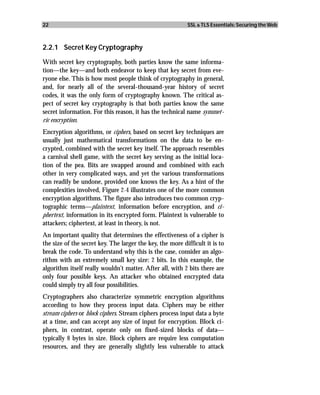
  • 65.
    54 SSL & TLS Essentials: Securing the Web Step Action 3 Server sends its public key certificate in Certificate message. 4 Server concludes its part of the negotiation with ServerHello- Done message. 5 Client sends session key information (encrypted with server’s public key) in ClientKeyExchange message. 6 Client sends ChangeCipherSpec message to activate the nego- tiated options for all future messages it will send. 7 Client sends Finished message to let the server check the newly activated options. 8 Server sends ChangeCipherSpec message to activate the nego- tiated options for all future messages it will send. 9 Server sends Finished message to let the client check the newly activated options. Client Server 1 ClientHello ServerHello 2 Certificate 3 ServerHelloDone 4 5 ClientKeyExchange 6 ChangeCipherSpec 7 Finished ChangeCipherSpec 8 Finished 9 Figure 3-5 Two SSL messages authenticate a server's identity.
  • 66.
    SSL Operation 55 3.5.1 Certificate When authenticating its identity, the server sends a Certificate mes- sage instead of the ServerKeyExchange message section 3.3.3 de- scribed. The Certificate message simply contains a certificate chain that begins with the server’s public key certificate and ends with the certificate authority’s root certificate. The client has the responsibility to make sure it can trust the certifi- cate it receives from the server. That responsibility includes verifying the certificate signatures, validity times, and revocation status. It also means ensuring that the certificate authority is one that the client trusts. Typically, clients make this determination by knowing the public key of trusted certificate authorities in advance, through some trusted means. Netscape and Microsoft, for example, preload their browser software with public keys for well-known certificate authori- ties. Web servers that want to rely on this trust mechanism can only obtain their certificates (at least indirectly) from one of these well- known authorities. One additional detail in the certificate verification process can some- times seem subtle, but is nonetheless crucial for real security: The cli- ent must ensure not only that the certificate is issued by a trusted authority, but that the certificate also unambiguously identifies the party with whom it wants to communicate. Consider, for example, a malicious company that receives a legitimate certificate from a trusted certificate authority under its own name, but then turns around and uses that certificate illegitimately to masquerade as a competitor. The unsuspecting client that communicates with this malicious company (believing that it is communicating with the competitor) will receive a legitimate certificate as part of the ssl ex- change. The client, however, must be intelligent enough to detect that the certificate does not belong to the real competitor. For Web commerce, the key to solving this problem normally relies on the domain name of the server. Respected certificate authorities include the Internet domain name of the Web server in the certificates they issue. And Web browsers check the domain name in certificates they receive against the domain name their users attempt to contact. If,
  • 67.
    56 SSL & TLS Essentials: Securing the Web for example, a browser tries to connect to www.goodcompany.com and receives a certificate for www.badcompany.com, the browser knows something is amiss no matter how valid the certificate other- wise appears. Appendix b contains additional information on verify- ing certificates. 3.5.2 ClientKeyExchange The client’s ClientKeyExchange message also differs in server au- thentication, though the difference is not major. When encryption only is to be used, the client encrypts the information in the Client- KeyExchange using the public key the server provides in its ServerKeyExchange message. In this case, of course, the server is au- thenticating itself and, thus, has sent a Certificate message instead of a ServerKeyExchange. The client, therefore, encrypts its Client- KeyExchange information using the public key contained in the server’s certificate. This step is important because it allows the client to make sure that the party with whom it is communicating actually possesses the server’s private key. Only a system with the actual pri- vate key will be able to decrypt this message and successfully con- tinue the communication. 3.6 Separating Encryption from Authentication The previous section explained how a server can send a Certificate message instead of a ServerKeyExchange message to authenticate it- self. One consequence of this approach is that the same public key information used to verify the server’s identity is also used to encrypt key material in the client’s ClientKeyExchange message. This con- straint is not always desirable; indeed, in some cases it is actually im- possible to support. The impossible cases are easiest to describe. Some public key algo- rithms (such as the Digital Signature Algorithm) can only be used for signing. By their very design, they cannot be used for encryption. In such cases, it will be impossible for the client to encrypt its Cli- entKeyExchange information using the server’s public key.
  • 68.
    SSL Operation 57 This limitation alone would be sufficient to require greater flexibility from the ssl protocol, but it is worthwhile to understand why com- bining signing and encryption might be undesirable, even when the public key algorithm supports both operations. The most common reason for separating encryption from signing is based not on techni- cal considerations, but on legal ones. Some countries, including im- portant producers of cryptographic products such as the United States (at least at the time of this writing), control the use or the ex- port of products that include cryptography. In particular, the United States makes it more difficult for suppliers to export cryptographic products that use encryption key lengths greater than a certain minimum. (Key lengths less than or equal to these limits are said to Client Server 1 ClientHello ServerHello 2 Certificate 3 ServerKeyExchange 4 ServerHelloDone 5 6 ClientKeyExchange 7 ChangeCipherSpec 8 Finished ChangeCipherSpec 9 Finished 10 Figure 3-6 Three SSL messages isolate authentication from encryption.
  • 69.
    58 SSL & TLS Essentials: Securing the Web be exportable.) In principle, at least, the United States does not im- pose the same restrictions on keys used for digital signatures. Systems that fall under u.s. jurisdiction, therefore, may prefer to use the long- est practical keys for authenticating their identity (thus providing the strongest practical authentication), but use encryption keys that con- form to the weaker export restrictions. Whatever the reason, ssl does provide a mechanism for separating server authentication from the encryption. Table 3-9 outlines the steps involved, and figure 3-6 illustrates the entire process. The figure highlights the three messages that are significant for separating en- cryption and server authentication. They are the Certificate, ServerKeyExchange, and ClientKeyExchange messages. Table 3-9 Separating Server Authentication from Encryption Step Action 1 Client sends ClientHello message proposing SSL options. 2 Server responds with ServerHello message selecting the SSL options. 3 Server sends its public key certificate in Certificate message. 4 Server sends the public key that the client should use to en- crypt the symmetric key information in a ServerKeyExchange; this public key is signed with the public key in the server’s cer- tificate. 5 Server concludes its part of the negotiation with ServerHello- Done message. 6 Client sends session key information (encrypted with the public key provided by the server) in a ClientKeyExchange message. 7 Client sends ChangeCipherSpec message to activate the nego- tiated options for all future messages it will send. 8 Client sends Finished message to let the server check the newly activated options. 9 Server sends ChangeCipherSpec message to activate the nego- tiated options for all future messages it will send. 10 Server sends Finished message to let the client check the newly activated options.
  • 70.
    SSL Operation 59 3.6.1 Certificate The Certificate message in this example is identical to the example in section 3.5, except that the public key in the server’s certificate will only be used to verify its identity. The client still has all the responsi- bilities section 3.5.1 discussed, however. It must verify the certificate’s signatures, validity times, and revocation status, and it must ensure that the certificate authority is trusted, and that the certificate was is- sued to the party with whom it wishes to communicate. 3.6.2 ServerKeyExchange The server follows its Certificate message with a ServerKeyExchange message. It is this second message that contains the public key the client should use to encrypt session key information. The ServerKeyExchange is the same message that we saw when no au- thentication was involved, and the information contained in the mes- sage is the same as described in section 3.3.3—with one significant difference: Unlike the example of section 3.3, in which the server keys were sent by themselves, in this scenario, the key information is signed using the public key contained in the server’s certificate. This step is essential to give the client a way to verify that the server really does possess the private key corresponding to its public key certifi- cate. 3.6.3 ClientKeyExchange The client uses a ClientKeyExchange message to finish the negotia- tion process, just as it does in other scenarios. As before, this message contains the key information for the symmetric encryption algorithm the two parties have selected. Also as before, this information is en- crypted using the server’s public key. It is important to note that the public key used for this encryption is the public key from the ServerKeyExchange message, not the public key from the server’s Certificate message (even if that public key algorithm supports en- cryption).
  • 71.
    60 SSL & TLS Essentials: Securing the Web 3.7 Authenticating the Client’s Identity Since ssl includes mechanisms to authenticate a server’s identity, it is natural to expect that the protocol also defines a way to authenticate a client’s identity. Indeed, that is the case; the mechanism is very similar to that for server authentication. You can see the whole proc- ess in figure 3-7, which highlights the messages that are significantly different from the message flows we’ve considered so far. Those mes- sages are the CertificateRequest, the client’s Certificate message, and the CertificateVerify. Table 3-10 highlights the role of those messages by summarizing the entire message flow. The rest of this section de- scribes them in more detail. Table 3-10 Client Authentication Step Action 1 Client sends ClientHello message proposing SSL options. 2 Server responds with ServerHello selecting the SSL options. 3 Server sends its public key certificate in Certificate message. 4 Server sends a CertificateRequest message to indicate that it wants to authenticate the client. 5 Server concludes its part of the negotiation with ServerHello- Done message. 6 Client sends its public key certificate in a Certificate message. 7 Client sends session key information (encrypted with the server’s public key) in a ClientKeyExchange message. 8 Client sends a CertificateVerify message, which signs importa- tion information about the session using the client’s private key; the server uses the public key from the client’s certificate to verify the client’s identity. 9 Client sends a ChangeCipherSpec message to activate the ne- gotiated options for all future messages it will send. 10 Client sends a Finished message to let the server check the newly activated options. 11 Server sends a ChangeCipherSpec message to activate the ne- gotiated options for all future messages it will send. 12 Server sends a Finished message to let the client check the newly activated options.
  • 72.
    SSL Operation 61 3.7.1 CertificateRequest In any ssl exchange, the server determines whether client authenti- cation is required. The client has no choice of its own; it simply com- plies with the server's wishes. If the server does require client authentication, it indicates that by sending a CertificateRequest mes- sage as part of its hello negotiation. As figure 3-7 indicates, the server sends the CertificateRequest after its own Certificate message. Although not shown in the figure, the Client Server 1 ClientHello ServerHello 2 Certificate 3 CertificateRequest 4 ServerHelloDone 5 6 Certificate 7 ClientKeyExchange 8 CertificateVerify 9 ChangeCipherSpec 10 Finished ChangeCipherSpec 11 Finished 12 Figure 3-7 Three SSL messages authenticate a client's identity.
  • 73.
    62 SSL & TLS Essentials: Securing the Web CertificateRequest would also follow any ServerKeyExchange mes- sage the server sends. Note, however, that the ssl specification for- bids a server from sending a CertificateRequest if it is not also authenticating itself (by sending a Certificate message). This restric- tion ensures that the client will know the server’s identity before re- vealing its own. The CertificateRequest message contains two fields: a list of certifi- cate types and a list of distinguished names, as table 3-11 indicates. Table 3-11 CertificateRequest Components Field Use CertificateTypes A list of certificate types acceptable to the server. Distinguished- A list of distinguished names of certificate au- Names thorities acceptable to the server. The CertificateTypes field lists the various types of certificates (dif- ferentiated by the particular signature algorithm employed) that the server will accept. The certificate types are listed in order of decreas- ing preference. The DistinguishedNames field identifies the certifi- cate authorities (denoted by their distinguished name; see appendix a) that the server will accept. No preference is implied by the order in which the different authorities appear in this list. 3.7.2 Certificate A client normally responds to the certificate request by sending its own Certificate message immediately after receiving the ServerHel- loDone. The format of the client’s Certificate message is identical to the server’s Certificate message that section 3.5.1 discussed; both con- tain a certificate chain beginning with the local system’s certificate and ending with the certificate authority’s root certificate. If a client does not possess a certificate that meets the server’s criteria (or if it has no certificate at all), it responds with a NoCertificateAlert. The server can choose to ignore this alert and continue with the commu- nication (though it will be unable to verify the client’s identity), or it can terminate the session at that point.
  • 74.
    SSL Operation 63 Note that ssl only uses the client’s public key for digital signatures. Unlike for the server’s public key, there is no protocol function that uses the client’s public key for encryption. There is no need, there- fore, to explicitly separate client authentication from encryption, so ssl has no client equivalent for the ServerKeyExchange message. (The ClientKeyExchange, as we’ve seen, transfers symmetric key in- formation, not public key information.) 3.7.3 CertificateVerify Simply sending a client Certificate message does not complete the process of authenticating the client’s identity. The client must also prove that it possesses the private key corresponding to the certifi- cate’s public key. For its proof, the client uses a CertificateVerify mes- sage. This message contains a digitally signed cryptographic hash of information available to both the client and the server. Specifically, the client signs a hash of the information table 3-12 lists. The server also has this information, and it will receive (in the Certificate mes- sage) the client’s public key. The server can then verify the signature and make sure that the client possesses the appropriate private key. Table 3-12 Information Authenticated by CertificateVerify Message • Key information. • Contents of all previous SSL handshake messages exchanged by the systems. From looking at figure 3-7, you might wonder why the Certificat- eVerify message doesn’t immediately follow the Certificate message. Instead of this seemingly natural order, ssl has the client send a Cli- entKeyExchange message between the two. The reason for this mes- sage order is based on the cryptographic contents of the messages. The CertificateVerify message relies on cryptographic values that are computed and transferred to the server in the ClientKeyExchange. Until the server receives the ClientKeyExchange, it cannot validate the CertificateVerify message. (Chapter 4 contains a more detailed discussion of the specific computations each side employs.)
  • 75.
    64 SSL & TLS Essentials: Securing the Web 3.8 Resuming a Previous Session As this chapter has demonstrated, establishing an ssl session may be complex, requiring sophisticated cryptographic calculations and a significant number of protocol messages. To minimize the overhead of these calculations and messages, ssl defines a mechanism by which two parties can reuse previously negotiated ssl parameters. With this method, the parties do not need to repeat the crypto- graphic negotiations or authentication calculations; they simply con- tinue from where they left off before. As table 3-13 and figure 3-8 show, resuming earlier sessions notably streamlines the negotiation. Table 3-13 Resuming a Session Step Action 1 Client sends ClientHello message specifying a previously estab- lished SessionID. 2 Server responds with ServerHello message agreeing to this SessionID. Client Server 1 ClientHello ServerHello 2 ChangeCipherSpec 3 Finished 4 5 ChangeCipherSpec 6 Finished Figure 3-8 It only takes six messages to resume an SSL session.
  • 76.
    SSL Operation 65 Step Action 3 Server sends ChangeCipherSpec message to reactivate the ses- sion’s security options for messages it will send. 4 Server sends Finished message to let the client check the newly reactivated options. 5 Client sends ChangeCipherSpec message to reactivate the ne- gotiated options for all future messages it will send. 6 Client sends Finished message to let the server check the newly reactivated options. As the figure indicates, after the server sends it ServerHello message, it immediately sends ChangeCipherSpec and Finished messages. Similarly, the client only sends ChangeCipherSpec and Finished messages once it receives the ServerHello. In both cases, the ChangeCipherSpec directs each party to make the previously active cipher suite active once again. The key to session resumption is the ClientHello message. The client proposes to resume a previous session by including that session’s Ses- sionID value in its ClientHello. (Recall from the discussion in sec- tion 3.3.1 that this value is left empty when an ssl session is first established; the server can supply a value in its ServerHello re- sponse.) If the server wishes to accept the client’s proposal and re- sume the earlier session, it indicates its acceptance by including the same SessionID value in its own ServerHello. If the server elects not to resume the earlier session, it sends a different SessionID value and the full negotiation then takes place. Although session resumption offers a great deal of convenience and efficiency to the systems that use it, those systems should exercise some care in employing it. When a single key is employed, encryp- tion inevitably becomes less secure, both as more information is pro- tected and as time passes. Potential attackers gain more data to analyze and more time to perform the analysis. Systems that consider using ssl session resumption should weigh those considerations against the expected efficiency and convenience gains.
  • 78.
    4 Message Formats With chapter 3’s description of the various ssl messages and how they’re used in mind, it is time to turn our attention to the detailed formats of those messages. Unfortunately, at least for those used to reading protocol specifications, the ssl standard uses a novel ap- proach for describing that formatting, and although concise and easy to present in textual documents, the ssl descriptions may be a bit confusing for many networking professionals. For that reason, we’ll use a more conventional approach—pictures—in this chapter. The ssl protocol itself consists of several different components or- ganized as figure 4-1 illustrates. Four different sources create ssl mes- sages: the ChangeCipherSpec protocol, the Alert protocol, the Handshake protocol, and applications like http. The Record Layer protocol accepts all of these messages, then formats and frames them appropriately, and passes them to a transport layer protocol such as tcp for transmission. HTTP Change Hand- Appli- Secure Alert Cipher shake cation Sockets Layer Record Layer TCP Figure 4-1 SSL consists of several component protocols. 67
  • 79.
    68 SSL & TLS Essentials: Securing the Web This chapter begins with a discussion of the requirements ssl im- poses on the transport protocol. It then describes the details of each ssl component. The final subsections document the cryptographic calculations and options available with ssl. 4.1 Transport Requirements The Secure Sockets Layer does not exist as a protocol in isolation. Rather, it depends on additional lower-level protocols to transport its messages between peers. The ssl protocol requires that the lower layer be reliable; that is, it must guarantee the successful transmission of ssl messages without errors and in the appropriate order. In all practical implementations, ssl relies on the Transmission Control Protocol (tcp) to meet those requirements. Client Server TCP 1 ClientHello Segment ServerHello 2 TCP Certificate 3 Segment ServerHelloDone 4 5 ClientKeyExchange TCP 6 ChangeCipherSpec Segment 7 Finished ChangeCipherSpec 8 TCP Segment Finished 9 Figure 4-2 SSL can combine messages within TCP segments.
  • 80.
    Message Formats 69 Like all protocols that use tcp, ssl is self-delimiting. That means that ssl can determine the beginning and end of its own messages without assistance from the transport layer. To mark these beginnings and endings, ssl puts its own explicit length indicator in every mes- sage. This explicit delimiter lets ssl combine multiple ssl messages into single tcp segments. Figure 4-2 shows a typical ssl handshake sequence. Note that nine separate ssl messages result in only four tcp segments. This combination conserves network resources and in- creases the efficiency of the ssl protocol. 4.2 Record Layer The Secure Sockets Layer uses its Record Layer protocol to encapsu- late all messages. Figure 4-3 emphasizes the Record Layer’s position in the ssl architecture. It provides a common format to frame Alert, ChangeCipherSpec, Handshake, and application protocol messages. The Record Layer formatting consists of 5 bytes that precede other protocol messages and, if message integrity is active, a message au- thentication code at the end of the message. The Record Layer is also responsible for encryption if that service is active. Figure 4-4 shows the structure of Record Layer formatting. Table 4-1 describes the figure’s individual fields, with the exception of encryp- tion and message authentication codes. Those fields are the subject of section 4.7. In the previous figure, multibyte fields are shown in net- HTTP Change Hand- Appli- Secure Alert Cipher shake cation Sockets Layer Record Layer TCP Figure 4-3 The Record Layer formats and frames all SSL messages.
  • 81.
    70 SSL & TLS Essentials: Securing the Web Protocol Version Length... ...Length Protocol Message(s) Encrypted (Optional) Message Authentication Code (Optional) Figure 4-4 SSL’s Record Layer encapsulates all protocol messages. work byte order, sometimes known as big endian. Higher-order bytes (those that are most significant) appear first in the figures. Table 4-1 SSL Record Layer Fields Field Size Usage Protocol 1 byte Indicates which higher-layer protocol is contained in this SSL Record Layer message. Version 2 bytes The major and minor version of the SSL SSL vs. TLS specification to which this message con- forms. The current SSL version is 3.0 (but see The TLS protocol the sidebar). uses a version Length 2 bytes The length of the following higher-layer value of 3.1 in- protocol messages as a 16-bit binary num- stead of 3.0. ber. The SSL specification requires that this value not exceed 214 (16 384). 14 Protocol n bytes Up to 2 (16 384) bytes of higher-layer pro- Messages tocol messages, including message authen- tication codes; the SSL Record Layer may concatenate multiple higher-layer mes- sages into a single Record Layer message. Those messages must all belong to the same higher-layer protocol. Also, as a con- sequence of this potential concatenation, each higher-layer protocol itself must be self-delimiting. The ssl specification defines the four different higher-layer protocols that the Record Layer can encapsulate. For any particular message, the Protocol field indicates the specific higher-layer protocol. Table 4-2 lists the values for that field.
  • 82.
    Message Formats 71 Table 4-2 Record Layer Protocol Types Type Value Protocol 20 ChangeCipherSpec protocol 21 Alert protocol 22 Handshake protocol 23 Application protocol data 4.3 ChangeCipherSpec Protocol The ChangeCipherSpec protocol is the simplest possible protocol— it has only one message. That message is the ChangeCipherSpec message introduced in chapter 3. Despite this simplicity, though, ssl treats ChangeCipherSpec as a separate protocol. As figure 4-5 shows, it has the same position in the ssl architecture as other protocols, in- cluding the Alert, Handshake, and application data. At first glance, this approach might seem like overkill. Why not just consider the ChangeCipherSpec message to be part of the Hand- shake protocol, for example? More careful analysis, however, reveals that ChangeCipherSpec messages must be a separate protocol. Oth- erwise, ssl couldn’t function. The requirement arises because of the record layer encapsulation. The ssl protocol applies security services such as encryption to entire Record Layer messages at once. The ChangeCipherSpec message, however, indicates a change in those services. (Typically, it activates them.) Since encryption cannot be HTTP Change Hand- Appli- Secure Alert Cipher shake cation Sockets Layer Record Layer TCP Figure 4-5 ChangeCipherSpec messages are a separate protocol.
  • 83.
    72 SSL & TLS Essentials: Securing the Web Prot: 20 Vers: 3 0 Len: 0 1 CCS: 1 Figure 4-6 The ChangeCipherSpec message is very simple. applied to parts of a message, it is impossible for any other message to follow a ChangeCipherSpec message within a Record Layer mes- sage. The most effective way to outlaw such combinations is to de- fine ChangeCipherSpec as a separate protocol, and that is exactly 1 what the ssl specification does. The ChangeCipherSpec message itself is quite simple, as figure 4-6 shows. The figure also shows how the entire message is encapsulated in a Record Layer message. (The Record Layer header is shaded in the figure.) The Record Layer has a protocol type value of 20, a pro- tocol version of 3.0, and a length of 1. The ChangeCipherSpec mes- sage itself consists only of a single byte. It has the value 1. 4.4 Alert Protocol Systems use the Alert protocol to signal an error or caution condition to the other party in their communication. This function is impor- tant enough to warrant its own protocol, and ssl assigns it protocol type 21. As figure 4-7 illustrates, the Alert protocol, like all ssl proto- cols, uses the Record Layer to format its messages. Figure 4-8 shows the resulting message format. The Alert protocol itself defines two fields: a severity level and an alert description. 4.4.1 Severity Level The first field indicates the severity of the condition that caused the alert. Alerts can either be warnings (with a severity level of 1) or fatal _________________ 1 The ssl specification theoretically allows multiple ChangeCipherSpec messages in a single Record Layer message. That would create the same problems described above. Fortunately, however, there is no practical reason to combine messages that way, so the problem does not arise in real implementations.
  • 84.
    Message Formats 73 HTTP Change Hand- Appli- Secure Alert Cipher shake cation Sockets Layer Record Layer TCP Figure 4-7 The Alert protocol signals error conditions. (severity level 2). Fatal alerts represent significant problems with the communication, and require that both parties terminate the session immediately. Warning alerts are not quite as drastic. A system receiv- ing such an alert may decide to allow the present session to continue; however, both parties must invalidate the ssl session for any future connections, and they must not try to resume the session later. 4.4.2 Alert Description The second field in an Alert protocol describes the specific error in more detail. The field is a single byte, and it can take on the values listed in table 4-3. Table 4-3 Alert Protocol Descriptions Value Name Meaning 0 CloseNotify The sending party indicates explicitly that it is closing the connection; closure alerts have a warning severity level. 10 Unexpected- The sending party indicates that it received Message an improper message; this alert is always fatal. Prot: 21 Vers: 3 0 Len: 0 2 Level Desc. Figure 4-8 Alert protocol messages have only two fields.
  • 85.
    74 SSL & TLS Essentials: Securing the Web Value Name Meaning 20 BadRecord- The sending party indicates that its has re- MAC ceived a message for which the message au- thentication code failed; this alert is always fatal. 30 Decompres- The sending party indicates that it received sionFailure data that it could not decompress; this alert is always fatal. 40 Hand- The sending party indicates that it was not ShakeFailure able to negotiate an acceptable set of security services for the session; this alert is always fa- tal. SSL vs. TLS 41 NoCertificate The sending party (which is always a client) indicates that it has no certificate that can sat- The TLS protocol isfy the server’s CertificateRequest. eliminates alert description 41 42 BadCertifi- The sending party received a certificate that (NoCertificate) cate was corrupt (e.g. , its signature could not be and adds a verified). dozen other val- 43 Unsupported The sending party received a certificate of a ues. Certificate type that it could not support. 44 Certificate- The sending party received a certificate that Revoked has been revoked by the certificate authority. 45 Certificate- The sending party received a certificate that Expired has expired. 46 Certificate- The sending party indicates an unspecified Unknown problem with a certificate it received. 47 IllegalParam- The sending party indicates that it received a eter handshake message with a parameter value that was illegal or inconsistent with other pa- rameters. 4.5 Handshake Protocol Most of the ssl specification describes the Handshake protocol, as it is the one primarily responsible for negotiating ssl sessions. As figure 4-9 shows, the Handshake protocol relies on the Record Layer to en- capsulate its messages. Figure 4-10 illustrates their general format,
  • 86.
    Message Formats 75 HTTP Change Hand- Appli- Secure Alert Cipher shake cation Sockets Layer Record Layer TCP Figure 4-9 The Handshake protocol handles session negotiation. and indicates that multiple handshake messages may be (and fre- quently are) combined into a single Record Layer message. Each handshake message begins with a single byte that defines the specific type of handshake message. Table 4-4 lists the values that ssl defines. The type byte is followed by 3 bytes that define the length of the body of the handshake message. This length is measured in bytes and it does not include the type or length fields of the message. The remainder of this section describes each handshake message in detail. With one exception, the text follows the order of table 4-4. Client- KeyExchange is discussed before the CertificateVerify, since the Cer- tificateVerify message relies on information from the ClientKey- Prot: 22 Vers: 3 0 Length... Msg ...Length Msg Length... Type ...Length Handshake Message Msg Msg Length Type Handshake Message ... Figure 4-10 Handshake protocol messages may be combined.
  • 87.
    76 SSL & TLS Essentials: Securing the Web Exchange. This approach also follows the order of messages in actual communication sessions more closely. Table 4-4 Handshake Protocol Types Value Handshake Protocol Type 0 HelloRequest 1 ClientHello 2 ServerHello 11 Certificate 12 ServerKeyExchange 13 CertificateRequest 14 ServerHelloDone 15 CertificateVerify 16 ClientKeyExchange 20 Finished 4.5.1 HelloRequest The HelloRequest allows a server to ask a client to restart the ssl handshake negotiation. The message is not often used (and thus does not appear in any of the example scenarios of chapter 3), but it does give servers additional options. If a particular connection has been in use for so long that its security is unacceptably weakened, for exam- ple, the server can send a HelloRequest to force to client to negotiate new session keys. Figure 4-11 shows the format of the HelloRequest message. As is clear from the figure, the HelloRequest is quite sim- ple. It has a handshake message type of 0, and, since its message body is empty, its handshake message length is also 0. Prot: 22 Vers: 3 0 Len: 0 4 Type: 0 Len: 0 0 0 Figure 4-11 HelloRequest messages use a simple format.
  • 88.
    Message Formats 77 4.5.2 ClientHello The ClientHello message normally begins an ssl handshake negotia- tion. Figure 4-12 shows the fields that make up a ClientHello mes- sage. ClientHello messages have a handshake message type of 1, and a variable message body size. Two bytes immediately following the SSL vs. TLS message length identify the ssl protocol version. Values of 3 and 0 for this field indicate ssl version 3.0. Although this information is The TLS protocol uses a version essentially the same as that in the Record Layer encapsulation, in value of 3.1 in- theory, at least, it allows the Record Layer and Handshake protocols stead of 3.0. to evolve independently. After the protocol version, the client inserts a 32-byte random num- ber. The ssl specification suggests that clients use the current date and time (up to the second) as the first 4 bytes of this random num- ber, but it does not demand any particular degree of accuracy. Includ- ing the date and time reduces the possibility of duplicating the random value, which, if it were to inadvertently occur, could com- Prot: 22 Vers: 3 0 Length... ...Length Type: 1 Length... ...Length Vers: 3 0 ClientRandomValue (32 bytes) ID len Session ID CipherSuite length CipherSuite 1 CipherSuite 2 CipherSuite n Cmp len Cmp 1 Cmp 2 ... Cmp n Figure 4-12 The ClientHello message proposes CipherSuites.
  • 89.
    78 SSL & TLS Essentials: Securing the Web promise security. A client, for example, might not be able to remem- ber previous values in between reboots or resets. Including the date and time eliminates the possibility of duplicating an old value (as- suming that the reboot or reset process takes at least one second). The byte after the random value contains the length, in bytes, of the session id; the session id itself follows next. Unless a client wishes to resume a previous session, it leaves out the session id (and sets the id length to 0). The ssl protocol limits session ids to 32 bytes or fewer, but it places no constraints on their content. Note, though, that since session ids are transmitted in ClientHellos before any encryption is enabled, implementations should not place any information in the session id that might, if revealed, compromise security. The client’s list of proposed cipher suites follows the session id. The list begins with a single byte indicating the size of the list. The size is measured in bytes, even though cipher suites themselves are 2-byte quantities. A client proposing five cipher suites, for example, would set the CipherSuite length field to 10. Table 4-5 lists the ssl version 3.0 cipher suites; for details on each suite, refer to section 4.7. Table 4-5 SSL Version 3.0 CipherSuite Values Value Cipher Suite 0,0 SSL_NULL_WITH_NULL_NULL 0,1 SSL_RSA_WITH_NULL_MD5 0,2 SSL_RSA_WITH_NULL_SHA 0,3 SSL_RSA_EXPORT_WITH_RC4_40_MD5 0,4 SSL_RSA_WITH_RC4_128_MD5 0,5 SSL_RSA_WITH_RC4_128_SHA 0,6 SSL_RSA_EXPORT_WITH_RC2_CBC_40_MD5 0,7 SSL_RSA_WITH_IDEA_CBC_SHA 0,8 SSL_RSA_EXPORT_WITH_DES40_CBC_SHA 0,9 SSL_RSA_WITH_DES_CBC_SHA 0,10 SSL_RSA_WITH_3DES_EDE_CBC_SHA 0,11 SSL_DH_DSS_EXPORT_WITH_DES40_CBC_SHA 0,12 SSL_DH_DSS_WITH_DES_CBC_SHA
  • 90.
    Message Formats 79 SSL vs. TLS Value Cipher Suite 0,13 SSL_DH_DSS_WITH_3DES_EDE_CBC_SHA The TLS protocol, by default, does 0,14 SSL_DH_RSA_EXPORT_WITH_DES40_CBC_SHA not include sup- 0,15 SSL_DH_RSA_WITH_DES_CBC_SHA port for the For- 0,16 SSL_DH_RSA_WITH_3DES_EDE_CBC_SHA tezza/DMS cipher 0,17 SSL_DHE_DSS_EXPORT_WITH_DES40_CBC_SHA suites, the last 3 listed in the ta- 0,18 SSL_DHE_DSS_WITH_DES_CBC_SHA ble. In addition, 0,19 SSL_DHE_DSS_WITH_3DES_EDE_CBC_SHA the TLS stan- 0,20 SSL_DHE_RSA_EXPORT_WITH_DES40_CBC_SHA dardization 0,21 SSL_DHE_RSA_WITH_DES_CBC_SHA process makes it much easier to 0,22 SSL_DHE_RSA_WITH_3DES_EDE_CBC_SHA define new ci- 0,23 SSL_DH_anon_EXPORT_WITH_RC4_40_MD5 pher suites. As of 0,24 SSL_DH_anon_WITH_RC4_128_MD5 this writing, doz- 0,25 SSL_DH_anon_EXPORT_WITH_DES40_CBC_SHA ens have been proposed. In a 0,26 SSL_DH_anon_WITH_DES_CBC_SHA similar manner, 0,27 SSL_DH_anon_WITH_3DES_EDE_CBC_SHA TLS makes it eas- 0,28 SSL_FORTEZZA_DMS_WITH_NULL_SHA ier to define 0,29 SSL_FORTEZZA_DMS_WITH_FORTEZZA_CBC_SHA compression methods. 0,30 SSL_FORTEZZA_DMS_WITH_RC4_128_SHA The final fields of a ClientHello message list the compression meth- ods that the client proposes for the session. The list begins with a length byte; individual compression methods follow as single-byte values. As a practical matter, though, no compression methods other than the null compression have been defined for ssl version 3. Con- sequently, all current implementations set the compression length to 1 and the next byte to 0, indicating no compression. 4.5.3 ServerHello The ServerHello message closely resembles the ClientHello message, as figure 4-13 shows. The only significant differences are the value of the handshake message type (2 instead of 1) and the fact that the server specifies a single cipher suite and compression method rather than a list. The values identified by the server are those that the par-
  • 91.
    80 SSL & TLS Essentials: Securing the Web Prot: 22 Vers: 3 0 Length... ...Length Type: 2 Length... ...Length Vers: 3 0 ServerRandomValue (32 bytes) ID len Session ID CipherSuite Compr Figure 4-13 The ServerHello message designates the CipherSuite. ties will use for the session; the server must pick from among the choices the client proposed. The server may include, at its own discretion, a SessionID in the ServerHello message. If the server includes this field, it will allow the client to attempt to reuse the session at some point in the future. Servers that don’t wish to allow a session to be reused may omit the SessionID field by specifying a length of 0. 4.5.4 Certificate The Certificate message is relatively straightforward, as figure 4-14 makes clear. Its Handshake protocol message type is 11, and it begins with that message type and the standard handshake message length. The body of the message contains a chain of public key certificates. That chain begins with 3 bytes that indicate its length. (The value for the chain length is always three less than the value of the message length.) Each certificate in the chain also begins with a 3-byte field that holds the size of the certificate. The message first indicates the overall length of the certificate chain. Then it indicates the length of each certificate with 3 bytes immediately preceding the certificate. Certificate chains allow ssl to support certificate hierarchies. The first certificate in the chain is always that of the sender. The next cer-
  • 92.
    Message Formats 81 Prot: 22 Vers: 3 0 Length... ...Length Type: 11 Message Length... ...Length Certificate Chain Length Certificate 1 Length Certificate 1 ... Certificate n Length Certificate n Figure 4-14 The Certificate message contains a certificate chain. tificate is that of the authority that issued the sender’s certificate. The third certificate (if one is present) belongs to the ca for that author- ity, and so on. The chain continues until it reaches a certificate for a root certificate authority. 4.5.5 ServerKeyExchange The ServerKeyExchange message carries key information from the server to the client. Its exact format depends on the cryptographic al- gorithms being used to exchange key information. The various for- mats—which correspond to Diffie-Hellman, rsa, and Fortezza key exchange protocols—are illustrated in figures 4-15, 4-16, and 4-17. In all cases, the handshake message type has the value 12. Note that there is no explicit indication in the message itself of the particular format it employs. Clients must use knowledge they possess from previous handshake messages (the key exchange algorithm from the selected cipher suite in the ServerHello message and the signing al- gorithm, if relevant, from the Certificate message) to interpret a ServerKeyExchange message correctly. The first of the three figures, figure 4-15, shows a ServerKeyExchange message for Diffie-Hellman key exchange. The three Diffie-
  • 93.
    82 SSL & TLS Essentials: Securing the Web Prot: 22 Vers: 3 0 Length... ...Length Type: 12 Length... ...Length DH p length DH p ... ...value DH q length DH q value DH Ys length DH Ys value Signed MD5 hash [if RSA signing] (16 bytes) Signed SHA hash [if RSA or DSA signing] (20 bytes) Figure 4-15 ServerKeyExchange carries Diffie-Hellman parameters. Hellman parameters (p, q, and ys) make up the first six fields after the message length. Each parameter includes its own length, fol- lowed by the actual value. For rsa key exchange messages (figure 4-16), the key information consists of the rsa modulus and public exponent. Each of those pa- rameters is carried in the message as a length, followed by the value. Prot: 22 Vers: 3 0 Length... ...Length Type: 12 Length... ...Length RSA mod len RSA ... ... mod value RSA exp length RSA exp value Signed MD5 hash [if RSA signing] (16 bytes) Signed SHA hash [if RSA or DSA signing] (20 bytes) Figure 4-16 ServerKeyExchange carries RSA parameters.
  • 94.
    Message Formats 83 Prot: 22 Vers: 3 0 Len: 0 132 Type: 12 Len: 0 0 128 Fortezza rs (128 bytes) Figure 4-17 ServerKeyExchange carries Fortezza/DMS parameters. When the systems employ Fortezza/dms key exchange, the ServerKeyExchange message carries the Fortezza rs value. Since rs is always 128 bytes in size, there is no need for a separate length pa- rameter in the ServerKeyExchange message. The handshake message length of 128 is sufficient, as figure 4-17 indicates. The figures also show that a ServerKeyExchange may include signed parameters. Again, the exact format of those parameters depends on the specific signature algorithm the server supports. If server authen- tication is not part of a particular ssl session, then no signing is em- ployed, and the ServerKeyExchange message ends with the Diffie- Hellman, rsa, or Fortezza parameters. This option corresponds to the encryption-only scenario of section 3.3. If the server is not acting anonymously and has sent a Certificate message, however, then the signed parameters format depends on the signature algorithm indicated in the server’s certificate. If the server’s certificate is for rsa signing, then the signed parameters consist of the concatenation of two hashes: an md5 hash and a sha hash. Note that a single signature for the combined hashes is included, not sepa- rate signatures for each hash. If the server’s certificate is for dsa sign- ing, then the signed parameters consist solely of a sha hash. In either case, the input to the hash functions (and, thus, the data being signed) is constructed as in figure 4-18. That data consists of the client’s random value (from the Client- Hello), followed by the server’s random value (in the ServerHello), followed by the key exchange parameters (either the Diffie-Hellman parameters of figure 4-15 or the rsa parameters of figure 4-16). No signed parameters are included for Fortezza/dms key exchange.
  • 95.
    84 SSL & TLS Essentials: Securing the Web ClientHello Random Value ServerHello Random Value Server Key Parameters H( ) hash Figure 4-18 The server signs a hash of ServerKeyExchange parameters. 4.5.6 CertificateRequest To authenticate a client’s identity, a server first sends a CertificateRe- quest message. This message not only asks a client to send its certifi- cate (and to sign information using the private key for that certificate), it also tells the client which certificates are acceptable to the server. Figure 4-19 shows the format for this information. The CertificateRequest message is handshake message type 13; after the handshake type and length, the message contains a list of accept- able certificate types. This type list begins with its own length (a one-byte value), and consists of one or more single-byte values that identify specific certificate types. Table 4-6 lists the defined certifi- cate type values and their meanings. Prot: 22 Vers: 3 0 Length... ...Length Type: 13 Length... ...Length CT len CT 1 CT 2 ... CT n CAs length CA 1 length DN of CA 1 ... Figure 4-19 The CertificateRequest message asks for specific certificates.
  • 96.
    Message Formats 85 Table 4-6 Certificate Types CT Value Certificate Type 1 RSA signing and key exchange 2 DSA signing only 3 RSA signing with fixed Diffie-Hellman key exchange 4 DSA signing with fixed Diffie-Hellman key exchange 5 RSA signing with ephemeral Diffie-Hellman key exchange 6 DSA signing with ephemeral Diffie-Hellman exchange 20 Fortezza/DMS signing and key exchange In addition to certificate types, the CertificateRequest message also indicates which certificate authorities the server considers appropri- ate. This list begins with its own 2-byte length field and then con- tains one or more distinguished names. Each distinguished name has its own length field, and unambiguously identifies a certificate au- thority. For more details on distinguished names, see appendix a. 4.5.7 ServerHelloDone The ServerHelloDone message concludes the server’s part of a hand- shake negotiation. This message does not carry any additional infor- mation; it takes the simple form of figure 4-20. The handshake message type is 14, and the message body length is 0. 4.5.8 ClientKeyExchange With a ClientKeyExchange message, the client provides the server with the key materials necessary for securing the communication; the exact format of the message depends on the specific key exchange al- gorithm the parties are using. The three possibilities that ssl allows are rsa, Diffie-Hellman, and Fortezza/dms key exchange. Figures Prot: 22 Vers: 3 0 Len: 0 4 Type: 14 Len: 0 0 0 Figure 4-20 A ServerHelloDone message ends the server’s negotiation.
  • 97.
    86 SSL & TLS Essentials: Securing the Web Prot: 22 Vers: 3 0 Length... ...Length Type: 16 Length... ...Length Encrypted Premaster Secret Figure 4-21 For RSA, the ClientKeyExchange carries a premaster secret. 4-21, 4-22, and 4-23 show the message formats for each. Note that the ClientKeyExchange message does not include an explicit indication of the format or key exchange algorithm. Rather, both parties infer the format by knowing the key exchange algorithm of the negotiated cipher suite. The first message format is for rsa key exchange. As figure 4-21 indi- cates, the message has a handshake message type of 16, and the stan- dard handshake message length. The message body itself consists solely of the encrypted premaster secret. This premaster secret is en- crypted using the public key of the server, as received in the ServerKeyExchange or Certificate message. The premaster secret is a preliminary step in deriving the master se- cret for the session. (The master secret, discussed in detail in the next subsection, is the source of all the essential cryptographic data for the session.) For rsa key exchange, the premaster secret is simply 2 bytes for the version of ssl the client supports (3 and 0, for version 3.0) fol- lowed by 46 securely generated random bytes. Prot: 22 Vers: 3 0 Length... ...Length Type: 16 Length... ...Length DH Yc length DH Y value c Figure 4-22 For ephemeral Diffie-Hellman, ClientKeyExchange carries Yc.
  • 98.
    Message Formats 87 Prot: 22 Vers: 3 0 Length... ...Length Type: 16 Length... ...Length Fortezza Key Material (10 values) Figure 4-23 For Fortezza, the ClientKeyExchange carries key material. When the key exchange protocol is Diffie-Hellman, there are two possibilities for the ClientKeyExchange message. If the Diffie- Hellman exchange is ephemeral, then the message takes the format of figure 4-22. As the figure shows, the message body contains the client’s yc value, preceded by the length of that value. If the Diffie- Hellman exchange is explicit, then the yc value is carried in the cli- ent’s certificate. In that case, the ClientKeyExchange will be empty. For Fortezza/dms key exchange, the ClientKeyExchange message of figure 4-23 requires a set of parameters. Table 4-7 lists the details. Table 4-7 Fortezza/DMS ClientKeyExchange Parameters Parameter Size Size of the Yc value 2 bytes The Yc value (between 64 and 128 bytes), or nothing if 0 – 128 bytes Yc is in the client’s certificate The client’s Rc value 128 bytes The Key Encryption Algorithm’s public key, signed with 20 bytes the client’s DSS private key The client’s write key, wrapped by the Token Encryp- 12 bytes tion Key ( TEK) The client’s read key, wrapped by the Token Encryption Key 12 bytes The client’s initialization vector 24 bytes The server’s initialization vector 24 bytes The master secret initialization vector used for en- 24 bytes crypting the premaster secret The premaster secret, which is a securely generated 48 bytes random value, encrypted by the TEK
  • 99.
    88 SSL & TLS Essentials: Securing the Web Prot: 22 Vers: 3 0 Length... ...Length Type: 15 Length... ...Length Signed MD5 hash [if RSA signing] (16 bytes) Signed SHA hash (20 bytes) Figure 4-24 The CertificateVerify message contains a signed hash. 4.5.9 CertificateVerify A client proves that it possesses the private key corresponding to its public key certificate with a CertificateVerify message. The message, as figure 4-24 shows, consists of hashed information digitally signed by the client. The exact format of the information depends on whether the client’s certificate indicates rsa or dsa signing. For rsa certificates, two separate hashes are combined and signed: an md5 hash and a sha hash. One signature covers both hashes; there are not two separate signatures. For dsa certificates, only a sha hash is cre- ated and signed. In all cases, the information that serves as input to the hash functions (and, thus, is the information that is digitally signed) is the same. Clients build the information in three steps. First they compute a special value known as the master secret. Section 4.6.3 describes how this master secret is used in various cryptographic computations; for now, we’re only concerned with how systems create a master secret. To calculate the master secret value, the client follows the process given in table 4-8. Figure 4-25 shows the calculation as an equation. Table 4-8 Master Secret Calculation Step Action 1 Begin with the 48-byte premaster secret. The client creates this value and sends it to the server in the ClientKeyExchange mes- sage. (See the previous section for details.)
  • 100.
    Message Formats 89 SSL vs. TLS Step Action The TLS protocol 2 Calculate the SHA hash of the ASCII character ‘A’ followed by the uses a slightly premaster secret, the client’s random value (from the Client- different hash Hello) and the server’s random value (from the ServerHello). calculation for 3 Calculate the MD5 hash of the premaster secret, followed by the the Certificate- output of step 2. Verify hash; it 4 Calculate the SHA hash of the two ASCII characters ‘BB’, the pre- does not involve master secret, the client’s random value (from the ClientHello), the master se- and the server’s random value (from the ServerHello). cret. 5 Calculate the MD5 hash of the premaster secret followed by the output of step 4. 6 Concatenate the results from step 5 to the results from step 3. 7 Calculate the SHA hash of the three ASCII characters ‘CCC’ fol- lowed by the premaster secret, the client’s random value (from the ClientHello), and the server’s random value (from the ServerHello). 8 Calculate the MD5 hash of the premaster secret, followed by the output of step 7. 9 Concatenate the results from step 8 to the results from step 6. Once the client has the master secret value, it moves to the next stage in building the CertificateVerify message. The client creates a hash of the full contents of all previous ssl handshake messages exchanged during the session, followed by the master secret, followed by the single-byte value 001100110, repeated 48 times for md5 and 40 times for sha. In the third step, the client creates a new hash using the same master secret, followed by the binary value 01011100, repeated 48 times for md5 and 40 times for sha, followed by the output of the intermediate hash. Figure 4-26 summarizes the entire process. master secret = MD5(premaster secret + SHA(‘A’ + premaster secret + ClientHello.random + ServerHello.random)) + MD5(premaster secret + SHA(‘BB’ + premaster secret + ClientHello.random + ServerHello.random)) + MD5(premaster secret + SHA(‘CCC’ + premaster secret + ClientHello.random + ServerHello.random)) Figure 4-25 The master secret requires six hash calculations.
  • 101.
    90 SSL & TLS Essentials: Securing the Web Handshake Messages... Master Secret 48 bytes of 0x36 MD5 Master Secret 48 bytes of 0x5C hash MD5 hash Figure 4-26 CertificateVerify has a signed hash of handshake messages. 4.5.10 Finished The final handshake message is type 20, the Finished message. This message indicates that the ssl negotiation is complete and that the negotiated cipher suite is in effect. Indeed, the Finished message is itself encrypted using the cipher suite parameters. Figure 4-27 shows the format of a Finished message. As the figure indicates, though, the actual contents may be encrypted. When an encrypted message traverses networks, it contents are not visible. The Finished message body consists of two hash results, one using the md5 hash algorithm and the other using the sha hash algorithm. Both hash calculations use the same information as input, and both are calculated in two stages. Figure 4-28 illustrates the process each system uses to calculate the sha hash for its Finished message. The md5 calculation is similar. First, the sender creates a hash of the full contents of all previous ssl handshake messages exchanged during the session, followed by an indication of the sender’s role, the master secret, and padding. The sender’s role is the hexadecimal value 434c4e54 if the sender is a
  • 102.
    Message Formats 91 Prot: 22 Vers: 3 0 Len: 0 56 Type: 20 Len: 0 0 36 MD5 hash (16 bytes) Handshake message Encrypted SHA hash (20 bytes) MD5 Message Authentication Code MAC (16 bytes) Figure 4-27 The Finished message uses negotiated security services. SSL vs. TLS client, 53525652 if a server. The padding is the binary value 001100110, The TLS protocol repeated 48 times for md5 and 40 times for sha. uses a slightly For the second stage, the sender creates a new hash using the master different hash calculation for secret, followed by an alternate padding and the output of the inter- the Finished mediate hash. The second-stage padding is the binary value 01011100, message. repeated 48 times for md5 and 40 times for sha. Handshake Messages... Sender's Role Master Secret 40 bytes of 0x36 SHA Master Secret 40 bytes of 0x5C hash SHA hash Figure 4-28 The Finished messages includes a signed hash.
  • 103.
    92 SSL & TLS Essentials: Securing the Web Note the similarity between this calculation and the hash calculation for the CertificateVerify message (see section 4.5.9). There are two differences, however. First, the Finished hash includes the sender’s role while the CertificateVerify hash does not. (Of course, only cli- ents can send CertificateVerify messages.) Second, the set of hand- shake messages will be different when the two hashes are calculated. In either case, note that ssl does not consider ChangeCipherSpec messages to be handshake messages (they are not part of the Hand- shake protocol), so their contents are not included in the hash. 4.6 Securing Messages The Finished message is the first to actually use the security services that ssl negotiates. Once those services are in place, however, all sub- sequent messages in the session also make use of them—even addi- tional handshake messages, should the parties want to renegotiate new security parameters. The most important messages, though, are application protocol messages. Those messages contain the actual data that the two parties want to exchange; the security requirements of that data are what make ssl necessary. Figure 4-29 shows how ap- plication data fits in the ssl architecture. The ssl protocol provides both encryption and message authentication codes for the data, en- suring that it is kept confidential and that it is not altered. The fol- lowing two subsections detail each of these services. HTTP Change Hand- Appli- Secure Alert Cipher shake cation Sockets Layer Record Layer TCP Figure 4-29 Applications use the Record Layer directly.
  • 104.
    Message Formats 93 4.6.1 Message Authentication Code The Secure Sockets Layer supports two different algorithms for a message authentication code (mac). As figures 4-30 and 4-31 indicate, those algorithms are rsa’s Message Digest 5 (md5) and the Secure Hash Algorithm (sha). The particular algorithm for any given com- munications is determined by the negotiated cipher suite. Other than the algorithm itself, the only difference between the two is the size of the hash. The md5 algorithm generates a 16-byte hash value, while sha creates a 20-byte value. In both cases, the hash result is simply appended to the application data. The ssl Record Layer length value includes both the application data and the authentication code. Also, as the figures highlight, both the application data and the check value are encrypted. To calculate (or verify) the message authentication code, a system uses a two-stage hash very similar to hash computations in the hand- shake messages. It starts with a special value known as the mac write secret, followed by padding, a 64-bit sequence number, a 16-bit value with the length of the content, and, finally, by the content itself. The padding is the single-byte value 001100110, repeated 48 times for md5 and 40 times for sha. For the second stage, the system uses the mac write secret, padding, and the output of the intermediate hash. This time, the padding is the binary value 01011100, repeated 48 times for md5 and 40 times for sha. This result is the mac value that appears Prot: 23 Vers: 3 0 Length... Record Layer ...Length Application Data Encrypted MD5 MD5 Message Authentication Code MAC (16 bytes) Figure 4-30 The MD5 MAC protects the integrity of application data.
  • 105.
    94 SSL & TLS Essentials: Securing the Web Prot: 23 Vers: 3 0 Length... Record Layer ...Length Application Data Encrypted SHA SHA Message Authentication Code MAC (20 bytes) Figure 4-31 The SHA MAC also protects application data integrity. SSL vs. TLS The TLS protocol in the ssl messages. Figure 4-32 shows the process for an md5 mes- uses a com- sage authentication code. pletely different calculation for The two special values included in this calculation are the mac write the message au- secret and the sequence number. Section 4.6.3 discusses the mac thentication write secret, along with other important cryptographic parameters. codes. See sec- The sequence number is a count of the number of messages the par- tion 5.4.3. MAC secret 48 bytes of 0x36 seq. num. proto. type msg. len. message data MD5 MAC secret 48 bytes of 0x5C hash MD5 MAC Figure 4-32 SSL calculates a message authentication code in two stages.
  • 106.
    Message Formats 95 ties have exchanged. Its value is set to 0 with each ChangeCipher- Spec message, and it is incremented once for each subsequent ssl Record Layer message in the session. 4.6.2 Encryption The ssl protocol supports both stream and block encryption ciphers, although the message formats differ slightly. The examples illustrated so far show stream encryption algorithms; they represent the simplest case. Figure 4-33 shows that the information to be encrypted is sim- ply the application data, followed by the message authentication code. With stream encryption algorithms, no other parameters are required. For block encryption, on the other hand, the data to be encrypted must be a multiple of the block size. And, since application data can rarely be forced into specific sizes, block encryption algorithms rely on padding. In this case, padding is used in the sense described in section 2.2.1. Dummy data added to the application data to force its length to be a multiple of the block size. In order to successfully ex- tract the actual application data once the information has been en- crypted, the recipient must know where the application data ends and the padding begins. This requirement leads to the format of fig- ure 4-34. As that figure indicates, the very last byte of the encrypted Prot: 23 Vers: 3 0 Length... Record Layer ...Length Application Data Encrypted Message Authentication Code Figure 4-33 SSL can use stream encryption to protect application data.
  • 107.
    96 SSL & TLS Essentials: Securing the Web Prot: 23 Vers: 3 0 Length... Record Layer ...Length Application Data Encrypted Message Authentication Code Message Padding Pad len Figure 4-34 SSL can also use block encryption ciphers. information contains the length of the padding. After decrypting the block, a recipient counts backward from the padding length byte to find the end of application data. 4.6.3 Creating Cryptographic Parameters The Secure Socket Layer’s encryption and message authentication code algorithms rely on a collection of secret information known only to the communicating parties. Indeed, establishing that information securely is one of the three major purposes of the ssl handshake. (The other two are authenticating identity and negotiating cipher suites.) The starting point for all the shared secret information is the master secret, previously discussed in the context of the CertificateVerify message. The master secret is, in turn, based on the premaster secret. In most cases, the client picks the premaster secret by generating a secure random number. The client then encrypts this value using the server’s public key, and sends it to the server in the ClientKeyEx- change message. (For Diffie-Hellman key exchange, the result of the conventional Diffie-Hellman calculation serves as the premaster se-
  • 108.
    Message Formats 97 cret. The ClientKeyExchange completes the Diffie-Hellman calcula- tion.) In all cases, once the server has received the Client- KeyExchange message, both parties know the same premaster secret. Each then takes the premaster secret and inputs it, along with the random values each chose for its Hello message, into secure hash functions. After combining the hash outputs in prescribed ways, both systems will have the same master secret. Tables 4-9 and 4-10 show the details of these two processes. The first summarizes the rules for creating the premaster secret. Table 4-9 Creating the Premaster Secret Key Exchange Action RSA Client generates the premaster secret as 2 bytes containing the SSL version (binary 3 and then 0), fol- lowed by 46 securely generated random bytes. Fortezza/DMS Client generates the premaster secret as 48 securely generated random bytes. Diffie-Hellman The key created by the Diffie-Hellman computation (usually referred to as Z) is used as the premaster se- cret. Table 4-10 shows how each party calculates the master secret from the premaster secret. Figure 4-35 illustrates the information graphi- cally, and figure 4-36 shows the same steps in the form of an equa- tion. Table 4-10 Calculating the Master Secret Step Action 1 Calculate the SHA hash of the ASCII character ‘A’ followed by the premaster secret, followed by the client’s random value (from the ClientHello), followed by the server’s random value (from the ServerHello). 2 Calculate the MD5 hash of the premaster secret, followed by the output of step 1. 3 Calculate the SHA hash of the two ASCII characters ‘BB’ followed by the premaster secret, followed by the client’s random value (from the ClientHello), followed by the server’s random value (from the ServerHello).
  • 109.
    98 SSL & TLS Essentials: Securing the Web Step Action 4 Calculate the MD5 hash of the premaster secret followed by the output of step 3. 5 Concatenate the results from step 4 to those from step 2. 6 Calculate the SHA hash of the three ASCII characters ‘CCC’ fol- lowed by the premaster secret, followed by the client’s random value (from the ClientHello), followed by the server’s random value (from the ServerHello). 7 Calculate the MD5 hash of the premaster secret, followed by the output of step 6. 8 Concatenate the results from step 7 to the results from step 5. 'A' Premaster Secret Client Random Server Random 'BB' Premaster Secret Client Random Server Random 'CCC' Premaster Secret Client Random Server Random SHA Premaster Secret hash SHA Premaster Secret hash SHA MD5 MD5 Premaster Secret hash MD5 hash hash hash Master Secret Figure 4-35 SSL uses hash functions to generate the master secret.
  • 110.
    Message Formats 99 master secret = MD5(premaster secret + SHA(‘A’ + premaster secret + ClientHello.random + ServerHello.random)) + MD5(premaster secret + SHA(‘BB’ + premaster secret + ClientHello.random + ServerHello.random)) + MD5(premaster secret + SHA(‘CCC’ + premaster secret + ClientHello.random + ServerHello.random)) Figure 4-36 The master secret requires six hash calculations. Once each system has calculated the master secret, it is ready to gen- SSL vs. TLS erate the actual secret information needed for the communication. The TLS protocol The first step in that process is determining how much secret infor- defines a com- mation is necessary. The exact amount depends on the particular ci- pletely new pher suite and parameters that the two parties have negotiated, but process for gen- generally consists of the information that table 4-11 lists. Each party erating key ma- terial. See section selects from that table the information that is appropriate for the ne- 5.4.4. gotiated cipher suite, and then counts the number of bytes each value requires based on the negotiated cipher suite parameters. The result is the size of the required secret information. Table 4-11 Shared Secret Information Parameter Secret Information client write MAC The secret value included in the message authenti- secret cation code for messages generated by the client. server write MAC The secret value included in the message authenti- secret cation code for messages generated by the server. client write key The secret key used to encrypt messages gener- ated by the client. server write key The secret key used to encrypt messages gener- ated by the server. client write IV The initialization vector for encryption performed by the client. server write IV The initialization vector for encryption performed by the server. To create shared secret information, both parties use a process very similar to the one that yields the master secret in the first place. Fig- ure 4-37 illustrates the approach. They first calculate the sha hash of
  • 111.
    100 SSL & TLS Essentials: Securing the Web 'A' Master Secret Server Random Client Random 'BB' Master Secret Server Random Client Random 'CCC' Master Secret Server Random Client Random SHA Master Secret hash SHA Master Secret hash SHA MD5 . MD5 . Master Secret hash . MD5 hash hash hash hash hash ... Key Material Figure 4-37 The master secret allows SSL to calculate key material. the ascii character ‘a’ followed by the master secret, followed by the server’s random value (from the ServerHello), followed by the client’s random value (from the ClientHello). Systems then calculate the md5 hash of the master secret, followed by the results of the intermediate hash. If the resulting 16-byte value is not sufficient for all the secret information, they repeat the process, but with the ascii characters ‘bb’ instead of ‘a.’ The parties continue repeating this calculation (with ‘ccc,’ then ‘dddd,’ then ‘eeeee,’ and so on) as many times as necessary to generate enough secret informa-
  • 112.
    Message Formats 101 key material = MD5(master secret + SHA(‘A’ + master secret + ClientHello.random + ServerHello.random)) + MD5(master secret + SHA(‘BB’ + master secret + ClientHello.random + ServerHello.random)) + MD5(master secret + SHA(‘CCC’ + master secret + ClientHello.random + ServerHello.random)) + … Figure 4-38 The master secret seeds calculation of key material. tion. Figure 4-38 shows the calculations as an equation. The results yield the values of table 4-11 in order, as figure 4-39 indicates. In many cases, the values of table 4-11 directly supply the secret in- formation needed for the cryptographic computations. One particu- lar class of cipher suites, however, requires an additional refinement. Those cipher suites are known as exportable, and generally use smaller key sizes for encryption. (Such cipher suites are said to be exportable because systems that only use such cipher suites are, due to u.s. laws and regulations, generally easier to export from the United States.) For exportable cipher suites, the final secret key used for messages encrypted by the client is the md5 hash of the client write key from table 4-11, followed by the client’s random value (from the Client- Hello), and followed by the server’s random value (from the Server- Hello). Similarly, the final secret key for messages encrypted by the server is the md5 hash of the server write key from the table, followed by the server’s random value, and followed by the client’s random value. Note, the initialization vectors are not taken from table 4-11, but are simply the md5 hash of the client and server’s random values Key Material hash hash hash hash hash hash hash hash hash hash hash hash client MAC server MAC client cipher server cipher client IV server IV Figure 4-39 SSL extracts secret values from key material.
  • 113.
    102 SSL & TLS Essentials: Securing the Web (for the client write iv) or the server and client’s random values (for the server write iv). 4.7 Cipher Suites Version 3.0 of the ssl specification defines 31 different cipher suites, representing a varied selection of cryptographic algorithms and pa- rameters. Table 4-12 lists those cipher suites, and indicates the key ex- change, encryption, and hash algorithms each employs. The first three columns, when combined, form the official ssl name of the ci- pher suite. The rightmost column marks those cipher suites consid- ered exportable. Table 4-12 Cipher Suite Algorithms Key Exchange Encryption Hash Exportable SSL_NULL_ WITH_NULL_ NULL • SSL_RSA_ WITH_NULL_ MD5 • SSL_RSA_ WITH_NULL_ SHA • SSL_RSA_EXPORT_ WITH_RC4_40_ MD5 • SSL_RSA_ WITH_RC4_128_ MD5 SSL_RSA_ WITH_RC4_128_ SHA SSL_RSA_EXPORT_ WITH_RC2_CBC_40_ MD5 • SSL_RSA_ WITH_IDEA_CBC_ SHA SSL_RSA_EXPORT_ WITH_DES40_CBC_ SHA • SSL_RSA_ WITH_DES_CBC_ SHA SSL_RSA_ WITH_3DES_EDE_CBC_ SHA SSL_DH_DSS_EXPORT_ WITH_DES40_CBC_ SHA • SSL_DH_DSS_ WITH_DES_CBC_ SHA SSL_DH_DSS_ WITH_3DES_EDE_CBC_ SHA SSL_DH_RSA_EXPORT_ WITH_DES40_CBC_ SHA • SSL_DH_RSA_ WITH_DES_CBC_ SHA SSL_DH_RSA_ WITH_3DES_EDE_CBC_ SHA SSL_DHE_DSS_EXPORT_ WITH_DES40_CBC_ SHA • SSL_DHE_DSS_ WITH_DES_CBC_ SHA SSL_DHE_DSS_ WITH_3DES_EDE_CBC_ SHA SSL_DHE_RSA_EXPORT_ WITH_DES40_CBC_ SHA • SSL_DHE_RSA_ WITH_DES_CBC_ SHA SSL_DHE_RSA_ WITH_3DES_EDE_CBC_ SHA SSL_DH_anon_EXPORT_ WITH_RC4_40_ MD5 • SSL_DH_anon_ WITH_RC4_128_ MD5
  • 114.
    Message Formats 103 Key Exchange Encryption Hash Exportable SSL_DH_anon_EXPORT_ WITH_DES40_CBC_ SHA SSL_DH_anon_ WITH_DES_CBC_ SHA SSL_DH_anon_ WITH_3DES_EDE_CBC_ SHA SSL_FORTEZZA_DMS_ WITH_NULL_ SHA SSL_FORTEZZA_DMS_ WITH_FORTEZZA_CBC_ SHA SSL_FORTEZZA_DMS_ WITH_RC4_128_ SHA 4.7.1 Key Exchange Algorithms The ssl specification defines a total of 14 different key exchange al- gorithms, counting the available variations. Table 4-13 lists those al- gorithms. For those key exchange algorithms that are part of exportable cipher suites, the table also indicates the size limit that 2 u.s. export policy defines for the algorithm. Table 4-13 Key Exchange Algorithms Algorithm Description Key Size Limit DHE_DSS Ephemeral Diffie-Hellman with DSS signa- none tures DHE_DSS_EXPORT Ephemeral Diffie-Hellman with DSS signa- DH: 512 bits tures DHE_RSA Ephemeral Diffie-Hellman with RSA signa- none tures DHE_RSA_EXPORT Ephemeral Diffie-Hellman with RSA signa- DH: 512 bits tures RSA: none DH_anon Anonymous Diffie-Hellman none DH_anon_EXPORT Anonymous Diffie-Hellman DH: 512 bits DH_DSS Diffie-Hellman with DSS certificates none DH_DSS_EXPORT Diffie-Hellman with DSS certificates DH: 512 bits DH_RSA Diffie-Hellman with RSA certificates none DH_RSA_EXPORT Diffie-Hellman with RSA certificates DH: 512 bits RSA: none FORTEZZA_DMS Fortezza/DMS NULL No key exchange RSA RSA key exchange none RSA_EXPORT RSA key exchange RSA: 512 bits _________________ 2 During the writing of this book, the u.s. government announced its intention to revise its export policy so as to eliminate these restrictions in many, but not all, cases.
  • 115.
    104 SSL & TLS Essentials: Securing the Web 4.7.2 Encryption Algorithms The ssl protocol supports nine different encryption algorithms, SSL vs. TLS counting variations. They can be found in table 4-14. The table also shows the key material size (derived from the master secret, as sec- The TLS standard does not include tion 4.6.3 describes), the effective key size, and the initialization vec- definitions for tor size. (In all cases other than fortezza_cbc, the iv size is also the the Fortezza/DMS block size.) cipher suites. In addition, the TLS Table 4-14 Encryption Algorithms standardization Algorithm Type Key Material Key Size IV Size process allows 3DES_EDE_CBC Block 24 bytes 168 bits 8 bytes for many more DES_CBC Block 8 bytes 56 bits 8 bytes cipher suites to DES40_CBC Block 5 bytes 40 bits 8 bytes be added to the FORTEZZA_CBC Block 96 bits 20 bytes protocol. IDEA_CBC Block 16 bytes 128 bits 8 bytes NULL Stream 0 bytes 0 bits RC2_CBC_40 Block 5 bytes 40 bits 8 bytes RC4_128 Stream 16 bytes 128 bits RC4_40 Stream 5 bytes 40 bits 4.7.3 Hash Algorithms The final component of an ssl cipher suite is the hash algorithm used for the message authentication code. Table 4-15 shows the three different hash algorithms ssl defines. It also shows the padding size used in several ssl calculations, including the mac itself. Table 4-15 Hash Algorithms Algorithm Hash Size Padding Size MD5 16 bytes 48 bytes NULL 0 bytes 0 bytes SHA 20 bytes 40 bytes
  • 116.
    5 Advanced SSL In the two previous chapters, we’ve seen how ssl normally operates and examined the detailed format of its messages. This chapter ex- amines some additional facets of the protocol, advanced features that augment its normal operation. Those advanced features include com- patibility with earlier versions of the ssl protocol and special support for strong cryptography under u.s. export restrictions. The chapter concludes with a comprehensive explanation of the difference be- tween ssl and tls. 5.1 Compatibility with Previous Versions The latest version of the ssl specification is the third major version of the ssl protocol. And, although ssl version 3.0 is well established, some existing systems may support only earlier versions of the proto- col. One of the decisions facing developers of current ssl systems is whether to support communication with those older implementa- tions. Adding such support will require additional work, and may re- sult in slightly weaker security. Supporting older versions will provide the greatest degree of interoperability, however. Fortunately, ssl ver- sion 3.0 mechanisms can easily accommodate compatibility with ear- lier versions. The details of ssl versions prior to 3.0 are outside the scope of this book. However, since compatibility with version 2.0 remains a feature of the latest popular Web browsers, even engineers whose only con- cern is version 3.0 may find it useful to understand some aspects of version 2.0 compatibility. Network engineers looking at captured 105
  • 117.
    106 SSL & TLS Essentials: Securing the Web protocol traces, for example, may well discover version 2.0 Client- Hello messages crossing their networks. To aid in such understand- ing, this section looks at how systems negotiate ssl versions, the details of the version 2.0 ClientHello message, and version 2.0 cipher suites. 5.1.1 Negotiating SSL Versions If a system wants to interoperate with both ssl version 2.0 and ssl version 3.0 systems, one obvious requirement is that the system itself must implement both ssl version 2.0 and version 3.0. It uses the ver- sion 2.0 implementation to communicate with other version 2.0 sys- tems, and the version 3.0 implementation to communicate with version 3.0 systems. This simple statement raises the obvious ques- tion: How does the system know which is which? The answer lies in the very first message that the two parties ex- change—the ClientHello. The next subsection describes the format of this message in detail, but the essential element of this message is this: a client prepared to support either version 2.0 or version 3.0 sends a version 2.0 ClientHello message. The message is a perfectly legitimate version 2.0 message, but it contains enough hints so that a version 3.0 server, if it’s paying attention, can recognize that the cli- ent also supports version 3.0. Such a server responds using the ssl version 3.0 protocol, and a normal version 3.0 handshake ensues. Figure 5-1 shows how this negotiation works when the server only implements ssl version 2.0. Such a server recognizes the version 2.0 ClientHello message, but it is oblivious to the special 3.0 hints. The server treats it like any other version 2.0 message and continues the version 2.0 handshake negotiation. In contrast, Figure 5-2 shows how a version 3.0 server responds. The server is not only capable of under- standing the version 2.0 ClientHello, it also understands the special hints. The server, therefore, recognizes that the client is capable of ssl version 3.0. It uses the standard version 3.0 handshake process for the rest of the communication. The server’s responsibilities are fairly simple. If it receives a standard version 2.0 ClientHello (without the version 3.0 hints), it responds
  • 118.
    Advanced SSL 107 Dual Version Client v2 Server 1 v2 ClientHello (with hints) v2 ServerHello 2 v2 handshake continues ... Figure 5-1 Clients can successfully negotiate with a version 2.0 server. using ssl version 2.0. If it receives a version 3.0 ClientHello or a ver- sion 2.0 ClientHello with the special hints, it responds using version 3.0. Even servers that do not support ssl version 2.0 should still ac- cept and respond to the version 2.0 ClientHello with the special hints. Such servers can reject other version 2.0 messages. There is one final twist to this process. Since version 3.0 has security improvements over version 2.0, systems should ensure that they’re using version 3.0 in every possible circumstance, even when a mali- Dual Version Client v3 Server 1 v2 ClientHello (with hints) v3 ServerHello 2 v3 handshake continues ... Figure 5-2 Clients can also negotiate with a version 3.0 server.
  • 119.
    108 SSL & TLS Essentials: Securing the Web cious party tries to trick them into falling back to version 2.0. The most likely threat is from a malicious system that interposes itself be- tween the client and server. During the negotiation phase, it pretends to be a server when talking to the client, then turns around and pre- tends to be the client when talking to the server. Figure 5-3 shows how such a man-in-the-middle attack might unfold. As the figure shows, the attacker modifies the ClientHello to remove the special version 3.0 hints. This modification will force the client and server to use ssl version 2.0, even though both are capable of the newer (and more secure) version 3.0. The ssl specification defines a special technique that allows two sys- tems to detect the attack if it were to occur. The client takes the first step. When a dual-version client ends up using ssl version 2.0 rather than version 3.0, it uses special padding values in the version 2.0 Cli- entKeyExchange message. In particular, it sets the last 8 bytes of the padding to the special binary value 00000011. This value indicates that the client could have supported version 3.0. Normal version 2.0 servers will be oblivious to the padding value. Dual version servers Dual Version Client Man-in-the-Middle Dual Version Attacker Server v2 ClientHello v2 ClientHello 1 2 (with v3 hints) (hints removed) v2 ServerHello v2 ServerHello 4 3 v2 handshake continues ... Figure 5-3 SSL protects against a version rollback attack like this one.
  • 120.
    Advanced SSL 109 that receive a version 2.0 ClientKeyExchange, however, can look for the special padding value. If the server finds it, then an attack is oc- curring. Note that the attacker will not be able to modify the padding (and thus remove the incriminating 00000011 bytes) because the cli- ent encrypts that information using the server’s public key. 5.1.2 SSL Version 2.0 ClientHello Even servers that support only ssl version 3.0 may still need to un- derstand version 2.0 ClientHello messages. As the previous subsec- tion indicated, they may receive such a message from a dual version client. The actual message contents are similar to those of the version 3.0 ClientHello, but the format is significantly different. Figure 5-4 shows a typical version 2.0 ClientHello as a dual version client might build it. As the figure shows, the Record Layer is only 2 bytes, and consists of a protocol type (128 is used for handshake mes- sages) and a single byte for the message length. The actual handshake v2.0 Record Layer ClientHello Handshake 128 Len 1 3 major version Protocol minor version 0 cipher suites length sess. ... ... id len challenge length cipher... ...suite 1 cipher suite ... ... 2 cipher suites cipher suite n Session ID Challenge Figure 5-4 Version 2.0 ClientHello messages differ from version 3.0.
  • 121.
    110 SSL & TLS Essentials: Securing the Web message follows, beginning with the message type of 1. This value in- dicates a ClientHello message. A 2-byte version indication follows. Notice that the version is set to 3.0, even though this is a version 2.0 ClientHello. In effect, the client lies about the version number for the message. This version number is the hint mentioned previously. It tells the server that, even though the client is sending a version 2.0 message, the client is capable of using version 3.0. A version 2.0 server will be able to parse the message. When it sees a version number greater than it can support, though, it just responds with a version 2.0 ServerHello. That response directs the client to fall back to version 2.0. The rest of the message is relatively straightforward, but note that version 2.0 cipher suites are 3 bytes in length, rather than 2. This fact provides a convenient way for dual version clients to propose version 3.0 cipher suites within a version 2.0 ClientHello. The client simply prepends a single byte of 0 to the 2-byte cipher suite value from table 4-5. For example, the cipher suite ssl_ssl_rsa_with_rc4_128_md5 (represented in version 3.0 messages as 0,4) becomes, in version 2.0 messages, 0,0,4. Since all legitimate 2.0 cipher suites begin with a value other than 0, a dual version server will be able to recognize the modified version 3.0 cipher suites correctly. 5.1.3 SSL Version 2.0 Cipher Suites To thoroughly understand version 2.0 ClientHello messages in the context of version 3.0 compatibility, it is necessary to recognize the version 2.0 cipher suites. Table 5-1 lists the values defined in the ssl version 2.0 specification. Table 5-1 SSL Version 2.0 Cipher Suite Values Value Cipher Suite 1,0,128 SSL_RC4_128_WITH_MD5 2,0,128 SSL_RC4_128_EXPORT40_WITH_MD5 3,0,128 SSL_RC2_CBC_128_CBC_WITH_MD5 4,0,128 SSL_RC2_CBC_128_CBC_EXPORT40_WITH_MD5
  • 122.
    Advanced SSL 111 5,0,128 SSL_IDEA_128_CBC_WITH_MD5 6,0,64 SSL_DES_64_CBC_WITH_MD5 7,0,192 SSL_DES_192_EDE3_CBC_WITH_MD5 5.2 Netscape International Step-Up One of the challenges facing ssl implementations, and indeed, secu- rity products in general, is complying with various laws and regula- tions that restrict the use of cryptography. The United States, for example, currently treats cryptography like weapons and limits the ability of u.s. companies to export cryptographic products. In princi- ple, the goal of this policy is to avoid letting cryptographic products fall into the hands of terrorists and other criminals, thereby hamper- 1 ing the ability of intelligence agencies to combat such criminals. The problem is particularly acute for companies such as Netscape and Microsoft. Those companies would like to make their Web browsers as widely available as possible, including making them downloadable from the Internet. Browser developers would also like to include the strongest possible cryptography in their products, however, and those two goals are in direct conflict with each other. Laws and regulations prevent browser developers from exporting software with strong cryptography, including distributing software using the Internet. Such laws, while perhaps hindering the ability of criminals to com- mit crimes, certainly interfere with legitimate commerce. A bank, for example, might like to offer banking services over the Internet, even to customers outside the United States. Potential customers might balk, however, if they knew that their Web transactions were secured only by the deliberately weakened cryptography required to satisfy u.s. export laws. _________________ 1 During the writing of this book, the u.s. government announced its intention to revise its export policy so as to eliminate these restrictions in many, but not all, cases.
  • 123.
    112 SSL & TLS Essentials: Securing the Web Both Netscape and Microsoft have worked with the u.s. government to develop a compromise approach. The Netscape approach is known as International Step-Up, and it is the subject of this section. (Micro- soft’s very similar Server Gated Cryptography is the topic of the next section.) 5.2.1 Server Components International Step-Up requires no changes at all to an ssl server im- plementation. The server simply responds normally to all ssl version 3.0 messages. The server does supply a critical element in the Inter- national Step-Up process, though—a special International Step-Up certificate. Note that the ssl protocol itself does not address the con- tents of public key certificates. It simply carries them (whatever their contents) in Certificate messages. International Step-Up server certificates are special in two important ways. First, they contain a special attribute in the extended key usage (extKeyUsage) field. Appendix a discusses this field (and certificates in general) in more detail, but the special attribute for Netscape’s In- ternational Step-Up includes the object identifier value of 2.16.840 .1.113730.4.1. The second important characteristic of International Step-Up server certificates is the certificate authority that issues them. All such certificates must be issued under the VeriSign Class 3 authority. (In theory, it would be possible for any authority to issue International Step-Up certificates; however, as of this writing, Net- scape’s web browser clients are pre-configured to only recognize VeriSign as a legitimate International Step-Up certificate authority.) 5.2.2 Client Components Most of the action with International Step-Up happens in the client. Clients that wish to use International Step-Up are generally those that have been licensed for export (otherwise, they would not be sub- ject to export laws restricting the strength of their cryptography). Such clients are not free to use strong cryptography in all cases. If they support International Step-Up, however, the client has a latent capability to support strong cryptography. The client is designed to
  • 124.
    Advanced SSL 113 keep this capability hidden from normal servers (thus it conforms to u.s. export regulations), but when it recognizes a server’s Interna- tional Step-Up certificate, it reveals its hidden capability and negoti- ates strong cryptography. Figure 5-5 shows the complete message exchange. Note that in mes- sage 1, the client only proposes to support export strength encryption. The client does this even though it is actually capable of stronger en- cryption; clients must do this to obtain the necessary u.s. export li- censes. The server has no choice but to select a cipher suite from among those proposed by the client, so the ServerHello message will indicate export-strength encryption. (At this point, the server does not know that the client supports International Step-Up.) Once the client receives message 3, however, it knows that the server is capable of supporting International Step-Up. It continues with the regular handshake negotiation (messages 4 through 9), but instead of beginning the exchange of application data, it starts a new negotia- tion with a second ClientHello message (message 10). This message proposes full-strength cipher suites. The server responds to this ap- propriately, and at the end of the second handshake with message 18, both parties have negotiated a full-strength cipher suite. 5.2.3 Controlling Full-Strength Encryption International Step-Up is a compromise between the needs of the u.s. government to limit the use of full-strength cryptography abroad and the desire of browser manufactures to offer the strongest possible product to the widest possible audience. Because the u.s. government has verified that Netscape’s Web browser only renegotiates full- strength cryptography after the server has produced a special Interna- tional Step-Up certificate, Netscape is free to distribute its browser worldwide, even by Internet download. Controlling the use of full- strength encryption becomes a matter of controlling the issuance of International Step-Up certificates. Currently, only one certificate au- thority (VeriSign) is able to issue International Step-Up certificates, and the u.s. government controls which companies are allowed to purchase those certificates.
  • 125.
    114 SSL & TLS Essentials: Securing the Web Client Server 1 ClientHello (export cipher suites) ServerHello (export cipher suite) 2 Certificate (International Step-Up) 3 not secured ServerHelloDone 4 not 5 ClientKeyExchange secured 6 ChangeCipherSpec 7 Finished ChangeCipherSpec 8 Finished 9 secured 10 ClientHello (full-strength ciphers) with export ServerHello (full-strength cipher) 11 cipher suite Certificate 12 secured with ServerHelloDone 13 export cipher 14 ClientKeyExchange suite 15 ChangeCipherSpec secured 16 Finished with full- strength ChangeCipherSpec 17 cipher full- suite Finished 18 strength Figure 5-5 International Step-Up negotiates cipher suites twice.
  • 126.
    Advanced SSL 115 5.3 Microsoft Server Gated Cryptography Microsoft’s Internet Explorer has a capability very similar to Net- scape’s International Step-Up. Microsoft calls its technology Server Gated Cryptography (sgc), which reflects the role the server plays in enabling the client to use full-strength cryptography. The principles behind Server Gated Cryptography are identical to those of International Step-Up. Clients begin a negotiation by pro- posing only export-strength cipher suites. When they see a special object in the server’s certificate, however, they renegotiate the cipher suite using full-strength encryption algorithms. There are, however, two important details in which Server Gated Cryptography differs from International Step-Up: the specific object identifier in the server certificate and the exact mechanism the client uses to renego- tiate the handshake. 5.3.1 Server Gated Cryptography Certificates Like International Step-Up, servers that qualify for Server Gated Cryptography use certificates with a special object identifier in the extended key usage field. The particular value for sgc is 1.3.6.1.4.1.- 311.10.3.3. Equally important, those certificates are issued by a certifi- cate authority approved by u.s. export regulators. As of this writing, the only authority that has the necessary approval is VeriSign, the same authority that issues International Step-Up certificates. In fact, VeriSign does not issue separate certificates for International Step- Up and Server Gated Cryptography. It issues a single certificate, which VeriSign calls a Global Secure ID, that has both extended key usage objects included in it. The same server certificate, therefore, supports both International Step-Up and Server Gated Cryptogra- phy. 5.3.2 Cipher Suite Renegotiation Another difference between Server Gated Cryptography and Inter- national Step-Up is the approach used to renegotiate the cipher suite
  • 127.
    116 SSL & TLS Essentials: Securing the Web Client Server 1 ClientHello (export cipher suites) ServerHello (export cipher suite) 2 Certificate (with SGC) 3 ServerHelloDone 4 5 ClientHello (full-strength ciphers) not secured ServerHello (full-strength cipher) 6 not Certificate 7 secured ServerHelloDone 8 9 ClientKeyExchange 10 ChangeCipherSpec 11 Finished full- ChangeCipherSpec 12 strength full- Finished 13 strength Figure 5-6 Server Gated Cryptography resets cipher suite negotiation. to a full-strength version. Figure 5-6 shows the sequence of messages for Server Gated Cryptography. A comparison with figure 5-5 shows that the key difference begins with step 5. While International Step-Up completes the initial hand- shake for export-strength ciphers and renegotiates after that hand- shake is complete, Server Gated Cryptography effectively aborts the
  • 128.
    Advanced SSL 117 initial handshake and sends a new ClientHello message at step 5. This new ClientHello proposes stronger encryption parameters, al- lowing the server to select full-strength security for the session. Two aspects of this approach to cipher suite renegotiation are worth elaboration. First, some of the documentation on Server Gated Cryptography available from Microsoft appears to imply that a spe- cial “reset” message precedes the second ClientHello of step 5. This is not the case, at least with versions 4.01 and 5.0 of Internet Explorer. The client simply sends a new ClientHello as soon as it receives the ServerHelloDone. There is nothing special about this ClientHello message. (It does not, for example, include a tcp reset.) With Server Gated Cryptography, any “reset” is merely implied by the second Cli- entHello. Second, the ssl standard is not completely clear as to whether the sgc approach is permitted. It is not clearly illegal, how- ever, and it does work appropriately. Given the widespread deploy- ment of Internet Explorer and Microsoft Web servers, the point is probably academic anyway. 5.4 The Transport Layer Security Protocol Although the Secure Sockets Layer protocol was originally developed primarily by Netscape, the protocol has become so critical to the operation of the Internet that the Internet Engineering Task Force (ietf) has, with Netscape’s blessing, taken over future development of ssl standards. For several reasons, including a desire to more clearly distinguish ssl from ongoing work with the ip Security (ipsec) protocol, the ietf rechristened the protocol with the name Transport Layer Security, or tls. The tls specification represents a relatively modest, incremental im- provement to the ssl protocol. There is far less difference, for exam- ple, between ssl version 3.0 and tls than there is between ssl versions 2.0 and 3.0. In fact, there are really only a few significant changes between ssl and tls, which table 5-2 summarizes. The re- mainder of this section details these changes in seven subsections, which correspond to the items in table 5-2.
  • 129.
    118 SSL & TLS Essentials: Securing the Web Table 5-2 Differences between SSL and TLS SSL v3.0 TLS v1.0 Protocol version in messages 3.0 3.1 Alert protocol message types 12 23 Message authentication ad hoc standard Key material generation ad hoc PRF CertificateVerify complex simple Finished ad hoc PRF Baseline cipher suites includes Fortezza no Fortezza 5.4.1 TLS Protocol Version Perhaps it is unfortunate that the ietf decided to rename ssl to tls. That decision has certainly introduced some confusion in the version numbers for the tls protocol. The existing Transport Layer Security standard is named version 1.0. Indeed, it is the first version of tls. However, in order to maintain interoperability with ssl version 3.0 systems (see section 5.4.8), the protocol version reported in the actual protocol messages must be greater than 3.0. Because tls is a modest rather than a drastic improvement over ssl, tls designers have speci- fied that the protocol version that appears in tls messages be 3.1. Presumably, should tls ever undergo a major revision itself, the new protocol would be named version 2.0, but would be indicated in the protocol messages as 4.0. 5.4.2 Alert Protocol Message Types One of the areas in which tls improves on ssl is in its procedures for notification of potential and actual security alerts. In particular, tls defines almost twice as many alert descriptions. Table 5-3 pro- vides the complete list of tls alerts. It also marks which of those are new to tls (with a bullet in the leftmost column), and it emphasizes the fact that alert description 41 (NoCertificate) was deleted in tls. The tls specification removed this alert because, in practice, it was difficult to implement. Successfully interpreting the NoCertificate alert requires a high level of synchronization between the Alert and
  • 130.
    Advanced SSL 119 Handshake protocols, a synchronization that is otherwise not needed. To eliminate the requirement for this synchronization, tls has clients that do not have appropriate certificates simply return an empty Certificate message. Table 5-3 TLS Alert Descriptions Value Name Meaning 0 CloseNotify The sending party indicates explicitly that it is closing the connection; closure alerts have a warning severity level. 10 Unexpect- The sending party indicates that it re- edMessage ceived an improper message; this alert is always fatal. 20 BadRecord- The sending party indicates that it re- MAC ceived a message with a bad message au- thentication code; this alert is always fatal. • 21 Decryption- The sending party indicates that a mes- Failed sage it decrypted was invalid (e.g., it was not a multiple of the block size or had invalid padding); this alert is always fatal. • 22 RecordOver- The sending party indicates that a mes- flow sage it received was, after decryption or decompression, more than 214+2048 bytes; this message is always fatal. 30 Decompres- The sending party indicates that it re- sionFailure ceived data that it could not decompress; this alert is always fatal. 40 Hand- The sending party indicates that it was not ShakeFailure able to negotiate an acceptable set of se- curity services for the session; this alert is always fatal. 41 NoCertificate The sending party (which is always a cli- ent) indicates that it has no certificate that can satisfy the server’s CertificateRequest. 42 BadCertifi- The sending party received a certificate cate that was corrupt (e.g., its signature could not be verified). 43 Unsupport- The sending party received a certificate of edCertificate a type that it could not support.
  • 131.
    120 SSL & TLS Essentials: Securing the Web Value Name Meaning 44 Certificate- The sending party received a certificate Revoked that has been revoked by the certificate authority. 45 Certificate- The sending party received a certificate Expired that has expired. 46 Certificate- The sending party indicates an unspecified Unknown problem with a received certificate. 47 IllegalParam- The sending party indicates that it re- eter ceived a handshake message with a pa- rameter value that was illegal or inconsistent with other parameters. • 48 UnknownCA The sending party indicates that it could not identify or does not trust the certifi- cate authority of a received certificate chain; this message is always fatal. • 49 Access- The sending party indicates that the party Denied identified in the peer’s certificate does not have access rights to continue negotiation; this error is always fatal. • 50 DecodeError The sending party indicates that a re- ceived message could not be decoded be- cause a field value was out of the permitted range or the message length was invalid; this message is always fatal. • 51 DecryptError The sending party indicates that a crypto- graphic operation essential to the hand- shake negotiation failed. • 60 ExportRe- The sending party indicates that it de- striction tected a negotiation parameter not in compliance with applicable U.S. export re- strictions; this message is always fatal. • 70 Protocol- The sending party indicates that it cannot Version support the requested TLS protocol ver- sion; this message is always fatal. • 71 Insufficient- The sending party (always a server) indi- Security cates that it requires cipher suites more secure than those supported by the client; this message is always fatal.
  • 132.
    Advanced SSL 121 Value Name Meaning • 80 InternalError The sending party indicates that an error local to its operation and independent of the TLS protocol (such as a memory alloca- tion failure) makes it impossible to con- tinue; this message is always fatal. • 90 UserCan- The sending party indicates that it wishes celed to cancel the handshake negotiation for reasons other than a protocol failure; this message is typically a warning and should be followed by a CloseNotify. • 100 NoRenego- The sender indicates that it cannot comply tiation with the peer’s request to renegotiate the TLS handshake; this message is always a warning. 5.4.3 Message Authentication Another area in which tls improves on ssl is in the algorithms for message authentication. The way ssl message authentication com- bines key information and application data is rather ad hoc, created just for the ssl protocol. The tls protocol, on the other hand, relies on a standard message authentication code known as h-mac (for Hashed Message Authentication Code). The h-mac algorithm is a defined standard, and has been subjected to rigorous cryptographic analysis. The h-mac specification (see the References section) in- cludes a precise description of the approach, as well as sample source code, but figure 5-7 illustrates h-mac in a format that can be com- pared with other figures in this text. Note that h-mac does not spec- ify a particular hash algorithm (such as md5 or sha); rather, it works effectively with any competent hash algorithm. The tls message authentication code is a straightforward application of the h-mac standard. The mac is the result of the h-mac ap- proach, using whatever hash algorithm the negotiated cipher suite requires. The h-mac secret is the mac write secret derived from the master secret. Table 5-4 lists the information that is protected.
  • 133.
    122 SSL & TLS Essentials: Securing the Web 64 bytes 64 bytes secret 0, 0, 0, ..., 0 64 bytes of 0x36 Exclusive-OR exclusive-OR output data to protect H( ) 64 bytes of 0x5C Exclusive-OR exclusive-OR output hash H( ) MAC Figure 5-7 Hashed MAC works with any hash algorithm. Table 5-4 Data Protected by TLS Message Authentication Code Data Protected by H-MAC • Sequence number • TLS protocol message type • TLS version (e.g., 3.1) • Message length • Message contents
  • 134.
    Advanced SSL 123 5.4.4 Key Material Generation Building on the h-mac standard, tls defines a procedure for using h-mac to create pseudorandom output. This procedure takes a secret value and an initial seed value (which can be quite small), and se- curely generates random output. The procedure can create as much random output as necessary. Figure 5-8 illustrates the procedure, and table 5-5 lists its steps. As with the h-mac standard, the procedure does not rely on a particular hash algorithm. Any hash algorithm, in- cluding md5 and sha may be used for the pseudorandom output. Table 5-5 Creating Intermediate Pseudorandom Output Step Procedure 1 Calculate H-MAC of the secret and the seed. 2 Calculate H-MAC of the secret and the results of the previous step; the result is the first part of the pseudorandom output. 3 Calculate H-MAC of the secret and the results of the previous step; the result is the next part of the pseudorandom output. 4 Repeat step 3 as many times as required to product sufficient pseudorandom output. secret seed H- MAC H- MAC H-MAC H- MAC H-MAC pseudo- random H- output MAC H-MAC . . . Figure 5-8 TLS uses H-MAC to generate pseudorandom output.
  • 135.
    124 SSL & TLS Essentials: Securing the Web For one additional refinement, tls uses the pseudorandom output procedure to create a pseudorandom function, or prf. The prf com- bines two separate instances of the pseudorandom output procedure; one uses the md5 hash algorithm and the other uses the sha hash al- gorithm. The tls standard specifies a function that uses both algo- rithms just in case one of the two is ever found to be insecure. Should that happen, the other algorithm will still protect the data. The prf appears in figure 5-9. It starts with a secret value, a seed value, and a label. As the figure shows, the function splits the secret into two parts, one for the md5 hash and the other for the sha hash. It also combines the label and the seed into a single value. Table 5-6 lists the detailed steps. Note that the md5 and sha hash outputs are of different lengths (16 and 20 bytes, respectively), so the pseudo- random output generation may require a different number of itera- tions for steps 2 and 3 in the table. secret label seed S1 S2 label seed P- MD5 P- SHA P-MD5 P-SHA Exclusive-OR PRF Figure 5-9 TLS’s Pseudorandom function uses both MD5 and SHA.
  • 136.
    Advanced SSL 125 Table 5-6 TLS Pseudorandom Function Step Procedure 1 Split the secret into two equal parts; if the secret consists of an odd number of bytes, include the middle byte in each part. (It’s the last byte of the first part and the first byte of the second part.) 2 Generate pseudorandom output using the first part of the se- cret, the MD5 hash function, and the combined label and seed. 3 Generate pseudorandom output using the second part of the secret, the SHA hash function, and the combined label and seed. 4 Exclusive-OR the results from steps 2 and 3. With an understanding of the tls prf, it now possible to describe how tls creates key material. The principle is the same as with ssl. Each system starts with the premaster secret; next it creates the mas- ter secret. Then, it generates the required key material from the mas- ter secret. To generate the key material, tls relies on the prf. Input values to the prf are the master secret (as the secret), the ascii string “key expansion” (as the label), and the concatenation of the server’s random value and the client’s random value for the seed. The 48-byte master secret itself is also computed using the prf. The input values, in this case, are the premaster secret, the ascii string “master secret” (as the label), and the concatenation of the client’s random value and the server’s random value. Figure 5-10 illustrates both steps in the process. 5.4.5 CertificateVerify Transport Layer Security also differs from ssl in the details of the CertificateVerify function. In ssl, the signed information in the Cer- tificateVerify function consists of a complex, two-level hash of hand- shake messages, master secrets, and padding. (See section 4.5.8.) In the case of tls, the signed information is simply the handshake mes- sages previously exchanged during the session.
  • 137.
    126 SSL & TLS Essentials: Securing the Web premaster secret "master secret" client random server random PRF master secret "key expansion" server random client random PRF key material Figure 5-10 TLS uses its PRF to create the master secret and key material. 5.4.6 Finished The tls specification also simplifies, slightly, the contents of the Finished message. For tls, the sole contents of the Finished message are 12 bytes created by applying the prf to the master secret, the label “client finished” (for clients) or “server finished” (for servers), and the concatenation of the md5 hash of all handshake messages and the sha hash of all handshake messages. Figure 5-11 shows the calcula- tion graphically. 5.4.7 Baseline Cipher Suites As a baseline, tls supports nearly the same set of cipher suites as ssl; however, explicit support for Fortezza/dms cipher suites has been removed. The set of defined tls cipher suites will likely expand as new cipher suites are developed and implemented. Because the ietf has a well-defined process for evaluating these proposals, enhance- ments will be much easier to add to tls than they were to ssl. Table 5-7 lists the baseline tls cipher suites, along with their values in hello messages.
  • 138.
    Advanced SSL 127 Handshake Messages... MD5 SHA master secret client/server label MD5 hash SHA hash PRF verify data (12 bytes) Figure 5-11 TLS uses the PRF for Finished messages. Table 5-7 TLS Version 1.0 Baseline CipherSuite Values Value Cipher Suite 0,0 TLS_NULL_WITH_NULL_NULL 0,1 TLS_RSA_WITH_NULL_MD5 0,2 TLS_RSA_WITH_NULL_SHA 0,3 TLS_RSA_EXPORT_WITH_RC4_40_MD5 0,4 TLS_RSA_WITH_RC4_128_MD5 0,5 TLS_RSA_WITH_RC4_128_SHA 0,6 TLS_RSA_EXPORT_WITH_RC2_CBC_40_MD5 0,7 TLS_RSA_WITH_IDEA_CBC_SHA 0,8 TLS_RSA_EXPORT_WITH_DES40_CBC_SHA 0,9 TLS_RSA_WITH_DES_CBC_SHA 0,10 TLS_RSA_WITH_3DES_EDE_CBC_SHA 0,11 TLS_DH_DSS_EXPORT_WITH_DES40_CBC_SHA 0,12 TLS_DH_DSS_WITH_DES_CBC_SHA 0,13 TLS_DH_DSS_WITH_3DES_EDE_CBC_SHA 0,14 TLS_DH_RSA_EXPORT_WITH_DES40_CBC_SHA
  • 139.
    128 SSL & TLS Essentials: Securing the Web 0,15 TLS_DH_RSA_WITH_DES_CBC_SHA 0,16 TLS_DH_RSA_WITH_3DES_EDE_CBC_SHA 0,17 TLS_DHE_DSS_EXPORT_WITH_DES40_CBC_SHA 0,18 TLS_DHE_DSS_WITH_DES_CBC_SHA 0,19 TLS_DHE_DSS_WITH_3DES_EDE_CBC_SHA 0,20 TLS_DHE_RSA_EXPORT_WITH_DES40_CBC_SHA 0,21 TLS_DHE_RSA_WITH_DES_CBC_SHA 0,22 TLS_DHE_RSA_WITH_3DES_EDE_CBC_SHA 0,23 TLS_DH_anon_EXPORT_WITH_RC4_40_MD5 0,24 TLS_DH_anon_WITH_RC4_128_MD5 0,25 TLS_DH_anon_EXPORT_WITH_DES40_CBC_SHA 0,26 TLS_DH_anon_WITH_DES_CBC_SHA 0,27 TLS_DH_anon_WITH_3DES_EDE_CBC_SHA 5.4.8 Interoperability with SSL As was the case with the transition from ssl version 2.0 to ssl ver- sion 3.0, there is a well-defined approach for systems to support both ssl 3.0 and tls 1.0 in an interoperable manner. Indeed, the process is essentially the same as that described in section 5.1.1. A client that supports both ssl version 3.0 and tls version 1.0 should send an ssl version 3.0 ClientHello, but with the protocol version set to 3.1. If the server understands tls, it responds with a tls ServerHello; other- wise, it responds with an ssl ServerHello, and the client knows to fall back to ssl version 3.0. Servers that support tls, even if they don’t support ssl, should still be prepared to accept an ssl v3.0 Cli- entHello. If they receive such a message with the version set to 3.1, they can safely proceed with a tls handshake. 5.5 The Future of SSL and TLS The future evolution of ssl and tls is clearly in the hands of the ietf, as well as developers of Web browsers, Web servers, and other Internet systems that require security. Version 3.0 of ssl is well estab- lished in these areas, and, as more systems connect to the Internet
  • 140.
    Advanced SSL 129 and more Internet transactions require security, ssl’s influence will only grow. Already, devices ranging from WebTV receivers to Palm computers include implementations of ssl or tls. In addition, appli- cations other than for regular Web commerce are realizing the bene- fits of an effective network security protocol. The Open Settlement 2 Protocol, for example, relies on ssl to secure ip-based telephony ser- vices; and the Wireless Application Protocol Forum has defined a 3 variation of tls for securing handheld devices. The shift from ssl as a proprietary technology to tls as an open standard will also strengthen the protocol. Now that tls is adminis- tered by an international standards organization, participation in its development is open to any interested party. The tls standardization process gives the network security community much more freedom to improve and enhance the protocol’s operation. Should a new vul- nerability be discovered, or should new, more effective cryptographic algorithms be developed, it will be much easier to modify tls appro- priately. This benefit alone insures that, under its new name, ssl will continue to secure Internet communications for years to come. _________________ 2 Technical Specification ts 101 321 from the European Telecommunications Stan- dards Institute, available at http://www.etsi.org. 3 The Wireless Transport Layer Security (wtls) specification is available at http://www.wapforum.org.
  • 142.
    Appendix A X.509 Certificates The Secure Sockets Layer protocol does not depend on a particular format for the public key certificates it exchanges. As far as ssl is concerned, a certificate is just an arbitrary set of bytes. Practical ssl deployments and implementations, however, depend heavily on the specifics of those certificates. Client implementations, for example, must verify a server’s certificate and extract the server’s public key in- formation from the certificate in order to encrypt the Client- KeyExchange contents. And, although the ssl protocol itself does not worry about certificate details, a thorough understanding of pub- lic key certificates is critical to any ssl implementation. One particular international standard is widely accepted as the ap- propriate format for public key certificates. That standard is from the International Telecommunications Union (itu), and it is universally known by its itu specification number: x.509. This appendix takes a closer look at the x.509 standard. It begins with an overview of x.509 certificates; the overview provides a high-level description of the cer- tificate format, but it does not include extensive detail. For readers who want to understand x.509 at a detailed level, the following two sections are included. Section a.2 explains Abstract Syntax Notation One (asn.1), a special data description language used extensively in the x.509 (and many other itu) specifications. Some understanding of asn.1 is essential for the third section of this appendix, which looks at x.509 certificates in depth. The fourth and final section in- cludes a complete example certificate, which shows how to read the actual certificate byte by byte. This section also discusses important aspects of constructing and interpreting x.509 certificates. 131
  • 143.
    132 SSL & TLS Essentials: Securing the Web A.1 X.509 Certificate Overview Certificates that conform to the latest x.509 standard can contain as many as 11 different fields. Their order in the certificate corresponds to the illustration of figure a-1. Note though, that the field names in the figure are not the same as the names in the x.509 standard. To this writer, some of the x.509 field names seem quite confusing. Re- luctantly, therefore, the figure and the following discussion take the 1 liberty of renaming the fields to more reasonable labels. A.1.1 Version The Version field identifies the particular version of the x.509 stan- dard to which the certificate conforms. As of this writing, the latest version of the x.509 standard is 3. Note, though, that for this field within the certificate, version numbers begin with 0 rather than 1. Consequently, the version number that appears in x.509 version 3 certificates is 2. Version Serial Number Algorithm Identifier Called "Signature" in standard Issuer Period of Validity Subject Subject's Public Key Issuer Unique ID Subject Unique ID Extensions Signature Called "Encrypted" in standard Figure A-1 An X.509 certificate contains fewer than a dozen items. _________________ 1 Other authors, including Kaufman, Perlman, and Speciner (see References), have also adopted this approach.
  • 144.
    X.509 Certificates 133 A.1.2 Serial Number The Serial Number is a value assigned by the certificate authority to an individual certificate. Presumably, the ca ensures that the value is unique for every certificate it issues. The certificate authority has complete control over this field, though, and can put any value what- soever here. A.1.3 Algorithm Identifier The Algorithm Identifier is one of the fields that is named differently in the standard. The x.509 specification calls this field the Signature. That choice is particularly inappropriate, because the field doesn’t contain a signature at all. Instead, as the name used here implies, the field simply identifies the algorithm used to sign the certificate, as well as any parameters pertinent to that algorithm. This information is actually repeated in the “encrypted” part of the certificate. Most implementations choose to use the information from that section, ef- fectively ignoring this value. A.1.4 Issuer The Issuer field identifies the certificate authority that issued the cer- tificate. It takes the form of a distinguished name. A distinguished name is a hierarchy, often starting with a country and then dividing into state or province, organizations, organizational units, and so on. Theoretically, a distinguished name may extend all the way to an in- dividual. Certificate authorities have historically been rather liberal in their interpretation of this hierarchy. The organizational unit ele- ment, for example, is often used to hold miscellaneous information relating to the authority. The example certificate of section a.4 dem- onstrates this practice. A.1.5 Period of Validity The Period of Validity identifies both the earliest and latest times that the certificate is valid. Outside of the bounds this field asserts, the certificate should not be considered valid.
  • 145.
    134 SSL & TLS Essentials: Securing the Web A.1.6 Subject The Subject field identifies the entity that owns the private key being certified. Like the Issuer field, this field takes the form of a distin- guished name, and, as with the Issuer, certificate authorities have his- torically interpreted the distinguished name hierarchy quite liberally. Generally, the most important element in the subject’s name is the element known as the commonName. The commonName is typically the actual name of the subject being certified. A.1.7 Subject’s Public Key This field contains the subject’s public key, and is, in effect, the whole reason for the certificate. This field also identifies the algorithm and its parameters. As an example, if the public key algorithm is rsa, then this field will contain the modulus and public exponent. Note that this information is different from the information in the Signa- ture and Algorithm Identifier fields of the certificate. Those two fields identify the algorithm of the certificate authority’s public key, the key used to sign the certificate. This field identifies the subject’s public key. A.1.8 Issuer Unique Identifier This optional field, which was introduced in x.509 version 2, permits two different issuers to have the same Issuer distinguished name. Such issuers would be distinguished from each other by having dif- ferent values for the Issuer Unique Identifier. As a practical matter, this field is rarely used. A.1.9 Subject Unique Identifier This optional field, also introduced in x.509 version 2, permits two different subjects to have the same distinguished name. For example, two different people in the same organization might be named Stephen Thomas. Such subjects would be distinguished by different values for this field. As a practical matter, like the Issuer Unique Identifier, the Subject Unique Identifier field is rarely used.
  • 146.
    X.509 Certificates 135 A.1.10 Extensions The Extensions field was introduced in version 3 of x.509 (the latest version as of this writing). It provides a place for issuers to add their own private information to the certificate. As discussed in Chapter 5, this is the area where the special object identifiers for Netscape’s In- ternational Step-Up and Microsoft’s Server Gated Cryptography ap- pear. Certificate authorities frequently use this area for miscellaneous information related to the certificate. The sample certificate of sec- tion a.4 includes examples of this type of information. A.1.11 Signature The Signature itself is the final element of an x.509 certificate. As the figure notes, the specification names this field “encrypted.” The field contains the algorithm identifier, a secure hash of the other fields in the certificate, and a digital signature of that hash. A.2 Abstract Syntax Notation One The x.509 standard describes certificates using a special notation known as Abstract Syntax One, or asn.1 for short. asn.1 has been called many things (not all of them nice, as it can be a very complex tool), but it resembles, in many respects, a programming language. It is not a true programming language, because asn.1 really only defines data structures; it cannot effectively describe execution logic. For those familiar with the c programming language, asn.1 is roughly analogous to the c source code that one typically finds in header (.h) files. It has the equivalent of structs, unions, typedefs, and even #defines; asn.1, however, does not include the equivalent of functions. Like the c language, asn.1 has well-defined primitive types, and it has methods to define complex combinations of those primitive types. Those topics, plus the rules for encoding asn.1 objects for transmission on a network, are the subject of the following subsec- tions. Please note that this entire section contains only the briefest
  • 147.
    136 SSL & TLS Essentials: Securing the Web possible introduction to asn.1. Readers requiring an in-depth discus- sion of asn.1 should consult the References section. A.2.1 Primitive Objects The asn.1 specification defines a few key objects as primitive objects. These objects, in fact, are the only objects defined by asn.1 itself. All other objects are created from combinations of the primitive objects. The asn.1 primitive objects play the same role that types such as int and char play in the c language. Table a-1 lists some of the asn.1 primitive objects commonly encountered in x.509 certificates. Table A-1 Important ASN.1 Primitive Objects Object Description BIT STRING An array of bits. BOOLEAN A value that is either TRUE or FALSE. IA5String An OCTET STRING in which the octets are re- stricted to be valid ASCII characters. INTEGER A positive or negative number (ASN.1 INTEGERs have no maximum size). NULL An empty object used as a placeholder. OBJECT IDENTIFIER A sequence of integers that uniquely identifies a particular object registered (directly or indi- rectly) with the ITU. OCTET STRING An array of bytes (which ASN.1 calls octets). PrintableString An OCTET STRING in which the octets are re- stricted to be printable characters. TeletexString An OCTET STRING in which the octets are re- stricted to be characters reproducible by Teletex machines. UTCTime A special ASCII string containing a universal time value (popularly known as Greenwich Mean Time), in the format YYMMDDHHMMSSZ. A.2.2 Constructed Objects The asn.1 language allows users to build upon its primitive objects by combining them into more complex objects. Just as the c language
  • 148.
    X.509 Certificates 137 (to continue the earlier example) allows various combinations such as struct, union, and arrays, asn.1 also provides for constructed ob- jects. Table a-2 lists the most common ways to combine asn.1 primi- tive types. Table A-2 Important ASN.1 Constructions Construct Description CHOICE Exactly one of the following individual objects; cor- responds to a C union. SEQUENCE An ordered combination of several individual ob- jects; corresponds to a C struct. SEQUENCE OF Zero or more of the same individual object (possibly with different values) in which the order of the ob- jects is important; corresponds to a C array, though the size need not be specified. SET An unordered combination of several individual ob- jects. SET OF Zero or more of the same individual object (possibly with different values) in which the order of the ob- jects does not matter. In x.509 certificates, the only constructions that commonly appear are sequence, set, and choice. The example certificate of section a.4 includes examples of both types. A.2.3 The Object Identifier Hierarchy The object identifier primitive type is a special feature of asn.1 that is not part of standard programming languages such as c. An object identifier value refers to a specific place in a special hierar- chy of objects. Every object within this hierarchy has its own unique object identifier value, and, with only this value, it is possible to unambiguously identify the corresponding object. The itu has defined an initial hierarchy for these objects. In graphi- cal form, the object hierarchy looks like figure a-2. At the highest level, the hierarchy recognizes the itu, the International Standards Organization (iso), and joint itu-iso objects. Many other public and
  • 149.
    138 SSL & TLS Essentials: Securing the Web root itu(0) iso(1) joint-iso-itu(2) ds(5) module(1) authFrame(7) x509(3) Figure A-2 OBJECT IDENTIFIER values are organized as a hierarchy. private organizations (including, for example, the ietf, the European Telecommunications Standards Institute, and others) have their own object hierarchies beneath one of the three top-level organizations. The figure details one example hierarchy under the joint itu/iso subtree. That hierarchy consists of directory services (ds), modules, an authentication framework, and, finally, x.509. This is the main path for x.509 objects. As you can see, the object identifier hierarchy is a little like the Internet’s domain name system (dns). In that system, the domain name www.ibm.com refers (reading backward) to commercial or- ganizations in general (.com), then a particular company (ibm), and then a specific system belonging to that company (www.). Borrowing from the dns tradition, object identifier values may be written us- ing a dot notation. A period separates different levels of the hierar- chy. Unlike domain names, object identifier values are normally written from most general to most specific. Furthermore, levels in the object identifier hierarchy are represented by numbers rather than names. The x.509 branch from the tree above, therefore, commonly appears as 2.5.1.7.3.
  • 150.
    X.509 Certificates 139 A.2.4 Tagging Another unique asn.1 characteristic is tagging. A tag associates a unique value with a specific asn.1 object or element within an object. This function sounds similar to that of an object identifier, but the two concepts are really quite different. The object identifier hierarchy is a global, distributed hierarchy that is actually independ- ent of the asn.1 language. The asn.1 language happens to have a na- tive, primitive type that represents object identifier values, but other languages could support the object identifier hierarchy equally well. Tags, on the other hand, are an intimate and essential part of asn.1. The asn.1 language has greater flexibility than many data description languages, and tags are one of the essential tools asn.1 needs to support that flexibility. The easiest way to sort this out is with an example, so let’s take a look at some samples of asn.1. Table a-3 shows an asn.1 description of a complex object. The example object (which is somewhat artifi- cial in order to clarify the important concepts) has two optional components and one printable string. The two optional components are both object identifier values, and they could be used to indi- cate the governmental level of a location. The itu, for example, has defined object identifier values for country, state or province, and locality, and either of these components could indicate whether the location is a country, state, city, or other. The important thing to note is that the sample asn.1 defines both the primaryLevel and the sec- ondaryLevel to be optional. That means that a Location object could have both, neither, or one or the other of these elements. Table A-3 Tagging within an Object ASN.1 Source Location ::= SEQUENCE { primaryLevel [0] OBJECT IDENTIFIER OPTIONAL, secondaryLevel [1] OBJECT IDENTIFIER OPTIONAL, placeName PrintableString } Now, consider how to interpret a Location instance that contains only a single element of type object identifier. Perhaps the Loca-
  • 151.
    140 SSL & TLS Essentials: Securing the Web tion has an object identifier value of 2.5.4.6, which the itu defines to be “country.” Does this object identifier value mean that the location’s primary level is a country; or is it the secondary level that’s the country? The answer lies in the bracketed numbers immediately before each object identifier keyword. Those numbers are tags. All primaryLevel elements will have a tag value of 0, and secondary- Level elements have a tag of 1. Any valid Location instance will in- clude the appropriate tag value along with the object identifier value. A quick check of the tag value is enough to tell which object identifier is present in the Location object. To summarize, the object identifier hierarchy is a globally admin- istered way to unambiguously refer to any object, and asn.1 happens to have some built-in features that make working with the hierarchy easy. Tags, on the other hand, are an integral part of asn.1 and are used to distinguish particular asn.1 objects or elements from each other. The previous example is only one way that tags distinguish asn.1 ob- jects from each other. The language actually has four different types of tags: universal, application-specific, context-specific, and private- use. What we’ve been discussing so far are context-specific tags. The 0 and 1 of table a-3 only have meaning in the context of a Location object. Different objects could safely reuse these tag values without the risk of confusion. Two of the other types of tags—application-specific and private- use—are rarely used in any asn.1, and are not relevant to x.509 cer- tificates, so we won’t discuss them further here. Universal tags, on the other hand, are important. They are used to distinguish between asn.1’s primitive types and constructed objects. The asn.1 standards define specific universal tag values for all the primitive types and construction operations. Table a-4 lists some that are important for x.509 certificates. Note that universal tags have the same numeric values as context-specific tags. (The universal tag for a boolean ob- ject is the same value, 1, as the context-specific tag for secon- daryLevel object identifier values in the previous example.) That’s not really a problem, though. As we’ll see, asn.1 has ways to indicate whether a particular tag is universal or context-specific.
  • 152.
    X.509 Certificates 141 Table A-4 ASN.1 Universal Tags Universal Tag ASN.1 Object 1 BOOLEAN 2 INTEGER 3 BIT STRING 4 OCTET STRING 5 NULL 6 OBJECT IDENTIFIER 16 SEQUENCE, SEQUENCE OF 17 SET, SET OF 19 PrintableString 20 TeletexString 22 IA5String 23 UTCTime In addition to belonging to a class, tags are either implicit or ex- plicit. By default, all tags are explicit, so the object identifier elements of Location objects are both explicitly tagged. That means that all primaryLevel elements will have two separate tags. The first is a context-specific tag of 0 just described; the second is a universal tag of 6, indicating an object identifier. Most of the time, the sec- ond tag is not necessary. In our example, by identifying the element as primaryLevel, the context-specific tag alone also implies that the element is an object identifier. The universal tag that indicates the element is an object identifier value is unnecessary. This idea leads to the asn.1 of table a-5. The implicit keyword with each ele- ment indicates that the second tag for the type itself is not needed. So, if Location is defined as in table a-5, a primaryLevel element will only have a single tag, the context-specific tag of 0. The universal tag for object identifier is merely implied and not actually present. Table A-5 Marking Tags as Implicit ASN.1 Source Location ::= SEQUENCE { primaryLevel [0] IMPLICIT OBJECT IDENTIFIER OPTIONAL, secondaryLevel [1] IMPLICIT OBJECT IDENTIFIER OPTIONAL, placeName PrintableString }
  • 153.
    142 SSL & TLS Essentials: Securing the Web A.2.5 Encoding Rules When asn.1 is used to define actual objects that are transferred across a communications network, it must be possible to represent those objects to computers. Representing asn.1 objects is known as encoding, and asn.1 defines several different approaches. For x.509 certificates, the approach is that of the Distinguished Encoding Rules, or der for short. The Distinguished Encoding Rules for asn.1 are relatively straight- forward. Nearly all objects consist of the three parts that figure a-3 shows: a tag, a length, and a value. (der also has a method of encod- ing objects whose final length is unknown when the encoding pro- cess begins, but this method doesn’t apply to x.509 certificates.) The first part of any encoded object is the object’s tag. Tags are en- coded in one of two ways, depending on whether their numeric value is less than 31. Figure a-4 shows how tag values less than 31 are en- coded. The two most significant bits indicate the class of the tag; ta- ble a-6 spells out their values. The next bit indicates whether the object is primitive or constructed, and the five least significant bits carry the tag value itself. For example, the tag for sequence is en- coded as a hexadecimal 0x30. The class bits 00 indicate a universal tag. The next bit is a 1 to indicate that the object is constructed, and the five remaining bits are 10000 for the universal tag of 16. Table A-6 Class Encoding Bit Values for Tags Bits Class 00 Universal Tag 01 Application-Specific Tag 10 Context-Specific Tag 11 Private-Use Tag Tag Length Value Encoded ASN.1 Object Figure A-3 ASN.1 encodes objects as a tag, a length, and a value.
  • 154.
    X.509 Certificates 143 Tag 0 to 30 Class Prim. Value Figure A-4 Small tag values are encoded as a single byte. When the tag value is greater than 30, the format shown in the bot- tom of figure a-5 encodes the tag. The class and primitive bits are the same as before, but the five least significant bits of the first byte are all ones. The value itself is present in the subsequent bytes. The most significant bit of these bytes is the extension bit. This extension bit is set to 1 in all bytes but the last. The remaining bits, when concate- nated together, form the complete tag value. There is no theoretical limit to the number of bytes der uses to encode tag values, so der can successfully encode arbitrarily large tag values. The length component of each object follows a similar (but not iden- tical) strategy. If the length is less than 128, it is encoded as a single byte with a value equal to the length. For objects greater than 127 bytes in length, the most significant bit of the first byte is set to 1, and the rest of that byte indicates the number of bytes in the length. The length itself then follows. For example, a length of 100 00o bytes appears as the hexadecimal value 0x830186a0. The first byte (0x83) indicates that the length is greater than 127, and that it is present in the next 3 bytes. Those bytes (0x0186a0, which is the hexadecimal representation of 100 000) hold the value itself. Tag 1 1 1 1 1 ... Class Prim. indicates multi-byte Ext. Value Figure A-5 Tag values greater than 30 use a multi-byte encoding.
  • 155.
    144 SSL & TLS Essentials: Securing the Web The encoding of the object’s value depends on the object’s type, but the process is relatively straightforward. String objects such as octet string, ia5string, and utctime simply encode the individual bytes of the string. The integer object uses two’s complement binary no- tation, while bit string objects are encoded like octet string ob- jects, except that the first byte after the length contains the number of unused bits in the final byte. The only primitive type with a tricky encoding is the object identi- fier. For an object identifier, the encoding rules are sufficiently complicated that they are best explained by an example. Figure a-6 shows the steps involved in encoding the object identifier value 1.0.8571.2. The first step combines the first two components of the value (the 1 and the 0) by multiplying the first by 40 and adding the 2 second. Then each of the resulting components is converted to a bi- nary value, which is, in turn, grouped into 7-bit quantities. Each of these 7-bit quantities becomes a single byte in the encoding. The most significant bit of each byte is set to 0 on the last 7-bit quantity 1 . 0 . 8571 . 2 ×40 + 40 8571 2 0101000 1000010 1111011 0000010 0 0101000 1 1000010 0 1111011 0 0000010 Figure A-6 Encoding OBJECT IDENTIFIER values takes several steps. _________________ 2 The asn.1 designers had a reason for this approach, but, in hindsight, the resulting complexity and political repercussions would probably cause them to reconsider if they could. What’s done is done, however.
  • 156.
    X.509 Certificates 145 of each component, and it is set to 1 on all other bytes. The final en- coding of the object identifier value 1.0.8571.2 is 0x28c27b02. Constructed objects defined as a sequence and set use the tag for the appropriate construction, the length of the entire construction, and then normal der encodings of the individual objects within the construction. Again, an actual example such as that of section a.4 provides the best illustration of such encodings. A.3 X.509 Certificate Definition Although the x.509 specification contains more than 70 pages, the essential definition of an x.509 certificate consists of only 45 lines of asn.1 source code that define 10 objects. This section examines each of those major objects. A.3.1 The Certificate Object The primary object for an x.509 certificate is the Certificate object itself. Table a-7 shows the 14 lines of asn.1 that make up its defini- tion. Line 1 highlights two key aspects of the Certificate object. First, it is digitally signed. The signed construction is an asn.1 parameter- ized type, essentially the same as a c-language macro. In this case, it indicates that the information to be signed (the asn.1 sequence that follows) is itself followed by an AlgorithmIdentifier, then by the bit string containing the results of the signing algorithm. Table A-7 X.509 Certificate Object Line ASN.1 Source 1 Certificate ::= SIGNED { SEQUENCE { 2 version [0] Version DEFAULT v1, 3 serialNumber CertificateSerialNumber, 4 signature AlgorithmIdentifier, 5 issuer Name, 6 validity Validity, 7 subject Name, 8 subjectPublicKeyInfo SubjectPublicKeyInfo, 9 issuerUniqueIdentifier [1] IMPLICIT UniqueIdentifier OP- TIONAL,
  • 157.
    146 SSL & TLS Essentials: Securing the Web Line ASN.1 Source 10 -- if present, version must be v2 or v3 11 subjectUniqueIdentifier [2] IMPLICIT UniqueIdentifier OP- TIONAL, 12 -- if present, version must be v2 or v3 13 extensions [3] Extensions OPTIONAL 14 -- If present, version must be v3 -- } } Line 1 also shows that the Certificate object is a sequence of other objects. Those other objects are defined by lines 2 through 14 of the asn.1; each is discussed in following subsections. Note also that lines 10, 12, and 14 begin with a double dash, or --. This is the asn.1 nota- tion for a comment. Comments continue to the end of the line, or, as in line 14, until another double dash is encountered. Most of the components of a Certificate object are a straightforward application of their respective objects, and thus are discussed in the following subsections. The “signature” component in line 4, however, is a bit tricky. It merely identifies the signature algorithm that the is- suer uses to sign the certificate; it is not actually a signature for the certificate. Its value is also repeated as part of the signed construc- tion, although that second occurrence is not included in the data be- ing signed. Because of this repetition, and because the AlgorithmIdentifier object has historically been the subject of con- siderable confusion, many implementations simply ignore this field in the certificate, and instead rely on the value in the signed con- struction. A.3.2 The Version Object The Version object identifies which version of the x.509 standard the certificate complies with. As table a-8 indicates, the object is a simple integer. It takes on the values 0, 1, or 2—for version 1, 2, or 3 of x.509, respectively. Table A-8 X.509 Version Object Line ASN.1 Source 15 Version := INTEGER { v1(0), v2(1), v3(2) }
  • 158.
    X.509 Certificates 147 A.3.3 The CertificateSerialNumber Object The CertificateSerialNumber is, as table a-9 shows, an integer. Table A-9 X.509 CertificateSerialNumber Object Line ASN.1 Source 16 CertificateSerialNumber ::= INTEGER A.3.4 The AlgorithmIdentifier Object The AlgorithmIdentifier object has caused a lot of confusion for ssl implementations. Part of the reason is that, as table a-10 shows, the x.509 specification does not fully define the object. Rather, it pro- vides a framework for defining AlgorithmIdentifier objects, and leaves the messy details up to other specifications. That has left the door open for many different bodies, including the itu, the ietf, in- dustry consortia, and proprietary vendors, to devise their own algo- rithm identifiers. What makes the situation particularly frustrating is that there really aren’t that many practical algorithms; the result has been many different ways to refer to the same few algorithms. Table A-10 X.509 AlgorithmIdentifier Object Line ASN.1 Source 17 AlgorithmIdentifier ::= SEQUENCE { 18 algorithm ALGORITHM.&id ({SupportedAlgorithms}), 19 parameters ALGORITHM.&Type ({SupportedAlgorithms}{ @algorithm}) OPTIONAL } 20 -- Definition of the following information object set is deferred, perhaps to standardized 21 -- profiles or to protocol implementation conformance statements. The set is required to 22 -- specify a table constraint on the parameters component of Algo- rithmIdentifier 23 -- SupportedAlgorithms ALGORITHM ::= { ... } Fortunately in this case, the void left by de jure standards has been filled by de facto implementations. The majority of existing ssl im- plementations rely on certificates issued by VeriSign or one of its
  • 159.
    148 SSL & TLS Essentials: Securing the Web partners. And VeriSign is generally consistent in using the following two algorithm identifiers. For public keys, the object identifier (1 2 840 113549 1 1 1) indicates rsa public key encryption. And for digital signatures, the object identifier (1 2 840 113549 1 1 4) represents the combination of md5 hash and rsa signing. The sample certificate of section a.4 includes examples of both AlgorithmIdentifier objects. Issuers other than VeriSign are likely to use the same identifiers to ensure interoperability with existing implementations. A.3.5 The Validity Object The Validity object, whose definition appears in table a-11, is a se- quence of two times. The first is the notBefore time; the certificate should not be considered valid until that time is reached. The second element of the sequence is the notAfter time. This is the expiration time for the certificate. Section a.3.7 below shows the definition of each time value. Table A-11 X.509 Validity Object Line ASN.1 Source 24 Validity ::= SEQUENCE { 25 notBefore Time, 26 notAfter Time } A.3.6 The SubjectPublicKeyInfo Object The subject’s public key information is carried within a SubjectPub- licKeyInfo object. As table a-12 shows, that object contains an Algo- rithmIdentifier, followed by the public key itself. Table A-12 X.509 SubjectPublicKeyInfo Object Line ASN.1 Source 27 SubjectPublicKeyInfo ::= SEQUENCE { 28 algorithm AlgorithmIdentifier, 29 subjectPublicKey BIT STRING }
  • 160.
    X.509 Certificates 149 A.3.7 The Time Object Table a-13 shows how a Time object can be described in either of two formats: as a universal time string or as a generalized time string. Nearly all implementations choose the universal time string alterna- tive. Table A-13 X.509 Time Object Line ASN.1 Source 30 Time ::= CHOICE { 31 utcTime UTCTime, 32 generalizedTime GeneralizedTime } A.3.8 The Extensions Object The x.509 Extensions object is, as table a-14 indicates, a sequence of one or more individual Extension objects. (Note the change from plural to singular.) Each Extension consists of an identifier, an indi- cation of whether the particular extension is critical, and the exten- sion value. The critical element assists systems that receive a certificate with extensions they do not understand. If the critical element is false, then those systems can simply ignore the exten- sions they cannot interpret. An extension that is critical, however, should not be ignored. A system that doesn’t understand a critical ex- tension should play it safe and treat the entire certificate as invalid. Table A-14 X.509 Extensions Line ASN.1 Source 33 Extensions ::= SEQUENCE OF Extension 34 Extension ::= SEQUENCE { 35 extnId EXTENSION.&id ({ExtensionSet}), 36 critical BOOLEAN DEFAULT FALSE, 37 extnValue OCTET STRING 38 -- contains a DER encoding of a value of type &ExtnType 39 -- for the extension object identified by extnId -- } Two particular extensions that are important to ssl are the extended key usage extensions that indicate International Step-Up and Server
  • 161.
    150 SSL & TLS Essentials: Securing the Web Gated Cryptography. (See sections 5.2 and 5.3.) Currently, any certifi- cate that supports International Step-Up also supports Server Gated Cryptography. Such certificates include both extensions. The extKe- yUsage object identifier is (2 5 29 37), and its value, in this case, consists of the sequence of object identifier values (2 16 840 1 113730 4 1) and (1 3 6 1 4 1 311 10 3 3). The example certificate of sec- tion a.4 shows this extension in full context. A.3.9 The UniqueIdentifier Object The x.509 certificate includes a few objects that are not defined in the x.509 specification itself, but are instead found in other itu rec- ommendations. The UniqueIdentifier object is one of those exter- nally defined objects. For completeness, table a-15 shows its definition. Note that a UniqueIdentifier is simply an arbitrary bit string. Table A-15 X.500 UniqueIdentifier Object Line ASN.1 Source 40 UniqueIdentifier ::= BIT STRING A.3.10 The Name Object A more significant object defined outside of the x.509 specification is the Name object. Names are used to identify both subjects and issu- ers of certificates. As table a-16 shows, a Name is a series of Rela- tiveDistinguishedName objects, where each of these objects is a set of one or more attributes. Table A-16 X.500 Name Object Line ASN.1 Source 41 Name ::= SEQUENCE OF RelativeDistinguishedName 42 RelativeDistinguishedName ::= SET OF AttributeValueAssertion 43 AttributeValueAssertion ::= SEQUENCE { 44 attributeType OBJECT IDENTIFIER 45 attributeValue ANY }
  • 162.
    X.509 Certificates 151 The important organizing concept behind Name objects is a hierar- chy. An example makes this clearer. I live in the town of Marietta. That information alone, though, is not really enough to identify my current hometown. There are at least 11 different cities in the United States alone named Marietta. A complete identification would be the town of Marietta, the state of Georgia, and the country of the United States. Figure a-7 shows this organization graphically. In x.509 terms, the Name for my town would be something like country=us, state=ga, city=Marietta. That full name consists of three separate Rela- tiveDistinguishedName objects: country=us, state=ga, and city= Marietta. To take the last of these RelativeDistinguishedName ob- jects, it is a single AttributeValueAssertion where the attributeType is city and the attributeValue is Marietta. Of course, certificates are not normally issued to or by cities. They typically identify a person or an organization, frequently in a business context. Various official and unofficial standards define many differ- ent attributes that can appear in an x.509 certificate. Table a-17 lists some of the more common ones. Each type in the list consists of an object identifier and an object for its value. Country: United States State: State: State: Florida Georgia Hawaii City: City: City: Macon Marietta Newnan Figure A-7 Distinguished names are organized in a hierarchy.
  • 163.
    152 SSL & TLS Essentials: Securing the Web Table A-17 Typical X.509 Name Attribute Types Attribute ASN.1 Description countryName ::= SEQUENCE { { 2 5 4 6 }, StringType( SIZE( 2 ) ) } organization ::= SEQUENCE { { 2 5 4 10 }, StringType( SIZE( 1...64 ) ) } organizationalUnitName ::= SEQUENCE { { 2 5 4 11 }, StringType( SIZE( 1...64 ) ) } commonName ::= SEQUENCE { { 2 5 4 3 }, StringType( SIZE( 1...64 ) ) } localityName ::= SEQUENCE { { 2 5 4 7 }, StringType( SIZE( 1...64 ) ) } stateOrProvinceName ::= SEQUENCE { { 2 5 4 8 }, StringType( SIZE( 1...64 ) ) } emailAddress ::= SEQUENCE { { 1 2 840 113549 1 9 1 }, IA5String } A.4 Example Certificate Although descriptions of asn.1 and x.509 certificates can be helpful, full understanding comes from actually looking at a real certificate. This section presents a complete x.509 certificate actually used for ssl security. Table a-18 shows the full certificate, matching the en- coded bytes with the appropriate asn.1 source. The leftmost column in the table indicates the offset (in hexadecimal) from the beginning of the certificate. This value is important, as further discussion in this section refers to specific components of the certificate by reference to their offset. Table A-18 Example X.509 Certificate Offset Certificate Contents ASN.1 0000 30 82 05 64 SEQUENCE, len=0x564 30 82 04 CD SEQUENCE, len=0x4CD A0 03 EXPLICIT TAG [0], len=3 02 01 INTEGER, len=1 02 2 02 10 INTEGER, len=0x10
  • 164.
    X.509 Certificates 153 Offset Certificate Contents ASN.1 3E value=0x3E29... 0010 29 CF 54 69 08 2B 0F AB 73 2D 95 39 A5 97 2C 30 SEQUENCE, len=0xD 0020 0D 06 09 OBJECT IDENTIFIER, len=9 2A 86 48 86 F7 0D 01 01 04 1.2.840.113549.1.1.4 05 00 NULL, len=0 30 81 SEQUENCE, len=0xBA 0030 BA 31 1F SET, len=0x1F 30 1D SEQUENCE, len=0x1D 06 03 OBJECT IDENTIFIER, len=3 55 04 0A 2.5.4.10 13 16 PrintableString, len=0x16 56 65 72 69 "VeriSign Trust Network" 0040 53 69 67 6E 20 54 72 75 73 74 20 4E 65 74 77 6F 0050 72 6B 31 17 SET, len=0x17 30 15 SEQUENCE, len=0x15 06 03 OBJECT IDENTIFIER, len=3 55 04 0B 2.5.4.11 13 0E PrintableString, len=0xE 56 65 72 "VeriSign, Inc." 0060 69 53 69 67 6E 2C 20 49 6E 63 2E 31 33 SET, len=0x33 30 31 SEQUENCE, len=0x31 06 OBJECT IDENTIFIER, len=3 0070 03 55 04 0B 2.5.4.11 13 2A PrintableString, len=0x2A 56 65 72 69 53 69 67 6E 20 49 "VeriSign International 0080 6E 74 65 72 6E 61 74 69 6F 6E 61 6C 20 53 65 72 Server CA = Class 3" 0090 76 65 72 20 43 41 20 2D 20 43 6C 61 73 73 20 33 00A0 31 49 SET, len=0x49 30 47 SEQUENCE, len=0x47 06 03 OBJECT IDENTIFIER, len=3 55 04 0B 2.5.4.11 13 40 PrintableString, len=0x40 77 77 77 2E 76 "www.verisign.com/CPS 00B0 65 72 69 73 69 67 6E 2E 63 6F 6D 2F 43 50 53 20 Incorp.by Ref. 00C0 49 6E 63 6F 72 70 2E 62 79 20 52 65 66 2E 20 4C LIABILITY LTD.(c)97 00D0 49 41 42 49 4C 49 54 59 20 4C 54 44 2E 28 63 29 VeriSign" 00E0 39 37 20 56 65 72 69 53 69 67 6E
  • 165.
    154 SSL & TLS Essentials: Securing the Web Offset Certificate Contents ASN.1 30 1E SEQUENCE, len=0x1E 17 0D UTCTime, len=0xD 39 "981203000000Z" 00F0 38 31 32 30 33 30 30 30 30 30 30 5A 17 0D UTCTime, len=0xD 39 39 "991211235959Z" 0100 31 32 31 31 32 33 35 39 35 39 5A 30 81 89 SEQUENCE, len=0x89 31 0B SET, len=0xB 0110 30 09 SEQUENCE, len=9 06 03 OBJECT IDENTIFIER, len=3 55 04 06 2.5.4.6 13 02 PrintableString, len=2 4E 5A "NZ" 31 11 SET, len=0x11 30 0F SEQUENCE, len=0xF 06 OBJECT IDENTIFIER, len=3 0120 03 55 04 08 2.5.4.8 13 08 PrintableString, len=8 41 75 63 6B 6C 61 6E 64 "Auckland" 31 11 SET, len=0x11 0130 30 0F SEQUENCE, len=0xF 06 03 OBJECT IDENTIFIER, len=3 55 04 07 2.5.4.7 14 08 TeletexString, len=8 41 75 63 6B 6C 61 6E "Auckland" 0140 64 31 19 SET, len=0x19 30 17 SEQUENCE, len=0x17 06 03 OBJECT IDENTIFIER, len=3 55 04 0A 2.5.4.10 14 10 TeletexString, len=0x10 41 53 42 20 "ASB Bank Limited" 0150 42 61 6E 6B 20 4C 69 6D 69 74 65 64 31 1D SET, len=0x1D 30 1B SEQUENCE, len=0x1B 0160 06 03 OBJECT IDENTIFIER, len=3 55 04 0B 2.5.4.11 14 14 TeletexString, len=0x14 49 6E 66 6F 72 6D 61 74 69 "Information Services" 0170 6F 6E 20 53 65 72 76 69 63 65 73 31 1A SET, len=0x1A
  • 166.
    X.509 Certificates 155 Offset Certificate Contents ASN.1 30 18 SEQUENCE, len=0x18 06 OBJECT IDENTIFIER, len=3 0180 03 55 04 03 2.5.4.3 14 11 TeletexString, len=0x11 77 77 77 2E 61 73 62 62 61 6E "www.asbbank.co.nz" 0190 6B 2E 63 6F 2E 6E 7A 30 81 9E SEQUENCE, len=0x9E 30 0D SEQUENCE, len=0xD 06 09 OBJECT IDENTIFIER, len=9 2A 86 1.2.840.113549.1.1.1 01A0 48 86 F7 0D 01 01 01 05 00 NULL, len=0 03 81 8C 00 BIT STRING, len=0x8C, unused=0 30 81 88 0x308188... 01B0 02 81 80 6C BE 1F AF 40 43 3F 8C B9 77 77 40 16 01C0 9A CF C7 5B 9B E9 5F D8 E5 2E A0 CC A5 85 09 F6 01D0 67 27 EC C9 78 BF 74 96 B0 38 6C C6 93 C4 62 82 01E0 F8 3B 84 EB 82 1D 48 C3 2A 68 C3 08 D5 6B E3 55 01F0 2C AA A3 8B 81 EE 77 17 12 0A F0 03 CE CE A6 14 0200 DF AB EC E0 C4 B4 77 8B 97 88 A3 12 29 A2 36 A2 0210 9E F9 66 A0 5E 8E FD 6D FB 83 51 41 C9 0B F8 7B 0220 E4 15 13 D9 C8 8D 2C 83 1A A6 CE 6A A4 90 FD 11 0230 25 86 73 02 03 01 00 01 A3 82 02 99 EXPLICIT TAG [3], len=0x299 30 82 02 95 SEQUENCE, len=0x295 0240 30 09 SEQUENCE, len=9 06 03 OBJECT IDENTIFER, len=3 55 1D 13 2.5.29.19 04 02 OCTET STRING, len=2 30 00 SEQUENCE, len=0 30 82 02 1F SEQUENCE, len=0x21F 06 OBJECT IDENTIFIER, len=3 0250 03 55 1D 03 2.5.29.3 04 82 02 16 OCTET STRING, len=0x216 30 82 02 12 SEQUENCE, len=0x212 30 82 02 0E SEQUENCE, len=0x20E 0260 30 82 02 0A SEQUENCE, len=0x20A 06 0B OBJECT ID., len=0xB 60 86 48 01 86 F8 45 01 07 01 2.16.840.1.113733.1.7.1.1 0270 01 30 82 01 F9 SEQUENCE, len=0x1F9
  • 167.
    156 SSL & TLS Essentials: Securing the Web Offset Certificate Contents ASN.1 16 82 01 A7 IA5String, len=0x1A7 54 68 69 73 20 63 65 "This certificate 0280 72 74 69 66 69 63 61 74 65 20 69 6E 63 6F 72 70 incorporates by 0290 6F 72 61 74 65 73 20 62 79 20 72 65 66 65 72 65 reference, and its 02A0 6E 63 65 2C 20 61 6E 64 20 69 74 73 20 75 73 65 use is strictly 02B0 20 69 73 20 73 74 72 69 63 74 6C 79 20 73 75 62 subject to, the 02C0 6A 65 63 74 20 74 6F 2C 20 74 68 65 20 56 65 72 VeriSign Certification 02D0 69 53 69 67 6E 20 43 65 72 74 69 66 69 63 61 74 Practice Statement 02E0 69 6F 6E 20 50 72 61 63 74 69 63 65 20 53 74 61 (CPS), available at: 02F0 74 65 6D 65 6E 74 20 28 43 50 53 29 2C 20 61 76 https://www.verisign 0300 61 69 6C 61 62 6C 65 20 61 74 3A 20 68 74 74 70 .com /CPS; by E-mail at 0310 73 3A 2F 2F 77 77 77 2E 76 65 72 69 73 69 67 6E CPS-requests@verisign. 0320 2E 63 6F 6D 2F 43 50 53 3B 20 62 79 20 45 2D 6D com; or by mail at 0330 61 69 6C 20 61 74 20 43 50 53 2D 72 65 71 75 65 VeriSign, Inc., 2593 0340 73 74 73 40 76 65 72 69 73 69 67 6E 2E 63 6F 6D Coast Ave., Mountain 0350 3B 20 6F 72 20 62 79 20 6D 61 69 6C 20 61 74 20 View, CA 94043 USA 0360 56 65 72 69 53 69 67 6E 2C 20 49 6E 63 2E 2C 20 Tel. +1 (415) 961-8830 0370 32 35 39 33 20 43 6F 61 73 74 20 41 76 65 2E 2C Copyright (c) 1996 0380 20 4D 6F 75 6E 74 61 69 6E 20 56 69 65 77 2C 20 VeriSign, Inc All Rights 0390 43 41 20 39 34 30 34 33 20 55 53 41 20 54 65 6C Reserved. CERTAIN 03A0 2E 20 2B 31 20 28 34 31 35 29 20 39 36 31 2D 38 WARRANTIES 03B0 38 33 30 20 43 6F 70 79 72 69 67 68 74 20 28 63 DISCLAIMED and 03C0 29 20 31 39 39 36 20 56 65 72 69 53 69 67 6E 2C LIABILITY LIMITED." 03D0 20 49 6E 63 2E 20 20 41 6C 6C 20 52 69 67 68 74 03E0 73 20 52 65 73 65 72 76 65 64 2E 20 43 45 52 54 03F0 41 49 4E 20 57 41 52 52 41 4E 54 49 45 53 20 44 0400 49 53 43 4C 41 49 4D 45 44 20 61 6E 64 20 4C 49 0410 41 42 49 4C 49 54 59 20 4C 49 4D 49 54 45 44 2E 0420 A0 0E TAG [0], len=0xE 06 0C OBJECT ID., len=0xC 60 86 48 01 86 F8 45 01 07 01 01 01 2.16.840.1.113733.1.7.1.1.1 0430 A1 0E TAG [1], len=0xE 06 0C OBJECT ID. len=0xC 60 86 48 01 86 F8 45 01 07 01 01 02 2.16.840.1.113733.1.7.1.1.2 0440 30 2C SEQUENCE, len=0x2C 30 2A SEQUENCE, len=0x2A 16 28 IA5String, len=0x28 68 74 74 70 73 3A 2F 2F 77 77 "https://www. 0450 77 2E 76 65 72 69 73 69 67 6E 2E 63 6F 6D 2F 72 verisign.com 0460 65 70 6F 73 69 74 6F 72 79 2F 43 50 53 20 /repository/CPS " 30 11 SEQUENCE, len=0x11 0470 06 09 OBJECT IDENTIFIER, len=9 60 86 48 01 86 F8 42 01 01 2.16.840.1.113730.1.1 04 04 OCTET STRING, len=4
  • 168.
    X.509 Certificates 157 Offset Certificate Contents ASN.1 03 02 06 BIT STRING, len=2, unused=6 0480 40 '01'B 30 20 SEQUENCE, len=0x20 06 03 OBJECT IDENTIFIER, len=3 55 1D 25 2.5.29.37 04 19 OCTET STRING, len=0x19 30 17 SEQUENCE, len=0x17 06 09 OBJECT IDENTIFIER, len=9 60 86 2.16.840.1.113730.4.1 0490 48 01 86 F8 42 04 01 06 0A OBJECT IDENTIFIER, len=0xA 2B 06 01 04 01 82 37 1.3.6.1.4.1.311.10.3.3 04A0 0A 03 03 30 30 SEQUENCE, len=0x30 06 0A OBJECT IDENTIFIER, len=0xA 60 86 48 01 86 F8 45 01 06 2.16.840.1.113733.1.6.7 04B0 07 04 22 OCTET STRING, len=0x22 16 20 IA5String, len=0x20 34 36 30 36 66 63 33 35 34 38 37 "4606fc354874e3d1 04C0 34 65 33 64 31 64 62 64 38 36 39 66 32 32 64 30 dbd869f22d0f273f" 04D0 66 32 37 33 66 30 0D SEQUENCE, len=0xD 06 09 OBJECT IDENTIFIER, len=9 2A 86 48 86 F7 0D 01 1.2.840.113549.1.1.4 04E0 01 04 05 00 NULL, len=0 03 81 81 00 BIT STRING, len=0x81, unused=0 4C 21 70 CC D6 3F EC 73 0x4C2170... 04F0 07 83 B2 78 3B C0 86 06 15 C1 97 ED 90 D7 3C B2 0500 0F 6E DE 94 10 46 FD F1 1E 67 76 0D A3 DD 5D 92 0510 DC 66 EC 4A 7A 61 03 AC E4 EF 00 7B 21 83 94 BE 0520 AB A7 22 07 58 F8 0C 39 11 31 B3 A4 22 F5 BB 20 0530 E2 BA C1 C2 3B 02 3A 26 95 C3 D0 2C 67 D3 F3 34 0540 A3 C8 44 35 37 E9 E2 5E 5B ED 53 A8 07 07 79 D7 0550 17 96 52 D3 50 14 5C C1 E1 41 88 CA A4 D6 17 84 0560 46 49 AC B1 5C C8 3B 5A To clarify the relationship between the x.509 standard’s definition of a certificate and an actual certificate, table a-19 repeats the asn.1 definition. It then identifies the offset of each major asn.1 compo- nent within the certificate.
  • 169.
    158 SSL & TLS Essentials: Securing the Web Table A-19 Offsets of X.509 Certificate Components Offset ASN.1 Source 0004 Certificate ::= SIGNED { SEQUENCE { 0008 Version [0] Version DEFAULT v1, 000D serialNumber CertificateSerialNumber, 001F signature AlgorithmIdentifier, 002E issuer Name, 00EB validity Validity, 010B subject Name, 0197 subjectPublicKeyInfo SubjectPublicKeyInfo, n.a. issuerUniqueIdentifier [1] IMPLICIT UniqueIdentifier OPTIONAL, -- if present, version must be v2 or v3 n.a. subjectUniqueIdentifier [2] IMPLICIT UniqueIdentifier OP- TIONAL, -- if present, version must be v2 or v3 0238 extensions [3] Extensions OPTIONAL -- If present, version must be v3 -- } } The example certificate includes several object identifier values. Table a-20 lists those that occur in the example certificate, along with a brief description of each. Some of the values in the actual cer- tificate are privately administered, and thus their meanings are not publicly known. Table A-20 OBJECT IDENTIFIER values in Example Certificate OBJECT IDENTIFIER Description Offset(s) 1.2.840.113549.1.1.1 rsaEncryption 019C 1.2.840.113549.1.1.4 md5withRSAEncryption 0021, 04D7 1.3.6.1.4.1.311.10.3.3 Server Gated Cryptography 0497 2.5.4.3 commonName 017F 2.5.4.6 countryName 0112 2.5.4.7 localityName 0132 2.5.4.8 stateOrProvinceName 0121 2.5.4.10 organizationName 0035, 0145 2.5.4.11 organizationalUnitName 0056, 0071,
  • 170.
    X.509 Certificates 159 OBJECT IDENTIFIER Description Offset(s) 00A4, 0160 2.5.29.3 certificatePolicies 024F 2.5.29.19 basicConstraints 0242 2.5.29.37 extKeyUsage 0483 2.16.840.1.113730.1.1 netscape-cert-type 0470 2.16.840.1.113730.4.1 International Step-Up 048C 2.16.840.1.113733.1.6.7 VeriSign unknown 04A5 2.16.840.1.113733.1.7.1.1 VeriSign certificatePolicy 0264 2.16.840.1.113733.1.7.1.1.1 VeriSign policy qualifier 0422 2.16.840.1.113733.1.7.1.1.2 VeriSign policy qualifier 0432 To conclude this section, table a-21 shows the logical content of the example certificate. It strips away the encoding information to focus on the essential elements of the certificate. Table A-21 Contents of Example Certificate Version X.509 version 3 Serial Number 0x3E29... Algorithm Identifier MD5 hash and RSA signing Issuer: Organization VeriSign Trust Network Organizational VeriSign, Inc. Unit Organizational VeriSign International Server CA = Class 3 Unit Organizational www.verisign.com/CPS ... Unit Validity: Not Before 1998-12-03 00:00.00 UTC Not After 1999-12-11 23:59.59 UTC Subject: Country New Zealand State or Province Auckland
  • 171.
    160 SSL & TLS Essentials: Securing the Web Locality Auckland Organization ASB Bank Limited Organizational Information Services Unit Common Name www.asbbank.co.nz Public Key Information: Algorithm RSA Public Key 0x308188... Extensions: International Step-Up Server Gated Cryptography various VeriSign extensions Algorithm Identifier MD5 hash with RSA signing Signature 0x4C2170...
  • 172.
    Appendix B SSL Security Checklist The Secure Sockets Layer protocol has been in use for Web com- merce for three years now, and under its new name of Transport Layer Security, the protocol is now in its fourth revision. Engineers now have quite a lot of experience with ssl and tls implementa- tions, much of which has helped to improve the security of the pro- tocol through its revisions. Security specialists have also learned quite a lot about the relationship of ssl to other aspects of the systems that implement it. In fact, although there are no known security flaws in the ssl or tls protocols themselves, other weaknesses in systems us- ing ssl have been successfully exploited, at least in academic or re- search environments. This appendix considers those other weaknesses. It presents them in the form of an ssl security checklist, primarily for those readers who are designing or evaluating ssl im- plementations. Of course, the following list is not exhaustive, and new threats and attacks are likely to arise in the future. Readers should certainly stay up to date with security news and events to make sure that their implementations do not become vulnerable as new attacks are discovered. This appendix considers security issues related to both the authenti- cation and the encryption services of ssl. Each service receives its own section. In some cases, the distinction between the two is a bit artificial, as several issues have important effects for both services. For these, the appendix concludes with a section of general issues that are not easily characterized. B.1 Authentication Issues Authentication often seems to take a back seat to encryption in secu- rity discussions, especially in the trade press, where reports of crack- 161
  • 173.
    162 SSL & TLS Essentials: Securing the Web ing cryptographic algorithms receive prominent coverage. Ultimately, however, authentication is more critical to security. How secure, after all, is a system that establishes full-strength, encrypted communica- tions with an attacker masquerading as the intended recipient? No amount of encryption can prevent an unsuspecting party sending an unauthenticated (or improperly authenticated) attacker the session keys. Although it may be tempting to overlook them, addressing au- thentication issues is vital to secure communication. As this section makes clear, many of the issues of ssl authentication revolve around x.509 certificates. There are, however, some authenti- cation issues specific to ssl that are independent of public key certifi- cates. B.1.1 Certificate Authority A certificate authority (ca) signs all x.509 certificates, and any ssl implementation must decide whether it can trust the ca of its com- municating peer. Typically, implementations compare the peer’s ca with an internal list of authorities that the implementation “knows” to be trustworthy. With this approach, it is important that the im- plementation use the public key from its internal store to verify the certificate, rather than the public key from the ca certificate provided by the peer. Attackers can construct fake ca certificates that are iden- tical to real certificates in all areas except the public key, substituting a public key corresponding to the attacker’s private key. Only by re- trieving ca public keys from its internal store would an implementa- tion prevent such an attack. If an implementation does decide to keep an internal list of trusted certificate authorities, it must carefully consider how, if at all, it will allow users to update that list. For short-lived implementations, such updates may not be needed. In general, however, users will need a way to revise the set of trusted authorities. Even ca certificates, for example, expire eventually.
  • 174.
    SSL Security Checklist 163 B.1.2 Certificate Signature This point may seem obvious, but it can be easy to overlook: an ssl implementation must validate all certificates it receives by verifying the ca signature within them. B.1.3 Certificate Validity Times All ssl implementations should also check the validity period for all certificates. The validity period includes both a “not before” and a “not after” time; both should be verified. As an additional twist, note that the asn.1 object used for time in x.509 certificates (the utctime string) only provides two decimal digits for the year. All appropriate y2k concerns apply. B.1.4 Certificate Revocation Status Implementations that operate in environments that support certifi- cate revocation should check the revocation status of any certificate before accepting it. Unfortunately, not all environments effectively support certificate revocation. The Web, for example, does not have a widely deployed mechanism for disseminating certificate revocation lists. In such cases, an implementation may want to provide users an alternative, perhaps by permitting the manual import of certificate revocation lists. B.1.5 Certificate Subject Perhaps it should go without saying, but an implementation must not only ensure that a certificate is valid; the implementation must also make sure that it certifies the right party. An attacker may well be able to get a perfectly valid certificate from a legitimate certificate authority. That certificate will simply be a certificate for the attacker. An implementation that tries to communicate with confidant.com, and instead receives a certificate for evilhacker.com, had better notice the discrepancy, no matter how valid the certificate.
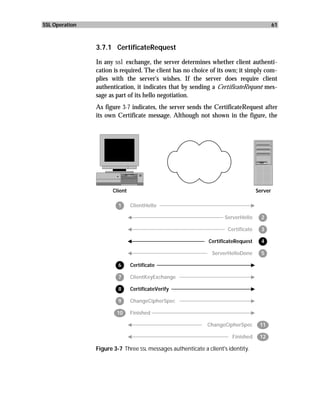
  • 175.
    164 SSL & TLS Essentials: Securing the Web Exactly how an implementation verifies that the certificate is for the intended subject depends on the policies of the certificate authority. VeriSign Class 3 certificates, for example, place the host name of the certified Web site in the commonName field of the certificate’s sub- ject. Both Netscape Navigator and Internet Explorer check this field against the host name that the user enters in the url (or that appears in the referring link). B.1.6 Diffie-Hellman Trapdoors When ssl implementations use ephemeral Diffie-Hellman key ex- change, the server specifies a full set of Diffie-Hellman parameters. There are, however, legitimate disagreements about what constitutes 1 sufficiently secure Diffie-Hellman parameters. Clients that support ephemeral Diffie-Hellman key exchange should check the parame- ters they receive from the server. They should ensure that the server has chosen values that the client believes will provide adequate secu- rity. B.1.7 Algorithm Rollback With a ServerKeyExchange message, an ssl server sends the client public key information the client needs to encrypt the premaster se- cret for the server. This key information is signed by the server using the private key corresponding to the public key in the server’s Cer- tificate message. The public key algorithm the client is to use, how- ever, is not specified explicitly in the ServerKeyExchange message, so that information is not signed by the server. This could make the ssl protocol vulnerable to an algorithm rollback attack. In an algorithm rollback attack, the attacker forces the two parties to have different opinions as to which public key algorithm is to be used _________________ 1 For example, in Network Security (Prentice-Hall, 1995), C. Kaufman, R. Perlman, and M. Speciner suggest that Diffie-Hellman prime numbers should have a special property that makes them strong primes. Bruse Schneier, on the other hand, argues in Applied Cryptography (John Wiley & Sons, 1996) that strong primes do not improve the security.
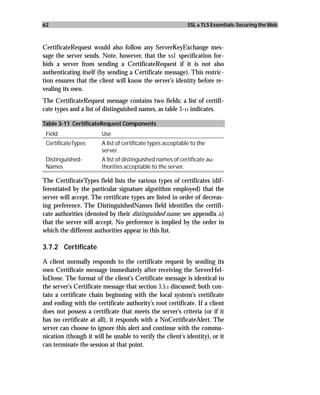
  • 176.
    SSL Security Checklist 165 to sign the premaster secret. The client, for example, might be fooled into believing that rsa encryption is appropriate, while the server ex- 2 pects Diffie-Hellman. David Wagner and Bruce Schneier show how this scenario leads to a complete breakdown of all cryptographic protection. The attacker is able to read all information for the session or to forge fake data in the name of either party. To protect against this algorithm rollback attack, ssl client imple- mentations should verify the length and number of parameters in any ServerKeyExchange message. As figures 4-10 and 4-11 indicated, rsa encryption requires only two parameters, while Diffie-Hellman uses three. If, in any received message, the lengths of the individual pa- rameters and the signed hash values do not add up to the correct length of the whole message, then the client should reject the session and generate an appropriate alert. B.1.8 Dropped ChangeCipherSpec Messages The ssl protocol does not include ChangeCipherSpec messages in the handshake authentication code that Finished messages carry. ChangeCipherSpec messages are omitted because ssl does not con- sider them to be Handshake protocol messages. (Recall that ChangeCipherSpec messages belong to their own separate ssl sub- protocol.) This omission does leave ssl implementations vulnerable to a particular attack when the parties use authentication-only (i.e., no encryption) sessions. To take advantage of this vulnerability, the attacker simply deletes the ChangeCipherSpec messages from the communication stream. Both parties will receive an apparently valid Finished message and begin transferring application data, without ever activating the cipher suite they have negotiated. (This attack is not feasible when the ses- sion uses encryption. In that case, the party sending a Finished mes- sage will encrypt it, while the party receiving the Finished message, _________________ 2 In “Analysis of the ssl 3.0 Protocol” (see the References section); this paper was the first to publish a description of this attack.
  • 177.
    166 SSL & TLS Essentials: Securing the Web not having seen the missing ChangeCipherSpec message, will expect it unencrypted.) Fortunately, combating this attack is very straightforward. An ssl implementation should not accept a Finished message unless it has also received a ChangeCipherSpec message. B.2 Encryption Issues Aside from the contentious legal issues that can limit the effective- ness of any security implementation, ssl is very effective in protect- ing the confidentiality of information. There are a few minor points to consider, however. This section reviews the importance of encryp- tion key size, and examines two other concerns about ssl encryption: a potential traffic analysis weakness and an attack first identified by Daniel Bleichenbacher. B.2.1 Encryption Key Size One important issue that arises repeatedly is the strength of the en- cryption that ssl offers. That strength depends most directly on the size of the keys used by the symmetric encryption algorithms, such as rc4 and des. In theory, developers could create ssl implementations that only used sufficiently large key sizes, and such implementations would be practically unbreakable. Some governments, however, place restrictions on the use or export of cryptography. The laws and regu- lations of the United States (home to many key ssl developers) forced the creation of the “export strength” ssl cipher suites, which, because of their limited key size, are much weaker than the protocol allows. Indeed, sessions encrypted using these cipher suites were suc- 3 cessfully attacked as early as 1995, and most security professionals today consider the ssl export strength cipher suites to offer only _________________ 3 Reported in “Netscape Security Encryption is Cracked—Breach Spurs Concern for Commerce on Internet,” San Jose Mercury News, 17 August 1995. Information is also available at http://pauillac.inria.fr/~doligez/ssl/.
  • 178.
    SSL Security Checklist 167 marginal security. The situation did not improve significantly when the u.s. government relaxed its regulations to allow export of stronger cryptography. The stronger 56-bit encryption was compromised in 4 1998. Secure Socket Layer implementations should carefully evaluate the value of the information they will protect and weigh that against the strength of the security they can offer. If the information is suffi- ciently valuable, and if the implementation would be subject to laws or regulations that would restrict its encryption strength, compromise solutions might be the most viable. Netscape’s International Step-Up and Microsoft’s Server Gated Cryptography are both examples of how stronger security is possible in the context of laws and regula- tions. B.2.2 Traffic Analysis Attackers may learn a lot about a target just by observing the traffic to and from that target, even if they cannot actually decrypt the in- formation. Traffic analysis, as such attacks are known, is difficult to defend against in an open environment such as the Internet. (Indeed, many Web sites like to publicize the amount and type of traffic they receive.) In any environment, however, the ssl protocol itself intro- duces an additional traffic analysis vulnerability. When ssl uses a stream cipher for encryption, the size of the encrypted messages can reveal the size of the unencrypted data; the attacker needs only to 5 subtract the size of the message authentication code. Bennet Yee has noted how this weakness could allow an attacker to discover some in- formation about an encrypted session, including, for example, which specific Web pages were retrieved by a user (though not the contents of those pages). This weakness is not present if block encryption ci- phers are used, since the padding they introduce effectively hides the exact size of the plaintext data. If the application warrants it, ssl im- _________________ 4 See Cracking DES: Secrets of Encryption Research, Wiretap Politics & Chip Design by the Electronic Frontier Foundation, published by O’Reilly & Associates in 1998. 5 As reported in Wagner and Schneier.
  • 179.
    168 SSL & TLS Essentials: Securing the Web plementations may choose to support only block encryption cipher suites in order to protect against this traffic analysis attack. B.2.3 The Bleichenbacher Attack In 1998, Daniel Bleichenbacher, a researcher at Lucent’s Bell Labora- tories, reported a specific active attack against security protocols that 6 use rsa encryption, including the ssl protocol. The attack takes ad- vantage of the way the rsa encryption algorithm encodes data before encrypting it. The encoded data (which ssl uses as a symmetric en- cryption key) always begins with the two bytes 00 and 02. Table b-1 shows how an attacker can exploit this characteristic. Table B-1 The Bleichenbacher Attack Step Action 1 The attacker carefully constructs many artificial ciphertext blocks and sends them to the target. (Since the attacker doesn’t know the target’s private key, the attacker won’t know how these ciphertext blocks will be decrypted. At this point, that is not important, though.) 2 The target receives the artificial ciphertext blocks and decrypts them. a For most of the blocks, the resulting “plaintext” will not con- form to the RSA encoding format. (It won’t begin with the bytes 00 and 02.) In those cases, the target generates an error or per- haps ignores the communication. b Occasionally a ciphertext block will happen to decrypt into plaintext that begins with the magic 00 and 02 bytes. In those cases, the target treats the decryption as successful and at- tempts to use the rest of the “plaintext” for its intended pur- pose. (Since the plaintext is effectively just random data, the target is likely to eventually realize that something is wrong with its data. By that time, however, it may be too late.) _________________ 6 Details can be found in Bleichenbacher’s paper “Chosen Ciphertext Attacks against Protocols Based on rsa Encryption Standard pkcs #1” in Advances in Cryptology— Crypto'98, lncs vol. 1462, pp. 1–12, 1998, published by Springer-Verlag. The attack is also described in rsa Laboratories’ Bulletin Number 7 (26 June 1998), available at this writing from the rsa Web site at http://www.rsasecurity.com/rsalabs/bulletins/.
  • 180.
    SSL Security Checklist 169 Step Action 3 The attacker observes the target’s reaction to each artificial ci- phertext block, noting which blocks cause response 2a and which cause response 2b. 4 By carefully choosing its artificial ciphertext blocks, and by re- fining those choices as the attack progresses, the attacker can use sophisticated mathematical analyses to decipher a related ciphertext block, perhaps one that was actually sent to the tar- get as part of legitimate communications. In practice, Bleichenbacher’s strategy does have a significant limita- tion. The number of artificial ciphertext blocks it requires can be quite large. For a 1024-bit rsa modulus (the standard key size for Web security not subject to u.s. export restrictions), the attacker 20 must generate about 2 (just over 1 million) different artificial cipher- text blocks. This limitation will likely warn any reasonably vigilant target that an attack may be under way. In addition, there are several other steps that ssl implementations can take to reduce their exposure to this attack. One step is to rigor- ously check the decrypted plaintext before accepting it as a valid de- cryption. In the case of received ClientKeyExchange messages, implementations should ensure that the premaster secret is the cor- rect size (48 bytes) and that the first 2 bytes are the ssl version num- ber, in addition to verifying the presence of the 00 and 02 bytes. Those steps alone will increase the number of artificial ciphertext 20 40 blocks the attack requires from 2 to more than 2 (about 20 mil- lion). Another design principle that can thwart this attack is to be very par- simonious in sending error responses. Ideally, an ssl implementation would behave consistently, whether it was unable to decrypt a Cli- entKeyExchange message or it decrypted successfully but found the resulting plaintext to be invalid. One possible implementation is to ignore the fact that decrypted ClientKeyExchange data does not conform to the rsa encoding format. (In other words, it does not be- gin with 00 02.) A convenient way to achieve this may be to replace any such invalid data with random data that does conform. The server
  • 181.
    170 SSL & TLS Essentials: Securing the Web will then detect and respond to the error just as if the invalid data had been appropriately formatted. Finally, please note that the symmetric encryption key that is en- crypted by the rsa algorithm is the only information at risk from this attack. The attack does not compromise any rsa private keys. B.3 General Issues A few important issues do not easily fit the categories of either au- thentication or encryption. This section discusses those issues, in- cluding the problems of rsa key size, version rollback attacks, premature closures, session id values, random number generation, and random number seeding. B.3.1 RSA Key Size The majority of ssl implementations today use the rsa encryption algorithm for digital signatures and public key encryption. The strength of the rsa algorithm depends directly on the size of the rsa public key. Longer keys yield more secure implementations. As the availability of computing power has increased and its cost has de- creased, key sizes that were once thought adequately secure are now susceptible to brute-force attacks. While the author was preparing this manuscript, a team of researchers announced that they had suc- 7 cessfully cracked an rsa key of 512 bits, the same key size that (due to u.s. export restrictions) is commonly used to secure most Web transactions. The team used several hundred computers full-time for seven months, so there may not be an immediate practical threat to existing systems, but rsa Laboratories recommends 768 bits as the minimum acceptable key size for the rsa algorithm. It is important to understand that a weakness or compromise of the rsa algorithm may be far more severe than one in symmetric encryp- _________________ 7 See http://www.rsasecurity.com/rsalabs/factoring/rsa155.html.
  • 182.
    SSL Security Checklist 171 tion algorithms such as rc4 or des. Symmetric algorithms provide the encryption for individual ssl sessions. If a particular symmetric encryption key is compromised, only information from the session that used the key is exposed. The rsa public key algorithm, however, is used both to authenticate parties and to securely exchange all ses- sion keys. If a particular rsa private key is compromised, then the owner of that key is vulnerable to impersonation, and the informa- tion from all ssl sessions with that party may be exposed. B.3.2 Version Rollback Attacks Secure Sockets Layer version 3.0 introduced several improvements to version 2.0, including those that increased the security of the proto- col. It is important, therefore, that two parties that are capable of us- ing version 3.0 actually do so, instead of falling back to the less secure version 2.0. As section 5.1.1 indicated, the ssl specification outlines a very specific approach to protect against attacks that force a version rollback. There is, however, one area that the specification does not address: resumption of prior sessions. A cursory ssl implementation might allow a session that had previously been established using ver- sion 3.0 to be resumed using version 2.0. Such an implementation would comply with the ssl standard. Careful implementations, though, should not allow this behavior. If a session is established us- ing ssl version 3.0, then the implementation should ensure that all attempts to resume the session also use ssl version 3.0. B.3.3 Premature Closure Another general security issue is the threat of truncation attacks due to the premature closure of an ssl session. If an attacker can delete protocol messages in transit, that attacker could create a scenario in which one or both of the communicating parties only receive partial information. If the missing information is vital to the communica- tions, the attacker will have compromised the overall security of the exchange. As section 3.4 discussed, the ssl protocol defines the Clo- sureAlert message to protect against this type of attack. (Although the ClosureAlert can’t prevent the attack, the absence of a Clo-
  • 183.
    172 SSL & TLS Essentials: Securing the Web sureAlert message at least alerts the parties to the potential problem.) Unfortunately, not all environments can rely on the ClosureAlert. Web browsing users, for example, may simply turn off their personal computer after completing a transaction, before that computer has a chance to send a ClosureAlert message. More thorough protection requires that applications using ssl security be sensitive to the possi- bility of premature closures. Web servers that support the HyperText Transfer Protocol (http), for example, include a Content-Length field with each page they send to a client. Clients should verify that the amount of data they receive is consistent with this field’s value. B.3.4 SessionID Values The ssl specification gives servers complete flexibility to choose par- ticular SessionID values. In making this choice, server implementa- tion should be careful not to include any critical security information. SessionID values are transferred in ClientHello and ServerHello messages before any encryption is active. Their values, therefore, are completely exposed to any potential attacker. B.3.5 Random Number Generation Random numbers are critical to the operation of the Secure Sockets Layer protocol. The random numbers exchanged in ClientHello and ServerHello messages ultimately determine the encryption key for the session. Random numbers, however, present an interesting chal- lenge to computer systems; software cannot do anything truly ran- domly. Instead, software implementations typically rely on algorithms known as pseudorandom number generators. These algo- rithms simulate true randomness with complex mathematical calcu- lations. There are two problems with pseudorandom number generators that should concern ssl and other security implementations. The first problem is the effectiveness of the algorithms themselves. Most software libraries generate pseudorandom numbers using a linear congruential generator algorithm. Although such algorithms can be ef- fective pseudorandom number generators, they can also be quite ineffective. Furthermore, many developers seek to improve on the
  • 184.
    SSL Security Checklist 173 effective. Furthermore, many developers seek to improve on the basic algorithm in ways that can, in fact, be quite disastrous. Press, Teukol- sky, Vetterling, and Flannery report on one widely used pseudoran- dom number generator that, in an extreme case, effectively generated 8 only 11 distinct random values. A more serious problem with linear congruential generators is that they are sequential, and completely predictable. If you know the pa- rameters of the algorithm and one specific value, it is easy to predict all future values that the algorithm will generate. Predictable random numbers are a serious problem for any security protocol, as they allow attackers to plan and prepare well into the future, waiting, perhaps, for a single, compromised value to appear. Implementations of ssl, therefore, should be careful not to use common pseudorandom num- ber generator libraries. Fortunately, standard cryptography algo- rithms, including both encryption and hash algorithms, can be 9 modified to provide effective random numbers. B.3.6 Random Number Seeding Regardless of the algorithm implementations used to generate ran- dom numbers, implementations typically must provide that algo- rithm with an initial starting point, or seed. For applications other than security, the primary requirement for this seed is that it be dif- ferent each time it is generated. That ensures, for example, that a computer game does not act the same at each playing. That has led many developers to use some form of the time of day as the seed. For security applications, however, random seeds not only must be differ- ent, they must also be unpredictable. The time of day is rarely unpre- 10 dictable. Indeed, Matthew Schmid reports a successful attack _________________ 8 In the second edition of Numerical Recipes in C: The Art of Scientific Computing (Cambridge University Press, 1992), p. 277. Chapter 7 includes a thorough (and so- bering) discussion of random number generation. 9 More information is available from rsa Laboratories’ Bulletins Number 1 (22 Janu- ary 1996) and Number 8 (3 September 1998), available as of this writing at http://www.rsasecurity.com/rsalabs/bulletins/. 10 In a posting to the Risks Forum at http://catless.ncl.ac.uk/Risks/20.56.html.
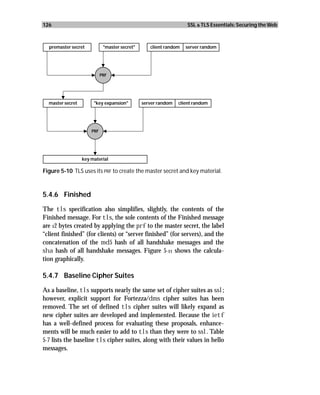
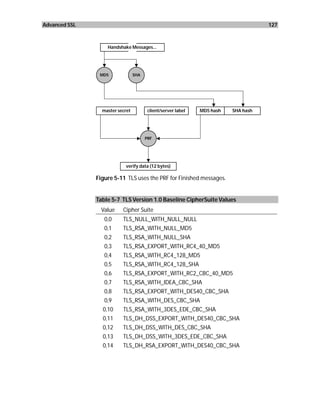
  • 185.
    174 SSL & TLS Essentials: Securing the Web against several online gambling sites that rely on flawed software for their online poker games. The software used the time of day to seed its random number generator and, as a result, attackers were able to successfully predict the cards in every player’s hand. Although not strictly ssl-related, the lesson is clear: using the time of day for ran- 11 dom seeds is totally unacceptable for ssl implementations. _________________ 11 Bulletins from rsa Laboratories, in this case Numbers 1 (22 January 1996) and 3 (25 January 1996), offer detailed advice on seeding random number generators. See http://www.rsasecurity.com/rsalabs/bulletins/.
  • 186.
    References The following sourceshave more detailed information on many top- ics in this text. Individual references, with commentary, are grouped by protocol standards, certificate formats, cryptographic algorithms, and ssl implementations. Protocol Standards The official specification for the Secure Sockets Layer Protocol (ver- sion 3.0) is available in several formats from the Netscape Web site at http://www.netscape.com/eng/ssl3/. Alan O. Freier, Philip Karlton, and Paul C. Kocher. The SSL Pro- tocol Version 3.0. Netscape Communications Corporation. 4 March 1996. Please note that some of the formats include errata to the original specification. The errata itself are also available from the same site. SSL 3.0 Errata. 26 August 1996. The Transport Layer Security specification is a proposed standard of the Internet Engineering Task Force (ietf). ietf documents may be found from the organization’s Web site at http://www.ietf.org. T. Dierks and C. Allen. The TLS Protocol Version 1.0 [rfc 2246]. The Internet Engineering Task Force, January 1999. Additional information on tls, including other related documents, meeting minutes, and mailing list archives, is available on the ietf Web site at http://www.ietf.org/html.charters/tls-charter.html. Formal, detailed documents on Netscape’s International Step-Up or Microsoft’s Server Gated Cryptography are not available as of this writing; however, each company’s Web site does include some infor- mation. The information Netscape makes available may be found at 175
  • 187.
    176 SSL & TLS Essentials: Securing the Web http://developer.netscape.com/tech/security/stepup/, while Microsoft describes sgc at http://www.microsoft.com/security/tech/sgc/. In ad- dition, VeriSign has some information on both enhancements in the description of its Global Site id available from its home page at http://www.verisign.com. Finally, the definitive security analysis of the Secure Sockets Layer protocol is that of David Wagner and Bruce Schneier. Their paper is available at http://www.counterpane.com/ssl.html. David Wagner and Bruce Schneier. “Analysis of the ssl 3.0 Protocol,” The Second USENIX Workshop on Electronic Commerce Proceedings, usenix Press, November 1996, pp. 29– 40. Certificate Formats The x.509 specifications for public key certificates are available, for a fee, from the International Telecommunications Union. These can be purchased directly from the itu Web site at www.itu.ch. (Yes, the itu does use ssl to secure this electronic commerce!). The x.509 standard itself contains the definition of a certificate; x.680 through x.683 define the Abstract Syntax Notation One, and x.690 defines the distinguished encoding rules for encoding asn.1. Note that many of the itu specifications have amendments and corrections (which the itu calls corrigenda) which are also available from the itu. Recommendation X.509 (08/97) - Information technology - Open Systems Interconnection - The Directory: Authentication frame- work. The International Telecommunications Union, August 1997. Recommendation X.680 (12/97) - Information technology - Abstract Syntax Notation One (ASN.1): Specification of basic notation. The International Telecommunications Union, December 1997. Recommendation X.681 (12/97) - Information technology - Abstract Syntax Notation One (ASN.1): Information object specification.
  • 188.
    References 177 The International Telecommunications Union, December 1997. Recommendation X.682 (12/97) - Information technology - Abstract Syntax Notation One (ASN.1): Constraint specification. The In- ternational Telecommunications Union, December 1997. Recommendation X.683 (12/97) - Information technology - Abstract Syntax Notation One (ASN.1): Parameterization of ASN.1 specifi- cations. The International Telecommunications Union, De- cember 1997. Recommendation X.690 (12/97) - Information technology - ASN.1 encoding rules; Specification of Basic Encoding Rules (BER), Ca- nonical Encoding Rules (CER) and Distinguished Encoding Rules (DER). The International Telecommunications Union, December 1997. Cryptographic Algorithms Three cryptographic algorithms of particular importance to many ssl implementations are the md5 and sha hash algorithms and the rsa public key encryption (and digital signature) algorithm. Descriptions of these algorithms may be found in the following references. National Institute of Standards and Technology. "Secure Hash Standard [nist fips pub 180-1].” u.s. Department of Com- merce. Work in progress, May 31, 1994. R. Rivest. The MD5 Message-Digest Algorithm [rfc 1321]. Internet Engineering Task Force, April 1992. R. Rivest, A. Shamir, and L. Adleman. “A Method for Obtain- ing Digital Signatures and Public-Key Cryptosystems.” Communications of the ACM, 21(2), pp. 120–126, February 1978. In addition, the following two books cover these cryptographic algo- rithms, as well as many others. Schneier’s work is thorough and comprehensive; the Kaufman et al. text is more introductory in na-
  • 189.
    178 SSL & TLS Essentials: Securing the Web ture, with particular emphasis on security for network communica- tions. C. Kaufman, R. Perlman, and M. Speciner. Network Security: Private Communications in a Public World. Prentice Hall, 1995. Bruce Schneier. Applied Cryptography Second Edition: Protocols, Algorithms, and Source Code in C. John Wiley and Sons, Inc., 1996. SSL Implementations In addition to reference text, some readers may appreciate actual software source code implementations of the ssl protocol. Although many vendors offer commercial software that implements ssl, two source code implementations are available for free. Netscape provides a reference implementation of ssl (currently restricted to the United States). As of this writing, information is available from Netscape at http://www.netscape.com/products/security/ssl/reference.html. Additionally, the OpenSSL Project is a collaborative effort to develop an ssl toolkit available as open source software. The project’s home page is http://www.openssl.org/.
  • 190.
    Glossary Abstract Syntax NotationOne (ASN.1). A language for describing data and data objects, used to define x.509 public key certifi- cates. Active Attack. An attack against a secure communications session in which the attacker creates and sends his or her own messages or modifies legitimate messages in transit between the communicating parties. Alert Description. A single-byte value that identifies the type of ssl alert. Alert Message. An ssl message that indicates that the sender has detected an error condition. Alert Protocol. A component of the ssl protocol that defines the format of Alert messages. Alteration. An attack in which the attacker attempts to modify in- formation without being detected. Asymmetric Encryption. The technical term for public key encryp- tion in which two different keys are used for encryption and decryption; one of the keys can be revealed publicly without compromising security. Asymmetric Key Cryptography. Cryptography based on asymmet- ric encryption; depending on the particular algorithms em- ployed, asymmetric key cryptography can provide encryption/decryption or digital signature services. Attack. An attempt to compromise or defeat the security of a com- munications session. Authentication. A security service that validates the identity of a communicating party. 179
  • 191.
    180 SSL & TLS Essentials: Securing the Web BIT STRING. An asn.1 primitive object that represents an arbitrary number of bits. Block Cipher. A cipher that encrypts and decrypts data only in fixed-size blocks. BOOLEAN. An asn.1 primitive object that represents a value that can only be true or false. Certificate. A public key certificate, digital information that identi- fies a subject and that subject’s public key and is digitally signed by an authority that certifies the information it con- tains. Certificate Authority (CA). An organization that issues certificates and vouches for the identities of the subjects of those certifi- cates; also known as an issuer. Certificate Chain. A series of certificates including a subject’s cer- tificate, the certificate for the root authority, and any inter- mediate certificate authorities; it establishes a chain of trust from the subject all the way to the root. Certificate Message. An ssl handshake message that carries a cer- tificate chain. CertificateRequest Message. An ssl handshake message that the server sends to ask the client to authenticate its identity. Certificate Type. Part of an ssl CertificateRequest message that in- dicates the digital signature and public key algorithms that the sender will accept. CertificateVerify Message. An ssl handshake message that the cli- ent sends to verify that it possesses the private key corre- sponding to its certificate; the client digitally signs part of the message using that private key. ChangeCipherSpec Message. An ssl message that activates the negotiated security parameters; those parameters will be in effect for the next message that the sender transmits.
  • 192.
    Glossary 181 ChangeCipherSpec Protocol. The ssl protocol for Change- CipherSpec messages. CHOICE. An asn.1 construction that specifies that exactly one of the indicated objects may be present. Cipher. An algorithm that encrypts and decrypts information. Cipher Suite. A cipher algorithm and the parameters necessary to specify its use (e.g., size of keys.) Ciphertext. Information that has been encrypted using a cipher. Class (of a tag). The context under which an asn.1 tag is defined: universal, application-specific, private, and context-specific. Client. The party that initiates communications; clients communi- cate with servers. ClientHello Message. An ssl handshake message that the client sends to propose cipher suites for the communication. ClientKeyExchange Message. An ssl message that the client sends to give the server information needed to construct key mate- rial for the communication. Compression Method. A particular data compression algorithm and parameters needed to specify its use. Confidentiality. A security service that protects information from being correctly interpreted by parties other than those par- ticipating in the communication. Cryptanalysis. The science concentrating on the study of methods and techniques to defeat cryptography. Cryptography. The science concentrating on the study of methods and techniques to provide security by mathematical manipu- lation of information. Cryptology. The science encompassing both cryptography and cryptanalysis. Data Encryption Standard (DES). A symmetric encryption algo- rithm published by the National Institutes of Science and
  • 193.
    182 SSL & TLS Essentials: Securing the Web Technology as a United States standard; des is a block ci- pher operating on 56-bit blocks. Decipher. To decrypt encrypted information. Decryption. The complement of encryption, recovering the original information from encrypted data. Diffie-Hellman. A key exchange algorithm developed by W. Diffie and M.E. Hellman; first published in 1976. Digest Function. A cryptographic function that creates a digital summary of information so that, if the information is altered, the summary (known as a hash) will also change; also known as a hash function. Digital Signature. The result of encrypting information with the private key of a public/private key pair; the public key can be used to successfully decrypt the signature, proving that only someone possessing the private key could have created it. Digital Signature Algorithm (DSA). An asymmetric encryption al- gorithm published as a u.s. standard by the National Insti- tutes of Science and Technology; dsa can only be used to sign data. Distinguished Encoding Rules (DER). A process for unambiguously converting an object specified in asn.1 into binary values for storage or transmission on a network. Distinguished Name. The identity of a subject or issuer specified according to a hierarchy of objects defined by the itu. Eavesdropping. An attack against the security of a communication in which the attacker attempts to “overhear” the communica- tion. Encipher. To encrypt information by applying a cipher algorithm; the result is unintelligible, and the original information can only be recovered by someone who can decipher the result. Encryption. The process of applying a cipher algorithm to informa- tion, resulting in data that is unintelligible to anyone who
  • 194.
    Glossary 183 does not have sufficient information to reverse the encryp- tion. Ephemeral Diffie-Hellman. Diffie-Hellman key exchange in which the necessary parameters are created just for a single com- munications session. Explicit Diffie-Hellman. Diffie-Hellman key exchange in which some of the parameters are established in advance. Explicit Tag. A type of asn.1 tag in which the tag value for the tagged object’s type is also included in the encoding. Exportable. Said of security products that may be easily licensed for export from the United States, generally those with encryp- tion algorithms that only use limited key sizes. File Transfer Protocol (FTP). An Internet application protocol for transferring files among computer systems; ssl can provide security for ftp communications. Finished Message. An ssl handshake message that indicates the sender has completed security negotiations. Forgery. An attack against secure communications in which the at- tacker tries to create data that appears to come from one of the communicating parties. Fortezza. A classified encryption and key exchange algorithm de- veloped by the u.s. government, the details of which are not publicly known. Global Secure ID. The brand name for Web security certificates, is- sued by VeriSign, that support International Step-Up and Server Gated Cryptography. Handshake Protocol. A component protocol of ssl responsible for negotiating security parameters. Hash Function. A cryptographic function that creates a digital summary of information so that, if the information is altered, the summary (known as a hash) will also change; also known as a digest function.
  • 195.
    184 SSL & TLS Essentials: Securing the Web Hashed MAC. A standard approach to using hash algorithms to cre- ate secure message authentication codes. HelloRequest Message. An ssl handshake message with which the server requests that a client restart negotiations. HyperText Transfer Protocol (HTTP). The application protocol for Web browsing; ssl can add security to http applications. IA5String. An asn.1 primitive object representing a character string from the ascii character set. Implicit Tag. A type of asn.1 tag in which the tag value for the tagged object’s type is not included in the encoding. Initialization Vector (IV ). Random data that serves as the initial in- put to an encryption algorithm so that the algorithm may build up to full strength before it encrypts actual data. INTEGER. An asn.1 object that represents a whole number. International Step-Up. Developed by Netscape; an addition to normal ssl procedures that allows servers to determine whether a client can exercise latent security services that are otherwise not permitted by u.s. export laws; similar (but not identical) to Server Gated Cryptography. International Telecommunications Union (ITU). An international standards body responsible for telecommunications proto- cols; the itu publishes the x.509 standards for public key cer- tificates. Internet Engineering Task Force (IETF). An international standards body responsible for Internet protocols; the ietf publishes the Transport Layer Security specifications. Internet Protocol (IP). The core network protocol for the Internet; ip is responsible for routing messages from their source to their destination. IP Security Protocol (IPSEC). Enhancements to the Internet Proto- col that allow it to provide security services.
  • 196.
    Glossary 185 Issuer. An organization that issues certificates and vouches for the identities of the subjects of those certificates; also known as a certificate authority. Kerberos. A network security protocol designed to provide authori- zation and access control services. Key. Information needed to encrypt or decrypt data; to preserve se- curity, symmetric encryption algorithms must protect the confidentiality of all keys, while asymmetric encryption algo- rithms need only protect private keys. Key Exchange Algorithm. An algorithm that allows two parties to agree on a secret key without actually transferring the key value across an insecure channel; the best known example is the Diffie-Hellman key exchange. Key Management. The procedures for creating and distributing cryptographic keys. MAC Read Secret. A secret value input to a message authentication code algorithm for verifying the integrity of received data; one party’s mac write secret is the other party’s mac read se- cret. MAC Write Secret. A secret value input to a message authentication code algorithm to generate message authentication codes for data that is to be transmitted; one party’s mac write secret is the other party’s mac read secret. Man-in-the-Middle Attack. An attack against secure communica- tions in which the attacker interposes itself between the communicating parties, relaying information between them; the attacker can seek either to read the secured data or to modify it. Masquerade. An attack against secure communications in which the attacker attempts to assume the identity of one of the communicating parties. Master Secret. The value created as the result of ssl security nego- tiations, from which all secret key material is derived.
  • 197.
    186 SSL & TLS Essentials: Securing the Web Message Authentication Code (MAC). An algorithm that uses cryptographic technology to create a digital summary of in- formation so that, if the information is altered, the summary (known as a hash) will also change. Message Digest 5 (MD5). A digest function designed by Ron Rivest and used extensively by ssl. Message Integrity. A security service that allows detection of any alteration of protected data. Net News Transfer Protocol (NNTP). An Internet application for transfer of news and news group information; nntp can be secured with ssl. Non-repudiation. A security service that prevents a party from falsely denying that it was the source of data that it did in- deed create. NULL. An asn.1 primitive object that represents no information. OBJECT IDENTIFIER. An asn.1 primitive type that represents objects in an internationally administered registry of values. OCTET STRING. An asn.1 primitive type representing an arbitrary array of bytes. Padding. Extra data added to information to force a specific block size. Passive Attack. An attack against secure communications in which the attacker merely observes and monitors the communicat- ing parties without actively participating in the communica- tions. Plaintext. Information in its unencrypted (and vulnerable) form be- fore encryption or after decryption. Premaster Secret. An intermediate value ssl implementation uses in the process of calculating key material for a session; the client usually creates the premaster secret from random data and sends it to the server in a ClientKeyExchange message.
  • 198.
    Glossary 187 PrintableString. An asn.1 primitive type that represents an array of characters, all of which have textual representations. Private Communication Technology (PCT ). A technology devel- oped by Microsoft that borrows from and improves upon ssl version 2.0; many of its features were incorporated into ssl version 3.0. Private Key. One of the keys used in asymmetric cryptography; it cannot be publicly revealed without compromising security, but only one party to a communication needs to know its value. Pseudorandom Function (PRF). An algorithm tls defines to gen- erate random numbers for use in key material message integ- rity. Pseudorandom Number. A number generated by a computer that has all the properties of a true random number. Public Key. One of the keys used in asymmetric cryptography; it can be publicly revealed without compromising security. Public Key Certificate. Digital information that identifies a subject and that subject’s public key and that is digitally signed by an authority that certifies the information it contains. Public Key Cryptography. Cryptography based on asymmetric en- cryption in which two different keys are used for encryption and decryption; one of the keys can be revealed publicly without compromising the other key. Record Layer. The component of the ssl protocol responsible for formatting and framing all ssl messages. Rivest Cipher 2 (RC2). A block cipher developed by Ron Rivest. Rivest Cipher 4 (RC4). A stream cipher developed by Ron Rivest. Rivest Shamir Adleman (RSA). An asymmetric encryption algo- rithm named after its three developers; rsa supports both encryption and digital signatures.
  • 199.
    188 SSL & TLS Essentials: Securing the Web Secret Key. A key used in symmetric encryption algorithms and other cryptographic functions in which both parties must know the same key information. Secret Key Cryptography. Cryptography based on symmetric en- cryption in which both parties must possess the same key in- formation. Secure Hash Algorithm (SHA). A hash algorithm published as a u.s. standard by the National Institutes of Science and Technol- ogy. Secure HyperText Transfer Protocol (S-HTTP). An addition to the HyperText Transfer Protocol application that provides secu- rity services. Secure Sockets Layer (SSL). A separate network security protocol developed by Netscape and widely deployed for securing Web transactions. SEQUENCE. An asn.1 construction that represents an ordered collec- tion of more primitive objects. SEQUENCE OF. An asn.1 construction representing a collection of multiple instances of a single, more primitive object, in which the order of the instances is important. Server. The party in a communication that receives and responds to requests initiated by the other party. Server Gated Cryptography (SGC). Developed by Microsoft, an addition to normal ssl procedures that allows servers to de- termine whether a client can exercise latent security services that are otherwise not permitted by u.s. export laws; similar (but not identical) to International Step-Up. ServerHello Message. An ssl handshake message in which the server identifies the security parameters that will be used for the session. ServerHelloDone Message. An ssl handshake message that the server sends to indicate it has concluded its part of the hand- shake negotiations.
  • 200.
    Glossary 189 ServerKeyExchange Message. An ssl handshake message in which the server sends public key information that the client should use to encrypt the premaster secret. SessionID. The value ssl servers assign to a particular session so that it may be resumed at a later point with full renegotiation. SET. An asn.1 construction that represents an unordered collection of more primitive objects. SET OF. An asn.1 construction that represents a collection of multi- ple instances of a single, more primitive object, in which the order of the instances is not important. Severity Level. A component of an ssl alert message that indicates whether the alert condition is fatal or merely a warning. Signature. The encryption of information with a private key; any- one possessing the corresponding public key can verify that the private key was used, but only a party with the private key can create the signature. Stream Cipher. A cipher that can encrypt and decrypt arbitrary amounts of data, in contrast to block ciphers. Subject. The party who possesses a private key and whose identity is certified by a public key certificate. Symmetric Encryption. The technical term for secret key encryp- tion in which encryption and decryption require the same key information. Symmetric Key Cryptography. Cryptography based on symmetric encryption; depending on the particular algorithms em- ployed, symmetric key cryptography can provide encryp- tion/decryption and message integrity services. Tag. A value associated with an asn.1 object that allows that particu- lar object to be unambiguously identified in encoded data. TeletexString. An asn.1 primitive type representing character strings limited to Teletex characters.
  • 201.
    190 SSL & TLS Essentials: Securing the Web Traffic Analysis. A passive attack against secure communications in which the attacker seeks to compromise security merely by observing the patterns and volume of traffic between the parties, without knowing the contents of the communica- tion. Transmission Control Protocol ( TCP). A core protocol of the Inter- net that ensures the reliable transmission of data from source to destination. Transport Layer Security ( TLS). The ietf standard version of the Secure Sockets Layer protocol. UTCTime. An asn.1 primitive object that represents time according the universal standard (formerly known as Greenwich Mean Time). X.509. An itu standard for public key certificates.
  • 202.
    Index A Asymmetric cryptography, 24–25, 28 at&t Certificate Services, 6 Abstract Syntax Notation One AttributeValueAssertion, x.509, 151 (asn.1), 131, 135–147, 163 Authentication: important constructions in, 137 of client’s identity, 60–61 primitive objects in, 136 of messages, 121 tags in, 139–141 Secure Sockets Layer (ssl) proto- Alert message, 38 col and, 161–162 Alert protocol, 67, 69, 71–74 separation of cryptography from, message types, 118–121 56–58 AlgorithmIdentifier, 133, 145–147 of server, 52–54 Algorithm rollback attack, 164–165 Algorithms. See also specific algo- B rithms cryptography, 104 Big endian, 70 Data Encryption Standard (des), bit string, 136, 141, 144–145 49–50 Bleichenbacher attack, 166, 168–170 Diffie-Hellman, 28–29 Block ciphers, 22–23 Digital Signature Algorithm Block cryptography, 95–96 (dsa), 27, 56 boolean, 136, 140 Fortezza/dms, 81, 83, 85, 87, 104 hash, 104 C key exchange, 103 Certificate authorities (ca), 6, 29, 31– linear congruential generator, 172 32, 80–81, 162 Message Digest 5 (md5), 21, 49– public key, x.509, 134 50, 90, 93–94, 100–101, 124 root authorities and, 34 Rivest Shamir Adleman (rsa) Certificate chains, 80 algorithm, 26, 45, 81–83, 85–86 Certificate hierarchies, 33–34, 80 Secure Hash Algorithm (sha), 21, Certificate message, 39, 55–56, 58–59, 90–91, 93–94, 124 62, 80–81, 86 ApplicationData message, 38 Certificate object, x.509, 145–146 Application protocol data, 69, 71 Application-specific tags, 140 191
  • 203.
    192 SSL & TLS Essentials: Securing the Web CertificateRequest message, 39, 61– ClientKeyExchange message, 39, 85– 62, 84 87, 96–97, 108, 131, 169 Certificate revocation lists (crl), 35 ssl operation and, 45–46, 56, 58– Certificate revocation status, 163 59, 63 Certificates, 29–30, 115, 163 Client’s identity, authentication of, CertificateSerialNumber object, 60–61 x.509, 147 Client state processing, 49–50 Certificate types, 85 ClosureAlert message, 52, 171–172 Certificate validity times, 163 CommonName, 134 CertificateVerify message, 39, 63, 75, Compression methods, 43 88–90, 92, 125 Constructed objects, x.509, 136–137 ChangeCipherSpec message, 39, 46– Constructions, asn.1, 137 51, 65, 72, 92, 95, 165–166 Core protocols, security within, 10 ChangeCipherSpec protocol, 67, 69– Cryptographic parameters, creation 70 of, 96–102 choice, 137 Cryptography, 17–35, 95–96, 166 Ciphers, 19, 22–23 algorithms, 22, 104 Cipher suites, 48–49, 77–79, 86, 93, asymmetric, 24–25, 28 102, 166 full-strength, control of, 113 algorithms, 102–103 issues in, 166 baseline, 126–128 public key, 17, 21, 24–25, 27, 29 exportable, 101 secret key, 17, 21–24, 27 renegotiation of, 115–117 symmetric, 22, 28 ssl version 2.0 and, 110–111 types of, 21–29 supported by ssl, 78–79, 102–104 Cyclic redundancy check (crc), 21 supported by tls, 126–128 Ciphertext information, 22 D Client, vs. server, 37 Data Encryption Standard (des), Client components, 112 49–50 ClientHello message, 39, 65, 83, 113, Diffie-Hellman, 81, 83, 85–87, 96–97, 117, 128 165 components of, 41–43 algorithm, 28–29 recognition of ssl versions and, ephemeral, 86 106–108 trapdoors in, 164 SessionID values and, 172 Digital signature, 135 ssl cipher suites and, 77–79 Digital Signature Algorithm (dsa), ssl version 2.0 and, 109–110 27, 56
  • 204.
    Index 193 Distinguished Encoding Rules Hash, 89, 91–92. See also Message (der), 142–143 Digest 5 (md5) Distinguished name, 62, 133 Hash algorithms, 104 Hashed Message Authentication E Code (h-mac), 121–122 Electronic commerce, 2–4 Hash functions, 20–21, 97 Encoding rules, 142 Hello message. See ClientHello mes- Encrypted communications, 39–41 sage; ServerHello message Encryption algorithms. See algo- HelloRequest message, 39, 76 rithms h-mac. See Hashed Message Au- Environmental limitations, security thentication Code (h-mac) and, 14 Hypertext Transfer Protocol (http), European Telecommunication Stan- 8–11, 13, 67 dards Institute, 138 Extension bit, 143 I Extensions field, x.509, 135 IA5String, 136, 141, 144 Extensions object, x.509, 149 Identity, proving, 19–20 extKeyUsage, x.509, 149 Information, verifying, 20 Initialization vector, 23 F integer, 136, 141, 144 File Transfer Protocol (ftp), 9–10 International Standards Organiza- Finished message, 39, 51, 65, 90, 92, tion (iso), 137 126, 165–166 International Step-Up, 111–116, 135, 149, 167 Fortezza/dms, 81, 83, 85, 104 ClientKeyExchange parameters, International Telecommunications 87 Union (itu), 131 Internet Engineering Task Force G (ietf), 5, 9, 117–118, 126, 128, 137 Internet Explorer. See Microsoft, Global Secure id, 115 Internet Explorer gte CyberTrust, 6 Internet Protocol (ip), 8, 117 ip Security (ipsec), 10–11, 117 H Issuer field, x.509, 133 Handshake message, 165 Issuer Unique Identifier, x.509, 134 Handshake protocol, 67, 69, 74–77, 80, 92
  • 205.
    194 SSL & TLS Essentials: Securing the Web K Server Gated Cryptography (sgc), 112, 115–117, 135, 149, 167 Kerberos, 11–12 Key, 21–22 N exchange algorithms, 28, 103 expansion, 125 Name attribute types, x.509, 152 management of, 29 Name object, x.509, 150 private, 26 National Center for Supercomputing public, 26–27 Applications (ncsa), 4 size, encryption and, 166 Net News Transfer Protocol (nntp), size, Rivest Shamir Adleman 9–10 (rsa) algorithm and, 170–171 Netscape, 4–5, 55, 111–113 Key material, 101, 123, 125–126 International Step-Up, 111–116 KeyWitness International, 6 Navigator, 4, 6, 32, 164 Network security, approaches to, 6–7 L NoCertificateAlert message, 62 NoCertificate message, 118 Linear congruential generator algo- Non-repudiation, 13 rithm, 172 null, 136, 141 Location, tags and, 140 M O object identifier, 136–141, 144–145, Man-in-the-middle attack, 108 147 Master secret, 86, 88–89, 91, 96, 100– x.509, 149, 151, 158 101, 121, 125–126 Object Identifier Hierarchy, 137–138 calculation of, 97–99 octet string, 136, 141, 144 Message authentication, 121 Open Settlement Protocol, 129 Message Authentication Code (mac), 49, 93–95, 104 P write secret, 93–94 Message Digest 5 (md5), 21, 49–50, Padding, 23, 91, 95 90, 93–94, 100–101, 124 Parameterized type, 145 Message formats, 67–104 Period of Validity, x.509, 133 Microsoft, 5–6, 55, 111–112, 117 Plaintext information, 22 Internet Explorer, 6, 32, 117, 164 Premaster secret, 86, 96–97, 125 Private Communication Technol- Previous session, resumption of, 64– ogy (pct), 5 65 Primitive objects, asn. 1, 136
  • 206.
    Index 195 PrintableString, 136, 141 Securing messages, 92 Private Communication Technology Separate Security Protocol, 8–9 (pct), 5 sequence, 137, 141, 145–146, 148 Private-use tags, 140 sequence of, 137, 141 Protocol limitations, 12–14 Serial Number, x.509 Certificates Pseudo-random function (prf), 124– and, 133 125 Server, vs. client, 38 Pseudo-random number generation, Server Gated Cryptography (sgc), 42 112, 115–117, 149, 167 Pseudo-random output, 123–124 certificates, 115 Public key certificates, 29–30 x.509, 135 Public key cryptography, 17, 21, 24–25, ServerHelloDone message, 39, 45, 62, 27, 29 85, 117 ServerHello message, 39, 43–45, 65, R 79–81, 83, 113, 128 Random numbers, 27–28, 172–174 CipherSuite field of, 44 Read state, 46–47 CompressionMethod field of, 44– Record Layer message, 71–72, 74–75, 45 77, 95 RandomNumber field of, 43–44 Record Layer protocol, 67, 69–71, 93 SessionID field of, 44 RelativeDistinguishedName, x.509, SessionID values and, 172 151 ssl version 2.0 and, 110 Rivest Shamir Adleman (rsa) algo- version field of, 43–44 rithm, 26, 45, 81–83, 85–86 ServerKeyExchange message, 81–84, 164–165 key size and, 170–171 Root authority, 34 CipherSuite field of, 45 ssl operation and, 39, 45, 55–56, S 58–59, 62–63 Server’s identity, authentication of, Secret key cryptography, 17, 21–24, 27 52–54 Secure communications, ending of, Server state processing, 50 52 SessionID, 65, 78, 80, 172 Secure Hash Algorithm (sha), 21, set, 137, 141, 145 90–91, 93–94, 124 set of, 137, 141 Secure Sockets Layer (ssl) protocol, Shared secret information, 99 1, 37–38, 68–69, 121, 128–129 Signature field, x.509, 135 security checklist for, 161–174
  • 207.
    196 SSL & TLS Essentials: Securing the Web ssl messages, 38–51. See also specific U messages UniqueIdentifier object, x.509, 150 ssl version 2.0, 4–6, 41, 105–111, 117, Universal tags, 140 128, 171 UTCTime, 136, 141, 144 ssl version 3.0, 5–6, 41, 77–79, 102, 105–107, 109, 117, 128, 171 V ssl versions, negotiating between, 106–109 Validity object, x.509, 148 ssl vs. tls, 6, 41, 44, 70, 74, 77, 79, 89, VeriSign, 6, 112–113, 115, 147, 164 91, 94, 99, 104, 118 Version object, x.509, 146 Stream ciphers, 22 Version rollback attacks, 171 Stream cryptography algorithms, 95 Subject, x.509, 134 W SubjectPublicKeyInfo object, x.509, Web security, 2–4 148 WebTV, 128 Subject’s public key, x.509, 134 Wireless Application Protocol Fo- Subject Unique Identifier, x.509, 134 rum, 129 Symmetric cryptography, 22, 24, 28 Write state, 46–47 T X Tags, 139–143, 145 x.509 Certificates, 131–159, 163 TeletexString, 136, 141 Algorithm Identifier field of, 133 Thawte Consulting, 6 AlgorithmIdentifier object and, Time object, x.509, 148–149 147 tls Message Authentication Code, AttributeValueAssertion and, 151 122 authentication and, 162 tls protocol version, 118 Certificate authority’s public key Tool limitations, 13–14 and, 134 Traffic analysis, 167 CertificateSerialNumber object Transport Control Protocol (tcp), 8, and, 147 13, 67–68 components of, 157–158 Transport Layer Security (tls) Pro- constructed objects and, 136–137 tocol, 5, 117, 121 contents, examples of, 159 alert descriptions, 119–121 definition of, 145 future of, 128–129 example of, 152–157 Transport requirements, 68–69 Extensions field and, 135 Truncation attack, 52 Extensions object and, 149
  • 208.
    Index 197 extKeyUsage and, 149 International Step-Up and, 135 Issuer field of, 133 Issuer Unique Identifier and, 134 name attribute types and, 152 Name object and, 150 object identifier and, 149, 151, 158 Period of Validity field and, 133 primitive objects and, 136 RelativeDistinguishedName and, 151 sequence and, 148 Serial Number field of, 133 Server Gated Cryptography (sgc) and, 135 Signature field and, 135 Subject field and, 134 SubjectPublicKeyInfo object and, 148 subject’s public key and, 134 Subject Unique Identifier and, 134 Time object and, 148–149 UniqueIdentifier object and, 150 Validity object and, 148 Version field and, 132 Version object and, 146
  • 210.
    About the CD-ROM Thecd-rom includes electronic editions of the full text of this book. Due to memory constraints, illustrations in the printed book are not available in all formats; however, key illustrations are recreated in the electronic editions as tables. System requirements for each format are listed below. PalmOS • Handheld computer such as the Handspring Visor, 3Com PalmPilot Pro, Palm III, Palm IIIe, Palm IIIx, Palm V, Palm Vx, Palm VII, or IBM WorkPad running PalmOS Version 2.0 or later. • At least 220k of free memory. Windows CE • Windows CE computer (Handheld, Palm, or Handheld Pro) running Windows CE Version 2.0 or later. • At least 260k of free storage space. • At least 256k of free program space. Other Platforms • Adobe Acrobat Reader version 3.0 or later, available for download at http://www.adobe.com.
  • 212.
    Electronic Edition LicenseAgreement 1. License. John Wiley & Sons, Inc. (“Wiley”) hereby grants you, and you accept, a non-exclusive and non- transferable license, to use the accompanying CD-ROM, referred to as the “Software”. 2. Term. This License Agreement is effective until terminated. You may terminate it at any time by destroy- ing the Software and all copies made (with or without authorization). 3. Authorized Use of Software. You shall have the right to load the [Software] on a single computer and at single location designated by you. You may not use the Software on a network or multi-user basis. Upon termination of this License, you agree to destroy all copies in any form. If you transfer possession of any copy of the software to another party, your license is automatically terminated. 4. Use Restrictions. You may not (a) copy the Software, except to load it into a computer in accordance with instructions set forth in the User’s Manual; (b) distribute copies of the Software to any other person; (c) modify, adapt, translate, reverse, engineer, decompile, disassemble, or create derivative works based on the Software (d) copy, download, store in a retrieval Software, publish, transmit, or otherwise reproduce, trans- fer, store, disseminate, or use, in any form or by any means, any part of the data contained within the Soft- ware except as expressly provided for in this License; (e) transfer, resell, sublicense, lease, or grant any other rights of any kind to any individual copy of the Software to any other persons; (f) remove any proprietary no- tices, labels, or marks on the Software. You shall take reasonable measures to maintain the security of the Software. 5. Proprietary Rights. You acknowledge and agree that the Software is the sole and exclusive property of Wiley, and the Software is licensed to you only for the term of this License and strictly under the terms hereof. Wiley owns all right, title, and interest in and to the content of the Software. Except for the limited rights given to you herein, all rights are reserved by Wiley. 6. Warranties, Indemnities, and Limitation of Liability. The software is provided “as is,” without warranty of any kind, express or implied, including but not limited to the implied warranties of merchantability or fitness for a particular purpose. Wiley neither gives nor makes any other warranties or representations under or pursuant to this license. Wiley does not warrant, guarantee or make any representations that the functions contained in the Software will meet your particular requirements or that the operation of the Software will be uninterrupted or error free. The entire risk as to the results and performance of the Software is assumed by you. If the Software disc is defective in workman- ship or materials and Wiley is given timely notice thereof, Wiley’s sole and exclusive liability and your sole and exclusive remedy, shall be to replace the defective disc. In the event of a defect in a disc covered by this warranty, Wiley will replace the disc provided that you return the defective disc to Wiley together with a copy of your receipt. If Wiley is unable to provide a disc that is free from such defects, you may terminate this License by returning the disc and all associated documentation to Wiley for a full refund. The foregoing states your sole remedy and Wiley’s sole obligation in the event of the occurrence of a defect coming within the scope of the limited warranty. In no event shall wiley, its suppliers, or anyone else who has been involved in the creation, production or delivery of the software or documentation be liable for any loss or inaccuracy of data of any kind or for lost profits, lost savings, or any direct, indirect, special, conse- quential or incidental damages arising out or related in any way to the use or inability to use the software or data, even if wiley or its suppliers have been advised of the possiblity of such damages. This limitation of liability shall apply to any claim or cause whatsoever whether such claim or cause is in contract, tort or otherwise. The limited warranty set forth above is in lieu of all other express warranties, whether oral or written. (Some states do not allow exclusions or limitations of implied warranties or liability in certain cases, so the above exclusions and limitations may not apply to you.) 7. General. (a) This License may not be assigned by the Licensee except upon the written consent of Wiley. (b) The License shall be governed by the laws of the State of New York. (c) The above warranties and indemnities shall survive the termination of this License. (d) If the Licensee is located in Canada, the parties agree that it is their wish that this License, as well as all other documents relating hereto, including notices, have been and shall be drawn up in the English language only.